Many media pundits explained Bush's victory in the 2004 presidential election as due in large part to an advantage that he held over Kerry in personal characteristics or character traits, at least as perceived by the voters. By these accounts, Kerry was seen by many voters as aloof, humorless, vacillating, and indecisive. In contrast, Bush was viewed as warm, authentic, and a strong leader. Such interpretations were expressed by a wide range of journalists. For example, New York Times Op-Ed columnist David Brooks (2004a) claimed that if “… the Democrats had nominated Dick Gephardt, this election wouldn't be close, but character is destiny, and Kerry's could be debilitating …” Also in the New York Times, Kate Zernike and John Broder (2004) found that in interviews around the country taken the day after the election, “the voices of voters … fairly shouted that the outcome was … about a fundamental question of character.” Leadership was the trait most commonly cited as one of Bush's strengths. As one voter whom they interviewed put it, “People say George Bush is a cowboy … People say he shoots quick … sometimes you have to do that, you have to be decisive. Kerry never projected that.” Kerry was also faulted for being dull and uninspiring. Brooks (New York Times 2004b) felt that Kerry talked “like a manager or an engineer.” Others felt that Kerry lacked the personal warmth or charm that would allow voters to relate to him. Klein (2006, 221) felt that Kerry “… remained aloof, a distant figure, a politician in all the worst senses of the word.” Perhaps the worst insult was hurled by one of my students, who called Kerry “too professorial.”
These conclusions were echoed by some political scientists in their interpretations of the 2004 presidential election. McWilliams (2005, 189) described Kerry as “having little charm, less humor, and almost no common touch,” with rhetoric that was “somber and stentorian.” Bush, on the other hand, was seen by voters as a strong leader who was also a “straight shooter, a regular, stand-up guy” (McWilliams 2005, 189). Pomper (2005, 56–7) agreed that voters saw Kerry as a flip-flopper and a weak leader, although he also believed that Kerry's debate performances convinced voters that he was “confident, competent, and better informed than the incumbent president.” Ceaser and Busch (2005, 129–32) argued that Kerry successfully portrayed himself as “articulate and thoughtful,” but Bush displayed “a more human touch.” Conley (2005, 124) concluded that “… the Republican campaign to contrast Bush's resolve with Kerry's ‘flip-flopping’ on issues worked.”
In sum, many observers believe that Bush won despite considerable dissatisfaction with the performance of his administration because voters viewed him as the better person, the individual with the better presidential character. These conclusions suggest two interesting and relevant research questions. To what extent and in what manner did voter perceptions of the character traits or personality characteristics of the candidates influence voting in the 2004 presidential election? Do the data support the conclusion that Bush's advantage on personal traits was decisive in 2004? This study attempts to answer these two questions.
Candidate Character Traits and Voting in Presidential Elections
There is general agreement in the voting behavior literature that voter perceptions of the personal qualities of the candidates are important short-term forces that influence voting in presidential elections. The authors of the American Voter found that voters in the 1952 and 1956 presidential elections provided many positive and negative comments about the personal traits of the presidential candidates in those elections (Campbell et al. 1960, 54–8). Other models of voting behavior have similarly viewed perceptions of candidate personal traits as important short-term forces, along with issue orientations and retrospective evaluations of the performance of the incumbent administration (Miller and Shanks 1996). These short-term forces are strongly influenced by party identification, ideology, and general policy dispositions, which are farther up the funnel of causality. A number of studies have analyzed survey data on presidential elections and have found that perceptions of traits affect the vote in presidential elections (Bartels 2002; Doherty and Gimple 1997; Funk 1999; Gant 1983; Goren 2002; Hayes 2005; Keeter 1987; Kenney and Rice 1988; Kinder 1986; Marcus 1982; Miller, Wattenberg, and Malanchuk 1986; Sullivan et al. 1990). These studies have used data from different years, have employed different measures of trait assessment, and have relied on different analysis methods, yet they come to the same general conclusion. Moreover, these studies share some basic theoretical perspectives that guide this study.
A number of specific traits have been identified in the existing research as important in presidential elections. The ones most commonly cited in the existing research are: (a) integrity, which refers to qualities such as honesty, morality, and trustworthiness; (b) leadership, which refers to being a strong leader, decisive, and inspiring; (c) competence, which refers to experience, knowledge, and intelligence; and (d) empathy, which refers to compassion and caring about people (Funk 1999; Goren 2002; Kinder 1986; McCann 1990; Miller and Shanks 1996). Some scholars identify only three of the above four dimensions (Conover 1981; Nimmo and Savage 1976). Others feel that personal traits can be defined by just two dimensions, one that combines leadership and competence and another that combines integrity and empathy (Funk 1996, Marcus 1982). Despite these differences, there is a general consensus that leadership, competence, integrity, and empathy cover the domain of relevant trait assessments, and this study employs that theoretical framework.
Measuring Presidential Character Traits in 2004
This study uses the closed items on candidate traits in the 2004 American National Election Study (ANES) survey. There were seven pairs of items in the survey. Each item asked the respondent whether he or she felt that a certain trait characterized a candidate extremely well, quite well, not very well, or not at all. Although most researchers have treated this set of possible responses as a four-point scale, there is reason to question that approach. The difference between saying that a trait characterizes an individual “extremely well” versus “quite well” seems theoretically small. Many people might use the two terms almost interchangeably. Furthermore, while “not very well” is not as negative as “not at all,” the two terms seem close to each other, and both seem far from “quite well” or “extremely well.” Some empirical investigation of these items supports the above theoretical claim. If we examine the presidential vote for each response category for each item, holding party identification constant, we find that there generally are only small differences in candidate choice between the “extremely well” and “quite well” groups and between the “not very well” and the “not at all” groups, but the difference between the “quite well” and “not very well” groups generally is relatively large. Furthermore, if we examine how party identification relates to these responses, we find an interesting pattern. Individuals who judge the candidate of their party negatively on a trait are much more likely to select “not very well” than “not at all.” Similarly, those who judge the candidate of the opposing party positively on a trait are more likely to select “quite well” than “extremely well.” For the above reasons, this study treats responses to each trait item as dichotomous (extremely or quite well versus not very well or not at all).
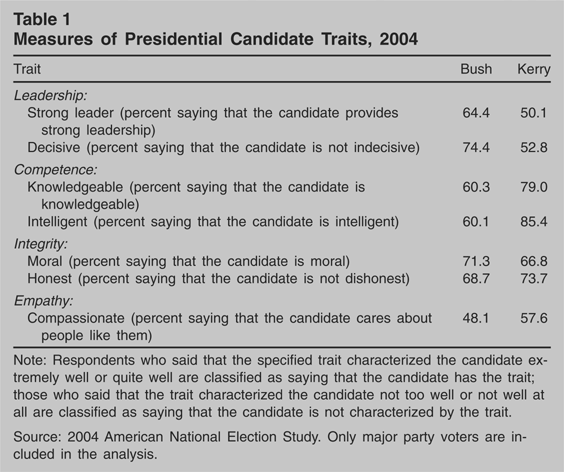
Table 1 contains responses to the seven trait item pairs.1
In this table and all subsequent tables, only major party voters are included. Given that our interest is in how perceptions of traits influenced voting, it seems appropriate to drop nonvoters from the analysis; minor party voters are so few in number that there is little point to including them.
Measures of Presidential Candidate Traits, 2004

Five of the seven trait item pairs asked in 2004 were worded in a positive direction, meaning that respondents were asked in each case whether a candidate possessed a desirable trait. Two of the item pairs were worded in the negative; respondents were asked whether the candidates were dishonest and indecisive, not whether they were honest and decisive. This appears to have introduced some error into the responses, a fact which is suggested by the interrelationships among the items. For both candidates, being a strong leader and being decisive (specifically, not being indecisive) correlate less than we would expect, given that these are supposed to be highly related aspects of a more general leadership dimension.2
For more analysis of the interrelationships among the trait items in 2004, see Charles Prysby. “May the Best Man Win: Perceptions of Candidate Personal Characteristics and the Presidential Vote in 2004.” Paper presented at the 2006 Annual Meeting of the American Political Science Association, Philadelphia, August 30 to September 3.
A plausible explanation of these patterns is that some random error was introduced by wording the questions in a negative fashion. Some respondents may have become confused by the negative wording, which led them to provide a response opposite of what they intended. It appears that the error is more likely to be random than systematic because the mean scores for the two items in question fit our prior expectations. Bush is substantially ahead on being decisive, which corresponds to his advantage on being a strong leader. On being honest, the two candidates are judged about even overall, which matches overall assessments of their morality. Thus, it seems that there were errors in both directions, leaving mean scores as representative of true overall sentiment but weakening the correlations between the negatively worded items and other variables.
In order to measure respondent assessments of candidate traits, an index was formed using all seven trait items.3
Several other indices of candidate personal traits were formed, such as one that used only the five positively-worded items, and the correlations among the various indices is well over .90, so it is unlikely that the results of this study would be substantially different if a different index had been employed.
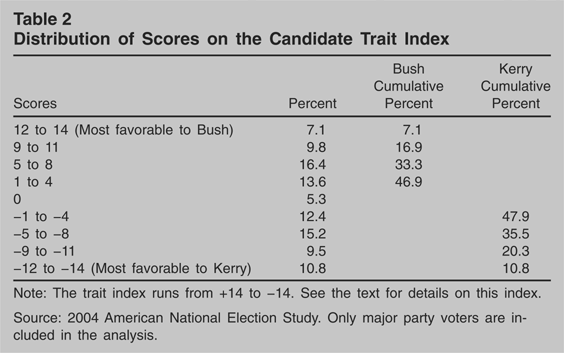
Table 2 contains the distribution of responses to the candidate trait index. The most significant aspect of this distribution is the very even balance of scores. About 47% of the respondents had a net perception that was favorable to Bush, whereas about 48% were more favorable on balance to Kerry.4
It should be noted that the survey slightly over represents the vote for Kerry. In the survey, he received 49.8% of the two-party vote, whereas his actual two-party share of the vote was 48.8%. From this, we may infer that the survey slightly over represents favorable attitudes toward Kerry. If we correct for this bias, the mean index score would be almost exactly zero.
Distribution of Scores on the Candidate Trait Index

The Effect of Candidate Trait Perceptions on the Vote
In order to analyze the effect that perceptions of candidate traits had on the vote in 2004, a logistic regression of the presidential vote was used, with a number of predictor variables besides the candidate trait index:
(a) Party identification and ideology were included as fairly stable orientations that influence a range of attitudes.5
Party identification was measured on a seven-point scale. Ideology was also measured on a seven-point scale. There were a substantial number of voters who did not place themselves on the seven-point ideological scale but who did classify themselves as liberal, moderate, or conservative with further prompting; these voters were classified as slightly liberal, moderate, and slightly conservative, respectively.
(b) Three measures of issue orientations were included in the model. An index of economic and social welfare issues combined responses to several highly related questions regarding the role of the government in the economy.6
Five items, all measured on seven-point scales, were used to construct the index. The items asked about: (a) preferences for more government services versus reducing services and taxes; (b) preferences for government guarantees of jobs and good living standards; (c) the desirability of protecting the environment versus protecting jobs; (d) the desirable role of government in providing health care; and (e) privatizing social security (this last item was measured on a five-point scale in the survey and was converted to a 1.0 to 7.0 range to construct the index). The index is the mean score on the component items.
The abortion question was dichotomized into those who opposed legalized abortion except in highly restricted cases (rape, incest, etc.) versus those who were more supportive of legalized abortion. The question about gay marriage provided only two choices, allow or not allow. The index is the sum of the two items, each of which was coded as zero or one.
Both the defense spending scale and the diplomacy-force were seven-point scales. The index is the mean score on these items.
(c) Two measures of approval of the performance of the Bush administration were included. One measured approval of Bush's handling of the economy.9
The item was a four-point scale running from strongly disapprove to strongly approve.
The three items were four-point scales running from strongly disapprove to strongly approve. The index is the mean score on these items.
The conceptual framework of this study assumes that party identification, ideology, issue orientations, and performance evaluations are causally prior to assessments of candidate traits, an approach that will yield conservative estimates of the effect of candidate traits on the vote. This conceptual framework is similar to that employed by Miller and Shanks (1996), although their framework differs somewhat in the specific variables that are included.
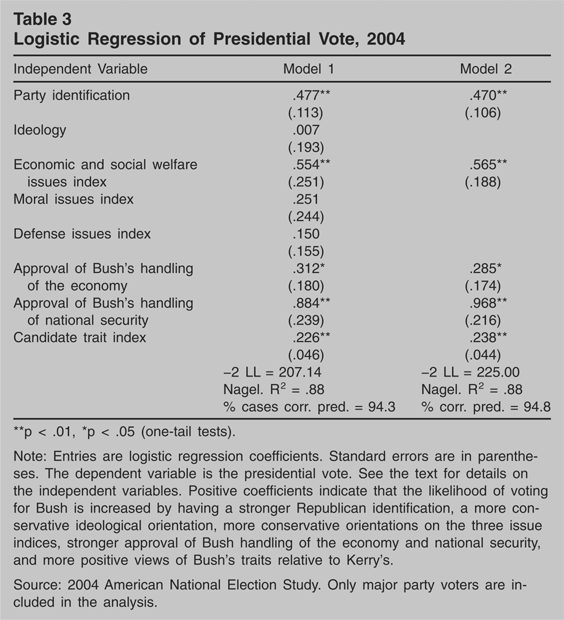
The results of this analysis are presented in Table 3. Model 1 uses all of the variables discussed above. Three of these variables (ideology, orientations on moral issues, and orientations on defense issues) turn out to be statistically insignificant in the model. Of course, while ideology has no direct effect on the vote, it has indirect effects through its effects on other variables in the model. Similarly, attitudes on defense issues have no direct effect, but they are related to approval of Bush's handling of national security. The variables that have a significant direct impact indicate that the vote was influenced by party identification, issue orientations (particularly those involving economic issues and those related to the war in Iraq), performance evaluations (regarding both the economy and foreign policy), and candidate traits. Furthermore, the direct effect of candidate traits is substantial, even with all of the controls. Model 2 uses only the variables that were statistically significant in Model 1; the results are very similar, but the coefficients change slightly. For both models, the coefficient for the candidate trait index is very strong relative to its standard error. In fact, the trait index has the highest Wald statistic of all the variables in the model.
Logistic Regression of Presidential Vote, 2004

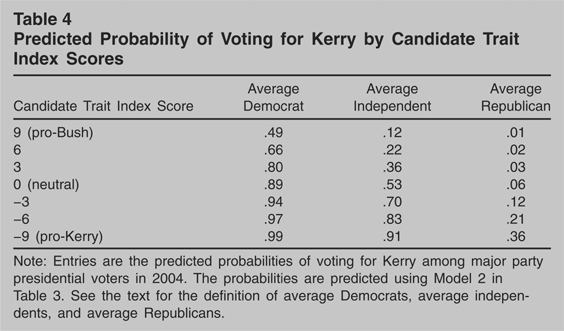
Interpreting the coefficients in a logistic regression is easier if we translate them into probabilities of voting given certain conditions. Table 4 estimates the probability of voting for Kerry, given a certain score on the candidate trait index, for three different groups. Average Democrats are defined as having scores on the other variables in the model that are about equal to the mean scores for all Democrats on these variables. For example, the average Democrat is a weak Democrat who is moderately left of center on economic issues (a score of 3.3 on a 7 point scale), and about halfway between disapproving and strongly disapproving of Bush's handling of the economy and of national security. Average independents and average Republicans are similarly defined as holding mean scores for their partisan group on the model variables.
Predicted Probability of Voting for Kerry by Candidate Trait Index Scores

As we can see, changes in the candidate trait index have a substantial effect on the probability of voting for Kerry among independents. An average independent who judged the candidates to be exactly even overall in personal traits had a 53% likelihood of voting for Kerry, whereas one who had an index score of 3 (which would be only slightly favorable to Bush) had just a 36% likelihood of voting for Kerry. Partisans were less influenced by their perceptions of the personal traits of the candidates unless they were substantially favorable to the candidate of the opposite party. For example, the average Democrat was still highly likely to vote for Kerry even if he or she rated Kerry as no better (or worse) than Bush on personal traits. Of course, the average Democrat disapproved of Bush's handling of the economy and national security, which provided sufficient reasons to vote for Kerry. A similar pattern exists for Republicans. Significant defection rates do not appear until the trait index is considerably favorable to the candidate of the opposite party, something that did not occur with great frequency. When partisans did defect in their presidential vote, it appears that unfavorable net assessments of the personal traits of their party's candidate played a substantial role in that decision, but defection rates among both Democrats and Republicans in 2004 were relatively low overall.
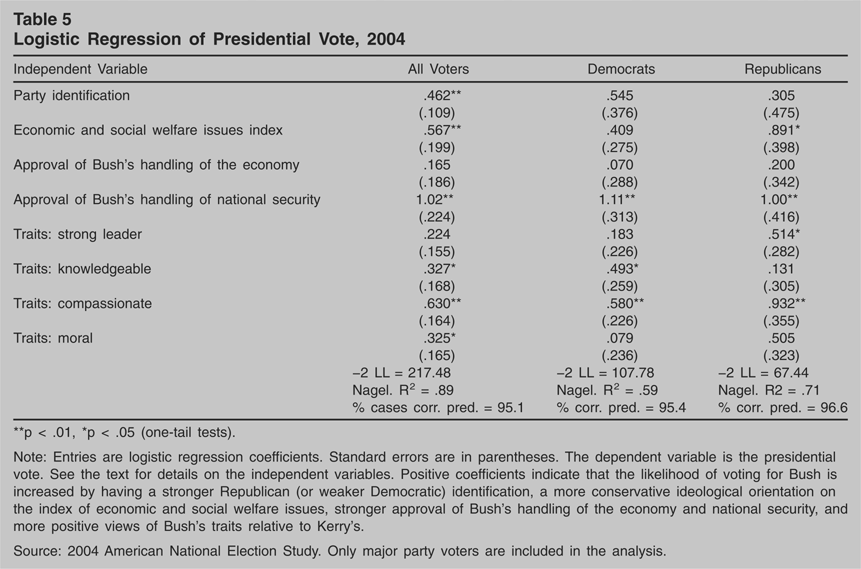
Having established that perceptions of candidates' personal traits were important in influencing the vote in 2004, we may now ask which particular traits were most important. This is an especially interesting question because the advantage of Bush or Kerry varied across traits. If leadership traits were foremost in the minds of voters, that would advantage Bush, for example. In order to investigate this topic, a logistic regression of the vote was run, using the same variables in Model 2 of Table 3, except that the candidate trait index is replaced with four specific trait variables. The four trait variables measure the relative advantage of Bush versus Kerry on the following traits: (a) providing strong leadership; (b) being knowledgeable; (c) caring about people like the voter (referred to as compassionate); and (d) being a moral person.
These specific traits were chosen because they tap the four theoretical dimensions identified earlier (i.e., leadership, competence, empathy, and integrity) and because each is worded in a positive direction, thereby avoiding the possible problems with negatively worded items that have been discussed previously. Thus, the item asking whether the candidate was a strong leader, not the item asking about decisiveness, is used to measure leadership. Since Kerry's alleged indecisiveness was a central aspect of the campaign, it might have been desirable to use the item that focused on that trait, but the negative wording of the item makes it a weaker measure of the leadership dimension.11
The analysis in Table 5 was run using the measure of decisiveness in place of the measure of strong leadership, and the results were not substantially different. In fact, the measure of decisiveness has a weaker relationship to the vote than does the measure of strong leadership.
The results of the analysis are presented in Table 5. The first column gives the results for all voters. The next two columns give the results for Democrats and Republicans, respectively. Examining each partisan group separately is desirable because some scholars have found that Democrats and Republicans give different weights to different candidate traits (Goren 2002; Hayes 2005). Among all voters, the most important trait is compassion, followed by being knowledgeable and moral. Surprisingly, leadership has the lowest coefficient of all of the four traits, and the coefficient is not statistically significant. Popular accounts may stress that many voters chose Bush over Kerry because of doubts about Kerry's leadership or confidence in Bush's leadership, but these data do not indicate that variations in the relative assessment of Bush and Kerry as strong leaders had much effect on the vote once other factors are taken into account.12
It is legitimate to use the coefficients to measure the relative effects of the four traits on the vote because the variance for each of the trait items is relatively similar. If the item measuring leadership had substantially more variation than the other items, then this variable might be more important even though the logistic regression coefficient is smaller, but that is not the case.
Logistic Regression of Presidential Vote, 2004

There are clear differences between Democrats and Republicans in their use of candidate traits in the vote decision. Among Democrats, competence and empathy played a strong role. Democrats who voted for Bush came disproportionately from those who did not see Kerry as substantially superior to Bush on being knowledgeable or on caring about people. Variations in the relative assessment of the leadership abilities of the two candidates were far less related to candidate choice among Democratic voters. Among Republicans, leadership, empathy, and possibly morality had a strong impact on the vote (the coefficient for perceived morality is statistically insignificant, but it has a fairly strong absolute value). Republicans who failed to vote for Bush came disproportionately from those who did not give Bush a large advantage on the leadership dimension. This is consistent with the findings of other scholars, who argue that Republicans tend to put more weight on leadership qualities (Goren 2002; Hayes 2005). Surprisingly, the coefficient for the variable that measures how much the candidates care about people is twice as large for Republicans as it is for Democrats. The strong impact that assessments about the relative compassion of the candidates have on the vote among Republicans is not what we expect. Democrats are supposed to be more responsive to this consideration (Goren 2002; Hayes 2005).
This analysis of the data from the 2004 ANES survey does not support the conclusion that Bush won the presidential election because of a decided advantage on character traits. Voter perceptions of candidate personal qualities did have a substantial influence on the vote. The more favorable that the voter's net evaluation of candidate personal traits was to Bush, the more likely the voter was to cast a ballot for Bush. However, these assessments were not the source of Bush's victory, in the sense that he had a sizable net advantage on this factor. Overall assessments of the two candidates were extremely even. Bush had an advantage on leadership, but Kerry had an advantage on competency and compassion. Moreover, the trait that Bush did best on, leadership, was not the most important one in the vote decision. While leadership was more important to Republicans than to Democrats, even among Republicans, assessments of empathy were more potent influences on candidate choice than were assessments of leadership.
Some Caveats
Two caveats to these conclusions should be stated. First of all, the assessments of character traits were measured in the pre-election ANES interviews, which were conducted in September and October. Voter assessments of these traits could have changed by Election Day, so perhaps Bush had a sizable advantage on this dimension when voters actually cast their ballots. However, this seems unlikely. The Swift Boat ads and the Republican convention occurred before the pre-election interviews, so most of the charges about Kerry's lack of presidential character had already been aired by the time that interviewing began for the 2004 ANES. It does not appear that negative assessments of Kerry's character grew during September and October. Public opinion polls showed that Kerry was further behind Bush in mid-September trial heats than he was in late-October trial heats. An average of four major polls showed Bush ahead by six points in mid-September and by just two points in late October.13
The four major polls were the CBS/New York Times, NBC/Wall Street Journal, ABC/Washington Post, and Gallup polls. The mid-September polls were ones conducted between September 6 and 19; the late October polls were ones conducted between October 16 and 30.
Further evidence that these data do not misrepresent the situation on Election Day can be provided. If we divide the ANES respondents into September and October interviewees, the latter group is no less favorable toward Kerry in its assessment of the personal qualities of the two candidates.14
The small number of respondents who were interviewed in very early November have been included with the October respondents. While it would be desirable to examine the attitudes of voters just prior to Election Day, there were too few respondents who were interviewed in this period to provide a decent sample of opinion just before the election. Only 321 of the voters in the ANES survey were interviewed after September 30, and if these respondents are broken down by the week of interview, the number in each group is fairly small.
For this analysis, independents included both leaners as well as pure independents. There were fewer than 50 pure independents who were voters, so this group is not large enough for a reliable analysis. Including the leaners increases the N to 243.
The results of a late October Gallup poll that contained a few items dealing with candidates' personal traits support the validity of the ANES data.16
The Gallup poll was taken between October 22 and 24, 2004, and had 1,537 respondents. Details on the survey and the results are available at http://brain.gallup.com.
A second caveat is that these data contain no measure of general warmth or likableness. If, as some pundits claimed, voters viewed Bush as the more likeable person, the one with whom they would prefer to have a beer (or, in Bush's case, a soft drink), that might have provided Bush with an advantage in personal traits. While this is a possibility, it would seem that perceptions of candidate warmth would correlate highly with perceptions of some other traits, most likely compassion and trust. If a voter viewed one candidate as more likable than the other, it would seem odd if that voter felt that the more likable candidate was less trustworthy or less compassionate. People usually do not like individuals whom they see as untrustworthy or self-centered. Since Kerry was viewed as equal to Bush in trust and superior in compassion, any warmth advantage for Bush was probably small. Furthermore, Kinder et al. (1980) found that voters regarded candidate warmth as a relatively unimportant aspect of the ideal presidential candidate. Finally, the Gallup poll data cited above indicated that Bush had at best a slight overall advantage on personal traits. If warmth (or some other unmeasured trait) was both important to voters and one on which Bush had a decided advantage, then the Gallup respondents should have been more favorable in their overall assessment of the personal qualities of Bush relative to Kerry.
Conclusions and Discussion
It appears that Bush's considerable advantage on personal traits was more in the mind of journalists and analysts than it was in the minds of the voters. Bush had at best a very small advantage in this area. Voters did rely on their trait assessments in their vote decision, but Kerry benefited from these assessments as much as did Bush. While Bush was seen as a stronger leader, Kerry was seen as more compassionate and more knowledgeable, and these traits were just as important in the minds of voters.
Nevertheless, one could still argue that trait assessments were crucial to Bush's victory in the sense that if Kerry had been perceived more positively, he probably would have won. The Republican campaign strategy of undermining perceptions of Kerry's leadership qualities may have been critical to Bush's victory. Absent this campaign effort, Kerry might have been perceived as a stronger leader, thus negating the most important advantage that Bush had on personal traits. Nothing in the findings of this study disputes the claim that Republicans successfully exploited some vulnerabilities in Kerry's character or that Kerry failed to respond to these attacks as well as he might have. What this study shows is that even if the Bush campaign outmaneuvered the Kerry campaign in this area, the end result was little if any net overall advantage for Bush on personal qualities.
The question that naturally arises from these findings is what was responsible for Bush's victory. A complete answer to that question is clearly beyond the bounds of this study, but two suggestions can be offered. First, we know that voting in presidential elections is influenced by both retrospective assessments of government performance, particularly on the economy and on foreign affairs, and evaluations of the candidates on issues of public policy. It therefore would seem logical to analyze the extent and nature of Bush's advantage on these factors. Second, given the very close popular vote in 2004, it may be that Bush did not have a sizable advantage on any major factor that influenced the vote. Perhaps a few tiny advantages added up to a narrow advantage in the popular vote. Unfortunately, the survey data that are available lack the precision to permit us to pinpoint such very tiny differences, so we may not be able to definitively answer this question.
Author Bio
Charles Prysby is a professor of political science at the University of North Carolina at Greensboro. He has written about various aspects of voting behavior, elections, and political parties. His e-mail address is prysby@uncg.edu.