Introduction
Dementia is a syndrome characterized by a progressive impairment in cognition, function and behaviour, with a considerable burden in terms of health care, social support and economic costs. Dementia's global presence is estimated to be as high as 24 million worldwide, and it has been predicted that numbers will double every 20 years. Alzheimer's disease (AD) is the leading cause of dementia.Reference Reitz, Brayne and Mayeux1
Many ethical issues arise while assessing and treating patients with cognitive impairment. A series of ethical dilemmas must be explored, many of them areas of controversy and each requiring skill in communication in order to reach a consensus decision. Key points include screening, neuropsychological assessment, laboratory tests and neuroimaging, genetic tests, and discussion of advance directives, driving, managing finances and testamentary capacity, pharmolocogical and non-pharmacological treatment, and also withholding or withdrawing some treatments and interventions in the later stages of the disease (for example feeding tubes, artificial hydratation and use of antibiotics) and end-of-life care.Reference Howe2
Ethical principles and the decision-making process
Bioethics is the study of typically controversial ethical issues brought about by the recent advancements made in biology and medicine. It also involves moral discernment as it relates to medical policy, practice and research. Ideally, for a medical practice to be considered ‘ethical’, it must respect all four of the Beauchamp principles: autonomy, justice, beneficence and non-maleficence.
1. Autonomy: the patient must be capable of thought, intention and action when taking decisions with regard to health care procedures. This is based on respecting the patient's decisions and preferences.
2. Justice: this is the ideology that the treatments and resources must be distributed equally among all groups in society. It looks for the balance of interests in conflict and also resource management based on efficiency and equity.
3. Beneficence: this defends the patient's right to receive treatment in accordance with their best interests. The procedure provided must have the intent of doing well for the patient involved.
4. Non-maleficence: this is the basis of preventing and avoiding possible damages. It requires that the diagnostic and therapeutic decisions respect the risk–benefit balance and they should also be based on scientific evidence.
Many times, as dementia advances, the ethical principles can come into conflict with each other and the progressive course of the disease may make this clash unavoidable. In the beginning, the patient's autonomy prevails above any other ethical principles, but where severity of impairment creates a real problem in terms of decision-making, appropriate interventions may change. Some of these may be controversial as the principle of autonomy needs to be overruled, with any decision having to be made by other people (family and physicians). At that point the principle of beneficence becomes the prevalent one.Reference Page3
The decision-making process
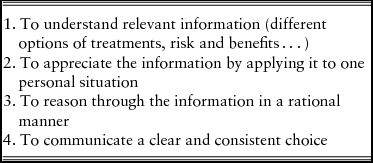
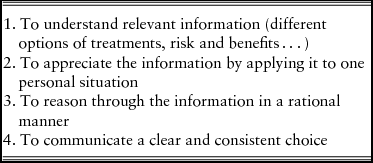
Decision-making capacity is conceptualized as involving four decisional abilities (Table 1). In the clinical context, the stringency with which one of the decisional abilities (or a combination) is demonstrated should vary according to the risk-to-benefit ratio of the decision in question. Competency means the capacity to make responsible and balanced decisions.Reference Alvaro4
Components of the decision-making process
With regard to most major psychiatric disorders, such as depression and schizophrenia, the mental health guidelines highly recommend the inclusion of patients in all decisions, but dementia constitutes an exception. Although guidelines emphasize the disclosure of diagnosis and patient independence and autonomy as a major aim, at the same time they consider impaired decisional competence to be a limiting factor for patients’ participation.5
Health professionals may overestimate or underestimate the patient's capacity to make decisions. When capacity is overestimated, patients may be allowed to make choices about important subjects that can be inconsistent with their best interests (for example, when an individual's cognitive impairment is overlooked). On the other hand, when the decision-making capacity is underestimated, the individual can be denied her/his right of self-decision and autonomous choice. This occurs mainly in patients with psychiatric co-morbidity or those in long-term care facilities.
AD and other dementias are characterized by progressive cognitive impairment that reduces and limits participation in medical decision-making. However, ability for many medical and social decisions may be intact during the early stages of AD, whilst with exhaustive assessment, impairment for more complex decisions can be obvious. Importantly, there are many decisions that are required to be made during the early stages, for example about advance directives, driving safety, the initiation of anti-dementia drugs and the patient's possible inclusion in clinical trials. Limiting patients from taking part in these clinical decisions not only reduces their autonomy, but also ignores the patient's will while they are still able to make such decisions.Reference Hamann, Bronner and Margull6 So the decision-making process is a crucial issue during the progression of the disease, with different considerations and key points in mild, moderate, severe and terminal dementia.
It must be remembered that not only the patients and their physicians, but also family members and caregivers are main characters in this process, especially in the moderate and advanced stages, when the capacity for decision-making is impaired and the family has to take more control and decide for the patient on his/her behalf. They assume the responsibility of decision-making at the moment their loved ones lose capacity and competence. At the same time they also have to face grief caused by the loss of that individual's role, they have to perform new roles and also avoid emotional distancing from the patient caused by his/her deterioration day by day.
Capacity
Many elements are considered important to the decision-making process relevant to a procedure or a treatment: the patient's capacity and will, and the information available for making a decision. The most important aspects for determining capacity can be addressed by the following questions:
• can the patient express his/her own personal preferences?
• can the patient understand the benefits and risks?
• is the patient aware of the implications?
• can the patient explain the reasons for the decision made and, if so, are these reasons reasonable?
There are many standards for evaluating capacity, as was recognized by Volicer and GanziniReference Volicer and Ganzini7 who proposed a study to evaluate the different standards that clinicians use in their daily practice in patients with mild AD. They observed four groups of health care professionals and included six items: ‘able to indicate yes or no to a question’, ‘makes decisions that seem reasonable’, ‘makes decision most other people would make in similar circumstances’, ‘able to appreciate the consequences of the decision for him/herself’, ‘able to provide rational reasons for the decision’ and ‘able to explain the treatment alternatives, risks and benefits’. For almost all respondents, all items presented contributed to determining capacity. Most respondents considered essential the item ‘able to appreciate the consequences of the decision for him/herself’, with the lowest proportion choosing ‘makes decisions that seem reasonable’. They also found that psychiatrists made more capacity evaluations and considered more items as necessary compared with other professional groups (geriatricians, psychologists and chairs of ethic committees).
Finally, this study found that evaluating capacity for decision-making in a patient with dementia is a very subjective and inconsistent process. Even so, there are some tools, such as the Hopkins Competency Assessment Test, that can be useful for determining capacity in specific cases.
Do people with dementia want to participate in treatment decisions?
Progressive cognitive impairment affects the patient's ability to make a proper choice, to understand and to process the relevant information. As dementia severity worsens, these patients need other people, mainly their family members, to take on a greater role and finally to turn into the medical decision-makers. Some studies of people with mild to moderate AD have found that these patients, despite their cognitive impairment, have the capacity to participate in a treatment decision. There are data that suggest that both gender (male) and the relationship between the patient and caregiver (spouse) may have an impact on the type of decision being made. According to Hirschman et al.,Reference Hirschman, Joyce, James, Xie and Karlawish8 mild- to moderate-stage AD patients would like to be involved in making treatment decisions and, commonly, caregivers and family members are willing to involve them. Clinicians can provide guidance and advice to help caregivers in understanding how to assess their loved one's capacity to make decisions.
Timely diagnosis of AD and other dementias
The neuropathological features of AD (and probably other dementias) start 10–20 years before the first symptoms appear. Cognitive failure can be present 3–6 years before assessment and diagnosis is made. Patients with mild cognitive impairment (MCI) are at heightened risk of progressing to dementia, but the development is heterogeneous.
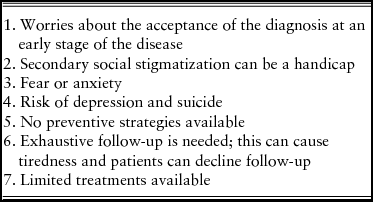
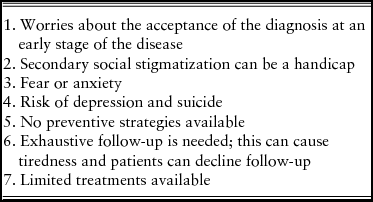
Early diagnosis of dementia has both advantages and disadvantages. It encourages the initiation of strategies to delay dependence and institutionalization, permits early treatment to slow progression before impairment is severe and allows the person with dementia to be more involved in the decision-making process. For family members, early diagnosis can ensure appropriate family support during the progression of the disease, reduce stress and caregiver burden and provide answers and solutions for some questions concerning the cognitive and functional decline. For both patient and family it helps when planning for the future. For the clinician, early diagnosis can help to establish timely, individualized plans for each patient and helps with management decisions, maximizes treatment efficacy, decreases inappropriate use of diagnostic tests and treatments and promotes the development of new therapies. However, there are some disadvantages of early diagnosis that should also be take into account when the diagnosis is confirmed (Table 2).
Potential disadvantages of early dementia diagnosis
Screening and evaluation for cognitive impairment
Screening tests for cognitive impairment should be considered for any patient with subjective cognitive complaints, or when family members worry about this possibility. The decision-making process begins with the request for screening tests by patients or family members. The decision to perform cognitive screening is more frequent in patients with better functional status, greater knowledge of the disease and in those who hold positive beliefs about the benefits of diagnosis and treatment and use this information to get involved in prevention activities.Reference Galvin, Fu, Nguyen, Glasheen and Scharff9, Reference Dale, Hemmerich, Hill, Hougham and Sachs10
When significant cognitive impairment is suspected, more exhaustive tests (including neuropsychological assessment, laboratory tests and neuroimaging) should be performed. Patients must be informed about the importance of their cognitive failures and the need for comprehensive evaluation. It is also very important to know about other medical conditions or pharmacological treatments that can affect or worsen cognitive performance and so may be reversible.
Despite negative results obtained during screening tests, some patients may still be concerned about a possible missed diagnosis and, in these cases, it is best to refer for an exhaustive neuropsychological assessment in order to address (and usually reduce) concerns and fears. It is more effective to perform an exhaustive assessment than to risk underdiagnosis and increases the likelihood that these patients will return in the future for retesting if their cognitive problems worsen. If the results of the more formal tests are negative, the patient can be reassured that the diagnosis of dementia, at least at this time, is unlikely. If MCI is suspected, a follow-up must be arranged.
False positive and false negative: risks of misdiagnosis
False positive and false negative diagnosis of dementia can both result in non-intentional but significant harm. False positives can cause life-changing fear and worry, whilst false negatives can result in misplaced reassurance and delay in correct care and treatment. Although an early approach will not change the final course of the disease, pharmacological and non-pharmacological interventions can delay progression and it is important that they are implemented in a timely fashion.
Information given at time of dementia diagnosis: the ethics of uncertainty – to know or not to know?
Some family members and caregivers show reluctance about patients being informed of the diagnosis of dementia. They fear the possibility of the patient becoming depressed or a suicide attempt. In early stages, and in patients with a high level of education, preserved insight and in those who perceive no adequate treatment response, the risk of suicide should be considered, although this response is extremely rare. Certainly the literature reflects that the great majority of elderly people (80%) express a wish to know a diagnosis of AD as soon as possible. Although families members and clinicians often worry about the patient's reaction when diagnosis is confirmed, many studies show that disclosure of a dementia diagnosis seldom prompts a catastrophic emotional reaction, even in those who are only mildly impaired and more often may provide some relief once an explanation for symptoms is known and a treatment plan is developed.Reference Mattsson, Brax and Zetterberg11, Reference Carpenter, Xiong and Porensky12 All clinicians and family members must respect the patient's will to know or not to know and conspiracy of silence must be avoided.
Biomarkers and early diagnosis
Given the growing prevalence of AD and other types of dementia, the development of better diagnostic tools and more effective therapeutic interventions is an extremely important issue. In clinical practice, the diagnosis is mainly based on the clinical interview, the neuropsychological tests and structural neuroimaging. However, in the earliest stages of AD, no significant cognitive or functional impairment or behavioural symptoms are detected by conventional assessment. In this situation, biomarkers such as structural and functional neuroimaging and biochemical analysis of proteins in cerebrospinal fluid (CSF) and blood may be useful, revealing correlates of intracerebral pathology in patients with mild, pre-dementia symptoms and even in the asymptomatic.
Currently, biomarkers are mainly used in research settings, but are likely to be applied in routine clinical practice in the future and become critical for early and accurate diagnosis and the development and monitoring of disease-modifying therapies.Reference Forlenza, Diniz and Gattaz13 Their use in clinical practice should allow clinicians to identify at-risk patients successfully and distinguish between different types of dementia, and to promote use of disease-modifying therapies (e.g. immunotherapy) in early stages of the disease. It would seem logical that the effectiveness of treatment will be greatest if used early in the pathological process.Reference Clark, Davatzikos and Borthakur14
Informed consent
A valid consent should be informed, voluntary, and given by a person with capacity. It expresses the patient's right to control his/her own destiny and exercise his/her personal will. In a patient with dementia, while still capable the consent should be given by the patient themself. Thus it is important to determine capacity before accepting a patient's consent or refusal to a procedure or treatment. In a situation where the patient no longer has capacity for decision-making, ideally this should be made by a surrogate or a proxy designated previously by the patient.Reference Yim15
Informed consent in research
As in any other situation, informed consent to take part in research must be complete and include the option that the patient may withdraw from the trial at any time.Reference Knebl and Patki16 When the patient lacks capacity, advance directives should help in the recruitment process for clinical trials, but, in reality, very few patients arrange these or, if they do, consider covering this issue when preparing them. In most cases, the caregiver/proxy then takes responsibility for consent. However, it should be borne in mind that even when lacking full capacity to consent, the patient's ability to express his or her wishes persists and must be fully considered. Generally, the inclusion of a subject in a clinical trial related to AD implies not only the patient's commitment but also that of the caregiver as they are usually the ones who accompany the patient during visits and help in the clinical evaluation of their functional and behavioural situation as an informed source of information. It is unlikely that it would be often feasible for a patient with dementia to take part in research without also gaining their caregiver's consent.
Genetic tests
Although at present no preventive treatment for dementia is available, if a patient or family member asks for a genetic test, it is important to give them the correct information about the test's implications. In asymptomatic subjects without a strong family history it is not recommended.Reference Tischa, Van der Cammen and Croes18 Whilst the genotype may be a susceptibility marker, it is not a disease marker in itself. Currently we know about a few causative genes involved in the process of some cases of early onset AD, namely the amyloid protein precursor gene (APP) isolated on chromosome 21 and the presenilin 1 and 2 genes (PSEN1, PSEN2) isolated on chromosomes 14 and 1, respectively. Apolipoprotein E4 genotype is recognized as the most significant genetic risk factor for late onset AD. However, despite this information, the diagnosis of AD still relies on clinical criteria and genotyping for ApoE4 should not be used as a diagnostic tool. For example, one study found that the mutations in the known risk genes related to the disease explained only 28% of cases. Even in early onset AD, 0.5% showed an APP gene mutation, 6% the PSEN1 gene and 1% the PSEN2 gene, implying that in more than 90% of cases genetic testing is not helpful.Reference Goldman, Hahn and Catania17
Treatment of dementia
There are no drug treatments available that can provide a cure for AD. However, treatments have been developed that can improve cognitive symptoms, or temporarily slow down their progression, in some people. There are two main types of medication used to treat AD: acetylcholinesterase inhibitors (AChEI) and the N-methyl-D-aspartate (NMDA) receptor antagonist receptor antagonist memantine. The latest guidance from the National Institute for Health and Clinical Excellence (NICE)19 recommends that the AChEIs donepezil, rivastigmine and galantamine are available as part of NHS care for people with mild-to-moderate Alzheimer's disease. There are also now several studies which suggest that they may also help people with more severe Alzheimer's disease. Memantine is licensed for the treatment of moderate-to-severe AD and there is some evidence that memantine may also help to reduce behavioural symptoms such as aggression and agitation. NICE guidance also acknowledges that people with dementia with Lewy bodies or dementia associated with Parkinson's disease may benefit from an AChEI.
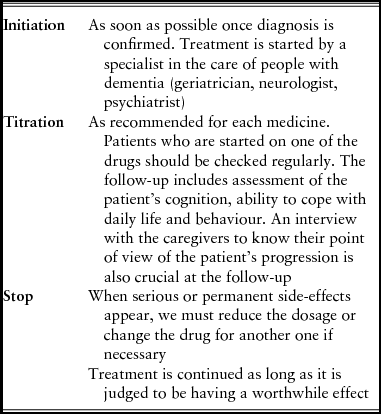
Deciding when treatment should be initiated and stopped can be problematic, and recommendations are given in Table 3. These drugs do not pointlessly prolong life with the disease. Rather, they delay and sometimes improve the cognitive impairment, dependency and quality of life of the patient, as well as improving the quality of life of caregivers. However, when the patient reaches the terminal stage of disease, consideration should be given for stopping the drugs and palliative management should take precedent.
Recommendations for use of antidementia drugs

Driving and dementia
A recent systematic reviewReference Man-Son-Hing, Marshall, Molnar and Wilson20 demonstrated that people with dementia are poorer drivers than cognitively normal drivers, though higher crash rates were not demonstrated consistently. Nevertheless, caregivers of people with dementia often express concerns about driving mistakes and their future consequences, and physicians are asked to render judgments regarding the competence and ability of cognitively impaired patients to continue driving. This issue particularly affects the patient's independence and sense of autonomy, so it is addressing an important part of daily life. Self-report is likely to be unreliable because of denial and diminished insight into driving abilities, and simple psychometric tests are only modestly predictive of actual driving performance and can be passed by many patients with mild dementia. In one study, 50 people with mild dementia were evaluated about their driving competence to determine the validity and reliability of clinicians’ ratings.Reference Ott, Anthony and Papandonatos21 It was concluded that although a clinician may be able to predict impaired driving ability, this is not sufficient to determine real driving competence in patients with mild dementia. When there is doubt, the physician should ask for a new evaluation of driving competence and carefully document in the patient's notes any advice given about curtailing driving or informing the relevant authorities.
Financial capacity
The capacity to manage financial issues has particular significance for maintaining independent performance of older adults. Financial capacity encompasses a wide range of judgement and conceptual abilities, ranging from basic skills like counting coins to more complex skills such as paying bills and exercising financial judgement. Impairment of financial capacities occurs in patients with AD and also, but to a lesser severity, in patients with MCI.Reference Griffith, Belue and Sicola22 Patients with MCI and their families should proactively engage in financial and legal planning, given these patients’ risk of developing AD and accelerated loss of financial capabilities. Families often ask for a clinician to address problems of declining financial skills and decision-making in their loved ones. These clinical judgements have important legal and ethical implications, because they may result in restriction or removal of patients’ freedom to manage their finances. Marson et al.Reference Marson, Martin and Wadley23 investigated financial capabilities in patients with MCI and AD by using a clinician interview approach. They concluded that clinicians can assess financial capacity in patients with cognitive impairment with a brief, semi-structured clinical interview.
Advance directives
Ideally a patient's preferences for treatments that prolong life should be established before the disease is advanced. Topics like cardiopulmonary resuscitation, hospitalization, use of intravenous medications, antibiotics, hydration and artificial nutrition should be addressed. This is where advance directives gain importance, because they are designed to maintain autonomy and to determine the patient's wishes about diagnostic tests and treatments if he or she is incapable of expressing them at a given time. The advance directive can be changed or revoked at any time whilst the person retains capacity. It is important to consider the presence of the family/caregivers while discussing advance directives with the patient, as this can help the patient to connect with the family and for them it is a way of knowing what their loved one wants.Reference Howe2
In the community setting, few patients prepare advance directives.Reference Goodman, Goodman and Evans24 In nursing homes (NH) the situation seems a little different. In a study with demented patients in nursing homes with pneumonia, only 7% did not have a ‘Do Not Resuscitate’ (DNR) order, and 56% had already a ‘Do Not Hospitalize’ (DNH) order. On the other hand, only 2% had an antibiotic restriction order, making it clear that this could be an issue little discussed, even in the nursing home setting.
The living will (LW) is a common form of advance directive. Garand et al.Reference Garand, Garand, Dew, Lingler and DeKosky25 evaluated the rates of advanced care planning (ACP). The cumulated incidence of ACP was 39%; of the subjects with advance directives, 15% completed a LW alone, 39% a durable power of attorney form (DPOA), and 45% completed both. Younger subjects showed higher rates of ACP in the 5-year follow-up. This study was conducted in the USA and it is likely that the rates in other countries are lower.
Palliative care
In patients with any type of dementia there are many needs that involve palliative care, such as pain management, location of care and attention to caregiver burden. Many families and healthcare professionals do not perceive dementia as a terminal disease, despite the growing evidence that about one in three people in the developed world now die with this disease. This misperception usually happens because in dementia the decline tends to be slow and prolonged. Also, there is a false belief that dementia is an intrinsic condition in the elderly population and therefore considered ‘normal’.Reference Sachs, Shega and Cox-Haley26 Symptoms in AD patients are also frequently at risk that the severity of their symptoms are underestimated or ignored, not only by the medical and nursing staff, but also by their own family caregivers.Reference Mahon and Sorrel27
A US studyReference Torke, Holtz and Hui28 that sought to determine the extent of hospice and palliative care (PC) for patients with dementia found 426 programmes. The main barriers against providing PC for these patients were economic and lack of information about needs, the most important of was information given to caregivers about the disease and its progression, management of behavioral symptoms and relief of caregiver burden. Ninety-eight per cent of the respondents considered that PC is effective in dementia.
As for any progressive and irreversible disease, the key points in PC for dementia are symptom control (prevention and treatment), assessment of the need for rehabilitation, information about technical aids, identifying patients near the end of life and discussion about preferences in that stage of the disease, co-ordinating care (social services, health services), spiritual and psychosocial support, and helping the families through the terminal stage and at the moment of the patient's death.Reference Mitchell, Black and Ersek29
The National Hospice and Palliative Care Organization Criteria (NHPCO) were developed in 1996 to guide management of advanced-stage dementia.30 Although limited, they can be used as an approach to identify patients in the latest stages of dementia:
- Functional Assessment Staging (FAST) ≥7c
- Total dependence: inability to walk, dress or bathe without help; urinary/faecal incontinence
- Complications such as infections, aspiration pneumonia, pressure ulcers grade 3–4, recurrent fever (despite antibiotics)
- Co-morbidities that require medical treatment
- Dysphagia/malnutrition
The main issues in the end stages of dementia are:
1. Behavioural symptoms: these vary significantly in form and intensity. Non-pharmacological measures (such as modifying the environment, avoiding physical restraints) should be used before medications (anti-psychotics, hypnotics). Treatment must be re-evaluated constantly and modified according to the changing patient needs.
2. Risk of delirium: this is usually secondary to other conditions like infections, hospitalization, pain, etc. The cause needs to be diagnosed and treated.
3. Eating disorders: common problems are poor oral intake, difficulty swallowing, weight loss and malnutrition. Basic interventions to be considered include modifying the food texture, more frequent meals with smaller amounts and use of oral supplementation. When these measures fail, options such as artificial feeding through nasogastric tube or gastrostomy tube can be considered, though these have not been proven to prevent malnutrition or weight loss, reduce the incidence of aspiration pneumonia, help in the healing of pressure ulcers, prolong life nor improve quality of life in patients with advanced dementia. Also they may require the use of restraints (physical or pharmacological) to prevent the patient from removing the tubes, this raising further ethical concerns.
In the USA the prevalence of feeding tubes in patients with dementia is ten times higher than in Europe and even more in the nursing home setting. This may be in part because of families struggling with the perception that feeding is a way of caring, and the belief that without it the patients will suffer from hunger and thirst. Consequently the term ‘comfort feeding only’ is used to emphasize that the patient will be hand fed as long as it is not stressful.Reference Palecek, Teno, Casarett, Hanson, Rhodes and Mitchell31
Withholding the administration of fluids and food in patients in late stages of dementia has been subject to much discussion. In a nursing home study in the Netherlands, The and colleaguesReference The, Pasman, Onwuteaka-Philipsen, Ribbe and van der Wal32 observed that in general there was mutual agreement between family and staff on not prolonging a patient's life in unnecessary ways once it is appreciated that hydration does not necessarily improve quality of life. Slow decline was considered part of the progression of the disease and when acute illness such as infection intervenes, the decline accelerates. It was also noted that some patients express their wishes directly, while others show their feelings through specific behaviours (e.g. closing the mouth, spitting food or gestures of being tired of living). Ultimately, the medical condition of the patient, the family's wishes and the personal care provider's interpretation of the patient's quality of life, were the main criteria used for determining the withholding of artificial administration of fluids and food.
4. Pain: this symptom is frequently underestimated and that can be difficult to assess. The main causes of pain in people with dementia are immobility, pressure ulcers, and constipation. There are many scales for assessing pain in dementia, such as the Pain Assessment Checklist for Seniors with Limited Ability to Communicate (PACSLAC)Reference Fuchs-Lacelle and Hadjistavropoulos33 or the Pain Assessment in Advanced Dementia Scale (PAINAD).Reference Warden, Hurley and Volicer34 It should be borne in mind that pain may be the cause of other complications such as delirium.
5. Hospitalization and problems of communication: 25% of nursing home residents with advanced dementia will make a visit to the hospital in their last 6 months of life. Givens and colleaguesReference Givens, Selby, Goldfeld and Mitchell35 observed residents in 22 nursing homes who had 74 hospitalizations and 60 visits to the emergency department. The main cause for hospitalization was infection (59%, mostly respiratory) and for emergency department visits, it was complications associated with feeding tubes (47%). The main characteristics associated with being transferred to a hospital were younger age, having a feeding tube, not having a DNH order, and the presence of chronic obstructive pulmonary disease. The authors suggest that these results imply that many of the conditions in those transferred to hospital are potentially treatable in the nursing home setting and that the frequent need for solving complications associated with feeding tubes is an important issue to address when deciding whether to place a feeding tube in the first place. A paper by Chen et al.Reference Chen, Lamberg and Chen36 studied a group of 240 nursing home residents, 64% of whom had at least one episode of pneumonia in their last 6 months of life, with 14% admitted to hospital and 5% to an intensive care unit. Not having a DNH order, suspected aspiration and unstable vital signs were all associated with a more aggressive treatment of pneumonia and antibiotics were given in 91% of the cases. Some authors state that if overall the patient seems to be experiencing more pleasure than suffering, it may be justified to continue with such life-prolonging measures that can always be re-evaluated should the situation change.
6. End of life care: there is a need to anticipate what to do in the late stage of dementia in every patient, including where they will spend their last days.Reference Jokinen, Janicki, Keller, McCallion and Force37 The majority of older people with dementia live and die at home, or in a care home. If the patient spends their last days at home, the family should be offered significant support to deal with extra burden of care giving in the days and moments before death. The focus for the patient should be on minimizing pain and other distressing symptoms, honouring the person's known preferences. Palliative sedation (use of medications to induce decreased or absent awareness in order to relieve otherwise intractable suffering) should be considered at the end of life when necessary.Reference Olsen, Swetz and Mueller38, Reference Kirk and Mahon39
Conflicts of interest
None.