1. Introduction
Upon the strong advice of the court and in order to avoid further and substantial litigation costs, the parties hereby agree [. . .] (Phrasing in judicial decree)
One of the major tasks of legal systems is to resolve legal disputes. A significant share of these disputes is resolved via court decisions. However, many legal disputes never reach the final stage of the litigation process but are successfully settled through court proceedings. If settlement negotiations fail, however, prolonged trials, written verdicts and potential appeals further exhaust legal resources.
Because taxpayers must finance the legal system, policymakers around the globe are interested in designing legal institutions that promote higher settlement rates (see e.g. US Committee on Rules of Practice and Procedure 1982, Jackson Reference Jackson2010 or Bundestag 2000). Many countries have adopted laws and statutes that aim to foster the negotiation of settlements and, more generally, to relieve the strained judiciary.Footnote 1 Standard policy measures in civil litigation can be exemplified in the case of Germany, where, for example, oral hearings are used as a default procedureFootnote 2 to increase the probability that the involved parties reach an in-court settlement. Moreover, there is a restriction on appealability as a court verdict can generally be appealed only if the contested value exceeds 600 euros (§ 511 ZPO/German civil procedure rules). While this rule is aimed primarily at reducing the workload of higher courts it might also have the effect that parties increase their efforts to reach a settlement as there is no further instance that could overrule a first-instance verdict.
In order to deliver policy advice, this paper aims at studying the determinants of in-court settlements.Footnote 3 Economic theory suggests that parties should actually be motivated to settle most disputes outside the courthouse, given the costs of litigation. This rational solution may not be achieved, for example, due to diverging beliefs on the case outcome or different stakes of the parties (see e.g. Shavell Reference Shavell1982, Reference Shavell1995). Very limited empirical knowledge is yet available on the question of which distinct factors have a systematic impact on settlement rates. Basically three sorts of factors might be considered: individual case characteristics (e.g. complexity, field of law), institutional factors (e.g. appealability rules, rules for oral proceedings) and judge characteristics (such as education and experience). One of the major reasons for the lack of empirical evidence on these determinants is the lack of suitable datasets. In this paper, we make use of a novel, hand-collected dataset consisting of 860 case records from a German trial courtFootnote 4 to study the determinants of in-court settlements.Footnote 5 We employ the logit regression technique to identify case-specific, judge-specific and institutional factors that influence the probability of in-trial agreements between the involved litigants. We find that institutional factors, such as appealability or the composition of oral hearings show a significant impact. We also provide first empirical evidence that judge-specific characteristics may play a different role in certain fields of law. In such cases, judges with different characteristics could be assigned to certain fields of law to further increase settlement rates.
The remainder of the paper is structured as follows: section 2 reviews the related literature. Section 3 introduces briefly into the German litigation system. The employed dataset is described in section 4. In section 5, we report the empirical results of our analysis of the determinants of in-court settlement probability. Section 6 is concerned with the empirical analysis of judge-specific characteristics in various subfields of law. Finally, section 7 summarizes the main results and draws some conclusions.
2. Related literature
Landes (Reference Landes1971), Posner (Reference Posner1973) and Gould (Reference Gould1973) authored the first theoretical papers concerned with explaining why not all legal disputes are settled. Building on the insights from this literature, Shavell (Reference Shavell1982, Reference Shavell1995) developed a standard model of suit and settlement that concluded that settlements typically occur whenever (1) both parties have the same expectations about the trial outcome (2) the parties are risk-neutral or even risk-averse (3) both parties have symmetrical stakes and (4) the parties refrain from strategic behavior in the bargaining process. Subsequent theoretical work analyzed the consequences of violating these requirements.Footnote 6 Although the theoretical literature provides important insights that contribute to deepening our understanding of (the outcomes of) trials, it does not allow us to judge which factors play the most important roles in promoting settlements because factors such as expectations of process outcome and informational asymmetries are hardly observable.
Most of the existing empirical literature on the determinants of settlements evolved in the context of the Case Selection Hypothesis (Priest and Klein Reference Priest and Klein1984). According to this hypothesis, verdicts are not a random draw from the pool of all legal disputes. As a consequence, empirical evidence based on case statistics and published verdicts provides only “a distorted window into people's behavior in response to legal rules” (Lederman Reference Ledermann1999, p. 317). Under certain conditions (e.g. both parties have the same stakes), the Case Selection Hypothesis suggests that we should observe that in reality, plaintiffs and defendants win trials with a probability of 50% each (Eisenberg Reference Eisenberg1990).Footnote 7 Although many attempts were made to test the Fifty Percent Hypothesis empirically, most of the related literature delivered little insight into how cases that go to trial actually differ from those that are successfully settled.
One remarkable exception is Lederman (Reference Ledermann1999) who examines 400 US tax court cases. The author finds that cases were more likely to be tried for higher disputed values (stakes) and when the taxpayer filed pretrial administrative appeals. Lederman (Reference Ledermann1999) also provides evidence in favor of the hypothesis that characteristics of the judge such as political leaning or professional background play a decisive role in determining whether a trial ends with a verdict. Another remarkable result was found by Eisenberg and Lanvers (Reference Eisenberg and Lanvers2009), who calculated settlement rates for two US districts. In addition to significant variation between districts, they also present empirical evidence that settlement probabilities vary between the various subfields of law. In particular, tort law cases were settled significantly more often relative to the reference category of contract law. For the field of German patent litigation, Cremers and Schliessler (Reference Cremers and Schliessler2015) show that changing stakes for firms, in this study identified as a sudden nullity suit against a patent, significantly affect settlement behavior.
The literature on case disposition time provides a different empirical perspective to decisions of suit and settlement. Building on theoretical models of sequential bargaining (among others, see Spier Reference Spier1992), the literature has identified several aspects that prolong court procedures. Fenn and Rickmann (Reference Fenn and Rickmann2001) show that a higher value in dispute and lower costs of bargaining lead to longer disputes. Bielen et al. (Reference Bielen, Marneffe and Veereck2015) find that expert opinions, the legal nature of the litigants and increasing case complexity induce longer disposition time. Moreover, Grajzl and Zajc (Reference Grajzl and Zajc2016) present empirical evidence that legal representation by an advocate and high judicial workload significantly delay case resolution.
Furthermore, behavioral researchers have addressed impact factors that are based on the personal values and beliefs of the bargaining individuals, such as fairness and optimism (e.g. Yildiz Reference Yildiz2011). While these potential determinants are difficult to examine outside experiments, it becomes evident that the identities of litigants and judges likely play a role in explaining settlements. For instance, Ramseyer (Reference Ramseyer2012) shows that a profound academic education of the judge leads to a faster handling of cases.
Previous empirical research on settlements has so far established relevant, measurable case characteristics that complement the theoretical literature on dispute resolution. Also, the role of the arbitrator has been emphasized in different bargaining scenarios. It is the scope of this study to expand this knowledge to the impact of applied institutional features in civil litigation on settlement probability.
3. Civil litigation in Germany
German civil jurisdiction is primarily based on written law, such as Bürgerliches Gesetzbuch (BGB). Although a consolidated trend in judicial decisions on a particular legal question is often recognized as a secondary source of law, civil courts are not bound by a single decision by another court (see Fon and Parisi Reference Fon and Parisi2006). Unlike standard trial court procedures (Prozessgericht), civil law courts also cover family law, default summons and law enforcement.
Civil and criminal law together form the system of ordinary jurisdiction (Ordentliche Gerichtsbarkeit). Ordinary jurisdiction follows a three-stage hierarchy of first-instance courts, courts of appeal and the Bundesgerichtshof as the Supreme Court. Civil law cases with a value in dispute not exceeding 5,000 euros and all tenancy law cases enter the first instance at the trial court level (Amtsgericht). In 2014, more than 1.1 million cases and thus 77% of all cases were filed at trial courts (Statistisches Bundesamt 2016). Trial court decisions can be appealed at second-instance courts (Landgericht and Oberlandesgericht), and, ultimately, at the Bundesgerichtshof. Cases with a higher value in dispute enter the first instance at the Landgericht level (§ 23 GVG). Outside the ordinary jurisdiction, specialized courts exist for labor, social welfare, financial, administrative, and constitutional law.
Generally, the plaintiff has to file the lawsuit at the court that is responsible for the district of the adversary's permanent residence (§ 13 ZPO). This can be inappropriate for specific civil law cases, such as doorstep deals, goods delivery to a certain place or lease contracts. Under these circumstances, the lawsuit can alternatively be addressed to the court that is geographically responsible for the dispute area. The filed case is allocated to a trial judge according to the responsible court's case assignment plan. On the Amtsgericht-level there is no specialization of judges in certain subfields of civil law, i.e. all judges deal with cases from all subfields of civil law. The judge can then either schedule an early hearing or launch preliminary written proceedings (§§ 275, 276 ZPO) to obtain the statement of defense, depending on the expected probability of a quick settlement, the urgency of the matter, and personal working routine (see Huber Reference Huber2009). Given the case is not withdrawn or settled right away, it is a basic principle that the parties are heard orally by the court. The judge will thus determine a date for the oral hearing of the main trial (§§ 278, 279 ZPO), and summon the litigants to appear in court. The parties may seek legal representation. The main trial starts with a conciliatory hearing, during which the trial judges seeks to establish an amicable agreement. If the parties cannot be conciliated, the trial proceeds with the taking of evidence, pleadings, and, eventually, the ruling of the judge. Given the consent of the parties or a low value in dispute, the judge may alternatively declare that the case will be decided without oral hearings (§495a ZPO). The trial court ruling can be challenged through an appeal, if the disputed value exceeds 600 euros. A valid settlement cannot be appealed.
The education of judges and lawyers in Germany is determined by federal law and supplemented by rules of the federal states. In order to be admitted to the legal profession, scholars have first to study law and second to complete a preparatory period (Vorbereitungsdienst). The regular time for completing law studies is four years. The studies end with a final examination (first state examination). However, in order to be admitted as a lawyer, a second state examination has to be passed. The second examination requires candidates to have passed a two-year preparation scheme in specific legal institutions, such as the public prosecutor's office, in a civil law court, a government agency or a law firm. Second examination graduates are fully qualified lawyers and may apply for judicial service. In that case, they enter the judiciary usually at the lower instance level as a probationary judge, and are eventually appointed for life in less than five years. Due to their extensive legal education, judges in Germany typically have no other working background.
4. Data
Our empirical analysis is based on legal proceedings at an intermediate German trial court (Amtsgericht) in HamburgFootnote 8 and consists of a random sample of 2,360 case records that originate from 2009.Footnote 9 All filings were allocated in a random manner to one of the 19 involved judges (13 of them female, four of them holding a PhD) of the court, who processed the case as a single judge. From our initial sample, we dropped cases with default judgments (689 cases), meaning one of the two parties failed to appear in court, and immediate recognition of claims (173 cases). For these cases, court records provided little more information than the judicial decree itself. We further had to drop abandoned claims (567 cases) as such cases had been concluded without court action. Finally, we excluded preliminary injunctions (71 cases). The remaining 860 cases led to court proceedings. In 279 of these cases, the parties eventually established an in-court settlement under the judge's supervision and the dispute was resolved. In the remaining 581 cases, the court had to promulgate a first-instance decision. Out of 377 appealable verdicts, however, 139 trial court decisions were later appealed, and the legal proceedings continued in the appellate court (Landgericht).
Our empirical analysis is based on the 860 observations of legal proceedings that required court action for resolution by either court ruling or in-court settlement in first instance. The respective outcome of a case is captured by the binary dependent variable SETTLEMENT, which is defined as 1 whenever a settlement was achieved and 0 otherwise.
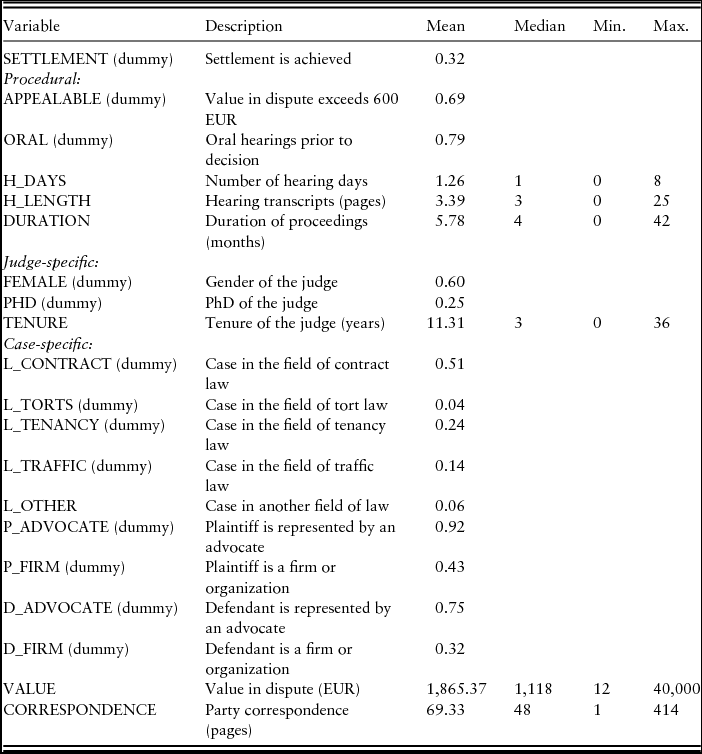
We consider three groups of explanatory variables in our empirical approach (for some descriptive statistics, see Table 1).
Descriptive statistics of dataset

The first group of explanatory variables consists of procedural variables. The dummy variable APPEALABLE captures whether the value in dispute exceeds the 600-euro threshold for appealable verdicts. The appealability of a verdict and thus the risk of subsequent litigation will affect the stakes of the case. The common economic argument would suggest that the threat of future legal conflict should increase cooperation among litigants today (see e.g. Mailath and Samuelson Reference Mailath and Samuelson2006). On the other side, McBride and Skaperdas (Reference McBride and Skaperdas2014) argue that winning a conflict today at the trial court is preferable to settlement and should also strengthen the winner's position in the appeals process. The effect of appealability on settlement is thus a priori ambiguous. The dummy variable ORAL reports whether at least one oral hearing between the involved parties took place.Footnote 10 Oral hearings provide a forum for a direct negotiation between the litigants and for moderation by the judge (see Grajzl and Zajc Reference Grajzl and Zajc2016). We thus expect a positive effect on settlement probability. We also control for the number of hearing days H_DAYS, the total length of hearings H_LENGTH, measured in pages of hearing transcripts, and the total duration of the legal case (DURATION). We expect a negative effect of the number of hearings and total litigation time on settlement. The recent literature argues that failure to settle early may lead to growing hostility between the parties and thus impede settlement (see e.g. Grajzl and Zajc Reference Grajzl and Zajc2016; Lurie Reference Lurie2013).
The second group of explanatory variables describes the characteristics of the judge who was concerned with the referring case. We control for gender by coding a dummy variable for female judges (FEMALE). The literature is divided about the role of gender in negotiations (see e.g. Boyd and Hoffmann Reference Boyd and Hoffman2012; Kulik et al. Reference Kulik, Perry and Pepper2003), but the recent study by Bielen et al. 2016 demonstrates that the judge's gender does affect judicial productivity under certain conditions. To control for qualification, we use a dummy variable for judges holding a PhD (PHD). Schneider (Reference Schneider2005) and Ramseyer (Reference Ramseyer2012) suggest that a higher academic degree leads to higher judicial productivity. The literature discusses judicial productivity as the number of resolved cases or as the amount of published opinions. However, as trial courts rarely publish opinions, this argument is less likely to be important in our setting. It might also be the case that a PhD title increases judges’ prestige as a good lawyer, thereby increasing the likelihood that settlement offers are accepted by both parties. Altogether, we expect judges holding a PhD to settle more often. Finally, we include the judge's tenure in our analysis (TENURE) to control for judges’ experience and seniority. The expected effect of a longer time in office is ambiguous. One could assume that a more experienced judge may be more capable of facilitating a settlement. The increasing age of the judge, however, could also deteriorate personal work effort and induce fewer settlements. Previous empirical research has similarly been split over the effect of judicial tenure on case disposition time (see e.g. Bielen et al. Reference Bielen, Grajzl and Marneffe2016; Christensen and Szmer Reference Christensen and Szmer2012).
The third group of explanatory variables controls for the characteristics of the referring case. Our choice of such variables follows the design of previous case-level studies (see e.g. Bielen et al. Reference Bielen, Grajzl and Marneffe2016; Christensen and Szmer Reference Christensen and Szmer2012; Grajzl and Zajc Reference Grajzl and Zajc2016). We distinguish between cases from the following fields of law by coding suitable dummy variables: contract law (L_CONTRACT), tort law (L_TORTS), tenancy law (L_TENANCY), traffic law (L_TRAFFIC), and other fields of law (L_OTHER). In addition, we have information on whether advocates were involved in the case. The dummy P_ADVOCATE (D_ADVOCATE) describes whether the plaintiff (defendant) was represented by an advocate. The expected effect of legal representation on settlement is ambiguous: in the traditional principal–agent perspective, one would assume that the self-interested advocate attempts to prolong the trial. However, given the additional fee for successful settlement (Nr. 1,000 RVG), advocates could be particularly incentivized to achieve an amicable agreement at least for low-value claims when it is impossible to proceed to the appellate level. The effects of other case characteristics are similarly unknown ex ante, such as whether the plaintiff and/or the defendant is a firm or another type of organization (P_FIRM/D_FIRM) or the value of the matter in dispute (VALUE). Finally, we know how many pages of correspondence between the parties and the court were exchanged (CORRESPONDENCE), which is a good proxy for the level of aggressiveness with which the involved parties pursued their legal claims. We suspect that a higher level of aggressiveness should result in less amicable agreements.
5. Determinants of settlement probability
Because our explanatory variable SETTLEMENT is binary, we employ a logit estimation approach to identify the factors that have a systematic impact on in-court settlements. As determinants of settlements, we consider all three groups of variables that were described in the previous section. To account for judge-specific effects, we estimate the models with judge-clustered standard errors (see e.g. Hilbe Reference Hilbe2009).
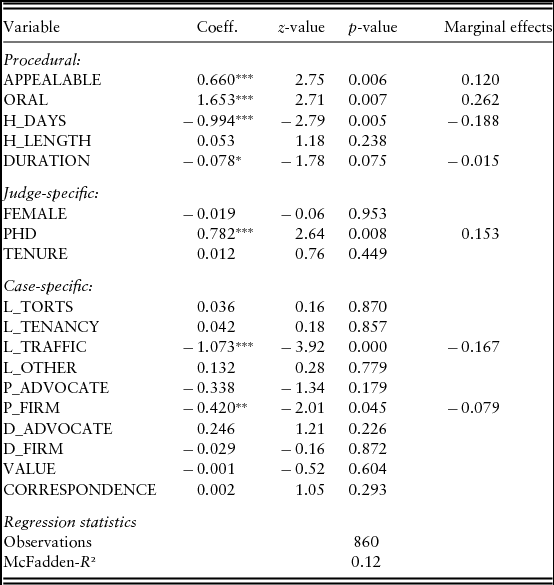
Table 2 reports the estimation results. Based on the set of employed control variables, this model classifies 73% of all observations correctly. We apply standard goodness-of-fit measures for logistic regression to demonstrate that our model is well fitted. An analysis of the bivariate correlations indicates that our estimation does not suffer from multicollinearity problems.Footnote 11
Logistic regression results for the determinants of settlements

Remarks. We report the results of a logistic regression with standard errors at the judge level. The reference category for the field of law is L_CONTRACT. We report marginal effects at the mean; however, all dummy variables were set to zero. Because the field-of-law dummies are categories of the same underlying variable, we follow Bartus (Reference Bartus2005) in reporting these marginal effects.
Significance levels: ***<0.01; **<0.05; *<0.1
Interestingly, we find most institutional variables and one judge-related variable to be significantly related to in-court settlements.
As expected, procedural factors have major relevance for settlement negotiations because they shape the circumstances under which the negotiations take place.
Appealability of a claim is found to have a statistically significant and positive impact on the probability of a settlement. If a court decision is appealable, the probability of settling in advance increases by 12 percentage points. This supports the previous argument that a “once and for all” settlement is more tempting if otherwise a potentially winning party must take into account that the decision might still be appealed by the opposing party. The threat of appellate review raises expected costs for the parties, thereby increasing the incentive to cooperate and settle the matter at the beginning. The conditions for appealability, which are defined by the lawmaker, thus show to be a crucial element in settlement considerations. Policy considerations face a trade-off: higher requirements for appeal likely reduce the total number of appellate reviews (thus saving costs)Footnote 12 but at the same time decrease the parties’ interest in settlements.
Furthermore, we found settlements to be much more likely whenever at least one oral proceeding was held. A hearing between the involved parties increases the probability of an in-court settlement by 26.9 percentage points.Footnote 13 An oral proceeding allows the opposing litigants to explain their legal claims in person, which is more likely to lead to negotiation. During hearings, the judge can also better utilize his mediation skills than in written correspondence. However, this finding also reveals a conflict for legal policy in Germany: Rules designed to accelerate court procedures and omit oral procedures in minor cases (e.g. the German Bagatellverfahren) will have a negative impact on settlement probability.
While one oral hearing thus increases the settlement probability, repeated oral proceedings tend to have the opposite effect; settlement probability decreases by 17.0 percentage points for a standard deviation increase in hearing days. Similarly, we find a significantly negative effect of the duration of the process on settlement probability.Footnote 14 These finding are plausible as settlements are best negotiated on the first day of litigation; with ongoing proceedings, the evidence and the legal situation become clearer and the party in the better position has little incentive to give in to any compromise. Lurie (Reference Lurie2013) and Grajzl and Zajc (Reference Grajzl and Zajc2016) argue that an increasing time to settlement as a consequence of more hearings might be the consequence of growing frustration of the involved parties over time. However, we do not find supporting evidence for this explanation as the estimated coefficient for the length of oral hearings turns out to be positive, although being statistically insignificant. Thus, it seems that it is more the number of meetings than their length which causes frustration and decreases settlement rates.
Only one out of the three judge-related variables turns out to have a significant effect on successful settlements. Settlements are more likely whenever the responsible judge holds a PhD Again, the effect is very large: judges with a PhD are more likely to obtain a settlement by 15.3 perentage points. Supporting the findings of Schneider (Reference Schneider2005) and Ramseyer (Reference Ramseyer2012), we suggest that with regard to settlements, trial judges holding a PhD may achieve such better performance records, as they can hardly engage in publishing opinions and thus settle cases more often than their colleagues do. The effect of the judge's tenure on settlement probability is positive, but insignificant. While it appears plausible to assume that more experienced judges are more skilled in achieving settlements, this assumption cannot be substantiated here. We also find no significant coefficient for the dummy variable for female judges. That is, in general at least, female judges do not appear to differ from their male counterparts in their ability to arrange in-court settlements.
For the case level variables, only traffic law cases and plaintiff firms show a significant impact on settlement probability. For traffic law, involved insurance companies may effectively restrict the parties’ ability to settle. Clearly, plaintiff firms have higher stakes in a litigated case than individuals do, as they may seek to establish a favorable precedent. Thus, they settle less often.
To study the stability of the results, we repeated the estimations using unconditional and conditional judge fixed effects. Although we had to exclude the judge-specific control variables in this case, the results for the remaining independent variables remained qualitatively unchanged. We also estimated a reduced model using only the significant predictors in the regression equation without effect on the qualitative results.
6. Do judge characteristics matter in subfields of law?
In the last section, we touched upon the question of whether the individual characteristics of judges have an influence on the success in arranging in-court settlements. While we found judges holding a PhD to be significantly more successful in arranging settlements, we found no systematic effect for gender and tenure. However, civil law cases differ in characteristics and applied procedures depending on the specific subfield of law. Working in these subfields requires knowledge of and routine in the application of different legal rules and principles.Footnote 15 Moreover, the typically involved parties (firms, insurances, private individuals) as well as the nature of the typical claims differ to some extent in between the various subfields of civil law. While tenancy lawsuits usually deal with long-term contractual relationships, the law of torts deals with cases where the parties typically have never met before.
Given the different nature of litigated cases within the subfields of civil law, the influence of the judge's characteristics on settlement might depend on those subfields. Perhaps, gender, tenancy or academic education have diverging effects in cases where long-run contractual relationships have to be settled as in cases where the parties interfered just by chance. So far, this question has not been addressed in previous research. However, if individual judge characteristics have a law-specific influence on settlement probabilities, this will have interesting implications for the internal organization of courts as judges with particular characteristics could then be appointed to work in subfields of law where their settlement probability is highest.
In order to deliver first empirical evidence on this issue we turn to an empirical analysis of the impact of judge-specific characteristics (gender, academic education and tenure) on settlement probabilities in different subfields of civil law. Our data allows us distinguishing contract law, the law of torts, tenancy law and traffic law.Footnote 16 In the following, we extend our logistic regression approach and consider the interaction of the three individual characteristics of the judge with the four major subfields of law. Studying interactions in logistic regression is more complex than in linear models, as the estimated coefficient of the interaction term does not by itself specify the interactive relationship. The values of interaction coefficients and standard errors thus require separate calculation (see e.g. Ai and Norton Reference Ai and Norton2003, Hilbe Reference Hilbe2009). To identify possible interactions in our model, we apply the following approach: first, we estimate the basic regression model with the additional interaction term for each case category and each individual characteristic separately to avoid an overlap in the analysis (see Hilbe Reference Hilbe2009, pp. 228). Given the four case categories and three judge-specific characteristics in our data, this requires twelve regression models with a single interaction. Second, we follow the methodology proposed by Ai and Norton (Reference Ai and Norton2003) to calculate interaction coefficients, standard errors and significance levels from the regression output.
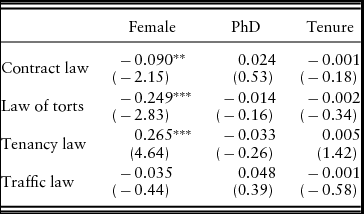
Ai and Norton (Reference Ai and Norton2003) show that the interaction effect in nonlinear models is conditional on the independent variables and may even have different signs for different patterns of covariates. In order to estimate the interaction effect, the authors compute the cross-derivative of the regression model. Consequently, magnitude and significance of the interaction depend on all other covariates. For reasons of clarity, we refrain from reporting the whole estimation results but only report the estimated mean coefficients of the interaction and the referring mean z-values (see Table 3).
Interaction effects between different fields of law and judge characteristics

Remarks. We report the mean interaction effects of logistic regressions and the referring z-values in brackets.
Significance levels: ***<0.01; **<0.05; *<0.1.
The reported empirical results indicate that the impact of academic education and tenure on settlement probability does not vary in any of the four subfields of law. Thus, although judges holding a PhD are more likely reach settlements, this effect does not differ significantly between case categories. Tenure did not play a role for settlement probabilities on the aggregate level and we find the same result for all considered subfields of civil law.
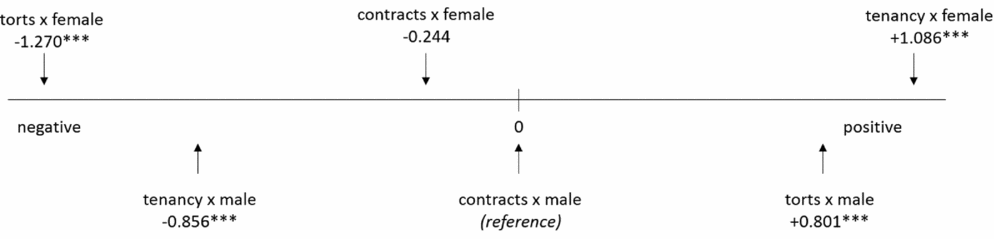
While the judges’ gender also played no significant role in settlement probabilities on the aggregate level, we find a different picture on the subfield level. Here, in three out of four fields of civil law the judges’ gender has a significant impact on settlement probabilities.Footnote 17 First, we find that female judges exhibit a lower probability of arranging in-court settlements in tort law. Second, we find the same (although much weaker) effect for cases from the field of contract law. And finally, we find the opposite effect in the field of tenancy law; that is, female judges more often arrange settlements between the parties in tenancy law cases. All three effects are significant at least at the 95% confidence level. The effect for tenancy law is particularly strong and contributes noticeably to the fit of our model. In addition to the interaction term, the coefficients for the related main effects for L_TORTS and L_TENANCY also become significant in the respective models. For traffic law we find no statistically significant interaction with the judge's gender.
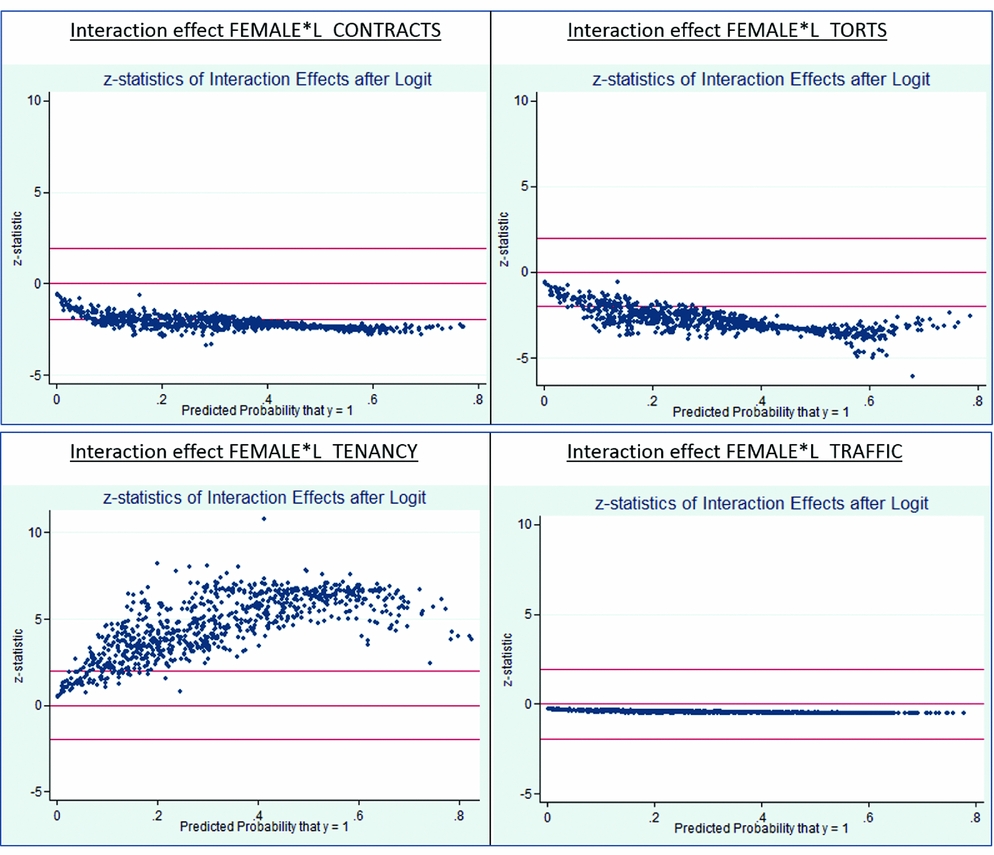
The advantage of the approach by Ai and Norton (Reference Ai and Norton2003) is that the determined interaction effect can be plotted against the predicted probability of the response SETTLEMENT, which allows for a more detailed interpretation. Focusing on the interaction with the judge's gender, Figure 1 displays the z-statistic of the interaction effect for each observation. To verify the robustness of our findings, we also apply the traditional approach to calculate interaction effects (see e.g. Hilbe Reference Hilbe2009). The results are qualitatively unaffected.Footnote 18
Z-values and 95% confidence level for interaction effects as a function of the predicted probability of settlements

We find that the interaction effect between a judge's gender and contract law is negative but insignificant for most cases with a rather low probability of settlement.Footnote 19 However, with an increasing estimated probability of settlement, the interaction effect becomes significant more often. This finding is even more pronounced in tenancy and tort law cases: given the reference category of contract law, we find a strongly negative interaction between a judge's gender and tort law. This interaction is again insignificant for very low levels of settlement probability, but becomes nearly always significant for probabilities over 20%. For tenancy law, the effect is equally strong, but in the other direction. The effect is found to be positive but insignificant for low probabilities of settlement, but the significance increases once a settlement becomes more probable. For settlement probabilities over 20%, again, nearly all observations deliver significantly positive effects. The displayed patterns indicate that the judge's gender does not matter whenever the party positions are so entrenched that any attempt at compromise is hopeless. As soon as there is any chance that settlements can be arranged, gender issues come to play a role in successfully reaching a settlement (at least with regard to tort, contract and tenancy law). Interestingly, we also do not find systematic effects in traffic law cases. In the light of the earlier discussed fact that traffic law settlements are comparatively rare because the litigants show strong interest in court rulings, this is not particularly surprising. Whenever settlement rates in a subfield of law are generally low, there is little room for the involved judges to mediate.
The empirical results of a judicial gender effect in settlement negotiations may be helpful for the organization of trials and courts, but tell us little about the logic that drives this effect. A finding by Croson and Gneezy (Reference Croson and Gneezy2009) might contribute to explain the observed pattern. In their review of experimental evidence on gender-related behavior they conclude that “women's decisions are more context-specific than men's” (Croson and Gneezy, Reference Croson and Gneezy2009, p. 11). Whenever this holds true, female and male judges might differ systematically in their perceptions and assessments of cases from different subfields of law because the contexts of these cases also differ systematically.
The visualization of the identified interaction effects may reveal such a general pattern (Figure 2). Female judges seem to exhibit higher settlement rates in long-run contractual relationships, whereas male judges perform better when the involved parties concurred “by chance.” Tenancy cases typically originate from friction in the long-term relationship between the litigants (and often, the continuation of this relationship is at least essential for one party), whereas the relationships in tort law cases are typically somewhat coincidental. Female arbitrators might be more able to moderate and also be more empathetic regarding existing malfunctioning relationships than their male counterparts, but they might lack these skills in the direct and volatile confrontations of tort law cases. Contract law might fall in between the two extremes because it contains cases with contracts between parties with long-term relationships (as for example between component suppliers and final good producers) and between parties that contract rather occasionally (as buyers in a supermarket). A different (and perhaps somewhat more provocative) explanation might be that female judges are more sensitive to the outcomes of lawsuits: failing to settle a tenancy case may often result in a delicate situation for the tenant as the inferior contract party, for example, in the case of a forced eviction. Settling a tort law case, however, might be perceived by a female judge as unfair to the victim or insufficient for restoring public order. Thus, a female judge may subconsciously prefer to express her beliefs in a court ruling and thereby suppress her commitment to settling. Obviously, we cannot formally test the correctness of these (admittedly speculative) explanations.
Calculated interaction effects for the subfield of law and the judge's gender

Due to the relatively low number of judges included in our analysis, the results presented in this section must be interpreted very cautiously. While they might be helpful in outlining future lines of research, the results have to be substantiated by additional empirical studies.
7. Summary and conclusions
As we argued in the introduction of this paper, governments around the globe are interested in high settlement rates in civil law litigation. To achieve these high settlement rates, governments need to know what factors have a significant impact on settlement probability. Knowledge of these factors is a prerequisite for the adequate and efficient design of legal institutions and procedures. This paper aims at increasing our knowledge regarding the institutional determinants of settlement probability. Based on a dataset from a German trial court, we study procedural and judge-related factors that have a significant impact on in-court settlement probability.
Our empirical study identifies a number of procedural factors that have a systematic influence on settlement probability. First, we find significantly higher settlement rates in cases with at least one oral hearing. One might therefore conclude that legislators should strive for a primacy of oral proceedings if they are interested in high settlement rates. This conflicts with present procedural rules, as minor cases (Bagatellverfahren) are often processed without an oral argument.
Second, we find significant evidence that the number of hearing days has a negative impact on settlement probability. However, a longer (single) hearing may show a positive effect on settlements, as it allows a deeper interaction between the parties and less private preparation. Even though the latter effect is not statistically significant, we suggest implementing court procedures that contain only one hearing with sufficient time for negotiations. Multiple hearings increase the use of court resources, but do not achieve higher settlement rates.
Third, we find that the rules for appealability have a significant impact on settlement probability; that is, cases that can be appealed exhibit significantly higher settlement probabilities. Clearly, legislators face a trade-off here. When the legal preconditions for a case to be appealable increase, the higher courts’ workloads decrease. However, this comes at the price of lower settlement rates in the courts of first instance.
We also find empirical evidence in favor of the hypothesis that judges differ in their abilities to arrange in-court settlements between the involved parties. Interestingly, judges with a PhD have a significantly higher probability in successfully arranging settlements. Although we did discuss different arguments behind this finding, it appears that employing a judge with a PhD contributes to increasing the settlement rate. Thus, hiring judges holding a PhD might be a suitable measure of increasing settlement rates. We also find gender differences in arranging in-court settlements. Although there is little empirical evidence in favor of the hypothesis that male and female judges in general differ in their abilities to reach in-court settlements, we identified gender-related differences in three subfields of law. Whereas male judges are more successful in arranging settlements in tort and contract law, the opposite holds true in tenancy cases; as a consequence, it might prove to be useful to allocate male judges primarily to tort and contract law cases and female judges to tenancy cases. If these results carry over to further empirical studies, this finding could help reorganizing courts in such a way that judges can be allocated to cases where (on average) they have the highest probability of arranging in-court settlements.
Although our empirical study thus has some highly interesting policy implications, the results should be interpreted cautiously. Especially for the judge characteristics the variation is limited in our dataset. However, our study provides a number of policy-relevant findings that might prove to be highly useful if they are further substantiated in future empirical studies with comparable designs.