Why Ecological Agriculture?
It is acknowledged by most observers that there are currently plentiful supplies of food produced in the US and around the world—certainly sufficient so that no person should go hungry or be in a position of food insecurity. On the other hand, about half the people in the world are malnourished—3 billion people. In the US, according to USDA, in 2004 ‘… 38.2 million people lived in food-insecure households, including 13.9 million children. Of these individuals, 7.4 million adults and 3.3 million children lived in households where someone experienced hunger during the year.'Reference Nord, Andrews and Carlson1 And a few years ago a New York Times article had a story with the following headline ‘Poor in India Starve as Surplus Wheat Rots.’Reference Waldman2 As a Wall Street Journal headline put it in 2004 ‘Want Amid Plenty, An Indian Paradox: Bumper Harvests and Rising Hunger.’Reference Thurow and Solomon3
So, the current system of production can be considered, in one important way to be quite a success story—there is a lot of food produced. And on the other hand, many people here and around the world are hungry and malnourished. In addition, the ecological and sociological problems of contemporary conventional agriculture are in the news almost daily. Water pollution from nitrogen and phosphorus and pathogens results in health hazards or algal blooms. Some of these effects are local, others are regional (pollution of Lake Champlain or the Chesapeake Bay), and some, such as the problems caused by nitrates entering the Gulf of Mexico, are truly continental in scope. Other environmental problems include accelerated soil erosion by wind and/or water, pesticides in groundwater and on food, the pesticide ‘treadmill’ caused by development of pest resistance to pesticides, routine use of antibiotics for animals leading to antibiotic-resistant strains of organisms, disease organisms contaminating meat and produce, pesticide contamination of farm workers, and so on. A good part of the nutrient pollution from agriculture is caused by a geographic separation between animal production facilities (consisting now mainly of large buildings and feedlots) and where the animal feeds are produced. This necessitates the use of large quantities of commercial mined and processed potash and phosphate fertilizers as well as synthetic nitrogen fertilizers on the crop farms at the same time as nutrients accumulate as manure on the animal farms. Additionally, in the poor countries of the Third World, an over-reliance on grain crop monocultures and loss of crop diversity in the aftermath of the ‘green revolution’ has resulted in a loss of well-balanced diets.
The development of factory farms and the physical separation of most of the animals from the land on which their feed grows are of relatively recent origin, developing especially over the past 25–50 yearsReference Magdoff, Lanyon and Liebhardt4, Reference Foster, Magdoff, Magdoff, Foster and Buttel5. Of longer duration, going back well over a century, has been the wide separation between where people live and where their food is produced. This causes both wasted energy for transportation of food as well as excess nutrient accumulation in and around urban areas. This issue, still very much with us today in the problems of treating and disposing of massive quantities of urban wastes, created some concern in the 19th century, as indicated by Karl Marx's comments:
Capitalist production, by collecting the population in great centres, and causing an ever-increasing preponderance of town population, on the one hand concentrates the historical motive power of society; on the other hand, it disturbs the circulation of matter between man and the soil, i.e., prevents the return to the soil of its elements consumed by man in the form of food and clothing; it therefore violates the conditions necessary to lasting fertility of the soil. By this action it destroys at the same time the health of the town labourer and the intellectual life of the rural labourer.Reference Marx6
Another critical issue is the extreme dependence on fossil fuels in conventional agriculture and the entire food system. Fuel is not only used to produce and power the large-scale equipment now used in agriculture—the tractors and combines and trucks for transportation. It is also used for other purposes such as drying grain and for production of agrichemicals. Although pesticide production is costly in energy terms, one of the most energy costly agrichemicals is the production, distribution, and application of nitrogen fertilizers. The two nitrogen atoms of the N2 molecule, so abundant in our atmosphere (78%), are held together by a triple bond that takes high temperature, pressure, energy, and catalysts, to convert to ammonia—the first product of Haber–Bosch process and the starting point for all other commercial N fertilizers.
The opening up of forests and grasslands for intensive agricultural production has caused, and continues to cause, a rapid decomposition (oxidation) of soil organic matter, leading to substantial releases of carbon dioxide (CO2) into the atmosphere. There is over three times more carbon stored in soils than is in the atmosphere as CO2. Thus, release of CO2 from soils through oxidation of organic matter is of fairly large magnitude, while at the same time the soils are becoming less healthy because of the loss of organic matter (see estimates of historical CO2 releasesReference Houghton and Hackler7).
Conventional farmers have been forced to become larger and highly mechanized—and, therefore, there are fewer of them—because of consolidation in the input and output (purchasing, processing and distribution) industries and low prices for their products. There are now few places to purchase needed inputs or wholesale markets to sell agricultural commodities. Farmers producing undifferentiated commodities must take advantage of all the physical and financial economies of scale in order to reduce their costs of production. In Iowa nowadays it takes about 1500 acres to make a living following conventional agriculture practices. This decrease in farm numbers and in agribusinesses that served the smaller farms has led to the decline and death of many rural communities. And the system continues along its ‘merry’ way in the US only with massive government subsidies—in 2001 an astonishing 47% of farm income came from government subsidies.Reference Ray, De La Torre Ugarte and Tiller8
Encouraged by agribusiness, agricultural science has contributed to the conventional system, with all its negative environmental and social effects. It has done so by taking a reductionist approach, where each issue that develops is viewed as an individual problem that needs to be addressed in isolation from all others. If soil fertility is low, just add fertilizers. If there is a pest outbreak (weed, insect, disease), then apply a pesticide. If the soil is compact, just use a subsoiler to relieve compaction. All issues are dealt with using a therapeutic approach. There is a ‘problem’ that needs some intervention, or therapy, to solve it. But what if these ‘problems’ are better viewed as symptoms of a deeper underlying and mostly hidden problem? What if these are caused by a poorly managed agricultural ecosystem?
Principles of Ecological Agriculture
The term ecological agriculture used in this essay is similar to agroecology in that it applies ecological principles and approaches to agricultural ecosystems. While not excluding organic agriculture, it is a broader concept that may be closer to ‘sustainable’ agriculture. Ecology is the ‘missing science’ in traditional agricultural education and research. Undergraduate and graduate agriculture students have until very recently studied basic sciences such as biology, chemistry and physics, but not ecology. In addition, the various agricultural disciplines have even been fragmented to sub-disciplines. No wonder the reductionist approach has been the norm. In going about the work of agriculture we purposefully disturb natural ecosystems (or formerly natural ecosystems) for the purpose of producing food and fiber crops and animal products of various kinds. These agroecosystems can be approached as any other ecosystem. An ecological approach to agriculture involves designing the strengths of natural ecosystem into agroecosystems. First we will discuss the strengths of natural ecosystems and then discuss how to develop these strengths in the context of farm fields and farms.
Strengths of natural ecosystems
Natural ecosystems exhibit certain strengths or characteristics. These include the following:
● Efficiency. Efficient energy flows are characteristic of natural systems. The sun's energy captured by green plants is then used by many organisms, as fungi and bacteria decompose organic residues and are then fed upon by other organisms, which are themselves fed upon by others higher up the foodweb. Natural ecosystems also tend to be efficient in capturing and using rainfall and in mobilizing and cycling nutrients. This helps to keep the ecosystem from ‘running down’ through the excessive loss of nutrients and at the same time helps maintain the quality of the groundwater and surface waters. Precipitation tends to enter the porous soil, rather than runoff, providing water to plants as well as recharge to ground water, slowly releasing water to streams and rivers.
● Diversity. A great biological diversity, both above ground and in the soil, characterizes many natural ecosystems in temperate and tropical regions. This provides checks and balances, nutrient availability to plants, checks on disease outbreaks, etc. For example, competition for resources and specific antagonisms (such as antibiotic production) from the multitude of soil organisms usually keep soilborne plant diseases from severely damaging a natural grassland or forest.
● Self-sufficiency. A consequence of efficiency and diversity is that natural terrestrial ecosystems are self-sufficient—requiring only inputs of sunlight and rainfall.
● Self-regulation. Because of the great diversity of organisms, outbreaks (or huge population increases) of diseases or insects that severely damage plants or animals are uncommon. In addition, plants have a number of defense mechanisms that help protect them from attack.
● Resiliency. Disturbances occur in all ecosystems—natural or not. The stronger ones are more resistant to disturbancesReference Holt-Gimenez9 and are able to bounce back quicker.
Building characteristics of strong ecosystems into agroecosystems
We need to learn to design farms, farming systems and landscapes to take advantage of the inherent strengths of natural systems, using minimal amounts of external interventions (inputs). Ideally, we would like to have agroecosystems that are productive but without the many negative ‘externalities’—or unwanted side effects—of conventional agriculture. We would like agricultural ecosystems to demonstrate characteristics of strong ecosystems—efficiency, diversity, self-sufficiency, self-regulation and resilience. The only way to really come close to reaching these goals is to view farms and fields as systems and approach them as such. This will not necessarily eliminate all the problems associated with contemporary conventional agriculture but should go a long way to alleviating many of them. And we must remember, of course, that ecologically managed agricultural ecosystems, while mimicking strong natural ecosystems, are still purposefully disturbed systems that will not look or function the same as natural systems.
Agricultural fields and their surroundings
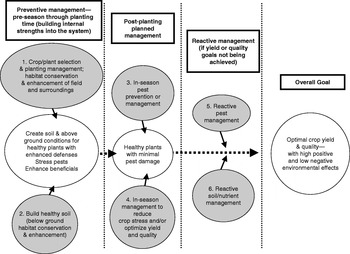
There is a three-step overall strategy to the production of crops relying heavily on ecological principles. Firstly, do everything reasonably possible to build internal strengths into the agricultural ecosystem. This aims at preventing ‘problems’ instead of dealing with them once they have appeared. Secondly, use routine ecologically sound practices during the season to keep plants healthy. Thirdly, if an unanticipated problem arises, use the most benign reactive (therapeutic) means possible to deal with it. Let us deal with each of these individually.
A. Building internal strengths into the system is usually done during the off-season through the time the crops are planted (see Fig. 1). The overall goals are to create soil and above-ground conditions that promote the growth of healthy plants, to stress pests, and to promote beneficial organisms. This can be viewed at as ‘habitat management and conservation’ to promote sufficient biological diversity and conditions for healthy growth of plants—above and below ground, in space (for example, field boundary management) and in time (cover crops, rotations). This is the heart of the matter, and for this reason we will discuss it in greater depth than the other two overall strategies. Although Fig. 1 and the discussion below divides strategies into ‘above ground’ and ‘below ground’ this is an artificial distinction. Many practices may have profound effects both above and below the soil surface.
Ecological field management framework.

Building strengths above ground
● Select crops and varieties resistant to local pests (in addition to other qualities such as yield, taste, etc.)
● Use appropriate planting densities (and companion crops)
● Plant perimeter (trap) crops that are more attractive to a particular pest than the economic crop(s) growing in the middle of the field and can intercept incoming insects.
● Create field boundaries and zones within fields that are attractive to beneficial insects. This usually involves planting a mix of flowering plants around or inside fields to provide shelter and food for beneficials.
● Use cover crops routinely to provide multiple benefits such as habitat for beneficial insects, adding N and organic matter to soil, reducing erosion and enhancing water infiltration into the soil, retaining nutrients in soil, (and much more). It is possible to supply all of the nitrogen to succeeding crops by growing a vigorous winter legume cover crop such as crimson clover in the south and hairy vetch in the north.
● Use rotations that are complex, involve plants of different families and, if at all possible, include sod crops such as grass/clover hay that remain without soil disturbance for a number of years.
● Reducing tillage is an important part of an ecological approach to agriculture. Tillage buries residues, leaving the soil bare and more susceptible to the erosive effects of rainfall, and at the same time breaks up natural soil aggregates that help infiltration, storage and drainage of precipitation. (The use of practices that reduce erosion is critical to sustaining soil productivityReference Pimentel10.)
Building soil strengths
● Add large quantities of organic materials on a regular basis—animal manures, composts, tree leaves, cover crops, rotation crops that leave large amounts of residue, etc. Soil organic matter and its management are at the heart of creating healthy soilsReference Weil, Magdoff, Magdoff and Weil11, Reference Magdoff, Weil, Magdoff and Weil12 that have significant internal strengths that produce healthy plants that have good defense mechanisms. These characteristics include good nutrient availability, good water (and air) relations, good conditions for plant roots to grow and explore, production of plant growth stimulating compounds by microorganisms, disease suppression, low weed seed populations, etc. However, care must be taken to not overload soils with nutrients by continually using large quantities of organic materials such as composts from off the farm.
● Use different types of organic materials because they have different effects on soil biological, chemical, and physical properties.
● Keep soil covered with living vegetation and/or crop residues by using cover crops, sod crops in rotations, and/or reduced tillage practices. This encourages water to infiltrate into the soil instead of running off the field, taking sediments (and organic matter) along.
● Reduce soil compaction to a minimum by keeping off fields when they are too wet, redistributing loads, using traffic lanes, etc.
● Use a variety of practices to reduce erosion. These include some mentioned above, such as keeping soil covered with living vegetation or crop residue (using cover crops, rotation sod crops, and reducing tillage), as well as other practices such as terracing, grassed waterways, strip cropping along the contour by alternating a row crop with a sod crop, using natural or planted buffers between fields and streams, etc.
● Use practices to supply supplemental fertility sources, when needed, that better match nutrient availability to crop uptake needs (which vary during the season). This helps to reduce both weed and insect damage.
Creative use of a combination of the practices discussed above, such as a good rotation, adding organic materials to soil, and intensive use of cover crops—goes a long way to creating a more ecologically sound agriculture at the field level. It creates the conditions that are hospitable to plant roots, allowing the development of strong and healthy plants and helps promote the presence of naturally occurring biological control organisms. This promotes characteristics of efficiency in use of nutrients and water, biological diversity above and below ground, self-sufficiency, self-regulation and resilience.
B. Routine ecologically sound practices during the season include such activities as scouting to see if pest problems are occurring and irrigating crops when rainfall is insufficient. Pruning tree crops to reduce humidity (and, therefore, fungal disease) is another one of these practices, as is cultivation for weed control.
C. Reactive management may be needed to save crops if, despite using a preventive approach, a pest outbreak or other issue occurs. In this situation, the release of beneficial biocontrol organisms may be the most benign approach although targeted (non-broad-spectrum), low persistence, low toxicity pesticides might be needed instead. The use of a foliar spray to quickly get nutrients into a plant during the season can help overcome some deficiencies that appear during the growing season. Reactive management becomes the last line of defense in ecological management, rather than the first or second.
Farm scale
We cannot just stop at the field scale, because practices that are carried out in a particular field are decided upon by farmers looking at their entire farm. What are the principles at the farm scale that will help guide a farmer making ecologically sound decisions that also provide the farm family with their desired quality of life, including adequate income, while being socially sound (see Fig. 2)?
● Minimize inputs from off the farm by building up soil organic matter and creating better above and below ground habitat (reducing tillage, using legumes to supply N to other crops, etc.).
● Maximize the use of locally available nutrients (manures, composts, cover crops, municipal leaves, etc.)
● Mix animal and crop production whenever possible to provide a number of benefits—such as more efficient cycling of nutrients on the farm (assuming that manure is handled well) and a reason to alternate sod (hay) crops with row crops. Mixed crop and animal production systems offer the potential for developing intensive biological synergies. These multi-species crop/animal systems can be extremely productive and provide opportunities for small and limited resource farmers to thrive—assuming they have access to credit and markets.
● Add value to agricultural products to provide family with added income.
● Sell products as local and direct to consumer as possible. This has two effects. Firstly it usually provides farmers with higher prices than they would receive through wholesale markets. Secondly, it creates more awareness of agriculture, agricultural issues, and provides a more direct connection between the public and their food. Because products are sold locally, this also creates the possibility of better cycling of nutrients.
● Minimize adverse effects on neighboring farms or the environment.
● Treat hired labor with respect and human decency, as the valuable resource that it is (this also reduces worker turnover).
Ecological farm management framework.

Constraints to Ecological Agriculture in the US
The basic principles and many practices of ecological agriculture are well known. So why aren't they being practiced on most farms in the US and abroad? For more complex rotations to be used on a majority of conventional farms there need to be large and easily accessible markets for the additional products—for example, something other than corn and soybeans in the US corn belt. And while it makes ecological sense to reunite animals with the land that raises their feeds, decisions made by large corporations about where to place processing facilities and how they want ‘their’ animals raised makes it difficult for farmers to sell large numbers of animals outside that industrial system that has developed. (It should be noted that the buy-local movement has led to the development of new markets for some farmers through the food service industry. How large and long lasting an effect this will have is yet to be seen.)
Another constraint in the US is that certain commodities receive subsidy payments while others do not. Why leave a relatively dependable system for one with many economic unknowns?
A major constraint that we may have in the future has recently raised its head—the use of crops to produce energy. The price of corn increased by 60% in the fall of 2006, in response mainly to the increased use of the crop to produce ethanol. The USDA has projected that ethanol production will use 20% of the US corn crop in 2006Reference Kilman13. With numerous ethanol plants currently under construction, ethanol will take an increasing share of the corn market and will compete with corn's use as an animal feed and feedstock for many byproducts such as high fructose syrup. With a more profitable corn crop, it will be difficult to shift corn belt farmers to more complex rotations. And with the accelerated push to produce ethanol (and other products) from crop residues, less organic matter will be returned to the land, leaving soils less fertile.
It is true that there are many farmers practicing ecological approaches to their farms. However, very few of these are large-scale growers trying to sell their products into the undifferentiated wholesale commodity markets. There are also currently some government subsidies for such farmers to follow more environmentally sound practices such as using cover crops or planting riparian buffer zones. However, even if an environmentally sound practice or two are used, rarely does a full-fledged ecologically based system develop. So farmers implementing a truly ecologically based system tend to be mainly small-scale growers who also try to capture for themselves some extra price above wholesale commodity prices—such as operators of Community Supported Agriculture farms (CSAs) and organic farmers that sell at farmers' markets, farm stands at the farm, and to local restaurants.
Over the past decade there has been a huge increase in interest among farmers in developing value-added products—from bottling milk, to making yoghurt, to farmstead cheeses, to processing meat and poultry, and so on. These farmers still represent only a small niche in US agriculture, although very important in some areas and definitely still growing. But the increasing desire for organic foods has been noticed by the ‘big guys,’ and we now have what should be a non sequitur—organic factory farms. Very large-scale organic dairies as well as vegetable and fruit farms are now common. And of all the outlets now getting interested in organic food, Wal-Mart is jumping in as part of its effort to attract upscale customersReference Morrison14, Reference Gogoi15. Thus, the small-scale farmer raising crops and animals ecologically needs to cultivate a local constituency—regardless of whether value is added to the products sold—and/or enter into values-based marketing networks with other farmers using their own brand(s).
Ecological Agriculture, Poor Countries, and Hunger
Possible alternate uses for crop residues is also a potential impediment in the Third World to implementation of an ecological agriculture that calls for returning as much biomass to the soil as possible. For example, dry cow dung in India is used as fuel and 60% of crop residues in China and 90% in Bangladesh are burned for fuelReference Wen and Pimentel16.
In Africa and other parts of the Third World there are also many other constraints to a more sustainable and ecologically based agriculture. Perhaps one of the largest has been the near wholesale elimination of government subsidies and other assistance to agriculture under recommendations and pressure from international organizations such as the International Monetary Fund (IMF). The abandonment of any real agricultural policy by many governments has left most farmers at the mercy of local market forces. Very low and declining yields are not uncommon as farmers attempt to eke out an existence on ‘worn-out’ soilsReference Dugger17. Additional problems, such as endemic corruption and poor basic infrastructure such as inadequate roads and storage facilities, only make things worse. Without significant assistance, it is very difficult for farmers to escape a downward spiral of declining soil fertility and yields. The recent push on the part of private US foundations to implement a ‘new green revolution’ in Africa will most likely do little to alleviate hunger and poverty because it focuses on traditional green revolution technologies (high-yielding varieties, commercial fertilizers, pesticides and irrigation) instead of building an ecological agriculture, addressing structural inequalities, and having local groups and local and national governments take an active role in supporting agricultureReference Holt-Gimenez, Altieri and Rosset18. It is certainly true that fertilizers will increase crop yields on many of the nutrient-depleted soils of Africa. Irrigation and other practices will probably also help. However, these technologies are neither unknown nor unused, and focusing on them misses the heart of the problem. The situation of Ghana's rice farmers has been described as follows: ‘In 1983, Ghana adopted free-market changes, followed by more in 1986. It earned accolades from the World Bank as the most promising West African economy after cutting duties and eliminating the aid that protected its rice sector. While the country's overall economy is expanding, poverty in the rural north has spiraled. Farming has been set back decades: Men harvest with small, hand-held sickles; women clean and sort rice by hand. According to the Ghana Rice Interprofessional Body, the country's three-ton-per-hectare …yield is half what it could be.’Reference von Reppert-Bismark19 It is the neglect of the interests of small farmers by governments following ‘free market’ policies that has worsened the agricultural situation in many countries—including yield reductions in Ghana due to decreased fertilizer usage. In addition, relying on the routine use of costly imported materials such as fertilizers and pesticides, though helpful in emergency situations, is not a long-term solution to the problems of subsistence and small farmers. That will require the development of an ecologically based and diversified agriculture relying to the greatest extent possible on local resources and focused on building and maintaining healthy soils (as described above).
A group of developing nations (the Group of 20, with sometimes more and sometimes less than 20, led by Brazil and India) has made the subsidies of US and European farmers a key issue in the World Trade Organization's negotiations. Their unwillingness to accept the conditions imposed by the wealthy countries has led to the collapse of the Doha round of WTO negotiations that began in 2001 in Qatar. Certainly, the subsidies paid to farmers in wealthy countries allow products to be sold on the world market below the actual cost of production. This, of course, makes it difficult for farmers in the Third World to sell in the local market and to export abroadReference von Reppert-Bismark19. However, of all the problems of agriculture in the poor countries of the world, subsidies to farmers in wealthy countries is a relatively small issue compared to some of the othersReference Magdoff20. The main threat to farmers in the Third World is not that prices for agricultural products are too cheap because of subsidies to US and European farmers. This might be an issue for highly mechanized producers in the poor countries, but small-scale producers selling commodities on the world wholesale market just cannot compete directly with highly mechanized producers (with per person production perhaps 500 times or more that of a small-scale producer), wherever they areReference Mazoyer and Roudar21. For example, Jamaican farmers cannot compete with US farmers in crops that do not receive direct subsidies, like carrots and onions, as well as in meat and chicken. Poor countries also compete among themselves, with the added coffee acreage in Brazil and Vietnam partially responsible for a few years of very depressed coffee prices worldwide. Vietnam, Taiwan and China are selling vegetables into the Philippines.
It is estimated that US corn entering Mexico under the NAFTA agreement has put some 1.5 million Mexican farmers out of business22. But this is primarily due to opening up markets by doing away with Mexico's protective tariffs—a ‘remedy’ or ‘growth strategy’ recommended to Third World countries by the IMF, the World Bank, and many NGOs—with the subsidies that US corn growers receive only making things somewhat worse. Even without the subsidies, highly mechanized farmers in the US will be able to produce commodity crops at prices below the price that will permit the subsistence of a small farmer growing those crops on a small plot in the Third World and trying to sell some portion in the local markets. Add to that, the takeover of the agricultural input industries—as well as purchasing, processing and selling of agricultural products—by large transnational corporations means that the small grower in the Third World is in a difficult situation, to say the least. One of the latest developments is the opening of large-scale European and US-owned supermarkets in poor countries. These supermarkets purchase produce only from large-scale growers, leaving the small farmer with the traditional markets, now less lucrative and serving fewer people. As a 2004 headline in the New York Times put it ‘Supermarket Giants Crush Central American Farmers’Reference Dugger23.
Large-scale, highly mechanized agriculture is probably the greatest threat to the existence of billions of people, for reasons that will be discussed below. It is also taking the place of small-scale peasant agriculture in countries such as Brazil. It is occurring in response to the profits that can be made by selling certain agricultural commodities on the world market. Brazil, for example, with its relatively cheap land and labor, has very low costs of production for soybeans and exports approximately the same quantity of soy products as the US. In 2004, Brazil exported 20.3 metric tons (MT) of beans plus 14.8 MT of soy meal, compared with US exports of 29.9 MT of beans and 5.4 MT of soy meal24. Once large-scale agricultural production of commodities is profitable, more small peasants are forced from their lands by capitalist farmers—‘legally’ or illegally. That Brazil exports a lot of soybeans, sugar and oranges (or orange juice), and coffee certainly helps its balance of trade with the rest of the world. On the other hand, this can have very negative effects on the production of food crops for internal use by subsistence and small-scale commercial farmers.
Subsistence farmers forced off their land by a variety of forces are flooding into the cities of the Third World. With few jobs available they head to the slums and join the ‘informal’ economy as best they can. It is estimated by the UN that of the half of the 6 billion people in the world that lives in cities, about 1/3 of city dwellers live in slums—approximately 1 billion people. The conditions generally get worse as cities and slums become larger. The chairman of a district in Lagos, Nigeria described it as follows: ‘We have a massive growth in population with a stagnant or shrinking economy. Picture this city ten, twenty years from now. This is not the urban poor—this is the new urban destitute.’Reference Packer25 Most slum dwellers are removed from both the formal economy and from any chance of advancing and breaking the cycle of poverty and hunger. George Parker ended an article on Lagos on a note of extreme pessimism: ‘The really disturbing thing about Lagos' pickers and vendors is that their lives have essentially nothing to do with ours. They scavenge an existence beyond the margins of macroeconomics. They are, in the harsh terms of globalization, superfluous.’24
Samir Amin has estimated that 20 million highly mechanized and productive farmers can produce all of the world's food supplyReference Amin26. The number is probably significantly less, but let us assume his number. What will happen to those billions of people engaged in agriculture in countries that are not developing fast enough to productively absorb the farmers leaving the land? This is a recipe for a human catastrophe of the highest magnitude! In an era of more expensive energy and global climate change, the dependence of industrial agriculture on cheap energy and relatively stable climate might decrease its advantages over smaller scale more ecologically sound and resilient systems. However, for the foreseeable future, large-scale mechanized agricultural production remains a massive threat to the small farmers of the world.
There is a growing realization that countries need to take a more active involvement in their agriculture, promoting it, providing technical support to farmers, subsidizing inputs when needed, and using protective tariffs. (This is what the United States and other countries did for many years, and still do. The assistance to the farming sector in the US is huge, much larger than the subsidies going to directly farmers—from export subsidies to an extensive research and extension system to maintenance of the transportation infrastructure and so on.) Otherwise a lot of the countryside in the poor nations of the world will look as Jamaica does now—full of abandoned fields, with almost all food imported. Or, it will look like the Brazilian state of Mato Grosso, a powerhouse in highly mechanized production and exportation of soybeans—much on former rainforest land—and where one person controls 250,000 acres of soybeans. Or there will be some combination of the two. Regardless of how it plays out, all the alternatives seem to lead to a large portion of humanity being left in a very precarious state. The only hope of countering those outcomes is to reverse the negative effects of ‘globalization’ on most countries of the Third World. This means that governments must take an active part in promoting agriculture instead of relying on the neoliberal mythology of ‘free markets’ as the answer to all problems.
An ecologically based agriculture, focusing on small-scale farmers in the Third World primarily providing food for themselves and others in their countries, can be created. There are many techniques and approaches that have been demonstrated to be able to help such farmers produce good yields with few purchased inputs (for example, see reports on the conversion of much of Cuban agriculture to organic practicesReference Wolfe27, the information on possibilities and practices of Biointensive Agriculture28, and the evidence that ecologically based farming can provide high yields for small farmersReference Halweil29). Although much emphasis by agronomists in Africa is rightly placed on the emergency situation of supplying nutrients to vastly depleted soils, a more holistic approach to soil management will be needed to unlock the real potential of agriculture on the continent. However, significant changes will only happen through major governmental programs in each country—ones that mobilize the creativity and enthusiasm of the people and rely to the greatest extent possible on the country's own human and natural resources. From a humanitarian as well as ecological point of view, this is one of humanity's greatest challenges.
Acknowledgements
I would like to acknowledge the influence of the ideas of Dr W.J. Lewis of USDA/ARS regarding ecosystem characteristics and the input of faculty and students of the Department of Plant and Soil Science at the University of Vermont for the field and farm framework figures.