Introduction
The internationalisation of innovation and knowledge flows in multinational enterprises (MNEs) are important and evolving areas of management and international business research (Gaur, Ma, & Ge, Reference Gaur, Ma and Ge2019; Papanastassiou, Pearce, & Zanfei, Reference Papanastassiou, Pearce and Zanfei2019). However, only recently scholars have begun to explore the joint influence of strategic orientations (Jean, Kim, Chiou, & Calantone, Reference Jean, Kim, Chiou and Calantone2018) and international knowledge connectivity (Andersson, Dasí, Mudambi, & Pedersen, Reference Andersson, Dasí, Mudambi and Pedersen2016) on various types of innovation – including radical innovation (Azar & Ciabuschi, Reference Azar and Ciabuschi2017) – and its performance implications (Han, Jo, & Kang, Reference Han, Jo and Kang2018). Scholars have also begun to discern a trend towards a wider diversity of countries and firms engaged in innovation across borders and its implications for the relationship between strategic motives, knowledge flows and innovation outcomes (Dachs, Stehrer, & Zahradnik, Reference Dachs, Stehrer and Zahradnik2014).
While recent attempts to extend the traditional models of research and development (R&D) internationalisation have considered R&D investment motives (Di Minin, Zhang, & Gammeltoft, Reference Di Minin, Zhang and Gammeltoft2012) and knowledge flows between headquarters (HQ), subsidiary and host country (Achcaoucaou, Miravitlles, & León-Darder, Reference Achcaoucaou, Miravitlles and León-Darder2014; Giuliani, Gorgoni, Günther, & Rabellotti, Reference Giuliani, Gorgoni, Günther and Rabellotti2014), they did not consider in depth the contextual factors (such as the roles of various types of distances) potentially impeding knowledge flows in MNEs (Gaur, Ma, & Ge, Reference Gaur, Ma and Ge2019) and did not investigate the link to innovation outcomes with respect to radical innovation (Zhou & Li, Reference Zhou and Li2012). Various theoretical approaches have been proposed to underpin the R&D internationalisation models, among which the knowledge-based view (Grant, Reference Grant1996a) remains under-utilised (Papanastassiou, Pearce, & Zanfei, Reference Papanastassiou, Pearce and Zanfei2019) and has recently gained prominence (Vrontis & Christofi, Reference Vrontis and Christofi2019).
Our study's setting is the European Union (EU), which remains an attractive destination for international R&D firm investments (EY, 2019; Laurens, Le Bas, Schoen, Villard, & Larédo, Reference Laurens, Le Bas, Schoen, Villard and Larédo2015). Firms from non-traditional investor countries outside of Europe, North America and Japan are increasingly conducting innovation in the EU (Montout & Sami, Reference Montout and Sami2016). The strategic motivation and innovation behaviour of these new players may not be explained by the existing models of R&D internationalisation developed by scholars who focus on firms from the developed countries in the Northern Hemisphere (Ambos & Ambos, Reference Ambos and Ambos2011; Håkanson & Nobel, Reference Håkanson and Nobel1993). The main aim of this study is to explain the innovation foreign direct investment (FDI) motives, outcomes and knowledge flows of European subsidiaries of Australian and New Zealand (ANZ) multinationals, and potentially uncover strategic motives, knowledge flows and processes inconsistent with the current models of R&D and innovation internationalisation.
The national innovation system of New Zealand has been studied before (Crawford, Fabling, Grimes, & Bonner, Reference Crawford, Fabling, Grimes and Bonner2007) and innovation is promoted as a new motor of economic growth for Australia (Bond-Smith, Cassells, Duncan, Kiely, & Tarverdi, Reference Bond-Smith, Cassells, Duncan, Kiely and Tarverdi2016). However, the international innovation activities of ANZ firms remain under-studied, especially in the European context. Studies have examined the strategic motives and knowledge flows related to innovation investment in Europe from emerging economies (Di Minin, Zhang, & Gammeltoft, Reference Di Minin, Zhang and Gammeltoft2012, Giuliani et al., Reference Giuliani, Gorgoni, Günther and Rabellotti2014). However, these studies focus on comparing advanced and emerging MNEs rather than examining the potential diversity of motives and behaviours within advanced economies. Some studies have included ANZ firms within the population of advanced-economy firms investing in innovation in Europe (Giuliani et al., Reference Giuliani, Gorgoni, Günther and Rabellotti2014). Others have treated Australia and New Zealand as part of the Asia-Pacific region (Driffield, Love, & Yang, Reference Driffield, Love and Yang2014).
There are reasons to treat ANZ firms as a separate group. Because of their relative isolation (distance from major economic centres), location in the Southern Hemisphere, proximity to emerging economies and large geographic and time zone distance from Europe, they are a special case to consider as these factors lead to distinct national innovation systems and strategies (Martin & Johnston, Reference Martin and Johnston1999). Other factors characterising these economies are an industrial structure that is biased towards primary industries and the relatively small size of firms and the economy (Crawford et al., Reference Crawford, Fabling, Grimes and Bonner2007). Moreover, the historical ties and the relatively low cultural distance (compared with Asian countries) between ANZ and the UK and Europe are also important. All these differences may affect innovation strategies and behaviour.
Driffield, Love, and Yang (Reference Driffield, Love and Yang2014) suggest that firms from the Asia-Pacific region may behave differently from European and North American firms in their global and regional innovation strategies. Asian firms effectively engage in knowledge sourcing in Europe and North America, but little technology sourcing occurs by Asian firms seeking knowledge within Asia (Driffield, Love, & Yang, Reference Driffield, Love and Yang2014). By contrast, European firms tend to effectively source knowledge within Europe and North American firms within North America. This literature has not fully considered the distinct characteristics of regions such as Australasia, South America, Africa and the Middle East. These regions are not defined as part of the ‘broad’ triad (the three major world regions of North America, the EU and Asia defined by Rugman and Verbeke, Reference Rugman and Verbeke2004) or are included in a region along with very different countries (Driffield, Love, & Yang, Reference Driffield, Love and Yang2014).
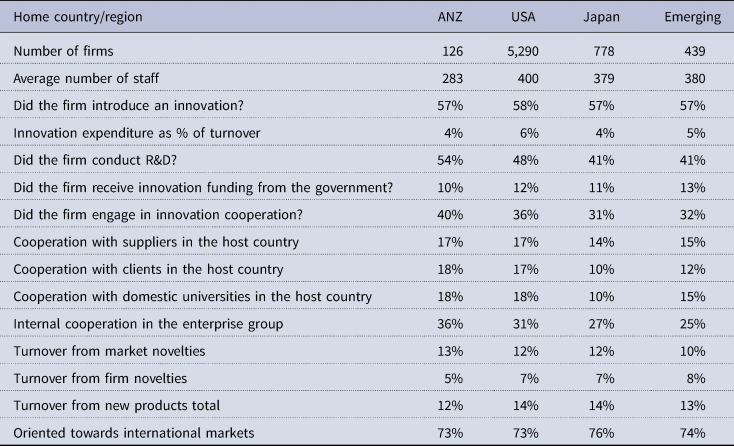
This paper defines innovation as the implementation of a new or significantly improved product or process, a new marketing method, or a new organisational method in business practices, workplace organisation or external relations (OECD & Eurostat, 2005). We acknowledge that some innovation might be disruptive, and consider innovation performance of foreign subsidiaries in terms of both radical and incremental innovation (Silva, Styles, & Lages, Reference Silva, Styles and Lages2017). The results of the Community Innovation Survey of innovation activities of firms in Europe (Table 1) reveals that ANZ firms exhibit roughly the same propensity to introduce new products to the market as firms in the other groups (57%). However, they do R&D (54%) and cooperate in innovation projects (40%) more frequently than other firms, particularly with regards to cooperation within the group.
Foreign firms innovating in the European Union

Source: Adapted and calculated from Eurostat and Community Innovation Survey data for 2008–10.
Note: We only show data for firms from ANZ, the USA, Japan and emerging markets.
The main research questions we ask are as follows:
1. Why and how do ANZ MNEs conduct innovation in Europe and how does distance from the EU affect it?
2a. How do the innovation motives and knowledge flows of European subsidiaries of ANZ firms align with one another and how do they affect innovation performance (especially radical vs. incremental innovation)?
2b. How do they differ from the motives and knowledge flows of European subsidiaries of other MNEs?
To investigate these questions, we organise the rest of the paper as follows. First, we review relevant literature and present our theoretical framework. Then, we specify our method, present the data, analyse the cases, discuss the findings and develop propositions. Finally, we conclude.
Review of Literature
Models explaining the internationalisation of R&D and innovation generally first consider motives for locating innovation abroad (Von Zedtwitz & Gassmann, Reference Von Zedtwitz and Gassmann2002; Di Minin, Zhang, & Gammeltoft, Reference Di Minin, Zhang and Gammeltoft2012). Second, they explain knowledge flows, both within the MNE (in particular between the HQ and the subsidiary) and between the foreign subsidiary and the host economy (Achcaoucaou, Miravitlles, & León-Darder, Reference Achcaoucaou, Miravitlles and León-Darder2014; Giuliani et al., Reference Giuliani, Gorgoni, Günther and Rabellotti2014). We anchor our literature review around these two building blocks. Then in the theory section we develop a framework focusing on the under-explored types of innovation motives and knowledge flows. Finally, we extend the extant models' focus on R&D motives and knowledge flows to factors affecting these flows (Gaur, Ma, & Ge, Reference Gaur, Ma and Ge2019), and the joint impact of knowledge flows and strategic motives on innovation performance, including radical innovation, embedding our approach in the knowledge-based view of the firm (Grant, Reference Grant1996a; Kogut & Zander, Reference Kogut and Zander1993).
Innovation motives
One of the main aims of this study is to understand the European subsidiaries of ANZ firms and to explain how their innovation investment motivation and behaviour differ from those of the subsidiaries of MNEs from other countries. The unique characteristics of ANZ firms (including large geographic and time zone distance between HQ and subsidiary) may shed new light on the role of these characteristics in international innovation processes and outcomes. Studies of developed-country MNEs, such as Ambos and Ambos (Reference Ambos and Ambos2011), highlight technology exploration versus exploitation motives, market versus technology-driven motives and push versus pull factors as the main motives for R&D internationalisation.
Von Zedtwitz and Gassmann (Reference Von Zedtwitz and Gassmann2002) identify two principal driving forces of R&D internationalisation:
(1) Access to local markets: MNEs create development units abroad to adapt their product range according to market and customer needs.
(2) Access to local knowledge: MNEs create research units abroad to capture scarce technological and other (managerial) knowledge.
There are thus two associated core motives: the market-seeking motive, i.e. technological exploitation of firm-specific advantages abroad by adopting to local circumstances to gain access to foreign markets, and the knowledge-seeking motive, i.e. exploration of firm technologies through access to overseas knowledge and know-how (Kuemmerle, Reference Kuemmerle1999).
The activities of foreign innovation establishments are usually driven by multiple motives (Håkanson & Nobel, Reference Håkanson and Nobel1993). In addition to the market-oriented units, there are also production support units for foreign innovation, whose primary aim is to support local production, and politically motivated units, created to underpin the MNE's political position and access to the foreign market (Birkinshaw & Hood, Reference Birkinshaw and Hood1998). Knowledge-seeking firms look for R&D epicentres in the area of their strategic interest to catch up with competitors' innovation levels, broaden their knowledge portfolio and search for the technical diversity of different regional market needs (Chung & Alcacer, Reference Chung and Alcacer2002).
Firms have other motives for international (innovation) investments; these include efficiency-seeking, cooperation-seeking and diversification-seeking motives (Demirbag & Glaister, Reference Demirbag and Glaister2010; Dunning, Reference Dunning1993; Meyer, Reference Meyer2015). Efficiency-seeking investors are predominantly interested in reducing the costs of innovation activities by conducting activities in countries with a lower price/productivity ratio for innovation inputs, particularly human capital (Schmiele, Reference Schmiele2012). Cooperation-seeking innovation ventures tap into alliances, networks and other interfirm agreements that involve the pooling of capital, employees, technology or other expertise and assets of participating firms or institutions (such as universities) in an undertaking that combines elements of market-based and intra-firm organisation (Mowery, Oxley, & Silverman, Reference Mowery, Oxley and Silverman1998). Cooperation refers to a set of interdependent business relationships centred on value creation, innovation and knowledge sharing. In some cases, MNEs can expand or develop cooperation networks internationally to fulfil their strategic goals (Chen & Huang, Reference Chen and Huang2004) and reach outside knowledge that they would not normally access (Yeoh, Reference Yeoh2000). Another reason for internationalising is to diversify a company's risks through diversification-seeking investments (Deng, Reference Deng2004; Dunning, Reference Dunning2001). Diversification across unrelated products or geographically unconnected markets may reduce risk and affect performance of foreign subsidiaries (Jiao, Liu, Wu, & Xia, Reference Jiao, Liu, Wu and Xia2019). A company may therefore choose to enter other business fields to hedge risks (Cantwell, Reference Cantwell2009; Yeung & Liu, Reference Yeung and Liu2008). International diversification may offer more benefits than costs and thus improves firm performance (Delios & Beamish, Reference Delios and Beamish1999).
Knowledge flows
For MNEs, knowledge is distributed internationally among a network of dispersed subsidiary units. The literature examines the consequences of knowledge creation and transfer within such networks (Gupta & Govindarajan, Reference Gupta and Govindarajan2010; Jensen & Szulanski, Reference Jensen and Szulanski2004; Minbaeva, Pedersen, Björkman, Fey, & Park, Reference Minbaeva, Pedersen, Björkman, Fey and Park2003; Wang, Tong, & Koh, Reference Wang, Tong and Koh2004). Studies have emphasised how knowledge transfer relates not only to the sending of knowledge from a source to a recipient unit but also the integration, understanding and application of knowledge (Cohen & Levinthal, Reference Cohen and Levinthal1990; Hansen, Reference Hansen1999; Szulanski, Reference Szulanski1996).
MNE subsidiaries can be classified along two key dimensions (Giuliani et al., Reference Giuliani, Gorgoni, Günther and Rabellotti2014):
(1) the degree to which MNEs transfer knowledge to and/or receive knowledge from their HQ and other subsidiaries (intra-corporate knowledge transfer) and
(2) the level of locally embedded innovative activities (generated value for the MNE and the local context), including the formation of local innovative ties (collaborations) and innovation activity developed locally by the subsidiary (internally and independently of the HQ and sister firms).
The typology proposed by Giuliani et al. (Reference Giuliani, Gorgoni, Günther and Rabellotti2014) includes four main types of subsidiaries. Predatory subsidiaries combine bottom-up knowledge transfer (Rasmussen, Reference Rasmussen1983) and low local embeddedness. Dual subsidiaries combine bottom-up knowledge transfer and high local embeddedness. Locally embedded subsidiaries combine top-down knowledge transfer and high local embeddedness (Almeida & Phene, Reference Almeida and Phene2004; Cantwell & Mudambi, Reference Cantwell and Mudambi2005). Passive subsidiaries combine top-down knowledge transfer and low local embeddedness.
While this framework is helpful, it focuses on the local embeddedness of innovation activities without considering in-depth internal cooperation and knowledge flows within the MNE group. Moreover, it does not explicitly take into account the possibility of high knowledge flows in both directions (between HQ and the subsidiary/subsidiaries and vice versa). Mudambi and Navarra (Reference Mudambi and Navarra2004) address this issue by identifying four basic knowledge flows within MNEs: (a) flows from the subsidiary to the parent (knowledge transfer that helps HQ exploit local knowledge); (b) flows from the subsidiary to the location (spillovers – flows to local customer, suppliers, universities etc.); (c) flows from the location to the subsidiary (reverse spillovers – subsidiary's learning and knowledge sourcing – Zámborský and Jacobs, Reference Zámborský and Jacobs2016) and (d) flows from HQ or another subsidiary (subsidiary exploits home base knowledge advantage).
Theory
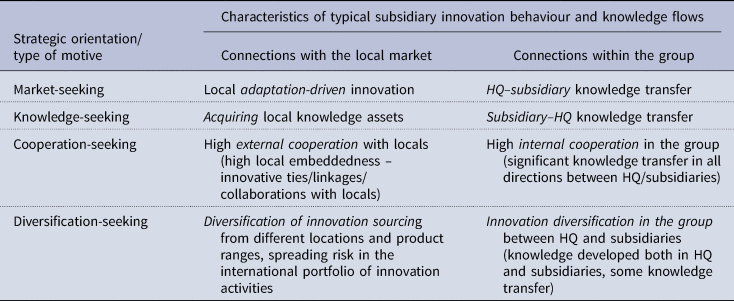
Building on extant models of the internationalisation of innovation, we start with a framework that highlights the main types of motives for innovation investment and the knowledge flows aligned with them (Table 2). We characterise subsidiary behaviour based on their connections to local markets and group. Our aim is to extend existing theoretical frameworks (Achcaoucaou, Miravitlles, & León-Darder, Reference Achcaoucaou, Miravitlles and León-Darder2014; Ghoshal & Bartlett, Reference Ghoshal and Bartlett1988; Giuliani et al., Reference Giuliani, Gorgoni, Günther and Rabellotti2014), root our model within the knowledge-based view (Grant, Reference Grant1996a), and to uncover under-explored factors related to the strategic motives and knowledge flows underlying international innovation investment and performance.
Strategic motives for international innovation investment

We use four main motives for R&D and innovation FDI. The market-seeking motive is related to exploiting, sustaining or protecting market share in the host country (Håkanson & Nobel, Reference Håkanson and Nobel1993). The second is knowledge seeking, which we define as augmenting firm-specific advantages by tapping into the knowledge generated by other firms or non-market institutions in host countries (Ivarsson & Jonsson, Reference Ivarsson and Jonsson2003). Other definitions of this concept include firms acquiring strategic capabilities to offset their competitive weakness (Rui & Yip, Reference Rui and Yip2008) and to acquire the strategic assets needed to compete more efficiently against global rivals and to avoid the institutional and market constraints faced at home (Luo & Tung, Reference Luo and Tung2007).
The third innovation investment motive is cooperation-seeking, which is related to an organisation's capability of external and internal cooperation. External cooperation refers to innovative ties and collaborations with local players and internal cooperation in the group refers to knowledge transfer in both directions between the HQ and subsidiary/other subsidiaries. Relationships between MNEs and their partners, customers, suppliers and research institutions are included in the term relational capital, which represents goodwill and trust (Chen, Chen, & Ku, Reference Chen, Chen and Ku2004). Creating a competitive advantage using a cooperation network requires the development of external links (Lavie, Reference Lavie2006).
Diversification also plays a key role in driving FDI in R&D (Cantwell & Piscitello, Reference Cantwell and Piscitello2000; Cantwell & Vertova, Reference Cantwell and Vertova2004; Dunning & Lundan, Reference Dunning and Lundan2009) and innovation, especially diversification of product and innovation portfolios to contain risk (Luedi, Reference Luedi2008). Firm learning dynamics has been represented through the process of expansion of a firm's technological competencies (including processes such as technical change), and knowledge and skills linkages have been also called technological diversification (Piscitello, Reference Piscitello2004). The patterns of MNEs' activities are driven by their technological competencies, but at the same time, diversification into new markets pushes MNEs to increase the diversification of their technological competencies, which results in interactions between several dimensions of their technology and product base (Chen, Reference Chen1996).
It is important to note that because of implementation bottlenecks (e.g., communication problems between HQ and subsidiary derived from a large distance between them), theorised alignment of knowledge flows with strategic motives may not actually be in line with the observed reality in organisations (Ciabuschi, Forsgren, & Martin, Reference Ciabuschi, Forsgren and Martin2012). Subsidiaries can be organised in complex structures to accelerate knowledge flows within the firm and to use cooperation and diversification to improve innovation performance (Narula, Reference Narula2014). It is important to consider not only the alignment between knowledge flows and innovation motives, but also the roles of factors affecting knowledge flow in MNEs, including country level distance factors such as spatial geography and institutional differences, and firm level factors such as MNE strategy and HQ–subsidiary relationship (Gaur, Ma, & Ge, Reference Gaur, Ma and Ge2019).
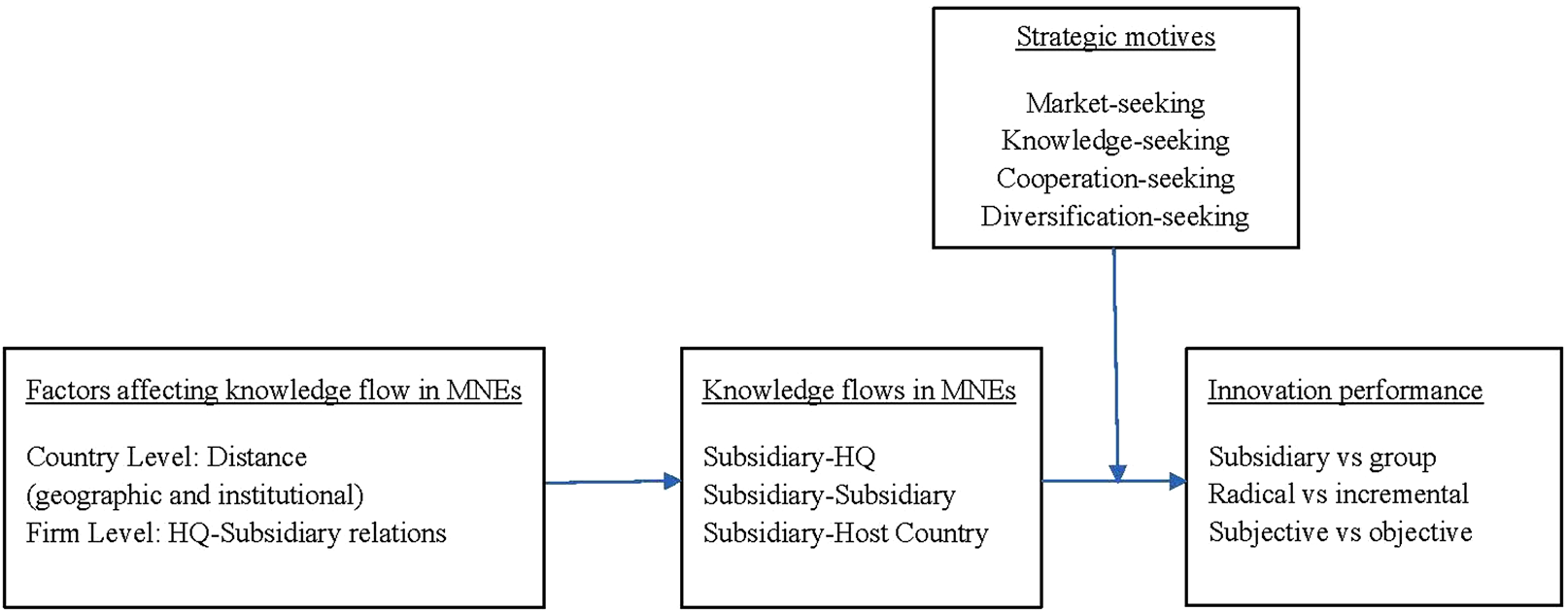
Finally, consistent with the knowledge-based theory of organisational capability (Grant, Reference Grant1996b), strategic innovation motives will affect the relationship between knowledge flows in MNEs and innovation performance, including generation of radical versus incremental innovations (Zhou & Li, Reference Zhou and Li2012). Innovation performance can be defined objectively (e.g., patent citations of the acquirer – Han, Jo, & Kang, Reference Han, Jo and Kang2018) or subjectively (e.g., subsidiary manager's perceptions of the extent to which the innovation in the subsidiary had affected its business performance – Ciabuschi, Holm, & Martín, Reference Ciabuschi, Holm and Martín2014). We focus on subsidiary's innovation performance, especially its role in generating radical innovation that advances the price/performance frontier by much more than the existing rate of progress (Gatignon, Tushman, Smith, & Anderson, Reference Gatignon, Tushman, Smith and Anderson2002). To integrate our theoretical discussion, we present a conceptual framework (see Figure 1) outlining core concepts and relationships we further investigate, extend and develop into specific propositions and model.
Factors affecting MNE knowledge flows and innovation performance

Method
The ‘why’ question of motives for international innovation investment is related to the ‘how’ question of (alignment with) knowledge flows between the foreign subsidiaries, HQ, other subsidiaries and various other actors, especially in the host country. While some preliminary conceptual structure has been imposed on the motives and their alignment with knowledge flows (Table 2), the motives for ANZ innovation investment require additional investigation and will be subject to qualitative inquiry. Similarly, while the previous section has reviewed the known aspects of theory of knowledge flows in relation to foreign subsidiaries, the ‘how’ questions of knowledge flows of ANZ multinationals' innovation investment in Europe and their alignment with the strategic motives (and their joint impact on innovation performance) are still open to research. The current knowledge in the field provides only a starting point for an inquiry guided by a qualitative research design and open-ended research questions.
Qualitative research
Qualitative research is uniquely suited to ‘open the black box’ of organisational processes, including the ‘how’, ‘who’ and ‘why’ of individual and collective coordinated action as it unfolds over time in a context (Yin, Reference Yin1994). The case study is a research strategy that focuses on understanding the dynamics present within a single setting. Birkinshaw, Brannen, and Tung (Reference Birkinshaw, Brannen and Tung2011) and Doz (Reference Doz2011) argue that qualitative research can play a significant role in international business and management literature since it can bring deeper insight into the complex constructs and contexts.
Case studies offer the opportunity for a holistic view of a process (Yin, Reference Yin1994). While examining a single case can suggest a general conceptual category or property, examining a few more can confirm it (Glaser & Strauss, Reference Glaser and Strauss1967). Multiple-case studies offer a potentially stronger base for theory building (Yin, Reference Yin1994). Interviews, as a means of qualitative research, provide the possibility to describe the ideas, knowledge and experiences of interviewees (Alvesson, Reference Alvesson2003). While recognising that there are several potential risks in using interviews in international business research, Macdonald and Hellgren (Reference Macdonald and Hellgren1999) inspire researchers to use them if they devote appropriate attention to addressing interviewees who are higher in the firm's information hierarchy.
We use Eisenhardt's (Reference Eisenhardt1989) process of building theory from case study research. A multiple-case study method approach is required to look ‘under the hood’ of new phenomena (Ghauri, Reference Ghauri2004), such as the key questions we answer in this study. In the first step, we have identified ANZ firms that conduct innovation in Europe from publicly available sources such as business press, trade promotion agencies and business intelligence websites. We have considered different types of participants based on their position, location and nationality, as these possibly affect their views on innovation:
• Managers of subsidiaries in Europe (usually not nationals of Australia and New Zealand)
• Global (HQ) innovation and R&D managers (usually Australian or New Zealand nationals)
Identified managers were contacted by telephone, email or LinkedIn. The interviews were based on a semi-structured guide that was piloted in three interviews. Although this study pursues a consistent line of inquiry, it also allows for the stream of questions to be fluid rather than rigid (Rubin & Rubin, Reference Rubin and Rubin2011). Confirmed participants received the questions prior to the interview. We used a triangulation of different approaches to the same task by (1) conducting interviews with European subsidiary innovation managers, (2) conducting interviews with innovation managers in the HQ and (3) fact checking the provided information through the EU innovation databases, http://www.factiva.com and MNEs' official websites. In qualitative research, instruments are typically derived from the properties of the setting and its actors' views of them. The researcher is essentially the main ‘instrument’ in the study (Miles, Huberman, & Saldana, Reference Miles, Huberman and Saldana2013). Lee and Lings (Reference Lee and Lings2008) suggest that having a framework allows researchers to structure their subsequent analysis more easily as they have a good idea of what concepts and categories are likely going to be there.
Data collection and analysis
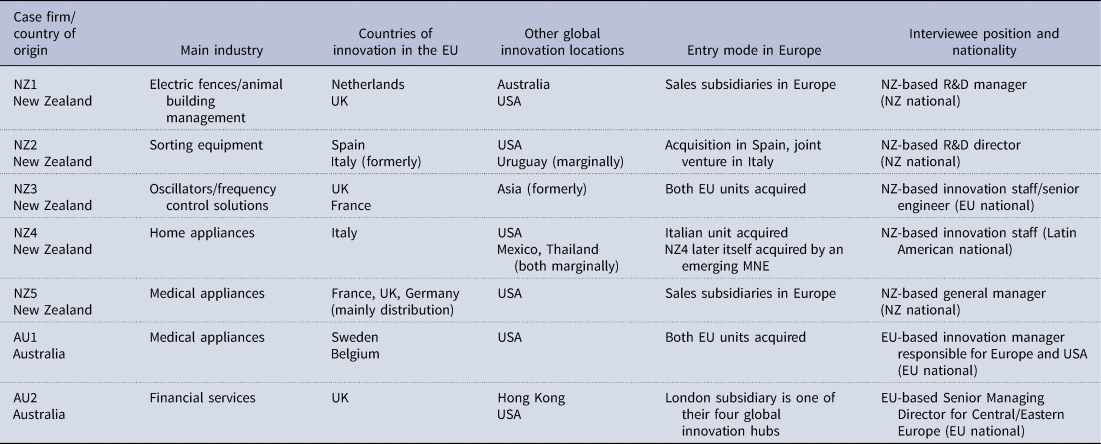
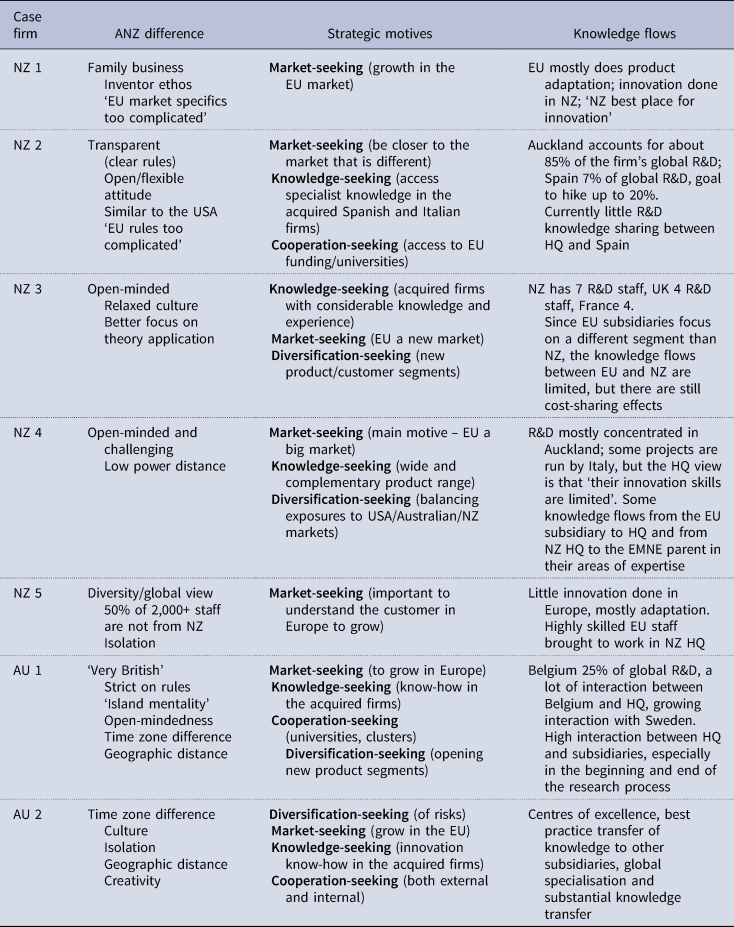
Based on the discussion above, we identified over 20 ANZ firms and investigated five New Zealand and two Australian firms with innovation-intensive subsidiaries in Europe. The industries range from finance to mechanical engineering, white goods and precision instruments (Table 3). The reason for investigating MNEs from a multiple-industry perspective is that given the nascent nature of the phenomenon (ANZ innovation investment in Europe), it would be impossible to have all cases operate in a single industry. Six of our cases are from similar sectors, machinery and appliances. We analysed our qualitative data through thematic analysis, a method that searches for themes or patterns in relation to different epistemological and ontological positions and identifies, analyses and reports themes in data (Braun & Clarke, Reference Braun and Clarke2006). Coding of themes, a crucial process in many qualitative data analysis strategies, informed our analysis (Bryman & Bell, Reference Bryman and Bell2015).
Description of cases

Cases
NZ1: This firm is a family business. A majority of its products are exported to the USA, Australia and Europe. It is a mature business, with its key invention dating back to 1938. Its R&D staff exceeds 100. The firm is a global leader in the innovation and marketing of animal management, security, fuel systems and contract manufacturing solutions. The EU has a secondary role in the firm's global innovation system, as there are different rules for many EU member states. The company maintains an open-door policy for its employees and supports innovative solutions. The motivation for locating their innovative activities was to create sophisticated products that would be the best in every direction. As the company has created innovative products used by agricultural businesses, it has expanded around the world. It has a strong sales network with a large number of partnerships, some of which have lasted more than 35 years.
NZ2: This company was initially formed in the 1980s to create solutions for handling produce in the fruit industry. It subsequently expanded internationally and is now a global market leader present in over 40 countries. It produces sorters, sorting systems, software and peripherals. The firm formerly had a joint venture in Italy. After some bad experience linked to the lack of control over Italian operations, it acquired a Spanish firm, where the firm experienced some difficulties related to cultural differences with ‘Southern Europe’. The firm's strategic plan is to grow its Spanish subsidiary from 7% to 20% of R&D and to 40% of global turnover while keeping its innovation HQ in New Zealand.
NZ3: Founded in 1967, this is a global high-technology company that designs and manufactures world-leading frequency control in infrastructure, space satellites and navigation devices. It has six manufacturing plants, including three joint venture plants and eight R&D centres. Its core strength is the intellectual knowledge in its R&D centres, located in NZ, France and the UK. Whereas its European subsidiaries operate in low-volume, sophisticated high-tech products for government clients, the NZ operations produce high-volume products for the telecom industry.
NZ4: This company, which dates back to 1934, engages in the design, manufacture, distribution and marketing of household appliances in New Zealand, Australia, North America and Europe. It operates in over 50 countries. In 2012, it was acquired by a major emerging market competitor and industry leader. The new owner retained most of the NZ4's operations and R&D in NZ. The NZ company acquired the Italian unit in 2006, and the combined effort and skills of the two R&D departments led to the development of more advanced and styled products.
NZ5: This major NZ corporation is a manufacturer, designer and marketer of products and systems for use in respiratory/acute care. It sells its products in 120 countries but focuses on the USA as a major source of revenue (it is primarily an export company). It has over 2,000 staff members in NZ, about half of whom are from abroad (often experienced managers). Europe does not play a major role in the firm's global innovation system, while the USA plays an important role. Its manufacturing plants are in New Zealand and Mexico. Product development and clinical research are critical to the firm's success as it continues to expand the range of innovative medical devices. New and improved products and processes, along with the development of new medical applications for new technologies, are critical drivers of its growth.
AU1: Based in Australia, this is a focused, innovative company founded in 1982. It produces technology that improves hearing for a wide range of people. It acquired a Swedish firm in a related line of business in 2005 to expand its range of product offerings and customer base. It also acquired a Belgian firm in 2000, which enabled access to digital design capabilities that complemented the company's existing technology and allowed it to improve the time-to-market of its product plans. Overall, the firm has about 300 R&D staff, and its R&D expenditure has been 12–16% of its revenue over the past 10 years. Belgium accounts for about 25% of the firm's global R&D, and Europe overall plays a crucial role in innovation.
AU2: This Australia-based global financial services provider has offices in 28 countries and four innovation hubs in Hong Kong, New York, Sydney and London. Each hub has several centres of excellence specialised in specific product categories, and created knowledge is transferred to other hubs and subsidiaries within the firm. Its expertise includes finance, research and retail financial services. The diversity of its operations, combined with a strong capital position and robust risk management framework, has contributed to almost 50 years of unbroken profitability. London is responsible for 14 of the group's 50 products, comprising about 35–40% of total innovation and 40% of profit.
Findings
Characteristics of ANZ firms
The interviewed firms characterised ANZ innovation staff as more open-minded, relaxed, challenging of authority (but following the rules afterwards) and untrusting of unknown people. One of the interviewees (AU2) noted: ‘They (Australians) prefer to send their own staff overseas. ANZ staff is seen as collaborative, with a global approach’. NZ5 noted: ‘It is not perfect for Europe because we have not made it for Europe; we have made it as perfect as it can be for the world’. Another aspect of the ANZ approach is that they are communicative but culturally distant in some cases. For example, an NZ2 interviewee commented on the firm's Southern European subsidiary: ‘Europeans just did not do what we wanted’. Another related comment (NZ4) was that ‘they [Europeans] have great experience with the market, but their innovation skills and transformation to the practice skills are a bit limited’. ANZ innovation staff often have a stronger focus on theory application than Europeans.
A distinguishing factor is that ANZ firms operate in a small, isolated market. NZ5 noted: ‘In New Zealand, we are at the bottom of the world. We have this mindset that you can do anything…you just have to figure it out’. They also find difficulties with the complicated law system and high costs in Europe. In contrast, non-ANZ interviewees noted that ANZ staff had an ‘island mentality’ and were less immersed/interested in developments in the rest of the world than Europeans. In general, transparency (clear rules, no ‘grey zones’), diversity (immigrant society), the importance of human factors, isolation and distance from Europe and other major economic centres (both geographic and time zone distance) were mentioned as distinguishing characteristics. This is illustrated by the following comment by the AU1 manager: ‘…this is another reason why you need the kind of European arm of the organisation. If you run that from Australia this is extremely difficult, because of distance and time difference’.Footnote 1 The findings suggest that both cultural (Peltokorpi & Yamao, Reference Peltokorpi and Yamao2017) and geographic distance (including time zone difference) hinder knowledge flows by reducing the quality of communication channels (Gaur, Ma, & Ge, Reference Gaur, Ma and Ge2019).
Hence:
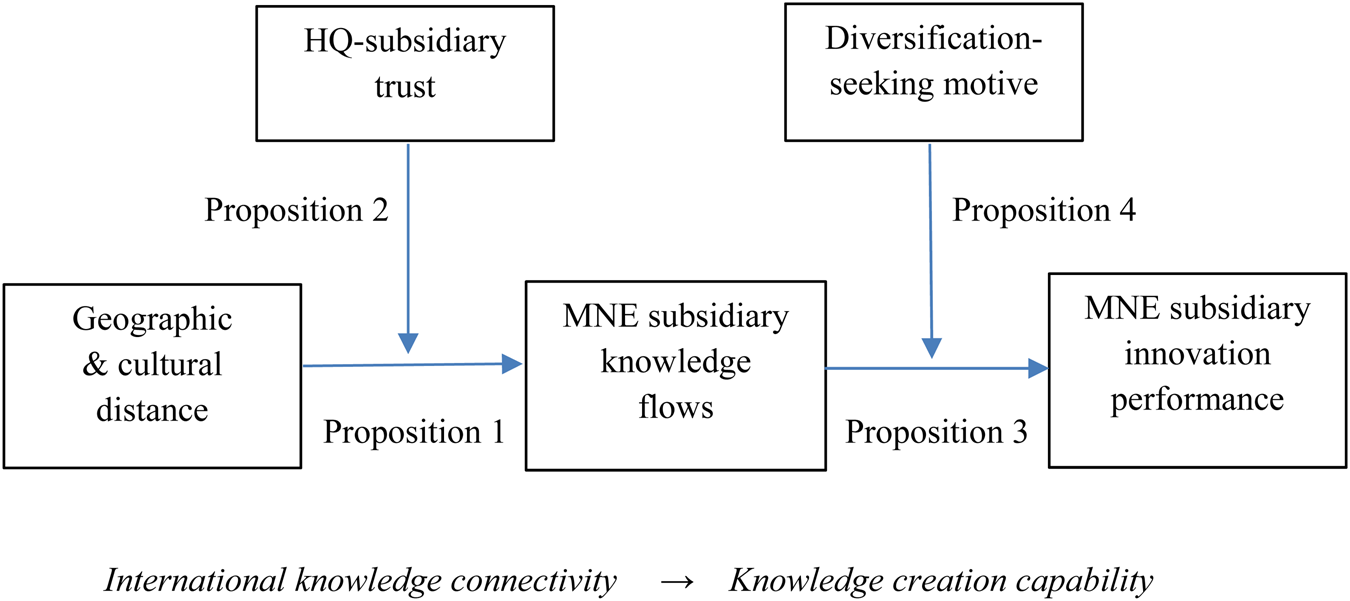
Proposition 1 Distance (cultural and geographic including time zones) between an MNE HQ and its foreign subsidiary negatively affects the quality of communication channels and thereby hampers the knowledge flows from the HQ to its subsidiary and vice versa.
Strategic motives
The companies cited market- and knowledge-seeking as their motives for innovation. While some saw the market-seeking motive as dominant, in line with the conventional wisdom for advanced MNEs (NZ1 and NZ5), most ANZ firms (NZ2, NZ3, NZ4, AU1 and AU2) used asset-augmentation strategies akin to those mostly ascribed to emerging multinationals (Buckley, Munjal, Enderwick, & Forsans, Reference Buckley, Munjal, Enderwick and Forsans2016), i.e. acquiring troubled European companies with considerable knowledge and experience with potential to grow (if managed properly) and gaining access to the firm's product in the European market.
Developed-country multinationals also use more traditional strategies, such as seeking complementary knowledge (Blanc & Sierra, Reference Blanc and Sierra1999). Overall, dual subsidiaries with both knowledge- and market-seeking motives prevailed. AU1 said, ‘HQ needed to have an R&D centre in Europe to be close to their customers, clusters and universities. We get perspective from the market, proposition validation, competitive analysis, trends, pricing and legal regulation this way. Acquisition of a company with new knowledge and products that was converted into an R&D centre was a great solution’. NZ4 said: ‘The acquisition of an Italian firm helped us with product adaptation and brand building and provided us with the platform to achieve strategic growth’. The CEO of the firm at the time also stated that the acquisition would provide further geographical diversification for them. Cooperation-seeking motives (Cuervo-Cazurra & Narula, Reference Cuervo-Cazurra and Narula2015; Reuer & Lahiri, Reference Reuer and Lahiri2014) were also present but were often seen as part of a diversified knowledge- or market-seeking strategy. Access to local clusters, universities, government financing and opportunities for knowledge transfer and cross-learning within the group were important motives (Arant, Fornahl, Grashof, Hesse, & Söllner, Reference Arant, Fornahl, Grashof, Hesse and Söllner2019).
‘We preferred global coordination before. In these days of permanent evolution, we have to be really close to customers, universities and knowledge clusters. We grow through acquisitions, and our main motive is diversification of risks’, said AU2. Innovation in Europe is seen as a key aspect of a strategy for diversifying innovation portfolios (Garcia-Vega, Reference Garcia-Vega2006; Qiu & Cantwell, Reference Qiu and Cantwell2019). AU2 stressed diversification-seeking as the main motive, and NZ3 and NZ4 stressed it as an important motive. A key aspect of this strategy is centres of excellence responsible for a specific product range to diversify access to sources of knowledge around the globe (Cantwell & Janne, Reference Cantwell and Janne1999). AU2 manager said, ‘Our understanding of innovation is as follows: acquisition of R&D firms for our purposes, innovation of our own products and innovation in acquired firms for their purposes’. AU1 said: ‘We use different development teams for each product category, like Lego boxes. Each box is a basic technology block that can be used by any other subsidiary. This kind of diversified innovation creation is more effective for us’. NZ3 and NZ4 managers stressed that acquired firms (subsidiaries) conduct R&D of specialised products and in different locations independently, and then, they spread the created information around the MNEs. Diversification was seen as geographical diversification (‘balancing exposures to ANZ and American markets’), product and segment diversification and diversification of risk in portfolios of innovation initiatives. See Table 4 for a summary of findings in terms of ANZ difference, strategic motives and knowledge flows (discussed next).
Findings

Knowledge flows
The knowledge flows underlying the motives pointed to a view of innovation as cooperation among a number of stakeholders and knowledge flows in multiple directions (Andersson et al., Reference Andersson, Dasí, Mudambi and Pedersen2016; Parker, Tippmann, & Kratochvil, Reference Parker, Tippmann and Kratochvil2019). The geographic isolation (‘We are living on an island’) of many of the firms (NZ1, NZ2 and NZ5) lead to a high concentration of knowledge in their HQ (Belderbos, Leten, & Suzuki, Reference Belderbos, Leten and Suzuki2013). However, a large number of them also recognised the drawbacks of this isolation and centralisation, and they considered cooperation and knowledge transfer from the European subsidiaries and partners to the rest of group (NZ3, NZ4, AU1 and AU2). This was often more planned than executed, and created an implementation challenge. NZ2, for example, planned to increase the share of its European R&D within global R&D from 7 to 20% but admitted that ‘at the moment, there is little knowledge sharing between the HQ and Spain’.
AU1 generated 25% of its global R&D in Belgium and a significant share in Sweden, but there was significant tension between the HQ and the Belgian subsidiary: ‘Belgium needs more autonomy and wants to conduct more radical innovation; the HQ are a bit afraid and busy with incremental innovation. There is high interaction between subsidiary and HQ in the beginning and end of research process. During the research, everybody has got clear rules what to do’. The manager also noted that they needed to build up more trust with the HQ to reduce the negative impact of the high geographic and time zone distance on communication and knowledge flows. The AU1 manager linked the geographic distance factor to the potentially moderating role of trust in reducing the negative impact of distance on HQ–subsidiary knowledge flows: ‘The most important factor is trust. Because I'm heading an operation which is on the other side of the world so it's an entire day to travel, currently 10 h' time difference. If you don't trust someone then it just doesn't work’.
Knowledge flows between Belgium and Sweden were also limited despite their relative proximity. AU2, in contrast, generates 35–40% of its global innovation from London, which is its most important innovation hub. The firm does not have an innovation HQ but has four independent R&D centres, and it lets knowledge flow within the group in many areas, including radical innovation, facilitated by centres of excellence. Most of the projects are created or at least approved by HQ and are executed locally.
ANZ firms need the physical presence of R&D in Europe to be closer to their customers, universities, advisors, innovation experts and local government organisations. Centres of excellence with accumulated knowledge, best practice and global product managers are important for internal knowledge transfer (Andersson & Forsgren, Reference Andersson and Forsgren2000; Criscuolo & Narula, Reference Criscuolo and Narula2007). ‘Today, R&D is coordinated from NZ with the help of regions (adaptation for the market, information from customers and exchanging of ideas/concepts) and driven by an understanding of the market, product management, marketing, cross-functional cooperation, regulatory standards, procurement and innovative suppliers’, said NZ1.
To sum up, the most salient finding of our research related to factors affecting knowledge flows in MNEs was the moderating role of trust in reducing the negative effect of distance on HQ–subsidiary knowledge flows in both directions. Isaac, Borini, Raziq, and Benito (Reference Isaac, Borini, Raziq and Benito2019) suggested that subsidiary's external relational embeddedness, based on trust and adaptation, is positively associated with the foreign subsidiary's local innovations. Subsidiaries with quality relationships, characterised by high trust levels with the external local network, tend to be associated with higher knowledge flows among the network actors and facilitate the emergence of local innovations (Isaac et al., Reference Isaac, Borini, Raziq and Benito2019). We argue that a subsidiary's quality relationship and high trust levels with the HQ will improve the quality of communication channels (Aichhorn & Puck, Reference Aichhorn and Puck2017) and reduce the negative impact of (HQ–subsidiary) national distance on knowledge flows in the group (Smaliukienė, Bekešienė, Chlivickas, & Magyla, Reference Smaliukienė, Bekešienė, Chlivickas and Magyla2017).
Hence:
Proposition 2 HQ–subsidiary trust positively affects the quality of communication channels and thereby moderates (reduces) the negative relationship between (geographic and cultural) distance and HQ–subsidiary knowledge flows in both directions.
Innovation performance
While firms use various metrics to evaluate the success of their innovation strategies (profitability, return on innovation investment, patents generated by subsidiaries and the group), a number of organisations (NZ1, AU1 and AU2) mentioned radical innovation as a key issue in measuring and maximising innovation performance (Kristiansen & Ritala, Reference Kristiansen and Ritala2018).Footnote 2 AU1 emphasised that its Belgian subsidiary is more successful in and places more emphasis on radical innovation than the HQ, which creates tension with the HQ. The interviewed manager responsible for the European and American R&D operations noted that the firm needed to persuade the CEO that radically new innovation was crucial. ‘There is a permanent struggle with the HQ. They want more centralisation, we want autonomy’, he said. Currently, innovation is largely managed from Australia and executed regionally, with knowledge flows most intense in the beginning and end of the innovation process. The predominantly ‘market-seeking’ and ‘knowledge-seeking’ motives of AU1 – with only minor elements of ‘cooperation-seeking’ and ‘diversification-seeking’ motives – are restricting its ability to foster knowledge flows between HQ and subsidiaries and enhance the group's overall potential for radical innovation, knowledge creation and innovation performance (Arant et al., Reference Arant, Fornahl, Grashof, Hesse and Söllner2019; Castaldi, Frenken, & Los, Reference Castaldi, Frenken and Los2015).
All firms found R&D and innovation very important for the future performance (Ciabuschi, Holm, & Martín, Reference Ciabuschi, Holm and Martín2014; Figueiredo, Reference Figueiredo2011; Thakur-Wernz & Samant, Reference Thakur-Wernz and Samant2019). NZ3 noted: ‘It must be kept at the current level of 10–15% of the revenue. Product development is very costly and time consuming (design, theory, documentation, prototype testing, HQ approval, trial testing takes 3–4 years)’. AU2 said, ‘The cycle of product innovation is 5–15 years, with changes every year, but when customers refuse it, the R&D hub has to develop a new one (every third project is successful)’. AU2 was the only company that had diversification as its main innovation motive. AU2 manager suggested that their four independent innovation hubs – an organisational structure linked to the diversification-seeking motive – and knowledge flows from their centres of excellence to the group are behind their superior knowledge creation capability, radical innovations and innovation performance. According to the manager, the diversity of AU2's innovation operations, combined with a robust risk management framework, has contributed to over 45 years of profitability.
To integrate the findings related to the impact of knowledge flows on innovation performance, we develop two propositions. The first one establishes a link between subsidiary's internal and external knowledge flows and the resulting superior knowledge creation capability (Arikan, Reference Arikan2009; Smith, Collins, & Clark, Reference Smith, Collins and Clark2005; Su, Peng, & Xie, Reference Su, Peng and Xie2016a) and (radical) innovation performance through internal and external knowledge integration (Zhou & Li, Reference Zhou and Li2012). Subsidiaries that are able to develop knowledge-intensive linkages with internal and external actors simultaneously and with increased frequency and improved quality over time achieve relatively higher levels of innovative performance (Figueiredo, Reference Figueiredo2011). Arant et al. (Reference Arant, Fornahl, Grashof, Hesse and Söllner2019) hypothesised that the greater the number of geographically and cognitively distant linkages a firm has, the higher the probability to generate radical innovations. Building on these arguments, we propose:
Proposition 3 High-quality, frequent MNE subsidiary's knowledge flows (internal within the MNE and external with stakeholders in distant knowledge-rich host economies) have a potential to increase the chance of radical innovation and thus are likely to lead to better innovation performance of the subsidiary.
The final proposition suggests that MNEs with diversification-seeking motives are relatively better positioned to reap the benefits of innovation (especially radical) in their foreign subsidiaries because of having organisational structures and processes enhancing value-creating potential of knowledge flows from multiple hubs (Criscuolo & Narula, Reference Criscuolo and Narula2007), through centres of excellence (Chiesa, Reference Chiesa1995) and organisational capability of knowledge integration (Grant, Reference Grant1996b; Zhou, Zhou, Feng, & Jiang, Reference Zhou, Zhou, Feng and Jiang2019). Gupta and Govindarajan (Reference Gupta and Govindarajan2000) suggested that the motivational disposition of a subsidiary to share its knowledge with other units can be expected to be positively associated with outflows of knowledge from that subsidiary, and the motivational disposition of a subsidiary to seek/accept knowledge from other units can be expected to be positively associated with inflows of knowledge into that subsidiary. Consequently, organisations' motivational disposition to diversify their innovation sourcing and portfolio through locally embedded, independent and properly incentivised innovation hubs will positively moderate how an MNE subsidiary's knowledge flows affect its innovation performance. This will occur through extending existing knowledge creation capability (Smith, Collins, & Clark, Reference Smith, Collins and Clark2005) to encompass new knowledge (Grant, Reference Grant1996b) and encouraging (radical) innovation in foreign subsidiaries in knowledge-rich host economies (Arant et al., Reference Arant, Fornahl, Grashof, Hesse and Söllner2019; Zhou & Li, Reference Zhou and Li2012).
We conclude:
Proposition 4 The motivational disposition of the MNE (HQ and subsidiaries) to strategically diversify their innovation sourcing and portfolio of knowledge creation will moderate (enhance) the positive relationship between an MNE subsidiary's knowledge flows (internal and external) and its innovation performance.
Discussion
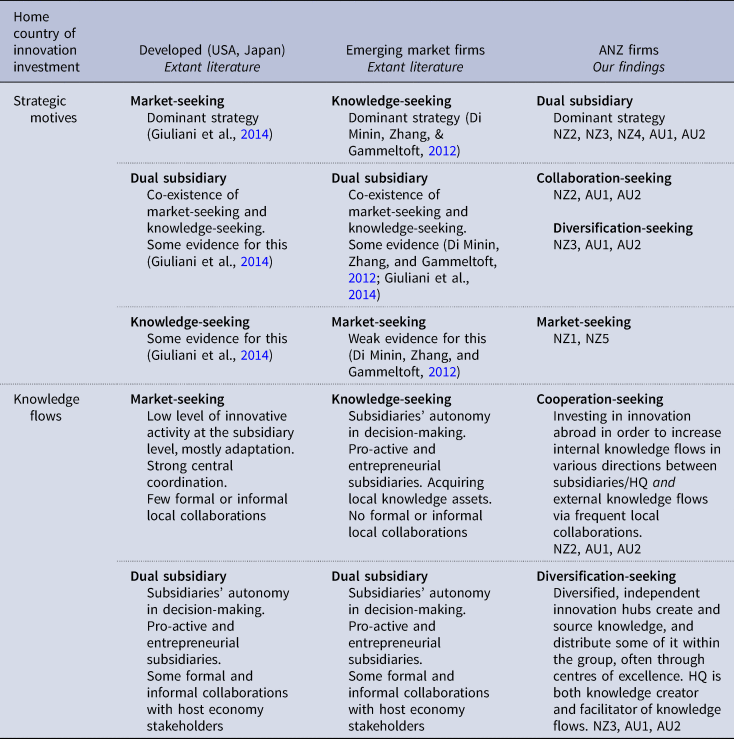
ANZ firms' innovation strategies in Europe tend to be less dominated by market-seeking motives than strategies of MNEs from the USA and Japan. ANZ firms often have ‘dual subsidiaries’ with both market- and knowledge-seeking motives. Cooperation- and diversification-seeking motives are important extra dimensions that characterise their strategies, distinguishing our findings from those of extant literature (see Table 5). While R&D internationalisation of non-traditional investor countries such as China have been studied (Di Minin, Zhang, & Gammeltoft, Reference Di Minin, Zhang and Gammeltoft2012) in the European context – with findings pointing towards unique motives and their dynamics – our study has dug deeper into the characteristics of these motives and underlying knowledge flows. Building on Achcaoucaou, Miravitlles, and León-Darder (Reference Achcaoucaou, Miravitlles and León-Darder2014), our framework acknowledges the role of the internal and external cooperation-seeking motive, but extends their dual embeddedness framework by considering the ‘diversification-seeking’ motive (diversification of innovation sourcing from different locations and R&D diversification within the group).
Comparison of findings for ANZ firms and extant literature

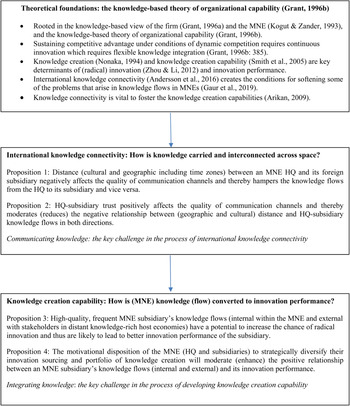
Figures 2 and 3 integrate our propositions into a model linking knowledge flows in MNEs to innovation performance, outlining the impact of factors affecting knowledge flows (geographic and cultural distance and HQ–subsidiary trust) and pointing to the moderating role of the diversification-seeking motive in the relationship between knowledge flows and innovation performance. The model is rooted in the knowledge-based theory of organisational capability (Grant, Reference Grant1996b), assuming that knowledge is the principal productive resource of the firm and suggesting that knowledge creation capability is the key determinant of innovation (Smith, Collins, & Clark, Reference Smith, Collins and Clark2005) and performance (Su, Peng, & Xie, Reference Su, Peng and Xie2016a). Furthermore, the model acknowledges that knowledge flow bottlenecks hinder knowledge creation (Gaur, Ma, & Ge, Reference Gaur, Ma and Ge2019) and that increasing (international) knowledge connectivity (Andersson et al., Reference Andersson, Dasí, Mudambi and Pedersen2016) may enable knowledge creation (Nonaka, Reference Nonaka1994) and knowledge creation capability (Arikan, Reference Arikan2009), rather than mere transfer (Cano-Kollmann, Cantwell, Hannigan, Mudambi, & Song, Reference Cano-Kollmann, Cantwell, Hannigan, Mudambi and Song2016).
The model of international knowledge connectivity and knowledge creation capability

Summary: the model of international knowledge connectivity and knowledge creation capability

Our study makes two key contributions to the research on R&D and innovation internationalisation. First, by uncovering the moderating role of under-explored diversification-seeking innovation investment motive in the process of international knowledge creation, this research provides additional insights to the knowledge-based view (Grant, Reference Grant1996a). According to the knowledge-based theory of organisational capability, ‘sustaining competitive advantage under conditions of dynamic competition requires continuous innovation which requires flexible integration through either (a) extending existing capabilities to encompass new knowledge, or (b) reconfiguring existing knowledge within new patterns of integration’ (Grant, Reference Grant1996b: 385). Our research implies that extending existing capabilities to encompass new knowledge can be achieved through encouraging radical innovation in foreign subsidiaries with high local embeddedness, and building trust and improving knowledge flows and communication between the HQ and subsidiaries in a diversified innovation portfolio. Our model acknowledges the difficulties in knowledge transfer within firms (Uygur, Reference Uygur2013) and the importance of factors related to the transfer of (tacit) know-how within versus across firms (Eapen & Krishnan, Reference Eapen and Krishnan2019). We extend this research by linking MNE subsidiary knowledge flows (Michailova & Mustaffa, Reference Michailova and Mustaffa2012) to knowledge creation capability (Arikan, Reference Arikan2009) and innovation performance (Han, Jo, & Kang, Reference Han, Jo and Kang2018).
Second, this research contributes to the international business and management research on the internationalisation of innovation by extending previous studies that have addressed the dual embeddedness of foreign subsidiaries (Achcaoucaou, Miravitlles, & León-Darder, Reference Achcaoucaou, Miravitlles and León-Darder2014; Ciabuschi, Holm, & Martín, Reference Ciabuschi, Holm and Martín2014; Meyer, Mudambi, & Narula, Reference Meyer, Mudambi and Narula2011). This research develops a framework to link dual embeddedness (connections with the local market and within the group) to strategic motives behind them, and knowledge flows underlying them. By considering diversification-seeking motive, we also move beyond embeddedness towards a strategic diversification perspective on innovation (Hagedoorn, Lokshin, & Zobel, Reference Hagedoorn, Lokshin and Zobel2018) and knowledge connectedness (Scalera, Perri, & Hannigan, Reference Scalera, Perri and Hannigan2018). We respond to the call for deeper insights into understanding the nuances of knowledge flows in MNEs (Gaur, Ma, & Ge, Reference Gaur, Ma and Ge2019) by adjusting their systematic framework to develop a better understanding of the challenges associated with knowledge transfer in MNEs. While our frameworks and model build on Gaur, Ma, and Ge (Reference Gaur, Ma and Ge2019) in identifying factors affecting knowledge flow in MNEs, we highlight the distinct roles of geographic distance, isolation, time zone differences and trust, and link to the concept of ‘knowledge connectivity’ (Andersson et al., Reference Andersson, Dasí, Mudambi and Pedersen2016). Finally, we extend the Gaur, Ma, and Ge (Reference Gaur, Ma and Ge2019) framework to include strategic motives behind knowledge flows and their joint impact on innovation performance including generation of radical innovations, which are increasingly critical to sustainable competitive advantage (Arant et al., Reference Arant, Fornahl, Grashof, Hesse and Söllner2019).
Conclusions
Our paper responds to Cano-Kollmann et al.'s (Reference Cano-Kollmann, Cantwell, Hannigan, Mudambi and Song2016) call for studies that improve our understanding of knowledge connectivity including the nuanced conditions that either facilitate or reduce the transfer of knowledge across international innovation networks. We also contribute to the debates on the performance implications of knowledge creation capabilities (Su, Peng, & Xie, Reference Su, Peng and Xie2016a) with a focus on the moderating effects of trust and investment motives on the innovation process and its outcomes. Finally, we respond to Estrin and Meyer (Reference Estrin and Meyer2013) call for studies on industrialised and emerging-economy MNE strategies considering each country of origin with its unique features, rather than assuming a bimodal separation between emerging and industrialised economies.
Future research on international innovation can account for this diversity and heterogeneity of source countries and explain the complementarity of multiple motives behind different types of innovation investments. We would like to encourage more research on ‘diversification-seeking’ (Patel, Fernhaber, McDougall-Covin, & van der Have, Reference Patel, Fernhaber, McDougall-Covin and van der Have2014; Zámborský & Turner, Reference Zámborský and Turner2017) and ‘cooperation-seeking’ innovation strategies (Reuer & Lahiri, Reference Reuer and Lahiri2014; Un & Rodríguez, Reference Un and Rodríguez2018). This could lead us to a deeper understanding of internal and external innovation cooperation strategies of ANZ and other investors, as ANZ investors seem to be more prone to diversification and (internal) cooperation than other investors in Europe. Future research could also explore cross-border market and knowledge co-creation capabilities (Kazadi, Lievens, & Mahr, Reference Kazadi, Lievens and Mahr2016; Pitelis & Teece, Reference Pitelis and Teece2010; Su, Lin, & Chen, Reference Su, Lin and Chen2016b).
The tensions between HQ and innovative subsidiaries with regards to radical innovation are also an interesting area for further study. While foreign subsidiaries often have the potential to create more radically new innovation than MNEs' HQ, our findings suggest that the distant HQ is often reluctant to recognise this. It is thus crucial to understand and diagnose this home bias and create innovation management strategies that allow high-performing foreign subsidiaries to take a leadership role in their area of competence without being stifled by tendencies to centralise and control innovation from the HQ (Belderbos, Leten, & Suzuki, Reference Belderbos, Leten and Suzuki2013). This centralisation may make sense for MNEs from major economic centres (the USA, Europe and Japan) but may have pitfalls for MNEs from peripheral or emerging markets. While communication barriers related to time zone differences and distance are here to stay, organisations can create solutions to reduce these obstacles and build trust (Abrams, Cross, Lesser, & Levin, Reference Abrams, Cross, Lesser and Levin2003) and global knowledge-sharing systems that improve innovation performance.
The limitations of our research include the small sample and that we did not incorporate a comparison group into the analysis. We also did not delve deeper into the nature of knowledge transferred (Hadjimichael & Tsoukas, Reference Hadjimichael and Tsoukas2019) and into risks of external knowledge sharing (Ritala, Husted, Olander, & Michailova, Reference Ritala, Husted, Olander and Michailova2018). Our research has implications for policy and business. Policy makers can benefit from a deeper understanding of the motives of investors from the Asia-Pacific region (Verbeke, Roberts, Delaney, Zámborský, Enderwick, & Nagar, Reference Verbeke, Roberts, Delaney, Zámborský, Enderwick and Nagar2019) and other countries outside of North America and Europe that are becoming more prominent in global innovation. Improving connectivity remains a key challenge for (innovation) policy in New Zealand and other nations [Ministry of Business, Innovation & Employment (MBIE), 2019; European External Action Service (EEAS), 2019]. Business leaders from non-traditional investor countries can benefit from understanding the experience of innovative ANZ investors in the EU and how they prioritise various motives including diversification and cooperation. The innovation internationalisation paths of antipodean MNEs often have a different global footprint than those of traditional multinationals, which presents challenges of global coordination and knowledge sharing.
Acknowledgements
We would like to acknowledge the University of Auckland for its research funding for this project (Faculty Research Development Fund grant no. 3710496). We would also like to acknowledge the New Zealand European Union Centres Network for seed funding related to this project. Finally, we also thank participants of the 5th International Research Conference at Ashridge, Hult International Business School, Associate Professor Maureen Benson-Rea, Dr. Bernhard Dachs and two anonymous peer reviewers for their valuable comments on a draft of this paper.
Igor Ingršt earned his Master's degree in management and law from Masaryk University in Brno, Czech Republic. He is a doctoral candidate in the Department of Management and International Business at the University of Auckland Business School in New Zealand. Igor's research focuses on international innovation strategy.
Peter Zámborský earned his PhD from Brandeis University's International Business School. He is a Senior Lecturer in the Department of Management and International Business at the University of Auckland, New Zealand, and an Editorial Review Board member of International Journal of Emerging Markets. Peter's research focuses on foreign direct investment, knowledge spillovers, foreign market entry modes and global innovation strategy. He has published in the areas of international business, management and economics in journals including Journal of Management & Organization, Journal for East European Management Studies, Global Economy Journal and Eastern European Economics. Peter is the co-author (with Alain Verbeke et al.) of Contemporary International Business in the Asia-Pacific Region (Cambridge University Press, 2019).