Clostridium difficile infection (CDI) is one of the most common healthcare-associated infections (HAIs)Reference Miller, Chen, Sexton and Anderson 1 and an important contributor to morbidity and mortality for affected patients.Reference Butt, Foster and Keedwell 2 , Reference Pepin, Valiquette and Alary 3 Over the last decade, substantial increases in the incidence of CDI have been observed,Reference McDonald, Owings and Jernigan 4 , Reference Reveles, Lee, Boyd and Frei 5 likely related to the emergence of more virulent strains.Reference McDonald, Killgore and Thompson 6 , Reference Lim, Stuart and Mackin 7 Approximately 50% of CDI cases develop during the course of an inpatient hospital episode of care,Reference Dumyati, Stevens and Hannett 8 which may result in significantly longer lengths of stay (LOS) and, consequently, in greater healthcare costs.
In previous studies, the estimated attributable LOS due to CDI has varied between 3 and 21 days.Reference Ghantoji, Sail, Lairson, DuPont and Garey 9 – Reference Gabriel and Beriot-Mathiot 11 However, most of these analyses did not account for the timing of infection, a problem referred to as time-dependent bias.Reference Barnett, Beyersmann, Allignol, Rosenthal, Graves and Wolkewitz 12 – Reference Beyersmann, Kneib, Schumacher and Gastmeier 15 Only hospital days that accrue after the occurrence of the CDI are possibly secondary to infection, and failure to account for the timing of infection results in overestimation of the excess LOS. Moreover, longer LOS increases the risk of CDI, which, from the perspective of estimating impact of CDI, is the phenomenon of reverse causation. Using regression models to control for confounders of CDI and total LOS does not remove bias due to reverse causation,Reference Samore and Harbarth 16 and the magnitude of this bias is probably larger than the bias due to uncontrolled confounding.Reference Vrijens, Hulstaert, Van de Sande, Devriese, Morales and Parmentier 17 Statistical techniques such as multistate models (MSMs)Reference Commenges 18 can account for the timing of infection, but they are not commonly used.
Of the available studies estimating excess LOS among patients with CDI, only a few have attempted to account for the timing of infection.Reference Mitchell, Gardner, Barnett, Hiller and Graves 19 – Reference Lagu, Stefan and Haessler 21 Of these, 2 studies estimated an excess LOS attributable to CDI of approximately 5–7 days,Reference van Kleef, Green and Goldenberg 20 , Reference Ampel 22 but the third concluded that there was no significant prolongation of LOS due to CDI.Reference Mitchell, Gardner, Barnett, Hiller and Graves 19 Of these 3 studies, 2 used data from only 1 institution and were performed outside the United States. Consequently, these studies may be of limited generalizability due to the high degree of geographical variability in both CDI risk and average LOS across institutions and countries.
The objective of this study was to improve on the existing literature by evaluating the excess LOS attributable to CDI among patients hospitalized in acute-care facilities in the Department of Veteran Affairs (VA) healthcare system using an MSM to account for the timing of infection. The VA healthcare system is the largest integrated healthcare system in the United States and accounts for millions of inpatient episodes annually. This large scale allows for more precise estimation of the effect of CDI on inpatient length of stay. We hypothesized that the MSM estimates would indicate a smaller effect of CDI on inpatient LOS than estimates obtained using mean comparisons and that geographic variability could account for differences in previous estimates.
METHODS
Study Design and Patient Population
We conducted a retrospective cohort study of all hospitalizations at 120 acute-care facilities within the US Department of Veterans Affairs (VA) healthcare system between January 1, 2005 and December 31, 2012. Patients were eligible for inclusion in the study if they were hospitalized on a general medical, surgical, or intensive care unit (ICU), and patients were followed from the time of admission until death or discharge. Information on admission and discharge dates, patient movement within the hospital, laboratory tests, and other patient and hospital characteristics were obtained from the Corporate Data Warehouse (CDW), the VA’s clinical data repository that contains electronic health records and administrative data for more than 9 million inpatient admissions dating back to 1999. Data were accessed through the VA Informatics and Computing Infrastructure (VINCI). This study was reviewed and approved by the University of Utah Institutional Review Board (IRB) and the Research and Development Committee of the VA Salt Lake City Health Care System.
The primary exposure of interest in this study was the development of CDI at any time during hospitalization. A case of CDI was defined according to the US Centers for Disease Control and Prevention (CDC) laboratory-identified (LabID) event definition, wherein all nonduplicate laboratory tests indicating the presence of C. difficile toxin are considered as clinical infections without confirmation of the presence of diarrhea.Reference Hebden, Anttila, Allen-Bridson, Morrell, Wright and Horan 23 During the study period, C. difficile testing was performed using cytotoxin assays, enzyme immunoassays (EIA) for toxins A and/or B, and polymerase chain reaction (PCR), and testing was variable by facility and by year. Only the first infection during hospitalization was considered. The time of infection onset was defined as the date that the positive test was recorded. In accordance with current guidelines,Reference Cohen Stuart, Gerding Dale and Johnson 24 severe CDI was defined as leukocytosis (white blood cell count >15,000 cells/mm3) or elevated serum creatinine >1.5 times baseline value (where baseline is defined as the average SCr in the 90 days prior to CDI) within 4 days of the positive CDI result being recorded.
Patient-level characteristics, including sex, age, and admission and discharge dates were collected for each hospitalization. Underlying burden of illness was assessed using the Charlson-Elixhauser combined score within 1 year prior to admission.Reference Gagne, Glynn, Avorn, Levin and Schneeweiss 25 Admission to an ICU at the time of hospital admission was recorded as a dichotomous variable as a proxy for patient acuity at baseline. Facility-level characteristics, including number of beds (≤75, 76–150, or >150), Veteran Integrated Service Network (VISN, a geographical grouping of VA facilities smaller than census region), geographical census region (Midwest, Northeast, South, or West), academic affiliation, and rural or urban location were also collected for each hospitalization.
Statistical Analysis
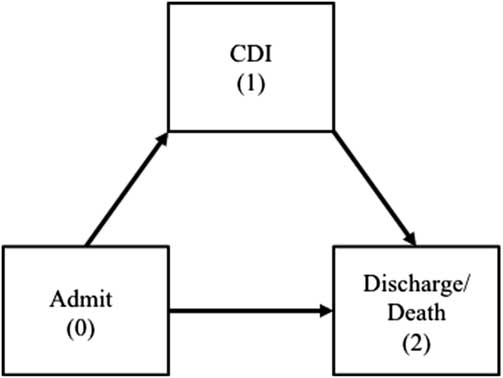
To assess the impact of CDI on the length of hospital stay, we constructed a nonparametric MSM (Figure 1) comprising 2 transient states (admission and infection) and a combined absorbing state (death and discharge), consistent with methods used in previous studies.Reference Barnett, Beyersmann, Allignol, Rosenthal, Graves and Wolkewitz 12 , Reference Mitchell, Gardner, Barnett, Hiller and Graves 19 , Reference van Kleef, Green and Goldenberg 20 , Reference Barnett, Batra, Graves, Edgeworth, Robotham and Cooper 26 To determine whether death might artificially reduce LOS, we constructed a second MSM in which death and discharge were treated as separate states. The overall estimates from the combined and separate endpoint models were nearly identical; therefore, all results presented are from the MSM using the combined endpoint. Because the transition from admission to infection could happen at any time, CDI was treated as a time-varying exposure. For the primary analysis, we evaluated the impact of CDI developed at any time during hospitalization on LOS. Because hospital-based interventions can only prevent infections that are acquired during hospitalization, we also evaluated the impact of healthcare facility onset (HCFO) CDI on excess LOS in a separate sensitivity analysis, excluding patients with CDI who developed their infection in the first 48 hours and any patient who was hospitalized less than 48 hours regardless of infection status. One of the main limitations of MSM models is the difficulty of accounting for other baseline covariates in the analysis using existing statistical packages. In an attempt to address this limitation, we assessed the potential impact of individual and facility-level factors on estimates of excess LOS by conducting subgroup analyses by selected characteristics, including age and admission to ICU at baseline.
Multistate model (MSM) to evaluate the excess length of stay (LOS) attributable to Clostridium difficile infection (CDI). This model used 3 states: (0) admitted and CDI-free (unexposed), (1) CDI (exposed), and (2) discharged alive or discharged due to death. Patients may only transition in the direction of arrows.

The probabilities of transitions between states (ie, from admission to discharge or from admission to infection and then to discharge) were estimated using the Aalen-Johansen estimator, which is a generalization of the Kaplan-Meier estimator for multiple states.Reference Allignol, Schumacher and Beyersmann 27 The mean excess LOS was then estimated by calculating the average difference in LOS between patients with and without CDI at each time t, weighted by time spent in the initial state. Bootstrapping techniques were used to generate robust 95% confidence intervals (CI) from 1,000 resampling runs of 3.96 million hospitalizations each.Reference DiCiccio and Efron 28 Separate re-sampling sets were generated for each subgroup analysis. All statistical analyses were conducted among patients with non-missing values (<1% for all variables except the Charlson-Elixhauser score). Descriptive analyses were conducted using SAS V9.4 (Cary, NC, USA). The MSM was fit using the etm package in R (http://www.r-project.org/).Reference Allignol, Schumacher and Beyersmann 27
RESULTS
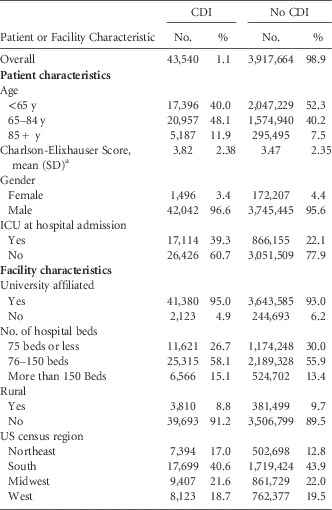
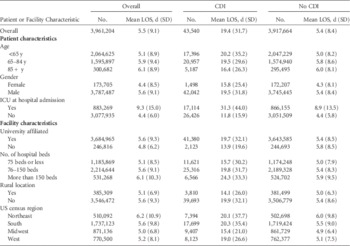
We included all eligible hospitalizations during the study period, totaling more than 3.96 million inpatient episodes and 21 million patient days of observation. A CDI developed in 1% (43,540) of those hospitalizations. Approximately half of CDIs (21,535; 49.5%) were considered mild to moderate and half (21,718; 49.9%) were considered severe. Among patients who developed CDI, the average time to positive CDI test was 7.6 days (SD 15.2). Characteristics of patients with and without CDI and their facilities are shown in Table 1. A higher proportion of patients with CDI were over age 65 at admission (60.0% vs 47.7%) and were more likely to have been admitted to the ICU at hospital admission (39.3% vs 22.1%). Patients with CDI had a slightly higher comorbidity burden than those without CDI, according to the Charlson-Elixhauser scores (3.82 vs 3.47, respectively). Table 2 displays the average LOS estimates by patient subgroup. Overall, patients were hospitalized for an average of 5.5 days (SD, 9.1). The mean LOS for patients who developed CDI was 19.4 days (SD, 31.7), compared to 5.4 days (SD, 8.4) for patients who did not develop CDI. The median (interquartile range) LOS for CDI and non-CDI patients were 11.0 days (SD, 17.0) and 3.0 days (SD, 4.0), respectively. Patients with CDI had longer LOS than patients without CDI across all subgroups.
Baseline Clinical and Facility Characteristics for Patients with and without C. difficile Infection (CDI)

NOTE. CDI, C. difficile infection; ICU, intensive care unit; US, United States.
a Among 2,943,342 patients with sufficient information to calculate the Charlson-Elixhauser score in the 1 year prior to admission.
Mean Lengths of Stay by Subgroup for Patients with and without C. difficile Infection

NOTE. CDI, Clostridium difficile infection; ICU, intensive care unit; LOS, length of stay; US, United States.
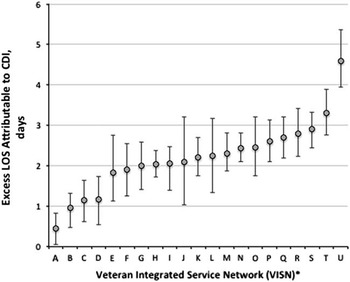
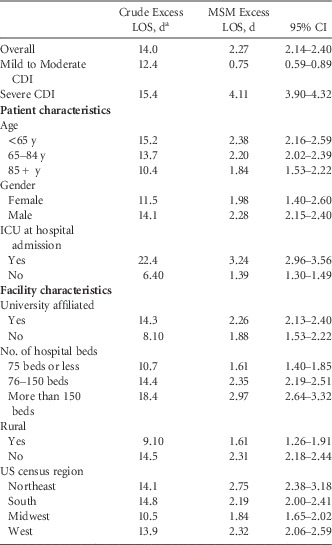
Unadjusted mean comparisons and estimates from the MSM are shown in Table 3. A comparison of means indicated that CDI was associated with an increase in LOS of 14 days. When accounting for the timing of infection using the MSM, the estimated excess attributable LOS was 2.27 days (95% CI, 2.14–2.40). Mild-to-moderate CDI resulted in an excess LOS of 0.75 days (95% CI, 0.59–0.89), whereas severe CDI added an estimated 4.11 days to LOS (95% CI, 3.90–4.32). CDI had the largest impact among patients who were admitted to the ICU at baseline; according to the MSM results, excess LOS was 3.24 days (95% CI, 2.96–3.56). Across all subgroups, the unadjusted differences in mean LOS between patients with and without CDI were between 4- and 7-fold higher than estimates generated by the MSM. Decreasing excess LOS was noted with increasing age: for patients aged <65 mean excess LOS among patients with CDI was 2.38; for those 65–84, it was 2.20; and for those patients aged 85+, it was 1.84 days. University-affiliated, urban, and larger hospitals had slightly higher estimates of excess LOS than non–university-affiliated, rural, and smaller hospitals. Variability in estimates of excess LOS was noted across geographical regions and by VISN. Estimates ranged from 1.84 days in facilities in the Midwest to 2.75 days in facilities in the Northeast. Figure 2 illustrates the variation in estimates by VISN. Estimates of excess LOS ranged from 0.45 days (95% CI 0.05–0.83) to 4.59 days (95% CI, 3.94–5.36). No trends in excess LOS were noted over time (data not shown).
Variability in the excess LOS attributable to CDI by the Veteran Integrated Service Network (VISN).

Estimates of Excess Length of Stay Attributable to C. difficile Infection among Hospitalized Veterans

NOTE. CDI, Clostridium difficile infection; LOS, length of stay; CI, confidence interval; ICU, intensive care unit; US, United States.
a Defined as the difference in mean LOS between patients with and without CDI.
Results from the MSM model with separate states for death and discharge were similar, except among the oldest patients, for whom death is a greater competing risk than CDI (data not shown). In the analysis of the impact of hospital-acquired CDI, 2.4 million hospitalizations >2 days and 22,250 cases of HCFO-CDI were included. The excess LOS attributable to HCFO-CDI was estimated to be 2.48 days (95% CI, 2.30–2.69) based on the result of our MSM.
DISCUSSION
In our study, CDI significantly contributed to LOS in the acute care setting. The crude difference in average LOS between patients with and without CDI was 14 days. When accounting for the timing of the infection using an MSM, the excess LOS attributable to CDI was 2.27 days. Crude estimates of excess LOS universally overestimated the impact of CDI on LOS across all patient subgroups by a factor ranging between 4 and 7. In agreement with previous work, the greatest impact of CDI was noted among patients who were admitted to the ICU at baselineReference Lofgren, Cole, Weber, Anderson and Moehring 29 and those with severe CDI.Reference van Kleef, Green and Goldenberg 20 Some geographic variability in estimates was noted; the greatest impact of CDI on LOS was observed among facilities in the Northeast census region. The variability in our estimates was consistent with the variation in the estimates from similar studies.Reference Mitchell, Gardner, Barnett, Hiller and Graves 19 – Reference Lagu, Stefan and Haessler 21
To policy makers, accurate estimates of the economic burden attributable to CDI and other healthcare-associated infections (HAI) are critical to determining the potential cost-effectiveness of implementing interventions. Because hospital costs vary among facilities, direct estimates of excess costs may not accurately represent costs at other institutions, particularly in settings with substantially different payment models. Because the main cost of HAIs arises from excess LOS,Reference Graves, Harbarth, Beyersmann, Barnett, Halton and Cooper 13 excess costs attributable to a particular condition can be estimated by multiplying the number of extra days of hospital stay by an estimate of how much that bed day costs the hospital to provide. Thus, estimates of excess LOS may be more useful to policy makers at other institutions because potential cost savings can be estimated using local estimates of the cost of a bed day. Generating accurate estimates of LOS attributable to HAI is challenging from a methodological standpoint because time-dependent bias arises from treating HAIs as if they were present at baseline (ie, on admission).Reference Wolkewitz, Allignol, Schumacher and Beyersmann 30 In such cases, the total LOS and costs accrued from admission onward are attributed to the HAI, resulting in an overestimation of attributable utilization.
The majority of previous studies reporting estimates of the excess LOS among CDI patients do not account for time-dependent bias. A recent review by Gabriel et alReference Gabriel and Beriot-Mathiot 11 reported estimates of attributable LOS ranging from 2.7 to 21.3 days across 24 studies, none of which addressed time-dependent bias.Reference Gabriel and Beriot-Mathiot 11 Variability in estimates of excess LOS can be observed even among the few studies that have been designed to take the timing of infection into account. In a cohort study matched on propensity score and pre-index LOS (defined as the number of days prior to infection for patients with CDI and the number of days prior to a randomly assigned index date for patients without CDI), Lagu et alReference Lagu, Stefan and Haessler 21 found that patients with CDI stayed in the hospital approximately 5 days longer than patients without CDI (95% CI, 4.4–5.7).
Thus far, 2 studies have evaluated the excess LOS due to CDI using MSMs with disparate results.Reference Mitchell, Gardner, Barnett, Hiller and Graves 19 , Reference van Kleef, Green and Goldenberg 20 In a study conducted at a single institution in the United Kingdom, van Kleef et alReference van Kleef, Green and Goldenberg 20 found that overall, CDI patients had an excess LOS of approximately 7 days (95% CI, 3.5–10.9), but the attributable LOS was substantially modified by severity of CDI. In their cohort, patients with severe CDI had an excess LOS of 11.6 days (95% CI, 3.6–19.6), whereas patients with mild-to-moderate CDI only stayed an additional 5 days (95% CI, 1.1–9.5).Reference van Kleef, Green and Goldenberg 20 In contrast, Mitchell et alReference Mitchell, Gardner, Barnett, Hiller and Graves 19 observed that CDI did not significantly contribute to LOS among inpatients 2 years and older at a hospital in Australia (0.9 days, 95% CI, 1.8–3.6).Reference Mitchell, Gardner, Barnett, Hiller and Graves 19 However, both of these studies were conducted at single institutions outside of the United States with relatively small numbers of CDI cases.
In our study, the impact of CDI on LOS varied across VISN and by geographic census region. In 4 of the 21 VISNs, the estimates for excess LOS were near 1 day or less, similar to the results from Mitchell et al.Reference Mitchell, Gardner, Barnett, Hiller and Graves 19 The highest VISN estimate was ~4.6 days, which is closer to the results observed by van KleefReference van Kleef, Green and Goldenberg 20 and Lagu.Reference Lagu, Stefan and Haessler 21 It is possible that the magnitude of excess LOS depends on the healthcare system, including typical discharge patterns. In addition, C. difficile is a genetically diverse organism. Strain types are geographically variableReference Cheknis, Sambol and Davidson 31 and have been linked to differences in disease severity, particularly among patients with the “epidemic” strain, BI/NAP1/027.Reference Walker, Eyre and Wyllie 32 As demonstrated in our results and the study from van Kleef et al,Reference van Kleef, Green and Goldenberg 20 CDI severity impacts the magnitude of excess LOS; thus, hospitals that have a greater proportion of CDIs caused by epidemic strains may observe a greater impact of CDI on LOS.
Our study has several notable limitations that should be considered when interpreting our results. The first is the possibility for misclassification in our CDI definition.Reference Baier, Morphis, Marsella and Mermel 33 We classified any laboratory test for CDI as an infection, and we were unable to verify the presence of clinical symptoms; however, agreement between clinical surveillance and LabID events has been estimated at ~80%.Reference Gase, Haley, Xiong, Van Antwerpen and Stricof 34 In addition, there were no standard testing practices across the included facilities during the study period. Therefore, the sensitivity and specificity of testing algorithms may have varied over time and across facilities. Our analysis is also limited by the inability to account for baseline comorbid conditions and other factors that may influence LOS in the MSM. We assessed ICU at admission as a proxy for acuity at baseline, and we found that the excess LOS attributable to CDI was higher (just under 2 days longer) for these patients than among those who were not admitted the ICU at hospital admission. While the underlying comorbidity burden appears to be relatively similar between CDI and non-CDI patients, average Charlson-Elixhauser scores may not be representative due to lack of information on patients without any prior outpatient visits. Finally, the VA healthcare system serves a very specific patient population. Thus, our results may not be generalizable to other settings. However, average LOS among VA inpatients is comparable to those in other inpatient settings. 35 Our study also has several important strengths. It is one of the few multicenter evaluations of the excess LOS attributable to CDI in the United States, and to date, it is the largest study to do so while accounting for the time-dependent nature of CDI. The large sample size in our study allowed us to evaluate potential variability in estimates by geographic region and across other patient subgroups in order to identify some potential sources of variation in attributable excess LOS estimates.
Overall, CDI is a significant contributor to patient LOS, but the magnitude of this effect has likely been overestimated in the past. Geographic variability in our VISN-specific and census region estimates is compatible with published results from individual institutions that account for the time-dependent nature of infection. Our results underscore the importance of using appropriate methods to evaluate the economic burden of CDI to avoid overstating the potential benefits of various interventions to prevent these infections.
ACKNOWLEDGMENTS
Financial support: No financial support was provided relevant to this article.
Potential conflicts of interest: All authors report no conflicts of interest relevant to this article.