Introduction
Dynamics of species diversity has been one of the major targets of ecological studies in the past three decades because of concerns regarding possible species extinction associated with habitat losses caused by human activities. Species diversity as a concept may be separated into two main components: richness of species (the number of species in a locality or region) and equitability (the number of individuals per taxonomic unit) (Magurran, Reference Magurran1988). Quantification of these numbers in a locality is the basis of models in community ecology, especially as they relate to the structure of assemblages, saturation of communities, species conservation and dynamics of extinction (Connell, Reference Connell1978; May, Reference May1988; Cornell, Reference Cornell1999).
In these studies, systematization of data collection methods is indispensable. In adult Diptera diversity surveys, the Malaise trap has been considered the most effective (Brown, Reference Brown2005). It is easy to maintain for long periods in the field, and can be deployed continuously without the use of attractants (Gressit and Gressit, Reference Gressit and Gressit1962; Breeland and Pickard, Reference Breeland and Pickard1965). During the design of the trap, different colours of the different parts of the trap were experimented on before the final combination was developed (Townes, Reference Townes1972). Inclusion of an attractant would restrict the use of the trap to only members of a specific guild, but a flight interceptance trap without attractants can be used for monitoring the diversity and relative abundance of all individuals that make up the Muscidae encountered in a community. However, changes in colour profile of the mesh resulting from long-term exposure of the trap to the environment may modify its capture efficiency as first noted by Roberts (Reference Roberts1975) while working with Tabanidae. After more than three decades of use, there are still no precise protocols concerning continuous outdoor exposure of Malaise traps and how this may influence their efficiency. Our objective was to study the possible influence of the exposure of the Malaise trap to the environment on the capture of individuals of different species of Muscidae in the Campos Sulinos biome.
Materials and methods
Insect collections for the study were obtained from Malaise traps placed at two locations in the Campos Sulinos biome, southern Brazil, located in the municipalities of Arroio Grande (32°13′22″S, 53°11′57″W) and Pelotas (31°44′39″S, 52°13′22″W). The muscids were sorted from samples collected weekly using two Malaise traps at each location between March and May, 2004, in Arroio Grande, and between April and June, 2004, in Pelotas, which gave 19 collections during the periods. The traps were based on the model of Townes (Reference Townes1962) with the modifications of the collecting receptacle proposed by Dutra and Marinoni (Reference Dutra and Marinoni1994). The traps were placed 10 m apart. A reference collection was deposited in the Museu Entomológico Ceslau Biezanko, Faculdade de Agronomia Eliseu Maciel and Universidade Federal de Pelotas.
To test the influence of the time of use of the Malaise trap in the field, we conducted two experiments. In Arroio Grande, we compared catches obtained from a new trap with those obtained from a trap that had been used continuously for 18 months in the field. In Pelotas, we compared a new trap with one that had been used continuously for 12 months. The data from the two locations were analysed independently by the generalized linear models, followed by analysis of residues to verify the distribution of errors and to evaluate the effect of use of the traps on catches of different species. All the statistical analyses were performed with the software R (R Development Core Team, 2009) with P < 0.05.
Results and Discussion
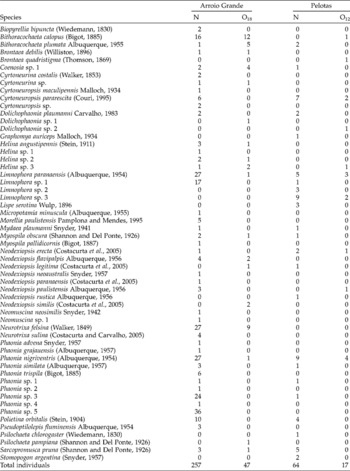
During the experimental period, we collected 385 muscids distributed between 57 species (Table 1). In both localities, the age of the traps appears to have influenced both the number of individuals of a given species and the number of species caught. In Arroio Grande, the new trap captured 257 individuals belonging to 46 species, while the 18-month-old trap captured 47 individuals belonging to 18 species ( = 110.11, df = 20, P < 0.001 and
 = 42.385, df = 20, P < 0.001), and in Pelotas, the new trap captured 64 individuals belonging to 23 species, while the 12-month-old trap captured 17 individuals belonging to 10 species (
 = 87.994, df = 16, P = 0.021 and
 = 53.675, df = 16, P = 0.029).
Abundance of species of Muscidae (Diptera) at two localities in Campos Sulinos biome, southern Brazil

N, new trap; O18, 18-month-old trap; O12, 12-month-old trap.
The older traps were less efficient than the new ones, probably because the white screen that covers the roof and large portion of the traps becomes darker depending on the time of exposure to the environment. Since the attracted insects that enter the traps move upwards in the direction of the light and are then concentrated in the collector flask, a darkened screen could affect this behaviour, with many individuals flying back and out of the trap. Such an effect of decreased luminosity inside the traps was observed previously by Roberts (Reference Roberts1975) in a limited experiment with horseflies (Diptera: Tabanidae) where new traps were found to capture five times more tabanids than 2-year-old, darker traps. However, the effect of colour of a trap may be different for different taxonomic groups, as shown by Tomé et al. (Reference Tomé, González, Gayubo and Tores2001).
Thus a study on relative species density and diversity based on catches with Malaise traps needs to take into account the results of the present study. Long-term use of the Malaise traps could affect trap catches, and lead to distorted interpretation of results of ecological studies and to biodiversity conservation strategies and use. Further studies are needed on this subject as Malaise traps continue to be the most efficient and common Muscidae sampling method.
Acknowledgements
We thank Philip J. Scholl for English language revision. J.L.P. Duarte (process number 136323/2008-1) and C.J.B. de Carvalho (process number 300873/2008-5) were supported by CNPq.