Horseradish is an important specialty crop grown in Illinois. Most horseradish production is in Madison and St Clair counties, which are in the Mississippi River Valley region adjacent to St Louis, Missouri (Shehata et al. Reference Shehata, Mulwa, Babadoost, Uchanski, Norton, Skirvin and Walters2009). Horseradish is produced in this area due to favorable soil characteristics and European immigrant settlement patterns (Bratsch Reference Bratsch2006). Soils in this part of Illinois are deep, friable, moist, and loamy with high organic matter. These soil conditions are conducive to root growth and digging and are therefore ideal for horseradish production (Johanning et al. Reference Johanning, Walters and Young2016). Although horseradish can be grown in a perennial production system, it is grown in an annual production system in Illinois (Walters and Wahle Reference Walters and Wahle2010). In an annual production system, root segments are planted in the soil and grow into an enlarged primary root with smaller secondary roots after 6 mo of growth. Root segments are typically planted in April to May, with enlarged primary roots harvested in late autumn (Shehata et al. Reference Shehata, Mulwa, Babadoost, Uchanski, Norton, Skirvin and Walters2009; Walters and Wahle Reference Walters and Wahle2010). Horseradish roots will often grow deeper than 4.3 m, although most of the horizontal growth is contained within a 0.5-m radius of the plant (Walters and Wahle Reference Walters and Wahle2010). Because horseradish has an extensive rooting depth, harvesting the entire root is nearly impossible, and various sizes of root segments remain in the soil after harvest (Johanning et al. Reference Johanning, Walters and Young2016). Due to the perennial nature of horseradish, volunteer plants can emerge from root segments remaining in fields following horseradish harvest and can become a localized pest in rotational crops such as corn and soybean (Rundle et al. Reference Rundle, Walters and Young2007). The presence of volunteer crop plants negates the many beneficial aspects of crop rotation, such as reduction of disease and insect pressure (Boydston Reference Boydston2001). Volunteer horseradish plants act as host for several pathogenic organisms (e.g., Verticillium dahliae, V. longisporum, and Fusarium solani) that cause internal root discoloration, which is a major problem in Illinois horseradish production (Babadoost Reference Babadoost2006; Rundle et al. Reference Rundle, Walters and Young2007; Walters Reference Walters2009). Therefore, volunteer horseradish control methods need to be developed to minimize regrowth.
In addition to volunteer horseradish, Palmer amaranth is becoming an important weed pest in southwestern Illinois soybean production. Moreover, Palmer amaranth in southwestern Illinois may be glyphosate resistant (GR; Heap Reference Heap2017). Beckie (Reference Beckie2006) noted that Palmer amaranth has become one of the most economically damaging GR weed species in the United States. Palmer amaranth has a remarkable ability to evolve herbicide resistance (Ward et al. Reference Ward, Webster and Steckel2013). Resistance to five different herbicide mechanisms of action (MOAs) has been confirmed in this weed species: acetolactate synthase (ALS) inhibitors, dinitroanilines (microtubule inhibitors), triazines (photosystem II inhibitors), glyphosate, and 4-hydroxyphenylpyruvate dioxygenase inhibitors. Some Palmer amaranth populations have been reported to be resistant to more than one of these MOAs (Burgos et al. Reference Burgos, Kuk and Talbert2001; Culpepper et al. Reference Culpepper, Webster, Grey, Vencill, Kichler, Webster, Brown, York, Davis and Hanna2006; Gaeddert et al. Reference Gaeddert, Peterson and Horak1997; Horak and Peterson Reference Horak and Peterson1995; Norsworthy Reference Norsworthy2008; Thompson et al. Reference Thompson, Peterson and Lally2012; Wise et al. Reference Wise, Grey, Prostko, Vencill and Webster2009). The majority of these GR populations evolved in cropping systems that were exposed to repeated glyphosate applications with little or no other herbicide MOAs used in weed management programs (Beckie Reference Beckie2011; Culpepper et al. Reference Culpepper, Webster, Grey, Vencill, Kichler, Webster, Brown, York, Davis and Hanna2006).
Volunteer horseradish infestations are also difficult to control in soybean production, causing potential problems with crop quality or potential rotational restrictions due to herbicide carryover concerns (Johanning et al. Reference Johanning, Walters and Young2016; Rundle et al. Reference Rundle, Walters and Young2007; Wiedau Reference Wiedau2017). Volunteer horseradish presence, as mentioned earlier, negates the effects of crop rotation, which is essential to minimize pathogens and insects for future horseradish crops (Rundle et al. Reference Rundle, Walters and Young2007; Walters and Wahle Reference Walters and Wahle2010). Field cultural practices, such as tillage, have shown to result in minimal volunteer horseradish reduction. Volunteer horseradish does not emerge uniformly in the field, because plants emerge from various-sized root pieces at varying soil depths. This makes volunteer horseradish difficult to control (Rundle et al. Reference Rundle, Walters and Young2007). Therefore, POST herbicides are an essential part of an integrated management system to control this weed. However, previous studies reported that glyphosate alone provided variable and inadequate control of volunteer horseradish at 870 g ae ha−1, with 86% control in 2006 and 43% control in 2007 (Johanning et al. Reference Johanning, Walters and Young2016) and only 76% foliar control and 57% root biomass reduction on some varieties at 840 g ae ha−1 (Rundle et al. Reference Rundle, Walters and Young2007); while Burke and Hopen (Reference Burke and Hopen1983) achieved effective control at the high rate of 4.5 kg ae ha−1 with an application in mid-September following disking. Johanning et al. (Reference Johanning, Walters and Young2016) found that treatments containing 2,4-D had among the highest efficacy, at 91% control or better, with the highest levels of control in combinations of 2,4-D and halosulfuron or 2,4-D and rimsulfuron + thifensulfuron; however, these treatments containing ALS inhibitors require a 36-mo plant-back restriction to specialty crops like horseradish. Johanning et al. (Reference Johanning, Walters and Young2016) also studied the use of dicamba for volunteer horseradish control, finding inconsistencies from year to year, with 91% control in 2006 and 56% control in 2007. Although there are previously reported inconsistencies in efficacy of dicamba on volunteer horseradish control, new technologies, such as dicamba-tolerant soybean, may become an important component in managing volunteer horseradish and GR Palmer amaranth. Dicamba is a low-cost, environmentally friendly herbicide that does not persist in soils for long periods of time and shows little to no toxicity to wildlife or humans (Behrens et al. Reference Behrens, Chakraborty, Jiang, LaVallee, Herman, Clemente and Weeks2007). Although these characteristics of low toxicity and persistence are favorable from a regulatory standpoint, care must be taken in applications of dicamba formulations to minimize risks of volatility and off-target movement. Dicamba is an auxinic herbicide and one of the most widely used herbicides in the United States (Todd and Suter Reference Todd and Suter2001), yet widespread resistance to dicamba has yet to be reported, in contrast to other commonly used herbicides (Heap Reference Heap2017).
Few herbicides used in soybean production will allow for rotation to horseradish in the subsequent year. However, sulfentrazone is labeled for use in both soybean and horseradish production; Sweat et al. (Reference Sweat, Horak, Peterson, Lloyd and Boyer1998) have reported that sulfentrazone alone controlled Palmer amaranth in the absence of protoporphyrinogen oxidase (PPO) inhibitorresistant biotypes. With the development of dicamba-tolerant soybeans, glyphosate plus dicamba can be applied PRE with no plant-back restrictions and POST through the R1 stage. Therefore, both glyphosate and dicamba can be used as part of an overall management program in soybean–horseradish rotations to control Palmer amaranth and volunteer horseradish and to also allow growers to plant horseradish the following year with no carryover concerns (Wiedau Reference Wiedau2017). Furthermore, Palmer amaranth control may be more successful through the use of effective PRE and POST herbicides. Therefore, the objective of this research was to evaluate: (1) the effectiveness of dicamba and glyphosate on volunteer horseradish control, as well as reduction of root biomass and viability; and (2) the efficacy of various herbicides in Palmer amaranth control in a simulated dicamba-tolerant soybean production system with horseradish crop rotation.
Materials and Methods
Volunteer Horseradish Experiment
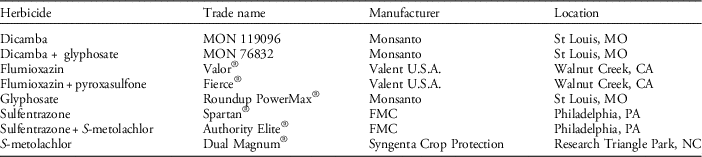
The effect of dicamba and glyphosate applications on volunteer horseradish control was evaluated in field experiments near Collinsville, IL, during 2014 (38.695°N, 90.022°W) and 2015 (Site 1: 38.634°N, 90.052°W; Site 2: 38.626°N, 90.061°W). The experiments were conducted in non-cropped fields to simulate a dicamba-tolerant soybean field. Fields were planted in either ‘9705’ or Hungarian horseradish the previous year (Source: Bluff View Farm, 8490 Forest Blvd., Caseyville, IL 62232). Soil type was a Worthen silt loam (fine-silty, mixed, superactive, mesic Cumulic Hapludolls) with approximately 3.1 % organic matter content, CEC of 11, and pH 4.9. The experimental design was a randomized complete block design (RCB) with a control (nontreated) and 6 herbicide treatments applied to 10- and 20-cm-tall volunteer horseradish plants. Treatments were replicated 4 times. Each plot was 3.3-m wide by 9.1-m long. Specific herbicide treatments evaluated were: (1) glyphosate (1,265 g ae ha−1), (2) glyphosate (1,893 g ae ha−1), (3) MON 119096 (dicamba; 280 g ae ha−1), (4) MON 119096 (dicamba; 560 g ae ha−1), (5) MON 76832 (proprietary mix of dicamba+glyphosate; 840 g ae ha−1), and (6) MON 76832 (proprietary mix of dicamba + glyphosate; 1,680 g ae ha−1) (Table 1). Herbicides were applied to 10-cm horseradish on July 1, 2014, and July 2, 2015, and to 20-cm horseradish on July 15 for both years. Before herbicide treatment applications, the entire experiment received sulfentrazone plus S-metolachlor at 280 g ai ha−1 and 1,420 g ai ha−1, respectively, PRE to control weeds. All herbicides were applied with a handheld CO2 backpack sprayer with TTI 11002 nozzle tips (TeeJet® 11002 Turbo TeeJet Air Induction nozzle tips, Spraying Systems, P.O. Box 7900, Wheaton, IL 60189) in 140 L ha−1 spray volume at 207 kPa.
Herbicides evaluated in field studies for volunteer horseradish and Palmer amaranth control.

Before herbicide treatment applications, four volunteer horseradish plants were flagged in each plot for later evaluations. Volunteer horseradish control was visually estimated from 0% (no control) to 100% (dead) at 14, 28, 42, and 56 d after treatment (DAT). Previously flagged volunteer horseradish plants were dug from each plot by hand on November 6, 2014, and November 11, 2015. Roots from plants in each plot were rinsed and oven-dried at 62 C for 72 h to determine dry biomass reduction, while roots from four additional plants were dug from plots and planted into 7.5-L-volume plastic pots filled with a 1:1:1 mix of soil:sand:peat (Premier ProMix® BX, Premiere Horticulture, Quakertown, PA 18951) and planted on January 14, 2015, and February 9, 2016, at the Southern Illinois University Carbondale Horticultural Research Center Greenhouse for root viability testing. Root viability and fresh and dry root weights were collected on February 2, 2015, and March 9, 2016. For viability determinations, roots were stored in the cooler for 2 mo to simulate winter conditions and break dormancy before being planted in pots. Roots were considered viable if horseradish foliage emerged from the soil, and the percentage viability was determined based on the four roots planted for each replication.
ANOVA procedures were performed using PROC GLM (SAS v. 9.4, SAS Institute, Cary, NC 27513). For each experiment, the main effects and any interaction(s) were tested using ANOVA. For volunteer horseradish visual control ratings, there were no effects of timing, location, or year; therefore, these measures were pooled and analyzed with a one-way ANOVA to determine the effects of herbicide treatment. For percent root viability and root biomass, there were no effects of location or year; therefore, the effects of the treatment categories of herbicide by rate by plant size (10 cm vs. 20 cm) were analyzed, pooled over location and year. The dependent variables of percent root viability and root biomass were analyzed separately with two one-way ANOVAs to determine the effects of herbicide by rate by plant size. Herbicide treatment means for the variables evaluated were separated using Fisher’s protected LSD (P≤0.05).
Palmer Amaranth Experiment
The efficacy of dicamba alone or in combination with glyphosate for Palmer amaranth control was also evaluated in field experiments in Illinois during 2014 and 2015. Fields near Collinsville, IL, naturally infested with GR Palmer amaranth were selected for this experiment. One location (38.694°N, 90.028°W) was used in 2014, while two locations (same location as 2014 and one additional location, 38.689°N, 90.020°W) were used in 2015. Soil type in all fields was an Orion silt loam (coarse-silty, mixed, superactive, mesic Aquic Udifluvents) with approximately 2.5 % organic matter content, CEC of 14, and pH 7.1.
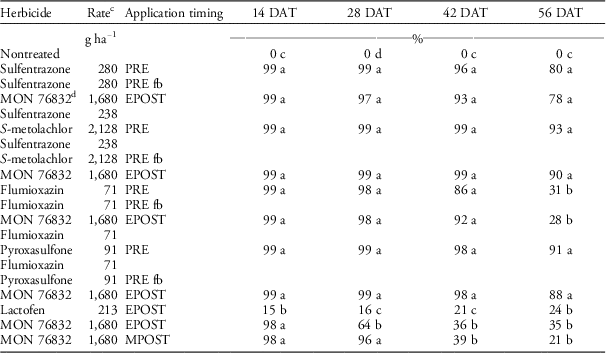
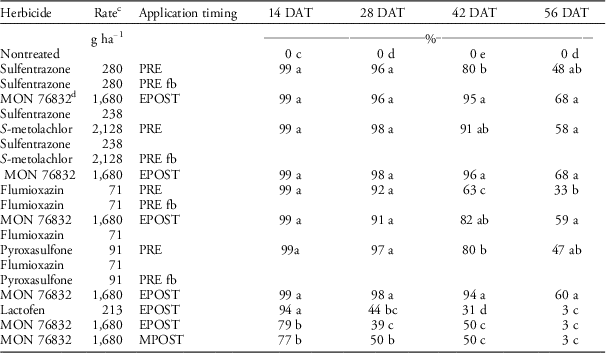
The experimental design was an RCB with 12 herbicide treatments and 4 replications. Each plot was 3.3-m wide by 9.1-m long. Herbicide treatments were: 1) sulfentrazone (280 gaiha−1) PRE; 2) sulfentrazone (280 gaiha−1) PRE fb MON 76832 (proprietary mix of dicamba+glyphosate, 1,680 gaeha−1) EPOST; 3) sulfentrazone (238 gaiha−1) plus S-metolachlor (2,128 gaiha−1) PRE; 4) sulfentrazone (238gaiha−1) plus S-metolachlor (2,128 g ai ha−1) PRE fb MON 76832 (proprietary mix of dicamba+glyphosate, 1.680 kg ae ha−1) EPOST; 5) flumioxazin (71 g ai ha−1) PRE; 6) flumioxazin (71 gaiha−1) PRE fb MON 76832 (proprietary mix of dicamba+glyphosate, 1.680 kgaeha−1) EPOST; 7) flumioxazin (71 g ai ha−1) plus pyroxasulfone (91 gaiha−1) PRE; 8) flumioxazin (71 g ai ha−1) plus pyroxasulfone (91 g ai ha−1) PRE fb MON 76832 (proprietary mix of dicamba+glyphosate, 1,680 gaeha−1 EPOST; 9) lactofen (213 gaiha −1) EPOST; 10) MON 76832 (proprietary mix of dicamba+glyphosate, 1.680 kg ae ha−1) EPOST; and 11) MON 76832 (proprietary mix of dicamba+glyphosate, 1.680 kgaeha−1) MPOST. Table 1 lists all the herbicides tested in this experiment. The experiment was conducted in a non-cropped, bare-ground system to simulate a dicamba-tolerant soybean field.
All herbicides were applied with a hand-held CO2 backpack sprayer using TTI 11002 nozzles in 140 L ha−1 spray at 207 kPa. PRE herbicides were applied on May 21, 2014, and May 19 and 21, 2015, which was 1 d after tillage. The first rainfall after herbicide application in 2014 was 38.1 mm on May 25. The first rainfall after herbicide application in 2015 was 108 mm on May 21 at Location 1 and 58.4 mm on May 26 at Location 2. PRE herbicides were followed by POST (EPOST and MPOST) applications. EPOST herbicides were applied to 10-cm-tall weeds on June 19, 2014, and June 17, 2015, while MPOST herbicides were applied to 20-cm-tall weeds on July 15, 2014, and June 25, 2015. Palmer amaranth was evaluated for visual control from 0% (no control) to 100% (dead) at 14, 28, 42, and 56 DAT.
ANOVA procedures were performed using PROC GLM in SAS. For each experiment, the main effects and any interaction(s) were tested using ANOVA. The 2014 data are presented alone and were analyzed using a one-way ANOVA. For 2015, no location by herbicide treatment interactions were detected; therefore, locations were pooled and analyzed using a one-way ANOVA. Herbicide treatment means for the variables evaluated were separated using Fisher’s protected LSD (P≤0.05).
Results and Discussion
Volunteer Horseradish Control
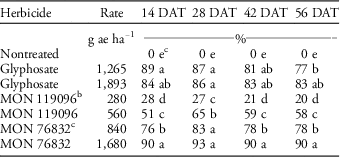
Volunteer horseradish control data were pooled over years and locations. No interactions were detected between year and herbicide treatment or location (P >0.05), and no differences were found between application timings (P>0.05). Thus, herbicide treatment means are presented by days after treatment (DAT) and pooled over application timings and years (Table 2).
Influence of glyphosate, dicamba, or their combination and rate on volunteer horseradish control at 14, 28, 42, and 56 d after treatment (DAT) combined over the application timings, locations, and years 2014 and 2015.Footnote a

a Application timing: 10- and 20-cm volunteer horseradish. Means within the same column followed by the same letter are not significantly different according to Fisher’s protected LSD at P=0.05.
b MON 119096 is dicamba alone.
c MON 76832 is dicamba + glyphosate.
In both years, dicamba alone (MON 119096) provided the lowest level of control across all treatments, rates, and times at 20% to 50% volunteer horseradish control at 56 DAT (Table 2). These data support research by Johanning et al. (Reference Johanning, Walters and Young2016) suggesting that volunteer horseradish control with dicamba alone at 560 g ae ha−1 was inconsistent at 91% in 2006 and 56% in 2007. However, in the present study, dicamba applied alone at 560 g ae ha−1 increased control of volunteer horseradish at 56 DAT by 38% compared with 280 g ae ha−1. Glyphosate alone provided better control than dicamba alone, with 77% at the low rate and 83% at the high rate at 56 DAT. Previous studies of volunteer horseradish control with glyphosate have been inconsistent but do show increasing efficacy with increasing glyphosate rate. Johanning et al. (Reference Johanning, Walters and Young2016) found 86% control in 2006 and 43% control in 2007 at 870 g ae ha−1, while Rundle et al. (Reference Rundle, Walters and Young2007) found 76% control at 840 g ae ha−1. Burke and Hopen (Reference Burke and Hopen1983) reported glyphosate provided effective control at 4.5 kg ae ha−1. The treatment combination of glyphosate plus dicamba (MON 76832) was more effective than dicamba alone but not significantly different from glyphosate alone. Glyphosate plus dicamba at the high rate provided 93% and 90% control at 28 and 56 DAT, respectively, while the same combination at the low rate controlled 83% and 78% of the volunteer horseradish at 28 and 56 DAT, respectively. The documented efficacy of glyphosate plus dicamba in the present study is also consistent with the findings of Wiedau (Reference Wiedau2017), showing that overall control ratings for glyphosate plus dicamba for five horseradish varieties grown in the greenhouse were equivalent to glyphosate alone but greater than dicamba alone.
Volunteer Horseradish Root Viability and Root Biomass Reduction
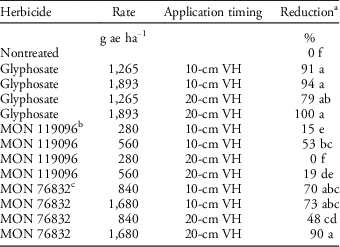
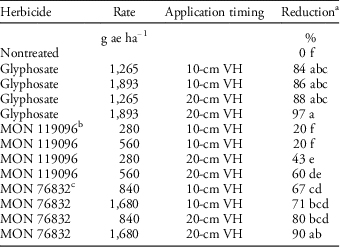
Data for horseradish root viability and biomass reduction were combined over both years and locations, since no interactions (P > 0.05) were detected between year and herbicide treatment or location. Means are presented as percent reduction in biomass and viability (Tables 3 and 4). All treated and flagged plants were not planted in the greenhouse due to natural decomposition of treated horseradish sets at the time of excavation. If horseradish sets were decomposed at the time of excavation, viability was recorded as zero. Glyphosate-only treatments were more likely to exhibit decomposition at the time of excavation.
Influence of glyphosate, dicamba, or their combination and rate as influenced by timing of herbicide application on percent root viability reduction of volunteer horseradish (VH) averaged across locations and years 2014 and 2015 at 120 d after treatment.

a Means followed by the same letter are not significantly different according to Fisher’s protected LSD at P=0.05.
b MON 119096 is dicamba.
c MON 76832 is dicamba plus glyphosate.
Effect of dicamba, glyphosate, or their combination and rate on root biomass reduction at 120 d after treatment as influenced by application timing on volunteer horseradish (VH) averaged across location and years 2014 and 2015.

a Means followed by the same letter are not significantly different according to Fisher’s protected LSD at P=0.05.
b MON 119096 is dicamba.
c MON 76832 is dicamba plus glyphosate.
Following similar patterns as visual control estimates, there were effects of herbicide treatment on volunteer horseradish root viability (Table 3). As already noted, plants treated with glyphosate only were more likely to be decomposed at excavation. This noted efficacy is in contrast to previously documented inconsistencies in control with glyphosate (Johanning et al. Reference Johanning, Walters and Young2016; Rundle et al. Reference Rundle, Walters and Young2007). Glyphosate alone provided the highest absolute measures of efficacy in root viability reduction across both plant heights and rates but was not statistically different from glyphosate plus dicamba (MON 76832); one exception to this trend was the decreased control of 20-cm plants at the low rate of glyphosate plus dicamba (840 g ae ha−1) compared with glyphosate-only treatments. Application of the low rate of glyphosate plus dicamba on 20-cm plants provided 48% root viability reduction, compared with 79% and 100% at the low and high rates of glyphosate alone. Dicamba alone was not an effective treatment for reducing root viability. Dicamba (MON 119096) applied alone on 10-cm volunteer horseradish reduced root viability by 15% at the low rate and by 53% at the high rate. However, dicamba applied alone on 20-cm volunteer horseradish reduced the viability by 0% and 19% at the low and high rates, respectively. These results suggest that the addition of dicamba to glyphosate may not result in greater control of volunteer horseradish roots than glyphosate alone.
The trends in root biomass reduction supported the trends in visual control estimates and root viability reduction (Table 4). Overall, measures of biomass reduction in the glyphosate-alone treatment (84% to 97%) were higher than but not statistically different from the glyphosate plus dicamba treatment (67% to 90%); with an exception in the higher-rate treatments on 20-cm plants. The glyphosate-alone treatment at 1,893 g ae ha−1 is more effective at reducing root biomass on 20-cm plants (97% reduction) than all the glyphosate plus dicamba treatments, except for the glyphosate plus dicamba treatment at 1,680 g ae ha−1 on 20-cm plants (90%). Increased efficacy of control on 20-cm plants compared with 10-cm plants might have resulted if the increased aboveground surface area allowed increased herbicide absorption and translocation to roots of similar sizes. Rundle et al. (Reference Rundle, Walters and Young2007) found that horseradish root segment size did not affect herbicide efficacy but did not examine root-to-shoot ratio effects on control efficacy. In contrast to efficacy of treatments containing glyphosate, the dicamba-alone treatment did not effectively reduce root biomass, providing only 20% root biomass reduction at the low rate on 10-cm volunteer horseradish and 43% reduction on 20-cm volunteer horseradish.
Palmer Amaranth Control
Data analysis is presented as a one-way ANOVA, with means presented by days after treatment (Tables 5 and 6). Treatments were significantly different between years (P<0.0001). The only difference between sites in 2015 was at 42 DAT for the PRE-only treatments (P=0.004). By 56 DAT, there were again no differences between sites (P=0.09). Therefore, the Palmer amaranth control data are presented for 2014 with one location and two pooled locations in 2015.
The efficacy of herbicide treatments and timing of application on Palmer amaranth control in non-crop in 2014.Footnote a , Footnote b

a Abbreviations: DAT, days after treatment; EPOST, early POST, 10-cm weed height; fb, followed by; MPOST, mid-POST, 20-cm weed height.
b Means within the same column followed by the same letter are not significantly different according to Fisher’s protected LSD at P=0.05.
c Flumioxazin, lactofen, pyroxasulfone, S-metolachlor, and sulfentrazone are g ai/ha; MON 76832 is g ae/ha.
d MON 76832 is dicamba plus glyphosate.
The efficacy of herbicide treatments and timing of application on Palmer amaranth control in non-crop in 2015.Footnote a , Footnote b

a Abbreviations: DAT, days after treatment; EPOST, early POST, 10-cm weed height; fb, followed by; MPOST, mid-POST, 20-cm weed height.
b Means within the same column followed by the same letter are not significantly different according to Fisher’s protected LSD at P=0.05.
c Flumioxazin, lactofen, pyroxasulfone, S-metolachlor, and sulfentrazone are g ai/ha; MON 76832 is g ae/ha.
d MON 76832 is dicamba plus glyphosate.
PRE-Only Applications
Generally, there were higher levels of Palmer amaranth control in the 2014 PRE-only applications than in 2015. However, ratings of PRE-only treatments often were not statistically different from PRE fb POST treatments in both years (Tables 5 and 6). The 2015 growing season was affected by above normal rainfall, compared with normal rainfall amounts in 2014. Rainfall following the PRE treatments for 2014 and 2015 by 14 DAT was 62 and 72.9 mm, respectively; sites received 104.3 and 185.4 mm by 28 DAT and 213.7 and 407.9 mm by 56 DAT for 2014 and 2015, respectively. Precipitation in 2015 may have leached PRE herbicides down into the soil and below the zone of germinating weed seeds. The appropriate amount of rainfall for effective treatment depends on the herbicide; the amount of precipitation needed to activate five soil-applied herbicides for residual Palmer amaranth control ranged from 0.5 cm for flumioxazin (among the least) to 1.3 cm for S-metolachlor (among the most) (Norsworthy et al. Reference Norsworthy, Still, Johnson, Bangarawa and Smith2010).
Loss of Palmer amaranth control in PRE-only applications was recorded 2 wk earlier in 2015 at 42 DAT as compared with 56 DAT in 2014. Flumioxazin had the lowest efficacy of all the PRE-only treatments, while the other PRE-only treatments were often equivalent to the PRE fb EPOST and more effective than the EPOST- and MPOST-only treatments. In 2014, flumioxazin alone controlled Palmer amaranth 98% and 31% at 28 and 56 DAT, respectively, similar to 2015, when flumioxazin alone controlled Palmer amaranth by 92% and 33% at 28 and 56 DAT. In contrast to these results, Whitaker et al. (Reference Whitaker, York, Jordan, Culpepper and Sosnoskie2011) rated flumioxazin as one of the three most effective herbicides for residual control of Palmer amaranth (along with fomesafen and pyrithiobac) in a comparison of 13 PRE herbicides; and flumioxazin has been shown to control Palmer amaranth for 6 wk or more after application in cotton (Gossypium hirsutum L.) (Cahoon et al. Reference Cahoon, York, Jordan, Everman and Seagroves2014; Price et al. Reference Price, Wilcut and Cranmer2002). Jordan et al. (Reference Jordan, York, Hinton, Seagroves, Eure and Hoffner2011) found that flumioxazin alone PRE gave 94% control, which increased to 100% with the addition of pyroxasulfone. Flumioxazin plus pyroxasulfone showed 99% and 91% control of Palmer amaranth at 28 and 56 DAT, respectively, in 2014; while in 2015, control efficacy decreased to 91% and 47% at 28 and 56 DAT, respectively.
Sulfentrazone alone or sulfentrazone plus S-metolachlor had higher efficacy than flumioxazin alone. Sulfentrazone-containing treatments were among the most efficacious at 56 DAT. In 2014, sulfentrazone plus S-metolachlor controlled 99% and 93% of Palmer amaranth at 28 DAT and 93% at 56 DAT, respectively; and in 2015, sulfentrazone plus S-metolachlor controlled Palmer amaranth 98% and 58% at 28 and 56 DAT, respectively. This 56 DAT measure in 2015 is only 10% greater than the sulfentrazone-only treatment. Sweat et al. (Reference Sweat, Horak, Peterson, Lloyd and Boyer1998) reported 100% control of Palmer amaranth with sulfentrazone in Kansas, which supports the high control rates seen in the present study with sulfentrazone.
PRE fb POST Applications
The PRE fb POST treatments were among the most efficacious treatments at all years and evaluation timings, with the exception of the flumioxazin PRE fb POST treatment (Tables 5 and 6). Flumioxazin alone PRE fb dicamba plus glyphosate EPOST controlled Palmer amaranth 98% and 28% at 28 and 56 DAT, respectively, in 2014, and 91% and 59% at 28 and 56 DAT, respectively, in 2015. Thus, control of Palmer amaranth at 56 DAT with flumioxazin PRE fb dicamba plus glyphosate EPOST was not as consistent as control with sulfentrazone PRE fb dicamba plus glyphosate EPOST. Steckel et al. (Reference Steckel, Eubank, Weirich, Scott and Montgomery2012) found that Palmer amaranth could be controlled with flumioxazin PRE fb glyphosate plus dicamba POST before plants reached a height of 12 cm. EPOST applications in the present study were made at 10-cm plant height and were within the target range reported by Steckel et al. (Reference Steckel, Eubank, Weirich, Scott and Montgomery2012).
POST-Only Applications
The least efficacious group of treatments were the POST-only treatments. In 2014, POST-only treatments containing dicamba plus glyphosate (MON 76832) performed better than the lactofen POST-only treatment; however, this trend was reversed in 2015 (Tables 5 and 6). Lactofen alone EPOST in 2014 provided only 24% control by 56 DAT. In 2014, dicamba plus glyphosate (MON 76832) alone applied EPOST or MPOST provided only 35% and 21% control of Palmer amaranth at 56 DAT, respectively. In comparison, lactofen (EPOST) alone or dicamba plus glyphosate alone EPOST or MPOST in 2015 provided only 3% Palmer amaranth control at 56 DAT. Previous studies of Palmer amaranth control with lactofen have shown high variability; lactofen at 220 g ai ha−1 applied EPOST to glyphosate-susceptible Palmer amaranth in the greenhouse resulted in 34% to 78% control, with similar variability in the field, from 41% to 90% (Mayo et al. Reference Mayo, Horak, Peterson and Boyer1995). Lactofen applications have also been shown to be most effective on weeds less than 8-cm tall (Ward et al. Reference Ward, Webster and Steckel2013); in the present study, EPOST was applied to 10-cm plants and MPOST was applied to 20-cm plants. However, the lack of control with EPOST application of lactofen in the present study is likely due to PPO-inhibitor resistance (Salas et al. Reference Salas, Burgos, Tranel, Singh, Glasgow, Scott and Nichols2016). The site used in 2014 is 0.8 km from one of the 2015 research sites for volunteer horseradish where Palmer amaranth was confirmed to be PPO-resistant in 2016. Quantitative PCR tests showed that 3 out of 16 plants were heterozygous for the Gly-210 deletion, suggesting a resistance frequency of 18.8% in this random sample of plants surviving treatments of fomesafen and lactofen (Heap Reference Heap2017). This population is also resistant to glyphosate. Site history does not suggest strong selection pressure for PPO resistance. This area is in the Mississippi River Valley region and, therefore, in the flightpath of several species of migratory birds that may ingest and transport Amaranthus seeds (KW Bradley, personal communication). Growers within this region should manage their fields as if PPO-resistant Palmer amaranth is already present to avoid potential control failures like those seen with lactofen in 2014 in the present study.
These data indicate that herbicides applied POST only are not very effective for Palmer amaranth control. Other research has shown that two passes of dicamba are necessary to provide effective control, EPOST fb MPOST, in a glyphosate system in Georgia dicamba-tolerant cotton (Cahoon et al. Reference Cahoon, York, Jordan, Everman, Seagroves, Culpepper and Eure2015). However, POST applications of glyphosate plus dicamba have been shown to improve the control efficacy of GR Palmer amaranth by 30% to 65% (Johnson et al. Reference Johnson, Young, Matthews, Marquardt, Slack, Bradley, York, Culpepper, Hager, Al-Khatib, Steckel, Moechnig, Loux, Bernards and Smeda2010). Volunteer horseradish and Palmer amaranth management will continue to be a challenge in soybean and horseradish production in southwestern Illinois. Dicamba alone provided the lowest control of volunteer horseradish and the lowest reduction in root biomass and viability. However, glyphosate alone and glyphosate plus dicamba (MON 76832) were effective for control of volunteer horseradish, resulting in a significant reduction in root biomass and viability. Thus, glyphosate plus dicamba may be an effective option to control volunteer horseradish and to reduce volunteer horseradish root biomass and viability, while allowing horseradish to be planted the following season. Our research also indicates that PRE treatments containing sulfentrazone plus S-metolachlor provided good control of Palmer amaranth while allowing rotation to horseradish the following spring (Wiedau Reference Wiedau2017); however, the evolution of PPO-resistant Palmer amaranth would lead to control failures with treatments containing sulfentrazone. Palmer amaranth in Arkansas has been documented as resistant to an 8X rate of all of the soil-applied PPO-inhibiting herbicides tested (Schwartz-Lazaro et al. Reference Schwartz-Lazaro, Norsworthy, Scott and Barber2017). Unless managed carefully, Palmer amaranth in other geographies may quickly evolve similar resistance to soil-applied PPO-inhibiting herbicides.
Therefore, in dicamba-tolerant soybean, the use of effective soil herbicides along with POST applications of dicamba plus glyphosate may assist in managing these pests. However, growers should use established best management practices in addition to herbicides to effectively manage these weeds (Norsworthy et al. Reference Norsworthy, Ward, Shaw, Llewellyn, Nichols, Webster, Bradley, Frisvold, Powles, Burgos, Witt and Barrett2012). Palmer amaranth has an extended emergence period (Jha and Norsworthy Reference Jha and Norsworthy2009); therefore, it is important to use diverse herbicide MOAs and overlapping soil-residual herbicides to minimize emergence of new plants, thus decreasing the evolutionary selection pressure imposed by POST applications (Duke and Powles Reference Duke and Powles2008; Whitaker et al. Reference Whitaker, York, Jordan, Culpepper and Sosnoskie2011) and possibly slowing the evolution of resistance to other herbicide MOAs.
Acknowledgments
We would like to thank Monsanto for funding and horseradish growers Dan Fournie and Barry McMillan for the use of their fields and support throughout this project. We also thank several researchers and graduate students for their assistance.