INTRODUCTION
The majority of directed studies of lipid levels and cognition, especially total cholesterol (TC) and low-density lipoprotein cholesterol (LDL-C), have been performed in non-Latino white participants (Anstey, Lipnicki, & Low, Reference Anstey, Lipnicki and Low2008; Lv et al., Reference Lv, Yin, Chei, Brasher, Zhang, Kraus, Kraus, Qian, Shi, Matchar and Zeng2016; Ma et al., Reference Ma, Yin, Zhu, Luo, Shi and Gao2017; Wardle et al., Reference Wardle, Rogers, Judd, Taylor, Rapoport, Green and Nicholson Perry2000). This is despite the fact that Hispanics/Latinos are less aware of their cholesterol levels (Rodriguez et al., Reference Rodriguez, Cai, Swett, Gonzalez, Talavera, Wruck, Wassertheil-Smoller, Lloyd-Jones, Kaplan and Daviglus2015) and have consistently elevated triglyceride (TG) levels compared to other minority groups (Rodriguez & Brenes, Reference Rodriguez, Brenes, Chavez-Tapia and Uriba2008). Furthermore, Hispanics/Latinos have a higher burden of dyslipidemia (Rodriguez et al., Reference Rodriguez, Daviglus, Swett, Gonzalez, Gallo, Wassertheil-Smoller, Giachello, Teng, Schneiderman, Talavera and Kaplan2014) and associated adverse cardiovascular (Daviglus et al., Reference Daviglus, Talavera, Aviles-Santa, Allison, Cai, Criqui, Gellman, Giachello, Gouskova, Kaplan, LaVange, Penedo, Perreira, Pirzada, Schneiderman, Wassertheil-Smoller, Sorlie and Stamler2012; Willey et al., Reference Willey, Rodriguez, Carlino, Moon, Paik, Boden-Albala, Sacco, DiTullio, Homma and Elkind2011) and select cerebrovascular (Gezmu et al., Reference Gezmu, Schneider, Demissie, Lin, Giordano and Gizzi2014) outcomes. Thus, more work is needed to study lipid levels and cognition in Hispanics/Latinos.
To date, studies in Hispanics/Latinos, studies have often been done within the context of metabolic syndrome (e.g., Gonzalez et al., Reference Gonzalez, Tarraf, Vasquez, Sanderlin, Rosenberg, Davis, Rodríguez, Gallo, Thyagarajan, Daviglus, Khambaty, Cai and Schneiderman2018), with fewer studies focusing on a complete lipid panel. The majority of studies suggest that the burden of metabolic syndrome and/or global cardiovascular disease risk is associated with cognition, including declarative memory, working memory, and information processing speed, in cohorts either including or composed exclusively of Hispanics/Latinos (Del Brutto, Mera, & Zambrano, Reference Del Brutto, Mera and Zambrano2016; Lamar et al., Reference Lamar, Durazo-Arvizu, Sachdeva, Pirzada, Perreira, Rundek, Gallo, Grober, DeCarli, Lipton, Tarraf, González and Daviglus2019; Levin et al., Reference Levin, Llabre, Dong, Elkind, Stern, Rundek, Sacco and Wright2014; Warsch et al., Reference Warsch, Rundek, Paik, Elkind, Sacco and Wright2013; Yaffe et al., Reference Yaffe, Haan, Blackwell, Cherkasova, Whitmer and West2007; Zeki Al Hazzouri et al., 2013). All but one (Del Brutto et al., Reference Del Brutto, Mera and Zambrano2016) found that individual lipid levels contributed to these cognitive profiles. More directed studies either including (Reitz et al., Reference Reitz, Tang, Manly, Schupf, Mayeux and Luchsinger2008) or composed exclusively of Hispanics/Latinos (Ihle et al., Reference Ihle, Gouveia, Gouveia, Freitas, Jurema, Tinoco and Kliegel2017; Parthasarathy et al., Reference Parthasarathy, Frazier, Bettcher, Jastrzab, Chao, Reed, Mungas, Weiner, DeCarli, Chui and Kramer2017) reported differing results based on the lipid level and/or background studied. For example, while TC and LDL-C levels did not contribute to cognitive impairment for Hispanics/Latinos of Caribbean background (Reitz et al., Reference Reitz, Tang, Manly, Schupf, Mayeux and Luchsinger2008), a Brazilian study reported associations between lower high-density lipoprotein cholesterol (HDL-C) level and lower declarative and working memory (Ihle et al., Reference Ihle, Gouveia, Gouveia, Freitas, Jurema, Tinoco and Kliegel2017). A study of a heterogeneous group of older adults fluent in English reported a negative association between TG levels and executive functioning but not memory (Parthasarathy et al., Reference Parthasarathy, Frazier, Bettcher, Jastrzab, Chao, Reed, Mungas, Weiner, DeCarli, Chui and Kramer2017). These studies lay the foundation for a comprehensive investigation of the relationship between lipid levels (i.e., TC, LDL-C, HDL-C, and TG) and cognition within a large cohort study of Hispanics/Latinos from multiple backgrounds.
The Hispanic Community Health Study/Study of Latinos (HCHS/SOL) provides the opportunity to systematically examine associations between individual lipid levels and cognition in mid- to late-life Hispanics/Latinos of different backgrounds (e.g., Mexican, Puerto Rican, Cuban, Central American, and Dominican). Given the outsized importance TG levels may play in the burden of disease in this population (Martinez-Larrad et al., Reference Martinez-Larrad, Lorenzo, Gonzalez-Villalpando, Gabriel, Haffner and Serrano-Rios2012; Rodriguez & Brenes, Reference Rodriguez, Brenes, Chavez-Tapia and Uriba2008; Vega-Lopez et al., Reference Vega-Lopez, Calle, Fernandez, Kollannoor-Samuel, Chhabra, Todd, Segura-Pérez, D’Agostino, Damio and Perez-Escamilla2013), and based on the previous studies of TG levels and cognition incorporating Hispanics/Latinos, we hypothesized that TG levels would be associated with working memory and executive functioning (but not memory) performance after adjusting for relevant confounders. We also explored associations between TC levels and cognition, with follow-up analyses investigating the contributions of LDL-C versus HDL-C on significant results. Given the conflicting results of the association between lipid levels and cognition in distinct Hispanic/Latino backgrounds (Reitz et al., Reference Reitz, Tang, Manly, Schupf, Mayeux and Luchsinger2008), and the fact that the Hispanic/Latino background contributes to differential levels of cholesterol and dyslipidemia (Daviglus, Pirzada, & Talavera, Reference Daviglus, Pirzada and Talavera2014; Daviglus et al., Reference Daviglus, Talavera, Aviles-Santa, Allison, Cai, Criqui, Gellman, Giachello, Gouskova, Kaplan, LaVange, Penedo, Perreira, Pirzada, Schneiderman, Wassertheil-Smoller, Sorlie and Stamler2012; Rodriguez et al., Reference Rodriguez, Cai, Swett, Gonzalez, Talavera, Wruck, Wassertheil-Smoller, Lloyd-Jones, Kaplan and Daviglus2015) and cognition (Gonzalez et al., Reference Gonzalez, Tarraf, Gouskova, Gallo, Penedo, Davis, Lipton, Argüelles, Choca, Catellier and Mosley2015), we also investigated whether background was an effect modifier of the association between lipid levels and cognition. Lastly, Hispanics/Latinos with dyslipidemia in HCHS/SOL were found more likely to be female (Rodriguez et al., Reference Rodriguez, Daviglus, Swett, Gonzalez, Gallo, Wassertheil-Smoller, Giachello, Teng, Schneiderman, Talavera and Kaplan2014); thus, we investigated whether sex was an independent effect modifier of the association between lipid levels and cognition. Investigating profiles of lipids and cognition in Hispanics/Latinos by background and sex may point toward biomarkers related to cognition in specific individuals.
METHODS
The HCHS/SOL is a population-based prospective cohort study of 16,415 Hispanics/Latinos ages 18–74 years from four U.S. cities (Chicago, IL; Miami, FL; Bronx, NY; San Diego, CA) that oversampled persons ages 45–74 years to facilitate the examination of target outcomes based on a multistage stratified probability sampling design (Lavange et al., Reference Lavange, Kalsbeek, Sorlie, Aviles-Santa, Kaplan, Barnhart, Liu, Giachello, Lee, Ryan, Criqui and Elder2010). The baseline examination (2008 to 2011) consisted of comprehensive biological, behavioral, and sociodemographic assessments (Sorlie et al., Reference Sorlie, Aviles-Santa, Wassertheil-Smoller, Kaplan, Daviglus, Giachello, Schneiderman, Raij, Talavera, Allison, Lavange, Chambless and Heiss2010). Cognitive testing was also conducted during this baseline examination, but only for individuals of age 45 years and older. The cohort includes participants who self-identified as having a Central American, Cuban, Dominican, Mexican, Puerto Rican, or South American background regardless of race or genetic ancestral markers. The sample design and cohort selection have been described in detail elsewhere (Lavange et al., Reference Lavange, Kalsbeek, Sorlie, Aviles-Santa, Kaplan, Barnhart, Liu, Giachello, Lee, Ryan, Criqui and Elder2010). This HCHS/SOL was approved by the Institutional Review Board at each site, all participants gave written informed consent, and the research was completed in accordance with the Helsinki Declaration.
Participants
Only men and women of age 45 years and older with baseline examination data related to lipid levels and cognition were considered for this cross-sectional analysis (N = 9714). We excluded 1696 participants who self-reported acute stroke, or substance abuse, and/or were found to have psychotropic medication use, including antianxiolytics, antidepressants, and antipsychotics based on the medication review at the study visit. Stroke (Mijajlovic et al., Reference Mijajlovic, Pavlovic, Brainin, Heiss, Quinn, Ihle-Hansen, Hermann, Assayag, Richard, Thiel, Kliper, Shin, Kim, Choi, Jung, Lee, Sinanović, Levine, Schlesinger, Mead, Milošević, Leys, Hagberg, Ursin, Teuschl, Prokopenko, Mozheyko, Bezdenezhnykh, Matz, Aleksić, Muresanu, Korczyn and Bornstein2017) and substance abuse (George & Koob, Reference George and Koob2017) can negatively impact cognitive health. Psychotropic medication use suggests the presence of anxiety, depression, and/or psychotic disorders serious enough to warrant pharmacological intervention. These conditions, and at times the medications used to treat them (Barker, Greenwood, Jackson, & Crowe, Reference Barker, Greenwood, Jackson and Crowe2004; Yeo, Lim, Mao, & Yau, Reference Yeo, Lim, Mao and Yau2017), may negatively impact cognition. Including these conditions and/or individuals using such medications in our analyses would confound our interpretation of results within the conceptual framework of lipid levels and cognition. We also excluded participants who were missing data on any cognitive variable (n = 428) or key covariate (n = 177). These exclusions resulted in 7413 participants.
Determination of Lipid Levels
Participants fasted for 12 hr prior to a blood draw by trained and certified clinical staff. Fasting blood samples were collected soon after participants’ arrival for their baseline visit, stored at −20°C, and shipped every week for analysis to the Lipoprotein Analytical Laboratory at the HCHS/SOL Central Lab at the University of Minnesota Medical Center. The Lipoprotein Analytical Laboratory participates in the Lipid Standardization Program of the CDC. TG levels were measured in EDTA plasma with the use of TG GB reagent (Roche Diagnostics) on a centrifugal analyzer. The TC level was measured using cholesterol oxidase enzymatic method. The LDL-C level was calculated using the Friedewald equation (Friedewald, Levy, & Fredrickson, Reference Friedewald, Levy and Fredrickson1972), and the HDL-C level was measured using an enzymatic method after the precipitation of non-HDL cholesterol with heparin and magnesium dextran sulfate. All field center procedures and laboratory protocols are available online: http://www2.cscc.unc.edu/hchs/manuals-forms.
Cognitive Testing
Test measures were administered in the preferred language of participants during face-to-face interviews by study staff trained and supervised by doctorate-level, licensed, clinical neuropsychologists. Our brief neuropsychological assessment was designed to limit participant burden during the 6-hr clinic visit and structured to include important outcomes associated with aging. The Brief Spanish English Verbal Learning Test (B-SEVLT) (Gonzalez et al., Reference Gonzalez, Tarraf, Gouskova, Gallo, Penedo, Davis, Lipton, Argüelles, Choca, Catellier and Mosley2015) asked participants to recall items from a 15-item list presented for three consecutive “learning” trials, followed by a 15-item distractor list and a free recall trial immediately following thereafter (Gonzalez, Mungas, & Haan, Reference Gonzalez, Mungas and Haan2002; Gonzalez, Mungas, Reed, Marshall, & Haan, Reference Gonzalez, Mungas, Reed, Marshall and Haan2001). Variables of interest included total learning across all three trials (range = 0 – 45) and recall postinterference (memory; range = 0 –15). Verbal fluency required participants to generate as many words as possible within 60 s that began with a specific letter, that is, “F” and “A” (Benton & Hamsher, Reference Benton and Hamsher1989; Lezak, Howieson, & Loring, Reference Lezak, Howieson and Loring2004). The total number of correctly generated words was summed across both trials and represents the executive ability of establishing and maintaining mental set and word retrieval flexibility. Digit symbol substitution (DSS) from the Wechsler Adult Intelligence Scale-Revised measured working memory and information-processing speed (Wechsler, Reference Wechsler1981) by requiring the rapid copying and encoding of symbols to numbers within 90 s. The variable of interest was the total number of correctly transcribed symbols during the time allotted. A brief Six-Item Screener measured orientation and mental status (higher = better performance) (Callahan, Unverzagt, Hui, Perkins, & Hendrie, Reference Callahan, Unverzagt, Hui, Perkins and Hendrie2002), with scores of 4 or lower suggestive of low mental status (Callahan et al., Reference Callahan, Unverzagt, Hui, Perkins and Hendrie2002; Gonzalez et al., Reference Gonzalez, Tarraf, Gouskova, Gallo, Penedo, Davis, Lipton, Argüelles, Choca, Catellier and Mosley2015).
Relevant Covariates
In addition to age, sex, education, and Hispanic/Latino background, we adjusted for the language of test administration, health insurance status, physical activity, diet, body mass index (BMI), diabetes, and hypertension. The language of administration may be an important consideration for cognitive testing in Hispanics/Latinos; thus, the language preference for testing (Spanish/English) was used as a covariate in all analyses. The health insurance status (yes/no) was also queried given that this may impact access to care, overall health, and well-being.
Physical activity levels, known to affect lipid levels (Lin et al., Reference Lin, Zhang, Guo, Roberts, McKenzie, Wu, Liu and Song2015) and cognitive health (Gonzalez et al., Reference Gonzalez, Tarraf, Gouskova, Rodriguez, Rundek, Grober, Pirzada, González, Lutsey, Camacho, Daviglus, Wright and Mosley2016), and highly associated with functional status in older adults (Paterson & Warburton, Reference Paterson and Warburton2010; Steeves, Shiroma, Conger, Van Domelen, & Harris, Reference Steeves, Shiroma, Conger, Van Domelen and Harris2019), were evaluated using the WHO Global Physical Activity Questionnaire (Surveillance, 2008) and determined per the 2008 physical activity guidelines available at the time of the HCHS/SOL Visit 1. Five mutually exclusive levels of physical activity were determined: inactive (no activity beyond baseline activities of daily living); low activity (activity beyond baseline but fewer than 150 min of moderate-intensity physical activity a week or the equivalent amount of vigorous-intensity activity or the equivalent combination of moderate and vigorous activities); medium activity (150 – 300 min of moderate-intensity activity a week or 75 – 150 min of vigorous-intensity physical activity a week or the equivalent combination of moderate and vigorous activities); high activity (more than the equivalent of 300 min of moderate-intensity physical activity a week or more than 150 min of vigorous activity or the equivalent combination of both); and not reported. Activity had to be performed in episodes of at least 10 min.
Nutritional differences are known to influence cholesterol levels (Howell, McNamara, Tosca, Smith, & Gaines, Reference Howell, McNamara, Tosca, Smith and Gaines1997; Jin & Nicodemus-Johnson, Reference Jin and Nicodemus-Johnson2018). We assessed diet intake via the 2010 Alternative Healthy Eating Index (AHEI-2010), a measure of diet quality based on 11 foods and nutrient components predictive of a chronic disease risk (Chiuve et al., Reference Chiuve, Fung, Rimm, Hu, McCullough, Wang, Stampfer and Willett2012). AHEI-2010 scores (range = 0 – 110, with higher scores representing healthier eating habits) were derived from available 24-hr dietary recall data (one to two recalls per participant). BMI, a known contributor to both lipid levels (Fall et al., Reference Fall, Hagg, Ploner, Magi, Fischer, Draisma, Sarin, Benyamin, Ladenvall, Åkerlund, Kals, Esko, Nelson, Kaakinen, Huikari, Mangino, Meirhaeghe, Kristiansson, Nuotio, Kobl, Grallert, Dehghan, Kuningas, de Vries, de Bruijn, Willems, Heikkilä, Silventoinen, Pietiläinen, Legry, Giedraitis, Goumidi, Syvänen, Strauch, Koenig, Lichtner, Herder, Palotie, Menni, Uitterlinden, Kuulasmaa, Havulinna, Moreno, Gonzalez-Gross, Evans, Tregouet, Yarnell, Virtamo, Ferrières, Veronesi, Perola, Arveiler, Brambilla, Lind, Kaprio, Hofman, Stricker, van Duijn, Ikram, Franco, Cottel, Dallongeville, Hall, Jula, Tobin, Penninx, Peters, Gieger, Samani, Montgomery, Whitfield, Martin, Groop, Spector, Magnusson, Amouyel, Boomsma, Nilsson, Järvelin, Lyssenko, Metspalu, Strachan, Salomaa, Ripatti, Pedersen, Prokopenko, McCarthy, Ingelsson and Consortium2015) and a sometime associate of cognition (e.g., Dahl & Hassing, Reference Dahl and Hassing2013; Han et al., Reference Han, Jo, Seo, Kim, Kim, Jo, Park and Park2009), was quantified via weight (kg)/height (m2).
Diabetes and hypertension were also measured given that they combine with lipid levels to contribute to metabolic syndrome. Diabetes status (presence/absence) was determined using the criteria set forth by the American Diabetes Association (ADA, 2018), which included at least one of the following: random glucose of ≥ 200 mg/dl; fasting glucose, ≥126 mg/dl; hemoglobin, A1C ≥6.5%; or, if available, 2-hr post-load glucose, ≥200 mg/dl during an oral glucose tolerance test. Diabetes was also defined based on the use of antidiabetic medication, determined by the medication review at the study visit. Hypertension status (presence/absence) was determined using the definition implemented in the NHANES. Thus, three blood pressure (BP) readings were obtained (and averaged) at 1-min intervals, following a 5-min rest period on the right arm, with the participant in a seated position and the arm resting. If the systolic or diastolic BP was greater than or equal to 140/90 or if antihypertensive medications were provided during the medication review, the participant was deemed hypertensive. We chose to adjust for the diabetes and hypertension status as opposed to continuous measures of glucose and/or BP, respectively, so that we could incorporate the presence/absence of medications for these conditions, which have been shown to affect cognition in older adults (Lamar et al., Reference Lamar, Wu, Durazo-Arvizu, Brickman, Gonzalez, Tarraf and Daviglus2017; Ryan et al., Reference Ryan, Freed, Rood, Cobitz, Waterhouse and Strachan2006). In addition, values of BP tend to be ‘censored’ due to treatment, occurring in over 30% of participants. Thus, continuous BP adjustment will not capture the entire effect of an individual’s BP. Additionally, adjusting for both continuous BP and hypertension treatment has been demonstrated in the context of modeling BP as a function of covariates to yield biased estimates of regression coefficients. Thus, we opted to use the hypertension and diabetes status as confounding variables to adjust for the effect of a health condition that reflects both levels and treatment.
Statistical Analyses
All summary statistics and formal statistical analyses were conducted in STATA 15.1 and accounted for the HCHS/SOL sample design, including sampling weights, cluster sampling, and stratification, to allow appropriate generalization to the target population (Lavange et al., Reference Lavange, Davis, Hankinson, Enright, Wilson, Barr, Aldrich, Kalhan, Lemus, Ni, Smith and Talavera2017). Separate multivariable linear regressions were used to adjust for potential confounders. Statistical significance was assessed via p-values ≤ .05 and 95% confidence intervals (CIs).
All lipid levels, that is, TC, HDL-C, LDL-C, and TG, were log2 transformed, for example, log2(TG) for triglyceride levels, not only to approximate normality but because our application of fractional polynomials to our data revealed that the log transform proved the best fit for the data. Thus, beta weights reflect the effect of doubling a given lipid level on cognition. While individual lipid levels are often converted into ratios, for example, a ratio of TG to HDL-C, we chose to analyze each variable separately given the fact that ratios may increase variability in our metrics and cause spurious correlations, making it difficult to interpret the exact contributing factors for resulting associations. Cognitive outcomes were normally distributed based on Q-Q plots and Kolmogorov-Smirnov testing (Razali & Wah, Reference Razali and Wah2011).
For each cognitive outcome (B-SEVLT learning and memory, verbal fluency, and DSS performance), we fit two survey linear regression models using log2(TG) and log2(TC) separately as continuous variables. Model 1 adjusted for age, sex, education, Hispanic/Latino background, language of test administration, health insurance status, physical activity, diet, and BMI. To determine whether other cardiovascular disease risk factors of diabetes and hypertension contributed to our results, we ran a second model (Model 2) adding these terms. If log2(TC) was statistically significant in Model 2, we substituted it with log2(HDL-C) and log2(LDL-C) as the predictor variables to determine whether good or bad cholesterol levels were driving results. We investigated whether background or sex was an effect modifier of the association between lipid levels and cognition by running a series of models that added either the interaction term log2(lipid)*background or log2(lipid)*sex to both Model 1 and Model 2. To aid in the interpretation of significant interaction terms (as appropriate given our corrected p-value of .01), we followed up with overall survey-adjusted Wald tests.
RESULTS
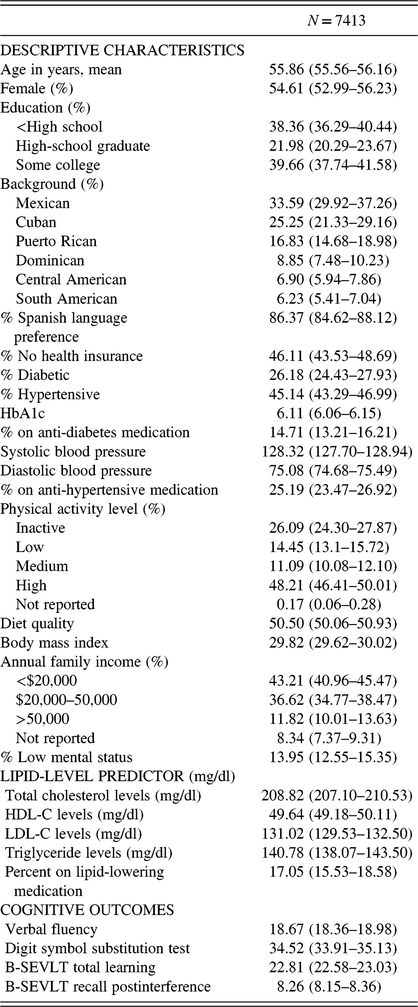
The key characteristics and cognitive test performance data for our target population may be found in Table 1. The levels of fasting TC were, on average, elevated above the published Cholesterol Clinical Practice Guidelines (Grundy et al., Reference Grundy, Stone, Bailey, Beam, Birtcher, Blumenthal, Braun, de Ferranti, Faiella-Tommasino, Forman, Goldberg, Heidenreich, Hlatky, Jones, Lloyd-Jones, Lopez-Pajares, Ndumele, Orringer, Peralta, Saseen, Smith, Sperling, Virani and Yeboah2018). The key characteristics and cognitive test performance data by Hispanic/Latino background may be found in Supplemental Table 1.
Summary statistics for the target population

Note: All values represent the mean percent (95% CIs) unless otherwise noted and account for the HCHS/SOL sample design (including sampling weights, cluster sampling, and stratification) to allow appropriate generalization of the target population, cluster sampling, and stratification (Lavange et al., Reference Lavange, Kalsbeek, Sorlie, Aviles-Santa, Kaplan, Barnhart, Liu, Giachello, Lee, Ryan, Criqui and Elder2010); low mental status = Six-Item Screener ≤ 4; B-SEVLT = Brief Spanish English Verbal Learning Test.
Triglyceride Levels and Cognitive Test Performance
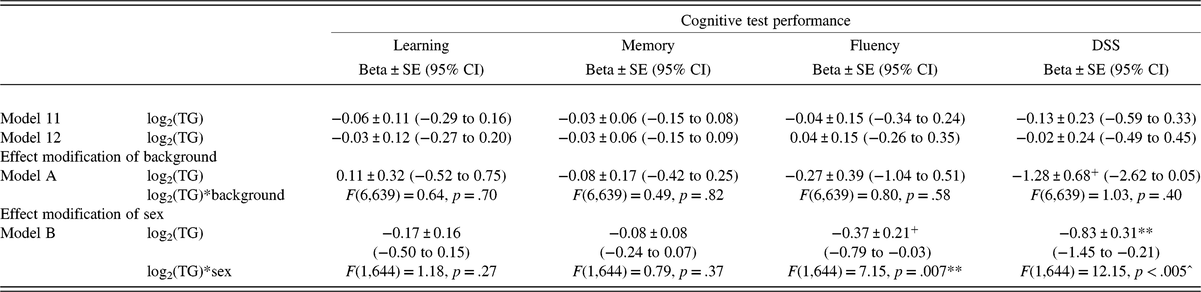
As seen in Table 2, log2(TG) levels were not associated with any cognitive test score, regardless of adjustments.
The association of triglyceride levels, log2(TG), with cognitive test performance

Note: log2(TG) = triglyceride levels log2 transformed to approximate normality and improve model fit; thus, beta weights reflect the effect of doubling triglyceride levels on cognition.
Model 1: Adjusted for age, sex, education, Hispanic/Latino background, language of test administration, health insurance status, physical activity, diet, and body mass index (BMI).
Model 2: Adjusted for age, sex, education, Hispanic/Latino background, language of test administration, health insurance status, physical activity, diet, and BMI, as well as diabetes and hypertension.
Effect Modification Model A: Adjusted for age, sex, education, Hispanic/Latino background, language of test administration, health insurance status, physical activity, diet, and BMI, as well as diabetes and hypertension, and included the interaction term of log2(TG)*background.
Effect Modification Model B: Adjusted for age, sex, education, Hispanic/Latino background, language of test administration, health insurance status, physical activity, diet, and BMI, as well as diabetes and hypertension, and included the interaction term of log2(TG)*sex.
ˆˆp < .001, ˆp < .005, **p < .01, *p< .05, +p < .10.
When we investigated whether background was an effect modifier, log2(TG) levels were inversely associated only with DSS performance but the log2(TG)*background interaction term did not meet the threshold for significance, regardless of adjustments (p-values ≥ .56). Thus, a doubling of TG levels resulted in a significant reduction in DSS performance by slightly over 1 point (beta = −1.40, SE = 0.67, t = −2.08, 95% CI = −2.72 to −0.08, p = .03) when adjusting for age, sex, education, Hispanic/Latino background, language of test administration, health insurance status, physical activity, diet, and BMI. While the magnitude of the effect did not change with the additional adjustments for hypertension and diabetes (Model A, Table 2), results did not meet the threshold for significance (p = .06).
When we investigated whether sex was an effect modifier of log2(TG) and cognitive test scores, the log2(TG)*sex interaction term was significant for fluency regardless of adjustments (p ≤ .008; Table 2); follow-up analyses did not reach the threshold for significance in the fully adjusted model (p-values ≥ .07). The log2(TG)*sex interaction term was significant for DSS regardless of adjustments (p ≤ .005). A doubling of TG levels was associated with a significant reduction in DSS performance for women (beta = −0.83, SE = 0.31, t = −2.65, 95% CI = −1.45 to −0.21, p = .008) in the fully adjusted model (Table 2). Sex was not a significant effect modifier for either B-SEVLT score regardless of adjustments (fully adjusted models outlined in Table 2).
Total Cholesterol and Cognitive Test Performance
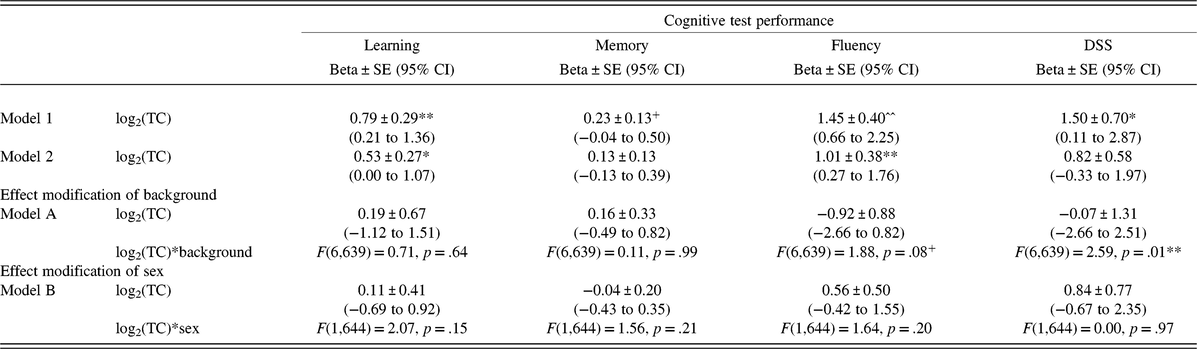
Several significant positive associations between log2(TC) and cognitive test variables were noted such that a doubling of TC levels was associated with an increase in performance across learning and verbal fluency, regardless of adjustments (all p-values < .05; Table 3). Follow-up analyses replacing log2(TC) with log2(HDL-C) and log2(LDL-C) levels as predictors to these cognitive test variables in fully adjusted models (Supplemental Table 2) revealed that log2(LDL-C) was driving the positive association between log2(TC) and both learning and verbal fluency. Thus, a doubling of “bad” cholesterol was associated with an increase in performance across both test scores, but only verbal fluency (p = .04) reached our threshold for significance (learning p-value = .06).
The association of total cholesterol, log2(TC), with cognitive test performance

Note: log2(TC) = total cholesterol levels log2 transformed to approximate normality and improve model fit; thus, beta weights reflect the effect of doubling total cholesterol levels on cognition.
Model 1: Adjusted for age, sex, education, Hispanic/Latino background, language of test administration, health insurance status, physical activity, diet, and BMI.
Model 2: Adjusted for age, sex, Hispanic/Latino background, language of test administration, health insurance status, physical activity, diet, and BMI, as well as diabetes and hypertension.
Effect Modification Model A: Adjusted for age, sex, education, Hispanic/Latino background, language of test administration, health insurance status, physical activity, diet, and BMI, as well as diabetes and hypertension, and included the interaction term of log2(TC)*background.
Effect Modification Model B: Adjusted for age, sex, education, Hispanic/Latino background, language of test administration, health insurance status, physical activity, diet, and BMI, as well as diabetes and hypertension, and included the interaction term of log2(TC)*sex.
ˆˆp < .001, ˆp < .005, **p < .01, *p < .05, +p < .10.
Results revealed the effect modification of Hispanic/Latino background only between log2(TC) and DSS performance (Model A p = .01; Table 3). Follow-up survey-adjusted Wald testing revealed that individuals reporting either a Puerto Rican or a Central American background showed a significant association between log2(TC) and DSS performance. More specifically, a doubling of TC was associated with a decrease in DSS performance for Central Americans (beta = −3.11, SE = 1.39, t = −2.24, 95% CI = −5.85 to −0.38, p = .02) but resulted in an increase in DSS performance for Puerto Ricans (beta = 2.95, SE = 1.16, t = 2.53, 95% CI = 0.66–5.25, p = .01) (Supplemental Table 3). When we replaced log2(TC) with log2(HDL-C) and log2(LDL-C) levels as predictors, there was a significant effect modification of Hispanic/Latino background and log2(LDL-C) on DSS performance in fully adjusted models similar to that outlined for log2(TC): Central Americans (beta = −2.07, SE = 0.98, t = −2.10, 95% CI = −4.01 to −0.13, p = .03); Puerto Ricans (beta = 1.75, SE = 0.80, t = 2.17, 95% CI = 0.16–3.30, p = .03).
Sex was not an effect modifier of log2(TC) for any cognitive test score in fully adjusted models (Model B p-values ≥ .15; Table 3). Thus, we did not conduct follow-up analyses replacing log2(TC) with log2(HDL-C) and log2(LDL-C) levels as predictors.
Post hoc Analyses of Cholesterol-Lowering Medication Use
Medication information gleaned from review and scanning at the baseline visit was used to determine cholesterol-lowering medication use for hypercholesterolemia (Table 1). Results reported in Table 1 did not change when considering the presence/absence of cholesterol-lowering medication use (data not shown).
DISCUSSION
This study investigated the associations of lipid levels (i.e., TG, TC, LDL-C, and HDL-C) with cognition in the largest study of mid- to late-life Hispanics/Latinos in the United States to date. Consistent with our hypothesis, TG levels were inversely associated with working memory performance as measured by DSS, however, only when considering the effect modification of TG by background. Further, although the magnitude of the association did not change substantially, it did not remain significant after an additional adjustment for hypertension and diabetes. In contrast, sex was a significant effect modifier of the association between TG and DSS performance, such that women with higher TG levels had a lower test performance. We found positive associations of TC and LDL-C levels (separately) with learning and verbal fluency. Lastly, we found significant effect modification of the DSS association by background, such that individuals reporting a Puerto Rican or Central American background showed a significantly stronger association between TC (and LDL-C) and DSS performance, albeit in opposite directions. Taken together, these results suggest differential associations of individual lipid levels with cognitive test performance that may depend on select demographic variables (i.e., sex and Hispanic/Latino background) in Hispanics/Latinos.
Our work in Hispanics/Latinos adds to the existing literature in non-Latino whites in several ways. The negative association between TG levels and working memory reported in our study extends previous reports of a negative association between TG levels and declarative memory in non-Latino whites and blacks (Leritz, McGlinchey, Salat, & Milberg, Reference Leritz, McGlinchey, Salat and Milberg2016), suggesting that this association exists in other populations as well as our own. Likewise, our results related to TC and LDL-C support previous studies suggesting that higher levels of these lipids are associated with higher declarative memory and attentional processes (Aine et al., Reference Aine, Sanfratello, Adair, Knoefel, Qualls, Lundy, Caprihan, Stone and Stephen2014; Elias, Elias, D’Agostino, Sullivan, & Wolf, Reference Elias, Elias, D’Agostino, Sullivan and Wolf2005; Henderson, Guthrie, & Dennerstein, Reference Henderson, Guthrie and Dennerstein2003; Leritz et al., Reference Leritz, McGlinchey, Salat and Milberg2016; Lv et al., Reference Lv, Yin, Chei, Brasher, Zhang, Kraus, Kraus, Qian, Shi, Matchar and Zeng2016) and extend it to include learning and working memory in a large cohort of mid- to late-life Hispanics/Latinos. While findings exist in the non-Latino literature suggesting that higher TC and LDL-C levels are associated with lower cognition (Lu et al., Reference Lu, An, Yu, Che, Zhang, Rong, Xi and Xiao2017; Meusel et al., Reference Meusel, Anderson, Parrott, Yuen, Tchistiakova, MacIntosh, Feldman and Greenwood2017; Smit et al., Reference Smit, Trompet, Sabayan, le Cessie, van der Grond, van Buchem, de Craen and Jukema2016; Solomon et al., Reference Solomon, Kareholt, Ngandu, Wolozin, Macdonald, Winblad, Nissinen, Tuomilehto, Soininen and Kivipelto2009; Stough et al., Reference Stough, Pipingas, Camfield, Nolidin, Savage, Deleuil and Scholey2019; van den Kommer et al., Reference van den Kommer, Dik, Comijs, Fassbender, Lutjohann and Jonker2009; van den Kommer, Dik, Comijs, Jonker, & Deeg, Reference van den Kommer, Dik, Comijs, Jonker and Deeg2012), the majority of these studies were conducted in older adults (Lu et al., Reference Lu, An, Yu, Che, Zhang, Rong, Xi and Xiao2017; Stough et al., Reference Stough, Pipingas, Camfield, Nolidin, Savage, Deleuil and Scholey2019), used significantly smaller sample sizes (Meusel et al., Reference Meusel, Anderson, Parrott, Yuen, Tchistiakova, MacIntosh, Feldman and Greenwood2017), were embedded within a longitudinal treatment study (Smit et al., Reference Smit, Trompet, Sabayan, le Cessie, van der Grond, van Buchem, de Craen and Jukema2016), or leveraged mid-life lipid levels to predict late-life cognition (Solomon et al., Reference Solomon, Kareholt, Ngandu, Wolozin, Macdonald, Winblad, Nissinen, Tuomilehto, Soininen and Kivipelto2009). Any one of these study differences would make direct comparisons difficult regardless of race or ethnicity. Taken within this larger context, our results point toward the importance of considering alternative metrics available in a lipid panel, for example, TG, when investigating the relationship between cholesterol and cognition in Hispanics/Latinos.
While the underlying mechanisms to explain these associations are beyond the scope of this cross-sectional study, potential underpinnings may be found in the literature. For example, the fact that our TG results did not withstand additional adjustments for hypertension and diabetes suggests that the negative association of TG levels on working memory scores in Hispanics/Latinos of this study may reflect the combined role of TG in the metabolic syndrome and overall cardiovascular disease risk factor burden as previously reported (Gonzalez et al., Reference Gonzalez, Tarraf, Vasquez, Sanderlin, Rosenberg, Davis, Rodríguez, Gallo, Thyagarajan, Daviglus, Khambaty, Cai and Schneiderman2018; Levin et al., Reference Levin, Llabre, Dong, Elkind, Stern, Rundek, Sacco and Wright2014; Warsch et al., Reference Warsch, Rundek, Paik, Elkind, Sacco and Wright2013; Yaffe et al., Reference Yaffe, Haan, Blackwell, Cherkasova, Whitmer and West2007; Zeki Al Hazzouri et al., 2013). The fact that female sex modified the negative association of TG levels on working memory, withstanding all adjustments, including those for hypertension and diabetes further suggests that the higher overall cardiovascular disease risk factor burden known to exist in Hispanic/Latino men compared to women (Daviglus et al., Reference Daviglus, Pirzada, Durazo-Arvizu, Chen, Allison, Aviles-Santa, Cai, González, Kaplan, Schneiderman, Sorlie, Talavera, Wassertheil-Smoller and Stamler2016; Daviglus et al., Reference Daviglus, Talavera, Aviles-Santa, Allison, Cai, Criqui, Gellman, Giachello, Gouskova, Kaplan, LaVange, Penedo, Perreira, Pirzada, Schneiderman, Wassertheil-Smoller, Sorlie and Stamler2012) may have diluted the effect of TG in the main analyses. Lastly, the fact that TG levels, the lipid that may play an outsized role in disease burden for Hispanics/Latinos (Martinez-Larrad et al., Reference Martinez-Larrad, Lorenzo, Gonzalez-Villalpando, Gabriel, Haffner and Serrano-Rios2012; Rodriguez & Brenes, Reference Rodriguez, Brenes, Chavez-Tapia and Uriba2008; Vega-Lopez et al., Reference Vega-Lopez, Calle, Fernandez, Kollannoor-Samuel, Chhabra, Todd, Segura-Pérez, D’Agostino, Damio and Perez-Escamilla2013), showed a negative association with cognition, suggesting that it may also play an outsized role in cognitive burden as well.
Select positive associations between TC and LDL-C levels and cognition showed an effect modification by background. Thus, while higher TC and LDL-C levels were associated with higher learning and verbal fluency performance overall, the association between TC and DSS was particularly robust for individuals of Puerto Rican and Central American background. Within HCHS/SOL, Puerto Ricans have the highest levels of awareness and treatment-related control of their cholesterol levels (Rodriguez et al., Reference Rodriguez, Cai, Swett, Gonzalez, Talavera, Wruck, Wassertheil-Smoller, Lloyd-Jones, Kaplan and Daviglus2015). Within this analytic sample, Puerto Ricans reported the lowest levels of uninsured individuals, while Central Americans reported the highest (Supplemental Table 1); additionally, Central Americans had some of the highest levels of TC and LDL-C and some of the lowest levels of lipid-lowering medication use. While the presence of lipid-lowering medications did not alter our results, it may be that within the Puerto Rican background, optimal TC levels (and health status more generally secondary to the available health insurance) associate more robustly with higher levels of working memory, or, alternatively, higher levels of working memory associate more robustly with optimal TC levels. The cross-sectional nature of our work does not allow us to explore the directionality of this particular outcome; however, it is clear that Central Americans show a differential relationship between TC and cognition than Puerto Ricans that may be due, in part, to their more precarious health situation.
In addition to its cross-sectional nature, this study possesses other limitations. Most obviously, the direction and causal nature of the reported associations cannot be explicitly known without longitudinal follow-up. As with any study, not all potential exclusionary conditions or confounds were considered. For example, while we excluded individuals with self-reported stroke, we did not consider self-reported myocardial infarctions. Likewise, while we excluded individuals based on psychotropic medication use to ensure the interpretation of our results as it relates to lipid levels and cognition, this approach may limit generalizability. Information on APOE status thought to exacerbate TG levels (van den Kommer et al., Reference van den Kommer, Dik, Comijs, Fassbender, Lutjohann and Jonker2009) was not adjusted for in the current project and may represent an additional contributor to our reported results. Given that the focus of the HCHS/SOL study was cardiovascular in nature (Sorlie et al., Reference Sorlie, Aviles-Santa, Wassertheil-Smoller, Kaplan, Daviglus, Giachello, Schneiderman, Raij, Talavera, Allison, Lavange, Chambless and Heiss2010), our cognitive testing was limited; however, it incorporated important outcomes (and several identical test measures) documented to be associated with TG, TC, LDL-C, and HDL-C, including learning and memory, as well as verbal fluency and DSS thought to involve attention, working memory, and executive functioning.
Despite these limitations, this study represents one of the largest studies within the Hispanic/Latino ethnicity on the associations between lipids (i.e., TG, TC, LDL-C, and HDL-C) and cognition in mid- to late-life individuals. Recent studies suggest that the variability in lipid levels (Smit et al., Reference Smit, Trompet, Sabayan, le Cessie, van der Grond, van Buchem, de Craen and Jukema2016) as well as steeper declines in select cholesterol levels (Ma et al., Reference Ma, Yin, Zhu, Luo, Shi and Gao2017) may influence cognitive decline. While the test point alterations reported in this study may not equate to clinically significant cross-sectional implications, they may represent baseline levels of functioning that portend either slowed or accelerated cognitive decline in later life given the relatively young age of our cohort. For example, while a 1–3 point decrement in cognitive testing may not meet standard cut points for at-risk states for dementia, including mild cognitive or vascular cognitive impairment currently, it may place Hispanic/Latino individuals with higher lipid levels at increased risk for accelerated aging given their scores are closer to these cut points to begin with when compared to an individual with lower lipid levels. Taken together, more work is needed within the Hispanic/Latino population generally, and by background specifically, to fully understand the long-term consequences of our reported associations on cognitive health.
ACKNOWLEDGEMENTS
The authors thank the staff and participants of HCHS/SOL for their important contributions. A complete list of staff and investigators has been provided by Sorlie P. et al. in Ann Epidemiol. 2010 Aug;20: 642–649 and is also available on the study website http://www.cscc.unc.edu/hchs/
The HCHS/SOL was carried out as a collaborative study supported by contracts from the National Heart, Lung, and Blood Institute (NHLBI) to the University of North Carolina (N01-HC65233), University of Miami (N01-HC65234), Albert Einstein College of Medicine (N01-HC65235), Northwestern University (N01-HC65236), and San Diego State University (N01-HC65237). The following Institutes/Centers/Offices contribute to the HCHS/SOL through a transfer of funds to the NHLBI: National Center on Minority Health and Health Disparities, the National Institute of Deafness and Other Communications Disorders, the National Institute of Dental and Craniofacial Research, the National Institute of Diabetes and Digestive and Kidney Diseases, the National Institute of Neurological Disorders and Stroke, and the Office of Dietary Supplements. Funding for M.L. was provided by NIA K01-AG040192.
CONFLICTS OF INTEREST
The authors have nothing to disclose.
SUPPLEMENTARY MATERIAL
To view supplementary material for this article, please visit https://doi.org/10.1017/S1355617719001000