I. INTRODUCTION
Many legal theorists are skeptical of talk of “degrees of causal contribution” in the law. “[C]ausation . . . exists or it does not,” Richard Pearson reminds us, “and if it does exist one does not speak of ‘degrees of causation.’”Footnote 1 Richard Wright agrees that “[c]ausation . . . is not a matter of degree,” because “[s]ome condition either was or was not a cause (in the proper scientific sense).”Footnote 2 Kit Barker and Jenny Steele go as far as to describe “the idea [of] relative causal contributions to an injury that is indivisible” as “seemingly oxymoronic.”Footnote 3 And the most recent Restatement of Torts is “quite explicit” in its opinion that “there are no degrees of factual cause.”Footnote 4
This skepticism, however, is unwarranted. Although causation is a nonscalar relation, it is nevertheless a relation to which multiple events can contribute to different degrees. After sketching out my preferred theory of causal contribution in Section II, I use it in Section III to critically evaluate different legal mechanisms for “limiting” liability for consequences of wrongdoing, including the fraught legal concept of “proximate causation.” I challenge the pervasive view that “‘proximate cause’ is neither about cause nor proximity, as those two words are commonly understood.”Footnote 5 A proximate cause of an effect, I argue, should be thought of as an event that contributed to a significant degree to a causing of the effect—a degree above some threshold. In Sections IV and V, however, I argue that proximate causation doctrines ought after all to be abandoned in favor of a more fine-grained approach, one that recognizes the possibility of partial liability for losses. I ground this approach in a conception of tort law as a system of corrective justice, according to which wrongful contributions to causings of loss trigger corresponding duties to contribute toward repairing the loss. Finally, I use my theory of partial liability to defend a revisionary approach to the “apportionment” of liability between multiple wrongdoers.
II. CAUSAL CONTRIBUTION
It is often natural to compare two events by describing one as more of a cause of an effect than the other. A teacher might describe a student's lack of preparation as more of a cause of his poor exam performance than the difficulty of the questions, for example.Footnote 6 Similar talk of “degrees of contribution,” of “causal potency” or “causal efficacy,” and of “chief,” “main,” or “principal” causes is pervasive in many disciplines, including the natural and social sciences, history, and the law. Yet these kinds of comparisons receive scant attention in the philosophy literature. In earlier work, I try to remedy this by defending a novel metaphysics of causal contribution.Footnote 7 This section reviews the fundamental elements of my account before turning to its potential applications to legal liability.
Let us begin with an analogy. Consider the following sentence:
-
(1) Alice and Bob surrounded the tree.
(1) is ambiguous. Read distributively, it follows from (1) that Alice surrounded the tree and Bob also surrounded the tree. But the more natural reading is the collective one, according to which Alice and Bob surrounded the tree together (by joining hands around the tree, for example). These are distinct states of affairs. On the distributive reading, the tree is surrounded twice; on the collective reading, it is surrounded only once, even though it is surrounded by two people.
Exactly the same is true of (2):
-
(2) The driver's drunkenness and the rainstorm caused the car crash.
Read distributively, it follows from (2) that the drunkenness caused the crash and the rainstorm also caused the crash. On the more natural collective reading, however, the drunkenness and the rainstorm caused the crash together. These are distinct states of affairs. On the distributive reading, the crash was caused twice over—it was overdetermined, to put it another way—whereas on the collective reading the crash was only caused once, even though it was caused by two events. Causation relates pluralities to individuals, in general; and a plurality of events can collectively cause an effect without any one of the plurality individually causing it.
To be an author of a book is to be one of a plurality of people who collectively authored it. Similarly, to be a cause of an effect is to be one of a plurality of events that collectively caused it. “X caused Y” and “X was a cause of Y” are therefore not synonymous, notwithstanding a widespread tendency among philosophers to use them interchangeably. On the collective reading of (2), the rainstorm was a cause of the crash but it did not cause it—what caused it was the rainstorm and the drunkenness taken together.
Some relations are scalar. Take loving, for example: I can love someone a lot, and I can love one person more than I love another. But surrounding is not a scalar relation. Consider the following sentences, for example:
-
(3) Alice surrounded the tree a lot.
-
(4) Alice surrounded the tree more than Bob did.
Statements (3) and (4) sound odd, even ungrammatical.Footnote 8 How could Alice have surrounded the tree “a lot”? Either she surrounded it or she did not!
But now consider the following sentences:
-
(5) Alice contributed a lot to the surrounding of the tree.
-
(6) Alice contributed more than Bob to the surrounding of the tree.
Statements (5) and (6) are perfectly grammatical; indeed, they would be true if Alice and Bob collectively surrounded the tree but Alice had longer arms and therefore reached further around the tree than Bob. So surrounding is all-or-nothing; but that's perfectly consistent with the possibility of different people contributing to a surrounding to different degrees.
Michael Moore claims that “[c]ausation is a scalar relation.”Footnote 9 I think he is simply wrong about this. Consider the following sentences, for example:
-
(7) The driver's drunkenness caused the crash a lot.
-
(8) The driver's drunkenness caused the crash more than the rainstorm did.
Statements (7) and (8) sound odd, even ungrammatical. How could the drunkenness have caused the crash “a lot”? Either it caused the crash or it did not!
But now consider the following sentences:
-
(9) The driver's drunkenness contributed a lot to the causing of the crash.
-
(10) The driver's drunkenness contributed more to the causing of the crash than the rainstorm did.
Statements (9) and (10) are perfectly grammatical. So causing is all-or-nothing; but this is perfectly consistent with the possibility of different causes contributing to a causing of an effect to different degrees.Footnote 10
Note that contributing to a causing of an effect is not the same as contributing to the effect. To contribute causally to an effect is to cause a part of that effect. Suppose I have a contract worth $100 with company A and a contract worth $400 with company B. A and B both breach the terms of their contract, leaving me $500 out of pocket. There is a sense in which B's breach contributes more to my total losses than A's breach, because B's breach causes a larger fraction of my total losses than does A's breach. But this is not what is going on in the car-crash case. To say that the driver's drunkenness and the rainstorm collectively caused the crash is not to say that the driver's drunkenness caused one part of the crash and the rainstorm caused a different part of the crash. The drunkenness did not cause the crash, nor did it cause a part of the crash; it contributed to a causing of the crash. Consider our surrounding analogy again: I can surround a tree by reaching all the way around it; I can surround part of a tree by reaching all the way around one of its branches; and I can contribute to a surrounding of the tree by joining hands with another person around the tree. These are all distinct states of affairs—so it is with causation.
These distinctions fit naturally with the familiar idea that causes are minimally jointly sufficient in the circumstances for their effects.Footnote 11 Here is one way of cashing out this idea. Let X 1, . . . , X n and Y be distinct events; let x 1, . . . , x n, and y be the propositions that X 1, . . . , X n, and Y, respectively, occurred; let b be the conjunction of all relevant “background conditions”;Footnote 12 and let P(p) be the function that returns the objective chance of p.Footnote 13 Now consider the following necessary condition on causation:Footnote 14
Minimal Sufficiency: If X 1, . . . , X n collectively caused Y relative to b, P(y │ x 1 ˄ . . . ˄ x n ˄ b) = 1 and for all proper sub-pluralities X i, . . . , X j of X 1, . . . , X n, P(y │ x i ˄ . . . ˄ x j ˄ b) < 1.Footnote 15 , Footnote 16
Notice how Minimal Sufficiency captures the distributive/collective ambiguity in statement (2) above. If D, R, and C are the events of the drunkenness, the rainstorm, and the car crash, respectively, occurring, and d, r, and c are the corresponding propositions that those events occurred, on its distributive reading (2) implies that P(c │ d ˄ b) = 1 and P(c │ r ˄ b) = 1. On its collective reading, however, (2) implies only that P(c │ d ˄ r ˄ b) = 1, whereas P(c │ d ˄ b) < 1 and P(c │ r ˄ b) < 1.
If Alice and Bob collectively surround a tree, but Alice has longer arms, Alice contributes more than Bob to the surrounding of the tree. Intuitively, this is because, although neither Alice nor Bob individually surrounds the tree, Alice comes closer to surrounding the tree by herself than Bob does. Similarly, although neither the drunkenness nor the rainstorm individually caused the car crash on the collective reading of (2), if P(c │ d ˄ b) > P(c │ r ˄ b)—that is, if the probability (in the circumstances) of the crash occurring is more conditional on the drunkenness occurring than it is conditional on the rainstorm occurring—then although neither the drunkenness nor the rainstorm individually caused the crash, the drunkenness in some sense came closer to causing the crash by itself than the rainstorm did, because it came closer to being individually sufficient for it. This, I think, is a situation in which it would be appropriate to say that the drunkenness contributed more to the causing of the crash.
Here is a natural way of cashing out this thought. Let f(X i, [X 1, . . . , X n]→Y) b be the function that returns X i’s degree of contribution to the causing of Y by the plurality of events X 1, . . . , X n, relative to the conjunction of background conditions b. Then:
Causal Contribution: If X
1, . . . , X
n collectively caused Y relative to b, then f(X
i, [X
1, . . . , X
n]→Y)
b
=
 $\frac{{\rm P}(y | x_{\rm i}\,\wedge\, b)}{\sum_{\rm j=1}^{\rm n} {\rm P} (y | x_{\rm j}\,\wedge\, b)}$
In words: An event's degree of contribution to a causing of an effect is equal to the probability of the effect occurring conditional on the cause occurring (and the background conditions obtaining), divided by the sum of the conditional probabilities for all the events involved in that causing. The denominator of this fraction is a renormalizing factor that ensures that degrees of contribution to a causing always sum to 1 (i.e., it follows from Causal Contribution that
 $\mathop\sum_{{\rm{i}} = 1}^{\rm{n}}\$
f(X
i, [X
1, . . . , X
n]→Y)
b
= 1).Footnote
17
Consider a car crash that was collectively caused (in the circumstances) by the driver's drunkenness and a rainstorm. Which event contributed more to the causing of the crash, according to Causal Contribution? Well, that depends. Suppose first that the driver was really drunk. Although his drunkenness was not by itself sufficient for the crash, any number of potential distractions would have been enough for him to lose control of his vehicle—a butterfly on the side view mirror, a funny-shaped cloud, and so on. The rainstorm, meanwhile, was fairly mundane; it contributed to the causing of the crash only by impeding the driver's vision because he was too drunk to operate the windscreen wipers.Footnote 18 On these facts, P(c │ d ˄ b) is close to 1: conditional on the driver being in his inebriated state, it was very likely in the circumstances that the crash would have occurred one way or the other. On the other hand, because the rainstorm would have posed no danger to a sober driver, P(c │ r ˄ b) is not much higher than P(d ˄ b), the unconditional probability in the circumstances of the driver being as drunk as he was. Suppose for the sake of argument that P(c │ d ˄ b) = 0.9 and P(c │ r ˄ b) = 0.2; then it follows from Causal Contribution that f(R, [R, D]→C) b ≈ 0.82 and f(D, [R, D]→C) b ≈ 0.18.
Alternatively, suppose that the rainstorm was incredibly severe, so that any number of slight lapses in concentration would have been enough for the driver to lose control of the vehicle. The driver, meanwhile, was only slightly drunk; his drunkenness contributed to the causing of the crash only by reducing his reaction time by a few milliseconds. On these facts, P(c │ r ˄ b) is close to 1: conditional on the rainstorm occurring, it was very likely that the crash would have occurred one way or the other. On the other hand, because the drunkenness would have posed no danger to the driver in normal weather conditions, P(c │ d ˄ b) is not much higher than P(r ˄ b), the unconditional probability in the circumstances of the rainstorm occurring. If the rainstorm was particularly unlikely in the circumstances—a freak occurrence, say—then Causal Contribution implies that the driver's drunkenness contributed only a negligible amount to the causing of the crash.Footnote 19
In this section, I argue that causation, though not a scalar relation, is a relation to which multiple events can contribute to different degrees. I also motivate a probabilistic measure of an event's degree of contribution to a causing of an effect. It is now time to put these concepts to theoretical work.
III. A CAUSAL THEORY OF “PROXIMATE CAUSATION”
What is tort law? According to the corrective-justice theory, tort law is a mechanism for rectifying or correcting injustices inflicted by one person on another. The theory received its classic formulation in Aristotle's Nicomachean Ethics and forms the basis of many modern theories of tort.Footnote 20 Agents, on this view, bear certain first-order duties toward other agents, who, correlatively, have certain rights against those duties being breached. If D breaches a first-order duty she bears toward C, C has thereby been wronged by D. This triggers a second-order duty on the part of D, a duty to correct or make right that wrong.Footnote 21 The point of tort law, according to the corrective-justice theory, is to provide a mechanism for enforcing these second-order duties.
The corrective-justice theory is consistent with many possible views about the contents of these duties. But given the resources developed above, the standard view can be expressed as follows:
Wrongful Contribution: For all legal persons D and C:
D bears a first-order duty toward C not to contribute wrongfully to a causing of a loss to C, and
if D breaches her first-order duty toward C, D acquires a second-order duty to restore C to the state she would have been in, but for the loss.
Proponents of Wrongful Contribution disagree both on what constitutes a loss Footnote 22 and on what it is to contribute wrongfully to a causing of a loss. But the basic idea is easy to illustrate. If D recklessly runs a red light at a road junction and collides with C, injuring her, D has thereby breached his first-order duty toward C not to contribute wrongfully to a causing of a loss to her. This triggers a second-order duty on the part of D to restore C to the state she would have been in but for the loss—D is said to be liable for C's loss in such a case. Because D cannot magically cure C of her injury, he would normally be expected to discharge his liability through the paying of monetary damages to C to compensate her for medical costs, lost earnings, pain and suffering, and so on.Footnote 23
On the face of it, however, Wrongful Contribution faces an important difficulty: it massively overgenerates second-order duties. Consider the classic Palsgraf v. Long Island Railroad Co.,Footnote 24 wherein an employee of the defendant company negligently helped a man board a moving train. The man dropped a package which, unbeknownst to the train guard, contained fireworks. The package fell under the wheels of the train and exploded, sending shockwaves down the platform, and this tipped over a set of scales onto one Mrs. Palsgraf, injuring her. The employee's action was a cause of Palsgraf's injury. Moreover, that action was wrongful—in helping the man board the moving train, the employee failed to exercise the kind of care that might reasonably be expected of him. By Wrongful Contribution, then, it seems that the train company (as the guard's employer) should be liable for Palsgraf's injury. Yet it is not at all clear that this is the right result—intuitively, the injury seems in some sense too removed from the initial wrongdoing for a finding of liability to be appropriate. Call this the overgeneration problem.
Chief Justice Cardozo's celebrated solution to this problem, formulated in his majority opinion in Palsgraf, was to insist on a relational account of wrongfulness. An action is not wrongful simpliciter, he argued, but only relative to an outcome: “Negligence in the air, so to speak, will not do,” to quote Sir Frederick Pollock's well-known maxim.Footnote 25 To contribute wrongfully to a causing of a loss, one must perform an action that was wrongful relative to that loss; and although the action of the train guard was wrongful relative to any harms the holder of the package may have suffered, Cardozo argued that it was not wrongful relative to Palsgraf's injury, and hence the train guard did not breach his duty to Palsgraf not to contribute wrongfully to a causing of harm to her. “The conduct of the defendant's guard, if a wrong in its relation to the holder of the package, was not a wrong in its relation to the plaintiff, standing far away. Relatively to her it was not negligence at all.”Footnote 26
What is it for an action to be wrongful relative to a particular loss? Some theorists appeal to the concept of reasonable foreseeability:Footnote 27
Reasonable Foreseeability: S's φ-ing at t was wrongful relative to a loss L if and only if L was reasonably foreseeable by S at t.
Arguably, however, Reasonable Foreseeability is both too weak and too strong. To see why it is too weak, suppose D acts in such a way that foreseeably causes a small loss to C, but only to avoid a much larger loss to herself. It follows from Reasonable Foreseeability that D acts wrongfully relative to (and hence should be held liable for) C's loss; and at least some argue that this is the wrong result.Footnote 28
On the other hand, suppose D shoots blindly into a crowd of people. It was reasonably foreseeable by D that a death would result from her actions; but if a death in fact results, that particular death was not reasonably foreseeable by D at the time she shot her weapon, assuming she had no way of knowing which person in the crowd her bullet would strike. Foreseeing a harm is not the same as foreseeing that a harm of a certain kind will occur.Footnote 29 Presumably, however, there would be no hesitation in this case in holding D liable for the death that in fact results. When a defendant “ought to have foreseen in a general way consequences of a certain kind, it will not avail him to say that he could not foresee the precise course or the full extent of the consequences, being of that kind, which in fact have happened.”Footnote 30
In light of these challenges, some theorists advocate a more sophisticated definition of relational wrongfulness:
Harm-within-the-Risk: S's φ-ing at t was wrongful relative to a loss L if and only if S's φ-ing created an unjustified risk of a loss of type L occurring, of which L was an instance.
According to Harm-within-the-Risk, D may be excused from liability for a foreseeable loss so long as the risks her action created were justified. But on the other hand, D can be held liable for an unforeseeable loss, according to Harm-within-the-Risk, so long as her actions created an unjustified risk of a harm of some type occurring of which the loss was an instance—the loss need only be “within the risk that made [the defendant's] action negligent.”Footnote 31
Hurd and Moore identify a number of “quite damning conceptual challenges”Footnote 32 for Harm-within-the-Risk, which they take to be “good grounds to suspect that [it] cannot be coherently defended.”Footnote 33 But even setting aside their concerns, there is reason to think that Harm-within-the-Risk cannot by itself solve the overgeneration problem. Consider the following case:
Fire: D negligently drops a lighted cigarette. The cigarette starts a fire that damages C's car. C takes her car to the local garage to be repaired. Unfortunately, the garage is struck by lightning overnight, causing a fire that further damages C's car.
C suffers two separate losses in Fire—call them L 1 and L 2—neither of which would have occurred but for D's negligent act (since had the first fire not occurred, C's car would not have been in the garage when the lightning struck). Nevertheless, I take it that D should only be held liable for L 1, and not L 2—in the relevant sense, L 2 is “too removed” from D's initial wrongdoing for it to be reasonable to hold him liable for it. The problem is that it is not at all obvious how Harm-within-the-Risk can explain this, because both losses are of exactly the same type; if D is liable for L 1 in virtue of the fact that his dropping the cigarette created an unreasonable risk of fire damage to C's car occurring, Harm-within-the-Risk does not preclude holding D liable for L 2 as well, for the very same reason. The problem is that Harm-within-the-Risk “only asks after a logical relation between a type of harm (the one the risk of which made the defendant negligent) and a token of harm (the harm that actually happened),” and this logical relation “takes no notice” of the “freakishness” of the “causal route.”Footnote 34
In practice, the law deals with these kinds of cases by invoking the concepts of “proximate causation” or “remoteness.”Footnote 35 In Fire, for example, the idea is that D is liable for L 1 but not L 2 in virtue of the fact that although his dropping the cigarette was a “factual cause” of both losses, it was a “proximate cause” of L 1 but not of L 2. This concept of proximate causation has been widely criticized, however.Footnote 36 The current consensus seems to be that “‘proximate cause’ is neither about cause nor proximity, as those two words are commonly understood.”Footnote 37 It cannot be about spatiotemporal proximity, because defendants are often rightly held liable for losses greatly removed both in space and time from their wrongdoing.Footnote 38 And it cannot be about causation either, the thought continues, because “[a] necessary condition for a relevant harm is a factual cause of that harm, without limitation” and “there are no degrees of factual cause.”Footnote 39 Once it has been established that the defendant's wrongdoing was a cause of the claimant's harm, it is generally assumed that any further questions could not possibly belong to any genuine causal inquiry.
But this assumption is mistaken. As I argue in Section II, once we have established that the defendant's wrongdoing was a cause of the claimant's harm, there is always a further question: that of the degree of contribution the wrongdoing made to the causing of the harm. This suggests the following, causal theory of “proximate causation”: a “proximate cause” of an effect is an event that contributed to a significant degree to a causing of the effect—a degree above some threshold.Footnote 40 In other words, I propose to interpret tort law's “proximate causation” requirement as expressing a commitment to the following characterization of the duties of corrective justice:
Threshold: Where D and C are legal persons:
D bears a first-order duty toward C not to contribute wrongfully to a significant degree to a causing of a loss to C; and
if D breaches his first-order duty toward C, D acquires a second-order duty to restore C to the state she would have been in but for the loss.
What counts as a “significant degree” of contribution is a vague matter, of course, but an element of vagueness in the law should come as no surprise. Judges may well draw the line in different places in different contexts. But the basic idea is that the law's reluctance to impose liability for losses that are “too remote” should be understood as amounting to a reluctance to impose liability on defendants whose actions made only small contributions to causings of loss.
Threshold, together with Causal Contribution, can explain the intuition in Fire. L 2, let us suppose, was collectively caused (in the circumstances) by D's negligence and the lightning strike on the garage. The important fact here is that conditional on D dropping the cigarette, the probability of L 2 occurring was vanishingly small—something really unlikely had to happen in order for the car to be damaged by fire a second time, even given D's negligent behavior. Conditional on the lightning strike occurring, by contrast, the probability of L 2 occurring was nonnegligible—even if D had not dropped his cigarette, there are many other reasons C might have felt the need to take the car to the garage that day. Hence it follows from Causal Contribution that D's dropping the cigarette made only a negligible contribution to the causing of the second loss—and that is why D should not be held liable for it, according to Threshold.
I think that Threshold can make sense of many of the ways lawyers actually talk about “proximate causation.” In his dissent in Palsgraf, for example, Justice Andrews lists “some hints that may help us” in determining whether one event was a “proximate cause” of another: “Was the one a substantial factor in producing the other? Was there a direct connection between them, without too many intervening causes? Is the effect of cause on result not too attentuated [sic]? Is the cause likely, in the usual judgment of mankind, to produce the result?”Footnote 41 Talk of “substantial factors,”Footnote 42 “material contributions,”Footnote 43 or events that “overwhelm”Footnote 44 or “eclipse”Footnote 45 other causes, commonly found in judicial discussions of causation, can be naturally interpreted as referring to causes that contributed to a significant degree to a causing of the effect. It also makes sense to ask how many other events were involved in the causing of the effect, because it follows from Causal Contribution that the degree of contribution of an event to a causing of an effect decreases as the number of other causes increases, all other things being equal.Footnote 46 And it straightforwardly follows from Causal Contribution that talk of the “likelihood” of the effect occurring given that the cause occurred, together with other “[j]udicial expressions such as ‘abnormal’ and ‘coincidental’ on the one hand and ‘in the ordinary course of things’ and ‘natural and probable consequence’ on the other,”Footnote 47 can be a decent guide to whether the event made a significant contribution to the causing of the effect.
Admittedly, the language of “proximate causation” is used in a variety of different ways for different purposes in the law. At times it may well be used to express what would more accurately be described as a mismatch between the type of harm risked and type of harm caused, or even as an attempt to mask underlying disputes over questions of legal policy.Footnote 48 But in this section I am arguing that there is a legally indispensable concept of “proximate causation,” properly analyzable in causal terms, which reflects the law's reluctance to impose liability on defendants who make only small contributions to causings of loss.
IV. AGAINST ALL-OR-NOTHING LIABILITY
Threshold, just like Wrongful Contribution, implies that liability is all-or-nothing. A defendant either breached a duty to the claimant not to contribute wrongfully to a significant degree to a causing of a loss to him, or she did not. If she did, she is bound by a second-order duty to restore the claimant to the state he would have been in but for the loss, and so is fully liable for the loss; if she did not, she bears no second-order duty to the claimant at all. In this section, however, I argue that this all-or-nothing approach should in fact be abandoned in favor of a more fine-grained approach, one that recognizes the possibility of partial liability for losses.
Start by considering the following case:
Contributory Negligence: Big Corp negligently fails to replace its outdated equipment. The equipment short-circuits. At around the same time, Greta negligently drops a lighted cigarette nearby. Both events start small fires which, if either had occurred alone, would eventually have fizzled out without causing much damage. Unfortunately, however, the two fires join together into one big fire, which burns down Greta's house.
According to Threshold, Big Corp in Contributory Negligence is either fully liable or not at all liable for Greta's loss, depending on whether Big Corp's negligence made a significant contribution to the causing of the damage. But neither of these options seems like the right result. Requiring Big Corp to absorb all of Greta's losses seems too harsh, because, after all, the damage would not have occurred but for Greta's own negligence. But excusing Big Corp from all liability seems too lenient, because, after all, the damage would not have occurred but for Big Corp's negligence.
A number of legislative overhauls have sought to allow for more flexibility in such cases. The paradigm example is the British Law Reform (Contributory Negligence) Act 1945, which states that:
Where any person suffers damage as the result partly of his own fault and partly of the fault of any other person or persons . . . the damages recoverable in respect thereof shall be reduced to such extent as the court thinks just and equitable having regard to the claimant's share in the responsibility for the damage.Footnote 49
The act allows a court to reduce the damages owed to the claimant, in principle by any fraction of the claimant's total losses, so as to reflect the claimant's own “share in the responsibility” for the harm caused.Footnote 50 But although this mechanism might achieve the intuitively correct result, it is difficult to make sense of it in terms of Threshold. After all, if Big Corp has indeed committed a wrong that can only be corrected by restoring Greta to the state she would have been in but for the damage to her house, corrective justice presumably requires us to hold Big Corp liable for 100 percent of Greta's losses, regardless of Greta's own actions.
Now consider a slightly different case:
Joint Negligence: Big Corp and Little Corp both negligently fail to replace their outdated equipment. Both sets of equipment short-circuit. Both events start small fires which, if either had occurred alone, would eventually have fizzled out without causing much damage. Unfortunately, however, the two fires join together into one big fire, which burns down Greta's house.
As before, Big Corp and Little Corp in Joint Negligence are both fully liable for Greta's losses, according to Threshold, so long as their actions each made a significant contribution to the causing of the damage. Hence Greta can choose to sue either Big Corp or Little Corp for 100 percent of her losses. But again, neither option seems like the right result. Because Big Corp and Little Corp both contributed to the causing of the damage, we would presumably want the costs to be shared between them.
In practice, the law gets around this problem by allowing whichever company Greta chooses to sue to then bring a separate claim against the other company for a contribution toward the damages paid, allegedly on grounds of “fairness” or “unjust enrichment.”Footnote 51 But again, it is hard to make sense of this practice in corrective-justice terms. If Greta decides to sue Big Corp, it is not clear what grounds Big Corp could possibly have to bring a claim against Little Corp—after all, Big Corp has not been wronged by Little Corp just because Greta chose to sue the former over the latter, and so there is no wrong that such a claim could be interpreted as correcting.Footnote 52
A conclusion one could draw from all this is that tort law is not, after all, purely concerned with corrective justice. John Gardner, for example, claims that these apportionment-of-liability mechanisms “lack a corrective-justice rationale,” because “[c]orrective justice . . . knows only addition and subtraction,” and hence “has no room for division, which is the business of distributive justice.”Footnote 53 Given my arguments in Section II, however, this argument is unsound. The problem is not that corrective justice cannot explain the outcomes in these cases—the problem is that Threshold is not the correct characterization of the duties of corrective justice. Once we realize that contributions to causings come in degrees, we should also think of liability as coming in degrees. In other words, Threshold should be replaced with the following principle:
Proportionality: Where D and C are legal persons:
D bears a first-order duty toward C not to contribute wrongfully (to any degree) to a causing of a loss to C, and
if D breaches his first-order duty toward C by wrongfully contributing to degree x to a causing of a loss to C, D acquires a second-order duty to contribute to degree x toward restoring C to the state she would have been in but for the loss.
Proportionality is, I hope, fairly intuitive on its face. It encodes a natural relationship between the contribution a defendant's wrongdoing makes to the causing of a loss and the contribution she is thereby required to make toward repairing it. Defendants, according to Proportionality, should be held liable for claimants’ losses only to the extent to which their wrongdoing contributed to bringing those losses about.Footnote 54 Threshold, by contrast, can be thought of as a coarse-grained version of Proportionality, one that follows from imposing on Proportionality the unmotivated constraint that liability must be all-or-nothing. Whereas according to Threshold, a defendant's degree of liability effectively jumps down from 100 percent to 0 percent as the degree of contribution of her wrongdoing to the causing of the loss passes the threshold, Proportionality allows for degrees of liability gradually to decrease as a function of the wrongdoing's degree of contribution to the causing of the loss.
Suppose, for example, that Big Corp contributes to the causing of Greta's loss to degree 0.4 in Joint Negligence (so that Little Corp contributes to degree 0.6, because degrees of contribution to causings always sum to 1). Then Big Corp, according to Proportionality, acquires a second-order duty to contribute to degree 0.4 toward restoring Greta to the state she would have been in but for the damage to her house. I say that Big Corp is “liable to degree 0.4,” or “40 percent liable,” for Greta's loss in such a case. Plausibly, Big Corp can discharge its 40 percent liability by paying monetary damages to Greta equal to 40 percent of her losses.Footnote 55 Thus, if Greta were to successfully sue both Big Corp and Little Corp, she would recover 100 percent of her losses, 40 percent from one and 60 percent from the other.
Some might object at this point that Proportionality, at least compared to Threshold, seems strongly weighted in favor of defendants.Footnote 56 Suppose Little Corp in Joint Negligence has no liability insurance and no assets, or it is currently insolvent, or it no longer exists, or for some other reason it is not able to discharge its second-order duty to Greta. Under Threshold, Greta can still recover 100 percent of her losses from Big Corp. But under Proportionality, Greta can sue Big Corp for only 40 percent of her losses and must absorb the remaining 60 percent herself. This seems unfair; after all, Big Corp is a large, multinational corporation with a poor safety record for which 60 percent of Greta's losses is mere small change, whereas Greta is an innocent victim who has lost everything she owns in a fire she neither caused nor could have prevented. It feels morally unacceptable to ask Greta to absorb even a fraction of her losses, given that they could so easily be absorbed by Big Corp (or, more likely, by Big Corp's liability insurance provider).
I agree that there is something unjust about Greta having to absorb 60 percent of her losses in Joint Negligence. But this is a distributive injustice, not a corrective one. To illustrate, consider the following case:
Noncausal Negligence: Big Corp fails to replace its outdated equipment. Luckily, the equipment does not short-circuit. Unfortunately, however, lightning strikes a tree nearby, starting a fire that burns down Greta's house.
Both Proportionality and Threshold imply that Greta cannot recover her losses from Big Corp in this case, for the simple reason that Big Corp's negligence played no role in bringing about the damage. From a distributive perspective, it might seem unfair that Greta must absorb losses for which she is not responsible when they could so easily be absorbed by less deserving individuals, Big Corp included. But the duty to compensate Greta in Noncausal Negligence, if there is one at all, falls not to Big Corp but to the state or, failing that, Greta's community at large. If Greta is owed compensation in Noncausal Negligence, it is not because she has been wronged, but because one has a duty to distribute (and redistribute) resources in such a way as to alleviate the suffering of those harmed through no fault of their own. The fact that Greta's loss can be alleviated at such a small cost to Big Corp is, of course, not irrelevant to the question of how to meet the demands of distributive justice in this case. But it is of no relevance to the demands of corrective justice; and because tort law is a system of corrective justice, it should not be part of the remit of tort law to provide compensation to Greta in Noncausal Negligence, no matter how deserving she might be.
My claim is that exactly the same considerations apply to Joint Negligence. Big Corp in this case has wrongfully contributed to a causing of the damage to Greta's house to degree 0.4. I am arguing that this is a wrong for which contributing to degree 0.4 toward compensating Greta for her losses is the required remedy. Once Big Corp has discharged this duty, the demands of corrective justice have been met. How Greta ought to be compensated for the remainder of her losses, if at all, is an important question, but it is a question of distributive justice, not corrective justice, and hence not a question to which tort law need provide an answer.
Accepted in full generality, Proportionality admittedly has some fairly revisionary consequences for tort law as actually practiced, and not just in cases of insolvency. Suppose C's loss was collectively caused (in the circumstances) by D's negligence and a natural event, such as a lightning strike (as in Fire, above). According to Threshold, D is either 100 percent liable or not at all liable for C's loss, depending on whether the degree of contribution of D's negligence to the causing of the loss is above or below the threshold (i.e., whether D's negligence can be considered a “proximate cause” of the loss). But Proportionality allows for D's degree of liability to vary smoothly as a function of his degree of contribution. If his negligence contributed to degree 0.6 to the causing of C's loss, for example, Proportionality would hold him 60 percent liable for it. Because the other cause was a natural event, C in this case would recover only 60 percent of her losses once all wrongs had been corrected. How C ought to be compensated for the remainder of her losses is an important question, but it is a question of distributive justice, not corrective justice, and hence not a question to which tort law need provide an answer.Footnote 57
Some might insist that even if it is fundamentally a system of corrective justice, tort law can still legitimately be used to pursue distributive goals, perhaps in order to pick up some of the slack created by the state's failure to address them.Footnote 58 But the danger with this approach is that we end up with a tort system that cannot be justified on either corrective or distributive grounds. Suppose we hold Big Corp 100 percent liable for the damage to Greta's house in Joint Negligence; 40 percent of this liability can be justified on corrective grounds, on my view, so the other 60 percent must be justified on distributive grounds. We might appeal to the fact that Greta is deserving and poor, whereas Big Corp is undeserving and rich, for example. But there are many deserving poor people besides Greta—why should Big Corp pay extra money to Greta rather than these other people? There are also many undeserving rich people (and many more undeserving rich corporations)—why should Big Corp, rather than these other individuals, cover the remainder of Greta's losses? It is no use pointing to the causal connection between Big Corp's negligence and Greta's loss, because this fact is, at least on the face of it, simply irrelevant to the concerns of distributive justice.
For these and other reasons, I think that normative coherence in tort law can be achieved only by using it purely to pursue the demands of corrective justice, and this means replacing Threshold with Proportionality across the board. Holding everything else fixed, such a change would probably increase the level of distributive injustice in the world, because it would decrease the amount of compensation available to innocent victims through the tort system. Personally, I think this is more a reason for the state to face up to its distributive obligations than it is a reason to reject Proportionality. But I accept that in an imperfect world it might be preferable, all things considered, to make do with an incoherent tort system. That does not make it any less incoherent.
V. OVERDETERMINATION
Now consider yet another variant of the case above:
Overdetermining Negligence: Big Corp and Little Corp both negligently fail to replace their outdated equipment. Both sets of equipment short-circuit at the same time. Both events start large fires, which spread independently and arrive at Greta's house at the same time. Greta's house is badly damaged.
In most jurisdictions, Overdetermining Negligence would be resolved in exactly the same way as Joint Negligence —Greta would have the option of suing either Big Corp or Little Corp for 100 percent of her losses, at which point whichever company she chose would have a claim against the other company for a contribution toward the damages paid.Footnote 59 But the two cases are treated very differently by Proportionality. Whereas in Joint Negligence Big Corp's negligence and Little Corp's negligence collectively caused the damage, in Overdetermining Negligence they each individually caused the damage. Big Corp and Little Corp are therefore both fully liable (i.e., liable to degree 1) for the damage, according to Proportionality. Hence, in this case, Greta can choose to sue either company for 100 percent of her losses. Suppose she chooses Big Corp; what then happens to Little Corp? Little Corp, just like Big Corp, breached a first-order duty that gave rise to a second-order duty to restore Greta to the state she would have been in but for the damage to her house. But once Big Corp pays up, Greta is already in the state she would have been in but for the damage to her house (or as close as monetary compensation is likely to get her, at any rate). Hence I submit that Little Corp is not required to make any contribution toward Greta's losses—once Big Corp discharges its second-order duty of repair, Little Corp is relieved of its second-order duty of repair on account of there being nothing left to repair.Footnote 60 Moreover, Big Corp now has no right against Little Corp to recover any of the damages it paid to Greta—after all, Big Corp has not been wronged by Little Corp, and so there is no wrong such a settlement could be interpreted as correcting.
This may strike you as unfair. After all, Little Corp is just as much to blame for the damage to Greta's house as Big Corp is. It seems wrong to allow Little Corp to get away with its actions just because Greta chose to sue someone else.Footnote 61 I agree that there is something unfair about Little Corp getting away with its negligent behavior. But this is a retributive injustice, not a corrective one.Footnote 62 To illustrate, consider Noncausal Negligence again. In this case, Big Corp's negligence could easily have caused damage to Greta's house; but as it happened, Greta's house was burnt down by a fire caused entirely by the lightning strike. From a retributive perspective, it might seem unfair to allow Big Corp to avoid financial penalty—it was clearly only a matter of luck, after all, that its negligence caused no harm. But tort law uncontroversially cannot deliver this punishment, because Big Corp's negligence was not a cause of Greta's loss.
I think exactly the same considerations apply to Overdetermining Negligence. It is not part of the remit of tort law to ensure that Little Corp is punished in Overdetermining Negligence, no matter how blameworthy it might be. Once Big Corp has compensated Greta for her losses, the demands of corrective justice have been met, and Little Corp is relieved of its second-order duty without having to discharge it. How Little Corp ought to be punished, if at all, for wrongfully causing Greta's loss is an important question, but it is a question of retributive justice, not corrective justice, and hence not a question to which tort law need provide an answer. Little Corp may well have committed a crime as well as a tort, for which it may still be prosecuted even after civil proceedings have come to an end—if so, it is the responsibility of the criminal justice system to ensure that retributive justice is done.
Again, some people might insist that even if it is fundamentally a system of corrective justice, tort law can still legitimately be used to pursue retributive goals, perhaps in order to pick up some of the slack created by the state's failure to address them. Some jurisdictions, for example, allow claimants to sue for punitive damages, over and above ordinary damages, in cases where the defendant's conduct is judged to be particularly insidious.Footnote 63 Punitive damages very obviously have nothing to do with meeting the demands of corrective justice. Rather, “an award of punitive damages expresses the community's abhorrence at the defendant's act [and] commutes our indignation into a kind of civil fine, civil punishment.”Footnote 64
But again, the danger with this approach is that we end up with a tort system that cannot be justified on either corrective or retributive grounds. Suppose that Big Corp's negligence in Overdetermining Negligence was particularly insidious. Perhaps Big Corp had known all along about the risks its outdated equipment posed to Greta but deliberately and cynically ignored them. Greta is awarded compensatory damages to cover her losses and an extra sum in punitive damages. The extra sum is justified on retributive grounds, because the compensatory damages were insufficient to punish Big Corp properly for its particularly blameworthy behavior. But why should Greta receive the punitive damages? Her losses have already been repaid. There are many victims who cannot recover through the tort system at all; why should the punitive award not go to them instead? Some have suggested that “[p]unitive damages . . . are awarded to the injured party as a reward for his public service in bringing the wrongdoer to account.”Footnote 65 But this is difficult to sustain; after all, members of the public who assist the police in bringing criminals to account tend not to receive million- or billion-dollar rewards for their efforts, except perhaps in exceptional cases.
Normative coherence in tort law can be achieved only by using it purely to pursue the demands of corrective justice, and this means replacing Threshold with Proportionality across the board. Holding everything else fixed, such a change would probably increase the level of retributive injustice in the world, because some wrongdoers would receive less punishment than they deserve. Personally, I think this is more a reason for the state to face up to its retributive obligations than it is a reason to reject Proportionality. But I accept that in an imperfect world it might be preferable, all things considered, to make do with an incoherent tort system. That does not make it any less incoherent.
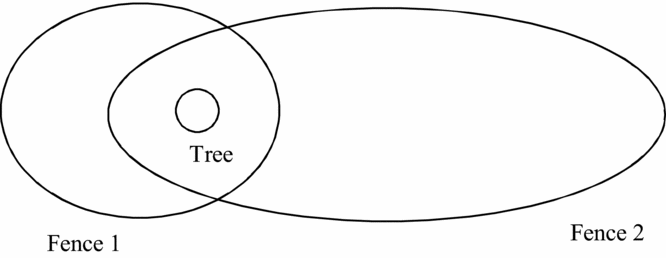
Imagine a tree surrounded by two fences made of vertical wooden planks. The fences intersect at two points (see fig. 1). Consider the plank of wood at one of the points of intersection. It contributes to two different surroundings of the tree, the surrounding by Fence 1 and the surrounding by Fence 2. Moreover, it contributes less to the surrounding by Fence 2 than it does to the surrounding by Fence 1, because Fence 2 is longer than Fence 1. A plank of wood can contribute to some degree to one surrounding of a tree and contribute to a different degree to another surrounding of that very same tree.
Two fences surround a tree.

The same is true for causation;Footnote 66 an event can contribute to some degree to one causing of an effect and contribute to a different degree to another causing of that very same effect. For example, suppose D1, D2, and D3 are the members of the executive committee of a manufacturing company. They all vote in favor of not replacing their outdated equipment. The equipment later short-circuits, starting a fire that causes damage to C's property. Let V 1, V 2, and V 3 be the events of D1, D2, and D3, respectively, voting in favor of the motion not to replace the equipment. Because two votes would have been sufficient for the motion to pass, there are three pluralities of events that were minimally jointly sufficient (in the circumstances) for the damage: [V 1, V 2], [V 1, V 3], and [V 2, V 3]. So according to Minimal Sufficiency (see Section II), the damage was caused three times by three different pluralities of events. But these pluralities are overlapping—each event contributed to more than one causing of the damage. Depending on the values of the relevant conditional probabilities, then, it is possible that these events contributed to different degrees to different causings of the damage. V 1, for example, might have contributed to degree 0.3 to the causing by V 1 and V 2 and contributed to degree 0.5 to the causing by V 1 and V 3.
This raises an important question: To what degree should D1 be held liable for the damage to C's property in such a case? On the face of it, there are a number of options. One option would be to add the two degrees of contribution together, so that D1’s degree of liability for C's loss is 0.5 + 0.3 = 0.8. Another option would be to take the average of the two values, so that D1’s degree of liability for C's loss is
 $\frac{{0.5\ +\ 0.3}}{2}$
= 0.4. I think neither of these strategies is ultimately correct, however. Instead, D1 should be held liable for C's loss to degree 0.5—the larger of the two degrees of contribution.
To see this, suppose first that Nina poisons Oscar's lunch. But she wants to make sure of his death—so at just the moment when Oscar is about to succumb to the poison, she fatally shoots him. Oscar's death is overdetermined by the shooting and the poisoning. In this case, then, Nina performs two actions, each of which individually caused a death. But it surely would not be right to charge Nina with two counts of murder. To do so would intuitively involve some objectionable double-counting, because it was the same death caused twice over.
Now consider a slightly different case. As before, Nina poisons Oscar's lunch, and also shoots him at just the moment he is about to succumb to the poison. But this time, her gunshot wounds Oscar nonfatally. However, at the same time, Patrick also shoots Oscar nonfatally, in such a way that the two gunshots are collectively (but not individually) sufficient, in the circumstances, for Oscar's death. As before, Oscar's death is caused twice—once by the poisoning and once by the two gunshots. Suppose Nina's gunshot contributes to degree 0.5 to the latter causing. Hence, in this case, Nina contributes to degree 1 to one causing of Oscar's death and also contributes to degree 0.5 to a different causing of Oscar's death.
I think the right reaction in this case is again to charge Nina with a single count of murder. To punish her separately for her contributions to both causings of Oscar's death would involve the same kind of objectionable double-counting as in the case above. But on the other hand, it would be absurd to reason that because her average contribution to causings of Oscar's death is 0.75, she should be punished less than if she had merely murdered Oscar by poisoning alone.
These cases are not exactly analogous to the voting case—Nina performs two separate actions here, each of which contributes to a different causing of Oscar's death, whereas in the voting case, D1 performs a single action that itself contributes to two different causings of C's injury. Nevertheless, I submit, similar considerations apply. To hold D1 liable to a degree equal to the sum of the two degrees of contribution would involve some objectionable double-counting, because it is the same injury being caused twice over. To take the average of the two degrees of contribution, on the other hand, would be to let D1 off too lightly. So we should take the larger of the two degrees of contribution and ignore the other. This means that D1 should be held liable to degree 0.5 for C's loss; and this means that C could sue D1 for up to 50 percent of his loss, depending on how much he has already recovered from the other defendants.
VI. CONCLUSION
In this paper, I defend a causal theory of partial liability: a defendant should be held liable for a claimant's loss only to the degree to which the defendant's wrongdoing contributed to the causing of the loss. Though this view has some revisionary consequences, I argue that they can be defended, at least on a conception of tort law as a system of corrective—and not distributive or retributive—justice.
Some people might agree with everything I say in theory but worry that in practice adopting Proportionality across the board would lead to chaos. “Causation itself is difficult enough; degrees of causation would really be a nightmare.”Footnote 67 Determining degrees of causal contribution is difficult and time-consuming, and different judges and juries might come to entirely different conclusions. Defendants and claimants who know the law might still therefore be ignorant of the likely outcome of legal action. This threatens the principle of the rule of law, the idea that the outcome of a legal dispute should be determined by the law and not by the arbitrary decisions of the officials presiding over it.
I have some sympathy for these concerns. There is the question of how things ought to be in a perfect world (“ideal theory”), and then there is the question of how things ought to be, holding fixed the various imperfections of the world we live in (“nonideal theory”). This paper is an exercise in ideal theorizing. I defend a vision of what tort law should aim to be. I invite others more qualified than I to discuss any consequences my arguments may have for the more practical question of how things ought to be, holding fixed the limitations on resources and time and evidence that govern actual tort cases.