Introduction
According to the current nomenclature (Bayliss et al., Reference Bayliss, Kolitsch, Nickel and Pring2010), the alunite supergroup includes trigonal minerals with the general formula DG 3(TX 4)2X′6 where D = K+, Na+, H3O+, NH4+, Tl+, Ag+, Rb+, Ca2+, Sr2+, Ba2+, Ca2+, Pb2+, Hg2+, Ln3+ (Ln = La, Ce, Nd, Sm), Bi3+, Th4+ and vacancy; G = Zn2+, Cu2+, Mg2+, Al3+, Fe3+, V3+, Ga3+, Cr3+ and Sn4+; T = Si4+, P5+, As5+, S6+ and Cr6+; X = O and OH; X′ = H2O, OH and F (species-defining components are highlighted in bold type). At present, 52 minerals belonging to the alunite supergroup are known. In particular, in beudantite-group minerals belonging to the alunite supergroup, the D-cation is bivalent and both 5- and 6-valent T-atoms are considered as species-defining components. The general formula of beudantite-group minerals is D 2+G 3+3(T 5+O4)(T 6+O4)(OH)6. This group contains ten mineral species including the new mineral oberwolfachite SrFe3+3(AsO4)(SO4)(OH)6 described in this paper.
A holotype specimen of oberwolfachite has been collected at dumps of the Clara mine, Oberwolfach baryte mining area, Wolfach, Schwarzwald (Black Forest), Baden-Württemberg, Germany (Walenta, Reference Walenta1966, Reference Walenta1975; Kaiser, Reference Kaiser1984). Clara mine is famous for its mineral diversity: more than 450 valid mineral species have been identified there (https://www.mindat.org/loc-1782.html). It is the type locality for 15 minerals, including oberwolfachite. In this locality, the new mineral occurs in a low-temperature association including quartz, baryte, hematite, illite, goethite, K,S-rich beudantite, and a dussertite-related mineral (Ba,Sr,K)Fe3+3(SO4,AsO4)2(OH)6 (a member of the dussertite–oberwolfachite–jarosite solid-solution system with a Ba:Sr atomic ratio close to 1 or slightly above 1).
Subsequently, the same mineral was collected from the Monterniers mines, Lantignié, Rhône, Auvergne-Rhône-Alpes, France (Gastineau et al., Reference Gastineau, Dietrich, Galvier and Schwab1999). The exact location is the upper vein (46°10′7″N, 4°37′22″E), where oberwolfachite occurs in microcrystalline quartz veinstone. The Lantignié area has been mined in the past for fluorite and baryte. Secondary mimetite and wulfenite after galena are also abundant in the deposit. In the Monterniers mines, oberwolfachite is associated closely with jarosite. Other minerals of the alunite supergroup [arsenogoyazite and La-rich graulichite-(Ce)] and arseniosiderite have been observed in proximity of the same veinstones. In addition, concretions composed of goethite and hematite are observed in the association.
Oberwolfachite is named after the Oberwolfach baryte mining area where the discovery locality of the holotype sample, the Clara mine is situated. The new mineral and its name have been approved by the International Mineralogical Association Commission on New Minerals, Nomenclature and Classification (IMA2021-010, Chukanov et al., Reference Chukanov, Zubkova, Möhn, Varlamov, Pekov, Ksenofontov, Agakhanov, Britvin, Koshlyakova, Desor, Ermolaeva and Pushcharovsky2021). The holotype specimen is deposited in the collection of the Fersman Mineralogical Museum of the Russian Academy of Sciences, Moscow, Russia with the registration number 5674/1. A part of the cotype from Monterniers mines is stored in the collection of the Natural History Museum, University of Oslo, catalogue number KNR 44331.
Experimental methods and data processing
Three chemical analyses of the holotype sample were carried out using a Tescan VEGA-II XMU INCA Energy 450 (energy dispersive spectroscopy mode, 20 kV, 190 pA, beam size < 5 μm). The standards used were: SrF2 (Sr); BaF2 (Ba); PbTe (Pb); albite (Na); Fe metal (Fe); LaPO4 (La); CePO4 (Ce); NdPO4 (Nd); InAs (As); and FeS2 (S). Chemical analyses of the sample from the Monterniers mine were performed using a CAMECA SX100 electron microscope housed in the Department of Geosciences, University of Oslo. The instrument is equipped with five spectrometers and was operated in wavelength dispersive mode. The instrument conditions were an acceleration voltage of 15 kV, beam current of 15 nA and a beam size of 10 μm. The following standards were used: orthoclase (K); SrSO4 (Sr); BaSO4 (Ba and S); Al2O3 (Al); CePO4 (Ce); AsGa (As) and Fe metal (Fe). The intensity data were corrected for inter-element overlaps and for matrix effects using the PAP procedure (Pouchou and Pichoir, Reference Pouchou and Pichoir1984). The H2O content in both samples was calculated from the empirical formula with 6 OH groups. CO2 was not determined because, according to infrared spectroscopic data, carbonate groups are absent in the holotype sample, and only occur in trace amounts in the cotype sample.
Reflectance values for oberwolfachite have been measured in air relative to a SiC reference material by means of a Universal Microspectrophotometer UMSP 50 (Opton-Zeiss, Germany).
In order to obtain infrared (IR) absorption spectra, powdered samples were mixed with anhydrous KBr, pelletised, and analysed using an ALPHA FTIR spectrometer (Bruker Optics) at a resolution of 4 cm–1. Sixteen scans were collected. The IR spectrum of an analogous pellet of pure KBr was used as a reference.
Powder X-ray diffraction data were collected using a Rigaku R-AXIS Rapid II diffractometer (image plate), CoKα, 40 kV, 15 mA, rotating anode with the microfocus optics, Debye-Scherrer geometry, d = 127.4 mm and exposure time of 15 min. The raw powder XRD data were collected using a program suite designed by Britvin et al. (Reference Britvin, Dolivo-Dobrovolsky and Krzhizhanovskaya2017). Calculated intensities were obtained by means of STOE WinXPOW v. 2.08 program suite (holotype sample, Stoe and Cie GmbH, Darmstadt, Germany) and VESTA 3 software (cotype sample; Momma and Izumi, Reference Momma and Izumi2011) on the basis of atomic coordinates and unit-cell parameters.
The single-crystal X-ray diffraction study of the holotype oberwolfachite sample was carried out at room temperature, on a crystal of 0.04 mm × 0.22 mm × 0.27 mm using an Xcalibur S single-crystal diffractometer equipped with a CCD detector. A full sphere of three-dimensional data was collected. Data reduction was performed using CrysAlisPro version 1.171.39.46 (Rigaku Oxford Diffraction, 2018). The data were corrected for Lorentz factor and polarisation effects. The crystal structure of oberwolfachite was determined and refined using the SHELX software package (Sheldrick, Reference Sheldrick2015) to R 1 = 3.13% and wR 2 = 6.96% for 270 unique reflections with I > 2σ(I) in the frame of the space group R ${\bar 3}$ m.
The single-crystal X-ray diffraction data on the cotype sample were collected on a platy fragment of 0.36 mm × 0.15 mm × 0.02 mm at 173 K. The Apex 3 software package was used for processing of diffraction data, including corrections for background, polarisation and Lorentz effects. A multi-scan semi-empirical absorption correction was done using SADABS (Sheldrick, Reference Sheldrick2002). The structure has been solved by direct methods and refined in space group R ${\bar 3}$ m using SHELXL (Sheldrick, Reference Sheldrick2015) to R 1 = 2.65% and wR 2 = 6.43% for 396 observed reflections with I o > 2σI.
The crystal data, experimental and crystal structure refinement details for both samples are presented in Table 1. The crystallographic information files have been deposited with the Principal Editor of Mineralogical Magazine and are available as Supplementary material (see below).
Crystal data, data collection information and structure refinement details for the oberwolfachite.

Results
General appearance and physical properties
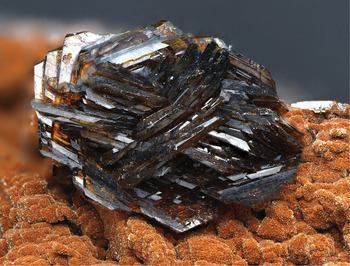
In the holotype specimen, oberwolfachite occurs as dominant zones in tabular to lamellar hexagonal crystals up to 3 mm across and up to 0.5 mm thick and as their globular and rosette-like aggregates up to 6 mm across (Fig. 1). The pinacoid {0001} is the major form and the rhombohedral faces {01${\bar 1}$ 2} form a lateral zone.
Aggregate of oberwolfachite crystals on a goethite crust on a fragment of the holotype. Field of view width: 7 mm.

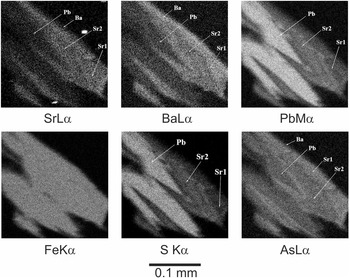
Cores of K,S-rich beudantite and very thin (3–4 μm thick) peripheral zones of a Ba-rich dussertite-related mineral form predominantly in oberwolfachite crystals (Fig. 2).
Images of predominantly oberwolfachite crystals in characteristic X-ray radiation for different elements. Two kinds of Sr-dominant zones, as well as Ba- and Pb-dominant zones are marked. Polished section, crystals from the Clara mine (holotype sample).

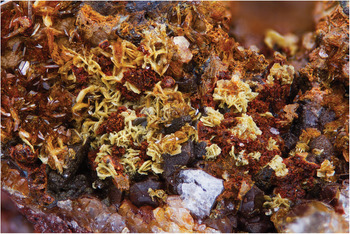
Crystals of oberwolfachite are translucent with an adamantine lustre. The colour is brown and the streak is brownish yellow. The Mohs hardness is 5. Oberwolfachite is brittle. A distinct cleavage on {0001} is observed. The fracture across cleavage direction is uneven. Density of the holotype sample calculated using the crystal-chemical formula and unit cell volume refined from single-crystal XRD data is equal to 3.874 g⋅cm–3. In the cotype specimen, oberwolfachite appears as aggregates of light yellow hexagonal lamellar crystals up to 1 mm × 1 mm × 0.1 mm (Fig. 3). The colour of the cotype crystals changes slightly from yellow under LED light to light-brown under tungsten halogen light. The mean refractive index of the holotype sample calculated using the Gladstone–Dale equation (Mandarino, Reference Mandarino1981) is equal to 1.91.
Aggregates of oberwolfachite (light yellow hexagonal lamellar crystals) from the Monterniers mine (KNR 44331), associated with orange-brown to dark brown crystals of jarosite. Field of view width: 4 mm.

Reflectance spectroscopy in the visible range
Under the microscope in reflected light, oberwolfachite is grey. Internal reflections are not observed. Bireflectance is weak, ΔR = 0.2% (λ = 589 nm). Anisotropy is weak. Pleochroism is not observed. Reflectance values are given in Table 2.
Reflectance values of oberwolfachite from the Clara mine (%).*

* Data for wavelengths recommended by the IMA Commission on ore microscopy (COM) are marked in boldtype.
Infrared spectroscopy
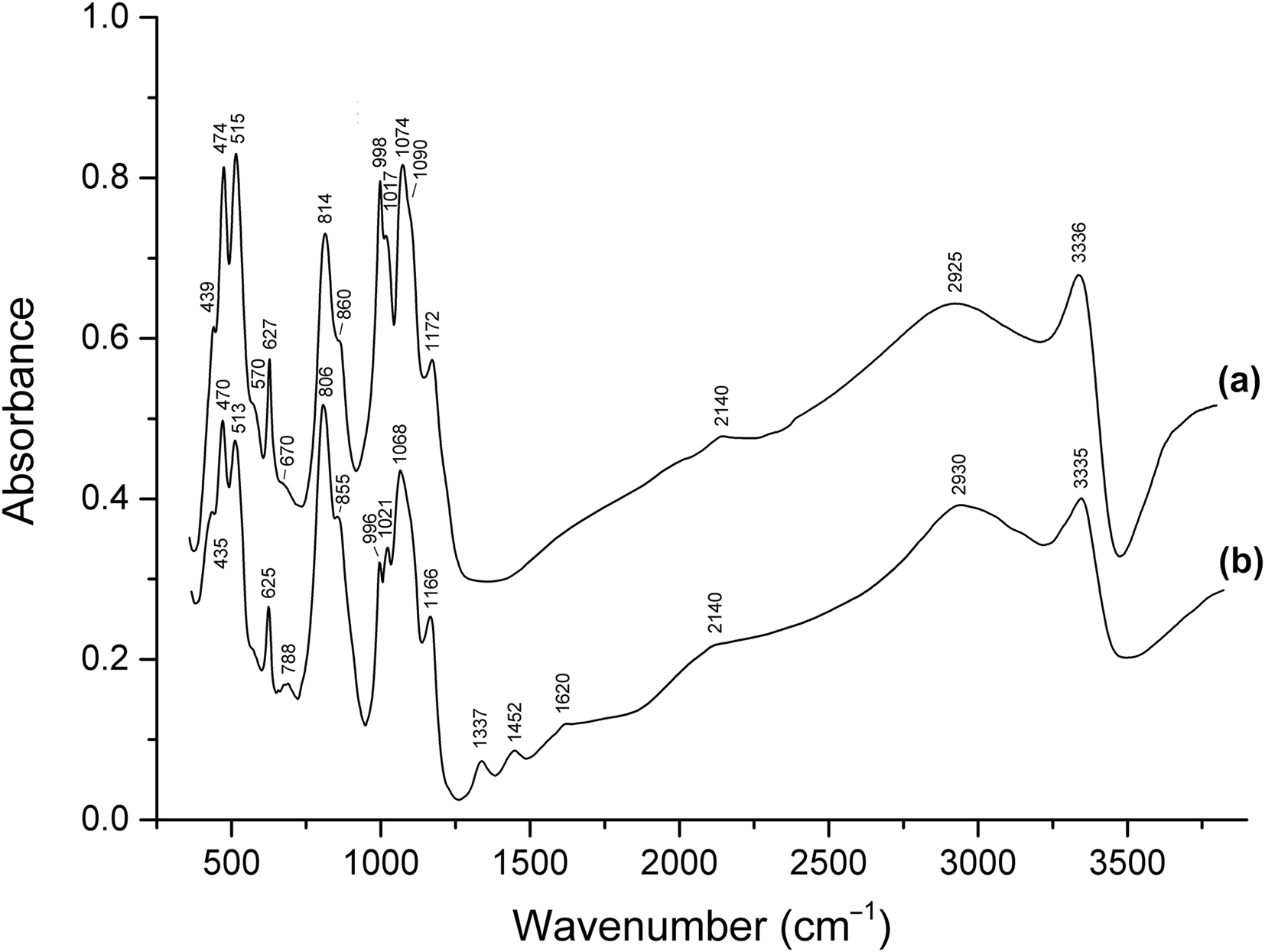
The assignment of the IR absorption bands in the IR absorption spectrum of oberwolfachite from the Clara mine (curve (a) in Fig. 4) is as follows. The bands in the range 2900–3400 cm–1 correspond to O–H stretching vibrations. The bands in the range of 1070–1180 cm–1 correspond to asymmetric stretching vibrations of SO42– [the F 2(ν3) mode]. Bands in the range 998 and 1017 cm–1 correspond to symmetric stretching vibrations of SO42– in different local environments [the A 1(ν1) mode]. Bands at 810–860 cm–1 are due to the overlapping bands of As–O stretching and OH libration vibrations. The band at 626 cm–1 corresponds to the bending vibrations of SO42– [the F 2(ν4) mode]. The 430–520 cm–1 range is due to overlapping bands of bending vibrations of AsO43– [the F 2(ν4) mode], bending vibrations of SO42– [the E(ν2) mode] and Fe3+–O stretching vibrations. The weak bands at 570 and 670 cm–1 and in the range of 1900–2300 cm–1 correspond to overtones and combination modes. A high intensity band at 998 cm–1 corresponding to the A 1(ν1) mode indicates a strong distortion of the SO4 tetrahedron, in agreement with the structural data (see below).
Powder infrared absorption spectra of (a) oberwolfachite holotype and (b) beudantite with the composition Pb1.0(Fe2.7Al0.3)[(AsO4)1.15(SO4)0.6(PO4)0.2(CO3)0.05](OH,H2O)6 from the Cestoso mine, Arouca, Portugal.

Absorption maxima of O–H stretching bands in arsenate and sulfate alunite-supergroup minerals are observed below 3160 and above 3320 cm–1 (Chukanov, Reference Chukanov2014; Chukanov and Chervonnyi, Reference Chukanov and Chervonnyi2016). Consequently, the bands at 2925 and 3336 cm–1 correspond to OH groups forming hydrogen bonds with the O atoms at the O1 site belonging to the AsO43– and SO42– groups, respectively.
No bands of H2O molecules and CO32– groups (in the range of 1300–1800) are observed in the IR spectrum of oberwolfachite.
The IR spectrum of oberwolfachite differs from that of beudantite (curve (b) in Fig. 4) with somewhat higher wavenumbers of most bands in the range of 400–1200 cm–1 and a higher intensity of the strongest band of symmetric stretching vibrations of SO42–.
In the IR spectrum of the oberwolfachite cotype sample from the Monterniers mine (Supplementary figure 4S), bands related to SO42– groups are stronger than analogous bands of the holotype sample, in agreement with chemical data (see below). Very weak bands at 1452 and 1702 cm–1 in the IR spectrum of the cotype may correspond to trace amounts of carbonate and hydronium groups, respectively (Chukanov, Reference Chukanov2014; Chukanov and Chervonnyi, Reference Chukanov and Chervonnyi2016).
Chemical data
In predominantly oberwolfachite crystals from the Clara mine, two kinds of Sr-dominant zones (marked in Fig. 2 as Sr1 and Sr2) can be distinguished. The border between the Sr1 and Sr2 zones is distinct but not sharp. The electron microprobe analyses have been carried out for the material from the outer Sr1 zone for which crystal structure was solved.
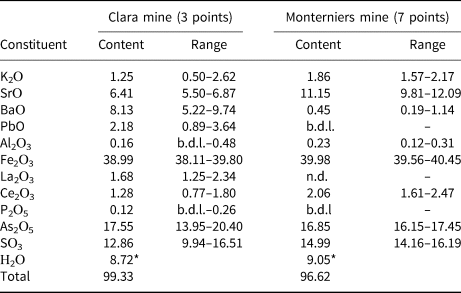
Analytical data are given in Table 3. Contents of other elements with atomic numbers > 8 are below their detection limits.
Chemical composition of oberwolfachite (wt.%).

Note: * H2O content was calculated by stoichiometry, for 6 OH groups per formula unit; b.d.l. – below detection limit; n.d. – not determined.
The empirical formula of the holotype sample on the basis of 14 O atoms is (Sr0.38Ba0.33K0.16Pb0.06La0.06Ce0.05)Σ1.04(Fe3+3.03Al0.02)Σ3.05[(SO4)1.00(AsO4)0.95(PO4)0.01](O6.16H6.00), resulting in the simplified formula (Sr,Ba,K,LREE,Pb)Fe3+3(AsO4)(SO4)(OH)6.
The ideal formula is SrFe3+3(AsO4)(SO4)(OH)6 which requires SrO 17.50, Fe2О3 40.44, As2O5 19.41, SO3 13.52, H2O 9.13, total 100 wt.%.
In the holotype sample, oberwolfachite occurs as two kinds of zones (marked in Fig. 2 as the Sr1 and Sr2 zones with different Sr:Ba and S:As ratios) in mixed crystals (Fig. 2). As noted above, material from the Sr1 zone is considered as the holotype. The representative empirical formulae (calculated on the sum of atoms of all elements measured by electron microprobe equal to 6) of other zones marked in Fig. 2 are as follows.
Ba zone (thin outer zone): (Ba0.43Sr0.42K0.05Pb0.03Ca0.02)Σ0.95Fe3+3.11[(AsO4)1.26(SO4)0.67(PO4)0.01](OH,O)6 (a significant excess of Fe may be due to submicroscopic goethite inclusions).
Sr2 zone (inner Sr-dominant zone): (Sr0.53Ba0.34K0.08Pb0.03)Σ0.98Fe3+3.06[(AsO4)1.08(SO4)0.86(PO4)0.02](OH,O)6.
Pb zone (core of a crystal): (Pb0.62K0.32)Σ0.94Fe3+3.05[(SO4)1.34(AsO4)0.61(PO4)0.06](OH,O)6.
The low total of 96.62 wt.% for the chemical composition of the cotype specimen from the Monternier mine may be due to the presence of La and lanthanides heavier than Ce, as well as trace amounts of H3O+ and CO32– groups detected using IR spectroscopy. The empirical formula of the cotype is (Sr0.64K0.24Ce0.08Ba0.02)Σ0.97(Fe3+3.00Al0.02)Σ3.02[(SO4)1.12(AsO4)0.88](OH)6. The chemical composition of the tetrahedrally and octahedrally coordinated components is close to that of the holotype, but the cotype sample is significantly richer in Sr and depleted in Ba compared to the holotype material.
X-ray diffraction and crystal structure
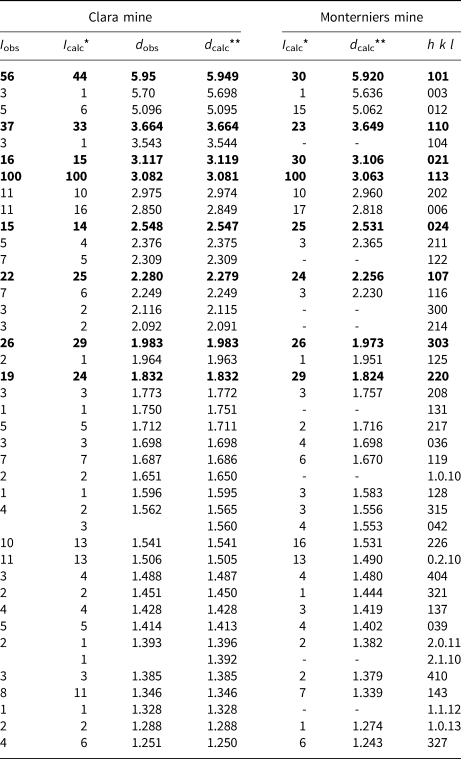
Powder X-ray diffraction data of oberwolfachite from the Clara mine are listed in Table 4. Unit-cell parameters of the holotype sample refined from the powder data are: a = 7.330(1) Å, c = 17.101(3) Å and V = 795.7(3) Å3.
Powder X-ray diffraction data (d in Å) of oberwolfachite.

* For the calculated pattern, only reflections with intensities ≥1 are given.
** For the unit-cell parameters calculated from single-crystal data.
The strongest peaks are given in bold.
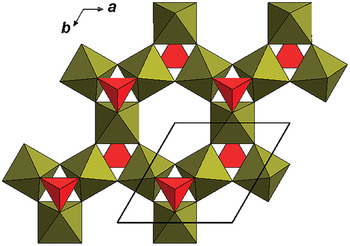
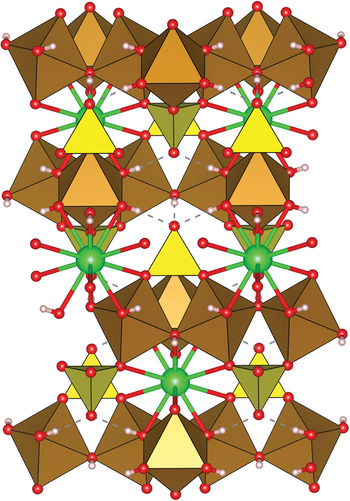
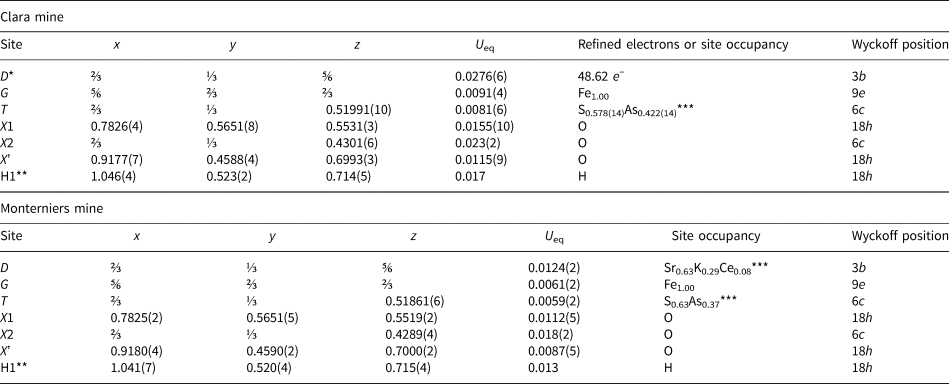
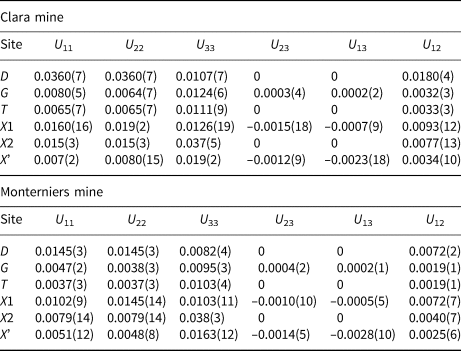
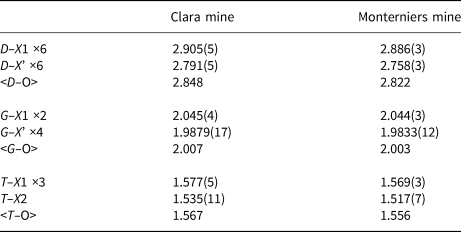
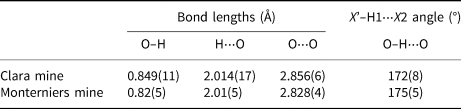
The crystal structure of oberwolfachite (Figs 4–6, Tables 5–8) consists of (001) layers of Fe3+-centred octahedra in which the groups of three corner-linked octahedra are connected with the same groups via common oxygen corners to form six-membered rings. Three apical O atoms of each octahedral group form the base of the (S,As)-centred TO4 tetrahedra connected with the octahedral layers from both sides. A cations are located between the layers and centres of icosahedra.
Heteropolyhedral layer in the structure of oberwolfachite. The unit cell is outlined.

Oberwolfachite structure: view perpendicular to the b axis. The dashed lines represent hydrogen bonds. D site (green spheres), Gϕ6 polyhedra (brown), Tϕ4 polyhedra (yellow), X/X’ sites (red spheres) and H atoms (white spheres) are shown.

Coordinates, equivalent displacement parameters (U eq, in Å2) of atoms, site occupancy factors (s.o.f.) and Wyckoff positions in the structure of oberwolfachite.

* The occupancy of the D site was refined as Sr vs. Ba with the refined ratio 0.41:0.59. The refined number of electrons for the D site is 48.62 that is in agreement with the value of 47.20 calculated from the empirical formula (the difference between these values is within the limits determined by the standard deviations given in Table 3).
** H1 atom of the OH group was located from the difference-Fourier synthesis and its position was restricted to keep O–H distance of 0.85(1) Å, U iso for H1 was constrained to be 1.5U eq of X’.
*** The refined site occupancies are in good agreement with the empirical formulae.
Anisotropic displacement parameters of atoms (in Å2) in the structure of oberwolfachite.

Selected bond distances (in Å) for oberwolfachite.

Hydrogen bond parameters for the structure of oberwolfachite.

Discussion
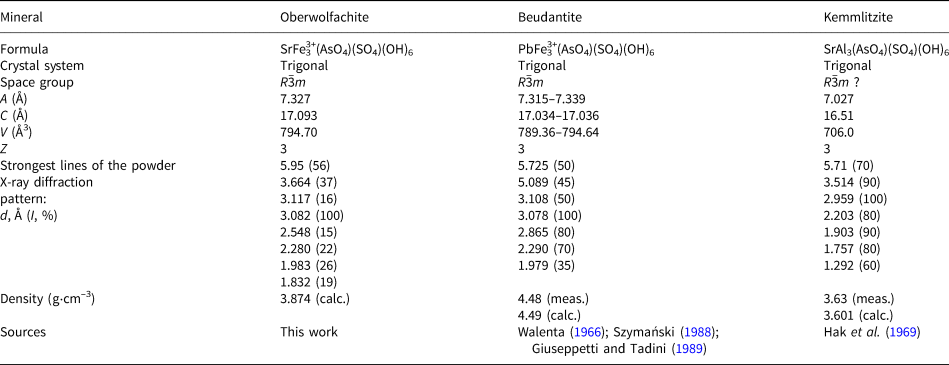
Oberwolfachite is isostructural with beudantite PbFe3+3(AsO4)(SO4)(OH)6 (Szymański, Reference Szymański1988) and other members of the alunite supergroup with the same unit cell dimensions and space group R ${\bar 3}$ m. For comparison of oberwolfachite and related beudantite-group minerals see Table 9.
Comparative data for oberwolfachite and related beudantite-group minerals.

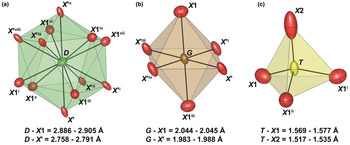
The single-crystal X-ray diffraction experiment performed at 293 K on the holotype sample indicates that the crystallographic parameters are slightly different from those of the cotype material collected at 173 K. The unit-cell volume of the cotype crystal is smaller by 15 Å3, which is mainly the result of a smaller c parameter. These variations are related to the differences in the chemical composition and therefore in the occupancies of crystallographic sites. The octahedral Gϕ6 site has the same average bond distance in both samples, as it is fully occupied by Fe3+ in both cases (Fig. 7 and Table 7). In the cotype specimen, the smaller size of the Tϕ4 tetrahedral site, and especially of the apical T–X2 bond, is related to the higher amount of the smaller SO4 tetrahedron at the cost of the larger AsO4 tetrahedron. Similarly, the 12-fold coordinated D site is smaller in the cotype specimen, due to the absence of Ba and a higher amount of Sr occurring at this site.
View of the coordination polyhedra Dϕ12 (a), Gϕ6 (b) and Tϕ4 (c) occurring in the structure of oberwolfachite. The bond-distances variations are given for the cotype and holotype, respectively. The thermal ellipsoids of the oxygen atoms are drawn at 90% probability. The symmetry codes are: (i) –y, x–y, z; (ii) –x+y, –x, z; (iii) –x+⅔, –y+⅓, –z+⅓; (iv) y+⅔, –x+y+⅓, –z+⅓; (iv) y+⅔, –x+y+⅓, –z+⅓; (v) –x+⅓, –y+⅔, –z+⅔, (vi) x+⅔, y+⅓, z+⅓, (vii) –x+y+⅔, –x+⅓, z+⅓, (viii) y+⅓, –x+y+⅔, –z+⅔; (ix) x–y+⅓, x+⅔, –z+⅔; (x) x–y+⅔, x+⅓, –z+⅓.

In the crystal structures of both holotype and cotype samples, the hydrogen atom position was determined from the difference-Fourier map. The H-bonds network observed in the structure of oberwolfachite is identical to that reported in the structure of the alunite-supergroup minerals goyazite, SrAl3(PO4)(PO3OH)(OH)6 and corkite, PbFe3(SO4)(PO4)(OH)6 (Kato, Reference Kato1987; Giuseppetti and Tadini, Reference Giuseppe and Tadini1987). Oxygen atoms of OH groups occupy the X’ site, which is common for two adjacent Fe3+O6 octahedra (Fig. 7). A hydrogen atom is located at 2.01 Å from the apical oxygen of the (S,As)O4 tetrahedron (Table 8). Analogous H⋅⋅⋅O distances in goyazite and corkite are equal to 1.84 and 1.91 Å, respectively.
In both localities, oberwolfachite crystallised under low-temperature (supergene or low-temperature hydrothermal) conditions. We assume that the crystallisation of oberwolfachite from the Monterniers mine could be promoted by the remobilisation of S6+ in the course of alteration of galena. The source of Sr could be baryte which is rather abundant in the Monterniers area. However, solubility of baryte at temperatures below 300°C is very low (Blount, Reference Blount1977; Zhen-Wu et al., Reference Zhen-Wu, Dideriksen, Belova, Raahauge and Stipp2014). Mimetite is believed to be the source of As5+.
Supplementary material
To view supplementary material for this article, please visit https://doi.org/10.1180/mgm.2021.63
Acknowledgements
The authors are grateful to Prof. Peter Leverett and anonymous referees for valuable comments. This work was carried-out in accordance with the state task of Russian Federation, state registration number ААAА-А19-119092390076-7. The authors thank the X-ray Diffraction Centre of Saint-Petersburg State University for instrumental and computational resources. The authors thank the UCA-PARTNER for the use of the material characterisation facilities at Université Clermont Auvergne, as well as the “Editions du Piat”, editors of the French magazine “Le Règne Minéral”, who established the partnership with the “Laboratoire Magmas et Volcans” where the first EDS analyses of the Monterniers mine cotype were performed. Muriel Erambert is thanked for her assistance with the EPMA data collection of the Monterniers material.