


Introduction
The need to find policy solutions to address socio-economic development and environmental conservation is of utmost importance in Latin America, a region containing environmental systems of global significance alongside poverty and inequality. Questions of realism and social justice have led to the understanding that conservation programmes should address the welfare of resident populations.Footnote 1 Economic instruments have been promoted as a potentially efficient way to achieve conservation and development, with Latin America often a focus for implementation.Footnote 2
This research study contributes to literature on the design and implementation of economic instruments for conservation by examining the longest-standing example, from Brazil, known as an ecological fiscal transfer (EFT). An EFT is a public policy mechanism that redistributes tax revenue between government levels to compensate for or incentivise environmental protection. Despite its great potential to contribute to a policy mix for socially just conservation, no other Latin American country has implemented an EFT.
The Brazilian EFT, known as the ecological ICMS (ICMS-E: imposto sobre a circulação de mercadorias e serviços – ecológico or ‘tax on the movement of goods and services – ecological’), distributes tax revenue from state to municipal governments based on ecological criteria, such as the presence of protected areas. The ICMS-E arose as a means of providing financial compensation for municipalities with a large proportion of their territory under environmental protection, potentially limiting the ability of local government to promote economic activity.Footnote 3 Originating in the early 1990s in the state of Paraná, the ICMS-E has since been adopted in 16 other Brazilian states. The ICMS-E is an early example of a policy that responds to the high costs that a command and control approach to nature conservation imposes on local resource users. EFTs complement this approach, utilising the ‘protector receives’ rather than the ‘polluter pays’ rationale.Footnote 4 Despite growing interest in EFTs around the world,Footnote 5 they have been relatively little analysed and no other similar mechanism exists in Latin America.
Policies and programmes are negotiated and transformed between their central design and their application at the level of resource use. Accordingly, economic instruments must be examined at the level of both their formulation and their application, where the policy may be adapted and interpreted according the local context.Footnote 6 The research presented here marks the first comparative examination of the historical evolution and implementation of the ICMS-E in two different sites. A comparative analysis of this public policy instrument was conducted in the neighbouring states of Paraná and São Paulo, where two versions of the mechanism have evolved over almost three decades.
Previous analyses of the ICMS-E have paid relatively little attention to the complexities of the socio-ecological systems within which the mechanism functions. A framework based on an institutional approach is therefore developed to interrogate the legislative design of the ICMS-E and how it functions within the nuances of local socio-ecological systems. The framework enables the identification of key lessons which may assist in the development of EFTs throughout Latin America and beyond.
Economic Instruments for Conservation
Economic instruments for conservation can be understood as a suite of tools that provide financial (dis)incentives to stakeholders, inducing environmentally responsible behaviour to generate financial benefits.Footnote 7 They are considered a promising opportunity in a policy mix for addressing numerous environmental challenges from biodiversity loss to climate change.Footnote 8 Economic instruments may address the costs of conservation borne by those who have direct influence on the management (or mismanagement) of the ecosystems that provide environmental services.Footnote 9 Economic instruments can stimulate a local agenda for sustainable development, reduce poverty and ease conflict between communities and conservation.Footnote 10 Latin America has been a focus for the implementation of economic instruments such as Payment for Ecosystem Services (PES); however to date Brazil is the only country from the region to implement an EFT policy.
As part of a policy mix targeting conservation, EFTs may have some advantages over other types of economic instruments for conservation. They introduce ecological criteria into a fiscal transfer system, building on existing institutions and administrative procedures, which lowers transactions costs.Footnote 11 EFT funding is stable and permanent as payments are drawn from existing tax revenue, eliminating the problem of finding new sources of funding for conservation.Footnote 12
The Ecological ICMS
EFTs operated by Brazilian state governments provide long-standing examples for analysis. Essentially, the ICMS-E is the redistribution, according to environmental criteria, of revenue raised by an existing tax. The ICMS is a levy on the movement of goods and services and is an essential source of tax revenue for state and municipal governments.Footnote 13 The ICMS accrues to the state government with one quarter returned to the municipalities within that state, known as a pass-through. The majority (75 per cent) of ICMS pass-through is based on the performance of the municipality's economy, whilst the remaining quarter is distributed according to state legislation (Figure 1). Further details of the processes by which these proportions are allocated are provided elsewhere.Footnote 14 Municipalities that experience land use restrictions, such as those associated with the presence of protected areas and watersheds, may be less able to stimulate economic activity and are therefore at a competitive disadvantage with regard to accessing the 75 per cent proportion of the ICMS distributed according to economic criteria. In response, numerous states have included ecological criteria in the distribution of the ‘flexible’ quarter of the ICMS, which has become known as the ICMS-E.
The Distribution of the ICMS from State to Municipal Government

First discussed in the state of Paraná in 1989, and passed into law in 1991, the ICMS-E predates most other examples of economic instruments for conservation. It arose as the result of an alliance of local governments from a region which provides important watershed protection for the state capital, Curitiba. Concerned about the land use restrictions that limited potential revenues from the ICMS tax, the mayors of these municipalities lobbied for a share of ICMS revenue as compensation. With the support of the state legislative assembly, ecological criteria were included in ICMS distribution. Since then the ICMS-E has been passed into law separately in 16 states, each with different criteria, mechanisms and objectives. The ecological criteria which constitute the ICMS-E across these states cover themes from soil conservation and fire prevention to solid waste management.
The ICMS-E is part of a fiscal system in which the vertical redistribution of tax revenue across levels of government helps to ensure sufficient financial capacity to fulfil public functions at all levels. Whilst the ICMS-E is intended to compensate and, in some cases, also stimulate local conservation activity, the management of revenue is determined by municipal government and is not conditional on any pre-defined activity. Even so, the ICMS-E is considered to have a broad range of potential positive impacts including: biodiversity conservation, strengthening of environmental institutions, introduction of environmental agendas in small towns and improved community support for protected areas.Footnote 15 The ability of the mechanism to achieve one or all of these potential outcomes may depend on how the law is written and implemented on a state-by-state basis, and how it is interpreted at the municipal level. This article uses case studies from Paraná, where the mechanism originated in 1991, and neighbouring São Paulo, the second state to implement the ICMS-E, in 1993. Each state's legislation, whilst initially similar, has followed different trajectories in the subsequent decades.
Theoretical Framework
Finding Policy Solutions
The complexities involved with environmental conservation in regions of poverty and natural resource dependence are well established.Footnote 16 There is often agreement that conservation and development should be approached jointly, yet policies and programmes which achieve win-win outcomes are rare.Footnote 17 Conservation ‘panaceas’, such as government ownership, privatisation or community property, are recognised as inadequate to manage the intricacies of socio-ecological systems and the need to maintain sustainable livelihoods within healthy ecosystems.Footnote 18 Accordingly, it has been acknowledged that the outcomes of economic instruments for conservation are context specific and that they should not be used as blueprint solutions.Footnote 19
Research that evaluates economic approaches to conservation often looks at outcomes in terms of efficiency and additionality, providing valuable insights into design.Footnote 20 However, efficiency and additionality cannot measure how these approaches are interpreted locally and their intended and unintended outcomes. Public policies are rationally designed, formal structures, embedded within context-specific social norms and practices. Such features demand an examination of institutional interplay.Footnote 21 Exploring these interactions may help untangle this complexity, providing direction for the when, where and how of effective economic instruments for conservation.Footnote 22
Evaluative Framework
Environmental problems are not isolated from social systems. They are complex, occur over a long time-frame, and our knowledge of them may often be uncertain or incomplete.Footnote 23 As such, approaches to solving these problems are myriad and a wide range of characteristics has been identified as relevant to the examination of policies and programmes. We categorise aspects within three broader themes that contribute to understanding how the ICMS-E, elaborated by state government, is interpreted and executed to produce outcomes at the municipal level.
The first theme is design, in relation to how the policy is legislated and implemented. The way payments function at the local level is influenced by relational aspects, which refer to the characteristics of the interactions between different actors, and between actors and the policy itself. Finally, structural aspects are considered, which relate to the recurrent arrangements that configure the available choices and opportunities, relative control over resources and capacities of different actors.Footnote 24 It is particularly critical to assess these aspects in the context of developing nations, where institutional capacity and availability of resources may be precarious.Footnote 25 These aspects are detailed in the following sections. Our framework (Table 1) was based principally on the works of authors Fikret Berkes, Per Mickwitz, Neil Adger, Katrina Brown and Emma Tompkins;Footnote 26 however it also draws from the pool of literature cited in the following sections.
Framework for Evaluating Payment for Conservation Policy Interventions

Source: Authors’ conceptualisation, based on the works cited in Footnote note 26.
Design and Implementation Aspects
The design of a policy intervention is critical to outcomes, influencing participation rates, the creation of alliances or the exacerbation of conflicts of interest, effectiveness and whether the policy is relevant to real problems.Footnote 27 The aspects of policy design and implementation considered particularly relevant to EFTs are explained below.
Explicit multiple objectives: Inherent in economic instruments for conservation is a sustainable development approach, yet most programmes emphasise outcomes for either conservation or development. Environmental systems do not exist separately from social systems and policies must address this complexity in a holistic way. Programmes that create horizontal linkages between levels of government and other parties may provide opportunities to deal with multiple objectives.Footnote 28
Linkages amongst stakeholders: The outcomes of policy interventions are determined by factors at a range of levels, from constitutional and organisational to those at the user level. Therefore, it is necessary to identify how policy creates the conditions necessary to foster vertical and horizontal linkages and how knowledge is shared amongst actors.Footnote 29 Linkages are interactions between stakeholders that provide information or resources related to natural resource management.
The involvement of multiple organisations, including government, civil society and private enterprise, allows each to bring their relative strengths to support and build capacity. Horizontal and vertical interplay between actors in the form of partnerships, alliances and networks contributes to the understanding of problems and the provision of necessary resources for policy implementation. Horizontal linkages amongst local-level actors and vertical linkages with other institutions depend on the trust built up between parties, the presence of leadership and the translation of knowledge. The costs associated with creating linkages can act as a barrier to their formation.Footnote 30
Flexibility: It has been suggested that economic instruments for conservation should be highly flexible, allowing institutions to adapt programmes to local contexts.Footnote 31 Instruments should avoid rigid adherence to a preconceived strategy, instead allowing for the development of relationships which benefit local circumstances and can be adapted to changing conditions.Footnote 32
Relational Aspects
Mechanisms which intend to achieve conservation and human well-being often cannot be conceived and implemented at one single sphere (local, regional, national or global) but may require management at multiple levels, with horizontal and vertical interplay between actors.Footnote 33 It is also assumed that non-state actors will participate in decision-making processes at various levels.Footnote 34 A multi-level approach to environmental management may capture the comparative advantages provided by both local resource users and higher institutional spheres,Footnote 35 helping to overcome institutional deficiencies.Footnote 36 Interplay between actors can contribute to better understanding of problems and provision of resources for policy implementation.Footnote 37 Vertical interplay is particularly important in building the capacity of less influential stakeholder groups, through improving skills and sharing information.Footnote 38 Many aspects of the relationships between stakeholders are interlinked and interdependent. The relational aspects considered in this research study are described below.
Transparency: Transparency refers to the degree to which the processes of policy formulation and implementation are observable. The transparency of interactions between stakeholders is influenced by pre-existent power structures.Footnote 39 The level of transparency of a payment scheme will influence how it is perceived by stakeholders, affecting its legitimacy.Footnote 40
Legitimacy: Environmental management is often characterised by conflicting goals and divergent belief systems of different stakeholder groups.Footnote 41 The legitimacy of an intervention may be influenced by how environmental problems are understood by stakeholders with different perspectives or worldviews. Where responsibility for a programme is held jointly by multiple levels of government, each level must be accountable.Footnote 42
Knowledge: Knowledge is important, both to the policy process and to questions of equity. Translating and incorporating local/traditional and scientific knowledge into policy responses can create shared understanding and increase the range of information available to create better informed policy that more adequately addresses local issues.Footnote 43 The democratisation of access to knowledge can improve the legitimacy and equity of interventions.Footnote 44
Participation: Participation conceived solely as co-option or coercion contributes to the failure of conservation and development interventions. Instead it is suggested that communities should be partners, involved in capacity building and working relationships.Footnote 45 Participation during policy formulation can align community needs with intended policy outcomes, informing decisions to provide increased benefits and efficiency. Broad participation in the application of environmental payments can direct the use of the funds towards activities that benefit the community as a whole, reducing the potential capture of those benefits by the local elite.Footnote 46
Structural Aspects
Structural aspects, such as access to resources and capacity, are important considerations for programmes that operate between multiple jurisdictional levels.
Resources: An appropriate governance structure for natural resource management should include the sharing of responsibilities, rights and resources.Footnote 47 However, the devolution of responsibility may not always be accompanied by the devolution of sufficient rights and resources.Footnote 48 Since the end of the military dictatorship in 1985 and the People's Constitution of 1988, Brazil's political system has undergone a process of decentralisation, with local government increasingly responsible for service provision.Footnote 49 Whilst the sharing of responsibility is thought to have many benefits, it has not necessarily been accompanied by a sufficient transfer of resources, often rendering municipal governments unable to perform their responsibilities adequately.Footnote 50
Capacity: Where environmental payments have positive outcomes for livelihoods, it is often suggested that governance structures have ensured this outcome,Footnote 51 highlighting the role of formal institutions in achieving multiple positive results from economic instruments for conservation. Institutional capacity depends not only on people's capabilities but also on the overall size of the task, the resources required to perform the task and the framework within which capacities are used.Footnote 52 The involvement of multiple organisations, including government, civil society and private enterprise, allows each entity to bring their relative strengths to support and build capacity. The capacity of institutions is critical to dealing with conflict, cooperation and change in a policy setting.Footnote 53
Methodological Framework
States in the Case Study
Paraná and São Paulo are neighbouring states in Brazil's South and South-East regions, respectively. They are arguably the economic powerhouses of the country, ranked fourth-highest and first for gross domestic product (GDP) of the 27 states, accounting jointly for 40 per cent of the nation's GDP (São Paulo alone is responsible for around 30 per cent). Both states are situated within the Atlantic forest biome, one of the most threatened in the world, with only 12 per cent of its original area remaining as intact forest.Footnote 54 The Atlantic forest supports exceptional levels of endemism,Footnote 55 is home to over 60 per cent of Brazil's threatened mammal species,Footnote 56 and has plant species diversity per unit area higher than the Amazon.Footnote 57 The conservation of the remaining forest is, therefore, of critical importance. The two states implemented the ICMS-E in the early 1990s and thus the programme has considerable longevity in both cases. The differing paths that the ICMS-E legislation has taken over time creates the possibility of comparison of two divergences of the same mechanism, within similar socio-economic and environmental contexts.
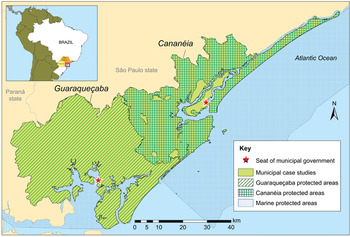
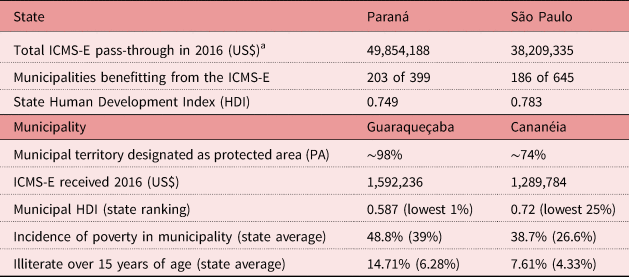
The municipalities of Guaraqueçaba (Paraná) and Cananéia (São Paulo) are neighbours, their territories meeting at the Paraná–São Paulo state border (Figure 2). Both lie within one of the largest intact remnants of Atlantic forest. The greater part of their territory is protected by a mosaic of reserves under federal, state and private jurisdiction, making the ICMS-E a significant source of revenue (Table 2). Despite the designation of protected areas, the degradation of forests through resource extraction activities remains an environmental concern.Footnote 58
Location of Case Study Municipalities
Source: UNEP-WCMC, World Database on Protected Areas: Brazil, online: https://www.protectedplanet.net/country/BRA

Characteristics of ICMS-E in the Two States and the Case Study Municipalities

a Currency conversion rates from December 2016 (http://www.xe.com).
Sources: IAP, ‘ICMS Ecológico’ (see Footnote note 63); HDI: https://cidades.ibge.gov.br/pesquisas, heading ‘Índice de Desenvolvimento Humano’; PA: authors’ elaboration; literacy: http://tabnet.datasus.gov.br/cgi/ibge/alfdescr.htm#ofmort (last accessed 30 Dec. 2020).
The two municipalities exhibit similar characteristics; they are both amongst the poorest municipalities in their respective states and both have the majority of their territories assigned to environmental protection. Both municipalities exhibit high incidences of poverty and are ranked towards the bottom of their states for human development (Table 2). The ICMS-E provides a significant source of revenue for both municipalities, yet each municipal government operates under a very different ICMS-E scheme. This contrast provides insights into how the different versions of the ICMS-E perform.
Data Acquisition
Fieldwork for this research was undertaken in 2016 in the states of Paraná and São Paulo. It involved conducting semi-structured interviews with participants selected through reputational and positional sampling.Footnote 59 Participants were recruited from each state and included participants active in the state and/or federal sphere (n = 11) such as environmental agency representatives, protected area managers and public servants involved in the development and implementation of the ICMS-E. Participants from the local sphere (n = 31) included municipal government representatives, private protected area owners, community leaders and local business people. Some participants, for example non-government organisations (NGOs) and researchers, were active across jurisdictional levels, with interactions at municipal and state spheres, and interests (in the case of NGOs) reaching the national level (n = 9). Participants were interviewed using a semi-structured approach, guided by open-ended questions that allowed them to direct the flow of conversation. This allowed interviews to reflect the themes considered most significant by those with intimate knowledge of the ICMS-E.Footnote 60 The interview questions explicitly did not refer to all the criteria listed in Table 1, to allow for a more natural evaluation based on the participant's interpretation of the important aspects of the policy. Interviews were conducted in Portuguese by the lead author, lasted from half an hour to two hours in length and were recorded and transcribed verbatim, using the software program NVivo 9 to manage, code and analyse the data. Quotes have been translated by the lead author. The research is also informed by the examination of documents including local and state legislation, draft laws, decrees, management plans, technical reports and grey literature.
State Case Studies: The ICMS-E in Paraná and São Paulo
This section examines the design of the ICMS-E in both states according to the aspects identified in Table 1.
Paraná
The ICMS-E legislation in Paraná originated as a compensatory mechanism with environmental questions of secondary importance. However, the legislation evolved to include incentives, intending to stimulate conservation activity by local governments seeking a larger parcel of ICMS-E revenue.Footnote 61 The legislation allocates 2.5 per cent of the 25 per cent decided by state government (see Figure 1) to be distributed between eligible municipalities, based on the proportion, category and quality index of each protected area. The quality index comprises 67 variables and is determined annually for each municipality by the state environmental agency, hereafter referred to as the IAP (Instituto Ambiental do Paraná). These variables include biological quality and representativeness of the protected area, development of management plans, access control and municipal action regarding urban planning, agriculture and sanitation. The quality index enables governments to benefit financially from local conservation activities as a higher score is related to a higher financial return for ecological criteria the following year. The ecological portion of the ICMS is transferred separately from the rest of the ICMS, so local government can easily recognise the ICMS-E value and identify increases or possible decreases. However, the incentive effect may be inhibited by the policy's success. If many municipalities improve their quality index the economic return becomes diluted, potentially leading to a reduction in the financial incentive if economic growth does not maintain pace.
São Paulo
In São Paulo, ecological criteria determine the distribution of 0.5 per cent of the flexible portion of the ICMS. The ICMS-E calculation is based on the proportion of the municipal territory designated as protected area multiplied by the category of the protected area, with more strictly protected areas (equivalent to IUCN Category I or II)Footnote 62 receiving higher weighting due to the more stringent land use restrictions. The legislation recognises only state-managed protected areas, not federal, municipal or private, with seven protected area categories, and weightings ranging from 0.1 to 1.0. It does not include a quality index and does not reward municipal environmental action. The ecological portion of the ICMS arrives in the municipal account jointly with the rest of the ICMS, meaning that local authorities do not necessarily know its value. Despite numerous attempts the legislation in this state has not been amended since its inception.
Multiple Objectives
The ICMS-E in both states originated with one objective: to compensate municipal governments for the inability to utilise their territory for economic production due to the presence of protected areas. In São Paulo, this has not changed and the mechanism remains a simple compensation for opportunity costs of hosting protected areas. The amount allocated to the ecological criteria was a political decision, not calculated based on the potential foregone tax revenue of alternative land uses. Meanwhile, in Paraná, successive years of policy evolution have led to the mechanism being referred to as ‘The ICMS-E for Biodiversity’. It contains multiple objectives covering social, institutional and environmental themes (translated from state legislative documents):Footnote 63
1. The designation and regulation of protected areas, including their planning, creation, management and sustainability;
2. Construction of ecological corridors;
3. Integrating society into protected area management, including the free flow of information and environmental education, ecotourism and regulation of land use;
4. Institutional enhancement through legislation, capacity-building, decentralisation and structuring of long-term public policy;
5. Promoting the ‘protector-receives’ rationale to achieve funding for the conservation of biodiversity.
Linkages
The ICMS-E in Paraná formally establishes the responsibility of local government for the environment through the creation of Terms of Engagement (Termos de Compromisso). The document is developed by the IAP in consultation with the municipal government as part of the annual evaluation of the municipality's quality index. The Terms of Engagement formalise the participation of the municipality, either directly in the management of protected areas, or indirectly through aligning local expenditures, for example on sanitation, agriculture or urban development, with the improvement of local environmental quality. Non-compliance will result in the
… [c]ancellation of the record of the protected area in the state register [that determines the ICMS-E calculation], implying automatically the loss of financial resources that originate from that area to be passed to the municipality [the following year].Footnote 64
Despite being a resource constitutionally prohibited from being earmarked, state authorities have found a way to direct ICMS-E revenue to environmental outcomes. According to a technical officer involved in the annual evaluations, the approach taken focuses strongly on the improvement of biodiversity conservation rather than the institutional and social objectives listed above.
A legal platform also exists for creating public–private partnerships for biodiversity conservation. Much of the remaining Atlantic forest lies on private land and Paraná's state government has focused on incentivising the creation of private reserves. Reflecting the assumption that local government benefits from the creation of protected areas due to the generation of the ICMS-E, a legal framework exists for local government to support owners of private reserves with maintenance costs (Decree no. 1529 dated 2 Oct. 1997). Agreements are made between reserve owners and local government and may pertain to up to 100 per cent of the ICMS-E received for the presence of the private reserve. Investments in the quality of the reserve, in theory, may generate further revenue for local government, creating a virtuous cycle.
In São Paulo, the ICMS-E is a simple transfer of revenue, with the ecological percentage transferred jointly with the rest of the ICMS revenue. The revenue is not circumscribed in any way and the legislation does not include any mechanisms that enable municipal government to increase their ecological pass-through. As such the ICMS-E does not create any linkages between stakeholders, nor demand any local engagement with environmental management.
Flexibility
According to an interviewee involved in the formulation and development of the ICMS-E in Paraná, it is intended ‘as a platform that makes possible an endless set of arrangements’. The ICMS-E is managed by the IAP, who conduct annual evaluations of every municipality in the state. This captures variation in the presence and quality of protected areas, allowing payments to reflect changing conditions. Local government can capitalise on the incentive effect in a variety of ways, depending on the municipality's comparative advantage, due to the broad range of criteria that influence the score received. For example, a municipality with a large territory and low population may choose to set aside some land for a municipal reserve, whilst it may be more efficient for another municipality to improve sanitation. Both will increase their score and associated return from the ICMS-E. However, municipal activity must be passed into local law in order to contribute towards improving the ICMS-E score.
In São Paulo, the ICMS-E has limited flexibility, as the only way to alter the value of the ICMS-E received by a municipality is for state legislators to create (or remove) a protected area or reclassify its level of protection. Legislation specifies the categories and weightings of protected areas calculated in the pass-through and there is no scope for regulation of the mechanism by the state environmental agency. This was considered problematic by the environmental agency representative responsible for its allocation to municipalities, who stated that ‘we can't make any alteration, like the inclusion of a category or change in the weights. That can be done only by changing the whole ICMS law. This is a problem because we can't use the ICMS-E to stimulate or reward any action.’
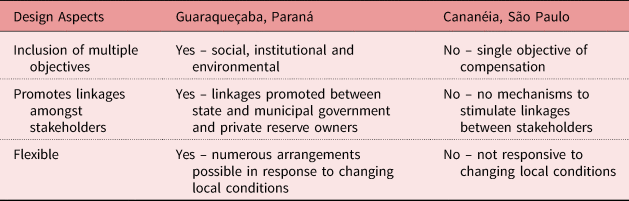
Whilst in Paraná the ICMS-E has explicit multiple objectives, creates institutional linkages and is highly flexible, in São Paulo the ICMS-E has one objective, creates no linkages and is inflexible (Table 3). Based on theory alone it could be hypothesised that the design of the ICMS-E from Paraná would be more effective in creating positive outcomes for conservation and development. The following section will examine how these two versions of the ICMS-E function within the relational and structural contexts of local level governance.
Design Aspects of the ICMS-E Legislative Framework

Municipal Case Studies – The ICMS-E on the Ground
This section will examine the way that ICMS-E revenue is applied in each case study municipality to examine how the design of the mechanism translates to the municipal context. The influence of the relational and structural aspects on policy implementation and appropriation at the municipal level is then examined.
Paraná – The ICMS-E in Guaraqueçaba
Guaraqueçaba is amongst the poorest municipalities in Paraná, with lower than average rankings for a wide variety of indicators (Table 2). With 98 per cent of its territory under environmental protection, the ICMS-E is a critical source of income for local government, accounting for 20–30 per cent of total annual revenue and almost 75 per cent of ICMS revenue.
In Guaraqueçaba the ICMS-E revenue was mostly used for municipal payroll. A portion was also used to fund community beach clean-up activities, with the intention of improving social welfare and environmental conditions. The Programa Estrela do Mar (Starfish Programme) was implemented in 2015 and rewarded women from island communities with basic food and hygiene products every month, in return for twice-weekly collection and sorting of rubbish from beaches. This was the first initiative undertaken by the administration of Guaraqueçaba to invest part of the ICMS-E revenue into a project with social and environmental outcomes, previously utilised in its entirety for the salaries of municipal employees.
Members of the local administration had reasonable knowledge of the mechanism and interest in the potential to profit from conservation action, with the mayor stating in interview, ‘I sought to learn more about the ICMS-E, to try to understand how I could work with it.’ However, the Programa Estrela do Mar, with positive outcomes for environmental education and the maintenance of protected area shorelines, was not used to contribute to an increase in the ICMS-E. The mayor stated that she ‘… did not have the time. I didn't participate in any meeting to discuss how to go about this process.’
Despite the ICMS-E framework establishing a clear linkage between local environmental legislation and financial reward, the complicated nature of the legislation has hindered application in Guaraqueçaba. The full ICMS-E legislation is a 108-page document supported by online information portals on the IAP website. There is no tool available to demonstrate how local activities will affect the value of the ICMS-E. To navigate, interpret and infer how to benefit from the incentives offered requires time and capacity, and a more simplified approach may be needed, as summarised by the mayor: ‘We need to know how much ICMS-E will be generated by our activities. Then we could perform better in relation to environmental preservation.’
Although there was a lack of nuanced understanding of how to utilise the incentive effect, government respondents identified activities which could provide mutual benefits in increasing ICMS-E revenue and improving local conditions, including the creation of a municipal environmental council. The hypothetical council would manage a fund, resourced by the ICMS-E, for hiring professionals such as environmental engineers to support and implement socio-environmental projects. It is interesting to note that the focus of this theoretical investment was on increasing local technical capacity, the lack of which arose in many interviews and is further discussed below.
Improving partnerships with landowners to incentivise the creation and maintenance of private reserves was also emphasised, with the mayor asserting, ‘It is my understanding that a percentage of the money that enters the city coffers from the presence of private reserves should be passed to the owner, to help them manage their land. This would stimulate more people to establish reserves on their properties, which isn't an easy service to provide.’ The environment secretary opined that this would benefit the municipality through an increase in ICMS-E revenue due to better management of private reserves, which, belonging to a more stringent protected area category, attract a higher return from the ICMS-E than other types of protected area: ‘We did the calculations. Private reserves return more [ICMS-E revenue] than the Area of Environmental Protection [of Guaraqueçaba, a less restrictive category of protected area]. We researched the [ICMS-E] law and we know it's possible. Next year we want to include this in our system.’ It was also suggested that this would stimulate local jobs as reserve owners might hire park guards and maintenance workers.
Government interviewees showed a good knowledge of the opportunities for innovation afforded by the design of the ICMS-E. However, there appeared to be significant barriers to realising these opportunities. According to a representative of an NGO that owns a private reserve in Guaraqueçaba, they had made repeated attempts to establish a partnership with the local administration through the establishment of a local law that would funnel a small percentage of ICMS-E funds to the improvement of the reserve:
We started this process in 2009. We went to speak with the mayor, we consulted the state accounting office, we hired a lawyer and made a work plan. At first the mayor was interested in working together. We had done the calculation, of how much return they would get from an investment in the reserve, and it was very advantageous. But, when it came time to approve the law, there was always a problem and they ended up not passing it. We have made various attempts, with various administrations. I really don't know what impedes them, if they are justified in their resistance to pass these laws. The money from the ICMS-E is very precious because it's not earmarked, they can use it as they need.
Almost all revenue received by municipal governments is destined by state or federal law to a specific application. ICMS revenue is an exception, with states constitutionally prohibited from earmarking its local use. The scarcity of ‘unencumbered’ resources available to local government means that careful consideration when legislating even a small percentage to a particular project was a concern for the mayor:
When I assumed this role, I assumed responsibility for 430 employees. I have a payroll of over R$1 million per month. If I give up on part of this [ICMS-E] resource and pass it on to someone, I would have to reduce my payroll. And how do I do that? By firing someone. So, I would resolve one problem, by stimulating private reserves, but I would create a social problem.
The flexible design of the ICMS-E in Paraná, with the opportunity for local government to innovate using the framework provided, has led to some interaction with the policy. However, this has generated few significant outcomes due to local constraints. The incentive effect has not created additional conservation activity nor partnerships, and nor has it created financial reward for programmes already enacted. The difficulties appear to be related to structural aspects of capacity and resource availability, further discussed below.
São Paulo – The ICMS-E in Cananéia
Cananéia is amongst the poorest municipalities of São Paulo, with below-average indicators for education and a high incidence of poverty when compared to the rest of the state (Table 2). Around three-quarters of its municipal territory is covered by protected areas and the 0.5 per cent of the ICMS distributed according to ecological criteria produces 60 per cent of the municipality's total ICMS revenue. Due to divergent perspectives and knowledges exhibited in interviews, the local government representatives in this analysis are divided into two groups: those who worked for the environmental secretariat, and those who did not.
Government representatives from areas outside the environmental secretariat had no knowledge of the monetary value provided by the ecological criteria of the ICMS. All respondents underestimated the significance of the ICMS-E for the local budget, with one high-ranking official estimating it at 10 per cent of the actual amount (R$400,000 versus R$4 million annually). No participant from this group could explain how the revenue was spent. Knowledge of the mechanism was extremely poor, with confusion about all aspects of the ICMS-E. One official believed the entire amount of the ICMS-E was earmarked for environmental activities. Despite not knowing the value, this group showed dissatisfaction with the amount distributed according to ecological criteria, with the mayor stating ‘I believe that much more money should come [from the ICMS-E].’
The restrictions implied by conservation were perceived as a direct impediment to the economic well-being of the community, requiring greater compensation. The mayor stated, ‘There are many things we can't do here because of the environment. We can't deforest and bring industry. The municipality ought to receive a lot more to compensate for this loss.’ The imposition of protected areas by state government was perceived as a barrier to local development and compensation from the ICMS-E as insufficient to counteract this view, possibly aggravated by the lack of knowledge of the monetary values involved.
Local government participants from within the environmental secretariat had a contrasting perspective. They exhibited good knowledge of the ICMS-E and its value, although, apart from the 10 per cent that funded their department, they did not know how the ICMS-E revenue was used, assuming that it went to health, education and payroll. Local outcomes of the ecological payments were not identifiable.
These participants were able to pinpoint aspects of the mechanism they considered substandard compared to those in other states. The main concern was the lack of stimulation of local engagement with environmental conservation: ‘The environment is abandoned by the local authorities. The ICMS-E in São Paulo has to change, because there is no incentive to pay attention to the subject. It's a passive thing, it's enough to have so many hectares of protected area. The local government doesn't need to do anything.’
Related to this is the lack of recognition of municipal and private reserves in the ICMS-E legislation, with another respondent complaining that, ‘The municipality doesn't receive ICMS-E for the presence of a private reserve, not even if they implement one themselves. We have written a plan for the creation of a reserve, but it hasn't been legislated. Investing in conservation doesn't entail any benefit for the municipality. Maybe if there was an incentive they would be interested.’
Nevertheless, organised civil society has had some success in allocating part of the revenue for environmental activities. The municipal environmental council consists of representatives from local government, civil society groups and state government agencies. In 2011 the council lobbied to pass legislation to allocate a part of the ICMS-E to an environmental fund for activities determined by the council. The coordinator of the council explained the reasoning behind the law as follows: ‘The ICMS-E law in São Paulo doesn't change, so, independent of that, we wanted to apply some of this resource to the environment. We studied the accounts and talked to the finance department and arrived at the conclusion that 2 per cent of the ICMS-E would be sufficient to initiate some projects without compromising public accounts.’
By creating a municipal law the environmental council believed they would be able to function independently of the interests of changing administrations, stating that, ‘We wanted a legal instrument that tied the ICMS-E to the environmental fund, regardless of the government. Otherwise you are at the mercy of the will of one mayor or another.’
The law was passed and the fund became operational, receiving a number of payments which were utilised in the development of a recycling programme. However, following a change of municipal government in the next election payments stopped. The new administration claimed the transfer to be unconstitutional, even though similar laws had been successfully enacted in other municipalities. The coordinator of the council explained her understanding of the motivations for this as follows: ‘The municipal administrations are always short of money. Any money that is redirected can be prejudicial. Local public authorities still see the environment as a bad thing, something that interferes with development. They don't see any benefit in spending municipal money on environmental matters.’
The same respondent felt that the absence of a direct financial incentive for conservation action within the ICMS-E mechanism reduced the leverage that the council had in advocating for the application of the resource to the environment: ‘Perhaps, if we could show the return that an investment in the environment would give, we would be successful in reinstating the payments.’
The environmental council coordinator had previously worked for the state government performing the calculation of the ICMS-E and had conducted her own research on the instrument. Her knowledge and experience of the mechanism, and tireless efforts, were critical to the success of passing the fund into law. The case of Cananéia demonstrates that organised civil society, and the leadership that exists within it, can be a determining factor for the application of conservation payments to the local management of natural resources.
Relational Aspects
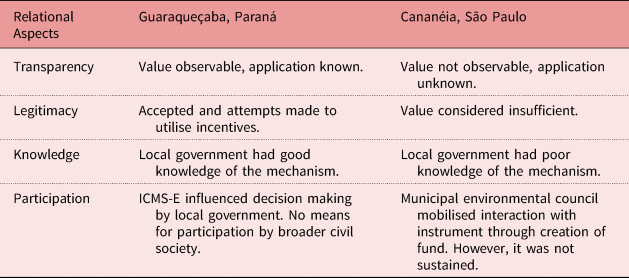
This section discusses how the implementation and functioning of the ICMS-E in the municipalities have been influenced by the relational aspects (transparency, legitimacy, knowledge, participation) identified in Table 1, with results summarised in Table 4.
Relational Aspects of the ICMS-E Legislative Framework at Municipal Level

In Guaraqueçaba the value of ICMS-E was transparent and well known amongst local government representatives, and the application of the revenue was made advisedly. This improved the legitimacy of the ICMS-E, providing recognition of the contribution of the protected areas to municipal coffers. In Cananéia the value of the ICMS-E was considered insufficient, even though it was largely unknown. The lack of transparency meant that the legitimacy of the initiative was also diminished. The separation of the ecological portion from the rest of the ICMS when it entered municipal accounts in Guaraqueçaba appears to have increased the visibility of the payments, and its application to specific outcomes improved legitimacy. However, in Guaraqueçaba, the knowledge that local authorities had of the ICMS-E was insufficient when navigating an extremely complex policy, and knowledge sharing and capacity building between institutional spheres were lacking, despite this being a specific objective of the ICMS-E.
In both São Paulo and Paraná, the ICMS-E was legislated due to the mobilisation of local governments affected by the presence of protected areas. In Paraná, active participation in the ICMS-E by local government is prescribed in the mechanism, with the annual evaluation and determination of the Terms of Agreement occurring in tandem with local authorities. In Guaraqueçaba this has contributed to increased interaction with the mechanism, both in its application to a socio-environmental project, and through the proposed creation of local protected areas to increase financial return from the ICMS-E. The authorities in Guaraqueçaba have been unable or unwilling to promote public–private partnerships with private reserve owners, even when financially beneficial.
Developments in Guaraqueçaba since this field research was undertaken indicate that the mechanism has influenced local decision-making. In early 2017 a new local government was elected. Within one year the creation of four protected areas corresponding to IUCN Categories I and II had been progressed. In its justification for this legislation the local government clearly identified the financial return from the ICMS-E as a key motivation and indicated that the mechanism improved the perception of equitable distribution of the ICMS, stating that, ‘Another … positive impact is the immediate increase in ICMS-E revenue, by the simple creation of the protected areas. The ICMS-E revenue may be used for all matters, not just the environment. Nothing is more just than Guaraqueçaba, almost 100 per cent covered by protected areas, receiving a significant share of this [ICMS-E] resource.’Footnote 65
In São Paulo, the legislation is entirely passive, with no requirements for participation by local administrations. Yet the existence of an environmental council with engaged and knowledgeable members in Cananéia led to community participation in the application of ICMS-E revenue. This is entirely unanticipated in the ICMS-E legislation and has important implications. Despite a policy that demands no interaction or even awareness from local authorities, the environmental council was able to bring about the creation of an environmental fund in Cananéia based on the revenue from the ICMS-E. Local perception of the importance of natural resource management, and the responsibility the community feel for the environment, may be fundamental to the outcomes of such programmes, independent of the policy design. The importance of local leadership for information sharing and mobilisation is also emphasised by this finding.
Structural Aspects
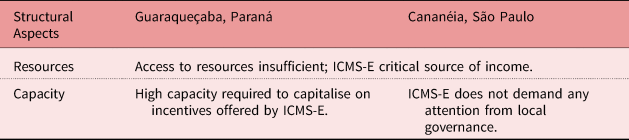
This section discusses how the implementation and functioning of the ICMS-E in the municipalities have been influenced by the structural aspects (resources and capacity) identified in Table 1, with results summarised in Table 5.
Structural Aspects of the ICMS-E Legislative Framework at Municipal Level

A common theme in interviews was the lack of resources available to municipal governments to meet their responsibilities. Increasing the institutional capacity of local authorities is apparent in the objectives of the ICMS-E in Paraná. However, programmes and partnerships to address this appear to be lacking and the policy instead places onus on local authorities through the Terms of Engagement. In Brazil, municipal government is recognised as the government entity least capable of producing meaningful results due to institutional and technical limitations.Footnote 66 This was evident in the inability of the authorities in Guaraqueçaba to establish partnerships with private reserve owners, despite the advantages that would arise from such interaction, and the inability to integrate existing legislation into ICMS-E evaluations.
Municipalities may require further technical support and direction from state government to capitalise on the opportunities offered by the ICMS-E. Furthermore, the ICMS-E legislation may require simplifying to facilitate engagement by local actors. Municipalities should be able to easily identify which environmental activities will produce the best economic return. Perhaps for these reasons, the IAP is developing a new system to distribute the ICMS-E in Paraná state, as described by an interviewee within the organisation. The intention is to base the ecological criteria on the presence and activity of a municipal environmental council controlling an environmental fund with the budget coming directly from the ICMS-E. The higher percentage of ICMS-E revenue earmarked by local law for this fund, the higher the financial reward received.
Whilst this is certainly a simplified approach that may be easier for local government to navigate, it entails potential consequences for distributional equity, when one remembers that the core motivation of the intergovernmental transfer of the ICMS is to provide resources for local government to perform critical public functions. Municipal governments have responsibility for health, education, transport, sanitation, solid waste management and other basic services. Constitutionally, the ICMS cannot be earmarked, and linking it so directly to environmental activity may not be appropriate. Well-resourced municipalities may be able to allocate a large proportion of the ICMS-E to the environmental fund and thus be better compensated, whilst impoverished municipalities that depend on the funding for payroll and basic services will be less able to do so, exacerbating distributional inequity. The creation of a functioning environmental council also demands capacity, time and resources, potentially further disadvantaging places like Guaraqueçaba, where these are all in short supply.
Higher government levels generally have more consolidated administrative structures for environmental management, making them better able to allocate and manage protected areas.Footnote 67 Even so, many protected areas administered by these higher levels of government do not adhere to the basic management instruments that federal legislation imposes. For example, the federal environmental agency is still developing the management plan for the Superagui National Park in Guaraqueçaba some 29 years after the park was first established, despite federal legislation requiring a completed plan by 2005. This calls into question the ability of the less well-resourced municipal government of Guaraqueçaba to effectively administer the four new parks being legislated, especially considering the presence of resource-dependent communities within the designated areas and the potential conflicts and social justice issues that may arise.Footnote 68 Local government may not be sufficiently capable of navigating and resolving these complex issues and it is unclear if the financial return from the ICMS-E will justify the financial investment and possible social costs of establishing new protected areas. Reserve management plans require financial investment and technical capacity. The lack of technical capacity locally may lead to poor reserve management, a low evaluation and little return from the ICMS-E. It is, however, interesting to note that the presence of the ICMS-E incentive has made the creation of protected areas a productive investment, as oppose to a burden, as was the perception in Cananéia.
In São Paulo the ICMS-E, despite being criticised for not incentivising conservation, did not demand any attention from local government and so did not divert critical capacity away from the provision of core services. The activity of the environmental council indicates that the community considered conservation important and demanded action in this area. Environmental education, knowledge sharing and increasing participation of civil society in decision-making processes may be more important to conservation outcomes than legislation that places onus and responsibility on the local sphere.
In São Paulo, where the ICMS is purely compensatory, the state government has introduced a complementary programme to stimulate local natural resource management. The Programa Município VerdeAzul (GreenBlue Municipality Programme),Footnote 69 implemented in 2007, is voluntary, and all 645 municipalities have enrolled. The programme invites representatives of all municipalities to participate in workshops and seminars which provide technical capacity building and share knowledge. Annual evaluations are conducted to measure municipal environmental performance including in air quality, water management, urban greening, biodiversity management, environmental education and the action of the environmental council. These criteria allow participation by all municipalities, not just those that host protected areas. A score is given out of 100 and those municipalities receiving more than 80 points receive preferential treatment when making applications to the Fundo Estadual de Prevenção e Controle da Poluição (State Fund for Pollution Prevention and Control, FECOP), in 2017 worth R$15 million (US$4.6 million). Agreements are made between local and state governments for the use of the fund to pay, for example, for solid waste and recycling infrastructure or systems to capture and reuse water. The money received from FECOP by successful municipalities is additional, not withdrawn from the pool required to cover basic public functions, as is the case of the ICMS-E.
Initiatives that include capacity building and the active participation by municipal public servants may be more effective in stimulating natural resource management by local governments than the simple offer of a compensation payment. The participation of local government in the VerdeAzul capacity-building programmes helps to address the critical problem of low capacity at the municipal level. Whilst in Paraná there is little publicly available data on ICMS-E outcomes, the Programa Município VerdeAzul has clearly demonstrated environmental outcomes, with all funds applied to additional environmental management (for more information see the programme website; details in Footnote note 69).
Policy Implications
Economic instruments for conservation are being applied around the world and whilst EFTs are gaining increasing attention they have not yet been implemented in any Latin America country other than Brazil. The design and implementation of payments to stimulate conservation or to compensate for its local costs should be carefully considered, as outcomes are highly context dependent. However, the application of the framework using two case studies has allowed for several observations that may be more universal in nature, particularly for countries with high environmental significance and poverty, as exist throughout Latin America:
1. The outcomes of environmental payments depend largely on the structural characteristics of the institutional level at which payments are received. A lack of institutional capacity and limited resources may prevent positive environmental outcomes;
2. The inclusion of incentives may be a key factor in stimulating local environmental activity through direct financial reward, and can also create political leverage in the form of an economic argument for conservation;
3. The design of payments significantly alters how they are applied at the local level and the results in terms of intended and unintended outcomes. EFTs must be designed not to incur high transaction costs for local government;
4. The way protected areas are perceived influences how environmental payments are applied locally. Improving the visibility of the multiple values of ecosystems, including ecological and monetary, and the opportunities they provide may help to change the narrative of conservation as an impediment to development. To this end there should be high transparency in the revenue received from the presence of protected areas;
5. Increased civil society participation in public processes may be more important to achieving local natural resource management than legislation that places responsibility for conservation on local authorities.
These observations may inform the development of similar policy mechanisms and are discussed in turn below.
Capacity building: Payments schemes that are intended to produce specific outcomes within a context of poor institutional capacity should include capacity building and technical support programmes. This may contribute to the efficient and effective application of funds. Collaboration and support across levels of governance may be critical in enabling payment beneficiaries to derive the greatest benefits from limited resources.
Incentives: The inclusion of incentives can serve two purposes. First, incentives can stimulate local conservation activity by offering financial reward. Incentives may also have an important function in providing political leverage for stakeholders with environmental interests by providing an economic argument for conservation. For this to occur, payments must be transparent and well disseminated, and civil society must have sufficient capacity to act. Incentives must be designed to avoid promoting local conservation activity that increases inequality by implying costs for the rural poor.
Transaction costs: EFTs have the significant advantage of implying low transaction costs at the level of allocation by central government. However, overly complicated instruments can involve high costs for local government trying to capitalise on incentives, as seen in Guaraqueçaba. The incentive mechanism must allow for easy understanding of potential returns in order to encourage informed investments in conservation. Local transaction costs could be lowered by providing a simulation tool, so municipal authorities are able to identify their comparative advantage and implement policy with an advantageous cost–benefit ratio.
Perceptions of conservation and transparency: Both Cananéia and Guaraqueçaba benefit from opportunities for sustainable development available to few other places. In this region, the natural environment provides the most significant opportunity for creating a viable economic strategy, through the realisation of the productive and employment potential afforded by the presence of abundant and intact nature, informed by diverse and place-specific cultures. Conservation payments may be a part of this scenario; however, local authorities need to understand this potential and be enabled to capitalise on it in ways that are sensitive to cultural and natural heritage. Priority should be given to working together with communities, protected area managers and environmental authorities. To this end, the use of environmental payments should be widely disseminated and monetary values made highly transparent. Payments that enter local government accounts based on ecological criteria should be separate from other transfers to allow easy identification of the revenue attributed to nature conservation.
Participation and knowledge sharing: Information about environmental payments should be widely disseminated to local government and the broader public. This should occur beyond the roll-out phase of a programme, to accompany changing administrations. Information on payments should be easily accessible, in terms of both terminology and in communication methods. More broadly, environmental education may play a role in promoting civil society interest in conservation.
Conclusion
This research study has examined two versions of a Brazilian EFT, the ICMS-E. In the state of Paraná, despite the policy being flexible and fostering multi-level linkages, it does not adequately account for the local context in which it functions. The complexity of the policy overwhelms the ability of local institutions to access the incentives offered for additional natural resource management. Incentives can be most easily accessed through the creation of municipal protected areas, raising questions of social justice and environmental management. The ICMS-E in Paraná may also create problems of distributional justice, favouring municipalities that enjoy higher levels of institutional capacity and greater resource access.
If analysed simply for design aspects, without consideration of the influence of the relational and structural aspects at the local level, the ICMS-E in Paraná could be considered a leading example of a conservation payment scheme. The application of the framework enabled the identification of some problematic aspects of this approach that have not been discussed in other literature on the ICMS-E. Applying the framework to other contexts and other payment schemes could reveal similar findings to help inform the development of new programmes.
In São Paulo, the ICMS-E is inflexible and does not demand any engagement by local governments. It acts as simple compensation for some of the costs of conservation, without stimulating engagement with the theme. The negative perception of protected areas by local municipal authorities had a detrimental impact on engagement with conservation activity, despite civil society leadership in this area. Funding was not applied to environmental projects, as this was considered a wasted investment. In this case the inclusion of a direct financial incentive for local environmental activity may produce positive results, as leverage for organised civil society to provide an economic argument for environmental conservation. Better dissemination of the mechanism is also necessary, as a lack of knowledge of the monetary values involved was a significant barrier to improving environmental perceptions and implementing local natural resource management. The separation of the ecological portion of the ICMS revenue, as performed in Paraná, could enhance recognition of the economic value of protected areas and help to counteract negative perceptions of protected areas held by some local stakeholders.
Whilst EFTs, like the ICMS-E, may contribute towards economic well-being and conservation, their development should be carefully considered. Revenue from intergovernmental transfers is intended and, indeed required, for the provision of basic services at the municipal level. Linking this revenue to conservation activity has potential repercussions for local governance, particularly in countries like Brazil, where municipal institutions are the least well resourced, and the least efficient and effective in applying revenue.Footnote 70 The ICMS-E is a critical source of local funding, and distributional equity should be at the centre of decisions about its allocation, with care being taken to not further disadvantage impoverished municipalities.
This research comprises the first comparative examination of three decades of implementation of two versions of the ICMS-E, providing an opportunity to examine contextual nuances and the historical evolution of the policy itself that can lend support to replication. EFTs are a mechanism with potential to contribute towards a policy mix for conservation that takes account of the needs of social justice and reinforces the protection of ecosystems. The framework developed in this research, and then applied to case studies, has enabled a fuller understanding of how two versions of an EFT function in local contexts, contributing to the conceptual understanding of one of the most under-utilised economic instruments for conservation.
Adopting a mainstream institutionalist approach, this framework may aid decision-makers in considering the interactions that can occur between the legislative design of a mechanism and the relational and structural aspects of the context in which it must be implemented. In this sense, the framework presented here may begin to bridge a gap in the research that examines EFTs, allowing for local socio-ecological and institutional contexts to be incorporated into analysis, whilst using an approach that is highly accessible to all relevant actors.