The global spread of carbapenemase-producing Enterobacteriaceae (CPE) poses remarkable clinical and therapeutic challenges.Reference Tzouvelekis, Markogiannakis, Piperaki, Souli and Daikos 1 CPE have been associated with significant morbidity and mortality, with a mortality rate approaching 40%.Reference Tzouvelekis, Markogiannakis, Piperaki, Souli and Daikos 1 A number of observational studies have suggested that combination antibiotic therapy is associated with improved clinical outcomes for patients with infections due to CPEReference Tzouvelekis, Markogiannakis, Piperaki, Souli and Daikos 1 . This is likely because of the broader coverage provided with 2 antimicrobial agents compared with a single agent. Because infections caused by CPE are associated with poor outcomes, optimizing antibiotic therapy as early as possible is essential.
It can take several days before complete susceptibility data for a CPE are available. Delays can be due to both confirmation of automated in vitro results and testing of additional agents not normally included in susceptibility panels. A combination antibiogram provides a method of evaluating organism cross resistance across multiple antibiotics.Reference Pogue, Alaniz, Carver, Pleva, Newton and DePestel 2 It can assist with determining the pairing of antibiotics that affords the greatest likelihood of coverage against highly drug-resistant organisms, such as CPE, while awaiting susceptibility results. Our objective was to develop a combination antibiogram for CPE.
METHODS
We included all clinical Enterobacteriaceae isolates identified as carbapenemase-producing over a 24-month period using our clinical microbiology database between April 2013 and March 2015. Carbapenemase-production was defined as organisms with minimum inhibitory concentrations (MICs) ≥4 µg/mL to ceftriaxone AND ≥2 µg/mL to ertapenem AND modified Hodge test (MHT) positive. Perirectal surveillance cultures were excluded. Clinical samples were processed at The Johns Hopkins Hospital Clinical Microbiology Laboratory according to standard procedures.
Antimicrobial susceptibility testing was determined using the BD Phoenix Automated System (Becton Dickinson Diagnostics, Sparks, MD). Meropenem and imipenem-cilastatin resistance was defined as MIC ≥1 µg/mL, using the current Clinical and Laboratory Standards Institute (CLSI) interpretive criteria. MICs to colistin were determined using macrobroth dilution. Because no CLSI colistin breakpoints have been established for Enterobacteriaceae, the breakpoint for Pseudomonas species and Acinetobacter species (≤2 µg/mL) was used, which is also The European Committee on Antimicrobial Susceptibility Testing (EUCAST) clinical breakpoint for Enterobacteriaceae. For tigecycline, the US Food and Drug Administration breakpoint was used (susceptible, MIC ≤2 µg/mL). If an organism was less than or equal to or greater than or equal to an MIC value, the more conservative MIC was selected (eg, if an MIC was ≤2 µg/mL, 2 µg/mL was selected as the MIC, if the MIC was ≥64 µg/mL, 128 µg/mL was selected). Guidance for antibiogram preparation from the CLSI was used, 3 it included the first clinical isolate (from any site) per patient of an organism meeting the CPE definition during the 2-year period.
Pharmacokinetic-pharmacodynamic (PK-PD) data,Reference Roberts, Kirkpatrick, Roberts, Robertson, Dalley and Lipman 4 animal studies,Reference Daikos, Panagiotakopoulou, Tzelepi, Loli, Tzouvelekis and Miriagou 5 , Reference Souli, Konstantinidou and Tzepi 6 and clinical dataReference Daikos and Markogiannakis 7 indicate that prolonged-infusion meropenem remains a viable option for Enterobacteriaceae with meropenem MICs as high as 8–16 µg/mL. Thus, we also developed a combination antibiogram for Enterobacteriaceae with meropenem MICs of up to 8 µg/mL categorized as susceptible. Because of concerns with the stability of imipenem-cilastatin administered as a prolonged infusion,Reference Keel, Sutherland, Crandon and Nicolau 8 this agent was excluded from the combination antibiogram that included elevated carbapenem MICs. Current CLSI breakpoints were used for all other agents. All combinations included a carbapenem because many experts believe carbapenems remain the most reliable therapeutic option for treating CPE.Reference Tzouvelekis, Markogiannakis, Piperaki, Souli and Daikos 1 The different susceptibility proportions using meropenem breakpoints of 1 µg/mL and 8 µg/mL were compared using the χ2 test. A 2-sided P value of ≤.05 was considered statistically significant. Data were analyzed using Stata, version 12.0 (Stata Corp, College Station, TX).
RESULTS
Our combination antibiogram included 175 isolates during a 24-month period. The following organisms were identified as CPE: Klebsiella spp. (50%), Enterobacter spp. (29%), Escherichia coli (9%), Citrobacter spp. (7%), Serratia marcescens (3%), Morganella morganii (1%), and Proteus mirabilis (1%). Common sources from which CPE were isolated included urine (34%), sputum (22%), and intra-abdominal fluid (21%). Median MICs and interquartile ranges (IQRs) for antibiotics tested were as follows: meropenem (4 µg/mL; IQR, 1–16 µg/mL), imipenem-cilastatin (8 µg/mL; IQR, 4–16 µg/mL), colistin (0.25 µg/mL; IQR, 0.12–0.5 µg/mL), tigecycline (1 µg/mL; IQR, 1–2 µg/mL), ciprofloxacin (4 µg/mL; IQR, 0.5–4 µg/mL), trimethoprim-sulfamethoxazole (4 µg/mL; IQR, 0.5–4 µg/mL), gentamicin (2 µg/mL; IQR, 2–16 µg/mL), tobramycin (8 µg/mL; IQR, 2–16 µg/mL), and amikacin (8 µg/mL; IQR, 8–8 µg/mL).
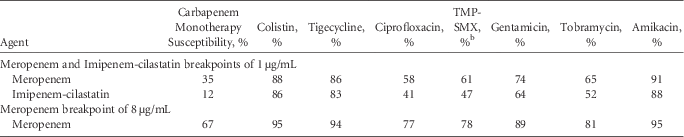
Using the meropenem breakpoint of ≤1 µg/mL, 35% of isolates were susceptible to meropenem monotherapy. Activity increased to 91% and 88% with the addition of amikacin and colistin, respectively (Table 1, P<.01 for both combinations). Using a cutoff of 8 µg/mL, meropenem showed activity against 67% of CPE isolates (P<.01 compared to a breakpoint of ≤1 µg/mL). The combinations with the greatest activity against CPE, when defining meropenem susceptibility as up to 8 µg/mL, were meropenem plus amikacin (95%) and meropenem plus colistin (95%).
Combination Antibiogram for 175 Carbapenemase-Producing Enterobacteriaceae Using Current Meropenem and Imipenem-Cilastatin Breakpoints of 1 µg/mL and a Meropenem Breakpoints of 8 µg/mLFootnote a

a Carbapenemase-production was defined as organisms with minimum inhibitory concentrations (MICs) ≥4 µg/mL to ceftriaxone AND ≥2 µg/mL to ertapenem AND positive modified Hodge test (MHT). The values under each column represent the percentage of isolates with in vitro activity for the combination of meropenem or imipenem-cilastatin and the agent listed, evaluating the first clinical isolate (from any site) per patient of an organism meeting the carbapenemase-producing Enterobacteriaceae definition during a 2-year period.
b Trimethoprim-Sulfamethoxazole.
DISCUSSION
We developed a combination antibiogram to better understand the incremental benefit of various antibiotic combinations against CPE. Our results suggest that combination therapy provides better coverage against CPE then meropenem or imipenem-cilastatin alone, and that the combination of agents most likely to provide coverage is a carbapenem plus amikacin or a carbapenem plus colistin. As dual therapy is considered the standard of care for the treatment of CPE (outside of uncomplicated urinary tract infections), the use of a combination antibiogram increases the likelihood that patients with CPE receive early and appropriate therapy. All combinations evaluated in our antibiogram included a carbapenem. Although randomized controlled trial data to define the optimal combination of antibiotics to treat CPE infections are lacking, some evidence indicates that carbapenem-containing regimens are more efficacious than carbapenem-sparing ones.Reference Tzouvelekis, Markogiannakis, Piperaki, Souli and Daikos 1 This finding is likely a result of the predictable and sustained drug concentrations with carbapenems compared with agents like tigecyclineReference Yahav, Lador, Paul and Leibovici 9 and colistin.Reference Garonzik, Li and Thamlikitkul 10
The current meropenem breakpoint is 1 µg/mL; however, even for MICs of 8 µg/mL, high-dose, prolonged infusion meropenem regimens exhibit high probabilities of target attainment for time above the MIC necessary for bactericidal activity.Reference Roberts, Kirkpatrick, Roberts, Robertson, Dalley and Lipman 4 Enterobacteriaceae with carbapenem MICs between 2 and 8 µg/mL are currently reported as nonsusceptible to carbapenems. Clinicians may not realize that carbapenems remain an option with MICs in this range; they may instead resort to prescribing alternate and potentially less effective agents. Larger clinical studies evaluating the risks versus benefits of raising the carbapenem breakpoint need to be conducted.
We are aware of several limitations pertaining to this study. First, as our study used single-center data, our range of antibiotic MICs for CPE may differ from those of other centers. However, we still believe that this study is important in reminding us that clinical microbiology laboratories, particularly those serving high-prevalence CPE regions, should consider developing institutional combination antibiograms to aid in the selection of empiric therapies for these organisms. Second, we do not have molecular data confirming the presence of carbapenemase encoding genes for the isolates included in our study. Although MHT is a culture-based test for detecting the release of carbapenemases into agar media, it is also known to detect some noncarbapenemase methods of carbapenem resistance (eg, extended-spectrum β-lactamases or hyperproducing AmpCs with reduced outer-membrane permeability). In accord with CLSI and EUCAST recommendations, most clinical microbiology laboratories do not pursue additional characterization of carbapenem resistance; therefore, most clinicians are also unaware of the mechanism of carbapenem resistance when considering therapeutic options. As carbapenems remain the backbone of therapy for carbapenem-resistant Enterobacteriaceae regardless of carbapenemase or non-carbapenemase resistance mechanisms, the actual mechanism of carbapenem resistance may be less important. Finally, we defined “optimal” combinations based on in vitro activity, but whether in vitro activity always translates to clinical efficacy remains unclear. These limitations notwithstanding, our findings suggest that combination antibiograms provide valuable information regarding which combination of antibiotics achieves the highest likelihood of adequate empiric antibiotic coverage against CPE.
ACKNOWLEDGMENTS
Financial support: This publication was made possible by support from the Sherrilyn and Ken Fisher Center for Environmental Infectious Diseases, Division of Infectious Diseases of The Johns Hopkins University School of Medicine.
Potential conflicts of interest: All authors report no conflicts of interest relevant to this article.
The contents of this article are solely the responsibility of the authors and do not necessarily represent the official view of the Fisher Center or The Johns Hopkins University School of Medicine.