INTRODUCTION
In recent years, the topic of trust generated a great deal of research interest (Colquitt, Brent, Scott, & LePine, Reference Colquitt, Lepine, Zapata and Wild2007; Schoorman, Mayer, & Davis, Reference Schwierena and Sutterb2007). This has been exacerbated by an ever-increasing realization that trust is a key component of effective socio-economic relationships and outcomes (Rotter, Reference Rotter1980). Working together often involves interdependence, and people must therefore depend on others in various ways to accomplish their personal and organizational goals (Fukuyama, Reference Fukuyama1995; Mayer, Davis, & Schoorman, Reference Mayer and Davis1995; Hardin, Reference Hardin2008). In this perspective, trust becomes fundamental to human beings in their socio-economic interactions (Sztompka, Reference Sztompka1999; Hurley Reference Hurley2012). It involves an ongoing process of relationship building, communication, and action (Misztal, Reference Misztal1996). The majority of scholars who have examined trust generally agree that it refers to the willingness to accept vulnerability based upon positive expectations about another’s behavior. Trust propensity refers to the dispositional willingness to rely on others (Colquitt et al., Reference Colquitt, Lepine, Zapata and Wild2007). When individuals trust other people, they are accepting that while it is possible these people could act to their disadvantage, yet they believe they are not likely to (Das & Teng, Reference Das and Teng2004). Trust also means confidence in the integrity, agenda, and capabilities of others, as well as their track records based on past actions (Bernerth & Walker, Reference Bernerth and Walker2009). In other words, trust evolves incrementally over time and is based on historical judgment (Sutter & Kocher, Reference Sutter and Kocher2005). Hence the time-factors embedded in age and experience may often shape individuals propensity (or predisposition) to trust (Colquitt et al., Reference Colquitt, Lepine, Zapata and Wild2007).
Previous research on the impact of/on trust is quite varied and lacks agreement on what may affect individuals’ propensity to trust. Also, studies examining the impact of individualism–collectivism on trust remain relatively lacking and/or sparse (Huff & Kelly, Reference Huff and Kelly2003; Shin & Park, Reference Schwartz2005). Moreover, the relevance of gender as it relates to trust remains unclear (Feingold, Reference Feingold1994; Furumo & Pearson Reference Furumo and Pearson2007; Buchan, Croson, & Scinick, Reference Buchan, Croson and Scinick2008; Dreber & Johannesson, Reference Dreber and Johannesson2008; Croson & Gneezy, Reference Croson and Gneezy2009). Also, studies examining the above characteristics rarely include varied target samples, and seldom cater for these in the middle-east context. To address this gap, this paper reports on a study conducted in the United Arab Emirates. The main purpose is to examine the role and impact of individualism–collectivism on individual’s propensity to trust. Data were collected from three target populations, namely students; (n=370); small business owners/operators (n=324) and other employed individuals (n=376). Propensity to trust was assessed with the instrument developed by Mayer and Davis (Reference Mayer, Davis and Schoorman1999) and individualism–collectivism was measured using the concept of vertical/horizontal individualism–collectivism developed by Triandis and Gelfand (Reference Triandis1998). The aim is also to examine gender differences and differences across the above cohorts in relation to trust.
LITERATURE REVIEW AND HYPOTHESES
The meaning of trust
Trust is a complex construct that has been conceptualized in multiple ways. It is commonly agreed that it refers to a psychological state comprising the intention to accept vulnerability based upon positive expectations of the intentions and behavior of others (Rotter, Reference Rotter1980). Rousseau, Silkin, Burt, and Camerer (Reference Rousseau, Silkin, Burt and Camerer2011) define trust as a ‘psychological state comprising the intention to accept vulnerability based upon a positive expectation of the intentions or behavior of another’ (2011: 395). Trust involves an ongoing process of relationship building, communication, and action (Misztal, Reference Misztal1996).
However, over the years, the concept of trust has been subjected to differing theoretical perspectives which have been subjected to a great deal of controversies and much debates in the literature. Colquitt, Lepine, Zapata, and Wild (Reference Colquitt, Brent, Scott and LePine2011) showed that different types of trust can be distinguished from each other and suggested that the literature dealing with the concept of trust entails two distinct streams. The first stream is the one exemplified by Mayer, Davis, and Schoorman’s (Reference Mayer and Davis1995) view which emphasizes the vulnerability aspect of trust. The other stream, captured in the arguments put forth by Rousseau et al. (Reference Rousseau, Silkin, Burt and Camerer2011) emphasizes the expectations aspect of trust.
The trust literature also distinguishes trustworthiness (the ability, benevolence, and integrity of a trustee) and trust propensity (a dispositional willingness to rely on others). This perspective is generally endorsed by researchers who think of trust as a personality characteristic often use an individual’s general disposition or propensity to trust to predict trust behavior (Chopra & Wallace, Reference Chopra and Wallace2003). In other words, individuals’ propensity to trust refers to their dispositional willingness to rely on others (Colquitt et al., Reference Colquitt, Lepine, Zapata and Wild2007). It is an expression of their readiness and confidence that they will not be harmed or put at risk by the actions of other people. When individuals are predisposed to trust other people, they are accepting that while it is possible these people could act to their disadvantage, yet they believe they are not likely to do so (Das & Teng, Reference Das and Teng2004; Ferguson & Peterson Reference Ferguson and Peterson2015). In this study, we focus on the notion and concept of propensity to trust.
Gender and trust
The existence of gender differences in trust behavior has important implications for economic behavior (Croson & Gneezy, Reference Croson and Gneezy2009; Chang, O’Neill, & Travaglione, Reference Chang, O’Neill and Travaglione2016). Yet, the empirical research to-date remains mixed, in terms of demonstrating which gender group may be more trusting in given economic situations [Croson & Buchan, Reference Croson and Buchan1999; Buchan, Croson, & Scinick, Reference Buchan, Croson and Scinick2008; Schwierena & Sutterb, Reference Shin and Park2008]). More specifically, survey evidence on which gender is more trusting is deeply divided. While some studies emphasize significant differences between males and females on their propensity to trust; other studies show no differences, or even the opposite.
Sheehan (Reference Schoorman, Mayer and Davis1999) found that female consumers have greater trust concerns than men and are less likely to engage in purchasing over the web. Spector and Gwene (Reference Spector and Gwene2004) reported a significant interaction effect between respondent gender and initial trust. Specifically, they found that initial trust level was much lower among female employees. They justify their findings by arguing that females tend to exhibit lesser ‘trusting stance’ (i.e., the degree to which an individual consistently deals with people as if they are well-meaning and reliable across situations and persons). In other words, female are less likely to make a conscious choice to trust people until they prove untrustworthy. In a study of the effects of gender on trust and trustworthiness, Buchan, Croson, and Scinik (Reference Buchan, Croson and Scinick2008) examined the effects of gender on trust and trustworthiness. They compared choices by men and women in a laboratory-controlled game supplemented by survey data aimed at understanding the motivations for the behavioral differences between men and women. Their findings revealed that men tend to trust more than women do, and that women are more trustworthy than men.
While the above studies point to a lesser degree of trust among females, other studies do not support this contention. Feingold (Reference Feingold1994) meta-analysis of gender and scales of personality inventories shows that females scored slightly but consistently higher than males on scales of trust (Feingold, Reference Feingold1994). Similarly, in a study of gender impacts in virtual teams, Furumo and Pearson (Reference Furumo and Pearson2007) reported that females displayed higher trust than males.
Dreber and Johannesson (Reference Dreber and Johannesson2008) conducted a series of experiments to test for a difference in lying and trusting behavior between men and women. In particular, they tested whether there was a difference in the extent to which men and women trusted the contents of different types of messages. They found no significant gender differences in this regard. Similarly, in an analysis of gender differences on a trust game, Vyrastekova and Onderstal (Reference Wagner and Moch2005) observed that, on average, men and women did not differ on trust and that women are slightly more trustworthy than men. In a comprehensive study of e-government services in the Romanian context, Colesca (Reference Colesca2009) found that gender did not influence trust and that women did not necessarily trust more than men.
Given the above research evidence, it would be plausible to assume that women in the United Arab Emirates would be less trusting than their male counterparts.
Hypothesis 1: By comparison to males, females tend to have less propensity to trust.
The role of entrepreneurial experience
A large body of research on trust, crossing many disciplines, assumes that the willingness to trust is closely associated with the willingness to take risk and thus associate trust with entrepreneurship and risk taking (Steensma, Marino, & Weaver, Reference Steensma, Marino and Weaver2000; Kwon & Arenius, Reference Kwon and Arenius2010). The main argument here is that entrepreneurs need to network with others and trust them in order to form and grow their organizations. Yet, some researcher still persist and argue that by comparison to other social groups, entrepreneurs are generally more cautious and less trusting (e.g., Brodsky, Reference Brodsky1993; Goel & Karri, Reference Goel and Karri2006). This view relies on the assumption that if/when entrepreneurs are over-trusting, they expose themselves to greater vulnerability and risk.
Yet, in contrast, several studies do not support the above claim. They argue that entrepreneurs need to be more trusting because this is part of their predisposition to take risk which is embedded in the profiles/personalities of successful entrepreneurs (Steensma, Marino, & Weaver, Reference Steensma, Marino and Weaver2000; Kwon & Arenius, Reference Kwon and Arenius2010). In fact, trusting and readiness to engage in trusting relationships that involve risk are some of key ingredients of successful entrepreneurs. In other words, trust and risk are closely linked (Das & Teng, Reference Das and Teng2004). In contrast, individuals (e.g., nascent entrepreneurs) who were presented with business/entrepreneurial opportunities and did not take them at a given time (because of lack of trust) blame themselves for the missed opportunities.
Trust, as it relates to entrepreneurship, may also be contextual. For instance, individuals from countries with higher propensity to trust and breadth of memberships to groups (collectivism) may perceive more entrepreneurial opportunities and therefore take more risks (Steensma, Marino, & Weaver, Reference Steensma, Marino and Weaver2000; Kwon & Arenius, Reference Kwon and Arenius2010). In recent years, this tendency has been more common and is clearly demonstrated by the huge and growing international business ventures (and investments) of Middle-East entrepreneurs (more specifically those from the Gulf region) despite current socio-political unrest. For the success of their ventures, entrepreneurs need to develop network and nurture trusting relationships within these. When members of their networks trust each other, they are more willing to engage in cooperative activity through which further trust may be generated. Trust and risk are also closely interrelated (Mayer, Davis, & Schoorman, Reference Mayer and Davis1995). Consequently, trust is a critical ingredient for the success of entrepreneurs willing to take risks. It is often the key to establishing long-term viable business relations. It is therefore essential for entrepreneurship as it can reduce some risks inherent within entrepreneurial activities as well as act as a governing mechanism for various entrepreneurial relationships (Welter, Reference Wheeler, Reis and Bond2012).
Hence, the predisposition to trust becomes almost a necessity for individuals engaged in small business/entrepreneurial activities, particularly those business experience.
Hypothesis 2: Individuals with greater business/entrepreneurial experience are more predisposed to trust others.
Individualism–collectivism and propensity to trust
Individualism/collectivism describes the relationship between the individual and the prevailing collectivity in a given society. Individualism implies a loosely knit social framework in which people are supposed to take care of themselves and their immediate families only, while collectivism is characterized by a tight social framework in which people distinguish between in-groups and out-groups; they expect their in-group to look after them, and in exchange they feel they owe absolute loyalty to it (Hofstede, Reference Hofstede1980). Much of the research on individualism and collectivism has tended to focus more on these dimensions as aspects of national cultures rather than as personality traits (Gunther, McGrath, MacMillan, & Scheinberg, Reference Gunther, McGrath, MacMillan and Scheinberg1992). However, there is strong evidence to suggest that the cultural syndromes of individualism/collectivism and personality are tightly related (Triandis, Reference Triandis and Gelfand2001). Hence, there is a great degree of overlap between individualism and collectivism as personal traits and as cultural dimensions. People in collectivist cultures, compared with people in individualist cultures, are likely to define themselves as aspects of groups, to give priority to in-group goals, to focus on context more than the content in making attributions and in communicating, to pay less attention to internal than to external processes as determinants of social behavior, to define most relationships with in group members as communal, to make more situational attributions, and tend to be self-effacing (Hofstede, Reference Hofstede1980; Spence, Reference Spence1985; Wagner & Moch, Reference Welter1986; Hui, Reference Hui1988; Sampson, Reference Sampson1988; Wheeler, Reis, & Bond, Reference Wheeler, Reis and Bond1989; Schwartz, Reference Sheehan1990; Triandis & Gelfand, Reference Triandis1998; Triandis, Reference Triandis and Gelfand2001; Finkelstein, Reference Finkelstein2010).
Propensity to trust refers to the dispositional willingness to rely on others (Colquitt et al., Reference Colquitt, Lepine, Zapata and Wild2007). It is a stable individual difference that represents an individual’s dispositional tendency to trust or distrust (be suspicious of) other individuals (Rotter, Reference Rotter1980; Bernerth & Walker, Reference Bernerth and Walker2009). It refers to a generalized expectancy to attribute benevolent intent to others and rely on information received from others. Those who characteristically trust others believe that they will be treated fairly and that over time their good acts will be reciprocated in some manner (Van Dyne, Vandewalle, & Kostova, Reference Van Dyne, Vandewalle and Kostova2000). Thus they are more likely to get involved in collective work and try to benefit from positive experiences as group members. In fact Rotter (Reference Rotter1980) demonstrated that trusting individuals respected the rights of others and were liked by others and were sought out as friends. Extending this logic, we would assume that trusting individuals would value relationships with others and would more likely value collectivism. This may explain why much of the literature emphasizes a strong positive relationship between trust and collectivism, and a negative relationship between trust and individualism (Van Dyne, Vandewalle, & Kostova, Reference Van Dyne, Vandewalle and Kostova2000; Kiffin-Petersen & Cordery, Reference Kiffin-Petersen and Cordery2003). It would seem that collectivists tend to place more importance on relationships and nurture them with more care than individualists. For instance, Kiffin-Petersen and Cordery (Reference Kiffin-Petersen and Cordery2003) found that trust enhances the predisposition to work in a collective manner such as teamwork. More specifically, their research indicated that trust was a strong predictor of an employee’s preference for teamwork. Overall, it is assumed that collectivism is linked with hierarchical and engulfed social bonds that impede the formation of trust in society (Shin & Park, Reference Schwartz2005).
Based on the above views, it would be more logical to assume that propensity to trust will be higher among collectivists than individualists.
Hypothesis 3: Propensity to trust is more strongly associated with collectivist aspirations than with individualist aspirations.
METHODOLOGY
Data and sample
The data reported here targeted three sets of populations. The first target population is a convenience sample of business students attending courses in a University in the United Arab Emirates. The second target population is a convenience sample of small business owners/operators. The third target population is a convenience sample of non-business owners employees from a variety of public/private institutions. The questionnaire instrument was piloted randomly before final delivery and the scales and associated items were all borrowed from previous validated research (see measures section below). The questionnaire was in English. All respondents were informed beforehand that the survey was delivered in English. Hence, those with language difficulties were not expected to (and did not) participate in the survey.
Sub-sample 1 – students
These are considered as potential (or nascent) entrepreneurs.
In regard to the first target, the questionnaire was administered to 500 students taking upper level subjects within the business studies area, in a large university in the United Arab Emirates. This ensured a cross-section of students in regards to level of study and gender. The questionnaire was distributed at the end of classes and was voluntary and completely anonymous, in compliance the university’s code of ethics for research. Students were given the option of completing the questionnaire in class and return it to their instructor (who was not involved in the research), or they could complete it in their own time and return it through the internal mail. Class instructors were briefed on these conditions by the researchers and were requested to read out the information sheet relating to the objective of the survey, ensuring respondents’ confidentiality, time required to complete the survey, and the voluntary nature of their participation. Of the total 500 questionnaires distributed, 370 completed surveys were received, for a 74% response rate. This response rate is quite satisfactory and is deemed acceptable in empirical research of this type of research as a 50% response rate (and above) is generally considered as acceptable (Baruch, Reference Baruch1999).
Sub-sample 2 – business owners/operators
The second target population is a sample of small business owners/operators based in one of the Emirates of the United Arab Emirates. These are considered to as actual entrepreneurs. Here, we targeted small businesses in and around the business district (including shopping malls) in the same Emirates as the above university. A total of 500 questionnaires were prepared and the research investigators sought participation by first calling the business premises and seeking the voluntary participation of the business owner or his associate (or business operator). The UAE business law requires that all non-nationals engaging in business activities need to operator in partnership with a national (individual or entity). The telephone contacts were made daily as ~20 phone calls a day for a period of 3 months. After receiving agreement to participate, a research assistant was given the task of distributing and retrieving the questionnaires from the participating businesses. We insisted and ensured that the person completing the questionnaire was either the owner of the business or his/her associate. While distributing the questionnaires, we also seized the opportunity to seek the participation of other businesses (shop owners) that happened to be in proximity. The questionnaires were delivered to respondents in person. Respondents were asked to complete the questionnaire in total anonymity, in their own time, for the assistant to collect later on the same day, or another day. No names or other information that would identify the person completing the questionnaire was recorded. In accordance with the standard research code of ethics, a cover letter (with the university’s letterhead) was attached to the questionnaire, explaining the purpose of the research, and ensuring respondents of complete anonymity. In total, 500 questionnaires were distributed, from which we collected 324 duly completed and usable ones, for a 65% response rate. This response rate is quite satisfactory and is deemed acceptable in empirical research of this type of research as a 50% response rate (and above) is generally considered as acceptable (Baruch, Reference Baruch1999). The trading areas captured in the small business sample are varied and cover a wide range of business types, which include: grocery shops, bookshops, flourmill, internet-cafes, hardware shops, bicycle shops, cafeterias, shoe-shops, mobile phones-shops, small food stores, butchers, bakeries, flour and spices shops, kids accessories shops, car rentals, used cars dealers, perfume shops, toys shops, herbs shop, stationary shops, gents tailoring shops, restaurants, garments shops, furniture shops, hairdressing saloons, ladies tailoring shop, lighting equipment shops, ladies beauty parlor, jewelry shops, optical shops, laundry services, home appliances shops, electrical shops, etc.
Sub-sample 3 – employees
Here, we targeted employees from various institutions in proximity of the university. This was a convenient sample as the participants were approached directly. In some cases we approached the HR manager and left the questionnaires with him/her to distribute to members, for us to collect the following day. Of the total 500 questionnaires distributed, 376 completed surveys were received, for a 74% response rate. This response rate is quite satisfactory and is deemed acceptable in empirical research of this type of research as a 50% response rate (and above) is generally considered as acceptable (Baruch, Reference Baruch1999).
The response rates for all three target populations are satisfactory and are generally deemed to be acceptable in empirical research. Table 1 shows the sample distribution by gender and respondent types. The distribution reveals fewer females (25%) among the small business owners and more females (60%) among the student population. This reflects the realities of entrepreneurial activities and studentship in the United Arab Emirates, and indeed other countries in the region, where (currently) business courses are attended by a much larger proportion of females (compared with males). At the same time, small business owners/operators are dominated by males. The sample of working individuals follows the same pattern as that of the small business owners/operators, the majority are males.
Sample distribution by gender and respondent type

The sample distribution by gender groups, across the three samples is shown in Table 1.
MEASURES
Demographic variables
Gender (as dummy variables) was attributed ordinal values: Male=1; Female=2. Age was measured by asking respondents to report their age group based to which the following values were given: 18 years or less=1; 19–25=2; 26–35=3; 36–45=4; 46–55=5; over 55=6. Education was assessed on the following basic scale: high school or below=1, higher education (technical/university)=2; postgraduate (Master/PhD)=3. Work experience was based on full-time work and was assessed as follows: 5 years or less=1; 6–10 years=2; 11–20 years=3; over 20 years=4. Respondents were also asked to indicate whether or not they are currently working full-time or part-time.
Propensity to trust
The propensity to trust scale used in the present study was the eight-item measure used by Mayer and Davis (Reference Mayer, Davis and Schoorman1999). Each item was rated on a 5-point scale (1=strongly disagree to 5=strongly agree). A sample item is ‘Most people can be counted on to do what they say they will do.’ Cronbach α for this scale is moderate (0.67), but acceptable and consistent with past studies (see Appendix 1).
Individualism–collectivism
The concept and measures of individualism and collectivism as cultural dimensions were borrowed from Triandis and Gelfand (Reference Triandis1998). The instrument comprises 16 items, broken down into four sub-categories relating to horizontal and vertical individualism (two separate sub-dimensions), horizontal and vertical collectivism. Horizontal orientation emphasizes equality while vertical orientation emphasizes hierarchy. Individualism emphasizes independent exchange relationships, attitudes, and personal goals. By contrast, collectivism emphasizes interdependent relationships, norms, and in-group goals. More specifically, horizontal individualism assesses the extent to which individuals strive to be distinct without desiring special status. Horizontal collectivism assesses the extent to which individuals emphasize interdependence but ‘do not submit easily to authority.’ Vertical individualism assesses the extent to which individuals strive to be distinct and desire special status. Vertical collectivism assesses the extent to which individuals emphasize interdependence and competition with out-groups (Singelis, Triandis, Bhawuk, & Gelfand, Reference Singelis, Triandis, Bhawuk and Gelfand1995; Triandis & Gelfand, Reference Triandis1998). More details are provided in Appendices 2–6.
ANALYSIS AND RESULTS
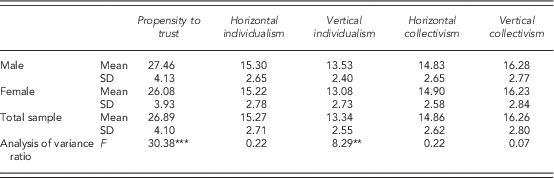
To test for Hypothesis 1, we subjected the data to analysis of variance. The results are shown in Table 2. It is quite clear from these results that the overall propensity to trust (for the total sample) is, on average, lower among females (F ratio: 30.38, ***p<.001). These results were consistent when we compared males and females within each of the four respondent types considered in our study. When scrutinize differences on vertical/horizontal individualism/collectivism, it seems that the differences are more significantly expressed in terms greater vertical individualism among males. These results demonstrate that the propensity to trust is consistently lower among females.
Analysis of variance (by gender)

Note. ***p<.001; **p<.01; *p<.05.
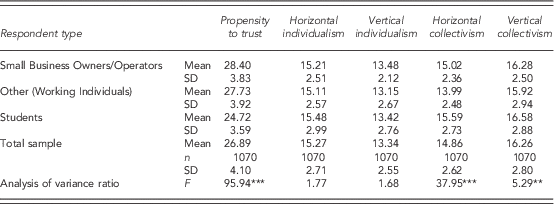
To test for Hypothesis 2, we ran analysis of variance on propensity to trust comparing the three sub-samples. This is to check on potential differences in the predisposition to trust across these three cohorts of respondents. The statistical results are shown in Table 3.
Analysis of variance by respondent types

Note. ***p<.001; **p<.01; *p<.05.
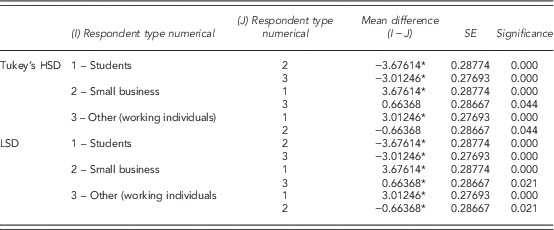
The results show significant differences on propensity to trust across the three groups. On the face value, they give some indication that small business owners/operators tend to be relatively more trusting. To verify this, we ran post hoc tests which are reported in Appendix 7. These tests confirm that propensity to trust is higher among the above group. The mean differences between this group and the other two groups is shown to be significant (at 0.05 level). These findings support Hypothesis 2 and confirm that individuals with business experience tend to be more predisposed to trust than those without (or with less) experience. This may have to do with the element of risk (or predisposition the take risk) which business owners/operators develop over time (Welter, Reference Wheeler, Reis and Bond2012). Also, businessmen (and entrepreneurs) in the Middle-East are reputed for their daring nature and readiness to take opportunity charged with trust from the outset. It is also interesting to note that, on average, small business owners scored lower on individualism and higher on collectivism than the other two groups. This is a further indication that, in the context of our study, risk taking and trust appear to hand in hand. This provides further support of the arguments provided in Hypothesis 2.
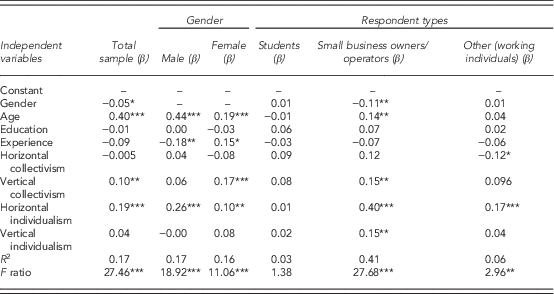
To test for the impact of individualism–collectivism on trust, we ran multiple regressions. We also included the main demographical variables, as independent variables, in the equation. The results are shown in Table 4.
Regression analysis (impacts on trust)

Dependent variable: propensity to trust.
The results reveal that age has a significant impact on individuals’ propensity to trust. Previous studies also found that trust increases with age (see Sutter & Kocher, Reference Sutter and Kocher2005). In their recent review of organizational trust, Schoorman, Mayer, and Davis (Reference Schwierena and Sutterb2007) also stressed the element of time and experience in shaping predisposition to trust.
In support of our Hypothesis 3, collectivism is strongly associated with trust. More specifically, horizontal individualism and vertical collectivism have strong effect on the likelihood to trust. These results are consistent across the three sub-groups included in this study. By reference to gender, it seems that male’s propensity to trust is more strongly affected by horizontal individualism, whereas females’ propensity to trust is shaped vertical collectivism. Small business owners/operators likelihood to trust seems to be most strongly shaped by horizontal individualism, although the effect of vertical collectivism is also significant.
DISCUSSION AND IMPLICATIONS
Trust is fundamental to effective relationships between individuals, within groups, within organizations and in society in general (Chang, O’Neill, & Travaglione, Reference Chang, O’Neill and Travaglione2016). In support of the Hypothesis 1, this study shows that gender groups have different predispositions to trust. Women, in general are lees trusting than men. While these findings may be contextual, they also support the findings of other studies (Sheehan, Reference Schoorman, Mayer and Davis1999; Spector & Gwene, Reference Spector and Gwene2004; Buchan, Croson, & Scinick, Reference Buchan, Croson and Scinick2008). This is in many ways related to the fact that by-and-large women are more cautious and less risk-averse (Colquitt et al., Reference Colquitt, Lepine, Zapata and Wild2007).
In support of our Hypothesis 2, we found that, by comparison to the other groups, propensity to trust is generally higher among the entrepreneurs (business owners/operators) group of respondents. This is not surprising, for entrepreneurs need to trust others and may often serve as trustees in order to form and grow their business. This is because trust among entrepreneurs, their coworkers and their business partners plays a key role in their regular business activities. As Goel and Karri proposed, it may well be that entrepreneurs (in this case, business owners/operators) focus only on those things that they control. Therefore, they tend to frame ‘trust’ as uncontrollable, and thus may even over-trust (Goel & Karri, Reference Goel and Karri2006). This may also be contextual, as businessmen (and entrepreneurs) in the Middle-East are reputed for their daring nature and readiness to take opportunity charged with trust from the outset.
In support of our Hypothesis 3, collectivism is strongly associated with trust. Following Hofstede’s research on cultural values (Hofstede, Reference Hofstede1980), this dimensions seems to be a key determinant of propensity to trust. Also, consonant with the suggestions of Triandis and Gelfand (Reference Triandis1998) and Triandis (Reference Triandis and Gelfand2001) both horizontal individualism and vertical collectivism have a significant influence on individuals’ propensity to trust. However, there were some differences across the sub-groups considered in this study. For instance, male’s propensity to trust is more strongly affected by horizontal individualism, whereas females’ propensity to trust is shaped mainly by vertical collectivism. Small business owners/operators likelihood to trust seems to be most strongly shaped by horizontal individualism, although the effect of vertical collectivism is also significant. Overall, these findings support the view that entrepreneurs in collectivistic cultures are more likely to trust than do entrepreneurs in individualistic cultures (Goel & Karri, Reference Goel and Karri2006).
Implications and limitations
In initiating this study, we struggled with an expansive literature base that appeared to use an array of perspectives on trust and multiple antecedents. We focused on propensity to trust and attempted to show how it is affected by demographic variables (e.g., gender and experience) and individual aspirations (individualism and collectivism). The results of the study are quite indicative and shade some light on the relevance of the above variables in shaping individuals’ likelihood to trust. The data also provide some insight into the relative magnitude of the relationships between trust and other variables.
Our use of three samples enhanced the robustness of the findings. We are tempted to assume that some of the results are contextual and pertain to the country in which the study was conducted. However, the findings are also consistent with research that had been conducted in other contexts. Nevertheless, to broaden the validity of the above hypotheses future research could consider gathering data from a cross-national sample. The sample could include respondents from other countries in the Middle-East and beyond. It would be interesting to explore how gender, experience and individualism–collectivism pave out and affect trust in countries with different cultural aspirations. Future research may also empirically examine potentially mediating processes involved, when multi-national samples are considered.
Appendices
Propensity to trust scale - inter-items correlation matrix

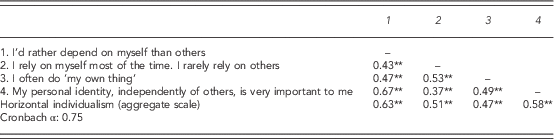
Horizontal individualism

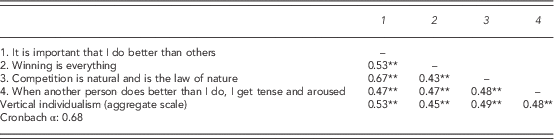
Vertical individualism

Horizontal collectivism

Vertical collectivism

Inter-correlations matrix of main variables

Analysis of variance post hoc tests (multiple comparisons)Dependent Variable: Propensity to Trust

About the Author
Rachid Zeffane is Professor of Management (Org Behavior and HRM) in the College of Business Administration at the University of Sharjah, United Arab Emirates. He received his Master Degree and PhD from the Cardiff Business School, UK. Before joining the University of Sharjah, he held academic positions at Griffith University, the University of Newcastle and Deakin University in Australia. His teaching and research interests are in the areas of Organizational Behavior, Human Resource Management, Leadership, Entrepreneurship and Organizational Change.