1. Introduction
The author has proposed a ball lightning model according to which the motion of the electrons in the ball lightning core is the superposition of oscillatory motion and thermal motion in directions perpendicular to those of the oscillations (Shmatov Reference Shmatov2015b
). This model results from the development of the model taking into account only the oscillatory motion of the electrons (Shmatov Reference Shmatov2001, Reference Shmatov2003, Reference Shmatov2004a
,Reference Shmatov, Liu, Ofuruton and Kamogawa
b
, Reference Shmatov2006). At an atmospheric pressure
 $p_{\mathit{atm}}$
of about
 $10^{5}$
Pa, the lifetime
 ${\it\tau}_{c}$
of the ball lightning core is of the order of 1 s when the initial value
 ${\it\varepsilon}_{\mathit{osc}}^{\mathit{max}1}$
of the maximum electron kinetic energy
 ${\it\varepsilon}_{\mathit{osc}}^{\mathit{max}}$
, corresponding to oscillatory motion, is several tens of kiloelectronvolts (Shmatov Reference Shmatov2015b
). An increase in
 ${\it\varepsilon}_{\mathit{osc}}^{\mathit{max}1}$
and a decrease in
 $p_{\mathit{atm}}$
increase
 ${\it\tau}_{c}$
(Shmatov Reference Shmatov, Liu, Ofuruton and Kamogawa2004b
, Reference Shmatov2006, Reference Shmatov2015b
). The formation of ball lightning requires the initial acceleration of electrons to kinetic energies
 ${\it\varepsilon}_{k0}$
of about
 ${\it\varepsilon}_{\mathit{osc}}^{\mathit{max}1}$
or higher, because the subsequent stages of the formation will be accompanied by losses of energy (
 ${\it\varepsilon}_{\mathit{osc}}^{\mathit{max}1}$
will be about
 ${\it\varepsilon}_{k0}$
if these losses are sufficiently small).
The results of theoretical studies of problems related to runaway electrons (Wilson Reference Wilson1925; Gurevich Reference Gurevich1960; Hill Reference Hill1963; Shaw Reference Shaw1967; Babich Reference Babich2003; Cooray, Becerra & Rakov Reference Cooray, Becerra and Rakov2009; Carlson, Lehtinen & Inan Reference Carlson, Lehtinen and Inan2010; Cooray et al. Reference Cooray, Dwyer, Rakov and Rahman2010; Celestin & Pasko Reference Celestin and Pasko2011; Celestin, Xu & Pasko Reference Celestin, Xu and Pasko2012; Dwyer, Smith & Cummer Reference Dwyer, Smith and Cummer2012a ; Shmatov Reference Shmatov2015a ), the generation of high-energy photons in experiments with rocket-triggered lightning (Dwyer et al. Reference Dwyer2004a ,Reference Dwyer b , Reference Dwyer, Smith and Cummer2012a ) and in some other situations (Dwyer et al. Reference Dwyer2005, Reference Dwyer, Schaal, Cramer, Arabshahi, Liu, Rassoul, Hill, Jordan and Uman2012b ; Yoshida et al. Reference Yoshida, Morimoto, Ushio, Kawasaki, Torii, Wang, Takagi and Watanabe2008), and observational data on the spectra of some terrestrial gamma-ray flashes (TGFs) (Tavani et al. Reference Tavani2011) allow us to assume that such acceleration of electrons occurs due to their attraction to the positive charge injected into the atmosphere. This assumption is in agreement with the available information about the circumstances of the death of Professor G.-W. Richman, who probably performed the first unintentional experiment on the formation of ball lightning (Powell & Finkelstein Reference Powell and Finkelstein1970; Singer Reference Singer1971; Shmatov Reference Shmatov2001), and with a number of reports about the observed formation of ball lightning, for example, those published by Singer (Reference Singer1971, Reference Singer and Golde1977), Stakhanov (Reference Stakhanov1996) and Grigor’ev (Reference Grigor’ev2006). Some of those reports are considered in § 2.
The initial acceleration of electrons of the core of ball lightning seems to be provided by the effect usually called ‘cold runaway’ or ‘thermal runaway’. These terms describe the situation when the strength
 $E$
of the electric field in gas or plasma is so high that the electron, influenced by this field, acquires high kinetic energy
 ${\it\varepsilon}_{k}$
or, in other words, becomes runaway, at any initial value of
 ${\it\varepsilon}_{k}$
(Gurevich Reference Gurevich1960; Babich Reference Babich2003; Cooray et al.
Reference Cooray, Becerra and Rakov2009, Reference Cooray, Dwyer, Rakov and Rahman2010; Carlson et al.
Reference Carlson, Lehtinen and Inan2010; Celestin & Pasko Reference Celestin and Pasko2011; Celestin et al.
Reference Celestin, Xu and Pasko2012; Dwyer et al.
Reference Dwyer, Smith and Cummer2012a
). The possibility of the realization of cold runaway in the electric fields arising due to the electrical activity of the atmosphere was demonstrated for the first time by the generation of high-energy photons in experiments with rocket-triggered lightning (Dwyer et al.
Reference Dwyer2004a
,Reference Dwyer
b
, Reference Dwyer, Smith and Cummer2012a
). In recent years, it was shown that cold runaway generates seed electrons of TGFs with a hard spectrum, i.e. with a significant spectral density at photon energies of several tens of megaelectronvolts (Carlson et al.
Reference Carlson, Lehtinen and Inan2010; Celestin & Pasko Reference Celestin and Pasko2011; Tavani et al.
Reference Tavani2011; Celestin et al.
Reference Celestin, Xu and Pasko2012; Dwyer et al.
Reference Dwyer, Smith and Cummer2012a
).
According to the model presented in § 3, acceleration of electrons to
 ${\it\varepsilon}_{k}$
of at least of the order of 10–100 keV can occur on screening of the strong electric field of positive charge injected into the atmosphere. Earlier, a similar model was proposed to explain the initial acceleration of electrons of TGFs with a hard spectrum (Shmatov Reference Shmatov2015a
).
Probably, in the ball lightning core many modes of oscillation of electrons are excited initially, but the losses of energy due to the emission of radio waves on the plasma frequencies and their harmonics quickly attenuate almost all of them except for the spherically symmetrical one and, in some situations, a few others.
2. Some observational data and possible regions and times for the formation of ball lightning
The observational data allow us to assume that several scenarios for the injection of positive charge into the atmosphere with the subsequent formation of ball lightning are possible.
Reports about the formation of ball lightning in situations when ordinary lightning strikes an ungrounded antenna (see e.g. Grigor’ev (Reference Grigor’ev2006, p. 102, report no. 140)) and information about the equipment used in the last experiment of Professor G.-W. Richman (Powell & Finkelstein Reference Powell and Finkelstein1970; Singer Reference Singer1971; Shmatov Reference Shmatov2001) correspond to the assumption that such injection can occur when positive cloud-to-ground lightning strikes an ungrounded elongated conductor (Shmatov Reference Shmatov2003). One of the conditions for the realization of this scenario is that all of the accelerated electrons, or at least a significant fraction of them, do not hit the conductor. Some of the reports about the observation of ball lightning arising inside or near stoves and fire-places (Singer Reference Singer1971; Grigor’ev Reference Grigor’ev2006) may correspond to a similar scenario, because a funnel lined with soot can serve as an elongated conductor. However, it should be taken into account that a funnel can also serve as an entrance for ball lightning that arose outside the building (see also Singer (Reference Singer1971) and Grigor’ev (Reference Grigor’ev2006)). One more similar scenario can probably be realized when the positive leader hits a metal airplane. Reports that might correspond to this scenario were mentioned by Balyberdin (Reference Balyberdin1966).
The formation of ball lightning at the stage of the return stroke in regions of propagation of both negative (Shmatov Reference Shmatov, Liu, Ofuruton and Kamogawa2004b ) and positive leaders seems to be possible. The neutralization and subsequent positive charging (see e.g. § 4.4.1 of Bazelyan & Raizer (Reference Bazelyan and Raizer2000)) of the former region can probably create ball lightning near the points of the strike of negative cloud-to-ground lightning and/or near the head(s) of the defunct negative leader(s) of such lightning. The formation of ball lightning may also be caused by similar processes involved in intra-cloud and cloud-to-cloud discharges. Note that Dwyer et al. (Reference Dwyer, Schaal, Cramer, Arabshahi, Liu, Rassoul, Hill, Jordan and Uman2012b ) reported a gamma-ray flash detected during a natural negative cloud-to-ground return stroke and presented data according to which ‘the leader branches that are not directly involved in the attachment process are most likely the source of the gamma rays’. A. A. Marvin reported the formation of ball lightning near the sharpened end of a cable the other end of which was connected to a lightning arrester placed on a geodetic landmark (Stakhanov Reference Stakhanov1996, p. 148, report no. 117). The ball lightning arose when lightning struck the geodetic landmark (Stakhanov Reference Stakhanov1996). The region of formation of this ball lightning seems to be analogous to the neighbourhood of the head of the defunct leader of cloud-to-ground lightning. Note, however, that the sign of the ordinary lightning mentioned in the report of A. A. Marvin is not known, and that this report is also compatible with the assumption about the injection of positive charge due to a positive leader hitting a lightning arrester with a high grounding resistance (Shmatov Reference Shmatov2009).
The return stroke of negative cloud-to-ground lightning having one descending negative leader and one ascending positive leader results in the injection of positive charge not only in the channel of the negative leader but also in that of the positive leader (see e.g. § 4.4.1 in Bazelyan & Raizer (Reference Bazelyan and Raizer2000)). Thus, the return stroke supplies the additional positive charge in the channel of the ascending positive leader of negative cloud-to-ground lightning (Bazelyan & Raizer Reference Bazelyan and Raizer2000) and, probably, can cause the formation of ball lightning in the region of the propagation of this leader, for example, near its head. A similar process of the formation of ball lightning may also occur in situations when negative cloud-to-ground lightning has several ascending and/or descending leaders (Bazelyan & Raizer Reference Bazelyan and Raizer2000) and when the return strokes supply the additional positive charge in the channel(s) of the positive leader(s) of intra-cloud and cloud-to-cloud lightning.
3. Initial acceleration of electrons of the core of ball lightning on screening of the strong electric field
3.1. Model not taking into account interaction of accelerated electrons with air
At least at
 ${\it\varepsilon}_{\mathit{osc}}^{\mathit{max}1}$
of the order of 10–100 keV, the initial acceleration of the electrons of a ball lightning core can probably occur on screening of the strong electric field.
Let us assume that during some time in the region of injection of positive charge into the atmosphere the maximum value of
 $E$
is about
 $10^{7}~\text{V}~\text{cm}^{-1}$
or higher and the density
 $n_{m}$
of air molecules in this region is about
 $(0.1{-}0.2)n_{L}$
, where
 $n_{L}\approx 2.69\times 10^{19}~\text{cm}^{-3}$
is the Loschmidt number. Here it is assumed that the relatively low value of
 $n_{m}$
results from preceding heating of the region under consideration (see Hill Reference Hill1963; Bazelyan & Raizer Reference Bazelyan and Raizer2000; Cooray et al.
Reference Cooray, Becerra and Rakov2009, Reference Cooray, Dwyer, Rakov and Rahman2010) or from both heating and the large altitude of this region. The chosen maximum value of
 $E$
corresponds, for example, to the situation when the electric field can be described approximately as that of a longitudinally uniform cylinder with effective linear charge density
 ${\it\lambda}_{\mathit{eff}}$
and the ratio
 ${\it\lambda}_{\mathit{eff}}/r$
, where
 $r$
is the distance from the axis of the cylinder, is about
 $5.6\times 10^{-2}~\text{C}~\text{m}^{-2}$
or greater. The values of
 ${\it\lambda}_{\mathit{eff}}$
, corresponding to
 $E\approx 10^{7}~\text{V}~\text{cm}^{-1}$
and
 $r\leqslant 10$
cm, are relatively low compared with the maximum estimated absolute values of the linear charge densities
 ${\it\lambda}_{nl}$
of the leaders of negative cloud-to-ground lightning in regions near the ground. According to the observational data and estimates presented by Thomson, Uman & Beasley (Reference Thomson, Uman and Beasley1985),
 $|{\it\lambda}_{nl}|$
were up to about
 $3.2\times 10^{-2}~\text{C}~\text{m}^{-1}$
, while the aforementioned requirement on
 ${\it\lambda}_{\mathit{eff}}/r$
yields
 $$\begin{eqnarray}{\it\lambda}_{\mathit{eff}}(r=10~\text{cm})\geqslant 5.6\times 10^{-3}~\text{C}~\text{m}^{-1}.\end{eqnarray}$$
When air is influenced by an electric field with
 $E$
of the order of
 $10^{6}~\text{V}~\text{cm}^{-1}$
or higher,
 $E$
will quickly be reduced due to the ionization of the air and screening of the electric field by the arising plasma (Bazelyan & Raizer Reference Bazelyan and Raizer2000; Carlson et al.
Reference Carlson, Lehtinen and Inan2010; Celestin & Pasko Reference Celestin and Pasko2011). However, the electrons can be accelerated to
 ${\it\varepsilon}_{k}$
of the order of 10 keV and higher during the screening process itself (Shmatov Reference Shmatov2015a
).
The one-dimensional model yields that the strong electric field, removing the electrons from the screening layer completely, is screened in plasma on a distance
 $$\begin{eqnarray}l_{s}\approx \frac{{\it\varepsilon}_{0}E_{b}}{eZ_{s}n_{i}},\end{eqnarray}$$
where
 ${\it\varepsilon}_{0}$
is the electric constant,
 $E_{b}$
is
 $E$
on the boundary of the layer,
 $e$
is the absolute value of the electron charge,
 $Z_{s}$
and
 $n_{i}$
are the average ionization stage and the density of ions in the layer, respectively (Sze Reference Sze1981; Babich Reference Babich2003; Shmatov Reference Shmatov2015a
).
Let us assume that
 $$\begin{eqnarray}Z_{s}n_{i}\approx 10^{14}~\text{cm}^{-3}.\end{eqnarray}$$
This choice is based on the following. Usually, the electron density in avalanches is no greater than
 $10^{14}~\text{cm}^{-3}$
(Korolev & Mesyats Reference Korolev and Mesyats1991; Bazelyan & Raizer Reference Bazelyan and Raizer2000). Therefore, situations where the initial electron density
 $n_{e0}=Z_{s}n_{i}$
in the region where the screening layer arises is greater than this value are unlikely. Note that an electron density of about
 $10^{14}~\text{cm}^{-3}$
in the region of propagation of streamers corresponds to air with
 $n_{m}\approx n_{L}$
and is proportional to
 $n_{m}^{2}$
(Bazelyan & Raizer Reference Bazelyan and Raizer2000). Note also that for air in thermodynamic equilibrium with
 $n_{m}\geqslant 0.1n_{L}$
and a pressure of about
 $10^{5}$
Pa, the electron density is much less than
 $10^{14}~\text{cm}^{-3}$
(Kuznetsov Reference Kuznetsov1965; Bazelyan & Raizer Reference Bazelyan and Raizer2000). Thus, (3.3) seems to provide a reliable upper bound of
 $Z_{s}n_{i}$
.
Substituting
 $$\begin{eqnarray}E_{b}=10^{7}~\text{V}~\text{cm}^{-1}\end{eqnarray}$$
and (3.3) into (3.2), we obtain
 $$\begin{eqnarray}l_{s}\approx 5.53\times 10^{-2}~\text{cm}.\end{eqnarray}$$
The fact that this value of
 $l_{s}$
is much less than 1 cm justifies the use of the one-dimensional model, because the typical transverse size
 $R_{s}$
of the boundary of the screening layer is of the order of 0.1–1 cm or greater (the radius
 $R_{ch}$
of the lightning channel is of the order of 0.1–1 cm (Rakov & Uman Reference Rakov and Uman2003; Jayakumar et al.
Reference Jayakumar, Rakov, Miki, Uman, Schnetzer and Rambo2006; Wang et al.
Reference Wang, Yuan, Cen, Liu and Li2014; Cen et al.
Reference Cen, Yuan, Xue and Wang2015) while
 $R_{s}$
is about
 $R_{ch}$
at some relatively late stage of the channel expansion or greater).
Let us denote the kinetic energy of the electron, which had initial velocity
 $v_{0}=0$
in the region where
 $E\approx E_{b}$
and was accelerated over the whole thickness of the screening layer, as
 ${\it\varepsilon}_{k}^{s}$
. When the interaction of the electron with the particles of this layer is negligible, then
 $$\begin{eqnarray}{\it\varepsilon}_{k}^{s}\approx eE_{b}l_{s}/2\approx {\it\varepsilon}_{0}E_{b}^{2}/(2Z_{s}n_{i}).\end{eqnarray}$$
In the situations under consideration,
 ${\it\varepsilon}_{k}^{s}\approx 276$
keV (see (3.3)–(3.5)). This estimate is in agreement with the results of computer simulation taking into account scattering and losses of energy of electrons in the screening layer (see below).
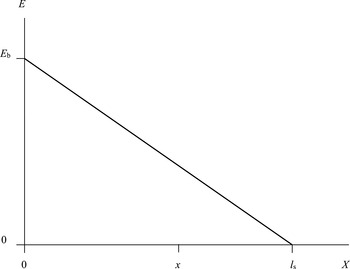
The dependence
 $E(x)$
corresponding to the one-dimensional model.

3.2. Interaction of accelerated electrons with air
According to Longmire & Longley (Reference Longmire and Longley1973), the motion of electrons accelerated by the electric field in air can be described approximately by
 $$\begin{eqnarray}\frac{\text{d}p}{\text{d}t}\approx \frac{eE}{{\it\eta}}-g({\it\varepsilon}_{k})\end{eqnarray}$$
and
 $$\begin{eqnarray}\frac{\text{d}{\it\eta}}{\text{d}t}\approx \frac{avg({\it\varepsilon}_{k})}{mc^{2}({\it\gamma}^{2}-1)}-e({\it\eta}^{2}-1)\frac{E}{p},\end{eqnarray}$$
where
 $p$
is the average value of the momentum of the electron,
 $t$
is the time,
 ${\it\eta}$
is the average value of
 $1/\cos {\it\theta}$
,
 ${\it\theta}$
is the angle between the vector of the force
 $\boldsymbol{f}$
acting on the electron in the electric field and that of the electron velocity
 $\boldsymbol{v}$
,
 $g$
is the absolute value of the frictional force experienced by the electron due to collisions with the particles of air,
 $a\approx 3.87$
,
 $v$
is the absolute value of
 $\boldsymbol{v}$
,
 $m$
is the rest mass of the electron,
 $c$
is the velocity of light and
 ${\it\gamma}=1/\sqrt{1-v^{2}/c^{2}}$
. The one-dimensional model yields that the strength of the electric field accelerating the electron in the region
 $0\leqslant x\leqslant l_{s}$
, where
 $x$
is the average value of the projection of the path of the electron on
 $\boldsymbol{f}$
, is given by
 $$\begin{eqnarray}E(0\leqslant x\leqslant l_{s})\approx E_{b}(1-x/l_{s})\end{eqnarray}$$
(see figure 1). The axis
 $0X$
is directed from the initial position of the electron to the centre of the positively charged cylinder. The projection of the vector of the electric field
 $\boldsymbol{E}$
on this axis equals
 $-E$
. The values of
 $g$
were calculated using plot 8.2 and table 12.4 of Berger et al. (Reference Berger, Inokuti, Anderson, Bichsel, Dennis, Power, Seltzer and Turner1984); see also Dwyer (Reference Dwyer2004) and Dwyer et al. (Reference Dwyer, Smith and Cummer2012a
, Reference Dwyer, Smith, Hazelton, Grefenstette, Kelley, Lowell, Schaal and Rassoul2015). The dependence of
 $x$
on
 $t$
is given by
 $$\begin{eqnarray}\text{d}x\approx v\,\text{d}t/{\it\eta}\end{eqnarray}$$
(
 $1/{\it\eta}$
is about the average cosine of
 ${\it\theta}$
, thus the ratio
 $v/{\it\eta}$
is about the average projection of
 $\boldsymbol{v}$
on the axis
 $0X$
).
The system of equations (3.7)–(3.10) was solved numerically using (3.4), (3.5) and the values
 $a\approx 3.96$
(see appendix A),
 $n_{m}=0.1n_{L}$
and
 $0.2n_{L}$
,
 ${\it\varepsilon}_{k}(t=0)=10$
eV,
 $x(t=0)=0$
, and
 ${\it\eta}(t=0)=1.5$
, 10 and 100.
In all of the examples,
 ${\it\varepsilon}_{k}(x=l_{s})\approx 276$
keV, the time
 $t_{\mathit{ac}}$
of acceleration of the electron to this
 ${\it\varepsilon}_{k}$
(or, in other words, the time of its motion in the region
 $0\leqslant x\leqslant l_{s}$
) is about 3.3 ps and
 ${\it\eta}$
reduces to values of 1.01 and less in the initial acceleration stages corresponding to
 ${\it\varepsilon}_{k}$
of the order of 0.1–1 keV. For example, at
 $n_{m}=0.1n_{L}$
and
 ${\it\eta}(t=0)=1.5$
,
 ${\it\eta}\approx 1.01$
at
 $t\approx 6.7\times 10^{-2}$
ps and
 ${\it\varepsilon}_{k}\approx 0.49$
keV; while at
 $n_{m}=0.2n_{L}$
and
 ${\it\eta}(t=0)=100$
,
 ${\it\eta}\approx 1.01$
at
 $t\approx 0.125$
ps and
 ${\it\varepsilon}_{k}\approx 1.34$
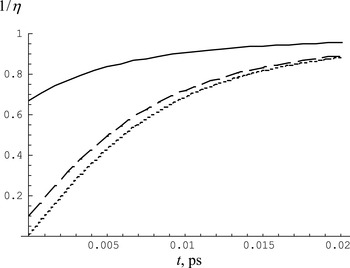
keV. The change in the ratio
 $1/{\it\eta}$
with time at
 $n_{m}=0.1n_{L}$
and
 ${\it\eta}(t=0)=1.5$
, 10 and 100 is shown in figure 2. The fact that
 $1/{\it\eta}$
tends to unity rapidly even when
 ${\it\eta}(t=0)$
is as large as 100 means, first of all, that the directions of
 $\boldsymbol{v}$
are mainly determined by those of
 $\boldsymbol{E}$
rather than by scattering. This corresponds to the assumption about the possibility of the rather effective formation of a ball lightning core due to the process under consideration. Strong scattering, described by the relatively low values of
 $1/{\it\eta}$
, would either result in significant losses of electrons from the region of their initial acceleration or even make the formation of the core, i.e. plasma cloud with physically important oscillatory motion of the electrons, impossible.
The change of the ratio
 $1/{\it\eta}$
with time at
 $E_{b}=10^{7}~\text{V}~\text{cm}^{-1}$
,
 $l_{s}=5.53\times 10^{-2}$
cm,
 ${\it\varepsilon}_{k}(t=0)=10$
eV,
 $n_{m}=0.1n_{L}$
and
 ${\it\eta}(t=0)=1.5$
(solid line), 10 (dashed line) and 100 (dotted line).

It is worth noting that
 $t_{\mathit{ac}}$
is significantly greater than the typical values of the Maxwellian time
 ${\it\tau}_{M}^{\mathit{ch}}$
of a lightning channel. The lightning channel conductivity
 ${\it\sigma}_{\mathit{ch}}$
of about
 $10^{4}$
to
 $2.27\times 10^{4}~\text{S}~\text{m}^{-1}$
(Jayakumar et al.
Reference Jayakumar, Rakov, Miki, Uman, Schnetzer and Rambo2006; Guo et al.
Reference Guo, Yuan, Shen and Wang2009; Cen et al.
Reference Cen, Yuan, Xue and Wang2015) corresponds to
 ${\it\tau}_{M}^{\mathit{ch}}={\it\varepsilon}_{0}/{\it\sigma}_{\mathit{ch}}\approx (3.9{-}8.9)\times 10^{-16}~\text{s}\approx (1.2{-}2.7)\times 10^{-4}t_{\mathit{ac}}.$
The Maxwellian time of the charged plasma creating the strong electric field will be much less than
 $t_{\mathit{ac}}$
even if its conductivity is much less than
 ${\it\sigma}_{\mathit{ch}}$
, for example, about
 $10^{-3}{\it\sigma}_{\mathit{ch}}$
. This is in agreement with the assumption about the possibility of fast increase in
 $E$
and its relatively slow decrease due to screening accompanied by the acceleration of electrons to rather high
 ${\it\varepsilon}_{k}$
.
Let us consider the ionization of air in the screening layer by the accelerated electrons. The electron passes the region
 $0\leqslant x\leqslant l_{s}$
without collisional ionization of the air components with probability
 $$\begin{eqnarray}p_{0}=\exp \left\{-n_{m}\int _{0}^{l_{s}}\frac{{\it\sigma}_{\mathit{eff}}[{\it\varepsilon}_{k}(x)]\,\text{d}x}{{\it\eta}}\right\},\end{eqnarray}$$
where
 ${\it\sigma}_{\mathit{eff}}$
is the effective collisional ionization cross-section averaged over the components (see e.g. Ventzel (Reference Ventzel1969) and Raizer (Reference Raizer2009)). Let us describe
 ${\it\sigma}_{\mathit{eff}}$
by
 ${\it\sigma}_{\mathit{eff}}({\it\varepsilon}_{k},E)=k_{{\it\sigma}}({\it\varepsilon}_{k},E)\langle {\it\sigma}_{\mathit{air}}^{\mathit{pr}}({\it\varepsilon}_{k})\rangle ,$
where
 $k_{{\it\sigma}}$
is a coefficient that seems to be in the range of about 1–2 and
 $\langle {\it\sigma}_{\mathit{air}}^{\mathit{pr}}\rangle$
is the collisional ionization cross-section averaged over the air components in the principal states. Air contains about 78.08 %
 $\text{N}_{2}$
, 20.95 %
 $\text{O}_{2}$
and 0.93 % Ar (Kuznetsov Reference Kuznetsov1965; Budyko Reference Budyko and Prokhorov1988). Thus,
 $\langle {\it\sigma}_{\mathit{air}}^{\mathit{pr}}\rangle \approx 0.7808{\it\sigma}_{\text{N}_{2}}^{\mathit{pr}}+0.2095{\it\sigma}_{\text{O}_{2}}^{\mathit{pr}}+9.3\times 10^{-3}{\it\sigma}_{\text{Ar}}^{\mathit{pr}}$
, where
 ${\it\sigma}_{\text{N}_{2}}^{\mathit{pr}}$
,
 ${\it\sigma}_{\text{O}_{2}}^{\mathit{pr}}$
and
 ${\it\sigma}_{\text{Ar}}^{\mathit{pr}}$
are the cross-sections for the collisional ionization of
 $\text{N}_{2}$
,
 $\text{O}_{2}$
and Ar in the principal states. Probably, the typical values of
 ${\it\sigma}_{\mathit{eff}}$
are greater than those of
 $\langle {\it\sigma}_{\mathit{air}}^{\mathit{pr}}\rangle$
by several tens of per cent, for the following reasons. The region in which the electrons are accelerated also contains excited molecules and atoms, the collisional ionization cross-sections of which are greater than
 ${\it\sigma}_{\text{N}_{2}}^{\mathit{pr}}$
,
 ${\it\sigma}_{\text{O}_{2}}^{\mathit{pr}}$
and
 ${\it\sigma}_{\text{Ar}}^{\mathit{pr}}$
(Raizer Reference Raizer2009; Lowke Reference Lowke2015). At
 $E$
of the order of
 $10^{6}{-}10^{7}~\text{V}~\text{cm}^{-1}$
, some of the collisionally excited molecules and atoms undergo quick tunnel ionization (Bethe & Salpeter Reference Bethe and Salpeter1957; Delone & Krainov Reference Delone and Krainov2001) and, therefore, some of the excitation events are equivalent to ionization (Shmatov Reference Shmatov2015a
; see also appendix A). The formation and collisional ionization of NO may also be important (Bazelyan & Raizer Reference Bazelyan and Raizer2000). Assuming that the dependence of
 $k_{{\it\sigma}}$
on
 $E$
is negligible and the typical values of this coefficient are about 2, and using (3.4), (3.5) and (3.9)–(3.11), we obtain
 $p_{0}(n_{m}=0.1n_{L})\approx 0.515{-}0.516$
and
 $p_{0}(n_{m}=0.2n_{L})\approx 0.265$
. At fixed
 $n_{m}$
,
 $p_{0}$
decreases with increasing
 ${\it\eta}(t=0)$
, but in the situations under consideration such a decrease is weak and the choice of
 ${\it\eta}(t=0)$
is not very important (see also the examples of
 $t$
and
 ${\it\varepsilon}_{k}$
corresponding to
 ${\it\eta}\approx 1.01$
; figure 2 and (3.11)). Information about the used collisional ionization cross-sections is presented in appendix A. The last value of
 $p_{0}$
corresponds to significant ionization of the air during acceleration of the electrons. However, such ionization does not prevent acceleration of the electrons to a
 ${\it\varepsilon}_{k}$
of at least about 100 keV. Using (3.4), (3.5), (3.7)–(3.10) and an equation similar to (3.11), it is possible to show that the electron passes the region
 $0\leqslant x\leqslant x_{100\,\text{keV}}$
(where the last is the value of
 $x$
corresponding to
 ${\it\varepsilon}_{k}=100$
keV) with probability
 $p_{0}^{100\,\text{keV}}$
of about 0.67 at
 $n_{m}=0.1n_{L}$
and about 0.45 at
 $n_{m}=0.2n_{L}$
. If the typical values of
 $k_{{\it\sigma}}$
are about 1.2, then
 $p_{0}(n_{m}=0.1n_{L})\approx 0.67$
,
 $p_{0}(n_{m}=0.2n_{L})\approx 0.45$
,
 $p_{0}^{100\,\text{keV}}(n_{m}=0.1n_{L})\approx 0.79$
and
 $p_{0}^{100\,\text{keV}}(n_{m}=0.2n_{L})\approx 0.62$
. It should be emphasized that if
 $n_{e0}$
is sufficiently low, even a manifold increase in
 $Z_{s}n_{i}$
will correspond to the possibility of acceleration of a significant part of the electrons of the screening layer to high
 ${\it\varepsilon}_{k}$
(Shmatov Reference Shmatov2015a
).
3.3. The number of accelerated electrons
The chosen parameters for the region of acceleration of the electrons are compatible with estimates of the number
 $N_{e}^{c}$
of electrons in the ball lightning core.
If the region of formation of ball lightning can be described, as previously mentioned, as approximately a cylinder, the number
 ${\it\xi}_{e}^{r}$
of electrons removed from its unit length on the injection of positive charge equals
 ${\it\lambda}_{\mathit{eff}}/e$
(for the sake of simplicity of terminology, here it is assumed that the injection starts when the cylinder is neutral). The condition (3.1) corresponds to
 $$\begin{eqnarray}{\it\xi}_{e}^{r}\geqslant 3.5\times 10^{14}~\text{cm}^{-1}.\end{eqnarray}$$
The assumption that
 ${\it\lambda}_{\mathit{eff}}$
is about the maximum value of
 $|{\it\lambda}_{nl}|$
presented by Thomson et al. (Reference Thomson, Uman and Beasley1985) yields
 $$\begin{eqnarray}{\it\xi}_{e}^{r}\approx 2\times 10^{15}~\text{cm}^{-1}.\end{eqnarray}$$
The number
 ${\it\xi}_{e}^{h}$
of electrons accelerated to
 ${\it\varepsilon}_{k}\geqslant {\it\varepsilon}_{\mathit{osc}}^{\mathit{max}1}$
in unit length of the region of formation of ball lightning can be greater than
 ${\it\xi}_{e}^{r}$
due to avalanche multiplication of the number of fast electrons (Babich Reference Babich2003; Dwyer et al.
Reference Dwyer, Smith and Cummer2012a
) and, in some situations, the large initial value of the ratio
 $R_{s}/l_{s}$
.
Let us assume that ball lightning is spherical, the initial value
 $R_{c}^{1}$
of the ball lightning core radius is about 3–10 cm (Singer Reference Singer1971, Reference Singer and Golde1977; Stakhanov Reference Stakhanov1996; Grigor’ev Reference Grigor’ev2006), the initial electron density
 $n_{\mathit{ec}}^{1}$
in the ball lightning core is about
 $(1.12{-}2.68)\times 10^{14}~\text{cm}^{-3}$
(Shmatov Reference Shmatov2015b
) and the volume of the empty region that may arise around the centre of the core (Shmatov Reference Shmatov2003) is negligible. According to the last assumption,
 $N_{e}^{c}\approx (4{\rm\pi}/3)n_{\mathit{ec}}^{1}(R_{c}^{1})^{3}$
. Substituting the aforementioned
 $R_{c}^{1}$
and
 $n_{\mathit{ec}}^{1}$
into this formula, we obtain
 $$\begin{eqnarray}N_{e}^{c}\approx 1.3\times 10^{16}\text{ to }1.1\times 10^{18}.\end{eqnarray}$$
Let us denote the ratio
 $N_{e}^{c}/{\it\xi}_{e}^{r}$
as
 $L_{0}$
. Multiplying the dimensionless values
 $N_{e}^{c}$
and
 ${\it\xi}_{e}^{r}L_{0}$
by
 $e$
, we obtain that
 $L_{0}$
is the length of the region with linear charge density
 ${\it\lambda}_{\mathit{eff}}$
and total electric charge that equals the absolute value of the electric charge of all the electrons of the ball lightning core. The length
 $L_{f}$
of the region of injection of the positive charge, involved directly in the formation of the ball lightning, can be represented as
 $L_{f}\approx (N_{e}^{c}/{\it\xi}_{e}^{h})=(N_{e}^{c}/{\it\xi}_{e}^{r})\times ({\it\xi}_{e}^{r}/{\it\xi}_{e}^{h})=L_{0}({\it\xi}_{e}^{r}/{\it\xi}_{e}^{h}).$
Equation (3.13) and the lower bound of the range (3.14), obtained assuming that
 $R_{c}^{1}\approx 3$
cm, correspond to
 $L_{0}\approx 6.5$
cm, i.e. to the approximate equality of
 $L_{0}$
and the initial diameter of the ball lightning core. In such situations, the presence of a sufficiently large number of the electrons with
 ${\it\varepsilon}_{k}\geqslant {\it\varepsilon}_{\mathit{osc}}^{\mathit{max}1}$
in the region of formation of the ball lightning core can be explained using the assumptions that
 ${\it\xi}_{e}^{h}\approx {\it\xi}_{e}^{r}$
and there is no longitudinal constriction of the plasma cloud in which the initial acceleration of the electrons occurs. The situations when
 $L_{0}\gg 2R_{c}^{1}$
seem also to be possible. They can be realized at high
 ${\it\xi}_{e}^{h}/{\it\xi}_{c}^{r}$
and/or significant longitudinal constriction, as mentioned above. The assumption about the possibility of such constriction, or, in other words, about the possibility of the formation of ball lightning with
 $R_{c}^{1}\ll L_{f}/2$
, corresponds to reports that can be interpreted as those about the formation of spherical ball lightning from a ribbon-like one (see Grigor’ev (Reference Grigor’ev2006, pp. 126–129)). Note that the lower bound of
 ${\it\xi}_{e}^{r}$
from the inequality (3.12), the lower bound of the range (3.14) and
 $R_{c}^{1}\approx 3$
cm correspond to
 $L_{0}/2R_{c}^{1}\approx 6.2$
. The realization of
 ${\it\xi}_{e}^{h}/{\it\xi}_{e}^{r}$
of about this value and higher seems to be quite possible.
3.4. Factors favourable for the formation of ball lightning
Equation (3.11) allows us to assume that low
 $n_{m}$
values are favourable for the formation of ball lightning. Therefore, for the experiments on the formation of ball lightning, the reduction of
 $n_{m}$
in the expected region of formation seems to be expedient. Such a reduction can be realized by means of heating the region and/or isolating it from the surrounding atmosphere and a partial pumping-out of air. Such measures may be useful when, for example, the geometry of the experiment corresponds to the last experiment of Professor G.-W. Richman (Powell & Finkelstein Reference Powell and Finkelstein1970; Singer Reference Singer1971; Shmatov Reference Shmatov2001) or the report of A. A. Marvin (Stakhanov Reference Stakhanov1996). They may also be useful in experiments with rocket-triggered lightning and laboratory installations (see also Shmatov Reference Shmatov2003, Reference Shmatov2009).
According to Imyanitov (Reference Imyanitov and Prokhorov1988), ‘even outside the thunderclouds, in the clouds ball lightning are one hundred times more frequent than near the ground’. Although the conclusion about the quantitative correctness of this statement will be possible only after special studies, it should be noted that it corresponds to the assumptions about the favourableness of high altitudes for both the formation of ball lightning and the realization of relatively long
 ${\it\tau}_{c}$
(Shmatov Reference Shmatov2015b
). Note also that the formation of ball lightning due to the supply of additional positive charge in the region of propagation of the positive leader seems to occur only at sufficiently large altitudes.
Attempts to create ball lightning in helium may be expedient due to the relatively low
 $E$
necessary for the runaway of electrons (Babich Reference Babich2003) and the relatively long
 ${\it\tau}_{c}$
(Shmatov Reference Shmatov2004a
). The answer to the question about the expediency of experiments on the formation of ball lightning in hydrogen will be possible only after analysis of several problems related, in particular, to safety measures and the possibility of the elimination of ball lightning by chemical explosion.
In experiments on the formation of ball lightning in the region near some electrodes, use of graphite or graphite-coated electrodes can serve as a measure preventing contamination of the ball lightning core by element(s) with atomic number(s) greater than 8. Such contamination would result in a decrease in
 ${\it\tau}_{c}$
due to an increase in radiative losses from the core (Shmatov Reference Shmatov2003, Reference Shmatov2015b
).
In order to increase the probability of the formation of ball lightning in experiments with natural lightning striking an ungrounded antenna, or a lightning arrester grounded through a high resistance, or equipment similar to that used by A. A. Marvin, it will be expedient to install the maximum possible number of antennas or lightning arresters.
4. Conclusion
The condition (3.3) yields a conservative estimate of
 ${\it\varepsilon}_{k}^{s}$
. At fixed
 $E_{b}$
, the maximum values of
 ${\it\varepsilon}_{k}^{s}$
are mainly determined by the minimum initial values of
 $Z_{s}n_{i}$
(see (3.6) and § 3.2). The reliable estimation of these values will be possible only after special studies. However, in experiments on the formation of ball lightning, safety measures related to the radiation hazard should be taken, assuming that
 ${\it\varepsilon}_{k}^{s}$
and
 ${\it\varepsilon}_{\mathit{osc}}^{\mathit{max}1}$
are very high, for example, about 50 MeV or even higher. The well-documented report of Dmitriev, Bakhtin & Martynov (Reference Dmitriev, Bakhtin and Martynov1981) about melting the ground by large ball lightning can be explained only by assuming that
 ${\it\varepsilon}_{\mathit{osc}}^{\mathit{max}1}$
was at least about 50 MeV (Shmatov Reference Shmatov, Liu, Ofuruton and Kamogawa2004b
). The formation of ball lightning with
 ${\it\varepsilon}_{\mathit{osc}}^{\mathit{max}1}$
of the order of 10 MeV can be explained using (3.2) and (3.6) and assuming that
 $Z_{s}n_{i}$
is about
 $10^{12}~\text{cm}^{-3}$
or less,
 $E_{b}$
is about
 $10^{7}~\text{V}~\text{cm}^{-1}$
or higher, and
 $R_{s}$
is about 8 cm or greater. For example, substituting
 $Z_{s}n_{i}=10^{12}~\text{cm}^{-3}$
and
 $E_{b}=1.5\times 10^{7}~\text{V}~\text{cm}^{-1}$
into (3.2) and (3.6), we obtain
 $l_{s}\approx 8.3$
cm and
 ${\it\varepsilon}_{k}^{s}\approx 62$
MeV. Thus, at the chosen
 $Z_{s}n_{i}$
and
 $E_{b}$
, and for
 $R_{s}$
of the order of 1 cm, screening of the electric field should be described within the framework of the two-dimensional or three-dimensional model, but the acceleration of electrons to
 ${\it\varepsilon}_{k}$
of the order of 10 MeV is probably possible even at
 $R_{s}\approx l_{s}\approx 8$
cm. Note that Bazelyan & Raizer (Reference Bazelyan and Raizer2000) consider the situation when, at some stage of lightning discharge, the temperature of the air is about 3000 K and the electron density is of the order of
 $10^{10}{-}10^{11}~\text{cm}^{-3}$
.
Acknowledgement
I would like to thank the anonymous reviewer for useful comments on the first version of this paper.
Appendix A. The approximations used to calculate
 $a$
, the tunnel ionization rates and
$\langle {\it\sigma}_{\mathit{air}}^{\mathit{pr}}\rangle$


The parameter
 $a$
is about
 $0.538\langle Z^{2}\rangle /\langle Z\rangle$
, where
 $\langle Z^{2}\rangle$
is the average squared atomic number of the components of air and
 $\langle Z\rangle$
is the average atomic number of these components (Longmire & Longley Reference Longmire and Longley1973). Longmire & Longley (Reference Longmire and Longley1973) used the approximations
 $\langle Z^{2}\rangle /\langle Z\rangle \approx \langle Z\rangle$
and
 $\langle Z\rangle \approx 7.2$
that correspond to
 $a\approx 3.87$
. Data on the composition of air (Kuznetsov Reference Kuznetsov1965; Budyko Reference Budyko and Prokhorov1988) yield that
 $\langle Z^{2}\rangle /\langle Z\rangle$
is about 7.36 and, therefore,
 $a\approx 3.96$
.
The rate
 ${\it\omega}_{t}$
of tunnel ionization of a molecule or an atom in the state with ionization potential
 $I_{i}$
was estimated as
 $$\begin{eqnarray}{\it\omega}_{t}~(\text{s}^{-1})\approx 3.197\times 10^{5}\times E~(\text{V}~\text{cm}^{-1})\times \!\left(\frac{5.589\times 10^{10}}{E~(\text{V}~\text{cm}^{-1})n^{\ast 4}}\right)^{2n^{\ast }}\!\exp \left(-\frac{3.42667\times 10^{9}}{E~(\text{V}~\text{cm}^{-1})n^{\ast 3}}\right),\end{eqnarray}$$
where
 $n^{\ast }\approx \sqrt{13.605/I_{i}~(\text{eV})}$
. Equation (A 1) is an analogue of (9.4) from the book by Delone & Krainov (Reference Delone and Krainov2001) for the situation when an electric field ionizes an atom. Equations (3.7)–(3.10), (A 1) and game theory (Ventzel Reference Ventzel1969; Raizer Reference Raizer2009) yield, for example, that, if in the situations considered in § 3 an electron with
 ${\it\varepsilon}_{k}\approx 15$
keV creates an excited neutral particle (i.e. molecule or atom) with
 $I_{i}$
of 2.2–2.3 eV, the probability of tunnel ionization of this particle during the time of acceleration of the electron to
 ${\it\varepsilon}_{k}\approx 100$
keV is about 0.644 (at
 $I_{i}=2.3$
eV) to 0.997 (at
 $I_{i}=2.2$
eV). This example and the cross-sections for collisional ionization and excitation of air components (Schram et al.
Reference Schram, De Heer, Van Der Wiel and Kistemaker1965; Phelps & Pitchford Reference Phelps and Pitchford1985; Murphy Reference Murphy1988; Itikawa Reference Itikawa2006; Phelps Reference Phelps2008; Raizer Reference Raizer2009) allow us to assume that collisional excitation makes an important contribution to
 ${\it\sigma}_{\mathit{eff}}$
.
When calculating
 $\langle {\it\sigma}_{\mathit{air}}^{\mathit{pr}}\rangle ({\it\varepsilon}_{k}\leqslant 15~\text{keV})$
, the
 ${\it\sigma}_{\text{N}_{2}}^{\mathit{pr}}$
and
 ${\it\sigma}_{\text{O}_{2}}^{\mathit{pr}}$
values of Murphy (Reference Murphy1988) and the
 ${\it\sigma}_{\text{Ar}}^{\mathit{pr}}$
of Phelps (Reference Phelps2008) (at
 ${\it\varepsilon}_{k}\leqslant 10$
keV) and Schram et al. (Reference Schram, De Heer, Van Der Wiel and Kistemaker1965) (at
 $10~\text{keV}<{\it\varepsilon}_{k}\leqslant 15$
keV) were used. Finally,
 $\langle {\it\sigma}_{\mathit{air}}^{\mathit{pr}}\rangle ({\it\varepsilon}_{k}>15~\text{keV})$
was described by
 $$\begin{eqnarray}\langle {\it\sigma}_{\mathit{air}}^{\mathit{pr}}\rangle ({\it\varepsilon}_{k}>15~\text{keV})~(\text{cm}^{2})\approx 5.94\times 10^{-20}\frac{{\it\gamma}^{2}}{{\it\gamma}^{2}-1}\left[8.68+\log ({\it\gamma}^{2}-1)+\frac{1}{{\it\gamma}^{2}}\right]\end{eqnarray}$$
(Murphy Reference Murphy1988; see also (71)–(73) of Longmire & Longley Reference Longmire and Longley1973).