Background
The coronavirus infectious disease 2019 (COVID-19) pandemic resulted in a global health care crisis requiring a change in the way health care is accessed and utilized. Fever, shortness of breath, and cough are the most common manifestations of COVID-19, however, evidence highlights delirium, a type of an acute brain failure, as a symptom of COVID-19 (Beach, Reference Beach2020; Hosseini et al., Reference Hosseini, Shetty, Sprigg, Auer and Constantinescu2020). The reported prevalence of delirium in COVID-19 ranges from 28 to 33% in hospitalized older adults (Kennedy, Reference Kennedy2020) and 29 to 84% in intensive care unit (ICU) patients (Pun, Reference Pun2021; Helms, Reference Helms2020).
Delirium is the outcome of an interplay between predisposing and precipitating risk factors in a given circumstance and individual. Age, cognitive impairement, and severity of illness are well-known established risk factors for delirium (Hshieh et al., Reference Hshieh, Inouye and Oh2019). Hospitalized older adults are at high risk for delirium with prevalence independent of COVID-19 ranging from 18 to 35% in general medicine patients and up to 50% in critically ill patients (Hshieh et al., Reference Hshieh, Inouye and Oh2019). COVID-19 resulted in severe to critical illness requiring hospitalization for patients of all ages with a higher preponderance of need in older adults (Beach, Reference Beach2020). While early studies reported the prevalence of delirium in COVID-19 patients, long-term impact on cognition, in this specific population, is presently unknown and yet to be determined (de Erausquin et al., Reference de Erausquin, Snyder, Carrillo, Hosseini, Brugha and Seshadri2021). The pathophysiology of delirium in COVID-19 is hypothesized to be either a direct impact on the central nervous system or microvascular or immune mediated (Beach, Reference Beach2020) or circumstantial derangement of routine delirium prevention cares or a combination of all the above (Helms, Reference Helms2020).
Isolation during COVID-19 illness further adds to the complexity of delirium prevention and management strategies that are routinely deployed for a hospitalized patient. This isolation includes limited social interaction with friends and family because of physical distancing and visitor restrictions. Because care providers are limiting their exposures to patients, this also limits reorientation resources all of which contribute to an increase in the overall delirium occurence in hospitalized COVID-19 patients (Pun, Reference Pun2021). The appropriate use of personal protective equipment by medical personnel may adversely impact sensory perception for some adults as equipment may complicate verbal and nonverbal communications, especially in older adults with uncorrected sensory impairments, which is a risk factor for delirium (Hshieh et al., Reference Hshieh, Inouye and Oh2019). Impaired functional mobility both at home and in hospital, given isolation to their respective rooms, results in increased risk of delirium (Hshieh et al., Reference Hshieh, Inouye and Oh2019). Other delirium precipitants common during COVID-19 hospital admissions include rising levels of inflammation, the use of psychoactive or sedative medications, and bladder catheter use among several others (Hshieh et al., Reference Hshieh, Inouye and Oh2019).
Recent studies in older adults reported delirium to be associated with poor outcomes (both short term and long term) but were limited by mostly focusing on specific age groups or on ICU patients only (Kennedy, Reference Kennedy2020; Pun, Reference Pun2021). We aim to characterize the occurrence of delirium in all hospitalized COVID-19 patients at Mayo Clinic, describe the trend across age groups and severity of COVID-19 illness, and examine the relationship between the occurrence of delirium and clinical outcomes of mortality, length of stay, readmission rates, and discharge location.
Methods
A retrospective chart review of hospitalized COVID-19 patients from March 1, 2020 through December 31, 2020 across all Mayo Clinic sites was performed. This study was approved by the Institutional Review Board. Patients without research authorization in electronic record were excluded from this study. All Mayo Clinic hospitals in Rochester, Florida, Arizona, and Mayo Clinic Health System were included as part of this study. Electronic data extraction of all hospitalized COVID-19 patients at Mayo Clinic Hospitals was performed. All ages were included in this study. Hospitalizations within 30 days following a COVID-19 diagnosis or COVID-19 diagnosis within 14 days of an ongoing hospitalization were included as COVID-19-related hospitalizations for this study.
Delirium identification
Delirium was diagnosed if one of the three criteria were met: 1) Physician diagnosis of delirium or encephalopathy by International classification of disease (ICD)-9/10 coding, or 2) Nursing flowsheet documentation of Confusion Assessment Method (CAM) tool (performed twice daily on all hospitalized patients), or 3) Using validated natural language processing (NLP) system based on CAM criteria (Fu, Reference Fu2020). A history of delirium was established using the same eligibility of meeting one of the three above criteria for delirium prior to the COVID-19 diagnosis date or hospital admission.
Outcomes measurement
The outcomes of interest for this study include length of stay, all-cause mortality at discharge, 30-day all-cause mortality after discharge, readmission within 30 days of discharge, and discharge location. All the outcomes were measured through January 31, 2021. Length of stay for a patient in the study was counted as the duration from admission to discharge in days. For COVID-19 patients requiring multiple readmissions, a sum of the duration of all hospital stays qualified as readmission within 30 days was calculated toward length of stay. A readmission was defined as a hospital admission that occurred within 30 days of the last hospital discharge date related to COVID-19. Patients who had mortality event during the hospital stay were excluded from regression analysis related to readmission and 30-day mortality after discharge, while mortality is measured as a censored event in survival analysis measuring time to hospital discharge (length of stay). Discharge location was classified as home versus skilled nursing facility depending on the location of care after hospital discharge.
Demographic factors
Variables of age, sex, and race/ethnicity were obtained from electronic health record (EHR). Charlson comorbidity score was digitally extracted from EHR utilizing the ICD-9 and ICD-10 codes present on or before the date of admission.
Statistical analysis
Descriptive statistics were utilized to describe the variables and bivariate analysis performed to compare variables across the two groups (group with delirium and group with no-delirium). We stratified the patient cohort by age groups of <18 years, 18–39 years, 40–59 years, 60–74 years, and >75 years. Severity of COVID-19 infection was calculated using World Health Organization (WHO) criteria for classification of symptomatic COVID-19 disease into four classes namely mild, moderate, severe, and critical (WHO, 2021). The univariate analysis was performed with Chi-square test for categorical variables (race/ethnicity, ICU cares, and Hx of delirium), Fisher’s test for age categorization (given small sample size in some categories), and student t-test for continuous variable (age mean). Jonckheere–Terpstra test was performed to analyze COVID severity. Logistic regression analysis was performed for categorical outcomes. The adjusted odds ratios (OR) with confidence intervals (CIs) were reported for logistic regression models. Survival analysis was done using Kaplan–Meier curve to measure the time to hospital discharge (length of stay) in which mortality was considered as a censored event. Statistical analysis was performed using analytical software R version: 3.6.2 (2019-12-12).
Results
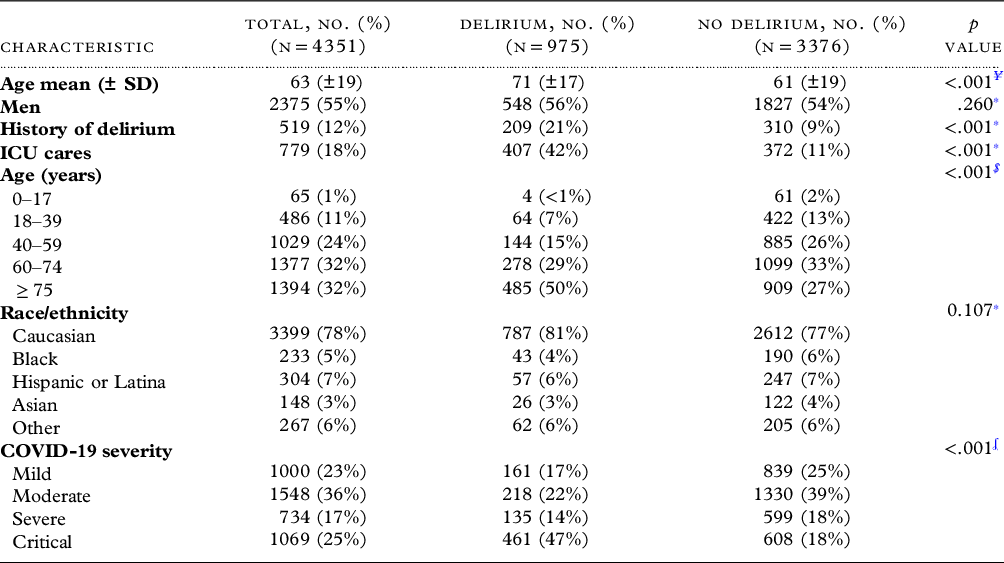
A total of 4351 patients met criteria for inclusion in this study, of whom 55% were men and 78% were Caucasian by race (Table 1). Twelve percent of the study population had a history of delirium. Of these hospitalized COVID-19 admissions, 975 patients (22.4%) had a delirium episode during their hospitalization. The occurrence of delirium within each age category was noted as 6% in the pediatric age group (<18 years), 13% in the 18–39 age group, 14% in the 40–59 age group, 20% in the 60–74 age group, and nearly 35% in the 75 or greater age group (Table 1). The detailed results of all variables and comparison between the two groups (delirium and no-delirium) are summarized in Table 1.
Characteristics of hospitalized patients with COVID-19 across two groups

* Chi-square test for categorical variables (men, race/ethnicity, ICU cares and history of delirium)
$ Fisher’s exact test for age categorization (given small sample size)
ʆ Jonckheere–Terpstra test for COVID severity
¥ Student t-Test for continuous variables (age mean)
Percentages represented are column percentages for each labeled group.
SD: Standard Deviation
Hospitalized COVID-19 patients with an occurrence of delirium were significantly older (mean age 71 vs 61 years), had a history of delirium (21% vs 9%), received ICU cares (42% vs 11%), and had higher critical COVID-19 severity (47% vs 18%) (Table 1). Adjusted for age, sex, Charlson comorbidity score, and COVID-19 severity, patients with delirium were at higher risk for all-cause mortality at hospital discharge (OR 4.35, 95% CI 3.27, 5.83; p <0.001), a higher risk of all-cause mortality 30-days following hospital discharge (OR 4.54, 95% CI 3.25, 6.38; p < .001), a significantly higher likelihood of readmission to the hospital (OR 1.48, 95% CI 1.17, 1.85; p < 0.001), and a higher rate of discharge to skilled nursing facility (OR 4.07, 95% CI 3.30, −5.02; p < 0.001).
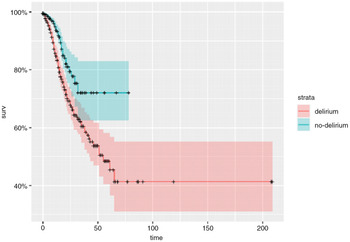
Kaplan–Meier curve analyzing the time to hospital discharge (length of stay) with mortality as a censored event plots the trajectory for both groups with delirium and no-delirium (Figure 1), with improved survival rates and shorter hospital length of stay in the no-delirium group.
Kaplan–Meier curve for in hospital mortality.
Kaplan–Meier curve analyzing the time to hospital discharge (hospital length of stay) in days on x-axis, with mortality being considered as a censored event (survival rate on y-axis). Each step down represents mortality, while the + marking on the curve represents the duration of hospital length of stay in days for a given patient. The shaded area around the curves represents CI.

Discussion
This study shows a 22.4% occurrence rate of delirium among all hospitalized COVID-19 patients across all Mayo Clinic sites. Delirium occurrence increased proportionally with age, with the highest occurrence of 35% in older adults aged 75 years or greater. Fifty percent of all patients with delirium occurrence belong to age 75 years or greater. The occurrence of delirium is also higher in those with critical COVID-19 illness compared to other COVID-19 illness categories. The occurrence of delirium was associated with an increased risk of all-cause mortality during hospitalization and 30-day mortality following hospital discharge, readmissions, and the need for skilled nursing facility on discharge. This emphasizes the need for prompt, early detection, and initiation of evidence-based nonpharmacological strategies to prevent and manage delirium as much as possible in COVID-19 patients. Prior large studies were limited by mostly focusing on specific age groups or on ICU patients only (Kennedy, Reference Kennedy2020; Pun, Reference Pun2021).
This study both substantiates what previous studies have identified about delirium and COVID-19 illness and builds on current evidence by examining hospitalized COVID-19 patients across all age groups. The multifactorial nature of delirium in COVID-19 illness raises an important question: Is the occurrence of delirium in COVID-19 patients related to viral illness and its severity, or is it a manifestation in patients with prior history of delirium along with additional precipitating factors such as isolation, or is it solely in older adults or critically ill patients where the risk of delirium is already high to start with? The possible pathophysiological mechanisms behind the increased occurrence of delirium during COVID-19 illness continue to be elusive and multifactorial which includes a) the direct neuronal invasion by the virus and/or b) decreased routine delirium prevention cares because of isolation precautions.
Poor outcomes of increased mortality and length of stay despite adjustment for age, sex, Charlson comorbidity score, and the severity of the COVID-19 illness demonstrate the devastating impact of delirium during COVID-19 illness. Hence, delirium prevention, detection, and optimization are critical in hospitalized COVID-19 patients. The COVID-19 pandemic magnified the crucial nature of applying and implementing the validated delirium prediction tools (Pagali, Reference Pagali2021) to prevent and respond to delirium timely. Prediction and early detection of delirium could be linked to effective multicomponent delirium prevention/mitigation activities such as the Hospital Elder Life Program (HELP) and the ABCDEF bundle, both of which are modified to accommodate and address the care needs and challenges of COVID-19 patients. The recent finding by Pun et al., Reference Pun2021, that family visitation, either by video conference call or in person, reduced the risk of delirium by 27% highlights how small changes in the clinical environment can have a large impact (Pun, Reference Pun2021).
Noting the association of poor outcomes in hospitalized COVID-19 patients with delirium, this study will add resource to clinicians facilitating goals of care discussion especially in older adults. One common limitation to retrospective delirium studies includes the possibility of missed instances of delirium capture. To minimize this limitation, we employed our recently developed NLP algorithm that had demonstrated high validity and accuracy in identifying undocumented delirium. An additional limitation was that our study sample was predominantly Caucasian, though no specific patient population was excluded from our study based on race/ethnicity. However, it was a large, comprehensive, and geographically diverse study population representing all Mayo Clinic sites across the country.
Conclusion
Delirium in hospitalized COVID-19 patients is a marker for increased mortality and morbidity. Outcomes were worse in this group of hospitalized COVID-19 patients with delirium who are older, and with a critical severity of COVID-19 illness. The study findings underscore the importance of screening and early identification of delirium and prompt implementation of delirium management strategies to prevent worse outcomes and facilitate timely goals of care discussion. Additional studies are needed to further identify the long-term outcomes in COVID-19 patients with a delirium.
Conflict of interest
Authors have no conflict of interest to report.