Extracorporeal membrane oxygenation, first introduced clinically in 1972, has been applied as a means of cardiopulmonary support after cardiac surgery both as an elective therapy and as a rescue therapy.Reference Shen and Ungerleider 1 – Reference DA, Thiagarajan and Wypij 13 The common indications for extracorporeal membrane oxygenation use in children after cardiac surgery include low cardiac output syndrome, inability to wean from cardiopulmonary bypass, refractory arrhythmias, pulmonary hypertension, inotrope refractory cardiogenic shock, bridge to heart transplant, and extracorporeal cardiopulmonary resuscitation.Reference Baffes, Fridman, Bicoff and Whitehill 4 – Reference DA, Thiagarajan and Wypij 13
Although there are multiple reports on the successful outcomes of children receiving extracorporeal membrane oxygenation in the immediate post-operative period, there are very sparse data on the outcomes of children receiving delayed rescue extracorporeal membrane oxygenation (≥7 days) after cardiac surgery.Reference Kulik, Moler and Palmisano 6 – Reference Ravishankar, Dominguez and Kreutzer 12 The primary aim of this project is to identify the aetiology and outcomes of extracorporeal membrane oxygenation in children receiving delayed rescue extracorporeal membrane oxygenation therapy after cardiac surgery. We hypothesised that children receiving delayed rescue extracorporeal membrane oxygenation will have worse mortality than children receiving extracorporeal membrane oxygenation in the immediate post-operative period.
Patients and methods
We conducted a retrospective review of all children ≤18 years supported with delayed extracorporeal membrane oxygenation after cardiac surgery between the period January, 2001 and March, 2012 at the Arkansas Children’s Hospital, United States of America, and Royal Children’s Hospital, Australia. We defined delayed extracorporeal membrane oxygenation as patients receiving extracorporeal membrane oxygenation ≥7 days after cardiac surgery – during the same hospital stay. Patients receiving extracorporeal membrane oxygenation after hospital discharge were excluded from the study. The patients transferred from other hospitals on mobile extracorporeal membrane oxygenation were also excluded from the study. The Institutional Review Board at University of Arkansas Medical Sciences approved the conduct of this study. However, such an approval was waived at Royal Children’s Hospital because of the retrospective nature of the study.
The data collected in our study included patient demographic information, diagnoses, indications for extracorporeal membrane oxygenation initiation, extracorporeal membrane oxygenation support details, medical and surgical history, laboratory, microbiological, and radiographic data, information on organ dysfunction, complications, and patient outcomes. The outcome variables evaluated in this report included: survival to hospital discharge and current survival with emphasis on neurological, renal, pulmonary, and other end-organ function. Bleeding was defined as cannulation site or surgical bleeding requiring surgical exploration.Reference DA, Thiagarajan and Wypij 13 Hepatic insufficiency was defined as patients with a peak aspartate aminotransferase or alanine aminotransferase >500 IU/dl that developed in the period after deployment of extracorporeal membrane oxygenation.Reference DA, Thiagarajan and Wypij 13
Statistical methodology
Continuous variables were presented as the median (Q1, Q3), where Q1 is the 25th percentile and Q3 is the 75th percentile, whereas categorical variables were presented as numbers and percentages. p-Values are based on Wilcoxon–Kruskal–Wallis test for continuous and ordinal data, and Pearson or Fisher’s exact test for categorical variables. Analyses were performed using statistical analysis software SAS v 9.1.3.
Results
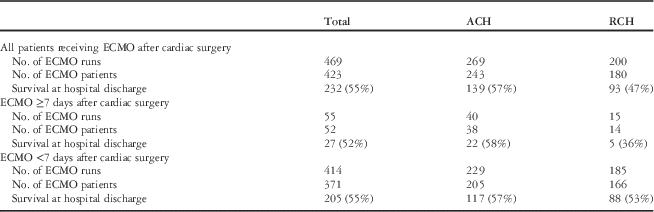
During the study period, 423 patients undergoing cardiac surgery were supported with extracorporeal membrane oxygenation at two institutions, with a survival of 232 patients (55%). Of these, 371 patients received extracorporeal membrane oxygenation <7 days after cardiac surgery, with survival to hospital discharge of 205 (55%) patients. In all, 52 patients received extracorporeal membrane oxygenation ≥7 days after cardiac surgery – during the same hospital stay – with survival to hospital discharge of 27 (52%) patients. The distribution of patients between the two centres is shown in Table 1. There were 37 boys (67%) in the study cohort with a median age of 64 days (interquartile range: 22, 227) and a median weight of 3.5 kg (interquartile range: 2.8, 6 kg). The median number of days of initiation of extracorporeal membrane oxygenation after cardiac surgery was 9 days (interquartile range: 7, 32). The median duration of the extracorporeal membrane oxygenation run for the study cohort was 5 days (interquartile range: 3, 10).
Summary of ECMO experience between the two study centres.

ACH=Arkansas Children’s Hospital, Little Rock, Arkansas, United States of America; ECMO=extracorporeal membrane oxygenation; RCH=Royal Children’s Hospital, Melbourne, Australia
Location and indications of delayed extracorporeal membrane oxygenation
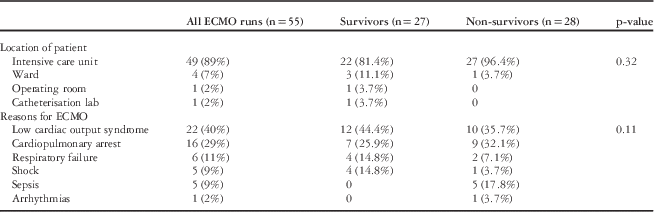
Table 2 shows the location and reasons of decompensation before extracorporeal membrane oxygenation initiation in our study cohort. Majority of the patients receiving extracorporeal membrane oxygenation ≥7 days after cardiac surgery were in an intensive care unit before decompensation. There were four patients who were transferred to the ward before initiation of extracorporeal membrane oxygenation. There was one patient who decompensated in the operating room after reoperation for a residual lesion requiring extracorporeal membrane oxygenation for survival. Another patient decompensated while undergoing cardiac catheterisation for detection of a residual lesion. The most common reasons for decompensation were low cardiac output syndrome and cardiopulmonary arrest. In all, six patients received extracorporeal membrane oxygenation because of respiratory failure. Of these, two patients with single-ventricle physiology received extracorporeal membrane oxygenation after extubation failure. There were five patients who received extracorporeal membrane oxygenation because of inotrope refractory shock, five patients who received extracorporeal membrane oxygenation for sepsis and bacteraemia, and one patient who received extracorporeal membrane oxygenation for intractable arrhythmias.
Location and reasons for delayed ECMO in study patients.
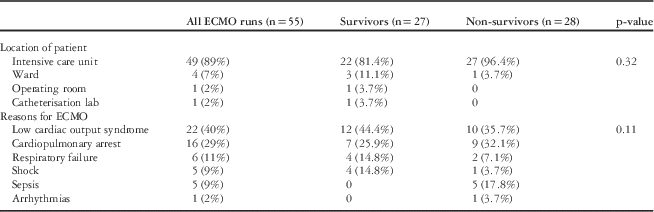
ECMO=extracorporeal membrane oxygenation
Patient characteristics, diagnoses, and complications
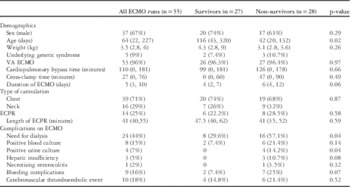
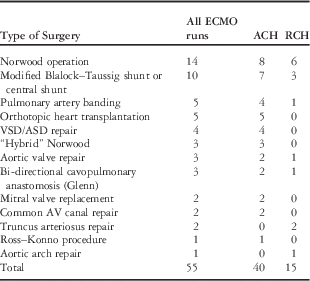
Table 3 demonstrates demographics and extracorporeal membrane oxygenation details for the study patients. Table 4 demonstrates cardiac surgeries associated with study patients. There were five patients in our cohort who had genetic abnormalities. Majority of the patients in our study cohort received veno-arterial extracorporeal membrane oxygenation. The median cardiopulmonary bypass time with the associated cardiac surgeries was 110 minutes with a median cross-clamp time of 27 minutes. In all, 39 (71%) patients in study cohort had an open chest at the time of extracorporeal membrane initiation. There were 14 patients who received extracorporeal membrane oxygenation during active cardiopulmonary resuscitation with chest compressions. There were 10 patients (18%) who had cerebrovascular thromboembolic events associated with extracorporeal membrane oxygenation runs.
Demographics and ECMO details for the study patients.

ECMO=extracorporeal membrane oxygenation; ECPR=extracorporeal cardiopulmonary resuscitation; VA ECMO=veno-arterial extracorporeal membrane oxygenation
Continuous variables are summarised by the triplet of quartiles 50th (25th and 75th). Categorical variables are summarised as per cent (n)
Cardiac surgeries associated with delayed ECMO in the study patients.
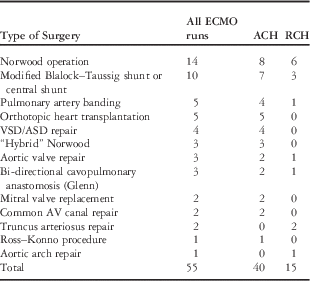
ACH=Arkansas Children’s Hospital; ASD=atrial septal defect; AV canal=atrioventricular canal; ECMO=extracorporeal membrane oxygenation; RCH=Royal Children’s Hospital; VSD=ventricular septal defect
Comparison between two centers
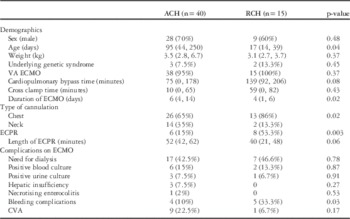
Table 5 depicts location-based extracorporeal membrane oxygenation details for the study patients. In all, 15 patients at Royal Children’s Hospital received delayed extracorporeal membrane oxygenation, while 40 patients at Arkansas Children’s Hospital received delayed extracorporeal membrane oxygenation. The patients in Royal Children’s Hospital cohort were younger and smaller than the Arkansas Children’s Hospital cohort. The mortality rate was 66% (10 patients) at Royal Children’s Hospital and 45% (18 patients) at Arkansas Children’s Hospital (p=0.15).
Univariate comparisons of patient and ECMO characteristics between the two study centres.

ACH=Arkansas Children’s Hospital; CVA=cerebrovascular thromboembolic event; ECMO=extracorporeal membrane oxygenation; ECPR=extracorporeal cardiopulmonary resuscitation; RCH=Royal Children’s Hospital; VA ECMO=veno-arterial extracorporeal membrane oxygenation
Continuous variables are summarised by the triplet of quartiles 50th (25th and 75th). Categorical variables are summarised as per cent (n)
Outcomes
Of the patients receiving extracorporeal membrane oxygenation ≥7 days after cardiac surgery, 27 patients survived to hospital discharge. Of these, 19 patients are still alive with significant comorbidities. There are six patients who have significant chronic lung disease; three patients who have significant renal dysfunction requiring dialysis, with one patient listed for renal transplant; and eight patients who have significant neurologic damage, with brain atrophy and developmental delay.
Discussion
Our investigation provides the first report on temporal trends, landscape, and outcomes of children receiving extracorporeal membrane oxygenation ≥7 days after cardiac surgery. Although prolonged duration of extracorporeal membrane oxygenation is associated with worse outcomes, it is unknown whether the timing of initiation of extracorporeal membrane oxygenation after cardiac surgery affects outcomes.Reference Gupta, McDonald and Chipman 14 Despite varied aetiologies, the survival to hospital discharge in patients receiving delayed extracorporeal membrane oxygenation is comparable to patients receiving extracorporeal membrane oxygenation in the immediate post-operative period. To our knowledge, this is the first study to date on this topic in the available medical literature.
The increasing complexity of congenital cardiac surgery has resulted in the increased use of extracorporeal membrane oxygenation support for children in the post-operative period. Up to 2–5% of all children undergoing corrective or palliative cardiac surgery use mechanical cardiac support with extracorporeal membrane oxygenation.Reference Duncan, Hraska and Jonas 5 – Reference Chaturvedi, Macrae and Brown 8 The timing of extracorporeal membrane oxygenation initiation in children after cardiac surgery is not well defined and is institution specific. Some authors propose “routine” or “elective” use of extracorporeal membrane oxygenation after Stage I Norwood with good outcomes.Reference Shen and Ungerleider 1 , Reference Ungerleider, Shen and Yeh 3 , Reference Ungerleider, Shen and Burch 15 Others use extracorporeal membrane oxygenation as a “rescue” therapy before the onset of end organ or circulatory collapse.Reference Baffes, Fridman, Bicoff and Whitehill 4 , Reference Kulik, Moler and Palmisano 6 – Reference Gupta, McDonald and Chipman 14 , Reference Booth, Roth and Laussen 16 , Reference Laforte, Walter and Hetzer 17 The most common need for extracorporeal membrane oxygenation in the immediate post-operative period is the inability to wean off cardiopulmonary bypass in the operating room. Patients with either long complex repairs and prolonged myocardial ischaemic times or those with pre-existing left ventricle compromise have enough post-pump myocardial dysfunction that they cannot be successfully weaned off cardiopulmonary bypass. They are subsequently bridged over to extracorporeal membrane oxygenation to allow recovery of ventricular function.
One of the postulated mechanisms for delayed unexpected sudden acute decompensation in patients with single-ventricle physiology could be dangerous increase in systemic vascular resistance.Reference Wright, Crowley, Charpie, Ohye, Bove and Kulik 18 In their case series of five patients after Norwood palliation, Wright et al demonstrated elevated systolic blood pressures associated with acute cardiovascular collapse 8–15 days after cardiac surgery.Reference Wright, Crowley, Charpie, Ohye, Bove and Kulik 18 Of these, one patient required chest compressions and emergent use of extracorporeal membrane oxygenation for survival. Others required mechanical ventilation and intravenous inotropic agents or vasodilators with rapid resolution of their acidosis.Reference Wright, Crowley, Charpie, Ohye, Bove and Kulik 18 The other reason for delayed cardiovascular collapse necessating extracorporeal membrane oxygenation could be the presence of significant residual lesions requiring surgical re-intervention. According to a recent study, residual lesions are present in approximately one-quarter of post-operative cardiac surgery patients receiving extracorporeal membrane oxygenation support.Reference Wright, Crowley, Charpie, Ohye, Bove and Kulik 18 In this study, residual lesions were detected in 35 of the 119 post-operative patients placed on extracorporeal membrane oxygenation support. Earlier detection of residual lesions during the first 3 days of extracorporeal membrane oxygenation support improved rate of decannulation significantly as compared with later detection – after 3 days of extracorporeal membrane oxygenation support.Reference Agarwal, Hardison and Saville 19
Pulmonary hypertension could be another reason for delayed cardiovascular collapse. Many congenital heart lesions, particularly those requiring repairs in the neonatal period, are associated with severe pulmonary hypertension. Some patients with large ventricular septal defects or complete atrioventricular canal defects, as well as neonates with total anomalous pulmonary venous connection, cor triatriatum, and truncus arteriosus, are particularly prone to sudden and severe rise in pulmonary vascular resistance post-operatively. This is related to inherent reactivity of the pulmonary vascular bed in response to either obstructed pulmonary venous outflow or extreme pulmonary overcirculation from a large left-to-right shunt. Other children develop hospital-acquired viral respiratory infections or have undiagnosed pre-existing infections that increase the pulmonary vascular resistance even higher. Some patients with continued pulmonary hypertensive crises may benefit from extracorporeal membrane oxygenation support.
Occasionally, the decrease in cardiac function appears more quickly, or without warning, and may be related to sudden changes in volume status, electrolyte balance, or oxygenation and ventilation that leads to cardiac arrest that may not be reversible with conventional resuscitative measures.Reference DA, Thiagarajan and Wypij 13 These patients can be resuscitated with extracorporeal cardiopulmonary resuscitation.Reference DA, Thiagarajan and Wypij 13 Respiratory failure in children after heart surgery can be another speculated reason for delayed extracorporeal membrane oxygenation after heart surgery. This can be associated with or without intrinsic lung disease. Extubation failure can be a factor for sudden cardiovascular collapse, especially in children with single-ventricle physiology. In one of the landmark studies on extubation failure in children after cardiac surgery, our group demonstrated an extubation failure of 22% (14/64) in children after Norwood operation.Reference Gupta, McDonald and Gossett 20 Of these, one patient had a sudden cardiac arrest in the immediate post-extubation period with the need for extracorporeal cardiopulmonary resuscitation.Reference Gupta, McDonald and Gossett 20
As in other studies, the most common complications in this report were related to bleeding, thromboembolic events, and nosocomial infections.Reference Wang, Han and Jia 21 – Reference Burket, Bartlett and Vander Hyde 24 The three most common neurological complications of extracorporeal membrane oxygenation in children include central nervous system haemorrhage, central nervous system infarction, and seizures. In a recent study from ELSO registry, intracranial haemorrhage occurred in 7.4% of the patients, cerebral infarction occurred in 5.7% of the patients, and clinically diagnosed seizures occurred in 8.4% of all extracorporeal membrane oxygenation-treated patients.Reference Hervey-Jumper, Annich, Yancon, Garton, Muraszko and Maher 25 In our cohort receiving delayed extracorporeal membrane oxygenation, the incidence of these complications was similar to the intracranial haemorrhage occurring in 10% of the patients, and cerebral infarction in 7% of the patients. Survivors after delayed extracorporeal membrane oxygenation run develop long-term sequalae such as developmental delay, neurological deficits, chronic lung disease, renal insufficiency, and other end-organ dysfunction.
Our study has limitations inherent to any retrospective analysis. The results from this study may not be generalisable to all centres. Our study combined data from two geographically distinct centres from two continents with different ideologies. Although both these centres believe in the use of extracorporeal membrane oxygenation as a rescue therapy before the onset of cardiovascular collapse, the threshold of using extracorporeal membrane oxygenation may be different in two centres leading to differences in outcomes among two centres. The relatively small sample size limited our ability to analyse outcomes based on surgical diagnosis and precluded regression tests to identify independent predictors. We excluded patients receiving delayed extracorporeal membrane oxygenation after hospital discharge. This patient population may have provided a different insight in speculating reasons for delayed extracorporeal membrane oxygenation. Our study also lacked haemodynamic data before initiation of delayed extracorporeal membrane oxygenation. Our study lacked data on complications in the patients receiving extracorporeal membrane oxygenation data <7 days after cardiac surgery. Although mortality was similar in two groups, it is possible that complications and other outcomes may have been different in the two groups.
Despite these limitations, this study provides insight on temporal trends, landscape, and outcomes of children receiving extracorporeal membrane oxygenation ≥7 days after cardiac surgery. We conclude that the number of patients receiving extracorporeal membrane oxygenation ≥7 days after cardiac surgery is small, aetiology diverse, and outcomes comparable to patients receiving extracorporeal membrane oxygenation in the immediate post-operative period.
Acknowledgement
None.
Financial Support
This research received no specific grant from any funding agency, commercial or not-for-profit sectors.
Conflicts of Interest
None.