According to information provided in 2014 by the French ‘Centre de Documentation de la Musique Contemporaine’ (CDMC), approximately 30 per cent of composers living in Paris were foreigners.Footnote 1 This presence is the result of a cumulative trend whose origin dates back to the late 1970s. Various French state policies oriented to promoting cultural activities, including the contemporary music milieu, contributed to this phenomenon. Argentine composers were part of this tendency. Furthermore, in Paris they became the largest group of foreign composers, even superseding their colleagues from Italy.
Emigration from Argentina since the 1960s was driven partially by political factors – such as two military dictatorships and various economic crises – but it also had social motivations – such as the desire to develop a career in a professional field with the history, size, and diversity of the French capital. Today, around thirty composers of Argentine origin participate professionally in the different facets of French musical life.Footnote 2 Within this group there are many highly visible composers. Something similar occurs in the field of music education, which not only is the main economic resource for those who want to develop careers as composers, but also contributes to their positioning in the French musical landscape.Footnote 3 Some notable examples are Luis Naón (b. 1961), first a graduate and then a professor of electroacoustic music at the National Conservatory of Paris; Martin Matalon (b. 1958), who teaches composition at the National Conservatory of Lyon;Footnote 4 Daniel D'Adamo (b. 1966), professor of the composition at the Strasbourg Conservatory; and Horacio Vaggione (b. 1943), professor emeritus at the University of Paris VIII. There have also been composers in management positions at important musical institutions. Daniel Teruggi (b. 1952), for instance, was head of the Groupe de Recherche Musical (GRM) until his retirement in 2018; and Sebastián Rivas (b. 1975) was recently appointed head of the GRAME (Générateur de Ressources et d'Activités Musicales Exploratoires) in Lyon.Footnote 5
The Argentine composers who settled in Paris have created an important body of works, which I have estimated at around 1,200 compositions. This corpus includes music for a wide variety of settings, including instrumental solos and chamber ensembles, diverse types of electroacoustic works, mixed and multimedia compositions, as well as larger and more ambitious symphonic and operatic works. Most of this music finds in the French ‘art world’ its rightful place; but a significant portion of this repertory has also circulated in Argentina. Although there is a paradigm of autonomy, which suggests that for a successful professional career as a composer nationality is less relevant than personality, and which has been hegemonic in both French and Argentine contemporary music circles, in the case of foreign composers who enter the French scene, nationality continues to function as a marker of identity and a classification label. This classification could bring together creators into ‘prosopographies’, a factor which collides with their bids for individual recognition and assertion of creative genius.Footnote 6 It is no coincidence that there is no association or similar institution that formally brings together the Argentine composers settled in Paris. At the same time, in Argentina these composers are seen as constituents of the Argentinian contemporary music scene, even if they have been living abroad for decades.
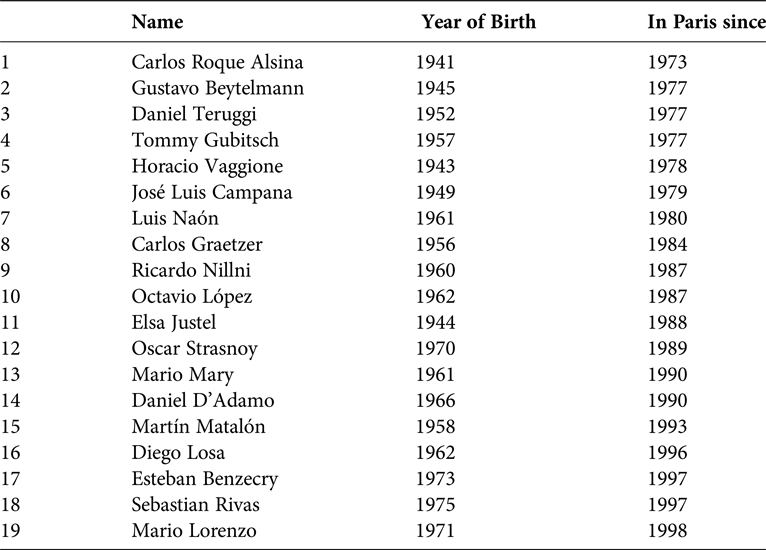
The main goal of this article is to observe how a group of ‘compositores’ became ‘compositeurs’ during the last quarter of the twentieth century. In the first part of the article, I focus on a group of nineteen composers who settled in Paris between 1970 and 2000 – there is only one female composer, Elsa Justel (b. 1944), in this group. A few of them later moved to other cities or countries (Oscar Strasnoy (b. 1970) to Berlin, Mario Mary (1961) to Monaco) or returned to Argentina (Justel), while the rest are still living and composing in the French capital (see Table 1). In the second part, I offer a closer view on how five of them – Carlos Roqué Alsina (b. 1941), Gustavo Beytelmann (b. 1945), Vaggione, Naón, and Matalon – have successfully inserted themselves in a variety of French music spaces.
Argentine composers settled in Paris between 1970 and 2000

Paris, from Ville lumière to Ville monde
As pointed out by Raymond Williams, metropolitan cities such as Paris have entered a completely new cultural dimension since the nineteenth century. A change of scale made them go from being large cities or imperial capitals to globalized spaces in which ‘new social, economic and cultural relations, beyond both city and nation in their older senses, were beginning to be formed: a distinct historical phase which was in fact to be extended, in the second half of the 20th century, at least potentially, to the whole world’.Footnote 7
As spaces that concentrated imperial wealth and power, their elites had access to the cultural diversity of the countries under their domination. In turn, they allowed the coexistence of a ‘complexity and sophistication of social relations, supplemented in the most important cases – Paris above all – by exceptional liberties of expression’.Footnote 8 Williams emphasizes that immigration to the metropolis played an important role in the field of artistic renewal:
Liberated or breaking from their national or provincial cultures, placed in quite new relations to those other native languages or native visual traditions, encountering a novel and dynamic environment from which many of the older forms were obviously distant, the artists and writers and thinkers of this phase found the only community that was available to them: a community of the medium, of their own practices.Footnote 9
Regarding Williams's assertion, the collective volume La Paris des étrangères (1995) studies the continuities and changes experienced in Paris during the second half of the twentieth century, after the trauma of the Second World War.Footnote 10 In 1999, Pierre Bourdieu maintained that it is the complexity of the French cultural field, its long historical sedimentation, and its central position in the globalized scene that makes Paris function as a space that favours artistic creation.Footnote 11
In the fields of Argentina's literature and visual arts we find examples that support Bourdieu's statement. Writers such as Julio Cortázar, Juan José Saer, and Edgardo Cozarinsky lived in Paris, but continued to write in Spanish, publishing for the Latin American market.Footnote 12 Argentinian visual artists continued to move ‘back and forth’ between France and Argentina, although some of them ended up settling in Paris.Footnote 13 In the performing arts, such as music and theatre,Footnote 14 the ‘Argentines of Paris’ had a much closer relationship with the French art world. Making music and making theatre requires interpreters and situated audiences. In the case of composers, there was a qualitative change after the 1960s, Argentina experienced what Oscar Terán called the ‘process of modernization and radicalization of the second post-war period’,Footnote 15 and in the field of contemporary music, the epicentre became the Latin American Center for Advanced Musical Studies (Centro Latinoamericano de Altos Estudios Musicales, CLAEM), which operated at the Di Tella Institute.Footnote 16 CLAEM put to rest a decades-long dispute between nationalist and universalist schools of composition. As a result, by the last quarter of the twentieth century the hegemony of the absolute music paradigm led musicologist Omar Corrado to affirm that ‘at the antipodes of the [social and political] explicit references practiced by numerous Latin American musicians at different times, Argentine musical production remains almost exclusively contained in the aesthetic series, the deep-rooted formal autonomy of the artistic, stubbornly resistant to revealing itself as a social text’.Footnote 17 If musical works have no other anchorage than their own immanence, it is possible to dream that both composers and their creations can be part of an international community of avant-garde art. In France, the existence of a historical path that went symbolically ‘from Darmstadt to IRCAM’Footnote 18 represents this cosmopolitan ideal.
The Argentine elite was particularly Francophile. From the end of the nineteenth century until the first decades of the twentieth century many Argentinian composers – members of this elite – went to Paris to study composition, later returning to the country. Although France progressively ceased to be the point of reference for Argentine elites through the 1960s, Paris still continued attracting composers in the 1970s. What changed in that decade was that, besides the opportunities to continue studying, there were new possibilities to stay and develop composition careers in France. When Argentine composers arrived in Paris, they not only took advantage of its century-old institutions, such as the conservatories, the orchestras, the concert and opera houses, and the media, but they also discovered new organizations devoted to music and technology – among them, IRCAM (1977), which would play a central role in the internationalization of the French scene – and realized they could have access to the Commandes D'Etat (grants for the creation of new works).
Among the group of nineteen Argentine composers I focus on here, fourteen entered through various stages of formal French education. Five completed their studies at the Conservatoire National Supérieur de Musique et de Danse de Paris (CNSMDP): Teruggi, José Luis Campana (b. 1949), Naón, Ricardo Nillni (b. 1960), and Oscar Strasnoy (b. 1970). Four obtained their doctorate at the University of Paris VIII: Vaggione, Justel, Mary, and Mario Lorenzo (b. 1971). D'Adamo studied at the CNSMD de Lyon, Rivas in Strasbourg, Esteban Benzecry (b. 1973) at the Conservatoire à rayonnement régional de Paris. Octavio López (b. 1962) and Carlos Graetzer (b. 1956) travelled to France due to bourses d'etudes that allowed them to take classes at CNSMDP. Most of them also were active at the IRCAM annual courses. In addition to being a centre for research and technological development applied to musical creation, IRCAM had positioned itself as a key institution within the composers’ musical training system. This reaffirms the thesis formulated by Danièle Pistone regarding the importance that the institution created by Pierre Boulez has for France as an international centre, for both the diffusion of the work by local composers and the reception of foreign musicians.Footnote 19
As noted by Pierre-Michel Menger, serious music learning in France presents ‘the characteristics of a pyramidal organization and provides the most detailed model of the concurrent selection of talent’.Footnote 20 Attending specific schools and being awarded with prizes and grants that recognize this pyramidal formation results in a significant advantage once in the labour market. A typical ideal path conducive to the insertion in the professional field of composition in France would include studying at the CNSMDP, attending the IRCAM Cursus, and receiving the historical Prix de Rome – this award was given to D'Adamo and, more recently, to Rivas.Footnote 21
Once the training stage has been completed, obtaining a Commande D'Etat is another key element for professional development.Footnote 22 Fourteen of the composers listed in Table 1 have obtained at least one creation grant (Naón received 8, Campana 7, Matalon 6).Footnote 23 The other five composers (Gustavo Beytelmann (b. 1945), Mary, Diego Losa (b. 1962), Benzecry, and Lorenzo) have received commissions from important French institutions, such as Radio France, GRM, or Musique Nouvelle en Liberté.
In 1981, when the French socialist party won the presidential election, it brought a shift from ‘droit à la culture’ to ‘droit à la différence’, as Eric Drott rightly points out. The policy of supporting ‘l'animation culturelle’, which was associated with community practices, was replaced by a priority to artistic ‘création’ by professionals.Footnote 24 The spirit of the ‘droit à la différence’ promoted by the government of François Mitterrand can be observed in the strategies for professional insertion of the Argentine composers I have discussed. Nevertheless, their personal paths show both the possibilities and the shortcomings they found in the complex field of French contemporary music.
The different trajectories of two pianists-composers
Composers Carlos Roqué Alsina and Gustavo Beytelmann are both also outstanding pianists. The different types of repertoire they played as performers – musique savante and musique populaire respectively – had direct consequences on their respective artistic careers. As explained by Drott, in France, the latter half of the 1970s witnessed ‘a revalorization of the status of the professional artist, as soixante-huitards critiques of specialization and the division of artistic labor gradually lost much of their persuasive power’.Footnote 25 Within the field of contemporary music, ‘groups closely identified with free improvisations, text composition, and other experimental practices diminished. This was the case of “New phonic art”’.Footnote 26 One of the members of New Phonic Art was Roqué Alsina. Born in Buenos Aires in 1941, he was a child prodigy pianist. In 1964, he was awarded a grant by the Ford Foundation and moved to Berlin, where he quickly integrated into the contemporary music scene. It was the piano which first opened musical doors for him when he was just beginning his training as a composer. It was the piano that led him to meet composers such as Luciano Berio, Karlheinz Stockhausen, and specially Bruno Maderna, who was one of the first supporters of his music in the Old Continent.Footnote 27
In the context of the rise of experimentalism in the late 1960s, Alsina co-founded in 1969 the free improvisation group New Phonic Art (NPA) with Michel Portal (b. 1935), Vinko Globokar (b. 1934), and Jean Pierre Drouet (b. 1935). Roqué Alsina would settle in Paris in 1973, with NPA as his main centre of activities.Footnote 28 The change of era mentioned previously by Drott affected the biographical trajectory of Roqué Alsina: based on his talent as a piano virtuoso he was able to move from improvisation to interpretation, and also to pedagogy. His standing as a piano virtuoso led him to accept the position of professor of piano at the National Conservatory of Lyon. At the same time, commissions for works and access to the precious Commandes D'Etat started to materialize.Footnote 29 In those early years of the opening of socialism, Maurice Fleuret, national director of music and dance, nominated him for the title of ‘Chevalier des arts et des lettres de France’ – which he received from Minister of Culture Jack Lang – and supported his petition of French citizenship.Footnote 30
As a composer, his music could be described as Boulezian post-serialism. However, his aesthetic orientation has also a genealogy that can be traced back to his younger days in Argentina, where he was member of the Agrupación Nueva Música led by Juan Carlos Paz (1897–1971), one of the pioneers of twelve-tone music in Latin America. Some representative works of his most active French composition period in the 1980s include the Suite Indirecte for orchestra (1989), and piano works such as the Concerto for piano (1985), Hinterland (1982) for piano, percussion and tape, and Klavierstück VI. Hommage à Bach (1986). Roqué Alsina obtained six Commandes D'Etat in his career. The growing of spectralism slowly decentred post-serialism from the 1980s; with that, Roqué Alsina's relevance in the French new music scene also diminished. Nevertheless, his music continued circulating in Buenos Aires in the 1990s, due to invitations from various former members of the Agrupación Nueva Música, especially Francisco Kröpfl (b. 1931).
Gustavo Beytelmann's emigration to Paris took place in a dramatic context. He explains: ‘I left a very problematic Argentina, because it had been months since the coup of March 24 [1976] had taken power, although as we all know the violence [against citizens] started before that.’Footnote 31 Beytelmann was already a professional musician with a very active career in Argentina, mainly in the field of popular music, arranging, film music, and tango, as well as studies with composer Francisco Kröpfl in the field of contemporary music. Forced to remain in France as a political exile, Beytelmann actively participated in different actions devoted to denouncing human rights violations by the Argentinean military junta. As part of these activities, he co-founded the music ensemble Tiempo Argentino, which was very involved in denouncing the military dictatorship.
As Esteban Buch details, Beytelmann had an epiphany in France. At one of the moments of lowest interest in tango in its history, thousands of kilometres away from its epicentre in Buenos Aires, Beytelmann decided that his efforts as a composer would focus on this genre.Footnote 32 The decision had him playing this music in the French music scene of the 1980s. ‘Droit à la différence’ allowed him to develop an intense work schedule with the popular music trio he formed with bandoneon player Juan José Mossalini and double bassist Patrice Caratini.Footnote 33 The field of contemporary music did not yet have room for the crossings between populaire and savant that Beytelmann was exploring.
Through tango, Beytelmann found his voice, which made him a reference, not of the contemporary music, but of ‘new tango’ and, in the words of Ramón Pelinski, of ‘tango nómade’ (nomadic tango). As suggested by Pelinski, this tango composed abroad has a dual quality: it is still concerned with current musical developments taking place in Buenos Aires while very clearly articulating another cultural context.Footnote 34 As pointed out by Mathieu Cepitelli: ‘Gustavo Beytelmann speaks his mother tongue, the Argentinean tango, but at the urging of its French adoption, he speaks it with the accent of an informed exile, lucid and conscious of its implications and consequences.’Footnote 35 These particular poetics had a concrete impact on his entrance into the Parisian music scene. It would be not until the end of the 1990s that hybridizations between popular and art music such as those of Beytelmann's began to find their own spaces of integration. Therefore, before that, his music was not featured in contemporary music spaces but rather in those of musique classique and in festivals of eclectic orientation.Footnote 36
Beytelmann himself contributed to translating his tango compositions into a hybrid style between classic and popular music. Esteban Buch illustrates this in his analysis of the transformation of the work Raíces I (1978) into Lo cercano se aleja (2005). Buch observes a process of translation from popular music into chamber music that starts with the orchestration. If Raíces has the typical instrumental line-up of 1970s fusion groups (flute, alto sax, bandoneon, electric guitar, piano, electric bass, and percussion), Lo cercano se aleja is a chamber music score for string quartet with bandoneon. In both, the bandoneon guarantees the most archetypical tango references. The work, explains Buch, ‘suffers a true genre displacement that not only distances him from militant art but also detaches him from the means of fusion to bring him closer to the classical tradition’.Footnote 37
Although Roqué Alsina and Beytelmann both shared a double profile as composers and performers, their aesthetic interests led them to very different paths in the regulated French music scene. Alsina integrated seamlessly into the field of classical piano teaching and art music composition. Beytelmann was able to insert himself in the field of popular music, postponing his appearance in the art music composition scene until the end of the twentieth century.
Horacio Vaggione, the radical cosmopolitan composer
In the case of Horacio Vaggione, his interest in the field of contemporary music and electroacoustics led him to create a pioneering laboratory in Córdoba, Argentina, in the 1960s. This project started with the support of the Fondo Nacional de las Artes and the backing of Juan Carlos Paz. A first trip to the United States in 1996 brought him into direct contact with the incipient field of electronic and computer music. After this trip he felt a cultural asphyxiation due to the new military dictatorship that ruled his country between 1966 and 1973. His defiant performances of political character related to several universities, including the Universidad Nacional de Córdoba, led to political persecution and eventually prompted him to leave the country. As Vaggione recalls, the situation was traumatic: ‘it liquidated us, it liquidated us. There were I don't know how many hundreds of professors who left the country at that time’.Footnote 38
Vaggione moved to Spain in 1968. During the 1970s he moved back and forth between Spain and the United States. His intense activity in Spain brought him into contact with French colleagues who encouraged him to move to Paris; he did in 1978. There he developed a personal musical style, associated with the aesthetics/technique of granulation, which has distinguished him among his generational peers and has allowed him to have a presence not only in France but also in Germany and Argentina.
His entry into the French music scene took place during the early days of IRCAM. There, he produced the works that led to the development of his personal aesthetic. However, Vaggione did not fully fit into the narrow aesthetic framework that Pierre Boulez, director of IRCAM, stressed. After obtaining a doctorate in arts from the University of Paris VIII in March 1983, he accepted a position as professor of post-graduate training at that university, where he remained active as a pedagogue until recently, when he was named professor emeritus. This insertion in the field of education and research at the university level strengthened his double role as composer and theoretician. This led him to develop a similar career to the kind he had started developing in his native Córdoba before moving to Europe. These activities were complemented by his active contribution to the GRM – a ‘rivals’ electronic music lab to IRCAM – and the Bourges's studio – devoted to concrete and acoustic music. In that small French town, Vaggione became one of the most successful composers, receiving dozens of commissions. In the introduction to a monographic book dedicated to Vaggione, musicologist Makis Solomos states that
Vaggione represents several figures simultaneously. First of all, that of the artist ‘citizen of the world’ who has lived in several countries, forced by history or by choice, and whose reputation has also spread, in parallel, in several countries. Then that of the ‘pioneer’: he contributed to the development of electroacoustic music in his country of origin; he was one of the architects of the development of historical live electronics; he is one of the first composer-researchers at the French University; etc. More importantly, he is a ‘prospective’ artist, who mixes works and work in progress, who explores new paths, integrates them into his musical and conceptual network.Footnote 39
Vaggione's music lacks any reference to Argentinean or French traditional music, which makes him one of the most radical ‘cosmopolitan musicians’ of this group of Argentine composers. He is recognized as one of the most important composers in the field of electroacoustic music. However, he does not have the same kind of presence in French music encyclopaedias that he has in Anglo-American publications, where the New Grove Dictionary includes a biographical entry about him.Footnote 40
Unlike younger Argentinian composers living in Paris, the question of ‘identity’ is absent in Vaggione's music. His is a music radically centred on itself, on its materials, its syntax, its formal organization: nothing seems to escape from musical autonomy. Even in the mixed works for acoustic instruments and electronics, the materials taken from the traditional instruments are worked on for their material aspect, avoiding any references to historically located languages or rhetorical turns. Vaggione's desire for abstract and cosmopolitan radicalism is evident when looking at the titles on the catalogue of his music prepared by Héctor Rubio.Footnote 41 Despite having previously named his compositions mostly in Spanish,Footnote 42 after he settled in Paris there is a predominance of titles whose idiomatic origin is unclear or could be multiple: Thema (1985), Fractal A (1982), Set (1986), Tar (1987), Scir (1988), Ash (1989–90), Till (1991), Holos, Kitab and Tahil (1992), Myr (1994), and Atem (2002).Footnote 43
Although Vaggione's cosmopolitanism does not seek to deny his origins, it leaves no room for nostalgia. If his music does not feature any glimpses of Argentina, his visits to his native country have allowed him to remain a relevant artistic figure there. Vaggione has returned several times to Córdoba, often avoiding Buenos Aires, and is considered a reference in the field of contemporary music in his native city, where the National University of Córdoba bestowed on him a Doctorate Honoris Causa in 2019.
Luis Naón: Who Am I?
As mentioned earlier, since the 1970s it has become commonplace for composers to successfully enter their professional field by going through the French music education system. Luis Naón emigrated when Argentina was immersed in its last military dictatorship, which ruled between 1976 and 1983. In the previous rarefied political climate, his only brother was killed by a parapolice group a year before the coup. He arrived in Paris in 1980, to study at the CNSMDP, where he later became a professor of electroacoustic music.
Having left his native country at a young age in conditions of political violence, Naón has made a point of maintaining emotional and musical bridges with his native country. This decision has impacted his work in different ways throughout his career. The first work in his catalogue, Final del juego (1983/84) for flute, clarinet, trumpet, French horn, viola, cello, percussion, and tape is illustrative of this dynamic: Naón chooses Spanish and not French to name his first work composed in Paris, and associates it with Argentine culture through taking the name of the story of an Argentine writer who, like him, had settled in the French capital. The title is a quotation from a well-known short story by Julio Cortázar, who produced several of his most famous works, such as Rayuela (1963), in Paris.Footnote 44
At the same time, Naón's music from the 1980s and 1990s not only reflects his training at the CNSMDP, but also shows his interest in spectralism. A good example of this is Speculorum Memoria (1992–93) for orchestra, which shows how Naón, like the composers of the second generation of spectralists, adopts the techniques rather than the aesthetic creed of spectralism. In this work, Naón uses the procedure of ‘instrumental synthesis’ that was coined by one of the founders of spectral music, Gerard Grisey (1946–98), but unlike him, who relied on sonograms of acoustic instruments, Naón employs two ‘ideal’ spectra integrated by a series of fifteen partials. Taking the extreme notes of the two spectra, an E1 and G6 respectively, Naón performs a series of pitch distribution operations from which he will derive not only the entire harmony of the piece, but also the structure of the melodic lines, according to micro-intervals in quarter tones. In this way, instrumental synthesis – an aesthetic axiom for Grisey – becomes a principle of orchestration and composition.
Speculorum Memoria was the work that consolidated Naón's career in France. However, at the time of this writing it had not been played in Argentina. As was the case with many other symphonic works by Argentines of that generation living in Paris, the writing style made their works difficult to perform in Argentina due to the use of extended techniques that were standard for French orchestras – the use of quarter tones in this case – but were not customary for Argentinian orchestras. The performance of these works was not viable in Argentina as it required more orchestral rehearsal time – with the implied administrative red tape – while the successful outcome remained uncertain.Footnote 45 Widespread practices in one country can be infrequent in another, thus becoming a barrier in the circulation of this kind of repertoire.
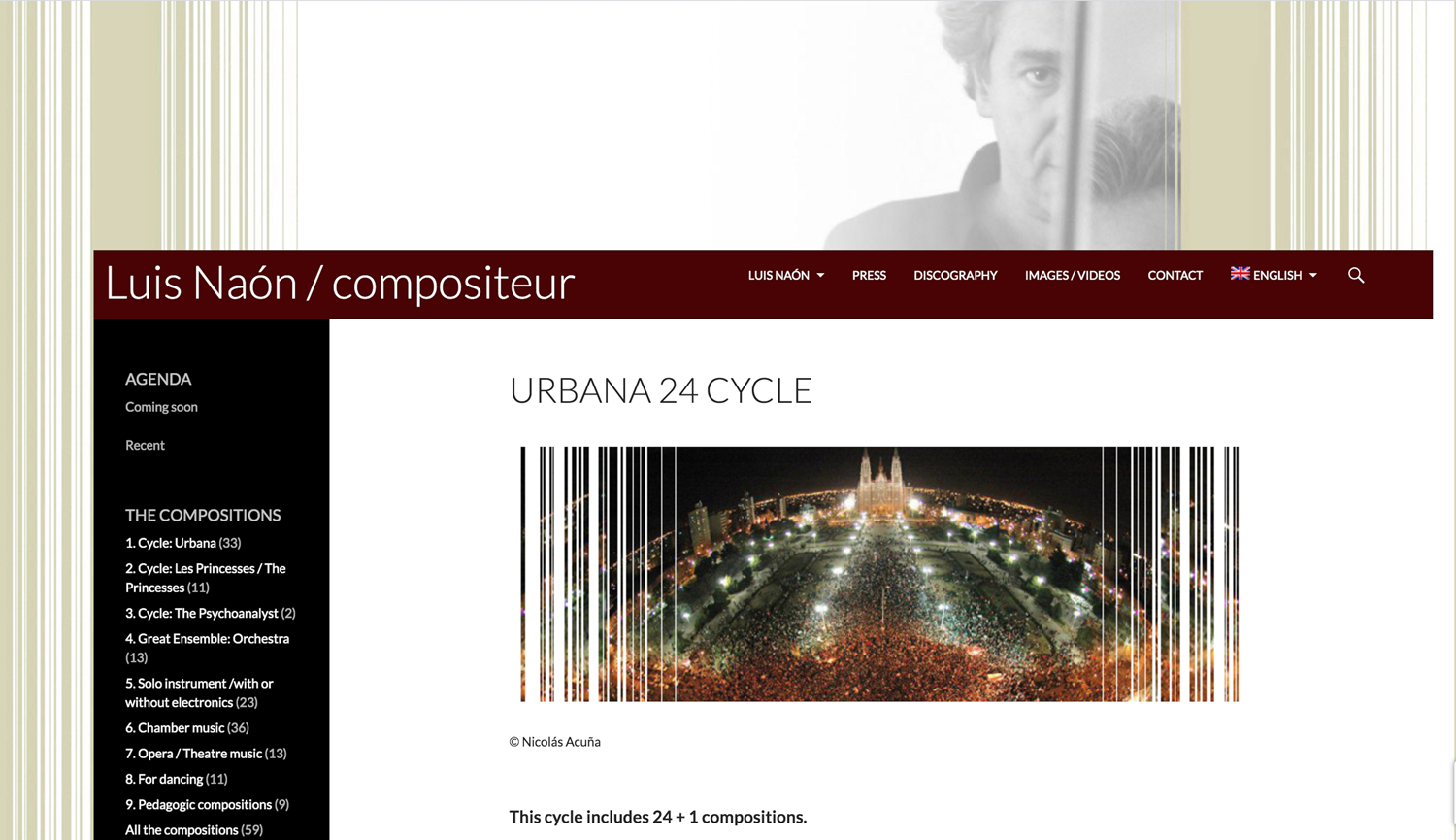
Speculorum Memoria also offers analytical layers related to its title. The mirrors (speculorum) are materially found in the symmetrical arrangement of the orchestral musicians over the performance space. Mirrors are part of the poetic universe of Argentine writer Jorge Luis Borges – without doubt one of the main influential figures of Argentinian intellectual culture in the twentieth century – but they are also connected to Naón's personal memories of his childhood in La Plata, in Argentina. As he explains, the mirrors of the work's title ‘could be mistaken with memory of the mirrors, the subtle difference being the impossibility of forgetting’.Footnote 46 Those remembrances are an important aspect of Naón's ouvre. In 1997, he began conceiving a cycle of pieces called Urbana. On his personal website, Naón explains the goals of the cycle. One of them is ‘To construct, little by little, a Utopia.’Footnote 47 Certain elements in the cycle reveal its cosmopolitan aspiration. For example, three languages are used in the titles: French, Spanish, and Latin; the photograph that illustrates the webpage is an aerial view of Plaza Moreno, the geographical downtown of La Plata, that resembles a bar code (Figure 1). Thus, Naón builds up ‘a Utopia’, an imaginary multicultural city, made with elements that surround the artist's life as a whole, including icons of the crucial early first years of his childhood and youth in Argentina as well as symbols of his professional and affective life in Paris. It is telling that the title chosen by Naón for his essay in the book Nuevas poéticas en la música contemporánea argentina (New Poetics in Contemporary Argentine Music, 2007)Footnote 48 is ‘Who am I?’
(Colour online) Luis Naón. ‘Cycle Urbana 24’. https://luisnaon.com/es/cycle-urbana-24/.

Martin Matalon and Metropolis, an iconic IRCAM's internationalist project
Martin Matalon also left Argentina as a result of the last military dictatorship, although not as a political exile. As opposed to Naón, Matalon arrived in Paris in 1993, after more than a decade living in the United States, where he had completed his musical training at the Juilliard School of Music. Based in New York, he was able to obtain scholarships to attend summer courses in France, where he was able to study with Boulez as well as Tristan Murail, one of the referents of spectralism.Footnote 49
This section focuses on an IRCAM project that featured Matalon prominently when he was chosen to compose music for Fritz Lang's classic silent film Metropolis. This 1995 project became an icon for the institution and a landmark for Matalon's compositional career. As such, the project reflects the articulation between cultural actors, institutions, politicians, technicians, technology, instrumentalists, and critics, from both Paris and Buenos Aires, resulting in an entanglement that provides one of the best exercises at constituting a cosmopolitan musical culture in the French contemporary milieu.
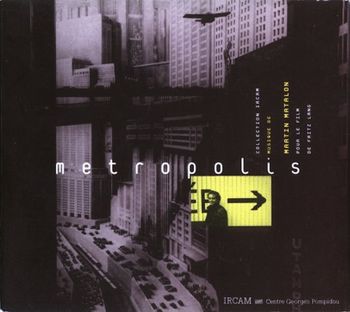
François Bayle became manager of IRCAM in 1986, and came with innovation based on his previous experience with the ‘Musica’ Festival in Strasbourg. As part of this new outlook, he insisted on the insertion of IRCAM composers into a broader cultural life, encouraging them to work beyond the walls of the concert hall in order to establish alliances with other cultural domains.Footnote 50 He came up with the idea of commissioning new music for Lang's film, a project that clearly articulated his desire to make IRCAM relevant beyond the world of contemporary music. Metropolis is a cult classic by a German filmmaker who emigrated to the United States due to the Nazi dictatorship, and it seemed appropriate to include music by a young composer from South America who had been living in New York for ten years due to the presence of an authoritarian regime in his country. The project involved sixteen local musicians and the Catalonian conductor Ernest Martínez Izquierdo, who was Boulez's assistant director at Ensemble Intercontemporain. IRCAM provided its unpaired technological capacity; the music for the film included not only an intensive interaction between fixed and live processed electroacoustic parts but also a surround sound multi-channel system (Figure 2).
(Colour online) CD cover of Matalon's music for the film Metropolis. Edited by IRCAM.

The climax of this ambitious project was an international tour. The piece had a preview in March 1995 at the Helsinki Biennial and officially premiered in May the same year. Since then, the project has been presented in dozens of cities around the world, first under the baton of Izquierdo, later with other conductors, and since 2000, with Matalon himself on the podium. The performance also had a second life when, in July 2008, a copy of the film in 16mm, containing 25 extra minutes that were thought to be lost, was found, coincidentally, in Buenos Aires. This discovery led Matalon to write new music for those scenes. Finally, twelve years after the project first saw the light of day, the composer decided to rewrite his music for a full symphonic orchestra, thanks to a commission from the Philharmonie de Paris, the Paris Orchestra, and the Gürzenich Orchester Köln. This new symphonic version is scheduled to be premiered during the 2021–22 season.
Metropolis allowed Matalon to strengthen his ties with Argentina as a composer. The international tour of 1996 included a performance at Teatro Colón in Buenos Aires, then under the direction of Sergio Renan. During his administration (1989–96), Renan notably updated the repertoire of the traditional opera house. In 1994, he developed a ‘20th-century season’ in which he proposed not only to present repertoire by canonical composers of the twentieth century, but also new works by Argentine composers.
Setting Metropolis to music was a challenge, but IRCAM's support and the ultimate success of the work meant for Matalon one of those milestones that, as Menger points out, constitute a turning point in the development of an artistic career. Matalon's music caused a great impact on the French and international scene. As stated in the programme notes of the premiere at the Théâtre du Châtelet on 30 May 1995:
The music conceived by Martin Matalon for this film is not a simple sound illustration of the images. The composer believes that music composed today is perfectly suitable to transcribe Fritz Lang's urban and futuristic visions and to adhere to the dramatic unfolding of the film. Matalon's musical language introduces elements borrowed from jazz and rock into a contemporary classical music context. His music is, throughout the film, airy, personal, and inventive, spacious in the sense that it provides the listener with space for reflection and appreciation of the images and narrative.Footnote 51
After this project, Matalon produced several concert cinema projects, including films by Luis Buñuel such as Un chien andalou (1929), L’Âge d'or (1930), and Las Hurdes (1933).Footnote 52 This was the result of a long-term alliance with IRCAM, which also included the cycle Traces (I to XIV, 2004–19) for soloists, instruments, and real time electronics – another important trademark of IRCAM since the 1990s.
Georgina Born suggests that the opening of IRCAM's dissemination strategies did not necessarily imply an aesthetic renovation. Matalon's music may represent the aesthetic limit acceptable by the Bayle's management, since, as Born stated, the Boulezian imprint continued to dominate IRCAM's for many years.
By way of conclusion: cosmopolitans, nomads, musicians from afar
During the last quarter of the twentieth century many Argentine composers emigrated to Paris and made it their professional and artistic headquarters. The process of integration of these composers into French musical life was characterized by a growing institutionalization. It was via their passage through conservatories and universities that this transition took place. Musical education in France has a pyramidal structure with the CNSMDP and IRCAM at the top. Those who pass through both institutions have a better chance to develop successful professional careers than those who opt for other conservatories of the national network of public education in music.Footnote 53
Most of the composers who managed to insert themselves in the French professional scene never returned to Argentina to live because they found themselves in an environment that, despite aesthetic differences, and its explicit or implicit hierarchies, allowed them to produce and premiere music in a more stable context than that of Argentina. Nevertheless, these composers are still considered part of the Argentinean cultural milieu as active members of the country's contemporary music scene. This phenomenon applies to Argentinian composers who are living not only in France, but also in other countries, especially the United States. Federico Monjeau affirms that
For some years now, it has become doubly difficult to talk about Argentine music, even in the most sober and limited historical sense, since this music does not even have a real location: it has been dispersed … Today the diaspora is enormous; surely there are as many composers in the country as abroad. I won't try to determine the reasons; in a way the world is becoming more and more one, as Cage once said.Footnote 54
The idea of an ‘Argentine music’ dispersed around the world implies an essentialist aporia. If art has no frontiers, the artist who produces it should not carry identity tags. In that case, how is it possible to continue being Argentine? The power of such an affirmation must be taken into account, especially because Monjeau is the most important critic of the contemporary music in Argentina.Footnote 55 Monjeau's definition contributes to the delimitation of the field of Argentine contemporary music, a network composed of composers, musicians, journalists, academic researchers, and concert programmers. When works by composers of Argentine origin living abroad are performed, analysed, and discussed in Argentina, a ‘grouping’ of local contemporary music is re-produced.Footnote 56 The same happens in France. Argentinian composers living in Paris are usually considered part of the French music field by ensembles, institutions, and festival programmers from different European countries.Footnote 57 At the same time, French institutions often play with the double entendre at the centre of these composers’ identitarian dilemma. For example, the 2015 Radio France's Festival ‘Présences’, devoted to the ‘The two Americas’, included works by Naón, Matalon, Benzecry, and Nillni.Footnote 58 Thus, it is a question of perspective. Depending on the viewpoint, it is possible to define an inside/outside of Argentine contemporary music and at the same of French contemporary music.