


1. Introduction
For the past 30 years or so, there has been a discussion concerning a family of metaphysical views known variously as the ‘causal theory of properties’ (Shoemaker Reference Shoemaker1998), ‘dispositional essentialism’ (Ellis and Lierse Reference Ellis and Lierse1994), ‘dispositionalism’ (Bird Reference Bird2005, Reference Bird2007), and ‘causal structuralism’ (Hawthorne Reference Hawthorne2001).Footnote 1 These views all contend that properties essentially have the causal powers that they do—the causal “profile” of a given property is constitutive of the identity of that property. It is generally agreed that these views imply a view I will call ‘necessitarianism about laws’, which contends that the laws of nature are necessary, namely, that the laws could not have been other than they are. Shoemaker’s (Reference Shoemaker1980) article has been a common touchstone for this discussion, and all the various views within the family mentioned above do not stray too far from his conception. However, a similar view was presented a bit earlier by Wilfrid Sellars (Reference Sellars1948). Sellars’s picture is somewhat different from the one presented by Shoemaker et al., and those differences point the way to a kind of necessitarian position that requires fewer controversial metaphysical assumptions. In this article, I will present that minimal position and give an argument for it inspired by that Sellars article.
Note that the view described here is not meant to be a historically accurate reconstruction of Sellars’s view but a compelling picture inspired by his work. Sellars describes his own work in relation to Leibniz as follows: “However, as our purpose is not historical, we shall have to disregard much that he said, and add much that he didn’t say” (Reference Sellars1948, 292). Here we shall be doing much the same thing.
It is also worth noting that in Sellars’s article he is careful to mention early on that the article is an exploration of “naive realism” (Reference Sellars1948, 291–92), but by the end he is ready to announce the resumption of a more “sophisticated” position that can be derived from the naive exploration. Unfortunately, Sellars does not, to my mind, explicitly draw the connections between the naive view for which he argues throughout the article and the more sophisticated view that is the supposed take-home message. The naive discussion, as we shall see, largely concerns the nature of universals and possible worlds. The title of the article suggests that the sophisticated conclusion is not about universals but about concepts. What was considered naive in the 1950s is now somewhat more acceptable, and many philosophers now feel free to draw conclusions about universals, possibility, or possible worlds. I intend the following discussion to be acceptable to any such “naives.” However, toward the end of the article, I will return to address Sellars’s concerns about the appropriate lessons to be drawn from such a discussion.
2. Necessitarianism
The view I am defending is a necessitarianism about laws of nature (merely necessitarianism henceforth).Footnote 2 Such a necessitarian holds that some laws of nature are themselves metaphysically necessary and not contingent.Footnote 3 Many people will grant that laws of nature have a particular kind of necessity and indeed bestow that necessity upon their instances. When granted, this kind of necessity is often called nomic or physical necessity and is distinguished from necessity of the highest kind: metaphysical necessity. The necessitarian makes the stronger and more controversial claim that at least some laws are metaphysically necessary and, thus, could not have been otherwise—in the idiom of possible worlds, we may say that some laws of the actual world are the laws of every possible world.Footnote 4
3. Modal Structuralism
The Sellarsian argument relies on a thesis about the identity conditions of fundamental properties. In general, when I use the word ‘property’, it will be short for ‘fundamental property’, unless otherwise noted. The basic thesis that Sellars uses is a version of the principle of the identity of indiscernibles (PII). Leibniz first formulated PII, which says that two objects that have exactly the same properties are identical. For our argument, we will need a version of this principle that applies to properties. Sellars describes this principle as follows: “Two universals (putting the matter in the usual paradoxical way), which have the same properties are identical” (Reference Sellars1948, 300). While Sellars uses the term ‘universal’, I have been using the term ‘property’ so as to be neutral between various conceptions of properties. Let us also try to phrase the thesis in a less “paradoxical way” and assume the following principle of the identity of indiscernible properties:
(PIIP) If a property F is indiscernible from a property G, then F = G.
The acceptability of PIIP (as with PII) hinges largely on what is meant by ‘indiscernible’—too liberal a notion of indiscernibility makes the principle trivial, and too restrictive a notion makes the principle false. Nonetheless, it is worth taking a moment to consider the general motivation for PIIP. It is noteworthy that PII has come under sustained attack, especially by arguments to the effect that quantum mechanics describes physical systems that violate PII (see Margenau Reference Margenau1944; French and Redhead Reference French and Redhead1988). Prima facie, if PII is threatened, PIIP is as well, even though these arguments do not directly attack PIIP; they are concerned with indiscernible but nonidentical physical objects, and they do not directly address the identity conditions of properties. However, I believe that the force of these attacks is somewhat blunted by the appeal to indiscernibility in PIIP, rather than to the sharing of common (second-order) properties. Conceptions of indiscernibility that recognize that objects may share all their properties yet be discernible allow defense of PII (see Quine Reference Quine1976). Similarly, PIIP is more defensible when phrased as above. So weakened from the usual way of phrasing such principles, PIIP simply makes the reasonable demand that there be something that distinguishes two distinct properties, so that entities not be multiplied without reason. But to properly assess the reasonability of this demand, we must more precisely characterize indiscernibility.
Sellars gets at the indiscernibility of properties by presenting a very particular characterization of properties that has many controversial features. However, at the core of his picture of the indiscernibility of properties is a simpler structuralist conception of properties that can be pulled out of the more specific picture. Sellars uses his specific picture to present an interesting argument for necessitarianism, but the argument can be made using only the more general structuralist conception, and such an argument is obviously stronger in that it presumes less.Footnote 5 So I will next present Sellars’s specific picture of properties and then describe the more general view that I will call modal structuralism.
For Sellars, properties are “simple,” nonrelational universals that cannot be coexemplified with any other simple universal by a given particular at a world. The particulars that exemplify the universals are events organized by spatiotemporal relations into distinct histories, which is how Sellars prefers to characterize possible worlds.Footnote 6 The histories are grouped into families. The spatiotemporal relations are not themselves properties or universals that are characterized by this picture of properties—they are taken as primitives.
To this picture, Sellars adds a characterization of the identity conditions of properties, as follows: “Now the business of a universal is to be exemplified, just as the business of a particular is to exemplify. Thus, the properties of a universal as universal concern that which is involved in its being exemplified. These properties will be identical with respect to all possible exemplifications of the universal, and together they will be distinctive of the universal” (Reference Sellars1948, 300). I do not find this description especially clear, but there are a few salient points that can be extracted. The first is that the identity of properties is determined by how they are exemplified, rather than by some essence (or quiddity) that can be separated from the exemplification. The second point is that the relevant exemplifications include possible exemplifications as well as actual exemplifications. These two ideas are part of a structuralist conception of properties that Sellars exhibits a bit more explicitly in the conclusions he draws from this criterion of identity. Sellars’s modal structuralism about properties holds that a property is identified with the role that it plays in the structure of possibilities.Footnote 7 By contrast, causal structuralists identify properties with roles played in the causal structure of the actual world. Compared to this position, modal structuralism has more permissive criteria for what kinds of difference make a difference.
Let’s see whether we can characterize modal structuralism a bit more precisely and with fewer presumptions, by thinking about the proper conception of discernibility in PIIP. A handy tool for expressing structuralism is the ramsification of sentences. In general, ramsification of a sentence involves removing interpreted symbols from a sentence, replacing them with variables, and then existentially quantifying over those variables. One way to ramsify is over names. Thus, the sentence ‘Eddie is a wolf-boy’ becomes ‘There is an object x such that x is a wolf-boy’. One may also ramsify over predicates. Thus, we might get ‘There is a property X such that Eddie has X’. More generally, if we take a sentence T(a 1, … , an, P 1, … , Pm), where a 1, … , an are all of the names in T and P 1, … , Pm are all of the predicates in T, and let T(x 1, … , xn, X 1, … , Xm) be the formula one gets by replacing the terms in T with appropriate variables, then ∃x 1 … ∃xn∃X 1 … ∃Xm T(x 1, … , xn, X 1, … , Xm) is a Ramsey sentence of T.
Typically, the structuralist can use Ramsey sentences in a given domain in the following way: the structuralist takes a theory (or set of sentences) about the domain and ramsifies it (them) with respect to some or all of the terms and then asserts that there is no more to say (either because of epistemic limitations or ontological considerations) about the domain than what is expressed by the Ramsey sentence. In other words the structuralist asserts that two theories with the same Ramsey sentence are indiscernible (again, epistemically or ontologically in various cases). But ramsification can be used to make structuralist claims in other ways as well. Consider the n-tuple that satisfies the formula T(X 1, … , Xn), where T(P 1, … , Pn) is now the complete, true theory of the world, and P 1, … , Pn name distinct fundamental properties. The ontological structuralist can assert her position by saying that any n-tuple that satisfies T(X 1, … , Xn) is identical to every n-tuple that satisfies T(X 1, … , Xn). Put this way, ontological structuralism is the wholesale rejection of quidditism, as formulated by David Lewis (Reference Lewis, Braddon-Mitchell and Nola2009, 209)—according to quidditism, the satisfaction of T(X 1, … , Xn) by distinct permutations of the n-tuple counts as different possible ways a world could be.Footnote 8 Consider two possible worlds that, for every formula Φ(X 1, … , Xn), agree on whether the formula is satisfied but, for at least one such formula, disagree on which properties occupy which place in the n-tuple that satisfies the formula. Such worlds are merely quidditistically different.Footnote 9
Sellars’s view is a kind of intermediate position between quidditism and ontological structuralism as I have described them: he allows that some merely quidditistic differences are possible but denies that every quidditistic difference is a distinct possibility. Sellars draws this conclusion after the previously quoted passage:
In order for each universal to have … a distinctive property, the family of possible histories which exemplify the domain of universals to which the universal belongs cannot consist of the relational arrays of states of affairs which would be possible if, per impossible, universals were completely indifferent to the context in which they are exemplified. In other words, the family of possible histories which exemplify this domain of universals cannot consist of all “logically possible” arrays of exemplifications of the universals by sets of particulars, where by this is meant the arrays that would be possible if a domain of universals were a sheer multiplicity of exemplifiables, as substitutable for one another in any context as pennies. (Reference Sellars1948, 300)
In this passage it is fairly evident that Sellars rejects the idea that every mere quidditistic difference is a real possibility, but it is perhaps less evident that he allows some mere quidditistic differences to be possible. I believe that careful consideration of his essay reveals that it is at least the case that he should accept some mere quidditistic differences, but as I am less concerned with getting Sellars right than with presenting an interesting view inspired by his argument, I will not press the matter. Rather, let’s see how to construct such a position.
Sellars’s criterion of identity for properties is that they should play a unique role in the structure of possibilities, considered as a whole. We can make this idea more precise in the following way. Let Ti be a complete qualitative description of world i in terms of the fundamental properties—in other words, let Ti specify for every object in world i the fundamental properties and relations instantiated by that object, but let each Ti contain no proper names of objects (although each does contain predicates for the fundamental properties and relations). Now consider the sentence S(… P …) = ⋄T1(… P …) ∧ … ∧ ⋄Tn(… P …) ∧ … , where each Ti is the complete qualitative description of a possible world and every possible world is qualitatively described by some Ti, so that S is the complete qualitative description of all possible worlds.Footnote 10 Note that ‘P’ need not appear in every conjunct.Footnote 11 Note further that haecceitism could be defined as any one of these Ti being true of more than one world. Antihaecceitism could then be enforced by requiring that each Ti uniquely characterize a world and that no two Ti be identical. I believe that Sellars’s position is antihaecceitist and that a modal structuralist would generally be sympathetic to antihaecceitism, but we do not need to insist on it here for anything that follows. However, I will henceforth drop the ‘qualitative’ before the word ‘description’.
A simple interpretation of the “distinctive property” mentioned by Sellars in the earlier passage would allow S(… X …) to represent such a property. But this interpretation does not capture the structuralism of Sellars’s view, as P might differ from Q solely in virtue of there being a possible world in which some object is P and not Q. So we must ramsify away all the other fundamental properties named in S(… X …) and existentially quantify the variables put in their stead, leaving a new open sentence S′(… X …). It is this open sentence that can be used, with PIIP, to uniquely characterize a given fundamental property, according to modal structuralism. Equivalently, and perhaps more saliently, we can define modal structuralism with the following thesis:
(MS) The open sentence S(X 1, … , Xn), where S(P 1, … , Pn) is the complete description of possibilities, and P 1, … , Pn are all the fundamental properties, is satisfied by exactly one n-tuple.
On this position, some mere quidditistic differences are possible, as can be seen by looking at a toy example. Let S1, our total description of possibilities, be

Three possibilities are described: one in which two objects are P but not Q, another in which two are Q and not P, and a third in which two are P and exactly one is Q. The world characterized by the first conjunct is merely quidditistically different from the world described by the second conjunct, but the third conjunct guarantees that P and Q play distinct roles in the overall structure of possibilities.
However, modal structuralism also requires that some merely quidditistically different worlds be impossible. Modifying our toy example, consider all combinations of the properties P and Q with two distinct (but not independently identifiable) objects. There are 10 combinations, three of which are described above. Of those 10 combinations, six can be combined into three pairs of merely quidditistically different worlds (e.g., as expressed by the first two conjuncts in S1), while the other four are self-symmetric with respect to the role of P and Q (e.g., the possibility that both objects exemplify both P and Q). Now imagine that all 10 combinations were really possible, namely, that the total description S2 be the conjunction of the following 10 sentences (organized into the three pairs and four symmetric possibilities):
(a) 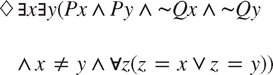 |
(b) 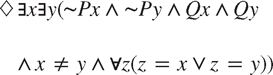 |
(c) 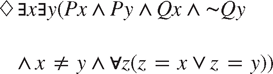 |
(d)  |
(e)  |
(f) 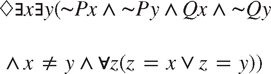 |
(g)  |
|
(h)  |
|
(i)  |
|
(j)  |
|
The formula S2(X, Y) abstracted from S2 also consists of 10 conjuncts and begins ⋄∃x∃y(Xx ∧ Xy ∧ ∼Yx ∧ ∼Yy ∧ x ≠ y ∧ ∀z(z = x ∨ z = y)) ∧ ⋄∃x∃y(∼Xx ∧ ∼Xy ∧ Yx ∧ Yy ∧ x ≠ y ∧ ∀z(z = x ∨ z = y)) … . The pair 〈P, Q〉 satisfies S2(X, Y) of course. That means 〈P, Q〉 also satisfies each conjunct, such as ⋄∃x∃y(Xx ∧ Xy ∧ ∼Yx ∧ ∼Yy ∧ x ≠ y ∧ ∀z(z = x ∨ z = y)) and ⋄∃x∃y(∼Xx ∧ ∼Xy ∧ Yx ∧ Yy ∧ x ≠ y ∧ ∀z(z = x ∨ z = y)). But if 〈P, Q〉 satisfies the first conjunct, then 〈Q, P〉 must satisfy the second since swapping X and Y in the second formula yields a formula logically equivalent to the first. By the same reasoning, 〈Q, P〉 satisfies the first formula, as well as the formula abstracted from c–f. The formulas abstracted from g–j are all symmetric with respect to the roles of X and Y, so 〈Q, P〉 satisfies each of them as well. Thus, 〈Q, P〉 satisfies every conjunct in S2(X, Y) and thus satisfies S2(X, Y) itself, in violation of modal structuralism. Getting rid of one of the symmetric formulas will not solve the problem, so from at least one of the three pairs describing merely quidditistically different worlds, one and only one member must be false.
Generally, this result holds for any complete description S and every pair of fundamental properties that appears in S. There must be at least one possible world with a merely quidditistically different “possibility” involving the swapping of the two properties that is not truly possible. If there were not, then there would be more than one permutation of properties that satisfies the open theory of possibilities, in violation of modal structuralism. However, this result only holds for fundamental properties that are “ramsified away” in the characterization of the distinctive feature of a given fundamental property. Mere quidditistic differences between worlds involving properties not among P 1, … , Pn, if such there be, would be consistent with modal structuralism.
Structuralism can be motivated in many different ways. Hawthorne (Reference Hawthorne2001) identifies five arguments for causal structuralism (a close cousin of modal structuralism), classing them as semantic, metaphysical, epistemological, and methodological. Hawthorne deems the methodological argument for causal structuralism the “most promising” (369). That same line of argument supports modal structuralism at least as well, if not better. Effectively, Hawthorne’s methodological argument is an application of Occam’s Razor: “Why invoke what you don’t need?” (368). In particular, Hawthorne notes that quidditism requires a “mysterious” entity, a quiddity, that plays no role in our scientific investigations of the world. Causal structuralism is one way to avoid postulating such entities, but modal structuralism is another way that is not committed to a robust notion of causation.
Let us express causal structuralism with a thesis similar to MS. For causal structuralism, the characteristic sentence is the “lawbook” L(P 1, … , Pn), which is a conjunction of all the causal laws of the actual world. The corresponding characterization of causal structuralism is the following thesis:
(CS) The open sentence L(X 1, … , Xn), where L(P 1, … , Pn) is the actual lawbook, and P 1, … , Pn are all the fundamental properties, is satisfied by exactly one n-tuple.
According to CS, different properties must play a different causal role in the actual world, whether or not they can be distinguished in other ways in this or other worlds. By contrast, modal structuralism is more “open-minded.” The difference between two properties P and Q only need emerge somewhere in the class of all possibilities. The differences demanded by Shoemaker and others would count, but so would less “cosmic” differences such as P being coexemplified with R in one possible world, while Q fails to be so coexemplified.
This greater flexibility allows modal structuralism to avoid a couple of difficulties for causal structuralism raised by Hawthorne. The first is that the methodological strategy may also lead one to dispense with causation if science can get by without it (Reference Hawthorne2001, 369). Causal structuralism would then be undermined by its own argument. Since modal structuralism does not share the commitment to a robust notion of causation, it is not threatened by this worry. Hawthorne raises a second difficulty for causal structuralism (373–74): he describes a scenario in which there are four distinct properties governed by the following three causal laws (and presumably no others): N(A, C), N(B, C), and N(A & B, D).Footnote 12 If this scenario is possible, then causal structuralism is false, as it individuates properties by their causal role, and A and B have identical causal roles. Modal structuralism would permit this scenario, as long as there is some other noncausal law that distinguishes A from B. For example, there could be a law requiring that at least one thing have A but no such law requiring that any object have B. Such a law is not causal in that it does not link a cause and an effect. Note that it is not sufficient for A and B to be distinguishable in the actual world (“this is A but not B, and that is B but not A”), if they are not also distinguished by a possibility that applies to one of the two but not the other.
One might argue that this solution to Hawthorne’s second difficulty does not address the real substantial worry about modal structuralism. The symmetry under “property swapping” in causal laws has only been purchased at the price of an arbitrary asymmetry in the overall structure of possibilities. Indeed, while modal structuralism allows some symmetric worlds and laws, it does require that the total set of possibilities be asymmetric under every permutation of properties. Thus, according to modal structuralism, putatively fundamental theories such as classical electromagnetism, which is symmetric under the permutation of positive and negative charge,Footnote 13 cannot fully characterize the set of possible worlds. In other words, modal structuralism does not allow that the set of worlds consistent with classical electromagnetism be the complete set of possibilities. And it may seem quite surprising that an a priori argument for modal structuralism should be able to rule out a candidate theory that is internally consistent (pace Frisch Reference Frisch2005).Footnote 14
However, modal structuralism does not disallow classical electromagnetism; rather, it requires that classical electromagnetism is not the complete story. More specifically, modal structuralism requires either that there be some possible worlds inconsistent with classical electromagnetism or that some worlds consistent with electromagnetism be impossible. One might see this result as an arbitrary constraint on scientific theorizing, but it is really only a constraint on theorizing about the complete theory of possibilities, which is arguably not a significant roadblock for science. Moreover, it should be expected that modal structuralism, like any metaphysical theory, will imply some nonobvious claims. The question then becomes, as it often does with metaphysical theories, whether the unintuitive consequences of the view are compensated by its other attractive features. I find quiddities obviated by modal structuralism far more bizarre than the cosmic permutation asymmetry mandated by it, but I leave it to the reader to make her own judgment.
A further worry is that modal structuralism is not quite permissive enough of possible grounds for differentiating properties. An anonymous reviewer has pointed out that modal structuralism does not allow that two properties may be distinguished merely by being instantiated by different particulars in the actual world (for modal structuralism requires further that there must be some possible swapping of roles that is excluded). A similar worry is that modal structuralism does not require that properties exhibit a difference in the actual world. To both of these objections, one response is simply the intuition that the actual world should play no special role in the determination of the identities of properties. This intuition does not require modal realism, I believe. The second objection can also be answered by noting that S(P 1, … , Pn), the complete description of possibilities, can be understood in different ways. For an actualist, for example, S(P 1, … , Pn) would describe only one possible world (the actual one), and it would follow that two different properties could not be coextensive in the actual world.
One final strength of modal structuralism worth noting is that it respects the quidditist’s intuition that different properties can play the same roles—up to a point. Antiquidditism does not allow any merely quidditistic differences between possible worlds. For modal structuralism, different properties can often play the same roles, but to be distinct, there must be some possibility available to one property that is not available to the other.
4. Superweak Necessitarianism
So, for any complete description of possibilities S(… , P, … , Q, …) and two properties P and Q that appear in the description, there must be a possibility described by T(… , P, … , Q, …) or T(… , Q, … , P, …) such that the other is not possible. Without loss of generality, let’s say that T(… , P, … , Q, …) is not possible. It then follows that it is necessary that the negation of T(… , P, … , Q, …) be true. Indeed, for every pair of fundamental properties described by S, there must be such a necessity. Sellars characterizes necessities like these as laws of nature (compare his definition; Reference Sellars1948, 309).
Are these necessities laws of nature? It is common to ask what distinguishes mere accidental generalizations from true laws of nature, and many philosophical theories of laws of nature are aimed at providing a way of so distinguishing the laws. There is another less commonly asked question that comes from the “opposite direction”—What distinguishes the laws of nature from metaphysical necessities? Many of those theories will have a ready answer to that question as well. For Armstrong, the laws are universals of a peculiar kind: they are the instantiation of a second-order contingent relation of necessitation by two first-order properties. For Lewis, the laws are just the best system of truths that characterize the actual world and, thus, are true (or nearly so) in nearby possible worlds, but not in every world, as the metaphysical truths are. But both of these theories presume that laws of nature (nomic necessities) are not metaphysically necessary. One may be inclined to consider the possibility that this presumption is false. We must then ask how to distinguish the necessities that are metaphysical and nomic from those necessities that are merely metaphysical.Footnote 15
I think a reasonable answer to this question can be found partly in the work of Kripke and Putnam, which has been a persistent touchstone for necessitarians. Putnam (Reference Putnam1975) and Kripke (Reference Kripke1980) both persuasively argued that there are facts (water is H2O; tigers are animals) that are necessary but could not be discovered a priori. Kripke dubbed such facts necessary a posteriori and did not include laws of nature among these facts, although he leaves that question open (99). Kripke makes clear that the necessity he has in mind is metaphysical necessity, the strongest kind (35–36). Necessitarians have argued that, indeed, the laws of nature should be included in this category, as the laws of nature are metaphysically necessary (so they argue) and are a posteriori. Ellis (Reference Ellis2001, 226), for example, attributes a posteriority to necessary laws. A posteriority alone excludes nonphysical necessities that are logical and mathematical. So it seems that we at least have a (conceptually) necessary condition for a law of nature—it must be a posteriori. This condition separates metaphysically necessary laws from some non-nomic metaphysical necessities.
However, a posteriority is not sufficient to distinguish the metaphysically necessary laws of nature from the mere metaphysical necessities. According to Kripke, the fact that I was born to my parents is necessary (given that I exist). Similarly, he contends that it is necessary that I was human for at least some stage of my life. Neither of these kinds of facts can be considered laws of nature, and if we accept them as necessary a posteriori, then we have clear counterexamples to the idea that the necessary a posteriority is sufficient for lawhood. For these cases, it is clear what is missing. It is generally agreed that laws of nature do not concern particular individuals, such as me.Footnote 16 So let us say that in addition to a posteriority, nonparticularity is also necessary for (metaphysically necessary) lawhood.
If these two conditions are jointly sufficient to distinguish the mere metaphysical necessities from the laws that are metaphysically necessary, then we must admit that Kripke/Putnam generalizations like ‘water is H2O’ are laws of nature. This conclusion is controversial (see Armstrong Reference Armstrong1983, 138) but not obviously absurd. Consider a less discussed example: the well-tested coextension of inertial mass and gravitational mass(es). Before the general theory of relativity, their apparent equivalence seemed accidental, but in the light of that theory one may reasonably argue that they are identical and, hence (according to Kripke/Putnam), that they are necessarily coextensive. Here we have a perhaps more plausible case of a necessary identity that is nonetheless a law. But let us not settle the question and instead ask, what is the troubling feature of these generalizations (assuming that it is not merely the rejection of metaphysically necessary laws)? Here is one diagnosis: ‘water’ and ‘H2O’ pick out the exact same property, and thus the necessity of ‘water is H2O’ arises because it is an identity statement. Although it is not analytic, it seems to share something of the triviality of an analytic statement—the constraint that a property be identical with itself does not seem very substantial. If one thinks all laws of nature are metaphysically contingent, then that contingency serves to distinguish them from “trivial” generalizations like ‘water is H2O’. But if one allows for metaphysically necessary laws of nature and wants to reject such generalizations, then one needs another criterion. Let us take that criterion to be that laws cannot be necessary identities or the logical consequences of such identities.
By the above-mentioned criteria, the necessities Sellars describes may reasonably be deemed laws of nature. They are a posteriori in that they are not true by virtue of their logical form: if ∼T(… , P, … , Q …) is the law in question, then T(… , Q, … , P, …) must be possible. By stipulation, ∼T does not contain any names of particulars. Finally, we assumed that S concerned distinct fundamental properties, so ‘water is H2O’ will not be one of these necessities or a logical consequence of them, as being water and being H2O are not fundamental properties. Having inertial mass and having gravitational mass are more plausible cases of fundamental properties,Footnote 17 but if they are identical they are not distinct. Indeed, if they are fundamental properties, and they are in fact the same property, it is hard to see why any Ti, the complete description of world i, would distinguish between them. So if one is bothered by necessary identities, they will not be among the laws picked out by modal structuralism.
So, modal structuralism implies that if there are at least two fundamental properties, then there must be laws of nature. These a posteriori laws are true in all possible worlds, so they are metaphysically necessary, and thus modal structuralism seems a type of necessitarianism. However, some might think that it is not quite necessitarianism. After all, the view does not imply that there are necessarily laws, only that there are necessarily laws conditional on there being at least two fundamental properties. Moreover, there is no guarantee that all laws are necessary, as necessitarianism typically holds. Furthermore, these necessities have a kind of arbitrary character—they seem to lack sufficient reason. There has to be some, but it easily seems that it could have been those rather than these. A useful analogy can be drawn with spontaneous symmetry breaking: pure symmetry is not allowed, but nothing determines which way the symmetry fails. For all these reasons, it may be appropriate to call this view, with a nod to Bird’s distinction, superweak necessitarianism.
5. Knowledge of Properties and Laws
It is worth pointing out what many might consider a weakness of superweak necessitarianism. So far, our discussion has been at quite a high level of abstraction, and we have not yet said much about any actual candidates for lawhood or how we may recognize them as such. It would be nice if the arguments given above could lead us to a bit more detail. Unfortunately, I am not sure that modal structuralism has much to say on this subject. We may know that P is involved in some a posteriori necessity. We know from the fact that necessity implies actuality that this necessity must be one of the a posteriori truths involving P in the actual world. But beyond this fact, I cannot see how we say much more about which of those truths may be necessary using the resources of a modal structuralism.
Shoemaker’s view does not seem to be in a much better situation. Shoemaker says that his motivation for holding his view is epistemological (Reference Shoemaker1980, 214), and he argues that if properties were not individuated by causal laws, then we would not be in a position to know what properties there are, which suggests that his view can reveal more about what the laws are. But his view does not really do so. Even if Shoemaker’s argument is successful, it presumes that we start with knowledge of the essences of some properties and the associated laws; it does not tell us how we know what they are. Presumably Shoemaker will have to tell a further story about why we do have good reason to think that a purported law is in fact a law and that a purported property is in fact a property. That story may also be available to a necessitarian of the superweak stripe that I have been describing.
Nevertheless, that story might also fail to work for the superweak view, and thus the problem may be worse for that view. On many orthodox conceptions of laws of nature, they are generalizations of the form ∀x(Fx → Gx). However, modal structuralism may allow that a law has effectively any logical form. So it could be a law that ∃x Fx. It would seem much more difficult to establish such a law than one governing an observed regularity. If a view like Shoemaker’s rules out such kinds of laws, as I think it does, then this challenge would be more uniquely faced by the superweak view. Nonetheless, I do not think it is impossible to have reasons for thinking there is such a law. However these reasons would have to be supplied by considerations (i.e., scientific considerations) beyond those supplied by superweak necessitarianism. For example, physics may reveal that it is necessary that any universe begins in a point singularity, making the existential claim that there is a point singularity lawlike. In any event, it is worth remembering that one can accept the arguments for superweak necessitarianism but incorporate the view into a more comprehensive account of natural laws. Superweak necessitarianism fails to tell us how to distinguish laws from accidents, and it even fails to tell us how to distinguish metaphysically necessary laws from merely physically necessary laws, if such there be. Nonetheless, it does tell us that there are laws, and some of them are metaphysically necessary, much as a mathematical proof may show us that an equation has a solution, although the proof cannot supply the solution.
6. Sellars and Naive Realism
The argument of this article was specifically inspired by Sellars (Reference Sellars1948), and it would be remiss to ignore (as van Fraassen [Reference van Fraassen1989, 70] claims that many do) Sellars’s last-minute semantic ascent from the “Realm of Being” and its associated “naive realism.” In the final section of his article, Sellars reveals that the discussion has not really been about possible worlds, possible histories, and universal properties. Rather, “under the guise of ‘exploring’ the ‘realm of possibility’ we have been rehearsing explicative metalinguistic activity of the sort which is characteristic of the ‘analytic philosopher’ who is but a few steps removed from common sense” (Reference Sellars1948, 314). In other words, the appropriate lessons of the naive discussion will be about our use of words. Curiously, in the main text Sellars does not translate these lessons from his previous naive arguments into the more sophisticated metalinguistic idiom. Instead, he refers to what those lessons would be. He says we have “reached the point where further ‘exploration’ would soon lead us to explicit recognition of distinctions which would need but a slight twist to become the characteristic apparatus of the ‘pure theory of empirical languages’ that is being developed by contemporary Logical Empiricism. This exploration would give us a clearer understanding of the status of our results, but would not impair their validity” (315). This extended reference to work yet to be done is a bit maddening. However, in the final footnote, attached to the final word of the article, he does say a little more, first pointing out that we have learned how possible worlds can be used to give an extensional analysis of the meanings of predicates and then giving a brief list of what is involved in the analysis of predicates. There he uses the word ‘world’ in scare quotes, suggesting that that word still needs appropriately sophisticated analysis (as it may even for the naive realist).
So I think that the picture we get from Sellars is something like as follows. We have constraints on how we may use predicates. Some of these constraints, like the one requiring that ‘bachelor’ not be applied to any nonmale or married person, bind us by virtue of the meaning of the word; in other words, they are analytic. But for each predicate there are other synthetic constraints on its application, in virtue of the need to distinguish it from other predicates. However, unlike the case of the analytic constraints, we cannot merely analyze our use of the word to know what those constraints are. Hence, they are synthetic.Footnote 18
If this picture is the right interpretation of Sellars, then I think it is an unattractive view, although it may be acceptable. What I find most peculiar about this view is that it proposes a kind of constraint on our linguistic practice that cannot really function as a constraint at all. Of course, it is perfectly reasonable that our uses of words establish obligations that we are not in a position to know—I may not call Barack Obama a bachelor, even if I do not know it. But in Sellars’s view, it is not that there is some definite synthetic truth that I may be unknowingly committed to but rather that I am committed to the mere existence of some synthetic truth (a generalization) involving a given predicate. And I can hardly avoid applying predicates so that they are involved in some synthetic generalization, if I am limited to applying predicates in the actual world, as I am. The interesting feature of the naive discussion is that it implies that there are real limits to possible applications of the predicate as well. However, on Sellars’s linguistically sophisticated view, it is not clear what these claims about possibility really amount to. We would like to know more about how to eliminate the scare quotes around ‘world’.
In any event, whether or not Sellars’s view is tenable, I do not think it is illegitimate to take his naive realist discussion as inspiration for a view that never bothers to make the semantic ascent. If one is willing to accept modal structuralism literally, then the argument deriving necessitarianism from it stands or falls on its merits. It does not matter that the position was inspired by a metaphor.
7. Conclusion
So, if we are allowed to take the naive discussion seriously, and the argument has been correct, what has been learned? Modal structuralism involves a particular interpretation of PIIP: that properties are individuated by their role in the structure of possibilities. With the rejection of all merely quidditistic differences, it leads to superweak necessitarianism, the thesis that at least some laws are necessary, conditional on there being more than one fundamental property.
What I think is most interesting about this result is that it rigorously shows how essentialism and necessitarianism may arise from a fairly weak structuralism. As far as I can tell, these assumptions and their consequences are consistent with causal structuralism. However, unlike causal structuralism, this modal structuralism does not presume any metaphysics of causes, dispositions, or powers. To be sure, the assumptions are not insubstantial. But I, at least, find these structuralist ideas tempting and do not think rejecting necessitarianism worth the cost of accepting differences that make no difference.


