Introduction
Successful navigation of daily life requires cognitive control processes. One measure of cognitive control is antisaccade performance. This task begins with central fixation. A cue is presented in the periphery and participants are instructed to look towards the mirror image location (opposite direction, same distance from center). An initial saccade towards the cue is an error and an indicator of compromised cognitive control. Antisaccade can be compared with prosaccade performance, which requires a reflex-like glance towards a visual cue. Performance for both tasks is quantified using percent error, as well as latency for correct and error responses. Antisaccades elicit a greater percentage of errors and longer latencies, evidence of the increased cognitive control required compared with prosaccades.
Neural circuitry supporting saccades has subcortical and cortical components. Subcortical circuitry includes basal ganglia, thalamus, and superior colliculus (SC). Cortical saccade regions include visual cortex, posterior parietal cortex, and supplementary and frontal eye fields (SEF and FEF) (Coe & Munoz, Reference Coe and Munoz2017; Luna et al., Reference Luna, Thulborn, Strojwas, McCurtain, Berman, Genovese and Sweeney1998; McDowell, Dyckman, Austin, & Clementz, Reference McDowell, Dyckman, Austin and Clementz2008). The SC integrates cortical and subcortical signals and projects to pontine reticular formation neurons that stimulate the ocular motor nuclei that move the eyes (Coe & Munoz, Reference Coe and Munoz2017). Prior to saccades, there is a build-up of firing in the intermediate layer of SC (Helminski & Segraves, Reference Helminski and Segraves2003; Peck, Reference Peck1990) and reversible lesions of SC result in inhibited saccades and/or greatly increased latencies (Schiller, Sandell, & Maunsell, Reference Schiller, Sandell and Maunsell1987), or saccades to the wrong target (McPeek & Keller, Reference McPeek and Keller2004). Activity in this region is regulated by input from the fixation zone of rostral SC, which receives input from FEF that allows contextual factors to speed or prevent responses to stimuli. Via projections to FEF, higher-order regions including dorsolateral prefrontal and anterior cingulate cortices can bias the SC in a context-appropriate manner. Functional magnetic resonance imaging (fMRI) demonstrates increased signal in saccadic circuitry during antisaccade performance (Ettinger et al., Reference Ettinger, Ffytche, Kumari, Kathmann, Reuter, Zelaya and Williams2008; Kimmig et al., Reference Kimmig, Greenlee, Gondan, Schira, Kassubek and Mergner2001; Pierce & McDowell, Reference Pierce and McDowell2016).
Impaired cognitive control is a feature of psychoses, including schizophrenia (SZ), schizoaffective disorder (SAD) and bipolar disorder with psychosis (BDP). Compared to healthy participants, SZ and SAD consistently demonstrate higher antisaccade error rates and longer correct antisaccade latencies, in the context of preserved antisaccade error latencies and prosaccade performance (Radant et al., Reference Radant, Millard, Braff, Calkins, Dobie, Freedman and Tsuang2015; Reilly, Harris, Khine, Keshavan, & Sweeney, Reference Reilly, Harris, Khine, Keshavan and Sweeney2008). Those with bipolar disorder also show higher antisaccade error rates than healthy participants, although results are less consistent (Gooding & Tallent, Reference Gooding and Tallent2001; Tien, Ross, Pearlson, & Strauss, Reference Tien, Ross, Pearlson and Strauss1996). One contributing factor to these inconsistencies is that studies often fail to distinguish between bipolar disorder cases with and without psychosis (Gooding, Mohapatra, & Shea, Reference Gooding, Mohapatra and Shea2004; Harris, Reilly, Thase, Keshavan, & Sweeney, Reference Harris, Reilly, Thase, Keshavan and Sweeney2009; Tien et al., Reference Tien, Ross, Pearlson and Strauss1996).
Recently, consortia have provided valuable information regarding cognitive functions as measured by saccade metrics in large psychosis samples. The Consortium of Genetics of Schizophrenia (COGS) found elevated antisaccade errors in 143 SZ compared to 195 healthy participants; COGS-2, a corresponding case-control study, showed a similar deficit in an older cohort of SZ patients (Radant et al., Reference Radant, Dobie, Calkins, Olincy, Braff, Cadenhead and Tsuang2010, Reference Radant, Millard, Braff, Calkins, Dobie, Freedman and Tsuang2015). The Bipolar-Schizophrenia Network for Intermediate Phenotypes (B-SNIP1), a multisite collaboration, collected clinical, cognition, eye movement, electrophysiology, and neuroimaging genetic information in a large sample of SZ, SAD, BDP and their first-degree relatives (Tamminga et al., Reference Tamminga, Ivleva, Keshavan, Pearlson, Clementz, Witte and Sweeney2013). For the B-SBNIP1 sample, Reilly et al. (Reference Reilly, Frankovich, Hill, Gershon, Keefe, Keshavan and Sweeney2014) demonstrated that, compared to healthy participants, SZ (n = 267) showed the most elevated antisaccade error rate, closely followed by SAD (n = 150) and BDP (n = 202) probands, and these effects were still pronounced after accounting for the level of global cognitive function. Coe and Munoz (Reference Coe and Munoz2017) also showed that generalized cognitive impairment could not fully account for elevated antisaccade errors associated with psychosis.
One feature that may determine success in antisaccade tasks is a speed-performance tradeoff – the faster a person responds, the less time there is for top-down ‘stop’ processes to inhibit saccades (Li et al., Reference Li, Amlung, Valtcheva, Camchong, Austin, Dyckman and McDowell2012). Top-down control is task-relevant before peripheral cues (maintenance of fixation) as well as after (inhibition of proponent movement plus planning and executing the antisaccade). Because distributions for antisaccade latencies are continuous for both correct and error responses, a multi-parameter function that simultaneously summarizes distributions for correct v. error trial latencies can clarify the nature of cognitive processing features contributing to reduced efficiency of antisaccade performance. Polli et al. (Reference Polli, Barton, Vangel, Goff, Iguchi and Manoach2006) used quadratic functions to examine the speed-accuracy relationship of SZ and healthy participants. They found that SZ and healthy participants showed a speed-performance tradeoff as latency increases. However, SZ error rate plateaued at a higher level, indicating a limit on maximal performance even when response initiation was delayed (Polli et al., Reference Polli, Barton, Vangel, Goff, Iguchi and Manoach2006).
Here we report findings from B-SNIP2, the follow-up to the B-SNIP1 consortium study (Reilly et al., Reference Reilly, Frankovich, Hill, Gershon, Keefe, Keshavan and Sweeney2014). As with the first iteration, SZ, SAD, BDP, and healthy participants were recruited at five sites to determine shared v. specific patterns of performance across the psychosis spectrum. The saccade portion of B-SNIP2 was designed to replicate B-SNIP1, investigate latencies and error rates as links to neural efficiency in cognitive control processes, and compare speed-performance tradeoff patterns between groups. B-SNIP2 included saccade paradigms identical to B-SNIP1 (antisaccade overlap, prosaccade overlap, synchronous, and gap trials) and included an additional antisaccade gap condition. We hypothesize that (i) deficits in cognitive control, as assessed using antisaccade tasks, are pronounced in psychosis (Reilly et al., Reference Reilly, Frankovich, Hill, Gershon, Keefe, Keshavan and Sweeney2014), (ii) increased antisaccade errors and increased correct antisaccade latencies are markers for functional brain changes in psychosis, and (iii) speed-performance tradeoff patterns for healthy and psychosis groups differ.
Methods
Participants
B-SNIP2 data collection sites located in Athens, Boston, Chicago, Dallas and Hartford recruited clinically stable, outpatient participants with diagnoses of SZ, SAD, or BDP. Healthy participants also were recruited from local communities. After providing written consent approved by each site's respective Institutional Review Board, participants completed the Structured Clinical Interview for the DSM-IV-TR [SCID; (American Psychiatric Association, 2000)], Reading Subtest of the Wide Range Achievement Test-IV [WRAT; (Berg, Durant, Banks, & Miller, Reference Berg, Durant, Banks and Miller2016)] and Brief Assessment of Cognition for Schizophrenia [BACS; (Keefe et al., Reference Keefe, Goldberg, Harvey, Gold, Poe and Coughenour2004)]. Participants provided medication and other health histories. Exclusion criteria included positive tests for controlled substances (current), or head injuries leading to lost consciousness for longer than 30 min (lifetime). Clinical profiles were assessed using the Positive and Negative Symptom Scale [PANSS; (Kay, Fiszbein, & Opler, Reference Kay, Fiszbein and Opler1987)], Montgomery-Asberg Depression Rating Scale [MADRS; (Montgomery & Asberg, Reference Montgomery and Asberg1979)], Young Mania Rating Scale [YMRS; (Young, Biggs, Ziegler, & Meyer, Reference Young, Biggs, Ziegler and Meyer1978)], and Birchwood Social Functioning Scale (Birchwood, Smith, Cochrane, Wetton, & Copestake, Reference Birchwood, Smith, Cochrane, Wetton and Copestake1990). For complete study protocols for B-SNIP, see Tamminga et al. (Reference Tamminga, Ivleva, Keshavan, Pearlson, Clementz, Witte and Sweeney2013) and Reilly et al. (Reference Reilly, Frankovich, Hill, Gershon, Keefe, Keshavan and Sweeney2014).
Eye movement paradigms
Testing procedures and equipment were identical across B-SNIP2 collection sites (and same as in B-SNIP1). Pupil position was recorded using EyeLink II head-mounted infrared headsets (500 Hz sampling rate) and their corresponding control platform (SR Research Ltd., Mississauga, Canada). Stimuli were programmed using Presentation software (Neurobehavioral Systems, Inc., Berkeley, CA,) and presented on 22-inch CRT monitors in completely darkened rooms.
Trials began with a red crosshair centered on a dark screen, followed by a white peripheral cue (1° visual angle) presented at +/− 10- or 15° locations, with variable inter-trial intervals (1500–2500 ms). For prosaccade trials, the peripheral cue was a white circle. Three fixation conditions were administered that altered the timing of fixation extinction relative to the peripheral illumination (32 trials per condition). For the ‘gap’ condition, the central target was extinguished 200 ms before illumination of the peripheral cue. For the ‘synchronous’ condition, fixation was extinguished simultaneously with the illumination of the peripheral cue. In the ‘overlap’ condition, fixation remained for 200 ms following illumination of the peripheral cue. Participants were instructed to fixate on the central cross and then to move their eyes as quickly and accurately as possible to the peripheral cue once it appeared.
For antisaccade trials, the peripheral cue was a white square. Two conditions were administered, 80 trials each. For antisaccade ‘gap’ condition, the fixation offset preceded the peripheral cue illumination by 200 ms. For antisaccade ‘overlap’ condition, fixation and peripheral cue overlapped by 200 ms. Participants were instructed to fixate on the central crosshair and then when the peripheral cue appeared, to move their eyes quickly and accurately to the mirror image location of the cue (opposite direction, same distance from central fixation).
The task order was always prosaccades followed by antisaccade-overlap, then antisaccade-gap. Order of prosaccade tasks was counterbalanced. Within each task and condition, trials were arranged pseudo-randomly so that trials were evenly split between +/− 10° and 15° displacement. A brief practice block was performed before antisaccade-overlap to ensure participants' understanding of the task.
Eye position data over time was scored by trained research assistants blind to participant group membership using in-house programs written in Matlab (MathWorks Inc., Natick, MA, USA). Trials characterized by anticipatory movements, blinks during cue onset, lack of movement, or eye drifts were excluded. For each saccade, the following variables were scored: (a) direction (for evaluation of correct or error response) and (b) onset latency (time from the illumination of the peripheral cue to start of saccade).
Statistical analysis
After all eye movements were scored, data quality control, generation of averages, group comparisons, and effect modeling were performed on SAS base software (version 9.4; SAS Institute Inc. Cary, NC, USA). For participants with at least 25%, scorable trials for every task (3 prosaccades and 2 antisaccades), correct and error response latencies and error rates were calculated by task and condition for each subject. Demographic and clinical features of the sample are listed in Table 1. Antisaccade error rate and prosaccade latency are age-dependent in the healthy population (Knox & Pasunuru, Reference Knox and Pasunuru2020; Shafiq-Antonacci et al., Reference Shafiq-Antonacci, Maruff, Whyte, Tyler, Dudgeon and Currie1999). To adjust for age distributions in the participant groups while preserving participant-level variability, linear coefficients of age for the healthy group were estimated for each outcome variable (TRANSREG procedure, SAS 9.4), then age-adjustment was performed on individual participant's results by subtracting the product of each outcome variable and the corresponding age coefficient (Dukart, Schroeter, Mueller, & Alzheimer's Disease Neuroimaging, Reference Dukart, Schroeter, Mueller and Alzheimer's Disease Neuroimaging2011). After age adjustment, differences by group (SZ, SAD, BDP, and healthy) and condition (prosaccade: gap, synchronous, and overlap; antisaccade: gap and overlap) were examined using the GLM procedure. Fixation condition and target amplitude were specified as repeated factors. Other demographic factors (gender, site, race) were also included in the models if significant main effects were present based on F values from type III marginal least-squared means. Post-hoc pairwise group comparisons were performed using the Tukey-Kramer procedure (Richter & McCann, Reference Richter and McCann2012). To evaluate possible medication associations with saccade performance, patients taking and not taking each class of psychotropic medication were compared using ANOVAs for each saccade variable.
Demographic and clinical characteristics of included subject groups

SZ: Schizophrenia; SAD: Schizoaffective Disorder; BP: Bipolar Disorder Type I with Psychosis.
a Wide-Range Achievement Test (IV): Reading Test.
b Birchwood Social Functioning Scale.
c Montgomery Asberg Depression Rating Scale.
d Young Mania Rating Scale.
*p < 0.05, **p < 0.01, ***p < 0.001.
Speed-performance trade-off
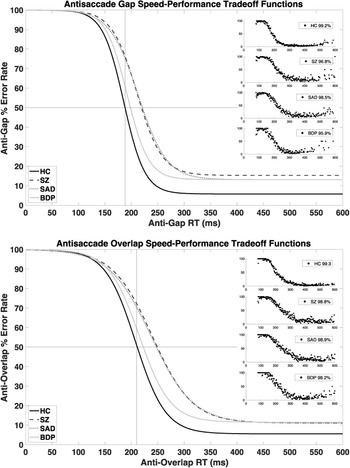
Patterns of speed-performance tradeoff were created for each group (SZ, SAD, BDP, and healthy) by calculating the correct-to-error ratio within 10 ms latency bins. The following steps are an adaptation of the procedure used by Polli et al. (Reference Polli, Barton, Vangel, Goff, Iguchi and Manoach2006). No significant difference was found among within-group variances in age-adjusted antisaccade latency, so age-adjusted latencies for correct and error trials were pooled and tallied within each group for each 10-ms bin. Percent error rates for each bin were calculated and plotted. Upon visual examination of the plot patterns, logistic functions were selected to model the speed-performance tradeoff (Fig. 3, insets). For each group, parameters of the following function were estimated separately for gap and overlap conditions (NLIN procedure, SAS 9.4):

where parameters A, B, and r were estimated with initial seeds: (i) minimum error rate A = 0% [‘optimal performance’; the best possible performance a group can achieve, approached at the longest latencies (lower asymptote)], (ii) maximum speed-performance tradeoff rate r = 0.1 (‘tradeoff rate’; how quickly participants within a group can improve on antisaccade performance if they slow their reaction times, measured by reduction in error rate per msec), and (iii) latency of maximum tradeoff B = 200 ms (‘time to 50% correct’; the point at which participants within a group reach 50% correct trials). The formula constrained the upper limit at 100%, the maximum error rate possible. This procedure achieved optimal fit through an iterative process until the minimal least squared error was achieved. Percent variance explained by each function was determined by dividing the adjusted model sum of squares by the total sum of squares.
Relationship of antisaccade variables to cognition and clinical features
Canonical correlation (CANCORR procedure, SAS 9.4) was used to investigate relationships between antisaccade variables that showed significant main effects of the group with either (a) cognition variables or (b) clinical features. Canonical correlation is particularly useful when there are high intercorrelations within variable sets (Lambert, Wildt, & Durand, Reference Lambert, Wildt and Durand1988). The outcome of canonical correlation is pairs of orthogonal latent variates. In the present case, each pair consists of weighted sums of the saccade variables maximally correlated with the weighted sums of the cognition variables or clinical features.
The BACS (Keefe et al., Reference Keefe, Goldberg, Harvey, Gold, Poe and Coughenour2004) assesses general cognitive ability across six subtests that index processing speed, attention, reasoning, motor control, and verbal fluency. It has shown deviations in cognition across the psychosis spectrum in B-SNIP1 (Hill et al., Reference Hill, Reilly, Keefe, Gold, Bishop, Gershon and Sweeney2013) that replicated in B-SNIP2 (Gotra et al., Reference Gotra, Hill, Gershon, Tamminga, Ivleva, Pearlson and Keedy2020). Age- and sex-adjusted subtest scores from Gotra et al. (Reference Gotra, Hill, Gershon, Tamminga, Ivleva, Pearlson and Keedy2020) were used in this canonical correlation analysis. Clinical features were assessed using the Birchwood Social Functioning, PANSS Positive, PANSS Negative, PANSS General, Young Mania Rating, and Montgomery-Asberg Depression Rating Scales.
Results
Antisaccade performance
Antisaccade error rates showed a main effect of group [F(3696) = 37.47, p < 0.0001] and fixation condition [F(1696) = 30.22, p < 0.0001] (Fig. 1). Pairwise comparisons indicated that SZ and SAD groups committed the most errors compared to healthy participants (p < 0.0001), and error rate in BDP was intermediate between SZ/SAD and healthy (p's < 0.01). There was a significant interaction between group and condition [F(3696) = 2.80, p = 0.0394]. Analyses revealed that both SZ and SAD had greater error rates during gap than overlap trials (t's > 3.49, p's < 0.001); the BDP and healthy participants did not differ between conditions (t's < 0.65; p's > 0.516). There was no effect of target amplitude [F(1696) = 1.06, p = 0.3].
Percentage antisaccade error rates (mean and standard error) by group [schizophrenia (SZ), schizoaffective disorder (SAD), bipolar disorder with psychosis (BDP) and healthy comparison (HC)] and condition (gap: solid lines; overlap: dotted lines). **p < 0.01, ***p < 0.001.

Latencies for correct antisaccade responses (Fig. 2, top) differed by group [F(3699) = 9.95, p < 0.0001], condition [F(1699) = 120.66, p < 0.0001], and target amplitude [F(1699) = 555.28, p < 0.0001]. Overlap conditions produced longer latencies than the gap condition in all groups (p's < 0.0001) (Fig. 2, top). There were longer latencies to 15° trials than 10.° trials for all groups and conditions (all p's < 0.01). There was a group by condition interaction [F(3699) = 2.65, p = 0.048], such that SZ showed a larger difference between overlap and gap latencies than all other groups.
Reaction time results. The upper plot shows antisaccade latencies (mean and standard errors) by correct responses (solid lines) and error responses (dotted lines), by group [schizophrenia (SZ), schizoaffective disorder (SAD), bipolar disorder with psychosis (BDP) and healthy subjects (HC)], and by condition [gap (grey) and overlap (black)] collapsed across 10° and 15° targets. Pairwise comparisons for latencies on correct responses were significant for SAD v. HC and SZ v. HC in both overlap and gap conditions. The lower plot shows prosaccade correct latencies (mean and standard error) by group (SZ, SAD, BDP, and HC) and condition [gap (squares), regular (triangles), and overlap (‘x’)]. There were no significant group differences in prosaccade latency. ***p < 0.001.

Latencies for antisaccade error responses showed no group difference [F(3670) = 1.09, p = 0.350]. There was the main effect by condition [F(1670) = 273.9, p < 0.0001], which was shorter in the gap compared to overlap, as well as the main effect or target amplitude [F(1670) = 650.84, p < 0.0001], with 15° trials showing longer latencies than 10° trials.
Prosaccade performance
Correct prosaccade latencies (Fig. 2) showed no main effects of group; however, the effects of condition [F(21 462) = 386.84, p < 0.0001], and target amplitude [F(1731) = 1105.63, p < 0.0001] were significant. Post-hoc comparisons showed that gap prosaccades were fastest, overlap prosaccades took the longest and synchronous prosaccades were intermediate (all p's < 0.001). Prosaccade latencies to 10° targets (M = 158 ms, s.d. = 32 ms) were faster than those to 15° targets (M = 170 ms, s.d. = 35 ms). Average prosaccade error rate was less than 2% in all groups (healthy: M = 0.3%, s.d. = 1.6; SZ: M = 1.1%, s.d. = 3.1; SAD: M = 1.2%, s.d. = 3.2; BDP: M = 0.5%, s.d. = 1.8).
Medication associations with saccade variables
No medication associations were found for antisaccade or prosaccade correct latencies for first-generation/second-generation antipsychotics, antidepressants, or anticholinergics (all p > 0.05). The only medication association observed for antisaccade error rate was a significant group by second-generation antipsychotic drug interaction [F(2449) = 3.80, p = 0.023]. BDP was the only group that showed a difference between probands on and off second-generation antipsychotics: participants not taking second-generation antipsychotics had lower antisaccade error rates than those that were treated (difference of 0.69 standard deviation units).
Speed-Performance tradeoff
Distributions of correct and error antisaccade trials for each group were relatively normal (online Supplementary Fig. S1). All speed-performance tradeoff functions reached optimal fit within 16 or fewer iterations and explained at least 95% of each group's variance. The logistic estimations of the tradeoff functions for antisaccade gap and overlap conditions are shown in Fig. 3a and b, respectively. Estimates of optimal performance, tradeoff rate, time to 50% correct, and variance explained for each group are listed in and online Supplementary Table S1. Comparisons are based on 95% confidence intervals for the parameter estimates. The faster correct latency in gap condition compared to overlap was preserved in the logistic models i.e. time to 50% correct for each participant group was longer in the overlap condition.
Speed-performance tradeoff shown for antisaccade error rate plotted against correct antisaccade response times for Anti-Gap (top) and Anti-Overlap (bottom) by group [schizophrenia (SZ, dashed line), schizoaffective disorder (SAD, dotted line), bipolar disorder with psychosis (BDP, grey solid line) and healthy comparison (HC, black solid line)]. Cross hairs are placed at the time to 50% error for HC. Compared to controls, SZ and SAD groups had worse optimal performance and slower tradeoff rate. BDP was intermediate between SZ/SAD and HC. Insets: scatter plots of % error rates at each 10-ms time bin by each group (dots). Percentage indicates the amount of variance explained by the model of each group.

The optimal performance was better in healthy participants (5–6% error rate for both gap and overlap conditions) than for all psychosis groups (13–15% error rates on the gap and 11% on overlap trials; p's < 0.05). The tradeoff rate was lower in SZ for overlap conditions, lower for SAD in both conditions (p's < 0.05), and relatively normal in BP (p > 0.05). This pattern indicates that error rate in SZ and SAD did not improve as rapidly given longer latencies, compared to BDP and healthy groups. Time to 50% correct was roughly 20–30 ms delayed in SZ and SAD compared to BDP and healthy groups in both conditions [gap: ~190 ms (BDP/Healthy) v. ~210 ms (SZ/SAD); overlap: ~210 ms (BDP/healthy) v. ~240 ms (SZ/SAD)]. In summary, all psychosis groups demonstrated disrupted antisaccade speed-performance variables in terms of optimal performance, with a more persistent deficit (tradeoff rate and time to 50% correct) also observed in SZ and SAD.
Antisaccade performance and cognition
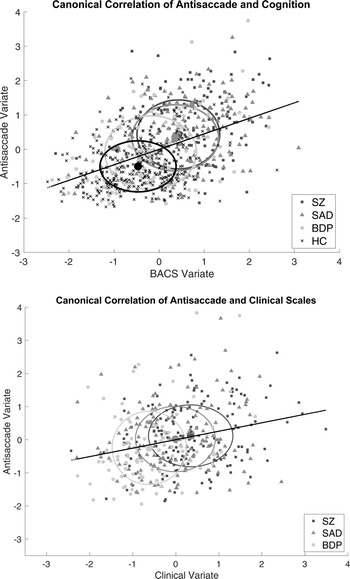
Canonical correlation between antisaccade variables and cognition revealed one significant variate pair, r = 0.44, F(242 432.8) = 7.47, p < 0.0001 [the next variate pair, F(151 927.3) = 0.97, p = 0.483]. Antisaccade variables, especially error rates, were highly correlated with the saccade variate (antisaccade gap percent error r = 0.95, antisaccade overlap percent error r = 0.85) while BACS measures of verbal abilities were highly correlated with the cognition variate (verbal memory r = −0.89, verbal fluency r = −0.80); see Fig. 4 (top) and online Supplementary Table S2. This association reveals that higher antisaccade error rates are associated with poorer verbal abilities.
Canonical correlation between antisaccade and (a) cognition (upper plot) and (b) clinical features (lower plot). Larger filled circles indicate centroids for each group, and the ovals indicate one standard deviation. Straight line indicates the best-fitting linear relationship across all subjects [Schizophrenia (SZ), squares; schizoaffective disorder (SAD), triangles; bipolar I with psychosis (BDP), filled circles; healthy comparisons (HC), black ‘x’].

Antisaccade performance and clinical features
Canonical correlation between antisaccade variables and clinical features revealed one significant linear combination, r = 0.26, F(241 333.8) = 1.99, p = 0.003 [the next variate pair, F(15.1057.7) = 1.42, p = 0.128)]. Antisaccade variables, especially latency and gap trial error rate, were highly correlated with the saccade variate (antisaccade gap correct latency = 0.66, antisaccade overlap correct latency = 0.87, antisaccade gap percent error = 0.65) while negative symptoms (0.68) and social functioning (−0.77) were highly correlated with the clinical variate (verbal memory r = −0.89, verbal fluency r = −0.80); See Fig. 4 (bottom) and online Supplementary Table S3. This association reveals that especially slower speed of responding on correct antisaccade trials is associated with more negative symptoms and more impaired social functioning across the psychosis spectrum.
Discussion
Cognitive control was assessed using saccade tasks to determine shared and distinct patterns of performance across the psychosis spectrum. Pro- and anti-saccade error rates, response latencies, and antisaccade speed-performance tradeoff functions were assessed in groups with SZ, SAD, and BDP compared with HC. Prosaccade error rates were low and did not differ by group. Prosaccade correct latencies demonstrated the expected changes with fixation condition manipulation – fastest responses during the gap, intermediate with synchronous and slowest in overlap trials. There were no group differences in prosaccade correct latency. Intact prosaccade performance suggests that SC functioning is preserved; deficits were observed only in the more cognitively complex antisaccade tasks, which must therefore result from problems with top-down modulation of SC (Luna, Velanova, & Geier, Reference Luna, Velanova and Geier2008), potentially through fronto-striatal projections.
Antisaccade data showed two novel and related findings that illustrate important similarities across, and distinctions between, groups and conditions: (i) greater deficit in antisaccade performance in the gap condition, and (ii) altered speed-performance tradeoffs. These outcomes suggest that there may be two mechanisms underlying the greater performance deficits in SZ spectrum patients: weaker or slower arrival of antisaccade commands from cortical or basal control regions in the presence of visual attentional gaps (Reilly et al., Reference Reilly, Harris, Khine, Keshavan and Sweeney2008), and failure in goal maintenance (Ethridge et al., Reference Ethridge, Soilleux, Nakonezny, Reilly, Hill, Keefe and Sweeney2014).
Antisaccade error rates were high in SZ and SAD and intermediate in BDP, replicating findings in the initial B-SNIP1 cohort (Reilly et al., Reference Reilly, Frankovich, Hill, Gershon, Keefe, Keshavan and Sweeney2014). The present study also showed that antisaccade error rates were higher in the gap than the overlap condition in SZ and SAD, while the BDP and healthy participants error rates did not differ between conditions.
The gap condition facilitates the release of fixation (and speeds reaction times). When inhibition was aided by extended fixation in the overlap condition, SZ and SAD benefited and generated fewer errors. Average latencies of correct antisaccade responses for SZ and SAD were slower than healthy, while no group differences were found in error latencies. In the saccade system, visual attention to a cue increases corticofugal drive to the fixation zone of the SC, which in turn projects inhibitory drive to the saccade-related neurons in the more posterior SC. A greater deficit in gap trials, when the fixation cue is not present to activate this system, suggests either a weakened corticofugal drive to the fixation zone of SC [as has been suggested previously, (Sereno, Briand, Amador, & Szapiel, Reference Sereno, Briand, Amador and Szapiel2006)] or a reduction in inhibitory input from the fixation zone of SC to the intermediate layer of posterior SC that plays a key role in saccade generation. The integrity of performance on the prosaccade tasks suggests that the observed performance deficits are related to top-down input to the SC rather than intrinsic SC pathology. Previous resting-state fMRI studies are consistent with this interpretation (Lui et al., Reference Lui, Yao, Xiao, Keedy, Reilly, Keefe and Sweeney2015).
Evaluation of speed-performance relationships for antisaccade tasks was done by fitting logistic functions. Polli et al. (Reference Polli, Barton, Vangel, Goff, Iguchi and Manoach2006) reported that quadratic functions showed poorer optimal performance in SZ compared to controls. In the current study, all three psychosis groups showed worse optimal performance compared to the healthy group. SZ and SAD results were similar throughout; they had slower tradeoff rates and slower time to 50% correct. In contrast, BPD sometimes tracked with SZ and SAD (optimal performance), and sometimes with the healthy group (tradeoff rate and time to 50% correct).
Speed-performance tradeoffs are useful for parsing specific types of deficits by estimating multiple parameters simultaneously. A dominant hypothesis for antisaccade errors states that upon the perception of a cue, reflexive prosaccade signals and inhibitory antisaccade signals are generated simultaneously, and directional errors result from prosaccade signals outracing inhibitory signals to SC. Immediately before an antisaccade error, the inhibitory signal may have been initiated but traveled slower, or it might not have been initiated at all. The slower tradeoff rates in psychosis suggest that they do generate inhibitory signals, but the signals are on average slower than the healthy group. This provides a parallel to stop-failure trials in stop-signal tasks, another measure of inhibitory control, which also is deviant in psychosis (Ethridge et al., Reference Ethridge, Soilleux, Nakonezny, Reilly, Hill, Keefe and Sweeney2014; Matzke, Love, & Heathcote, Reference Matzke, Love and Heathcote2017).
The reduced benefit to SZ/SAD from slowing responses during antisaccade performance also may suggest reduced efficiency in goal maintenance, and perhaps a weakened ability to maintain inhibitory tone in the saccade system. The greater antisaccade deficit in SZ/SAD may be related to their greater cognitive impairment, which in this study was most closely associated with verbal abilities. Ethridge et al. (Reference Ethridge, Soilleux, Nakonezny, Reilly, Hill, Keefe and Sweeney2014) devised a strategy for investigating inhibition v. goal maintenance that could be usefully employed in future investigations.
Canonical correlation of antisaccade data with cognitive variables showed that individuals with psychosis who made more errors had lower scores on verbal tasks. Possibly, antisaccade performance is aided rehearsing instructions that aid goal maintenance (‘when I see a square I move’) (Unsworth, Schrock, & Engle, Reference Unsworth, Schrock and Engle2004). Canonical correlation of antisaccade data with clinical features showed that antisaccade latencies were related to negative symptoms and social functioning, such that slower responses were related to more negative symptoms and more impaired social functioning across the psychosis spectrum. Antisaccade variables may be useful as proxy measures of persistent deficits in cognitive, social, motivational and emotional features (Egeland, Holmen, Bang-Kittilsen, Bigseth, & Engh, Reference Egeland, Holmen, Bang-Kittilsen, Bigseth and Engh2018; Grant & Beck, Reference Grant and Beck2009; Green, Reference Green1996; Rector, Beck, & Stolar, Reference Rector, Beck and Stolar2005), an empirical question for future testing.
The saccadic outcomes from B-SNIP1 (Reilly et al., Reference Reilly, Frankovich, Hill, Gershon, Keefe, Keshavan and Sweeney2014) are remarkably reproduced in B-SNIP2, especially considering data acquisition which covered 10 years and six recording sites (online Supplementary Table S4). The Biotype classification system for psychosis that arose from B-SNIP1 included saccadic variables (Clementz et al., Reference Clementz, Sweeney, Hamm, Ivleva, Ethridge, Pearlson and Tamminga2016). The successful replication of the saccade data, at least, suggests that Biotype replication using B-SNIP2 data will not be complicated by differing results on saccadic variables. Radant et al. (Reference Radant, Millard, Braff, Calkins, Dobie, Freedman and Tsuang2015) also showed that effect sizes for control- SZ differences in antisaccade error in COGS-1 and COGS-2 were similar, despite differences in study design, target populations and recruitment strategies (Radant et al., Reference Radant, Millard, Braff, Calkins, Dobie, Freedman and Tsuang2015). These large consortia studies demonstrate that even with differences in clinical representation and geographical location, a common deficit in neural circuitry for antisaccade performance exist in individuals with idiopathic psychosis.
Limitations of the study include there being half as many people with BDP as there were in the other two psychosis groups, although that still equated to 96 BDP participants. The difference in antisaccade error rate between BDP subjects on and off second-generation antipsychotics provides an interesting direction for future studies, as this is rare evidence of second-generation decreasing antisaccade performance that is counter to other reports (Barrett, Bell, Watson, & King, Reference Barrett, Bell, Watson and King2004; Harris, Reilly, Keshavan, & Sweeney, Reference Harris, Reilly, Keshavan and Sweeney2006). The current study design cannot resolve the degree to which this is a medication effect, a marker of illness severity or risk, or a consequence of some confounding factor. There is strong evidence, however, that antisaccade performance deficits reflect factors intrinsic to psychotic disorders given that they are consistently observed among never treated first-episode patients and unaffected family members, and show limited changes after treatment initiation in first-episode patients (Harris et al., Reference Harris, Reilly, Thase, Keshavan and Sweeney2009; Reilly et al., Reference Reilly, Frankovich, Hill, Gershon, Keefe, Keshavan and Sweeney2014).
In sum, when considering saccadic variables across psychosis groups, a minority of measures were similar across all three groups (i.e. prosaccades and optimal performance). In the majority of variables, SZ and SAD groups were similar, with the BDP group being intermediate between them and the healthy group (i.e. antisaccade error rates, fixation condition manipulation, tradeoff rate and time to 50%). Given these outcomes, it is likely that the underlying biological manifestations of SZ and SAD related to performing the antisaccade task are more similar to each other than to BDP. It is also reasonable to suspect these alterations, illustrated by impaired antisaccade control, are dimensional in nature. It is feasible that SZ, SAD, and BDP differ in how they deviate from healthy brain function in magnitude, instead of in kind. This possibility can be investigated in the future when the present data are used to support the replication of psychosis Biotypes (Clementz et al., Reference Clementz, Sweeney, Hamm, Ivleva, Ethridge, Pearlson and Tamminga2016) that aim to improve classification of severe psychosis syndromes by incorporating biological data (Clementz, Reference Clementz, Tamminga, Ivleva, Reininghaus and van Os2020).
Supplementary material
The supplementary material for this article can be found at https://doi.org/10.1017/S003329172000478X.
Acknowledgements
Bipolar-Schizophrenia Network for Intermediate Phenotypes 2 (B-SNIP2), MH077851, NIH
Conflict of interest
JS consults to VeraSci; CT functions as the Chair of a Merch DSMB, ad hoc advisor to Astellas and Sunovian, a Clinical Advisory Board member at Kynexis, and Advisor and holds stock at Karuna; MK holds a consulting role for Alkermes and is an editor for Schizophrenia Research (Elsevier); Other authors report no conflict of interest.