Introduction
According to the 1993 United Nations Declaration on the Elimination of Violence against Women, ‘violence against women constitutes a violation of the rights and fundamental freedoms of women and impairs or nullifies their enjoyment of those rights and freedoms’ (United Nations, 1993, p. 2). Violence against women has substantial physical, mental and reproductive health consequences. According to the World Health Organization (WHO) Global and Regional Estimates of Violence against Women report, women who have been physically, emotionally or sexually abused are twice as likely to experience depression, 1.5 times more likely to acquire HIV and 16% more likely to have a low-birth-weight baby (WHO, 2013). Moreover, violence has a long-lasting effect on children, and on society, as experiencing or witnessing domestic violence in childhood increased an individual’s probability of resorting to violence, or being the victim of violence, as an adult (Rakovec-Felser, Reference Rakovec-Felser2014).
Goal 5 of the Sustainable Development Goals (SDGs) seeks to improve gender equality and empower women (United Nations, 2018). In Africa, several regional policies and legislations aimed at eliminating violence against women in particular have been advocated in response to the high prevalence of IPV and related violence. For instance, the 2003 Protocol to the African Charter on Human and People’s Rights of Women in Africa and the 2006 African Youth Charter require states to adopt and implement appropriate measures for the protection of women and girls from all forms of violence (WHO, 2013). In Malawi, the government committed to ending all forms of violence through national gender-based response initiatives that ran from 2002 to 2007 and reviewed for 2008 to 2013. Meanwhile, the National Plan for Action for Combating Gender Based Violence in Malawi 2014–2020 is providing a comprehensive, multi-sectoral and sustained blueprint for ending all forms of violence (Government of Malawi, 2014).
Despite an international commitment to achieve gender equality, violence against women persists in many forms, with intimate partner violence (IPV) being one of the most common (United Nations, 2017). This includes physical, emotional and sexual abuse by a current or previous intimate partner (Fulu & Kerr-Wilson, Reference Fulu and Kerr-Wilson2015). It typically occurs on an on-going basis rather than as an isolated episode and affected women often experience more than one form of violence (García-Moreno et al., Reference García-Moreno, Jansen, Ellsberg, Heise and Watts2006). The WHO estimates that 35% of women worldwide have experienced IPV or closely related violence in their lifetime (WHO, 2017). In Africa, women are more often victims of lifetime IPV (45.6%) than anywhere else in the world. However, the prevalence of IPV varies from one African country to another and over time (García-Moreno et al., Reference García-Moreno, Pallitto, Devries, Stöckl, Watts and Abrahams2013). In Malawi, the prevalence of IPV or closely related violence is estimated as 42% (NSO-Malawi & DHS Program, 2017).
There are many determinants of IPV which are well explained by the Heise’s ecological framework, adapted from Bronfenbrenner’s ecological framework of child development in understanding IPV (Heise, Reference Heise1998). The framework recognizes that the probability of IPV occurring is a function of many factors that interact with each other across four levels – individual, relational, community and societal (Go et al., Reference Go, Johnson, Bentley, Sivaram and Srikrishnan2003). It can be argued that this framework is not definitive and needs to be adapted to the cultural context in which it is used (Heise, Reference Heise1998), particularly in low-income countries, since the initial framework drew heavily on studies in high-income countries due to the availability of research when it was developed. However, it has since been validated by studies in low-income contexts and its continued relevance has been demonstrated (Go et al., Reference Go, Johnson, Bentley, Sivaram and Srikrishnan2003; Kyegombe et al., Reference Kyegombe, Starmann, Devries, Michau, Nakuti and Musuya2014; Wekwete et al., Reference Wekwete, Sanhokwe, Murenjekwa, Takavarasha and Madzingira2014; Paul, Reference Paul2016).
At a societal level, the ecological framework explains how institutions maintain the social and economic inequalities between men and women that could contribute to IPV vulnerability and perpetration. In most developing nations, laws protecting the victims of IPV are either non-existent or non-enforced because of religious and cultural norms that put women in a subordinate position (Hamby, Reference Hamby2000; Levitt & Ware, Reference Levitt and Ware2006). Indeed, a multi-country study, specifically in Asia, Africa and South America, reported widespread attitudes supporting wife/female partner beating (Abramsky et al., Reference Abramsky, Watts, Garcia-Moreno, Devries and Kiss2011).
At the community level, the ecological framework shows that IPV vulnerability may result from factors inherent in social relationships that are the accepted norm in a particular community. Thus, some traditional practices in ethnic groups reinforce IPV vulnerability (Hamby, Reference Hamby2000). Studies have found an association between ethnicity and IPV (Fanslow et al., Reference Fanslow, Robinson, Crengle and Perese2010), and in Malawi in particular (Chikhungu et al., Reference Chikhungu, Amos, Kandala and Palikadavath2019). The rural/urban context has also been found to be associated with IPV, as demonstrated in studies in Malawi and sub-Sahara Africa in general (Chilanga et al., Reference Chilanga, Collin-Vezina, Khan and Riley2020; Darteh et al. Reference Darteh, Dickson, Rominski and Moyer2020).
At the individual level, age, socioeconomic status (SES) and substance use are associated with IPV experience among women. Studies globally and in sub-Sahara Africa have found IPV to be associated with the women’s or partners’ education status, access to information, working status, age (especially of a woman) and a violent family history (for a partners this acts as a catalyst for committing IPV while for a woman as a catalyst to condoning IPV) (Lawoko, Reference Lawoko2008; Okenwa et al., Reference Okenwa, Lawoko and Jansson2009; Abramsky et al., Reference Abramsky, Watts, Garcia-Moreno, Devries and Kiss2011; Rahman et al., Reference Rahman, Hoque and Makinoda2011; Atteraya et al., Reference Atteraya, Gnawali and Song2015). Similarly, studies in Malawi have found an association between IPV and the aforementioned variables (Chikhungu et al., Reference Chikhungu, Amos, Kandala and Palikadavath2019; Chilanga et al., Reference Chilanga, Collin-Vezina, Khan and Riley2020).
Finally, the relational level of the ecological framework accounts for those variables that inevitably manifest in a relationship. Notwithstanding, these variables are either derived from, or connected to, society, community and individual levels. Thus, globally, and in sub-Sahara African in particular, studies have found an association between IPV and household wealth status, partner practising polygamy or having extramarital affairs and partner consuming alcohol (Lawoko, Reference Lawoko2008; Fanslow et al., Reference Fanslow, Robinson, Crengle and Perese2010; Rahman et al., Reference Rahman, Hoque and Makinoda2011; Darteh et al. Reference Darteh, Dickson, Rominski and Moyer2020). Similarly, studies in Malawi have found an association between IPV the aforementioned variables, including partner jealousy (Chikhungu et al., Reference Chikhungu, Amos, Kandala and Palikadavath2019; Palamuleni, Reference Palamuleni2019; Chilanga et al., Reference Chilanga, Collin-Vezina, Khan and Riley2020).
Nonetheless, there are relational factors that have received less attention in the literature, including women’s autonomy in the household – an indicator of power and control within relationships (Hindin & Adair, Reference Hindin and Adair2002; Friedemann-Sánchez & Lovatón, Reference Friedemann-Sánchez and Lovatón2012). Autonomy is generally defined as freedom from external control or influences, and is the ability to formulate one’s own strategic choices, control resources and to exercise interpersonal control (Dyson & Moore, Reference Dyson and Moore1983; Jejeebhoy, Reference Jejeebhoy1991). It is a multi-dimensional concept but has three levels, namely personal, relational and environmental (Lombardini et al., Reference Lombardini, Bowman and Garwood2017). This study focused on relational autonomy in the household – that between a woman and her husband/partner. Since power and control are linked to the perpetration of gender-based violence, understanding relationship power dynamics through women’s autonomy in the household will enhance the understanding of IPV (Hindin & Adair, Reference Hindin and Adair2002).
Feminist theory argues that increasing women’s empowerment reduces IPV, so enhancing women’s autonomy in the household should reduce IPV (Eswaran & Malhotra, Reference Eswaran and Malhotra2011; Schuler & Nazneen, Reference Schuler and Nazneen2018). Although it has been asserted that there is an inverse relationship between IPV and women’s autonomy in the household, empirical evidence is mixed. For instance, a study in ten sub-Sahara African countries, Malawi included, found a positive association between IPV and women autonomy in the household, which was operationalized as participating in decision-making on purchases, own health care and own mobility (Ahinkorah et al., Reference Ahinkorah, Kwamena, Seidu and Sekyi2018). In the case of Nigeria, the finding has been replicated by Sunmola et al. (Reference Sunmola, Sambo, Mayungbo and Morakinyo2019). However, replication of the study at national level (in Ghana and Zimbabwe) with similar operationalization of women’s autonomy as in Ahinkorah’s study found contrasting results, i.e. an inverse association (Mann & Takyi, Reference Mann and Takyi2009; Bengesai et al., Reference Bengesai, Hafiz and Khan2020).
This study replicated Ahinkorah et al.’s (Reference Ahinkorah, Kwamena, Seidu and Sekyi2018) operationalization of women’s autonomy as autonomy in decision-making participation focusing solely on Malawi and controlling for an exhaustive list of variables found to be associated with IPV in Malawi. Autonomy in decision-making participation was operationalized as participating in decision-making on purchases, own health care and own mobility. Sole and joint decision-making was condensed into a single indicator which is justifiable because in a relationship decision-making should be shared (Allendorf, Reference Allendorf2007). Nonetheless, others have argued that spouses/partners may make a joint decision in which one party undertakes ‘tacit agreement’ while not completely accepting the agreement (Agarwal, Reference Agarwal1997). Hence, the addition of women’s sexual autonomy (operationalized as the ability to ask for condom use or refuse sex) may better represent women’s autonomy in the household. However, other researchers have argued that women’s claim to have autonomy to bargain for sex refusal or ask for condom use may only be temporal as they bargain or beg with reasons like sickness, not in the mood, tiredness and menstrual pain (Popoola, Reference Popoola2009; Paul et al., Reference Paul, Mejia, Muyanda and Munthali2017). Notwithstanding, including sexual autonomy in the household as another dimension of women’s autonomy would give an insight into how sexual autonomy is associated with IPV in Malawi.
Therefore, this study looked at the association between dimensions of women’s autonomy in the household (autonomy in decision-making participation and sexual autonomy) and IPV in Malawi among women aged 15–49 years who were married or cohabiting at the time of the 2015–16 MDHS.
Methods
Study area
Malawi is landlocked and shares its borders with Mozambique, Zambia and Tanzania. Its population is estimated at 17.6 million, of whom about 51% are female according to the Malawi Housing and Census report of 2018 (NSO-Malawi, 2019). Malawi is a generally peaceful country and has had stable governments since independence in 1964. However, it remains one of the poorest countries in the world and its economy is heavily dependent on agriculture, which employs nearly 80% of the population. It is vulnerable to external shocks, particularly climatic ones (World Bank, 2020).
Data and study design
The study utilized secondary data d from the nationally representative, cross-sectional Malawi Demographic and Health Survey, 2015–16 (NSO-Malawi, 2017). This was the fifth DHS to be conducted in Malawi and involved multi-stage probability sampling to select the targeted 25,146 women of reproductive age (15–49 years). Of the sampled women, 24,562 were successfully interviewed (97.7%). A detailed report of the methodologies involved in data collection can be obtained from the appropriate survey report (NSO-Malawi, 2017).
The study was based on married and cohabiting women who were aged 15–49 years at the time of the survey. Of the 15,952 such women in the survey (65% of interviewed women), only 4622 responded to the domestic violence module, i.e. 29% of married or cohabiting women and 19% of all interviewed women. Hence, this study analysed a subsample of 4622 women aged 15–49 years who were either married or cohabiting at the time of the survey and who responded to the domestic violence module.
Dependent variables
The three dependent variables were physical, emotional or sexual IPV. A respondent was considered to have suffered physical IPV if she had experienced at least one of the six sub-types of physical violence from their partner: pushed, shook or thrown any object; slapped; punched with fist or hit by something harmful; kicked or dragged; strangled or burnt; threatened with a knife or gun or other weapon. Emotional violence was defined as a respondent being: humiliated; threatened with harm; or insulted or made to feel bad by their spouse/partner. Sexual violence was defined as: being physically forced to have unwanted sex; or physically forced to perform sexual acts they did not want to do by their spouse/partner.
Each sub-type of physical, emotional and sexual IPV had four response categories, i.e. ‘never’, ‘often’, ‘sometimes’ and ‘yes but not in the last 12 months’. The items were recoded and an item was given a score of ‘1’ if the respondent experienced the abuse and ‘0’ if she did not experience the abuse. Then a composite variable was created for each type of IPV (physical, emotional and sexual) by the summation of all sub-type variables, i.e. a sum of all items for each individual was obtained. If the total score was ‘0’ the individual was categorized ‘not having experienced violence’, and any other score meant that the individual had experienced violence (see Palamuleni, Reference Palamuleni2019).
Independent variables
The main explanatory variable was ‘women’s autonomy in the household’, measured as autonomy in decision-making participation and sexual autonomy.
Autonomy in decision-making participation was constructed from three variables: the person who usually decides on the health care of the respondent; the person who usually decides on large household purchases; and the person who usually decides on visits to family or relatives. Initially, each variable had six categories: (a) respondent alone, (b) respondent and partner, (c) respondent and another person, (d) partner alone, (e) someone else and (f) others. The first three categories (a), (b) and (c) were recoded as respondent ‘participating in decision-making’ and coded as ‘1’. The last three categories (d), (e) and (f) were recoded as respondent ‘not participating in decision-making’ and coded as ‘0’. The composite variable after the recoding therefore had three categories: 1) women who participated in all decision-making were categorized as ‘having autonomy’, 2) women who participated in one or two decisions were categorized as ‘having partial autonomy’ and 3) women who did not participate in any decision-making were categorized as ‘having no autonomy’.
Likewise, women’s sexual autonomy in the household was computed as a composite variable from two variables, i.e. ‘can refuse sex’ and ‘can ask partner to use condoms’, and these had two initial categories: yes coded ‘1’ and no coded ‘0’. After recoding, the composite variable had three categories: 1) women who said yes for both variables were categorized as ‘having autonomy’, women who said yes to any one of the variables were categorized as ‘having partial autonomy’ and women who said no to both variables were categorized as ‘having no autonomy’ Similar approach have been followed by other researchers (Manyange, Reference Manyange2003; Kanteh & Palamuleni, Reference Kanteh and Palamuleni2019).
Moreover, education level of the woman or her partner, urban–rural residence, ethnicity, religion, household wealth index, woman’s occupation and age of woman were included as control variables as these have been found to have a moderating effect on women’s autonomy in the household (Bardhan, Reference Bardhan1985; Greenhalgh, Reference Greenhalgh1985; Agarwal, Reference Agarwal1986; Dixon-Mueller, Reference Dixon-Mueller1993; Acharya et al., Reference Acharya, Bell, Simkhada, van-Teijlingen and Regmi2010; Sougou et al., Reference Sougou, Bassoum, Faye and Leye2020). In addition, alcohol consumption by partner, respondent supporting wife beating, exposure to mass media, partner jealous if the respondent talked to other men, respondent accused of unfaithfulness by partner, partner having another woman or more have also been found to be significantly associated with IPV (Lawoko, Reference Lawoko2008; Fanslow et al., Reference Fanslow, Robinson, Crengle and Perese2010; Abramsky et al., Reference Abramsky, Watts, Garcia-Moreno, Devries and Kiss2011; Rahman et al., Reference Rahman, Hoque and Makinoda2011; Atteraya et al., Reference Atteraya, Gnawali and Song2015; Chikhungu et al., Reference Chikhungu, Amos, Kandala and Palikadavath2019; Palamuleni, Reference Palamuleni2019; Chilanga et al., Reference Chilanga, Collin-Vezina, Khan and Riley2020; Darteh et al. Reference Darteh, Dickson, Rominski and Moyer2020; Okenwa et al., Reference Okenwa, Lawoko and Jansson2009), so they were also used as control variables in the adjusted regression model. Other variables, including religion, household wealth index, occupation and partner had one or more other women, have been recorded in other studies (Palamuleni, Reference Palamuleni2011; Fuseini & Kalule-Sabiti (Reference Fuseini and Kalule-Sabiti2015).
Respondents’ attitude towards wife beating was determined from five variables, i.e. respondent considers beating justified if she goes out without telling her spouse/partner, neglects the children, argues with her spouse/partner, refuses sex and burns food. If all of the responses were ‘no’ the respondent was categorized as ‘not justifying wife beating’ and the score given to that was ‘0’; if she replied ‘yes’ to any of the questions the respondent was categorized as ‘justifying wife beating’ and the score given to that ‘1’.
Statistical analysis
Descriptive statistics were used to derive summarized univariate data and the results presented as percentages. Chi-squared tests were used to examine the relationship between independent variables and outcome variables (respondent experienced physical, emotional and sexual IPV) at the bivariate level. Variables that were found to be associated with any form of IPV under consideration were further analysed by stepwise forward binary logistic regression to establish if they were determinants of any form of IPV. Gross and net odds ratios and their 95% confidence intervals (95% CIs) were estimated in the unadjusted and adjusted models, respectively. All associations were considered to be statistically significant at p<0.05, with a 95% confidence interval. Data analyses were performed using SPSS version 25.
Results
Sample description
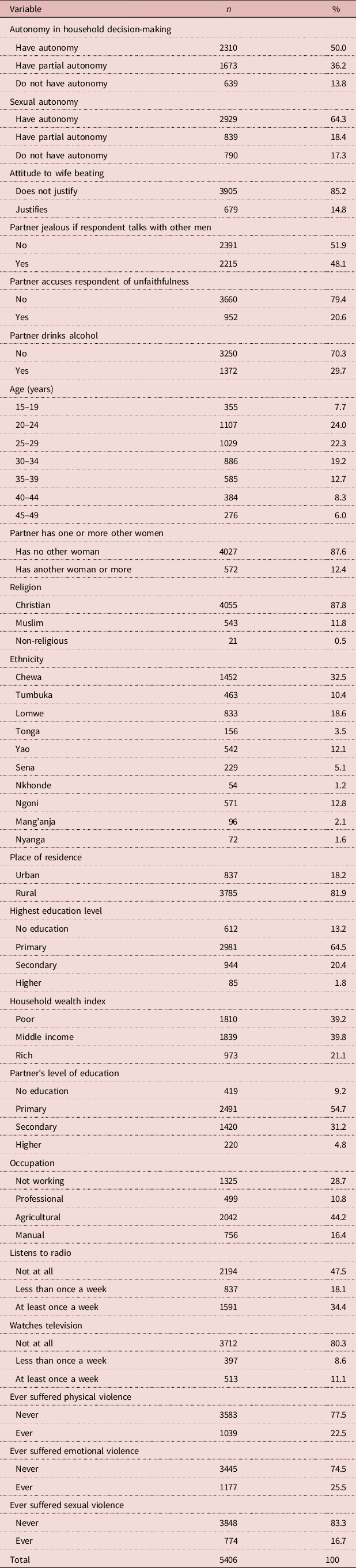
The characteristics of the study population are presented in Table 1. Slightly more than a quarter of the respondents (25.5%) reported ever experiencing emotional violence, 22.5% reported ever experiencing physical violence while 16.7% reported ever experiencing sexual violence. Around half (50.0%) of respondents reported having autonomy in decision-making participation in the household, with slightly over one-third (36.2%) having partial autonomy and 13.3% no autonomy. Most respondents reported having sexual autonomy (64.3%), with 18.4% reporting partial sexual autonomy and 17.3% no sexual autonomy.
Characteristics of married or cohabiting women aged 15–49 years at the time of survey who responded to the domestic violence module, 2015–16 MDHS (N = 4622)

The largest proportions of respondents were aged between 20 and 24 years (24.0%), lived in rural areas (81.9%), were from middle income households (39.8%), were Christian (87.8%), from the Chewa ethnic group (32.5%), did agricultural work (44.2%), had primary education (64.5%) and had partners with primary education (54.7%). Fewer respondents justified wife beating (14.8%); had partners who accused the respondents of unfaithfulness (20.6%); had partners who were jealous if the respondents talked to other men (48.1%); had partners who drank alcohol (29.7%); and had partners with another woman or more (12.4%). Also, a higher proportion of respondents (80.3%) had no exposure to television than had exposure, and 47.5% reported had no exposure to the radio.
Association between women’s autonomy in the household, IPV and other explanatory variables
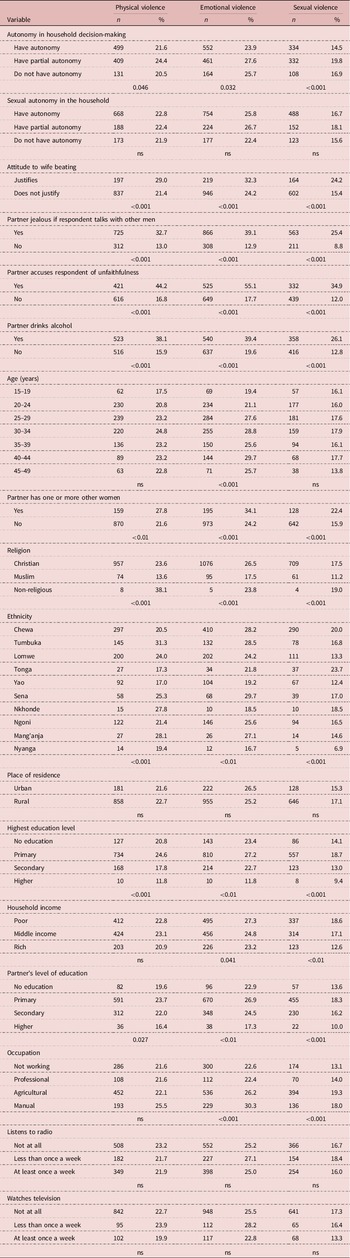
Table 2 shows the bivariate associations between dimensions of women’s autonomy in the household as well as other explanatory variables and each form of intimate partner violence (physical, emotional and sexual).
Bivariate associations (chi-squared test) between women’s autonomy in the household by other explanatory variables and each form of intimate partner violence

p-values indicated, with statistical significance at p<0.05; ns, not significant.
Physical violence
Respondents with partial autonomy had the highest proportion experiencing physical violence (24.4%), followed by those with autonomy (21.6%) and those with no autonomy (20.5%). Respondents who were non-religious had the highest proportion experiencing physical violence (38.1%) and Muslims the lowest (13.6%). Respondents of Tumbuka ethnicity had highest proportion experiencing physical violence (31.3%) and Yao ethnicity the lowest (17.0%). Respondents with primary education had the highest proportion experiencing physical violence (24.6%), followed by 20.8% for no education and 11.8% for higher education. Those whose partners had primary education had the highest proportion experiencing physical violence (24.6%) followed by those with secondary education (20.8%), then those with higher education (11.8%). Furthermore, respondents who justified wife beating, whose partners were jealous when they saw the respondents talking to other men, whose partners accused the respondents of unfaithfulness, whose partners drank alcohol and whose partners had another woman or more were at greater risk of experiencing physical violence. No association was found between physical violence and sexual autonomy. Other non-significant variables were age, place of residence (rural/urban), household income, occupation and exposure to mass media.
Emotional violence
Respondents with partial autonomy had the highest proportion experiencing emotional violence (27.6%), followed by those with no autonomy (25.7%) and those with autonomy (23.9%). Respondents in the age group 40–44 years had the highest proportion (29.7%) experiencing emotional violence, and those aged 15–19 years had the lowest (19.4%). Christians had the highest proportion experiencing emotional violence (26.5%) and Muslims had the lowest (13.6%). Sena ethnicity had the highest proportion experiencing emotional violence (29.7%) and Nyanga ethnicity had the lowest (16.7%). Those with primary education had the highest proportion experiencing emotional violence (27.2%), followed by no education (23.4%) then higher education (11.8%). Respondents whose partners had primary education had the highest proportion experiencing emotional violence (26.9%), followed by those with secondary education (24.5%) then those with higher education (17.3%). Respondents from poor households had the highest proportion experiencing emotional violence (27.3%), while those from rich households had the lowest proportion (23.2%). Respondents who were doing domestic manual work had the highest proportion experiencing emotional violence (30.3%), followed by agricultural (26.2%) then professional work (22.4%). Respondents who justified wife beating, whose partner were jealous when they saw the respondents talking to other men, whose partners accused the respondents of unfaithfulness, whose partners drank alcohol and whose partners had another woman or more were at greater risk of experiencing emotional violence. Meanwhile, the results show no association between emotional violence and sexual autonomy. Other non-significant variables were place of residence (rural/urban) and exposure to mass media.
Sexual violence
Respondents with partial autonomy had the highest proportion experiencing sexual violence (19.5%), followed by no autonomy (16.9%) then those with autonomy (14.5%). Christians had the highest proportion experiencing sexual violence (17.5%) and Muslims had the lowest (11.2%). Tonga ethnicity had the highest proportion experiencing sexual violence (23.7%) and Nyanga ethnicity had the lowest (6.9%). Respondents with primary education had the highest proportion experiencing sexual violence (18.7%), followed by no education (14.1%) then higher education (9.4%). Respondents whose partners had primary education had the highest proportion experiencing sexual violence (18.3%) followed by secondary education (16.2%) then higher education (10.0%). Respondents from poor households had the highest proportion experiencing sexual violence (18.6%) and those from the rich households had the lowest (12.6%). Respondents doing agricultural work had the highest proportion experiencing sexual violence (19.3%), followed by those doing domestic manual work (18.0%) then those who were not working (13.1%). Respondents who justified wife beating, whose partners were jealous when they saw the respondents talking to other men, whose partners accused the respondents of unfaithfulness, whose partners drank alcohol and whose partner had another woman or more had an increased risk of experiencing sexual violence. Meanwhile, the results show no association between sexual violence and sexual autonomy. Other non-significant variables were age, place of residence (rural/urban) and exposure to mass media.
Determinants of IPV: results of the binary logistic regression analysis
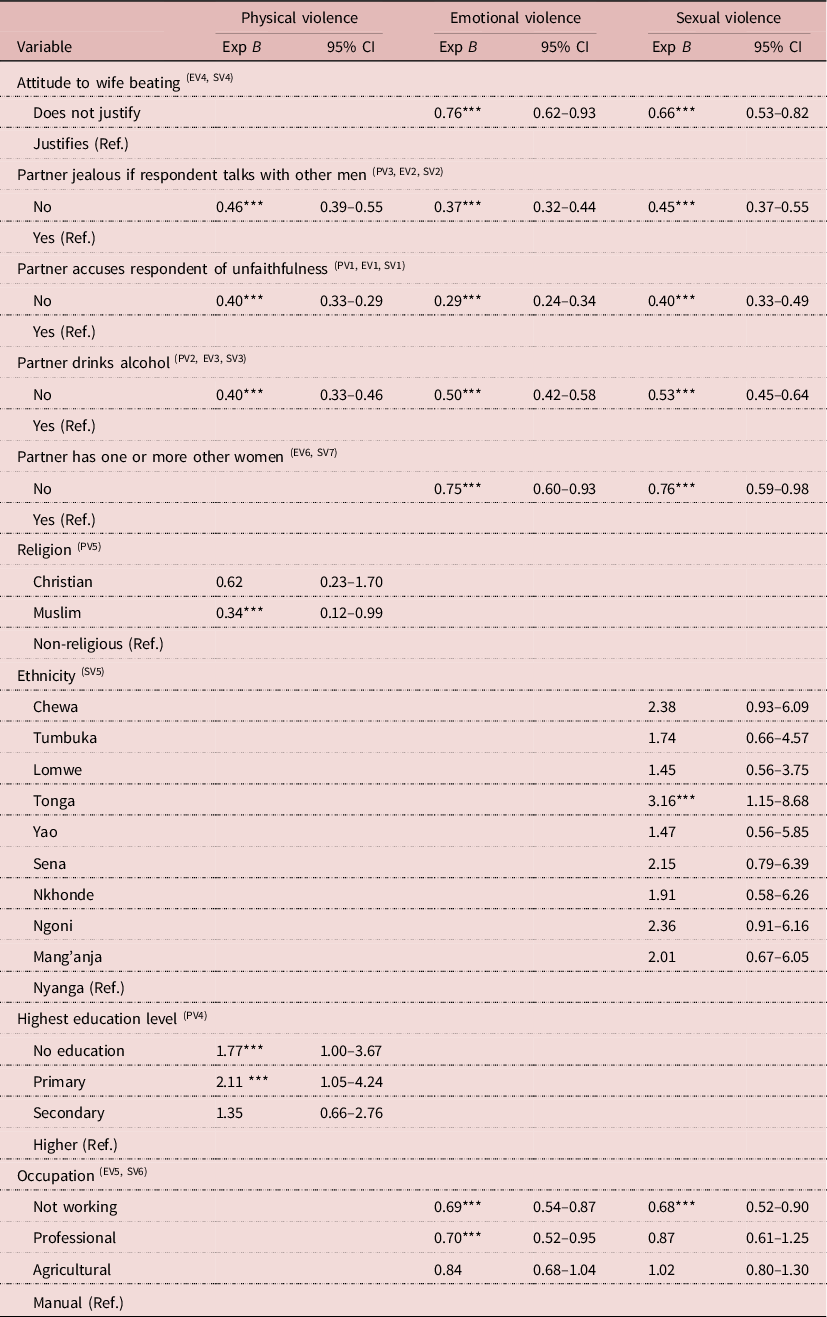
Table 3 shows the odds ratios of the main explanatory variables predicting the likelihood of physical, emotional and sexual violence. This was based on the final model with all variables adjusted for. The last model for physical violence (Model 5) only included five significant variables, for emotional violence the last model included six significant variables (Model 6) while for sexual violence the last model only included seven significant variables (Model 7). Stepwise regression analysis showed in detail which variables were more significant depending on the step of entry. For example, as shown in the Table 3, the variable ‘partner accuses respondent of unfaithfulness’, the superscript PV1, EV1 and SV1 indicate that the variable was recognized as the most significant variable with all forms of violence and was entered at the first step in each respective first model. Then the variable ‘partner jealous if respondent talked with other men’ was entered at the second step when modelling emotional and sexual violence, and third with physical violence as indicated by the superscripts PV3, EV2, SV2 (see Table 3). Although it is argued that collinearity of variables may lead to an equally significant variable being dropped from the model (Wang & Jain, Reference Wang and Jain2003), in this case the variables ‘partner accuses woman of unfaithfulness’ and ‘partner jealous if respondent talks with other men’, which seemingly may have collinearity, were sustained in the models for all outcome variables.
Adjusted odds ratios showing the likelihood of intimate partner violence among married or cohabiting women aged 15–49 years: stepwise forward binary logistic regression using likelihood ratio

***p<0.05; Ref.: Reference category.
n is the step/model number that a particular independent variable was included in the model for analysis in relation to each dependent variable, i.e. PV, EV, SV. Where PV is physical violence, EV is emotional violence and SV is sexual violence.
The variables age group, partner’s highest education level and household income were found not to be significant and were therefore not included in the analysis. Also, the main independent variables, i.e. autonomy in general household decision-making and sexual autonomy, were not significantly associated with any form of IPV and were not included in the model. However, women whose partners drank alcohol, were jealous if respondents talked to other men and accused women of unfaithfulness were significantly associated with all forms of violence and hence were included in all the models for analysis. Compared with their respective reference categories, women whose partners did not drink alcohol (AOR=0.40, 95% CI=0.33–0.46), were not jealous if the women talked to other men (AOR=0.46, 95% CI=0.39–0.55) and did not accuse the women of unfaithfulness (AOR=0.30, 95% CI=0.33–0.49) were less likely to experience physical violence. Likewise, women whose partners did not drink alcohol (AOR=0.50, 95% CI=0.42–0.58), were not jealous if the respondents talked to other men (AOR=0.37, 95% CI=0.32–0.44) and did not accuse the women of unfaithfulness (AOR=0.29, 95% CI=0.24–0.34) were less likely to experience emotional violence. Similarly, women whose partners were not drinking alcohol (AOR=0.53, 95% CI=0.45–0.64), were not jealous if the women talked to other men (AOR=0.45, 95% CI=0.37–0.55) and did not accuse the women of unfaithfulness (AOR=0.40, 95% CI=0.33–0.49) were less likely to experience sexual violence.
The variables partner has another woman or more, justifying wife beating and occupation were found to be significantly associated with emotional and sexual violence. Women whose partners had another woman or more and occupation were significantly associated with both emotional and sexual violence. Compared with women whose partner had another woman or more, women whose partners had no another woman were less likely to experience emotional violence (AOR=0.76, 95% CI=0.62–0.93) or sexual violence (AOR=0.66, 95% CI=0.53–0.82). Compared with women who justified wife beating, women who did not were less likely to experience emotional violence (AOR=0.80, 95% CI=0.64–0.98) and sexual violence (AOR=0.73, 95% CI=0.59–0.90). Compared with women whose occupation was domestic manual work, those who were not working were less likely to experience emotional violence (AOR=0.69, 95% CI=0.54–0.87) and sexual violence (AOR=0.68, 95% CI=0.52–0.90). However, women who were working as professionals were less likely to experience emotional violence (AOR=0.70, 95% CI=0.52–0.95), while for sexual violence the association was insignificant. Also, agricultural work was not significantly different from the reference category.
Religion and education level of the respondents were found to be significantly associated with physical violence only. Thus, compared with non-religious women, Muslim women were less likely to experience physical violence (AOR=0.34, 95% CI=0.12–0.99). However, Christian women were not significantly different from women of the reference group. On the other hand, compared with women with higher education, those with no education (AOR=1.77, 95% CI=1.00–3.67) or primary education (AOR=2.11, 95% CI=1.05–4.24) were more likely to experience physical violence. Nonetheless, there was no significant difference between women with secondary education and women of the reference category. On the other hand, ethnicity was significantly associated with one form of IPV – sexual violence. Compared with women of Nyanga ethnicity, women of the Tonga ethnic group (AOR=3.16, 95% CI=1.15–8.68) were more likely to experience sexual violence.
Discussion
This study examined data from the cross-sectional Malawi Demography and Health Survey 2015–16 with the aim of assessing the association between women’s autonomy in the household and IPV among married and cohabiting women in Malawi. No significant association was found between women’s autonomy in the household and IPV (physical, sexual or emotional). This is consistent with previous findings in Ghana, where sexual autonomy had no significant association with any of the three forms of IPV, and autonomy in decision-making participation was not associated with two forms of IPV (physical and sexual). Tenkorang (Reference Tenkorang2018), however, found an association with emotional violence. This finding is inconsistent with findings in Zimbabwe, where autonomy in decision-making participation had a negative significant association with IPV; however, moderate autonomy had a positive association with emotional violence (Bengesai et al. Reference Bengesai, Hafiz and Khan2020). The finding is also inconsistent with those in Nigeria, where autonomy in decision-making participation (moderated by husband’s controlling and domineering attitudes) had a positive association with all forms of IPV (Sunmola et al., Reference Sunmola, Sambo, Mayungbo and Morakinyo2019). Thereforer, the association between women’s autonomy in the household and IPV varies from one contextual setting (especially country) to another.
In Malawi, the lack of association between women’s autonomy and all forms of IPV could be a result of patriarchy norms or religious beliefs that advocate for female submission. Hence, men ensure to suppress women who exercise their autonomy, resulting in no significant difference between these women and those without autonomy in experiencing IPV. Moreover, women who report having autonomy may not necessarily have absolute autonomy, but may just be consulted and the partner has the final say (Agarwal, Reference Agarwal1997). Others have argued that women’s claim to have sexual autonomy, i.e. to bargain for sex refusal or ask for condom use, may only be temporal as they bargain or beg with reasons like sickness, not in the mood, tiredness and menstrual pain (Popoola, Reference Popoola2009; Paul et al., Reference Paul, Mejia, Muyanda and Munthali2017) and they may not be very different from women who reported having partial or no sexual autonomy.
However, other variables were found to be significantly associated all forms of IPV, including partners drinking alcohol, being jealous if they talked to other men and accusing women of being unfaithful. This is consistent with previous findings in Malawi by Palamuleni (Reference Palamuleni2019) using 2010 DHS data, and suggests that partners’ lack of trust exacerbates IPV in Malawi. The association with drinking alcohol is consistent with the findings of Kusanthan et al. (Reference Kusanthan, Mwaba and Menon2016) and Owusu-Adjah and Agbemafle (Reference Owusu-Adjah and Agbemafle2016) in Zambia and Ghana, respectively. Drinking alcohol increases an individual’s risk of committing violence. In the case of Malawi, where more than half of the ethnic groups practise a matrilineal system of marriage, i.e. where the male partner lives within the woman’s community; an aggrieved but sober partner hardly ever commits IPV. However, he can deliberately drink alcohol to commit premeditated violence.
As for jealousy and unfaithfulness, this can be expected in a country like Malawi where men are expected to be providers in their households. Financially poorer men struggle to meet these obligations, resulting in them feeling insecure when they see their women talking to men of better socioeconomic standing. Often times this leads to accusations of unfaithfulness and possibly IPV.
Other control variables, i.e. women justifying wife beating and women whose partners had another woman or more, were significantly associated with increased IPV, especially emotional and sexual violence. This replicates the findings of Palamuleni (Reference Palamuleni2019) in Malawi based on 2010 DHS data. Women justifying violence perpetuates some forms of IPV in Malawi. With regard to jealousy, the possible explanation for this could be that women, like men, are also jealous, and when their partners have another woman this can lead to conflict and IPV. Furthermore, many women need undivided attention and affection from their partners, which is likely to be distorted when another woman is in the picture and conflicts are likely to occur. Moreover, men tend to pay more attention to their newly found women, as evidenced by a finding in Mozambique that senior wives tend to suffer more violence than junior wives and that the level of violence among junior wives in polygynous marriages may not significantly differ from those of women in monogamous marriages or unions (Jansen & Agadjarian, Reference Jansen and Agadjarian2019).
Women’s occupation was also found to be associated with emotional and sexual IPV, with women who were not working being significantly less likely to experience these. This is consistent with the finding of Palamuleni (Reference Palamuleni2019) in Malawi based on 2010 MDHS and Rahman et al. (Reference Rahman, Hoque and Makinoda2011) in Bangladesh, especially in relation to sexual violence. Furthermore, women working as professionals were significantly less likely to experience IPV (especially emotional). This finding is, to some extent, consistent with findings in Ghana, where women who were working were found to be significantly less likely to experience IPV (Tenkorang, Reference Tenkorang2018), while in Zambia and Kenya there was no significant association between women’s working status and IPV (Lawoko, Reference Lawoko2008). Thus, the association between women’s occupation and IPV is mixed. One possible explanation for the lower experience of IPV (emotional and sexual) among women who are not working in Malawi could be that they are over-dependent on their partners for their livelihoods and may be very submissive and tolerating, hence avoiding conflicts that lead to IPV.
Religion was found to be significantly associated with IPV, with Muslim women being significantly less likely to experience physical violence. This is inconsistent with findings in Nigeria and Ghana by Okenwa-Emegwa et al. (Reference Okenwa-Emegwa, Lawoko and Jansson2016) and Tenkorang (Reference Tenkorang2018), respectively, where no association was found between religion and IPV, especially physical violence. In Malawi polygyny is the accepted norm among people of Muslim religion, and this may mitigate the conflict emanating from a man having more than one wife, hence averting IPV, especially physical violence. Additionally, drinking alcohol is rare among Muslims as is against their beliefs and strictly observed and enforced, and this may mitigate IPV, especially physical violence.
The education level of women was also found to be significantly associated with physical violence, with those with primary education or less being significantly more likely to experience physical violence. This is consistent with findings from Ghana (Tenkorang, Reference Tenkorang2018), Zambia and Kenya (Lawoko, Reference Lawoko2008) and Nigeria (Okenwa-Emegwa et al., Reference Okenwa-Emegwa, Lawoko and Jansson2016). However, in Nigeria, women with secondary education had significantly greater risk of experiencing physical violence compared with women with higher education level. The plausible explanation for the inverse association between education level, especially secondary or above, and IPV could be that more-educated women are more likely to be enlightened on all forms of violence and where to report it – and for physical violence provide evidence to use against their partners to the police or courts, acting as a deterrent to their partners. Moreover, educated women have a better chance of getting employment and may not be over-dependent on their partner, making them more likely to report their abusive partners to the relevant authorities.
Ethnicity was found to be associated with sexual violence, with women from the Tonga ethnic group being significantly more likely to experience sexual violence than those of other ethnicities. A similar result was also found in Ghana (Tenkorang, Reference Tenkorang2018), where the Ga-Adagbe ethnic group had a significantly increased risk of sexual violence. Malawi has both a matrilineal (where a partner is expected to live at the woman’s home or community) and patrilineal marriage system (where a lobola or dowry is paid for the woman and she is expected to live in her partner’s home). Intimate partner violence is expected among ethnic groups who practise a patrilineal system of marriage, hence the results pertaining to women of Tonga ethnicity are not surprising. Notwithstanding, the Tonga ethnicity is not the only ethnic group that practises a patrilineal marriage system in Malawi. However, the Tonga ethnic group has particular tradition practices that may explain women’s increased risk of sexual violence. These include the continued demand for lobola-like payments (from the woman’s family), when a woman or child is sick and the sickness is regarded as not normal. This may be costly for men, who in return may expect a lot from the women, including sex, and any excuse from women may result in sexual violence. Another practice is men’s uneasiness about divorcing their women as they are expected to have a hearing of public repudiation where women and their families could dismiss the men without formality unless the men are rich or powerful. This suggests that most men have to live with women even if they would like to divorce them and such co-existence is likely to increase violence, including sexual violence.
The study has its limitations. First, it only included a sub-sample of survey women who responded to the domestic module (about one-third of all married or cohabiting women), which may have affected on the results. Moreover, information was collected through self-reporting, which can distort the accuracy of results through social desirability, where women may have experienced some forms of IPV but chose not to report it as tradition discourages bringing marital issues into the public domain.
In conclusion, the study has shown that women’s autonomy in the household is not associated with IPV in Malawi. Women’s individual level factors that have been found to be associated with IPV were work status and educational level, while partner’s individual factors were drinking alcohol and jealousy. Religion, which is a community/society level factor, was also found to be associated with IPV. Therefore, this study recommends: that youth in Malawi, especially girls, are supporting to complete secondary education before they marry or cohabit; the development of accessible and affordable psycho-social counseling specialists and platforms for married and cohabiting couples; nationwide rigorous advocacy and civic education on the issues surrounding IPV; and the enforcement of Malawi’s domestic violence law of 2006.
Acknowledgments
The authors thank the MEASURE DHS project for their support and for free access to the original data used in this study.
Funding
The authors received no financial support for the research, authorship or publication of this article.
Conflicts of Interest
The authors declare that they have no conflicts of interest.
Ethical Approval
The study data were obtained from MEASURE DHS, which is the monitoring and evaluation body of the Demographic and Health Survey (DHS) globally. The original study (MIS) obtained ethical clearance from Malawi’s National Health Sciences Research Committee (NHSRC) and all participants provided oral informed consent to participate in the survey.