Introduction
Zebu cattle (Bos taurus indicus) are one of the most diverse bovine subspecies in Mexico adapted to tropical conditions. The most popular Zebu breeds are Guzerat, Nellore, Gir, Indubrazil (a crossbreed between Guzerat and Gir, with a minor influence from Nellore, selected for their longer ear length; (Sanders, Reference Sanders1980; Parra-Bracamonte et al., Reference Parra-Bracamonte, Martinez-Gonzalez, Sifuentes-Rincón and Rosa-Reyna2018), and Sardo Negro, which is considered the first Zebu breed to originate in Mexico. Sardo Negro has a significant influence from Gir and Indubrazil, initially recorded as Gir-indubrazil with a ‘mouro’ coat (Ocampo, Reference Ocampo2004).
The Brahman breed resulted from crossbreeding sires from various breeds, including Nellore, Guzerat, Krishna Valley, Misore, Red Syndhi, Gir, Sahiwal and Indubrazil, with Bos taurus dams of British origin, such as Hereford, Shorthorn and Aberdeen Angus. Dairy breeds such as Ayrshire, Holstein, Jersey and Brown Swiss were also involved (Koch, Reference Koch1999). Currently, two types of Brahman cattle can be distinguished: the Gray Brahman, primarily influenced by the Guzerat and Nellore breeds, and the Red Brahman, mainly a mix of Indubrazil and Gir breeds with some influence from Guzerat (Sanders, Reference Sanders1980).
Zebu breeds are primarily used as pure lines in meat production systems, and in some cases, for milk production, as seen in certain selected lines of Gir cattle (Castellanos et al., Reference Castellanos, Oliva, Granados and Quiro2016). Zebu breeds are also used in crossbreeding to take advantage of the hybrid vigour with beef breeds (e.g., Charbray, Braford, Suiz-bú, Girholando, etc.) or in dual-purpose production systems for both calf and milk production, predominantly in tropical and subtropical regions (Rojo-Rubio et al., Reference Rojo-Rubio, Vázquez-Armijo, Pérez-Hernández, Mendoza-Martínez, Salem, Albarrán-Portillo, González-Reyna, Hernández-Martínez, Rebollar-Rebollar, Cardoso-Jiménez, Dorantes-Coronado and Gutierrez-Cedillo2009; Román-Ponce et al., Reference Román-Ponce, Ruiz-López, Montaldo, Rizzi and Román-Ponce2013). The resistance to parasites and high heat and humidity of tropical parasites are well known and documented (Cooke et al., Reference Cooke, Daigle, Moriel, Smith, Tedeschi and Vendramini2020 a,b).
Maternal ability influences calf performance from birth to weaning, primarily through milk provision, which depends on both the quantity and quality of the milk (Paranhos da Costa et al., Reference Paranhos da Costa, Schmidek and Toledo2008; Estrada-León et al., Reference Estrada-León, Magaña-Monforte, Segura-Correa and Parra-Bracamonte2024). Identifying the genetic factors that influence maternal ability would be of importance for improving the early growth performance of calves (Parra-Bracamonte et al., Reference Parra-Bracamonte, Sifuentes, De la Rosa and Arellano2011; Estrada-León et al., Reference Estrada-León, Magaña-Monforte, Segura-Correa and Parra-Bracamonte2024). The identification of polymorphisms in candidate genes related to milk production and quality could indirectly enhance calf rearing by increasing both milk yield and solids content, ultimately improving the efficiency and profitability of beef production systems at weaning.
Given the genetic diversity of Zebu breeds and their importance in livestock production in Mexico, the study of genetic polymorphisms related to key productive traits, such as protein and fat yield, has become essential (Worku et al., Reference Worku, Gowane, Alex, Joshi and Verma2022).
These studies enable improvements in both the efficiency and profitability of production systems by identifying genes that directly affect the quality and quantity of products derived from livestock (Mueller and Van Eenennaam, Reference Mueller and Van Eenennaam2022; Ward et al., Reference Ward, Ng’ang’I, Randhawa, McHugo, O’Grady, Flórez, Browne, Pérez, Landaeta-Hernández, Garcia, Sonstegard, Frantz, Salter-Townshend and MacHugh2024). The identification of such a genomic variation would benefit cow–calf production systems in which milk and calf are fundamental products. Therefore, analysing the allelic and genotypic frequencies of loci related to protein and fat production in Zebu breeds can provide valuable insights for optimising productive performance.
The objective of the present study was to report the allelic and genotypic frequencies of several key loci associated with protein and fat deposition in seven Zebu cattle breeds present in Mexico.
Materials and methods
Hair follicle samples were collected from purebred Brahman (BRH, n= 358), Red Brahman (RBR, n= 25), Guzerat (GZT, n= 31), Gir (GIR, n= 41), Indubrazil (IBZ, n= 25), Nellore (NEL, n= 36) and Sardo Negro (SDN, n= 109) animals from various beef cattle farms registered with the Asociación Mexicana de Criadores de Cebú. All sampled animals were young and mature bulls directed to genetic improvement programmes.
A panel of polymorphisms was designed to include variants of αs1-casein 1175AG (CSN1S1 175AG; Koczan et al., Reference Koczan, Hobom and Seyfert1993), and g26181A>G (rs4370310) (CSN1S1 26181BC; Mohan et al, Reference Mohan, Kumar, Khan, Kumar, Kapila, Lathwal and Niranjan2021), κ-casein 13068 (CSN3 AB1) and 13104 (CSN3 AB2) loci (Prinzenberg et al., Reference Prinzenberg, Krause and Erhardt1999), β-lactoglobulin variants 3984GA (BLG 3984GA; Agrawala et al., Reference Agrawala, Wagner and Geldermann1992) and 5263CT (BLG 5263CT; Agrawala et al., Reference Agrawala, Wagner and Geldermann1992), Diacyl glycerol transferase K232A (DGAT1 K232A; Grisart et al., Reference Grisart, Coppieters, Farnir, Karim, Ford, Berzi, Cambisano, Mni, Reid, Simon, Spelman, Georges and Snell2002), and Stearoyl CoA desaturase A702G (SCD1 A702G; Taniguchi et al., Reference Taniguchi, Utsugi, Oyama, Mannen, Kobayashi, Tanabe and Tsuji2004) and A762G (SCD1 A762G; Taniguchi et al., Reference Taniguchi, Utsugi, Oyama, Mannen, Kobayashi, Tanabe and Tsuji2004). Genotyping of the single nucleotide polymorphisms (SNP) was performed using the Sequenom MassARRAY® system (iPLEX GOLD; Sequenom, San Diego, CA, USA) designed using the described base primers (Supplementary information 1a and b) to NEOGEN (Lansing, Michigan USA). Genotypic and allelic frequencies of all loci were estimated from a genotype matrix output. Hardy–Weinberg equilibrium and genotypic linkage disequilibrium among loci in the same gene were tested using the Fisher test as implemented in GENEPOP ver. 4.2. (Rousset, Reference Rousset2008).
Results
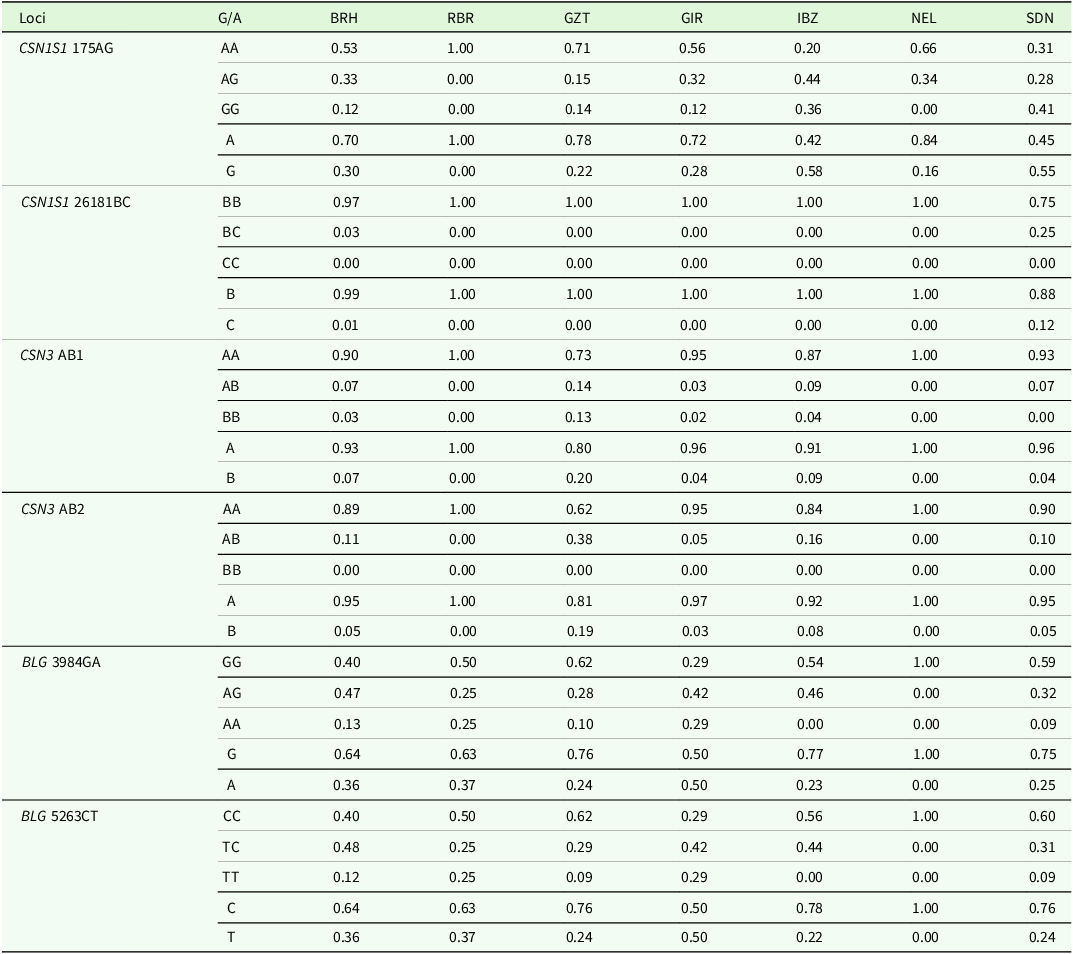
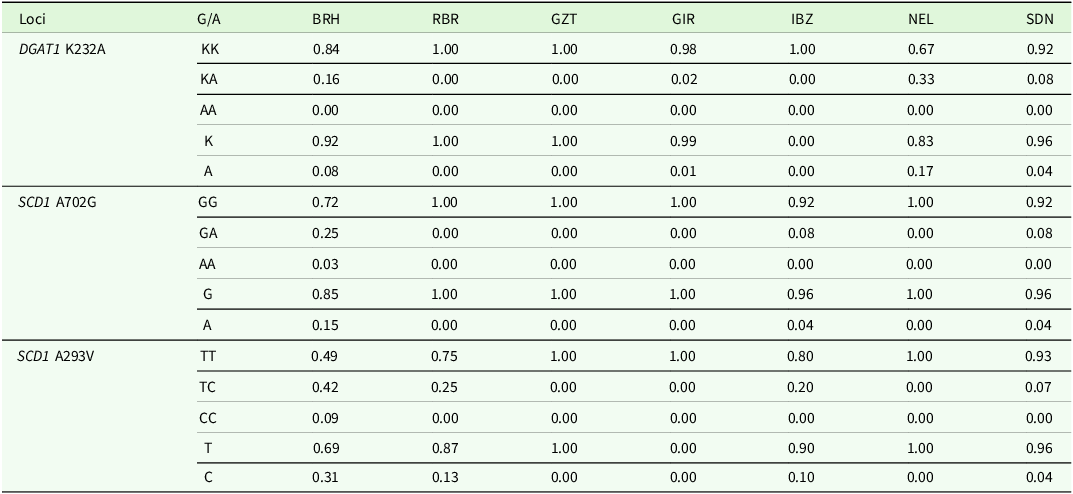
In the present study, the genotype and allele frequencies of polymorphisms in candidate genes associated with milk traits and composition were estimated in seven Zebu cattle breeds from Mexico. Table 1 presents the frequencies observed of casein and beta-lactoglobulin polymorphisms, while Table 2 shows the frequencies of Diacylglycerol transferase 1 (DGAT1) and Stearoyl-CoA desaturase 1 (SCD1) polymorphisms. Hardy Weinberg equilibrium test revealed that low-frequency genotype distributions amongst assessed breeds were segregated as expected (Supplementary information 2). However, these tests were not performed for breeds with low sample sizes (i.e. Red Brahman, Nellore).
Genotypic and allelic frequencies of casein (CSN) and β-lactoglobulin (BLG) genes polymorphisms in seven Zebu breeds

G/A, Genotype/Allele; BRH, Gray Brahman; RBR, Red Brahman; GZT, Guzerat; GIR, Gir; IBZ, Indubrazil; NEL, Nellore; SDN, Sardo Negro.
Genotypic and allelic frequencies of beta diacyl glycerol transferase (DGAT1) and stearoyl CoA desaturase 1 (SCD1) genes polymorphisms in seven Zebu breeds

G/A, Genotype/Allele; BRH, Gray Brahman; RBR, Red Brahman; GZT, Guzerat; GIR, Gir; IBZ, Indubrazil; NEL, Nellore; SDN, Sardo Negro.
Table 1 shows that the frequencies for AA genotype in loci CSN1S1 175AG (100 %) were higher for RBR compared with the other breeds, however this breed shows an absence of genotype AG and GG. IBZ breed expressed a high frequency of GG genotype (0.36) and for the allele G (0.58). GZT and GIR have a mixture of genotypes with intermediate frequencies. The frequencies of alleles A and G indicate variable genetic diversity among the analysed populations. In loci CSN1S1 26181BC, BB is the predominant genotype in all breeds, especially in BRH, RBR, GZT, GIR and IBZ, where a frequency of 1.00 or close to this frequency was observed. BC had very low frequencies, being significant only in the SDN (0.25) and BRH (0.03) breeds. CC is not present in any of the breeds analysed.
Locus CSN3 AB1 presents genotype AA as predominant in all breeds. AB has a low presence, being more notable in GZT (0.14), IBZ (0.09) and BRH (0.07). In some breeds, such as RBR and NEL, it is not present. Genotype BB also shows low frequencies, with a higher representation in GZT (0.13) and in some other breeds but is practically absent in RBR and NEL. The gene frequencies for the A allele were higher (0.91) for all breeds; conversely, for B allele in GZT breed was the higher frequency observed (0.20).
For CSN3 AB2, AA is the most common genotype in all breeds, with very high frequencies in RBR and NEL (1.00), and in other breeds it ranges between 0.62 and 0.95, indicating a strong predominance. AB is present in some breeds, being most notable in GZT (0.38) and IBZ (0.16), but is not found in RBR and NEL.
In BLG 3984GA locus, the GG genotype was the most frequent genotype in most breeds, with the highest frequency in NEL (1.00), indicating homogeneity in this breed. In other breeds, frequencies vary, being notable in GZT (0.62) and BRH (0.40). Genotype frequencies for AG were variable in all breeds, presenting values from 0.47 to 0.00. AA has lower frequencies compared to the other genotypes, being more common in RBR (0.25) and GIR (0.29), but absent in NEL and IBZ. For BLG 5263CT CC is the most common genotype in NEL breed (1.00), in other breeds, such as GZT (0.62) and BRH (0.40), it also has significant frequencies.
The DGAT1 K232A locus presents KK as the predominant genotype in almost all breeds, especially in RBR, GZT and IBZ, where a frequency of 1.00 is observed. KA is absent in most breeds, being most notable in BRH (0.16) and NEL (0.33). In RBR, GZT and IBZ, it is not present. AA genotype was found to be absent in the breeds analysed.
The GG genotype is the most common genotype for loci SCD1 A702G, with frequencies of 1.00 in RBR, GZT, GIR and NEL, indicating strong homogeneity in these breeds. It is also significant in BRH (0.72) and IBZ (0.92). GA has a low presence, being more noticeable in BRH (0.25) and in IBZ (0.08). In other breeds, such as RBR, GZT, GIR and NEL, it is not present. Similarly, in locus SCD1 A761G, TT was found to be the highest genotype especially in GZT, GIR and NEL, where it reaches 1.00. In other breeds, such as BRH (0.49) and IBZ (0.80), it also has a significant representation. For the genotype TC, had frequencies in BRH (0.42) and RBR (0.25), but is non-existent in GZT and GIR, with TT genotype being fixed in these breeds.
Discussion
Bovine milk proteins are generally classified as caseins, which account for approximately 80 % of the total milk proteins. Caseins consist of four proteins: αs1-casein (CSN1S1, 39–46 % of total caseins), αs2-casein (CSN1S2, 8–11 %), β-casein (CSN2, 25–35 %) and κ-casein (CSN3, 8–15 %) (Eigel et al., Reference Eigel, Butler, Ernstrom, Farrell, Harwalkar, Jenness and Whitney1984).
The CSN1S1 gene encodes the αS1 casein (αS1-CS). The CSN1 -175 polymorphism is a G>T transition at position -175 in the promoter region of the αS1 casein gene (Koczan et al., Reference Koczan, Hobom and Seyfert1993), which has been associated with increased daily milk yield in Black and White cows, favouring the A allele (Szymanowska et al., Reference Szymanowska, Strzalkowska, Siadkowska, Krzyzewski, Ryniewicz and Zwierzchowski2003). Interestingly, in this study, the G allele was found only in heterozygous form. Subsequent research in Simmental and German Holstein cattle confirmed the absence of G homozygotes at this locus, with allele frequencies of 0.19 and 0.05 in heterozygous carriers. These heterozygous individuals exhibited a higher percentage and content of milk αS1 compared to A homozygotes (Kuss et al., Reference Kuss, Gogol, Bartenschlager and Geldermann2005). More recently, Kishore et al. (Reference Kishore, Mukesh, Sobti, Mishra and Sodhi2013) reported this variation in Kangayam and Sahiwal Bos indicus cattle breeds from India, documenting a G allele frequency of 16 %. Although this polymorphism is not located in a coding region, it is related to the AP-1 transcription factor binding site, suggesting a regulatory function (Kuss et al., Reference Kuss, Gogol, Bartenschlager and Geldermann2005; Kishore et al., Reference Kishore, Mukesh, Sobti, Mishra and Sodhi2013).
The g26181A>G (rs4370310) polymorphism is located in exon 17 of the CSN1S1 gene and causes an amino acid substitution of Glu>Gly at position 192 of the mature αS1 casein protein (p.Glu192Gly), which characterises the C variant (Lühken et al., Reference Lühken, Caroli, Ibeagha-Awemu and Erhardt2009). This variant is common in Bos taurus cattle, in contrast to the B variant, which is more frequent in Bos indicus (Caroli et al., Reference Caroli, Chessa and Erhardt2009).
Mohan et al. (Reference Mohan, Kumar, Khan, Kumar, Kapila, Lathwal and Niranjan2021) studied CSN1S1 g26181A>G polymorphism in synthetic Karan Fries (Bos taurus [Holstein] × Bos indicus [Tharparkar]) crossbred cattle and found a significant dominant effect of this polymorphism on casein yield and percentage, as well as protein and whey yield and percentage, favouring the C variant.
For the CSN3 gene, the identification of the two most commonly reported variants was achieved. The prevalence of these variants was confirmed by two loci in Exon IV, which cause changes at positions 136 (CSN3 AB1) and 148 (CSN3 AB2) of the protein. In general, all Zebu breeds exhibited a high frequency of variant A compared to variant B. These frequencies are similar to those found in other studies conducted on different Zebu breeds. Kemenes et al. (Reference Kemenes, Regitano, Rosa, Packer, Razook, Figueiredo and Coutinho1999) reported high frequencies of variant A in Nellore, Gir and Guzerat cattle in Brazil. Other studies have also suggested that variant A is prevalent in Zebu background breeds (Azevedo et al., Reference Azevedo, Nascimento, Steinberg, Carvalho, Peixoto, Teodoro and Machado2008; Rachagani and Gupta, Reference Rachagani and Gupta2008). Some research indicates that the frequency of the B allele, which is considered favourable for protein deposition in milk, can be increased through selection strategies, such as introgression (Azevedo et al., Reference Azevedo, Nascimento, Steinberg, Carvalho, Peixoto, Teodoro and Machado2008) or crossbreeding, as seen in the case of the Red Sindhi breed (Patel et al., Reference Patel, Chauhan, Singh and Soni2007; Barbosa et al., Reference Barbosa, Araújo, Martins, Silva, Jacopini, Batista and Silva2019).
In general, segregation of the B allele has been reported more frequently in animals with a Bos taurus background, both in breeds intended for meat production (Kemenes et al., Reference Kemenes, Regitano, Rosa, Packer, Razook, Figueiredo and Coutinho1999) and in breeds intended for milk production (Tsiarias et al., Reference Tsiaras, Bargouli, Banos and Boscos2005; Zepeda-Batista et al., Reference Zepeda-Batista, Alarcón-Zúñiga, Ruíz-Flores, Núñez-Domínguez and Ramírez-Valverde2015; Gurses et al., Reference Gurses, Yuce, Etem and Patir2016).
The low frequency of the B allele in the study population suggests that for some breeds, the contribution of this gene to increasing the milk composition of Zebu cattle may be limited. It has been suggested that selection for favourable variants could enhance the percentage of protein and non-fat solids in milk (Rachagani and Gupta Reference Rachagani and Gupta2008; Gurses et al., Reference Gurses, Yuce, Etem and Patir2016). Gurses et al. (Reference Gurses, Yuce, Etem and Patir2016) found that the B variant in Swiss Brown cattle positively affects the percentage of protein and non-fat solids in milk; similarly, they reported a favourable effect of this variant on the percentage of fat in milk from Jersey cattle. Rachagani and Gupta (Reference Rachagani and Gupta2008) also reported a beneficial effect of the B allele in Sahiwal cattle in India. However, other studies suggest that the AB genotype, which combines variants A and B, is more favourable for protein deposition (Tsiarias et al., Reference Tsiaras, Bargouli, Banos and Boscos2005; Gurses et al., Reference Gurses, Yuce, Etem and Patir2016) and non-fat solids in Holstein cattle (Gurses et al., Reference Gurses, Yuce, Etem and Patir2016).
Whey proteins make up about 16 % of the total milk protein and include two major proteins: α-lactalbumin and β-lactoglobulin (D’Alessandro et al., Reference D’Alessandro, Zolla and Scaloni2011). The remaining minor components consist of peptones/low molecular weight peptides (3 %) and milk fat globule membrane proteins (1 %) (D’Alessandro et al., Reference D’Alessandro, Zolla and Scaloni2011).
Beta-lactoglobulin (β-LG) is a whey protein encoded by the LGB gene on chromosome 11, which has 7 exons and 6 introns (D’Alessandro et al., Reference D’Alessandro, Zolla and Scaloni2011). In this study, the G3984A and C5263T loci were genotyped, both are non-synonymous polymorphisms that exhibited complete linkage disequilibrium (P< 0.0001). For G3984A, the polymorphism at position 64 of the protein causes a change from glycine to asparagine, while C5263T nucleotide substitution results in a change from alanine to valine at position 118 of the protein (Caroli et al., Reference Caroli, Chessa and Erhardt2009). The linkage between these two loci defines the B variant, with allele G in G3984A and allele C in C5263T, whereas the A variant is defined by allele A in G3984A and allele T in C5263T (Caroli et al., Reference Caroli, Chessa and Erhardt2009).
All studied breeds, except for Nellore, where the B variant was fixed, exhibited both alleles in HW equilibrium (P> 0.05). However, the prevalence of the B variant was higher in all breeds. Similar allele frequencies were reported by Kemenes et al. (Reference Kemenes, Regitano, Rosa, Packer, Razook, Figueiredo and Coutinho1999) in different Bos indicus breeds: Nellore (0.60), Gir (0.63) and Guzerat (0.66). Likewise, Badola et al. (Reference Badola, Bhattacharya, Biswas, Shivakumar, Kumar and Sharma2004) reported higher frequencies of allele B in Sahiwal (0.73), Tharparkar (0.79), Nimari (0.73), Khilari (0.71), Deoni (0.80), Amritmahal (0.77), Hariana (0.80) and Hilly cattle (0.70) from India. Mir et al. (Reference Mir, Ullah and Sheikh2014) also reported a frequency of 0.91 for allele B in a Sahiwal population from Pakistan.
The importance of variants in the LGB gene has been well documented. Badola et al. (Reference Badola, Bhattacharya, Biswas, Kumar and Sharma2003) reported that the AA genotype produced significantly higher milk yields in Sahiwal cattle, whereas the BB genotype resulted in higher milk production in Holstein-Friesian cattle. Tsiaras et al. (Reference Tsiaras, Bargouli, Banos and Boscos2005) found significant differences for milk yield (AB > AA), fat yield (BB and AB > AA), fat content (BB > AA and AB) and lactose yield (AB > AA). They also noted that cows with the AA genotype had significantly shorter gestation lengths compared to those with AB or BB genotypes in a Holstein population of European origin. Heck et al. (Reference Heck, Schennink, Van Valenberg, Bovenhuis, Visker, Van Arendonk and Van Hooijdonk2009) reported that the LGB genotype was associated with the relative concentrations of β-LG (A > B) and α-LA, αS1-CN, αS2-CN, β-CN and κ-CN (B > A), but not with any milk production traits in Holstein cattle from the Netherlands. More recently, Cendron et al. (Reference Cendron, Franzoi, Penasa, De Marchi and Cassandro2021) reported that the LGB A variant was associated with lower urea content and improved milk coagulation properties in a large population of Holstein-Friesian cows from Italy. Similarly, Steinberg et al. (Reference Steinberg, Carvalho, Rosse, Machado and Peixoto2022), in an assessment based on breeding values, found an association between the LGB AA genotype and higher 305-day milk, fat and protein production in Guzerat cattle from Brazil.
The K232A polymorphism in the DGAT1 gene is a non-synonymous substitution of lysine to alanine, which has been demonstrated to have a major effect on the function of the resulting enzyme. This enzyme plays a fundamental role in triacylglycerol metabolism (Grisart et al., Reference Grisart, Farnir, Karim, Cambisano, Kim, Kvasz, Mni, Simon, Frere, Coppieters and Georges2004).
In the present work, the K genotypes and allele were nearly fixed in all Zebu breeds, except for Brahman, Nellore and Sardo Negro. Therefore, the frequency of the A allele was present only in heterozygous animals. Documented frequencies of these variants vary among reported breeds and localities. In Holstein cattle, Näslund et al. (Reference Näslund, Fikse, Pielberg and Lundén2008) reported a K allele frequency of 14 % in Sweden, Bobbo et al. (Reference Bobbo, Tiezzi, Penasa, De Marchi and Cassandro2018) found a frequency of 24.7 % in Italian Holstein, Lacorte et al. (Reference Lacorte, Machado, Martinez, Campos, Maciel, Verneque and Fonseca2006) described a frequency of 27 % in Brazilian Holstein, and Gautier et al. (Reference Gautier, Capitan, Fritz, Eggen, Boichard and Druet2007) reported a frequency of 37 % in French Holstein. Banos et al. (Reference Banos, Woolliams, Woodward, Forbes and Coffey2008) reported a K allele frequency of 47 % in UK Holstein cattle, while Tăbăran et al. (Reference Tăbăran, Balteanu, Gal, Pusta, Mihaiu, Dan, Tăbăran and Mihaiu2015) documented a much higher frequency of 82 % in Romanian Holstein. For other Bos taurus breeds, the frequencies are lower; for instance, the Montbéliard and Normande breeds show K allele frequencies of 4 and 13 %, respectively (Gautier et al., Reference Gautier, Capitan, Fritz, Eggen, Boichard and Druet2007), and Näslund et al. (Reference Näslund, Fikse, Pielberg and Lundén2008) reported a 9 % frequency of the K allele in Swedish Red cattle.
On the other hand, all reports on the DGAT1 K232A polymorphism in Zebu breeds align with the present findings, indicating an almost fixed K allele frequency across different breeds (Lacorte et al., Reference Lacorte, Machado, Martinez, Campos, Maciel, Verneque and Fonseca2006; Patel and Chauban Reference Patel and Chauhan2017; Gotwhal et al., Reference Gothwal, Magotra, Bangar, Malik, Yadav and Garg2023; Samuel et al., Reference Samuel, Dadi and Dinka2023). Lacorte et al. (Reference Lacorte, Machado, Martinez, Campos, Maciel, Verneque and Fonseca2006) reported K allele frequencies of over 97 % in Gir, Guzerat, Nellore and Red Sindhi breeds from Brazil. Patel and Chauban (Reference Patel and Chauhan2017) found similar frequencies in Indian Gir and Kankrej breeds, with K alleles frequencies of 93 and 90 %, respectively. Likewise, Gotwhal et al. (2023) reported frequencies of 80 % in Indian Hardhena cattle and 98 % in Sahiwal cattle. Samuel et al. (2023) also found K allele frequencies exceeding 75 % in Ethiopian Boran, Begait, Horro and Fogera breeds. Interestingly, all studies indicated that the A allele was present only in heterozygous combinations, with the exception of Lacorte et al. (Reference Lacorte, Machado, Martinez, Campos, Maciel, Verneque and Fonseca2006), who documented a 2 % occurrence of homozygous Gir animals in their sample population.
The relevance of both A and K variants is well documented. While the A allele has been associated with higher milk yield (Grisart et al., Reference Grisart, Coppieters, Farnir, Karim, Ford, Berzi, Cambisano, Mni, Reid, Simon, Spelman, Georges and Snell2002; Näslund et al., Reference Näslund, Fikse, Pielberg and Lundén2008; Bovenhuis et al., Reference Bovenhuis, Visker, Poulsen, Sehested, van Valenberg, van Arendonk, Larsen and Buitenhuis2016; Patel and Chauban, Reference Patel and Chauhan2017; Gotwhal et al., Reference Gothwal, Magotra, Bangar, Malik, Yadav and Garg2023), the K allele has been linked to higher fat and protein percentages (Näslund et al., Reference Näslund, Fikse, Pielberg and Lundén2008; Bovenhuis et al., Reference Bovenhuis, Visker, Poulsen, Sehested, van Valenberg, van Arendonk, Larsen and Buitenhuis2016; Patel and Chauhan, Reference Patel and Chauhan2017; Bobbo et al., Reference Bobbo, Tiezzi, Penasa, De Marchi and Cassandro2018; Kęsek-Woźniak et al., Reference Kęsek-Woźniak, Wojtas and Zielak-Steciwko2020) as well as improved casein and milk coagulation properties (Bobbo et al., Reference Bobbo, Tiezzi, Penasa, De Marchi and Cassandro2018). Specifically, Tăbăran et al. (Reference Tăbăran, Balteanu, Gal, Pusta, Mihaiu, Dan, Tăbăran and Mihaiu2015) documented that the K allele is associated with increased fat percentage and higher levels of C16:0 and C18:0 fatty acids, with a higher ratio of saturated to unsaturated fatty acids. Furthermore, the K allele has been positively related to higher percentages of C6:0, C8:0 and both saturated and unsaturated fatty acid fractions in milk (Kęsek-Woźniak et al., Reference Kęsek-Woźniak, Wojtas and Zielak-Steciwko2020). Additionally, in dairy cattle, the K allele has been associated with higher contents of C16:0, C15:0 and C16:1, as well as total output of most fatty acids. Conversely, it has been linked to lower contents of C14:0, C18:1 cis-9, CLA cis-9, trans-11, C18:2 cis-9, cis-12 and C18:3 cis-9, cis-12, cis-15 (Bovenhuis et al., Reference Bovenhuis, Visker, Poulsen, Sehested, van Valenberg, van Arendonk, Larsen and Buitenhuis2016).
Although contrasting implications have been stated regarding the use of the documented variation of the K232A polymorphism, it is evident that selection pressure in different dairy breeds has led to the current prevalence of both K and A variants, depending on the selection objective-either milk yield or fat and protein percentages. However, in the context of the studied Zebu cattle, which are mostly oriented toward beef production (except for Gir), the presence of these identified variations can provide insight into the preweaning performance of calves (Hohmann et al. Reference Hohmann, Weimann, Scheper, Erhardt and König2020). The prevalent KK and KA genotypes, associated with higher fat and protein percentages, may represent an advantage in weaning live-weight performance. Additionally, opportunities can also be directed towards improving milk yield for dairy lines in Gir breed or for crossbreeding in dual-purpose cattle systems, common in tropical regions where both milk and calf production are essential components of the system (Rojo-Rubio et al. Reference Rojo-Rubio, Vázquez-Armijo, Pérez-Hernández, Mendoza-Martínez, Salem, Albarrán-Portillo, González-Reyna, Hernández-Martínez, Rebollar-Rebollar, Cardoso-Jiménez, Dorantes-Coronado and Gutierrez-Cedillo2009; Román-Ponce et al. Reference Román-Ponce, Ruiz-López, Montaldo, Rizzi and Román-Ponce2013).
SCD1 is a rate-limiting enzyme responsible for fatty acid desaturation in the mammary gland and other tissues. It is involved in the biosynthesis of monounsaturated fatty acids (MUFA) and catalyses the formation of Δ9 unsaturated carbon double bonds (C16:1 or C18:1), as well as the endogenous synthesis of t10c12-CLA (Jacobs et al., Reference Jacobs, Dijkstra, Hendriks, van Baal and van Vuuren2013; Mu et al., Reference Mu, Hu, Ma, Feng, Zhang and Gu2021).
Two polymorphisms in exon 5 of the SCD1 gene were assessed in Zebu breeds samples. The SCD1 A702G SNP involves a synonymous G>A substitution at the third base of the 293rd codon (Matosinho et al., Reference Matosinho, Fonseca, Peixoto, Rosse, Lopes, Zózimo, Filho, Bruneli and Carvalho2023), while the SCD1 T762C polymorphism is a synonymous SNP described by a T > C substitution (Kgwatalala et al., Reference Kgwatalala, Ibeagha-Awemu, Mustafa and Zhao2009).
For SCD1 G702A, the G allele was found to be fixed in Red Brahman, Guzerat, Gir and Nellore animals. A small proportion of heterozygous animals was observed in Indubrazil and Sardo Negro breeds, and Brahman was the only breed presenting homozygous AA animals. Regarding the SCD1 T762C polymorphism, the T allele was fixed in Guzerat, Gir and Nellore samples. Heterozygous TC animals were observed in Red Brahman, Indubrazil and Sardo Negro breeds; however, no CC genotype was detected. Brahman was the only breed presenting an equilibrated frequency of both alleles.
Both studied markers have been reported in total linkage disequilibrium (Taniguchi et al., Reference Taniguchi, Utsugi, Oyama, Mannen, Kobayashi, Tanabe and Tsuji2004), with a non-synonymous SNP (C878T) that promote a C > T substitution at the second base of the 293rd codon, resulting in an alanine-to-valine replacement in the amino acid sequence (Matosinho et al., Reference Matosinho, Fonseca, Peixoto, Rosse, Lopes, Zózimo, Filho, Bruneli and Carvalho2023). These three markers originally defined the A and V types, characterised by the allele combinations: ATC and GCT, respectively (Taniguchi et al., Reference Taniguchi, Utsugi, Oyama, Mannen, Kobayashi, Tanabe and Tsuji2004).
The SCD1 type A gene has been associated with a higher percentage of monounsaturated fatty acids and a lower melting point in intramuscular fat of Japanese Black Cattle (Taniguchi et al., Reference Taniguchi, Utsugi, Oyama, Mannen, Kobayashi, Tanabe and Tsuji2004). The AA genotype has also been linked to greater content of cis-9 C18:1, total monounsaturated fatty acids, and a higher C14:1/C14 ratio in Italian Holstein cows (Mele et al., Reference Mele, Conte, Castiglioni, Chessa, Macciotta, Serra, Buccioni, Pagnacco and Secchiari2007). Kgwatalala et al. (Reference Kgwatalala, Ibeagha-Awemu, Mustafa and Zhao2009) further reported that A-type cows are positively associated with desaturation of C:10, C:12 and C:14 in the milk of Canadian Jersey cows, concluding that specifically the C878T (A293V) marker could be used to enhance desaturation of these fatty acids. Similarly, Houaga et al. (Reference Houaga, Muigai, Ng’ang’a, Ibeagha-Awemu, Kyallo, Youssao and Stomeo2018) reported that in Borgou cattle, the SCD1 AV genotype was associated with higher C14 and total unsaturation indices, while the V allele was linked to a decrease in the C14 index. The same study found that SCD1 VV genotype was associated with lower C18:1 cis-9 content, with a predominant frequency (>83 %) of the V allele in African White Fulani cattle.
In the present assessment, although only A702G and T762C were studied, LD verification was possible only for the Brahman population, as it was the only breed with enough data for estimation. In this case, the most prevalent associated alleles were GT and GC for G702A and T762C. While isolated reports of these markers are not commonly documented, Milanesi et al. (Reference Milanesi, Nicoloso and Crepaldi2008) reported variations in allelic frequencies across different Italian breeds, suggesting a differential selective pressure on SCD1 polymorphism or a signature of a distinct evolutionary history in their studied breeds. A similar dynamic could be suggested for the variation pattern observed in the studied Zebu breeds, where allelic fixation in most breeds points to their historical genetic isolation at this gene locus. In the case of Brahman, the observed variation may indicate a likely introgression background.
Further research on these and the non-synonym A293V polymorphism is needed for Zebu cattle breeds. First, it is necessary to corroborate variation at the loci, as the C allele in A293V was recently reported as fixed in a Brazilian Gir population (Matosinho et al. Reference Matosinho, Fonseca, Peixoto, Rosse, Lopes, Zózimo, Filho, Bruneli and Carvalho2023). Second, it is important to verify the theoretical linkage disequilibrium between the loci and consequently evaluate the alleged association with different fatty acid content or other relevant traits (e.g., protein and lactose content, as noted by Houaga et al., Reference Houaga, Muigai, Ng’ang’a, Ibeagha-Awemu, Kyallo, Youssao and Stomeo2018). Given the allelic association observed in both assessed loci, the reported A or V variants would likely balanced, at least in Brahman cattle.
Implications
In this study, except for the LGB gene, most of the theoretically favourable assessed variants were observed at low frequencies across the seven assessed Zebu breeds. The presence of these favourable alleles might represent an opportunity for marker-assisted introgression. In Mexico, although not all Zebu breeds are specifically bred for the dairy industry, some breed lines of Gir and Sardo Negro have been selected for milk production. Additionally, a dual production system, widely used in the tropical regions of Mexico, plays a significant role in milk output. This system conveniently uses Zebu breeds as the genetic foundation to maintain their crossbreed cow populations, with proportions ranging from F1 to ¾ Bos taurus (Rojo-Rubio et al. Reference Rojo-Rubio, Vázquez-Armijo, Pérez-Hernández, Mendoza-Martínez, Salem, Albarrán-Portillo, González-Reyna, Hernández-Martínez, Rebollar-Rebollar, Cardoso-Jiménez, Dorantes-Coronado and Gutierrez-Cedillo2009; Román-Ponce et al. Reference Román-Ponce, Ruiz-López, Montaldo, Rizzi and Román-Ponce2013).
Therefore, the implications of promoting the segregation of favourable variants in Mexican Zebu cattle would be, complementarily closely related to the growth potential of calves at weaning, given the possibility of receiving higher concentrations of solids, fat and protein, which would enhance their nutrition. On the other hand, in breeds aimed at milk production, increasing the frequency of favourable variants could potentially improve milk yield and cheese-making properties, in combination with conventional breeding strategies. Breeding programmes in Brazil may serve as a model for this objective, where the two predominant Zebu breeds, Gir and Guzerá, have been selected over the last 30 years for milk production and solids content through progeny testing and/or multiple ovulation and embryo transfer nucleus selection schemes (Santana et al., Reference Santana, Pereira, Bignardi, el Faro, Tonhati and Albuquerque2014).
Using genomic approaches could be advantageous to ensure the segregation of optimal combinations of polymorphisms associated with milk composition. Evidence suggests a relationship between some genes involved in milk protein composition. For example, Heck et al. (Reference Heck, Schennink, Van Valenberg, Bovenhuis, Visker, Van Arendonk and Van Hooijdonk2009) concluded that selecting for both the LGB genotype B and the β-κ-CN haplotype A2B will result in cows that produce milk more suitable for cheese production. Similarly, Huang et al. (Reference Huang, Peñagaricano, Ahmad, Lucey, Weigel and Khatib2012) found that polymorphisms in CSN and LGB are significantly associated with six protein composition traits (αS-CN, β-CN, κ-CN, β-LG, total protein and the αS-CN to β-CN ratio), indicating substantial heritable proportions of the phenotypic variation and major effects caused by a few SNPs.
Higher levels of protein for pseudo-monogastric calves might represent a substantial benefit in preweaning performance. Hohmann et al. (Reference Hohmann, Weimann, Scheper, Erhardt and König2020) evaluated the effect of casein genotypes of dams on the preweaning performance of their calves. They found that composite casein genotypes in αs1, β, αs2 and κ-CN were associated with greater average daily weight gains and heavier age-adjusted weaning weights of Simmental and Angus calves. They also observed individual casein loci effects, with calves from dams carrying the κ-CN BB and αs1-CN BB genotypes showing greater average daily gain and weaning weight (WW); specifically, larger age-adjusted WW for calves from dams with the κ-CN genotype BB. This evidence supports the idea that specific genotypes contribute to maternal environmental effects observed in calf phenotypes. As suggested by Hohmann et al. (Reference Hohmann, Weimann, Scheper, Erhardt and König2020), this provides new perspectives for breeding strategies in beef cattle aimed at improving preweaning calf performance.
On the other hand, although not documented, a similar perspective could be applied to candidate gene polymorphisms related to fat and fatty acid deposition (e.g., SCD1, DGAT1). Further research is needed to validate this hypothesis, considering the importance of the studied breeds in cow-calf production systems, including both beef and dual-purpose systems. An additional significance of this assessment is that all included animals are registered sires contributing to the genetic variability of national Zebu population. Since most of local genetic improvement programmes conveniently use sire-based selection, and none milk yield and composition trait is recorded for selection purposes, marker-assisted selection would be an indirect valuable strategy for gradually increase the segregation of favourable alleles into breeding nucleus population, enhancing cow-calf industry.
Conclusion
Favourable variants of polymorphisms in candidate genes associated with milk traits and composition estimated in seven Zebu cattle breeds were low, and present mostly in heterozygote carriers. The results emphasise the relevance of integrating genomics in the management and improvement strategies for dairy cattle, as well as the need for future research that delve into the functionality of these genetic variants and their impact on dairy production under specific dairy conditions of breeding and management. The use of small but present variation of favourable variation associated to milk yield and composition can be used by introgression strategies of marker-assisted selection.
Supplementary material
The supplementary material for this article can be found at https://doi.org/10.1017/S0021859625100154
Author contributions
Conceptualisation, GMPB, JCMG. Writing – original draft preparation, GMPB. Methodology, GMPB, VIPC. Writing – Review and editing, JFVA, VIPC, JGMM, JCMG, NLV, JBHO. All authors have read and agreed to the published version of the manuscript.
Funding statement
This research received financial support from the SIP-IPN through research grant SIP20240056.
Competing interests
The authors declare they have no conflicts of interest.
Ethical standards
Not applicable.