





Introduction
Antarctica, the coldest, driest and windiest continent on Earth, presents one of the most extreme environments for human activity. However, the Antarctic has become an increasingly popular destination for tourists, especially over the last few decades (see Fig. 1). The number of Antarctic tourists had reached a record high of 122 859 during the 2023–2024 season, compared with 105 331 in the previous year, with most arrivals facilitated by ship-based operators affiliated with the International Association of Antarctica Tour Operators (IAATO; Oertle & Liggett Reference Oertle and Liggett2025). In the 2025–2026 season, 113 518 tourists visited Antarctica, with 1106 participating in deep-field tourism (IAATO 2026).
Numbers of tourists visiting the Antarctic, 1965–2025 (based on International Association of Antarctica Tour Operators (IAATO) statistics).

Figure 1. Long description
The Y-axis is labeled Tourist numbers, ranging from 0 to 80,000 in increments of 10,000. The X-axis is labeled Seasons, showing biennial intervals from 1965/66 to 2023/24.
Five data series are plotted:
* Expedition cruises (all): Represented by a light blue line with asterisks. It starts near zero, grows steadily to 30,000 by 2007/08, dips, then rises sharply to a peak of over 70,000 in 2022/23 after a near-zero drop in 2020/21.
* Cruise only (no landings): Represented by a red line with squares. This series begins around 1999/00, fluctuates between 5,000 and 15,000 until 2019/20, drops to zero in 2020/21, and spikes to over 40,000 by 2022/23.
* Land-based (air-supported): Represented by a green line with triangles. It remains consistently low, near the zero line, for the entire duration.
* Overflights: Represented by a purple line with crosses. It shows small peaks in the late 1970s and late 1990s but remains below 5,000.
* Air and cruise combination: Represented by a lavender line with diamonds. It appears around 2003/04 and shows a gradual increase, reaching approximately 10,000 by 2023/24.
All categories except land-based travel show a total collapse to near-zero during the 2020/21 season, followed by a rapid, record-breaking recovery in the subsequent years.
The majority of Antarctic tourism takes the form of ship-based cruise expeditions to the Antarctic Peninsula, located south of South America. This aspect of Antarctic tourism has received considerable attention from policymakers as well as the scholarly community (Liggett & Stewart Reference Liggett, Stewart, Saarinen and Hall2025, Guggisberg Reference Guggisberg2026). The focus stems from the high volume of visitors to the Antarctic region and the associated environmental risks, which include both the impacts of routine operations and the potential consequences of accidents in the remote, ice-laden Southern Ocean. Over the past 2 decades, Antarctic tourism has also undergone substantial diversification, expanding beyond traditional sightseeing cruises to encompass a growing range of specialized experiences and adventure-based activities (Liggett & Stewart Reference Liggett, Stewart, Saarinen and Hall2025).
This evolution has prompted increasing discussion regarding whether the existing governance framework under the Antarctic Treaty System remains sufficiently robust to balance tourism growth with environmental protection and scientific priorities in one of the world’s last international commons (Liggett & Stewart Reference Liggett, Stewart, Saarinen and Hall2025). Antarctic tourism now represents an industry valued at ~820 million USD annually, further demonstrating its economic significance and the importance of effective governance (Guggisberg Reference Guggisberg2026). Despite this growth, tourism is not governed by a dedicated treaty or a single comprehensive regulatory instrument within the Antarctic Treaty System (Guggisberg Reference Guggisberg2026). Instead, tourism activities are managed through a combination of Antarctic Treaty measures and the general provisions of the Protocol on Environmental Protection, which apply broadly to all human activities conducted in Antarctica (Guggisberg Reference Guggisberg2026). Ongoing discussions within the Antarctic Treaty Consultative Meeting have therefore focused on developing a more cohesive framework for tourism governance (Guggisberg Reference Guggisberg2026). Recent proposals have explored mechanisms such as visitor and vessel caps, tourism fees, standardized assessment processes for emerging activities and improved oversight of increasingly complex operations, reflecting the growing recognition that existing regulatory approaches may require adaptation as Antarctic tourism continues to expand and diversify (Guggisberg Reference Guggisberg2026).
While traditional ship-borne expedition-style tourism to the Antarctic remains dominant, the past decade has seen a significant diversification of tourism activities and growth in physically demanding and risk-orientated activities such as kayaking, polar plunges, mountaineering and scuba diving (Makanse Reference Makanse2024). However, these developments bring new challenges in health, safety and environmental management, especially in remote and high-risk environments such as the Antarctic. To better characterize these hazards, this study applies a qualitative risk assessment framework that considers both the likelihood and potential severity of injuries within the unique environmental context of Antarctica.
As Fig. 1 also highlights, land-based tourism (supported by ship or aircraft) has a relatively long history in Antarctica but has experienced less growth than ship-based tourism. Adventure tourism spans both land- and ship-based operations and includes physically demanding or risk-orientated activities such as marathon running, mountaineering, skiing, kayaking, scuba diving and polar plunges. It is generally defined as travel involving physical activity, interaction with the natural environment and varying levels of perceived or actual risk (Buckley Reference Buckley2006). Because perceptions of risk differ among participants, adventure tourism is inherently dynamic and continues to evolve in response to market demand, environmental conditions and technological advances (Buckley Reference Buckley2006, Huddart & Stott Reference Huddart, Stott, Huddart and Stott2020). In Antarctica, these activities require specialized equipment, expert guides and extensive logistical support due to the harsh polar environment, with examples including technical mountaineering, ultramarathons, under-ice diving and long-distance ski traverses.
Since 2014, extreme sports activities and adventure tourism more generally in the Antarctic have diversified and grown in scale, in step with what has been observed globally. However, thus far Antarctic tourism scholars have mainly focused on the largest component of the Antarctic tourism sector by visitor numbers: cruise tourism operations. Very little attention has been paid to Antarctic adventure tourism activities and the associated challenges (Liggett et al. Reference Liggett, Cajiao, Lamers, Leung and Stewart2023), with a few early works representing rare exceptions (Lamers & Gelter Reference Lamers and Gelter2012, Schillat Reference Schillat, Schillat, Jensen, Vereda, Sánchez and Roura2016). This study addresses this gap by focusing specifically on Antarctic adventure tourism over a 10 year period (2014–2024).
We characterize trends in participation, identify common sites of activity and evaluate associated risks by analysing participant numbers, incident reports and medical evacuations, drawing on reports by IAATO. Understanding these trends is essential not only for public health and expedition planning, but also for informing Antarctic tourism governance and ensuring responsible environmental stewardship in this fragile ecosystem.
Physiological challenges related to Antarctic adventure tourism activities
General risks related to cold-weather exertion
Some of the adventure tourism activities in Antarctica involve engaging in vigorous physical activity. Cold-air exposure is known to provoke airway hyper-responsiveness, leading to exercise-induced bronchospasm, chronic cough and asthma exacerbations - effects commonly observed in winter athletes (D’Amato et al. Reference D’Amato, Molino, Calabrese, Cecchi, Annesi-Maesano and D’Amato2018). A higher prevalence of respiratory symptoms and airway hyper=responsiveness has been identified in skiers, swimmers and long-distance runners (D’Amato et al. Reference D’Amato, Molino, Calabrese, Cecchi, Annesi-Maesano and D’Amato2018). Furthermore, the combination of cold exposure and physical exertion has been associated with an elevated risk of acute myocardial infarction, particularly during high-intensity or mixed-mode activities (Manou-Stathopoulou et al. Reference Manou-Stathopoulou, Goodwin, Patterson, Redwood, Marber and Williams2015). These interactions between cold stress and exercise emphasize the importance of pre-activity screening, appropriate gear, acclimatization and physiological monitoring during cold-weather sports.
Aquatic activities
Among the most popular Antarctic adventure tourism activities, kayaking places individuals near freezing waters, presenting risks of hypothermia, ice impact, capsizing and sudden weather changes. While kayaking injury rates are relatively low, estimated at 3 to 6 injuries per 100 000 global boating days (Fiore Reference Fiore2003), they predominantly affect the musculoskeletal system. Acute shoulder injuries, particularly labral tears, are common due to repetitive paddling mechanics (Holland et al. Reference Holland, Torrance and Funk2018). Environmental exposure risks such as near-drowning, frostbite and hypothermia account for a significant proportion of serious kayaking-related incidents and may be life-threatening in up to 25% of cases (Spittler et al. Reference Spittler, Gillum and DeSanto2020).
Scuba diving beneath Antarctic sea ice is among the most technically demanding and hazardous of adventure sports because of its unique physiological and environmental challenges. Divers operate in near-freezing water with limited visibility, unstable ice conditions, constrained access points and equipment that may malfunction in extreme cold (Pollock Reference Pollock, Brubakk and Neuman2007). Hypothermia can impair physical coordination and cognitive function, increasing the risk of disorientation, panic and drowning (Pollock Reference Pollock, Brubakk and Neuman2007). Cold-water diving is also associated with a higher incidence of decompression sickness and an increased risk of malignant cardiac arrhythmias, particularly in individuals with undiagnosed cardiovascular disease (Lundell & Ojanen Reference Lundell and Ojanen2023). These risks are further compounded by the lack of readily accessible hyperbaric treatment facilities in Antarctica, making even minor diving incidents potentially life-threatening.
The ‘polar plunge’ is a popular activity in the Antarctic, typically involving rapid, full-body immersion into near-freezing seawater. It is often undertaken for charitable causes or as a personal challenge (Hardy et al. Reference Hardy, Markwell and Dyer2025). During the 2022–2023 season, a viral video showing a physically fit woman leaping into the frigid ocean garnered 67.7 million views (Hardy et al. Reference Hardy, Markwell and Dyer2025). Despite its festive and seemingly harmless atmosphere, the polar plunge imposes considerable physiological stress and carries substantial health risks, particularly within the extreme conditions of Antarctica. These physiological realities mandate the need for pre-activity medical screening, the presence of trained safety personnel and standardized safety protocols to mitigate preventable harm. Despite these risks, the polar plunge continues to grow in popularity, highlighting the urgent need for evidence-based risk communication and comprehensive participant education.
Cold-water and ice swimming - defined as swimming in water temperatures below 15°C - represents a related but distinct category of extreme aquatic endurance sports. Unlike the brief immersion typical of a polar plunge, these activities involve prolonged exposure and thus demand substantial preparation, acclimatization and experience (Knechtle et al. Reference Knechtle, Waśkiewicz, Sousa, Hill and Nikolaidis2020). Cold-water swimming provokes intense physiological responses, including peripheral vasoconstriction, increased cardiac workload and altered respiratory mechanics, all of which can challenge even well-trained athletes (Knechtle et al. Reference Knechtle, Waśkiewicz, Sousa, Hill and Nikolaidis2020). The most significant risk associated with ice swimming is the development of hypothermia; however, another serious complication is swimming-induced pulmonary oedema (Knechtle et al. Reference Knechtle, Waśkiewicz, Sousa, Hill and Nikolaidis2020). As the popularity of cold-water endurance events continues to rise, understanding these physiological mechanisms and their interaction with environmental extremes will be essential for developing evidence-based safety guidelines and reducing the incidence of preventable morbidity and mortality.
Endurance events
Endurance events such as marathons, when conducted in the extreme environment of Antarctica, impose significant stress on the cardiovascular, respiratory and metabolic systems. Even in temperate climates, marathons have been associated with serious medical complications, including sudden cardiac arrest, which may occur even in well-conditioned athletes (Tunstall Pedoe Reference Tunstall Pedoe2007). The incidence of cardiac-related fatalities during marathons has been estimated to range from 1 to 50 per 100 000 participants (Tunstall Pedoe Reference Tunstall Pedoe2007). This demonstrates the need for pre-race screening and on-site emergency preparedness (Tunstall Pedoe Reference Tunstall Pedoe2007). In cold environments such as Antarctica, where physiological demands are further amplified by subzero temperatures, wind exposure and limited medical infrastructure, these risks are probably exacerbated.
Beyond cardiac concerns, marathon participants are also susceptible to overuse musculoskeletal injuries and systemic complications. Gastrointestinal symptoms, including nausea, vomiting, diarrhoea and faecal incontinence, occur in 30–81% of endurance athletes (Sanchez et al. Reference Sanchez, Corwell and Berkoff2006). Exertional rhabdomyolysis has also been reported during extreme endurance events and may be under-recognized in remote environments (Sanchez et al. Reference Sanchez, Corwell and Berkoff2006). Although no cases have been reported in the Antarctic literature, prolonged cold exposure and hypothermia may further increase the risk of rhabdomyolysis through sustained vasoconstriction, excessive shivering and tissue hypoxia, potentially resulting in acute kidney injury and other life-threatening complications (Chase & Smith Reference Chase and Smith2015).
Although the all-cause mortality rate for major races such as the London Marathon has been estimated at ~1 in 65 000 participants under normal environmental conditions (Tunstall Pedoe Reference Tunstall Pedoe2007), the combination of physiological strain and environmental stressors in Antarctica may elevate this risk profile.
Climbing and skiing
Mountaineering and ice climbing in Antarctica present extreme physical and environmental challenges, drawing elite climbers seeking remote, high-risk objectives. However, these pursuits carry substantial injury risk, compounded by the continent’s harsh terrain, unpredictable weather and profound remoteness. In general, climbing injuries result from a combination of falls, overuse, improper technique and equipment failure. A study of climbing accidents in US national parks found that falls accounted for ~75% of all reported climbing-related injuries, with many incidents involving multiple traumatic injuries (Addiss & Baker Reference Addiss and Baker1989). Notably, falls on snow or ice surfaces - conditions typical in Antarctica - were longer in distance and more likely to result in fatal outcomes compared to falls on rock (Addiss & Baker Reference Addiss and Baker1989). Common injuries include fractures, ligament sprains and tendon ruptures, particularly involving the upper and lower extremities, which are highly engaged in technical climbing manoeuvres (Schöffl et al. 2020). In Antarctica, cold exposure further increases the risk of frostbite, impaired dexterity and hypothermia, all of which hinder both performance and self-rescue capacity. As climbing and mountaineering gain traction among Antarctic adventure tourists, especially through guided expeditions, predicting and planning for medical evacuations and traumatic situations are paramount.
Skiing in Antarctica, whether as alpine descents or cross-country traverses, requires technical proficiency, physical endurance and cold-weather acclimatization. Unlike resort skiing, all Antarctic skiing occurs in remote, uncontrolled backcountry terrain, where unstable snow conditions and rapidly changing weather increase the risks of frostbite, snow-blindness, high-velocity falls and delayed access to medical care. Common injuries include ligamentous knee injuries (particularly anterior cruciate ligament tears), wrist fractures from falls and concussions, especially on icy or uneven terrain (McBeth et al. Reference McBeth, Ball, Mulloy and Kirkpatrick2009). Whiteout conditions, crevassed landscapes and avalanche hazards further increase risk, requiring constant situational awareness. Additionally, the dynamic and isometric muscular demands of skiing increase cardiac workload and may precipitate ischaemic events in susceptible individuals (Manou-Stathopoulou et al. Reference Manou-Stathopoulou, Goodwin, Patterson, Redwood, Marber and Williams2015).
A retrospective analysis undertaken by the British Antarctic Survey of skiing-related injuries at four permanent Antarctic research stations found that lower-extremity injuries were by far the most common, followed by upper-extremity injuries and head injuries. Sprains were the most frequent diagnosis, with fractures also occurring regularly (Cattermole Reference Cattermole1999). These findings highlight the need for Antarctic physicians to be trained in the evaluation and management of musculoskeletal trauma. Fatal skiing injuries in other settings most commonly involve experienced skiers sustaining high-speed collisions with fixed objects, and mortality is significantly higher in backcountry than resort environments (Tough & Butt Reference Tough and Butt1993). Because Antarctic skiing occurs exclusively in backcountry terrain, these findings reinforce the need for careful risk assessment and emergency preparedness.
Methods
We conducted a comparative qualitative analysis of participation trends and associated risks in selected adventure tourism activities in Antarctica over a 10 year period (2014–2024). The data underpinning our analysis were primarily compiled from information provided by IAATO. Through formal data requests to IAATO, we obtained detailed records on participant numbers and activity locations. For the purposes of this study, the terms ‘adventure tourism’ and ‘adventure sport tourism’ are used interchangeably.
Selection of activities
The study focused on human-powered adventure sports that emphasize endurance, skill and physical ability, excluding motorized or mechanized activities. The final set of analysed activities was determined based on data availability. These sports included climbing, cross-country skiing, deep-field camping, downhill skiing, helicopter-assisted ski-touring, helicopter-assisted trekking, ice walks, kayaking, marathons, polar plunges, remote underwater vehicle use, scuba diving, snorkelling, snowshoeing, stand-up paddleboarding and distance swimming. These sports were selected for analysis based on their consistent representation in IAATO activity records, the availability of longitudinal data across multiple seasons and their direct relevance to studying human physiological performance and risk under the extreme environmental stressors characteristic of the Antarctic setting.
Data collection and analysis
Quantitative data were provided by IAATO in spreadsheet format, detailing annual participation numbers and medical evacuations. These datasets included annual activity participation statistics and medical evacuation reports submitted by IAATO member operators. Data completeness and consistency were assessed; years with incomplete or unavailable data were noted as limitations. Due to the observational nature of the data and absence of individual injury reports, injury rates were estimated using published epidemiological data and literature. However, these reference data primarily originate from non-polar environments, which may limit the direct applicability of the estimates to Antarctic conditions.
Risk of injury assessment
A qualitative, multi-factorial framework was developed to estimate the risk of injury associated with each sport. For the purposes of this study, risk was conceptualized as the likelihood that participation in an activity would result in injury or illness together with the potential severity of those outcomes, while accounting for environmental factors unique to Antarctica, including extreme cold, remoteness and delayed access to definitive medical care. Because Antarctic-specific injury incidence data are limited, risk was assessed qualitatively rather than quantitatively using published injury epidemiology, injury severity, participant exposure and Antarctic-specific environmental modifiers. Each criterion was given equal qualitative consideration rather than numerical weighting because insufficient Antarctic-specific epidemiological data exist to support quantitative modelling. Risk ratings were assigned through consensus among the authors after integrating four domains: 1) published injury epidemiology, 2) severity of common injuries, 3) Antarctic environmental modifiers and 4) participant exposure volume. A formal numerical risk matrix was not developed because the available data were insufficient to justify weighted scoring. The following criteria guided this assessment:
-
1) Published injury rates and epidemiology: Where available, the peer-reviewed literature provided estimates of injury incidence per exposure unit (e.g. injuries per 100 000 participation-days). For example, the kayaking injury rates reported by Fiore (Reference Fiore2003) and the climbing and skiing injury epidemiology from Schöffl et al. (2020) and McBeth et al. (Reference McBeth, Ball, Mulloy and Kirkpatrick2009) informed baseline risk assessments.
-
2) Severity of common injuries: Activities were ranked higher if they commonly resulted in severe injuries such as fractures, head trauma, hypothermia, drowning or decompression sickness. For instance, scuba diving was classified as ‘very high’ risk given its association with potentially fatal outcomes, while kayaking was rated ‘moderate-high’, reflecting the frequent but generally non-fatal musculoskeletal injuries.
-
3) Environmental risk factors specific to Antarctica: The unique Antarctic environment was considered a significant risk amplifier due to factors such as subzero temperatures (predisposing to cold injuries and respiratory compromise), geographical remoteness (causing delays in medical intervention) and challenging terrain or water conditions (increasing risks of falls, immersion and equipment failure; Hollan et al. Reference Holland, Torrance and Funk2018). Activities typically considered low risk elsewhere (e.g. swimming) were consequently rated as higher risk in this context.
-
4) Participant volume and exposure: High numbers of participants, such as the more than 164 000 kayakers who were cumulatively recorded over the study period, were considered in conjunction with injury severity to assess the population-level impact of each sport. Although direct injury incidence data in Antarctica were unavailable, exposure volume contributed to the overall risk classification.
Limitations
This study is limited by variability in data completeness, particularly in the earlier years when recordkeeping was less consistent. Changes in IAATO reporting standards, environmental accessibility and operator policies probably influenced trends in participation and medical evacuations. Additionally, lack of individual injury and outcome data necessitated reliance on extrapolated injury rates and qualitative risk assessment rather than precise epidemiological incidence in Antarctica. As a result, the qualitative risk classifications presented here should be interpreted as informed estimates based on the published literature rather than quantitative injury incidence in Antarctica.
Results
Over the past decade, adventure and extreme sports tourism in Antarctica has grown substantially, both in scale and diversity. Table I summarizes participation numbers across 17 recorded activities between the 2014–2015 and 2023–2024 summer seasons. The total number of recorded activity participations rose from 21 019 in 2014–2015 to 70 748 in 2023–2024, a more than three-fold increase, despite significant disruption caused by the COVID-19 pandemic during the 2020–2021 season.
Number of participants by activity and season in Antarctica.

Table I. Long description
The table lists 16 activities and their participation numbers across seasons from 2014-2015 to 2023-2024.
* Climbing: Ranges from 416 to 894, with 12 in 2021-2022 and N P in 2020-2021.
* Cross-country skiing: N P until 2021-2022 (0), then 688 and 278.
* Deep-field camping: Highs of 2988 (2017-2018) dropping significantly after 2018.
* Skiing: Consistent participation around 1000 to 1500 until a drop to 74 in 2020-2021.
* Helicopter-assisted ski-touring and trekking: Only recorded from 2021-2022 onwards with low double-digit figures.
* Ice walks: Fluctuates between 470 and 3669.
* Kayaking: The most popular activity, growing from 10660 to 34037.
* Marathons: Ranges from 11 to 824.
* Polar plunge: Significant growth from 10130 in 2018-2019 to 23745 in 2023-2024.
* Remote underwater vehicle use: Generally low, peaking at 764 in 2022-2023.
* Scuba diving: Ranges from 199 to 3328.
* Snorkelling: Ranges from 119 to 1661.
* Snowshoeing: Ranges from 862 to 4075.
* Stand-up paddle-boarding: Recorded from 2016-2017, peaking at 1031.
* Swimming - distance: High initial participation (up to 6258) dropping to near zero after 2018.
Total participation grew from 21019 in 2014-2015 to 70748 in 2023-2024, with a notable outlier of only 74 participants in 2020-2021 due to the COVID-19 pandemic. N P indicates data was not provided by I A A T O.
Note that 2020–2021 was not a normal tourism year in Antarctica due to the global COVID-19 pandemic.
a ‘Skiing’ in the International Association of Antarctica Tour Operators (IAATO) data was not further specified and is assumed to be cross-country skiing.
NP = not provided by IAATO activity and site visits.
Ocean kayaking emerged as the most popular adventure activity in Antarctica, with a cumulative total of 164 199 recorded participants across the decade. Participation in kayaking has steadily increased, with particularly sharp growth in recent years: numbers more than quadrupled from 7527 in 2021–2022 to 34 037 in 2023–2024.
The polar plunge - a brief immersion into near-freezing ocean water - was first documented by IAATO in the 2018–2019 season, with 10 130 participants. Since then, interest in the activity has grown rapidly. In the 2023–2024 season alone, 23 745 individuals took part, representing a 135% increase over 5 years.
Ice walking and snowshoeing were also among the more frequently recorded land-based activities. Ice walking saw dramatic variability, with 3669 participants in 2023–2024, a nearly eight-fold increase from a decadal low point of 470 in 2019–2020. Snowshoeing participation peaked in 2022–2023 with 4075 participants.
Other prominent activities include scuba diving (8706 participants total) and snorkelling (5345 participants total), which require specialized training and equipment. Participation in these water-based sports has remained modest but consistent. Scuba diving reached a peak in 2018–2019 with 3328 divers.
Notably, there has been a rise in helicopter-assisted sports, such as ski-touring and trekking, which only appear in the IAATO dataset from 2021–2022 onwards. Though small in absolute numbers, the 2023–2024 season saw 168 people engage in helicopter-assisted ski-touring, nearly tripling the 2022–2023 participation level.
In contrast to these upwards trends, deep-field camping - once a cornerstone of Antarctic adventure travel - has declined sharply. From a peak of 2988 participants in 2017–2018, numbers dropped to just 258 by 2023–2024.
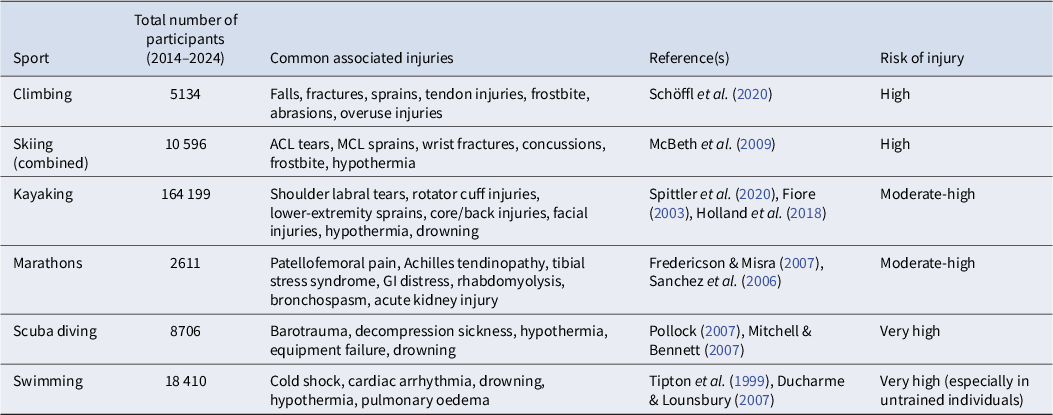
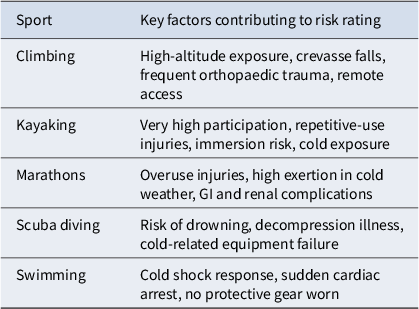
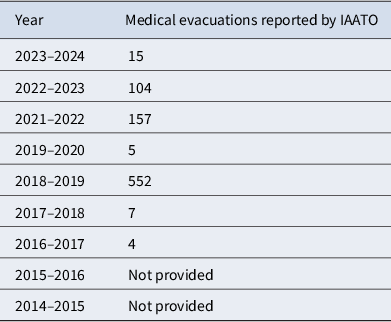
To complement participation trends, Table II summarizes the principal injury patterns and qualitative risk classifications assigned to the major Antarctic adventure tourism activities based on the risk assessment framework described in the ‘Methods’ section. Table III summarizes the key factors underlying these risk classifications. Table IV presents the number of medical evacuations reported by IAATO during the study period.
Selective list of the activities with the most associated injuries and the total number of people who participated in these activities over 2014–2024.

Table II. Long description
The table contains five columns and six rows of data.
* Climbing: 5134 participants. Injuries include falls, fractures, sprains, tendon injuries, frostbite, abrasions, and overuse injuries. Reference: Schöffl et al. 2020. Risk: High.
* Skiing combined: 10 596 participants. Injuries include A C L tears, M C L sprains, wrist fractures, concussions, frostbite, and hypothermia. Reference: McBeth et al. 2009. Risk: High.
* Kayaking: 164 199 participants. Injuries include shoulder labral tears, rotator cuff injuries, lower-extremity sprains, core or back injuries, facial injuries, hypothermia, and drowning. References: Spittler et al. 2020, Fiore 2003, Holland et al. 2018. Risk: Moderate-high.
* Marathons: 2611 participants. Injuries include patellofemoral pain, Achilles tendinopathy, tibial stress syndrome, G I distress, rhabdomyolysis, bronchospasm, and acute kidney injury. References: Fredericson and Misra 2007, Sanchez et al. 2006. Risk: Moderate-high.
* Scuba diving: 8706 participants. Injuries include barotrauma, decompression sickness, hypothermia, equipment failure, and drowning. References: Pollock 2007, Mitchell and Bennett 2007. Risk: Very high.
* Swimming: 18 410 participants. Injuries include cold shock, cardiac arrhythmia, drowning, hypothermia, and pulmonary oedema. References: Tipton et al. 1999, Ducharme and Lounsbury 2007. Risk: Very high especially in untrained individuals.
Footnote: A C L = anterior cruciate ligament; G I = gastrointestinal; M C L = medial collateral ligament.
ACL = anterior cruciate ligament; GI = gastrointestinal; MCL = medial collateral ligament.
Relationship between sport and key factors underpinning the risk analysis in Table II.

Table III. Long description
The table consists of two columns: Sport and Key factors contributing to risk rating.
* Climbing: High-altitude exposure, crevasse falls, frequent orthopaedic trauma, remote access.
* Kayaking: Very high participation, repetitive-use injuries, immersion risk, cold exposure.
* Marathons: Overuse injuries, high exertion in cold weather, G I and renal complications.
* Scuba diving: Risk of drowning, decompression illness, cold-related equipment failure.
* Swimming: Cold shock response, sudden cardiac arrest, no protective gear worn.
A footer notes that G I stands for gastrointestinal.
GI = gastrointestinal.
Medical evacuations reported by International Association of Antarctica Tour Operators (IAATO).

Table IV. Long description
The table consists of two columns: Year and Medical evacuations reported by I A A T O.
* 2023–2024: 15
* 2022–2023: 104
* 2021–2022: 157
* 2019–2020: 5
* 2018–2019: 552
* 2017–2018: 7
* 2016–2017: 4
* 2015–2016: Not provided
* 2014–2015: Not provided
Discussion
The 2023–2024 Antarctic tourism season marked an all-time high in visitor numbers following the COVID-19 pandemic, with IAATO reporting over 122 000 tourists, the majority of whom arrived by ship (Oertle & Liggett Reference Oertle and Liggett2025). During the same season, over 70 000 adventure sport participations were recorded, representing a more than three-fold increase since 2014–2015. Although many visitors probably participated in multiple activities, these findings demonstrate substantial growth in adventure tourism - as also emphasized by Makanse (Reference Makanse2024), who reports a significant diversification of tourism activities in recent years - over the past decade, and they suggest that an increasing proportion of Antarctic visitors are seeking physically demanding and immersive experiences. This expansion has important implications for medical preparedness, risk management and environmental stewardship in one of the world’s most remote and medically austere environments.
These findings are broadly consistent with recent reviews of medical emergencies in Antarctica, which identify musculoskeletal injuries, trauma, environmental exposure and prolonged evacuation as recurring challenges across tourism operations, national Antarctic programmes and scientific expeditions (Tissot et al. Reference Tissot, Lecordier and Hitier2023, Cherry et al. Reference Cherry, Ayton, Cooper and Zosky2024). Although the populations and operational settings differ, these studies similarly emphasize that geographical isolation and limited access to definitive medical care exacerbate the consequences of injuries that might otherwise be routinely managed in other environments.
Among the activities examined, ocean kayaking remained the most popular throughout the study period. Its continued growth probably reflects broader interest in low-impact, nature-based adventure tourism, as well as the relative ease with which kayaking excursions can be incorporated into ship-based expeditions. Similarly, participation in polar plunges increased rapidly after their introduction into the IAATO dataset, probably owing to their accessibility, novelty and widespread visibility on social media. Ice walking and snowshoeing also remained popular because they provide relatively accessible opportunities for visitors to experience the Antarctic landscape without requiring extensive technical skills. In contrast, participation in deep-field camping declined substantially over the study period, possibly reflecting increasing logistical complexity, changing operator priorities or environmental management considerations. The recent emergence of helicopter-assisted skiing and trekking further suggests growing demand for more technically challenging and remote adventure experiences.
The increasing popularity of these activities has important medical implications because the level of risk varies considerably across adventure sports. Although our study did not directly measure injury incidence, the observed growth in participation, together with published evidence regarding activity-specific injury mechanisms, suggests that medical preparedness and risk management will become increasingly important as Antarctic adventure tourism continues to expand. Kayaking accounted for the greatest number of participants, and it is associated with both overuse musculoskeletal injuries and potentially life-threatening environmental hazards such as hypothermia and near-drowning. Climbing and skiing similarly present substantial risks due to technical terrain, cold exposure and the potential for traumatic injuries. Climbers in Antarctica must also contend with unstable ice formations and the threat of crevasse falls, increasing the importance of safety equipment and guided protocols.
While marathon participation remained comparatively low, endurance events conducted in Antarctica introduce additional physiological stress related to prolonged exertion in extreme cold. Cold-induced bronchospasm, dehydration and rhabdomyolysis have all been reported among marathoners in polar environments, reinforcing the importance of participant screening and on-site medical preparedness (Sanchez et al. Reference Sanchez, Corwell and Berkoff2006, Fredericson & Misra Reference Fredericson and Misra2007).
Among the activities examined, based on our qualitative risk assessment, scuba diving and long-distance swimming probably pose the greatest medical risk because they combine the hazards of equipment failure, cold-water immersion, hypothermia, drowning and decompression illness with the challenges of providing medical care in one of the world’s most remote environments (Pollock Reference Pollock, Brubakk and Neuman2007). Antarctic scientific diving programmes similarly emphasize the need for specialized equipment, emergency oxygen capability and contingency planning for delayed evacuation (Pollock Reference Pollock, Brubakk and Neuman2007, Wood et al. Reference Wood, Bowen, Hartley, Stevenson, Warner and Watts2024). Antarctic scientific diving programmes emphasize extensive pre-deployment preparation, including fitness-to-dive assessments, emergency medical training, emergency oxygen capability, contingency planning and, in some settings, on-site hyperbaric capability with access to remote diving medicine specialists (Wood et al. Reference Wood, Bowen, Hartley, Stevenson, Warner and Watts2024). Such resources are generally unavailable to commercial tourism expeditions, meaning definitive treatment for decompression illness may still require prolonged evacuation outside Antarctica (Pollock Reference Pollock, Brubakk and Neuman2007).
The discrepancy between the high volume of adventure sport participation and the relatively small number of reported medical evacuations suggests that either significant additional precautions and a conservative approach to risk management taken by Antarctic tourism operators results in far fewer injuries than would be ordinarily expected elsewhere or that many injuries and illnesses are minor and able to be managed in situ and are therefore not captured within IAATO evacuation records. Consequently, the true burden of medical events associated with Antarctic adventure tourism remains uncertain. Improved injury surveillance, standardized reporting and documentation of non-evacuated injuries and near-miss events would provide a more accurate assessment of risk and better inform future safety recommendations.
Medical risk in the context of Antarctic adventure sports
Scuba diving in Antarctica presents specific hazards such as barotrauma, decompression sickness (‘the bends’), nitrogen narcosis and profound hypothermia. Access to definitive hyperbaric treatment for tourism-related diving emergencies remains extremely limited and often requires evacuation outside Antarctica.
Compounding these risks is the continent’s limited medical infrastructure. The most advanced facility, McMurdo General Hospital, offers urgent-care-level support and functions as a small emergency department but lacks definitive surgical capabilities. Even under favourable conditions, evacuation from Antarctica may require many hours to several days depending on location and weather (Oertle & Liggett Reference Oertle and Liggett2025). A case report by Coldron et al. (Reference Coldron2007) illustrates these challenges: after a diver aspirated a piece of plastic scuba equipment at Rothera Research Station, it took 14 days to complete his evacuation to a hospital in Uruguay due to weather and logistical delays. Such prolonged evacuation times mean that even treatable injuries or illnesses can become life-threatening, emphasizing that medical interventions in Antarctica must rely heavily on on-site stabilization and emergency preparedness rather than rapid transfer to definitive care.
During the 2018–2019 season, IAATO reported an anomalously high number of evacuations (n = 552), although IAATO has not provided a detailed explanation for this discrepancy. By contrast, only 15 evacuations were recorded in 2023–2024, which may reflect under-reporting or improved risk mitigation. This variability justifies the need for standardized injury and evacuation reporting.
Serious medical emergencies may require assistance extending beyond the expedition operator, including national Antarctic programmes, nearby vessels, meteorological services and international search-and-rescue coordination. Consequently, increasing adventure tourism may place indirect demands on organizations whose primary missions are scientific research and operational support. As participation in higher-risk activities expands, insurers and operators may increasingly face higher evacuation costs, liability considerations and pressure to strengthen participant screening and emergency preparedness. Investment in preventative risk management may reduce both medical and financial consequences compared with reactive responses following serious incidents. Future work should also examine whether tourists receive sufficient information regarding activity-specific medical risks before participation.
Cold-water immersion and the polar plunge
Although polar plunges are typically conducted in controlled environments with staff on standby, they still pose significant physiological risks, particularly for individuals with cardiovascular or respiratory disease (Wittmers & Savage Reference Wittmers, Savage, Pandolf and Burr2001). As participation continues to increase, pre-activity health screening and adherence to IAATO safety protocols become increasingly important components of operator risk management.
In the event of a cold-water immersion requiring rescue, the primary medical concern is often the effects of near-drowning rather than severe hypothermia (Szpilman & Morgan Reference Szpilman and Morgan2021). Although severe complications are uncommon, near-drowning may rapidly progress to respiratory failure and require advanced critical care - resources that are generally unavailable during Antarctic tourism operations (Szpilman & Morgan Reference Szpilman and Morgan2021).
In the remote and resource-limited environment of Antarctica, even uncommon medical emergencies may overwhelm onboard medical resources or require complex evacuations. Consequently, preventing avoidable cold-water incidents is considerably more effective than relying on definitive medical treatment.
Antarctic operators increasingly compete by offering novel adventure experiences. While these activities enhance visitor experiences, they may also increase operational complexity and medical risk. Balancing commercial innovation with participant safety and environmental stewardship will remain an important challenge.
Environmental considerations
IAATO prohibits bringing food or snacks ashore during tourism and non-governmental activities to minimize environmental contamination and protect local wildlife (IAATO 2019). This policy - along with an increasing number of tourists, which implies reduced operational capacity to accommodate overnight camping activities, necessitating operators having booked a slot to access a landing site twice to deposit and retrieve the camping party - may be one contributing factor to the observed decline in deep-field camping, as extended overland activities without food provisioning can be logistically complex and less appealing to tour operators.
Additionally, IAATO issues detailed waste-reduction guidelines that impact the types of items allowed onshore. For example, single-use items such as paper cups lined with plastic, teabags sealed with plastic adhesives and even contact lenses are discouraged or prohibited due to their non-biodegradable components (IAATO n.d.). These restrictions, although essential for conservation, may pose challenges for planning multi-day expeditions or supporting adventure sports that involve extended exposure to the environment.
Although most Antarctic adventure activities are conducted under strict IAATO environmental protocols, the cumulative ecological effects of increasing participation in these activities remain poorly understood (Tejedo et al. Reference Tejedo, Cajiao, O’Neill, Lamphere and Liggett2024). Activities such as helicopter-assisted skiing and remote landings may introduce additional pressures through carbon emissions, acoustic disturbance and repeated use of sensitive environments (Cajiao et al. Reference Cajiao, Tejedo, Aase, Benayas, Vereda and Obermann2025). Improving communication of activity-specific risks in context may also help prospective participants make more informed decisions while aligning visitor expectations with the medical and logistical realities of adventure tourism in Antarctica. Long-term environmental monitoring will be essential as Antarctic adventure tourism continues to expand.
Implications for tourism governance and policy
The expansion of Antarctic adventure tourism necessitates proactive risk management that evolves alongside increasingly diverse activity offerings. Standardized safety protocols, participant screening, staff training, emergency preparedness and transparent injury surveillance should be prioritized by both operators and policymakers. Such measures may reduce medical incidents, evacuation costs and operational disruption while supporting responsible growth of the sector (Basaran et al. Reference Basaran, Lamphere, McFarlin and Nyman2025). As adventure tourism continues to diversify, integrating medical preparedness, environmental stewardship and evidence-based risk governance will be essential to protecting visitor safety while supporting the long-term sustainability of Antarctic tourism.
Conclusions
Over the past decade, Antarctic adventure tourism has expanded substantially, with increasing participation in activities such as kayaking, polar plunges, scuba diving and mountaineering. Although the individual risk of injury remains relatively low, the growing number of participants has increased the potential for medical emergencies in one of the world’s most remote and medically austere environments.
As adventure tourism continues to evolve, evidence-based safety measures, including standardized protocols, appropriate medical screening, emergency preparedness, staff training and injury surveillance, will be important to minimize risk. Ongoing monitoring of environmental impacts, particularly as remote landings and helicopter-assisted activities expand, is also essential to ensure that increasing tourism does not compromise Antarctic ecosystems. Further research on both polar-specific injury epidemiology and the environmental effects of adventure tourism will help inform future management strategies that protect both visitor safety and the Antarctic environment.
Acknowledgements
The authors gratefully acknowledge the International Association of Antarctica Tour Operators (IAATO) for providing access to activity participation data that made this analysis possible. We appreciate their commitment to transparency and collaborative research in support of responsible and safe Antarctic tourism.
Financial support
None.
Competing interests
The authors declare none.



 Open access

