If we cannot make babies
Maybe we can make some time
Fuck so pretty, you and me
Erotic City, come alive
—Prince (1984)On an October night in 2024, an intergenerational crowd of queers packed themselves into the bite-sized, red-lit, mirrored room of the East Village’s ironically titled Big Bar for artist Julie Tolentino’s 60th birthday. Boisterous laughs and yelps bounced off the walls for this celebratory homecoming of sorts (Tolentino has resided on the West Coast for the past 20 years or so). While living in New York from the 1980s until the early 2000s, she stewarded the now legendary lesbian party Clit Club (1990–2002), and this occasion brought a number of Clit Club crew members and partygoers back together.Footnote 1 When Michele Hill, former door staff for the club, heard I was writing a dissertation in which the party would feature, it was only right that she should school me. Leaning against the bar wall, Hill looked me up and down with undeniable butch swagger. “Well, what have you learned?” Somewhat nervously, I listed off what I had gathered about the singular ethos of the party, eventually asserting that Clit Club was a space for lesbians to have sex. Hill gestured her hand toward me, “Woah, woah, woah, let me stop you right there.” I quietly panicked—had I too eagerly overestimated the presence of public sex within Clit Club’s milieu? Quite the opposite. “We weren’t having sex,” Hill corrected me, “we were fucking.” I won’t forget Hill’s emphasis on fucking as the more accurate descriptor of what went down nearly every Friday night for a decade in a Meatpacking District warehouse.Footnote 2 Hill’s corrective signals the pleasures and possibilities that queer sex practices can confer when no future relation, security, or world is promised. As a venue for lesbian public sex, Clit Club challenged the inherited protocols of lesbian feminist culture that were, to quote Heather Love, “more about sitting in circles than sitting on each other’s faces” (2000:98). Shaping an emergent wave of dyke erotics full of grit, hunger, and desire, Clit Club participated in redefining the terms of lesbian contact.
Tolentino and Jocelyn Taylor, aka Jaguar Mary, both artists of color and members of the ACT UP affinity group House of Color Video Collective, cofounded Clit Club with fellow dykes and friends in 1990. Operating until 2002, Clit Club was a weekly, multiracial, mixed-class lesbian party, where “every single place in the club was for sex” (Tolentino et al. Reference Tolentino, Crockett, Hart, Khusro, Kang and Mansion2018b:468).Footnote 3 Taking cues from the party’s mode of socio-poetic (dis)composition, I approach Clit Club as an experimental and durational performance in its own right. In theorizing the making of a queer nightlife scene as and through performance, I also situate Clit Club within Tolentino’s larger body of performance-installation work.Footnote 4 While partygoers would not have conceived of Clit Club in these terms, this repositioning affords a study of the imaginative and material labors involved in shaping and caring for an atmosphere. I employ what I call the “lesbian surround” in my analysis as an emergent heuristic for learning from those labors and thinking with manifestations of lesbian sociality that don’t cohere into a bounded or stable form. When read together, Clit Club’s fragments, ephemera, and transmissions produce lesbian surrounds—provisional and temporary envelopments of the social that are subtended by dyke sex and erotics.
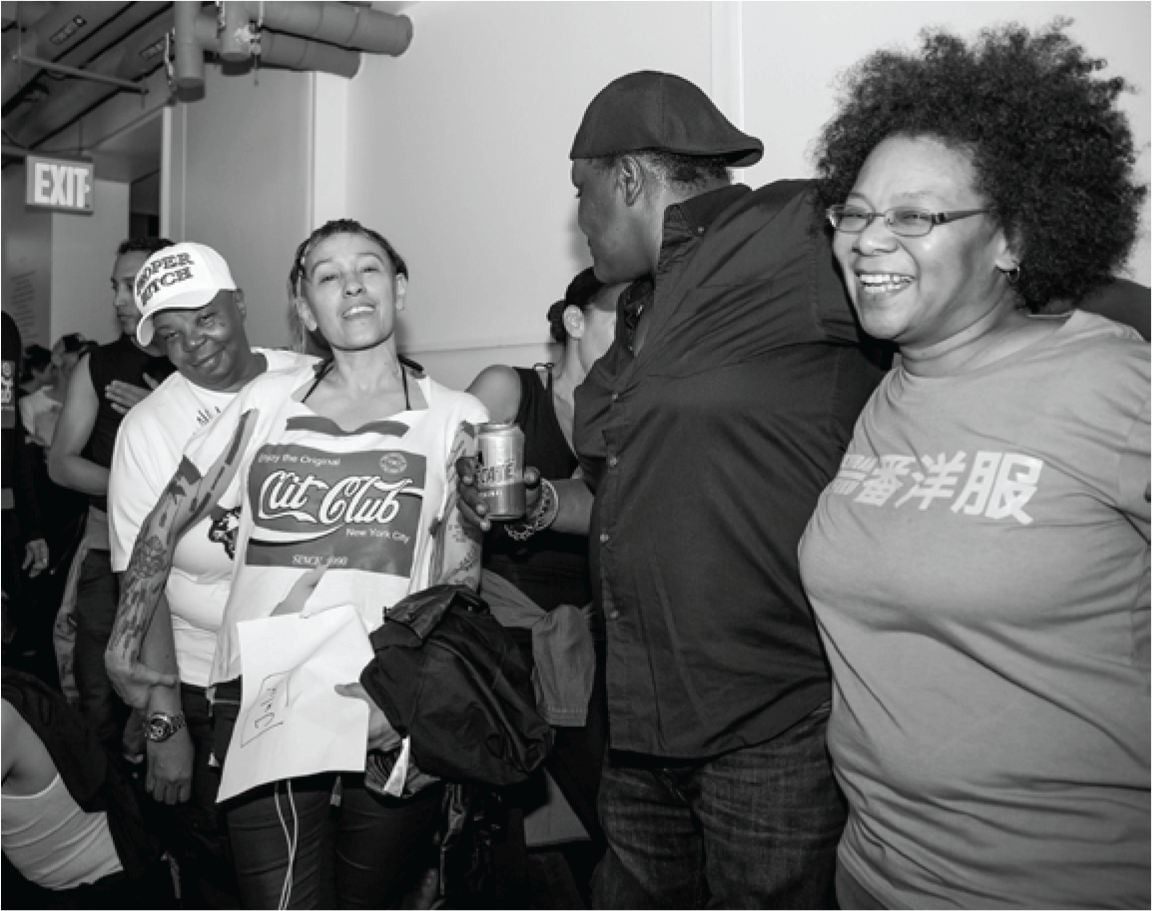
Judy, Julie Tolentino, Michele Hill, and Shigeru McPherson at Clit Club reunion party, Performance Space New York, 21 June 2019. (Photo by Suzanne Abranson)

Lesbian Surround
Stefano Harney and Fred Moten begin their exposition of the undercommons with the image of a “surrounded fort.” Their reading illustrates how apparatuses of enclosure—from the settler-colonial fort to the neoliberal university—are persistently vulnerable to the uncontainable and agonistic excesses of the outlawed life they attempt to capture (2013:17). In its verb form, to surround invokes that fundamental activity of the undercommons, its immanent praxis. As Tolentino, Crockett, Hart, Khusro, Kang, and Mansion write in their collective essay on Clit Club:
The undercommons appears inside yet also surrounds, and exceeds, the forces that would privatize and prevent social bonds […] We posit the Clit Club as a sexual undercommons that refused the misery and moralizing enclosures of spaces, sexual practices, and social being of 1990s New York City by creating a place for sexual play and social intimacy in its tiny, hot, crowded spaces of intense proximity. (2018b:469)
Building on their articulation, I focus on the many valences and scales—somatic, affective, sociocultural—of surrounding and being surrounded that a sexual undercommons like Clit Club entails. Heat, breath, and bass envelop bodies moving in and out of contact on the dance floor. Holes swallow fingers, hands, and straps in the enfleshed exchanges of sexual practice. An ethics of difference within what is shared swarms, disperses, and unsettles attempts to commodify and constrain an ontological hold on the “lesbian.” Surround, in its noun form, metonymizes the excess of this social erotics, pointing toward the everywhere-immanent potential of the “common beyond and beneath—before and before—enclosure” (Harney and Moten Reference Harney and Moten2013:17).
The surround is particularly well suited for thinking with the minor facets and appearances of lesbian sociality. Specific yet permeable, a lesbian surround denotes the deliberate tending of porous and affective atmospheres amid cycles of abandonment and enclosure that shape sexuality in the neoliberal city. Foregrounding the rub of racial difference, gender improvisation, and queer performativity in the making of lesbian desiring fields, lesbian surrounds are appositional to spaces that purport to create an enduring or stable commitment to identity. In tandem with the pervasive lack of infrastructures for lesbian sociality, a lesbian surround emerges at the interface between need and improvisation, channeling what has been built or designed for other purposes toward ambivalent and unintended uses. Lesbian social life can feel like a mirage, particularly when it signals the bookstores and bars that connote the residual forms of our communal organization. When attended to from the vantage of the surround, however, lesbian social life is not bound to any one place or space but is an affective possibility promiscuously and insidiously embedded within the given world. “Our task,” Harney and Moten wrote, “is the self-defense of the surround.” To situate such a call within the fickle and compromised scenes of lesbian relation shifts the object of our protection; what would it look like to defend our ability to unearth or engender a lesbian surround, within any given situation, at any scale?
As an experimental analytic for studying and theorizing lesbian social life, surround is distinct from the more commonly used and established rubrics of lesbian spaces on the one hand, and queer worlds, on the other.Footnote 5 Without refuting the vital work of either of these frameworks—as both material practices and theoretical apertures—a surround troubles some of the proprietary and settler attitudes that can undergird claiming space and making worlds, while also offering a vantage on scenes and performances of lesbian social life that might fail to meet the qualifying criteria of either framework. Lesbian spaces inevitably reproduce questions of access and inclusion: who belongs in such spaces and who do these spaces belong to? By shifting my terminology from space to surround, I turn away from conflict over who qualifies to be in a given space and move toward a consideration of the forms of life and relation a particular atmosphere might make possible or foreclose. Concurrently, by dwelling in the surround’s atmospheric register, I remain hesitant about the presumption of worlds as the necessary formal or theoretical outcome of queer culture and performance.Footnote 6 Attending to atmosphere requires that we keep our eye on the material violences and uneven vulnerabilities wrought by the current world order, while attuning ourselves to more radically hospitable environments that can be culled from what’s at hand. If queer worldmaking indexes infrastructural activity that is embedded with a future-bound positivism, then a lesbian surround suggests an uneasy combination of insertion and defection that operates at the level of the parainfrastructural, or what AbdouMaliq Simone terms a “submergent infrastructure” (2022:11). I use the term “parainfrastructural” to highlight networks of connection that lack the institutional or material stability we typically associate with infrastructure, but that nonetheless leverage preexisting structures to elaborate and provisionally sustain forms of life. Additionally, while I retain the specificity of “lesbian” alongside “queer,” this is not intended as a return to lesbian over and against queer. Notably, Clit Club resists the partitioning of lesbian and queer that has marked intellectual genealogies of queer and feminist theory. To that end, I’m interested in the way these terms, and the lifeworlds they signify, continue to operate as indeterminate conjugations of each other. In other words, a lesbian surround is both constituted by, and constitutive of, queerness.
We can notice the differentiation between space and surround in the example of lesbian bars, within which territorializing debates over in- and exclusions, as well as practices that police the bounds of lesbian gathering on the basis of race, gender, and class, have accreted over time. While these contestations are a material and ongoing part of lesbian history, they can overshadow the less legible formations of lesbian gathering that have been crafted at the edges of visibility, sometimes as a result of their exclusions from these very spaces and sometimes irrespective of them. The loss of the lesbian bar, as Mairead Sullivan argues, is often “assumed to point to the end of ‘lesbian’ as a meaningful identity or organizing rubric rather than to open the lesbian to more capacious projects” (2022:26). Indeed, as Sullivan observes, “fears around the loss of lesbian space and lesbian identity reflect both tacit and often explicit transphobia, as well as the inability of white, middle-class lesbian leadership to address issues of classism and racism with their conception of lesbian spaces” (26). Furthermore, as Kemi Adeyemi reminds us, “changing economic structures” and “political economic conditions,” significant factors in the lesbian bar’s overall decline, are “often obscured in larger debates around the place of trans people and politics within lesbian (and feminist) spaces” (2022:145). As more lesbian bars have opened since 2022, the buzz accompanying this “measured revitalization” continues to bypass a critical attention to the role of capital in the rise and fall of lesbian spaces (Berg Reference Berg2023). Returning to Sullivan’s provocation that more capacious projects might await us, what if those expansive visions already exist within our archives, coasting on the edges or in the abandoned recesses of the city, offering us other modes of social (dis)organization for thinking with lesbian social life? By pointing toward lesser articulated, more provisional sites of lesbian gathering, we can do the work of attending to what remains unsettled, unpropertied, and dispossessive in the ways we imagine, construct, and remember lesbian space.
Situated at the corner of 14th and Washington Streets, in what was then the “defunded, defunct meatpacking district,” Clit Club offered a deliberate alternative to the racialized discrimination and class divisions that characterized New York City’s lesbian bar culture in the 1990s (Tolentino and Shirazi Reference Tolentino and Shirazi2020:20). Hill recalls:
before Clit Club I don’t think black women and white women really partied together. Back then, there were bars with predominantly white clientele like Crazy Nannies, the Cubby Hole and “Hens” (aka Henrietta Hudson), as well as long-running spaces like the Duchess, which attracted mostly black women, and Hatfield’s, a bar for Latinas. Clit Club brought everyone together and that was amazing. There were other places, of course, but the scene was separated either by color or money. (Tolentino et al. Reference Tolentino, Crockett, Hart, Khusro, Kang and Mansion2018b:481)
There were a range of portals into Clit Club that made it possible and desirable for people living in diverse positions across the social field to land themselves there. On any given Friday night, trans women working the stroll would “come in for a quick drink before their night-time work began,” Lola Flash recalls (in Tolentino et al. Reference Tolentino, Crockett, Hart, Khusro, Kang and Mansion2018b:479). Others traveled from the outer boroughs: “organizers wanted to make the club as cheap as possible for women to be able to afford admission and a drink, especially women coming in from Brooklyn, the Bronx, Queens, or Staten Island” (482). Nimby, a club regular, who lived as a lesbian and as a man at home, fulfilling the roles of partner and father to a girlfriend and her children, would travel to Manhattan from deep in Brooklyn “to escape the family and go and be with the ‘sisters’” (in Fialho Reference Fialho2018). As Tolentino recalls, “that sort of open trans sensibility was always working underneath the Clit Club” (in Fialho Reference Fialho2018). Black women, women of color, trans, and genderqueer people could arrive at Clit Club knowing they would be welcomed, rather than double carded, interrogated, or turned away. “Educated white women from all of the major colleges around the East Coast” came to protest Clit Club’s inclusion of “sex positivity, non-monogamy, and porn,” while others “from the same colleges who were pro-sex came to celebrate that very thing” (in Fialho Reference Fialho2018). By forgoing homogeneity, Clit Club worked with lesbian social life as a conditional and permeable zone of difference multiplied, of “atmosphere-generating juxtaposition,” in a way that sought to make the proximity of those differences—with all their contestations and unevenness—sexy and pleasurable (Berlant Reference Berlant2023:105).
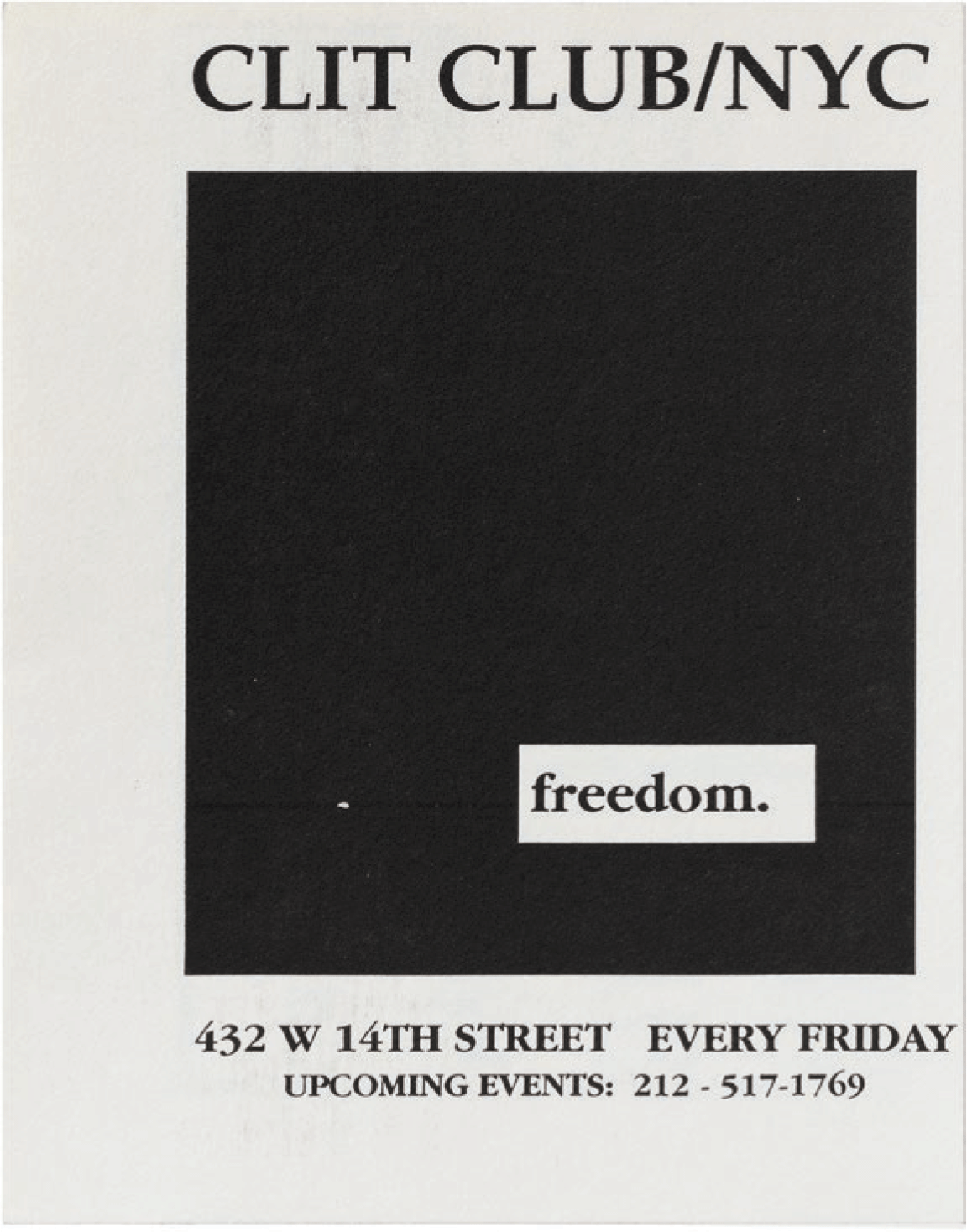
“Freedom.” Clit Club, original flyer, front, 1990. (Courtesy of Climax Books)

Countering anxieties that racial, class, and gender differences intrude on (white) lesbian existence in order to bring about the category’s erasure, the Clit Club shows us, conversely, that articulations of difference are central to the social fabric of an abundant lesbian sexual culture. Cofounder Taylor described Clit Club as “the first place to unapologetically emphasize sexual pleasure for dykes in a club atmosphere” (1995:33). DJ Aldo Hernández fondly remembers the crowd as the “dyke diaspora. A spectrum of the femalia. Mixed ages, races, ethnicities, sexual identities, and genders (though not necessarily all in the same room at one time)” (in Tolentino et al. Reference Tolentino, Crockett, Hart, Khusro, Kang and Mansion2018b:478). Hernández’s aside critically interrupts the presumption that the dancefloor is an inevitable site of queer community building. Rather, we might describe this as a scene of “homo-dissonance,” what Ethan Philbrick calls an invitation to “hear the incoherence of internal differentiation within any provisional coherence around a shared category” (2023:127). Homo-dissonance is also its own kind of soundtrack—Clit Club workers’ recollections of the party’s sounds include, from Hill, “Moaning and heavy breathing when folks came outside for air and the MUSIC ’cause you never heard those sounds on the radio at the time” (in Tolentino et al. Reference Tolentino, Crockett, Hart, Khusro, Kang and Mansion2018b:483). Door staff and graphic designer Shigeru “Shigi” McPherson recalls, “Thumping bass and the muffled audio of porn under the music. The sound of the person you were dancing with breathing in your ears while you were ‘going down’ on the dance floor” (483–84). The house music booming through the sound system—Crystal Waters, Black Box, and Robin S.—was inseparable from the sensorium of the club’s social erotics.
Less self-contained communities bound by identification, lesbian surrounds are more like indeterminate assemblies around a purposefully submergent or ill-defined call. An early Clit Club flyer from 1990 helps us envision this solicitation. Void of representational imagery, the flyer opts instead for black abstraction, its central image consisting of a matte black rectangle punctuated by the word freedom. Set in relief, the word hovers in the rectangle’s bottom right corner as a solicitation to those interpellated by its call. Bordered by minimal textual information, the flyer is a proposition to imagine the opacity of freedom’s surround and to participate “every Friday” in its making and re-invention (Clit Club 1990). Following Clit Club’s fierce devotion to the varied possibilities of what lesbian sociosexual life could be and its spirit of dispossessive impropriety, Clit Club prompts us toward lesbian surrounds—not as a model to reproduce, but as a way to think with the generative disordering of practice, identity, and atmosphere. A lesbian surround forgoes the binary between identities and acts, sliding away from one’s being and even from one’s doing. Rather than asking, Does one belong here?, we might ask instead, Is this the kind of air one wants to breathe?
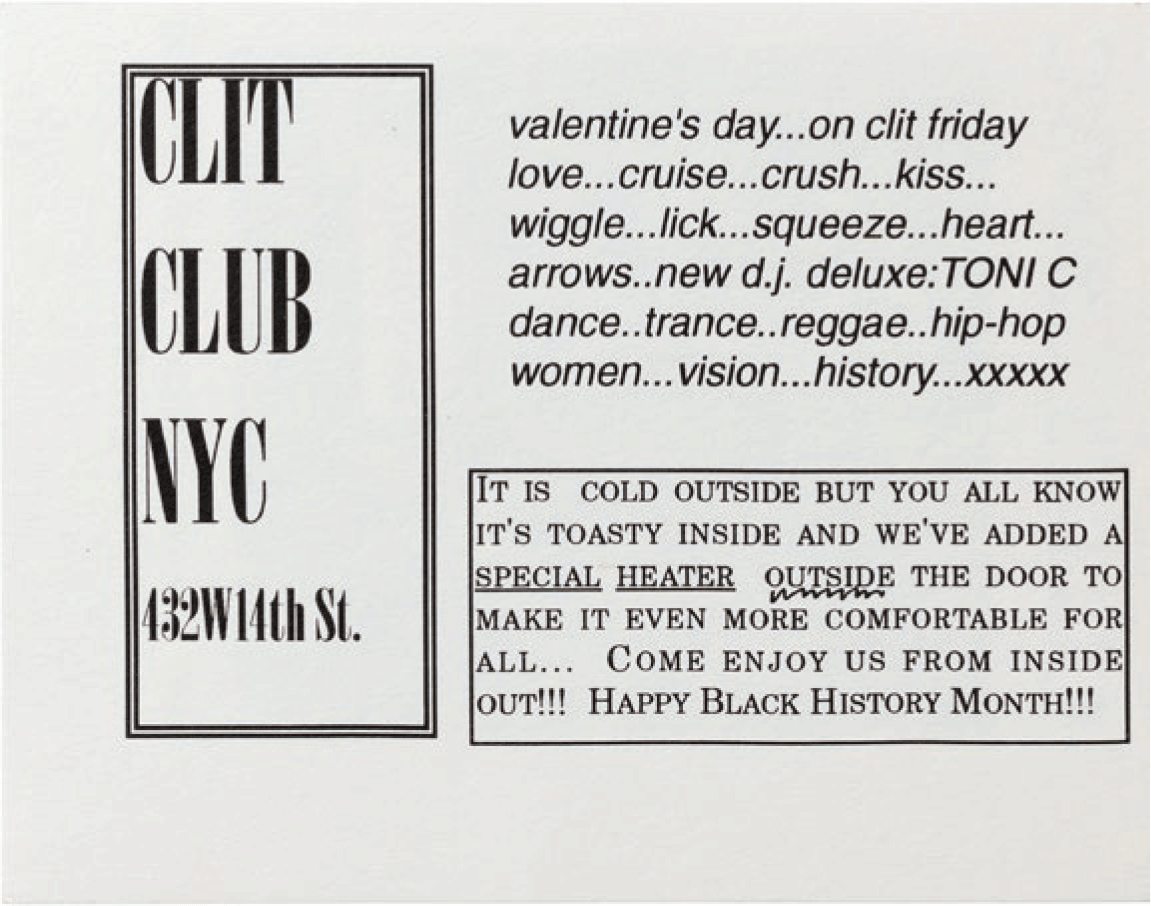
“Freedom.” Clit Club, original flyer, back, 1990. (Courtesy of Climax Books)

Although Clit Club was held in the same warehouse for the first 10 years of its existence, its limited and recursive temporality of “Every Friday” proves instructive. As a looping cycle of dissolution and reappearance, the schedule yielded a sense that what was possible on any given night was also already slipping away, only to be reconstituted again the following week, but differently so. This temporal design resonates with the connecting threads of “loss, risk, and desire” that shaped Clit Club from the ground up. The first gathering held in the warehouse was a memorial (Tolentino and Shirazi Reference Tolentino and Shirazi2020). The rage and grief unearthed by the onslaught of the AIDS crisis; the activism, advocacy, and “webs of care” that assembled to fight governmental neglect and the criminalization of people living with HIV/AIDS—all of this labor and mourning was woven into the DNA of the dancefloor and its lifeforce. “Attendees often began their evenings at meetings, memorials, and direct actions prior to arriving at Clit Club” (Tolentino et al. Reference Tolentino, Crockett, Hart, Khusro, Kang and Mansion2018b:472). Clit Club’s recursive temporality thus ritualized the loss that suffused the party. This incorporation of loss signals a different attitude toward obsolescence than the one dominating most conversations around lesbian spaces, which tend to draw an equivalency between the loss of property and the loss of identity. In addition to bolstering well-worn anxieties that “queer,” and especially “trans,” are vehicles of lesbian erasure, this logic relies on a stable binary of presence and absence that aligns the former with visibility and the latter with disappearance. On the contrary, the schedule for Clit Club embraced weekly dissolution and remaking, effectively refusing an equivocation between visibility and presence and lending trust to the indeterminate assembly of those who would show up to the city’s edge to be part of what might happen each time around. As Simone writes of the surrounds, it is “a challenge of pacing and rhythm: how to slow things down sufficiently to have opportunities to practice new ways of doing things […] but without habituating to the particularities of the locale or worrying about what can be retained and applied to the next occupation.” Surrounds, “skirting on the interface between habituation and improvisation,” are thus constantly on the verge of disappearance (2022:13). Yet, their impermanence suggests other registrations of endurance that may not be visible, representational, or place-bound as much as they are the roving effects, imprints, and transformations of specific practices.
Are these negotiations of pacing and rhythm some index of what Prince was talking about when he wrote those seductive lyrics, “If we cannot make babies / maybe we can make some time”? When I first heard his 1984 funk track “Erotic City,” I would listen to the song on repeat just to hear Sheila E.’s soft and unwavering voice sing that refrain. The line took hold in my imagination, becoming a mantra, a sense of possibility that one, or two, could still make time in the city, irrespective and in excess of regimes of reproduction. “Erotic City” echoes the glimmering impression I get of Clit Club’s sexual surround—of what it might feel like to be covered with, corrupted by, and turned inside out in the proximity of one another’s excesses. The sex-positive environment cultivated by Clit Club does not confer a blanket sexual utopianism. Rather, this was a social space in which the negativity and abjection attributed to queer sex practices—from the hegemonic realities of racialized homophobia to the internal battles over sex within the lesbian community—could be inhabited and played with. Greg Tate’s writing on Prince applies here: “Starman Prince realized the cultural battleground of the future would be fought over what all bodies that had been othered by the state did to pleasure themselves, did to make themselves” (2018:8). Turning now to a 2019 performance-installation work by Tolentino, Slipping Into Darkness, we can notice how her tactics persist across decades and formats. Both Clit Club and Slipping evidence the crafting of ephemerality and duration into coexistent temporal processes, making time and bending existent infrastructures towards queer pleasures and opacities. Tolentino’s words from 1995 still ring true: “what’s fierce is tending this little garden of weirdness and keeping it fresh” (in Trebay Reference Trebay1995:20).
Slipping
On Saturday 7 December 2019, I walked through the East Village toward Performance Space New York (PSNY)—formerly known as Performance Space 122 (PS122)—for my 10pm appointment with Tolentino. A repurposed public school building, PSNY had recently undergone an architectural renovation and institutional rebrand. Back in 1990, PS122 had presented An Army of Lovers: Combatting AIDS, Homophobia and Censorship, an exhibition organized by the artist collective Art+Positive, which included Clit Club crew members Tolentino, Hernández, and Flash, as well as artist, activist, and friend Ray Navarro—who died from an AIDS-related illness that same year. Nearly 30 years later, I was one of many appointments Tolentino had scheduled that evening for the night mode of Slipping Into Darkness. Footnote 7 From the work’s description, I understood that our encounter would be “an intimate one-to-one exchange immersed in a dark pool of mineral water” (Tolentino Reference Tolentino2019). I had also received a voicemail from Tolentino a day or so prior sharing some practicalities: Wear something for bathing—anything you would be comfortable in. Bring a warm jacket for passing from the theatre’s building to the outdoor tent. Know that you will take a pre-pool shower. Plan to spend about 90 minutes in total at the theatre. This preliminary contact, characterized by Tolentino’s informal yet extensive attention to our shared preparation, was part of the work’s choreographic operations, extending the duration of the performance encounter beyond its event-time. While these details offered me coordinates around which to orient, they also made the unknown that much vaster. Within the void of all that I couldn’t know was the work’s unspoken but palpable prerequisite—trust, that illusive and increasingly hard to come by social glue.
The typically buzzing lobby of PSNY was now eerily vacant. Tolentino had in fact arranged to empty the building of all staff and patrons from the other arts organizations and venues housed there, granting the space itself a more tangible presence. I checked in with the single box office worker and was given over to the care of Pigpen, whose likeness was familiar to me from Catherine Opie’s iconic photographs of butch and transmasculine subjects.Footnote 8 Akin to the door person at Clit Club, Pigpen permits and welcomes the visitor, while also subtly vetting and calibrating their entry. Escorting me up the elevator to the fourth floor, we passed through the main theatre into a changing room, and then to the backstage area where I was instructed to shower. Once cleansed and changed, Pigpen led me down the building’s stairwell and outside to its courtyard where a small white canopy tent had been erected. Only slightly recessed from the sidewalk of First Avenue, I entered the tent where Tolentino awaited me, sitting below the surface of the water in a circular cedar tub. Lined wall-to-wall with gold leaf, the vestibular retreat glistened, its gold hues bouncing off the opaque surface of the pool’s water. “Lit, shimmering, hot, sweaty.” Tolentino has used these four adjectives to describe the “liveness of Clit Club,” but they happen to perfectly capture the inside of the tent I had just entered (Tolentino et al. 2018a).
Over the next 30 minutes or so, I shared the pool with Tolentino, who guided me into various degrees of “consensual drowning” via practices of breathing and submerging (in Holloway and Tolentino Reference Holloway and Tolentino2023). After sitting and breathing together at the edges of the tub, Tolentino invited me into a floating position on my back with their hands lightly supporting me. With the aid of a nose plug to prevent water from rushing into my nasal passages, I began submitting to the contact I would receive from Tolentino. Submerging and floating, submerging and floating, drowning…floating…drowning. In the interplay of pressures, I was brought underneath the water’s surface and returned to the air. Throughout, I was guided by the touch of Tolentino’s hands, as they responded to the capacities and inclinations of my muscles, flesh, and breath. Within the surround of the water’s opacity and darkness, its enveloping effects of pressure and lightness, the touch of another gave way to a temporary and intensified self-loss. Moving toward an inaccessible interiority, brought on by the affects that hover around being in proximity to sex and death, I had the feeling of yielding to a world-receding. In the resurfacing, Tolentino and I would fall into conversation—casually remarking on how things were going, what was happening, what was working or not. Quotidian exchanges above the surface were juxtaposed with the psychic-somatic drop into the sensorium of the void below—a space where language doesn’t easily go. I came to feel, in the words of Vivian L. Huang, “the brightening sense that the queer work therein is the holding together of distance and intimacy” (2022:61).
In Tolentino’s words, Slipping “was all about consensual drowning, and the encounter with strangers” (in Holloway and Tolentino Reference Holloway and Tolentino2023). These two practices—consensual drowning and encountering strangers—rely on Tolentino’s transposition of knowledges and techniques from queer and S/M sex practices in tandem with her longstanding bodywork practice. By situating Slipping alongside Clit Club, I suggest that this one-to-one exchange is an incomplete transmission of the modes of touch, contact, and pressure that were intrinsic to the party’s lesbian surround. In the heat of the tent and the swelling intensity of the drown, one experiences a concentrated distillation of the somatic, erotic, and psychic affects of the club. The wetness and density of atmosphere; the excesses and opacities of the night; the push and pull of bodies moving in, with, and around each other. Uncannily, when recounting their first experience of sneaking into Clit Club at the age of 17, Shanté Paradigm Smalls evoked a sense memory, recalling that upon entering the club, it was as if the walls were wet.Footnote 9 Paired together, Clit Club and Slipping ask that we attend simultaneously to the ongoing composition and dissolution of a collective scene—“the dimension and extension of” what Lauren Berlant calls “organized air, the projected atmospheres sustained by collective practices”—as well as the ways such a surround might work on, within, or through an existent one (2023:23). Following Kevin Quashie (Reference Quashie2021), this “one” does not refer to the unit of the individual, but rather to the fictional, projective, and imaginative capacities that accompany (un)becoming in a scene of erotic relation. While Slipping does not reproduce the assembly of a tightly packed party through performance, its spacious retreat from the world temporarily distills a sense of the social to the networks and living-pedagogies embedded in Tolentino’s, as well as Pigpen’s, touch. To borrow Gregg Bordowitz’s words for Gertrude Stein, “her touch”—or in this case, their touch—“is the connecting tissue among things” (2010:19).
Nearly 60 years before Tolentino’s Slipping, Samuel Delany attended a different scene in the East Village involving the queer erotics of the bath—although in his case, it was the explicitly sexual exchange of an “undulating mass of naked male bodies, spread wall to wall” at the St. Mark’s Baths (Delany Reference Delany1988:173; emphasis added). His recounting of this scene in The Motion of Light in Water—and in particular his vision of the homosexual mass as an exemplary performance of public sex—would later grant José Esteban Muñoz “a glimpse of utopia” (2009:52). Reading Delany, Muñoz theorizes queer performance as a medium for worldmaking that relies on the cooperation of two elements: an “ensemble of social actors” and a site for the becoming of their alternative sociality (49). While Tolentino is part of a lineage of queer-of-color artists whose work is rightly situated within the constellation of performance makers and culture workers to whom Muñoz has attributed the powers of queer worldmaking, I am compelled by the socio-poetic interval Tolentino opens up with Slipping by evading performance’s worlding capacities at every turn. Leaving behind the conventions of time, space, and assembly, Slipping opts instead for an uneasy combination of insertion and defection, or parasitism and withdrawal, that illuminates parainfrastructural tactics. Clit Club’s sensibility is thus not only felt through the contact that occurs between the visitor and Tolentino under water, but also through the artist’s contact with the theatre, as institutional and architectural site, and her side-stepping of queer theatrical forms. First, by refusing a contained event-time, the work’s duration leaks beyond the scope of liveness, sliding into the audience member’s life through a voicemail or conversation days before the “show.” Second, the work disaggregates and disarranges the theatre into a series of passages and portals. One never arrives to a stage or scene of action but rather passes through sensorial and affective registers—from elevator, to shower, to stairwell, to tent, to pool, and back again. Finally, the one-to-one format defers the social assembly of the audience, somehow promising both more-and-less anonymity than a typical performance event. Navigating the work’s protocols of passage through the institution, one becomes privy to the circumventions that carve out recesses for dyke-inflected contact.
Given that lesbians have historically lacked infrastructures for public sex—what Delany has described for gay men as the “galleries of institutions […] to accommodate our sex”—the social materialities of lesbian erotic lifeworlds may often evade or fail to constitute a queer world and its attendant modes of recognition (1988:174). For instance, Delany has elsewhere attributed the lack of lesbian and women-centered venues for public sex to a deficiency in numbers:
What waits is for enough women to consider such venues as a locus of possible pleasure. I felt that way twenty years ago. Nothing I’ve heard from the reports in two decades of women’s bars and lesbian nights at male leather bars and the reports of men and women from heterosexual sex clubs has made me suspect I am wrong. ([1999] 2019:32)
In Delany’s view, there aren’t enough “social actors” to constitute or beckon a world-into-being. We might consider, as counterexample to Delany’s assessment, that the male leather bar served as a formative studio of sorts for Tolentino’s durational performance practice. Tolentino recalls:
So back in the old days when I ran the Clit Club, I could use the club space [to rehearse]. But we were always pretty busy, and remaking the bar every night so it looked different. My friends, the artists Lovett/Codagnone, ran another party called Pork, which was the sister to the Clit Club back in the ’90s. Their space was in a leather bar; it wasn’t a dungeon but it had this particular type of audience. So I would come and do some of my projects there. For years I was just making my work to the back of a bunch of hairy ass leathermen—my “workspace.” (in Holloway and Tolentino Reference Holloway and Tolentino2023)
Tolentino thus channels what has been designed for other purposes in service of unaccounted-for needs and uses—the gay leather bar becoming solo-dyke-performance-workspace. Contrary to Delany’s perception of lack, Tolentino’s shadow-presence in the male leather bar is a registration of what Tiana Reid terms the “everywhereness of lesbian sex,” even when it might not be recognizable to some as such (2023:41). Lesbians both pervade and are conscripted to sexual publics. Forged as a practice of relation with others and within oneself, under and against the pressures of gendered, racialized, and sexual regimes, lesbian sex may not regularly take the shape of mass formations, but rather permeates, often surreptitiously, everywhere life is lived.
In the midst of shrinking public infrastructures for social life, contemporary performance appears to promise the potential formation of a temporary audience-as-collective, a metric and value on which institutions and funders certainly rely. However, the positive valence associated with gathering can often sweep over the many frictions that constitute the matter of any event, and in particular the ways that infrastructural abandonment continues to shape racialized experiences amidst scenes of assembly. In the difference between Clit Club’s indefinite crowds and Slipping’s restrained trios, we can notice changes in modes of gathering and performance between the early 1990s and the late 2010s. If, as Boris Groys (Reference Groys2010) asserts, the contemporary is dominated by the poetic attitude, whose corollary position is the producer rather than the spectator, then attending a performance in the 21st century is as much about performing for each other—and re-mediating such presences virtually—as it is about a spectatorial experience. Summer Kim Lee terms this arrangement “compulsory sociability,” drawing our attention to the way such injunctions fall disproportionately on minoritarian subjects, who “must also bear and navigate the burden of relatability from which a compulsory sociability emerges” (2019:29). Countering the injunction to perform relatability, Lee theorizes “Asian American asociality” as “a mode of racial performativity that navigates the processes by which Asian Americans have been racially figured as a problem for and of sociality, as assimilated yet socially isolated, unrelatable subjects” (29). Tolentino, who is mixed-race and of Filipina and El Salvadoran descent, reflects:
I grew up deeply impacted by early LGBT and race riots in San Francisco, raised by teen parents and first-generation Filipino and El Salvadoran immigrant grandparents. Language and access bore down on how we navigated progress narratives, access, the reality of living with and among HIV and AIDS, the various forms of belongings and the righteous making of lives through clubs, affinities, drugs, difficulty, disabilities, art forms…. In retrospect, I learned to take in isolation as something to address, support, and surround, yet also allow myself to identify and work with. (in Lee, Tolentino, and Binghao Reference Lee, Tolentino and Binghao2023; emphasis added)
With Slipping, Tolentino’s maneuvers redirect the visitor away from the position of the spectator and the producer-cum-performer. They shape the condition of isolation into a source of reprieve from the increasingly professionalized scene of the social, while nonetheless challenging and inviting the visitor to enter into a mode of relation that is appositional to recognized forms of queer performativity. Here, Tolentino mobilizes a brown asociality in service of the relations that can be yielded by what Huang terms the “inscrutable surface as queer racial form” (2022:7). Bypassing compulsory sociability, Slipping strips away the defenses and protective affordances of the audience, proposing a scene of relation, or nonrelation, that welcomes the stranger into the promiscuous and projective possibilities of the impersonal.
Furthermore, Slipping deforms the theatrical venue into a situation that sits in discomfiting proximity to the feminized and racialized locales of sex, care, and service work. The theatre is not transformed into a spa, and yet the protocols of a spa are woven throughout the work’s choreography of hospitality. Nor does the performance make direct reference to the gay sauna, and yet the sexual cultures of the bathhouse are nonetheless evoked by the work’s clandestine and erotic aura. This is no gimmick, however. Instead, the work’s “affective experimentalism” bears and recirculates material traces of life lived in the crosshairs of sex, care, and service economies (Berlant Reference Berlant2023:123). As a performance-bordering-on-service-or-sex-work, Slipping knows something about the material history of its aesthetic form. Performance gained traction as a discrete field of artistic practice in tandem with the US economy’s post-1970s shift toward a service-oriented marketplace wherein feminized and racialized forms of affective labor came to characterize the majority of the workforce. In this sense, Slipping references performance’s imbrication with economies of affective and emotional labor, while also prioritizing the knowledges from below that subtend economic realities and form the stuff of Tolentino’s life and art—the esoteric, do-it-yourself, hacked-into-existence, flesh-bound practices borne out of the same devouring conditions of racial capital and forged to ensure queer survival in the cracks of what we call social life. Twisting and unsettling the theatre into a non-site for encounter and contact, Slipping nods to the service economy without overtly submitting to its strictures. As Tolentino adopts the performer-as-caregiver position—a role that echoes the consignment of feminized Asian persons to economies of hospitality and service—she boldly wagers “the optic of submissiveness” (Huang Reference Huang2022:72). The performance-installation parasitically inserts and attaches itself to its host’s architecture, in a tent literally jutting out from the PSNY building’s side. Her guests become temporary institutional interlopers as they travel through the theatre’s interstitial and backstage zones. In her brown and genderqueer inhabitation of densely layered connotations, Tolentino acts as the host within the parasite, of which she is both the architect and the user. Slipping thus remains complicitly in excess of institutional, and interpretive, capture. In turn, the work reveals the pockets of illegibility that can be tended toward from the edges, akin to what Simone White calls “the arrangement of soft temporalities that do not thrive under attempts to forcibly extend the time of their (our) existence” (2024). Within the intensified “aesthetics of neoliberalization” that engulf the city and its performance spaces, Slipping invites us to feel the unsettlement hidden within any given architecture (Tolentino and Shirazi Reference Tolentino and Shirazi2020:20). In Slipping, the stage is not the site for another world. Rather, a withdrawal from the stage opens onto the possibility of a temporary “outside” within every site of enclosure.
Erotic City
The Clit Club’s primary haunt for its first decade of existence could be found at 14th and Washington streets, a location Tolentino has described as “a small space at the edge of the city, almost tumbling into the river” (in Fialho Reference Fialho2018). The movement of tumbling helps me to feel the vertiginous materiality of queer life as it was bound up with the city: tumbling-at-the-edge describing both the urban geography and the landscape of queer, trans, and lesbian identities and desires unfolding within and around the party. Writing on the peripheries of urban regions, Simone reminds us that:
[These] spaces may indeed be surrounded by both an emergent order of rationalization that will come to settle present uncertainties and a sense that eventually what exists as unprofitable, over- or underbuilt, informal, or tacitly contested will be normatively valuable. But for the time being, such spaces become opportunities for rehearsal, for experiencing the possibility of being exposed to something unprecedented, caring, and suggestive of new ways of moving and living. (2022:9)
Urban sanitization and its logics of value did indeed creep west, “shift[ing] the cruising and the queer DIY nightscapes, smoothing out its edges and illuminating its dark corners” (Tolentino and Shirazi Reference Tolentino and Shirazi2020:20). When Sadia Shirazi and Tolentino returned to Clit Club’s former warehouse in 2020, they found it fully submerged within the “order of rationalization” to which it became subject. (In 2020, the site was occupied by a business selling “art for interiors” [Tolentino and Shirazi Reference Tolentino and Shirazi2020:20]. As of April 2026, it is now the storefront for the luxury watch retailer Breitling.) A process motivated by the “neighborhood’s rent potential” and aided by “incentivized development, zoning ordinances, restrictive land use, liquor law revisitation, and ‘selective’ law enforcement,” the space that once held Clit Club is now firmly situated within the Meatpacking District’s domineering marketplace of commodity fetishism combining retail, art, dining, and tourism (Tolentino and Shirazi Reference Tolentino and Shirazi2020:20). The former architecture has been renovated and “laid bare,” now exhibiting a “modern, ‘loft-like’ open plan” replete with “transparency, high ceilings, and polished concrete floors” (2020:20). In a text coauthored for Movement Research Performance Journal, Tolentino and Shirazi describe the process of remapping the club’s former setup, using “limbs, hands, and steps” to measure the space and “feel for those things that evade the capture of representation” (20). They find “ingrained in the now-stained and sealed floors traces of the old walls, the imprint of the large bar, corner markers indicating the miniature club stage” (20). They remember what no longer exists, “mock[ing] the action of traveling downstairs from the main room to the illicit, sexy bathroom line not evident in the space’s now-open plan” (20). Where the dancefloor once was, they encounter a “torn-open center,” “cut out to accommodate a double-wide glass and steel staircase” (20).
How did sex unfold within this architecture in its heyday? One gleans uneven topographies of contact where sex did not congeal into a recognizable form or gravitate around a center, but rather “looked like many things,” and could be found occurring on the pool table, the dancefloor, inside the bathroom, and on the queue (in Tolentino et al. Reference Tolentino, Crockett, Hart, Khusro, Kang and Mansion2018b:468).
In the early years, a dark room downstairs was available for kink, play, and exhibitionism, and for strict and exploratory S&M, though sex was palpable and explicit throughout the space. Rooms had dark corners and bright centers, and encompassed cooler areas and hot, sweaty ones, places to hang out and talk, places to smoke, and other areas offering relief from smoking. Every single place in the club was for sex. (Tolentino et al. Reference Tolentino, Crockett, Hart, Khusro, Kang and Mansion2018b:468)
Sex is remembered as one activity bleeding into and out of others, becoming indistinguishable from the general hapticality and informal pedagogies of the club—the unquantifiable work of taking reprieve from the discrepant hostilities of the world, and exchanging techniques for surviving its material pressures.
In my search for traces of Clit Club’s urban presence, I was delighted to find a single manila folder of records on file—with the words “Clit Club” scrawled in pencil on its tab—in New York City’s Municipal Archives. The folder’s contents include a handful of complaints and subsequent correspondence with mayor David Dinkins’s office after the Clit Club threw a disorderly and raucous block party during 1991 Pride weekend. The party was held at the corner of Barrow and Commerce streets in the West Village, a predominantly white, residential intersection farther east than its usual meatpacking locale. A letter penned by the particularly incensed resident Mary K. Doris provides us with a detailed account of the event, a “horribly noisy and boisterous invasion of female celebrants” who “transform[ed] [her] otherwise normally highly livable and civilized street” into “an atmosphere of inappropriate exhortations” (1991:1). In Doris’s words, the block party included:
massive drunkenness and yelling in unison among celebrants; horribly loud, non-stop disco music with a thudding, heavy bass; semi-nudity; aggressive and grotesque and deliberately exaggerated advertisement of a specific sexual-practice point of view—these messages were conveyed through posters stuck on our lampposts, flower planters, etc. and on information tables staffed by the event’s organizers. (Doris Reference Doris1991:1; emphasis added)
Notice Doris’s use of the possessive pronoun when referring to sidewalk lampposts. Placing the city’s public architecture under her purview, she transforms the street into an extension of the residents’ personal domains, indexing a belief that the city belongs only to its class of property owners and that a neighborhood belongs only to its residents. Lauren Berlant and Michael Warner remind us of the social life that cuts through this “disturbing fantasy”:
The local character of the neighborhood depends on the daily presence of thousands of nonresidents. Those who actually live in the West Village should not forget their debt to these mostly queer pilgrims. And we should not make the mistake of confusing the class of citizens with the class of property owners. Many of those who hang out on Christopher Street—typically young, queer, and African American—couldn’t possibly afford to live there. Urban space is always a host space. (1998:563)
The queer Black life that Berlant and Warner gesture towards intimates the ongoing inextricability of urbanization and (anti)blackness. Simone’s work on the surrounds is useful here:
Black inhabitation amplifies the need to pay attention to how urban spaces are actually used, the ways in which usage comes to exceed the impositions of formatting, and how the positionality of Black residency identifies the necessity of maximizing the disruptions of such formatting that involve all of “us.” (2022:17)
We might consider Clit Club’s party, populated by white and nonwhite lesbians alike, as one such “disruption of formatting.” As we shall see, Doris’s tirade against the Clit Club’s deviant burst into the neighborhood is subtended by the affects of whiteness and its proprietary world schema. Her complaints make palpable class antagonisms that designate the racialized terms of order and disorder in the city, forming an intimate backdrop to what would become Rudy Giuliani’s “revanchist 1990s,” a political program that “reaffirmed the rights of the white middle class to the city” (Smith Reference Smith1998:3). Giuliani would capitalize on the sentiments expressed by Doris’s letter with his Police Strategy No. 5, which promised to “reclaim the public spaces of New York,” and with zoning laws that decimated queer public life by targeting adult businesses like those on the nearby Christopher Street (in Smith Reference Smith1998:2). As Berlant and Warner wrote, “queer publics are also peculiarly vulnerable to initiatives such as Mayor Rudolph Giuliani’s new zoning law. The law aims to restrict any counterpublic sexual culture by regulating its economic conditions; its effects will reach far beyond the adult businesses it explicitly controls” (1998:562). Within the intensifying privatization of public space over the course of the 1990s—a dovetail process of cannibalizing and bending nonsovereign uses of the city toward profitability and criminalizing and expunging all who remained deviant and expendable—eruptions into public space, like that of the Clit Club’s block party, insinuated insurgent social grammars into an increasingly stultified public life.Footnote 10
Reading Doris’s letter, it becomes clear that what most offended her was not the temporary claiming of city space by “minorities,” but rather the unabashed and unapologetic spirit of sexual and erotic exhibitionism that pervaded the assembly.
The totally insensitive, vulgar, blasted and screamed poor taste displayed in every aspect of the event which, as far as many of us can see, had nothing at all to do with Pride and everything to do with Sex. (Doris Reference Doris1991:2)
Doris focused her outrage on one particular image: “a clothesline stretched across part of our street with a full line of lightweight rubber gloves suspended from it.” Lest the mayor’s office question the purpose of such an exposition, Doris annotates her description for the uninitiated reader: “a member explained to me these were used for Safe Sex between women using hands, and I have a feeling the same explanation would gladly have been offered to any ten- or eleven-year-old resident who might have asked on that day.” For Doris as for Giuliani, disorder signaled “a city that cannot protect its space or its children” (in Smith Reference Smith1998:3). What Doris’s description makes clear however—whether she likes it or not—is that she too has become a student of the Clit Club’s sexual pedagogy. Her language indexes not only her enraged status as a “civilized” resident, but the ways her very sense of self is buttressed by an erotic fascination and a will to sexual knowledge. As Sharon P. Holland argues, the erotic is not some queer autonomous zone but rather “a possible harbinger of the established order” (2012:9). Reading Doris’s aggravation through the heuristic of the lesbian surround asks that we consider her, not as an interloper, but as part of Clit Club’s temporary urban swarm. Following Moten’s assertion that “deviance is not opposed to the norm,” but rather “comes before it, bears it,” we can see how Doris’s sense of propriety is not simply threatened by the Clit Club’s display of sex, it depends on it (2018:243). Held together by the rhetoric of anti-Black logic, Doris uses quotations around the word human—“a sampling of the ‘human’ problems generated”—to cast doubts on the partygoers’ abilities to perform and reproduce the genre-as-such. In so doing, Doris separates the crowd from the “creative artists and business people,” “elderly, disabled neighbors,” and “children” whom she positions as victims of their disturbance, revealing that her dismay is not merely a matter of sexuality, but of sexual practices that disrupt and disintegrate the coherence of whiteness and its attachment to humanistic propriety.
While I do not portend to know once and for all Doris’s racial identity, my point is that her rhetoric relies on and deploys the logic of whiteness, per Cheryl I. Harris (Reference Harris1993), as property. “Whiteness as property has taken on more subtle forms, but retains its core characteristic—the legal legitimation of expectations of power and control that enshrine the status quo as a neutral baseline, while masking the maintenance of white privilege and domination” (1993:1715). Contrasting Doris’s individuated claim to order, the temporary affective shift brought on by the block party marks the potentiality of lesbian sociosexual life to wreak havoc on established norms of civil comportment. Here, identity itself is not the cause for disturbance, rather the threat is sexual practice, and by extension, the potential of lesbian sex to thwart established forms of social reproduction. Eliminating practices of sex that disentangled whiteness from its attachments to privacy in the forms of property ranging from one’s living domain to one’s body were fundamental to the sanitization and financialization of the city (see Delany [Reference Delany1999] 2019). Lesbian sex in public, as indexed by the clothesline of latex gloves and the web of knowledge that surrounds them, proposes an epistemological shift in one’s understanding of what sex can do in the city. The repurposing of the domestic vocabulary of women’s work via the clothesline offers an uncanny registration of the regendering that is possible when the materials of everyday life are put to use for what may appear to be the useless ends of convivial pleasures and freakish desires.Footnote 11
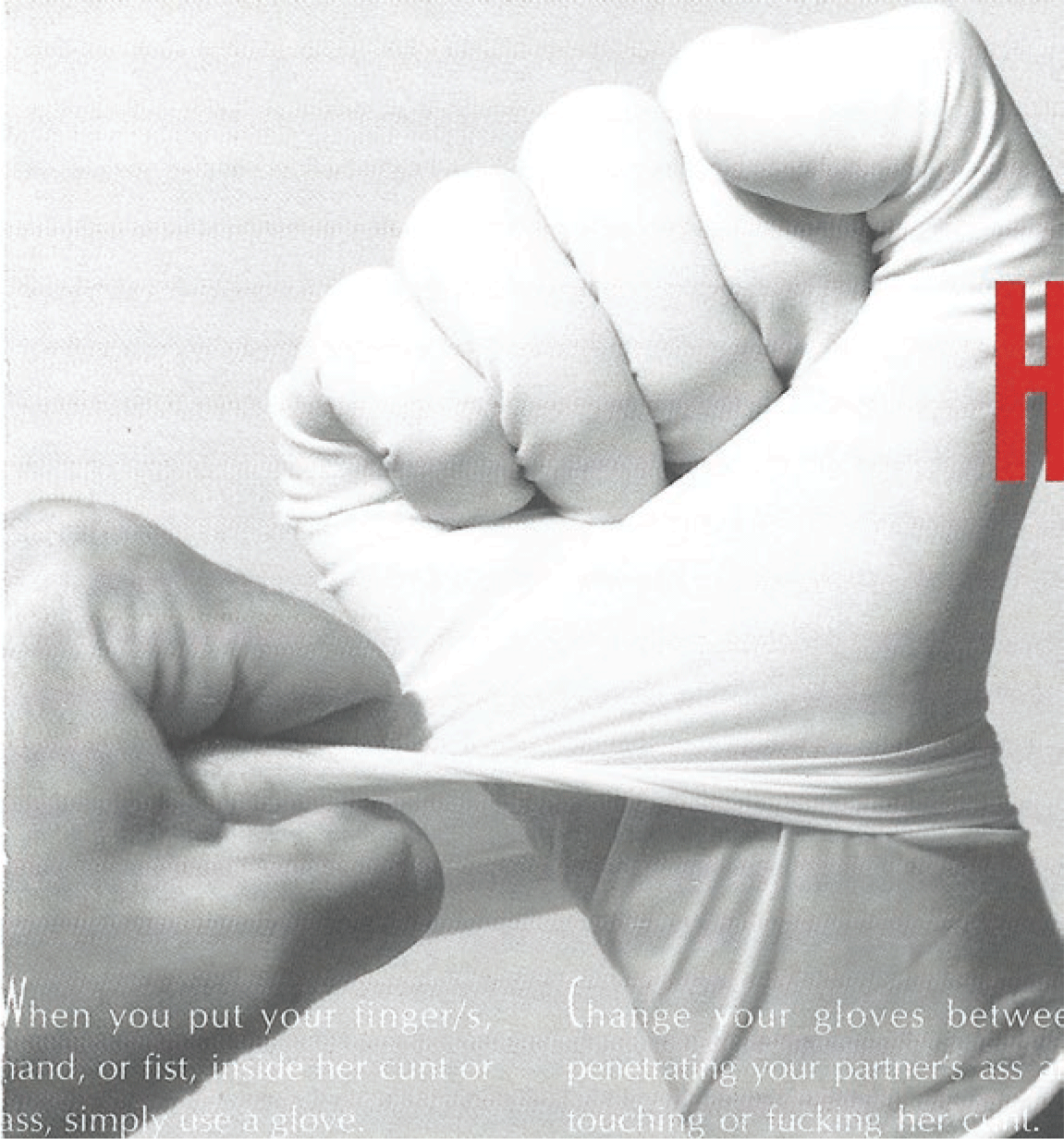
Page 6 in Safer Sex Handbook for Lesbians by Cynthia Madansky and Julie Tolentino, 1993. Lesbian AIDS Project—Gay Men’s Health Crisis. (Image courtesy of Joshua Lubin-Levy and “Ephemera as Evidence”)

Reflecting on Clit Club’s “attitudes toward sex and sexuality,” McPherson shares, “I learned that being a sexual being is not just OK, it’s good. This resonated for me even before I learned that being a lesbian is not just OK, it’s good” (in Tolentino et al. Reference Tolentino, Crockett, Hart, Khusro, Kang and Mansion2018b:478). Her analysis rebuts the disarticulation of sex and homosexuality on which Doris’s shaming rhetoric rests. Clit Club embraced all that might be pathologized as “grotesque,” “vulgar,” and “insensitive,” making it intrinsic to the spirit of the party—what McPherson describes as “the freedom I felt in the club that allowed anyone to be who/whatever they wanted to be” (478). Flipping through the “Safer Sex Handbook for Lesbians,” written by Tolentino and Cynthia Madansky and distributed throughout Clit Club in the early ’90s, one comes to a spread on “Finger(s), Hand, Fist.” The handbook—which progresses from “Mouth, Lips, Tongue” to information on toys, needles, bloodletting, water sports, and welts—reads both as a manual for protecting oneself and one’s partners from the transmission of HIV and STIs, and for learning the ins and outs of the many ways that lesbian sex can unfold. On this particular pair of pages, the image on the left shows a hand pulling a latex glove firmly around its other half, which is tightly gripped into the shape of a fist. On the right, instructions are provided: “For safe penetration, use a slippery, lubed up latex glove to enable one finger or a whole fist to safely rock her into a frenzy” (Madansky and Tolentino Reference Madansky and Tolentino1993). In the ricochet between Doris’s description and the handbook’s suggestion, the image of the latex gloves multiplies. Laundry hung out to dry on the city block evokes a future or former occupation, when material will have clung around someone’s hand on its way to being enveloped inside another’s flesh. The surround, now surrounded, folds in on itself.