Experimental and discussion
Guar [Cyamopsis tetragonoloba (L.) Taub.] is a diploid (2n = 14), drought-tolerant, summer-annual legume, grown primarily in India and Pakistan. Guar is used as a green manure for crops, as forage for cattle, as a vegetable for human consumption and as a laxative (Hymowitz and Matlock, Reference Hymowitz and Matlock1963; Whistler and Hymowitz, Reference Whistler, Hymowitz, Whistler and Hymowitz1979). Guar seeds contain a high amount of total dietary fibre (55%) and have been widely used as nutraceutical and pharmaceutical additives (Morris, Reference Morris and Goodman2004). Although guar seeds have been used in pharmaceuticals, nutraceuticals and industrials, the composition and content of isoflavonols and flavonols in guar seeds are unknown. The objectives of this study are to: (i) determine the concentration and variability of daidzein, genistein, kaempferol and quercetin in guar accessions by HPLC; (ii) detect correlation between the content of various flavonoids; (iii) compare the flavonoids in guar seeds with those in soybean seeds; and (iv) encourage guar seed utilization by providing information related to flavonoid content.
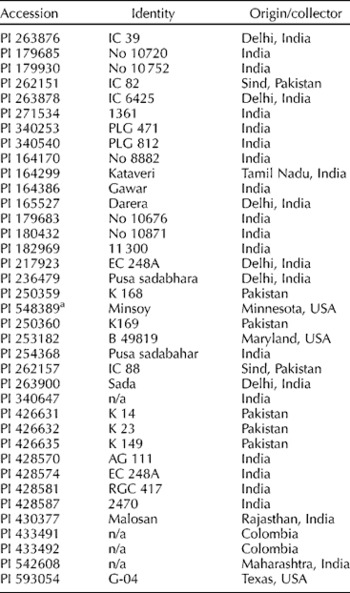
Guar seeds from 36 accessions and soybean seeds from one accession were obtained from the USDA-ARS, Plant Genetic Resources Conservation Unit and soybeam genetic resources management unit (SGRMU), respectively. Their accession numbers and collection sites are listed in Table 1. Seeds from each accession were planted in the greenhouse and pods were harvested based on seed physiological maturity. For flavonoid analysis, a standard curve of daidzein, genistein, kaempferol and quercetin was established using reagents purchased from Sigma (St Louis, MO, USA). Supernatant was extracted from ground seed tissue with 80% methanol (containing 1.2 M hydrochloric acid for hydrolysis). Two independent extractions were made from each accession. The supernatant was filtered through a 0.2 μm syringe filter prior to injection into an HPLC system. Flavonoid separation was performed on the Agilent 1100 series HPLC system. A one-way ANOVA was conducted using the software package SAS OnlineDoc® 9.1.3 (SAS Institute Inc., Cary, NC, USA) and Fisher's protected least significant difference (LSD) test was used to compare means. A Pearson's correlation coefficient analysis was performed to determine the correlations between flavonoid contents.
Selected guar accessions

n/a, no data available.
a Soybean accession was used as a check for comparison.
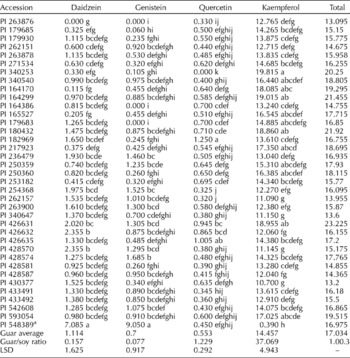
Variation for all four flavonoids is statistically significant at P < 0.0001. The variation from replications was not statistically significant except for diadzein which was significant at P < 0.05. Therefore, the variability of flavonoid contents detected by HPLC mainly came from the difference of germplasm accessions (i.e. the difference of genotypes). Flavonoid contents in guar seeds from different germplasm accessions are listed in Table 2. Significant variation of the isoflavonoids (daidzein and genistein) was detected among guar accessions. For example, PI 263876 from Dehli, India contained neither daidzein nor genistein (not detectable using HPLC), while PI 426632 from Pakistan and PI 428570 from India contained a high amount of daidzein (2.355 mg/100 g). PI 428574 from India contained the highest amount of genistein (1.685 mg/100 g). The average amount of daidzein and genistein in guar seeds was 1.114 mg/100 g and 0.7 mg/100 g, respectively, which was much lower than that observed in soybean seeds (7.085 mg/100 g and 9.050 mg/100 g from PI 548389). Therefore, guar seeds would not be a good source of isoflavonoids. However, there was significant variation in flavonols (quercetin and kaempferol) among guar accessions. PI 340253 from India contained no quercetin but had the highest concentration of kaempferol (19.815 mg/100 g). PI 182969 from India contained the highest concentration of quercetin (1.250 mg/100 g). The average amount of quercetin in the guar seeds was 0.553 mg/100 g, similar to the amount observed in the soybean seeds (0.450 mg/100 g). However, the average amount of kaempferol in guar seeds was 14.457 mg/100 g, and significantly higher than that observed in the soybean seeds (0.390 mg/100 g). Therefore, guar seeds appear to be a very good source for kaempferol. Although there were significant differences in the concentration of these four flavonoids between guar and soybean seeds, the total amounts on average were similar (16.975 mg/100 g in soybean versus 17.034 mg/100 g in guar; Table 2).
Comparison of different flavonoids in guar seeds (mg/100 g)

LSD, least significant difference.
Means with the same letter are not significantly different.
a Soybean is used as a check for comparison.
Daidzein, genistein, quercetin and kaempferol are synthesized from the same biosynthetic pathway in soybean seeds (Koes et al., Reference Koes, Quattrocchio and Mol1994; Dhaubhadel et al., Reference Dhaubhadel, McGrarvey, Williams and Gijzen2003). Since soybean and guar belong to the same legume family, their biosynthetic pathway for these flavonoids could be very similar. Therefore, the correlations between the content of various flavonoids in guar seeds were calculated. There was a positive correlation between daidzein and genistein (r = 0.8760, P < 0.0001); however daidzein was negatively correlated to kaempferol (r = − 0.5842, P < 0.0001) and genistein was negatively correlated to kaempferol (r = − 0.6317, P < 0.0001) in guar seeds. Isoflavonoid synthase (IFS plus other enzymes for daidzein and genistein) and flavonol synthase (FLS plus other enzymes for quercetin and kaempferol) use the same upstream substrates for the competition of isoflavonoid and flavonol synthesis. This may explain the negative correlation of daidzein and genistein with kaempferol.
Extensive variability was observed in flavonoids among seeds of 36 guar accessions. In general, guar seed contains very low amounts of daidzein and genistein, a low (but higher than soybean) amount of quercetin, and a high amount of kaempferol. The amount of daidzein and genistein was significantly and positively correlated while both were significantly and negatively correlated to kaempferol. As an economic crop, guar seeds not only contain a high amount of dietary fibre but also a high amount of kaempferol. The nutraceutical and pharmaceutical utilization of guar needs to be further explored.
Acknowledgements
The authors gratefully thank Mr J. Davis for his assistance with statistical analysis, Dr R. Nelson for providing soybean seeds and Ms M. Reed for her excellent technical assistance.