Requiring a short research paper in introductory political science courses can prove challenging for instructors, in part because of the diversity of student grade levels and majors in such courses. This is particularly the case with Introduction to Comparative Politics, as, at most universities, this course is not only required for the political science major, but often also fulfills multicultural requirements and can be used to complete lower division social science requirements. In deciding whether to include a research paper assignment in this course, one must weigh the benefit of catching majors early in order to begin building strong research skills, as well as the benefit of immersing students in key issues affecting the larger world, against the challenge of underdeveloped writing and research skills among the typical student in such a course. Another factor to consider is the grading load of reading large numbers of papers, given that most introductory courses have high enrollments. When choosing to require a research paper under these circumstances, then, one must also commit to working with students to hone their research and writing skills. In a collaborative, mutually beneficial partnership, college and library faculty can work together to identify ways to integrate information literacy concepts into course content and to design effective learning assignments addressing these important skills. This approach was undertaken by the authors, who revised a significant portion of the Introduction to Comparative Politics course at the University of West Florida to integrate information literacy activities in support of a semester-long, content-based research and writing assignment. This article explores using information literacy exercises as a tool to produce higher quality research papers in lower division political science courses.
What Is Information Literacy?
Broadly defined, information literacy consists of a “set of abilities requiring individuals to recognize when information is needed and have the ability to locate, evaluate, and use effectively the needed information” (ACRL 2000). Based on the Association of College and Research Libraries' (ACRL) Information Literacy Standards, an information literate individual is able to:
- Recognize a need for information
- Determine the extent of information needed
- Identify and locate appropriate information sources effectively and efficiently
- Apply research skills to scholarly, professional, and personal information needs
- Critically evaluate the quality and usefulness of information in a variety of formats
- Incorporate selected information into one's knowledge base
- Apply technology appropriately and competently
- Use information ethically and effectively to accomplish a specific purpose, including communicating information knowledgeably and persuasively to others
- Understand the economic, legal, and social issues surrounding the use of information, such as plagiarism, citation styles, copyright, intellectual property, and the research and publishing process
Using information effectively includes communicating it to others through oral and written presentation. Such skills are highly transferable both inside and outside of the university environment. At universities, information literacy concepts provide students with better information processing skills, which enable them to identify, analyze, and apply information resources to their academic experience regardless of discipline, learning environment, method of instructional delivery, or level of education.
A myriad of information has been published over the past decade in the library science and education-related literature on the theory, practice, and value of information literacy. It also remains one of the primary topics of interest among academic librarians in their research and publishing, conference discussions and presentations, and coverage in workshops and seminars.1
University of West Florida's (UWF) general information web page on information literacy, found at http://library.uwf.edu/reference/InfoLiteracy.shtml, provides additional information.
A number of books now offer practical advice and sample assignments for use by both librarians and instructors. Four recent examples include Teaching Information Literacy: 35 Practical, Standards-Based Exercises for College Students,2
This book was purchased for each participant in UWF's 2004 Information Literacy Workshop.
The full citations for these four books are as follows: Joanna M. Burkhardt, Mary C. MacDonald, and Andrée J. Rathemacher, Teaching Information Literacy: 35 Practical, Standards-Based Exercises for College Students (Chicago: American Library Association, 2003); Jane Birks and Fiona Hunt. Hands-On Information Literacy Activities (New York: Neal-Schuman, 2003); Elaine Andersen, Learn Basic Library Skills (Lanham, MD: Scarecrow Press, 2002); and Carla List, Information Research, 2nd ed. (Dubuque: Kendall/Hunt, 2002).
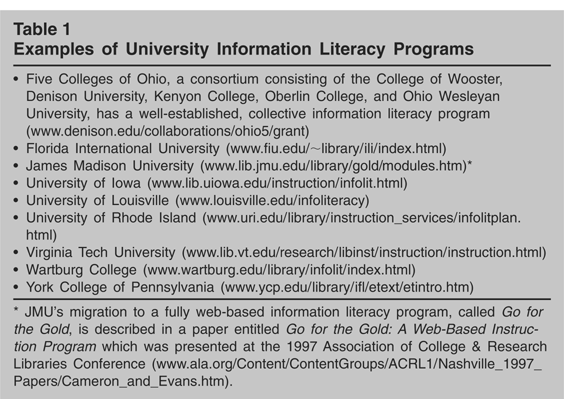
Examples of University Information Literacy Programs

Despite the thorough coverage of information literacy in the fields of library science and education, the concept has yet to make deep inroads into specific disciplines far beyond its obvious application in introductory English composition classes. Several bibliographies, nonetheless, outline various information literacy resources in various disciplines. Information Literacy in the Disciplinary Literature offers a brief and somewhat dated bibliography of articles published in academic journals (Jordan-Baker 2000). Slightly longer, yet as dated and focusing largely on library instruction, rather than information literacy, is Lorenzen's compilation (n.d.). The most current and comprehensive, although still limited, is the well-organized New Mexico State University offering (n.d.), which primarily links to online syllabi for information literacy-related courses at selected institutions nationwide. Furthermore, Grafstein's (2002) “A Discipline-Based Approach to Information Literacy” discusses in detail information literacy initiatives within individual disciplines.
“Information literacy” is not yet a descriptor entry in the thesaurus for the Worldwide Political Science Abstracts (WPSA) database. Likewise, entering it as a keyword phrase in the resource returns only one result.4
As of December 13, 2004.
John Carlo Bertot, “The Multiple Dimensions of the Digital Divide: More than the Technology ‘Haves’ and ‘Have Nots.’” Government Information Quarterly 20, no. 2 (2002): 185–191.
While they do not specifically use the term “information literacy,” articles that address the principles and activities comprising information literacy within the discipline of political science have been published. Two dated examples include those from Boenau (1990) and Tuckett and Pryor (1983), which discuss reference sources used in comparative politics and research strategies for political science, respectively. Additional articles include Van Ullen and LaFond's (2000) discussion of bibliographic instruction focusing on European Union depository collections, and Kuzma's (1998) selection concerning use of the Web to promote active learning in the international relations classroom. More recently, Hamann and Wilson (2003) also addresses use of the Internet to enhance active learning and critical thinking and analysis skills among students through the use of five online exercises assigned in various political science courses. Finally, Sherman and Waismel-Manor (2003) presents ideas on how instructors of both writing and political science can develop exercises “to assist citizens and professionals to improve their writing skills concerning political issues.” Similar to the practice of this article's authors, Sherman utilized political science subject matter to advance students' writing and communication skills.
Despite the absence of the phrase “information literacy” in the political science literature, many instructors are slowly beginning to adopt and incorporate it into their course syllabi, as illustrated by the current article. Further examples include Deborah Gerner's (1998) Political Science 670 course, U.S. Foreign Policy, at the University of Kansas. In addition to outcomes indicating student gains in problem solving, analytical skills, independent thinking, writing proficiency, and other skill sets, another stated learning outcome is to increase students' “information literacy by becoming familiar with key library resources relevant to the study of foreign policy.” The syllabus further requires frequent use of print and electronic reference sources, includes a graded library exercise, and specifies that librarians will conduct hands-on library instruction in support of the course's goals. More extensively, Lowery's (1996) PLS 210 course, Library Research Methods in Political Science, the first of a two-course series, offers greater integration of information literacy outcomes. Topics covered include search strategies appropriate to the specialized finding aids and reference sources of the major subfields of the discipline; finding aids for books, articles in edited books, periodicals, government documents, and compilations of statistics, biographies, and news chronologies; location, content, and use of basic political reference works, including specialized encyclopedias, dictionaries, almanacs, and directories, as well as primary and secondary sources for legal research; and creation of an annotated bibliography using APSA style guidelines for manuscript writing. Similar to the course summarized in this article, Lowery's syllabus states expected outcomes such as the abilities to think, speak, and write with insight and precision—i.e., to ask meaningful questions; to pose relevant, testable hypotheses; to locate and evaluate relevant published research; to collect appropriate empirical evidence; to use computer and statistical tools to analyze the data; to draw warranted conclusions; and to report results effectively in oral and written form to friends, colleagues, instructors, and employers. The course culminates with a 150-point final exam consisting solely of a library search exercise.
Why Is Information Literacy Important for Political Science?
A survey conducted at the University of California at Berkeley in late March 1994 was designed to “better understand and document the library skills acquired by graduating seniors in the Political Science and Sociology departments during the course of their studies at UC Berkeley. The researchers hoped that the results of this empirical study could be used to convince faculty of the need for more extensive use of course integrated library instruction in the Cal undergraduate educational experience” (Maughan 1994). Seventy-one percent of graduating seniors in political science responded after 386 surveys were mailed to all graduating seniors in both departments. While students overwhelmingly rated their library skills as fair, pretty good, or excellent, approximately 63% of the graduates received poor to failing scores on the survey questions. Only 1.2% of the students scored 90% or higher in correctly answering the survey questions. A question-by-question review of the responses revealed that fewer than 50% of the respondents were able to properly search for library materials by subject, correctly identify citations to books and journal articles, limit online search results by language, recognize and identify key reference sources in the social sciences, or recognize and identify key electronic sources in their subject major. Interestingly, 62% of high scorers in political science reported having had library instruction during their years at Cal. Upon returning their completed survey to the Librarian's Office, many of the students reflected on their own library skills remarking, “I wish I had known this before I graduated” (Maughan 1994). While this study was conducted a decade ago, the need for strong information literacy skills not only remains high, but has significantly increased since then, while students continue to overestimate their abilities in these areas.
Teaching Information Literacy in Introduction to Comparative Politics
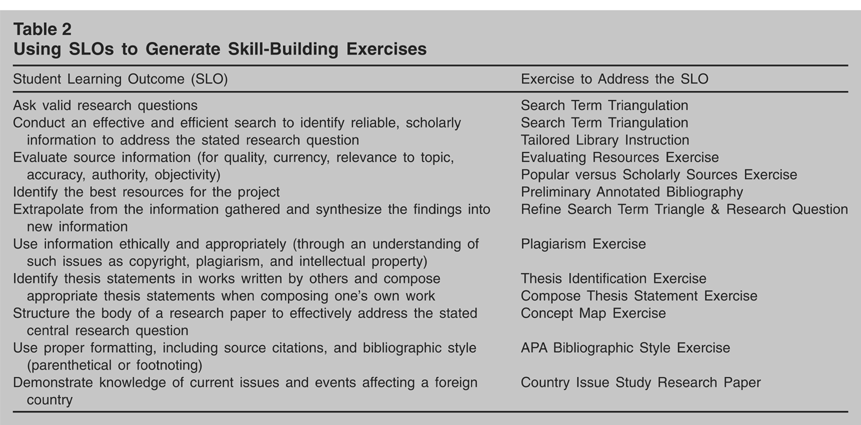
The goal of this project was to enhance student information literacy skills while improving the quality of research papers in Introduction to Comparative Politics; the first step was to identify the desired Student Learning Outcomes (SLOs). These SLOs were then used to structure the information literacy series utilized throughout the course. A minimum of one exercise was developed to specifically address each SLO (Table 2).
Using SLOs to Generate Skill-Building Exercises

The information literacy exercises were introduced over the course of the semester, interspersed with country-specific lectures and classroom discussion. In scheduling the exercises, the objective was to keep students progressing steadily through the research project, while allowing them time to absorb and digest the information from each activity before advancing to the next stage of the project. Generally, this meant introducing one topic per week that built upon the preceeding weeks' topics in a logical progression through the research project. Students, therefore, began in an abbreviated research design phase and moved through developing and hypothesizing answers to a research question through organizing and structuring the paper prior to writing the final product.
Throughout the course, the professor reinforced that learning information literacy skills in addition to the regular course content was designed to help students improve their grades on the final research paper. This paper was then weighted to comprise the most significant grade component of the course. By placing such heavy emphasis on the paper, the professor conveyed the importance and relevance of the information literacy exercises to students in this course, even when such activities might initially be viewed as more germane to an English composition course.
For the research paper assignment, referred to as the Country Issue Study, students were asked to select one country outside of the United States and to explore a contemporary issue, whether social, political, or economic, facing that country. The paper should provide analysis of the dimensions of the problem, describe its effects on the country, speculate about possible solutions, and discuss the likelihood of those solutions based on the present context. The paper must be five to seven pages in length, utilize a minimum of six scholarly sources, and follow a structure whereby it begins with a thesis statement addressing the research question.
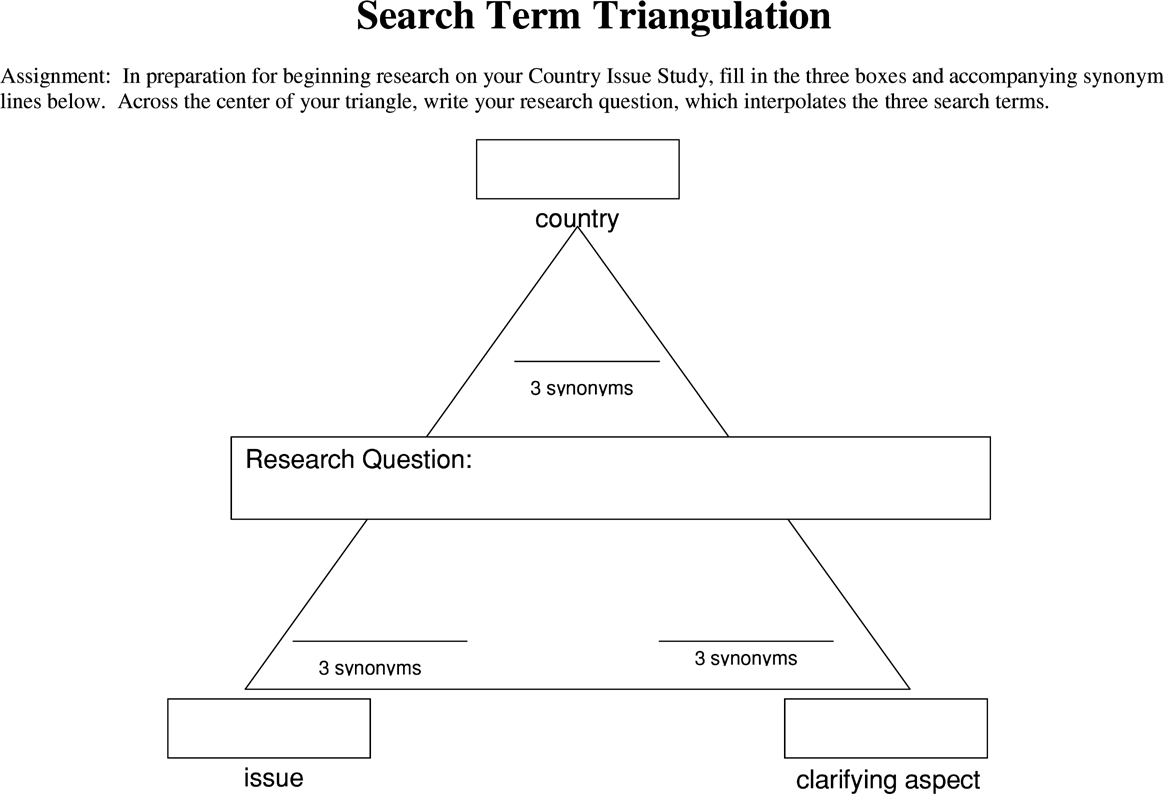
The first exercise in the information literacy series is the Search Term Triangulation assignment, which is designed to spur students to consider ideas for their paper topic, to focus on specific words that they can use in searching the library catalog and journal databases for information on the topic, and to think in terms of asking a research question which they will then use the research paper to answer. The motivation for this exercise is based upon the idea that all good research begins with a puzzle or question. The Search Term Triangulation exercise emerged out of a comment made during an earlier library instruction session. While demonstrating to students how to perform an advanced search for journal articles in a database, the librarian stated that two search terms or concepts often do not provide specific enough search parameters to yield the desired, focused results. However, three search concepts used in cooperation can be employed to precisely define the broad topic, a narrower focal point, and an additional clarifying concept. This combination of three elements tends to produce more narrow results and yield a list of resources targeting the topic more effectively. The exercise developed for the purpose of the Country Issue Study assignment requires students to insert a country at the top point of the triangle, an issue facing that country at the lower left point, and a clarifying idea at the lower right point (Figure 1). It further requires students to insert up to three synonyms for each term just inside the triangle diagram at each point, corresponding to library instruction describing truncation, thesauri, and use of alternate words when searching online catalogs and databases. Students are then asked to formulate a research question incorporating all three concepts and to write this question beneath the triangle diagram.

Search Term Triangulation Exercise Example
The student-completed Search Term Triangulation exercises are submitted to the librarian in advance of the first library instructional session tailored to the Country Issue Study. The librarian is then able to use the students' intended topics to demonstrate appropriate and effective search strategies and useful resources. This approach renders the overall instructional class much more student-centered and course-integrated than a generic session and, therefore, of greater interest and value to the students. Having the students begin to think about their topics before the library instruction and incorporating the students' own research questions into the session leads to taking more notes and asking better quality and a greater quantity of questions than in classes where the information literacy exercises were not employed. During library instruction, the librarian addresses not only basic search strategies, effective use of the library catalog and journal databases, and reference sources containing country-specific information, but also brings in selected print-materials addressing the students' specific research questions. Additionally, the librarian covers the topics of detecting bias in both print and electronic information sources, distinguishing between popular magazines and scholarly journals, and evaluating resources for appropriateness to a topic. Following the library instruction, the students are given two exercises designed to review and reinforce this information. One exercise covers the difference between popular and scholarly sources, while another reviews how to evaluate the validity, usefulness, and authority of a variety of sources, including those on the Internet.
Once students are engaged in initial research, the next step requires them to submit a preliminary bibliography. This exercise demands inclusion of 10 scholarly sources consisting of four books and six scholarly journal articles, even though the final paper requires only a total of six sources. This requirement encourages students to selectively evaluate the resources they have identified. In other words, they must choose the best sources from among those obtained for the paper during the initial research. The preliminary bibliography assignment asks students to provide an abstract for each journal article and a one-paragraph summary of key ideas covered by the chosen books. The students must provide one to two sentences explaining how they feel this resource addresses their research question and how they might use this particular resource for the paper. The goal is to have students think in terms of the utility of the resource for addressing the particular question that they are posing, in addition to assessing its academic quality and appropriateness.
Once the annotated bibliography is submitted and the professor's comments have been returned, students are given the opportunity to refine their Search Term Triangle and research question in light of the comments received. Often, their topic is too broad or narrow and they are asked to modify it accordingly. Other times, if the resources they have found do not appear to directly address the question that they are posing, they will be asked either to find alternate resources or to refine their topic and research question. The completion of this initial research stage provides a prime opportunity to sharpen the students' research focus prior to moving forward with the project.
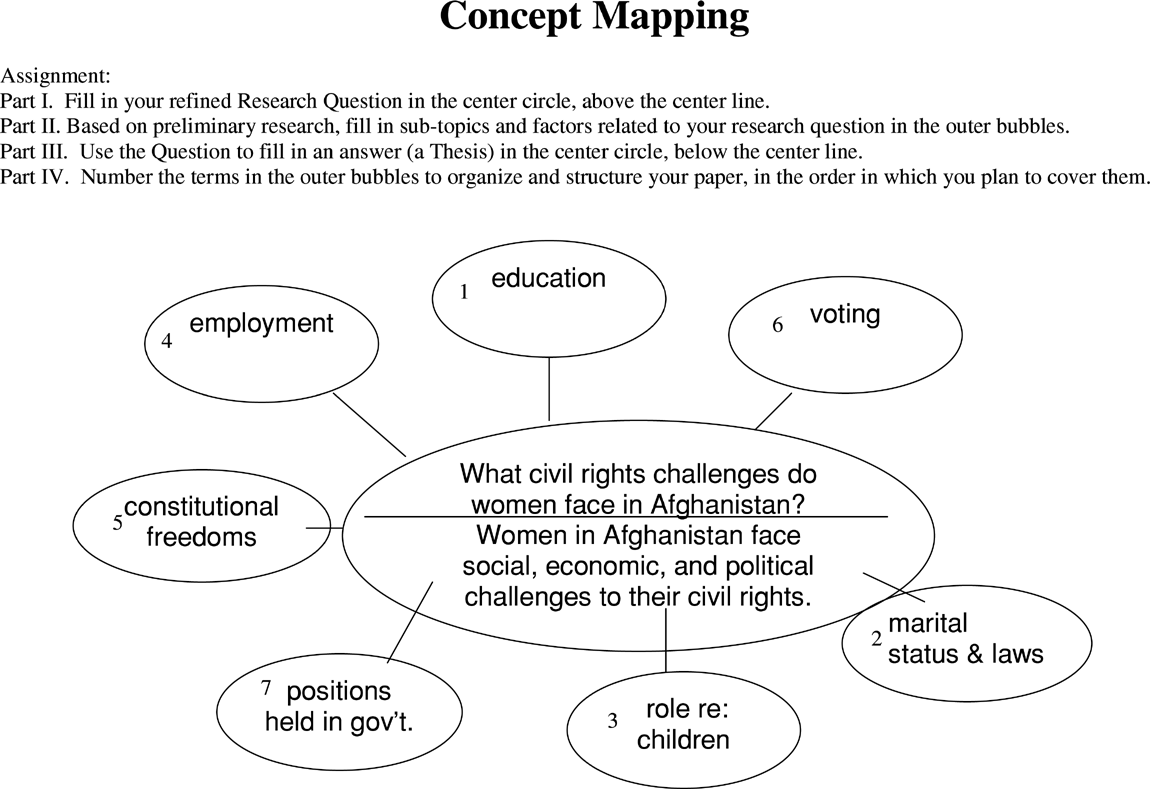
The next several exercises combine with in-class instruction on each topic to review some basics of scholarly writing, from academic integrity to the structural components of a research paper. A plagiarism exercise gives students a quotation from an article that is plagiarized in eight different ways. Students are then asked to identify the problem with each of the eight examples of that material. Next, a Thesis Identification exercise asks students to underline the thesis statement within three paragraphs taken from articles published in key journals from the political science discipline. After being taught to identify other authors' thesis statements in this manner, students must formulate their own thesis statements by answering the research question they developed based upon their research. Third, the professor introduces and demonstrates the technique of concept mapping, after which students complete a concept map for their particular research question. One week later, incorporating the professor's comments on their map, students number their concept map to indicate the order in which they plan to cover the various ideas as they write the final paper (Figure 2). This activity provides a way to visually structure the research question, appealing to visual learners and functioning much like a premeditated and logical outline for the paper. In the final exercise, students learn the basics of APA formatting style by correcting errors in the use of APA style in various citations. This is done to ensure that students remain consistent with one formatting style, as well as to remind them that, as a formal research paper, this assignment should be structured and formatted accordingly. APA style was selected as a mainstream style appropriate for the social sciences.

Concept Map Exercise Example
All of the instruction and exercises aim at improving the quality of the culminating assignment, the Country Issue Study. At each step, exercises combine with classroom instruction to teach information literacy skills. They are designed to lead the students systematically through the process of taking an empirical puzzle, formulating a research question, and answering that question. The goal is to introduce, develop, and foster skills to undertake high quality academic research, while also encouraging students to practice academic integrity and uphold high standards for their research. Information literacy provides the perfect vehicle for achieving these goals, as it endeavors to provide the tools so that individuals can identify and access information they need when they need it, as well as teaching the skills to evaluate and synthesize such material to produce new scholarship.
Findings and Analysis of Student Learning
To determine if the undergraduate students learned using the information literacy learning modules, we conducted a 22-item pre-test/post-test study (n = 76) in the comparative politics course over a three-semester period. Students were given an in-class pre-test to assess prior knowledge of information literacy skills. The information literacy series described in the previous section was administered over the course of each semester. The learning modules were designed using a blended format; both in-class and online lectures, information, and exercises were employed. After the treatment, a post-test was administered to assess student learning outcomes. Our expectation was that students would learn from the information literacy series and use the knowledge gained as a tool for writing better research papers.
The study was designed to determine the levels of learning outcomes students could achieve and the relationship between information literacy and performance on research papers. To address the levels of learning, Bloom's taxonomy of educational objectives was translated into learning outcomes. Bloom's classic work (1956) identifies six levels of learning: knowledge, comprehension, application, analysis, synthesis, and evaluation. The levels are hierarchical and span a continuum from concrete to abstract. Thus, the assessment test was constructed to evaluate lower and higher levels of learning, challenging students to accomplish outcomes from recall of facts to applying concept maps. Statistical tests employed to assess the effects of the information literacy learning modules were paired-samples t-tests and linear regression. All tests were analyzed at the .05 level of significance.
A paired-samples t-test was conducted to assess if significant learning occurred among students completing the information literacy modules. The results indicated that the post-test mean score (M = 15.04, SD = 2.60) was significantly greater than the pre-test mean score (M = 11.61, SD = 2.26), t = 8.50, p < .0005. Thus, based upon test scores, students learned from the information literacy treatment.
The student population was composed of lower division (freshmen and sophomores) and upper division (juniors and seniors) students. A paired-samples t-test also was conducted based upon class levels. The results for the lower division students were post-test mean score (M = 14.13, SD = 2.78) and pre-test mean score (M = 11.38, SD = 1.93), t = 4.73, p < .0005. The results for the upper division students were post-test mean score (M = 15.59, SD = 2.43) and pre-test mean score (M = 11.69, SD = 2.47), t = 7.16, p < .0005. Even though the upper division mean score was higher than the lower division mean score, the results indicated that each class level gained significant learning from the treatment.
Linear regression analysis was conducted to evaluate the prediction of the term paper scores from the post-test scores. A scatterplot of the variables indicated that they have a positive linear relationship since the paper scores increase as the post-test scores increase. The regression equation for predicting the term paper scores is

Since the 95% confidence interval for the slope (164.16 to 204.60) does not contain the value of zero, the post-test scores are significantly related to the term paper scores. Therefore, students who scored higher on the information literacy post-test tended to have higher term paper scores. Accuracy in predicting the term paper scores was moderate. The correlation between post-test scores and paper scores was .32. Approximately 10% of the variance of the paper scores was accounted for by its linear relationship with the post-test scores. Other writing skill criteria such as grammar, punctuation, and style also have to be considered in assigning the paper scores.
Conclusions
The old axiom “knowledge is power” could easily be a motto of information literacy-based learning. An information literate student has the power to ask the right questions, find appropriate information, perform focused analysis, and derive reasonable answers both at the university level and in the wider world. Our study shows that students both learned and applied their knowledge of information literacy through our series of instruction.
Using a two-stage analysis of the data collected over three semesters in the Introduction to Comparative Politics course, we arrive at two main findings. First, stage one analysis shows that student learning occurred through completion of the information literacy series of instruction, as students performed better on the post-test than on the pre-test. Second, stage two analysis demonstrates that information literacy skills correlate significantly with student performance in written work, where higher post-test scores are positively related to higher research paper grades. In sum, through our information literacy series, we taught students to apply information literacy knowledge to improve their proficiency at progressing logically through a research project. They also learned to communicate complex ideas more effectively. As a result of these two stages, students in introductory political science courses are better prepared for future challenges both inside and outside of the university setting.
Biographies
Michelle Hale Williams is assistant professor in the department of government at the University of West Florida. She teaches courses in comparative politics on Western Europe, Eastern Europe, and democratization. Research interests include right-wing extremism, political parties, nationalism and ethnic politics, and democracy. She is author of The Impact of Radical Right-Wing Parties in Western Europe (Palgrave McMillan, forthcoming 2006).
Kymberly Anne Goodson is the former head of reference and social sciences librarian, including the political science subject specialist, at the University of West Florida. While there, she also spearheaded the university's information literacy efforts. She is currently the assistant director for access services at the University of California at San Diego.
W. Gary Howard is director of the Center for University Teaching, Learning and Assessment at the University of West Florida. He has been the recipient of 13 national, state, and university teaching awards. His research on the use of contemporary technology in effective teaching and learning has been published in international and national journals; he has been an invited speaker at several international conferences.