INTRODUCTION
Two museums in the city of Liverpool have material from the Sanctuary of Artemis Orthia, Sparta: the Garstang Museum of Archaeology in the Department of Archaeology, Classics and Egyptology at the University of Liverpool, and World Museum, part of National Museums Liverpool.
The Sanctuary of Artemis Orthia, excavated by the British School at Athens from 1906 until 1910, has strong links with the University of Liverpool, as work at the site was initiated in 1906 by Robert Carr Bosanquet, then Director of the British School. Bosanquet was Professor of Classical Archaeology at the Institute of Archaeology at Liverpool, the predecessor of the present Department of Archaeology, Classics and Egyptology. He bequeathed much of his collection to Liverpool City Museum, the predecessor of the present World Museum. In addition, Bosanquet's successor as Professor of Classical Archaeology, John Percival Droop, loaned various items, including lead votives and pottery sherds from the Artemis Orthia sanctuary, to Liverpool City Museum in 1951, which were subsequently given on his death in 1963 as a bequest.
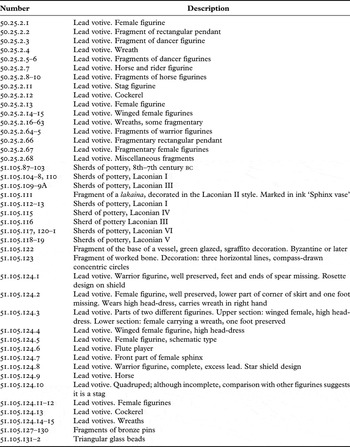
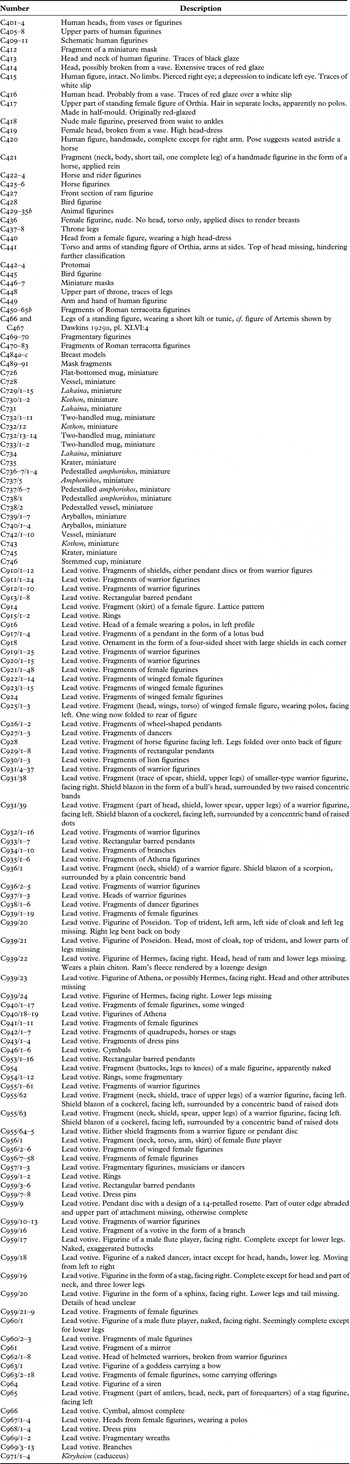
The artefacts from the Artemis Orthia sanctuary which are now in the collections in Liverpool (Table 1, Table 2) represent all periods of the use of the sanctuary, between the eighth century bc and the third century ad. They comprise lead figurines and miniature vessels, both characteristic of Laconian sites, as well as other types of pottery and terracotta figurines. Large and more extravagant offerings, such as items made from ivory or bronze (Dawkins Reference Dawkins and Dawkins1929b; Droop Reference Droop and Dawkins1929b), are not represented. However, the range of artefacts, particularly lead figurines, is impressive, and complements the material from the sanctuary which has already been published, primarily in the volume edited by Dawkins and published in 1929 (Dawkins Reference Dawkins1929). In addition, the collections include a few objects of exceptional interest, mentioned in the article with further details in the Appendix.Footnote 1
List of Votive Offerings from the Sanctuary of Artemis Orthia, Sparta, in National Museums Liverpool (World Museum).

List of Votive Offerings from the Sanctuary of Artemis Orthia, Sparta, in Garstang Museum, University of Liverpool.

Most of the artefacts in the Garstang Museum were a gift from the Ashmolean Museum, Oxford, which donated pottery and lead figurines from excavations at the Sanctuary (Annual Report of the Institute of Archaeology, University of Liverpool for 1925), originally given to the Ashmolean Museum by the Greek government through the British School at Athens. However, a few objects derive from individual archaeologists associated with the original excavations at the sanctuary. A miniature vessel in the Garstang Museum was part of the original Bosanquet Collection, donated by Bosanquet in 1906 (GM C745, a miniature krater), and some of the lead votives and pottery sherds in World Museum were part of Droop's collection. A further donation of lead votives, given to World Museum by a private individual (NML [WM] 50.25.2), is also included in this article as they are almost certainly from Laconia, although their exact provenance is unknown.
LEAD VOTIVES
The lead votives in the Liverpool collections with a secure provenance are part of the assemblage of over 100,000 lead votives found in the excavation of the Sanctuary of Artemis Orthia. It is possible that the group of non-provenanced Laconian votives in Liverpool is either from the Artemis Orthia sanctuary or part of the assemblage of at least 6,000 lead votives found in excavations at the Menelaion and other sites in Laconia. Although lead figurines, similar to those from Laconia, have been found at Olbia on the Black Sea (Gill and Vickers Reference Gill and Vickers2001, 235 n. 40), it is unlikely that the non-provenanced Liverpool material was found in a location other than Laconia.
Although there is evidence of increasing use of the site from the later eighth century bc onwards, it is unlikely that any of the figures were deposited much earlier than the middle of the seventh century bc. Most of the lead figurines from the sanctuary date to the period following the deposition of a layer of sand around 570 to 560 bc, with a peak in the second half of the sixth century bc. There is a decline in the fifth century bc and later.
Wace identified six chronologically distinct styles of figurines, corresponding to pottery styles: Lead O, Lead I, Lead II, Lead III–IV, Lead V and Lead VI (Wace Reference Wace and Dawkins1929, 251–2). All except Lead O are represented in the Liverpool collections. These designations are frequently also applied to chronological periods. Hodkinson (Reference Hodkinson, Fisher and Wees1998) has proposed a revised chronology, based on the conclusions of the original excavators (Dawkins Reference Dawkins1929), the revision by Boardman (Reference Boardman1963), and the findings of Cavanagh and Laxton (Reference Cavanagh and Laxton1984). Hodkinson's suggestion is that figurines may date from around 650 bc, with a peak in Wace's Lead III–IV (580–500 bc) of over 68,000 figurines (Hodkinson Reference Hodkinson, Fisher and Wees1998, 107, table 2).
The technique of casting the votives in moulds is apparent from the presence of excess lead on many of the figurines of various types (dancer: GM C927/3; ‘grille’: GM C913/7; warrior: GM C912/1; wreath: NML [WM] 50.25.2.45). Analysis of the Laconian figurines in other institutions suggests the lead was from Lavrion in Attica, mined from the silver beds (Gill and Vickers Reference Gill and Vickers2001, with references to earlier analytical work).
Figurine types
Several different types of figurine were found. One of the most popular types is the representation of warriors, dedicated from around 650 bc at the Sanctuary of Artemis Orthia, and from around 600 bc at the Menelaion. The warrior figurines first appear in ‘Lead O’, a period not represented in the Liverpool museums' collections, with 15 separate varieties in Lead I, 26 varieties in Lead III–IV, 10 varieties in Lead V and three varieties in Lead VI (Hodkinson Reference Hodkinson, Fisher and Wees1998, 107).
Some of the most characteristic figures represent warriors, both large and small types, the latter considered to be later in date. The most complete examples illustrate a warrior in a full set of armour (NML [WM] 51.105.124.1 and 51.105.124.8). The incomplete nature of most of the figures in Liverpool illustrates the weak parts of this type of figurine: the neck, the spear and the knees. The most distinctive element of the warrior figures is the shield design, and Boss (Reference Boss2000) classifies the figures in this way. All of the most common shield designs are represented in the Liverpool collections, namely concentric circles around a central boss (GM C955/2–9, C931/7–8, C931/1–6), straight lines radiating from a central boss (GM C955/10–22, C931/9–14, C931/15–19; NML [WM] 51.105.124.8), rosettes (GM C931/25–32, C932/9–12; NML [WM] 51.105.124.1) and curved lines radiating from a central boss (GM C919/21, C955/56–7). The rarer figured shield blazons are also represented in the Liverpool collections: bucranium (GM C931/38), cockerel (GM C931/39, C955/63) and scorpion (GM C936/1).
The other main type represented in the Liverpool collections is female figures, although in many cases the preservation of only the lower part of the figure makes interpretation as human votaries or supernatural females difficult to determine. Some votaries carry wreaths (GM C921/44, C924; NML [WM] 51.105.124.2) or branches (GM C963/3) similar to those represented as offerings in their own right (discussed further below). Another figurine carries a pomegranate (GM C963/2). Winged female figures, some wearing a polos (GM C916, C924, C940/7; NML [WM] 51.105.124.3; 51.105.124.4), are clearly supernatural, and are plausibly intended to be images of Artemis Orthia, the patron deity of the sanctuary. Some of the winged figures are schematically rendered (NML [WM] 50.25.2.15; 51.105.124.5), and are plausibly from the later period of Greek use of the sanctuary.
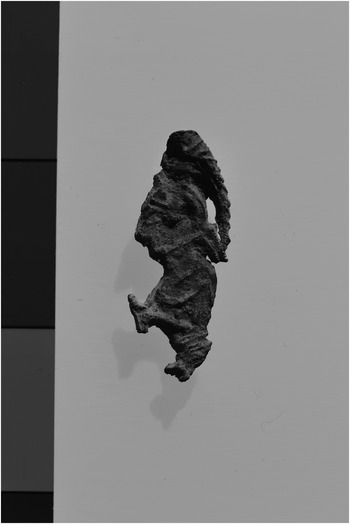
The Liverpool figurines include types which can be identified as Olympian deities: Poseidon (GM C939/20–1), Hermes (GM C939/22, C939/23, C939/24) and, in particular, Athena (GM C935/1–6, C940/18–19), who is recognisable by the snakes fringing her aegis. It is plausible that other armed female figures, such as those equipped with a shield (GM C939/1–4, C963/6–7; NML [WM] 51.105.124.12) or bow (GM C963/1; Appendix, item 1, Fig. 1), are intended to represent Athena. The latter type is particularly unusual, not included in the 1929 publication (Dawkins Reference Dawkins1929), although an example was found at the Menelaion (Wace 1908–9, 135–6, fig. 9.19). In the collection of Liverpool figurines, Hermes appears carrying a sheep as Hermes Kriophoros, a common theme in both major sculpture and the minor arts, with 38 examples being recorded in Lexicon Iconographicum Mythologiae Classicae. There are also two votives in the form of a kērykeion (GM C971/3–4), the caduceus or herald's wand that is one of the attributes of Hermes. The size of the kērykeia suggests that they were intended as a discrete offering rather than being broken from a figure of Hermes. Other supernatural creatures, the sphinx (GM C959/20; NML [WM] 51.105.124.7) and siren (GM C964), are also depicted.
Figurine of a goddess carrying a bow. Garstang Museum C963/1.

The Liverpool material also includes examples of the figurines of musicians and dancers which were frequent finds at the sanctuary. The musicians include individuals playing the flute (GM C923/15, C956/1, C960/1; NML [WM] 51.105.124.6) and the lyre (GM C923/14). The pose of others suggests that they are dancers (NML [WM] 50.25.2.3; GM C938/1–6; C960/3).
Images of animals and birds represented in the Liverpool collections are stags (GM C942/1–3, C942/7, C965; NML [WM] 50.25.2.11; 51.105.124.10), horses (GM C928, C942/5–6; NML [WM] 50.25.2.10; 51.105.124.9), lions (GM C930/1–3) and cockerels (GM C959/14–15; NML [WM] 50.25.2.12; 51.105.124.13), all of which can be interpreted as substitute sacrifices or animals associated with the hunt. An alternative interpretation would be an allusion to victory or warfare (Mitsopoulou-Leon Reference Mitsopoulou-Leon and Prêtre2009, 261).
The Liverpool collections have examples of the type of votives which were intended as smaller versions in lead of full-size offerings, whether of durable materials or ephemeral in nature. Offerings in the latter category well represented at Liverpool are votives in the form of wreaths (GM C969/1–2; NML [WM] 51.105.124.14; 51.105.124.15, several examples in the 50.25.2 series) and branches (GM C969/3–15), including an example of the realistic type found in the Hellenistic period (GM C959/16). The collections include representations of more durable objects including several pairs of dress pins (GM C968/1–4), a mirror depicted in miniature (GM C961) and finger-cymbals (GM C946/1–6, C966), although it is possible that the latter could be bosses from shields. Some figurines appear purely decorative, such as votives in the shape of the lotus (GM C917/1–4) or palmette (GM C919/25). Other decorative items are pendants in various forms, one type with large shields in each corner (GM C925/4), another in the form of a rectangle with openwork decoration (several examples in the Liverpool collections including NML [WM] 50.25.2.66 and GM C929/1–8) and the enigmatic ‘grilles’, whose meaning is unknown (several examples, including NML [WM] 50.25.2.2; GM C933/1/9, C953/3–16).
CERAMIC VOTIVES
Miniature pottery vessels
The Garstang Museum's collection includes examples of the miniature pottery vessels intended as votives, which are a characteristic of Laconian sanctuaries from the later seventh century bc until the third century bc (Catling Reference Catling, Cavanagh, Crouwel, Catling and Shipley1996, 84–5), although precise dating is difficult due to the technique of manufacture. The Garstang Museum's records indicate that all were found at the Sanctuary of Artemis Orthia.
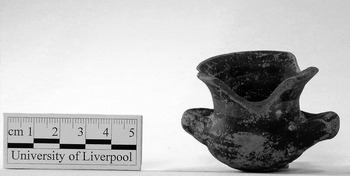
Most of the miniature vessels in the Garstang Museum are handmade, although a couple are wheelmade with handles added subsequently, such as GM C729/1, 2, 6. Miniature vessels were often left unglazed, such as GM C731, although many of the examples in the Garstang Museum are black-glazed, such as GM C732/1–13. The glaze is usually good quality, although on some vessels it has flaked into small slivers (Stibbe Reference Stibbe1989, 14). Examples in the Garstang Museum demonstrate this, such as GM C729/7 and C732/3. Only a few flecks of slip remain on a couple of vessels (GM C729/11 and C739/11). Red oxidised areas are frequently found on miniature vessels from Laconia. Examples in the Liverpool collections are GM C729/2 and C729/4–6. The only additional decoration on vessels in the Liverpool collections are thin lines around the body, rendered in cream-coloured slip (GM C729/1 [Appendix, item 2, Fig. 2], C729/3, C729/6 and C729/15).
Miniature lakaina. Garstang Museum C729/1.

At least seven different shapes are represented in the Liverpool collections, although some examples are so poorly fashioned that it is difficult to determine the full-sized vessel on which they were based. This is particularly noticeable in the case of miniature amphorae, such as GM C736 and C738/1–2, a type which was particularly common at the Sanctuary of Artemis Orthia (Droop Reference Droop and Dawkins1929a, 106–7, fig. 82:k,l).
The miniature pottery vessels in the Garstang Museum include a group of lakainai (GM C729/1–15, C731 and C734), characterised by a rounded bowl and a high cylindrical wall rising from it, with two horizontal handles attached to the bowl. The full-size versions of lakainai, the most common type of drinking vessel in Laconia in the seventh and sixth centuries bc, were made especially for the local market, and the shape is relatively rare outside Laconia.
Another typical Laconian vessel shape, which is well represented in the Garstang Museum, is the one-handled mug or kothon (GM C726, C730/1, C732/12, C743). The two-handled mug, which should be treated as a separate type of vessel from the one-handled mug (Stibbe Reference Stibbe1994, 47), is also well represented (GM C732/1–11, C732/13–14, C733/1–2). All the mugs have a curving body with a low rim. Stibbe (Reference Stibbe1994, 48) comments that entirely black-glazed full-sized examples are rare. This would appear not to be the case with miniature versions, as shown by the number in the Garstang Museum.
There is also a group of miniature aryballoi in the Garstang Museum (GM C739/1–7, C740/1–5). They exhibit marked variation in the shape of the body of the vessel and, accordingly, parallels with full-sized vessels are difficult to trace. All the vessels in the Garstang Museum have a flat base; as Catling observes (Catling Reference Catling and Sanders1992, 66), this is usually the case with Laconian miniature vessels of this type, unlike the full-size examples. The small pots, similar in shape to aryballoi but lacking a handle (GM C742/1–10) are also represented in the Garstang Museum's collection. These also have a small opening, and are clearly related in nature.
Sherds from full-sized pottery vessels
The pottery sherds from full-sized vessels in the collection of National Museums Liverpool represent most of the phases of the use of the Sanctuary of Artemis Orthia. The earliest group (eighth century bc to 650 bc) is divided by Droop and described as ‘Geometric Early’ (NML [WM] 51.105.87, 89–90, 92–94), ‘Geometric Later’ (NML [WM] 51.105.95–102A) and ‘Sub-Geometric’ (NML [WM] 51.105.103) in a notebook, now in the collections of National Museums Liverpool and labelled in Droop's handwriting ‘List of antiquities in the possession of J.P. Droop. December 1948’.
Also represented are the styles named Laconian I (650–620 bc; NML [WM] 51.105.104, 105, 107, 108, 110, 112, 113), Laconian II (620–580 bc; NML [WM] 51.105.111), Laconian III (earlier sixth century bc; NML [WM] 51.105.116), Laconian IV (later sixth century bc; NML [WM] 51.105.115), Laconian V (500 to 425 bc; NML [WM] 51.105.118, 119), and Laconian VI (425 to 350 bc; NML [WM] 51.105.117, 120, 121). The sherds are marked in ink ‘Orthia’, usually followed by the period, in a very distinctive style of handwriting, which corresponds to Droop's.
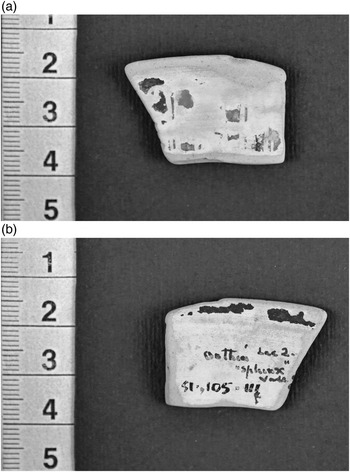
The most notable Laconian sherd in the collection of National Museums Liverpool (WM 51.105.111; Appendix, item 3, Fig. 3a–b ) is a fragment of a lakaina decorated in the Laconian II style and marked ‘Sphinx vase’ in ink on the reverse. In his notebook, referred to above, Droop records: ‘The “Sphinx” vase was made up from pieces found in all four years of the excavation. After the first year I brought home a few sherds to get the ware identified, and it was only on returning to England in 1909 that I spotted this sherd as belonging to that particular vase. The ware being very friable I thought the vase would suffer more by having this fragment inserting than by going without it.’ To Droop it appeared obvious that the sherd now in Liverpool was part of a lakaina from the Sanctuary of Artemis Orthia (Droop Reference Droop and Dawkins1929a, 76–77, pls. VII and VIII); the name ‘Sphinx Vase’ derived from its distinctive decoration.
a–b. Fragment of the lakaina known as the ‘Sphinx Vase’. National Museums Liverpool (World Museum) 51.105.111.

Terracotta votives
The terracotta votives in the Garstang Museum fall into two main chronological groups: Archaic (seventh and sixth centuries bc) and Roman, all of the latter of which are post-ad 250. They were either modelled by hand or made in a mould, with no examples of wheelmade terracotta votives.
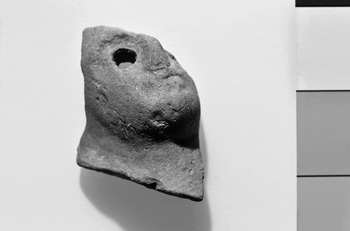
The most distinctive terracotta objects found in the Artemis Orthia sanctuary are masks in the shape of the human face, represented in the Garstang Museum by a group of fragments of masks consisting of noses (GM C489a and b) and brow ridges (GM C490a and b). The fragments in the collection suggest that the majority of the masks were the size of the average human face, although some of the later masks in the series in the Garstang Museum are smaller (GM C489c; nose and part of the forehead) or miniature in size (GM C412; Appendix, item 4, Fig. 4). None of the fragments of masks in Liverpool shows evidence of being painted.
Fragment of a miniature mask. Garstang Museum C412.

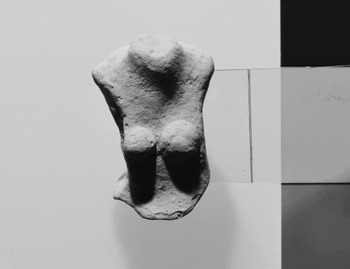
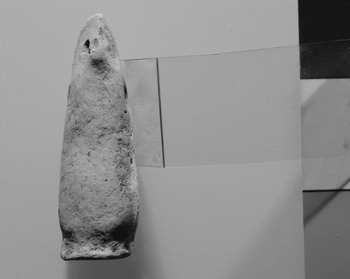
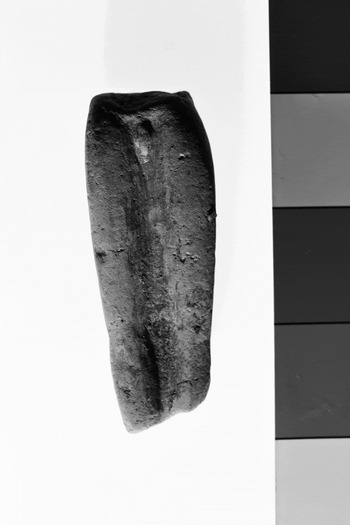
Distinctive Archaic terracotta figurines found in the Sanctuary of Artemis Orthia depict a female in a very static pose (Dawkins Reference Dawkins and Dawkins1929a, type I), resembling a xoanon (ancient cult image), of which there are two examples in the Garstang Museum (GM C417, C441). This type of statuette is found not only in Laconia during the seventh and sixth centuries bc, but also at the Sanctuary of Artemis Hemera at Lousoi (Mitsopoulou-Leon Reference Mitsopoulou-Leon and Prêtre2009, 263–4, fig. 6). A much more unusual figurine, represented in the Garstang Museum, is of a nude female figure (GM C436; Appendix, item 5, Fig. 5). There are also three fragments of thrones in the collection (GM C448 [seat], C437 and C438 [legs]), of the type associated with a female deity. Female heads in the collection are unlikely to have been elements of complete figurines and may have been broken from vases (GM C414, C416, C419, C442, C443, C444). The same may be true of some of the male heads (GM C401, C402), although in other instances it is clear that the heads were elements of complete figurines (GM C403–413). A particularly interesting example of a votive, of indeterminate gender, is a limbless figure, its facial features schematically rendered (GM C415; Appendix, item 6, Fig. 6). Also noteworthy in the collection is the lower part of a male figurine, made in a half-mould (GM C418; Appendix, item 7, Fig. 7).
Terracotta figurine of a nude female. Garstang Museum C436.

Terracotta figurine. Garstang Museum C415.

Terracotta figurine of a nude male. Garstang Museum C418.

Among the most frequent finds of animal terracotta votives at the Sanctuary of Artemis Orthia are horses. The Garstang Museum's collection has riderless examples (GM C421, C425–6) or examples with a rider (GM C422–424). The collection also includes a figurine of a rider, although the horse is not present (GM C420). Other figurines in the Garstang Museum may be interpreted as substitutes for real sacrificial animals: examples are a ram (GM C427) and a bird (GM C428). The precise species of other quadrupeds (GM C429–433, 425a and b) are more difficult to ascertain due to post-depositional factors.
The group of Roman terracotta votives, all of which (as previously noted) can be dated to post-ad 250, in the Garstang Museum's collection, is representative and includes examples of some of the main types from this period from the Artemis Orthia sanctuary (Dawkins Reference Dawkins and Dawkins1929a, 160–2). Specific categories represented in the collection are figures wearing a conical cap (best preserved GM C460.1, C461), standing draped figures (best preserved GM C455 [upper body], GM C469 [lower body]) and fragments of Artemis figurines (GM C466, C467, C471).
ACKNOWLEDGEMENTS
I would like to thank colleagues and former colleagues at the University of Liverpool and National Museums Liverpool for their assistance, particularly Steven Snape, Cordula Werschkun and Ben Jones. The study of the votive offerings from the Sanctuary of Artemis Orthia now in the Garstang Museum was part of a project funded by the Arts and Humanities Research Council.
APPENDIX: NOTEWORTHY OBJECTS IN LIVERPOOL COLLECTIONS
-
1. Garstang Museum C963/1 (Fig. 1).
Description: Figurine of a goddess carrying a bow.
Material: Lead.
Height: 34 mm.
Date: 580–425 bc.
Comparanda: Wace Reference Wace1908–9, fig. 9:19.
-
2. Garstang Museum C729/1 (Fig. 2).
Description: Miniature lakaina. Black-glazed. Added cream band part-way down exterior wall and on interior of rim.
Material: Pottery.
Height: 41 mm.
Date: 7th–6th century bc.
Comparanda: Stibbe Reference Stibbe1994, fig. 14.
-
3. National Museums Liverpool (World Museum) 51.105.111 (Fig. 3a –b).
Description: Fragment of a lakaina, decorated in the Laconian II style. Marked in ink ‘Sphinx vase’. A fragment of a lakaina shown in Droop Reference Droop and Dawkins1929a, 76–7, pls. VII and VIII.
Material: Pottery.
Dimensions: 32 mm × 23 mm.
Date: 620–580 bc.
-
4. Garstang Museum C412 (Fig. 4).
Description: Fragment of a miniature mask, extant eye pierced. Unglazed.
Material: Terracotta.
Fabric: Munsell 2.5 YR 5/6.
Height: 55.5 mm.
Date: 425–250 bc
Comparanda: Dawkins Reference Dawkins and Dawkins1929a, 153–4 Type XI, pl. XXXVIII:6–11.
-
5. Garstang Museum C436 (Fig. 5).
Description: Nude female figurine. No head, torso only, applied discs to render breasts. Concave back.
Material: Terracotta.
Fabric: Munsell 5 YR 6/6.
Height: 35 mm.
Date: Around 6th century bc.
Comparanda: Dawkins Reference Dawkins and Dawkins1929a, pl. XXXVI:5,6.
-
6. Garstang Museum C415 (Fig. 6).
Description: Human figurine, intact. No limbs. Pierced right eye; a depression to indicate left eye. Traces of white slip.
Material: Terracotta.
Fabric: Munsell 5 YR 6/8.
Height: 49 mm.
Date: 700–500 bc.
Comparanda: Dawkins Reference Dawkins and Dawkins1929a, 155–7 Type XIII A.
-
7. Garstang Museum C418 (Fig. 7).
Description: Nude male figurine, preserved from waist to ankles. Made in a half-mould. Traces of red glaze.
Material: Terracotta.
Fabric: Munsell 7.5 YR 6/6.
Height: 66.5 mm.