

Introduction
Political leadership has traditionally been considered a male prerogative, with female leadership limited to rare, exceptional cases. In western democracies, this norm still persists, although in a somewhat attenuated form, as women remain underrepresented in elective office. Likewise, selection of political leaders based on ethnic group affiliation continues and is in fact more pronounced (see Canon, 1999: 12 regarding the success rate of black candidates in the United States; also Lublin, Reference Lublin1997; Barker et al., 1999; Schaller and King-Meadows, 2006; Griffin and Newman, Reference Griffin and Newman2008). Election results, therefore, suggest that voters still express both gender and race biases when exercising their electoral choices.
Given our focus on Italy, we note that Italian politics has traditionally been the province of males (Italy has never had a female Prime Minister or President), and high dominance or ‘macho’ males in particular (Barański and Vinall, Reference Barański and Vinall1991; Spackman, Reference Spackman1996). In recent decades, political leaders like Bettino Craxi, Umberto Bossi, and Silvio Berlusconi exemplify this pattern, not to mention the case of Benito Mussolini from pre-democratic Italy. In fact, the fascist era provides a clear historical benchmark for assessing race bias toward ethnic (namely Afrocentric) out-groups (Burgio, Reference Burgio2000). The presence of explicit racial attitudes has also been detected in a study on racial prejudice in contemporary Italy, which showed that almost 20% of Italians judged Central Africans ‘inferior by nature’ (Sniderman et al., Reference Sniderman, Peri, De Figueiredo and Piazza2002: 30–31).
Another relevant feature of contemporary Italian politics is the mix of growing personalization (Calise, Reference Calise2000; Barisione, Reference Barisione2006; Garzia, Reference Garzia2014; Garzia and Viotti, 2011) and ideological polarization (ITANES, 2008; Bellucci and Segatti, Reference Bellucci and Segatti2010). This twofold tendency has been particularly clear since 1994, when Silvio Berlusconi first entered the political scene. Since then, a clear ideological cleavage has defined center-left anti-Berlusconi and center-right pro-Berlusconi voters, with virtually all political attitudes and behaviors – from news media exposure to opinions on policy issues to leader thermometer ratings – being aligned along this cleavage.
In sum, Italy provides an interesting case study not only in terms of expectations over possible race and sex implicit bias, but also because Italian politics clearly exemplifies some of the most typical features of contemporary media politics. It is in particular with contemporary US politics that Italy has come to share – probably more than any other European country – the key features of candidate-centeredness and ideological polarization across party lines, partly as a consequence of the partisan media environments characterizing both countries (Prior, Reference Prior2013; Barisione et al., Reference Barisione, Catellani and Garzia2014). Among other assets, this makes us more confident about the possibility of extending our theoretical expectations, which are mainly derived from US-based scholarly studies, to another culture and political system.Footnote 1
As motives underlying candidate choice, sexism and racism are notoriously difficult to document. For one thing, the most explicit forms of prejudice have declined dramatically over time. Although in Italy there is no clearly documented trend on this issue, the percentage of Americans, for instance, who subscribe to biological theories of racial distinctiveness has fallen to the single digits, as has the number reporting that they would refuse to vote for a woman for President. Group animus is no longer overt or transparent, but more disguised and implicit in manifestation. Scholars have had to abandon ‘old-fashioned’ measures of group prejudice in favor of newer and more subtle indicators. In the United States, the standard survey indicator of race bias is symbolic racism, defined as a set of beliefs that African-Americans violate traditional norms of individualism and the work ethic (Kinder and Sears, Reference Kinder and Sears1981; Sears, Reference Sears1988; Sears and Henry, Reference Sears and Henry2003). Parallel measures of gender bias tap into beliefs that women no longer face discrimination and that gender equity is tantamount to reverse discrimination toward men (see Swim et al., Reference Swim, Aikin, Hall and Hunter1995).
These new indicators of racial and gender bias, despite their relatively indirect approach, face a number of measurement challenges, which we take up in the next section. However, even if one assumed their validity, the more fundamental challenge facing researchers of group prejudice is that the relevant beliefs and attitudes are not susceptible to conventional survey measurement, because many people are unaware of their biases toward social groups. In psychological terms, group-related preferences represent implicit attitudes that exist independently of attitudes that are consciously expressed (for an overview of the implicit–explicit attitude distinction, see Nosek and Smyth, Reference Nosek and Smyth2007; Banaji and Heiphetz, Reference Banaji and Heiphetz2010).
Given the latent nature of group prejudice, a more appropriate (and cost-efficient) test of implicit gender and race bias is to bypass entirely the measurement of gender and racial attitudes – either implicit or explicit – and observe voters’ willingness to support candidates whose physical features have been subjected to subtle manipulations that make them appear more prototypically feminine or non-white in appearance. Digital face morphing technology makes possible precise alterations to the physiognomic features of a face associated with the male and female gender and with European and African ethnicity. Are voters less likely to support a candidate with feminine features? In the case of ethnicity, is there an electoral penalty imposed on candidates with a relatively Afrocentric rather than Eurocentric appearance?
As described below, this is the approach we implemented in the context of the 2013 Italian election. We presented a national sample of Italian voters with pictures of male and female parliamentary candidates – both unknown and well known – whose faces had been manipulated along two dimensions – masculinity vs. femininity and Afrocentrism vs. Eurocentrism. Given this ‘within-face’ design, in which all manipulations occur within the same face, the appropriate test of bias against women and non-whites is simply the extent to which Afrocentric and feminine features reduce the level of the target candidate’s electoral support.
Overall, we found that Italian voters are generally unconcerned with candidate differences in terms of sex- or race-typicality. On the one hand, this finding is consistent with recent trends in Italian politics and society, which see both growing gender equality within the institutions and ethnic diversity in many domains of social life. On the other, this also rests on a powerful party bias driving the voters’ evaluations of target candidates, who are accepted or rejected depending on their party label rather than on any visual cues.
Literature review and theoretical expectations
Attitudinal measures of group prejudice
We have already noted that survey research into group prejudice is fraught with difficulty. Given the widespread commitment to egalitarian values in most democratic societies, there are strong incentives for survey respondents to avoid expressing any attitudes that might be construed as prejudicial toward minority groups (Crosby et al., Reference Crosby, Bromley and Saxe1980; McConahay et al., Reference McConahay, Hardee and Batts1981). White Americans, for instance, evaluate whites and blacks even-handedly on a feeling thermometer scale. Moreover, when asked whether they would support a female candidate, the response is almost universally in the affirmative. Very frequently, however, respondents will select the ‘no opinion’ or ‘not sure’ option, rather than risk appearing prejudiced, where a non-committal alternative is offered. Thus, it is only when people believe that they are not violating norms of equality that they feel free to express preferences and stereotypes hostile to minorities.
In order to avoid the normative pressures elicited by questions that ask respondents to support one group over another, researchers have turned to more indirect or unobtrusive measures of group bias. In the case of gender bias, the newer measures include the modern sexism, neo-sexism, and ambivalent sexism scales (Swim et al., Reference Swim, Aikin, Hall and Hunter1995; Tougas et al., Reference Tougas, Brown, Beaton and Joly1995; Glick and Fiske, Reference Glick and Fiske1996). As we have noted, the widely used modern racism (more recently labeled as racial resentment) scale utilizes question that tap both racial stereotypes and individualistic values (Kinder and Sears, Reference Kinder and Sears1981; Virtanen and Huddy, Reference Virtanen and Huddy1998). Not surprisingly, critics of the scale have pointed out that it confounds racism with support for mainstream individualist (for the most recent version of this critique, see Carmines et al., Reference Carmines, Sniderman and Easter2011).
More damaging than questions surrounding the face validity of the new generation of survey indicators is the fact that people have limited introspective access to a wide range of group-related attitudes. In response, psychologists have turned to a new measurement approach that bypasses the standard survey research protocol and relies instead on rapid associations between groups (such as African-Americans and whites) and attributes (such as good and bad) or between groups (such as men and women) and concepts (such as family and career). Based on the idea that that which has come to be automatically associated will be responded to faster and with fewer errors, these measures focus on the time taken (and number of errors made) when responding to group–attribute pairings (e.g. white+good and black+bad; women+family and men+career) to generate an indirect measure of group preference (see Greenwald et al., Reference Greenwald, McGhee and Schwartz1998).
Results from numerous administrations of the Race implicit-association test (IAT) – many with representative samples (Greenwald et al., Reference Greenwald, Tucker, Sriram, Bar-Anan and Nosek2009; Iyengar et al., Reference Iyengar, Sood and Lelkes2012) – show that there is a significant bias against African-Americans. A parallel Gender IAT reveals the extent to which people associate women with family (e.g. child rearing) rather than career (e.g. management) responsibilities. Importantly, an extension of the gender IAT to politics showed that even individuals who claimed to be supportive of women candidates took significantly longer to associate female names with leadership positions (Mo and Weiksner, 2009; Mo, Reference Mo2014). All told, the results from the IAT research suggest that old and new survey-based measures of racial prejudice or sexism both understate the true extent of these biases.
Given our interest in examining the applicability of gender and race biases in influencing voting choices, it would have been difficult to compare survey-based scales with IAT scores, because of the different metrics and methods involved. We, therefore, decided to forego the attitude measurement phase entirely and to observe bias more directly by assessing voter support for candidates whose physical features had been altered to more closely resemble gender and ethnic prototypes.
Measuring prejudice through non-verbal manipulations
There is a growing literature on the role of non-verbal cues in politics and, more specifically, on the importance of gender and ethnicity-related cues to evaluations of candidates. This literature is based primarily on experimental methods that make more or less prominent the facial attributes that convey gender or ethnic identity. A major finding of these studies is that individuals process facial cues instinctively and reflexively, inferring attributes and traits from faces – including those associated with electoral success – in a matter of milliseconds (Todorov and Uleman, Reference Todorov and Uleman2003; Todorov et al., Reference Todorov, Pakrashi and Oosterhof2009; Benjamin and Shapiro, 2009; for a review see Olivola and Todorov, Reference Olivola and Todorov2010). Clearly, facial cues influence judgments at the implicit level, independent of deliberate cognitive effort.
The evidence is also unequivocal that cues conveying European or African ethnicity elicit differential responses; in majority-white societies, people perceived as non-white continue to experience significant discrimination (see Herring et al., Reference Herring, Keith and Horton2004; Hochschild and Weaver, Reference Hochschild and Weaver2007; Glenn, Reference Glenn2009). For instance, criminal defendants with typical Afrocentric faces receive more severe treatment from the US criminal justice system (Blair et al., Reference Blair, Judd and Chapleau2004; Eberhardt et al., Reference Eberhardt, Davies, Purdie-Vaughns and Johnson2006). American employers are less likely to interview job applicants with African-American names whose credentials are identical to those of applicants with white names (Bertrand and Mullainathan, Reference Bertrand and Mullainathan2004).
Similar biases extend to voting decisions. Early in the 2008 primary campaign, following exposure to a darkened image of Obama, white voters were more inclined to vote for either Hillary Clinton or John Edwards (Iyengar et al., Reference Iyengar, Messing, Bailenson and Hahn2010). The same complexion manipulation exerted no effects a few weeks before the election, suggesting that non-verbal cues are especially influential when candidates are relatively unfamiliar to voters and when other salient voting cues (e.g. party affiliation) are absent. The aversion to dark-skinned candidates appears to be heightened among people with higher levels of implicit racial prejudice (Iyengar et al., Reference Iyengar, Messing, Bailenson and Hahn2010) and among conservatives (Nevid and McClelland, Reference Nevid and McClelland2010; Weaver, Reference Weaver2012). Interestingly, judgments of a mixed-race candidate’s ethnicity are themselves colored by partisan preference; Democrats selected a lightened photograph of Obama as the more representative image of their candidate while Republicans did the opposite (Caruso et al., Reference Caruso, Mead and Balcetis2009; for further evidence of motivated processing of a candidate’s face, see Young et al., Reference Young, Ratner and Fazio2014).
Do facial features conveying femininity similarly harm female candidates’ electoral prospects? Given the pervasiveness of gender stereotypes that view leadership and strength as male competencies (Huddy and Terkildsen, Reference Huddy and Terkildsen1993; Eagly and Mladinic, 1994), it might be expected that female candidates with prototypically feminine facial features are at a disadvantage. Non-verbal cues conveying female attributes can prime the association between gender and personal traits, leading voters to view men as more competent and assertive and women as more warm and compassionate (Johns and Shephard, Reference Johns and Shephard2007; Chiao et al., Reference Chiao, Bowman and Gill2008).
Given the different traits associated with men and women, gender stereotypes may have different implications for vote choice depending on the particular issues that are important. Male attributes such as strength will lead voters to favor men when national security is a major concern, but to favor women when issues such as education or child abuse are in focus. The evidence suggests that issue salience is indeed an important moderator of gender-based voting. In one study, Dutch students were shown images of Swedish female politicians that were either stereotypically feminine, or more gender ambiguous in appearance. The feminine faces were preferred to counter-stereotypical faces when participants were prompted to think about issues of compassion and nurturance (e.g. healthcare), but the pattern was reversed when issues of resource allocation and management (e.g. the state of the economy) were made salient. Thus, on issues that call out for male attributes, it is the woman with the counter-stereotypical rather than the stereotypical face who gains the edge (Lammers et al., Reference Lammers, Gordijn and Otten2009). Similar findings emerged from an American study where conservative female politicians with stereotypically feminine faces were rated as less competent, whereas stereotypically feminine but liberal politicians were judged as more competent (Carpinella and Johnson, Reference Carpinella and Johnson2013b). As conservatism is associated with men and liberalism with women (McDermott, Reference McDermott1998; Koch, Reference Koch2000; King and Matland, Reference King and Matland2003), femininity violates expectations in the case of conservative women, but is stereotype-consistent for liberals.
Finally, unlike the case of race, where racial group membership and non-verbal cues conveying racial typicality consistently weaken support for minority candidates, the evidence is more complex for gender. On the one hand, category membership (i.e. being a man) represents a net political advantage. On the other, gender typicality does not necessarily add to the advantage. In a recent study conducted in the United States, male candidates with more masculine facial features were rated no more positively than males with relatively gender-neutral faces. For female candidates, however, gender typicality was correlated with increased support for women candidates, although the relationship held only among conservatives (Hehman et al., Reference Hehman, Carpinella, Johnson, Leitner and Freeman2014; also see Carpinella and Johnson, Reference Carpinella and Johnson2013a). Conservatives may prefer male to female candidates overall, but when choosing between women they prefer those with stereotypically feminine features.
Overall, the evidence indicates that non-verbal cues relevant to gender identity tend to reinforce gender stereotypes casting women as compassionate but weak. Women with feminine features are disadvantaged when issues entailing conflict or competition are at the forefront of the campaign agenda. Unlike the case of race where voters consistently penalize non-white candidates with typical racial features, the bias against women is weakened in some cases when female candidates display prototypical feminine features.
Theoretical expectations
Extrapolating from the literature on race and gender biases in political judgment, we derive two sets of theoretical expectations concerning the effects of race and gender typicality on voter choice. The first and most obvious is that in majority-white and male-dominated societies, Afrocentric and feminine features in a candidate’s face will weaken the candidate’s support. We further expect that in a society dominated by whites and where expressions of prejudice toward immigrants are common (Balbo and Manconi, Reference Balbo and Manconi1992; Quillian, Reference Quillian1995; Sniderman et al., Reference Sniderman, Peri, De Figueiredo and Piazza2002; Zick et al., Reference Zick, Pettigrew and Wagner2008), the bias against non-whites will exceed the bias against women.
Although our expectation concerning ethnicity is symmetric – that is, typical Afrocentric features represent a liability and Eurocentric features an asset – the expectations concerning gender typicality are more nuanced. We anticipate that male politicians with unambiguously masculine features will receive greater support, all else equal, than their counterparts with more effeminate features. Given the evidence – although limited to a single study – that conservative Americans tend to favor female politicians who appear more feminine, we have some basis for anticipating that any adverse effects of female typicality on voter support is conditional on party membership.
Our second expectation rests on the ‘motivated reasoning’ paradigm, which posits that voters form judgments consistent with pre-existing ideological or partisan dispositions (Sniderman et al., Reference Sniderman, Brody and Tetlock1991; Popkin, Reference Popkin1994; Lodge et al., Reference Lodge, Steenbergen and Brau1995; Marcus, Reference Marcus2000; Kuklinski, Reference Kuklinski2001; Taber et al., Reference Taber, Cann and Kucsova2009). Non-verbal cues with negative affective implications should be ignored or discounted when present in the face of a candidate from the in-party, but taken into account and heavily weighted when displayed in the face of an out-party candidate. In effect, we predict an interaction between category typicality and party support. The penalty against non-white and feminine candidates is applied only when the candidate does not represent the voter’s party. In essence, the voter protects favored candidates from gender or racial bias, viewing non-white and feminine candidates from the in-party as ‘one of us’.
‘Motivated’ processing of non-verbal cues is also consistent with the classic theory of assimilation and contrast in persuasion situations (Hovland et al., Reference Hovland, Harvey and Sherif1957; Sherif and Hovland, Reference Sherif and Hovland1961). Initially conceived at the intersection of social psychological and mass communication research, the theory posits that people either accept or reject messages presented to them depending on the relative distance between their current attitudes and the position advocated by the message. When the message seems congruent with the recipient’s attitudes, the recipient tends to overestimate the degree of congruence (assimilation effect), whereas when the message is discrepant the extent of discrepancy will be exaggerated (contrast effect). The related notions of ‘latitude of acceptance’ and ‘latitude of rejection’ refer to the thresholds under which recipients either assimilate (accept) or contrast (reject) the incoming message (Sherif and Hovland, Reference Sherif and Hovland1961). In our adaptation of the theory, it is not the distance between previous attitudes and message content that is important, but rather the distance between partisan preference and the preference attributable to candidates based on their facial cues.
Research design
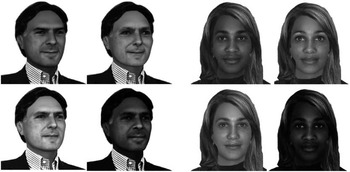
The experimental design is based on a CAWI post-election survey conducted online in 2013 on a representative sample of 3008 Italian voters. Respondents were provided digitally altered pictures of two real Italian candidates of foreign origin (one man and one woman), who were unknown to the general public, and of three well-known party leaders. Using a series of split-sample experiments, different respondents were provided digitally altered pictures of the candidates. The manipulations (all implemented using the FaceGen Modeler software) made the target candidate appear more stereotypically masculine or more feminine.Footnote 2 In other conditions, the same candidates were presented as more stereotypically Afrocentric or Eurocentric.
The scope of the manipulation was identical across the gender and ethnicity dimensions. The software’s sliders for gender or race feature morphing were both moved to exactly the same degree (±15 on the relevant metric) to generate more masculine/feminine or more Afrocentric/Eurocentric faces, both in terms of face shapes and in terms of skin textures/complexion. The resulting manipulations are presented in Appendix (1b) (male candidate), (1c) (female candidate), and A3 (party leaders). The metric that we settled on represents the best possible compromise between treatment credibility and effectiveness, both for unknown and for famous candidates.
A manipulation check conducted on Italian undergraduate students confirms that all sex- and race-based experimental conditions were correctly perceived as different (e.g. the masculine female candidate was actually rated as more masculine on a 0–10 scale than its feminine version). These facial differences in terms of masculinity/femininity and Eurocentrism/Afrocentrism were correctly perceived both for the unknown candidates and the party leaders.Footnote 3
Finally, we also manipulated the candidate’s party affiliation (center-left vs. center-right party), as candidates’ faces are typically associated with political parties in real-world contexts.
Respondents were then invited to rate the target candidates on a ‘feeling thermometer’, a set of trait terms, and to express their propensity to vote for them.
Although we rely on an experimental design, the classic problems of generalizability of results and of experimental realism are attenuated both by the use of an online experiment administered on a national sample (Vavreck and Iyengar, Reference Vavreck and Iyengar2013) and by inserting the experimental treatments in a standard post-election survey, which ensured a realistic frame for treatments. Moreover, as an experimental study, it is inherently replicable (Iyengar, Reference Iyengar2011).Footnote 4
Target candidates and parties
The experiment was designed to coincide with the occasion of the 2013 Italian general election. The treatment consisted of manipulating the facial features of two real Italian candidates of foreign origin,Footnote 5 who were unknown to the general public, and of three party leaders: Silvio Berlusconi (PDL, center-right), Matteo Renzi (PD, center-left), and Nichi Vendola (SEL, Left).Footnote 6 Although Berlusconi provides the benchmark in terms of candidate recognition, Renzi and Vendola were well-known party leaders in 2013, but their faces were not necessarily as familiar to the voting public. In addition to including two leaders from the main center-right and center-left parties, we selected a third party leader, Nichi Vendola, as a control condition, given the good fit of his facial features to the requirements of our photo morphing software.Footnote 7
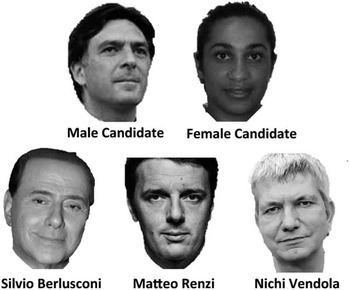
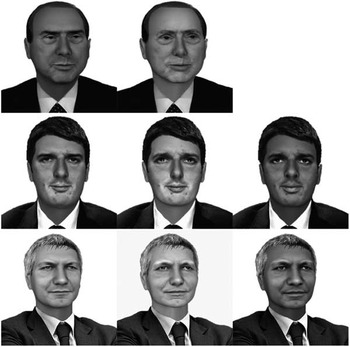
The actual photographs of the party candidates and leaders (Appendix 1a) were subjected to symmetric manipulations along the two (gender and ethnicity) dimensions in the following directions: (1) more masculine/more feminine; (2) more Eurocentric/more Afrocentric. Thus, our design consisted of four manipulations administered on each prototype, giving rise to eight different ‘faces’. In the case of party leaders, the design is less symmetric: the gender-based manipulations were applied to the three candidates, whereas race-based alterations were not implemented for Silvio Berlusconi, whose face is most highly familiar to all Italian voters, and for whom the Afrocentric-looking morphing would not have been credible.Footnote 8
In addition to masculinity/femininity and Eurocentrism/Afrocentrism, we manipulated the unknown candidates’ party affiliation. Each of the eight visual conditions was assigned either a center-left or center-right party label, referencing the two main Italian parties: PD (Democratic Party) and PDL (Silvio Berlusconi’s People of Freedom). Overall, this fully crossed 2×2×2×2 factorial design yielded 16 conditions based on the pairings of the four manipulated attributes – gender (male/female), sex-typicality (masculine/feminine), ethnicity (Eurocentric/Afrocentric), and party (left-wing/right-wing).
Data collection
The experiment was conducted online (CAWI) within the ITANES (Italian National Election Studies) post-election survey on a sample of 3008 respondents representative of the Italian adult population.Footnote 9 Our experiment was, therefore, embedded in a much wider questionnaire covering all the standard main topics relating to the election campaigns and voting choice, as in any standard national election study. All the participants of the experimental survey had already completed the pre-election questionnaire, which did not include any experimental module, a few weeks earlier, and were subjected to the experiment during the second half of the second (post-election) survey questionnaire. This had two potentially important implications on the outcome of the experiment, both of which bolster the realism of the design. First, and quite obviously, the timing of the study provides participants with an important real-world context for their assessing the role of non-verbal cues. Second, it makes them less attentive to the subtleties of the experimental manipulations: as participants have already been subjected to an extensive set of survey items before the onset of our manipulations, they might have paid less attention to the visual nuances. This has positive implications, because a relatively low level of attention to visual cues mirrors the real-world communication environment. In this sense, the timing of the manipulation both protects the credibility of the manipulations and reduces the possibility of artifactual effects induced by high levels of attentiveness. Conversely, as voters may never be exposed to less familiar candidates’ faces in the real world, our findings should apply to higher intensity campaign environments and flows of communication.
The entire post-election sample was requested to complete the standard questionnaire. In the case of our experimental module, however, the sample was split randomly into eight different subsamples of about 380 respondents. All respondents in each subsample were then exposed to three randomly selected experimental conditions, corresponding to the male and female candidate, and to one party leader.
Although the picture was displayed on the participant’s computer screen, participants were asked to respond to a short battery of questions about each of the three candidates. They first rated the candidate or leader on a ‘feeling thermometer’ ranging from 0 to 10. Subsequently, they rated the candidates on a set of leadership attributes (strength, integrity, empathy, and intelligence). Finally, they indicated their voting intentions concerning the races involving the target candidates. The full questionnaire used for the survey experiment is presented in Appendix 1.
Variables and indicators
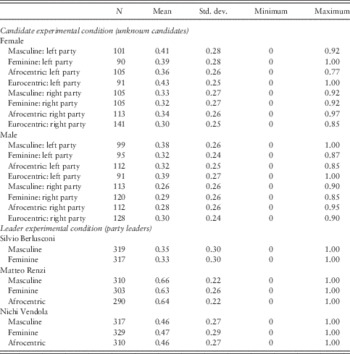
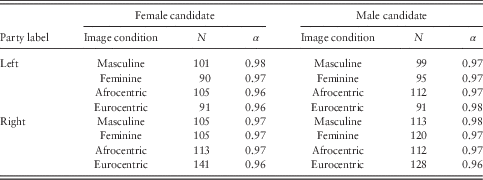
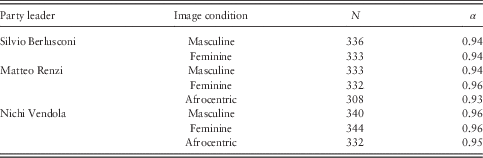
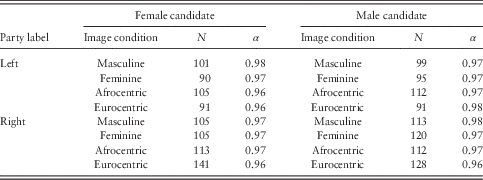
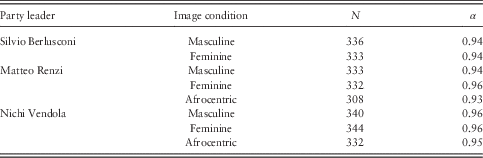
Our Candidate Support Index (CSI) collapses into a single scale: the responses concerning each candidate’s overall thermometer rating, assessments of particular traits (strength, integrity, empathy, intelligence), and the likelihood of voting for the candidate. Tables A1 and A2 show measures of internal consistency (Cronbach’s α) for these four items. The extremely high values of these coefficients (⩾0.93) for each experimental condition indicate that respondents assessed candidates and leaders consistently not only in terms of thermometer rating and likelihood of voting but also along the four image dimensions. As all four traits tap leadership attributes that are ‘valenced’ – they are ideologically non-divisive and it is considered desirable for all political leaders to possess them (Stokes, Reference Stokes1992; Barisione, Reference Barisione2015) – acknowledgment of these traits also becomes a proxy of potential candidate support. The resulting 0–60 scale based on these six variables was then converted to a 0–1 metric, which represents our final CSI. This scale provides us with a broader and more robust indicator of candidate perception and support. In Table 1, we provide descriptive statistics of this Index for each experimental condition.
Descriptive statistics of Candidate Support Index (CSI) for each experimental condition (unknown candidates and party leaders)

Note: The CSI collapses on a single scale the voter’s six responses concerning candidate feeling thermometer, candidate traits, and voting intention for the candidate (see Appendices 2 and 3). The original 0–60 scale was converted to a 0–1 metric.
Source: ITANES CAWI (2013).
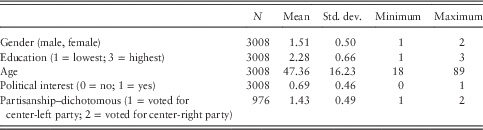
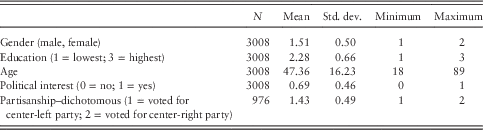
Our key covariate variables are respondents’ gender, ethnicity, and party affiliation. If gender is well distributed within the sample, ethnicity is a constant, as the ethnic composition of the electorate is still very homogenous in the whole country (over 99% white).Footnote 10 As for partisanship, it is given by responses to the question concerning actual vote choice at the 2013 general election. More particularly, a vote for PD (Democratic Party: center-left) or PDL (People of Freedom: center-right) is used to designate respondent’s partisanship in dichotomous terms.
Further specifications
Before we present the results, some important disclaimers must be made.
First, we do not directly compare the male and female candidates but their ‘within-face’ masculinity and femininity, because the candidates’ faces do not only differ by their gender but also by other potentially relevant non-verbal features such as eye contact, attractiveness, and age. Admittedly, we are using feminization and masculinization as our best proxies for gender effects, as largely discussed in ‘Measuring prejudice through non-verbal manipulations’ and ‘Theoretical expectations’ sections, because gender stereotypes concerning political leadership rest on assessments of leadership-related attributes that are largely associated with representations of masculinity and femininity.
Second, we acknowledge that a certain sense of artificiality results from the manipulated images, but we have no specific reason to assume that this boosts or attenuates the impact of the non-verbal dimension on the respondents’ evaluations of the candidates (see also footnote 2 on manipulation check and relative implications).
Third, we have, on the contrary, a clear assumption regarding the consequences of our decision to specify (and manipulate) party labels for the unknown candidates: the absence of any party label would have certainly boosted the impact of facial manipulations, but we argue that the resulting findings would have hardly been meaningful, as candidates’ faces are typically associated with political parties in real-world contexts.
Finally, we use both prominent party leaders and unknown candidates to implicitly control for levels of candidate recognition, as the impact of any communication-related factor is typically weaker on those targets (such as Silvio Berlusconi) about whom people already have clearly formed opinions.
Results
Race and gender bias: main effects of non-verbal cues
As this experiment aims to test the importance of race and gender bias in political judgment, our first theoretical expectation concerns the main effects of sex-typicality and race-typicality manipulations on the direction and magnitude of candidate support. As discussed in ‘Theoretical expectations’ section, we anticipate that support will decrease both for candidates and for leaders presenting Afrocentric and feminine facial features.
To test the race- and sex-bias hypotheses, we first examined average treatment effects across each pairing of experimental conditions for lesser-known candidates, then the statistical significance of the gaps in CSI scores across intra-leader experimental conditions.
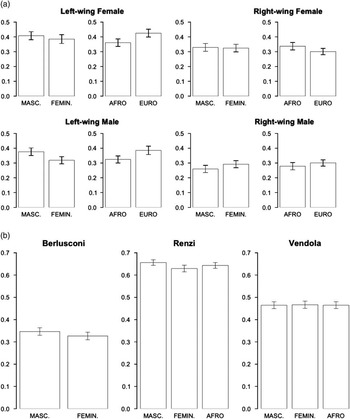
Figure 1a shows the CSI by sex- and race-typicality across candidates’ gender and party label. As the latter variables are clearly associated with the overall level of CSI, these variables are held constant.Footnote 11 We, thus, compared average treatment effects within center-left/center-right female/male conditions.
(a) Average treatment effects in Candidate Support Index by pairings of candidate conditions (±SE). (b) Average treatment effects in Candidate Support Index by party leader conditions (±SE).

Only in two cases do treatment effects reach a minimum level of statistical significance, and both involve manipulations referencing the ethnicity of left-wing candidates. The female candidate’s CSI score was 0.36 in the Afrocentric condition, significantly lower than the mean of 0.43 in the Eurocentric version (t=−1.75, P=0.041, one-tailed). The corresponding difference for the male candidate was 0.06 (0.38 in the Eurocentric and 0.32 in the Afrocentric condition; t=−1.67, P=0.048). Conversely, the effects of race-typicality were not significant in the cases of the right-wing (male and female) candidates.Footnote 12
Turning to gender typicality, the data reveal no significant pattern. The effects approach significance only in one case, where the left-wing male was rated higher in the masculine (0.38) than in the feminine version (0.32; t=1.58, P=0.057). In the other three pairings of experimental conditions, the gaps in CSI were not statistically significant, neither was their direction always the expected one.
With regard to party leaders, the vertical bars and related standard errors plotted in Figure 1b indicate that within each of the three target leaders average treatment effects are nil. Indeed, the appearing CSI gaps in favor of the masculinized versions of Berlusconi (0.02, t=0.83) and Renzi (0.03, t=1.38) were far from being statistically significant (P=0.20 and 0.08, respectively, one-tailed). Finally, the CSI scores for Vendola were remarkably stable across the different manipulations.
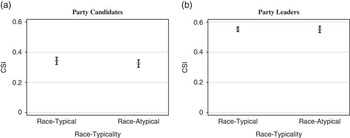
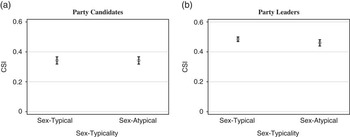
Figures 2 and 3 provide a last and more systematic test for the typicality hypotheses, both in relation to party candidates and leaders. Instead of presenting the CSI score for each sex- and race-typicality condition, the scores in these figures refer to sex- and race-typical and atypical conditions pooled across gender and partisanship. Once again, we expect Italian voters to penalize sex-atypical candidates (i.e. masculine females and feminine males) and race-atypical (Afrocentric-looking) candidates on the CSI.
Candidate Support Index (CSI) score for candidates (a) and leaders (b) by race-typicality (ITANES, 2013 pooled data set).

Candidate Support Index (CSI) score for candidates (a) and leaders (b) by sex-typicality (ITANES, 2013 pooled data set).

Figure 2a shows that sex-typical candidates (feminine females and masculine males from both parties) have the same score on the CSI as the sex-atypical ones; Figure 3a demonstrates that race-typical candidates (Eurocentric versions of both genders and parties) do not enjoy any significant advantage over race-atypical candidates. Based on this evidence, both sex- and race-typicality hypotheses can be rejected for the lesser-known candidates.
Finally, Figures 2b and 3b show the results of the same analyses replicated on party leaders. The average CSI scores for pooled race-typical and atypical leader conditions were statistically indistinguishable from each other, and so were the sex-typical and atypical ones. Overall, party leaders confirm to be even more impermeable than unknown party candidates to the effects of non-verbal cues referencing race- and sex-typicality.
Contrary to the race- and sex-typicality hypotheses, our results indicate that Afrocentric and feminine facial features do not weaken support for Italian party candidates and leaders. As we used the voters’ responses to treatments as an indicator of race and sex implicit bias, we acknowledge that Italian voters, overall, seem relatively ‘blind’ to candidate differences in terms of sex- or race-typicality. This finding may be consistent with recent trends in Italian politics and society, which see growing gender equality within the institutions, on the one hand,Footnote 13 and growing ethnic diversity in many domains of social life on the other – from schools to the service sector, from TV broadcasts to national sports teams – with its possible corollaries in terms of social ‘normalization’ and the public’s relative inattentiveness to this diversity.
Of course, this cannot exclude the presence of race and sex bias in these and other realms of social life, but such bias does not appear to be significant when it comes to political judgment, which is profoundly driven by politically relevant considerations – namely, by partisan and ideological predispositions.
Partisan bias and conditional effects of non-verbal cues
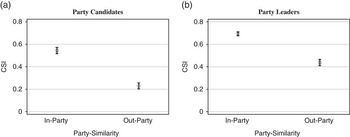
When we introduced partisan similarity – that is, the match of the target candidate’s party label and the respondent’s party vote – we found an overwhelming effect on the CSI, which is – like in the previous section – our overall measure of candidate perception and support (combining voters’ feeling thermometer, assessment of candidate traits, and voting intention on a 0–1 scale). Figure 4a and 4b show the results of these analyses for party candidates and leaders. In the first case (left panel), the CSI score is strongly conditional on candidate–voter partisan affinity (or similarity): when the target candidate belongs to the same party that the respondent has voted for during the 2013 election, the average CSI score is 0.54, whereas it drops to 0.23 for out-party candidates.Footnote 14 In the second case (right panel), the average CSI score is 0.44 for out-party and 0.69 for in-party leaders.Footnote 15
Candidate Support Index (CSI) score for candidates (a) and leaders (b) by partisan affinity (ITANES, 2013 pooled data set).

These results suggest that a powerful party bias drives the voters’ evaluations of target candidates, who are rewarded or rejected depending on their party label more than on any visual cues. To be sure, this is also an indicator of polarization of political attitudes along party lines in Italy. If this is the overall pattern, however, we still wonder whether potentially ‘negative’ visual clues such as sex- or race-atypical facial features are differently appraised depending on candidate/voter party similarity.
To respond to this question, we estimated a set of three-way interaction models – that we apply here only to the unknown candidates – between sex- and race-typicality and candidate/voter partisan similarity. According to the motivated reasoning hypothesis, we would expect sex- and race-atypical candidates to be penalized by voters only when they belong to the opposing party (‘contrast’ effect). For this reason, we confine the analysis to those who have voted for PD or PDL during the 2013 election.
 $$\eqalignno{ {\rm Model}\,{\rm 1:}\,{\rm CSI}= \,& \beta 0{\plus}\beta {\rm 1}Gender_{i} {\plus}\beta 2Gender_{j} \cr & {\plus}\beta 3Sex\,Typical_{j} {\plus}\beta 4Party_{{ij}} \cr & {\plus}\beta 5Sex\,Typical_{j} {\times}Party_{{ij}} {\plus}{\varepsilon} $$
 $$\vskip -19pt \eqalignno{ {\rm Model}\,{\rm 2:}\,{\rm CSI}= & \,\beta 0{\plus}\beta 1Gender_{i} {\plus}\beta 2Gender_{j} \cr & {\plus}\beta 3Race\,Typical_{j} {\plus}\beta 4Party_{{ij}} \cr & {\plus}\beta 5Race\,Typical_{j} {\times}Party_{{ij}} {\plus}{\varepsilon} $$
 $$\vskip -29pt \eqalignno{ {\rm Model}\,{\rm 3:}\,{\rm CSI}= & \,\beta 0{\plus}\beta 1Gender_{i} {\plus}\beta 2Gender_{j} \cr & {\plus}\beta 3Sex\,Typical_{j} ({\rm or}\,\beta 3Race\,Typical_{j} ) \cr & {\plus}\beta 4Party_{j} {\plus}\beta 5Party_{i} \cr & {\plus}\beta 6Sex\,Typical_{j} ({\rm or}\,\beta 6Sex\,Typical_{j} ) \cr & {\times}Party_{i} {\plus}{\varepsilon} $$
Model 1 estimates the effects of sex-typicality (Sex Typical) on the CSI by interactions of candidate (j)/voter (i) party affiliations, whereas model 2 replicates the same equation with candidate race-typicality (Race Typical). In both models, both the candidate’s (j) and the voter’s (i) genders are included as control variables. In effect, we wanted to ascertain whether PDL voters rate PD Afrocentric or sex-atypical candidates lower than PD Eurocentric or sex-typical candidates, and whether the same logic applies to PD voters when faced with PDL candidates.
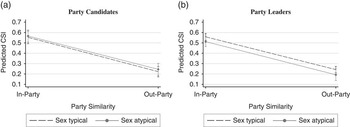
In both the models, interaction coefficients were far from reaching statistical significance. As predicted probabilities and marginal effects were particularly reliable in capturing interaction effects between covariates (Brambor et al., Reference Brambor, Clark and Golder2006), we focus here on the graphical visualizations of our values of interest. Figure 5a and 5b show variations in CSI scores for sex-typical vs. atypical candidates (5a) and for race-typical vs. atypical candidates (5b), conditional on their in- vs. out-party status. In both cases, not only are not atypical conditions significantly penalized with respect to typical ones, but also they are not more specifically penalized for out-party than for in-party candidates (i.e. no evidence of ‘contrast’ effects).
Interactions of partisan similarity with sex-typicality (a) and of partisan similarity with race-typicality (b). Panels (a) and (b) show variations in Candidate Support Index (CSI) scores for sex-typical vs. atypical candidates (a) and for race-typical vs. atypical candidates (b), conditional on their in- vs. out-party status (see models 1 and 2).

Finally, model 3 tests the interactions of voter’s (i) partisanship (PD vs. PDL) alternatively with race- and sex-typicality, this time using candidate’s (j) partisanship as a simple control variable and not as an interaction term tapping candidate/voter partisan similarity. The aim is to detect possible inclinations against atypical visual cues among voters of one specific party. As we found no significant interaction (tables not reported), this implies that neither PD nor PDL voters specifically penalized sex- and race-atypical candidates.
To sum up the results of interaction models 1, 2, and 3, we may say that, first, being black or white or more feminine or more masculine makes – as such – no difference to voters, neither for in-party nor for out-party candidates. Second, masculine/feminine and Afrocentric/Eurocentric facial features do not significantly alter candidate evaluations neither for center-left nor for center-right voters.
The main implication is that, contrary to our second expectation, we do not find evidence of ‘motivated processing’ of facial cues on patterns of candidate support. In other words, perception of visual cues referencing gender and ethnicity is not conditional on candidate/voter party similarity – that is, atypical cues being assessed negatively only for out-party candidates. Rather, appraisal of these facial cues seems merely irrelevant on candidate evaluation, provided that the target candidate’s face is associated with a party label.
Conclusion
Survey experiments using non-verbal cues – such as a candidate’s facial features – provide valuable tests of implicit gender and race bias in political judgment (Iyengar et al., Reference Iyengar, Messing, Bailenson and Hahn2010; Carpinella and Johnson, Reference Carpinella and Johnson2013a). In this study, we have applied such an experimental design to assess race and gender bias in candidate perception and support in Italy – a country with a traditionally male-dominated political system and a majority-white population that national stereotyping, reinforced during the Berlusconi era, portrays as inclined to sexist and racist attitudes.
Our manipulations of gender and racial typicality, albeit perceptible, failed to trigger any effects on overall candidate support – both for the lesser-known candidates and for the well-known party leaders – which implies that Italian voters are generally unresponsive to candidate differences in terms of sex- or race-typicality. In other words, no overall gender or race bias in political judgment emerged from our experiment. This suggests either that black or feminine candidates are not subject to discrimination from Italian voters or alternatively that gender- and race-based discriminations are simply overwhelmed by party-based bias.
Our study also demonstrates that party is the dominant indicator of out-group status, and thus the strongest predictor of candidate perception and support. When a candidate is associated with one of the two main party labels, it is this label – much more than gender, sex- or race-typicality – that will drive voters’ loyalty or hostility toward him or her. As this mechanism tends to be logically more powerful in ideologically polarized political contexts – such as Italy in the Berlusconi era – it is important to note that a similar pattern has repeatedly been observed in relation to the US politics in recent years, with several studies (contra Fiorina et al., Reference Fiorina, Abrams and Pope2005) pointing to increasing partisan polarization (Abramowitz and Saunders, 2008), partisan sorting (Levendusky, Reference Levendusky2009), partisan dislike (Iyengar et al., Reference Iyengar, Sood and Lelkes2012), and partisan antipathy (Pew Research Center, 2014) between Republican and Democratic voters. The relative similarity, at least in this respect, between the Italian and the US cases makes the hypotheses and findings of this study of potential interest beyond the national boundaries of the experimental context as well.
The present experiment may certainly be replicated in other contexts than the Italian case, where the ethnic composition of the electorate is still very homogenous. This would provide the research design with a wider sample of ethnic out-groups, thus leading to a more symmetric test of potential race bias in political judgment.
Acknowledgments
None.
Financial support
The experimental module was part of a broader research on the 2013–15 electoral cycle in Italy that has been funded by the Italian Ministry of Education, University and Research (Prin-Miur).
Data
The replication data set is available at http://thedata.harvard.edu/dvn/dv/ipsr-risp
Appendix 1
Original photographs of the candidates (above) and party leaders (below).

Facial manipulations for a male candidate: masculine (top-left), feminine (top-right), Eurocentric (bottom-left), and Afrocentric (bottom-right).
Appendix (1c) (right)Facial manipulations for female candidate: masculine (top-left), feminine (top-right), Eurocentric (bottom-left), Afrocentric (bottom-right).

Facial manipulations for party leaders: Silvio Berlusconi (masculine, feminine); Matteo Renzi (masculine, feminine, Afrocentric); Nichi Vendola (masculine, feminine, Afrocentric).

Appendix 2: Questionnaire of the survey experiment
In the next few questions, we will show you the faces of some politicians. The first one is a well-known party leader. The two others are much less-known party candidates. For each of them, we will ask you for your opinions. If you do not know the less-known candidates, you can simply do your best impressions.
Q1. (SHOW PICTURE) This is [ZAC FARDESI/RANIA BRAMI], who was a candidate in the last election with the [DEMOCRATIC PARTY/PEOPLE OF FREEDOM]. Please indicate how you rate [him/her] on a 0 to 10 scale, where 0 means a completely negative assessment and 10 an entirely positive one.
Q2. (SHOW PICTURE) In your opinion, to what extent does [ZAC FARDESI/RANIA BRAMI], the [PD/PDL] candidate, have the following characteristics? Please use a scale from 0 to 10, where 0 means [he/she] does not have them at all and 10 that [he/she] has them completely:
(1) Strong: knows how to gain respect
(2) Honest: it’s someone you can trust
(3) Close to the people: cares about the problems of the people, especially the most vulnerable
(4) Intelligent: is able to understand the problems of the country
Q3. (SHOW PICTURE) At the next general election, [ZAC FARDESI/RANIA BRAMI] could be a candidate for the [CENTER-LEFT/CENTER-RIGHT] coalition. On a scale from 0 to 10, where 0=not at all likely and 10=very likely, what is the probability that you can vote for [him/her]?
[The set of questions concerning the party leaders replicated Q1-Q3].
Appendix 3
Cronbach’s α reliability tests for Candidate Support Index based on feeling thermometer, image traits (strength, integrity, empathy, and intelligence), and voting intentions for each candidate/image condition
Cronbach’s α reliability tests for each leader/image condition
Appendix 4
Descriptive statistics for other variables included in OLS regression models