Introduction
Phenol compounds are present in the environment both naturally and as a consequence of anthropogenic activities. They are used in the production of resins, nylons and artificial fibres as well as in preparing insecticides, herbicides and fungicides. Phenol is highly toxic even at low concentrations because of its hydrophobicity and the easy formation of a reactive radical that can cause oxidative mutagenesis and carcinogenesis in living organisms (Nawawi et al. Reference Nawawi, Ahmad, Shukor, Syed, Khalil and Ab Rahman2016, Mazuki et al. Reference Mazuki, Shukor and Ahmad2019).
Phenol, along with other hydrocarbons, can reach Antarctica through natural processes including ocean and atmospheric currents (Fernández et al. Reference Fernández, Martorell, Blaser, Ruberto, De Figueroa and Cormack2017). For instance, Zangrando et al. (Reference Zangrando, Barbaro, Vecchiato, Kehrwald, Barbante and Gambaro2016) noted that high concentrations of phenolic compounds were found in marine samples collected across a wide area of the Southern Ocean in January 2012, originating from forest fires in New Zealand during that period. However, in Antarctica, the major local pollution source is fuel spillage, exacerbated by low temperatures restricting degradation rates (Abdulrasheed et al. Reference Abdulrasheed, Zakaria, Roslee, Shukor, Zulkharnain and Napis2020, Roslee et al. Reference Roslee, Zakaria, Convey, Zulkharnain, Lee, Gomez-Fuentes and Ahmad2020). Hydrocarbons from oil spills have been detected in Antarctic soils over 30 years after the pollution event. The largest oil spill to date in Antarctica occurred when the Argentinian vessel Bahía Paraíso hit a reef and sank close to the shore near Palmer Station (central Antarctic Peninsula) in 1989, releasing ~600 000 l of marine diesel oil into the local marine environment (Sweet et al. Reference Sweet, Kennicutt, Klein and Fingas2014). Australia's Davis Station in East Antarctica has discharged wastewater containing phenolic compounds into the marine environment, potentially threatening local wildlife (Jonathan et al. Reference Jonathan, Bridgen, Dunshea, Fenzi, Hunter and Johnstone2016). According to Hughes & Nobbs (Reference Hughes and Nobbs2004) and Connor (Reference Connor2008), discharge of wastewater in inland areas, including burial in snow, can lead to discharge into inland streams and lakes and onto ice-free ground, constituting a major pollution source in the Antarctic.
Phenol and phenolic compounds are trace contaminants in fuel oil and petroleum products and have been found in soil, water and snow in contaminated areas of Antarctica, generally close to research stations where spills have occurred (Connor Reference Connor2008, Lee et al. Reference Lee, Ahmad, Yasid, Zulkharnain, Convey and Johari2018). Decontamination of phenol-polluted areas is widely practiced globally. Bioremediation has become a primary focus today due to its cost effectiveness and its ability to degrade organic pollutants, including phenol, and to generate non-toxic inorganic end products such as carbon dioxide and water. Cold-adapted microorganisms can adapt in cold climate regions to counteract the negative effects of low temperatures on biochemical reaction rates (Subramaniam et al. Reference Subramaniam, Mazuki, Shukor and Ahmad2019), and their use in bioremediation can provide the industry and the environment with new solutions (Gerginova et al. Reference Gerginova, Litova, Manasiev, Peneva and Alexieva2014). To date, however, studies on the degradation of phenol have been conducted using mesophilic strains of bacteria and filamentous fungi such as Fusarium, Graphium and Aspergillus (Lee et al. Reference Lee, Ahmad, Yasid, Zulkharnain, Convey and Johari2018, Zakaria et al. Reference Zakaria, Ahmad, Yasid, Yin, Manogaran, Subramaniam and Shukor2018). There is currently limited information available about Antarctic or other cold environment bacteria that can degrade phenol (Mazuki et al. Reference Mazuki, Shukor and Ahmad2019). Recent studies have reported using indigenous microorganisms that are already adapted to the cold and extreme climates to function as degraders of phenolic pollutants and hydrocarbons in Antarctica (Gerginova et al. Reference Gerginova, Manasiev, Yemendzhiev, Terziyska, Peneva and Alexieva2013).
Response surface methodology (RSM) is a well-known optimization technique used in the development of bioremediation processes to significantly enhance the performance of a system while minimizing costs, and it was first established by Box and collaborators in the 1950s (Ferreira et al. Reference Ferreira, Bruns, Ferreira, Matos, David and Brandão2007, Karamba et al. Reference Karamba, Ahmad, Zulkharnain, Syed, Khalil and Shamaan2016). According to Box & Wilson (Reference Box and Wilson1951), the number of experimental runs required in development could be reduced using a full factorial design, and the approach is widely used in modern research. The primary objective of this study was to optimize the medium composition and culture conditions for phenol degradation using the hydrocarbon-degrading Antarctic bacterium Rhodococcus sp. strain AQ5-14. The optimization of growth for this strain was attained using RSM with the Plackett-Burman (PB) and central composite design (CCD) approaches (Nawawi et al. Reference Nawawi, Ahmad, Shukor, Syed, Khalil and Ab Rahman2016).
Materials and methods
Phenol medium
One litre of minimal salt medium was prepared by adding the following (in g l-1): KH2PO4 (0.4), K2HPO4 (0.2), NaCl (0.1), MgSO4 (0.1), (NH4)SO4 (0.4), MnSO4.H2O (0.01), Fe2(SO4).H2O (0.01) and NaMoO4.H2O (0.01) (Ahmad et al. Reference Ahmad, Shamaan, Arif, Koon, Shukor and Syed2012). The pH of the medium was adjusted to 7.2 using 1 M NaOH solution. Phenol medium (PM) was autoclaved at 121°C for 20 min and chilled at room temperature. Then, 0.5 g l-1 phenol was added, and the medium was stored in a chiller at a temperature of 15°C.
Source of strain
Strain AQ5-14 was isolated from soil collected on King George Island, South Shetland Islands, maritime Antarctic (62°11'42.2″S, 58°58'43.7″W).
Identification using 16S rRNA sequencing
For 16S rRNA sequencing, the GeneJET Genomic DNA Extraction Kit (Thermo Scientific, USA) was used to extract genomic DNA, followed by polymerase chain reaction (PCR) amplification performed using forward (domain-specific) and reverse universal primers with the sequences 27F: 5'-AGAGTTTGATCCTGGCTCAG-3' and 1492R: 5'-TACGGTTACCTTGTTACGACTT-3'. The PCR amplification was performed using a T100 Thermal Cycler (Bio-Rad Laboratories, USA) under the following conditions: initial denaturation at 94°C for 3 min, 34 denaturation cycles at 94°C for 1 min, annealing at 58°C for 1 min, extension at 72°C for 2 min and a final elongation at 72°C for 10 min with incubation at 4°C. The amplified PCR products were confirmed with gel electrophoresis on 1.0% agarose gel stained with the ethidium bromide.
Phylogenetic analysis
The 16S rRNA gene sequence of purified strain AQ5-14 was identified using BLAST (Basic Local Alignment Search Tool). ClustalW was used to perform multiple sequence alignment and to generate the phylogenetic tree based on 16S rRNA sequences of the isolates. The phylogenetic tree was constructed and viewed using MEGA version 10.0.5 and the neighbour-joining tree was also generated using this software (with bootstrap percentage values for 1000 replicates) (Tamura et al. Reference Tamura, Stecher, Peterson, Filipski and Kumar2013). Escherichia coli was used as the outgroup in the cladogram for AQ5-14.
Bacteria growth and phenol degradation assay
Bacterial growth was determined as optical density at 600 nm (OD600) by using a spectrophotometer at a wavelength of 600 nm (UVmini-1240, Shimadzu, Japan). Phenol concentration in the culture medium was determined by a colorimetric method using 4-aminoantipyrene (4-AAP), followed by oxidation with potassium ferricyanide (C6N6FeK3) under alkaline conditions to give a red-coloured product. One millilitre of sample supernatant was altered to pH 10 using ammonium solution (NH4Cl), and then 100 μl of C6N6FeK3 was added, followed by 100 μl of 4-AAP. The absorbance of the resulting solution after incubation for 15 min in the dark and was measured at 510 nm using a spectrophotometer (American Public Health Association 2005).
Optimization of bacterial growth and phenol degradation using one-factor-at-a-time analysis
Optimization of Rhodococcus sp. AQ5-14 growth was carried out to achieve the maximum growth and to observe the phenol degradation activity of the bacterial strain. Parameters including salinity, pH and temperature were manipulated to study their effects on growth and phenol degradation. The effect of salinity was studied across the range from 0.0 to 0.5 g l-1 NaCl. Acetate buffers (pH 5 and 6) and phosphate buffers (pH 6, 7 and 8) were used to study the effect of pH on growth and phenol degradation. The influence of temperature was studied at 10°C, 15°C, 20°C, 25°C and 25°C. Experiments involving salinity, pH and temperature were carried out in triplicate using a one-factor-at-a-time approach. The data obtained were analysed using one-way analysis of variance (ANOVA).
Design of experiments and statistical analysis
Plackett-Burman design
The PB design is an efficient way of identifying important factors among a wide range of variables and was used here to screen the important variables affecting phenol degradation. Three parameters were investigated: salinity (g l-1), pH and temperature (°C). The three parameters were analysed using a 12-run PB design. To determine the conditions closest to optimum, each independent factor was analysed at two levels: low level (-1) and high level (+1) of their respective value. Parameters with significant values (P < 0.05) were considered to have a significant effect on phenol degradation and selected for further optimisation using RSM.
Central composite design of experiments and RSM
The significant model obtained from one-way ANOVA, with model terms (influential factors) with P < 0.05 in the PB design being selected and used in CCD. The number of factors in this experiment was the same as in the PB design in order to identify any interactions between factors that significantly influenced the degradation of phenol. In this study, three factors with 20 runs were employed. The three factors selected from PB were salinity (g l-1), pH and temperature (°C). Each factor was evaluated at five different levels: 0, central point; -1, +1, combining factorial points; and -2, +2, axial points.
The mathematical model used to fit the response to the independent variables is shown in Eq. (1):
 $$Y \!= {\rm \beta }_0 + \mathop \sum \nolimits_{i-1}^K {\rm \beta }_iX_i + \mathop \sum \nolimits_{i-1}^K {\rm \beta }_{ii}X_i^2 + \mathop \sum \nolimits_i \mathop \sum \nolimits_j {\rm \beta }_{ij}X_iX_j$$
where Y is the predicted response (degradation of phenol), Χi and Χj are input variables that influence the response Y, K is the number of variables, β0 is the constant term, βi is the ith linear coefficient, βii is the ith quadratic coefficient and βij is the ijth interaction coefficient.
Statistical analysis
Analysis of variance was conducted to determine the significance of the model and regression coefficients. Determination coefficients (R 2) validated the quality of the polynomial equation. Fischer's F-tests and Student's t-tests were used to check the statistical significance and the significance of the regression coefficients, respectively. The response surface and contour plots of the model-predicted responses were used to evaluate the interaction between significant factors (Pandimadevi et al. Reference Pandimadevi, Venkatesh and Vinod2014).
Results
Identification
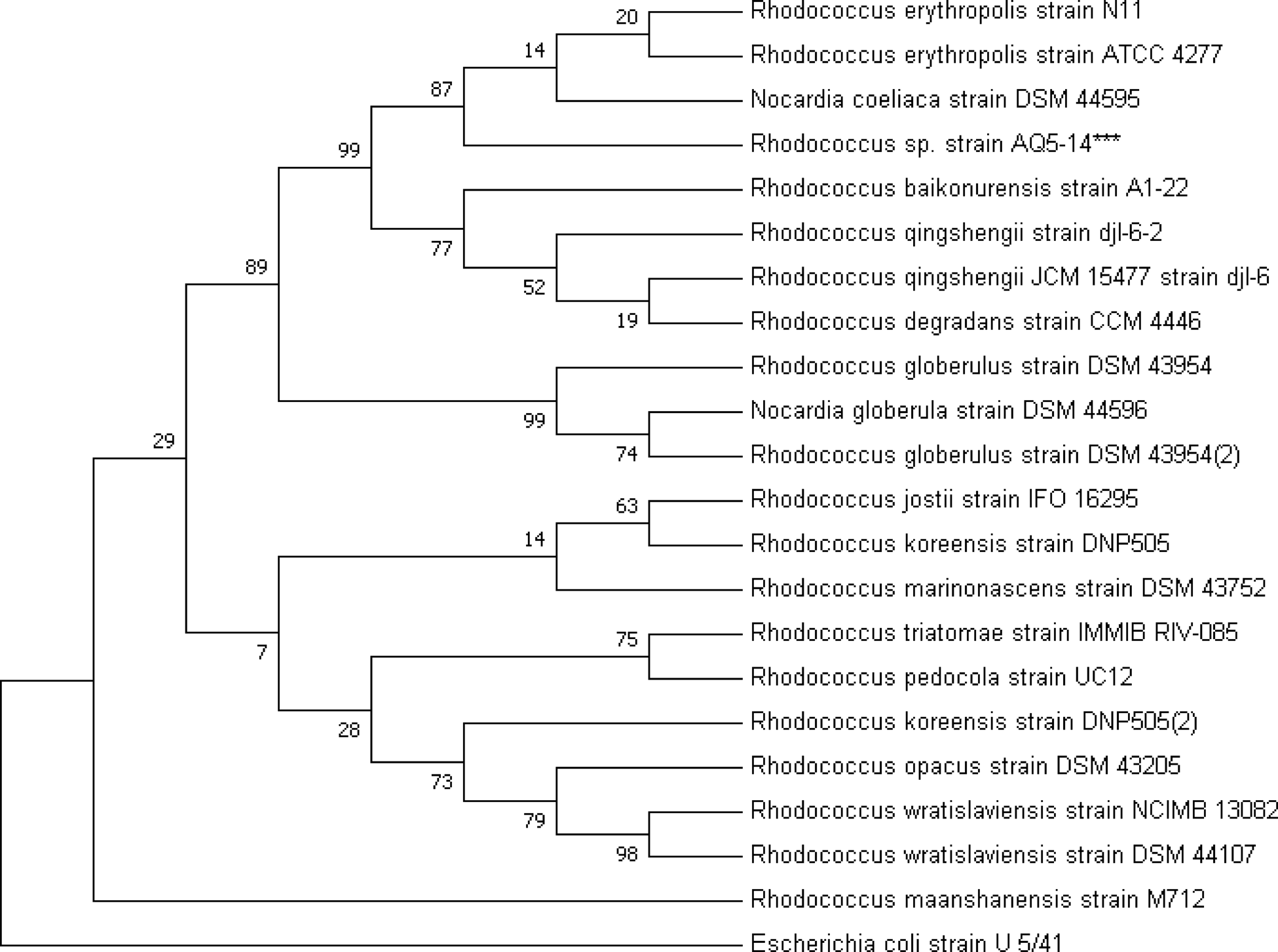
The phenol-degrading bacteria used in this study were isolated from Antarctic soil. Bacterial colonies were visible after 5 days of incubation in PM agar at 10°C. Bacterial growth indicated the strain's ability to grow using phenol. The bacteria were Gram-positive rods. Single colonies of strain AQ5-14 obtained on phenol agar were circular in shape with entire margins and flat elevation. The analysis of the 16S rRNA sequence using Nucleotide BLAST showed that isolate AQ5-14 was most probably associated with the genus Rhodococcus, although showing highest (96%) similarity to both Nocardia coeliaca strain DSM 44595 and Rhodococcus erythropolis strain N11. However, the 16S rRNA gene sequence of N. coeliaca showed extremely close similarity to that of Rhodococcus (99.9%). A phylogenetic tree was built using E. coli strain U 5/41 as the outgroup based on the partial 16S rRNA sequence. The sequence-based phylogenetic analysis showed that isolate AQ5-14 was situated in a well-supported subclade of R. erythropolis (Fig. 1).
Phylogenetic analysis of 16S rRNA gene sequences using the neighbour-joining method for AQ5-14 and 20 other closely related reference microorganism. Numbers on the branches indicate bootstrap values based on 1000 bootstrap replicates. Escherichia coli strain U 5/41 is used as the outgroup to the tree (GenBank: MK834794).

Optimization of bacterial growth and phenol degradation using one-factor-at-a-time analysis
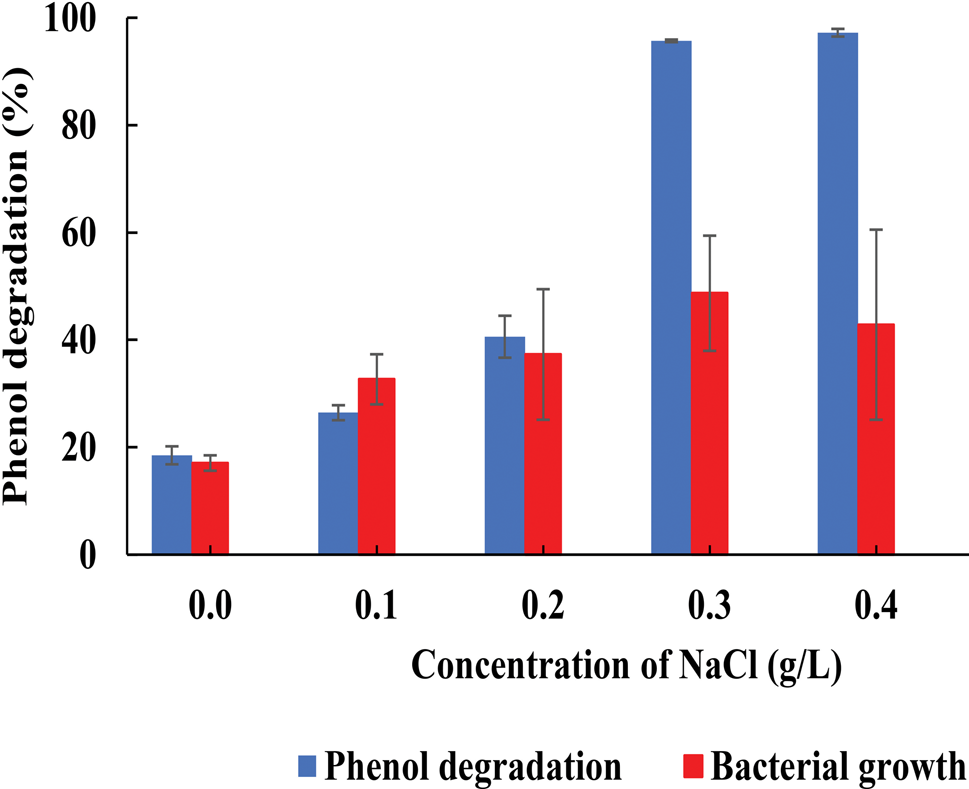
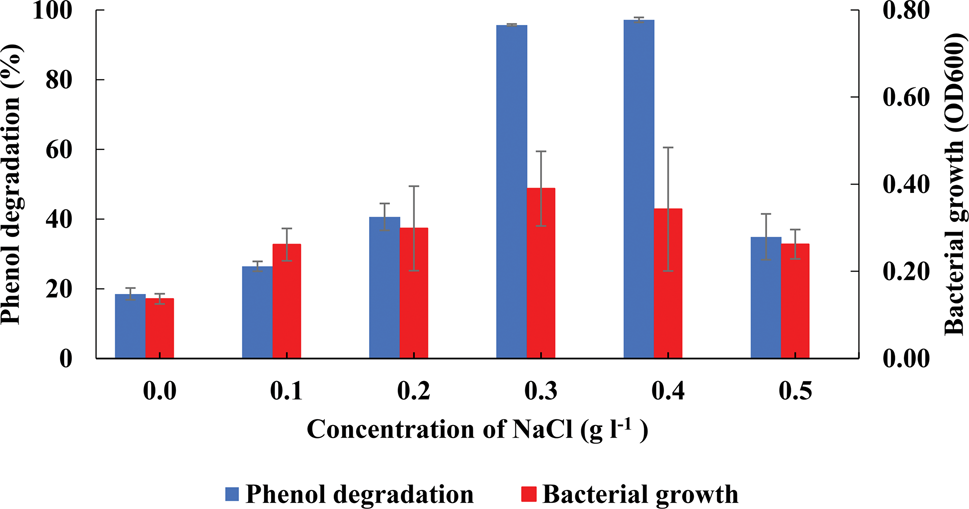
Growth and phenol degradation of Rhodococcus sp. strain AQ5-14 in NaCl concentrations ranging from 0.0 to 0.5 g l-1 were studied (Fig. 2). This strain grew and degraded phenol well at 0.4 g l-1, but low concentrations of NaCl resulted in decreased growth and degradation (ANOVA, F = 528.628, P = 0.000). The highest phenol degradation (97%) and growth (0.3427 nm) were observed at 0.4 g l-1 concentration. However, there were no significant differences between the values obtained at 0.3 and 0.4 g l-1. Post hoc comparison using Tukey honestly significant difference (HSD) test indicated that there is significant difference between the mean value of the optimum (M = 97.1951, SD = 0.35072) and other tested concentrations excluding 0.3 g l-1.
The effects of salinity on growth and phenol-degrading activity of Rhodococcus sp. strain AQ5-14. The bacterium was cultured in minimal salt medium containing 0.5 g l-1 phenol and incubated in an orbital shaker at 150 rpm and at a temperature of 15°C. Samples were analysed after 7 days of incubation. Values shown are mean ± standard error of the mean, n = 3.

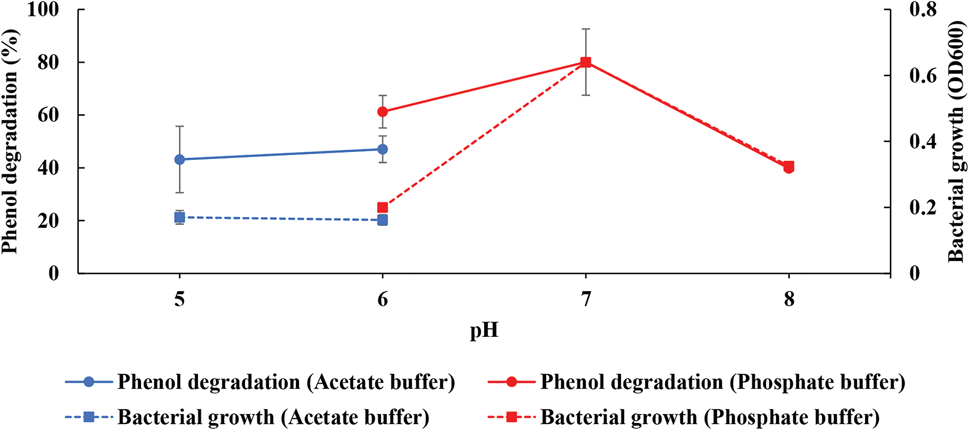
Figure 3 displays the effects of pH on growth and phenol degradation of Rhodococcus sp. strain AQ5-14. Rhodococcus sp. strain AQ5-14 showed optimum growth in phosphate buffer (50 mM) at pH 7, with an OD600 of 0.6420 and phenol degradation of 80% achieved. In acetate buffer with pH 5 or 6, much lower phenol degradation and growth were achieved (ANOVA, F = 2.653, P = 0.095). At pH 5, phenol degradation was 43.17% with an OD600 of 0.1703. More acidic pH clearly inhibited the bacterial activity.
The effects of pH on growth and phenol-degrading activity of Rhodococcus sp. strain AQ5-14. The bacterium was cultured in minimal salt medium containing 0.5 g l-1 phenol and incubated in an orbital shaker at 150 rpm and at a temperature of 15°C. Samples were analysed after 5 days of incubation. Values shown are mean ± standard error of the mean, n = 3.

Analyses of bacterial growth and phenol degradation were made after an incubation period of 72 h in order to study the effects of temperature. At temperatures between 10°C and 30°C, Rhodococcus sp. strain AQ5-14 showed growth and phenol degradation (Fig. 4) (ANOVA, F = 20.424, P = 0.000). The maximum growth rate was observed at 20–25°C, and the strain was classified as psychrotolerant as growth continued at > 20°C. The highest phenol degradation activities were observed at 25°C.
The effects of temperature on growth and phenol-degrading activity of Rhodococcus sp. strain AQ5-14. The bacterium was cultured in minimal salt medium containing 0.5 g l-1 phenol and incubated in an orbital shaker at 150 rpm and at a temperature of 15°C. Samples were analysed after 3 days of incubation. Values shown are mean ± standard error of the mean, n = 3.

Optimization of phenol degradation using RSM
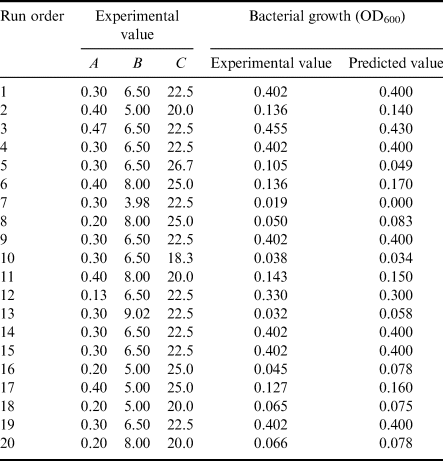
The degradation of phenol was significantly affected by all parameters tested in the PB design: salinity, pH and temperature. The CCD design of RSM experiments is presented in Table I using three independent factors with the experimental and predicted values for phenol degradation. The maximum bacterial growth was observed in run 3 (OD600 = 0.455), with medium conditions of pH 6.5, 22.5°C and 0.47 g l-1 NaCl. Multiple regression analysis generated the second-order polynomial equation in Eq. (2).
 $$\eqalign{Y & = + \, 0.40 + 0.039A + 3.212 {\rm E} -003B \cr &\quad+ 4.443 {\rm E} - 003C - 0.014A^2 - 0.14B^2 - 0.13C^2 \cr &\quad+ 1.250{\rm E} -003AB + 2.500{\rm E}- 003AC \cr &\quad+ 7.500{\rm E} -004BC} $$
Experimental central composite design on bacterial growth by Rhodococcus sp. strain AQ5-14.

A = salinity, B = pH, C = temperature, OD600 = optical density at 600 nm.
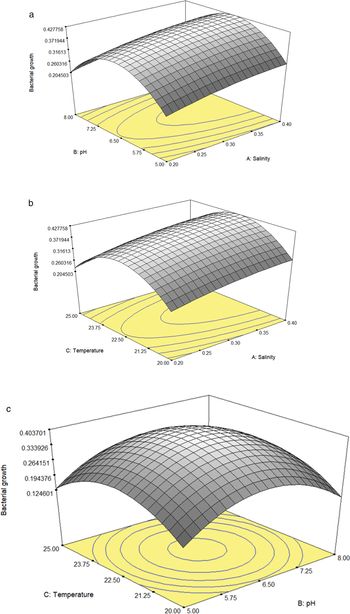
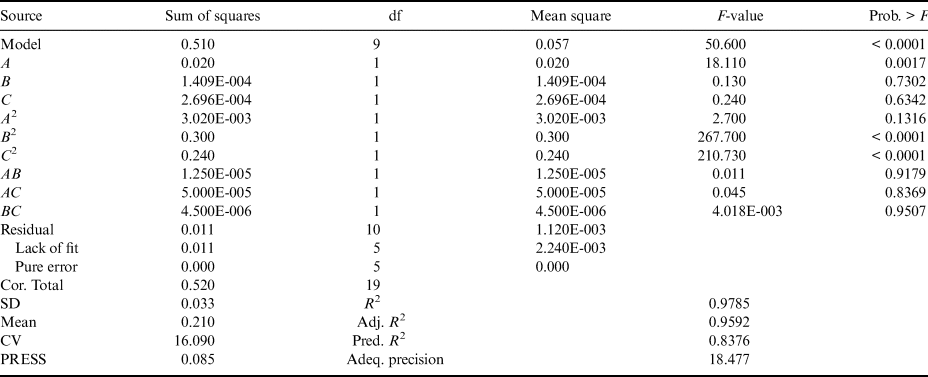
Table II shows the ANOVA for the bacterial growth response surface by isolate AQ5-14. Four quadratic terms (B 2, C 2) of the model were significant in the response. The analysis of the curves and contours of the 3D response showing the interaction between salinity (A) and pH (B) on bacterial growth is depicted in Fig. 5a. The highest bacterial growth (0.4277) was achieved close to 0.4 g l-1 NaCl and with pH values of 6.50–7.25, with phenol degradation of 98.09%. The plot showed a quadratic dependence on pH, which generally had a greater effect than salinity on bacterial growth. The plot suggests that the interaction between these two factors has a minimal effect on bacterial growth.
The 3D response surface plots showing the effect of interactions between significant factors. Bacterial growth by Rhodococcus sp. strain AQ5-14 showing variable interactions of a. salinity and pH, b. salinity and temperature and c. pH and temperature.

Analysis of variance for bacterial growth by Rhodococcus sp. strain AQ5-14.

A = salinity, B = H, C = temperature, CV = coefficient of variance.
Figure 5b illustrates the effects of the interaction between salinity (A) and temperature (C) on bacterial growth. The highest bacterial growth (0.4277) was again at 0.4 g l-1 of NaCl, within a temperature range of 21.25–23.75°C, and phenol degradation was 98.10%. The plot indicates that temperature did not alter the effect of salinity on bacterial growth, again suggesting that the interaction between these two factors was insignificant for bacterial growth.
The interaction between pH (B) and temperature (C) is shown in Fig. 5c. The highest bacterial growth (0.4037) was at pH 6.5 and a temperature of 22.5°C, achieving phenol degradation of 97.53%. The plot again indicated that the interaction between these two factors was insignificant for bacterial growth.
The phenol degradation by strain AQ5-14 was experimentally examined under the optimum conditions as predicted by CCD to validate the model. Under optimized conditions, 100% phenol degradation from an initial concentration of 0.5 g l-1 was predicted at 22.5°C, 0.3 g l-1 NaCl and pH 6.50. The triplicate experiment generated a marginally lower but similar value of 99.10% phenol degradation, supporting the validity of the model.
Discussion
Antarctica, despite the extent of its ice cover and its geographical isolation, is increasingly vulnerable, especially to processes such as global climate change and other human impacts (Lana et al. Reference Lana, Berton, Covaci, Ciocco, Barrera-Oro, Atencio and Altamirano2014, Lee et al. Reference Lee, Ahmad, Yasid, Zulkharnain, Convey and Johari2018). Human impacts have led to environmental stresses that affect this pristine continent, with pressures coming both from within and outside the region (Tin et al. Reference Tin, Fleming, Hughes, Ainley, Convey, Moreno and Snape2009, Aronson et al. Reference Aronson, Thatje, McClintock and Hughes2011). Although the continent has no native human population and the human presence is limited to national scientific research stations and activities and the tourism industry, Antarctic ecosystems are vulnerable to the effects of contamination of soil and water, while the natural processes that may help in the removal of pollution operate far more slowly than in warmer regions (Lana et al. Reference Lana, Berton, Covaci, Ciocco, Barrera-Oro, Atencio and Altamirano2014). Oil spills represent one of the major pollution concerns in Antarctica (Sweet et al. Reference Sweet, Kennicutt, Klein and Fingas2014), while other toxic compounds such as heavy metals, phenol and phenolic compounds, other hydrocarbons, pesticides and antibiotics are also of concern (Fernández et al. Reference Fernández, Martorell, Blaser, Ruberto, De Figueroa and Cormack2017).
As the Antarctic Treaty prohibits non-Antarctic organisms from being introduced (Stallwood et al. Reference Stallwood, Shears, Williams and Hughes2005, McWatters et al. Reference McWatters, Rowe, Wilkins, Spedding, Jones and Wise2016), the Antarctic's indigenous microbial population has been considered to have potential application in the remediation of existing and new polluted sites. The isolation of bacterial species with hydrocarbon-degrading potential from pristine Antarctic soils illustrates that hydrocarbon-degrading bacteria are components of the natural Antarctic soil microbiota.
Members of the bacterial genus Rhodococcus are Gram-positive and are regularly found in hydrocarbon-contaminated locales in cold regions such as the Arctic and Antarctic. Several key characteristics contribute to this, including their ability to degrade a wide range of alkane compounds through possession of multiple alkane hydroxylase systems (Aggarwal et al. Reference Aggarwal, Dawar, Phanindranath, Mutnuri and Dayal2016), production of biosurfactants (Malavenda et al. Reference Malavenda, Rizzo, Michaud, Gerçe, Bruni and Syldatk2015) and cell surface hydrophobicity (Whyte et al. Reference Whyte, Slagman, Pietrantonio, Bourbonnière, Koval and Lawrence1999). Such features, combined with their cold environment tolerance, potentially make them an effective tool for use in soil remediation in the Antarctic (e.g. Margesin et al. Reference Margesin, Schumann, Zhang, Redzic, Zhou, Liu and Schinner2012).
Understanding the effect of salinity on the biodegradation of phenol is crucial because it is an important factor influencing bacterial growth and phenol-degrading enzyme activity. Qin et al. (Reference Qin, Tang, Li and Zhang2012) noted that high salinity hinders metabolic activity as a result of increased osmotic stress and altered solubility or absorption of toxic or essential ions. Salt content and composition in Antarctic soils is known to vary, most obviously with proximity to the coast or to dense colonies of marine vertebrates, but also with soil age in polar desert soils, such as those of Victoria Land (Navas et al. Reference Navas, López-Martínez, Casas, Machín, Durán, Serrano and Mink2008, Convey et al. Reference Convey, Chown, Clarke, Barnes, Cummings and Ducklow2014). Our data indicate that Rhodococcus sp. strain AQ5-14 is a moderately halophilic bacterium, supporting its ability to degrade phenol under high-salinity conditions such as in coastal and marine areas (Tabib et al. Reference Tabib, Haddadi, Shavandi, Soleimani and Azizinikoo2012).
pH is another key factor controlling normal cell operation, as it strongly influences the cell's physiological and biochemical functions. Extreme pH (acid or alkaline) can cause changes in protein conformation and alter the enzyme structure. Optimum environmental pH is critical in maintaining the life cycle of the bacterium, as most enzymes only function effectively at close to optimal condition. Our data show that for optimal growth and phenol degradation strain AQ5-14 requires near-neutral pH. A similar optimal pH has been reported previously for a cold-tolerant Rhodococcus strain (Dennett & Blamey Reference Dennett and Blamey2016). Changes in pH affect phenol degradation as, when pH diverges from neutral conditions, degradation rates are reduced (Ahmad et al. Reference Ahmad, Shamaan, Arif, Koon, Shukor and Syed2012, Lee et al. Reference Lee, Ahmad, Yasid, Zulkharnain, Convey and Johari2018).
Temperature is a third important factor influencing the success of biodegradation. While the optimum degradation temperature of strain AQ5-14 was relatively high (28°C), its temperature response characteristics showed that it is a psychrotolerant strain, with more than 25% of degradation activity being retained at a temperature of 10°C. Psychrotolerance is a more prevalent strategy than true psychrophilia amongst Antarctic microorganisms, which is appropriate given the high-temperature fluctuations typical of terrestrial habitats on the continent (Ahmad et al. Reference Ahmad, Shukor, Shamaan, Mac Cormack and Syed2013, Convey et al. Reference Convey, Coulson, Worland and Sjöblom2018).
The RSM approach has several advantages compared to conventional experimental or optimization methods in which one-factor-at-a-time analyses are used. The RSM approach also includes consideration of interaction effects between the independent factors on the response measured (Baş & Boyacı Reference Baş and Boyacı2007). In this study, the data obtained, as measured by the coefficient (R 2), indicated that RSM had a better capability for the prediction of bacterial growth and phenol degradation, even though the models gave very little evidence of significant interactions between the three factors examined. According to Anderson & Whitcomb (Reference Anderson and Whitcomb2004), a value of R 2 near to 1.0 denotes a higher accuracy for the model. In this report, an R 2 value of 0.9785 and an adjusted R 2 value of 0.9592 for isolate AQ5-14 confirmed the model's accuracy, as they signify a strong correlation between the experimental and predicted values. The accuracy of the model was also supported by a quite high F value of 50.20 (Baş & Boyacı Reference Baş and Boyacı2007). This information showed that the response, which is based upon bacterial growth, depends on both the interacting and quadratic products of all of the tested parameters. Even though an abnormally high coefficient of variance of 16.09 obtained for the model of isolate AQ5-14 may represent low precision and reliability in the overall response data, the adequate precision of 18.477 in terms of the signal-to-noise ratio is sufficient for the model to be used to navigate the design space.
Isolate AQ5-14 was capable of degrading phenol at an initial concentration of 0.5 g l-1 within an incubation period of 48 h at a temperature of 15°C. Optimized parameters, as well as salinity, pH and temperature, powerfully enhanced phenol degradation activity in isolate AQ5-14. The RSM optimization provided better understanding of the interactions among the significant parameters affecting the degradation of phenol. We conclude that isolate AQ5-14 is a good candidate for development and inclusion in bioremediation processes in hydrocarbon-contaminated soils in cold regions such as the Antarctic.
Financial support
This work was supported by Matching Grant PUTRA (UPM-YPASM 9300430), YPASM Berth Support, PUTRA-IPS (9631800), PUTRA-Berimpak (9660000), IIOES-2014 G ‘Latitudinal Differences in Response and Adaptation of Microbes to Atmospheric Changes’, research grant Higher Institute of Centre of Excellence, Ministry of Higher Education. P. Convey is supported by NERC core funding to the British Antarctic Survey's ‘Biodiversity, Evolution and Adaptation’ Team. We also thank Universiti Putra Malaysia for providing a GRF scholarship to Miss Kavilasni Subramaniam.
Author contributions
S.A. Ahmad and A. Zulkharnain carried out the research. T.A. Tengku-Mazuki, K. Subramaniam and N.N. Zakaria conducted the research and drafted the manuscript. K. Abdul Khalil and G.L.Y. Lee carried out the statistical data analyses. P. Convey and N.A. Shaharuddin edited and reviewed the manuscript.