1. Introduction
A century ago, Duhem argued in a small work called La Mixte that in order to think through the philosophical implications of chemistry we need to retrace the footsteps of Aristotle (Duhem Reference Duhem1902; Needham Reference Needham2002). Whether we are inclined to Aristotle's conception of substance or not, Duhem recommended we grapple with Aristotle's concept of mixis—roughly our notion of chemical compound, as opposed to what we now, by a curious twist of linguistic usage, call mixture.
Duhem was particularly interested in Aristotle's observation that the results of chemical combinations of the kind he designated mixis exhibited their resulting characteristics homogeneously. If there were truly homogenous substances formed by some such process, could the chemical elements constituting the resulting compound still be present? How are we to understand the role of such constituents? And what is their status in the end product? The observable properties of constituent chemical elements are manifestly no longer there, but something must be, since they can be reclaimed by further chemical reactions.
Among his efforts to reclaim some aspects of this Duhemian analysis, Paul Needham (Reference Needham1996,Reference Needham2002) has been arguing that this reaching back to Aristotle addresses some of the issues which confront us today. In particular, philosophers of chemistry have been interested in why some of the assumptions of classical atomism, played out in somewhat different form in the nineteenth century, have so misled our appreciation for when and how theoretical chemistry finally leads to some explanation of chemical reactivity and the bonding of chemical compounds (van Brakel Reference van Brakel2000). Aristotle, like Duhem, was opposed to atomism and quite conscious of the strictures their assumptions placed on how one can construe chemical combination. Duhem was unlikely to find much help from Aristotle in formulating his version of physical chemistry, but he clearly appreciated how the Aristotelian analysis of elements combining to form compounds leads us back to questions we should be asking.
Unlike Needham, I am less interested in recovering how these considerations might lead to Duhem's chemical thermodynamics than in reconsidering those Aristotelian questions to which Duhem draws our attention, and which we both suspect will speak to our current concern to articulate what we mean by chemical substance. After recovering certain of these Aristotelian questions, I will suggest its relevance to our understanding the status of elements in chemical compounds.
2. Constituents of Chemical Substance
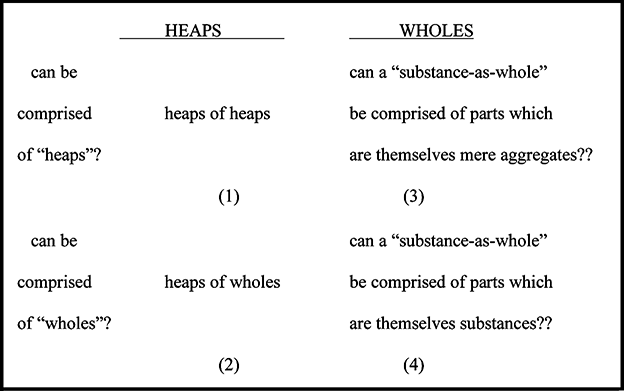
Substance in the sense Aristotle explores in his Metaphysics is always composite. But for any composite to achieve the status of substance requires that its parts constitute a whole, and not a mere heap (1045a 6–10 and 1040b 5–10). That already states an expectation that distinguishes Aristotle's natural philosophy from that of atomism, but it also harbors implications that are challenging within his own natural philosophy. I will construct a simple matrix to contrast these options and highlight Duhem's question about the status of constituents. Ultimately, this question will focus on constituents which are considered elemental, but we begin with optional ways a composite might be comprised of composites (see Figure 1).
Ways a composite might be comprised of composites.

Aristotle had no reason to doubt there were mere heaps in the world we inhabit, and there may in some sense (1) be heaps of what are themselves heaps. There might be mountains comprised of conglomerates, which are themselves heaps of diverse types of rock, themselves comprised of minerals, etc. And while our current theories might well contest whether any of these are simply heaps, Aristotle could readily have supposed there are piles of materials within which were aggregated materials. On this he could well agree with the classical atomists, except that atomists would surely have considered these paradigm examples of how the world is comprised. Their concern would have been focused on whether this schema can continue all the way down; at some point we must meet with constituents that are not heaps insofar as they are not composite at all, but the ultimate constituents—atoms. And since that exhausts the possibilities for atomism, the other three options of this schema would be ruled out. There is nothing composite, according to their assumptions, which is also whole.
Aristotle says there can be wholes, and one way to see what that implies is to examine the other three options in our matrix. Would he suppose his wholes could be comprised of heaps? Only comprised of other wholes? And could these wholes in turn comprise mere heaps? Or only ever other more complex, higher-order wholes?
There is no reason to suppose that Aristotle would not acknowledge (2) that there could be piles of organisms—organisms being his paradigm case of wholes. But he would surely argue that what differentiates a combination of organisms in a mere heap and a living community of organisms (what we have come to call an ecosystem) is the lack of interaction in the former case. You get a heap of organisms only when they are dead. It is a possibility, but not one that illuminates how organisms as wholes achieve their potential. There might also be mixtures (in our sense of the term) of chemical substances, or of tissues and other more complex organic parts. Reaching ahead to Aristotle's claim that chemical substances should be construed as wholes, that claim in itself will not preclude heaps of them. His own example is mixtures of wheat and barley, even though he would insist the individual grains are wholes or certainly were the product of organic processes.
Interestingly, we can begin to sense the tensions within the Aristotelian stance, where the sort of interaction which generates a grain, or an organ, or an organism, or an ecosystem (whatever that might be) is both required within the constituent wholes and is denied between these same constituents, in order for them to comprise a mere heap. Atomism is more straightforward in this regard, where the only interaction is limited to what might cause constituents to move around and into a pile, and the only constituents really are the atoms which themselves have no constituents. For Aristotle these tensions become even more evident when we shift our attention to (3) and (4) within our matrix.
Aristotle has several arguments against atomism, but a central concern is reflected in (3). If he is going to entertain the possibility of wholes that are not mere heaps, then their own constituents must have the minimum capability of so interacting—not just of moving, but of mutually influencing each other across Aristotle's full spectrum of change—so as to comprise a whole. Thus he typically speaks of organisms comprised of organs, which are themselves comprised of parts down to the level of tissues, which are themselves comprised of elemental materials. Atoms by contrast can only form heaps, and these in turn can only ever form larger more varied heaps. For Aristotle, both atoms and heaps of atoms (or heaps of wholes, for that matter) are incapable of the type of mutual influence minimally required to bring about a whole—ultimately, to generate an organism. (These arguments are examined in more detail in Bogaard Reference Duhem1979.)
But Aristotle also asks (4) whether such organisms can be themselves comprised of organisms. The typical examples are of parts like organs or tissues like blood and bone, which have a status beyond that of mere heap, but also a status that is somehow subordinated to the wholeness of the organism. Were these constituents substances-as-wholes in their own right, in the fullest possible sense, it would threaten to reduce the status of that which they comprise to that of a heap rather than achieving the status of a whole. In the Metaphysics, where this fullest sense of what it is to be a substance is explored, Aristotle concludes (1039a 2–5) that a substance cannot be comprised of substances.
Here is Aristotle's challenge: to be a substance, even at the level of a chemical substance, it must be more than a heap. If it is not, it will only seem to be a substance. Moreover, as we shall see, it could not meet the minimum conditions for comprising the scale of parts through tissues and organs up to organisms. It cannot act in the sense Aristotle will require even to be the constituent of a whole. But, on the other hand, if it achieves the status of a whole substance in the fullest sense, it cannot be comprised of competing substances. So Aristotle needs to find some possibility in between, and he seeks out that possibility in the treatise significantly titled Generation & Corruption. As this dilemma emphasizes, for him to lay out the possibility of the generation (and conversely, the destruction) of substances requires that at some level or to some degree there must be combinations of constituents that achieve a kind of status in between. And it seems to me that Duhem was aware of how important this is, and how directly it leads to Aristotle's handling of the status of constituents when comprising a chemical substance.
Aristotle's own argument in Generation & Corruption is structured differently than what I have presented. He argues that insofar as substances can be moved around (changing only via locomotion) there can only be a kind of juxtaposition of them forming a heap. Unlike the atomists, he insists there can also be alteration in quantity and in the qualities characterizing substances. But quantitative and even qualitative change, in the process of aggregation, might well leave the constituents intact—essentially the same substances they were to begin with—and therefore will still only comprise a heap in which the constituents remain. There is a more extreme possibility, however, and that would come about if the constituents so impacted on one another that one of them was completely transformed. One drop of wine in the ocean, so goes one famous example, and the drop does not constitute a new substance, but is destroyed in the process of becoming water.
In this framework, Aristotle introduces his in-between possibility—the one we have been considering as well. Can two constituents so interact with each other that neither simply overwhelms the other, but they nevertheless comprise a new substance, something different than either constituent alone? This would be Aristotle's idea of what we have come to call chemical compound: neither the formation of a mere heap of constituents (what we have come to call a mixture) nor the generation of a new substance via the destruction of one or more constituents, but a new substance in which the constituents remain. At least they remain in the sense in which they can be regained. Of course, and as we have seen, they cannot remain in the full sense of what they had been as substances. As Aristotle says, they do not remain in the sense of being fully actual, but are potential. Presumably, although this is open to interpretation, this means they have the potential to be reconstituted, but while serving as constituents their actuality is superseded by the whole substance of which they are constituents.
As Duhem had seen, this all hangs on the issue of how we construe the status of constituents. And the argument of this article is that we are still confronted by a comparable conceptual challenge: if we are to take the idea of chemical substances seriously. If water is to be more than a mixture of hydrogen and oxygen, since water is a complex substance in its own right, then what of the hydrogen and oxygen when they are comprising the new chemical compound? Aristotle's warning seems to be that these constituents can neither be construed as fully actual in their own right, but they also cannot be construed as having been destroyed.
3. Aristotle's Question in Context
Duhem had been intrigued by Aristotle's observation that in examples of mixis—in Aristotle's technical sense—the resulting properties are homogenous throughout. With mixtures in our modern sense, like pepper and salt, one can still rely on their lack of homogeneity, even if it requires tweezers to pick them out. A combination may look homogenous, but with an especially good eye—the eye of Lynchos, they said in Aristotle's day—one could still see the differences.
The character of a true mixis, Aristotle argues in opposition to the atomists, should not depend upon the eye of Lynchos. Resulting properties exhibit themselves homogeneously because they are properties of the newly constituted substance, not of its constituent elements. These constituent elements are no longer, essentially, what they were, but insofar as they can be reconstituted, must remain (in Aristotle's terms) potentially. Whether this solution helps us—it certainly fascinated Duhem—it arises in response to a question that goes to the heart of what we still mean by chemical substance. Moreover, Duhem thought Aristotle could articulate this question in a more meaningful way than Newtonian natural philosophy, or any of the still largely “mechanical” philosophies of the nineteenth century. We would claim, of course, that our own theoretical chemistry has come closer to resolving these challenges, but only because we have learned Aristotle's lesson: that constituents at the level of atoms must themselves be composite. Thus we are still caught within the matrix of options examined above.
For Aristotle, resolving this challenge also required opening up assumptions about change to include more than locomotion. Moreover, these modes of change were situated for Aristotle, or, more strongly, were constrained by where they took place and by their scale. For example, within Aristotle's conception of the celestial realm, there was no contact and could not be; there was only circular motion. Whatever substance comprised the heavens, there could be no generation nor destruction because there could be no chemical reaction: without the interaction which requires contact no elements could form mixis. Even in the sublunary realm, where the four elements were thought to be present, so long as there was little or no contact between diverse elements, change would be limited to locomotion, typically up and down. Only where stirred by the differential influence of the sun can there be a world of chemical and biological change (see Lloyd Reference Lloyd1996).
In this sense, Aristotle's heavens set the ulterior conditions for where the real action is—in this world of chemical and biological change, as we know it. Even where material conditions allow for more than change of position, scale remains a determinative parameter. Physics (192b 1–23) warns that it is not only organisms which are caught up in these richer modes of change, but also their parts, and not only tissues but even the simplest of bodies, the elements. All of these are capable of substantial change and of engendering this change from out of their own resources. How this works out, however, will be quite different in its details for elements, for tissue, for organs, and organisms, because each level of natural being is capable of acting. And since they are constantly commingling and in contact, they will act on each other mutually in bringing about change.
Furthermore, the Metaphysics repeats these compositional levels, these layers of interaction, and warns that the familiar conceptual tools which Aristotle is sorting out there—the correlates of form and matter, actuality and potentiality—will apply throughout, but somewhat differently at each level of interaction. Sufficiently so that each will need to be analyzed in their own context, at their respective scales. The metaphysical reason for this, so to speak, is that each layer serves as the matter for the layer it comprises. Each level of composition forms wholes which themselves exhibit the essential qualities of their kind. Each whole, in other words, is the locus of the form with which Aristotle identifies each kind of being. Were it not so, as stated at the outset, ours would be a world of heaps only and not wholes.
While the archetype for this sense of whole in many respects is organisms like ourselves, being more than a heap is not an achievement limited to organisms alone. In some way and to some degree, parts of organisms (in a manner not quite the match of full organisms), tissues (which display at least the homogeneity Duhem had highlighted), even the elements (the simplest of bodies) display some sense of wholeness. Each layer can be or must be construed each in its own context in terms of matter and form, potentiality and actuality. The elements, of course, exhibit their formal character least of all (being closest to matter) but are still capable of acting out their potential.
The question we are concerned with arises within Aristotle's philosophy of chemistry, so to speak, not the whole of his metaphysics. But to appreciate Aristotle's solution to this question about constituents—that they do persist, but as potential rather than substance fully actualized—it is crucial that we bear in mind Aristotle's own warning that these correlates will work out their metaphysical implications in ways that are peculiar to each context. Questions we can ask about organisms may have little purchase when we consider elements. Within a study of the parts, movements, and generation of animals (see Lennox Reference Lennox2001) we must ask how such organs themselves might be comprised, and we find there some consideration of what functional role flesh, blood, and bone must play.
However, the question of the composition of these so-called tissues—at the scale of substances with characteristically homogenous capabilities—is confronted in Generation & Corruption, for it underlies the issue of how generation is possible. The possibility of generation entails the possibility of mixis, for only here are distinguishable kinds of elemental constituents somehow responsible for comprising the next level of peculiarly homogenous substances. Elements are for Aristotle the very simplest of substances, but they do still have forms, at least in the limited sense that their key qualitative features enable them to act. And matter, too, is required for their makeup, signifying they can be acted upon and be changed accordingly. But here we reach the bottom of the compositional scale, in some sense, since below this there are no levels at which one can meaningfully talk about form. There would only be matter without form. Not surprisingly, interpreting what Aristotle has to say about the possibilities at this extremity has been endlessly controversial.
Once we step back into the realm of bodies, even though they are the simplest of bodies, there are constraints, but they are not the crippling constraints typical of atomism. Aristotle argues that even the simplest of beings which can act in characterizable ways must in principle not be simple. They are at least minimally complex. As composites of matter and form they can act and be acted upon—are capable of substantial interaction.
Generation & Corruption lays out the conditions for this first possible level of genesis, where already at this scale elemental substances can change in essence what they are. But the next step is what draws our attention, as it did Duhem's, where elemental constituents are not fully destroyed in the process of generating new substances, and thereby sets the stage for compositional layers on up to organisms. It begins the process of generating layer upon layer, constituted wholes which are themselves matter for constituents of larger-scale wholes. To get this hierarchical process started, Aristotle has to sort out how elements can be changed—can both act and be acted upon—without being destroyed, any more than tissues are destroyed by constituting organs, or organs by constituting organisms.
Elements act by engaging in qualitative change. But the list of possible qualities is extensive. Relatively simple bodies might appear to us to be more or less rough-smooth, hard-soft, viscous-brittle, coarse-fine, or even, as he investigates elsewhere, heavy-light. Since we are more complex organisms, we can be sensitive to these differences, which means we can perceive them. Along with seeing colors, and tasting bitter-sweet, we can by touch alone distinguish from the above list of qualities. Simpler bodies can also touch each other. But contact in itself need not induce any change in a particular quality. A brittle body touching something brittle does not make it more or less so, and so for hard, coarse, etc. By contrast, even the simplest of bodies can be moist or not, or warm or not, and when a warm body comes into contact with a cooler one (or a moist one with a dry) change will occur, in that quality, occasioned by contact. Without locomotion and tangibility this activity could not take place, but acting out this mode of change flows directly from these powers to act. And these, in turn, are the defining features of the four elemental kinds. For this reason these two pairs are the essential features of the simplest of bodies.
Under a specific set of circumstances, delineated within the conditions we have just reviewed, such qualitative interactions can lead to mixis. As noted at the outset, Aristotle locates this possibility between two extremes: two quantities of elemental substance will interact upon contact. But the interaction may be modest and produce little change. Quantity might change if they are of the same kind and coalesce, but with little or no qualitative change.
By contrast, it is possible for this balance to be tipped and for one body to severely impact or even overpower another. It might dry it out completely. And if moisture was a defining feature of the affected body, what it was essentially will have been changed. In this way, one element under extreme circumstances can actually transform another. From that point on, it will interact according to what is now its own dryness, or one drop of wine now acts like the rest of the ocean.
In neither of these two cases, however, is there a lingering question about the status of the original interactors. At the one extreme they are all still there, just relocated, and at the other extreme only the more powerful element remains, now increased in quantity. The latter case constitutes a kind of generation and corruption, but it is not a process on which Aristotle can build up the compositional scale to his archetypical organisms. For this he needs to posit another possibility, in between, where something is generated—something quite new that was not present among any of the interacting substances, but where the elements which contribute to this new generation will not be destroyed in the process, since under altered circumstances they can be recovered. But this leaves the status of the constituents puzzling. They are not fully present, in the sense of continuing to act as they might outside of the mixis, but on the other hand the actualization of these once essential features can be regained. This is unique to the special case of chemical substance.
I would argue, following Aristotle, that a crucial feature of this special case is that the new substance in some important sense forms a new compositional layer by comprising and yet obscuring (not destroying) its constituents. And neither Mary Gill's alternative interpretation of their status (Reference Gill1989) nor Joe Earley's contention within contemporary philosophy of chemistry that there is no salt in the sea (Reference Earley2005) accounts for this ability of the resulting substance to become a constituent in its own right—at its own scale.
4. Conclusion
I have not told this story because we can simply import Aristotle's answer. But I do suggest there is merit in asking Aristotle's question, or coming to understand what it would mean to ask this question. An atomist, as we have seen, cannot meaningfully ask this question. And an example will help to illustrate this. Needham cites a counterargument from Robert Boyle's Skeptical Chymist (Needham Reference Needham1996, 258). Boyle challenged the example of drops of wine in an ocean of water by asking what will happen if after the first drop another is added, and then another, until we have added a quantity of wine in excess of the water we started with. Surely one could thus reverse the effect. We counter with what Aristotle said against the atomists: if I eat one bite of bread, and let it digest, I do not harbor inside me a bit of bread but grow in flesh and bone. If the world were atomistic, such bits would typically be added onto the outer edges, like bricks on a wall, but manifestly we do not grow in this manner. To redirect this to Boyle: today I eat a whole loaf of bread, tomorrow I eat another, and then being persistent I eat my own weight in bread. But does Boyle suppose one would turn into a loaf of bread?
By resetting the context at the level of whole organisms, the turning of wine and bread into flesh need not be a threat. We presume, of course, that digestion ensures we are not really talking about bread being added, as is, but is decomposed to a lower scale—and becomes fuel for my metabolism. Given this situation, it is not a casual observation that I am composed of my organs, and they of tissue and cells, and the layer below that is molecules. Without this multilayered organization eating could not happen, nor reproduction and natural selection. Even Aristotle could anticipate, so long ago and having guessed wrongly in so many ways, that at the level of molecule—the layer that is comprised in some sense of elemental atoms—that at this scale the status of constituents is both problematic and crucial.
If in our day we still claimed that atoms are atomic, the problem would disappear, but then as Aristotle warns so would cells and organisms and minds. A natural philosophy in which atoms can be construed classically voids this compositional scaling, and avoids Aristotle's question, since it avoids the real issue of chemical substance.
It reminds me of that menu option in my Photoshop program. After adjusting the image on my screen, my computer warns that to proceed with this altered image has become surprisingly more complex. Each change has been programmed as an added layer, and this induces considerable complexity. So the menu option offered is to “flatten these layers”—flatten them back to one single-layered image. That is the option classical atomism offered, and the option Newton chose. He took the increasingly complex and rich image Aristotle offered and flattened all those layers. Context no longer mattered, all rules were universally applicable, and corpuscles were quite sufficient.
After this flattening of layers, we have no real substances to worry about—all heaps and no wholes—and we avoid Aristotle's question about constituents. As we find ourselves re-asking this question, it has carried with it the need to embrace various modes of change, and to replace assumptions about isolation with appropriate considerations of context, considerations that need to be sensitive to differences of compositional scale in both size and time. We confront the puzzling status of elements persisting in molecules. To grasp fully what is implied by chemical substance we should open ourselves to Aristotle's question.