Introduction
Species belonging to the monocotyledonous family Zingiberaceae have ethereal oils in their tissues and are widely used in cooking and medicine. The three most valuable species are Zingiber officinale Roscoe, ginger, Curcuma longa L., turmeric, and Elettaria cardamomum (L.) Maton, cardamom. The last of these is the true cardamom but there are several species in the related genus Amomum Roxb., such as Amomum subulatum Roxb., the brown cardamom of the Himalayas, which have similar properties.
Wild cardamoms belonging to Amomum are the most important non-timber forest product (NTFP) and agricultural export product in Laos (Foppes & Ketphanh, Reference Foppes and Ketphanh2000), generating a substantial contribution to rural household cash income. Official statistics indicate that from 1995 to 1999 an average of 285 tonnes, at US$4.8/kg (dry fruits), was exported. Currently 1000–1800 tonnes are exported each year, at around US$2.5–3/kg (dry seed), mostly to China, but also to Korea, Thailand and Vietnam. China sells cardamom via the internet as a single herb extract for US$17.4 per 100 g. Every year 400–500 tonnes of dried seeds are exported to China, where they are used as an ingredient in Chinese medicine, known as ‘sha ren’. Roughly 70% of the cardamom produced in Laos comes from the wild, and 30% from cultivated gardens. The export price was around US$7 per kg of dry seed over five years in the 1990s (Saint-Pierre, Reference Saint-Pierre1998; Foppes & Ketphanh, Reference Foppes and Ketphanh2000).
As well as being an important NTFP resource for food, medicine and trade, Amomum species are also an important component in many tropical forest ecosystems.
Although cardamom has a very high value, scientific knowledge of the species being traded is poor, owing to lack of scientific research, in particular in taxonomy. The most important and highest value species are ‘mak naeng kham’ Amomum microcarpum, ‘mak naeng khieo’ A. villosum and A. uliginosum, and ‘mak naeng daeng’ A. longiligulare, all of them wild plants. In addition, ‘mak naeng kouang toung’ Amomum villosum var. xanthioides has been introduced from China and cultivated for more than 10 years in northern Laos, and ‘mak naeng daeng’, A. longiligulare, is very commonly cultivated in southern Laos where it is not native.
Amomum Roxb. is estimated to have c.150 (Mabberley, Reference Mabberley2008) to 176 (World Checklist of Selected Plant Families, 2011) species, the majority of which are found in tropical Asia. Nineteen species were recognised in the most recent account of the genus in Cambodia, Laos and Vietnam (Gagnepain, Reference Gagnepain and Lecomte1908). More recent accounts covering single countries cite 11 species in Laos (Newman et al., Reference Newman, Ketphanh, Svengsuksa, Thomas, Sengdala, Lamxay and Armstrong2007), and 15 species in Vietnam (Pham Hoang Ho, Reference Pham Hoang2000).
This paper is the first comprehensive taxonomic revision of Amomum in Cambodia, Laos and Vietnam since that of Gagnepain, over 100 years ago, and will form a significant contribution to a new revision of the Zingiberaceae in the ‘Flore du Cambodge, du Laos et du Vietnam’. Cooperation has been sought with taxonomists studying Amomum in Thailand and in Sumatra because there is considerable overlap in species and many common problems relating to type specimens. Several of the species occurring in Cambodia, Laos and Vietnam have a wider distribution in China, Burma, Thailand and even the Himalayas.
IUCN Conservation Assessments
Provisional IUCN conservation assessments have been made for all species using the IUCN (2001) criteria. The following Red List Category abbreviations are used in the accounts below: CR = Critically Endangered, EN = Endangered, VU = Vulnerable, LC = Least Concern and DD = Data Deficient. The assessments are global but, as we do not have detailed information from outside Cambodia, Laos and Vietnam, we have sometimes had to assess species as DD when a local assessment might have indicated greater cause for concern. These assessments will inevitably change as more extensive exploration of the region and/or of each country takes place.
Material Studied
Material from the following herbaria was studied: A, AAU, BK, BKF, E, G, GH, HITBC, K, KUN, L, MO, NLS, NY, P, SING, UPS, US, VNM. NLS is the herbarium of the Faculty of Science, National University of Laos, Dong Dok, Vientiane. The future of this unregistered herbarium is uncertain; its collections may be merged with those of the National Herbarium of Lao PDR which was inaugurated on 22 July 2011 and registered with the code HNL.
More than 680 collections from all major herbaria in Asia, Europe and America were examined. A total of 409 of these collections were made by the authors, the majority in Laos, but some also in Cambodia and Vietnam; most are deposited at E and NLS; others are also duplicated at P, RUPP, UPS and VNM.
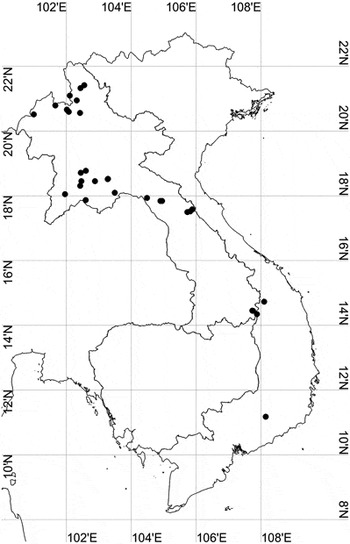
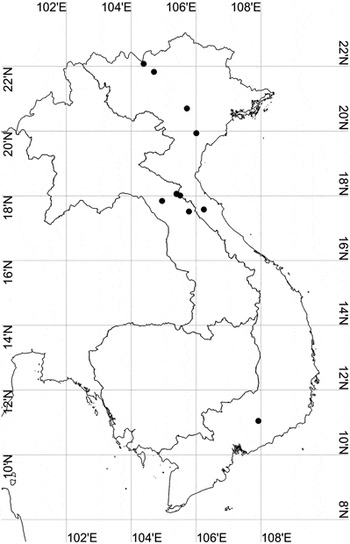
A record of each herbarium specimen was made in the Padme taxonomic database developed and used at the Royal Botanic Garden Edinburgh (www.rbge.org.uk/science/major-floras/biodiversity-informatics). Information recorded included the collector’s name, collection date and collection locality. Latitude and longitude coordinates, and collecting altitudes, given on specimen labels were recorded. When coordinates were not given on specimen labels, they were sought using gazetteers such as GNS (http://earth-info.nga.mil/gns/html/index.html). The points on the distribution maps derive from specimens alone; none derive from unverified literature or field reports. It was not possible to find the coordinates of every collecting locality. Thus, although a specimen of Amomum elephantorum from Vietnam has been seen (Poilane 21292, P), the coordinates of the collecting locality could not be found so Fig. 9 shows this species only in Cambodia and Laos.
The altitude ranges given under each species are those found in Cambodia, Laos and Vietnam. Wider ranges may be found in species which occur beyond these countries.
Morphology
A morphological species concept is employed. Taxa are recognised by discontinuities in characters or complexes of characters.
Amomum is diverse in morphology, showing differences of habit, inflorescence and capsule. The inflorescence and capsule structure have been found to be extremely important in identifying species. As mentioned below, there is some evidence that fruit character is phylogenetically informative (Xia et al., Reference Xia, Kress and Prince2004; Kress et al., Reference Kress, Newman, Poulsen and Specht2007) so a more detailed molecular phylogenetic study of Amomum is under way.
It should be noted that the differences between Amomum and Elettariopsis are very slight. Species of Elettariopsis usually have one or a few leaves per shoot, loosely tufted or more rarely forming a pseudostem, bracteoles open to the base and a prominent anther crest. These characters all occur in Amomum though not together in one species. Small species of Amomum, such as A. biflorum of southern Thailand and Peninsular Malaysia, are frequently misidentified as Elettariopsis. In this account, only the species of Amomum sensu stricto are treated.
Habit. The pseudostems are usually more than 5, arising near each other to form a clump, with short intervals of 0–10 cm between the pseudostems, or a loose clump with intervals of 10–15 cm between the pseudostems. Alternatively, there may be long intervals of 20 cm or more between the pseudostems, each new one arising at a distance from the previous pseudostem, sometimes as far as a metre away, so that the pseudostems appear solitary. This habit is termed creeping.
The rhizome usually grows at the soil surface or slightly above or below it but may be deep in the soil in a few species. In some species the rhizome is raised above the soil on stilt roots.
Leaves. The leaves consist of a sheath, petiole, ligule and a simple blade. As in most Zingiberaceae, the leaf sheaths clasp each other to form pseudostems which may be conspicuously swollen at the base or not. The surface of the sheaths is usually striate but may also be reticulate or smooth. The petiole may be very short or absent; if present, it is usually canaliculate. The ligule is coriaceous or membranous, entire or lobed, glabrous or with a ciliate margin, to c.4 cm long. The leaf blades are arranged distichously and the plane of distichy is transverse to the direction of growth of the rhizome; the blade varies from oblong to elliptic, oblong-elliptic or oblong-lanceolate with an acute, caudate or long caudate apex and attenuate to long attenuate base; the margin may be entire, wavy or straight; the primary vein is always prominent on the abaxial surface and the secondary veins sunken or prominent on both sides.
Inflorescence. The inflorescence is invariably radical in Amomum. It may be partially subterranean, lie at ground level or be held above it on a peduncle, arising from or near the base of new or old shoots, or anywhere on the rhizome of creeping species (e.g. Amomum schmidtii), sometimes arising vertically or looping downwards from the rhizome and then turning up. The peduncle is usually short but may be erect and c.2 m long in Amomum celsum, elongating in fruit in some species, with overlapping peduncle scales which are broadly triangular at the base of the peduncle to narrowly triangular or lanceolate above, often striate, coriaceous or papery. The flowering part of the inflorescence is ovoid, ellipsoid or globose. The peduncle scales gradually merge into the bracts which arise from the main axis without an involucre of sterile bracts of the kind seen in Etlingera Giseke. They are usually arranged in a spiral, imbricate, boat-shaped, narrowly triangular to lanceolate-oblong, often cucullate, usually subtending a single flower, rarely in cincinni of 2–3 flowers. The bracteole is tubular, at least at the base, or, as in most Amomum species with winged fruit, open to the base and ovate to lanceolate, or even absent.
Flowers. The flowers are always trimerous, white or coloured, two to a few (> 10) open at any one time, maturing from the base to the apex of the inflorescence, very shortly pedicellate. The calyx is tubular, usually with 2–3 teeth. The corolla consists of a tube with three cucullate, acute or rounded corolla lobes, the central one often largest, usually cucullate, with or without a subapical spur. Lateral staminodes, if present, are small. The labellum is always clawed, generally white with a yellow central stripe, with or without red marks, variously lobed or entire, the apex spreading or reflexed; rarely the base of the labellum is adnate to the base of the filament forming a very short tube above the insertion of the corolla lobes (not a distinct tube as in Etlingera). The filament often has a groove which grasps the style and the anther has one pair of thecae which dehisce by longitudinal, parallel slits; an anther crest is usually present and may be entire or variously lobed but not petaloid. The stigma is globose to funnel-shaped, ciliate or glabrous. Epigynous glands are always present and the inferior ovary is usually trilocular with axial placentation and numerous ovules.
Fruits. The fruit is either a smooth, fleshy berry or a dehiscent or indehiscent capsule which may be prickly, winged, ridged, or lobed, globose to ovoid, often with a persistent bract and calyx; the prickles, if present, are simple or branched, and the wings straight or wavy. The seeds are round or angular, with endosperm, arillate, scented and spicy to taste.
Lao Name and Uses
All the local names and uses reported in this revision come from a study of the ethnobotany of Amomum in Laos carried out by the first author (Lamxay, Reference Lamxay2011). This taxonomic account covers Cambodia and Vietnam as well as Laos but it has not been possible to gather the local names or uses from Cambodia or Vietnam.
Infrageneric Classification
The name Amomum was first used by Linnaeus in his Flora Zeylanica (1747) where he classified three species in the Monandria monogynia: Amomum scapo nudo, spica oblonga obtusa, Amomum scapo nudo, spica ovata and Amomum scapo bracteis alternis laxis caule breviore. In his Species Plantarum (1753), Linnaeus gave these species binomials, Amomum zerumbet, A. zingiber and A. cardamom respectively, and added a fourth species, Amomum grana-paradisi. As these species have all been transferred to other genera, namely Aframomum, Elettaria and Zingiber (Burtt & Smith, Reference Burtt and Smith1972), a later concept of the genus, Amomum Roxb. (Roxburgh, Reference Roxburgh1820), has been conserved with Amomum subulatum Roxb. as its conserved type (Burtt & Smith, Reference Burtt and Smith1968; McVaugh, Reference McVaugh1970).
Petersen (Reference Petersen, Engler and Prantl1889), in the first edition of Engler’s Die natürlichen Pflanzenfamilien, was among the first to attempt a classification of Amomum. Petersen’s system consisted of three sections, Amomum sect. Geanthus, A. sect. Euamomum and A. sect. Cenolophon, and also included species which would now be placed in Aframomum and Etlingera.
Some years later, in Engler’s Das Pflanzenreich, Schumann (Reference Schumann and Engler1904) divided Amomum into two sections and four series based on the structure of the anther crest, as shown in his key. This remains the most recent classification of Amomum.
A. Anther crest absent
Section: Geanthus
a. Flowers few 3–4
Series 1: Oliganthae
b. Flowers many
Series 2: Polyanthae
B. Anther crest present
Section: Euamomum
a. Anther crest bilobed or trilobed
Series 3: Lobulatae
b. Anther crest entire
Series 4: Integrae
Like Petersen, Schumann had a broad concept of Amomum. More recently, all the species of his Amomum series Oliganthae have been transferred to Etlingera along with most of Amomum series Polyanthae. The large section Euamomum has been maintained in Amomum. Amomum section Euamomum and Amomum series Integrae contain the type species of the genus, A. subulatum, so they must now be called Amomum section Amomum and Amomum series Amomum.
While Schumann worked on a worldwide monograph of Zingiberaceae in Berlin, Gagnepain in Paris was studying the material being sent back from the French colonies of Indo-China. He too took a broad view of Amomum, including species which would now be placed in Etlingera and Elettariopsis, and, in his revision of the Zingiberaceae of that region (Gagnepain, Reference Gagnepain and Lecomte1908), he described 19 species with a key to the species based on the presence and structure or absence of an anther crest. Of Gagnepain’s 19 species, four have been transferred to Etlingera (Amomum harmandii, A. pavieanum, A. laoticum and A. repens) and another three have been transferred to Elettariopsis (A. trilobum, A. monophyllum and A. unifolium).
The most important distinguishing characters of Amomum are its inflorescence which is partially subterranean or raised above the ground, bracts closely imbricating and usually subtending a single flower, flowers almost always bracteolate, and main axis elongating in fruit (Smith, Reference Smith1981). In addition, an anther crest is usually present, the bracteoles are usually tubular, the labellum is usually spathulate and white with yellow stripes and red marks, and the leaves are several to many forming a distinct pseudostem.
Kress et al. (Reference Kress, Prince and Williams2002) have published a molecular phylogenetic study of the Zingiberaceae which strongly supports a realignment of the genera into four subfamilies: Siphonochiloideae (Aulotandra and Siphonochilus), Tamijioideae (Tamijia), Alpinioideae (Alpinieae and Riedelieae, with > 20 genera) and Zingiberoideae (Zingibereae and Globbeae, with > 20 genera). This study confirmed the placement of Amomum, Alpinia and Etlingera in the large tribe Alpinieae of subfamily Alpinioideae based on the following characters: evergreen herbs with fibrous rhizomes, plane of distichy of the leaves perpendicular to the direction of growth of the rhizome, extrafloral nectaries absent, lateral staminodes small or absent, never petaloid, filament medium length, sometimes arching, anther crest petaloid or absent, ovary trilocular, placentation axial or free central, and fruit an indehiscent capsule or fleshy.
Sequencing of the nuclear ribosomal internal transcribed spacer (ITS) and the chloroplast matK coding and non-coding region (Xia et al., Reference Xia, Kress and Prince2004) was used to examine the evolutionary relationships of 31 accessions of Amomum and indicated that Amomum as currently defined is polyphyletic with three major groups of species that do not correspond to any of the earlier classifications based on anther appendage type alone (Schumann, Reference Schumann and Engler1904; Smith, Reference Smith1985, Reference Smith1989). This research also identified Paramomum as sister to Elettariopsis, which are both embedded in one clade of Amomum. These results were confirmed by Kress et al. (Reference Kress, Newman, Poulsen and Specht2007). It seems likely that the status of Elettariopsis will have to be reconsidered when better-supported phylogenies become available but, in this paper, Elettariopsis is excluded from Amomum on morphological grounds (see above).
Xia et al. (Reference Xia, Kress and Prince2004) tentatively divided Amomum into three groups based on the results of their molecular analysis, namely: (1) the Amomum tsaoko clade, distinguished by bilobed or trilobed anther crest and smooth fruit; (2) the Amomum villosum clade, distinguished by bilobed or trilobed anther crest, variable labellum shape, an obviously elongate inflorescence and prickly fruit; and (3) the Amomum maximum clade, distinguished by entire anther crest, a partially elongate infructescence and winged fruit.
In this morphological study, we tentatively accept the classification of Amomum based on distinct types of fruit, though the placement of a few species is different. Further research is necessary into the phylogeny of Amomum in Cambodia, Laos and Vietnam, and more widely, and we acknowledge that once this research is done the genus as currently circumscribed is likely to be radically altered, possibly in line with these three groups. Therefore, the species revised below are arranged into the three groups of Xia et al., as follows:
The Amomum maximum group: These are clump-forming herbs (except Amomum glabrum, A. longipetiolatum and A. prionocarpum); ligule often partly or wholly bifid; bracts subtending 1–5 flowers; bracteole absent or, if present, usually open, lanceolate; filament sometimes adnate to the labellum forming a short tube above the insertion of the corolla lobes; anther crest usually entire; fruits usually winged, never smooth. The 11 members of this group are: Amomum calcicolum, A. chevalieri, A. chryseum, A. dealbatum, A. glabrum, A. longipetiolatum, A. odontocarpum, A. plicatum, A. prionocarpum, A. repoeense and A. subcapitatum.
The Amomum villosum group: These are usually loosely clump-forming or creeping herbs; ligule ovate or lanceolate, coriaceous (one species has membranous ligules); leaf blade narrowly oblong; bracts subtending single flowers; bracteoles always tubular; anther crest usually lobed; filament always free from the labellum; anther crest variable; fruits prickly. The 15 species and one variety which belong to this group are: Amomum calcaratum, A. celsum, A. chinense, A. echinocarpum, A. elephantorum, A. gagnepainii, A. glabrifolium, A. longiligulare, A. microcarpum, A. muricarpum, A. schmidtii, A. stephanocoleum, A. tenellum, A. uliginosum, A. villosum and A. villosum var. xanthioides.
The Amomum tsaoko group: These are of variable habit, from clump-forming to creeping; ligule always ovate or lanceolate; bracts subtending single flowers; bracteoles always tubular; filament always free from labellum; anther crest entire to finely lobed; fruits smooth. The nine species and one variety which belong to this group are: Amomum koenigii, A. petaloideum, A. pierreanum, A. rubidum, A. sericeum, A. tomrey, A. tomrey var. stenophyllum, A. tsaoko, A. verum and A. vespertilio. This group has the greatest number of differences from the classification of Xia et al. (Reference Xia, Kress and Prince2004) in which Amomum koenigii and A. krervanh (= A. verum) were placed in the A. villosum group, A. petaloideum with Elettariopsis and A. sericeum in the A. maximum group. All species with smooth fruits are placed together here.
Systematic Treatment
Amomum Roxb., Pl. Coromandel 3: 75 (1820), nom. cons. – Type species: Amomum subulatum Roxb., Fl. Ind. 1 (1820), designated by Burtt & Smith (Reference Burtt and Smith1968).
Meistera Giseke, Prael. Ord. Nat. Pl. 199 (1792), nom. rej., vs Amomum Roxb.
Paludana Giseke, Prael. Ord. Nat. Pl. 199 (1792), nom. rej., vs Amomum Roxb.
Wurfbainia Giseke, Prael. Ord. Nat. Pl. 199 (1792), nom. rej., vs Amomum Roxb.
Geocallis Horan., Prodr. Monogr. Scitam. 33 (1862). – Type species: Geocallis fasciculata (Roscoe) Horan. (probably = Amomum aromaticum Roxb.).
Cardamomum Kuntze, Revis. Gen. Pl. 2: 685 (1891). – Type species not designated.
Conamomum Ridl., J. Straits Branch Roy. Asiat. Soc. 32: 121 (1899). – Type species: Conamomum utriculosum Ridl. (= Amomum utriculosum (Ridl.) Holttum), designated by Turner (Reference Turner2000).
Paramomum S.Q.Tong, Acta Bot. Yunnan. 7: 309 (1985). – Type species: Paramomum petaloideum S.Q.Tong (= Amomum petaloideum (S.Q.Tong) T.L.Wu).
Clump-forming to creeping herbs, rhizomatous, c.1–3.5(–4) m tall; rhizome subterranean, shallow, creeping on or above ground or deeply buried, 0.5–4 cm diameter; stilt roots sometimes present; interval between pseudostems short to fairly long (to 70 cm). Pseudostems c.2 cm diameter; leaves distichous, simple; leaf sheaths striate, reticulate or smooth, hairy or glabrous; ligule coriaceous or membranous, toothed, lobed or entire; petiole canaliculate or cylindrical, sometimes striate; blade oblong to lanceolate or elliptic, young leaves rotate, base attenuate to long attenuate, apex acuminate to long caudate, margin entire, glabrous to ciliate. Inflorescence always arising from the rhizome, sometimes at a distance from the pseudostems; peduncle short or elongate (to 2 m tall in Amomum celsum), erect or looping downwards then erect, often elongating after flowering; peduncle scales almost triangular at base to ovate or lanceolate above, striate, sometimes cucullate, with or without a small spur; flowers > 10 in the inflorescence (except A. glabrifolium and A. schmidtii), often many more, bracts arising spirally or symmetrically overlapping, boat-shaped, ovate, lanceolate or oblong, sometimes cucullate, with or without spur, coriaceous or soon rotting, usually subtending a single flower, rarely to 5; bracteoles, if present, usually tubular with 2–3 teeth or open, lanceolate. Flower white or coloured, opening from base to top of inflorescence, shortly pedicellate; calyx tubular, 2–3-toothed. Corolla tubular with 3 oblong lobes, the central lobe often largest, usually cucullate, with or without spur, the laterals narrower, usually adnate to the labellum; labellum generally clawed or spathulate, white with yellow central stripe edged by red dots spreading to the margin, yellow, orange or yellowish-green, margin lobed, bifid or entire, apex spreading or reflexed, labellum and filament rarely connate into a very short tube above the insertion of the corolla lobes; lateral staminodes, if present, usually small, triangular. Filament flattened; anther with two thecae, held at an obtuse angle to the labellum, curved over the labellum, dehiscing by longitudinal slits; anther crest usually present, lobed, spreading, truncate or semi-lunar. Stigma globose to funnel-shaped, ciliate or not; style held between anther thecae; epigynous glands 1 pair, glabrous; ovary inferior, trilocular, placentation axile; ovules numerous, c.15–90. Fruit a fleshy berry or dehiscent capsule, prickly, smooth, lobed, ridged or winged, with persistent calyx. Seeds rounded or angular, arillate.
Distribution. Tropical and warm subtropical Asia, Sri Lanka and India to Australia, c.150–176 species. Thirty-five species and two varieties found in Cambodia, Laos and Vietnam.
Key to the species in Cambodia, Laos and Vietnam
1a. Fruit prickly; usually creeping herb, rarely clump-forming 2
1b. Fruit winged, lobed or smooth; usually clump-forming herb, rarely creeping 16
2a. Flowers 4–6 per inflorescence; peduncle 1–3 cm long; fruit sparsely prickly 3
2b. Flowers > 10 per inflorescence; peduncle ≥ 4 cm long (usually 2–4 cm in Amomum villosum var. villosum); fruit densely prickly 4
3a. Leaves c.5–10 per pseudostem, hairy beneath 25. A. schmidtii
3b. Leaves c.16 per pseudostem, glabrous beneath 11. A. glabrifolium
4a. Leaves tomentose beneath, blade plicate; inflorescence pyramidal; fruits with simple prickles 16. A. microcarpum
4b. Leaves glabrous beneath, blade flat; inflorescence not pyramidal; fruits with branched or simple prickles 5
5a. Inflorescence on an erect peduncle at least 150 cm tall 3. A. celsum
5b. Inflorescence otherwise 6
6a. Infructescence, including peduncle, 25–35 cm long 7
6b. Infructescence, including peduncle, not more than 20 cm long 8
7a. Fruit with curved or hooked prickles; inflorescence cylindrical, not gelatinous 10. A. gagnepainii
7b. Fruit with straight prickles; inflorescence globose, gelatinous 9. A. elephantorum
8a. Clump-forming herb 9
8b. Creeping herb 13
9a. Pseudostem 2–2.5 m tall; corolla reddish orange, labellum yellowish-orange 17. A. muricarpum
9b. Pseudostem ≤ 1.8 m tall; corolla white or pale yellow, labellum white with yellow central line and red dots or pale yellow 10
10a. Pseudostem c.1 m tall, flowering part oblong-ellipsoid; flower pale yellow 29. A. tenellum
10b. Pseudostem > 1 m tall, flowering part ovoid or ellipsoid; flower white with yellow central line and red dots on labellum 11
11a. Ligule glabrous; fruits green 8. A. echinocarpum
11b. Ligule tomentose; fruits red 12
12a. Labellum bifid; fruits with branched prickles 27. A. stephanocoleum
12b. Labellum trilobed; fruits with simple prickles 1. A. calcaratum
13a. Ligule membranous, 3–4 cm long 14. A. longiligulare
13b. Ligule coriaceous, 0.4–1.5 cm long 14
14a. Pseudostem distinctly reticulate; ligule red; peduncle 15–20 cm long 5. A. chinense
14b. Pseudostem smooth or obscurely reticulate; ligule reddish or green; peduncle to 15 cm long 15
15a. Lateral staminodes present; bracts hard, coriaceous, light brown 32. A. uliginosum
15b. Lateral staminodes absent; bracts papery, soon rotting, dark brown 35. A. villosum
16a. Fruit winged, at least when young; anther crest entire, truncate, or lobed; ovary ridged 17
16b. Fruit smooth, ridged or lobed; anther crest lobed; ovary smooth or hairy 27
17a. Stilt roots present; inflorescence c.30 cm long 4. A. chevalieri
17b. Stilt roots absent; inflorescence ≤ 22 cm long (to 31 cm in A. subcapitatum) 18
18a. Loosely creeping herb, interval between pseudostems c.30–40 cm 19
18b. Clump-forming herb, interval between pseudostems c.3–10 cm 20
19a. Pseudostem > 1 m tall; leaves whitish tomentose below 15. A. longipetiolatum
19b. Pseudostem < 1 m tall; leaves glabrous below 22. A. prionocarpum
20a. Corolla yellow, lip yellow with red dots at base 6. A. chryseum
20b. Corolla white, lip white with yellow central line, often edged with minute red dots or with clear venation radiating towards the margin 21
21a. Bracts subtending single flowers 22
21b. Bracts subtending 2 or more flowers 25
22a. Leaves glabrous below 23
22b. Leaves hairy below 24
23a. Leaf blade plicate; C and S Laos at 335–880 m altitude 21. A. plicatum
23b. Leaf blade flat; N Laos and N Vietnam at 1200–1530 m altitude 18. A. odontocarpum
24a. Silky white hairs on abaxial surface of leaves; ligule truncate; fruits globose 2. A. calcicolum
24b. Hairs on abaxial surface of leaves not silky white; ligule bifid; fruit ovoid 7. A. dealbatum
25a. Petiole > 30 cm long; bracteole absent; anther crest semi-lunar 28. A. subcapitatum
25b. Petiole < 30 cm long; bracteole present; anther crest trilobed 26
26a. Leaf blade flat, sheath reticulate; fruits globose with straight wings 23. A. repoeense
26b. Leaf blade plicate, sheath smooth; fruits ovoid with wavy wings 21. A. plicatum
27a. Creeping herb, rhizome deep in the soil 28
27b. Clump-forming herb, rhizome at ground level or on stilt roots 30
28a. Pseudostem c.1 m tall with c.5–9 leaves; fruit ridged 12. A. glabrum
28b. Pseudostem c.1.5–2.5 m tall with c.15–20 leaves; fruit smooth, fleshy 29
29a. Ligule and margin of blade ciliate; fruit hairy 30. A. tomrey
29b. Ligule and margin of blade glabrous; fruit glabrous 13. A. koenigii
30a. Stilt roots present; bracts thick, apex with thick pointed spur 31
30b. Stilt roots absent; bracts thin, apex without thick pointed spur 32
31a. Leaf sheath distinctly reticulate; petioles > 10 cm long; leaf blade plicate 19. A. petaloideum
31b. Leaf sheath obscurely reticulate; petioles < 10 cm long; leaf blade flat 20. A. pierreanum
32a. Blade purplish-red abaxially 24. A. rubidum
32b. Blade green or whitish green abaxially 33
33a. Petiole 5–14 cm long; fruits lobed with impressed apex 26. A. sericeum
33b. Petiole not more than 1 cm long; fruits not impressed at apex 34
34a. Bracteoles open, boat-shaped; ligules and bracts glabrous 34. A. vespertilio
34b. Bracteoles tubular; ligules and bracts hairy 35
35a. Leaves c.30–40 per pseudostem, glabrous below; fruits dark reddish violet; N Laos and N Vietnam 31. A. tsaoko
35b. Leaves c.18 per pseudostem with ciliate margin; fruits pale brown; Cambodia 33. A. verum
1. Amomum calcaratum Lamxay & M.F.Newman, sp. nov.
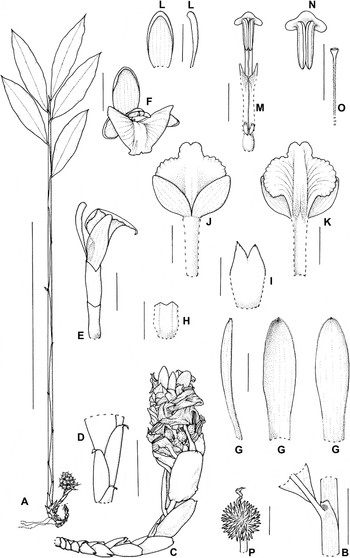
Amomo echinocarpo Alston pseudocaulibus foliisque glabris nitidis, floribus albis et fructibus aculeos simplices ferentibus simile, sed pedunculi squamis lanceolatis duris coriaceis ad apicem calcaratis, ligulis villosis ciliatis, labello trilobato et fructibus rubris aculeos molles ferentibus differt. – Type: Laos, Khammouan, Hin Boun, Bane Khoun Ngeun, 18°10′50″N, 104°29′32″E, 285 m, 19 v 2008, V. Lamxay et al. VL1290 (holo NLS; iso E). Figs 1,2.
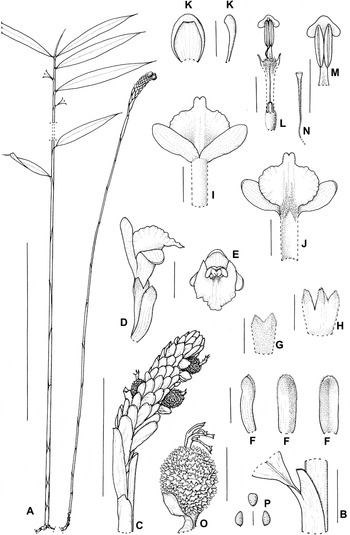
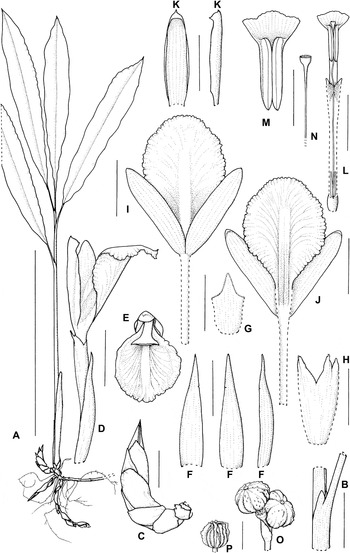
Fig. 1.Amomum calcaratum Lamxay & M.F.Newman. A, habit; B, ligule; C, inflorescence; D, peduncle sheaths; E, whole flower from side; F, whole flower from above; G, bract, inner, outer and lateral views; H, bracteole; I, calyx; J, labellum & lateral corolla lobes from below; K, labellum & lateral corolla lobes from above; L, dorsal corolla lobe, inner and lateral views; M, ovary, lateral staminodes and stamen; N, anther; O, stigma; P, fruit. Scale bars: A = 60 cm; B = 2 cm; C, D = 3 cm; E–P = 1 cm. Drawn from Lamxay VL1290, dried material & photos (A, B), spirit material (P); Lamxay VL1293, dried material (C, D), spirit material & photos (E–O).
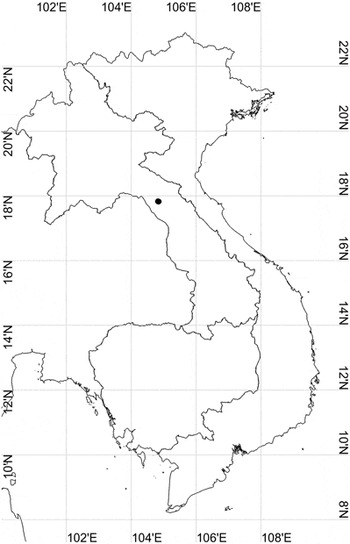
 Fig. 2.
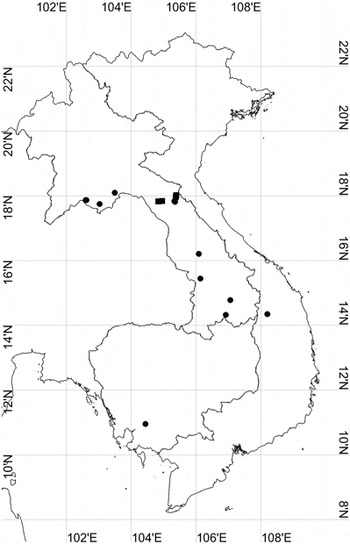
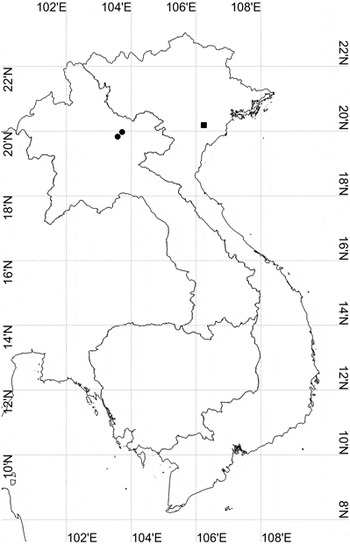
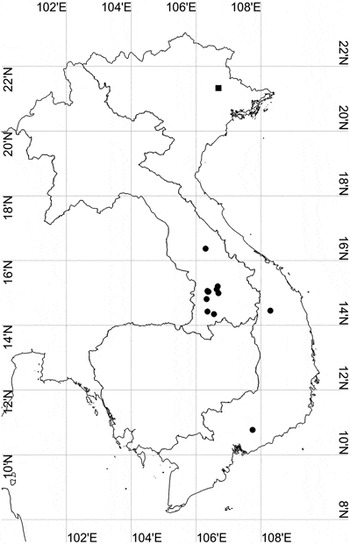
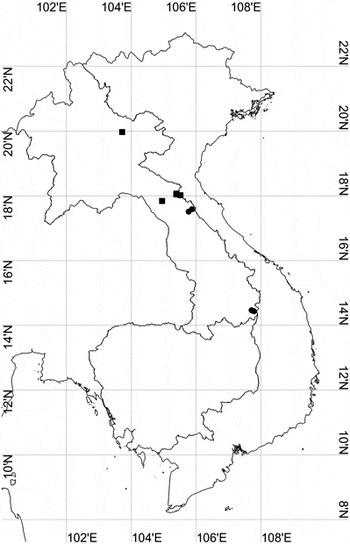
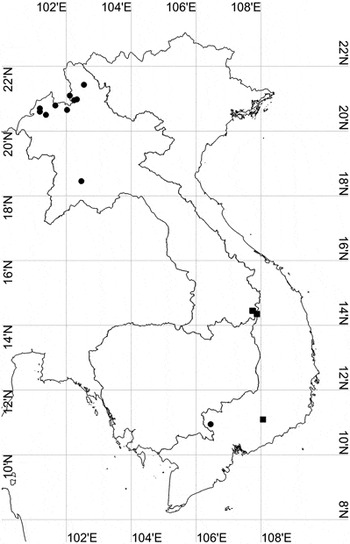
Distribution of Amomum calcaratum Lamxay & M.F.Newman in Cambodia, Laos and Vietnam.


Clump-forming herb, 1.8 m tall, c.10 pseudostems per clump; rhizome c.0.5–0.8 cm diameter, red then reddish-brown, striate, glabrous; stilt roots absent; interval between pseudostems c.7 cm long, scales broadly ovate, 1–2 cm long, pink then dark reddish-brown, coriaceous, striate, outer surface tomentose with long soft hairs, apex acute, margin ciliate. Pseudostem with 5–22 leaves per pseudostem, becoming gradually smaller towards apex, slightly swollen at base, 0.5–1.5 cm diameter, reddish-green then green, glabrous, striate or smooth, shiny, outer surface tomentose at base, margin of leaf sheaths ciliate; ligule ovate, 0.1–0.5 cm long, red then light green, coriaceous, outer surface tomentose, apex emarginate, margin ciliate; petiole very short, 0.1–0.2 cm long, canaliculate, green, glabrous, hairy at the base; blade oblong to elliptic to oblanceolate, 13–25 × 2–7 cm, green, glabrous, shiny, base attenuate, apex long caudate, margin entire, primary veins prominent below, secondary veins sunken. Inflorescence arising near base or from base, 1–2 per pseudostem; flowering part ellipsoid, c.5 × 3 cm, c.4 flowers open at once; peduncle 10 × 0.4–0.8 cm, red, glabrous, shiny; scales tubular at base, 1–2.5 × 0.8 cm, to broadly ovate above, 2–5 × 1.8–2 cm, red then dark reddish-brown, hard coriaceous, striate, outer surface tomentose, apex acute with short spur, margin ciliate with long white hairs; bracts boat-shaped to lanceolate, 2.3–3 × 0.5–0.7 cm, to c.4.5–5 × 2 cm when fruiting, red then dark reddish brown, hard coriaceous and papery above, striate, soon rotting, subtending a single flower, outer surface tomentose, apex acute with small oblong spur c.0.5 cm long, margin ciliate; bracteole tubular, 2-toothed, 1.2–1.3 × 0.4 cm, light brown, membranous, very thin, glabrous, outer surface tomentose at base, apex acute, bracteole tube 0.9–1 cm long, teeth 0.1–0.2 cm. Calyx tubular, 2-toothed, 1.5–1.6 × 0.3 cm, pinkish-light brown, membranous, very thin; calyx tube 1–1.2 cm long; teeth 0.4–0.5 cm long, apex acute with thick small spur. Corolla white, 3–3.2 cm long, corolla tube 1.5 cm long, coriaceous, outer surface tomentose, inner surface glabrous; lateral corolla lobes 1.5 × 0.7–0.8 cm, membranous, apex cucullate, glabrous; central corolla lobe 1.5 × 1 cm, membranous, apex cucullate, glabrous; labellum clawed, trilobed, 1.7 × 1.6–1.8 cm, white with yellow central stripe edged with red dots and red lines of minute red dots radiating to margin, tomentose at base, membranous, undulate; lateral staminodes oblong, 0.3 cm long, white. Filament flattened, 0.2 cm long, white, glabrous; anther oblong, 0.8 × 0.4 cm, white, glabrous; anther crest shallowly trilobed, 0.8 cm wide, central lobe 0.15 cm long, white, rounded, membranous. Stigma cup-shaped, glabrous, apex ciliate; style hairy; epigynous glands oblong, 0.3 cm long, apex ciliate; ovary 0.3 cm diameter, smooth, hairy; ovules globose, c.5 per locule. Infructescence peduncle c.6–10 × 0.4–0.7 cm, red, tomentose; scales boat-shaped to lanceolate, c.4.5–5 × 2 cm, reddish-green then dark reddish-brown, very hard, thick and coriaceous, outer surface tomentose, apex acute with small oblong spur c.0.5 × 0.2 cm, margin ciliate; fruiting part ovoid to globose, 4–5 × 5 cm, c.3–5 fruits per infructescence; fruits globose, 1 cm diameter, pink, prickles very soft, hairy. Seeds globose, 0.3–0.4 cm diameter, glabrous, c.3–5 per locule.
Distribution. Laos.
Habitat and ecology. Evergreen forest on limestone, at 285–381 m altitude.
Proposed IUCN status. VU D1. This species is known only from a very small area, with an area of occupancy less than 4 km2. This is all within a protected area and there are no threats and hence no continuing decline. The population is estimated to be very small, however, numbering fewer than 1000 mature individuals, and therefore qualifies for listing as Vulnerable under criterion D1.
Specimens examined. Laos.Khammouan: Hin Boun, Bane Khoun Ngeun, 381 m, 19 v 2008, V. Lamxay et al. VL1293 (E, NLS); ibid., 381 m, 28 iv 2009, V. Lamxay VL1713 (E, NLS, P, UPS); ibid., 381 m, 23 viii 2009, V. Lamxay VL2065 (NLS).
Amomum calcaratum has only been found in one locality in central Laos. It is very close to Amomum echinocarpum by its glabrous, shiny pseudostems and leaves, white flowers and simple prickles on the fruits but the peduncle scales are lanceolate, hard, coriaceous, spurred at the apex, the ligule villose, ciliate, the labellum trilobed and fruits pink with soft prickles.
In its glabrous and shiny leaves, and fruits with simple prickles, it also looks like Amomum uliginosum and A. villosum but it is distinguished from A. uliginosum by its small, very short lateral staminodes, and from A. villosum by its clump-forming habit, long peduncle with scales c.5 cm long, and semi-lunar or entire anther crest.
2. Amomum calcicolum Lamxay & M.F.Newman, sp. nov.
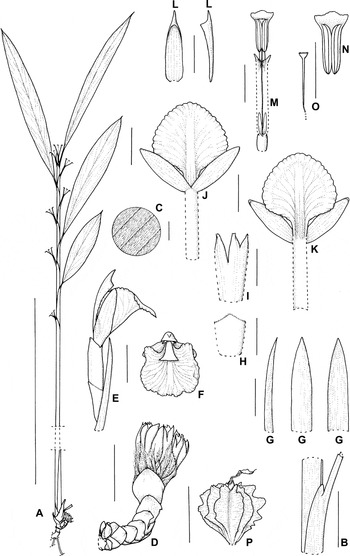
Amomo dealbato Roxb. habitu caespitoso, labello integro, corollae lobo centrali cucullato, antherae crista rotundata et fructibus alatis affine, sed ligulis nunquam fissis, in laminae pagina infera pilis sericeis albis, floribus simul apertis paucis et fructibus globosis alas 11 ferentibus differt. – Type: Laos, Khammouan, Hin Boun, 18°10′50″N, 104°29′32″E, 285 m, 19 v 2008, V. Lamxay et al. VL1291 (holo NLS; iso E, P, UPS). Figs 3,4.
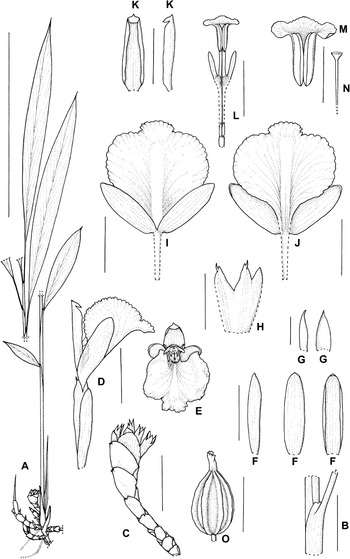
Fig. 3.Amomum calcicolum Lamxay & M.F.Newman. A, habit; B, ligule; C, indumentum on leaf blade; D, inflorescence; E, whole flower from side; F, whole flower from above; G, bract, inner, outer and lateral views; H, bracteole; I, calyx; J, labellum & lateral corolla lobes from below; K, labellum & lateral corolla lobes from above; L, dorsal corolla lobe, inner and lateral views; M, ovary, lateral staminodes and stamen; N, anther; O, stigma; P, fruit. Scale bars: A = 60 cm; B, D, P = 2 cm; C = 5 mm; E–O = 1 cm. Drawn from Lamxay VL2122, dried material (A–D), spirit material (P); Lamxay VL1714, spirit material & photos (E–O).
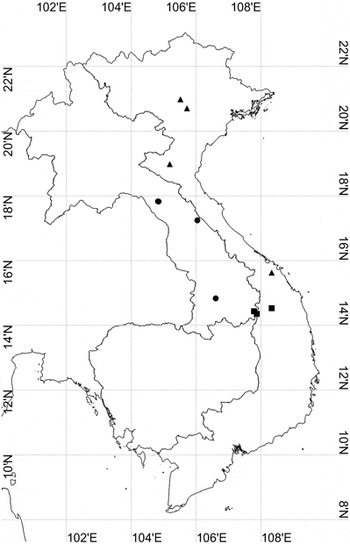
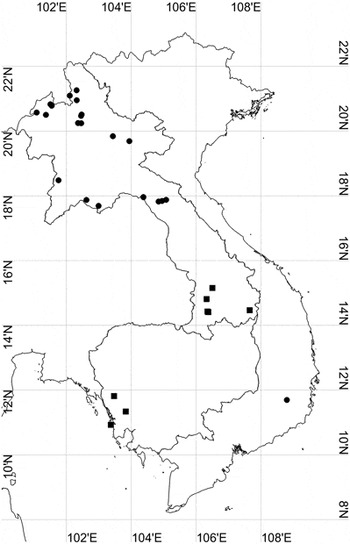
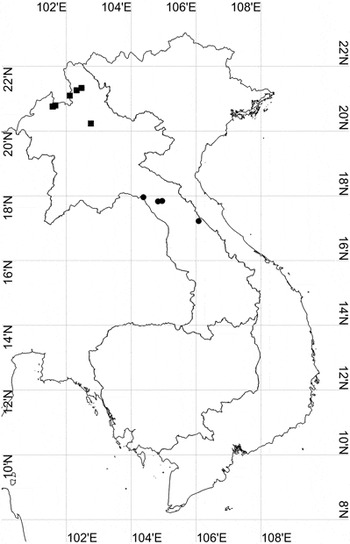
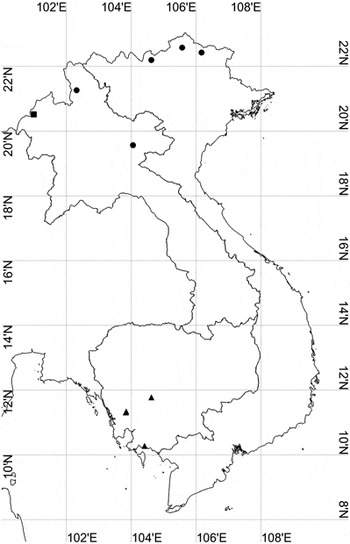
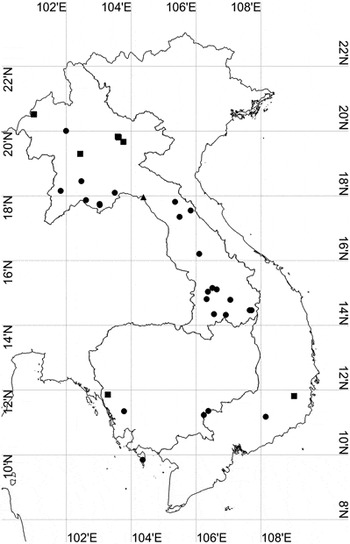
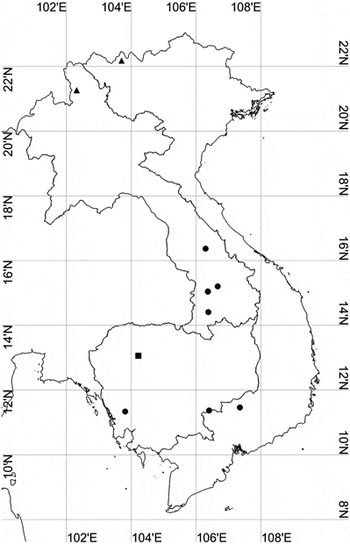
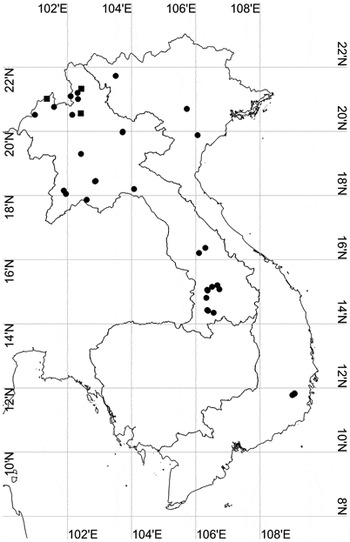
Fig. 4.Distribution of Amomum calcicolum Lamxay & M.F.Newman (•), Amomum celsum Lamxay & M.F.Newman (▪) and Amomum chevalieri Gagnep. ex Lamxay (▴) in Cambodia, Laos and Vietnam.


Clump-forming herb, c.1.2 m high, 3–5 pseudostems per clump; rhizome c.0.5–1.2 cm diameter, white then reddish-brown; stilt roots absent; interval between pseudostems c.5 cm long; scales ovate, 0.5–2 cm long, reddish then dark brown, coriaceous, striate, outer surface tomentose, rough, apex acute, margin ciliate. Pseudostem with c.12 leaves per pseudostem, becoming slightly smaller towards apex, slightly swollen at base, 1–1.5 cm diameter, red then green when old, glabrous, outer surface striate, rough, inner surface smooth, shiny; ligule ovate, 0.3–0.5 cm, light green then darker, glabrous, coriaceous, apex truncate; petiole canaliculate, 2–4 cm long, green, striate, glabrous; blade oblong, somewhat plicate, 37–50 × 5–6 cm, upper surface glabrous, dark green, lower surface tomentose with shiny, silky white hairs, base attenuate, apex long caudate, margin entire, primary veins prominent below, secondary veins sunken. Inflorescence arising from base, c.2 inflorescences per pseudostem; flowering part broadly ovoid to globose, 3 × 4 cm, a few flowers open at once; peduncle 2–5 × 0.5–0.6 cm, whitish-brown, striate, glabrous; scales broad, ovate, 0.5–1.5 × 1.5–2.2 cm, red then dark reddish-green, hard and thickly coriaceous, striate, glabrous, shiny, apex acute, margin ciliate; bracts boat-shaped to lanceolate, 2.5–3 × 0.3–0.5 cm, light brown, very thin, papery, striate, soon rotting, subtending a single flower, glabrous, apex caudate to acute; bracteole tubular, 1–1.2 × 0.3 cm, light brown, membranous, very thin, outer surface scabrous with short hairs, bracteole tube 0.5–0.6 cm long, apex truncate, 1-toothed. Calyx tubular, 3-toothed, 1.8–2.2 × 0.3 cm, pinkish to light brown, very thin and membranous, outer surface scabrous with short hairs, inner surface glabrous; calyx tube 1.2–1.4 cm long; teeth 0.4–0.7 cm long. Corolla 4–4.6 cm long, white, corolla tube 2–2.3 cm long, coriaceous, glabrous, inner surface pilose above; lateral corolla lobes 2–2.3 × 0.7–0.8 cm, membranous, glabrous, apex cucullate, margin ciliate; central lobe 2–2.3 × 1–1.2 cm, membranous, glabrous apex cucullate with pink, thick and pointed spur; labellum clawed, 2–2.3 × 2.2–2.5 cm, white with transparent veins radiating from yellow central stripe to margin and minute red dots at base, adaxial surface tomentose at base and central part, apex rounded, margin membranous; lateral staminodes triangular, 0.2 cm long, white with red dots at base. Filament flattened, 0.4 cm long, white, glabrous; anther oblong, 0.8 × 0.4 cm, white, glabrous; anther crest rounded, 0.3 cm long, membranous, white, glabrous. Stigma rounded, apex ciliate; style glabrous; epigynous glands oblong, 0.6 cm long, glabrous; ovary globose, 0.35–0.5 cm diameter, faintly 9–11-ridged, hairy; ovules globose, c.5–10 per locule. Infructescence peduncle 3–5 × 0.3–0.5 cm, brown, glabrous; fruiting part 5 × 4–5 cm, c.15–20 fruits per infructescence; fruits globose, 0.5–0.7 cm diameter, 9–11-winged, c.0.2–0.3 cm wide, bullate and ridged, hairy, young fruits green. Seeds globose, 0.3 cm diameter, glabrous, c.5–10 seeds per locule.
Distribution. Laos.
Habitat and ecology. Lowland and montane evergreen forest on limestone, in shade, at 285–1307 m altitude.
Proposed IUCN status. NT. This species has a small extent of occurrence (15,244 km2) but the population is not severely fragmented and only one of the three subpopulations is in decline, hence there are no locations. The species is therefore listed as Near Threatened as it almost qualifies for a Threatened listing under criterion B1ab(iii).
Specimens examined. Laos.Champasak: Tad Gneuang, 1307 m, 11 v 2009, V. Lamxay VL1726 (E, NLS, P). Khammouan: Bane Khoun Ngeun, 381 m, 28 iv 2009, V. Lamxay VL1714 (NLS); ibid., 381 m, 29 iv 2009, V. Lamxay VL1723 (NLS); ibid., 381 m, 23 viii 2009, V. Lamxay VL2066 (NLS); ibid., 381 m, 9 vi 2010, V. Lamxay VL2122 (E, NLS, P); along Pakang stream, Nam On catchment, Phou Ak escarpment, Nakai Nam Theun NPA, 790 m, 25 v 2006, M.F. Newman et al. LAO1302 (E).
This species resembles Amomum dealbatum, A. repoeense, A. chryseum and A. maximum by its winged fruits but it differs from A. dealbatum and A. maximum by its loosely clump-forming habit, small rhizome, leaf blade with silky white hairs on the lower surface and fruits with 11 wings, from A. repoeense by its bracts only bearing single flowers, and from A. chryseum by its white flowers.
3. Amomum celsum Lamxay & M.F.Newman, sp. nov.
Amomo koenigii J.F.Gmel. habitu laxe caespitoso, rhizomate profundo, pseudocaulibus juvenibus foliorumque pagina abaxiali glaucis et labello trilobato simile, sed ab eo speciebusque Amomi omnibus aliis pedunculis praeter modum longis, ad 2 m circiter, differt. – Type: Laos, Attapeu, Phouvong, Bane Phou Keua, 14°42′30″N, 107°31′28″E, 481 m, 15 v 2008, V. Lamxay et al. VL1253 (holo NLS; iso E, P, UPS). Figs 4,5.
Fig. 5.Amomum celsum Lamxay & M.F.Newman. A, habit; B, ligule; C, inflorescence; D, whole flower from side; E, whole flower from above; F, bract, inner, outer and lateral views; G, bracteole; H, calyx; I, labellum & lateral corolla lobes from below; J, labellum & lateral corolla lobes from above; K, dorsal corolla lobe, inner and lateral views; L, ovary, lateral staminodes and stamen; M, anther; N, stigma; O, fruit; P, seeds. Scale bars: A = 70 cm; B = 2 cm; C = 10 cm; D–O = 1 cm; P = 5 mm. Drawn from Lamxay VL1189, dried material (A–C); Lamxay VL1253, spirit material & photos (D–P).

Loosely clump-forming herb, c.2.5 m tall, 3–15 pseudostems per clump; rhizome growing deep in the soil, c.0.7–1 cm diameter, white, slightly striate, glabrous; stilt roots absent; interval between pseudostems c.15 cm long, scales broadly ovate, 1–2 cm long, pink then dark brown, coriaceous, striate, soon rotting, glabrous, inner surface shiny, apex acute. Pseudostem with c.20 leaves per pseudostem, becoming gradually smaller towards apex, slightly swollen at base, 1–1.5 cm diameter, pink then green, glabrous, outer surface glaucous, striate, inner surface smooth, shiny; ligule ovate, 0.5–0.7 cm long, pink then light green, coriaceous, outer surface tomentose, apex truncate to rounded, margin ciliate; petiole very short, 0.2–0.5 cm long, canaliculate, green, glabrous; blade oblong to oblong-lanceolate, 14–35 × 2–8 cm, glabrous, upper surface dark green, lower surface glaucous, light green, base attenuate, apex long caudate, cauda c.3.5 cm long, margin entire, primary veins prominent below, secondary veins sunken. Inflorescence arising near base, 1 per pseudostem; flowering part cylindrical, elongate, c.10 × 3–5 cm, 1–2 flowers open at once; peduncle c.200 × 0.5 cm, green, glabrous at base, tomentose above; peduncle scales broadly ovate at base, 1–2 × 1–1.5 cm, oblong-linear in middle, 10–20 (rarely to 25) × 1.5–2 cm, and oblong-lanceolate above, 3–5 × 1.3–1.5 cm, reddish-green then brown, hard coriaceous, striate, glabrous, outer surface scabrous, tomentose above, inner surface shiny, apex acute, with leaf-like spur c.1 × 0.2 cm, margin papery at base to ciliate above; bracts oblong to boat-shaped, 1.5–2.5 × 0.5–1 cm, pink then dark brown, hard coriaceous, striate and papery, shiny, outer surface tomentose, subtending a single flower, apex truncate to rounded, margin ciliate with long, white hairs; bracteole tubular, 1-toothed, 0.5–0.6 × 0.2 cm, pink, very thin and membranous, apex acute with long hairs, outer surface tomentose, bracteole tube 0.3 cm long, teeth 0.2 cm long. Calyx tubular, 3-toothed, 1–1.2 × 0.2 cm, light brown, membranous, thin, outer surface tomentose, inner surface glabrous, apex cucullate; calyx tube 0.5–0.6 cm long; teeth 0.2–0.6 cm long. Corolla 2–2.5 cm long, glabrous, membranous, corolla tube 1–1.2 cm long, coriaceous, white, glabrous; lateral corolla lobes 1–1.3 × 0.6–0.7 cm, apex cucullate; central corolla lobe 1–1.3 × 0.8–1 cm, glabrous, membranous, apex cucullate; labellum clawed, trilobed, 1.5–1.6 × 1.5–1.6 cm, white with yellow central stripe, membranous, tomentose at base on adaxial surface and along central part, apex rounded with 3 lobes, undulate; lateral staminodes subulate, 0.3–0.4 cm long, white. Filament flattened, 0.3 cm long, white, glabrous; anther oblong, 0.6 × 0.3 cm, white but dark reddish-brown along slit, glabrous; anther crest trilobed, 0.2 cm wide, rounded, membranous, white, glabrous. Stigma cup-shaped, glabrous, apex ciliate; style hairy; epigynous glands oblong, 0.2 cm long, glabrous; ovary 0.3 cm diameter, bullate or strumose, hairy; ovules globose, c.12 ovules per locule. Infructescence peduncle 150–200 × 0.5 cm, green then brown, glabrous at base, tomentose above; fruiting part elongating, oblong, c.10 × 5 cm, c.15 fruits per infructescence; fruits globose, 1.5–2.5 × 1–2 cm, light green, prickly, hairy. Seeds globose, 0.3–0.4 cm diameter, yellowish-brown, glabrous, bullate, c.10–12 seeds per locule.
Distribution. Vietnam, Laos.
Habitat and ecology. Lowland evergreen forest, mixed deciduous forest, open forest, at 349–481 m altitude.
Proposed IUCN status. EN B1ab(iii). This species has a very small extent of occurrence (EOO) of 314 km2, including the Vietnamese locality which is probably no longer extant so the EOO is an over-estimate. It is known at present only from two locations and there is continuing decline in the habitat due to logging and road building. Another population may exist in Laos; Poilane 13692 (P) was collected in 1927 in Savannakhet, Laos, ‘between L.G. Xinh xa ne and Lang Xoane’. These place names are unknown nowadays so we have not been able to confirm the presence of Amomum celsum in Savannakhet.
Specimens examined. Laos.Attapeu: Bane Houay Pik, 349 m, 27 vii 2007, V. Lamxay & Bounlop VL1189 (E, NLS, P, UPS). Savannakhet: between L.G. Xinh xa ne and Lang Xoane, 10 iv 1927, E. Poilane 13692 (P).
Vietnam.Kon Tum: Tu Mo Rông – Dak ha, 12 iii 1941, E. Poilane 32294 (P).
This species, with its exceptionally long, erect peduncle, has only been seen by us in one small site in southern Laos. Two other collections were made by Poilane in 1927 (Poilane 13692, P) and in 1941 (Poilane 32294, P). The collection locality for Poilane 13692 has not been identified but Savannakhet was larger at that time, including Attapeu Province, so Poilane’s collection may come from the same locality where we have collected this species.
4. Amomum chevalieri Gagnep. ex Lamxay, sp. nov.
Amomo repoeensi Pierre ex Gagnep. bractibus florum plurium quam singulorum cincinnos ferentibus, foliis glabris et fructibus alatis simile, sed radicibus gralliformibus, foliorum vaginis striatis, ligulis truncatis glabris, pedunculis multo longioribus, pedunculorum squamis longis, bracteis bracteolisque caliceque glabris et antherae crista semilunari manifeste distinguatur. – Type: Vietnam, Phu Tho, 18–19 iv 1914, Fleury s.n. (holo P). Fig. 4.
Clump-forming herb, c.50 cm tall; rhizome c.1 cm diameter, glabrous; stilt roots present, c.5 × 0.5–0.7 cm; interval between pseudostems short, scales soon rotting, papery, glabrous. Pseudostem with c.7 leaves per pseudostem, 1 cm diameter, striate, glabrous; ligule ovate, c.0.5 cm long, coriaceous, glabrous, apex truncate, margin ciliate; petiole canaliculate to cylindrical, c.10–15 (rarely to 20) × 0.3 cm, glabrous; blade broadly elliptic, 20–35 (rarely to 60) × 5–10 cm, dark green above, grey below, glabrous, base cuneate, apex acute, margin entire, ciliate at apex, primary vein prominent below. Inflorescence arising from base or near base, 1 per leafy shoot; flowering part oblong, c.10 × 2–3 cm; peduncle c.20 × 0.3–0.5 cm, striate, glabrous; peduncle scales broadly triangular at base, 1 × 1.5 cm, narrowly lanceolate-oblong above, 3 × 1 cm, coriaceous, striate, glabrous, apex acute; bracts lanceolate-oblong, c.2.5–3 × 1–1.2 cm, subtending a few flowers, coriaceous, striate, glabrous, apex acute, margin ciliate; bracteole open, narrowly lanceolate, c.1–1.5 × 0.7 cm, as long as pedicel, membranous, striate, glabrous, apex acute, margin ciliate. Calyx tubular, 3-toothed, c.1.5 × 0.5 cm, glabrous, as long as corolla tube; calyx tube c.1 cm long, membranous; teeth c.0.5–0.75 cm long. Corolla membranous, glabrous, apex acute, corolla tube as long as corolla lobes, c.0.4 cm diameter; corolla lobes oblong, c.1.5 × 0.8 cm, central lobe the same size and shape as lateral lobes, membranous; labellum clawed, glabrous, c.1.5 × 1–1.3 cm, apex rounded; lateral staminodes small, c.0.3 cm long. Filament flattened, c.1 cm long, glabrous; anther oblong, c.1 cm long, glabrous; anther crest large, semi-lunar, 0.7 × 1 cm, membranous, glabrous. Stigma cup-shaped, apex ciliate; style glabrous; epigynous glands oblong, c.0.4 cm long, apex rounded, glabrous; ovary ridged, c.0.4 × 0.3 cm, glabrous, pedicel c.1–1.5 × 0.2–0.3 cm. Fruits globose, c.1 cm diameter, winged.
Distribution. Vietnam.
Habitat and ecology. In high mountains, at c.1500 m altitude.
Proposed IUCN status. DD. This species has not been collected since 1923 so the current extent of occurrence is not known. Although most of the known localities have been visited by ginger experts, there has been no concerted attempt to search for this species. No threats have been identified. The species is listed as Data Deficient as there is insufficient information to apply the criteria.
Specimens examined. Vietnam.Hanoi: Ba Vi, 24 vii 1888, B. Balansa 4205 (P). Nghe An: 5 v 1914, Fleury 32344 (P). Phu Tho: 17 iv 1914–18 iv 1914, Fleury 32143 (P). Quang Nam-Da Nang: Ba Na, 1500 m, 17 vii 1923, E. Poilane 7227 (P).
The first collection of this species dates from 1888 (Balansa 4205, P) but the others were collected in 1914 and 1923, after Gagnepain had published his revision of the Indochinese Zingiberaceae (Gagnepain, Reference Gagnepain and Lecomte1908). The name was written onto the specimens at P but has not been published until now.
Two specimens were found in a type cover at P, Fleury 32143 and Fleury s.n. The first of these is dated 17–18/4/1914 while the second is annotated, ‘a déjà reçu un no. 18–19/4/1914’. As the dates differ, they cannot be regarded as being a single gathering, though they seem to have been collected together. Although the annotation on the second sheet says it has received a number, no number is attached to the sheet.
This species is close to Amomum repoeense by its bracts bearing cincinni of more than one flower, glabrous leaves and winged fruits but may be clearly distinguished by its stilt roots, striate leaf sheaths, truncate, glabrous ligules, much longer peduncle, long peduncle scales, glabrous bracts, bracteoles and calyx, and semi-lunar anther crest.
5. Amomum chinense Chun, Fl. Hainan. 4: 533 (1977); Wu & Larsen, Fl. China 24: 354 (2000). – Type: China, Hainan, Yaichow, iii–vii 1933, F.C. How 70635bis (holo IBSC n.v.; iso NY). Figs 6,7.
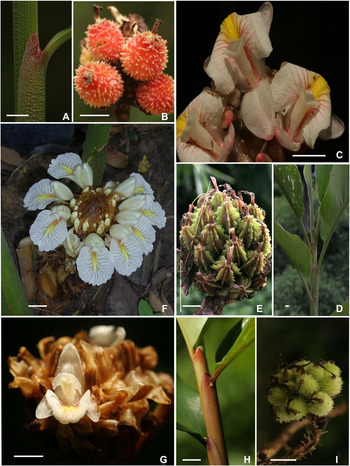
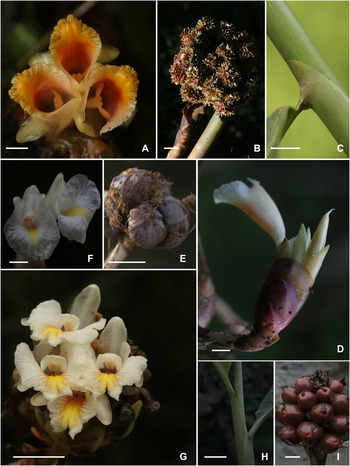
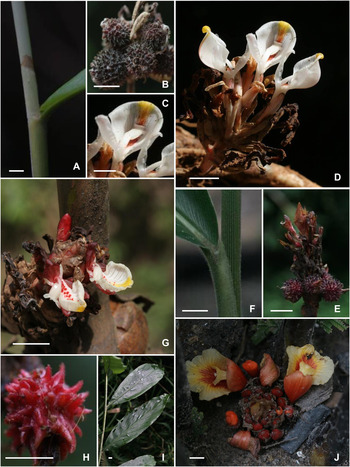
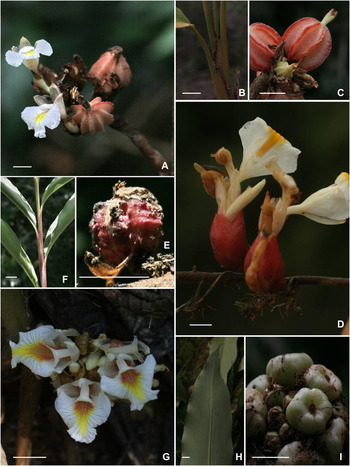
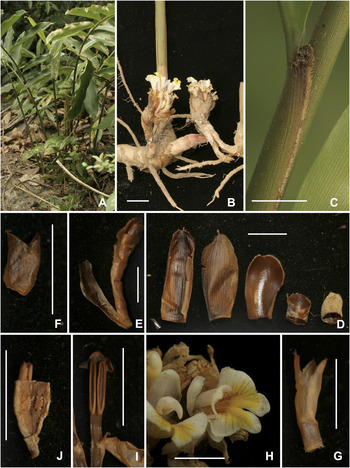
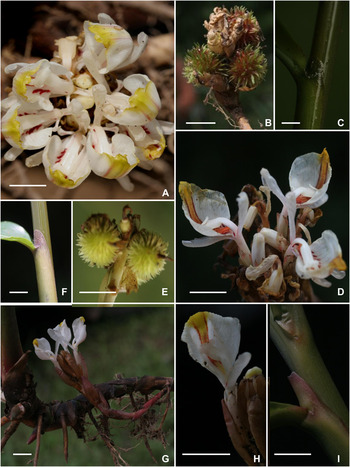
Fig. 6.A–C: Amomum chinense. A, ligule; B, infructescence; C, inflorescence. Lamxay VL1230. D–F: Amomum dealbatum. D, ligule; E, infructescence; F, inflorescence. Lamxay VL1151. G–I: Amomum echinocarpum. G, inflorescence; H, ligule; I, infructescence. Lamxay VL1306. Scale bar = 1 cm. (See online for a colour version of this figure.)
Fig. 7.Distribution of Amomum chinense Chun (•) and Amomum chryseum Lamxay & M.F.Newman (▪) in Cambodia, Laos and Vietnam.


Creeping herb, to 3 m tall; rhizome deep, c.0.5–2 cm diameter, white then green; stilt roots absent; interval between pseudostems c.20–50 cm long, scales tubular, 1–4 cm long, light brown, papery, striate, glabrous, outer surface rough, inner surface smooth, apex acute or truncate. Pseudostem with c.15 leaves per pseudostem, becoming gradually smaller towards apex, slightly swollen at base, 1–1.5 cm diameter, green, glabrous, outer surface striate, conspicuously reticulate, inner surface smooth, shining, margin of leaf sheaths red; ligule c.0.4–0.5 cm long, red then reddish-brown, coriaceous, glabrous, apex rounded to emarginate, margin ciliate; petiole very short, 0.5–1.2 cm long, canaliculate, green, striate, glabrous; blade oblong-elliptic, 25–33 × 6–8 cm, glabrous, lower surface whitish, glaucous, base attenuate, apex long caudate, cauda c.2 cm long, margin entire, primary vein prominent below, whitish, secondary veins sunken. Inflorescence arising from rhizome c.5 cm from base of mature shoots, 2–3 per pseudostem; flowering part ellipsoid to globose, c.4 cm diameter, c.4 flowers open at once; peduncle c.16–20 × 0.3 cm, pinkish then whitish-brown, glabrous at base, tomentose above, rough; scales tubular at base, 1.3–1.5 × 0.6 cm, broadly ovate to lanceolate above, 3.5–4 × 1–1.5 cm, light pink then dark brown, coriaceous, striate, glabrous to tomentose at base, apex acute or cucullate, margin glabrous or ciliate; bracts boat-shaped to lanceolate, 2–3 × 1–1.5 cm, greenish-pink then dark brown, coriaceous, striate, soon rotting, subtending a single flower, tomentose at base, apex cucullate to rounded, margin ciliate to glabrous; bracteole tubular, 2-toothed, 1.5–1.6 × 0.6 cm, light pink, membranous, striate, tomentose at base, bracteole tube 1–1.1 cm long, tomentose at base, teeth 0.5–0.6 cm, apex acute. Calyx tubular, 3-toothed, 1.5–1.6 × 0.4 cm, light pink then light brown, glabrous, outer surface tomentose at base, membranous; calyx tube 1–1.2 cm long; teeth 0.2–0.3 cm long, apex acute. Corolla 3–3.2 cm long, light pinkish-white, corolla tube 1.5–1.6 cm long, coriaceous, striate, outer surface pilose, tomentose at base, inner surface tomentose at base; lateral corolla lobes 1.5–1.6 × 0.5–0.7 cm, membranous, glabrous, apex cucullate; central corolla lobe 1.5 × 0.8–1 cm, membranous, glabrous, apex cucullate; labellum clawed, trilobed, 1.5–1.7 cm long, whitish-pink with yellow central stripe edged with lines of red dots radiating to margin, two longitudinal lines of long hairs at base, membranous, apex emarginate; lateral staminodes oblong, 0.2 cm long, white. Filament flattened, 0.3–0.4 cm long, white, glabrous; anther oblong, 0.7–0.8 × 0.5 cm, white, glabrous; anther crest rounded, entire, 0.5 × 0.2 cm, white, membranous, glabrous. Stigma rounded, coriaceous, glabrous, apex ciliate; style glabrous; epigynous glands oblong, 0.6 cm long, glabrous; ovary 0.4 cm diameter, tomentose with long white hairs; ovules globose, c.30 per locule. Infructescence peduncle 15–20 × 0.3 cm, brown, glabrous; fruiting part 5 × 5 cm, more than 10 fruits per infructescence; fruits globose, 1–1.5 cm diameter, tomentose, short hairy, with flattened, simple spines, cream at base, red at apex then dark red when ripe. Seeds globose, 0.3 cm diameter, yellowish, glabrous, c.30 per locule.
Distribution. China (Hainan), Thailand, Cambodia, Laos, Vietnam.
Habitat and ecology. Lowland forest, mixed deciduous forest, open forest, on many soil types, at 90–628 m altitude.
Lao name and uses. Mak sa. The fruits are slightly sweet and acidic when ripe and are eaten. The seeds taste of camphor and are used for treating toothache.
Proposed IUCN status. LC. This species has a very large extent of occurrence and is common with no major threats so it is listed as Least Concern.
Specimens examined. Cambodia.Kampong Spoe: Kirirom, 628 m, 29 v 2010, M.F. Newman et al. 2414 (E); Samrong Tong, 10 iv 1870, J.B.L. Pierre 542bis (P).
Laos.Attapeu: Bane Bak, Dong Bak Protected Area, 90 m, 11 ix 2006, V. Lamxay & Bounlop VL1089 (E, NLS, P); Bane Lak 62, 291 m, 17 v 2008, V. Lamxay & M.F. Newman VL1282 (E, NLS, P). Bolikhamxai: Bane Had Khai, 404 m, 9 v 2008, V. Lamxay et al. VL1243 (E, NLS); Bane Nam Phao, 499 m, 17 vi 2006, V. Lamxay VL1015 (E, NLS, P); ibid., 523 m, 28 iv 2009, V. Lamxay VL1715 (NLS); ibid., 527 m, 24 viii 2009, V. Lamxay VL2071 (NLS). Khammouan: Phone Than, O. Spire 4074 (P); Bane Mak Feuang, 19 xii 2005, E.C.S. Lundh & L.J. Ahnby Ella12 (E); Bane Na Wa, 590 m, V. Lamxay VL1878 (NLS). Salavan: Bane Kham Toey, 180 m, 3 vi 2000, Lee 106 (E, P). Savannakhet: Bane Na Thong, 207 m, 7 viii 2007, V. Lamxay VL1195 (NLS). Vientiane Capital: Bane Phia Lat, 607 m, 6 v 2008, V. Lamxay VL1230 (E, P); Bane Po, 185 m, 6 v 2006, V. Lamxay VL1001 (NLS); Xaythani, Bane Dane Xang, 179 m, 3 v 2008, V. Lamxay et al. VL1222 (E, NLS, P, UPS); ibid., 179 m, 27 i 2010, V. Lamxay VL2114 (NLS).
Vietnam.Kon Tum: Dak To, 800 m, 13 ix 1930, E. Poilane 18326 (P).
The main distinguishing characters of Amomum chinense are its loosely creeping habit, with its rhizome c.10 cm deep in the soil, the leaf sheath markedly reticulate, ligule red, peduncle erect, c.20 cm long, anther crest semi-lunar, and pink or reddish, prickly fruits grouped at the top of the infructescence. It resembles Amomum villosum and A. uliginosum but is distinguished from them by its semi-lunar anther crest and long peduncle. It differs from Amomum elephantorum by its white flowers and its fruits with simple spines.
6. Amomum chryseum Lamxay & M.F.Newman, sp. nov.
Amomo repoeensi Pierre ex Gagnep. inflorescentiis duorum florum cincinnos interdum ferentibus, bracteolis apertis et fructibus alatis persimile, sed ligulis ovatis ad apicem emarginatis, foliorum lamina angusta (minus quam 10 cm lata), floribus magis quam 4 cm longis, labello corollaeque lobis luteis praeditis, et fructibus ovoideis differt. – Type: Laos, Bolikhamxai, Kham Keut, Bane Na Heuang, 18°22′31″N, 105°2′2″E, 724 m, 29 iv 2009, V. Lamxay VL1719 (holo NLS; iso E, P, UPS). Figs 7,8.
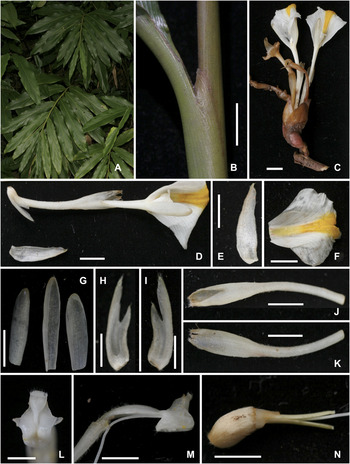
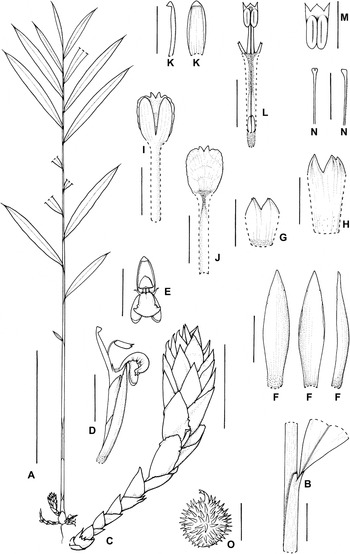
Fig. 8.Amomum chryseum Lamxay & M.F.Newman. A, habit; B, ligule; C, inflorescence; D, whole flower from side; E, whole flower from above; F, bract, inner, outer and lateral views; G, bracteole, lateral and inner views; H, calyx; I, labellum & lateral corolla lobes from below; J, labellum & lateral corolla lobes from above; K, dorsal corolla lobe, inner and lateral views; L, ovary, lateral staminodes and stamen; M, anther; N, stigma; O, fruit. Scale bars: A = 40 cm; B, D–F, H–L, O = 2 cm; C = 3 cm; G, M, N = 1 cm. Drawn from Lamxay VL1719, dried material (A–C), spirit material & photos (D–N); Lamxay VL1171, dried material & photos (O).

Clump-forming herb, c.80 cm tall, with c.20 pseudostems per clump; rhizome c.0.8 cm diameter, red; stilt roots absent; interval between pseudostems c.5 cm long, scales broadly triangular, 1–2 cm long, dark brown, coriaceous, striate, glabrous, apex acute, margin entire. Pseudostem with c.5–8 leaves per pseudostem, becoming gradually smaller towards apex, slightly swollen at base, c.1 cm diameter, red then greenish-red, striate, glabrous; ligule coriaceous, c.1 cm long, green, glabrous, apex emarginate or shortly bilobed, margin entire; petiole canaliculate, c.5–17 × 0.3 cm, green, striate, glabrous; blade obovate-elliptic to oblong or elliptic, 25–50 × 6–10 cm, green, glabrous, plicate, base attenuate, apex acute to long caudate, margin entire, primary veins prominent on lower surface, secondary veins prominent. Inflorescences arising near the base or from base, few per pseudostem; flowering part ellipsoid, 3–5 × 1–2 cm, 1–2 flowers open at once; peduncle c.3–5 × 0.5 cm, reddish-pink, glabrous; scales broadly triangular at base, 1–1.5 × 1.5–2 cm, ovate above, 3–4 × 2–2.5 cm, pink, coriaceous, finely striate, glabrous and shiny, apex soon drying and rotting, truncate to emarginate with short spur, margin entire, with very short cilia; bracts oblong-lanceolate, 2.5–4 × 1.5–2 cm, light pink, coriaceous, striate, glabrous, subtending 1–2 flowers, apex truncate to rounded, cucullate, margin entire; bracteole open, oblong-lanceolate, 1–1.5 × 0.3–0.5 cm, whitish-pink, coriaceous, striate, glabrous, apex acute, margin ciliate. Calyx tubular, 3-toothed, 2–2.5 × 0.3–0.5 cm, pinkish-white, coriaceous, striate, glabrous; calyx tube 1–1.25 cm long; teeth 0.4–0.5 cm long, apex acute, cucullate with spur c.0.2 cm long. Corolla 4–5 cm long, yellow, glabrous, corolla tube c.2–2.5 × 0.5 cm; corolla lobes oblong, 3–4 × 1 cm, apex cucullate; central lobe pointed at apex; labellum clawed, 3–4 × 3–4 cm, yellow with red dots at base and transparent lines radiating to margin, apex with 3 broad lobes, membranous and plicate; lateral staminodes oblong, membranous, 1 × 0.2–0.3 cm, yellowish-white. Filament flattened, 1 × 0.3–0.4 cm, white, glabrous; anther oblong, 1 × 0.5 cm, yellow, glabrous; anther crest trilobed, lateral lobe c.0.5 cm long, central lobe c.1.5 cm wide, yellow, membranous. Stigma cup-shaped, glabrous, apex ciliate; style glabrous; epigynous glands 0.5 cm long, glabrous, covered with small dark dots, apex truncate; pedicel glabrous, c.0.5 cm long; ovary c.0.5 cm diameter, ridged, glabrous; ovules globose, c.20 per locule. Infructescence c.7–10 × 1 cm, pink to greenish-red, glabrous, with 3–5 fruits clustered at apex; fruiting part c.3–5 cm; fruits ovoid, 1.5–2 × 0.8–1 cm, pointed at apex, with persistent calyx, 9-winged, margin of wings straight and entire, wings c.0.5 cm wide, greenish, glabrous. Seeds obovoid to globose, 0.3 cm diameter, white then black, aril white, 15–20 per locule.
Distribution. Laos.
Habitat and ecology. Mid-elevation evergreen forest on limestone, among rocks, in shady conditions, at 381–724 m altitude.
Proposed IUCN status. LC. Although this species has a very small extent of occurrence (200 km2), there are no threats and all the known localities are in protected areas. The species is therefore listed as Least Concern.
Specimens examined. Laos.Bolikhamxai: Bane Na Heuang, 18 vii 2007, V. Lamxay et al. VL1171 (E, NLS); Phou Hai, 9 vi 2010, V. Lamxay VL2119 (E, NLS, P, UPS). Khammouan: Bane Khoun Ngeun, 381 m, 29 iv 2009, V. Lamxay VL1724 (NLS).
This species resembles Amomum repoeense in its sometimes two-flowered cincinni, open bracteoles and winged fruits but its ovate ligule is emarginate to slightly bilobed, the leaf blades are narrow, the flowers are longer than 4 cm, the labellum and corolla lobes are yellow and the fruit is ovoid.
7. Amomum dealbatum Roxb., Fl. Ind. 1: 42 (1820); Wu & Larsen, Fl. China 24: 354 (2000). – Cardamomum dealbatum (Roxb.) Kuntze, Revis. Gen. Pl. 2: 686 (1891). – Type: See notes below. Figs 6,9.
Clump-forming herb to 2.5 m tall, 3–5(–15) pseudostems per clump; rhizome c.2–4 cm diameter, white then yellowish-brown; stilt roots absent; interval between pseudostems c.5 cm long, scales ovate to broadly ovate, 1–5 × 5 cm, brown, coriaceous, striate, shiny, glabrous, apex acute, margin entire. Pseudostem with c.8–10 leaves per pseudostem, becoming gradually smaller towards apex, slightly swollen at base, 1.5–2 cm diameter, light green, striate, outer surface tomentose, smooth, shiny, margin of leaf sheaths ciliate; ligule lanceolate, bifid, c.4–5 cm long, light brown, membranous, outer surface tomentose, margin ciliate; petiole canaliculate, > 10 cm long, green, striate, tomentose; blade oblong, 40–90 × 9–15 cm, light or pale green, plicate, upper surface glabrous, lower surface tomentose but not covered with silky white hairs, base long attenuate, apex long caudate, margin entire, primary veins prominent below, secondary veins prominent on both sides. Inflorescences arising from base, c.3 per pseudostem; flowering part ellipsoid, 5–6 × 6 cm, c.10–11 flowers open at once in a circle; peduncle 12–15 × 0.6–1 cm, light brown, striate, glabrous; scales broadly ovate to broadly lanceolate, 1.5–7 × 1–6 cm, light brown then dark brown, coriaceous, thick, hard, striate, glabrous, shiny, apex acute with short spur, margin entire; bracts boat-shaped to lanceolate, 2–4.5 × 1–1.5 cm, light brown, striate, soon rotting, subtending a single flower, outer surface scabrous to glabrous, apex acute with papery wing, margin entire; bracteole absent. Calyx tubular, 3-toothed, 2.5–3 × 0.3–0.5 cm, white, transparent colourless, membranous, outer surface pilose, inner surface glabrous; calyx tube 1.5–1.6 cm long; teeth 0.5–1 cm long, apex acute with thick, small spur. Corolla c.4–5 cm long, white, transparent, colourless, corolla tube 2–2.5 cm long, outer surface glabrous, inner surface glabrous at base, pilose to strigose and tomentose above; lateral corolla lobes 2–2.5 × 0.6–0.9 cm, membranous, glabrous, apex cucullate; central corolla lobe 2.3–2.5 × 0.8–1.2 cm, membranous, glabrous, apex cucullate; labellum clawed, 3.5–4 × 1.5–2 cm, white with red and yellow central stripe and clear venation radiating to margin, labellum and filament connate into a very short tube c.0.2 cm above insertion of corolla lobes, entire, membranous, rounded, hairy; lateral staminodes triangular, 0.2 cm long, white. Filament flattened, 0.2–0.3 cm long, white, adaxial surface pilose; anther oblong, 1.3–1.5 × 0.4 cm, white, glabrous; anther crest truncate, entire, 1 × 0.3 cm, membranous, white, glabrous. Stigma rounded, glabrous, apex ciliate; style glabrous; epigynous glands oblong, 0.8 cm long, glabrous; pedicel c.0.5 cm long, hairy; ovary 0.4 cm diameter, with 9 longitudinal ridges, hairy; ovules round, c.15 per locule. Infructescence peduncle c.10–15(–20) × 0.5 cm, brown, glabrous; fruiting part c.20 fruits per infructescence, 6–7 cm diameter; fruits ovoid, 2–2.5 × 1–1.5 cm, 9-winged, green then reddish-green, wings 0.2–0.3 cm wide, margin serrate, hairy. Seeds globose, 0.3 cm diameter, glabrous, black, aril yellowish, c.15–20 per locule.
Distribution. India (Assam), Bhutan, Sikkim, Burma, Thailand, Laos, Vietnam.
Habitat and ecology. Lowland to montane forest, mixed deciduous forest, limestone forest, open forest, at 120–1280 m altitude.
Lao name and uses. Mak kouk. The fruits of this species, which is very common in northern Laos, taste sweet and slightly acid. They are collected in August and September for eating at home and for local trade. Fruits have also been seen at the central market of Louangphabang. Some families have collected plants from the forest and planted them in their own gardens to provide a crop for local trade.
Proposed IUCN status. DD. This is a species complex and although, as currently circumscribed, it has a very wide range and is common, it may be resolved into a number of more restricted-range species. Hence for now it has to be assessed as Data Deficient.
Specimens examined. Laos.Bolikhamxai: 30 iv 1932, A.F.G. Kerr 21315 (K, P); Bane Kouan Chane, 16 v 2007, V. Lamxay VL1134 (NLS); Bane Phone Xay, 13 v 2008, V. Lamxay & M.F. Newman VL1248 (E, NLS); ibid., 27 iv 2009, V. Lamxay VL1710 (NLS). Khammouan: Bane Khoun Ngeun, 18 vii 2007, V. Lamxay VL1180 (E, NLS); ibid., 19 v 2008, V. Lamxay & M.F. Newman VL1289 (E, NLS, P). Louangnamtha: Mueang Sing, 22 v 1936, E. Poilane 26280 (P); Bane Sop Y, 17 viii 2009, V. Lamxay VL2052 (NLS); Bane Thong Lat, 3 v 2007, V. Lamxay & P. Phaphouampheng VL1129 (E, NLS); Bane Xiang Kok, 30 vi 2007, V. Lamxay & P. Phaphouampheng VL1156 (E, NLS). Louangphabang: Bane Nam Soy, 15 i 2010, V. Lamxay VL2107 (NLS). Oudomxai: Bane Lak 32, 4 vii 2007, V. Lamxay & K. Khounsirivong VL1165 (E, NLS); Bane Mok Kok, 20 viii 2009, V. Lamxay VL2061 (NLS); Bane Mouang La, 17 viii 2009, V. Lamxay VL2050 (NLS); ibid., 17 viii 2009, V. Lamxay VL2051 (NLS); Bane Na Vene, 7 vii 2007, V. Lamxay & S. Phommachak VL1168 (E, NLS). Phongsali: Bane Na Mak, 28 vi 2007, V. Lamxay & S. Ounmixay VL1151 (E, NLS); Bane Pa Kha, 26 vi 2007, V. Lamxay & S. Phounsimouang VL1142 (E, NLS); Say Phou Thaleng Protected Area, 22 iv 2009, V. Lamxay VL1708 (NLS). Vientiane Capital: Bane Phia Lat, 17 iii 2006, V. Lamxay VL1012 (E, NLS, P). Xiangkhoang: Bane Nong Pet, 13 i 2010, V. Lamxay VL2094 (NLS).
Vietnam.Lam Dong: Lang Bian, 29 iv 1919, A.J.B. Chevalier 40401 (P) [as cf. Amomum dealbatum Roxb.].
8. Amomum echinocarpum Alston, Handb. fl. Ceylon 6: 283 (1931). – Amomum echinatum Thwaites, Enum. Pl. Zeyl. 316 (1861), non Willd. – Type: Sri Lanka, sin loc., G.H.K. Thwaites C.P. 3020 (syn BM, CGE n.v., K n.v., PDA n.v.). Figs 6,10.
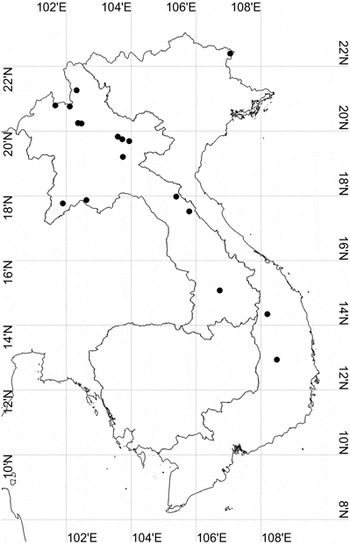
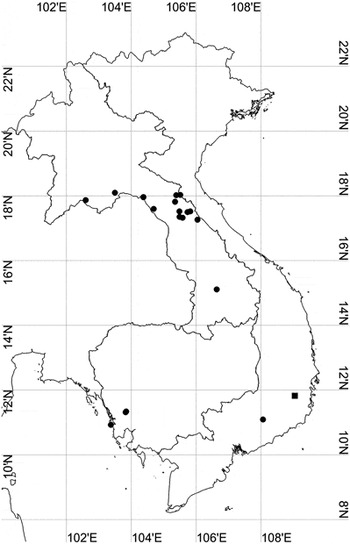
Fig. 9.Distribution of Amomum dealbatum Roxb. (•) and Amomum elephantorum Pierre ex Gagnep. (▪) in Cambodia, Laos and Vietnam.
Fig. 10.Distribution of Amomum echinocarpum Alston (•) and Amomum gagnepainii T.L.Wu, K.Larsen & Turland (▪) in Cambodia, Laos and Vietnam.


Clump-forming herb, 1.8 m tall, 2–3 pseudostems per clump; rhizome c.0.5–1 cm diameter, white then brown; stilt roots absent; interval between pseudostems c.10 cm long, scales tubular, 1–3 cm long, red then brown, papery, striate, glabrous, apex acute. Pseudostem with c.19 leaves per pseudostem, becoming smaller towards apex, slightly swollen at base, 0.8–1 cm diameter, green, glabrous, outer surface striate, inner surface smooth, shining, margin of leaf sheaths ciliate above; ligule c.0.1–0.3 cm long, light green, coriaceous, glabrous, apex truncate; petiole very short, c.0.1–0.2 cm long, canaliculate, green, glabrous; blade oblong, 12–30 × 3–7 cm, lower surface light green, glabrous, shiny, base attenuate, apex long caudate, cauda c.2 cm long, margin entire, primary veins prominent and hairy below, secondary veins sunken. Inflorescence arising near base or from base, 1–2 per pseudostem; peduncle 15 × 0.5 cm, red, striate, glabrous; scales tubular at base, 1–1.5 × 0.3 cm, and lanceolate above, 3–3.5 × 1–1.2 cm, red then dark reddish-brown, coriaceous, striate, glabrous to scabrous, apex acute; flowering part ovoid, c.5 × 4 cm, c.4 flowers open at once; bracts boat-shaped, 2–2.5 × 0.7–1 cm, dark brown, striate, soon rotting, subtending a single flower, glabrous, apex acute; bracteole tubular, 2-toothed, 1–1.2 × 0.3 cm, light brown, membranous then soon rotting, outer surface pilose at base, bracteole tube 0.7–0.9 cm long, teeth 0.2–0.3 cm long, apex acute to cucullate. Calyx tubular, 2-toothed, 1.5–1.6 × 0.3 cm, white, membranous, glabrous; calyx tube 0.7–0.8 cm long; teeth 0.4–0.8 cm long, apex acute. Corolla 2.8–3 cm long, white, corolla tube 1.3–1.5 cm long, coriaceous, glabrous; lateral corolla lobes 1.5 × 0.6–0.7 cm, membranous, glabrous, apex cucullate; central corolla lobe 1.5–1.7 × 0.9–1.2 cm, membranous, glabrous, apex cucullate; labellum clawed, 1.5 × 1.2–1.3 cm, white with yellow central stripe edged with lines of red dots, entire or somewhat bifid, membranous, undulate, long white hairs at base; lateral staminodes oblong, 0.3 cm long, white with red dots. Filament flattened, 0.3–0.4 cm long, white, glabrous; anther oblong, 0.8 × 0.4–0.5 cm, white, glabrous; anther crest entire, 0.3 cm wide, membranous, rounded to truncate, white. Stigma rounded, hairy, apex ciliate; style hairy; epigynous glands oblong, 0.3 cm long, glabrous; ovary 0.4 cm diameter, prickly, hairy; ovules globose, 3–5 per locule. Infructescence peduncle c.10–15 × 0.5 cm, reddish, glabrous; fruiting part to 5 × 5 cm, c.10 fruits per infructescence; fruits globose, 0.8–1 cm diameter, light green, prickly, hairy. Seeds globose, 0.4 cm diameter, glabrous, c.3–5 per locule.
Distribution. Sri Lanka, Laos, Indonesia (Java, Sulawesi), New Guinea, Bismarck Archipelago.
Habitat and ecology. Montane evergreen forest, mixed deciduous forest, in shady conditions, at 1034–1103 m altitude.
Proposed IUCN status. DD. This is a species complex and although, as currently circumscribed, it has a very wide range and is common, it may be resolved into a number of more restricted-range species. Hence for now it has to be assessed as Data Deficient.
Specimens examined. Laos.Houaphan: Bane Dan Cheng, 23 v 2008, V. Lamxay & M.F. Newman VL1304 (E, NLS); ibid., 23 v 2008, V. Lamxay & M.F. Newman VL1306 (E, NLS); Bane Sa Kok, 24 v 2008, V. Lamxay & M.F. Newman VL1315 (E, NLS).
The main distinguishing characters of this species are the glabrous, shiny leaf sheath and blade, ligule ovate with emarginate apex, long peduncle, bifid labellum, large, entire, semi-lunar anther crest which is curved inwards, and fruit with simple prickles.
Further research is required to establish whether these Lao collections belong to Amomum echinocarpum. Species delimitation in the complex of species which includes Amomum aculeatum, A. echinocarpum, A. flavum and A. elephantorum is uncertain. All are robust plants with spiny fruits. Many collections belonging in this complex have been determined to Amomum aculeatum but this is now thought to occur in Java, Peninsular Malaysia, Sumatra and Thailand (J. Droop, in prep.). The Lao collections cited above are distinguished from Amomum aculeatum and A. elephantorum by their white flowers and lanceolate, papery bracts, and from Amomum villosum by their large, entire, semi-lunar anther crest, bifid labellum and long peduncle. When the name of this taxon has been ascertained, it may be necessary to review the IUCN status of the species.
In addition to the syntypes, only one of which has been seen, there is reported to be a high quality colour painting at K (J. Leong-Škorničková, pers. comm.).
9. Amomum elephantorum Pierre ex Gagnep., Bull. Soc. Bot. France 53: 137 (1906); Gagnepain, Fl. Indo-Chine 6: 114 (1908). – Type: Cambodia, Cardamom Mountains, vi 1870, J.B.L. Pierre 630 (lecto P [barcode P032753], designated here). Figs 9,11.
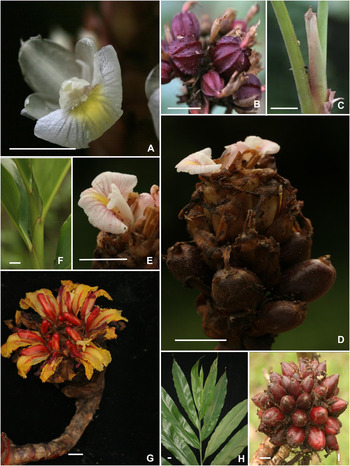
Fig. 11.A–C: Amomum elephantorum. A, inflorescence; B, infructescence; C, ligule. Lamxay VL1277. D–F: Amomum glabrum. D, inflorescence; E, infructescence; F, flowers. Lamxay VL1126. G–I: Amomum koenigii. G, inflorescence; H, ligule; I, infructescence. Lamxay VL1323. Scale bar = 1 cm. (See online for a colour version of this figure.)

Clump-forming herb, to 3–4 m high, c.15 pseudostems per clump; rhizome c.1–2 cm diameter, green; stilt roots absent; interval between pseudostems c.10 cm long, scales ovate to broadly ovate, 1.5–4.5 cm long, whitish then dark brown, coriaceous, striate, glabrous, inner surface shining, apex acute to cucullate, margin ciliate. Pseudostem with c.50 leaves per pseudostem, becoming smaller towards apex, swollen at base, 1–1.5 cm diameter, light green then dark green, glabrous, outer surface striate, inner surface shining; ligule ovate, emarginate, 0.5–1 cm long, brown, glabrous, coriaceous, margin ciliate; petiole very short or sessile; blade oblong to lanceolate, 15–35 × 1.5–10 cm, green, shiny, glabrous, base long attenuate, apex long caudate, margin entire, primary veins prominent below, secondary veins sunken. Inflorescence arising from base, c.2 inflorescences per pseudostem; flowering part globose, gelatinous, 5 × 5 cm, c.3 flowers open at once; peduncle 20 × 1–1.7 cm, white then reddish-brown, striate, rough, glabrous at base, tomentose above; peduncle scales ovate to broadly ovate, 2–6 × 1–5 cm, green to reddish-orange above, hard, thick, coriaceous, striate, tomentose above, inner surface tomentose at base, apex acute; bracts broadly ovate to rounded, 3–3.5 cm wide, 3–3.2 cm long, reddish then dark brown, hard, thick, coriaceous, ruminate, gelatinous, rotting soon, subtending only one flower, outer surface ruminate, rough, tomentose, inner surface ruminate, glabrous but tomentose at base, apex acute to cucullate; bracteole tubular, 2-toothed, 1.5–1.6 × 0.5 cm, reddish-light brown, coriaceous, outer surface tomentose, bracteole tube 1–1.2 cm long, teeth 0.3–0.5 cm long. Calyx tubular, 3-toothed, 2.5–2.6 × 0.3–0.6 cm, whitish-red, coriaceous, outer surface tomentose, inner surface glabrous, apex acute; calyx tube 1.5–1.6 cm long; teeth 0.4–0.8 cm long. Corolla 5–5.5 cm long, pale, whitish-yellow cream corolla tube 2.5–2.6 cm long, coriaceous, glabrous; lateral corolla lobes 2.5–3 × 0.6–0.8 cm; membranous, glabrous, apex cucullate; central corolla lobe 2.5–3 × 1–1.2 cm, membranous, glabrous apex cucullate; labellum bowl-shaped to clawed, 2.5–3 × 3 cm, yellowish orange with dark yellow patch on distal part of central lobe and covering of minute red dots, lobe entire, membranous, glabrous, apex rounded, margin plicate, entire; lateral staminodes oblong, 0.3 cm long, pink, unbranched. Filament flattened, 1.3–1.5 cm long, yellowish-orange covering of minute red dots, glabrous; anther oblong, 0.7–0.8 × 0.4 cm, yellow covering of minute red dots, glabrous; anther crest entire, 1.5 × 0.5 cm, pink, membranous, glabrous. Stigma rounded, hairy, apex ciliate; style hairy; epigynous glands oblong, 1 pair, 0.5 cm long, glabrous; ovary 0.5 cm diameter, 0.3 cm long, bullate, glabrous, shining; ovules globose, to 20 ovules per locule. Infructescence 25–35 cm long, peduncle 15–25 × 0.5 cm, brown, glabrous; fruiting part 10 × 10 cm, subtending to 25 fruits; fruit globose, 1–1.5 cm diameter, prickly with hard, sharp, straight prickles, hairy, dark red. Seeds globose, 0.3 cm diameter, glabrous, to 20 per locule.
Distribution. Thailand, Cambodia, Laos, Vietnam.
Habitat and ecology. Lowland to mid-elevation evergreen forest, mixed deciduous forest, open forest, in shady conditions, at 223–545 m altitude.
Proposed IUCN status. LC. This species has a large extent of occurrence and although there is some loss of habitat, this is not thought to be significant so the species is listed as Least Concern.
Specimens examined. Cambodia.Koh Kong: Thma Bang, 18 iii 2003, J. Kanstrup 221 (E); Veal Veng, road from Pramaoy to O Soam, 26 v 2010, M.F. Newman et al. 2394 (RUPP).
Laos.Attapeu: Bane Dak Toud, 16 v 2008, V. Lamxay & M.F. Newman VL1277 (E, NLS). Champasak: Pathoumphone, Xepiane NPA, 9 ix 2006, V. Lamxay VL1084 (E, NLS); Bane Khouang Sy, 30 viii 2009, V. Lamxay VL2087 (NLS); Bane Kiat Ngong, 24 vii 2007, V. Lamxay VL1185 (NLS [2]). Salavan: Bane Na Fang Ham, 14 ix 2006, V. Lamxay VL1106 (E, NLS, P).
Vietnam.Dong Nai: Bien hoa, 28 x 1932, E. Poilane 21292 (P).
Amomum elephantorum is close to A. aculeatum by its clump-forming habit, glabrous, shiny leaf blade, ligule ovate, emarginate, globose, gelatinous inflorescence, unbranched lateral staminodes, sub-trilobed anther crest, inflexed, yellowish-orange labellum, infructescence globose on top and fruits with hard, sharp, branched prickles but is distinguished from it by its very wide, rounded bracts, c.3–3.5 cm wide at the base of the inflorescence, central lobe of the anther crest much broader, hairy style, and infructescence which never elongates.
The protologue of Amomum elephantorum cites the type as follows: ‘Indo-Chine. – Cambodge: prov. de Tpong, dans les monts Krervanh, juin 1870 [Pierre]’. No collection number is given in the protologue. Two sheets at P match this information, one with collection number Pierre 630 (barcode P032753) and the other Pierre 630? and 551? (or 591?, the handwriting is not clear) (barcode P032754). Both are Gagnepain’s original material and sheet 1 (barcode P032753) has a detailed description written in Gagnepain’s hand of the new species, though it bears no date of collection. Sheet 2 (barcode P032754) bears the locality and collection date of the protologue but it cannot be said to be part of the same gathering as sheet 1 because it bears two collection numbers, both with question marks. We choose Pierre 630 (barcode P032753) as lectotype because it matches the protologue more closely than the other sheet. Sheet 2 (barcode P032754) is either an isolectotype or a syntype.
Tpong Province no longer exists. Thpong, in the modern spelling, is a district of Kampong Spoe Province. Krervanh is a transliteration of the word for cardamom in Khmer so ‘les monts Krervanh’ means the Cardamom Mountains.
10. Amomum gagnepainii T.L.Wu, K.Larsen & Turland, Novon 10(1): 90 (2000); Wu & Larsen, Fl. China 24: 353 (2000). – Amomum thyrsoideum Gagnep., Bull. Soc. Bot. France 49: 256 (1903), non Ruiz & Pav.; Gagnepain, Fl. Indo-Chine 6: 116 (1908). – Type: Vietnam, Nam Ha, Lat Son, 11 vi 1884, H-F. Bon 2687 (holo P). Fig. 10.
Clump-forming herb, c.1 m tall; rhizome c.0.8 cm diameter, glabrous; stilt roots absent; interval between pseudostems short, scales coriaceous, striate, glabrous. Pseudostem c.1 cm diameter, slightly swollen at base, striate, glabrous; ligule c.0.3–0.5 cm long, coriaceous, glabrous, apex truncate to rounded; petiole very short or absent, canaliculate, c.0.5 cm long, glabrous; blade lanceolate to oblong-lanceolate, 20–30 × 3–6 cm, glabrous, base long attenuate, apex long caudate, cauda c.3–4 cm long, margin entire, primary vein prominent below, secondary veins sunken. Inflorescence arising near the base, 1 per pseudostem; peduncle 20–26 × 0.4 cm, glabrous; scales broadly triangular, c.0.5 × 1 cm, to broadly ovate, 1 × 1.5–2 cm, coriaceous, striate, glabrous, apex broadly acute to rounded; flowering part cylindrical, rhachis 8–14 cm long; bracts narrowly oblong-lanceolate, 2 × 1 cm, coriaceous, striate, subtending a single flower, outer surface tomentose at base, apex finely cucullate with small spur; bracteole tubular, c.0.3–0.4 × 1 cm, membranous, striate, outer surface tomentose at base. Calyx tubular, 3-toothed, c.1 × 0.3 cm, membranous, striate, outer surface tomentose at base, apex of teeth acute. Corolla tube as long as calyx, outer surface hairy; corolla lobes membranous, glabrous, as long as corolla tube. Filament flat, as long as anther, glabrous; anther oblong, glabrous. Stigma cup-shaped, apex ciliate, hairy; style hairy; epigynous glands 1 pair, glabrous; pedicel c.1 × 0.2 cm, tomentose; ovary oblong-globose, dotted, tomentose with long white hairs. Infructescence elongate, c.30 cm long; peduncle 20–26 × 0.4 cm, glabrous at base then tomentose with white hairs above; fruiting part 8–14 cm long, spicate, fruit stalk c.1 × 0.2–0.3 cm, tomentose; fruits ovoid, hairy, c.2 × 1–1.5 cm, calyx persistent, prickles curved or hooked, c.0.2–0.3 cm long. Seeds unknown.
Distribution. China (Guangxi), Vietnam.
Habitat and ecology. Montane forest.
Proposed IUCN status. DD. A poorly known species with very little information on the range and no information on population size, trends or threats. It is therefore listed as Data Deficient. Targeted searches for this species are required.
The description above is made from the type alone. Amomum gagnepainii has a deep rhizome and lanceolate leaves like A. tomrey but differs by its prickly fruits. It has lanceolate leaves and a long peduncle like Amomum elephantorum but differs by its elongate inflorescence and fruits with simple, hooked spines.
11. Amomum glabrifolium Lamxay & M.F.Newman, sp. nov.
Amomo bifloro Jack habitu texturaque maxime simile, sed foliis foliorumque vaginis glabris, bracteolis brevissimis tubularibus, filamento quam anthera duplo longiore et calycis tuba quam dentibus duplo longiore differt. – Type: Laos, Khammouan, Hin Boun, Bane Khoun Ngeun, 9 vi 2010, 18°10′57″N, 104°28′27″E, V. Lamxay VL2121 (holo NLS; iso E). Figs 12,13.
Fig. 12.Amomum glabrifolium Lamxay & M.F.Newman. A, habit; B, ligule; C, inflorescence; D, flower and inner view of bract (below); E, outer view of bract; F, labellum from above; G, corolla lobes; H, bracteole showing tube; I, bracteole outer view; J, calyx; K, calyx; L, anther and stigma; M, filament and anther; N, ovary and epigynous glands. Scale bars: B–G = 1 cm; H–N = 0.5 cm. Photo by V. Lamxay. (See online for a colour version of this figure.)
Fig. 13.Distribution of Amomum glabrifolium Lamxay & M.F.Newman (•) and Amomum glabrum S.Q.Tong (▪) in Cambodia, Laos and Vietnam.


Creeping herb, c.1.2 m tall; rhizome c.0.5 cm diameter, brown; stilt roots present, 2–3 roots per mature shoot; interval between pseudostems c.50 cm, scales tubular, 2–4 cm long, light brown, papery, striate, outer surface tomentose, apex acute. Pseudostem with c.16 leaves per pseudostem, becoming smaller towards apex, slightly swollen at base, 0.5–1 cm diameter, reddish-brown, glabrous, outer surface striate, inner surface smooth, shiny; ligule ovate, 0.2–0.3 cm long, green, coriaceous, apex acute, margin ciliate; petioles canaliculate, 0.5–1 cm long, green, striate, glabrous; blade elliptic to oblong, 16–25 × 1.5–4 cm, green, glabrous, base attenuate, apex long caudate, cauda c.3 cm long, margin ciliate, primary veins prominent below, secondary veins prominent. Inflorescence arising vertically at any point of rhizome, c.40–50 cm from base of mature shoots, 2–3 inflorescences per pseudostem; flowering part ellipsoid, 5 × 3 cm, all parts with long white hairs, 1–2 flowers open at once, usually 4–6 in total; peduncle 1–3 × 0.2 cm, red, striate, glabrous at base, tomentose above; scales tubular at base, 0.5 × 0.3 cm, and broadly ovate above, 3 × 2.5 cm, brownish, coriaceous, striate, outer surface tomentose, apex acute, margin ciliate; bracts boat-shaped to lanceolate, 2.5–3 × 0.5–1 cm, pink to pinkish-brown, papery, striate, subtending a single flower, apex acute with short, hairy spur, margin ciliate; bracteole tubular, at least at base, 2-toothed, 1.5–2 × 0.3 cm, pink to light brown, membranous, bracteole tube 0.3–0.5 cm long, shorter tooth c.0.3 cm long, longer tooth 1–1.5 cm long, apex long caudate. Calyx tubular, 3-toothed, 2.5–3 × 0.3 cm, whitish-light brown, membranous; calyx tube 1.5–2 cm long; shortest tooth 0.2 cm long, longest tooth c.0.8–1 cm long, apex caudate, margin ciliate. Corolla 5.5–6 cm long, white, corolla tube 3.5–4 cm long, pilose at base, tomentose with soft hairs above; lateral corolla lobes 1.5 × 0.7–0.8 cm, membranous, abaxial surface hairy at base, apex cucullate; central corolla lobe 1.5 × 0.8–1 cm, membranous, abaxial surface hairy at base, apex cucullate without spur; labellum clawed, 3.5–4 × 2.8–3 cm, white with yellow central stripe, membranous, shiny, adaxial surface tomentose at base to central part, apex emarginate with 2 small, reflexed lobes, margin undulate; lateral staminodes absent. Filament flattened, 0.8 × 0.3 cm, white, hairy at base; anther oblong, 0.3 × 0.4 cm, white, adaxial surface hairy; anther crest 3-lobed, lateral lobes 0.2 × 0.3 cm, central lobe 0.3 × 0.4 cm, membranous, white, glabrous. Stigma cup-shaped, apex ciliate; style glabrous; epigynous glands oblong, 1 pair, 0.6 cm long, glabrous; ovary 0.5 × 0.5 cm, covered with long white hairs; ovules globose, c.10 per locule. Infructescence peduncle 3–5 × 0.2 cm, pink, glabrous; fruit globose, 1 × 1 cm, sessile or very shortly stalked, tomentose, pink to green, with sparse, short spines. Seeds globose with membranous seed coat, 0.2 cm diameter, black, c.10 per locule, aril white.
Distribution. Laos.
Habitat and ecology. Only found in mixed deciduous forest over limestone, along watercourses, in shady conditions, at 197–574 m altitude.
Proposed IUCN status. LC. Although this species has a small extent of occurrence, all the known localities are within protected areas and there are no known threats. It is therefore listed as Least Concern.
Specimens examined. Laos.Bolikhamxai: Bane Phone Xay, 27 iv 2009, V. Lamxay VL1712 (NLS); Phou Hai, 9 vi 2010, V. Lamxay VL2120 (E, NLS). Khammouan: Boualapha, 20 v 2006, M.F. Newman et al. LAO1207 (E); Hin Boun, Phou Hin Nam No NPA, 19 v 2008, V. Lamxay VL1286 (E, NLS, P); Bane Khoun Ngeun, 18 vii 2007, V. Lamxay VL1178 (E, NLS); ibid., 29 iv 2009, V. Lamxay VL1722 (NLS); ibid., 23 viii 2009, V. Lamxay VL2068 (NLS); ibid., 2 viii 2011, V. Lamxay VL2207 (NLS).
This species’ main distinguishing characters are its spreading habit, c.50 cm between pseudostems, stilt roots, long, glabrous leaves, apex of blade long caudate, short inflorescence arising at a distance from the base of mature pseudostems, and only one or two flowers open at a time.
12. Amomum glabrum S.Q.Tong, Acta Phytotax. Sin. 27(4): 282 (1989); Wu & Larsen, Fl. China 24: 355 (2000). – Type: China, Yunnan, Jinghong, 15 v 1958, Expedition Yunnan–Universitatis 952 (holo HBYU n.v.). Figs 11,13.
Creeping herb, c.1 m tall, glabrous throughout; rhizome c.0.3–0.7 cm diameter, white, pink or reddish then brown, deep and spreading underground, c.10 cm deep; stilt roots absent; interval between pseudostems c.20–35 cm, scales broadly triangular to ovate, 1–2 × 1–1.5 cm, reddish then brown, outer surface striate, apex acute. Pseudostem with c.5–9 leaves per pseudostem, becoming gradually smaller towards apex, slightly swollen at base, c.1 cm diameter, whitish pink when young then green, striate; ligule ovate, 0.3–0.5 cm long, coriaceous, apex emarginate to shallowly bifid; petiole c.2–4 × 0.2–0.3 cm, canaliculate, green; blade oblong, the lower ones elliptic, 20–40 × 5–10 cm, lower surface light green, shiny, base attenuate, apex long caudate, margin with short, sharp, spine-like hairs, primary veins prominent below, secondary veins sunken. Inflorescence arising from base or near base, c.10 cm long; scales broadly triangular, 0.5 × 1 cm below to boat-shaped and lanceolate, 2–3 × 1–2 cm above, reddish to pink, coriaceous, striate, apex acute to cucullate with short spur; flowering part ellipsoid, apex pointed, c.4–6 × 2–3 cm; bracts lanceolate, 3–4 × 1–1.5 cm, white, red or reddish-white or pinkish-white, papery, coriaceous then soon rotting, apex acute; bracteole tubular, c.1 cm long, 2-toothed, white, very thin, membranous, tube 0.5–0.7 cm long, teeth 0.3–0.5 cm long, apex acute. Calyx tubular, 3-toothed, white, membranous; calyx tube c.2 cm long; calyx teeth c.1 cm long, apex cucullate. Corolla c.5–6 cm long, white, corolla tube c.3 cm long, inner surface pilose or strigose with white hairs; lateral corolla lobes oblong, 2.5–3 × 0.6–0.8 cm, apex cucullate without spur; central corolla lobe oblong, 2.5–3 × 0.8–1 cm, apex cucullate with short pointed spur, c.0.3 cm long; labellum clawed, 3–4 × 2–3 cm, white, pink or red at base, central yellow stripe edged by transparent venation radiating to margin, membranous, glabrous; lateral staminodes ovate to lanceolate, c.0.5 cm long, white. Filament flattened, 0.7–1 × 0.2 cm; anther c.1.3–1.5 cm long, white; anther crest truncate, white, membranous. Stigma cup-shaped, ostiole ciliate; epigynous glands c.1 cm long; ovary globose, sessile or on very short pedicel, c.0.5 cm diameter, lightly ridged and dotted above; ovules globose, c.15 per locule. Infructescence peduncle elongate, c.15 cm long; fruiting part with c.3–6 fruits grouped at top; fruits globose, c.1–1.5 cm diameter, blackish-grey, with short wings or ridges, smooth to bullate, surrounded by white fibres of rotting bracts, fruit stalk very short or absent. Seeds globose with membranous aril, c.0.5 cm diameter, white, c.10–15 per locule.
Distribution. China (Yunnan), Laos.
Habitat and ecology. Montane evergreen forest, in shady conditions, at 886–1546 m altitude.
Proposed IUCN status. DD. The extent of occurrence is estimated to be 13,062 km2 but most of the population occurs in Lao PDR where all the known sites are in protected areas. The situation in China is not known and, if there was any evidence of continuing decline, the species could qualify as Near Threatened. Thus, it is listed as Data Deficient pending clarification on the situation in China.
Specimens examined. Laos.Louangnamtha: between Mueang Sing and Mueang Louang Namtha, 19 viii 2009, V. Lamxay 2057 (NLS); Bane Sop Y, 30 iv 2007, V. Lamxay & P. Phaphouampheng VL1126 (E, NLS, P); ibid., 1 vii 2007, V. Lamxay & P. Phaphouampheng VL1157 (E, NLS); ibid., 18 viii 2009, V. Lamxay VL2053 (NLS). Oudomxai: Bane Lak 62, 4 vii 2007, V. Lamxay & K. Khounsirivong VL1167 (E, NLS). Phongsali: Bounnuea, Lao–China Border Protected Area, 26 vi 2007, V. Lamxay & S. Phounsimouang VL1143 (E, NLS); Phou Fa Ecotourism Area, 25 vi 2007, V. Lamxay & S. Phounsimouang VL1137 (E, NLS); Say Phou Thaleng Protected Area, 25 v 2008, V. Lamxay & M.F. Newman VL1318 (E, NLS); ibid., 25 v 2008, V. Lamxay & M.F. Newman VL1321 (E, NLS, P).
The distinguishing characters are the loosely spreading habit, deep rhizome, all parts glabrous, ligule very short, inflorescence arising near or at base of pseudostem, ellipsoid, pointed, filament and labellum connate into a short tube above insertion of corolla lobes, and fruits ridged, globose. The leaves and rhizomes are scented in fresh material.
The type of Amomum glabrum, Expedition Yunnan–Universitatis 952, is in an unregistered herbarium, HBYU, which we could not locate. We have, however, matched our material to a paratype specimen (S.Q. Tong & A.M. Li 32801, KUN).
13. Amomum koenigii J.F.Gmel., Syst. Nat., ed. 13, 2: 6 (1791); Wu & Larsen, Fl. China 24: 352 (2000). – Cardamomum koenigii (J.F.Gmel.) Kuntze, Revis. Gen. Pl. 2: 686 (1891). – Type: Not located. See notes below. Figs 11,14.
Fig. 14.Distribution of Amomum koenigii J.F.Gmel. in Cambodia, Laos and Vietnam.
Amomum corynostachyum Wall., Pl. Asiat. Rar. 1: 48, t. 58 (1829). – Zingiber corynostachyum (Wall.) Steud., Nomencl. Bot. ed. 2, 2: 798 (1841). – Cardamomum corynostachyum (Wall.) Kuntze, Revis. Gen. Pl. 2: 686 (1891). – Type: See notes below.

Creeping herb, to 2.5 m tall, with only 2–5 pseudostems per clump; rhizome growing 10–15 cm deep in soil, c.1–1.5 cm diameter, white then reddish-brown; stilt roots absent; interval between pseudostems c.25 cm, scales broadly ovate, 2–3 cm long, brown, papery, striate, soon rotting, glabrous, apex acute. Pseudostem with c.17 leaves per pseudostem, becoming slightly smaller towards apex, 1–1.3 cm diameter, green, glabrous, outer surface striate, glaucous, margin of leaf sheaths red; ligule ovate, bilobed, 0.5–1 cm long, red then dark brown, coriaceous, swollen at base, glabrous, glaucous; petiole very short, 0.1–0.5 cm long, canaliculate, green, glabrous; blade oblong, 35–40 × 6–7 cm, lower surface pale, glaucous, glabrous, base long attenuate, apex long caudate, margin entire, primary veins prominent below, secondary veins sunken. Inflorescence single, arising near base of mature pseudostem on long, erect peduncle; flowering part elongate-ovoid, 3 × 2 cm, 2 flowers open at once; peduncle c.20–30 × 0.4–0.5 cm, reddish-brown, striate, glabrous; scales broadly ovate to lanceolate, 1.5–3.5 × 1–1.5 cm, reddish then dark reddish-brown, hard, coriaceous, striate, glabrous, glaucous, shiny, apex acute; bracts lanceolate, 1.8–2 × 1–1.2 cm, red then dark brown, striate, coriaceous, soon rotting, subtending a single flower, tomentose at base, apex acute; bracteole tubular, 2-toothed, 1–1.2 × 0.4 cm, light reddish-brown, membranous, outer surface tomentose at base, bracteole tube 0.8–0.9 cm long, glabrous, teeth c.0.2–0.4 cm long, apex acute. Calyx tubular, 3-toothed, 1.4–1.5 × 0.4 cm, light pinkish-brown, membranous, outer surface tomentose at base; calyx tube 0.7–0.8 cm long; teeth 0.3 and 0.7 cm long, apex acute. Corolla 3–3.2 cm long, pinkish-white, corolla tube 1.5–1.6 × 0.3 cm, coriaceous, outer surface pilose, inner surface glabrous; lateral corolla lobes 1.5–1.6 × 0.6–0.7 cm, membranous, glabrous, apex cucullate; central corolla lobe 1.5–1.6 × 1–1.2 cm, membranous, glabrous, apex cucullate; labellum clawed, 1.5–1.6 × 1.5 cm, connate with filament into a tube c.0.1–0.2 cm above insertion of corolla lobes, trilobed, white with yellow central stripe edged with lines of pink dots which radiate to margin, membranous, tomentose at base and along the central part, apex rounded and finely lobed; lateral staminodes oblong, 0.2 cm long, white. Filament flattened, 0.4–0.5 cm long, white, glabrous; anther oblong, 0.7–0.8 × 0.4–0.5 cm, white, glabrous; anther crest semi-lunar, entire, 0.2–0.3 cm, membranous, white. Stigma rounded-flattened, glabrous, apex ciliate; style hairy; epigynous glands oblong, 0.1–0.2 cm long, glabrous; ovary 0.5 cm diameter, hairy; ovules round, c.15–20 per locule. Infructescence peduncle c.20–30 × 0.5 cm, red, glabrous at base, tomentose above; fruiting part subglobose, 8 × 6 cm, subtending as many as 20 fruits; fruits ovoid, 1–1.5 × 1.5–2 cm, dark reddish-violet, glabrous, shining, lenticellate. Seeds round, 0.3 cm diameter, glabrous, to 15–20 per locule.
Distribution. Burma, Thailand, Laos, Vietnam.
Habitat and ecology. In a variety of forest and habitat types, such as montane evergreen forest, mixed deciduous forest, open forest, at 481–1291 m altitude.
Proposed IUCN status. LC. An extremely widespread and common species which, although threatened in places, is considered to be Least Concern.
Specimens examined. Laos.Bolikhamxai: Bane Na Heuang, 29 iv 2009, V. Lamxay VL1721 (NLS). Champasak: Bane Kong Ta Youne, 26 viii 2009, V. Lamxay VL2078 (NLS). Houaphan: Viengthong, Bane Hom Thong, 13 i 2010, V. Lamxay VL2095 (NLS); Bane Sa Kok, 24 v 2008, V. Lamxay VL1314 (E, NLS); Bane Sop Lap, 22 v 2008, V. Lamxay & M.F. Newman VL1302 (E, NLS). Khammouan: Bane Vang Le, 30 v 2009, V. Lamxay VL1876 (NLS). Louangnamtha: border between Sing and Louang Namtha districts, 19 viii 2009, V. Lamxay VL2056 (NLS). Oudomxai: Bane Lak 32, 4 vii 2007, V. Lamxay VL1166 (E, NLS). Phongsali: Bane Pa Kha, 26 vi 2007, V. Lamxay VL1139 (NLS); Say Phou Thaleng Protected Area, 25 v 2008, V. Lamxay & M.F. Newman VL1323 (E, NLS). Vientiane: Khok Khao Do Protected Area, 28 v 2008, V. Lamxay & M.F. Newman VL1326 (E, NLS). Vientiane Capital: Bane Phia Lat, 6 v 2008, V. Lamxay VL1232 (E, NLS). Xiangkhoang: Tad Peub Protected Area, 22 v 2008, V. Lamxay & M.F. Newman VL1296 (E, NLS).
Vietnam.Cao Bang: Ha Lang, Thang Loi municipality, vicinity of Lung Sam village, 24 iv 1999, K.L. Phan et al. 1671 (MO, P). Dak Lak: Ea H’Leo village, 29 vii 2009, H.D. Tran 171 (E). Dong Nai: Xa Trang Bom, 20 viii 2009, V. Lamxay VL2062 (NLS). Kon Tum: Dak To, 18 xi 1946, E. Poilane 35517 (P).
This species resembles Amomum tomrey by its smooth berry but may be distinguished by its glabrous, lenticellate berry, semi-lunar anther crest, and labellum and filament adnate into a short tube above the insertion of the corolla lobes.
We have observed and compared Amomum koenigii and A. corynostachyum and have found that they represent a single species. Therefore, Amomum corynostachyum becomes a synonym of A. koenigii. Both names will be typified when Amomum is revised for the Flora of Thailand (Kaewsri, in prep.).
14. Amomum longiligulare T.L.Wu, Fl. Hainan. 4: 533 (1977); Wu & Larsen, Fl. China 24: 353 (2000). – Type: China, Hainan, Ya Xian, 24 ix 1970, Working team 0536 (holo IBSC). Figs 15,16.
Fig. 15.A–D: Amomum longiligulare. A, ligule; B, infructescence; C, flower; D, inflorescence. Lamxay VL1805. E–G: Amomum microcarpum. E, infructescence; F, ligule; G, inflorescence. Lamxay VL1144. H–J: Amomum muricarpum. H, fruit; I, part of pseudostem; J, inflorescence. Lamxay VL1172. Scale bar = 1 cm. (See online for a colour version of this figure.)
Fig. 16.Distribution of Amomum longiligulare T.L.Wu (•) and Amomum longipetiolatum Merr. (▪) in Cambodia, Laos and Vietnam.


Creeping herb, c.1.5–3 m tall; rhizome scented, c.1–1.5 cm diameter, light brown, glabrous; stilt roots present; interval between pseudostems c.50 cm, scales triangular, 1–2 cm long, white then brown, outer surface tomentose, apex rounded. Pseudostem with c.25–40 leaves per pseudostem, becoming rapidly smaller towards apex, 1–1.5 cm diameter, red when young then brown, swollen at base, striate, glabrous, shiny; ligule entire, 3–4 cm long, light brown, membranous, tomentose; petiole very short, c.0.3 cm long, or absent, glabrous; blade oblong, 15–40 × 2–10(–15) cm, lower surface light green, glabrous, shiny, base attenuate, apex long caudate, margin entire, primary veins prominent below, secondary veins sunken. Inflorescence arising c.20 cm from base of mature shoots or c.5–10 cm from base of new shoots; peduncle c.4–6 × 0.3–0.5 cm, glabrous at base, tomentose above; scales triangular to ovate, 1–2 cm long, dark brown, coriaceous, pilose, margin ciliate; flowering part ovoid to ellipsoid, 4–5 × 3–4 cm, c.2–4 flowers open at once; bracts boat-shaped, 2–2.3 × 0.7–1 cm, brown, soft, papery, soon rotting, outer surface tomentose at base, pilose above, inner surface pilose at base, apex cucullate; bracteole tubular, 2-toothed, c.2 cm long, light brown then dark brown, membranous, very thin, outer surface pilose and tomentose at base, bracteole tube c.1 cm long, teeth c.1 cm long, apex cucullate, margin ciliate. Calyx tubular, 3-toothed, 2.5–3 × 0.3 cm, pink then light brown, membranous, thin, outer surface pilose and tomentose with long white hairs at base; calyx tube c.1.5–2 cm long; longer tooth c.0.5–1 cm long, shorter tooth c.0.2–0.5 cm long, apex cucullate with short, coriaceous spur. Corolla white, 5–6 cm long, corolla tube c.2.5–3 cm long, outer surface pilose and tomentose at base, inner surface pilose to strigose above; lateral corolla lobes 2.5–3 × 0.7–0.8 cm, membranous, abaxial surface hairy, adaxial surface glabrous, apex cucullate; central corolla lobe 2.5–3 × 0.8–1 cm, membranous, abaxial surface hairy at base, adaxial surface glabrous, apex cucullate; labellum clawed, 2–3 × 2–2.5 cm, white with yellow central stripe edged red with minute dots and clear venation radiating to margin, glabrous, membranous, apex rounded with 2 small, reflexed lobes; lateral staminodes absent. Filament flattened, 0.5–0.7 cm long, white, pilose; anther 0.5–0.7 cm long, white, abaxial surface hairy, adaxial surface glabrous; anther crest trilobed, lateral lobes small, c.0.2 cm wide, rounded, central lobe c.0.3 cm wide, membranous, glabrous. Stigma rounded, glabrous; epigynous glands 1 pair, 0.3 cm long, glabrous; ovary c.0.4 cm diameter, bullate, tomentose with long white hairs, on a hairy pedicel c.0.2 cm long; ovules globose, c.10 per locule. Infructescence peduncle c.3–4 × 0.3–0.5 cm, glabrous at base, tomentose above; fruiting part c.5 cm long, with few to 15 fruits per infructescence; fruits globose to ovoid, 1–1.2 cm diameter, prickly with simple prickles, red or reddish-brown or reddish-green then dark reddish-brown, stalk very short, c.0.3 cm long. Seeds angular, 0.2–0.3 cm diameter, c.7–12 per locule, brown then black, aril yellow.
Distribution. China (Guangdong, Hainan), Thailand, Vietnam, Laos.
Habitat and ecology. Lowland and montane evergreen forest, mixed deciduous forest, open forest, at 100–1017 m altitude.
Lao name and uses. Mak naeng daeng (red fruit). It is widely cultivated in southern Laos for commerce.
Proposed IUCN status. LC. This species has a very wide range and is a common species so it is listed as Least Concern.
Specimens examined. Laos.Champasak: Ba Chiang Chaleunsouk, 7 vi 2000, V. Lamxay 02 (E); ibid., 15 ix 2006, V. Lamxay VL1115 (E, NLS); Bane Khouang Sy, 20 x 1928, E. Poilane 16056 (P); ibid., 27 viii 2009, V. Lamxay VL2081 (NLS); ibid., 27 viii 2009, V. Lamxay VL2083 (NLS); Bane Nong Hin, 7 vi 2000, Boualy 88 (E); Bane Nong Soung, 26 viii 2009, V. Lamxay VL2077 (NLS); Bane Tha Hou, 27 viii 2009, V. Lamxay VL2084 (NLS); Bane Thang Beng, 9 ix 2006, V. Lamxay VL1085 (E, NLS, P). Salavan: Bane Dou Chai Gnai, 14 v 2009, V. Lamxay VL1733 (NLS); Bane Katanglavang, 13 ix 2006, V. Lamxay VL1102 (E, NLS). Savannakhet: Bane Houay Xay, 9 viii 2007, V. Lamxay VL1197 (E, NLS).
Vietnam.Dong Nai: Tan Phu forest, 17 vi 2008, H.D. Tran et al. 38 (E). Kon Tum: Dak Ha – Dak To, 3 x 1930, E. Poilane 18471 (E, P).
Amomum longiligulare has been found from central Laos to southern Vietnam in many types of forest on fertile soil.
Material collected in Laos and Vietnam matches the description of this species in the Flora of China and a photograph of the type of Amomum longiligulare at IBSC which we have seen. All this material appears to be indistinguishable from Amomum gracile Blume of Java but we are unable to place A. longiligulare in synonymy under A. gracile until we have examined all relevant type material more closely.
Amomum longiligulare looks like A. villosum and A. uliginosum which are also spreading herbs with shiny, glabrous leaves, a swollen base to the pseudostem, short inflorescence with oblong-lanceolate, boat-shaped bracts, white flowers with a yellow central stripe on the labellum and fruit with simple prickles. It differs from both these species by its very long, membranous ligule, c.3–4(–5) cm long, and from Amomum uliginosum by its lack of lateral staminodes.
15. Amomum longipetiolatum Merr., Lingnan Sci. J. 11: 40 (1932); Wu & Larsen, Fl. China 24: 349 (2000). – Elettariopsis longipetiolata (Merr.) D.Fang, Guihaia 10: 293 (1990). – Type: China, Hainan, Hung Mo Shan, 15 v 1929, U.K. Tsang et al. 17692 (holo NY). Fig. 16.
Creeping rhizomatous herb, 2.5 m tall; rhizome c.0.5 cm diameter, striate, glabrous, pink to white; stilt roots absent; interval between pseudostems > 40 cm, scales narrowly triangular, 3–4 × 1–1.5 cm, pink, striate, glabrous, apex acute. Pseudostem leaves many, becoming slightly smaller towards apex, slightly swollen at base, c.1–1.5 cm diameter, green, striate, glabrous; ligule c.1–2 cm long, membranous, glabrous, apex bilobed to truncate; petiole canaliculate, c.7–10 × 0.3–0.4 cm, green, striate, glabrous; blade oblong-elliptic, 40–45 × 7–9 cm, green, whitish soft hairy below, glabrous above, base long attenuate, apex long caudate, margin entire, primary vein prominent below. Inflorescence arising 40–50 cm from base of mature shoots, 1–2 per pseudostem; flowering part narrowly ellipsoid, 4–5 × 1–2 cm, white, 1–2 flowers open at once; peduncle c.3–5 (rarely to 15) × 0.3–0.4 cm, glabrous; scales narrowly triangular at base to broadly triangular above, 1.5–2.5 × 1–1.5 cm, brown, striate, glabrous, apex truncate; bracts narrowly lanceolate, 4 × 1–2 cm, white, striate, papery, glabrous, subtending a single flower, apex acute, with spur; bracteole narrowly lanceolate, 2–2.5 × 0.4–0.5 cm, striate, membranous, glabrous, apex acute, margin ciliate. Calyx tubular, 3-toothed, 5–6 cm long, membranous, outer surface hairy, margin ciliate, apex cucullate; calyx tube 4.5–5 × 0.3–0.5 cm; teeth c.0.5 and c.1.5 cm long. Corolla 10–11 cm long, mostly white, corolla tube c.5–6 cm long, outer surface hairy, corolla lobes oblong, membranous; lateral lobes c.3 × 0.5–0.7 cm; central lobe c.3 × 0.7–1 cm, membranous, adaxial surface hairy, abaxial surface glabrous, apex acute, cucullate; labellum c.3 × 1–2 cm, white with yellow to red-pink at base, abaxial surface hairy, adaxial surface glabrous, apex rounded; lateral staminodes oblong, flattened, membranous, c.0.5 × 0.1–0.2 cm, apex acute. Filament flattened, very short, c.0.3 cm long, white, glabrous; anther oblong, c.2 cm long, white, glabrous; anther crest deeply trilobed, c.0.5 cm long, white, membranous. Stigma cup-shaped, white, glabrous, ciliate with long white flat hairs; style hairy; epigynous glands 1 pair, oblong, flattened, apex acute, glabrous, 1 cm long; ovary 0.5 cm diameter, ridged, hairy; fruits not seen.
Distribution. China (Guangxi, Hainan), Vietnam.
Habitat and ecology. Inundated forest, cultivated fields in inundated forest, sometimes extending onto adjacent limestone hills, at c.110 m altitude.
Proposed IUCN status. DD. There is insufficient information to assess the status of this species as there is only limited distribution information and no information on population size, trends or threats to the species in China. Further surveys are required.
Specimens examined. Vietnam.Lang Son: Huu Lung district, Huu Lien municipality, Lan Dat, 2 iv 1998, D.K. Harder et al. 4144 (E).
This species has only been recorded in Hainan and in northern Vietnam, near the border with China. Wu & Larsen (Reference Wu and Larsen2000) treated this species in Amomum, although Fang (Reference Fang1990) had transferred it to Elettariopsis longipetiolata (Merr.) D.Fang.
We have examined Tsang et al. 17564 (NY), which is a paratype, but have only seen the type itself, Tsang et al. 17692 (NY), on the C.V. Starr Virtual Herbarium of New York Botanical Garden. Amomum longipetiolatum resembles A. biflorum by its short inflorescence arising vertically from the rhizome c.50 cm from the nearest pseudostem and in having only one or two flowers per inflorescence but it differs by being much bigger than A. biflorum and having pale whitish, soft hairs on the leaf blade below.
16. Amomum microcarpum C.F.Liang & D.Fang, Acta Phytotax. Sin. 16(3): 49 (1978); Wu & Larsen, Fl. China 24: 352 (2000). – Type: China, Guangxi, Da Zha, 29 iv 1975, Fang Ding 76564 (holo IBK n.v.). Figs 15,17.
Fig. 17.Distribution of Amomum microcarpum C.F.Liang & D.Fang in Cambodia, Laos and Vietnam.

Creeping herb, 1–2 m tall; rhizome c.1 cm diameter, red when young then greenish-yellow to brown; stilt roots c.5 cm long, c.0.5 cm diameter, dark reddish-brown; interval between pseudostems c.70 cm, scales ovate, 1.5–2 cm long, red then dark brown or black, striate, shiny, coriaceous, outer surface tomentose, apex cucullate, margin ciliate. Pseudostem with c.18–25 leaves per pseudostem, becoming gradually smaller towards apex, swollen at base, 0.7–1.5 cm diameter, red then dark brown, outer surface tomentose, striate; ligule 0.7–1 cm long, coriaceous, outer surface tomentose, apex ovate, emarginate to bilobed, margin ciliate; petiole very short, 0.2–0.3 cm long, tomentose; blade oblong, 10–50 × 2–12 cm, dark green, plicate, tomentose beneath, base attenuate, apex long caudate, margin entire, primary veins prominent below, secondary veins prominent. Inflorescence arising near base, 1–2 inflorescences per pseudostem; flowering part pyramidal, 5 × 4 cm, 1–2 flowers open at once, dark reddish; peduncle 10–12 × 0.5–0.7 cm, red, tomentose; scales tubular at base, ovate to lanceolate above, 0.5–2 × 0.3–0.7 cm, reddish-brown, coriaceous at base, papery above, outer surface tomentose, apex acute to cucullate with long spur c.0.2 cm, margin ciliate to glabrous; bracts boat-shaped to lanceolate, 1.8–2 × 0.5–0.7 cm, reddish then dark brown, papery, striate then soon rotting, subtending a single flower, outer surface tomentose, inner surface tomentose at base, apex acute; bracteole tubular, 2-toothed, 1.5–1.6 × 0.2 cm, light brown, membranous, very thin, outer surface tomentose, bracteole tube 0.7–0.8 cm long. Calyx tubular, 3-toothed, 1.2–1.3 × 0.2 cm, light pink to red, coriaceous, outer surface tomentose, inner surface glabrous; calyx tube 0.7–0.8 cm long; teeth 0.3–0.4 cm long, apex acute to cucullate with spur. Corolla white, 2–2.5 cm long, corolla tube 1–1.2 cm long, coriaceous, outer surface pilose, inner surface pilose to strigose above; lateral corolla lobes 1.2 × 0.5–0.6 cm, membranous, glabrous, apex cucullate with thick spur; central corolla lobe 1.2–1.3 × 0.7–0.8 cm, membranous, glabrous, apex cucullate with thick spur; labellum clawed, 1.2–1.3 × 1–1.2 cm, trilobed, white with yellow central stripe marked with minute red dots at base and transparent veins radiating to margin, coriaceous, glabrous, adaxial surface pilose at base and centre; lateral staminodes oblong, filiform, 0.3–0.5 cm long, white, glabrous. Filament flattened, 0.7 cm long, white, glabrous; anther oblong, 0.3–0.4 × 0.4 cm, curved over labellum, white, glabrous; anther crest trilobed, lateral lobes 0.2–0.3 cm wide, central lobe 0.4 cm wide, white, membranous, glabrous. Stigma rounded, glabrous, apex entire; style glabrous; epigynous glands oblong, 0.2–0.3 cm long, glabrous; ovary 0.4 cm diameter, on very short, hairy pedicel c.0.2 cm long, bullate, tomentose; ovules round, c.20 per locule. Infructescence peduncle c.10–20 × 0.5 cm, red, tomentose; fruiting part subtending c.5 fruits, 10–12 × 5–8 cm; fruits globose, 1–1.5 cm diameter, dark red, prickly, hairy. Seeds globose, 0.2 cm diameter, glabrous, c.15 per locule.
Distribution. China (Guangxi), Vietnam, Laos.
Habitat and ecology. Lowland to montane evergreen forest, mixed deciduous forest, open forest, on a variety of soil types, at 185–1190 m altitude.
Lao name and uses. Mak naeng kham (golden fruit). The fruits are very commonly collected from the forest in Laos for trade and medicinal use.
Proposed IUCN status. LC. This species has a very large extent of occurrence and is common, and although there are some threats these are not of significant concern. The species is therefore assessed as Least Concern.
Specimens examined. Laos.Attapeu: Bane Dak Lia, 27 vii 2007, V. Lamxay & Bounlop VL1190 (E, NLS); Bane Lak 52, 16 v 2008, V. Lamxay VL1265 (NLS); Bane Phou Keua, 15 v 2008, V. Lamxay et al. VL1263 (E, NLS). Bolikhamxai: Bane Had Khai, 9 v 2008, V. Lamxay et al. VL1241 (E, NLS); Bane Nam Deua, 31 viii 2009, V. Lamxay VL2091 (NLS); Phou Hai, 25 viii 2009, V. Lamxay VL2076 (NLS). Khammouan: Bane Ka Oy, 14 xii 2005, E.C.S. Lundh & L.J. Ahnby Ella1 (E); Bane Khoun Ngeun, 18 vii 2007, V. Lamxay VL1177 (E, NLS); Bane Mak Feuang, 19 xii 2005, E.C.S. Lundh & L.J. Ahnby Ella15 (E); ibid., 20 xii 2005, E.C.S. Lundh & L.J. Ahnby Ella35 (E); Bane Maka Kang, 27 v 2009, V. Lamxay VL1746 (NLS); Bane Na Wa, 1 vii 2006, V. Lamxay VL1050 (NLS); Bane Thong Noi, 25 vi 2006, V. Lamxay VL1046 (E, NLS). Louangnamtha: border between Sing and Louang Namtha districts, 19 viii 2009, V. Lamxay VL2055 (NLS); 20 v 1936, E. Poilane 26242 (P); Bane Xiang Kok, 28 iv 2007, V. Lamxay VL1123 (NLS). Oudomxai: road from Oudomxai to Bane Nam Pheng, 22 vi 1999, M.F. Newman 867 (E); Bane Nam Pheng, 19 viii 2009, V. Lamxay VL2059 (NLS); ibid., 22 vi 1999, M.F. Newman 870 (E); Bane Tad Mouane, 27 v 2000, Somsak 61 (E). Phongsali: Bane Chane Tane, v 2006, V. Lamxay PPS08 (E, P); Bane Had Sa, v 2006, V. Lamxay PPS09 (E); Bane Na Mak, 28 vi 2007, V. Lamxay VL1149 (NLS); Bane Pa Kha, 26 vi 2007, V. Lamxay VL1144 (E, NLS, P). Vientiane: Feuang, Phou Keo Kan-Phou In Thin NPA, 1 v 2008, V. Lamxay et al. VL1218 (E, NLS); Bane Houay Mo, 17 i 2010, V. Lamxay VL2111 (NLS); Bane Houay Pa Mak, 10 v 2008, V. Lamxay & C. Vongsombath VL1245 (E, NLS); Bane Mouang, 4 iv 2008, V. Lamxay VL1208 (NLS); Bane Na Xeng, 1 v 2008, V. Lamxay et al. VL1214 (E, NLS); Bane Phone Savane, 11 v 2008, V. Lamxay & C. Vongsombath VL1246 (E, NLS); Kasi, Bane Bouam Phouk, 17 i 2010, V. Lamxay VL2110 (NLS); Xaisomboun, Bane Nam Mo, 24 iv 2007, V. Lamxay VL1118 (E, NLS, P). Vientiane Capital: Bane Po, 6 v 2006, V. Lamxay VL1002 (E, NLS, P).
Vietnam.Kon Tum: Dak Gley, c.10 km N of Dak Gley town, between Dak Nen and Mang Khen (Dak Che) villages, 19 xi 1995, L.V. Averyanov VH1835 (MO, P). Lam Dong: Blao, 3 v 1953, M. Schmid (P); ibid., vi 1953, M. Schmid VN1647 (P).
Amomum microcarpum is similar to A. villosum and A. uliginosum in its red, prickly fruit but it differs from them by its hairy leaf sheaths, leaves plicate, hairy below, young stem and rhizome red, inflorescence pyramidal and flowers with anther arched over the labellum.
17. Amomum muricarpum Elmer, Leafl. Philipp. Bot. 8: 2896 (1915); Wu & Larsen, Fl. China 24: 354 (2000). – Type: Philippines, Mindanao, Davao del Sur, Todaya, vi 1909, A.D.E. Elmer 10947 (syn BO n.v., C n.v., FI n.v., G n.v., GH, HBG, L, MICH, U). Figs 15,18.
Fig. 18.Distribution of Amomum muricarpum Elmer in Cambodia, Laos and Vietnam.

Loosely clump-forming herb, 2–2.5 m tall, c.10 pseudostems per clump; rhizome 1–1.5 cm diameter, brown then white, striate, glaucous; stilt roots absent; interval between pseudostems c.15 cm, scales broadly ovate, 1–2.5 cm long, blackish-brown, papery, striate, glabrous, apex acute, margin ciliate. Pseudostem c.30 leaves per pseudostem, becoming smaller towards apex, swollen at base, 1–1.5 cm diameter, green, glabrous, outer surface striate; ligule c.0.7–1 cm long, glabrous, coriaceous, apex ovate to rounded, margin ciliate; petiole very short, 0.3–0.5 cm long, canaliculate, striate, glabrous; blade oblong to oblong-lanceolate, 25–30 × 6–7 cm, lower surface light green, glabrous, base long attenuate, apex long caudate, margin entire, primary veins prominent below, secondary veins prominent on both sides. Inflorescence arising near base, 1–2 inflorescences per pseudostem; flowering part ovoid, 4–5 × 4–5 cm, 1–2 flowers open at once; peduncle 10 × 0.5 cm, red, tomentose; scales broadly ovate to ovate, 1–3 × 1.5–2.5 cm, reddish, coriaceous, striate, outer surface pilose above, apex acute, margin ciliate; bracts boat-shaped to oblanceolate, 2.5–3 × 0.8–1 cm, reddish then brown, coriaceous, rough, subtending a single flower, outer surface tomentose, inner surface tomentose at base, apex acute, margin ciliate; bracteole tubular, 2-toothed, 1.5–2 × 0.4–0.6 cm, red, membranous, outer surface tomentose, bracteole tube 1.5 cm long, shorter tooth c.0.4 cm, longer tooth c.0.5 cm long, apex acute. Calyx tubular, 3-toothed, 2.5–3 × 0.3–0.6 cm, red, membranous, glabrous except outer surface hairy at base; calyx tube c.2 cm long; shorter tooth c.0.5 cm, longer tooth c.1 cm long, apex cucullate, margin ciliate. Corolla reddish-orange, 5 × 0.3 cm, corolla tube 2.5 cm long, coriaceous, inner surface pilose above; lateral corolla lobes 2.5 × 0.6–0.7 cm, membranous, glabrous, apex cucullate; central corolla lobes c.2.5 × 1.5–1.7 cm, membranous, glabrous, apex cucullate; labellum clawed, 2.8–3 × 2.4–2.5 cm, yellowish-orange with yellow central stripe and line of minute red dots radiating to margin, membranous, glabrous, apex rounded to somewhat bifid, margin undulate; lateral staminodes oblong, acute, 0.4 cm long, red. Filament flattened, 1.2 cm long, red, glabrous; anther oblong, 1.2 × 0.5 cm, red, glabrous; anther crest entire, 1.5 × 0.5 cm wide, reddish-orange, coriaceous, glabrous. Stigma cup-shaped, apex ciliate; style hairy; epigynous glands oblong, 0.6 cm long, glabrous; ovary 0.4 cm long, smooth, white hairy, pedicel 0.4 cm long; ovules globose, glabrous, 5–10 per locule. Infructescence peduncle c.10–12 × 0.5 cm, brown, tomentose; fruiting part 3–4 cm long, subtending 1–3 fruits per infructescence; fruits globose, 1–1.2 cm diameter, prickly with thick, soft prickles, reddish-pink, hairy. Seeds round, 0.3 cm diameter, glabrous, 5–10 seeds per locule.
Distribution. China (Guangdong, Guangxi, Hainan), Laos, Vietnam, Philippines.
Habitat and ecology. Lowland and montane evergreen forest, at 216–1112 m altitude.
Proposed IUCN status. LC. This species is a widespread and very common species with no significant threats and is therefore assessed as Least Concern.
Specimens examined. Laos.Bolikhamxai: Bane Na Heuang, 15 v 2007, V. Lamxay et al. VL1130 (E, NLS); ibid., 18 vii 2007, V. Lamxay et al. VL1172 (E, NLS); ibid., 18 vii 2007, V. Lamxay et al. VL1173 (E, NLS); Bane Nam Phao, 29 iv 2009, V. Lamxay VL1718 (NLS); Bane Thong Pe, 24 viii 2009, V. Lamxay VL2073 (NLS). Khammouan: Bane Maka Neua, 27 vii 2009, V. Lamxay VL2030 (NLS); Bane Vang Le – Bane Na Wa, 30 v 2009, V. Lamxay VL1879 (NLS).
Vietnam.Hanoi: Ba Vi, Tu Phap, v 1887, B. Balansa 4212 (P). Lam Dong: Da Hoai district, Deo Chuoi, 20 vi 2008, H.D. Tran et al. 60 (E). Lao Cai: Ban Ly, Cam Duong district, 20 vii 1989, D.L. Phuong s.n. (K). Ninh Binh: Nho Quan district, Cuc Phuong N.P., 27 vii 1999, D.D. Soejarto 10925 (MO). Yen Bai: Bao ha, 21 ii 1936, E. Poilane 25270 (E, P).
Amomum muricarpum is close to A. aculeatum and A. elephantorum by its orange or yellowish-red flower and fruits with hard prickles but it differs from A. aculeatum by its clawed, bifid labellum and from A. elephantorum by its lanceolate to oblong bracts and short peduncle. It also resembles Amomum echinocarpum by its bifid labellum and oblong-lanceolate bracts, but may be distinguished by its yellowish-orange flowers, and oblong-ovoid fruit with hard prickles.
Lectotypification of this name must await detailed study of material from the Philippines.
18. Amomum odontocarpum D.Fang, Acta Phytotax. Sin. 18: 224 (1980); Wu & Larsen, Fl. China 24: 356 (2000). – Type: China, Guangxi, Xilin Xian, 1550 m, D. Fang & Y.L. Li 26123 (holo GXMI n.v.). Figs 19,20.
Fig. 19.A–C: Amomum odontocarpum. A, inflorescence; B, ligule; C, young fruit. Lamxay VL1300. D–F: Amomum petaloideum. D, flower; E, inflorescence; F, ligule. Lamxay VL1154. G–H: Amomum pierreanum. G, inflorescence; H, ligule. Newman et al. 2289. Scale bar = 1 cm. (See online for a colour version of this figure.)

Clump-forming herb, to 1.5 m tall, 3–5 pseudostems per clump; rhizome c.0.7–1 cm diameter, white then green; stilt roots absent; interval between pseudostems c.3–5 cm, scales ovate, 1–1.5 cm long, brown, papery, striate, soon rotting, apex acute, margin ciliate. Pseudostem with c.7 leaves per pseudostem, becoming smaller towards apex, slightly swollen at base, 0.8–1.5 cm diameter, green, striate, glabrous; ligule ovate, bilobed, c.1.5–3 cm long, light brown, papery, glabrous, apex acute; petiole canaliculate, 0.7–1.5 cm long, striate, glabrous; blade oblong-elliptic, 50–55 × 8–12 cm, glabrous, base long attenuate, apex caudate, primary veins prominent below, secondary veins prominent. Inflorescences arising near base, c.3 per pseudostem; flowering part ellipsoid, 3–5 × 4 cm, 4–many flowers open at once; peduncle 4 × 0.5 cm, reddish-brown, striate, glabrous; scales ovate to lanceolate, 0.7–1.8 × 1–1.5 cm, red then dark reddish-brown, coriaceous, striate, shiny, apex acute, margin ciliate; bracts boat-shaped to lanceolate, 3.5–4 × 1.5–2 cm, light brown, striate then soon rotting, subtending a single flower, glabrous, apex acute; bracteole ovate to lanceolate, 0.7–1.2 × 0.4–0.6 cm, light brown, membranous, very thin, glabrous, apex acute. Calyx tubular, 3-toothed, 2.5 × 0.3–0.6 cm, light brown, membranous, glabrous; calyx tube 1.5–1.6 cm long; teeth 0.5 and 1 cm long, apex acute. Corolla white, 5.5–6 cm long, corolla tube 2.5–3 cm long, coriaceous, inner surface pilose to strigose and tomentose above; lateral corolla lobes 2.5–3 × 0.7–0.8 cm, membranous, apex cucullate, margin ciliate; central corolla lobe 2.5–3 × 1–1.2 cm, membranous, glabrous, apex cucullate; labellum clawed, 3–3.5 × 2.5–3 cm, white with yellow central stripe edged with minute red dots and clear venation radiating to margin, labellum and filament connate into a tube c.0.5 cm above insertion of corolla lobes, abaxial surface glabrous, adaxial surface hairy at base and in centre, apex rounded, margin membranous, undulate; lateral staminodes oblong, 0.2 cm long, white. Filament flattened, 0.5 cm long, white, abaxial surface pilose with short hairs, adaxial surface glabrous; anther oblong, 1.5 × 0.4 cm, white, glabrous; anther crest truncate, entire, 0.6 × 0.2 cm, white, membranous, glabrous. Stigma globose, glabrous, apex ciliate; style glabrous; epigynous glands oblong, 0.7 cm long, glabrous; ovary 0.5 cm diameter, pedicel c.0.2 cm long, 9–10 longitudinal ridges at base, hairy; ovules globose, c.25 per locule. Infructescence peduncle 3–4 × 0.5 cm, red then brown, glabrous; fruits (only very young fruits have been seen) ovoid, c.2 × 1–1.5 cm, reddish-brown. Seeds not seen.
Distribution. China (Guangxi), Vietnam, Laos.
Habitat and ecology. Montane evergreen forest, mixed deciduous forest, open forest, at 1200–1523 m altitude.
Proposed IUCN status. VU B2ab(iii). Although this species has a large extent of occurrence, the area of occupancy is much more restricted; well under 500 km2 and perhaps as low as 28 km2. It is known from about seven locations and there is continuing decline in the extent and quality of the habitat. The species is therefore listed as Vulnerable under criterion B2.
Specimens examined. Laos.Phongsali: Say Phou Thaleng Protected Area, 25 v 2008, V. Lamxay & M.F. Newman VL1322 (E, NLS). Xiangkhoang: Bane Tha, 22 v 2008, V. Lamxay & M.F. Newman VL1300 (E, NLS).
Vietnam.Cao Bang: Bao Lac district, Dinh Phung municipality, Man Lung ridge, 18 iv 1999, K.L. Phan et al. CBL1498 (MO). Ha Giang: Yen Minh district, Du Gia municipality, E slopes of Phu Tha Ca mountain, 3 v 1999, K.L. Phan et al. CBL2031 (MO, P). Lao Cai: Pakha (sic – Bac Ha district?), 11 xii 1935, E. Poilane 25070 (P).
This species is very close to Amomum dealbatum in its clump-forming habit, inflorescence arising from near the base of the pseudostems, many flowers open at once, bracts soon rooting, and winged fruits, but it differs by its glabrous leaves, bracteole present, and filament and labellum connate into a tube c.0.5 cm above the insertion of the corolla lobes. It also resembles Amomum subcapitatum and A. repoeense by its winged fruit but may be distinguished from both species by its very long and wide leaves, bracts subtending single flowers, rounded labellum and truncate anther crest.
The type, Fang & Li 26123 (GXMI), has not been seen but our material matches the description in the Flora of China. The protologue indicates that the type is at HGM. This is an unregistered code for GXMI.
19. Amomum petaloideum (S.Q.Tong) T.L.Wu, Novon 7(4): 441 (1998); Wu & Larsen, Fl. China 24: 355 (2000). – Paramomum petaloideum S.Q.Tong, Acta Bot. Yunnan. 7: 310 (1985). – Type: China, Yunnan, Mengla, Menglun, 10 vi 1981, S.Q. Tong 24801 (holo HITBC; iso HITBC, KUN). Figs 19,20.
Fig. 20.Distribution of Amomum odontocarpum D.Fang (•), Amomum petaloideum (S.Q.Tong) T.L.Wu (▪) and Amomum pierreanum Gagnep. (▴) in Cambodia, Laos and Vietnam.

Clump-forming herb, c.2 m high, 5–10 pseudostems per clump; rhizome c.1–1.5 cm diameter, red then green, scabrous; stilt roots c.10–15 × 0.5 cm, dark reddish-brown; interval between pseudostems c.10 cm, scales tubular, at least at the base, 1–2.5 cm long, red then dark brown, coriaceous, striate, outer surface hairy, apex acute. Pseudostem with c.5–7 leaves per pseudostem, slightly swollen at base, 1–1.5 cm diameter, red then green, striate, glabrous, outer surface markedly reticulate, inner surface glaucous, smooth, shining; ligule ovate, bilobed, 0.5–1 cm long, coriaceous, outer surface hairy, scabrous, apex acute; petiole 5–15 cm long, canaliculate, striate, glabrous; blade oblong-elliptic, 25–80 × 9–15 cm, rough, glabrous, base attenuate, apex caudate, primary veins prominent below, secondary veins prominent both sides. Inflorescences arising near base of pseudostems, c.2–4 per pseudostem; flowering part ellipsoid, c.10 × 6 cm diameter, only 1 flower open at once; peduncle c.5 × 1 cm, red, striate, glabrous; scales ovate to broadly ovate, 2–2.5 × 1–1.5 cm, reddish, hard coriaceous, striate, outer surface scabrous, hairy, apex acute, margin ciliate; bracts broadly ovate, 3.5–4 × 1.8–2 cm, reddish-green with green margin, coriaceous, ridged, subtending a single flower, glabrous except outer surface scabrous with short hairs above, inner surface ridged, apex pointed with thick, pointed spur c.0.3 cm long, margin ciliate towards apex, papery then soon rotting; bracteole oblong-lanceolate, with a single tooth, 1.8–2 × 0.5 cm, light brown, membranous, thin and transparent, hairy only at acute apex. Calyx tubular, 3-toothed, 2–2.2 × 0.2–0.5 cm, light brown, membranous, glabrous, except hairy above; calyx tube c.1–1.2 cm long; larger tooth c.1 cm, shorter teeth c.0.1 cm long, apex caudate. Corolla pinkish-white, 3.5–4 cm long, outer surface scabrous with short hairs, inner surface scabrous at base, tomentose above, corolla tube 2–2.2 cm long; lateral corolla lobes 1.5 × 0.5–0.7 cm, membranous; central corolla lobe 1.5 × 0.8–1 cm, membranous, apex cucullate with thick spur; labellum clawed, 2–2.5 × 1.5–2 cm, white except yellow central stripe and stripe of minute red dots at base, transparent veins radiating to margin, membranous with thick coriaceous, glabrous central ridge, apex rounded, margin undulate; lateral staminodes absent. Filament thick, coriaceous, flattened, 0.5 cm long, abaxial surface glabrous, adaxial surface hairy, red; anther ellipsoid, 0.5 × 0.5 cm, abaxial surface glabrous, adaxial surface hairy, red; anther crest entire, acute, 0.3 cm long, white, glabrous. Stigma rounded, glabrous, apex entire; style glabrous; epigynous glands oblong, 0.3 cm long, glabrous; ovary 0.3 cm diameter, smooth, ridged or winged at apex, glabrous; ovules round, c.10 per locule; fruits not seen. Seeds not seen.
Distribution. China (Yunnan), Laos.
Habitat and ecology. Evergreen forest, on limestone, open forest, on steep hills with rocky soil, at 447–452 m altitude.
Proposed IUCN status. VU A2ac. The only subpopulation known from Laos was destroyed by the planting of a rubber plantation between 2007 and 2009. The species may have suffered a similar fate in the Chinese part of its range. Thus, there has been at least a 30% population reduction in the last 30 years, resulting in a Vulnerable listing. The population reduction could, in fact, be larger but there is no information on the situation in China. Survey work is required to confirm this and to discover whether this species occurs in Burma.
Specimens examined. Laos.Louangnamtha: Bane Xiang Kok, 28 iv 2007, V. Lamxay & P. Phaphouampheng VL1122 (E, NLS); ibid., 30 vi 2007, V. Lamxay VL1154 (E, NLS, P).
In the original description of the monotypic Paramomum, Tong (Reference Tong1985) compared his new genus to Costus L. The habit and all characters of Paramomum petaloideum S.Q.Tong ally it to Amomum, however. It is a clump-forming herb with stilt roots, leaves arranged distichously, anther crest present, and stigma unbranched. These characters led Wu (Reference Wu1998) to publish a new combination in Amomum.
The main diagnostic characters of this species are: stilt roots present, young shoots reddish and markedly reticulate, inflorescence gelatinous with broadly ovate, coriaceous bracts that have an acute apex with a thick, pointed spur. Amomum petaloideum is similar to A. pierreanum in its bracts but it may be clearly distinguished by its white flower, thick, red, coriaceous filament and pointed anther crest.
20. Amomum pierreanum Gagnep., Bull. Soc. Bot. France 53: 143 (1906); Gagnepain, Fl. Indo-Chine 6: 112 (1908). – Type: Cambodia, monts Schval, Samrong Tong, 29 iv 1870, J.B.L. Pierre 591 (lecto P [barcode P00599243], designated here; isolecto P [barcodes P00599242 & P00599276]). Figs 19,20.
Clump-forming herb, 1.5–2 m tall; rhizome c.1 cm diameter; stilt roots present, c.1 cm diameter, dark brown, c.10–15 cm long, hairy; interval between pseudostems c.5 cm, scales hairy, broadly triangular, c.1 × 1.5 cm, coriaceous, striate, outer surface tomentose, apex broadly acute. Pseudostem with c.10–18 leaves per pseudostem, gradually becoming smaller towards apex, slightly swollen at base, c.2 cm diameter, striate, glabrous, outer surface finely reticulate; ligule ovate, c.1 cm long, coriaceous, glabrous, swollen at base of petiole, apex bifid; petiole canaliculate, c.2–3 × 0.5 cm, striate, glabrous; blade oblong, 30–50 × 5–7 cm, glabrous, base long attenuate, apex long caudate, primary vein prominent below, secondary veins sunken. Inflorescences arising near base, 2–3 per pseudostem; flowering part globose to ovoid, c.5–6 × 4–5 cm; peduncle cylindrical, c.3–5 × 1 cm, hairy; scales broadly triangular at base c.1–1.2 × 1.2–1.5 cm, narrowly triangular above, c.3–4 × 1–1.5 cm, striate, coriaceous, tomentose with soft hairs, apex acute, margin ciliate; bracts broadly ovate to boat-shaped, 2.5–4 × 1.5–2 cm, dark brown, hard, thick, coriaceous, subtending a single flower, outer surface striate, tomentose, apex cucullate with pointed spur; bracteole tubular, 3-toothed, c.1.5–2 × 0.5–0.8 cm, reddish-brown, membranous, striate, outer surface hairy, tube c.1 cm long. Calyx tubular, 3-toothed, c.2–2.5 × 0.4–0.5 cm, membranous, striate, glabrous, apex acute. Corolla tubular, corolla tube c.2 × 0.5 cm, glabrous, corolla lobes glabrous, reddish, with darker red, narrow stripes; lateral lobes 2 × 1.5 cm; central lobe 2.5 × 2 cm; labellum bowl-shaped, c.2.5 × 1–1.5 cm, margin turned forward, apex markedly trilobed, the central lobe emarginate and turned backward, glabrous, yellow with red lines radiating to margin; lateral staminodes bifid, apices pointed, reddish. Filament flat, c.1 cm long, glabrous, white; anther c.0.5 cm long, yellowish-white; anther crest trilobed, lateral lobes oblong, pointed and turned forward, central lobe triangular, yellowish. Stigma cup-shaped, yellowish, glabrous; style hairy; epigynous glands 1 pair, glabrous, c.0.3 cm long; ovary c.0.3 cm diameter, brown, glabrous. Infructescence peduncle c.4–5 × 1 cm, hairy; fruiting part c.6–8 × 4–5 cm, subtending many fruits; fruit globose, smooth with fine ridges, c.1 cm diameter, pale, calyx persistent. Seeds not seen.
Distribution. Thailand, Cambodia.
Habitat and ecology. Lowland evergreen forest over sandstone, at 511–960 m altitude.
Proposed IUCN status. LC. This species has a large extent of occurrence and all the known occurrences are within protected areas so the species is secure and not declining. It is therefore assessed as Least Concern.
Specimens examined. Cambodia.Kampong Chhnang: Phnom Chom, i 1939, E. Poilane s.n. (P). Kampong Spoe: Monts Schral, Samrong Tong, 25 iv 1870, J.B.L. Pierre 591 (K); ibid., 28 iv 1870, J.B.L. Pierre 591 (K, NY, P [2]). Kampot: Bokor N.P., 28 iii 2006, C. Long et al. CL133 (P). Koh Kong: Thma Bang, 21 iii 2003, J. Kanstrup 222 (E [2]); ibid., 15 v 2010, M.F. Newman et al. 2289 (E).
By its yellowish-orange flowers, divided lateral staminodes and anther crest turned forward it resembles Amomum aculeatum and A. elephantorum but it differs from both these species by its broadly ovate to boat-shaped bracts with cucullate, mucronate apex and globose, ridged fruits.
The protologue of Amomum pierreanum cites the type as follows: ‘Indo-Chine. – Cambodge: monts Schval, prov. de Samrong-tong, no 591 [Pierre]’. The name of the mountains, Schval, cannot be traced with certainty. It is printed Schval in the protologue but looks more like Schral on the handwritten labels on the specimens. Assuming that the letter r has been misread as v, and that the initial sound Sch should be transliterated as Ch, it may be that Pierre’s collection comes from the village of Phumi Stoeng Chral which is in or very near Kirirom National Park in Koh Kong Province. Samrong-tong is now a district of Kampong Spoe Province.
Eight sheets of Pierre 591 have been seen, with duplicates in various herbaria collected on a number of days in late April 1870. Thus, they are not a single gathering. The lectotype was collected on 29 April 1870. It and two isolectotypes are at P. The other five sheets were collected on other dates and so they are not to be considered types.
21. Amomum plicatum Lamxay & M.F.Newman, sp. nov.
Amomo repoeensi Pierre ex Gagnep. cincinnis praesentibus, labello trilobato, ligulis bifidis et bracteolis lanceolatis simile, sed foliorum lamina plicata vaginaque laevi glabra, labello filamentoque supra corollae loborum insertionem in tubam adnatis et fructibus ovoideis alas undulatas ferentibus manifeste differt. – Type: Laos, Attapeu, Saysetha, Bane Dak Toud, 7 vi 2010, 14°49′25″N, 107°21′36″E, V. Lamxay VL2117 (holo NLS; iso E, P). Figs 21,22.
Fig. 21.Amomum plicatum Lamxay & M.F.Newman. A, habit; B, clump with inflorescences; C, ligule; D, leaves; E, dissection of flower and inflorescence on the right (left to right: labellum, longitudinal section of corolla tube, ovary with epigynous glands and style, stamen, dorsal and lateral corolla lobes, calyx, bract, bracteole and buds, cincinnus with flower and young fruit, three peduncle scales and inflorescence); F, corolla tube and labellum from below; G, cross section of ovary; H, fruit. Scale bar = 1 cm. Photo by V. Lamxay. (See online for a colour version of this figure.)
Fig. 22.Distribution of Amomum plicatum Lamxay & M.F.Newman (•) and Amomum prionocarpum Lamxay & M.F.Newman (▪) in Cambodia, Laos and Vietnam.


Clump-forming herb, to 1–1.2 m tall, 6–7 pseudostems per clump; rhizome c.0.5–1 cm diameter, pink then reddish-brown; stilt roots absent; interval between pseudostems 3–5 cm long, scales triangular to ovate, 1–2 × 0.5–1.5 cm, light brown then dark brown, coriaceous, striate, glabrous, apex acute. Pseudostem with 5–8 leaves per pseudostem, slightly swollen at base, 0.5–0.8 cm diameter, pinkish then reddish-brown, striate, smooth, shining, glabrous; ligule lanceolate to ovate, bifid, 0.3–1 cm long, light brown, coriaceous, glabrous, apex rounded to acute, margin ciliate to glabrous; petioles canaliculate at base, cylindrical above, 7–15 cm long, striate, glabrous; blade elliptic to oblong, 12–35(–50) × 5–10(–20) cm, dark green above, pale green below, plicate, glabrous, base attenuate, apex caudate, margin entire, primary veins prominent below, secondary veins prominent. Inflorescences arising from base, 1–3 per pseudostem; flowering part ellipsoid to ovoid, 2–5 × 2–3 cm, c.4 flowers open at once; peduncle 2–5 × 0.5 cm, pink then red, glabrous; scales triangular 0.5 × 0.3 cm at base, to broadly ovate 1.5–2 × 1–1.2 cm above, greenish-pink then dark reddish-green, hard, coriaceous, striate, glabrous, apex emarginate, cucullate with short spur; bracts boat-shaped to lanceolate, 1.5–2 × 1 cm, light brown, hard coriaceous, striate, glabrous, subtending 1–2 flowers, apex acute, margin ciliate towards apex; bracteole ovate to lanceolate, 1.5–2 × 0.5–0.8 cm, light brown, membranous, very thin, striate, glabrous, apex cucullate with thick, short, coriaceous spur c.0.2 cm long, margin ciliate. Calyx tubular, 3-toothed, 1.3–1.5 × 0.3 cm, light brown, membranous, striate, glabrous; calyx tube 0.8–1 cm long; teeth 0.2 and 0.5 cm long, apex cucullate with thick, short spur. Corolla white, 2.8–3 cm long, corolla tube 1.5–1.7 cm long, coriaceous, inner surface pilose to strigose above; lateral corolla lobes 1.5–1.7 × 0.5–0.7 cm, membranous, glabrous, apex cucullate; central corolla lobe 1.5–1.7 × 0.8–1 cm, membranous, glabrous, apex cucullate with long, thick, coriaceous spur c.0.3 cm long; labellum clawed, 1.5–2 × 1.5–2 cm, white with yellow central stripe and clear venation radiating to margin, base adnate to filament forming tube c.0.4 cm long above insertion of corolla lobes, glabrous, adaxial surface with two lines of long hairs at base and centre, apex membranous, trilobed; lateral staminodes triangular to oblong, 0.1 cm long, white. Filament flat, 0.3 cm long, white, glabrous; anther oblong, 0.6 × 0.3 cm, white, glabrous; anther crest trilobed, lateral lobes rounded, small, c.0.1–0.2 cm wide, central lobe c.0.3 × 0.2 cm, white, membranous, glabrous. Stigma cup-shaped, glabrous, apex ciliate; style glabrous; epigynous glands oblong, 0.5 cm long, glabrous; ovary 0.3 cm diameter, c.9–10-ridged, glabrous, pedicel glabrous, c.0.5 cm long; ovules globose, c.35 per locule. Infructescence peduncle 5–10 × 0.5 cm, greenish-dark brown, glabrous; fruiting part 5 × 3 cm, subtending c.3–5 fruits; fruits on stalks 0.5–0.8 cm long, ovoid, pinkish, glabrous, 1.2–2 × 1–1.5 cm, 9-winged, wings 0.2 cm wide, undulate. Seeds globose, 0.2–0.3 cm diameter, glabrous, c.25 per locule.
Distribution. Laos.
Habitat and ecology. Low to mid-elevation evergreen forest, on limestone hills near waterfalls or along streams, at 335–877 m altitude.
Proposed IUCN status. LC. Although the species is known from only a few localities and the extent of occurrence in Laos alone is well within the threshold for a Threatened listing, all the known subpopulations are within protected areas. There are no significant threats and the population is stable so it is assessed as Least Concern.
Specimens examined. Laos.Attapeu: Bane Dak Lia, 27 vii 2007, V. Lamxay & Bounlop VL1191 (E, NLS, P, UPS); Bane Houay Pik, 27 vii 2007, V. Lamxay & Bounlop VL1188 (E, NLS, P, UPS); Bane Lak 52, 16 v 2008, V. Lamxay & M.F. Newman VL1264 (E, NLS, P, UPS). Khammouan: Bane Maka Kang, 27 v 2009, V. Lamxay VL1790 (NLS); Bane Vang Le, 30 v 2009, V. Lamxay VL1880 (NLS).
Amomum plicatum is similar to A. repoeense by its bifid ligules, lanceolate bracteoles, presence of cincinni and trilobed labellum but differs clearly by the plicate leaf blades and smooth, glabrous sheaths, the tube formed above the insertion of the corolla lobes by the base of the labellum and base of the filament, and the ovoid fruits with undulate wings.
It shares a number of characters with Amomum subcapitatum, namely its clump-forming habit with rather few leaves, bracts sometimes subtending cincinni of more than one flower, trilobed labellum, bifid ligule and winged fruit, but it differs by having ovoid fruits with wavy wings rather than globose fruits with straight wings.
22. Amomum prionocarpum Lamxay & M.F.Newman, sp. nov.
Amomo glabro S.Q.Tong affine, sed bracteolis hirsutis unidentatis, labelli pagina adaxiali pilis longis albis pilosa, in fructibus juvenilibus alis biserratis, et fructibus maturis aculeos breves acutos ferentibus notabile. – Type: Laos, Bolikhamxai, Kham Keut, Bane Na Heuang, 15 v 2007, 18°25′29″N, 105°2′40″E, V. Lamxay et al. VL1131 (holo NLS; iso E, P, UPS). Figs 22,23.
Fig. 23.Amomum prionocarpum Lamxay & M.F.Newman. A, habit; B, ligule; C, inflorescence; D, whole flower from side; E, whole flower from above; F, bract, inner, outer and lateral views; G, bracteole; H, calyx; I, labellum & lateral corolla lobes from below; J, labellum & lateral corolla lobes from above; K, dorsal corolla lobe, inner and lateral views; L, ovary, lateral staminodes and stamen; M, anther; N, stigma; O, infructescence; P, single fruit. Scale bars: A = 40 cm; B–L = 2 cm; M, N = 1 cm; O, P = 1.5 cm. Drawn from Lamxay VL1131, dried material & photos (A–C); Lamxay VL1717, spirit material & photos (D–N); Lamxay VL1174, spirit material (O), dried material & photos (P).

Creeping herb, c.1 m tall; rhizome c.0.5 cm diameter, red then white when old, deep underground; stilt roots absent; interval between pseudostems c.30 cm, scales soon rotting. Pseudostem with c.7–9 leaves per pseudostem, gradually becoming smaller towards apex, red at base, yellowish-green above, striate, glabrous; ligule ovate, bifid, c.0.5 cm long, green to light brown, coriaceous, glabrous; petiole canaliculate, c.2–3 cm long, glabrous; blade oblanceolate-oblong or oblanceolate, 15–25 × 5–7 cm, lower surface light green, glabrous, primary vein prominent below, secondary veins sunken. Inflorescence c.10 cm long, arising from or near base; flowering part ellipsoid, becoming pointed towards apex, a few or only 1 flower open at once; peduncle c.5 cm long, glabrous; scales ovate, 2–2.5 × 1.5–1.7 cm, red or pink, reddish-brown, coriaceous, hard, apex with long hairs, margin ciliate; bracts boat-shaped, 5–6 × 2–3 cm, whitish brown or reddish-pink, glabrous, papery at base but hard coriaceous above, apex acute; bracteole tubular, c.2.5–3 × 0.5 cm, white to light brown, 1-toothed, bracteole tube 1/2 as long as tooth, clear transparent white, membranous, thin, outer surface pilose, margin ciliate, apex long caudate. Calyx tubular, 2–3-toothed, coriaceous, glabrous; calyx tube c.3 cm long; teeth c.2 cm long, apex cucullate with short pointed hairy spur. Corolla white, outer surface glabrous, inner surface pilose with white hairs; lateral lobes c.3 × 0.8 cm, membranous, glabrous, apex cucullate with long spur; central corolla lobe c.3 × 1.2 cm, glabrous; labellum clawed, 3–3.5 × 2–3 cm, labellum and filament connate into a tube c.0.3–0.5 cm above insertion of corolla lobes, white except central red stripe at base becoming yellow apically and transparent lines radiating to margin, adaxial surface pilose with long white hairs, margin membranous and undulate; lateral staminodes triangular to ovate, 0.3 cm long, white, glabrous, apex acute. Filament flat, c.0.5 × 0.2 cm, white, glabrous; anther twice as long as filament, white; anther crest c.1 cm long, truncate, entire, membranous. Stigma cup-shaped, apex ciliate with long hairs; style glabrous; epigynous glands 1 pair, glabrous, cylindrical, c.1 cm long, acute; ovary globose, ridged at apex; ovules globose, glabrous. Infructescence peduncle c.5 cm long; fruiting part subtending only one to a few fruits; young fruit obovoid, winged, margin of wings double serrate; mature fruit 1–1.5 cm diameter, globose with short sharp prickles, blackish-dark brown to blackish-pink, apex truncate, stalk very short or absent, glabrous. Seeds globose, dark brown, 0.2–0.3 cm diameter.
Distribution. Laos.
Habitat and ecology. Moist evergreen forest and montane evergreen forest, at 573–1050 m altitude.
Proposed IUCN status. LC. Although the species is known from only a few localities and the extent of occurrence is well within the threshold for a Threatened listing, all the known subpopulations are within protected areas. There are no significant threats and the population is stable so it is assessed as Least Concern.
Specimens examined. Laos.Bolikhamxai: Kham Keut, Nam Phao checkpoint, Lao–Vietnam border, Nakai-Nam Theum NPA, 29 iv 2009, V. Lamxay VL1717 (NLS); ibid., 24 viii 2009, V. Lamxay VL2074 (NLS); Bane Na Heuang, 18 vii 2007, V. Lamxay et al. VL1174 (E, NLS, P, UPS). Houaphan: Bane Dan Cheng, 23 v 2008, V. Lamxay et al. VL1303 (E, NLS, P).
This species looks like Amomum glabrum by its loosely creeping habit with deep rhizome, white flower, truncate anther crest, cucullate central corolla lobes with pointed spur, and labellum and filament connate into a tube above the insertion of the corolla lobes, but it differs by its short sharp prickles and fruit with double serrate wings when young.
Other allied species are Amomum repoeense and A. subcapitatum which also have winged fruit and reticulate leaf sheaths, but it differs from these species by its bracts subtending single flowers. Amomum dealbatum has winged fruits that are like those of A. prionocarpum but it is a clump-forming herb with open bracteoles and many flowers open at once.
23. Amomum repoeense Pierre ex Gagnep., Bull. Soc. Bot. France 53: 144 (1906); Gagnepain, Fl. Indo-Chine 6: 114 (1908); Wu & Larsen, Fl. China 24: 356 (2000); Newman et al., Checkl. Vasc. Pl. Lao PDR 362 (2007). – Type: Cambodia, Koh Kong, Mt. Khnang Repeu, v 1870, J.B.L. Pierre 625 (lecto P [barcode P032742], designated here; isolecto E, K, NY, P [6 sheets]). Figs 24,25.
Fig. 24.A–C: Amomum repoeense. A, inflorescence; B, ligule; C, infructescence. Lamxay VL1022. D–F: Amomum schmidtii. D, inflorescences; E, infructescence; F, ligule. Lamxay VL1017. G–I: Amomum sericeum. G, inflorescence; H, part of leaf undersurface; I, infructescence. Lamxay VL1121. Scale bar = 1 cm. (See online for a colour version of this figure.)
Fig. 25.Distribution of Amomum repoeense Pierre ex Gagnep. (•) and Amomum rubidum Lamxay & N.S.Lý (▪) in Cambodia, Laos and Vietnam.


Clump-forming herb, 50–70 cm tall, 3–5 pseudostems per clump, scented; rhizome 0.5–1 cm diameter, red to reddish-brown; stilt roots absent; interval between pseudostems c.3–5 cm, scales triangular to narrowly triangular, 0.5–1 cm long, light brown, spiral, coriaceous, striate, glabrous, apex acute. Pseudostem with c.3–4 leaves per pseudostem, slightly swollen at base, 1–1.5 cm diameter, red then brown, glabrous, outer surface markedly reticulate, inner surface smooth, shiny; ligule lanceolate, bifid, 2–4 cm long, light brown, papery, outer surface tomentose, apex acute; petiole canaliculate, 15–25 × 0.3–0.5 cm, striate, glabrous; blade oblong to oblong-elliptic, 32–45 × 7–12 cm, glabrous, base attenuate, apex short caudate, primary veins prominent below, secondary veins prominent or sunken. Inflorescences arising from base or near base, to 2–3 inflorescences per pseudostem; flowering part ovoid, 5–7 × 3–5 cm, c.6 flowers open at once; peduncle 10–15 × 0.3–0.4 cm, reddish-brown, striate, glabrous; scales boat-shaped to lanceolate, 1–4 cm long, pink then dark brown, coriaceous, striate, outer surface tomentose, apex cucullate with short spur; bracts ovate to boat-shaped, 1.5–2.5 × 0.5–1 cm, pinkish-brown, hard coriaceous, striate, subtending 2–3 flowers, outer surface tomentose, apex acute, margin ciliate; bracteole open, broadly triangular, 1.5–2 × 1 cm, reddish-brown, membranous, striate, outer surface pilose, apex caudate with thick spur, margin ciliate. Calyx tubular, 3-toothed, 1.8–2 × 0.4 cm, pinkish-light brown, membranous, outer surface pilose; calyx tube 0.8–1 cm long; teeth 0.5 and 1 cm long, apex caudate with spur c.0.2 cm long, margin ciliate. Corolla 2.8–3 cm long, white, corolla tube 1.3–1.5 cm long, coriaceous, outer surface pilose, inner surface pilose to strigose; lateral corolla lobes 1.3–1.5 × 0.7–0.8 cm, membranous, upper surface pilose, lower surface glabrous, apex cucullate; central corolla lobe 1.3–1.5 × 0.8–1 cm, membranous, upper surface pilose, lower surface glabrous, apex cucullate with thick spur; labellum clawed, trilobed, 3–4 × 2–3 cm, white with yellow central stripe edged by red dots in middle and clear venation radiating to margin, coriaceous, adaxial surface pilose, apex rounded with 3 lobes, margin membranous, undulate, entire; lateral staminodes triangular, 0.2 cm long, white. Filament flat, 0.3 cm long, white, abaxial surface scabrous, adaxial surface pilose; anther oblong, 0.9–1 × 0.3 cm, white, abaxial surface pilose; anther crest trilobed, white, rounded, membranous, glabrous. Stigma cup-shaped, glabrous, apex ciliate; style hairy; epigynous glands oblong, 0.3 cm long, glabrous; ovary 0.5 × 0.3 cm, ridged, pilose; ovules round, c.15 per locule. Infructescence peduncle 10–20 × 0.3 cm, red, glabrous; fruiting part subtending c.10 fruits, grouped at apex, 5–10 × 5 cm; fruits globose, 1–2 cm diameter, whitish-pink to reddish, 9-winged, wings 0.2 cm wide, margin straight, glabrous. Seeds globose, 0.3 cm long, glabrous, c.10–15 per locule.
Distribution. Thailand, Cambodia, Laos, Vietnam.
Habitat and ecology. Lowland to mid-elevation evergreen forest, mixed deciduous forest, open forest, also in disturbed forest, on many soil types, at 120–803 m altitude.
Proposed IUCN status. LC. A widespread and common species and, although there is some loss of habitat within its range, it occurs in many protected areas and is generally secure. The species is therefore listed as Least Concern.
Specimens examined. Cambodia.Koh Kong: Thma Baing, 23 iii 2003, J. Kanstrup 223 (E); ibid., 15 v 2010, M.F. Newman et al. 2273 (E); Veal Veng, 14 ix 1999, R. Bansok 69 (K).
Laos.Bolikhamxai: 30 iv 1932, A.F.G. Kerr 21317 (K, P); Bane Had Khai, 9 v 2008, V. Lamxay VL1244 (E, NLS); Bane Nam Deua, 16 ix 2006, V. Lamxay VL1117 (NLS); Bane Nam Phao, 29 iv 2009, V. Lamxay VL1716 (NLS); ibid., 24 viii 2009, V. Lamxay VL2072 (NLS); Bane Phone Xay, 13 v 2008, V. Lamxay VL1249 (E, NLS, P); ibid., 27 iv 2009, V. Lamxay VL1711 (NLS); Kham Keut, Nam Chad-Nam Pan NPA, 17 vi 2006, V. Lamxay VL1176 (E, NLS); Lak Xao, 18 vi 2006, V. Lamxay VL1018 (E, NLS, P). Khammouan: Nakai, 19 vi 2006, V. Lamxay VL1022 (E, NLS, P); ibid., 22 vi 2006, V. Lamxay VL1028 (E, NLS, P); Bane Chat San, 19 v 2006, M.F. Newman et al. LAO1547 (E); Bane Mak Feuang, 19 xii 2005, E.C.S. Lundh & L.J. Ahnby 14 (E); ibid., 20 xii 2005, E.C.S. Lundh & L.J. Ahnby 30 (E); Bane Na Wa, 30 v 2009, V. Lamxay VL1877 (NLS); Bane Thong Noi, 25 vi 2006, V. Lamxay VL1047 (E, NLS); along Pakang stream, Nam On catchment, Phou Ak escarpment, Nakai Nam Theun NPA, M.F. Newman et al. LAO1298 (E). Salavan: Bane Dou Chai Gnai, 14 v 2009, V. Lamxay VL1732 (NLS). Vientiane Capital: Bane Po, 6 v 2006, V. Lamxay VL1003 (NLS).
Vietnam.Lam Dong: Deo Bao Loc, Dai Duc Me, 22 vi 2008, H.D. Tran et al. 67 (E). Quang Tri: massif de Dong Co Pat, 4 vii 1924, E. Poilane 11160 (P); Dong Tam Pe, 25 viii 1938, E. Poilane 27557 (P).
This species is widely distributed from southern China, northern Vietnam throughout Laos to Cambodia, being found in many forest and soil types. It belongs in a group of species with winged fruit including Amomum maximum and A. dealbatum in which it is distinguished by its short, clump-forming habit, bracts subtending cincinni of flowers and trilobed labellum. It is similar to Amomum subcapitatum from which it differs by its glabrous leaves and short petiole and to A. plicatum by its white flowers, its winged fruits and its trilobed labellum but it differs from this species by its globose fruits with straight wings.
Many duplicates of Pierre 625 are to be found in several herbaria. The sheet with the barcode P032742 (P), which has an illustration by Gagnepain attached to it, is selected as the lectotype.
24. Amomum rubidum Lamxay & N.S.Lý, sp. nov.
Amomo pierreano Gagnep. antherae crista cornuata inflexa et capsulis laevibus affine, sed foliorum paginae inferioris colori purpureorubro, labello reniformi margine reflexo et antherae cristae lobo centrali lato bidentato differt. – Type: Vietnam, Lam Dong, Bi Doup-Nui Ba N.P., 25 vii 2008, 12°10′37″N, 108°41′53″E, N.S. Ly 306 (holo VNM; iso E, SING). Figs 25,26.
Amomum rubidum Lamxay & N.S.Lý. A, habit; B, ligule; C, flowers; D, close-up of flower; E, inflorescence; F, infructescence; G, dissection of flower; H, close-up of ovary, epigynous glands and stamen. Scale bar = 1 cm. Photo by Ly Ngoc Sam. (See online for a colour version of this figure.)

Clump-forming herb, c.1.5 m tall with 12–19 leaves per pseudostem; rhizome branched, c.1.3–1.7 cm, externally yellowish brown, internally cream, slightly aromatic; stilt roots absent; interval between pseudostems c.5–10 cm, scales broadly triangular, 1–1.2 × 1 cm, brown, papery, apex acute. Pseudostem c.1.5 cm diameter, pink when young then green; ligule ovate, c.0.6–1.2 cm long, green then brown, shortly hairy, margin of leaf sheaths dark brown; petiole canaliculate, c.0.5–0.9 cm long, glabrous; blade oblong-linear, c.30–45 × 4.5–7 cm, dark green and glabrous above, pale green with purplish-red below, glabrous, base oblique, apex acuminate to long caudate, margin hairy. Inflorescence obovoid, arising from the base, creeping vertically then curved upwards; flowering part ovoid, c.5–7 × 4–5 cm; peduncle c.4–7 × 1 cm, hairy; scales ovate-triangular, 0.5–3.6 × 1–3 cm, reddish-purple then brown, coriaceous at base, papery above, hairy, apex cucullate with spur c.0.2 cm long; bracts obovate, 3.6–4.1 × 1.5–3.5 cm, greenish-red then dark brown, rotting soon, tomentose at base, apex acute and slightly mucronate or rounded, margin ciliate; bracteole tubular, c.2.4–3.1 × 1.1–1.3 cm, membranous, 2-toothed, c.4–6 mm long, hairy at base. Calyx tubular, c.2 × 0.5 cm; calyx tube c.1.5 cm; teeth c.0.5 cm, coriaceous, glabrous. Corolla tubular, corolla tube c.1.5 × 0.3 cm, glabrous; lateral corolla lobes oblong, 2–2.3 × 0.6–0.8 cm, membranous, reddish, glabrous, apex rounded; central corolla lobe oblong, c.2–2.5 × 1–1.1 cm, reddish, membranous, glabrous, apex rounded, slightly cucullate; labellum reniform, c.3–3.7 cm long, base c.1.3 × 0.9 cm, yellow with red stripe on margin, glandular hairy at base, apical part broadly semi-circular, trilobed, c.1.7–2.4 × 3 cm, yellow, margin undulate, reflexed; lateral staminodes triangular-linear, c.0.7–0.9 × 0.1–0.2 cm, sometimes with a few tiny teeth at base, pink-red at base, yellowish-white towards apex. Filament flat, c.0.7–0.8 × 0.2 cm, white, glandular hairy; anther yellowish-cream, c.0.8–0.9 × 0.4 cm, with glandular hairs on the connective tissue; anther crest trilobed, lateral lobes linear, horn-shaped, c.0.5–0.6 × 0.1–0.2 cm, white at base, turning yellow at tip, with a few glandular hairs, central lobe bidentate, inflexed, c.0.4–0.5 × 0.35 cm, yellow, glabrous. Stigma cup-shaped, cream white, ciliate; style c.3.5 cm, white, sparsely hairy; epigynous glands 1 pair, 0.4 cm long, white; ovary c.0.6 × 0.4 cm, ovoid, glabrous, trilocular; ovules many; fruiting part ovoid, c.7 × 4.5 cm, bracts persistent, brown, papery; fruits ovoid, c.1.7 × 1.3 cm, smooth, light red. Seeds not seen.
Distribution. Vietnam.
Habitat and ecology. Along streams in montane evergreen forest, at 1775–1869 m altitude.
Proposed IUCN status. LC. This species is known from three localities with an extent of occurrence of only 159 km2 but there is no continuing decline in extent and quality of habitat. The species is therefore assessed as Least Concern.
Specimens examined. Vietnam.Lam Dong: Bi Doup-Nui Ba N.P., 25 vii 2008, N.S. Ly 305 (E); ibid., 12 vi 2008, S. Hul 3567 (VNM).
The most significant characters of this species are the purplish-red lower surface of the leaf, yellow flower, reniform labellum with reflexed margin, trilobed anther crest with the two lateral lobes turned forward and lateral staminodes present.
25. Amomum schmidtii (K.Schum.) Gagnep., Fl. Indo-Chine 6(1): 111 (1908). – Elettariopsis schmidtii K.Schum., Bot. Tidsskr. 24(3): 269 (1902). – Cyphostigma schmidtii (K.Schum.) K.Schum., Pflanzenr. IV, 46 (Heft 20): 274 (1904). – Type: Thailand, Trat, Ko Chang, jungle near Klong Sarlakpet, 18 iii 1900, J. Schmidt 736 (lecto C, designated here; isolecto C, spirit collection). Figs 24,27.
Fig. 27.Distribution of Amomum schmidtii (K.Schum.) Gagnep. (•), Amomum sericeum Roxb. (▪) and Amomum stephanocoleum Lamxay & M.F.Newman (▴) in Cambodia, Laos and Vietnam.
Amomum biflorum auct. non Jack: Newman et al., Checkl. Vasc. Pl. Lao PDR 361 (2007).

Creeping herb, c.1.5 m tall; rhizome c.0.2–0.5 cm diameter, yellowish-brown, scented; stilt roots absent; interval between pseudostems c.50–70 cm, scales tubular, 1–3 cm long, light brown, glabrous, papery, striate, outer surface tomentose, inner surface smooth, apex acute, margin ciliate. Pseudostem with c.5–10 leaves per pseudostem, becoming slightly smaller towards apex, swollen at base, c.0.5–1 cm diameter, reddish-brown, outer surface tomentose, reticulate or striate; ligule ovate, 0.2–0.5 cm long, green, coriaceous, outer surface tomentose, apex acute, margin ciliate; petiole canaliculate, 1–2.5 × 0.3 cm, green, striate, glaucous, tomentose; blade elliptic to oblanceolate-oblong, 15–23 (rarely to 50) × 1.5–10 cm, base attenuate, apex long caudate, cauda c.3–4 cm long, margin ciliate, upper surface glabrous or hairy, lower surface tomentose to pilose, primary veins prominent below, secondary veins prominent on both sides. Inflorescences arising at any point of rhizome to c.50 cm from base of mature shoots; flowering part ellipsoid, 3 × 2 cm, 1–2 flowers open at once, usually 4–6 in total; peduncle 1–3 × 0.2–0.4 cm, glabrous at base, tomentose above; scales tubular at least at base, ovate to boat-shaped above, 2–2.5 × 0.3–1 cm, brownish, coriaceous, striate, outer surface glabrous to pilose, apex acute with short spur; bracts boat-shaped to lanceolate, 2–2.5 × 1–1.5 cm, pinkish, light brown, papery, striate, subtending a single flower, outer surface pilose, tomentose at base, apex acute, margin ciliate; bracteole tubular, 2-toothed, 1.5–2 × 0.3 cm, white to pinkish-brown, membranous, apex acute, outer surface tomentose, bracteole tube 1–1.2 cm long, teeth 0.5–1 cm long. Calyx tubular, 3-toothed, 5–5.6 × 0.2–0.4 cm, white and light brown at apex, membranous, thin, outer surface tomentose; teeth 0.5–0.6 cm long. Corolla white, 8–8.5 cm long, corolla tube 6–6.5 cm long, coriaceous, glabrous at base, pilose to tomentose above; lateral corolla lobes 2 × 0.7–0.8 cm, membranous, apex cucullate, glabrous; central corolla lobe 2 × 0.8–1 cm, membranous, apex cucullate, tomentose at base; labellum clawed, 3.5–4 × 2.8–3 cm, white with yellow central stripe and minute red dots at base, glabrous, abaxial surface shiny, adaxial surface tomentose at base and in centre, apex emarginate, membranous, margin undulate; lateral staminodes absent. Filament flattened, 0.5 × 0.3 cm, white, adaxial surface hairy; anther oblong, 0.5 × 0.4 cm, white, abaxial surface glabrous, adaxial surface hairy; anther crest trilobed, lateral lobes small, 0.2 × 0.3 cm, central lobe 0.3 × 0.4 cm, white, membranous, glabrous. Stigma cup-shaped, glabrous, apex ciliate; style glabrous; epigynous glands oblong, 1 pair, 0.8 cm long, glabrous; ovary 0.5 cm diameter, smooth, lobed, tomentose with long white hairs; ovules rounded, c.10 per locule. Infructescence peduncle c.1–3 × 0.3 cm, pink, glabrous; fruiting part subtending a single fruit; fruits globose, 1 × 1 cm, sessile or very shortly stalked, tomentose, pink to brown, with sparse, short spines. Seeds globose with membranous seed coat, 0.2 cm diameter, c.10 per locule.
Distribution. Thailand, Cambodia, Laos, Vietnam.
Habitat and ecology. Lowland and montane evergreen forest, mixed deciduous forest, open forest, on various soil types, in light and shade conditions, from 25 to 800 m altitude.
Proposed IUCN status. LC. This is a very common and widespread species with a large extent of occurrence. It occurs in many protected areas and, although there is some loss of habitat, this does not have a significant impact on the species. It is therefore listed as Least Concern.
Specimens examined. Cambodia.Kampong Spoe: Samrong Tong, 15 iv 1870, J.B.L. Pierre 554 (E, K, NY, P). Koh Kong: Thma Bang, 19 v 2010, M.F. Newman et al. 2363 (E).
Laos.Attapeu: Sanam Xai, 11 ix 2006, V. Lamxay VL1090 (E, NLS, P); Saysetha, Dong Am Pham NPA, 16 v 2008, V. Lamxay VL1278 (E, NLS); Bane Dak Toud, 7 vi 2010, V. Lamxay VL2116 (NLS); Bane Lak 62, 17 v 2008, V. Lamxay et al. VL1283 (E, NLS). Bolikhamxai: Bane Had Khai, 9 v 2008, V. Lamxay VL1242 (E, NLS); Bane Nam Phao, 17 vi 2006, V. Lamxay VL1016 (E, NLS, P); ibid., 17 vi 2006, V. Lamxay VL1017 (E, NLS, P); ibid., 24 viii 2009, V. Lamxay et al. VL2069 (NLS). Champasak: Bane Khouang Sy, 27 viii 2009, V. Lamxay VL2086 (NLS); Bane Nong Hin, 7 vi 2000, Boualy 87 (E); Bane Thang Beng, 9 ix 2006, V. Lamxay VL1086 (E, NLS, P). Khammouan: Nakai, 19 vi 2006, V. Lamxay VL1023 (E, NLS, P); Bane Mak Feuang, 19 xii 2005, E.C.S. Lundh & L.J. Ahnby Ella13 (E); ibid., 19 xii 2005, E.C.S. Lundh & L.J. Ahnby Ella16 (E); ibid., 19 xii 2005, E.C.S. Lundh & L.J. Ahnby 17 (E); Bane Teung, 23 vi 2006, V. Lamxay VL1032 (E, NLS, P). Louangnamtha: Bane Kou Lang Tai, 1 vii 2007, V. Lamxay VL1159 (E, NLS). Salavan: Lao Ngam, 14 ix 2006, V. Lamxay VL1108 (E, NLS); Bane Dou Chai Gnai, 14 v 2009, V. Lamxay VL1730 (NLS); Bane Na Fang Ham, 28 v 2008, V. Lamxay VL1324 (E, NLS). Savannakhet: Bane Na Thong, 7 viii 2007, V. Lamxay VL1194 (NLS). Vientiane: Bane Na Xeng, 1 v 2008, V. Lamxay VL1213 (E, NLS). Vientiane Capital: Xaythani, Bane Dane Xang, 3 v 2008, V. Lamxay et al. VL1221 (E, NLS, P); ibid., 18 vi 1999, M.F. Newman 864 (E); ibid., 27 i 2010, V. Lamxay VL2115 (NLS); ibid., 3 v 2008, V. Lamxay VL1223 (E, NLS); Sang Thong, Phou Phanang NBCA, 6 v 2008, V. Lamxay VL1229 (E, NLS).
Vietnam.Kien Giang: Phu Quoc, 1 iv 1875, Contest-Lacour 89 (P). Lam Dong: Blao, 7 v 1954, M. Schmid s.n. (P); ibid., 28 vi 1933, E. Poilane 22772 (P). Tay Ninh: Cau Tan Phu, Lo Go Xa Mat N.P., 11 vi 2008, H.D. Tran et al. 14 (E); Chang Riec forest, 14 vi 2008, H.D. Tran et al. 28 (E).
Amomum schmidtii is very widespread in northern and eastern Thailand, and in Cambodia, Laos and Vietnam. It can be easily recognised by its leaves crowded towards the apex of the pseudostem and which are hairy beneath, very long rhizome internodes, usually tubular peduncle scales, inflorescences above ground and arising vertically from the rhizome, and lobed anther crest. Holttum (Reference Holttum1950) placed Amomum schmidtii in synonymy under A. biflorum. Detailed study of material from Thailand has revealed that these are two separate species. Amomum biflorum is confined to Peninsular Malaysia and southern Thailand (Kaewsri, in prep.).
The protologue of Elettariopsis schmidtii cites an unnumbered Schmidt collection from Ko Chang without saying in which herbarium it was lodged. Very few of Schmidt’s collections seem to have been distributed and none of this species have been found. Three collections of this species have been found at C: Schmidt 232 from Lem Dan and Schmidt 736 from Klong Sarlakpet in the herbarium and Schmidt 736 in the spirit collection. The collection locality of the herbarium sheet of Schmidt 736 matches that cited in the protologue and bears the name Elettariopsis schmidtii n.sp. in Schumann’s hand so this is original material. The sheet of Schmidt 736 does not refer to the spirit collection of the same number so these are to be regarded as duplicates, not parts of a single specimen (McNeill et al., Reference McNeill, Barrie, Burdet, Demoulin, Hawksworth and Marhold2006, Art. 8.3). The sheet is chosen as lectotype and the spirit collection as isolectotype.
26. Amomum sericeum Roxb., Fl. Ind. 1: 45 (1820); Wu & Larsen, Fl. China 24: 349 (2000). – Cardamomum sericeum (Roxb.) Kuntze, Revis. Gen. Pl. 2: 687 (1891). – Amomum dealbatum var. sericeum (Roxb.) Baker, Fl. Brit. India 6: 239 (1892). – Type: See notes below. Figs 24,27.
Clump-forming herb, to 1.5–2 m tall, 5–8 pseudostems per clump; rhizome c.2.5 cm diameter, white then reddish-brown, scented; stilt roots absent; interval between pseudostems c.5 cm, scales ovate to boat-shaped, 1–2 × 1–1.5 cm, dark brown then black, papery, striate, glabrous, outer surface rough, apex acute. Pseudostem with c.5–10 leaves per pseudostem, gradually becoming smaller towards apex, slightly swollen at base, 0.5–2 cm diameter, reddish-green then green, outer surface hairy when young, later glabrescent, striate, rough; ligule ovate to lanceolate, bilobed, 0.5–1 cm long, reddish then green, coriaceous, glabrous, apex acute; petiole canaliculate at base and cylindrical at apex, 5–14 × 0.3–0.5 cm, striate, glabrous; blade variable, lower ones ovate to lanceolate, 15–60 × 6–9 cm, upper ones oblong to elliptic-oblong, 50–80 × 9–15 cm, upper surface glabrous, rough, dark green, shiny, lower surface tomentose, silky white with soft white hairs, base attenuate, apex long caudate, primary veins prominent below, secondary veins sunken. Inflorescences arising near the base or from base, 1–2(–5) inflorescences per shoot; flowering part ellipsoid, pointed at apex, 5–10 × 4 cm, c.2 flowers open at once; peduncle 4 × 0.5–0.7 cm, reddish then light brown, striate, glabrous; scales ovate to broadly ovate, 3–3.5 × 1–3 cm, reddish-brown then brown, distichous, coriaceous, striate, rough, apex acute to cucullate with short spur, margin ciliate to glabrous; bracts boat-shaped to lanceolate, 5.5–6 × 1–3 cm, reddish then light brown, coriaceous, glabrous, shiny, striate, rotting to threads by time of fruit formation, subtending a single flower, apex acute then filiform, margin ciliate to glabrous; bracteole tubular, 1-toothed, 2–2.2 × 0.5 cm, light brown, coriaceous, glabrous, bracteole tube 1.5–1.6 cm long, tooth 0.5 cm long, apex acute and ciliate. Calyx tubular, 3-toothed, 3–3.3 × 0.4–0.5 cm, light brown, coriaceous, membranous, glabrous; calyx tube 1.5–2.2 cm long; teeth 0.5 and 1 cm long, apex cucullate to acute with small, hairy spur, margin ciliate. Corolla whitish-pink, 5.5–6 cm long, coriaceous, glabrous except inner surface pilose to strigose and tomentose above, corolla tube 2.8–3 cm long; lateral corolla lobes 2.8–3 × 0.6–0.7 cm, membranous, glabrous, apex cucullate with short spur; central corolla lobe 2.8–3 × 0.8–1 cm, membranous, glabrous, apex cucullate with long thick coriaceous spur c.0.5 cm long; labellum clawed, 3–3.2 × 2 cm, adnate to filament forming a tube c.0.2–0.3 cm long above insertion of corolla lobes, white with red stripe at base, yellow central stripe on tip and transparent veins radiating to margin, membranous, tomentose at base and centre of adaxial surface, otherwise glabrous; lateral staminodes triangular to lanceolate, 0.2–0.6 cm long, white, glabrous, apex acute. Filament flat, 0.5–1 cm long, white, glabrous; anther oblong, 1–1.5 × 0.5 cm, abaxial surface pilose with short hairs, adaxial surface white, glabrous; anther crest rounded, obscurely trilobed, 0.3–0.4 cm wide, white, membranous, glabrous. Stigma rounded, glabrous, apex ciliate; style glabrous; epigynous glands oblong, 0.5–0.8 cm long, glabrous; ovary 0.4 cm diameter; pedicel c.0.5–1 cm long, smooth, glabrous; ovules globose, c.20 per locule. Infructescence peduncle 3–5 × 0.5 cm, brown, glabrous; fruiting part globose, 4 cm diameter, subtending c.15 fruits per infructescence; fruits globose to obovoid, lobed at apex, 1–1.5 × 0.6–1.5 cm, light green, smooth, glabrous, stalk c.0.5 cm long, glabrous. Seeds globose, 0.3 cm diameter, glabrous, c.15–20 per locule.
Distribution. China (Hainan), Burma, Thailand, Cambodia, Laos, Vietnam.
Habitat and ecology. Lowland to montane evergreen forest, mixed deciduous forest, on rocky soil, at 447–1422 m altitude.
Proposed IUCN status. DD. This is a species complex and although, as currently circumscribed, it has a very wide range and is common, it may be resolved into a number of more restricted-range species. Hence for now it has to be assessed as Data Deficient.
Specimens examined. Cambodia.Koh Kong: Veal Veng, road from Pramaoy to Thmo Da, 27 v 2010, M.F. Newman et al. 2397 (E).
Laos.Houaphan: Viengthong, km 12 from Viengthong to Bane Phonsong, 13 i 2010, V. Lamxay VL2097 (NLS); Bane Khok Sa-at, 15 i 2010, V. Lamxay VL2016 (NLS); Bane Sa Kok, 23 v 2008, V. Lamxay & M.F. Newman VL1312 (E, NLS). Louangnamtha: Bane Xiang Kok, 28 iv 2007, V. Lamxay & P. Phaphouampheng VL1121 (E, NLS); ibid., 30 vi 2007, V. Lamxay & P. Phaphouampheng VL1155 (E, NLS). Louangphabang: Bane Tad Kacham, 21 viii 2009, V. Lamxay VL2063 (NLS); ibid., 16 i 2010, V. Lamxay VL2108 (NLS).
Vietnam.Lam-Dong: Bi Doup-Nui Ba N.P., 14 vi 2008, S. Hul & N.S. Ly 3584 (E).
The diagnostic characters of this species are the silky white hairs on the undersides of its leaves and the smooth, glabrous fruits. Vegetatively, it is similar to Amomum chryseum which also has silky white hairs on the undersides of its leaves but it differs by its winged fruits.
Baker (Reference Baker and Hooker1892) treated Amomum sericeum as a variety, Amomum dealbatum var. sericeum (Roxb.) Baker. Amomum dealbatum has winged fruits, while Roxburgh describes the fruit of A. sericeum as three-celled, three-valved, with smooth surface of brownish red colour. For this reason, we maintain Amomum sericeum at species rank. Further research on Roxburgh’s species of Amomum is currently under way to typify each name and circumscribe the species in greater detail (Droop et al., in prep.).
27. Amomum stephanocoleum Lamxay & M.F.Newman, sp. nov.
Amomo echinocarpo Alston foliorum lamina glabra, floribus albis, staminodiis lateralibus praesentibus, labello bifido et fructibus aculeos simplices ferentibus, sed ligulis villosis, foliorum vaginis ciliatis inque margine pilis longis brunneis vestitis, antherae crista trilobata et filamento antheram aequanti differt. – Type: Laos, Bolikhamxai, Pakkading, Bane Phone Xay, 13 v 2008, 18°18′54″N, 104°1′22″E, V. Lamxay et al. VL1250 (holo NLS; iso E). Figs 27,28.
Fig. 28.Amomum stephanocoleum Lamxay & M.F.Newman. A, habit; B, rhizome with inflorescences; C, ligule; D, peduncle scales (left to right: above to base of peduncle); E, bract and bud; F, bracteole; G, calyx; H, labellum; I, stamen: filament, anther and anther crest; J, longitudinal section of ovary and pair of epigynous glands. Scale bar = 1 cm. Photo by V. Lamxay. (See online for a colour version of this figure.)

Clump-forming herb, c.1.5 m tall, c.15 pseudostems per clump; rhizome c.0.8–1 cm diameter, whitish-brown, striate, glabrous; stilt roots absent; interval between pseudostems c.5 cm, scales broadly triangular, 0.5–1 cm long, white then light brown, papery, striate, outer surface tomentose with long, soft hairs, apex acute. Pseudostem with c.16 leaves per pseudostem, gradually becoming smaller towards apex, slightly swollen at base, 0.5–1 cm diameter, reddish-green then green, finely reticulate, outer surface tomentose, margin of leaf sheaths ciliate with long brown hairs; ligule ovate, 0.1–0.3 cm long, reddish-green, coriaceous, outer surface tomentose with long hairs, apex truncate, ciliate, margin ciliate with dense, long, hard brown hairs; petiole absent; blade sessile or with long attenuate base, elliptic-oblong, 12–30 × 1–5(–8) cm, upper surface dark green, lower surface light green, glabrous, apex long caudate, primary veins prominent below, secondary veins sunken. Inflorescence arising near base or from base, 1–2 inflorescences per pseudostem; flowering part ovoid to ellipsoid, c.3–4 × c.2–3 cm, 2–4 flowers open at once; peduncle c.5 × 0.4–0.6 cm, glabrous, shiny; scales broadly triangular at base, c.0.7 × 0.5 cm, to lanceolate or boat-shaped above, c.2.5 × 1 cm, reddish-green then dark brown when dried, coriaceous at base, hard papery above, outer surface tomentose to villous, apex acute, sometimes with spur, margin ciliate with long brown hairs; bracts oblong-oblanceolate, 2–2.5 × 0.5–0.7 cm, light brown then dark brown, papery and soon rotting, subtending a single flower, tomentose only at base, striate with dark dots above, apex truncate; bracteole tubular, 2-toothed, 0.5–0.6 × 0.4–0.5 cm, pinkish-brown, thin, membranous, glabrous except outer surface tomentose at base, bracteole tube c.0.3 cm long, as long as teeth. Calyx tubular, 3-toothed, c.1.5 × 0.4 cm, pinkish-brown, thin, membranous, glabrous except outer surface hairy at base; calyx tube c.1 cm long; teeth c.0.3–0.5 cm long, apex acute with short hairy spur. Corolla 2.5–3 cm long, white, membranous, corolla tube c.1.5 × 0.4 cm, coriaceous, outer surface hairy, inner surface glabrous at base then tomentose above; lateral corolla lobes 1.5 × 0.5–0.6 cm, membranous, glabrous, apex cucullate; central corolla lobe 1.5 × 0.9–1 cm, membranous, glabrous, apex cucullate; labellum clawed, 1.5 × 1–1.2 cm, white with broad central yellow stripe, edged with red dots and two lines of red dots radiating to margin, membranous, abaxial surface glabrous, adaxial surface pilose, apex bifid; lateral staminodes oblong, 0.2 cm long, white with pink dots at base. Filament flat, 0.7–0.8 cm long, white, abaxial surface glabrous, adaxial surface hairy; anther oblong, 0.7–0.8 × 0.3–0.4 cm, white, abaxial surface glabrous, adaxial surface pilose; anther crest trilobed, 0.3 × 0.2 cm, white, membranous. Stigma cup-shaped, glabrous, apex ciliate; style hairy; epigynous glands oblong, c.0.3 cm long, glabrous, truncate at apex; ovary on tomentose pedicel c.0.4 × 0.1 cm, cylindrical, bullate, c.0.4–0.5 × 0.2–0.3 cm, tomentose with long white hairs; ovules globose, c.10–12 per locule. Infructescence peduncle c.13–15 × 0.4–0.6 cm, red, tomentose; fruiting part 5 × 4 cm, subtending c.10 fruits; fruits globose, 1–1.2 cm diameter, dark red, prickly, tomentose, prickles with 2–3 branches. Seeds round, 0.3 × 0.2 cm, glabrous, c.5–7 per locule, light brown, aril white.
Distribution. Laos.
Habitat and ecology. Lowland dry evergreen forest, mixed deciduous forest, in shade, at 120–238 m altitude.
Proposed IUCN status. EN D. This is a very restricted-range species known only from the type locality and with a very small area of occupancy of less than 4 km2. The whole population is within a protected area and there are no threats at present. The population is estimated to number fewer than 250 mature individuals (70 plants per 20 × 20 m plot). The species is therefore listed as Endangered under criterion D on the basis of the small population size.
Specimens examined. Laos.Bolikhamxai: Bane Phone Xay, 27 iv 2009, V. Lamxay VL1709 (NLS); ibid., 2 viii 2011, V. Lamxay VL2220 (NLS).
This species resembles Amomum echinocarpum in its glabrous leaf blades, white flowers, the presence of lateral staminodes and fruit with simple spines but can be distinguished by the margins of leaf sheaths ciliate with long brown hairs, ligule villous with long brown hairs, labellum bifid, anther crest obscurely trilobed, and filament as long as the anther.
Amomum stephanocoleum also resembles A. verum and A. tenellum by its villous ligule and ciliate leaf sheath margins but differs from A. verum by its prickly capsule, and from A. tenellum by its broad leaves and ovoid-globose inflorescence. It is very similar to Amomum villosum by its prickly fruit and glabrous leaves but it differs by its ligule and its leaf sheath villous with long brown hairs.
28. Amomum subcapitatum Y.M.Xia, Acta Phytotax. Sin. 35: 259 (1997); Wu & Larsen, Fl. China 24: 354 (2000). – Type: China, Yunnan, Yingjiang, 26 x 1993, Y.M. Xia & Q-J. Li 42775 (holo HITBC). Figs 29,30.
Fig. 29.A–C: Amomum subcapitatum. A, flower; B, infructescence; C, ligule. Lamxay VL1140. D–F: Amomum tomrey. D, infructescence; E, flower; F, ligule. Lamxay VL1252. G–I: Amomum tsaoko. G, inflorescence; H, part of pseudostem; I, infructescence. Lamxay VL1706. Scale bar = 1 cm. (See online for a colour version of this figure.)
Fig. 30.Distribution of Amomum subcapitatum Y.M.Xia (•) and Amomum tenellum Lamxay & M.F.Newman (▪) in Cambodia, Laos and Vietnam.


Clump-forming herb, to 1–2 m tall, with 3–7 pseudostems per clump; rhizome c.0.5–1.2 cm diameter, red then reddish-brown, glabrous; stilt roots absent; interval between pseudostems c.5–10 cm, scales triangular to ovate, 0.8–2 cm long, light brown, coriaceous, striate, glabrous, apex acute to cucullate with short spur. Pseudostem with 3(–7) leaves per pseudostem, slightly swollen at base, 1–1.5 cm diameter, red then reddish-green, outer surface reticulate; ligule lanceolate, bifid, 1–4 cm long, light brown then brown, papery, outer surface tomentose, apex acute; petiole canaliculate, 30–70 × 0.3–0.5 cm, green then reddish-green, striate, tomentose; blade elliptic to oblong-elliptic, 20–50 × 6–20 cm, pilose below, base attenuate, apex short caudate, primary veins prominent below, pilose when young, secondary veins prominent. Inflorescence arising near base, 3–5 inflorescences per shoot; flowering part ellipsoid, 5–8 × 3–5 cm, c.4 flowers open at once; peduncle 12–23 × 0.4–0.6 cm, reddish then brown, striate, glabrous; scales boat-shaped to lanceolate, 0.8–4 cm long, pink then greenish-dark brown, coriaceous at base, papery above, striate, outer surface tomentose, apex cucullate with short spur, margin ciliate towards apex; bracts boat-shaped to broadly ovate, 2–3 × 1–2 cm, dark brown, hard coriaceous at base, papery above, striate, subtending 3–5 flowers, glabrous, outer surface scabrous and pilose above, apex acute with short spur, margin ciliate; bracteole ovate to broadly ovate, 1.5–2 × 1–1.5 cm, light brown, membranous, striate, glabrous, outer surface scabrous to hairy above, apex bidentate, teeth c.0.2 cm long. Pedicel scabrous, 1 × 0.3 cm; calyx tubular, 3-toothed, 1.5–2.5 × 0.5 cm, light brown or pink, membranous, striate, glabrous; calyx tube 0.8–1.3 cm long; teeth 0.4–0.5 and 0.7–1.2 cm long, apex caudate. Corolla white or pinkish-white, 4.5–5 cm long, corolla tube 1.5–2.5 cm long, coriaceous, outer surface glabrous, inner surface pilose below to strigose above; lateral corolla lobes 1.5–2.5 × 0.7–0.8 cm, membranous, glabrous, apex cucullate; central corolla lobe 1.5–2 × 0.8–1.2 cm, membranous, adaxial surface glabrous, abaxial surface pilose, apex cucullate with short spur; labellum clawed, 1.5–2 × 1.5–2 cm, trilobed, white with yellow central stripe edged by minute red dots at base and clear venation radiating to margin, adaxial surface pilose at base, margin undulate; lateral staminodes triangular to oblong, 0.1–0.5 cm long, white, glabrous, apex pointed. Filament flat, 0.2–0.5 cm long, white, abaxial surface pilose, adaxial surface glabrous; anther oblong, 0.9–1 × 0.3 cm, white, adaxial surface pilose with glandular hairs, abaxial surface glabrous; anther crest rounded, entire, c.0.3 cm wide, white, membranous, glabrous. Stigma cup-shaped, glabrous, apex ciliate; style glabrous; epigynous glands oblong, 0.3 cm long, glabrous; ovary 0.5 cm diameter, to 9-ridged, pilose; ovules globose, c.25 per locule, glabrous. Infructescence peduncle c.15–20 × 0.3 cm, greenish-dark brown, glabrous; fruiting part 5–10 × 5 cm, comprising c.10 fruits; fruits globose, 1–1.5 cm diameter, pink then dark brown, violet or green, 9-winged, wings c.0.3 cm wide, straight, glabrous. Seeds globose, 0.3 cm diameter, brown, glabrous, c.20–25 per locule.
Distribution. China (Yunnan), Thailand, Laos, Vietnam (but see note below).
Habitat and ecology. Evergreen and mixed deciduous forest, montane forest, open forest, in hills, along rivers, in shady conditions, at 264–1190 m altitude.
Proposed IUCN status. LC. This species has a large extent of occurrence, is common and, although there is some loss of habitat, this is not of significant concern. The species is assessed as Least Concern.
Specimens examined. Laos.Louangnamtha: border between Sing and Louang Namtha districts, 19 viii 2009, V. Lamxay VL2058 (NLS); Bane Houay Thou, 29 iv 2007, V. Lamxay VL1124 (E, NLS); ibid., 29 iv 2007, V. Lamxay VL1125 (E, NLS); Bane Thong Lat, 3 v 2007, V. Lamxay VL1128 (E, NLS). Oudomxai: Bane Nam Pheng, 19 viii 2009, V. Lamxay VL2060 (NLS). Phongsali: Bane Had Sa, v 2006, V. Lamxay PPS07 (E); Bane Na Mak, 28 vi 2007, V. Lamxay & S. Ounmixay VL1147 (E, NLS); Bane Pa Kha, 26 vi 2007, V. Lamxay VL1140 (E, NLS); Bane Sin Xay, 27 vi 2007, V. Lamxay VL1145 (E, NLS). Vientiane: Bane Na Xeng, 1 v 2008, V. Lamxay et al. VL1215 (E, NLS, P).
Vietnam.Tay Ninh: 22 iv 1938, E. Poilane & R. Müller 29 (P).
This species is widely distributed in China and northern Laos. It resembles Amomum repoeense in being a clump-forming herb with bracts subtending more than one flower and winged fruits, but differs by its c.30–70 cm long petiole, long peduncle and wide leaves. Its inflorescence of cincinni, trilobed labellum and trilobed anther crest distinguish it from Amomum maximum and A. dealbatum.
Poilane & Müller 29 (P), from Tay Ninh Province in southern Vietnam, is tentatively determined to this species as the material is incomplete. The locality, which is at a great distance from other collection localities of this species, should be searched for new material to establish the correct identity.
29. Amomum tenellum Lamxay & M.F.Newman, sp. nov.
Amomo staminidivo Gobilik, A.L.Lamb & A.D.Poulsen, speciei borneanae, filamento exserto anthera super labello tenta, antherae crista trilobata lobis lateralibus acutis, fructibus aculeatis persimile, sed radicibus gralliformibus absentibus, rhizomatis squamis glabris, foliorum vaginis reticulatis, foliorum laminis oblongis, fructibus atrosanguineis postremo rubriviolaceis differt. – Type: Laos, Attapeu, Dong Ampham NPA, Bane Phou Keua, 15 v 2008, V. Lamxay et al. VL1260 (holo NLS; iso E). Figs 30,31.
Fig. 31.Amomum tenellum Lamxay & M.F.Newman. A, habit; B, ligule; C, inflorescence; D, whole flower from side; E, whole flower from above; F, bract, inner, outer and lateral views; G, bracteole; H, calyx; I, labellum & lateral corolla lobes from below; J, labellum from above; K, dorsal corolla lobe, inner and lateral views; L, ovary, lateral staminodes and stamen; M, anther; N, stigma; O, fruit. Scale bars: A = 30 cm; B, D–L, O = 1 cm; C = 3 cm; M, N = 0.5 cm. Drawn from Lamxay VL1260, dried material & photos (A–C), spirit material & photos (D–N); Lamxay VL1266, spirit material & photos (O).

Clump-forming to loosely clump-forming herb, c.1 m tall, c.8–10 pseudostems per clump; rhizome 0.3–0.5 cm diameter, white, striate, glabrous; stilt roots absent; interval between pseudostems c.7–15 cm, scales broadly ovate, 1–1.5 cm long, red then dark brown, coriaceous, striate, glabrous, apex acute. Pseudostem with c.7–18 leaves per pseudostem, becoming smaller towards apex, slightly swollen at base, 0.4–0.5 cm diameter, red then green, reticulate, outer surface tomentose with long hairs; ligule c.0.3–0.5 cm long, green to dark brown, coriaceous, outer surface tomentose, apex truncate, margin ciliate with hard, long hairs; petiole very short, c.0.1–0.3 cm long, canaliculate, glabrous; blade oblong, 7–25 × 1–4 cm, lower surface light green, glabrous, base attenuate, apex long caudate, c.2 cm long, primary veins prominent below, secondary veins sunken. Inflorescence arising from base, 1–3 inflorescences per pseudostem; flowering part oblong-ellipsoid, 3–5 × 2–3 cm, 2–4 flowers open at once; peduncle c.5–15 × 0.3 cm, white then red, glabrous at base, tomentose above; scales tubular at base, ovate to lanceolate above, 0.5–2.5 cm long, red then dark brown, coriaceous, hard, striate, outer surface tomentose at base, apex cucullate with short spur, margin ciliate; bracts lanceolate, 2–2.5 × 0.5–0.7 cm, subtending a single flower, reddish then light brown, striate at base, coriaceous, outer surface tomentose at base, apex acute; bracteole tubular, 2–3-toothed, 1–1.2 × 0.2 cm, light brown, membranous, outer surface hairy at base, apex acute, bracteole tube 0.4–0.6 cm long, glabrous, teeth 0.2–0.5 cm long. Calyx yellowish, membranous, outer surface with a few pilose hairs near ovary; tube 1–1.2 cm long, 2–3-toothed; teeth 0.2–0.5 cm long, acute. Corolla whitish-yellow, coriaceous, 2.5–2.8 × 0.2 cm, corolla tube 1.5–1.6 cm long, inner surface tomentose above; lateral corolla lobes 0.8–1 × 0.3–0.8 cm, membranous, glabrous, apex cucullate; central corolla lobe 1.2–1.5 × 0.5–1 cm, membranous, glabrous, apex cucullate; labellum clawed, trilobed, 1.4–1.6 × 1.5–1.6 cm, pale yellow with red dots in centre, membranous, apex lobed, glabrous, margin reflexed; lateral staminodes white, oblong, 0.2–0.4 cm long, acute to forked. Filament exserted and arched over labellum, flat, 0.5 cm long, yellowish-white, glabrous; anther oblong, 0.5 × 0.4 cm, yellowish-white, glabrous; anther crest trilobed, lateral lobes 0.1–0.15 × 0.07–0.15 cm, acute, central lobe 0.1 × 0.2 cm, whitish-yellow, rounded, membranous. Stigma rounded, glabrous; style with a dorsal line of hairs; epigynous glands oblong, apex lobed, 0.3–0.4 cm long, glabrous; ovary 0.2–0.3 cm diameter, smooth, hairy; ovules globose, to 10–15 per locule. Infructescence peduncle 5–15 × 0.3–0.5 cm, red, tomentose; fruiting part 5 × 2–3 cm, subtending 3 fruits per infructescence; fruits globose, 0.8–1 cm diameter, dark red turning reddish violet, prickly. Seeds globose, 0.2–0.4 cm diameter, glabrous, aril yellow, to 5–8 per locule.
Distribution. Laos, Vietnam.
Habitat and ecology. Montane evergreen forest, in fertile soil, at 481–878 m altitude.
Proposed IUCN status. LC. Although this species has a small extent of occurrence (11,804 km2), the two localities in Laos are in a protected area and the Vietnamese localities are also secure. As there are no threats to this species, it is assessed as Least Concern.
Specimens examined. Laos.Attapeu: Bane Dak Lia, 27 vii 2007, V. Lamxay & Bounlop VL1192 (E, NLS, P); Bane Lak 52, 16 v 2008, V. Lamxay et al. VL1266 (E, NLS); Bane Phou Keua, 15 v 2008, V. Lamxay et al. VL1255 (E, NLS).
Vietnam.Lam Dong: Deo Bao Loc, Dai Duc Me, 22 vi 2008, H.D. Tran et al. 66 (E).
The most conspicuous characters of this species are the densely clump-forming habit, absence of stilt roots, margins of leaf sheaths and ligule ciliate, blade oblong, glabrous, inflorescence elongate to oblong-ellipsoid, flowers yellowish, stamen exserted and arched over the labellum, and prickly fruits. It closely resembles Amomum staminidivum Gobilik, A.L.Lamb & A.D.Poulsen of Borneo by its exserted filament with anther held over the labellum, trilobed anther crest with acute lateral lobes and prickly fruits, but differs by the absence of stilt roots, rhizome scales glabrous, leaf sheaths reticulate, leaf blade oblong and fruits dark red turning reddish violet. The apex of the lateral staminodes varies from acute to forked. Sometimes one of the lateral staminodes of a flower will be acute and the other forked. The dimensions of the lip are difficult to measure, owing to its strongly recurved shape. The measurements given above are made from a flattened lip.
30. Amomum tomrey Gagnep., Bull. Soc. Bot. France 53: 145 (1906); Gagnepain, Fl. Indo-Chine 6: 113 (1908); Newman et al., Checkl. Vasc. Pl. Lao PDR 362 (2007). – Type: Cambodia, Kampong Spoe, Samrong Tong, Mt. Cherev, 12 iv 1870, J.B.L. Pierre 5847 (lecto P [barcode P00599247], designated here; isolecto P [barcodes P00599248 & P00599249]). Figs 29,32.
Fig. 32.Distribution of Amomum tomrey Gagnep. (•), Amomum tomrey var. stenophyllum Gagnep. (▪) and Amomum tsaoko Crevost & Lemarié (▴) in Cambodia, Laos and Vietnam.
30a. Amomum tomrey var. tomrey

Loosely clump-forming herb, c.2.5 m tall; rhizome 1–1.5 cm diameter, deep in soil, white, striate, glaucous; stilt roots absent; interval between pseudostems c.15 cm, scales broadly ovate to elliptic, 2–3 cm long, brown, papery, striate, soon rotting, glabrous, outer surface glaucous, apex acute. Pseudostem with c.20 leaves per pseudostem, gradually becoming smaller towards apex, 1–1.5 cm diameter, reddish along margin towards apex, glabrous, outer surface striate, glaucous; ligule ovate, entire, 0.5–1 cm long, red then dark brown, coriaceous, swollen at base, apex emarginate, margin ciliate; petiole very short, 0.2–0.4 cm long, canaliculate, glabrous, glaucous; blade oblong to oblong-lanceolate, 37–45 × 7–9 cm, upper surface dark green, lower glabrous, pale green to glaucous, base long attenuate, apex long caudate, margin ciliate to tomentose, primary veins prominent below, secondary veins sunken. Inflorescence arising from base of pseudostem, only 1 inflorescence per shoot; flowering part ovoid-oblong, 5 × 3 cm, 4 flowers open at once; peduncle c.26 × 0.5–0.8 cm, whitish-pink then reddish-brown, striate, glabrous below, tomentose above; scales broadly ovate to lanceolate, 1–2.5 × 1–1.5 cm, pinkish then dark reddish-brown, thin, papery below, hard, coriaceous above, striate, soon rotting, glabrous, glaucous, shiny, apex acute; bracts boat-shaped to lanceolate, 2–2.2 × 1–1.2 cm, red then dark brown, coriaceous, striate, soon rotting, subtending a single flower, outer surface pilose and tomentose at base, inner surface tomentose at base, apex truncate, ciliate, margin ciliate; bracteoles tubular, 2-toothed, 1–1.2 × 0.4 cm, light reddish-brown, coriaceous, striate, outer surface pilose and tomentose at base, bracteole tube 0.7–0.8 cm long, teeth 0.1–0.3 cm long, apex acute, hairy. Calyx tubular, 2–3-toothed, 1–1.3 × 0.3 cm, light pink, coriaceous, outer surface tomentose at base; calyx tube 0.6–0.7 cm long; teeth 0.3–0.6 cm long, apex acute, margin ciliate. Corolla white to pinkish-white, 2.4–2.5 cm long, corolla tube 1–1.3 cm long, coriaceous, outer surface pilose, inner surface glabrous; lateral corolla lobes 1.2–1.6 × 0.6–0.8 cm, membranous, glabrous, apex cucullate; central corolla lobe 1–1.3 × 0.7–1 cm, membranous, glabrous except for cilia on abaxial side of margin, apex cucullate; labellum clawed, 1.5–1.6 × 1.5–1.6 cm, pinkish-white with yellow central stripe and lines of minute pink dots radiating to margin, adnate to filament forming a tube to 0.2 cm long above insertion of corolla lobes, tomentose at base and along central line adaxially, apex rounded; lateral staminodes oblong, 0.2 cm long, white. Filament flat, 0.2 cm long, white, glabrous; anther oblong, 0.8 × 0.2–0.3 cm, white, glabrous; anther crest entire, 0.2–0.3 cm wide, rounded, white. Stigma flat, glabrous, apex ciliate; style hairy; epigynous glands oblong, 0.3 cm long, glabrous; ovary oblong, 0.7–0.8 × 0.3 cm, smooth, tomentose with long white hairs; ovules globose, c.10–12 per locule. Infructescence peduncle 20–25 × 0.5–0.8 cm, red then dark brown, glabrous at base, tomentose above; fruiting part subtending c.16 fruits, 6–7 × 4–5 cm; fruits ovoid to globose, 1–1.5 × 1–1.2 cm, green then dark reddish-violet, smooth, tomentose. Seeds globose, 0.1–0.2 cm diameter, glabrous, c.10 per locule.
Distribution. Cambodia, Laos, Vietnam.
Habitat and ecology. Lowland, dry evergreen forest, mixed deciduous forest, open forest, along margins or in scattered open areas within evergreen forest, at 33–443 m altitude.
Proposed IUCN status. LC. This taxon has a large extent of occurrence (124,073 km2) and, although there is loss of habitat in parts of its range, this is not considered to be of great concern as the variety is common. It is therefore assessed as Least Concern. A large part of its range falls within Lao PDR and none of the known localities there are within protected areas so this species may warrant monitoring and reassessment in the near future.
Specimens examined. Cambodia.Kampong Spoe: Samrong Tong, 15 iv 1870, J.B.L. Pierre 551 (P). Koh Kong: Thma Bang, 14 v 2010, M.F. Newman et al. 2266 (E).
Laos.Champasak: Bane Khouang Sy, 15 ix 2006, V. Lamxay VL1114 (E, NLS); ibid., 27 viii 2009, V. Lamxay VL2082 (NLS); Bane Kiat Ngong, 24 vii 2007, V. Lamxay VL1187 (E, NLS). Salavan: Bane Kadap, 14 v 2008, V. Lamxay et al. VL1252 (E, NLS); Bane Katanglavang, 13 ix 2006, V. Lamxay VL1100 (E, NLS). Savannakhet: Bane Houay Xay, 9 viii 2007, V. Lamxay VL1196 (NLS).
Vietnam.Dong Nai: Bien Hoa, summit of Nui Ba Ra, 23 iv 1930, E. Poilane 17343 (P). Tay Ninh: Chang Riec forest, Cau 15, 14 vi 2008, H.D. Tran et al. 30 (E).
This species resembles Amomum koenigii by its smooth fruits, its creeping habit, and glaucous leaf sheaths and blades, but it is clearly distinguished by its hairy fruits and its leaves hairy along the margin.
30b. Amomum tomrey var. stenophyllum Gagnep., Bull. Soc. Bot. France 53: 146 (1906); Newman et al., Checkl. Vasc. Pl. Lao PDR 362 (2007). – Type: Cambodia, Kampong Spoe, Samrong Tong, J.B.L. Pierre 5848 (holo P). Fig. 32.
Creeping herb, 1.5–2 m tall; rhizome c.0.5–1 cm diameter, deep, striate, glabrous; stilt roots absent; interval between pseudostems c.35 cm, scales lanceolate, 1.5–2 cm long, papery, glabrous, striate, soon rotting, apex acute. Pseudostem with > 15 leaves per pseudostem, gradually becoming smaller towards apex, c.1 cm diameter, glabrous, striate; ligule ovate, bilobed, 0.5–1 cm long, glabrous, coriaceous, thick at base, margin ciliate; petiole 0.5–1 cm long, canaliculate, glabrous; blade narrow, oblong, 30–40 × 3–5 cm, glabrous, base narrow, long attenuate, apex long caudate, primary veins prominent below, pale, secondary veins sunken. Inflorescence single, arising near base; flowering part ovoid–oblong, 3–4 × 2–3 cm; peduncle c.20 × 0.3–0.5 cm, striate, glabrous below, tomentose above; scales narrowly lanceolate at base, narrowly oblong above, 1–2.5 × 0.5–0.7 cm, thin, papery below, hard, coriaceous above, striate tomentose at base, apex acute or finely cucullate; bracts narrowly lanceolate to oblong, 1.5–2 × 0.4–0.6 cm, striate, coriaceous, subtending a single flower, outer surface pilose, tomentose at base, inner surface tomentose at base, apex obtuse, ciliate, margin ciliate; bracteoles tubular, 2-toothed, 1–1.2 × 0.4 cm, coriaceous, striate, apex acute, tomentose to pilose, bracteole tube twice as long as teeth. Calyx tubular, 2–3-toothed, 1–1.3 × 0.3 cm; calyx teeth very short, c.0.3 cm long, coriaceous, outer surface tomentose at base, apex acute, margin ciliate to pilose. Corolla 2–2.5 cm long, corolla tube 1–1.3 cm long, outer surface pilose, inner surface glabrous; lateral corolla lobes membranous, adaxially hairy, apex cucullate; central corolla lobe larger than lateral lobes, membranous, adaxially hairy, abaxially ciliate at margin, apex cucullate; labellum clawed, tomentose at base and along centre adaxially, apex lobed, as long as corolla lobes; lateral staminodes small, oblong, 0.2 cm long. Filament flat, 0.2 cm long, glabrous; anther oblong, 4 times as long as filament, glabrous; anther crest semi-lunar, finely lobed, 0.2–0.3 cm wide. Stigma flat, cup-shaped, glabrous, apex ciliate; style hairy; epigynous glands oblong, tomentose at apex; ovary oblong, smooth, tomentose with long white hairs; ovules globose. Infructescence peduncle 20–25 × 0.5 cm, glabrous at base, tomentose above; fruiting part ovoid, 6 × 4 cm, subtending > 10 fruits; fruits ovoid to globose, 1.5 × 1–1.2 cm, smooth, tomentose. Seeds globose, glabrous.
Distribution. Cambodia, Vietnam.
Habitat and ecology. Lowland forest.
Proposed IUCN status. DD. This is a poorly known taxon which has not been seen since 1870. Only four collections have been seen. Although there is still intact habitat at two of the recorded localities, there have been no specific searches for this species. It is therefore assessed as Data Deficient pending further information on its status.
Specimens examined. Cambodia.Kampong Spoe: Samrong Tong, 7 iv 1870, J.B.L. Pierre 551 (P). Siem Reab: Angkor Wat, C. Thorel 2081 (K, NY, P [3]).
Vietnam.Ba Ria – Vung Tau: iv 1866, J.B.L. Pierre 6672 (P).
This variety has not been collected recently. The description above is based heavily on Pierre 551 and 6672 (P) which are more complete than Thorel’s collection. Amomum tomrey var. stenophyllum differs from A. tomrey var. tomrey by its narrow, oblong, glabrous leaves and narrow, oblong bracts.
31. Amomum tsaoko Crevost & Lemarié, Cat. Prod. Indochine 300 (1917); Wu & Larsen, Fl. China 24: 350 (2000). – Type: Vietnam, Lai Chau, Yao San, north of Phong Tho, 10 xii 1937, E. Poilane 26843 (neo P, designated here). Figs 29,32.
Clump-forming herb, c.4 m tall, 3–10 pseudostems per clump; rhizome c.2–3(4) cm diameter, whitish then light brown; stilt roots absent; interval between pseudostems c.10 cm, scales broadly triangular, 1–2 cm long, brown, coriaceous, striate, glabrous, outer surface rough, apex acute to truncate. Pseudostem with c.30–40 leaves per pseudostem, gradually becoming smaller towards apex, c.1.5–2 cm diameter, reddish-green, slightly swollen at base, c.4 cm diameter, glabrous, outer surface striate; ligule ovate, 0.8–1.5 cm long, reddish-green, coriaceous, glabrous, apex emarginate to truncate, margin ciliate; blade sessile or long attenuate, oblong, 50–80 × 5–10 cm, upper surface rough, lower surface smooth, glabrous, apex long caudate, margin entire. Inflorescence arising near base or from base, c.3–5 inflorescences per shoot; flowering part broadly ellipsoid, 6–10 × 4–6 cm, c.6–8 flowers open at once; peduncle c.12 × 1 cm, reddish, glabrous; scales broadly triangular at base, 2 × 1 cm, to narrowly triangular above, 4–5 × 3–6 cm, red then dark brown, coriaceous at base, papery and soon rotting above, glabrous, outer surface finely striate, inner surface reticulate, apex emarginate or rounded with short spur; bracts narrowly triangular, 5–6 × 0.4–0.6 cm, dark brown, filiform, striate, papery, subtending a single flower, glabrous, apex acute, margin ciliate; bracteole tubular, 2-toothed, c.3–3.5 × 0.5–0.6 cm, reddish, coriaceous, finely striate, outer surface villous, bracteole tube c.2–2.5 cm long, teeth c.0.5–1 cm long, apex acute, membranous. Calyx tubular, 3-toothed, 2.5–3 × 0.5–0.6 cm, reddish-white, coriaceous, outer surface villous; calyx tube c.2 cm long; teeth c.0.5–1 cm long, apex acute, margin ciliate. Corolla yellowish, c.5 cm long, corolla tube c.2.5 × 0.5 cm, coriaceous, outer surface with scattered, short hairs; lateral corolla lobes oblong, c.2 × 1 cm, adnate to labellum, membranous, glabrous; central corolla lobe oblong, 2–2.5 × 0.8–1 cm, membranous, glabrous, margin ciliate; labellum clawed, c.2.5–3 × 2.5–3 cm, yellow, with two thin, red stripes arising from base towards apex, glabrous, apex crisped or plicate, margin plicate, rounded, dentate; lateral staminodes absent. Filament flat, c.0.7 cm long, white, glabrous; anther oblong, c.1.4 cm long, whitish-yellow, glabrous; anther crest semi-lunar, c.1 × 0.6–0.7 cm, yellow, membranous, margin dentate, ciliate. Stigma cup-shaped, glabrous, apex ciliate; style hairy; epigynous glands oblong, c.0.3–0.4 cm long, apex truncate, glabrous; pedicel c.0.3 cm long, pinkish-white, villous; ovary c.0.3 × 0.3–0.4 cm, reddish-white, villous; ovules globose, c.12 per locule. Infructescence peduncle c.10–20 × 1 cm, reddish-brown, glabrous; fruiting part c.7–10 cm diameter, c.20 fruits per infructescence; fruits grouped at apex; fruit a red, juicy berry, ovoid-ellipsoid, c.1.5–2 cm diameter, dark reddish-violet, smooth, dotted, shiny. Seeds globose, c.0.3 cm diameter, aril white, c.10–12 per locule.
Distribution. China (Yunnan), Laos, Vietnam.
Habitat and ecology. Lowland to montane evergreen forest, in shade, at 1100–1800 m altitude.
Proposed IUCN status. NT. This species has a small extent of occurrence (7989 km2) and appears to be known only from four locations. The main threat is over-collection of the fruits which may affect the long-term genetic viability or reduce reproductive success perhaps leading to inbreeding problems between the wild and cultivated plants. At present there is no evidence for continuing decline in numbers of mature individuals, however, so the species is listed as Near Threatened since it almost qualifies for a listing under criterion B1ab.
Specimens examined. Laos.Phongsali: Say Phou Thaleng Protected Area, 26 vi 2007, V. Lamxay & S. Phounsimouang VL1138 (E, NLS); ibid., 25 v 2008, V. Lamxay & M.F. Newman VL1317 (E, NLS); ibid., 21 iv 2009, V. Lamxay VL1706 (NLS).
Vietnam.Lai Chau: Phong Tho, 10 xii 1937, E. Poilane 26842 (P).
This species resembles Amomum koenigii and A. tomrey by its glabrous, shiny leaves and smooth fruits but is distinguished from them by its yellowish flower. The name Amomum tsaoko is frequently attributed to ‘Crevost & Lem.’ but Charles Lemaire, whose name is abbreviated Lem., died in 1871, long before publication of A. tsaoko. Crevost’s co-author was Charles Lemarié, about whom little is known. The protologue of Amomum tsaoko indicates that the species was described from very incomplete material. Leaves and flowers were unknown to the authors. It seems that their material consisted of a piece of rhizome with the base of a pseudostem and an infructescence attached to it. No trace of this material has been found so a neotype has been chosen. The type locality is in, or near, Phong Tho district, Lao Cai Province in northern Vietnam: ‘D’après la capitaine Durand, délégué à Phong-tho, du Résident de Lao-kay, cette plante est cultivée et occupe des champs entiers, aux altitudes de 1,000 à 1,500 mètres, sur les crêtes qui séparent la région annamite de Si-leu-lao du district chinois de Ma-khouei-tchang.’; the neotype is from the same district, which is now in Lai Chau Province and matches the description in the protologue.
32. Amomum uliginosum J.Koenig in Retz., Observ. Bot. 3: 56 (1783); Newman et al., Checkl. Vasc. Pl. Lao PDR 362 (2007). – Cardamomum uliginosum (J.Koenig) Kuntze, Revis. Gen. Pl. 2: 687 (1891). – Type: See notes below. Figs 33,34.
Fig. 33.A–C: Amomum uliginosum. A, inflorescence; B, infructescence; C, ligule. Lamxay VL1220. D–F: Amomum villosum var. villosum. D, inflorescence; E, infructescence; F, ligule. Lamxay VL1087. G–I: Amomum villosum var. xanthioides. G, part of rhizome with inflorescence; H, flower; I, ligule. Lamxay VL1153. Scale bar = 1 cm. (See online for a colour version of this figure.)
Fig. 34.Distribution of Amomum uliginosum J.Koenig (•), Amomum verum Blackw. (▪) and Amomum vespertilio Gagnep. (▴) in Cambodia, Laos and Vietnam.
Amomum ovoideum Pierre ex Gagnep., Bull. Soc. Bot. France 53: 140 (1906); Gagnepain, Fl. Indo-Chine 6: 115 (1908); Newman et al., Checkl. Vasc. Pl. Lao PDR 362 (2007). – Type: Cambodia, Kampong Spoe, Samrong Tong, 12 iv 1870, J.B.L. Pierre 542 (lecto P [barcode P00599417], designated here; isolecto E, K [3 sheets], NY [2 sheets], P [4 sheets]).
Amomum robustum K.Schum., Pflanzenr. IV, 46 (Heft 20): 253 (1904). – Type: Malaysia, Perak, Gunung Larut, H. Kunstler 1839 (lecto SING, designated here).


Creeping herb, c.3–3.5 m tall; rhizome 0.5–1 cm diameter, brown or white then green; stilt roots present; interval between pseudostems c.50–60 cm, scales tubular to ovate, 1.5–4 cm long, light brown, papery, striate, glabrous, outer surface rough, apex acute, margin ciliate. Pseudostem with c.40–45 leaves per pseudostem, becoming smaller towards apex, 1–2 cm diameter, swollen at base, glabrous, outer surface finely reticulate; ligule ovate, 1–1.5 cm long, green with red margin, coriaceous, glabrous, apex acute, margin ciliate; petiole very short, c.0.2–0.3 cm long, canaliculate, 0.5 cm diameter, glabrous, green or reddish-brown; blade oblong, 15–50 × 1.5–8 cm, shiny green above, light green below, glabrous, base attenuate, apex long caudate, cauda spiralling, c.2.5–5 cm long, primary veins prominent below, secondary veins sunken. Inflorescences arising c.5–10 cm from base, 1–3 inflorescences per pseudostem; flowering part ellipsoid, 3–5 × 2–3 cm, c.6–10 flowers open at once; peduncle 7 × 0.2–0.3 cm, whitish-brown, striate, tomentose; scales tubular at base, ovate to lanceolate above, 0.5–2.5 × 0.2–1 cm, light brown, hard, coriaceous, striate, outer surface pilose or tomentose, apex acute, margin ciliate; bracts boat-shaped to lanceolate, 2.3–3 × 0.8–1 cm, pinkish-brown then light brown, coriaceous, striate, hard, subtending a single flower, outer surface tomentose, rough, apex acute to cucullate; bracteole tubular, 3-toothed, 1.3–1.5 × 0.2–0.3 cm, pinkish-brown or light brown, membranous, outer surface tomentose, bracteole tube 1.5–2 cm long, teeth 0.3–0.5 and 0.7–1 cm long, apex acute to caudate. Calyx tubular, 3-toothed, 1.2–3 × 0.3 cm, whitish-pink or light brown, membranous, outer surface tomentose at base; calyx tube 1.2–2 cm long; teeth 0.3–0.6 and 0.6–1 cm long, apex acute to cucullate. Corolla 4–6 × 0.2 cm, whitish-pink, corolla tube 2–3 cm long, coriaceous, outer surface pilose at base, glabrous above; lateral corolla lobes 1.5–2.5 × 0.5–0.8 cm, membranous, glabrous, apex cucullate; central corolla lobe 1.5–2 × 0.8–1 cm, membranous, glabrous, apex cucullate; labellum clawed, 2.3–3 × 2–2.8 cm, white with yellow central stripe edged by minute red dots, sometimes with yellow tip, coriaceous, glabrous, apex rounded with 2 small lobes, margin undulate; lateral staminodes oblong, 0.5–0.7 cm long, white, apex emarginate. Filament flat, 0.5–0.7 × 0.2 cm, white, glabrous; anther oblong, 0.5–0.7 × 0.4 cm, white, glabrous; anther crest trilobed, lateral lobes 0.3 × 0.2 cm, rounded, central lobe 0.4 × 0.3 cm, membranous, white, glabrous. Stigma rounded, glabrous, apex entire; style glabrous; epigynous glands 1 pair, oblong, 0.3–0.5 cm long, glabrous; ovary 0.3–0.5 cm diameter, bullate, long white hairs; ovules round, c.20–25 per locule. Infructescence peduncle c.9–10 × 0.5 cm, brown, tomentose; fruiting part with a few fruits, 4–5 × 3 cm; fruits globose to ovoid, 1.2–2 × 1–1.5 cm, greenish-red then dark reddish-brown, prickly with 1–3 branched prickles, glabrous or hairy, stalk very short, c.0.4 cm long. Seeds globose, 0.3 cm diameter, glabrous, black, c.10–25 per locule.
Distribution. Thailand, Cambodia, Laos, Vietnam, Malaysia, Indonesia (Sumatra).
Habitat and ecology. Lowland to mid-elevation evergreen forest, mixed deciduous forest, open forest, always along streams, often scattered in openings in forest, at 120–720 m altitude.
Lao name and uses. Mak naeng khieo (green fruit). This name is used equally for Amomum villosum. The fruits and seeds of Amomum uliginosum and A. villosum are the most important non-timber forest products in Laos, and are collected from the forest for sale and for medicinal purposes.
Proposed IUCN status. LC. This species has a very large extent of occurrence, is common and, although there are some threats across its range, these are not considered to be significant. It is therefore listed as Least Concern.
Specimens examined. Cambodia.Kampong Spoe: Phnum Krapoeu, 17 vi 1930, E. Poilane 17649 (P); Kirirom, 29 v 2010, M.F. Newman et al. 2410 (E); Samrong Tong, 15 iv 1870, J.B.L. Pierre 542 (E, K, NY, P); ibid., iv 1870, J.B.L. Pierre 542 (E, K, NY, P). Koh Kong: Thma Bang, 14 v 2010, M.F. Newman et al. 2246 (E); ibid., 14 v 2010, M.F. Newman et al. 2265 (E); ibid., 15 v 2010, M.F. Newman et al. 2267 (E); Veal Veng, road from Pramaoy to O Saom, 26 v 2010, M.F. Newman et al. 2393 (E); road from Pramaoy to Thmo Da, 27 v 2010, M.F. Newman et al. 2398 (E). Pursat: 27 vi 1930, E. Poilane 17789 (P).
Laos.Bolikhamxai: Bane Na Heuang, 17 vii 2007, V. Lamxay VL1170 (E, NLS); Bane Nam Phao, 17 vi 2006, V. Lamxay VL1013 (E, NLS); ibid., 24 viii 2009, V. Lamxay VL2070 (NLS); Bane Phone Xay, 13 v 2008, V. Lamxay et al. VL1247 (E, NLS); Phou Hai, 25 viii 2009, V. Lamxay VL2075 (NLS). Khammouan: Boualapha, 20 v 2006, M.F. Newman et al. LAO1208 (E); Bane Khoun Ngeun, 23 viii 2009, V. Lamxay VL2067 (NLS); ibid., 18 vii 2007, V. Lamxay VL1179 (E, NLS); Bane Na Wa, 1 vii 2006, V. Lamxay VL1051 (NLS); Bane Oudomsouk, 19 vi 2006, V. Lamxay VL1021 (E, NLS); ibid., 20 vi 2006, V. Lamxay VL1026 (NLS); ibid., 20 vi 2006, V. Lamxay VL1027 (NLS); Phone Than, O. Spire 74 (P). Salavan: Bane Kham Toey, vii 2000, Lee 109 (E). Vientiane Capital: Xaythani, Bane Dan Xang, Houay Gnang Protected Forest, 18 vi 1999, M.F. Newman 863 (E); ibid., 3 v 2008, V. Lamxay et al. VL1220 (E, NLS, P).
Vietnam.Dong Nai: Tan Phu forest, Nga 3 Quan Y, 17 vi 2008, H.D. Tran et al. 39 (E). Khanh Hoa: Nha Trang, lower reaches of Song Cay, 18 vii 1921, F. Evrard 656 (P). Lam Dong: Deo Bao Loc, Dai Duc Me, 22 vi 2008, H.D. Tran et al. 68 (E). Quang Nam-Da Nang: Poste 6, 18 iii 1939, E. Poilane 29421 (P).
Unknown. F.J.Harmand 635 (P).
This species is widely distributed in central Laos, southern Vietnam and Cambodia, southwards to Peninsular Malaysia and Sumatra, being found in many forest and soil types.
Amomum uliginosum is similar to A. villosum and to A. longiligulare which also have glabrous, shiny leaves, white flowers with a yellow central stripe on the labellum, a trilobed anther crest and prickly fruits, but it may be distinguished from A. villosum by the presence of lateral staminodes, and from A. longiligulare by its short, coriaceous ligule.
Gagnepain (Reference Gagnepain and Lecomte1908, p. 115) treated this species as Amomum ovoideum but detailed study of all material determined to A. ovoideum and A. uliginosum from Thailand, Cambodia, Laos and Vietnam indicates that they represent a single species, for which A. uliginosum is the earlier name. Koenig collected Amomum uliginosum in Peninsular Thailand but his material has been lost. A neotypification will be carried out as part of a revision of Amomum for the Flora of Thailand (Kaewsri, in prep.).
The protologue of Amomum ovoideum cites specimens as follows: ‘Indo-Chine. – Cambodge, prov. de Samrong-tong, dans les monts Chereer et Tamire, avril-mai 1870, no 542 [Pierre]. – Laos, prov. de Cammon, à Phon-thane, no 74 [Spire]’. It has been noted before (Middleton & Regalado, Reference Middleton and Regalado2005) that Pierre sometimes numbered his collections long after he had collected them and gave a single number to collections he thought belonged to one species. Pierre 542 is a case in point. Twenty-seven sheets have been seen; they were collected over a period of weeks from 17 March 1870 to sometime in May 1870 and the one collected in May 1870 is not from the same locality as the others. The greatest number of sheets was collected on 12 April 1870 and it is one of these that we select as lectotype. Collections made on other dates and the one collection made at Tamire in May 1870 remain syntypes.
33. Amomum verum Blackw., Herb. Blackwell., t. 371, 1757 [1754–1757]. – Type: Herb. Blackwell., t. 371, 1757 [1754–1757]. – Epitype: Cambodia, Koh Kong, v 1870, J.B.L. Pierre 629 (epi P P00599237, designated here; isoepi GH, K, P P032750). Fig. 34.
Amomum krervanh Pierre ex Gagnep., Bull. Soc. Bot. France 53: 138 (1906), nom. illeg.; Gagnepain, Fl. Indo-Chine 6: 111 (1908); Newman et al., Checkl. Vasc. Pl. Lao PDR 361 (2007). – Type: Cambodia, Koh Kong, v 1870, J.B.L. Pierre 629 (lecto P P00599237, designated here; isolecto GH, K, P P032750).
Clump-forming herb to 3–4 m tall; rhizome 0.5–2 cm diameter, glabrous; stilt roots c.0.2–0.3 cm diameter, tomentose; interval between pseudostems c.10 cm, scales coriaceous, glabrous, outer surface smooth, inner surface striate. Pseudostem with c.18 leaves per pseudostem, gradually becoming smaller towards apex, sometimes slightly swollen at base, c.1–2 cm diameter, striate, outer surface densely hairy at base and with long, stiff hairs at margins of leaf sheaths; ligule c.0.4–0.8 cm long, coriaceous, outer surface with long stiff hairs, apex truncate to emarginate, margin ciliate with long stiff hairs; blade sessile, oblong, 25–70 × 6–18 cm, glabrous, base long attenuate, apex long caudate, margin ciliate with stiff, long hairs towards apex, primary vein glabrous, prominent below, secondary veins sunken. Inflorescences arising from base, one to a few per pseudostem; flowering part oblong to ellipsoid, c.10 × 3–4 cm; peduncle c.4–26 × 0.3–0.6 cm, densely hairy; scales triangular to broadly lanceolate, 0.5 × 1 cm at base, 3–4 × 1–1.6 cm above, rotting into threads, papery, outer surface densely hairy, apex acute, margin ciliate; bracts narrowly triangular to ovate, 3–4 × 1–1.5 cm, striate, coriaceous, subtending only one flower, outer surface densely covered with long, stiff hairs, inner surface with pinnate venation, apex acute, margin ciliate; bracteole tubular, 2-toothed, c.2 × 0.3 cm, including calyx, membranous, striate, outer surface villous with dense, long hairs at base, bracteole tube c.1.5 cm long, teeth c.0.5 cm long, apex acute. Flowers not seen. Infructescence peduncle c.10–26 cm long; fruiting part oblong, 5–10 × 3–4 cm diameter, c.16–17 fruits per infructescence; fruits globose, finely ridged, c.1–1.2 cm diameter, 3–4-lobed, pale brown, smooth, dense stiff hairs. Seeds triangular, 0.2–0.3 cm diameter, aril grey, c.8 per locule.
Distribution. Thailand, Cambodia, Indonesia (Sumatra).
Habitat and ecology. Lowland evergreen forest, c.300 m altitude.
Proposed IUCN status. DD. This is a species complex and although, as currently circumscribed, it has a very wide range and is common, it may be resolved into a number of more restricted-range species. Hence for now it has to be assessed as Data Deficient.
Specimens examined. Cambodia.Kampong Spoe: 21 vi 1930, E. Poilane 17738 (P). Koh Kong: 12 v 1870, J.B.L. Pierre 529 (GH); 25 v 1870, J.B.L. Pierre 529 (P); Mont Krevanh, 12 v 1900, C. D’Alleizette 7125 (L).
The protologue of Amomum krervanh lists Amomum verum Blackw. in synonymy but Blackwell’s name has priority so Amomum krervanh is illegitimate (McNeill et al., Reference McNeill, Barrie, Burdet, Demoulin, Hawksworth and Marhold2006, Art. 52). Since the name Amomum krervanh cannot be used for this species, then it must either be called Amomum verum or given a new name.
Blackwell’s A curious herbal was published between 1737 and 1739 with re-issues in 1739, 1751 and 1782 (Blackwell, Reference Blackwell1737). Another version of this work was published in Nuremberg as Herbarium Blackwellianum between 1747 and 1773. After 1749, the plates were published earlier than the accompanying descriptions. Plate 371, Amomum verum, appeared between 1754 and 1757 and is the first publication of the name after the starting date of 1 May 1753 (McNeill et al., Reference McNeill, Barrie, Burdet, Demoulin, Hawksworth and Marhold2006, Art. 13.1a). As the plate is by Blackwell, the name can be attributed to her, even though the description, published later, may have been written by Trews, Böhmer or Bose (Stafleu & Cowan, Reference Stafleu and Cowan1976, entries 545 and 546).
Gagnepain (Reference Gagnepain1906, p. 139) referred to ‘Blackwell. Herbarium Blackwellianum (1760), IV, tab., 371’. The slightly later date of this reference can be explained by the fact that the date on the title page of the later volumes of Herbarium Blackwellianum was the date of publication of the last few pages of descriptions (Stafleu & Cowan, loc. cit.). As stated above, the plates had been published earlier.
Although Blackwell’s name had priority, Gagnepain preferred to accept Pierre’s name because Pierre ‘a contribué plus que personne à faire connaître cette espèce intéressante et depuis si longtemps mal connue’ (Gagnepain, Reference Gagnepain1906). This is in direct contradiction of the principle of priority in nomenclature (McNeill et al., Reference McNeill, Barrie, Burdet, Demoulin, Hawksworth and Marhold2006, Prin. III).
Blackwell’s plate is an illustration of an infructescence, showing the whole infructescence, a single fruit, the seed mass from within the fruit and some separated seeds. Without floral details or the provenance of the material Blackwell illustrated, it is difficult to say which species she drew. It might have been identical with Amomum krervanh or might have belonged to Amomum compactum Sol. ex Maton of Indonesia (J. Droop, pers. comm.). Nonetheless, given that Gagnepain has already associated Amomum verum with the Cambodian species, and that no contradictory evidence is likely to arise, we shall assume that A. verum is the earliest legitimate name for this species and, by choosing Gagnepain’s material of A. krervanh as epitype of A. verum, the application of this name will be fixed. As noted in the description above, good flowering material has yet to be collected in the Cardamom Mountains. Further collecting will be necessary in order to come to a final resolution of the taxonomy of this material.
Within Cambodia, Laos and Vietnam, this species has been found only in the Cardamom Mountains, Cambodia. Thorel’s unnumbered collection at P (expedition of 1862–1866) was collected in Cochinchine which may be in modern-day Vietnam but there are no other collections of this species from Vietnam. Amomum verum closely resembles Amomum testaceum Ridl. by its narrowly triangular, striate, whitish bracts covered by stiff, long hairs, leaf sheaths and ligules ciliate with long, stiff hairs along the margin and hairy fruits lacking ridges, wings or spines, but it differs significantly by its bracteoles being longer than the calyx and its short peduncle. These two species are, therefore, maintained as distinct.
The protologue of Amomum krervanh cites a single collection, as follows: ‘Cambodge. – Prov. de Tpong, dans les monts Krervanh ; en langue kmer : Kreko-Krervanh, 12 mai 1870, no 629 [Pierre]’. We have found no material which exactly matches this information. Five sheets have been located, all collected by Pierre in the Cardamom Mountains, but each one differs in its way from the protologue.

Of these, we can exclude Pierre 529 (P, barcode P032749) because it bears a date which conflicts with that in the protologue. Pierre 529 (GH, P, barcode P032750) may be isolectotypes, assuming that the collection number 529 is a simple copying error for 629. The fact that the sheet at P, barcode P032750, bears the exact date of the protologue supports this assumption. Pierre 629 (P, barcode P00599237) is chosen as the lectotype because the only conflict with the protologue is that the date is given as May 1870, rather than 12 May 1870. Pierre 629 (K) may be an isolectotype though the determination on the label is Amomum racemosum Guibourt.
34. Amomum vespertilio Gagnep., Bull. Soc. Bot. France 49: 255 (1903); Gagnepain, Fl. Indo-Chine 6: 116 (1908). – Type: Vietnam, Hanoi, Mount Bavi, viii 1887, B. Balansa 4209 (lecto P [barcode P032738], designated here; isolecto K [barcode K000255057], P [barcodes P032736 & P032737]). Fig. 34.
Clump-forming herb, c.1 m tall; stilt roots absent; interval between pseudostems short, c.1–2 cm diameter, glabrous, scales soon rotting, glabrous. Pseudostem with > 10 leaves per pseudostem, c.1–1.3 cm diameter, glabrous, outer surface finely reticulate; ligule ovate, c.0.5–1.2 × 0.5–1 cm, swollen at base, coriaceous, glabrous, apex rounded; petiole short, canaliculate, c.1 × 0.5 cm, smooth, glabrous; blade oblong-elliptic, 40–60 × 8–13 cm, glabrous, base long attenuate, apex caudate, margin tomentose from middle to apex, primary vein prominent below, secondary veins sunken. Inflorescences arising from base; flowering part globose, c.3–5 × 5 cm, many flowers open at once; peduncle c.5 cm long, striate, hairy; scales broadly triangular, c.1 × 1 cm, to narrowly lanceolate c.4 × 1 cm, coriaceous, striate, outer surface hairy at base, apex acute; bracts narrowly lanceolate, c.4–5 × 1–1.2 cm, glabrous, subtending a single flower, coriaceous, striate, apex acute; bracteole open, boat-shaped, c.2–4 × 0.5 cm, membranous, striate, glabrous, apex acute. Calyx tubular, 2-toothed, c.2–4 × 0.5 cm, membranous, striate, glabrous. Corolla tube c.2–2.5 × 0.3 cm, glabrous; corolla lobes oblong, c.2–2.5 × 1 cm, membranous, glabrous, apex rounded; central lobe the same size and shape as lateral lobes; labellum clawed, c.2–2.5 × 2 cm, glabrous, obscurely trilobed at apex; lateral staminodes very small. Filament flat, glabrous, as long as anther; anther oblong, glabrous; anther crest semi-lunar, obscurely trilobed, c.1 cm wide, membranous, glabrous. Stigma cup-shaped, apex ciliate; style glabrous; epigynous glands oblong, c.0.4 cm long, glabrous; ovary c.0.3 cm long, villous with long white hairs. Infructescence peduncle c.3–5 × 1 cm, hairy; fruiting part c.5–6 × 1–2 cm, subtending many fruits; fruits c.4 × 1–1.5 cm, smooth, narrowly ovoid, glabrous, striate, acute, pericarp white outside, bright red inside. Seeds ovoid, c.0.3 cm diameter, glabrous, shining, black, aril white.
Distribution. Vietnam.
Habitat and ecology. Dry, evergreen forest, sometimes on very steep slopes, on hard, highly eroded, marble-like limestone, in rocky soil, at 284–450 m altitude.
Proposed IUCN status. VU B1ab(iii). This species has an extent of occurrence of just under 8000 km2. It is known from four locations and may already have been lost from one of these. There is continuing decline in the extent and quality of habitat due to habitat clearance for expanding agriculture and mining activities.
Specimens examined. Laos.Louangphabang: slopes of Phou Phung, 31 xii 1953, J.E. Vidal 2588 (P).
Vietnam.Bac Kan: Na Ri district, An Tinh community, Na Duong village, Kim Hy NPA, 22 xi 2002, D.K. Harder et al. 7532 (MO). Hoa Binh: Mai Chau district, Van Mai municipality, highway 7, 15 km post, on trail to east, between two mountains, D.K. Harder et al. 8169 (MO). Thanh Hoa: i 1886, B. Balansa 311 (P).
This species resembles Amomum dealbatum in having many flowers open at once and large leaf blades, but may be distinguished by its smooth capsules. Amomum vespertilio lacks the silky white hairs on the lower leaf surface which are seen in A. sericeum.
There are three sheets of the type, Balansa 4209, at P but there is nothing on the labels to suggest that they should be regarded as a single duplicate mounted over more than one sheet. Thus, we regard them as duplicates and choose one as the lectotype.
Vidal 2588 (P) is the only record of Amomum vespertilio in Laos and is a mixed collection. The infructescence is this species but the leaves belong to a species of Alpinia. The local name on the label, ‘kha khôm’, also corresponds to a species of Alpinia. The collecting locality, Phou Phung, has not been visited by us and the presence of Amomum vespertilio in Laos must be regarded as doubtful until more complete material is collected.
35. Amomum villosum Lour., Fl. Cochinch. 4 (1790), nom. cons. prop. (Newman & Lamxay, Reference Newman and Lamxay2011); Wu & Larsen, Fl. China 24: 353 (2000); Newman et al., Checkl. Vasc. Pl. Lao PDR 362 (2007). – Zingiber villosum (Lour.) Stokes, Bot. Mat. Med. 1: 63 (1812). – Cardamomum villosum (Lour.) Kuntze, Revis. Gen. Pl. 2: 687 (1891). – Type: Laos, Champasak Province, Pathoumphone District, Xepiane NPA, 14°47′13.1″N, 106°00′15.6″E, 210 m, 8 vi 2010, V. Lamxay VL2118 (E; iso NLS, P), typ. cons. prop. Figs 33,35.
Fig. 35.Distribution of Amomum villosum Lour. (•) and Amomum villosum var. xanthioides (Wall. ex Baker) T.L.Wu & S.J.Chen (▪) in Cambodia, Laos and Vietnam.
Amomum echinosphaera K.Schum., Bot. Jahrb. Syst. 27: 322 (1899); Gagnepain, Fl. Indo-Chine 6: 105 (1908). – Type: Vietnam, Hanoi, Mount Bavi, v 1887, B. Balansa 4211 (lecto P [barcode P00599372], designated here; isolecto K [barcode K000255069], P [barcodes P00599373 & P00599374]).
35a. Amomum villosum var. villosum

Creeping herb, c.2–3 m tall; rhizome scented, 0.4–1.5 cm diameter, white then brown or green; stilt roots absent; interval between pseudostems c.20–50 cm, scales tubular to ovate, 1–3 cm long, dark brown, smooth, coriaceous, striate, glabrous, apex acute to rounded, margin ciliate. Pseudostem with c.20–40 leaves per pseudostem becoming rapidly smaller towards apex, c.0.5–1.5 cm diameter, swollen at base, glabrous, outer surface striate; ligule 0.2–1 cm long, greenish-brown to dark brown, coriaceous, glabrous, apex emarginate to acute, margin ciliate; petiole very short, c.0.2–0.3 cm long or absent, canaliculate, swollen at base, glabrous; blade oblong to oblong-elliptic, 13–45 × 1–9 cm, shiny, glabrous, base attenuate, apex long caudate, primary veins prominent below, secondary veins sunken. Inflorescences arising near base, c.5–15 cm long, 1–3 per pseudostem; flowering part ovoid to ellipsoid, 3–4 × 1.5–3 cm, 1–2(–4) flowers open at once; peduncle 2–4 (rarely to 8) × 0.2–0.3 cm, striate, glabrous at base, tomentose above; scales tubular at base, ovate above, 1–3 × 0.5–1 cm, brownish then dark brown, coriaceous, striate, pilose to glabrous, apex acute, cucullate, mucronate, margin ciliate; bracts boat-shaped, 1.8–2.5 × 0.5–1.5 cm, light brown then darkening, coriaceous, striate, soon rotting, subtending a single flower, outer surface pilose, scabrous and tomentose at base, apex acute, margin papery; bracteole tubular, 2-toothed, 1.5–1.6 × 0.2 cm, whitish-brown, finely coriaceous then membranous, bracteole tube 0.7–0.8 cm long, teeth 0.5–0.7 cm long, apex acute. Calyx tubular, 3-toothed, 1.7–2.2 × 0.2 cm, whitish-pink then light brown, membranous, outer surface pilose, tomentose at base, apex cucullate; calyx tube 1.3–1.6 cm long; teeth 0.2–0.3 and 0.4–0.7 cm long. Corolla 4–5 cm long, whitish-pink, corolla tube 1.5–2.6 cm long, coriaceous, outer surface pilose, inner surface strigose above; lateral corolla lobes 2.2–2.5 × 0.5–0.7 cm, membranous, glabrous, apex cucullate; central corolla lobe 2.5 × 0.8–1 cm, membranous, glabrous, apex cucullate; labellum clawed, 2.3–2.5 × 2–2.3 cm, white with yellow central stripe and red lines from throat to tip, central lobe reflexed, dark yellow, apex rounded with 2 small lobes, coriaceous, glabrous, margin undulate; lateral staminodes absent, or very small, scale-like, c.0.1 cm long, white, glabrous. Filament flat, 0.5–0.7 × 0.2 cm, white, strigose at base on abaxial surface; anther oblong, 0.5–0.7 × 0.3 cm diameter, white, glabrous; anther crest trilobed, lateral lobes rounded, small, c.0.3 × 0.2 cm, central lobe 0.5 × 0.2 cm, membranous, glabrous, reflexed, white. Stigma rounded, glabrous, apex entire; style glabrous; epigynous glands oblong, 0.3–0.4 cm long, glabrous; ovary 0.4 cm diameter, bullate, tomentose with long white hairs; ovules globose, c.15 per locule. Infructescence peduncle 2–4 (rarely to 10) × 0.3 cm, brown, glabrous at base, tomentose above; fruiting part with few fruits, 2–6 × 3 cm; fruits on a very short pedicel, c.0.3 cm long, hairy, globose to ovoid, 0.5–1.5 cm diameter, prickly, green-red or pinkish-green or reddish-brown, prickles flat at base, tomentose. Seeds angular to rounded, 0.2–0.3 cm diameter, brown then black, glabrous, aril light brown, c.15 per locule.
Distribution. China, Thailand, Laos, Vietnam.
Habitat and ecology. Lowland to montane evergreen forest, mixed deciduous forest, open forest, always scattered in openings in forest, at 122–1650 m altitude.
Lao name and uses. Mak naeng khieo (green fruit). The fruits and seeds of Amomum villosum and A. uliginosum are the most important non-timber forest product in Laos and are collected from the forest for sale as an ingredient in Chinese medicine, known as ‘sha ren’. Amomum villosum has been widely collected from the wild and also planted in southern Laos for 20–40 years.
Proposed IUCN status. LC. A widespread and common taxon with no significant threats. It is assessed as Least Concern.
Specimens examined. Laos.Bolikhamxai: 30 iv 1932, A.F.G. Kerr 21319 (K). Champasak: Ba Chiang Chaleunsouk, 15 ix 2006, V. Lamxay VL1116 (E, NLS); Pathoumphone, Bane Tha Hou, Xepiane NPA, 8 vi 2010, V. Lamxay VL2118 (E); Bane Khouang Sy, 27 viii 2009, V. Lamxay VL2080 (NLS); Bane Kiat Ngong, 24 vii 2007, V. Lamxay VL1184 (E, NLS); ibid., 24 vii 2007, V. Lamxay VL1186 (NLS); Bane Kong Ta Youne, 26 viii 2009, V. Lamxay VL2079 (NLS); Bane Nong Hin, vi 2000, V. Lamxay 0088 (E); Bane Phone Thong, 7 vi 2000, V. Lamxay VL01 (E); Bane Tha Hou, 27 viii 2009, V. Lamxay VL2085 (NLS); Bane Thang Beng, 9 ix 2006, V. Lamxay VL1087 (E, NLS); Paksong, 26 ix 1928, E. Poilane 15731 (P). Houaphan: Bane Phonsong, Nam Et-Phou Loey NPA, 14 i 2010, V. Lamxay VL2096 (NLS); Bane Dan Cheng, 23 v 2008, V. Lamxay & M.F. Newman VL1308 (E, NLS). Khammouan: Bane Mak Feuang, 19 xii 2005, E.C.S. Lundh & L.J. Ahnby Ella19 (E) [as cf. Amomum villosum Lour.]. Louangnamtha: Bane Sop Y, 18 viii 2009, V. Lamxay VL2054 (NLS); Bane Xiang Kok, 28 iv 2007, V. Lamxay VL1120 (E, NLS). Louangphabang: Bane Tad Kacham, 21 viii 2009, V. Lamxay VL2064 (NLS); ibid., 16 i 2010, V. Lamxay VL2109 (NLS). Phongsali: Bane Na Mak, 28 vi 2007, V. Lamxay & S. Ounmixay VL1146 (NLS); ibid., 28 vi 2007, V. Lamxay VL1152 (E, NLS); Bane Pa Kha, 26 vi 2007, V. Lamxay VL1141 (E, NLS). Salavan: Lao Ngam, 14 ix 2006, V. Lamxay VL1105 (E, NLS, P); ibid., 14 ix 2006, V. Lamxay & S. Chanthavongsa VL1107 (E, NLS, P); Bane Katanglavang, 13 ix 2006, V. Lamxay VL1101 (E, NLS). Savannakhet: Bane Houay Xay, 9 viii 2007, V. Lamxay VL1198 (E, NLS); Bane Na Thong, 7 viii 2007, V. Lamxay VL1193 (E, NLS). Vientiane: Bane Houay Mo, 17 i 2010, V. Lamxay VL2112 (NLS); Bane Mouang, 4 iv 2008, V. Lamxay VL1207 (NLS); Bane Tha Heua, 21 v 2008, V. Lamxay VL1294 (E, NLS). Vientiane Capital: Bane Phia Lat, 6 v 2008, V. Lamxay VL1228 (E, NLS, P). Xaignabouli: Bane Na Khagnang, 28 v 2008, V. Lamxay & M.F. Newman VL1325 (E, NLS, P); Paklai, 1866–1868, C. Thorel s.n. (P).
Vietnam.Hanoi: road to Hoa Binh, 2 v 1941, P.A. Pételot 7585 (P); Ba Vi, vii 1887, B. Balansa 4213 (P) [as cf. Amomum villosum Lour.]. Hoa binh: Quy Duc, P.A. Eberhardt 4197 (P). Lai Chau: Muong Lai, 13 i 1938, E. Poilane P86 (P). Lam Dong: Lac Duong district, Da Chay municipality, vicinity of Klong Lanh village, 31 km NE of Dalat city, 3 v 1997, L.V. Averyanov VH4531 (MO); Da Chay municipality, 35 km NE of Dalat city, 4 v 1997, L.V. Averyanov VH4552 (MO); Bi Doup-Nui Ba N.P., 14 vi 2008, S. Hul & N.S. Ly 3596 (E) [as cf. Amomum villosum Lour.]; ibid., 13 vi 2008, S. Hul & N.S. Ly 3598 (E) [as cf. Amomum villosum Lour.]. Ninh Binh: Cuc Phuong National Park, 16 v 1999, N.M. Cuong 141 (GH, MO).
This taxon is very close to Amomum uliginosum and to A. longiligulare by its glabrous, shiny leaves, short, glabrous ligules, recurved labellum with two small lobes at the tip, and prickly fruits. It differs from Amomum uliginosum by its finely coriaceous to papery bracts which are dark brown and soon rot, and in lacking lateral staminodes; and from A. longiligulare by its short ligules and lack of lateral staminodes.
A proposal to conserve the name Amomum villosum with a conserved type has been published separately (Newman & Lamxay, Reference Newman and Lamxay2011). There are three sheets of Balansa 4211, the type of Amomum echinosphaera, at P. There is nothing to indicate that they are a single duplicate mounted over several sheets so one of them, with a leaf and an inflorescence, is chosen as the lectotype.
35b. villosum var. xanthioides (Wall. ex Baker) T.L.Wu & S.J.Chen, Acta Phytotax. Sin. 16(3): 38 (1978); Wu & Larsen, Fl. China 24: 353 (2000). – Amomum xanthioides Wall. ex Baker, Fl. Brit. India 6: 239 (1892); Newman et al., Checkl. Vasc. Pl. Lao PDR 362 (2007). – Cardamomum xanthioides (Wall. ex Baker) Kuntze, Revis. Gen. Pl. 2: 687 (1891). – Type: Burma, Tenasserim Division, Tavoy, 12 viii 1877, W. Gomez in Wallich 6557 (holo K-W; iso BM, BR). Figs 33,35.
Creeping herb c.2.5 m tall; rhizome subterranean, c.1–1.5 cm diameter, white then brown and green; stilt roots absent; interval between pseudostems c.20–50 cm long, scales spiral, ovate, 1–1.5 cm long, apex rounded, glabrous, papery. Pseudostem with c.30–40 leaves per pseudostem, becoming smaller towards apex, slightly swollen at base, c.1–1.5 cm diameter, glabrous, finely reticulate; ligule entire, ovate, 1 cm long, coriaceous, glabrous, margin ciliate; leaves with agreeable smell; petiole short, canaliculate, c.0.2–0.3 cm long, glabrous, swollen at base; blade oblong to oblong-elliptic, 15–40 × 2–8 cm, shiny, glabrous, lower surface light green, base attenuate, apex acuminate to long caudate. Inflorescences arising near base; flowering part ovoid, c.4–6 cm diameter; peduncle c.6–7 cm long, tomentose, internodes c.3 cm long; scales spiral, ovate to lanceolate, c.3.5 × 1 cm, brown to dark brown, cucullate, mucronate, striate, pilose, margin ciliate; bracts boat-shaped, coriaceous then papery, 1.5–2 × 0.5–1 cm, light brown then dark brown, outer surface tomentose at base, pilose above, inner tomentose at base, apex cucullate, margin papery; bracteole tubular, 2-toothed, c.1.5–2 cm long, teeth c.0.8–1 cm long, whitish-brown, outer surface tomentose at base, then pilose, finely coriaceous or membranous. Calyx tubular with 2 unequal teeth, c.1.5–2 cm long; calyx tube c.1–1.5 cm long; longer tooth c.0.3–0.5 cm, shorter tooth c.0.2–0.3 cm, pink to light brown, outer surface pilose. Corolla white, corolla tube as long as corolla lobes, c.1.5–2 cm long, coriaceous, outer pilose, inner strigose; corolla lobes membranous, glabrous; labellum clawed, 2–3 × 1.5–2 cm, white except yellow central stripe on labellum, glabrous, apex with 2 short lobes; lateral staminodes very small, subulate or scale-like, c.0.1 cm long, white, glabrous. Filament flat, c.0.5–0.7 cm long, white, glabrous; anther white, 0.5–0.7 cm long; anther crest 0.3 cm long, trilobed, lateral lobes spreading, c.0.2 cm, central lobe c.0.3 cm, reflexed, membranous, glabrous. Stigma ovoid to globose, glabrous; epigynous glands 0.4 × 0.2 cm, glabrous; ovary globose, c.0.4 cm diameter, tomentose with white hairs; ovules ovoid to globose, c.8–12 per locule, glabrous. Infructescence peduncle to 6–7 cm long; fruiting part with many fruits; fruits on a pedicel 0.3 cm long, globose, c.1 cm diameter, prickly, hairy, brown when mature, calyx persistent. Seeds angular, brown then black, glabrous, c.10 per locule.
Distribution. China, Burma, cultivated in Laos.
Habitat and ecology. Montane forest, in shade, at 705–1051 m altitude.
Lao name and uses. Mak naeng kouang toung (from Guangdong). Amomum villosum var. xanthioides was introduced to northern Laos in 1997 from China. It is cultivated for its fruits which fetch a high price.
Proposed IUCN status. DD. This taxon appears to have a very wide range and is common but it is impossible to distinguish the wild population from the naturalised/cultivated population so, for now, it has to be assessed as Data Deficient.
Specimens examined. Laos.Oudomxai: Bane Tad Mouane, 27 v 2000, Somsak 60 (E). Phongsali: Bountai, 28 vi 2007, V. Lamxay & S. Ounmixay VL1153 (E, NLS); Bane Chane Tane, v 2006, V. Lamxay PPS06 (E).
This variety resembles Amomum villosum var. villosum by its loosely spreading habit, pseudostem swollen at the base, glabrous, shiny leaves, lanceolate to narrowly oblong bracts, generally white flowers except for a yellow stripe on the labellum, trilobed anther crest with two small lateral lobes, and its prickly fruit. It may be distinguished from Amomum villosum var. villosum by its peduncle internodes c.3 cm long, peduncle scales c.3.5 cm long, and globose, brown mature fruits. The peduncle, at 6–7 cm long, usually distinguishes it from Amomum villosum var. villosum.
Excluded Species
A number of species treated in Amomum by Loureiro (Reference Loureiro1790), Schumann (Reference Schumann and Engler1904) and Gagnepain (Reference Gagnepain and Lecomte1908), or reported by Newman et al. (Reference Newman, Ketphanh, Svengsuksa, Thomas, Sengdala, Lamxay and Armstrong2007), are now known to belong in other genera:
Amomum cardamomum L. = Elettaria cardamomum (L.) Maton
Amomum galanga Lour. = Alpinia galanga (L.) Willd.
Amomum globosum Lour. = Alpinia globosa (Lour.) Horan.
Amomum harmandii Gagnep. = Etlingera harmandii (Gagnep.) R.M.Sm.
Amomum hirsutum Lour. = Alpinia hirsuta (Lour.) Horan.
Amomum hirticalyx K.Schum. = Etlingera sp.
Amomum laoticum Gagnep. = Etlingera sp.
Amomum littorale J.Koenig = Etlingera littoralis (J.Koenig) Giseke
Amomum medium Lour. = Alpinia galanga (L.) Willd.
Amomum monophyllum Gagnep. = Elettariopsis monophylla (Gagnep.) Loes.
Amomum montanum J.Koenig = Zingiber montanum (J.Koenig) Link ex A.Dietr.
Amomum pavieanum Gagnep. = Etlingera pavieana (Gagnep.) R.M.Sm.
Amomum repens Sonn. = Elettaria cardamomum (L.) Maton
Amomum trilobum Gagnep. = Elettariopsis triloba (Gagnep.) Loes.
Amomum unifolium Gagnep. = Elettariopsis unifolia (Gagnep.) M.F.Newman
Amomum zedoaria Christm. = Curcuma zedoaria (Christm.) Roscoe
Amomum zerumbet L. = Zingiber zerumbet (L.) Sm.
Amomum zingiber L. = Zingiber officinale Roscoe
Uncertain Species
Amomum aromaticum Roxb. was reported from Laos by Newman et al. (Reference Newman, Ketphanh, Svengsuksa, Thomas, Sengdala, Lamxay and Armstrong2007). This report came from the literature but the species has not been found in Cambodia, Laos or Vietnam during this study.
Amomum lacteum Ridl., J. Nat. Hist. Soc. Siam 4: 122 (1921), was based on C.B. Kloss s.n., collected at Dran, Lam Dong Province, Vietnam at 3000–4000 feet. Turner (Reference Turner2000) was unable to locate this collection. We, too, have failed to find it.
Doubtful Specimen
Poilane 25071 (P), collected 11 xii 1935 at Pakha (Bac Ha), Lao Cai Province, Vietnam, was determined as Amomum lappaceum Ridl. by K. Larsen in 1993. We have not been able to see this specimen to verify the determination but we have found no other collections of A. lappaceum in Cambodia, Laos or Vietnam.
Acknowledgements
The first author is grateful to SIDA-SAREC for funding his PhD study at Uppsala University. We thank Martin Pullan (E) for help with the Padme database, Claire Banks (E) for the line drawings and Philip Oswald (Cambridge) for translating the diagnoses into Latin. A Royal Society international travel award to Wittaya Kaewsri enabled him to visit E in 2010 to discuss nomenclature and taxonomy of Amomum in Thailand. We also thank Jane Droop, PhD student at Aberdeen University and E, who is revising Amomum of Sumatra, for useful discussions; Axel D. Poulsen (Oslo Botanical Garden) and Jana Leong-Škorničková (SING) for detailed reading of this manuscript; and Phil Thomas (E) for comments on the conservation assessments. Dr Zou Pu kindly sent us photographs of specimens housed at IBSC. The French government’s FSP-SEP project 350 funded field work in Vietnam, Laos and Cambodia in 2008, 2009 and 2010 respectively. Finally, we thank the curators of A, AAU, BK, BKF, E, G, GH, HITBC, K, KUN, L, MO, NLS, NY, P, SING, UPS, US and VNM for allowing us to consult or borrow their collections.
Index of Exsiccatae for Cambodia, Laos and Vietnam
Averyanov, L.V. VH1835 (16), VH4531 (35a), VH4552 (35a).
Balansa, B. 311 (34), 4205 (4), 4209 (34), 4211 (35a), 4212 (17), 4213 (35a); Bansok, R. 69 (23); Bon, H-F. 2687 (10); Boualy 87 (25), 88 (14).
Chevalier, A.J.B. 40401 (7); Contest-Lacour 89 (25); Cuong, N.M. 141 (35a).
D’Alleizette, C. 7125 (33).
Eberhardt, P.A. 4197 (35a); Evrard, F. 656 (32).
Fleury s.n. (4), 32143 (4), 32344 (4).
Harder, D.K. et al. 4144 (15), 7532 (34), 8169 (34); Harmand, F.J. 635 (32); Hul, S. 3567 (24); Hul, S. & Ly, N.S. 3584 (26), 3596 (35a), 3598 (35a).
Kanstrup, J. 221 (9), 222 (20), 223 (23); Kerr, A.F.G. 21315 (7), 21317 (23), 21319 (35a).
Lamxay V. et al. VL1130 (17), VL1131 (22), VL1171 (6), VL1172 (17), VL1173 (17), VL1174 (22), VL1214 (16), VL1215 (28), VL1218 (16), VL1220 (32), VL1221 (25), VL1222 (5), VL1223 (25), VL1241 (16), VL1243 (5), VL1247 (32), VL1250 (27), VL1252 (30a), VL1253 (3), VL1255 (29), VL1260 (29), VL1263 (16), VL1266 (29), VL1283 (25), VL1290 (1), VL1291 (2), VL1293 (1), VL1303 (22), VL2069 (25); Lamxay, V. VL01 (35a), 02 (14), PPS06 (35b), PPS07 (28), PPS08 (16), PPS09 (16), 0088 (35a), VL1001 (5), VL1002 (16), VL1003 (23), VL1012 (7), VL1013 (32), VL1015 (5), VL1016 (25), VL1017 (25), VL1018 (23), VL1021 (32), VL1022 (23), VL1023 (25), VL1026 (32), VL1027 (32), VL1028 (23), VL1032 (25), VL1046 (16), VL1047 (23), VL1050 (16), VL1051 (32), VL1084 (9), VL1085 (14), VL1086 (25), VL1087 (35a), VL1090 (25), VL1100 (30a), VL1101 (35a), VL1102 (14), VL1105 (35a), VL1106 (9), VL1108 (25), VL1114 (30a), VL1115 (14), VL1116 (35a), VL1117 (23), VL1118 (16), VL1119 (7), VL1120 (35a), VL1123 (16), VL1124 (28), VL1125 (28), VL1128 (28), VL1134 (7), VL1139 (13), VL1140 (28), VL1141 (35a), VL1144 (16), VL1145 (28), VL1149 (16), VL1152 (35a), VL1154 (19), VL1159 (25), VL1166 (13), VL1170 (32), VL1176 (23), VL1177 (16), VL1178 (11), VL1179 (32), VL1180 (7), VL1184 (35a), VL1185 (9), VL1186 (35a), VL1187 (30a), VL1193 (35a), VL1194 (25), VL1195 (5), VL1196 (30a), VL1197 (14), VL1198 (35a), VL1207 (35a), VL1208 (16), VL1213 (25), VL1228 (35a), VL1229 (25), VL1230 (5), VL1232 (13), VL1233 (25), VL1242 (25), VL1244 (23), VL1249 (23), VL1265 (16), VL1278 (25), VL1286 (11), VL1294 (35a), VL1314 (13), VL1324 (25), VL1706 (31), VL1708 (7), VL1709 (27), VL1710 (7), VL1711 (23), VL1712 (11), VL1713 (1), VL1714 (2), VL1715 (5), VL1716 (23), VL1717 (22), VL1718 (17), VL1719 (6), VL1721 (13), VL1722 (11), VL1723 (2), VL1724 (6), VL1726 (2), VL1730 (25), VL1732 (23), VL1733 (14), VL1746 (16), VL1790 (21), VL1876 (13), VL1877 (23), VL1878 (5), VL1879 (17), VL1880 (21), VL2016 (26), VL2030 (17), VL2050 (7), VL2051 (7), VL2052 (7), VL2053 (12), VL2054 (35a), VL2055 (16), VL2056 (13), VL2057 (12), VL2058 (28), VL2059 (16), VL2060 (28), VL2061 (7), VL2062 (13), VL2063 (26), VL2064 (35a), VL2065 (1), VL2066 (2), VL2067 (32), VL2068 (11), VL2070 (32), VL2071 (5), VL2072 (23), VL2073 (17), VL2074 (22), VL2075 (32), VL2076 (16), VL2077 (14), VL2078 (13), VL2079 (35a), VL2080 (35a), VL2081 (14), VL2082 (30a), VL2083 (14), VL2084 (14), VL2085 (35a), VL2086 (25), VL2087 (9), VL2091 (16), VL2092 (7), VL2094 (7), VL2095 (13), VL2096 (35a), VL2097 (26), VL2107 (7), VL2108 (26), VL2109 (35a), VL2110 (16), VL2111 (16), VL2112 (35a), VL2114 (5), VL2115 (25), VL2116 (25), VL2117 (21), VL2118 (35a), VL2119 (6), VL2120 (11), VL2121 (11), VL2122 (2), VL2207 (11), VL2220 (27); Lamxay, V. & Bounlop VL1089 (5), VL1188 (21), VL1189 (3), VL1190 (16), VL1191 (21), VL1192 (29); Lamxay, V. & Chanthavongsa, S. VL1107 (35a); Lamxay, V. & Khounsirivong, K. VL1165 (7), VL1167 (12); Lamxay, V. & Newman, M.F. VL1248 (7), VL1264 (21), VL1277 (9), VL1282 (5), VL1289 (7), VL1296 (13), VL1300 (18), VL1302 (13), VL1304 (8), VL1306 (8), VL1308 (35a), VL1312 (26), VL1315 (8), VL1317 (31), VL1318 (12), VL1321 (12), VL1322 (18), VL1323 (13), VL1325 (35a), VL1326 (13); Lamxay, V. & Ounmixay, S. VL1146 (35a), VL1147 (28), VL1151 (7), VL1153 (35b); Lamxay, V. & Phaphouampheng, P. VL1121 (26), VL1122 (19), VL1126 (12), VL1129 (7), VL1155 (26), VL1156 (7), VL1157 (12); Lamxay, V. & Phommachak, S. VL1168 (7); Lamxay, V. & Phounsimouang, S. VL1137 (12), VL1138 (31), VL1142 (7), VL1143 (12); Lamxay, V. & Vongsombath, C. VL1245 (16), VL1246 (16); Lee 106 (5), 109 (32); Long, C. et al. CL133 (20); Lundh, E.C.S. & Ahnby, L.J. Ella1 (16), Ella12 (5), Ella13 (25), Ella14 (23), Ella15 (16), Ella16 (25), Ella17 (25), Ella19 (35a), Ella30 (23), Ella35 (16); Ly, N.S. 305 (24), 306 (24).
Newman M.F. et al. LAO1207 (11), LAO1208 (32), LAO1298 (23), LAO1302 (2), LAO1547 (23), 2246 (32), 2265 (32), 2266 (30a), 2267 (32), 2273 (23), 2289 (20), 2363 (25), 2393 (32), 2394 (9), 2397 (26), 2398 (32), 2410 (32), 2414 (5); Newman, M.F. 863 (32), 864 (25), 866 (35a), 867 (16), 870 (16).
Pételot, P.A. 7585 (35a); Phan, K.L. et al. CBL1498 (18), 1671 (13), CBL2031 (18); Phuong, D.L. s.n. (17); Pierre, J.B.L. 529 (33), 542 (32), 542bis (5), 551 (30a, 30b), 554 (25), 591 (20), 625 (23), 629 (33), 630 (9), 5847 (30a), 5848 (30b), 6672 (30b); Poilane, E. s.n. (20), P86 (35a), 7227 (4), 11160 (23), 13692 (3), 15731 (35a), 16056 (14), 17343 (30a), 17649 (32), 17738 (33), 17789 (32), 18326 (5), 18471 (14), 21292 (9), 22772 (25), 25070 (18), 25270 (17), 26242 (16), 26280 (7), 26842 (31), 26843 (31), 27557 (23), 29421 (32), 32294 (3), 35517 (13); Poilane, E. & Müller, R. 29 (28).
Schmid, M. s.n. (16), s.n. (25), VN1647 (16); Soejarto, D.D. 10925 (17); Somsak 60 (35b), 61 (16); Spire, O. 74 (5), 4074 (5).
Thorel, C. s.n. (33), s.n. (35a), 2081 (30b); Tran, H.D. et al. 14 (25), 28 (25), 30 (30a), 38 (14), 39 (32), 60 (17), 66 (29), 67 (23), 68 (32); Tran, H.D. 171 (13).
Vidal, J.E. 2588 (34).
Index
In the following index, accepted taxa are given in roman, synonyms in italic and new taxa in bold. A number after a name refers to the number of the taxon in the text above, (gen) = found in generic section, (exc) = found in excluded species, (int) = found in introduction, and (unc) = found in uncertain species.
Alpinia galanga (L.) Willd. (exc)
Alpinia globosa (Lour.) Horan. (exc)
Alpinia hirsuta (Lour.) Horan. (exc)
Amomum Jack (gen)
Amomum aromaticum Roxb. (gen)
Amomum biflorum Jack (int)
Amomum calcaratum Lamxay & M.F.Newman (1)
Amomum calcicolum Lamxay & M.F.Newman (2)
Amomum celsum Lamxay & M.F.Newman (3)
Amomum chevalieri Gagnep. ex Lamxay (4)
Amomum chinense Chun (5)
Amomum chryseum Lamxay & M.F.Newman (6)
Amomum corynostachyum Wall. (13)
Amomum dealbatum Roxb. (7)
Amomum dealbatum var. sericeum (Roxb.) Baker (26)
Amomum echinatum Thwaites (8)
Amomum echinocarpum Alston (8)
Amomum echinosphaera K.Schum. (35)
Amomum elephantorum Pierre ex Gagnep. (9)
Amomum gagnepainii T.L.Wu, K.Larsen & Turland (10)
Amomum galanga Lour. (exc)
Amomum glabrifolium Lamxay & M.F.Newman (11)
Amomum glabrum S.Q.Tong (12)
Amomum globosum Lour. (exc)
Amomum harmandii Gagnep. (exc)
Amomum hirsutum Lour. (exc)
Amomum hirticalyx K.Schum. (exc)
Amomum koenigii J.F.Gmel. (13)
Amomum krervanh Pierre ex Gagnep. (33)
Amomum lacteum Ridl. (unc)
Amomum laoticum Gagnep. (exc)
Amomum longiligulare T.L.Wu (14)
Amomum longipetiolatum Merr. (15)
Amomum medium Lour. (exc)
Amomum microcarpum C.F.Liang & D.Fang (16)
Amomum monophyllum Gagnep. (exc)
Amomum muricarpum Elmer (17)
Amomum odontocarpum D.Fang (18)
Amomum ovoideum Pierre ex Gagnep. (32)
Amomum pavieanum Gagnep. (exc)
Amomum petaloideum (S.Q.Tong) T.L.Wu (19)
Amomum pierreanum Gagnep. (20)
Amomum plicatum Lamxay & M.F.Newman (21)
Amomum prionocarpum Lamxay & M.F.Newman (22)
Amomum repens Sonn. (exc)
Amomum repoeense Pierre ex Gagnep. (23)
Amomum robustum K.Schum. (32)
Amomum rubidum Lamxay & N.S.Lý (24)
Amomum schmidtii (K.Schum.) Gagnep. (25)
Amomum sericeum Roxb. (26)
Amomum stephanocoleum Lamxay & M.F.Newman (27)
Amomum subcapitatum Y.M.Xia (28)
Amomum subulatum Roxb. (gen)
Amomum tenellum Lamxay & M.F.Newman (29)
Amomum thyrsoideum Gagnep. (10)
Amomum tomrey Gagnep. (30)
Amomum tomrey var. stenophyllum Gagnep. (30b)
Amomum trilobum Gagnep. (exc)
Amomum tsaoko Crevost & Lemarié (31)
Amomum uliginosum J.Koenig (32)
Amomum unifolium Gagnep. (exc)
Amomum utriculosum (Ridl.) Holttum (gen)
Amomum verum Blackw. (33)
Amomum vespertilio Gagnep. (34)
Amomum villosum Lour. (35)
Amomum villosum var. xanthioides (Wall. ex Baker) T.L.Wu & S.J.Chen (35b)
Amomum xanthioides Wall. ex Baker (35b)
Amomum zerumbet L. (exc)
Amomum zingiber L. (exc)
Cardamomum Kuntze (gen)
Cardamomum corynostachyum (Wall.) Kuntze (13)
Cardamomum dealbatum (Roxb.) Kuntze (7)
Cardamomum koenigii (J.F.Gmel.) Kuntze (13)
Cardamomum sericeum (Roxb.) Kuntze (26)
Cardamomum uliginosum (J.Koenig) Kuntze (32)
Cardamomum villosum (Lour.) Kuntze (35)
Cardamomum xanthioides (Wall. ex Baker) Kuntze (35b)
Conamomum Ridl. (gen)
Conamomum utriculosum Ridl. (gen)
Curcuma longa L. (int)
Cyphostigma schmidtii (K.Schum.) K.Schum. (25)
Elettaria cardamomum (L.) Maton (exc, int)
Elettariopsis longipetiolata (Merr.) D.Fang (15)
Elettariopsis monophylla (Gagnep.) Loes. (exc)
Elettariopsis schmidtii K.Schum. (25)
Elettariopsis triloba (Gagnep.) Loes. (exc)
Elettariopsis unifolia (Gagnep.) M.F.Newman (exc)
Etlingera harmandii (Gagnep.) R.M.Sm. (exc)
Etlingera pavieana (Gagnep.) R.M.Sm. (exc)
Geocallis Horan. (gen)
Geocallis fasciculata Horan. (gen)
Meistera Giseke (gen)
Paludana Giseke (gen)
Paramomum S.Q.Tong (gen)
Paramomum petaloideum S.Q.Tong (19)
Wurfbainia Giseke (gen)
Zingiber corynostachyum (Wall.) Steud. (13)
Zingiber officinale Roscoe (exc, int)
Zingiber villosum (Lour.) Stokes (35)
Zingiber zerumbet (L.) Sm. (exc)