INTRODUCTION
Trichomonas vaginalis, the causative organism of human trichomoniasis mainly leads to asymptomatic infection, although it may cause vaginitis and cervicitis in women as well as urethritis in both sexes (Fouts and Kraus, 1993). In pregnant women, trichomonads are implicated in the premature rupture of membranes, premature delivery and delivery of low-birth-weight infants (Minkoff et al. 1984; Soper, Bump and Hurt, 1990). In addition, trichomoniasis has been implicated as a risk factor in human immunodeficiency virus transmission (Laga et al. 1993). More than 180 million people world-wide are annually infected by this parasite (Kent, 1991) and the incidence is reported to be 6·8% (Sharma et al. 1988) and 10% (Malla et al. 1989; Vishwanath et al. 2000) in different geographical areas of India.
Nitric oxide is produced from L-arginine in the presence of nitric oxide synthase that can be either constitutive (cNOS) or inducible (iNOS). iNOS is induced by IFN-γ, TNF-α and LPS in the endothelium, neutrophils, leucocytes, hepatocytes and macrophages (Cunha et al. 1993). Nitric oxide appears to play an important function as a cytotoxic effector molecule for tumor cells (Hibbs, Taintor and Vavrin, 1987) and several parasites (Adams et al. 1990; Rockett et al. 1994; Seydel, Smith and Stanley, 2000).
Previous studies with the cattle parasite Tritrichomonas foetus have demonstrated that high levels of nitrite probably inactivate FeS protein(s) of hydrogenosomes, so as to inhibit hydrogen production, which leads to killing of the parasite (Lloyd, Williams and James, 2002). A significant increase in RNI levels was observed in mice infected with T. vaginalis isolates from symptomatic and asymptomatic women as compared to uninfected controls (Malla et al. 2004). However, there is little information available on the role of nitric oxide (NO) in the pathogenesis of human trichomoniasis, and the existing information fails to define the exact virulence determinants in the development of the disease symptoms. Therefore, the aim of the present study was to assess iNOS and RNI in leucocyte cultures (stimulated with T. vaginalis) and VWs of T. vaginalis-infected symptomatic and asymptomatic women, in order to define its possible role in the pathogenesis of this disease.
MATERIALS AND METHODS
Patients
One thousand women in the child-bearing age group, attending the Obstetrics and Gynaecology OPD of the Nehru Hospital, attached to the Postgraduate Institute of Medical Education and Research, Chandigarh, India were included in the study, after obtaining an informed consent. The patients attending the clinic with the complaints of vaginal discharge, itching, dysuria and dyspareunia were considered as symptomatic and patients attending for routine ante-natal or post-natal check-up, infertility and family planning advice without any symptoms suggestive of trichomoniasis were considered as asymptomatic. History and clinical findings of patients were recorded on pre-planned proforma and per speculum examination findings were noted.
Samples and parasite isolation
Vaginal swabs and urine samples were collected at the time of examination. Both samples were subjected to wet smear examination and culture in TPS–1 medium (Diamond, 1970) for detection and isolation of parasites (Sharma et al. 1991). The axenization of isolates was achieved by adding penicillin (1000 U/ml) and streptomycin (1000 μg/ml) in the first 3–5 subcultures. The parasites were subcultured in fresh media and used for stimulation of leucocytes.
Blood and vaginal wash samples
Blood and vaginal washes were collected from 22 symptomatic and 20 asymptomatic T. vaginalis-infected women and 20 uninfected healthy women (controls). The blood (3–4 ml) was collected in a sterile tube containing heparin solution. The leucocytes were separated, cultured in vitro at 37 °C in 5% CO2 and cells (1×10⁷cells/ml) were stimulated with T. vaginalis trophozoites (10[ratio ]1) (Ryu et al. 2004) for 5 days. Supernatant was collected after 5 days (Leijh, Furth and Van Zwet, 1986) for iNOS and RNI determinations.
Vaginal washes (VWs) were aspirated with a sterile pipette containing PBS (Alderete et al. 1988). These VWs were used directly for detection of nitric oxide radicals. All the samples were stored at −20 °C until further use.
Inducible nitric oxide synthase (iNOS) determination
Inducible nitric oxide synthase (iNOS) was determined in supernatants of stimulated leucocytes and VWs of 22 symptomatic and 20 asymptomatic T. vaginalis-infected women and 20 uninfected healthy women (controls) by immunoblotting (Miralles et al. 2000). Mouse peritoneal macrophages were stimulated with 3% thioglycollate for 3–4 days and were used as positive control for iNOS (Leijh et al. 1986). Briefly, supernatants of stimulated leucocytes and VWs were electrophoresed on 10% acrylamide gels and proteins were transferred to nitrocellulose membranes. The membranes were blocked with BSA (3%) and after washing several times were incubated with anti-iNOS rabbit antibody (Sigma Chemicals Co. USA) (1[ratio ]10000) overnight at 4 °C. Subsequently the membranes were incubated with HRP-conjugated anti-rabbit IgG (Sigma Chemicals Co., USA) (1[ratio ]2000) and the substrate (3,3′-diamino benzidine+H2O2) with washings after each step. The blots were air-dried and scanned in a densitometer (Bio-Rad Inc., USA). The densitometric analysis of the bands was done using Quantity One Programme (Bio-Rad Inc., USA). Inducible nitric oxide synthase protein band intensity was expressed in arbitrary units.
Reactive nitrogen intermediates (RNI)
RNI was determined in supernatants of stimulated leucocytes and VWs of 22 symptomatic and 20 asymptomatic T. vaginalis-infected women and 20 uninfected healthy women (controls) as described by Rockett et al. (1994) using Griess reagent (Sigma Chemicals Co., USA). Standard curves for sodium nitrite (NaNO2) and sodium nitrate (NaNO3) were plotted separately using different concentrations (5 μM to 100 μM). Control tubes contained 30 μl of PBS (pH 7·2). The samples were tested in duplicate. Absorbance was read at a wavelength of 540 nm. In supernatants and VWs, nitrite was calculated by reading the absorbance directly from the nitrite standard curve, whereas for the calculation of nitrates, the absorbance of the sample (without enzyme) was subtracted from the absorbance of the sample with enzyme. The results are expressed as micromolar concentrations of the sum of nitrite plus nitrate (RNI).
Statistical significance
The results were analysed by Chi square test and Student's t-test.
Ethical clearance
The study was granted clearance by the Ethical Committee, Postgraduate Institute of Medical Education and Research, Chandigarh, India.
RESULTS
Symptoms and signs
Out of the 1000 women screened for the presence of T. vaginalis, 530 were symptomatic and 470 asymptomatic. Forty-two patients were positive for T. vaginalis, of which 22 were symptomatic and 20 asymptomatic. Per speculum examination findings showed that 13 out of 22 (59·1%) T. vaginalis-infected symptomatic patients had vaginal discharge as the main presenting sign; 6 (27·27%) had both vaginal discharge and vaginitis; 3 (13·64%) had vaginal discharge, vaginitis and cervicitis. All 20 T. vaginalis-positive asymptomatic patients had normal appearance of vagina and cervix.
iNOS determination
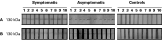
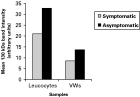
iNOS protein (130 kDa band) was present in all leucocytes and VWs of all 22 symptomatic and 20 asymptomatic Trichomonas-infected women but absent in samples of 20 uninfected healthy women (Fig. 1). The density of iNOS protein band in leucocytes of symptomatic women ranged between 16·12 and 30·15 arbitrary units while that in asymptomatic woman ranged between 25·09 and 44·32. Similarly, the density of iNOS protein band in VWs of symptomatic women ranged between 5·32 and 11·97 arbitrary units while that in asymptomatic woman ranged between 9·91 and 17·54. The mean iNOS protein band intensity was significantly higher (P<0·05) in leucocytes of asymptomatic as compared to symptomatic women, but there was no significant difference in VWs between symptomatic and asymptomatic women (P>0·05). The mean iNOS protein band intensity was significantly higher in leucocytes as compared to VWs (P<0·001) of both symptomatic and asymptomatic women (Fig. 2).

Fig. 1. Inducible nitric oxide synthase (iNOS – 130 kDa) in Trichomonas vaginalis-stimulated leucocyte cultures (A) and VWs (B) from representative (10 each) T. vaginalis-infected symptomatic and asymptomatic women and uninfected (control) women.

Fig. 2. Mean inducible nitric oxide synthase (iNOS – 130 kDa band intensity) determination in stimulated leucocyte cultures and VWs of Trichomonas vaginalis-infected symptomatic and asymptomatic women. Band intensity expressed in arbitrary units.
RNI determination
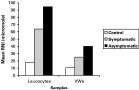
Nitrate and nitrite was determined by the Griess method. RNI was determined as nitrate plus nitrite. The mean RNI concentration in leucocytes of symptomatic women was 63·95±5·17 μM (range: 53·7 to 70·3 μM) while that in asymptomatic was 94·69±9·27 μM (range: 72·9 to 107·3 μM). Similarly the mean RNI concentration in VWs of symptomatic women was 25·27±3·28 μM (range: 18·5 to 31·4 μM) while that in asymptomatic was 40·14±6·89 μM (range: 30·5 to 48·7 μM). Mean RNI concentration was significantly higher in leucocytes (P<0·01) and VWs (P<0·05) of asymptomatic women as compared to symptomatic. The RNI concentration was significantly higher in leucocytes of both symptomatic and asymptomatic as compared to the respective VWs (P<0·001). A significant difference was observed in RNI concentration between the samples of infected women as compared to controls (P<0·001) (Fig. 3).

Fig. 3. Mean RNI concentration in stimulated leucocyte cultures and VWs of Trichomonas vaginalis-infected symptomatic and asymptomatic women and uninfected healthy women.
DISCUSSION
The mechanisms involved in the pathogenesis of trichomoniasis are not clearly understood. Nitric oxide (NO) and other reactive nitrogen radicals produced by neutrophils and other immune effector cells are important cytotoxic and cytostatic mediators for several parasites including intracellular and extracellular protozoans and helminths. The NOS isoform (iNOS) characterized in macrophages is a 130 kDa protein (Guo et al. 1999). In the present study, iNOS protein (130 kDa band) was present in all the leucocyte cultures and VWs of symptomatic as well as asymptomatic women, but was absent in samples from uninfected healthy women. However, the leucocytes of asymptomatic women produced more iNOS as indicated by higher intensity of bands than in symptomatic women (P<0·05). Though statistically not significant, the iNOS was higher in VWs of asymptomatic women than symptomatic women. These results suggest that, the high level of iNOS in asymptomatic women as compared to symptomatic women might help in maintaining low levels of infection. The mean iNOS protein band intensity was significantly higher in leucocytes as compared to VWs (P<0·001) of both symptomatic and asymptomatic women. Higher amount of iNOS production in leucocytes as compared to VWs may be because leucocytes are the primary cells at the site of infection and the first line of defence. Increased expression of iNOS has been demonstrated in a wide range of disorders, including sepsis, asthma, rheumatoid arthritis, atherosclerotic lesions, tuberculosis, inflammatory bowel disease, Helicobacter pylori-induced gastritis, allograft rejection, Alzheimer disease, and multiple sclerosis (Moshage, 1997). To the best of our knowledge, iNOS protein band intensity has not been reported in T. vaginalis-infected hosts, or in any other parasitic disease.
In this study, a significant increase in RNI production in the leucocytes and VWs of infected women as compared to uninfected healthy women was observed (P<0·001). The mean RNI concentration was significantly higher in leucocytes (P<0·01) and VWs (P<0·05) of asymptomatic as compared to symptomatic women. These results are similar to studies reported in various other parasitic infections (Rockett et al. 1994). A significant increase in RNI levels was observed in mice infected with T. vaginalis isolates from symptomatic and asymptomatic women as compared to uninfected controls (Malla et al. 2004). To the best of our knowledge this is the first report comparing RNI in leucocytes and VWs of symptomatic and asymptomatic T. vaginalis-infected women.
Although in present study, the mechanism involved in induction of iNOS was not investigated but inflammatory cytokines are known to induce iNOS, as reported in various studies (Sessa, 1994; Portugal et al. 2004). A direct stimulus for TNF-α production is reported to be provided by parasite components (Green et al. 1990). In an earlier study, IFN-γ and TNF-α levels were significantly higher in VWs of mice infected with isolates from symptomatic and asymptomatic women as compared to uninfected mice (Paintlia et al. 2002), thus these cytokines may be playing role in the induction of NO and its derivatives in the infected host.
In conclusion, we report for the first time that the mean iNOS protein band intensity and RNI concentration was significantly higher in leucocytes and VWs of asymptomatic women as compared to symptomatic women and also significantly higher than in the uninfected control group. These results suggest that reactive nitrogen radicals may have a role in limiting T. vaginalis infection in women.