The process of word learning in children has been a central focus in the study of children's understanding of reference in language, and the manner in which this understanding is integrated with other world knowledge (Swingley, Reference Swingley2010). One of the central concepts in this area, fast mapping (FM), was introduced by Carey and Bartlett (Reference Carey and Bartlett1978), and refers to the ability of children to associate a novel label with a novel item or action after very few exposures, and to remember this label even a month afterward (e.g., Bloom & Markson, Reference Bloom and Markson1998; but see Vlach & Sandhofer, Reference Vlach and Sandhofer2012).
The goal of the present study was to examine similarities and differences in FM abilities between emergent bilingual children and matched monolinguals. The novel aspect of our study is our focus on word learning abilities in kindergarten, in children who had acquired their first language in a monolingual environment, and are becoming early sequential bilinguals. Given that many children around the world are going to school in a language that is not spoken at home, it is necessary to explore the psycholinguistics of this sequential multilingualism.
The special linguistic situation in the educational system in Israel yields unique affordances to study this phenomenon. The majority of children in Israel study in monolingual environments: Jewish children study in Hebrew-speaking schools, and Arab children study in Arabic-speaking schools. Both types of schools are overseen by the Ministry of Education. As described below, Arab schools begin teaching Hebrew as a foreign language in third grade, while Hebrew-speaking schools begin teaching Arabic in junior high school. Thus, the majority of Arabic speakers in Israel are bilingual, with relatively high proficiency in Hebrew (as it is the majority language of the country), while the majority of Hebrew speakers do not know Arabic. In terms of sociolinguistic status, Hebrew is more prestigious than Arabic, although with the increasing integration of Arabic speakers into mainstream society, both economically and culturally, this gap is decreasing a bit. Hebrew is the primary official language and Arabic the secondary official language. In this context, there are bilingual kindergartens that were established around 10 years ago in Israel by the Center for Bilingual Education, and are an integral part of a small number of bilingual schools. The teaching staff in these schools represent both communities, Arab and Jewish, equally, with each class having two classroom teachers, one Arab and one Jewish. The languages are used concurrently and are not separated by time or by space. Each teacher is responsible for her native language, and in the flow of the daily routine, it is not really possible to separate out the use of the two languages. Code switching occurs, because the Arabic-speaking teachers are balanced bilinguals, and the Hebrew-speaking teachers have a basic knowledge of Arabic. The main objective of this dual language program is to increase intergroup communicative competence and cultural awareness. Achieving a balance between the two languages is critical, as it is the key to the students' integration within the classroom. We tested two groups of emergent bilinguals who study in the same bilingual preschools, where the native language of each group is the second language of the other. We compared the performance of these groups to matched monolinguals in the two languages, sampled from the regular, monolingual schools.
FM
A large number of studies on word learning in children have revealed some systematicity in this process: the mutual exclusivity bias, where both adults and children tend to assign an unfamiliar label to an unfamiliar object rather than to a familiar object for which they already have a label (e.g., Markman & Wachtel, Reference Markman and Wachtel1988), and the shape bias, in which children tend to generalize a label to new objects that are similar in shape to the newly labeled object (Landau, Smith, & Jones, Reference Landau, Smith and Jones1988). These seem to be characteristic of the process of FM, which may be the first stage of a statistical learning process in which the use of a label is noted by the learner in different situations, such that the meaning of the label is refined by experience.
An additional characteristic of FM in young children is the apparent dissociation between the form of the novel word and the word–referent association that is learned. Among infants, there seems to be competition between encoding the form of the novel word and the linking of it to a referent, with infants learning the word–referent link better than the specificity of the word form (e.g., Werker & Fennell, Reference Werker, Fennell, Hall and Waxman2006). Gordon and McGregor (Reference Gordon and McGregor2014) showed that this was true of 4- to 6-year-old children as well, with children remembering the word–referent link significantly better than the specific form of the novel word. Thus, FM may be comprised of at least two distinct mechanisms, one in which the association between a novel label and a novel object or action is formed quickly, and another, slower process, in which the specific form of the new label is learned such that it can be produced. This hypothesis is supported by the findings of Deák and Toney (Reference Deák and Toney2013), which showed that many of the characteristics of FM for words are also shown for nonverbal symbols, supporting the hypothesis that FM may be a general learning mechanism for creating new associations, and is not specific to word learning.
FM AND MULTILINGUALISM
There is a large literature on FM abilities in monolingual children (for a review, see Yurovsky, Fricker, Yu, & Smith, Reference Yurovsky, Fricker, Chen and Smith2014), and a somewhat smaller one, comparing bilingual and monolingual children. In general, studies that compared monolingual and bilingual children in novel word–novel object learning tasks reveal equivalent performance within the two groups (e.g., Deák & Toney, Reference Deák and Toney2013, Experiment 3; Kaushanskaya, Gross, & Buac, Reference Kaushanskaya, Gross and Buac2014; Rohde & Tiefenthal, Reference Rohde and Tiefenthal2000).
Bilingual children must learn to associate phonological and morphological forms from two languages to the same referent, and quickly learn that there is a dissociation between an object and its name, violating the exclusivity assumption. This led Kan and Kohnert (Reference Kan and Kohnert2008) to suggest that word learning, and specifically FM, may be a different process than in monolingual children. Kaushanskaya and Marian (Reference Kaushanskaya and Marian2009) compared monolingual and bilingual adults, and report an overall bilingual advantage for learning new words. They suggested that early exposure to two languages may facilitate the ability to acquire novel phonological forms over the life span. Kushanskaya et al. (Reference Kaushanskaya, Gross and Buac2014) have shown that sequential bilingual children show an advantage over monolingual children when the referents of novel labels are familiar, but not when they are unfamiliar, suggesting that the bilingual advantage in word learning reflects the experience of having more than one label for known objects, but does not generalize to novel word learning overall. However, Au and Glusman (Reference Au and Glusman1990) showed that monolingual children and adults can also violate the exclusivity assumption, if the labels refer to objects at different taxonomic levels, or if the words came from obviously different languages. A different kind of difference in the word-learning processes between young bilinguals and monolinguals is reported by Brodje, Ahmed, and Colunga (Reference Brojde, Ahmed and Colunga2012) where the bilinguals tended to use pragmatic cues such as the gaze direction of the adult, whereas monolinguals tended to use shape cues. Thus, it is still not clear whether FM processes differ between bilinguals and monolinguals, when both the objects and their names are novel.
In general, bilingual children have been shown to evince higher levels of metalinguistic knowledge than age-matched monolingual children, both in terms of phonological abilities and in knowledge about the symbolic aspect of language (Ben Zeev, Reference Ben Zeev1977; Marian, Faroqi-Shah, Kaushanskaya, Blumenfeld, & Sheng, Reference Marian, Faroqi-Shah, Kaushanskaya, Blumenfeld and Sheng2009). In terms of phonology, there is considerable evidence that bilingual children are more aware of the phonological units that make up the words of a language (e.g., Bialystok, Majumder, & Martin, Reference Bialystok, Majumder and Martin2003, Bruck & Genesee, Reference Bruck and Genesee1995). Previously, we have shown that in the children tested below, bilinguals achieved higher scores on tests of phonological awareness (Eviatar, Taha, & Schwartz, submitted). Although to our knowledge, only one study has directly tested morphological ability in bilinguals versus in monolinguals (Schwartz, Taha, Assad, Khamaisi, & Eviatar, Reference Schwartz, Taha, Assad, Khamaisi and Eviatar2016), we speculate that morphological abilities are also related to novel word learning. This is because in order to identify and manipulate morphemes, children must become aware of both semantic and grammatical aspects of parts of words, enriching lexical knowledge and aiding retention of novel words. We believe this would be especially true of children learning Semitic consonant root-based languages, in which morphology is highly salient (e.g., Berman, Reference Berman and Slobin1985). Thus, children who succeed in developing morphological knowledge may be assumed to have an advantage in acquiring new vocabulary (e.g., Kuo & Anderson, Reference Kuo and Anderson2006). Therefore, one of the goals of the present research is to explore the manner in which some of this metalinguistic knowledge, phonological and morphological abilities in particular, can be related to new word learning, as measured by a FM test, in both monolingual and bilingual children.
THE PRESENT STUDY: RATIONALE AND HYPOTHESES
All of the participants were in kindergarten (ages 5–6 years), and the bilinguals were attending Arabic–Hebrew bilingual preschools in Israel. Hebrew and Arabic are both Semitic languages, and although they are not mutually intelligible, they are similar in that morphologically, both are root languages. Thus, all verbs and most nouns are inflections of roots in which affixes and vowels are systematically implemented (Prunet, Beland, & Idrissi, Reference Prunet, Beland and Idrissi2000). In both languages, all nouns are inflected for gender and number. In both languages, verbs are richly inflected for tense, person, gender, and number. Both languages have a three-way tense system, including past, present, and future. Finite verbs must agree with their subject in gender, number, and in past and future tenses for person. The inflectional categories are marked by the addition of stem-external affixes (prefixes and suffixes), typically for gender, number, and person. In both languages, the intensive acquisition of the verb system begins at age 2 (Berman, Reference Berman and Slobin1985; Omar Nydell, 2007). By the age of 3, children are able to produce the prime grammatical categories of the verb system and to differentiate between tenses: the present, past, and future (Berman, Reference Berman and Slobin1985). In both Hebrew and Arabic, future tense acquisition is relatively later than present and past and continues to develop throughout elementary school (Berman, Reference Berman and Slobin1985).
We took advantage of the structure of the educational system in Israel, in which the majority of the Jewish population studies in Hebrew-speaking schools and the majority of the Arab population studies in Arabic-speaking schools. As mentioned above, this allowed us to compare bilinguals with matched monolinguals. However, there are two important differences between our bilingual groups that need to be mentioned. The first is that the sociolinguistic status of Hebrew and Arabic is not equal. Hebrew is the majority language of the country, and all of the parents of our Arabic speakers, whether they send their children to the bilingual school or not, are highly fluent in Hebrew. The majority of the parents of our Hebrew speakers, even those who send their children to the bilingual school, do not speak Arabic. Thus, the environment is asymmetric, such that there is a much larger exposure to Hebrew overall than there is to Arabic, and that Arabic speakers are universally bilingual with high levels of proficiency in Hebrew. An additional complication is that Arabic has two forms: the spoken form (Ammiya) and the written form (Fuṣha). The spoken form is always one of a set of colloquial dialects that share some syntactic and morphological features and lexicon, and differ in others, and is used by speakers of the language in a specified geographic area for daily verbal communication. This is the native language of virtually all Arabic speakers (and was the language in which our Arabic speakers were tested). Ammiya has no formal written form. The literary form (Fuṣha) is the language in which all speakers of Arabic, from all over the world, read and write, and is known as Modern Standard Arabic. This form of Arabic is universally used in the Arab world for formal communication and all written materials, including children's books. Everyday life reflects the mixing of spoken and literary Arabic. For example, in television shows, characters speak Ammiya, but announcers speak Fusha. On news programs, interviewees often mix the two forms of Arabic, but the interviewers speak only Fusha. In our study, all of the Arabic stimuli in all of the tasks, including all communication with the children, was in Ammiya, the spoken form of Arabic.
In our study, we manipulated the phonological similarity between the novel words and the languages that the children know. We created stimuli that were phonotactically similar to Arabic, to Hebrew, or were not typical of either language. This manipulation may allow us to shed light on other factors that affect novel word learning in sequential bilinguals. Previous studies that have manipulated the phonotactic similarity of stimuli to the different languages of bilinguals (e.g., Kohnert & Danahy, 2007; Windsor, Kohnert, Lobitz, & Pham, 2010) tended to use phonotactics that were similar to the home language (L1) or to the second language (L2). All found that learning is more efficient when stimuli are similar to L1. Our ability to test sensitivity to phonotactics in two groups of bilinguals where one group's L1 is the other's L2, together with our inclusion of a “neutral” phonotactic condition, can clarify the importance of phonotactics in novel word learning. We measured both identification (which taps the word–referent association created in the FM process) and production (which also taps memory for the specific form of the words) tasks.
We also measured phonological and morphological abilities in both Hebrew and Arabic, allowing comparison of the bilinguals to each monolingual group separately. Previously we have shown that in this sample of bilinguals and monolinguals, the bilinguals reveal superiority in sensitivity to some morphological categories (see Schwartz et al., Reference Schwartz, Taha, Assad, Khamaisi and Eviatar2016, for details). Here we focus on the effects of these abilities on FM that may be specific to a language. As mentioned above, Hebrew and Arabic are similar morphologically. However, Arabic is more complex (Ravid & Farah, Reference Ravid and Farah1999; Saiegh-Haddad & Henkin-Roitfarb, Reference Saiegh-Haddad, Henkin-Roitfarb, Saiegh-Haddad and Malatesha Joshi2014; Schwartz et al., Reference Schwartz, Taha, Assad, Khamaisi and Eviatar2016). For example, in the domain of number, the dialect of Palestinian Arabic spoken by our participants includes marking of singular, plural, dual, and collective. In contrast, the grammatical category of numbers in Hebrew distinguishes mostly singular and plural, with the dual marked only in a limited number of words belonging to paired parts of the body and time (2 days, 2 weeks, etc.). In addition, bound possessiveness is the only way of marking the possessive in Arabic and is used widely in Spoken Arabic at early ages, before entering school. In Hebrew, there is an additional, morphologically simpler way to mark the possessive, and the bound form is rarely used in informal speech by both children and adults. It is considered a literary-sounding style, and is acquired during late childhood after the onset of literacy acquisition at age 6 and exposure to formal written registers (Berman, Reference Berman and Slobin1985). It may be the case that these differences facilitate morphological abilities in Arabic-speaking children as compared to Hebrew-speaking children.
We tested the FM ability of monolingual Arabic and Hebrew speakers and compared it with that of emergent sequential bilingual Arabic–Hebrew and Hebrew–Arabic speakers. All of the tests were given in the children's home language, and all used the same stimuli. The stimuli were formed such that one category followed the phonotactics typical of Hebrew, one category followed the phonotactics typical of Arabic, and one category used neutral phonotactics that do not “sound” like either language in particular. We examined both identification and production performance in the monolingual and bilingual groups, focusing on the effects of the language experience (attending a bilingual or a monolingual kindergarten) of the children on learning via FM. All of the objects in our study were novel; thus, if Kaushankaya et al. (Reference Kaushanskaya, Gross and Buac2014) are correct in that bilinguals will only show superior performance in a FM task if the objects are familiar, we should not find a difference between our emergent bilingual and monolingual groups. However, if FM relies on metalinguistic abilities, in which bilinguals have an advantage, we may see a bilingual advantage even when the labeled objects are novel. Given that bilingual children are more sensitive to the phonological characteristics of words, we hypothesized that the manipulation of phonotactics would affect the performance of the bilinguals more than of the monolinguals.
METHOD
Participants
A sample of 93 5- and 6-year-old children participated in the study. The sample included two monolingual and two emergent bilingual groups: 26 Hebrew-speaking children from monolingual kindergartens (monos-H); 24 Arabic-speaking children from monolingual kindergartens (monos-A); 18 Hebrew-speaking children from the bilingual kindergartens (bis-L1H); and 25 Arabic-speaking children (bis-L1A) from the bilingual kindergartens. All emergent bilingual children were recruited from three Hebrew–Arabic bilingual kindergartens. The study was conducted at the end of the educational year (May–June), so the bilinguals had been attending the bilingual school for 8–9 months. We define our bilingual groups as early emergent bilinguals, because neither the native Arabic nor the native Hebrew speakers were highly fluent in their L2. Children were aware of the differences and similarities between the languages, as these are emphasized in class, and experienced learning and play thorough their L2, even though they were not fluent bilinguals yet. The Hebrew- and Arabic-speaking monolingual children were selected from five kindergartens from midlevel socioeconomic neighborhoods in the north of Israel.
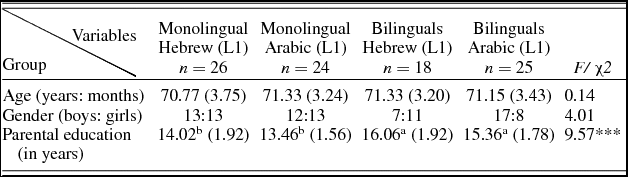
Participant selection was conducted in two stages. Consent for the children's participation in the study was given by parents. The consent forms were obtained through direct communication with parents during parent–teacher meetings in the middle of the academic year. All parents were asked to complete the consent form with a brief questionnaire. The questionnaire included information about the child's sociocultural background (parents’ education), the child's birthday, whether there were any problems with language acquisition, and the child's age at onset of preschool education (all of the children had gone to monolingual preschools from approximately age 2). The parents were asked about their language practice at home regarding communication with their children (language/s used in parent−child conversations). In addition, the Arabic-speaking parents were asked questions concerning patterns of their children's exposure to the two varieties of Arabic: Spoken Arabic and Modern Standard Arabic. Table 1 shows these demographic data.
Demographic information for the 4 groups. Different Latin superscripts (a, b) indicate a statistically significant difference; groups sharing a common superscript do not differ significantly

**p < .01, ***p < .001
Based on the parents’ reports, we selected the monolingual children who met the exclusionary criteria of monolingual development at home and at school (apart from Arabic-speaking children's nonsystematic exposure to Modern Standard Arabic [literary Arabic]), and the bilingual children who were emergent sequential bilinguals. No children with developmental delay in language acquisition were included in the sample.
We attempted to control our samples for two measures, socioeconomic status (SES) and verbal memory. We used parental education as a measure of SES, which usually correlates highly with parents’ educational level in Western countries (Duncan & Magnuson, 2005) and this has also been found in Israeli samples (e.g., Aram & Levin, 2001). Direct questions about the parents' incomes are not culturally appropriate in Israeli society. It can be seen that among the monolingual groups, parental education was equivalent, as it was between the bilingual groups. However, parents who chose to send their children to bilingual schools had significantly more years of education than parents who did not, irrespective of whether their L1 was Hebrew or Arabic. Therefore, all of the results were analyzed with parental education as a covariate.
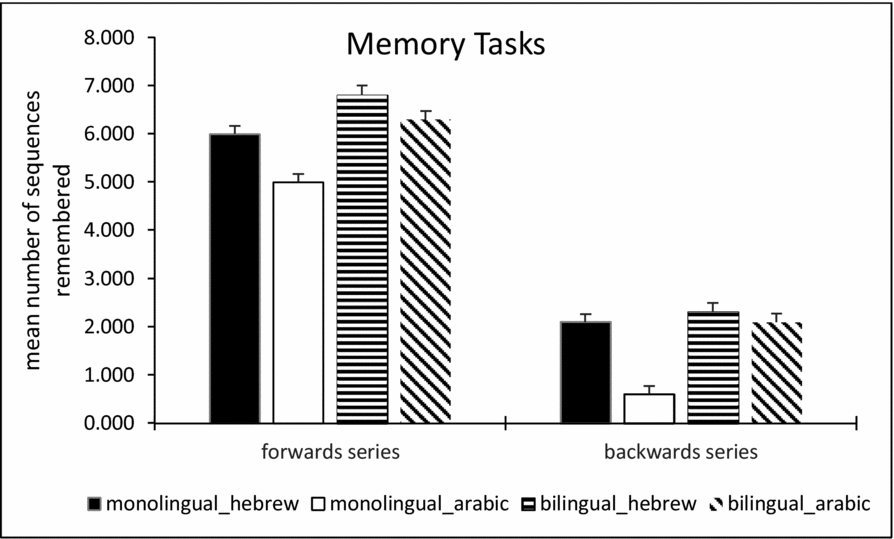
In order to control for differences among the groups is verbal memory, we conducted the Digit Span test (Kaufman, 1996). Arabic-speaking children were tested in the native dialect of their spoken Arabic, and Hebrew-speaking children were tested in Hebrew. Children were aurally presented with a series of numbers and were asked to repeat them in two different ways. In the “forward” condition, they were requested to remember the series in the order of presentation. In the “backward” condition, they were asked to repeat the numbers in the reverse order. Each part of the test began with a series of two numbers. At each level of difficulty, the children were presented with two series of numbers. Children who succeeded in remembering at least one out of the two series continued to the next series, which included a larger amount of digits. The final score is the number of series that the child was able to correctly remember. The maximum score for remembering the series in the order presented is 16 and for the reverse order is 14.
The scores of the children were analyzed using a univariate generalized linear modeling (GLM) procedure, with group (bis-L1H, bis-L1A, monos-H, or monos-A) as a between-groups factor. The “forward” and “backward” tests were analyzed separately, and the data of the children are shown in Figure 1. Using the education of both parents as a covariate, the analysis of memory in the “forward” condition revealed that the differences between the groups are not significant, p > .23. The analysis of the backward condition revealed an effect of group, F (3, 89) = 13.75, ηp 2 = 0.33, p < .0001. As can be inferred from the figure, the monolingual Arabic speakers had lower scores than all of the other groups, p < .0001, while the other groups did not differ from each other. To compensate for this difference, we used the scores on the memory task, in addition to parental education, as covariates in all subsequent analyses.
Scores on the memory tasks.

An additional difference between the groups is that all of the parents of the Arabic speakers were also fluent in Hebrew, as that is the majority language of the country, and all had taken matriculation tests in Hebrew. In addition, parents who had gone to university had all studied in Hebrew. Among the parents of the Hebrew speakers, only 3 individuals out of the 18 parental pairs knew any Arabic. Parents of the Arabic-speaking children reported that their children watch some cartoons in Hebrew on TV. Thus, the exposure of our two bilingual groups to their L2 is asymmetric.
Materials
FM task
The FM task was adapted from the designs of previous studies (e.g., Gershkoff-Stowe & Hahn, 2007; Gray, Reference Gray2003; Kan & Kohnert, Reference Kan and Kohnert2008; and a unpublished study in our lab that used this task with Russian–Hebrew 7-year-old students). Eighteen stimuli representing nouns were chosen from the stimuli used by Merhav, Karni, and Gilboa (2014). These stimuli were pictures of nine rare fruits and nine rare animals, which had been determined to be unfamiliar to Israeli undergraduates. A pilot with six children revealed that all were unfamiliar and nonthreatening. The stimuli were divided into three categories of six that were composed of three pictures of fruits and three pictures of animals. The stimuli in each category were divided into pairs consisting of one fruit and one animal and given pseudoword names. We created three types of stimuli:
Similar to Hebrew phonotactics (gavvas, marban): The six stimuli were composed of five two-syllable nonwords and one monosyllabic nonword. The nonwords represent three types of consonant/vowel (CV) structures: CVCVC, CVCCVC, and CVC and did not include consonant clusters. These types have high phonotactic probability in Hebrew. All were taken from Deutsch (1994).
Similar to Arabic phonotactics (khanfoor, bara'oof): The Arabic-like nonwords were composed according to the syllabic and morphological structure of frequently spoken words. The nonwords were composed by replacing several sounds in familiar real words, converting them into nonsense words. This process was conducted for each nonword while keeping the syllabic and the morphological structure as the original one. The nonwords represented two types of consonant/vowel structures: CVCVC and CVCCVC and did not include consonant clusters.
Neutral pseudowords, which are not specifically typical of either language (bongo, yottah): All of these were bisyllabic, with structures intentionally different from common noun and verb word forms in the two languages.
Four judges (two in each target language), who are speech therapists and linguists, rated the test items for phonotactic probability, phonological neighborhood density, and stress patterns in comparison to the real word structures in Hebrew and Arabic. There was 88% agreement between the judges, and inconsistencies were resolved through discussions. In addition, H.T., who is a bilingual Arabic–Hebrew psycholinguist, approved the equivalency of the items that were Hebrew-like and Arabic-like. The three lists were equal in terms of word length and number of syllables. A pretest was conducted in both languages to check how the children coped with the tests and their instructions. Children were given examples and feedback before testing.
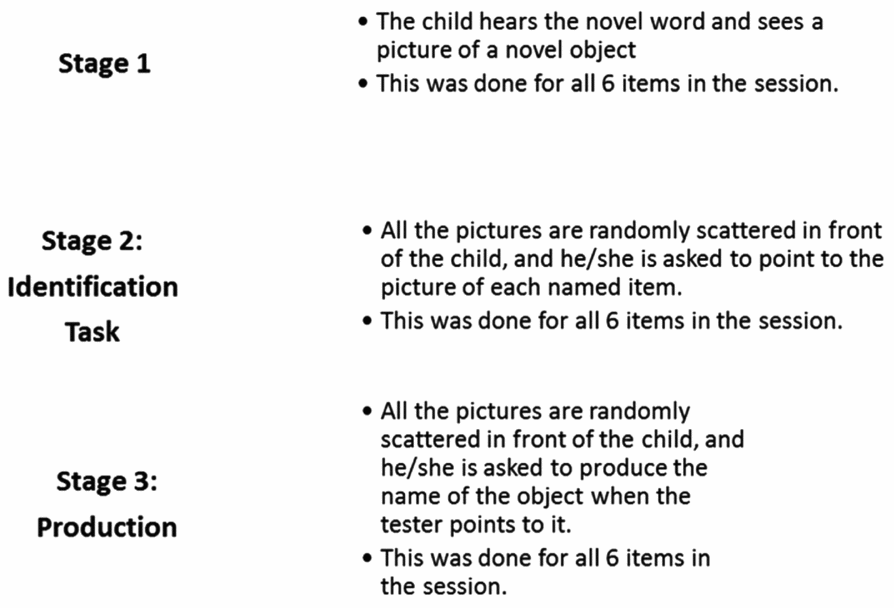
As shown in Figure 2, the task was conducted in three separate sessions. In each session, children were exposed to six of the stimuli (all of the children were shown the same stimuli in the same order). After seeing the stimuli (see Figure 2 for the procedure), children were asked first to identify the novel object that goes with a novel label, and then asked to produce the novel label while shown the novel object. A list of the stimuli is presented in Appendix A.
Procedure of the fast mapping task.

Phonological awareness
Three tests were prepared in each language (the Arabic language tests were in Spoken Arabic). The Arabic versions were constructed by Taha (Taha & Saiegh-Haddad, Reference Taha and Saiegh-Haddad2016), the Hebrew version of phoneme identification was constructed by Schwartz (Reference Schwartz2006), and syllable deletion was constructed by Shany and Ben-Dror (Reference Shany and Ben-Dror1998):
1. Initial phoneme identification: Ten pictured objects were shown to the children. In the Hebrew test there are five objects beginning with consonant clusters, CCV (e.g., dli, “pail”), and five objects beginning with a simple CV pattern (e.g., tut, “strawberry”); in Arabic, all 10 objects began with a simple CV (e.g., dob, “bear”). The children were asked to name the object and to say the first phoneme of each word. Internal consistencies for the Hebrew and Arabic versions of this test (α) were 0.90 and 0.89, respectively.
2. Last phoneme identification: Ten pictures that represent one- or two-syllable words were shown to the children (e.g., in Hebrew, kos, “glass”; in Arabic, roz, “rice”), who were asked to identify the last phoneme of each word. Internal consistencies for the Hebrew and Arabic versions of this test (α) were 0.92 and 0.86, respectively.
3. Syllable deletion: Children were required to say the word that remained after the deletion of a syllable from a word. The task included 10 words. For example, in Hebrew, “Say mispar (‘number’). Now, say mispar without mis”; in Arabic, "Say sinjab (‘squirrel’). Now say sinjab without sin.” Internal consistencies for Hebrew and Arabic versions of this test (α) were 0.85 and 0.85 respectively.
In order to reduce the data in this study, we used two composite measures of phonological awareness, one in Hebrew and one in Arabic. The composite measure for each language was created by extracting the first principal component from the three phonological awareness tests. For the Hebrew test, this first component accounted for a majority of the variance in this set (63%), with substantial weights for each of the three phonological awareness variables (.821, .812, and .754). For the Arabic test, the first component also explained most of the variance in this set (65%), with similar weights for each of the individual variables (.793, .855, and .777).
Morphological awareness
The test was constructed after Shatil (Reference Shatil1995) and Berko (Reference Berko1958). The tests in both languages include 36 pairs of pseudowords that represent six various inflectional morphological categories (masculine/feminine, singular/plural, dual number, bound possessives, past tense and present tense). Each category is measured by six items. Each participant was asked to identify the right target category by choosing one word of each pair of pseudowords. For example, in Arabic: which word, thameel or thameela, would be used with a girl? The items from different morphological categories were randomly ordered and were presented to the children in the same random order. Internal consistencies of the Hebrew and Arabic versions of this task were α = 0.71 and α = 0.82, respectively. We used the overall scores (summed over morphological categories). Details about the performance of this sample on the morphological task are reported in Schwartz et al. (Reference Schwartz, Taha, Assad, Khamaisi and Eviatar2016).
Procedure
Each child was assessed individually in a quiet room. To avoid fatigue, every test session lasted not more than 20 min. The children were seen in three sessions with 2 weeks break between the sessions. On all tests in each target language, children were given examples and feedback before testing. The order of tasks was counterbalanced. Native speakers of each language administered the tests in each language. Instructions were always given in the child's L1. The bilingual groups performed the phonology and morphology tests in both languages. The monolinguals performed them in their L1. The research assistants were master's degree students with an academic background in child education. Native Hebrew and Arabic speakers administered the tasks in Hebrew and in Arabic, respectively.
The FM test was conducted in three main stages in each of three separate sessions. In each session, 6 of the 18 stimuli were presented. Of the 6, 2 were Hebrew-like, 2 were Arabic-like, and 2 were neutral. The procedure for each session is described in Figure 2 below. In the first stage, the child was exposed to the new vocabulary item by hearing the stimulus nonword three times while seeing a picture of the object. In the second stage, the identification task, the child was asked to identify the object that the new word denoted. In the third stage, the production task, the child was shown the picture and asked to produce the novel word.
For the identification task, the child was either correct (1 point) or incorrect (0 points). The maximum score was 18. For the production task, the results were finely scored, with 2 points awarded for a correct pronunciation, 1 point for a pronunciation in which only one or two phonemes were substituted, and 0 points for other errors. The maximum score was 36.
RESULTS
FM task
The percent correct scores of the children were analyzed using a mixed GLM procedure, with group (bis-L1H, bis-L1A, monos-H, or monos-A) as a between-groups factor, and stimulus type (similar to Hebrew phonotactics, similar to Arabic phonotactics, or with neutral phonotactics) and task (identification vs. production) as within subject factors. Parental education and scores on the two memory tasks were used as covariates.
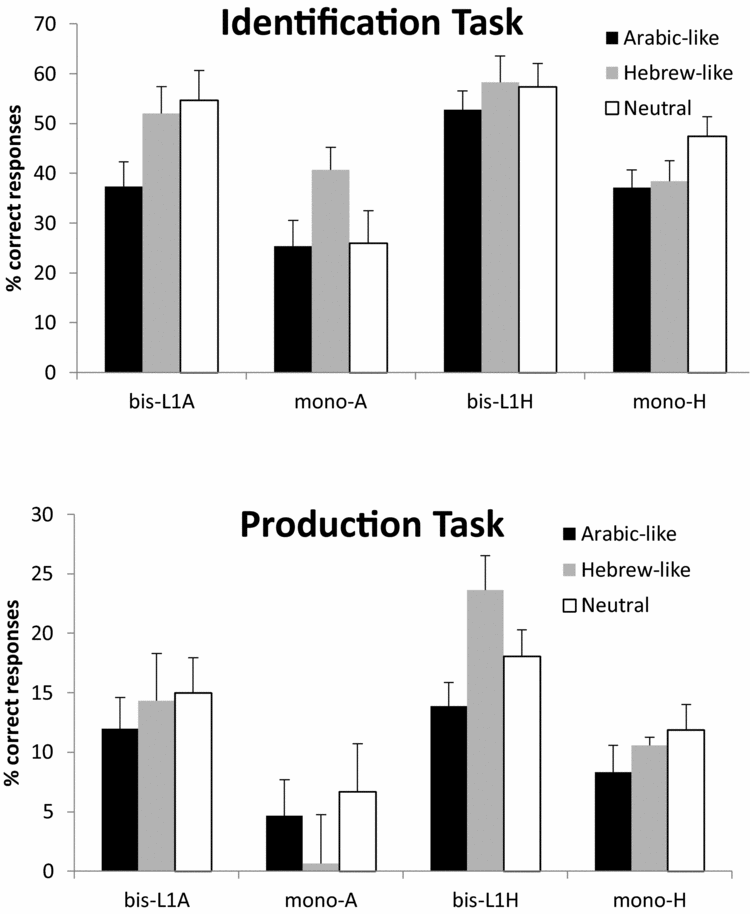
This analysis revealed a small, but significant three-way interaction, F (6, 178) = 3.04, ηp2 = 0.09, p < .01. The main effects of each of the factors were also significant: task, F (1, 89) = 377.28, ηp2 = 0.81, p < .0001; stimulus type, F (2, 178) = 6.57, ηp2 = 0.07, p < .005; and group, F (3, 89) = 6.13, ηp2 = 0.18, p < .001. No other interactions were significant. The cell means are illustrated in Figure 3.
(a) Scores on the identification portion of the fast mapping task. (b) Scores on the production portion of the fast mapping task.

The largest effect is of task, and it can be seen that levels of performance were much higher in the identification task than in the production task. In fact, one-sample t tests to test learning versus chance performance, revealed that for all of the groups, performance in the identification task was better than chance, p < .01, reflecting real learning, whereas for the production task, none of the groups performed better than chance, p = .05.
It can be seen that the largest difference between the tasks is in the monolingual Arabic-speaking group. When this group is excluded, the three-way interaction is not significant, p > .37. When other groups are excluded, the interaction remains significant. In order to investigate these effects more carefully, each task was analyzed separately. All the analyses included parental education and the two memory measures as covariates.
Identification task
The analysis revealed a small, but significant interaction between group and stimulus type, F (6, 178) = 2.32, ηp2 = 0.07, p < .05. The cell means are illustrated in Figure 3a. The main effect of stimulus type was significant, F (2, 178) = 6.08, ηp2 = 0.06, p < .005, as was the main effect of group, F (3, 86) = 4.73, ηp2 = 0.14, p < .005.
Planned comparisons showed that for Hebrew speakers, the type of stimulus either had no effect on responses, as in the bilingual Hebrew-L1 group (p > .7), or was marginal, as for monolingual Hebrew speakers (p = .068). For the Arabic speakers, it can be seen that the pattern was different. The bilingual Arabic-L1 group reveal a main effect of stimulus type, F (2, 48) = 6.04, ηp2 = 0.20, p < .01, with their responses to Arabic-like stimuli being less accurate than their responses to Hebrew-like stimuli, F (1, 48) = 7.46, ηp2 = 0.13, p < .01, and neutral stimuli, F (1, 48) = 10.41, ηp2 = 0.18, p < .005. The responses to Hebrew-like and neutral stimuli did not differ (p > .6). The monolingual Arabic speakers also showed a main effect of stimulus type, F (2, 46) = 5.28, ηp2 = 0.19, p < .005, with responses to Hebrew-like stimuli significantly more accurate than responses to Arabic-like stimuli, F (1, 46) = 7.52, ηp2 = 0.14, p < .005, and to neutral stimuli, F (1, 46) = 8.29, ηp2 = 0.15, p < .01. Responses to Arabic-like and neutral stimuli did not differ from each other (p > .8).Footnote 1
Overall, the bilinguals outperformed the monolinguals in all three types of stimuli: Arabic-like, F (1, 90) = 6.21, ηp2 = 0.06, p < .05; Hebrew-like, F (1, 90) = 7.95, ηp2 = 0.08, p < .01; neutral, F (1, 90) = 11.68, ηp2 = 0.11, p < .005.
Production task
Recall that the test for learning revealed that performance was not significantly better than chance in any of the groups. However, as can be seen in Figure 3b, performance was not uniform across the groups. The overall GLM analysis, with parental education and memory scores as covariates, revealed only a significant main effect of group, F (3, 86) = 4.4, ηp2 = 0.13, p < .01, and no other effects or interaction. Further comparisons revealed that the bilingual groups did not differ from each other (p > .18) and that the monolingual groups did not differ from each other (p > .18). However, among the Arabic speakers, the bilingual children performed significantly better than the monolingual children, F (1, 44) = 9.44, ηp2 = 0.18, p = .0036. Among the Hebrew speakers, the bilingual advantage was smaller (ηp2 = 0.08) and marginally significant, p = .07.
Phonological abilities
The scores of the Hebrew and Arabic tests were analyzed separately. In all analyses, parental education and the two memory scores were used as covariates. For the Hebrew test, we compared the scores of the two bilingual groups with that of the monolingual Hebrew-speaking group. The GLM analysis revealed that the main effect of group was not significant (p = .33), even though numerically, both groups of bilinguals achieved higher scores than the monolinguals (bilinguals with Hebrew as L1 M = 49.16% SD = 19.3; bilinguals with Arabic as L1 M = 41.16% SD = 25.6; monolingual Hebrew speakers M = 34.9% SD = 21.7). Although the difference between bilingual and monolingual native Hebrew speakers was not significant, it was in the predicted direction: F (1, 41) = 1.56, p = .21. For the Arabic test, we again compared the scores of the two bilingual groups with the scores of the monolingual Arabic speakers. Again, although the main effect of group was not significant, p > .39, numerically, the bilingual groups outperformed the monolingual group (M = 33.55%; bilinguals with Arabic as L1, M = 55.07%; bilinguals with Hebrew as L1, M = 60.7%). The scores of the two monolingual groups, each tested in their L1, did not differ significantly, p > .8.
Morphological abilities
For the Hebrew task, we compared the scores of the two bilingual groups with the monolingual Hebrew speakers, using the general linear model for unequal groups. In all analyses, parental education and the two memory scores were used as covariates. The analysis revealed a significant effect of group, F (2, 63) = 8.28, ηp2 = 0.21, p < .001. Planned comparisons revealed that the two bilingual groups do not differ from each other, p > .8, while both have significantly better scores than the monolingual group: bilinguals with Hebrew as L1 (M = 73.46%) versus monolinguals (M = 61.54%), F (1, 39) = 8.79, ηp2 = 0.19, p < .006; bilinguals with Arabic as L1 (M = 73.44%) versus monolinguals, F (1, 46) = 11.78, ηp2 = 0.20, p < .005.
For the Arabic task, we compared the scores of the two bilingual groups with the monolingual Arabic speakers, using the same analysis. This analysis also revealed a significant main effect of group, F (2, 61) = 4.48, ηp2 = 0.13, p < .05. Further analyses revealed that here, the bilinguals with Arabic as L1 (M = 73.55%) performed significantly better than the bilinguals with Hebrew as L1 (M = 61.42%), F (1, 38) = 8.08, ηp2 = 0.17, p < .01. In addition, the bilinguals with Arabic as L1 performed marginally better than the Arabic-speaking monolinguals (M = 57.89%), p = .07. The difference between the bilinguals with Hebrew as L1 and the monolingual Arabic speakers was not significant, p > .11. When tested in L1, bilinguals outperformed both of the monolingual groups. Again, the two monolingual groups, each tested in their L1, did not differ from each other, p > .3.
Regression analyses
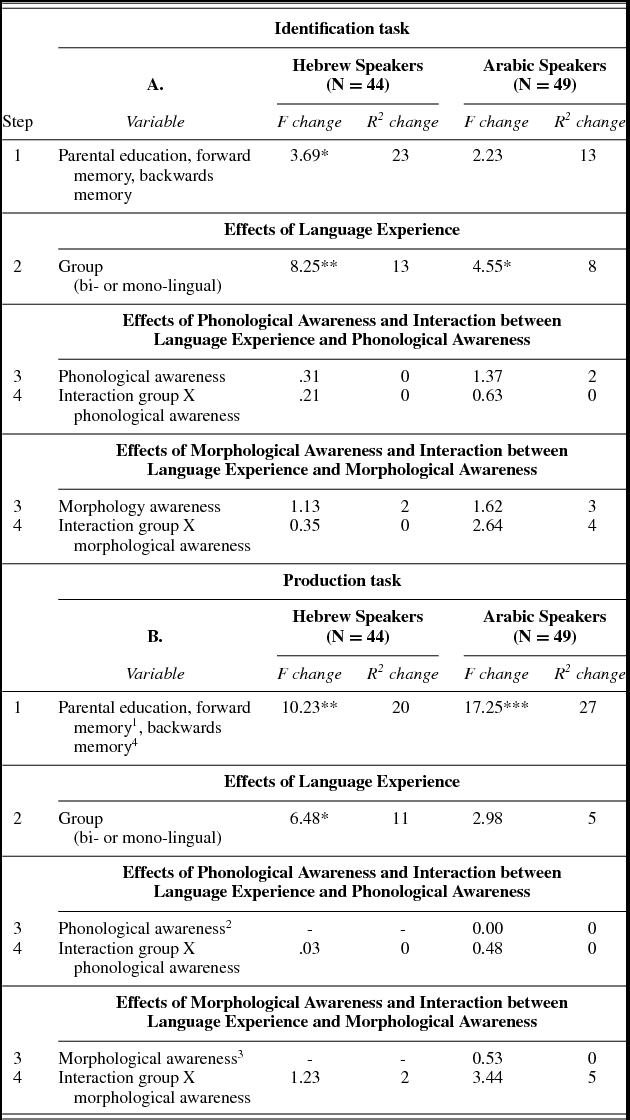
In order to explore the extent to which background variables (parental education and memory measures), together with language experience and phonological and morphological abilities, are related to new word learning as measured by our FM test, we conducted a series of hierarchical multiple regression analyses separately with the identification and production scores on the FM tasks as dependent variables. Because morphological and phonological abilities are highly correlated, r (47) = .55, p < .0001, for children whose L1 is Arabic; and r (42) = .47, p < .002, for children whose L1 is Hebrew), we computed their effects in separate models. The first model included our background measures of SES (the contribution of parental education) and the forward and backward memory measures (Step 1). We then added the effects of language experience (being bilingual or monolingual; Step 2), and then, separately, the scores on the phonology or morphology awareness tests (Step 3), and then in a Step 4, added the interaction between language experience and phonology or morphology awareness scores. This was done separately for children whose home language was Arabic and children whose home language was Hebrew. The results of these computations can be seen in Table 2.
First Regression Analyses: Contribution of parental education, forward and backward memory, language experience (Group), phonological and morphological awareness, and the interaction between language experience and phonology or morphology awareness to scores on the FM tasks. A. Identification task; B. Production Task

*p < .05; **p < .01; *** p < .001
Notes:
1 Parental education and backward memory were excluded from the regression equation.
2 Phonological awareness was excluded from the regression equation.
3 Morphological awareness was excluded from the regression equation.
4 Parental education and forward memory were excluded from the regression equation.
In the identification task (see Table 2), it can be seen that the critical factor for both groups of children (whose home language was Arabic and children whose home language was Hebrew) was their language experience: that is, whether the children attended a bilingual school or not. It can also be seen that neither phonological abilities nor morphological abilities, or their interaction with group, added predictive ability to the model.
In the production task (see Table 2), it can be seen that for both Arabic and Hebrew speakers, the crucial contributors to FM scores were the background variables (represented by forward memory for the Hebrew speakers and by backward memory for the Arabic speakers). For Hebrew speakers, group (going to a bilingual or a monolingual kindergarten) added predictive value, while for Arabic speakers this factor was marginal (p = .09).
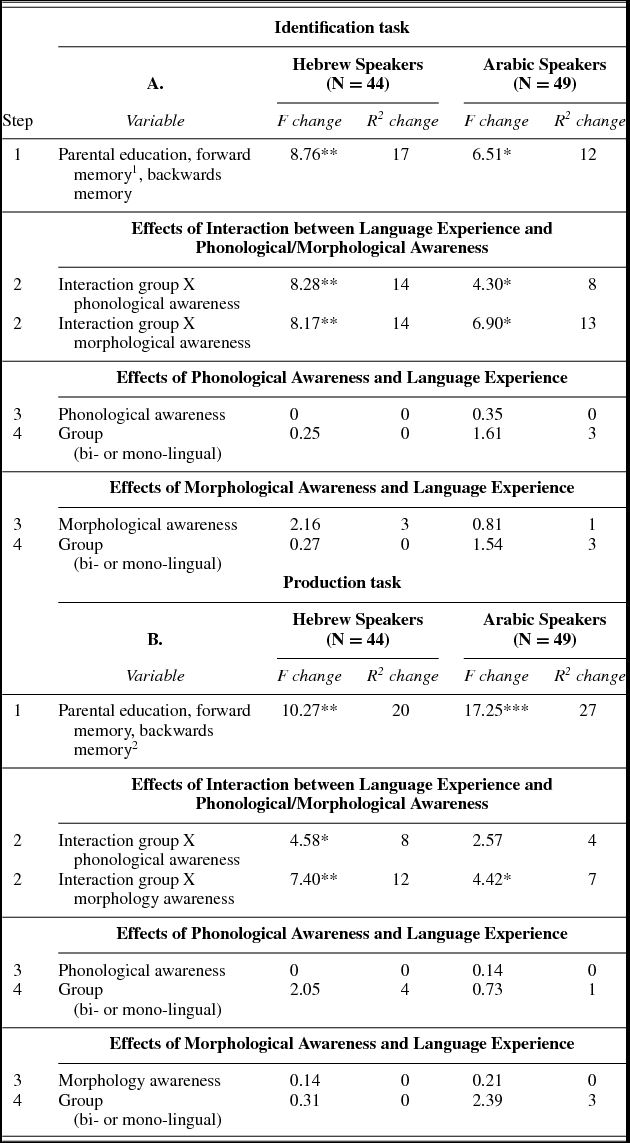
Recall that in the metalinguistic tests, there were numerical trends, some of which were significant, for bilinguals to achieve higher scores than monolinguals. It is thus possible that the variance explained by the scores on the metalinguistic awareness tests was swallowed up by the stronger effect of language experience. In order to examine this, we recomputed the hierarchical models, except that we now entered the interaction between group and metalinguistic ability in Step 2 instead of in Step 4. The results of these computations are shown in Table 3.
Second Regression Analyses: Contribution of parental education, forward and backward memory, the interaction between language experience and phonology or morphology awareness, language experience, the phonological and morphological awareness. A. Identification task; B. Production task

*p < .05 **p < .01 *** p < .001
Notes:
1 Parental education and forward memory were excluded from the regression equation.
2 Parental education and backward memory were excluded from the regression equation.
We can see that for both the identification and the production tasks, the interaction of language experience (the factor of group: bilingual vs. monolingual) with the scores on the phonological and morphological test significantly and strongly accounted for a larger portion of the variance in the FM scores. The contribution of this interaction was higher than the contribution of the language experience per se (see Table 2, Step 2). The only exception here was the interaction of group and phonology for the Arabic speakers in the production task. In both language groups, language experience by itself, and metalinguistic abilities by themselves, do not significantly predict FM scores.
DISCUSSION
Our study had three major goals. The first was to examine the FM abilities of kindergarteners who are emerging sequential bilinguals, and to compare them to monolinguals. The second was to examine the effects of the phonological characteristics of novel words and the manner in which these can interact with the phonotactic conventions of the languages under study. The third goal was to begin to explore the relations between metalinguistic ability in phonology and morphology and FM skills.
We believe we have added several bits of information to our conceptualization of vocabulary learning skills. We replicate the finding that children perform better on the identification than on the production tasks. This result converges with that reported by Gray (e.g., Reference Gray2006), who showed that in normally developing 4- to 6-year-olds, production scores are much lower than identification scores, and also with the suggestions of Werker and Fennel (Reference Werker, Fennell, Hall and Waxman2006) and Gordon and McGregor (Reference Gordon and McGregor2014), that FM is the fast component of word learning, in which a novel label is quickly and efficiently related to a novel object, but is less efficacious in the process of learning the specific form of the new referent. Other bits of information are specific to bilingualism and to the effects of phonotactics, and these are detailed below.
Bilingualism
Overall, our bilingual groups revealed better performance on the FM tasks than their matched monolingual controls. Our results differ from those reported by Kaushankaya et al. (Reference Kaushanskaya, Gross and Buac2014), who showed that bilinguals reveal an advantage over monolinguals when the referents are familiar objects but not when they are novel objects. They interpreted their findings as indicating that bilinguals have an advantage when the situation is similar to L2 learning, but in terms of learning novel names for novel items, the bilinguals are the same as the monolinguals. We agree that this is a reasonable interpretation, but suggest that it incorporates an interpretation of a null effect. In our study, all of the objects were unfamiliar to the children, and still the bilinguals showed an overall advantage. There are several possible sources for these different results. Our sample sizes were larger: overall, we tested 50 monolinguals and 43 bilinguals, whereas they tested 19 children in each group. Thus, in terms of power, our design may have been able to show an effect that is weaker than the one shown with familiar objects, but can still show up with a larger sample size. In addition, some of the participants in Kaushanskaya et al.’s study were older. Their sample included children who were in second grade, whereas we tested only kindergarteners. There may be differences in developmental trends in word learning that were captured by our study and not by theirs.
Another possible source for our result may be that the baseline linguistic abilities of the bilingual participants are higher than those of the monolinguals. We believe this is not a good explanation for our results, because among the Hebrew speakers, verbal memory (both forward and backward) did not differ between the bilinguals and the monolinguals, while bilinguals still outperformed the monolinguals.
Our findings can be seen as converging somewhat with the hypotheses suggested by Kan and Kohnert (Reference Kan and Kohnert2008) that FM is a different process among bilinguals and monolinguals. We believe that the process is probably not inherently different, but may be sharpened by the attention of the bilingual children to the characteristics of novel words. Schwartz and Asli (Reference Schwartz and Asli2014) examined the behavior of the teachers in these Hebrew−Arabic bilingual kindergartens, and found that the bilingual teachers spent a lot of time focusing on cognates and the similar roots of words in Hebrew and Arabic, and on the structural similarities and differences between words in Arabic and Hebrew. The teachers used a metalinguistic strategy to focus on similar roots of words in L1 and L2, and the shared origin of the Hebrew and Arabic languages. Thus, being introduced to novel words and their characteristics may be a more familiar experience for the bilingual than for the monolingual children and may strengthen FM processes.
Phonotactics
The effects of phonotactics on performance were surprising and suggest new avenues of research. Recall that we had predicted that because bilingual children had been shown to be more sensitive to the phonological characteristics of words, they would be more sensitive to our manipulation of phonotactics. In addition, given previous results, we expected learning to be better when the phonotactics of the stimuli matched L1. Instead, our results clearly show that the phonotactic manipulation strongly affected both bilingual and monolingual children whose home language is Arabic, and had very little effect on both bilingual and monolingual children whose home language is Hebrew.
The finding is of poor performance of the L1 Arabic speakers (both monolingual and bilingual) with the Arabic-like stimuli, as compared to their performance with the Hebrew-like and neutral stimuli. Both groups of native Arabic speakers performed significantly better with Hebrew-like stimuli than with Arabic-like stimuli (see Figure 3). We speculate that this is due to the complicated linguistic situation into which all Arabic-speaking children are born. As mentioned above Arabic has two forms: Ammiya and Fusha, which differ in phonology, morphology, in many lexical items, and in syntactic rules (Eviatar & Ibrahim, Reference Eviatar and Ibrahim2000). The differences between Ammiya and Fusha served as part of the background to the introduction of the term “diglossia” by Ferguson in 1959, and have generated a long debate over the distinction between diglossia and bilingualism (e.g., Eid, Reference Eid and Eid1990). Eviatar and Ibrahim (Reference Eviatar and Ibrahim2000) examined this issue directly, and compared phonological and metalinguistic knowledge among three groups of kindergarteners and first graders: a monolingual Hebrew-speaking group, a Russian–Hebrew bilingual group, and an Arabic-speaking group. The Arabic speakers did not live in mixed cities or villages, and were minimally exposed to Hebrew. The Russian–Hebrew bilinguals revealed the classic pattern of higher phonological and metalinguistic abilities, and lower vocabulary scores, than the monolingual group. The Arabic-speaking children patterned with the bilingual group. Eviatar and Ibrahim (Reference Eviatar and Ibrahim2000) suggested that the exposure to the two forms of Arabic challenges the cognitive systems of children such that they treat them as two different languages, and are essentially bilingual. This situation impacts language development and use among Arabic speakers, and has recently received much attention (e.g., Saiegh-Haddad & Joshi, Reference Saiegh-Haddad, Henkin-Roitfarb, Saiegh-Haddad and Malatesha Joshi2014). The children in the current study were exposed to the Palestinian Arabic dialect of Palestinian Spoken Arabic in their kindergartens, which was their native language; thus, diglossia may have impacted our results even though our stimuli were constructed based on this dialect, and no literary forms were used. Below we speculate as to the manner in which this impact may occur.
The linguistic environment of the Arabic-speaking groups in our study is more complex than that of the Hebrew-speaking groups. The Arabic speakers are exposed to new words in Fusha both at home and at school, where teachers prepare them for the task of learning to read (which only occurs in Fusha). Because Fusha is the language of religious texts, it is treated with much respect, and language errors are always corrected. Literate adult speakers are often hesitant to speak Fusha themselves. We speculate that for Arabic-speaking kindergarteners, who are made aware of the difference between the language they speak and Fusha, and whose experience with novel words is usually in the context of Fusha, word learning is a more controlled and monitored process than in other languages. Thus, it may be that when the Arabic speakers were presented with novel words that followed the phonotactics of Arabic,Footnote 2 FM processes may have been less efficient than when the stimuli followed different phonotactic rules. As mentioned above, this is a speculation, and a closer look at word learning in Arabic children under these conditions is warranted. We are currently testing this hypothesis with Arabic- and Hebrew-speaking adults.
Factors contributing to FM abilities
Our results show that when parental education and working memory are controlled for, metalinguistic abilities on their own do not contribute to FM scores over and above linguistic experience. As shown in Table 2, the strongest predictor was language experience, whether the children attended a bilingual or a monolingual school. However, because we had reason to believe that in these samples of children, the emergent bilinguals had higher scores than the monolinguals in both phonological measures (see Eviatar et al., XXXX) and morphological measures (see Schwartz et al., Reference Schwartz, Taha, Assad, Khamaisi and Eviatar2016, for details), we recomputed the regression analyses with the interaction of language experience and metalinguistic scores in Step 2, right after the background measures. These analyses, shown in Table 3, strongly suggest that the effects of metalinguistic awareness are mediated by language experience. Thus, in both analyses, the effect of language experience, on its own in the first analysis, and even more strongly in interaction with metalinguistic abilities in the second analysis, emerges as a predictor of FM abilities, over and above parental education and memory abilities. This pattern of data is in line with the growing research data on interaction between early bilingual experience and children's meta-linguistic development.
Limitations
A limitation of our study, which may constrain our interpretations of the effects of bilingualism, is that the parental education of the bilingual groups was significantly higher than that of the monolingual groups. Even though we covaried this factor in our analyses, it may have been the case that another factor that varies with parental education may have affected our results. This design flaw is unfortunately unavoidable, because the part of the Israeli population that sends its children to bilingual schools is special, and tends to have more education and consciousness of the importance of the sociocultural effects of education in general and of linguistic development in particular. In addition, overall, in the Israeli reality, the educational level of the Arabic-speaking population is lower than that of the Hebrew speakers. Because of this, we intentionally sampled monolingual Arabic speakers from two cities that are characterized by having relatively high educational levels. It is important to note that all of the parents of our monolingual groups had completed high school (12 years of education). Among the monolingual Arabic speakers, where the parental education was the lowest relative to the other groups, 10/24 had completed 12 years of education, and 14/24 had completed more than 12, 5 of whom had an undergraduate degree. Thus, none of the children came from low-SES families, but the effects of parental education cannot be ruled out.
Two additional limitations of our study are the asymmetric exposure of the bilingual children to their L2 outside of school, and the small sample size of the bilinguals with Hebrew as L1. Hebrew is the majority language of the country, and although there are children's shows on TV in Arabic, the number of shows in Hebrew is much larger than the number of shows in Arabic. Arabic-speaking parents reported that their bilingual children often choose to watch programs in Hebrew. None of the parents of the Hebrew speakers reported that their children choose to watch shows in Arabic. The small sample size of the bilingual Hebrew-speaking group is due to the fact that there are fewer children with Hebrew as L1 in the bilingual schools than children with Arabic as L1. We tested all the children who fulfilled our criteria and agreed to be tested.
Conclusions
Our findings are interesting in terms of both what we have shown and what we have not shown. Overall, we have replicated the finding that identification and production result in different levels of performance in children, supporting the hypothesis that learning to identify a novel label and learning to produce it may be separate processes. In addition, we show that even emergent bilinguals with low proficiency in L2 show facilitated performance on our FM task as compared to matched monolinguals, even when all of the stimuli were novel. We suggest that the process of FM may have been sharpened by the linguistic experience of the children in the bilingual schools.
Our regression analyses suggest that language experience (attending a bilingual or a monolingual school) is the crucial factor in predicting FM scores, over and above parental education and declarative memory scores, whereas phonological and morphological abilities do not add significantly to the prediction on their own (Table 2) However, metalinguistic awareness scores do predict FM scores strongly, in interaction with language experience (Table 3). Thus, it may be the case that the bilingual advantage is mediated by concomitant superiority in metalinguistic awareness.
Among the Arabic speakers, the effects of phonotactic similarity of nonwords to Arabic words had a detrimental effect on FM. We have suggested that the sociolinguistic situation, in which Arabic-speaking kindergartners are exposed to words in Literary Arabic, which differs from the dialect that they speak, resulted in inhibition or nonuse of FM strategies for stimuli that sound like Arabic. We have suggested that inhibition of speech in Fusha is true of adult Arabic speakers as well. However, this observation is based on anecdotal evidence and needs to be tested experimentally.
ACKNOWLEDGMENTS
We want to thank the children, parents, and teachers in the bilingual schools: Bridge over the Wadi in Kafr Kara and Hand in Hand Jerusalem, and the monolingual schools: Wietzman School in Kiryat Motzkin and Elementary School C in Turan.
SUPPLEMENTARY MATERIAL
To view the supplementary material for this article, please visit https://doi.org/10.1017/S0142716417000613