Introduction
The consequences of an ageing population receive increasing attention from researchers, policy makers and the public. Several decades of premature retirement and anticipated problems with the future labour supply have prompted repeated warnings about the sustainability of social welfare programmes in most contemporary western societies (Taylor Reference Taylor and Taylor2008). Such warnings particularly apply to public old-age pension programmes, since an ageing population obviously means an increased proportion of retired people in the population. The overall level of welfare in a country is therefore to an increasing extent dependent on the living conditions of older people, and thus on the coverage and general performance of national pension programmes. Even though increased longevity should be regarded first and foremost as a positive welfare achievement, one must also recognise that the ‘greying society’ trend of the past few decades has been accompanied by fundamental changes in the transition from work to retirement.
It has been observed that in mature welfare states, chronological age has become to an increasing extent a determinative characteristic of individuals and that it is associated with access to various social resources (Estes Reference Estes, Wallace, Linkins, Bird, Conrad and Fremont2000). One salient example was the institutionalisation of retirement, which meant that most people left the workforce at roughly the same age; that is, when they qualified for the public old-age pension. Retirement was a sign of old age, and coincided with a definite withdrawal from paid work. Thus, old age represented a phase in life that was structurally separate from active participation in the labour force.Footnote 1 The mid-20th century phase of universalism in the retirement transition has been supplanted in recent decades. In western societies today, the passage from work to retirement has considerable variability in both the transition ages and the exit pathways. In most countries, the average retirement age is well below the statutory pension age, and low in comparison to the levels of the 1960s and the 1970s (Organisation for Economic Co-operation and Development 2006).
In addition, a decreasing number of older workers are leaving the workforce by the old-age pension pathway. Instead, the transition is often achieved by combining elements of various means of support, e.g. the ordinary old-age pension, early-retirement pension options, disability benefits, and unemployment benefits (Kohli Reference Kohli1999; Ebbinghaus Reference Ebbinghaus, Scharpf and Schmidt2000; Wilensky Reference Wilensky2002; de Vroom and Guillemard Reference de Vroom, Guillemard, Andersen and Jensen2002; Maltby et al. Reference Maltby, de Vroom, Mirabile and Øverbye2004). Obviously, the old-age pension has become less significant as the principal instrument in western societies for regulating the transition from work to retirement. Today's transitions are more heterogeneous and unpredictable, which in turn may affect the overall distribution of welfare in society (Sjögren and Wadensjö Reference Sjögren and Wadensjö2000; Hyde et al. Reference Hyde, Ferrie, Higgs, Mein and Nazroo2004). This study elucidates this theme by analysing the consequences that different reasons for retirement have for the subsequent quality of life and wellbeing of pensioners.
Retirement, wellbeing and quality of life
Viewed from a welfare perspective, old-age pension systems fulfil an important function in providing for older people's needs for rest and financial security after a long and exacting working life. This certainly applies to those who anticipate retirement as a positive phase in life, with its improved opportunities for active leisure, more travelling and contact with family and friends, and more time for personal development. Others, however, find themselves more or less obliged to abandon paid work prematurely because of ill health, decreased capacities, or the lack of employment opportunities. Whatever the reason for retirement, the transition to life as a pensioner implies a substantial change that may have considerable consequences for the individual, because everyday working life provides many opportunities for social contacts and personal development.
Social gerontology research has not yet determined whether retirement has a negative or positive effect on a person's quality of life and wellbeing, but rather has produced contradictory results. Some research has supported the idea that retirement has positive effects on wellbeing, while other evidence has shown primarily negative effects. Some studies have even implied that retirement lacks any relationship with wellbeing (Kim and Moen Reference Kim and Moen2001; Mein et al. Reference Mein, Martikainen, Hemingway, Stansfeld and Marmot2003; Minkler Reference Minkler1981). A central theme in these studies has been the impact of various role-change transitions (Quadagno Reference Quadagno2005). These can be summarised in three theories that refer to ‘role expansion’, ‘role stress’ and ‘continuity’. Each of these theories has received some support from empirical evidence.
Studies supporting role expansion theory have shown that many different social roles are good for a person's wellbeing. Having multiple roles may serve as a buffer, because failure in one, e.g. parent, can be compensated by success and satisfaction in another, e.g. paid work. Multiple social roles are also thought to increase a person's self-confidence and chances of taking control of their personal finances and family life, which provides people with better opportunities for influencing their own lives. Since retirement means the loss of the work role, this may lead to a decline in wellbeing and quality of life. Within this conceptual framework, it is usual to discuss the retirement transition in terms of a crisis or shock (Barnet and Hyde Reference Barnett and Hyde2001; McGoldrick and Cooper Reference McGoldrick and Cooper1994). Studies that support role stress theory have shown that multiple social roles create more demands and expectations than some people can manage, or ‘role overload’. Multiple roles also imply a risk of role conflict, which in the long run can lead to stress and poorer mental health. According to this theory, being relieved of the role of breadwinner, with all its demands and pressure, should have a positive influence on personal wellbeing and quality of life in old age (Bosse et al. Reference Bosse, Aldwin, Levenson and Ekerdt1987; Doyle and Hind Reference Doyle and Hind1998; Duxbury, Higgins and Lee Reference Duxbury, Higgins and Lee1994; Hall Reference Hall1992; Lundberg, Mårdberg and Frankenhaeuser Reference Lundberg, Mårdberg and Frankenhaeuser1994). Finally, continuity theory surmises that when most people leave or enter a social role, they retain most of their previous lifestyle, self-image and values. Studies have shown, for example, that most people feel neither better nor worse when they stop working, which suggests that the retirement event has no special significance for wellbeing and quality of life (Salokangas and Joukamaa Reference Salokangas and Joukamaa1991; Kim and Moen Reference Kim and Moen2001; Midanik, Soghikian and Ransom Reference Midanik, Soghikian and Ransom1995).
It is thus abundantly clear that there is no consensus about retirement and pensioners' wellbeing. Several attempts have been made to account for the contradictory results by examining potentially confounding effects, especially those pertinent to various sub-populations. For example, it has been suggested that transitional effects may vary with the ‘personal development context’ or group-specific retirement trajectories (Pinquart and Schindler Reference Pinquart and Schindler2007: 442). To deepen the usual understanding of the retirement transition's variable consequences, it should be regarded as a process of gradual adaptation with several stages, including the preparation, a short honeymoon phase, a period of reorientation, and, last, accommodation to life as a pensioner. During the process, subjective wellbeing may go through phases of both improvement and decline, with considerable individual variation (Atchley Reference Atchley1976; Kim and Moen Reference Kim and Moen2001; Jæger and Holm Reference Jæger and Holm2004). This conception has gained strong empirical support, and it is now generally accepted that the retirement transition is far from uniform.
The particular ambition of this study was to increase our understanding of the effects of the retirement transition by scrutinising whether subjective wellbeing varies with the reasons for ceasing work. In line with Schultz, Morten and Weckerle (Reference Shultz, Morton and Weckerle1998), the basic assumption is that some reasons, such as involuntary push factors, tend to be associated with lower subsequent wellbeing. By examining information from Swedish nationally representative data, we have been able to analyse the wellbeing effects of many reasons for retirement, including various push and pull factors as well as the normal transition (when the age of eligibility for the old-age pension is attained). Although many studies have analysed post-retirement wellbeing, few have had sufficient data to distinguish and compare the effects of different push and pull reasons for work exits, and there have been none such in Sweden.
Predictors of post-retirement wellbeing
Different theoretical models partially explain the retirement effects for different subgroups of retirees (Pinquart and Schindler Reference Pinquart and Schindler2007). It is therefore imperative to distinguish these groups, and for each one to contextualise the transition and identify the various resources, characteristics and predictors that affect the risk of declining subjective wellbeing and quality of life as a retiree. Research has identified many influential factors, including economic and social resources, health status and previous occupation. People who had a job in a good physical and psychosocial environment, and who succeeded in maintaining a relatively high standard of living, a comprehensive contact network, and good health are decidedly more positive about life in retirement than are those without these advantages (Dorfman Reference Dorfman1995, Dorfman, Kohout and Heckert Reference Dorfman, Kohout and Heckert1985; Kim and Moen Reference Kim and Moen2001; Reference Kim and Moen2002; McGoldrick and Cooper Reference McGoldrick and Cooper1994; Mein et al. Reference Mein, Martikainen, Hemingway, Stansfeld and Marmot2003; Hyde Reference Hyde, Ferrie, Higgs, Mein and Nazroo2004; Smith and Moen Reference Smith and Moen2004; Pinquart and Schindler Reference Pinquart and Schindler2007).
In addition, several studies have indicated that being able to influence the time of retirement has a great effect on a person's subsequent experience. When the individual has influence, choice or control in the timing and manner of leaving work, it is highly probable that this has a positive effect on their subsequent quality of life (Crowley Reference Crowley1986; McGoldrick and Cooper Reference McGoldrick and Cooper1994; Sharpley and Layton Reference Sharpley and Layton1998; Isaksson and Johansson Reference Isaksson and Johansson2000; Hyde et al. Reference Hyde, Ferrie, Higgs, Mein and Nazroo2004; Szinovacz and Davey Reference Szinovacz and Davey2005; De Vaus et al. Reference De Vaus, Wells, Kendig and Quine2007). If, however, retirement is instigated partly or entirely by factors that are difficult for a person to influence, e.g. the individual ceased work against their will, it is likely that retirement does not have the same positive effect. One example of such a factor is when ill health means that a person is no longer able to work; another is when someone is forced to retire as an effect of structural or environmental pressures. These may be associated with labour market and production factors such as technological development, increased competition, and organisational change that alter labour supply and skill requirements. Mismatches between the characteristics of the jobs available and the characteristics of the labour force are not rare. Certain vulnerable individuals (the old, the sick, or those with the ‘wrong’ education, competence and skills) might be pushed out of jobs – and out of the labour market (Stattin Reference Stattin1998).
The terms ‘push’ and ‘pull’ factors are commonly used to distinguish negative or involuntary retirement and positive or voluntary retirement. It has been observed that a particular event may be perceived as either push or pull (Schultz, Morton and Weckerle Reference Shultz, Morton and Weckerle1998), so operationalising and interpreting the pull-push dichotomy is far from straightforward. For example, an employer's offer of early retirement may be regarded as a push factor by some employees but a pull factor by others. This is because the retirement decision is highly contextual and affected by, among other things, social norms, economic circumstances and pension-benefit rules. It is therefore insufficient to take into account only the actual reasons for retirement, for the level of perceived choice is of equal importance. When doing this, it is important to recognise that the effects on wellbeing of the various reasons for retirement differ for men and women. In recent cohorts of older people, men have customarily been more involved than women in paid work, so it is probable that their career or job has played a greater part in their self-image and identity. Although studies of unemployment during the later 20th century indicated that women found unemployment just as problematic as men, the finding applied primarily to young adults; most older workers still hold the opinion that employment is highly significant for men's self-image and wellbeing (Nordenmark Reference Nordenmark1999). Consequently, we can presume that the wellbeing of older people, particularly men, will be influenced negatively if their retirement is the result of work-related push factors. Given the above discussion, two hypotheses were formulated for testing.
- H1.
If a person has had limited influence over the time and reason for their retirement, then their psychosocial wellbeing as a pensioner will be relatively poor.
- H2.
If the reason for retirement is a labour-market push factor, psychosocial wellbeing as a pensioner will be relatively poor. This relationship will be stronger among men than among women.
Data and variables
The data for the study were drawn from the Swedish Panel Survey of Ageing and the Elderly (PSAE), a nationally-representative survey of the living conditions of older people. PSAE was launched in 2002–03, is an extension of the annual Swedish Survey of Living Conditions (ULF) and has the same basic sample and base questionnaire.Footnote 2 The ULF survey has not usually focused on older people, so several adaptations were necessary. First, the sample size was increased by 2,000 people aged 55 or more years. The upper age limit was abolished, and one-half of the additional sample was people aged over 84 years. Secondly, there was a substantial extension of the questionnaire for respondents aged 55 or more years, with items for older workers on work conditions, work ability and pension preferences; and questions for all older people on the transition from working life to retirement, social integration, health status and needs for care.
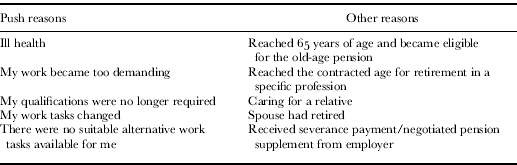
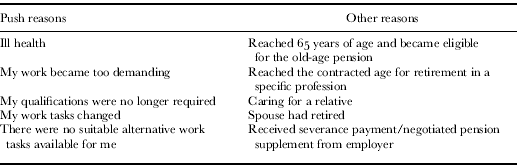
The dependent variable in this study, psychosocial wellbeing, was based on the responses to several questions, namely: ‘Have you often felt tired during the past two weeks?’ ‘Have you had sleeping problems?’ ‘Are you troubled with anxiety, uneasiness, or distress?’ ‘Have you felt unhappy and depressed?’ ‘Have you felt alone and deserted?’ ‘Have you felt that you are inferior and not appreciated as much as others?’ ‘Have you found it difficult to find something meaningful to do?’ Permitted responses were ‘yes’ (1) and ‘no’ (0). The responses to these questions were aggregated to constitute an index of psychosocial wellbeing, for which the higher the value, the poorer the respondent's wellbeing. Questions were also asked about the respondent's actual retirement age and their reasons for leaving work permanently. In most cases, the age of retirement coincided with the age of finally ceasing work (r=0.81). Some respondents, however, drew a pension while retaining some level of employment, and a few left the workforce without drawing a pension or any substitute social security benefits (this was extremely rare). The respondents were also asked to identify the significance of the various reasons as to why they left working life.Footnote 3 ‘Push-related’ reasons and ‘other’ reasons for the respondents leaving work were identified (see Table 1).
Push-related and other reasons for retirement, Sweden 2002–03
The PSAE questionnaire did not directly ask whether retirement was voluntary or involuntary. As a proxy for ‘voluntary’, we used a question about the level of influence over the retirement decision. This measure can be regarded as an indicator of individual control over the timing of retirement. The notion of ‘control’ is relevant since the decision to leave work for reasons beyond the individual's direction is closely linked to a perception that retirement is involuntary (Szinovacz and Davey Reference Szinovacz and Davey2005). Influence over the retirement transition was measured with the question: ‘To what extent were you personally able to influence the age when you actually stopped working?’ The responses were recorded as a continuous scale (0=no possibility, 10=high possibility). In line with the theoretical understanding that retirement adaptation is a protracted process during which wellbeing may vary, it is crucial to include a measure of the duration of retirement (Atchley Reference Atchley1976; Jæger and Holm Reference Jæger and Holm2004). This was computed by subtracting the respondent's age at retirement from the age at interview. The respondent's financial conditions were measured by asking whether, if unforeseen circumstances arose, s/he would be able to come up with 14,000 kronor (SEK) (€1,500) in cash within a week (yes/no). The position held in a previous job was indicated by the level of education (university, upper secondary school, comprehensive school). The social contact network was assessed with questions on whether the respondent had a close friend with whom they could discuss anything at all (yes/no), whether they had a partner or not and, if so, whether the partner was employed.
Results
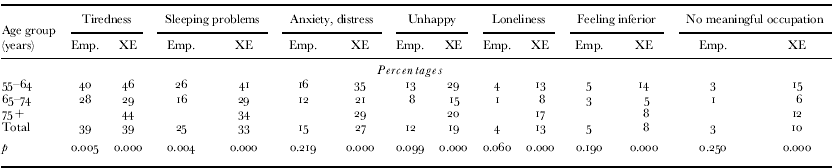
In this section, we describe the associations between wellbeing as a pensioner and both the reasons for retirement and the level of influence over the time for retirement. Table 2 presents the psychosocial wellbeing scores. Two patterns are apparent. First, those aged 55–64 years reported more negative psychosocial symptoms than those aged 65–74 years. The prevalence was higher in the oldest age group but overall not to the same level as for the youngest age group. Secondly, the reported prevalence of negative psychosocial symptoms was generally lower among people in employment than among those not in paid work. Relatively few reported feeling unhappy and depressed, alone and deserted, or inferior and not appreciated as much as others; similarly, few reported that they had trouble finding meaningful things to do. These indicators suggest that the oldest age group did not experience more psychosocial problems than those aged 55–64 years, and that overall those aged 65–74 years had the most positive psychosocial wellbeing. Because many in this age group had retired quite recently, it is tempting to suggest that retirement was a contributory cause, but those who were still working had even better psychosocial wellbeing. It is also important to keep in mind that those still in paid work were a heavily selected group and, in general, healthier and fitter than the average person of the same age.
Prevalence of psychosocial symptoms by whether in employment and age group
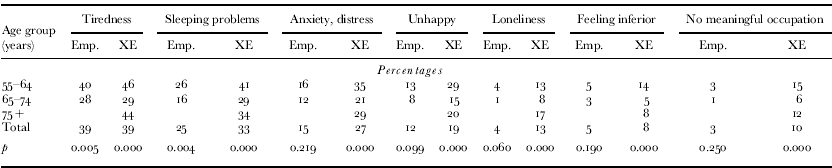
Notes: Emp: in paid employment. XE: not in paid employment.
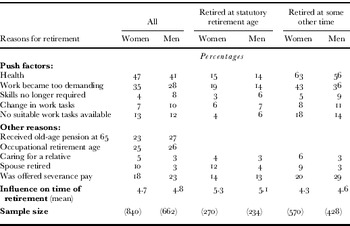
Table 3 presents the descriptive statistics of the reasons for retirement and the level of influence on the time of retirement. Since the reasons for retirement were closely linked to retirement age, those who retired at the statutory age were separated from those who retired at other times.Footnote 4 The results show that failing health was the most common reason for retirement, among both women (47%) and men (41%). As expected, this reason for retirement was much more common among those who had not retired at the normal pension age – the majority retired at an earlier age. Around 60 per cent of both the women and the men who had not retired at the normal age gave ill health as the reason. That work had become too demanding was another relatively common reason, and was also associated with early retirements. Retirement because work was overly demanding was slightly more common among women. Other reasons (skills no longer required, work tasks had changed, and suitable work tasks no longer available) also played a role and, in line with previous evidence, were more common among those who had retired before the normal age.
Reasons for retirement and level of influence over timing of retirement by gender and age of retirement, pensioners aged 55–74 years, Sweden 2002–03

Note: Statutory retirement age refers to receiving old-age pension at 65 years or to negotiated age of eligibility to an occupational pension.
The frequencies of ‘other reasons’ show that it was actually relatively unusual to leave working life because the age of either normal retirement age or that contracted for retirement in a specific profession had been attained. Overall, just under 40 per cent of the respondents gave any of these reasons for leaving working life.Footnote 5 Few gave ‘care of a relative’ as a reason, and it was more common for women than men to state that their spouse's retirement was a factor in their own retirement. Slightly fewer than 20 per cent of the women, and roughly 20 per cent of the men, maintained that the offer of a severance payment contributed to their decision to take retirement. Table 3 also shows the mean scores for the level of influence on the time of retirement (possible range 0–10). Not surprisingly, those who retired at an age other than the statutory retirement age reported less influence on the time of retirement than those who retired at the statutory retirement age. There were virtually no differences between men and women in this respect.
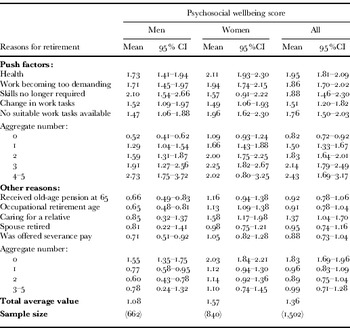
The next step was to study the associations between psychosocial wellbeing and the reasons for retirement. The results are presented in Table 4 for individual reasons and for the aggregate indexes of ‘push’ and ‘other’ reasons. Psychosocial wellbeing was measured using the seven-item index presented in Table 2. The index varied between ‘0’ and ‘7’; the higher the value the more psychosocial symptoms, and hence the lower the level of wellbeing. The hypothesis was that more push factors and low influence on retirement timing is associated with lower psychosocial wellbeing. Table 4 shows that the mean value on the psychosocial wellbeing index was 1.4 for all respondents, 1.6 for women, and 1.1 for men. Most push reasons for retirement were associated with relatively high mean scores, and poor psychosocial wellbeing was particularly associated with ill health, work having become too demanding, having skills that were no longer being required, and suitable work not being available. Moreover, the strong, significant relationship between poor wellbeing and retirement when the respondent's skills were entirely or partly no longer required was particular to men.
Psychosocial symptoms (mean value of total index) by different reasons for retirement and gender, Swedish pensioners aged 55–74 years

Note: CI confidence interval.
The relationship between the push factor index and the psychological wellbeing index was linear, i.e. the more push factors reported by an individual, the poorer his or her psychosocial wellbeing. The mean psychosocial symptom index value for pensioners who did not report any push factors (i.e. they reported solely ‘other reasons’) was 0.8, while the mean value for those who reported four or five push factors was 2.4. The association between the number of push factors and psychosocial wellbeing was stronger for men than women. It is also worth emphasising the substantial difference between men who reported no push factors and those who reported four or five. The mean values for the ‘other’ reasons were similar to or lower than the overall means, which indicates that these reasons had either a positive or no relationship with psychosocial wellbeing in retirement. In this case, there was no linear association between the retirement reasons index and the psychosocial wellbeing index. The mean values did, however, show that pensioners who reported one or more of these reasons experienced better wellbeing than those who reported none – this was the case for women and men. One explanation for these results is that those who reported no ‘other’ reasons necessarily will have reported push factor reasons.
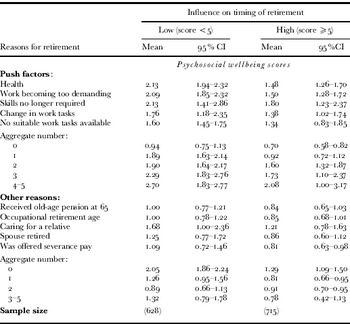
Table 5 presents the results for the association between the level of influence on the timing of retirement, reasons for retirement (individually and in the two aggregates used above) and psychosocial wellbeing. Scores for the level of influence on the timing (range 0–10) were dichotomised (‘low’ <5, ‘high’ ⩾5). There were roughly equal numbers in the two groups. This result shows clearly that wellbeing was conditioned by perceived control over the retirement decision. For each of the retirement reasons, relatively poor wellbeing was reported if the individual had low influence on the timing. Those who retired for health reasons, because work had become too demanding or because their skills were no longer required and had low influence on the timing reported the worst wellbeing. Also, the level of wellbeing worsened monotonically with the number of push factors among those who had both low and high influence on the timing, but the mean values were higher (lower wellbeing) among those with low influence. A similar pattern applied to those who retired for ‘other’ reasons. There was more poor health among those with low levels of influence on the retirement decision.
Psychosocial symptoms (mean value of total index) by different reasons for retirement and level of influence over the timing of retirement, pensioners aged 55–74 years, Sweden 2002–03

Note: CI confidence interval.
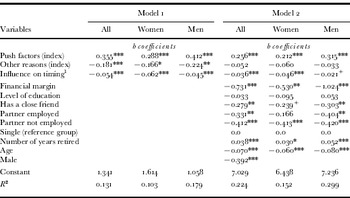
As discussed in the introduction, earlier research has shown that financial resources, previous position in working life, social status and state of health have much influence on whether retirement is experienced as positive or negative. To summarise the evidence from the PSAE data, a two-step multivariate linear regression analysis was carried out. First, we analysed the effects on retirement wellbeing of the contrasting reasons for retirement and of the level of influence on its timing. The push factors and psychosocial symptom indexes positively correlated; the more push factors reported, the greater the risk of psychosocial ill health after retirement (Table 6). Conversely, the ‘other reasons’ index negatively correlated with the psychosocial symptom index (and had a positive effect on wellbeing). As Table 4 shows, this association was not monotonic, but is evident when comparing those who gave at least one ‘other’ reason and those who gave none. The association was somewhat stronger for men than for women. Having significant influence over the time of retirement was also clearly related to positive wellbeing as a pensioner. All these associations were statistically significant.
Ordinary least squares regression of the index of psychosocial wellbeing of pensioners aged 55–74 years by reasons for and influence on the time of retirement controlling for other variables, Sweden 2002–03

Note: 1. Timing of retirement.
Significance levels: *** p<0.001, ** p<0.01, * p<0.05,+p<0.1.
The second step was to analyse the significance of these variables after controlling for other factors. The results are presented in the last three columns of Table 6, and show that the push factors remained significant when other factors were constant. The greater the number of push factors, the poorer was subsequent psychosocial wellbeing, particularly among men. On the other hand, ‘other’ reasons for retirement were no longer significantly associated with later wellbeing, but influence on the timing of retirement time was still highly significant, particularly among women. Lack of a financial margin (measured with a question about ability to come up with 14,000 SEK in cash within a week) was negatively related to psychosocial wellbeing, particularly for men. Level of education had no significant association with the dependent variable, and not having a close confidant was negatively associated with psychosocial wellbeing. Living alone increased the risk of psychosocial ill health compared to living with a partner, but among women this increase was only statistically significant for partners who were unemployed. The longer the duration of retirement, the poorer was wellbeing. Age negatively correlated with psychosocial ill health, signifying that older pensioners enjoyed relatively good wellbeing.
These effects are a little inconsistent and somewhat puzzling. One interpretation is that they are expressions of two different processes. First, the effect of the duration of retirement may reflect a selection effect. Those who had been retired for a long period or who retired relatively young probably did so because of severe health problems, which may have increased over time. Secondly, the effect of age might be the result of an adaptation process, which leads to improvements in general life satisfaction. To gain a better understanding of these intricacies, further analyses are needed. Table 6 finally shows that men were less likely to experience psychosocial ill health than women, even in the multivariate analysis.
Discussion and conclusions
This article has presented an analysis of the ways in which different reasons for retirement and the amount of influence on its timing were associated with subjective wellbeing as a pensioner. Given the increasing heterogeneity of the retirement process, this is a highly topical research question. The timing of and reasons for retirement have gradually fragmented and been de-institutionalised. As a consequence, public old-age pension schemes have declined as a universal institutional instrument for regulating the transition from work to retirement. From a general social welfare perspective, it is important to study the consequences of this development, especially since recent research suggests that the retirement transition may be experienced very differently by those with differing health, economic circumstances, social situations, prior labour market statuses, and not least retirement transition trajectories.
Substantial variation in psychosocial wellbeing between different groups of pensioners has been shown, much in line with previous findings. The general picture is that those who retired because of push factors, such as health problems or because their skills were no longer required, reported poorer wellbeing than those who retired for other reasons. Moreover, the results show that those who were able to influence the time of their retirement enjoyed better psychosocial wellbeing than those who had little or no such influence. Most of the associations were robust when controlling for other factors relevant to the wellbeing of pensioners. The results also lend support to the argument that, if retirement is instigated because one's skills are no longer required, there will be a decidedly negative effect on men's wellbeing – more so than for women. Both of our hypotheses were thus generally supported. Needless to say, it is difficult to determine causal relations and tendencies from cross-sectional data. For example, it is highly likely that among pensioners who reported push factors as reasons for retirement, and among those who had little or no influence on the timing, a component of the low level of psychosocial wellbeing arose from various health problems. Countering this, however, was the fact that the risk for poor psychosocial wellbeing in retirement rose with the number of reported push factors, even though health status was included in the index as one of the reasons. To investigate this further, it will be necessary to conduct longitudinal studies to control for psychosocial wellbeing before retirement.
The study has been able to analyse the wellbeing consequences of the retirement transition by many and various retirement reasons, including both push and pull factors and the neutral transition at the normal eligibility age for an old-age pension. This improves the coverage in the research literature of the great diversity of transitions to retirement. The findings emphasise that retirement is not a uniform phenomenon. The variation in psychosocial wellbeing, the importance of push factors and the role of the individual's control over the timing of the retirement decision underline the importance of striving for an improved understanding of the impact of increasing heterogeneity on the retirement decision process.