Introduction
The Arctic and high north are enjoying a renaissance. According to some observers, interest in the region's natural resources, not to mention the disputed borders, could take on a military aspect. As a former officer in the U.S. Coast Guard states, ‘[w]ithout U.S. leadership to help develop diplomatic solutions to competing claims and potential conflicts, the region could erupt in an armed mad dash for its resources’ (Borgerson Reference Borgerson2008). And writing in Time Magazine James Graff comments, ‘[j]ust as 150 years ago, when Russia and Britain fought for control of central Asia, it is tempting to think that—not on the steppe or dusty mountains but in the icy wastes of the frozen north—a new Great Game is afoot’ (Graff Reference Graff2007).
Given sentiments like these, one wonders whether words like ‘conflict’ and ‘dash’ present a true picture of developments in the high north. As the receding ice cap initiates a run for possession of whatever natural resources lie beneath the Arctic Ocean, will it bring us to the brink of a new cold war? Will unresolved legal issues and deteriorating foreign relations create the conditions for armed conflict instead of diplomatic resolution? Our objective in what follows, in light of the political realities and principles of international law, is to paint a balanced picture of security policy options in the Arctic waters.
A reconfigured security landscape?
The analysis concerns Norway, a small state, a NATO member, a country whose borders with Russia extend across land and water. As a foreign policy issue, the high north attracts a great deal of attention in Norway. Capitalising on the region's potential is something the Government intends to prioritise, according to its High north strategy of 2006. The three focal points are the Barents Sea as an energy province, the management of marine resources and improving relations with Russia.
We shall therefore place in context the challenges raised by these policy issues in terms of Norway's security. Insofar as Norway's jurisdictional reach and maritime borders have yet to be established entirely, we ask whether this circumstance could affect security policy. And despite Norway's geographic and thematic constraints, the findings of this study, it is believed, should also have relevance to other situations. Border and jurisdictional issues, and the use of maritime resources, including oil and gas, have implications for other waters within the Arctic circle.
Within this context we need to establish the security challenges facing Norway and whether Norway should fear a security policy crisis. Is there a real threat, and if there is, is it growing? Military activity has increased lately; Russia has resumed strategic bomber missions along the Norwegian coastline and conducted several naval exercises in the region (Norway, Ministry of Defence 2008). Russia has also adopted a harder verbal tone (Zysk Reference Zysk2008). The government is increasingly urged to make its military presence felt in the high north (Børresen Reference Børresen2005). The government has so far taken great care not to interpret Russian moves as an expression of direct pressure on Norway's interests. Things are only returning to their ‘normal state’, states the Government (Strøm-Erichsen Reference Strøm-Erichsen2007; Reference Strøm-Erichsen2008).
Nonetheless, changes in the high north are not without bearing on Norway's security. Indeed, the idea of security has wider connotations today, and it would be counter productive to limit a study of the rebirth of the high north to military tactics and strategies. Given then the principal examples of maritime borders and disputed lines of jurisdiction, we wish to explore what could be termed strategic interests, providing thereby a wider entry point to the study of security challenges in Norway's northern waters.
Particular issues can be addressed from a perspective of political strength as well as the international legal system. Several aspects of international law are in play here, chief among them being the bilateral demarcation of the continental shelf; the exclusive economic and fishery zones in the Barents Sea; and the system of marine resource stewardship in the waters around Svalbard. Second, Norway's foreign policy is related to power in a wider sense, insofar as continental Europe forms with the US the transatlantic dimension, and with Russia the apices of a triangle. We must therefore analyse security policy in the high north with reference to the real balance of power and to international law.
In what follows insights from legal studies and political science are integrated. By conducting an analysis at the crossroads of international law and politics, we hope it will be useful in areas of other issues and other geographical settings. At the same time, we want to draw a realistic picture of Norway's security challenges. The methodology integrates factors of importance to Norway's security, including military strategy, fisheries management practices and petroleum extraction in the Arctic waters, as we take a closer look at outstanding issues concerning unresolved areas of jurisdiction and demarcation lines. While we lack the space to pursue a detailed analysis of every individual issue under our terms of reference, we intend to substantiate our thesis that dispassionate diplomacy is more likely to resolve disputes than military confrontation, by way of examples.
Analytical perspective
Within the study of international politics, realism is a particularly hallowed tradition (Waltz Reference Waltz1979; Mearsheimer Reference Mearsheimer2001). To realists, the international community is virtually anarchic (Waltz Reference Waltz1979). States are the main stakeholders or players, and are motivated mainly to maximise their own security and influence. Driving the international system is the realisation that ‘[h]opes for peace will probably not be realized, because the great powers that shape the international system fear each other and compete for power as a result’ (Mearsheimer Reference Mearsheimer2001: xi). The very attitude makes the risk of military conflict and confrontation a key element of international relations.
A similar type of realpolitik is contained within the concept of geopolitics. Explained briefly, geopolitics sees politics, particularly power politics, as inextricably linked to geographical factors, including the resources of an area or region. The term was coined in the early 1900s, by political scientist and politician Rudolf Kjellén (Tunander Reference Tunander2008). It is an approach adopted in some relatively recent studies from Norway (Neumann Reference Neumann2002; Børresen 2004; Tunander Reference Tunander2008). In the empirical landscape studied in this article, with Norway at its centre, salient dimensions are the transatlantic, the continental European and the Russian. Norway is located between three different powers. This configuration has arguably a material and a cultural dimension, despite the classical entry point being the material dimension, that is the objective distribution of resources.
At a time when the notion of security is widening and threats are said to be global, geopolitics as a concept might strike some as being past its prime. On the other hand, it does help one to delimit a given analysis within a given field. Norway's triangular containment does not, however, tell the whole story. We could perhaps speak of a rectangle or even a pentagon. The conflict in the middle east and developments in Asia with China quickly moving into the top league of economic and military powers, affect Norwegian security and policy making (Norway, Ministry of Defence 2008). Challenges to Norway's security in the Arctic seas cannot be isolated from global reality. So while this contribution is unable to analyse all conceivable configurations likely to affect Norwegian risk perceptions, we can at least say, under the theoretical perspective drawn up here, that the division of global power, military and economic, will clearly inform security policy making for the northern expanses as well.
While realism is our starting point for this article, we do not reject other factors as salient variables. Nor do we accept the ontological and epistemological foundations of realism as a school, though we readily admit its importance as an interpretative lens through which to understand states’ behaviour in the international system. A narrow realpolitik point of entry will quickly prove wanting in respect of the issue areas in study here. A fuller picture of the security challenges in the Arctic seas not only requires consideration of strategic interests of importance to Norway and possibly to other foreign policy players, we also need to recognise the existence of an objective international legal code, international in the sense of applying to all foreign policy players, and objective insofar the past decades have seen significant progress in the law of the sea specifically.
The Arctic region does not suffer under a state of virtual anarchy, despite outward appearances, and states cannot claim rights to resources simply by planting flags in the sediment at the bottom of the sea. The Arctic Ocean is an ocean in which the rights and duties of states are reflected in international law. Issues affecting the polar regions may not have been at the top of the agenda when the United Nations Convention on the Law of the Sea (UNCLOS 1982) was negotiated into existence by the third UN conference on the law of the sea between 1973 and 1982 (UNCLOS III). The law of the sea convention itself, opened for signature in 1982 and ushered into force in 1994, makes no mention of the Arctic Ocean. However, article 234 of the convention, which regulates the right of coastal states to adopt and enforce non-discriminatory laws and regulations for the prevention, reduction and control of marine pollution from vessels in ice-covered areas, is often referred to as the ‘Arctic article’. While it is not limited to issues relating to the polar sea, the Arctic Ocean was clearly what the drafters had in mind, leaving no doubt that international consensus exists as to the question of the applicability of the law of the sea to all parts of the polar sea. As of today, the convention has been ratified by more than 150 states, including all Arctic coastal states apart from one, the US.
Unresolved jurisdictional and border issues in Norway's northern waters: what relevance for security policy?
Norway is more than a leading maritime nation. The law of the sea has turned Norway into a major coastal state with jurisdiction over about two million km2, six times Norway's territory. But the extent of Norway's jurisdiction and determination of maritime borders in the high north remain to some extent in dispute.
The Barents Sea
The Barents Sea has been one of the most important strategic areas in Europe. During the cold war, the seas north of Norway and Russia divided Europe between east and west, and between two military alliances. The North Atlantic Treaty Organisation (NATO) saw the Soviet Union's militarisation of the Barents Sea as a threat (Riste Reference Riste2005), and Murmansk remains to this day the home of the Russian northern fleet, located a mere hundred kilometres from the border with NATO member Norway.
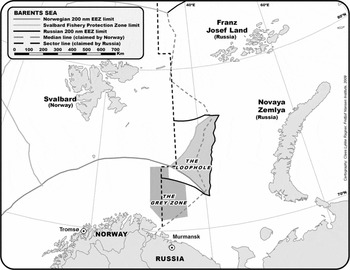
There is in particular one aspect of Norway's relations with Russia concerning the Barents Sea that seems to give Norwegian policy makers concern. Apart from an agreement signed in 1957, and updated in 2007, settling the boundary in the Varanger Fjord (Norway, Ministry of Foreign Affairs 2008), Norway and the Russian Federation have still to reach agreement on dividing the continental shelf between them and drawing up the boundaries of their respective exclusive economic/fishing zones (Fig. 1). Norwegian officials contacted the Soviet Union as far back as 1967 hoping to persuade them to enter into talks on the delimitation of the continental shelf. Both states are party to the 1958 Geneva Convention on the Continental Shelf (CCS 1958), and legislation in both refers to the ‘median line’ principle laid out in article 6 of the convention, requiring in the absence of an agreement and of ‘special circumstances’, that the border be drawn equidistant ‘from the nearest points of the baselines from which the breadth of the territorial sea of each State is measured’ (Norway, Act 2006; Rozakis Reference Rozakis and Bernhardt1989). The difference was, however, that the Norwegian Act lacked a reference to the ‘special circumstances’ criterion, and sowed thereby the seeds of the dispute. A corollary of this problem is the demarcation of waters and continental shelf between Svalbard and Zemlya Frantsa-Iosifa [Franz Josef Land].
Pending law of the sea issues in the Barents Sea.

The USSR referred to a number of ‘special circumstances’ that it maintained gave grounds for shifting the border westward. In addition to demographic, economic and security issues, the USSR relied on the so-called sector principle. According to Russian law, the principle is grounded in a decree issued by the Russian Empire to all allied states in 1916. The decree passed into law on 15 April 1926, and held that all ‘land and islands’ in the Arctic Ocean fell under Russian jurisdiction in a triangular wedge between 32 degrees east and 168 degrees west and ending at the North Pole (Dokumenty 1965). According to some earlier claims in Russian legal literature, Russian sovereignty extended to and included the waters of the Arctic, in addition to land (Korovin Reference Korovin1926). There are no grounds, on the other hand, for suggesting that Russia or the USSR ever officially perceived the borders of the Arctic sector as territorial borders. The sector's western demarcation line, however, has been subject of negotiations with Norway, and remains the basis of what is known as Russia's ‘sector demands’ in the Barents Sea.
Today, the 1982 Law of the Sea Convention provides the basis in international law for deciding where the disputed line between Norway and Russia should lie. Articles 74 and 83 of the convention contain, however, no reference either to the sector principle, median line, nor to special circumstances. By virtue of these provisions, states are instead encouraged to find an ‘equitable solution’. A purely legal approach to the demarcation dispute would therefore seem somewhat pointless, not least because Norway and Russia can in principle agree to draw the line wherever they want (constrained only by the rights of other states). But what ‘an equitable solution’ amounts to in practice is primarily a legal issue, and it is therefore of interest to explore official Norwegian and Russian perceptions on where the line should lie, particularly in light of recent court practice and the historical viewpoints to which either side sometimes appeal. Whether Norway and Russia will decide to compromise, or whether the dispute remains in limbo or is submitted for judicial examination, only time will tell.
Relevance to security policy
The Barents Sea has long been appreciated for its rich stocks of fish and catches here make up a significant share of the annual catches of both Russia and Norway (Hønneland Reference Hønneland2006). In January 1976, the Joint Norwegian—Russian Fisheries Commission met for the first time (Hønneland Reference Hønneland2006: 9). Norway and Russia/USSR have since managed important fish stocks in the bounteous Barents Sea. East—west tensions were high from the start, and indeed remained high until the end of the Cold War.
That notwithstanding, agreement was reached on quotas and how the fish stocks should be managed. The fish, apart from their economic significance, were largely excluded from security policy logic. And overall the collaboration has worked very well (Hønneland Reference Hønneland2006). The point in this connection is that sustainable bilateral management regimes were established and operated relatively smoothly also during times when security affairs were running at a high temperature.
It is essential therefore to remember that the various fields follow their own particular political logic. Although political scientists have widened the scope of the concept of security (Buzan and others Reference Buzan, Wæver and de Wilde1998: 23–24), it is not necessarily the case that it can be transferred to the concept of militarisation. There are exceptions, however. Disputes over the right to catch fish have brought the armed forces of respective countries head to head, even if the clashes never became overly antagonistic. Suffice it to mention the 1958–76 ‘cod wars’ between Iceland and the UK. That crisis culminated between 1973 and 1976 following Iceland's expansion of its territorial waters. The UK refused to recognise the new Icelandic border. Hostilities broke out involving both countries’ coastguard vessels (Jóhannesson Reference Jóhannesson2005). Fish were the food of high politics, although it is the exception that proves the rule.
Energy is a driving force of international relations. Secure and stable access to energy is vital to any state, and its security policy implications are, it goes without saying, enormous. The Barents Sea is no exception. The development and supply of whatever oil and gas the Barents Sea may hold are highly significant to Norway. That the Barents Sea may become a petroleum province is a firmly held belief among many. As a Newsweek commentary from 2007 remarked, ‘[t]oday [the Barents Sea] set to become Europe's energy Klondike, a last untapped pool of natural resources’ (Underhill Reference Underhill2007). This is a truth with modifications perhaps. More research is needed before we have a reliable idea of the energy resources in the Barents Sea, which could potentially be vast, on either side of the Norwegian—Russian border (Moe Reference Moe, Gottemoeller and Tamnes2008). All the same, the Norwegian Petroleum Directorate estimates that about 30% of all undiscovered and potential Norwegian resources lie in the Barents Sea (Norway, Ministry of Petroleum and Norwegian Petroleum Directorate 2008).
There are several different challenges here. First, the rights of states to access and utilise the resources need to be clarified. An assessment should be made of the extent to which collaboration in these areas could diminish the likelihood of disputes escalating into hostilities. In view of a realpolitik approach to the study of international relations, both issues are of paramount importance. States will seek to maintain or improve their position in the international system (Mearsheimer Reference Mearsheimer2001; Waltz Reference Waltz1979). Energy is an essential component in this sense. Norway is by and large a small actor on the international political stage. However, in certain areas, not least that of petroleum, Norway is comparable to a great power, especially on the technological front. What should being both a small political actor and having a leading capacity in energy and technology have to say with regard to Norwegian security policy in the north?
It is Norway's declared ambition to supply Russia with technology that it is hoped will facilitate the integration of the two states’ economies. According to the interdependence thesis, it would raise the conflict threshold (Keohane and Nye Reference Keohane and Nye1977).
Second, we find security challenges in connection with transport and supplies. Without discussing the terror dimension, there is one scenario, in which the Barents Sea figures as a future energy province, where a desire to sabotage supplies might lead individuals or groups to see the region as a likely target. In the current situation this is probably not very likely. According to the Norwegian Police Security Service's annual threat assessment for 2009, attacks of this nature are not considered to be very likely (Norway, Police Security Service 2009).
Of greater importance is what one could call the wider security challenges, connected especially with the danger of shipping accidents and oil spills. And here one should possibly concentrate more on international regulations and national capacity to search, save and contain: challenges which have a less narrow and classical relevance to defence policy. In a speech given on Iceland in January 2009 by NATO's General-Secretary Jaap de Hoop Scheffer, these were precisely the type of challenges he addressed (Scheffer 2009). The Norwegian defence establishment also gives these challenges much attention in the long term plans referred to above.
If there are extractable petroleum resources in areas adjacent to the border in the Barents Sea, Russia appears at any rate to have more time to spare than Norway. Oil from the Norwegian continental shelf in the Norwegian sea is expected to decline rapidly unless authorisation is given to start test drilling and production in other areas. The Barents Sea appears perhaps to Norway as the most promising area of seabed for these purposes. Russia, for its part, possesses enormous petroleum resources and numerous fields it can develop elsewhere. It lacks therefore the urgency to find a solution to the disputed area in the Barents Sea, and should therefore not be expected to enter into a final agreement on the maritime boundaries very soon. Nor is there any reason to believe Russia will moderate its demands with regard to where the demarcation lines should be drawn simply because it has substantial resources elsewhere. The desire to expand one's future power base is something desired instinctively by most states (Mearsheimer Reference Mearsheimer2001). Nevertheless, in concrete terms, and with a view to the challenges facing Norway and Russia with regard to the law of the sea in the Barents Sea, it is difficult to imagine them leading directly to military confrontation between the implicated states. The balance between military risk and political benefit would appear to make that sort of crisis very unlikely (Diesen Reference Diesen2007).
Here, of course, Norway's NATO membership could have significant effect. It is important also, that both Russia and Norway have probably much more to gain from letting the border dispute remain within the realms of foreign policy and diplomacy, with reference to the rule of international law enacted by the law of the sea convention and fleshed out by international legal practice. It is obviously difficult to see how a state in such a situation could distance itself from the political and legal ramifications of applying force to have the border disputed settled in a specific manner. Logically, practically and formally it is relatively inconceivable. Taking also into consideration the legal basis, that the demarcation of boundaries at sea and on the seabed require consensus and agreement on a right and proper demarcation line, or at least agreement to let the issue be decided by a court, there are far more apt and convenient options. One could, for instance, refuse to sit down and negotiate with one's opposite number. As far as the strategic military assessments are concerned, we do not of course mean to rule out the possibility of military action on all counts. We can envisage a form of ‘gunboat diplomacy’ that is a show of military power to achieve political rather than military ends. The essential point in this connection, however, is to make clear that the military tensions caused by the unresolved border between Russia and Norway have remained fairly insignificant. And while both have abstained from extracting the petroleum, the stewardship of the fisheries management of the inspection systems established under the Grey Area Agreement has performed satisfactorily (Hønneland Reference Hønneland2006). The evidence would seem to suggest that a solution will someday be achieved peaceably. As mentioned already, little would be gained from going down the military road anyway. Besides, domestic political pressure and one state's possible future need for urgent access to resources could easily affect the wording of the official demarcation agreement. But having to renounce one's demands in order to secure a faster solution is perhaps the main practical consequence.
A number of reasons serve to justify this conclusion. Economic interdependence raises the conflict threshold and there is generally a smoothly running management regime in place in the area. A military cost-benefit analysis would assess the use of military force to be counterproductive. And last but not least, whatever a state finds opportune to invoke in justification of its foreign policy depends largely on the premises set by international law. This is not then to say that we will never experience turbulence in the security policy arena, but one should be cautious about drawing conclusions about the security policy consequences without a detailed analysis of the actual potential for conflict, not least until one has clearly established the options in terms of different resolution models.
The waters and continental shelf around Svalbard
The Svalbard archipelago is inherently interesting due to its geostrategic location and rich natural resources of fish, coal and, possibly, petroleum. The 1920 Spitsbergen Treaty brought order to the question of sovereignty (Treaty 1920). According to article 1 of the treaty, Norway enjoys full and absolute sovereignty over Svalbard. The treaty's conception and geographical scope are nonetheless not entirely clear for all purposes. The current major legal issue concerns the question of if, and to what extent, Norway is entitled to claim sovereign rights over maritime areas, including the waters and seabed outside Svalbard's territorial waters. In its wording, the treaty applies only to the territory of Svalbard (including the islands named in article 1) and, in certain cases, adjacent ‘territorial waters’. Both the continental shelf and the economic zone are legal arrangements whose origin dates long after the signing of the treaty in 1920. The treaty therefore does not contain, naturally, explicit mention of these areas. For a detailed discussion of this topic, see Ulfstein (Reference Ulfstein1995).
Questions have therefore been raised in particular as to whether the provisions of the treaty on equal treatment of nationals of signatory states should apply offshore. Norway's official view is clearly that the treaty's equal treatment provisions do not apply on the continental shelf or adjacent waters. The writer who has supported Norway's official stance more than anyone is Carl August Fleischer, who has written voluminously on the subject (Fleischer Reference Fleischer1976: 7, Reference Fleischer1983: chapters 6–7). It has been said that the treaty cannot be applied in relation to legal concepts stemming from the modern law of the sea and which subsequently have acquired their own rules relating to resource management. The status of the waters around the islands’ territorial waters must be considered against the background of the provisions of the law of the sea, and one cannot apply the treaty's provisions on a presumption that the states would have widened the treaty's scope of application to the continental shelf and adjacent waters had they been aware of these legal arrangements in 1920. For the continental shelf on which Svalbard lies, there is the additional matter that it is a continuous shelf for which sovereignty over northern Norway provides justification (Fleischer Reference Fleischer1994: 112).
Certain Russian legal writers frame their arguments differently, and appear indeed to assume that the waters and shelf surrounding Svalbard constitute high seas and, presumably, part of the international seabed area respectively, and that fishing, for instance, and petroleum activity are subject only to the authority of the flag state (Vylegzhanin and Zilanov Reference Vylegzhanin and Zilanov2007: 57). To justify their argument, one would have to assume that long acknowledged rules and regulations on the right of all coastal states to adjacent maritime zones no longer apply, and that ‘Svalbard’ is considered a coastal state in its own right. This is problematic to say the least. Svalbard is part of Norway, and there is nothing, either in the treaty or the provisions of the law of the sea, to indicate that Norway may not establish maritime zones around the archipelago (Churchill and Ulfstein Reference Churchill and Ulfstein1992: 40). So far the issue has been solely of academic interest. First, there has been no petroleum activity on the continental shelf around Svalbard. Second, where the issue concerning the application of the treaty does have practical significance, in relation to the fishery resources, Norway has decided to establish a non-discriminatory fisheries protection zone. According to Norwegian law, prohibiting fishing by non-Norwegian nationals does not apply ‘for the time being’ in the fisheries protection zone (Norway, Royal Decree Reference Flock and Birger1977). Thus, Norway reserves its right to establish at some point in time an exclusive economic zone.
Relevance to security policy
Svalbard is problematic for Norwegian politicians not only regarding the interpretation of the treaty in light of contemporary developments under the law of the sea; there are a number of foreign and security policy challenges as well. After nearly twenty years of policing the fisheries protection zone with no little flexibility, the Norwegian coastguard seized an Icelandic fishing vessel in 1994. The reason being that the vessel belonged to a state without fishing quotas in the Barents Sea. In 2001, the coastguard for the first time flexed its muscles and seized a Russian trawler in the zone. Practice up to then was modelled on the so-called ‘lenient policing’ approach. Russia despatched the cruiser Severomorsk to the zone, in what it regarded as a measured response (Jørgensen Reference Jørgensen2004). The temperature rose again in autumn 2005 when the Norwegians attempted to seize a trawler, Elektron, for violating fishery regulations and two Norwegian coastguard officers were ‘kidnapped’ by the trawler's skipper. The incident was resolved peaceably, but the Russians felt they had been treated unfairly and saw the Norwegian coastguard as an aggressive actor.
In this analysis, sovereignty over Svalbard itself is not the subject of discussion. We could possibly be accused of skirting the issue by restricting our focus to security policy challenges associated with the adjacent waters insofar as the issues affecting Svalbard's territory and territorial waters could be said to be part of the same political context. All the same, it is issues concerning the management regime for the waters and continental shelf beyond the territorial waters around the archipelago that in terms of foreign policy and legal uncertainty have created most tension, and therefore will claim our attention below.
The key questions in terms of security policy are first whether controversies and disputes over the fisheries management regime around Svalbard could escalate and second whether these issues are likely to have an impact in terms of security policy. We maintain our assumption that the potential for conflict described above, and which so far has been practical in nature, that is the extraction of fishery resources, will in most situations find a peaceful resolution. And as many would doubtless agree, the two incidents mentioned above (the seizure in 2001 and attempted seizure in 2005), despite the heat and flurry of the moment, are more symptomatic of ‘low politics’. They were resolved via other channels than conventional military means. In a scenario in which a coastguard boards a Russian trawler and is met with armed opposition, the situation would obviously be of another calibre. In the two incidents referred to above some very sharp words fell between the countries, and situations like this are clearly damaging to diplomatic relations and channels between Norway and Russia. That such incidents could escalate to a large scale military confrontation is nevertheless not very likely.
The logic is similar with regard to whatever resources might lay concealed on the shelf around the archipelago. The seabed's substratum around Svalbard is presumed to contain oil or gas, albeit to an unknown extent. Were a Russian company inclined to extract petroleum from the Svalbard shelf and believe it could go ahead without regard to Norwegian regulations, Norwegian authorities would naturally take an opposing view of it. Justification would have to stem from a logic according to which one assumes that the continental shelf around Svalbard is an area ‘void of authority’ and that the coastal state involved (Norway) had absolutely no jurisdiction over the area. If this were to happen with the approval of the sender state (Russia or others), one would be facing a security policy challenge, or at least a situation with likely consequences for foreign policy.
The main point, nonetheless, is that the fallout tends to be limited. Although it has no substantive legal significance, Russia's ‘disagreement’ with Norway on the status of the maritime areas around Svalbard is interesting in itself from a security policy perspective. It is important to realise here, all the same, that the unresolved jurisdictional issues under discussion can best be described as remnants under the wider aegis of the law of the sea. Most of the pieces of the puzzle are already in place. Enormous ocean areas that used to belong to the more or less unregulated regime of the high seas are now subject to a tightly woven jurisdictional fabric which gives the coastal state responsibility for their management, but such that other states may enjoy their own rights without let or hindrance. The advances in international law to the present moment, in which both Norway and Russia played important parts, reflect a common appreciation of the need to create effective national regulatory mechanisms in coastal waters where most of the maritime activity takes place and where ecosystems are daily exposed to risk. Against this background, and remembering that there is almost universal support among the nations of the world for this as the best way of managing coastal waters, the security policy perspective with regard to Svalbard's maritime areas should be set out. It would be reasonable to expect the law of the sea to stabilise relations between industrialised states, particularly since these, at least formally, share a basic understanding of the need for regulation and effective control, and not least how this can best be achieved in practice.
A kindred argument concerns the nature and scope of the material rights and obligations in question. When discussion focuses on maritime areas subject to national jurisdiction, we are talking legally about a limited form of rights enjoyment. The practical and economic ramifications of a coastal state's exclusive right to, for instance, petroleum resources and fish should not be underestimated, of course. But having said that it is important to note that Norway's fisheries zone, economic zone or continental shelf are ‘Norwegian’ only in the sense prescribed by the material provisions set forth under the rule of international law. That is, Norway has positively defined rights and duties. When, for example, a ship steers out of Norway's economic zone and into Russia's economic zone, crossing a hypothetical maritime demarcation line in the Barents Sea, it is not travelling from ‘Norway’ to ‘Russia’. It transplants itself from a stretch of water over which Norway enjoys jurisdiction to a stretch of water over which Russia enjoys similar authority. With the exception of the territorial waters of coastal states, it is therefore in fact incorrect to speak of any state's sovereignty over the seabed or the water column above it, around Svalbard, in the Arctic Ocean or any other water.
This type of dogmatic legal approach notwithstanding, the general view, which obviously must be considered of greater importance to a security policy analysis than a legal scrutiny, tends to be that Norway's fisheries zone around Svalbard, for instance, is Norwegian ‘territory’. The significance of a tenable foreign policy approach is precisely for this reason no less central. It would clearly be in the interest of both Norway and other states to clarify what is meant by having formal jurisdiction over a continental shelf or enjoying a right to manage the fisheries in a certain part of the sea. In that sense, the meeting on Greenland in May 2008, at which the Arctic coastal states met to discuss the legal status of the Arctic Ocean, bore witness to a viable approach based on international law to issues of current or future importance with regard to Arctic waters (Illuisat Declaration 2008). While the law of the sea is not currently considered sufficient to every situation, there was agreement nevertheless at high political level that one already had a basic starting point in international law and that the concerns which once propelled work on a new international legal system for the world's oceans at the end of the 1960s still provide a solid foundation for how both regional and non-regional actors should approach the challenges in the high north.
A legal clarification could in that sense also serve as a security policy strategy for Norway as much as for other states. There is reason to believe that it would profit the interests of all states, the signatories of the Spitsbergen Treaty especially, to establish some form of regulatory mechanism over activities in the waters around the archipelago. As a starting point, an appreciation of the substantive legal problems, not whether Norway has jurisdiction but how it should be exercised, could as a practical step help offset some of the tensions and potentials for conflict. All the same, it has to be pressed home that this is not a legal or foreign policy issue. It has both a legal and a political aspect. Which brings us to another factor, one which adds to the complexity of the Svalbard problem: there is no cohesive group of foreign policy actors. What we have is a cluster of states whose interests converge and diverge interchangeably according to the policy field in question. We find, therefore, an irregular patchwork of ‘alliances’, which in itself can be problematic. But it can make Norway seem more ‘isolated’ in certain questions. The challenges raised by the Svalbard question would therefore seem to be more involved and extensive than simply how to find a solution to a disputed area. Our thesis is again, however, that irrespective of whether practical politics, realpolitik, informs our analysis or we take a more dogmatic legal approach, a serious security policy analysis is timely and appropriate.
Concluding remarks
The foreign policy challenges facing Norway in the north should also be approached in light of international law, rather more so than attending to the general discourse would suggest. A purely realpolitik approach to these issues, that relations between states are to be determined by their respective strengths, is more than simply inadequate. As a methodological approach it may be useful for analysing the strength and capacity of ‘great powers’ and ‘small states’, but the balance between might and right and might and politics is, after all, slightly more complicated. First, international law is key to what a state may find opportune to invoke to further its foreign policy objectives. Second, there is no obvious contradiction between what is called the self-interest of a nation state and its duties under international law. Basically, we need a realistic idea of what international law is and what it seeks to achieve. But as important in this context is to remember that many of the factors that are often said to represent security policy challenges to Norway in the high north are already regulated under sections of an international legal order which most states find it to their benefit to observe.
Given an analysis based entirely on realpolitik, it is difficult to image the challenges, linked to opposing interests, outlined in this text escalating into a military crisis. States, even if limited in terms of rationality, will balance political gains against military risk. It would be counterproductive for a state to use excessive force to achieve limited political ends. Which is not to say it is of no relevance to security policy in the high north, but at the moment of writing, disputes are more likely to be resolved peacefully than by military means. The purpose here has been to show that a fruitful analysis of security policy challenges in the north must rest both on an insight into the international legal framework on which co-existence in the region rests and a sober realpolitik analysis of the cost and benefit of deploying military tactics. A description of the situation as ‘an armed mad dash for resources’ seems both rather disingenuous and overdrawn, but perhaps most important, it is also divorced from the specific contexts of foreign policy and international law.