Thomas Hardy noted regretfully: “Few literary critics discern the solidarity of all the arts” (Florence Hardy 300). An architect self-educated in art history by visits to London museums, an avid reader of John Ruskin, keenly alive to music and responsive to the ornamental sculpture and painting of Gothic buildings, Hardy believed in a composite muse. After ceasing to write novels, in which he had included numerous painterly allusions and references to specific art works, he overtly probed the image/text relation in his 1898 debut volume of poetry: Wessex Poems and Other Verses, by Thomas Hardy, with 30 Illustrations by the Author. Although a reading experience dependent upon the original aesthetic interplay that Hardy had designed was destroyed in most subsequent printings, the first edition's partnership of image and text remains absolutely central to the book's multiple meanings. Indeed, Hardy's images and words should be regarded as inseparable, since they interact in what W. J. T. Mitchell has called a “composite art form” (83, 89).
Analyzing interactions between image and text, I shall argue, can allow us to read Wessex Poems in four related ways: as a response to Thomas Gray's “Elegy Written in a Country Church-Yard,” as part of Hardy's continuing exposé of Romanticism, as a linguistic archaeology that extracts lost meanings of words, and as a challenge to habitual reading patterns. Relying on Hardy's original sketches, housed in the Birmingham Museums and Art Gallery, the volume's first editions (UK and USA), and on the history of its illustrations, this essay opens with an examination of the book's frontispiece and its partner poem before exploring three other text/image pairings. Each pair delves into the topics of love and religion. Through their composite art Hardy tries to free lyric poetry from the subjective expressivity and idealism of many of his Romantic predecessors and Victorian contemporaries. The essay concludes with a look at the volume's final poem, suggesting that it is deliberately left un-illustrated.
To receive full justice, the intricacies of Wessex Poems would demand a book-length study. Consequently, this discussion can neither consider more than a few pairings, nor account for the position in the text of any items other than the frontispiece illustration and the final poem. Because Hardy insists on the uniqueness of each moment of experience, it would be falsely simplifying, as J. Hillis Miller warned twenty-five years ago, to advance a grand interpretive pattern based either on likenesses or differences among the poems or on their placement (270). Indeed, the “Apology” that Hardy appended to his 1922 Late Lyrics and Earlier suggests that his mixture of tones and his juxtaposition of discrepant styles, moods, subjects, meters, forms, formats, and genres is designed, purposefully, to jar the reader:
. . . there is a contingency liable to miscellanies of verse that I have never seen mentioned, so far as I can remember; I mean the chance little shocks that may be caused over a book of various character like the present and its predecessors by the juxtaposition of unrelated, even discordant, effusions; poems perhaps years apart in the making, yet facing each other. An odd result of this has been that dramatic anecdotes of a satirical and humorous intention following verse in graver voice, have been read as misfires because they raise the smile they were intended to raise, the journalist, deaf to the sudden change of key, being unconscious that he is laughing with the author and not at him. (Hardy, Complete Poems 559)
Hardy invites readers, then, to appreciate a deliberate unevenness. The “little shocks” Hardy creates in Wessex Poems may result from his tendency to have earlier-written and more recent verbal texts face each other. Yet the added “facing” of image and text in this particular volume creates a reading process that is far more radical in its disruptiveness. Unlike Hardy's header and footer illustrations, many of his full-page drawings, though sketched horizontally, are printed vertically and thus need to be tilted sideways before they can be fully examined. He thus creates a viewing process that matches the disorientation he establishes in the reading process. For, in the verbal text, Hardy's diction persistently interrupts our normal habits of reading lyrics. He forces us to stop and excavate meanings buried in archaic, obsolete, or compound words, reminding us that language not only expresses individual thought, but also belongs to a collective, historical, living, and dying medium. Hardy thus ruptures an emotional identification with his speaker and shows us that language can act as a barrier as well as a gateway to communication. His composite art opens cognitive spaces in which thought can repeatedly invade feeling.
The publication and reception history of the original Wessex Poems and Other Verses provides a necessary context for understanding its image/text format. Although the publisher's advertisements mentioned thirty illustrations, the frontispiece made a total of thirty-one. Unlike Hardy's final novel, The Well-Beloved (1897), which sold out its first run of 2,000 copies in two weeks, the small run of 500 copies of Wessex Poems sold slowly. The composition of the contents spanned many years. Since some twenty poems were written or drafted in the 1860s and a further eight were composed in the next decade, only twenty-one to twenty-three were actually written in the 1890s (Johnson 15–16). Yet the addition of drawings came later still, not until Hardy was selecting and editing poems for inclusion. The autobiographical Life and Work of Thomas Hardy records February 4, 1897 as yielding a first subtitle to the book, “With Sketches of their Scenes by the Author.” Hardy's letters further indicate that he drew the pen and ink illustrations during the summer and early autumn of 1898. At the end of August he described his activity to Florence Henniker as “a mysterious occupation I have been amusing myself with lately” (Letters 2: 199). In unsurprisingly mixed notices of the volume, most reviewers paid little to no attention to the illustrations, although among the few who did mention them, the strongest praise came from Arthur Quiller-Couch, who lauded their “intrinsic beauty” and claimed that they were “packed with meaning” (756).
The full publication history of Wessex Poems, however, was not detailed until the mid-late 1990s by Trevor Johnson and Pamela Dalziel. In their separate evaluations, both critics stress Hardy's self-deprecating remarks about the volume and his deep anxiety about readers’ hostility to his apparently new craft of poetry. Both note that he offered to defray all costs for reproduction of the book, an offer the publisher refused. Both observe that no reprint of the volume was needed until 1903; yet Dalziel also reveals that the illustrations were generally, though not uniformly, reversed in orientation in this reprinted edition. Where some illustrations had faced inwards towards the poems, for instance, they now faced outwards, away from the text, thus disturbing “whatever interplay Hardy had presumably sought to achieve in the volume as a whole” (Dalziel, “Drawings” 395). While in the early twentieth century the illustrations were still available in the Uniform edition and in the Pocket edition of 1907, albeit in reduced and unclear form, they were dropped altogether in 1912 when Wessex Poems was incorporated into Macmillan's new “Wessex Edition” of Hardy's complete works. But why?
Pamela Dalziel alone has argued that Hardy's seeming diffidence toward the drawings masked his actual fondness for them (“Drawings” 399–400). While it had generally been assumed that Hardy had no particular investment in retaining the illustrations, a self-addressed envelope with a September 1926 postmark, unlisted by Richard Little Purdy in his Thomas Hardy: A Bibliographical Study (1954), but discovered by Dalziel in the Dorset County Museum, tells another story. On the envelope, Hardy had written “Illustrations to Wessex Poems (from proofs),” yet Dalziel deduces that the drawings were, “removed not from proofs but from a copy of a published edition,” and had been through printers hands as “setting copy for a new edition” (“Drawings” 398). Identifying that edition as the 1912 Wessex Edition, Dalziel believes that Hardy's “intention” was to retain the drawings as illustrations and that his “hesitation to insist on their inclusion” in 1912 was due to the insistence of Frederick Macmillan (“Drawings” 398; 397). In a key letter, Macmillan points out that illustrations would look “a little odd” (MS qtd. in Dalziel, “Drawings” 398–99) in the 1912 volume, since Wessex Poems would now be bound with Poems of the Past and Present. Hence Dalziel deduces that Frederick Macmillan did not find the illustrations “intrinsic to the reading of the individual poems or to the integrity of the volume as a whole” (“Drawings” 399).
Significantly, Hardy did not give in easily to Macmillan's insistence; he wrote back to say that he wanted “subscribers” and “the question of sale to decide the matter” (Hardy qtd. in Dalziel, “Drawings” 399). While it is true that he originally told Macmillan he was indifferent to their reproduction, because it might be difficult to borrow the originals he had donated to the Birmingham Museum only a year before, it seems he expected them to remain as an integral part of his composite text. Yet pressure to the contrary persisted from his publishers. The illustrations were omitted from the Wessex Edition on the advice of Maurice Macmillan, who wrote in October of 1912: “as the originals are not in your possession, we advise leaving them out” (Macmillan qtd. in Dalziel, “Drawings” 399). One month later, Emma Hardy died and Thomas Hardy had other things on his mind. Between 1898 and 1912, moreover, he had published three other volumes of poetry without illustrations: Poems of the Past and Present (1901), The Man He Killed (1902), and Time's Laughingstocks and Other Verses (1909). No longer anxiously transitioning from novel-writing to poetry, but firmly established as a published poet, he did not insist on reprinting the illustrations to Wessex Poems.
Though available to readers in different formats and positioning in the smaller editions, the illustrations did not appear in most subsequent editions of Hardy's poetry. Even in Samuel Hynes's magisterial The Complete Poetical Works of Thomas Hardy, the drawings, wherever included, are reduced by half or enlarged by a third and repositioned. While two facsimile editions of Wessex Poems now do exist, one is flawed in its positioning and orientation of the illustrations and the other offers a less sharp imprint than the original. Unlike J. B. Bullen, I do not read the illustrations as “commentary” (18) on the poetry, but as an integral part of the primary text. Whether or not we care about Hardy's intentions or predilections or about trying to psychologize the motives for his not reprinting his drawings, the original layout deserves a close look.
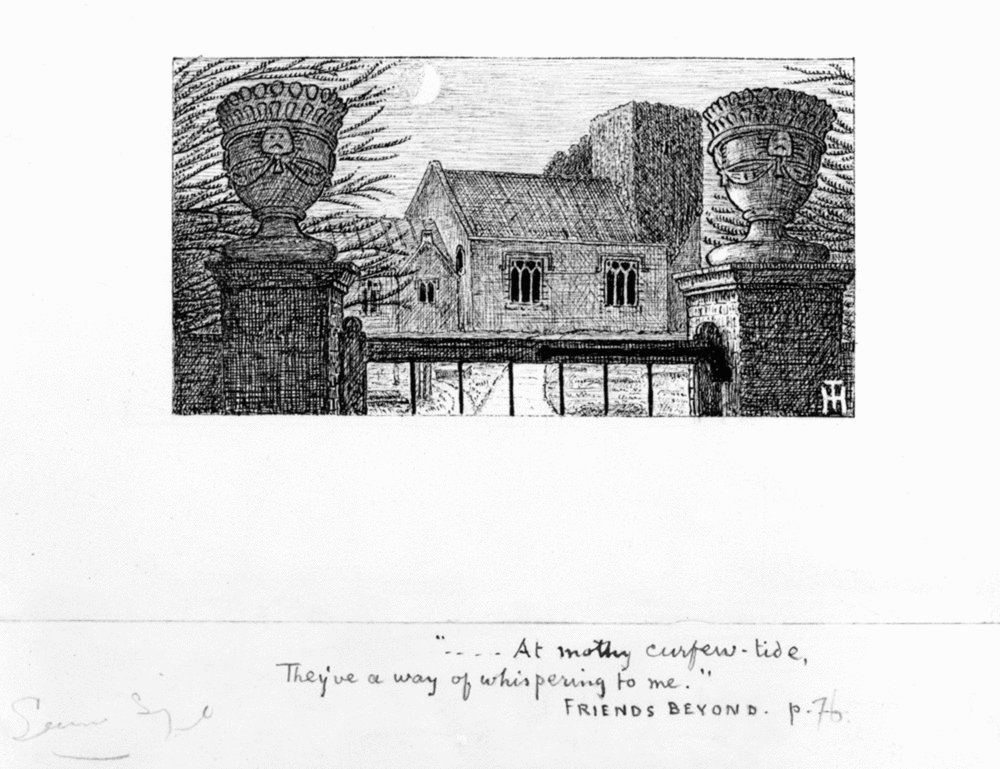
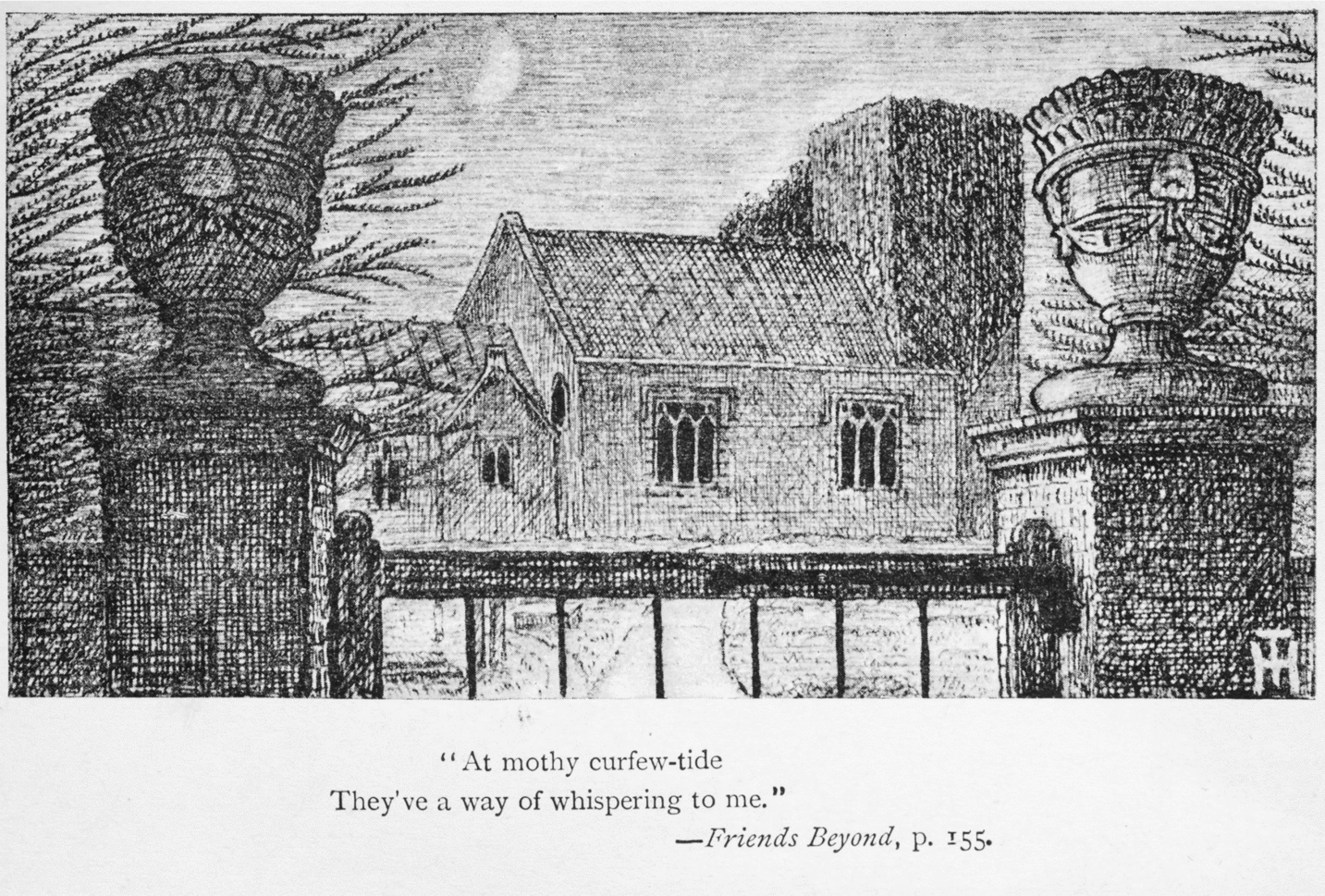
The deeply suggestive frontispiece to Wessex Poems (Figures 14 drawing and 15) of Stinsford Church and its cemetery, viewed from the near side of its gate, not only establishes a dark, serious tone, but also serves as a literal and figurative entryway into the volume. Stinsford, Hardy's Gothic parish church, dating from the thirteenth century, was one of his favorite spots near Dorchester. In 1898, its graveyard housed the remains of his paternal grandparents, his parents, other relatives, and neighbors. Despite the imaged graveyard's strong family connections, however, his representation is not merely personal.
Thomas Hardy, drawing of frontispiece for Wessex Poems, “‘. . . . At mothy curfew-tide,/ They've a way of whispering to me.’ FRIENDS BEYOND. p.76.” Courtesy of Birmingham Museums and Art Gallery.

Thomas Hardy, Wessex Poems and Other Verses (London and New York: Harper & Brothers, 1898), frontispiece after Hardy's drawing, “‘. . . At mothy curfew-tide,/ They've a way of whispering to me.’—Friends Beyond, p.155.” Courtesy of Bayne Stanley (Pamela Dalziel Collection).
The frontispiece immediately references graveyard poetry and another parish churchyard, specifically that of Thomas Gray's “Elegy Written in a Country Church-Yard” of 1751.Footnote 1 With multiple allusions to Chaucer, Shakespeare, Milton, Drayton, and to more recent poets, such as Akenside and Collins, Gray's “Elegy” about poetic fame served, in part, as a memorial to and a gravesite for earlier poets. Hardy would first have encountered it in Palgrave's anthology The Golden Treasury published in 1862, and a gift to him in January of that year from Horace Moule. This volume fueled Hardy's ambitions to become a great poet. He yearned to write poems that would have been included in The Golden Treasury, poems that would have been loved and memorized, just as he had memorized Gray (Taylor, “Poet's Currency” 454). Later in life, Hardy connected Stinsford explicitly to the rural churchyard of Gray's elegy and grave: Stoke Poges. When his secretary mentioned Stinsford as a “Gray's Elegy sort of place,” Hardy replied “It is Stoke Poges” (Taylor, “Poet's Currency” 455). In this larger sense, then, Wessex Poems conflates a dead personal past with the rural burial ground of earlier English poetry.
The Stinsford churchyard illustration that opens Wessex Poems (Figure 15) shows a gate that is half-imaged, and notably, shut. We do not stand in the cemetery communing with the dead; nor do we wend our way down the white path towards the church to pray or sing hymns. Instead, we remain in the world of the living looking in at graves and the church building. Two gatepost funerary urns bear the mask of tragedy. The masks’ downturned mouths may indicate the serious tone of many of the poems to come, but they also capture feelings evoked in prior elegiac poetry that Hardy's volume is about to complicate. Furthermore, the masks’ presence anticipates Hardy's description in his Preface to Wessex Poems of the type of poetry to come. The Preface states that his verses are “in a large degree dramatic or personative in conception; and this even when they are not obviously so” (Hardy, Complete Poems 6). By “personative” Hardy means dramatic, as in dramatic lyric. In other words, the poet too, like each urn, is wearing a dramatic mask, a further barrier to a direct emotional connection between speaker and audience.
The caption for the frontispiece playfully directs the reader to the page number of “FRIENDS BEYOND,” a poem paired with the frontispiece, literally buried almost two thirds of the way through the volume. Hardy thus asks us to dig for the fuller set of meanings and associations that the poem can provide. We are lured into a trap. Expecting a sentimental relationship to departed souls, we discover, instead, a jolly chorus of ghosts who celebrate the gap that, at long last, separates them from the living. Of course, if the reader does not immediately turn to the poem, she may be misled by the emotional implications of its title and by the caption that conjoins two separate lines: “At mothy curfew-tide / They've a way of whispering to me” (“Friends Beyond,” lines 8, 11).Footnote 2 Tricking us into expecting ghostly whispers that lovingly single out a speaker wandering among nocturnal moths, Hardy hints, through his choice of “mothy” (line 8), at the possibility of a contrary reading. Nectar-feeding moths, gracefully fluttering at twilight, would romanticize the moth-eaten, ragged, materiality of human decay.
The caption phrase “At mothy curfew-tide” (line 8) also revises the first line of Gray's “Elegy Written in a Country Church-Yard”: “The Curfew tolls the bell of parting day.” Hardy's “curfew-tide” means an end-of-day tiding, or piece of news, as well as a time of day. The piece of news here, though, does not involve some spiritual communication from those buried in the rural churchyard, but rather a manifesto that challenges Gray's quietism and Romantic idealization. Significantly, Hardy did not coin the hyphenated word “curfew-tide.” It both echoes and, at once, punctures a pastoral, sentimental 1894 poem by S. Cornish Watkins from Chamber's Journal reprinted in Littel's Living Age and in The Christian Work entitled: “Curfew-Tide.” This derivative popular poem features in smooth and consoling rhymes a common conjunction of day's ending, death, and ascent to heavenly “realms of rest” (Watkins, line 31), a conjunction that Hardy questions.
By invoking Thomas Gray's “Elegy” in his frontispiece illustration of Stinsford churchyard, in the caption word “curfew,” and in the companion poem “FRIENDS BEYOND,” Hardy establishes a highly complicated web of connections. Part pastoral, part graveyard poetry, part elegy, part meditation on a poet's legacy, “Elegy Written in a Country Church-Yard,” as Anne Williams reads it, contains two narratives: the lives and deaths of anonymous villagers who may have included “some Mute inglorious Milton” (Gray, line 59) and the life and death of the obscure and anonymous poet whose own epitaph concludes the poem (Williams 117–18). Looking at the memorial stones in the village cemetery, Gray's speaker – himself a poet – recognizes that even those whose destiny is “obscure” (line 30) yearn to be remembered with the “passing tribute of a sigh” (line 80). Death, he concludes, equalizes the lives of the famous and the unknown, while the “Curfew” (line 1) that “leaves the world to darkness and to me” (line 4) finally erases all selfhood.
Hardy's paired poem “FRIENDS BEYOND” rewrites Gray's “Elegy” by puncturing any sentimental construction of mourning and by demolishing the sense that the dead care about anything at all after death. It is what Diana Fuss terms a “corpse poem” (1), or perhaps even a skeleton poem, spoken first by a narrator but then by the individual dead. Rhymed in the aba, bcb terza rima rhythm of The Divine Comedy, yet also echoing Chaucer, Milton, Byron, and Shelley, the poem has a lilting, almost comic tone. Hardy's speaker opens with a roll-call: “William Dewey, Tranter Reuben, Farmer Ledlow late at plough, / Robert's kin, and John's, and Ned's, / And the Squire, and Lady Susan, lie in Mellstock churchyard now!” (“Friends Beyond,” lines 1–3). The next stanza seems definitive: “‘Gone,’ I call them, gone for good” (line 4). Yet the “I call them” (line 4) also means: I call to them although they are gone. And sure enough, “At mothy curfew-tide,” they find “a way of whispering back to me” (lines 5, 7). Unlike a Keatsian nightingale, or even a Romantic glow-worm, however, these night-flutterers merely whisper that they are happy to be dead. They do not reinforce connection, or transcendence, but, like the closed gate in the paired drawing, establish an absolute affective separation from the living. Moreover, the fact that the speaker names and knows them, unlike Gray's anonymous dead, intensifies the irony. “‘We have triumphed’” (“Friends Beyond,” line 10) they whisper. We are free at last, they say, free of earthly stress, of clothing, of eating, even of the fear of death (“Friends Beyond,” see lines 13–15). Then, speaking individually, in turn, they gleefully give away all that ties them to the living – from violin to spouse to children's memories – and, in unison, declare their lack of interest in life above the grave. The poem turns back to a narrator for whom the whispers have blended into a single murmur.
Instead of asking the reader to join a lonely wanderer among the graves of the “unhonoured dead” (Gray, line 93) Hardy's frontispiece and “FRIENDS BEYOND” create imaged barriers and verbal interruptions that alter the traditional notions of communion with the departed. In its subversions of Gray's “Elegy” and the sentimental cult of the dead, Wessex Poems also mutilates any sort of stately progression of narrative content or of linked lyric form. It thus refuses the ordering and content of a poem such as William Wordworth's 1814 The Excursion with its progression through a graveyard and its characterization of a Pastor who explains the life stories of his buried parishioners (Wordsworth, Books 5–8). Similarly, Wessex Poems repudiates Alfred Tennyson's 1850 In Memoriam, A. H. H. where linked lyrics act as “stepping stones” (Tennyson, line 3) to a rather frail, if definitely asserted, Christian faith. Later confirming to Edmund Gosse that he had rejected sentimental poetry and wanted to avoid conventional uses of language, what he called the “jewelled line,” (Hardy to Gosse, qtd. in Millgate, Selected 321; and see Gosse in Cox 446), Hardy strips his volume of all the expected trappings of elegy.
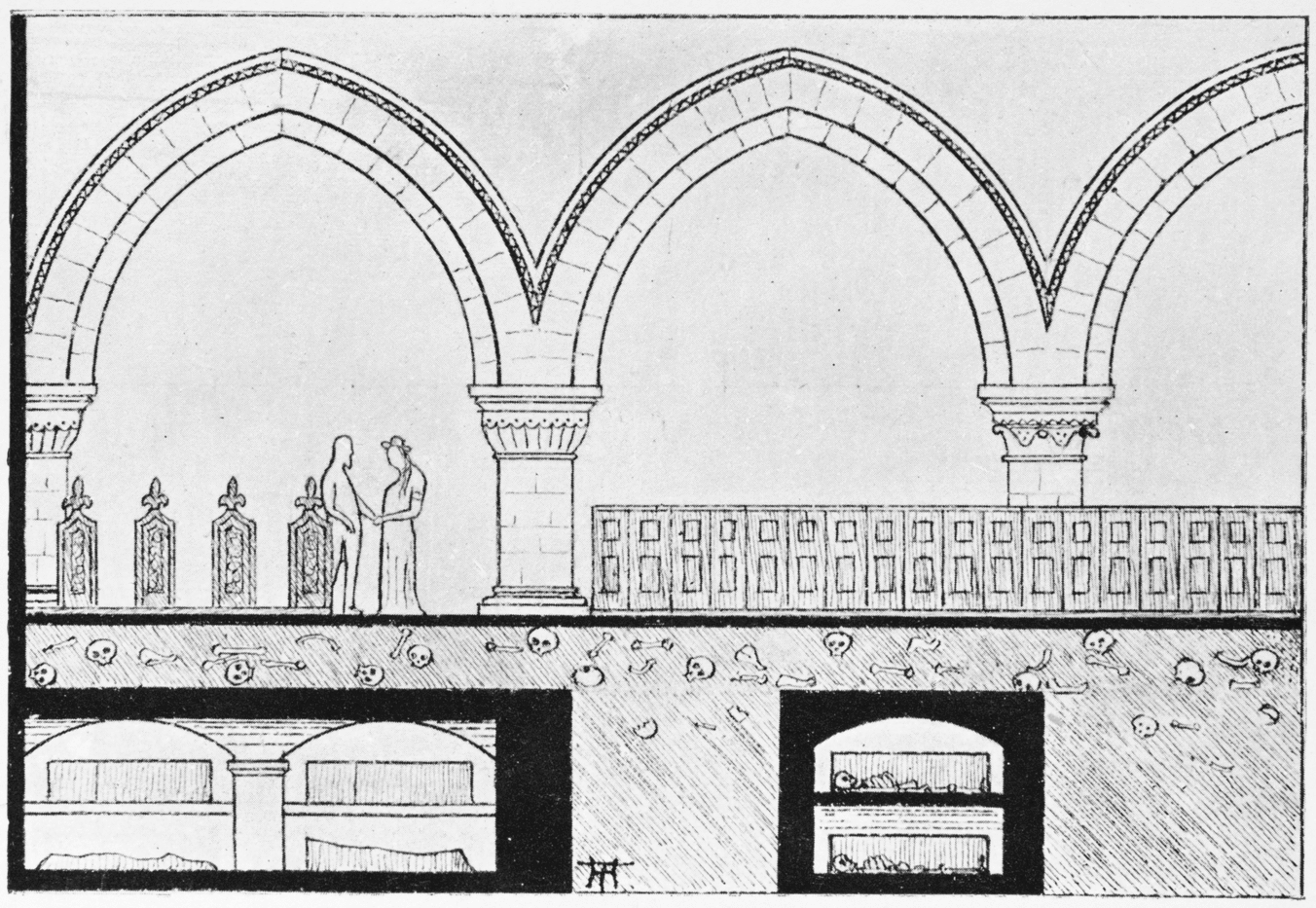
Instead, Wessex Poems offers lyrics that dissect illusions about our relationship to loved ones, the dying, and the dead, while exposing our adherence to systems of belief that promise continuity and redemption. In one of the most dramatic pairings of poem and illustration “HER DILEMMA (IN – CHURCH)” (Figure 16) the exchange between two speakers, who stand above a crypt, enacts Hardy's own dialogue with a prior Romantic self.
Thomas Hardy, Wessex Poems and Other Verses (London and New York: Harper & Brothers, 1898), first edition illustration after a drawing by Hardy for “HER DILEMMA (IN ___ CHURCH).” Courtesy of Bayne Stanley (Pamela Dalziel Collection).
Hardy here revises a long tradition of nineteenth-century poems that featured lovers’ responses to impending death or that imagined death as a division to be overcome: such as John Keats's “Bright Star” or “When I Have Fears,” William Morris's “The Haystack in the Flood,” D.G. Rossetti's “The Blessed Damozel,” Alfred Tennyson's “She is coming my own my sweet” from Maud, Elizabeth Barrett Browning's “The Romaunt of the Page” and “How do I Love Thee?” or, a Hardy favorite, Robert Browning's “The Statue and the Bust.” In contrast, “HER DILEMMA” presents the kind but unromantic situation of a woman's lying to a doomed suitor. Deliberately set within a church, an expected framework of consolation, the poem offers none. Instead, the site itself is both described and imaged as old and dying: “sunless” (“Her Dilemma,” line 1), “mildewed” (line 2), “wasted” (line 3), a “wormy” (line 5), material embodiment of “mothy curfew-tide” (“Friends Beyond,” line 6).
By placing his miniaturized, barely outlined anonymous speakers in a gothic church, on top of a multi-layered bone-yard and crypt, Hardy utterly destroys the notion that a companion drawing might capture the sublimity of either a church interior or of a man's suffering and his approaching death. Hardy distances himself not only from prior love and death poetry, but also from illustrations to such poems as Gray's “Elegy” or Charlotte Smith's Elegiac Sonnets. Dwarfed by gothic arches above them and by the layers of geological time below their feet, Hardy's two figures stand on death. The sculptural outline of the man's body itself stresses his imminent transition to cold silence, as if he were already in the process of turning into a memorial statue.
With its outlines and architectural accuracy, Hardy's sketch may appear orderly, but its vertical descent into layers of the decaying dead actually privileges disorder. The randomly scattered skulls and bones are not those of Christian burial, but of an unmarked potter's field. The builders of this church may not have realized that its vaults were desecrating graves or, perhaps, simply felt unconcerned with the graves of the inglorious. After all, even the humans who stand on the dead, with death's heads ironically decorating the Ionic column design on the far left of the image, are depicted as surface excrescences soon to become part of nature's strata. The clock time that is so clearly running out is also evident by the ticking beat of the meter that Hardy borrows from Gray's “Elegy.” Drawing and verse work together intimately. Significantly, the illustration captures the emotional response of the woman in the poem by re-presenting her sense that words are meaningless. The x-ray vision of a burial site that she cannot see confirms for us her own bleached-out emotion. The image forces us to rethink the plea of her dying lover.
The illustrated lyrics “THOUGHTS OF PH – A” and “THE IMPERCIPIENT” create subversions that are more complicated than those enacted by text and image in “HER DILEMMA.” For the disruptions in these two poems not only challenge the verbal and visual conventions by which thought and feeling are historically represented, but also create multiple linguistic fissures which only reinforce the need for pause and reassessment. If Hardy's drawings deny his readers the emotional comfort normally provided by accompanying illustrations, he only intensifies this discomfort by forcing the reader to stumble on words – pushing us to acknowledge physically the problematic and fossilized nature of language itself. The interruptions created by drawings, that must be turned sideways or decoded, are matched by the interruptions created by individual words that demand to be read beyond their functional and representational status. Moreover, Hardy employs different ways to make a reader pause: he exploits shaped stanzas, intertexts, older meanings, and the very feel of words. These lyrics expose not only histories of words, but, through such histories, contests or social struggles of meaning over ideologies of love or faith (see Volosinov ix; 106).
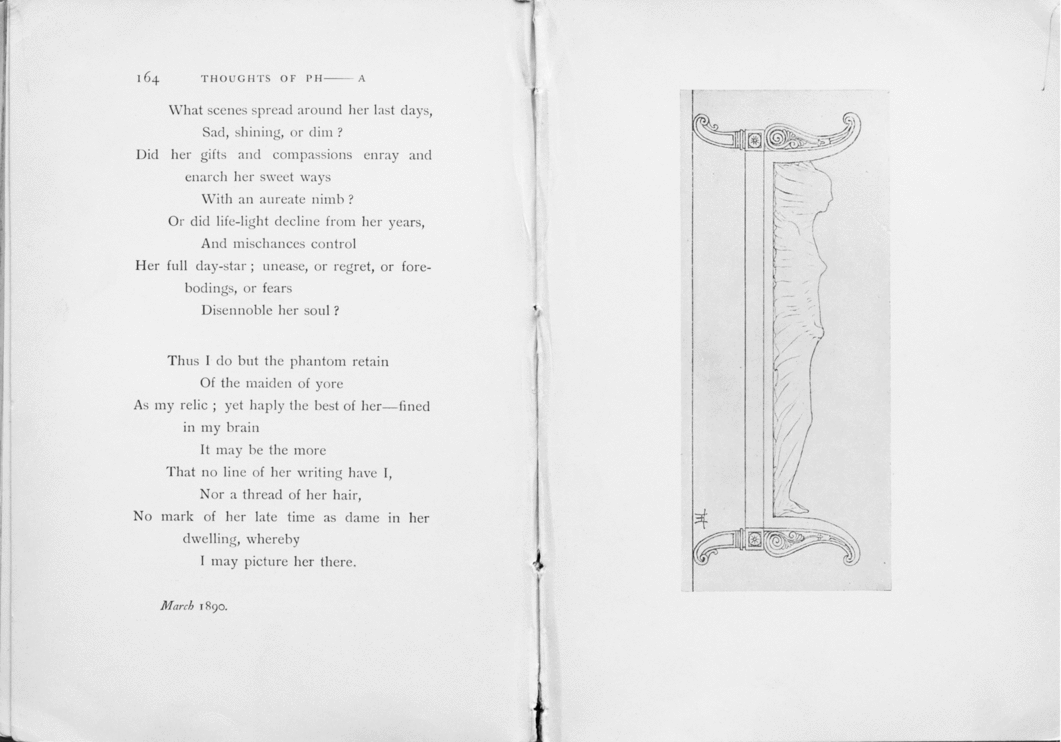
Whereas the pairings of illustration and text for “FRIENDS BEYOND” and “HER DILEMMA (IN – CHURCH)” are absolutely necessary to each other, the even more sophisticated interaction between the 1890 poem which became “THOUGHTS OF PH – A” and its companion illustration (Figure 17), provides the prime example of composite art in the entire volume. Both image and text treat representation. While each part refers to the other, the whole achieves a far greater power to shock than either part by itself.
If we try to read this poem only as the utterance of a grief-stricken and sensitive former lover, we would, as critics have so often done, interpret its many negatives solely as a sign of sincere sentiment: “Not a line” / “Not a thread” / “No mark” (“Thoughts of Phena,” lines 1–3). These negatives would merely dramatize the dearth of communication between once-close companions, now separated by death. We might argue that the repetitive language bespeaks a yearning for some writing or picture as a reminder of the “lost prize” (line 6) at her close. We could identify with a speaker who, despite the passage of years and the surprise at hearing of a former lover's untimely death, feels sentimental and vainly wants to renew, even if temporarily, that lost connection. We can understand why his memories take him back to a time when he desired the “maiden” (line 18), a girl of “sweet ways,” (line 11) radiating joy, and the dreams of youth. Moreover, we might note that the speaker does not just re-create the dead woman in a memory that features the past. Rather, he also thinks about what happened after he knew her – avowing that he would like to have known how she had fared later in life in order to put a closure on their joint, and separate, pasts.
Thomas Hardy, Wessex Poems and Other Verses (London and New York: Harper & Brothers, 1898), page spread from the first edition with illustration after a drawing by Hardy for “THOUGHTS OF PH – A,” 164–65. Courtesy of Bayne Stanley (Pamela Dalziel Collection).
While Hardy certainly encourages such a reading, he also exposes the insufficiency of its romantic self-centeredness, its desire for mastery, and its self-delusions, captured so well linguistically. His dactyls stress the interconnected words “line,” “thread,” and “picture,” so that the reader focuses on things that connect us to each other, not only on negatives. Yet these specific words also force the reader to relate image and text and to ask: how can we ever capture a person through sign systems, whether drawing her, writing about her, picturing her, or looking at a memento mori? Indeed, Hardy asks a brutally realistic question: is there anything left of an experience that can be retained merely by outlines or strands of hair? How potent are such traces compared to lived lives? Moreover, with his choice of the speaker's words “my lost prize” (“Thoughts of Phena,” line 6), Hardy asks: is it the deceased person whom we really are trying to conceive, or is it ourselves-in-the-past that we are trying to retrieve? This poem has a special biographical resonance. Hardy no doubt laments the loss of Tryphena Sparks, his cousin and one-time beloved who died at thirty-eight, increasingly ill after birthing her fourth child. So this corpse poem is prompted by the death of one who has conceived, while it is about kinds of mental conceiving.
To level a double critique at the metaphors of romance and our usual habits of thought, “THOUGHTS OF PH – A” draws on archaic and obsolete words, such as “aureate nimb” (“Thoughts of Phena,” line 14). For Hardy, language acts as a “subtle and flexible instrument by which he can not only describe, but characterize the description” (Taylor, Hardy's Literary Language 197). By casting a dead female beloved as an angel with a golden halo, Hardy suggests that his male speaker may have been as out of touch with the reality of the woman he knew in her youth, as he is now after their long separation. When Tryphena becomes a Legenda Aurea – a golden legend – the metaphor deadens rather than animates. Importantly, the archaic adjective “aureate” itself, used of diction, and not just of golden decorations, connotes grandiloquence and thus characterizes the speaker as overly rhetorical. To further question the speaker's use of “aureate nimb,” Hardy employs rhyme. “Nimb” (“Thoughts of Phena,” line 12) is not rhymed with a word such as “limb,” for instance, but with “dim” (line 10) a word meaning faintly outlined or dark, and hence the opposite of “aureate” (line 12). Hardy here proves the wisdom of George Eliot's comment about language in Middlemarch where she writes, “We all of us, grave or light, get our thoughts entangled in metaphors and act fatally on the strength of them” (79). The wordy speaker's thoughts of PH – A are fatally entangled in his excessive rhetoric.
Hardy's Wessex poem plumbs word histories, coinages, and metaphorical meanings to indicate how diction can distort experience. PH – A's sunny disposition and the speaker's obsolete phrase “aureate nimb” (“Thoughts of Phena,” line 12) seem to encourage him to rely on his own linguistic coinage when he pairs “enray” (line 11) with the architectural word “enarch” (line 12): “Did her gifts and compassions enray and / enarch her sweet ways / With an aureate nimb?” lines (11–12). R. C. Trench, the Victorian language theorist whom Hardy read with great interest, had pointed out in his English Past and Present the ways in which words through time often narrow their meanings, but more often than not enlarge their meanings – losing increasing precision as they do so (Trench, English 152). Hardy's linking of “enray” and “enarch” with “aureate” (lines 11–12), debunks a mythology of love-worship as self-interested sexism. The discourses of nature and religion, he suggests, keep propagating – or conceiving – increasingly generalized and absurd words and metaphors that can only falsify meaning.
Despite the flow of meter, Hardy uses sound to jar us into recognizing the illusory and transient meanings that we affix to words. If “aureate nimb” doesn't interrupt the reading of the poem for the average reader, “enray” and “enarch” do. They are difficult to say quickly, especially together, and unclear, even though they seem straightforward enough. The reader has to stop, pause, and try to figure out the meanings and derivations of those words. Words evolve. “Aureate” may sound dated at the end of the nineteenth century, but, as Hardy indicates through his word choice, we can create new words such as “enray” or adapt a word like “enarch” from another discourse to serve a favorite ideology such as romantic love. “THOUGHTS OF PH – A” dramatizes the linguistic entrapment that archaisms, new words, or new uses of words can produce. Even the circularity of the poem – ending with variations on the same four lines with which it begins – reinforces this point. Hardy echoes the verbal pattern of Romantic poems such as John Keats's “La Belle Dame Sans Merci” or Samuel Taylor Coleridge's meditation “Frost at Midnight,” which close with variations of their opening lines. He may also have been influenced by the popular Victorian roundel form, which opens and closes with the same line, such as Christina Rossetti's “Sleeping at Last” or those by Algernon Charles Swinburne and Henry Austin Dobson. While a romantic reading of “THOUGHTS OF PH – A” would certainly stress the eternity implied by a circular repetition, Hardy invokes the earlier mythologies of love and death in order to stress their idealism.
Hardy's changes to the title of this poem over time also accentuate the speaker's memorializing of a woman into art. In the 1890 manuscript he used “T–a” (i.e., for “Tryphena,” with no “Thoughts of”); in the 1898 Wessex Poems editions (UK and USA) the title was changed to “THOUGHTS OF PH – A” before it became “THOUGHTS OF PHENA” in the 1903 edition (which still included the illustrations). While it can be argued that employing a shortened form of a name for a familiar is standard practice (i.e., Tom and Phena), the choice of “PH – A” and “Phena” for “Tryphena,” instead of “T–a” in the title, calls further attention to Hardy's stress on the speaker's mental constructions and his framing of the woman as image. “PHENA,” the final choice, is related linguistically to the prefix “phen” which derives from the Greek “phaínein,” defined as: to show, or in a passive form “phenoménon” defined as: “appearance,” itself related to the verb “phantazein,” defined as: to present to the mind (and in its middle voice defined as: to imagine). As he demonstrates in The Well-Beloved, serialized just two years after he penned the poem, a modern consciousness, still bound up in romantic phenomena, can easily succumb to self-deluding fantasies and projections.
The speaker's allusion to arches and rays creates a mental image of a gothic cathedral. And, indeed, the original illustration position (Figure 17) features not the recumbent, draped body of a teen-aged woman the speaker has happily recreated, but an inert, vertical figure in a posture that resembles, in its outline, that of a marble caryatid on a classical temple column or of a saint carved into some enarched niche of a gothic church. Whereas such earlier sculptures would have been represented in realistic detail, striking different attitudes with their arms, hands, and faces, the vertical form depicted in Hardy's illustration appears rigid and faceless. The folds draped over the young body we can see in the horizontally tipped drawing have congealed vertically into the marble upward linearity of a rayonnant gothic structure.
Viewed in a horizontal position, the woman as a “lost prize” (“Thoughts of Phena” 6) still seems sexually charged, as if reposing on an Empire courting bench. Although her face has been covered, her lithe body and upright breasts remind her former lover of her youthful seductive potency. Nonetheless, she is placed on the middle shaft of an H frame, part of the ideogram of Hardy's signature initials TH (utilized on all illustrations), thus enclosing her – whatever she looked like at death and whomever she became – within his here and now instead of her there and then. Hardy's “lost prize” has become “my relic” (line 19). In a composite, reiterating gesture, the verse visually performs with its line lengths a similar action, as if the two long lines in each stanza serve as horizontal benches or the shaft of repeated sideways I's.
“THOUGHTS OF PH – A” does not offer us a voice from the grave, as “FRIENDS BEYOND,” nor does it expose lies to the dying as “HER DILEMMA.” Instead, it memorializes the dead by threading together the lines of two different kinds of art. In repeatedly declaring it has no “line” (“Thoughts of Phena,” line 1) from the living, the poem features dead remains, corpses of words, skeletons of mental abstractions, as well as a pictorial outline only of body. The verb “fined” in “yet haply the best of her – fined in my brain” (“Thoughts of Phena,” line 19) is perhaps, therefore, the single most important word in the poem. The awkwardness of f-i-n-e-d is the linguistic equivalent of another interruption – marking a moment when language is under pressure and when it exposes to full view the speaker's patterns of consciousness. The word “fined” means clarified, refined, or purified, or to make finer in size or quality – all of which the poetry and the illustration claim to have done with PH – A. The drawing is itself a refinement. Yet the word also evokes “confined” and even “refined,” with these meanings, it comments on the speaker's mental imaginings of his former beloved, who cannot be found in any line of her writing, but only in the refinements of the speaker's brain.Footnote 3
Hardy's sensitivity to shaped stanza form suggests that he is also working with three stanzas on purpose. Having revised and cut off the head of Tryphena's name, “Try-,” shortening it to “Phena” to focus on the Greek Phein, e.g. showing, he yet retains “Tri” with a trio of stanzas. He also images her in three ways a) writing lines because he has no lines from her, no letters b) drawing an image of her dead and c) in a new composite form. He fills the absence only by uniting picture and verse, but does not reanimate her. This composite form, where image and text work intimately together – a TRI PHEINA (or three ways of showing) is the key to his imagination at this point. To sum up for a moment: Hardy intervenes into the way we frame dead women and into the way we picture a loss. Finding language itself to be incommensurate, he is skeptical about the power of words. But Hardy goes well beyond such a commonplace observation. He indicates that, even if we have words, we are tied to old formulae and clichés such as “aureate nimb” or to sentimental depictions such as “enray” – which are, as far as he is concerned, dead letters (“Thoughts of Phena,” lines 12, 11). He respects the desire to image the dead as they once were. Yet neither old language, nor invented language, nor sketching makes this possible. Hardy's speaker is fetishizing Tryphena, creating a relic of his own, but in an ironic pairing of a drawing, almost humorous in its concealments, with a text that also insists on his inability to picture her. In the end, this union of an inadequate poem and an inadequate image bluntly admits the impossibility of the enterprise. Other poems might have claimed connection, vision, or consolation, but here you don't see her dead or alive, you only see that you cannot see what has been lost.
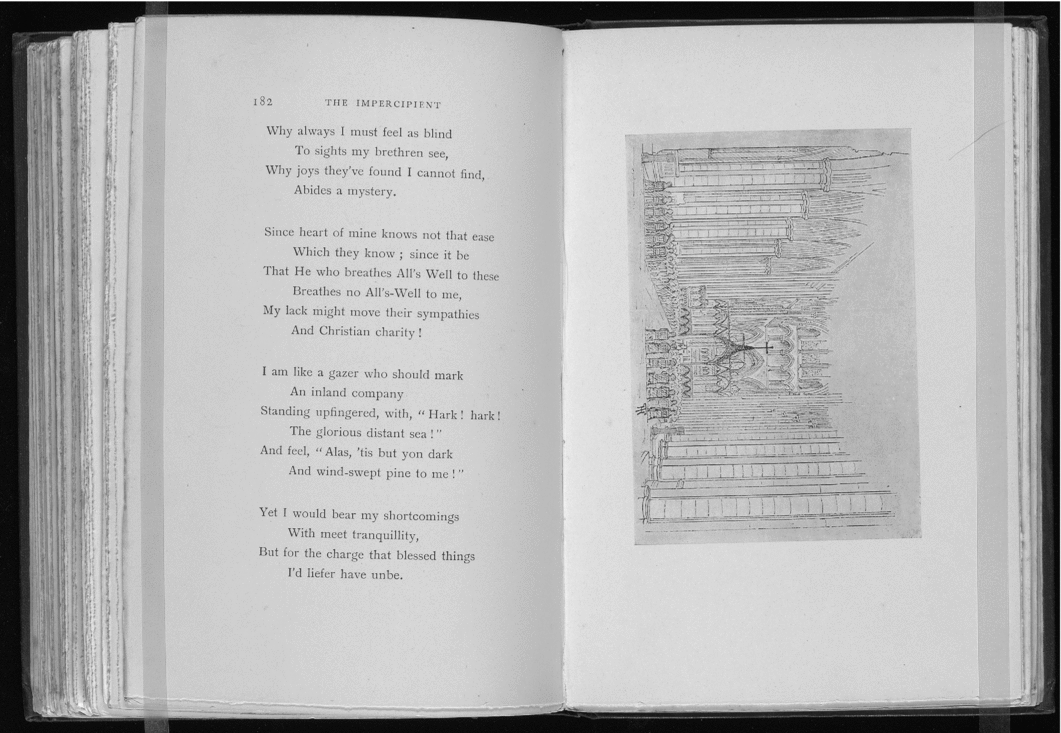
If correct orientation and size of the illustration for “THOUGHTS OF PH – A” proved important to the meanings of that poem, ironies multiply with the illustration for “THE IMPERCIPIENT: AT A CATHEDRAL SERVICE” (Figure 18).
Originally called “The Agnostic (Evensong:–Cathedral),” “THE IMPERCIPIENT” takes up the issue of faith even more directly than the last two poems discussed. Deliberately positioning his speaker at the rear of a full church service, well apart from the group of worshippers, who are imaged from the back at a distance, Hardy dramatizes this skeptic's alienation and extreme self-consciousness.Footnote 4 Although the congregation faces the altar, still the speaker wonders whether the congregants consider him a heretic for his inability to participate in their worship. He defensively states that he does not will his unbelief, a statement which confirms his separateness, but also indicates a struggle between intellect and emotion. Relying heavily on Christian discourse by referring to the “band” of brothers, “the comrades” of Christian soldiership, a “Shining Land,” “a soul” of felicity, “ease” of spirit, and “Christian charity,” the speaker admits that such words, though familiar, cannot connote any higher reality to him (“The Impercipient,” lines 1, 3, 5, 7, 13, 18). He yearns for the comfort that faith provides believers, but his intellect – demanding truth – rejects it. Instead of gazing up to a heavenly vault or even gaining a glimpse of an earthly expanse, such as Wordsworth's “immortal sea” (“Ode: Intimations of Immortality,” line 167), the speaker envisions only a dark and windswept grove of trees.
Thomas Hardy, Wessex Poems and Other Verses (London and New York: Harper & Brothers, 1898), page spread from the first edition with illustration after a drawing by Hardy for “THE IMPERCIPIENT,” 182–83. Courtesy of Beinecke Rare Book and Manuscript Library, Yale University.
Dramatizing the dilemma of this self-conscious speaker, Hardy refuses to align him with the consolation that a fellow-skeptic such as Tennyson could still proclaim in his elegy In Memoriam (1850). For Tennyson, though also struggling in a world of revolutionary and evolutionary changes, still managed to activate faith: “And all is well, Though faith and form / Be sundered in the night of fear” (CXXVII, lines1–2). Moreover, Tennyson imagines Hallam in a state of beatitude and ultimate knowledge: “While thou dear spirit, happy star / O'erlook'st the tumult from afar, / And smilest, knowing all is well” (CXXVII, lines18–20). Repeating “All's Well,” Hardy remembers this powerfully emotional stanza, itself an echo of a providential scene in Samuel (2 Sam. 18.28), but he does so only to separate his speaker from it: “He who breathes All's Well to these / Breathes no All's Well to me” (“The Impercipient,” lines 15–16). Although the church is a repository of traditions of worship and a continuing source of community, what animated it, Hardy implies, is no longer valid for this speaker.
The tortuous Latinate word impercipient, used in the title, and rarely employed in English, performs its own barriers to understanding and has a history in Hardy's writing. He coined it to mean a lack of perception, vision, or awareness, and would apply it a year later not to a person but to a desk drawer holding Tess's letter to Angel at the Vicarage in Tess of the d'Urbervilles (in the serial version, Chapter LXIX as cited in Taylor, Hardy's Literary Language 186). The prefix “-im-” as John Paul Riquelme has noted, presents a diminution of consciousness and implies the loss of a faculty that makes us human (208). It is precisely this sense of loss that Hardy's choice of “impercipient” over “agnostic” also charts. The difficulty of the word “impercipient” indicates the intractability of the speaker's situation as he imagines it – religiously, psychologically, and socially shut out. And that awkwardness is reinforced by our stumbling over the phrase at lines 25–28 ending “I'd liefer not have be.” The archaic Anglo-Saxon word “Liefer” emphasizes once shared and now lost linguistic and religious traditions. “Impercipient,” used primarily to refer to the speaker, includes, by extension, the idealistic congregation as well. The speaker, however, is more of a naïve idealist than he knows. If he thinks he is impercipient about religious belief, he is even more impercipient about mankind. Is it really possible that everyone in the congregation firmly believes? Hardy dramatizes a consciousness locked into a binary opposition of belief and unbelief, with no middle ground, one yearning to believe, but finding it impossible to do so.
The co-presence of religious discourse and skepticism in this highly intellectual poem ends in a stand-off, with each side seeming to cancel out the other. The self-interruption closing this poem is a literal reading break, a gap of ellipses: “. . . . / Enough. As yet disquiet clings / About us. Rest shall we.” (“The Impercipient,” lines 31–32) The last two lines can, however, be read in various ways. In particular, the word “rest,” which carries multiple meanings, serves as a single word commentary on what has preceded and what is to come. In his On the Study of Words, R. C. Trench noted “many a single word also is itself a concentrated poem, having stores of poetical thought and imagery laid up in it” (14). Hardy uses the word “rest” as such a storehouse. To “rest” means to be fixed or to stand firm. Or it means the opposite: to give in. While to “rest” means to be left/remain/continue to be, it also means the opposite: to die. Indeed, Hardy's last phrase “Rest shall we” (“The Impercipient,” line 32) recalls the prayer for the dead or the typical Christian headstone epitaph: Requiescant in pace: May they rest in peace. “Rest” is used ironically to show how a single word can imply such a wide range of meanings, including opposites.
Turning the accompanying illustration (Figure 18) of the thirteenth-century Salisbury cathedral upright from its facing presentation, we might wonder why we don't see the top of the gothic cathedral. The drawing cannily destroys the traditional elevation of a Gothic cathedral, with level upon level drawing the gaze ever upward in an attitude symbolic of Christian faith in an afterlife. As in the volume's frontispiece illustration (Figure 15), where the gateway to the churchyard was cut in half, here the upper windows, with what we can imagine as their Biblical stained glass narratives and their celestial light, are truncated, forbidding any transcendent experience of architecture. In fact, when turned horizontally, the represented structure resembles a ruined building much like Tintern Abbey.Footnote 5 To have the illustration correctly oriented, as in the original version, is therefore essential, so that the chopped off top cannot be explained away by its facing into a book seam or interpreted in terms of a vertical, invisible transcendence by its repositioning above the poem, on the top of a page.
In the context of the verticals and horizontals that are so important to this poem, the word “upfingered” confers a special and double resonance to the illustration's cutting off of any transcendent vision. “Standing upfingered, with, ‘Hark! Hark! / The glorious distant sea!’” (“The Impercipient,” lines 21–22), implies a gesture that may be commanding silence to hear the sound of a sea of faith, thereby recalling Wordsworth's Ode: Intimations of Immortality (again) and Arnold's more negative Dover Beach. “Upfingered” also means pointing upward in a profession of total faith in God, such as the frequent position assumed by Charles Dickens's Agnes, in David Copperfield. Yet, since Hardy writes here in a subversive mode, it may also signify the digitus impudicus, a sign of disrespect since Roman times.
The hymn rhythm and rhyme scheme familiar to Hardy from Hymns Ancient and Modern introduce further ironies. One can sing “The Impercipient” as if it were a hymn, except of course, for the disturbing fact that its words tamp down the emotions raised by such an act, just as the reader's spiritual ascendency is forbidden by the truncated gothic heights in the accompanying image. The prosody thus captures the poem's contraries. The desire to join the spiritual community is at odds with the intellectual realization that such fusion is impossible. If life for the speaker means no communion, afterlife means entering the sod, rather than the eternity of heaven.
At the start of this essay, I suggested that we should read Wessex Poems as an instance of Hardy's fascination with Thomas Gray's “Elegy Written in a Country Church-Yard” and the poetic past, as part of his continued exposé of Romanticism, as an archaeology of language and form, and as a statement about the importance of interrupting habitual mental patterns. It is significant that in the volume's fifty-first and final poem Hardy may be said to bring together these issues in a new way. Importantly, as well, he does not close his volume with an illustration. The closing poem title “‘I LOOK INTO MY GLASS’” is in quotation marks in the first edition, calling attention to a personal voice used on only one other occasion in the volume. In its seeming shift from impersonation to subjectivity this epilogue recalls Robert Browning's fifty-first poem appended to his 1855 volume Men and Women, “One Word More.” Just as that poet, in addressing Elizabeth Barrett Browning directly as his prime reader, claims to drop his mask: “Let me speak this once in my true person, / Not as Lippo, Roland or Andrea” (“One Word More,” lines 127–28), so does Hardy personalize a poetry that he has masked throughout Wessex Poems.
Yet just how personal is Hardy's final poem and how different from the poetry preceding it? His Tithonus-like speaker looks into a mirror and, seeing his wrinkling skin as he approaches sixty, wishes God had somehow better matched his physical frame to his feelings. Despite age and decay, he says, time “shakes this fragile frame at eve / With throbbing of noontide” (“I Look into My Glass,” lines 11–12). The poem echoes Hardy's 1897 The Well-Beloved in which the sculptor Pierston complains to himself: “When was it to end – this curse of the heart not aging while his frame moved naturally onward?” (Well-Beloved 338). Like Pierston, and unlike Browning in his final poem, Hardy is not talking to a beloved or even to an interlocutor, but to his own reflection in a mirror. Written in iambic trimeter quatrains with each third line in iambic pentameter, “‘I LOOK INTO MY GLASS’” is modeled on the short-meter doxology (Bailey 112). It also echoes Shakespeare's sonnets and Tennyson's quasi-sonnets that praised a beloved, living or dead. In Shakespeare's “Sonnet 62,” for instance, a speaker dismayed by the glassed image of his wasting body declares that this reflection of a “tanned antiquity,” (line 10), only betrays the “iniquity” (line 12) of his self-loving. Tennyson's elegiac lyrics for Hallam, compared by Hallam's father to Shakespeare's sonnets, are often twelve lines long, faintly resembling sonnets without a couplet, much like Hardy's final poem. As do Shakespeare and Tennyson, Hardy evokes “devouring time” (Shakespeare, “Sonnet 19,” line 1). Unlike them, Hardy calls attention to the absence of the counter-weight of love.
Above all, this final poem recalls George Herbert's 1633 religious poem “The Elixir,” reworded and set to music as a hymn by John Wesley (Johnson 41). In the “The Elixir,” Herbert asks God to teach him to see the Divine in all things: “A man that looks on glass, / On it may stay his eye, / Or if he pleaseth, through it pass, / And then the heav'n espy” (lines 9–12). Hardy's “I Look into my Glass” teases the reader, seeming to turn outward, but remains self-directed, self-enclosed. Unlike Gray, Shakespeare, Tennyson, and Herbert, Hardy here deepens the sense that there is no meaningful Other. Wessex Poems firmly sounds the death knell of the Romantic idiom. The dead cannot complete the living when they murmur to Hardy at curfew-tide, a beloved like Tryphena cannot return as she was – in memory or art, and God and the church cannot provide Hardy's speaker with a belief-system he can embrace. There is no paired illustration for the last poem. “‘I LOOK INTO MY GLASS’” stresses the aloneness of self-image, a solipsism which effectively shuts out all visionary company. Still, in his movement from a darkening “curfew-tide” (“FRIENDS BEYOND” 59, line 5) in the volume's opening caption to the “throbbing of noontide” in the closing poem's final line, Hardy asserts the throbbing of the heart – that of love and desire, to be sure, but also that of pain, cruelty, and the relentlessness of time for which there is no anodyne.
Moving beyond the radical ironies of his novels of the 1890s (Tess of the d'Urbervilles, Jude the Obscure, and The Well-Beloved), all of which had dismantled Romantic hopes and beliefs with “tragic parodies of redemption” (Moore 13), Wessex Poems takes a “full look at the Worst” (Hardy, “In Tenebris II” 14). Hardy confronts loss, historical change, and death. Refusing to indulge in the promises of faith or in the mythologies of love, without also looking directly at realities, Hardy stakes his legacy as a poet on burying any easy resolutions of his Romantic predecessors and Victorian contemporaries. He does not disavow or repress feeling in poetry or in the human heart, nor does he simplify its cost. Through a complicated composite art of image and text, Wessex Poems repeatedly challenges us to rethink the apparent ease of framing others and ourselves.