Introduction
The Ewing sarcoma family consists of a group of tumours characterised by morphologically similar small round cell neoplasms and by the presence of a characteristic chromosomal translocation.Reference Maheshwari and Cheng1 This family of tumours is the second most common malignant bone tumour of childhood and adolescence. These tumours most commonly arise from the bone, but in around 20–30% of cases, they arise from extraskeletal tissues.Reference Cash, McIlvaine and Krailo2
Ewing sarcoma is an aggressive cancer with an estimated median survival of 70% for patients with localised disease and less than 30% for those with metastatic disease.Reference Grünewald, Cidre-Aranaz and Surdez3 Generally, Ewing sarcomas are treated using multi-modality approach including surgery, radiation therapy and poly-chemotherapy.
Traditionally, patients with extraskeletal disease have been reported to be older and have a propensity for axial tumour origin.Reference Applebaum, Worch and Matthay4 A secondary involvement of bone is uncommon, even when the mass is located in proximity to a bone segment.Reference Galyfos, Karantzikos, Kavouras, Sianou, Palogos and Filis5 There is limited evidence in terms of clinical presentation, molecular biology and natural history of these tumours.
Many reports have characterised the histologic and electron micrographic features of extraosseous Ewing sarcoma, differentiating it from other small-cell neoplasms of the soft tissue.Reference Sharma, Kamala, Nair and Ragavendra6 This has helped in identifying that extraosseous Ewing sarcoma is a distinct clinical entity. However, there is a paucity of literature with respect to the molecular profiling of these tumours.
Over the last three decades, there have been a few case series of extraosseous Ewing sarcoma; however, the studies following the advent of newer and more effective chemotherapeutic agents, advanced techniques of radiation delivery and advances in surgery are few and far between. Hence, it was necessary to look into the advances in the treatment aspects in the modern era of multi-modality oncological treatment, necessitating this study.
Aim
To analyse the presentation, diagnosis and patterns of care of extraosseous Ewing sarcoma treated at our institution between 2008 and 2018.
Objectives
To study the clinical presentation, treatment modalities and outcomes of patients presenting with extraosseous Ewing sarcomas. To analyse the immunohistochemical (IHC) characteristics of patients presenting with extraosseous Ewing sarcoma.
Methods and Materials
Electronic medical records of extraosseous Ewing sarcoma patients treated at our institution between January 2008 and April 2018 were reviewed after obtaining ethics committee approval (IRB:11668 [Retro] dated 28.11.2018).
Inclusion Criteria
Biopsy-proven Ewing sarcoma/Primitive neuro-ectodermal tumours (PNETs). Both polymerase chain reaction (PCR) positive and negative Ewing sarcoma/PNET.
Exclusion Criteria
Primary tumour arising from the skeleton.
Statistics
Statistical analysis was done using SPSS Version 20.0 (IBM Corp., Armonk, NY, USA). Descriptive statistics such as mean, median and standard deviation were used for the nominal variables. Kaplan–Meier curves were plotted to assess the overall and disease-free survival with 95% confidence intervals. A univariate analysis was carried out to assess the impact of variables such as surgical excision, completeness of surgery, completeness of chemotherapy and addition of radiation therapy on the survival. Cumulative disease-free and overall survival rates were compared using the Log-rank test with p < 0·05 considered to be significant.
Results
The records of 65 patients treated at our institution were available for review.
Patient Demographics
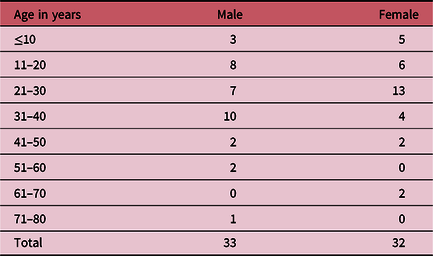
Of the 65 patients, 33 were male and 32 were female. The age of the patients ranged between 1 and 79 years with the mean age of 26·4 years. The predominant age at diagnosis was between 21 and 40 years with 34 patients (52·3%) (Table 1).
Patient demographics

Differential Diagnosis
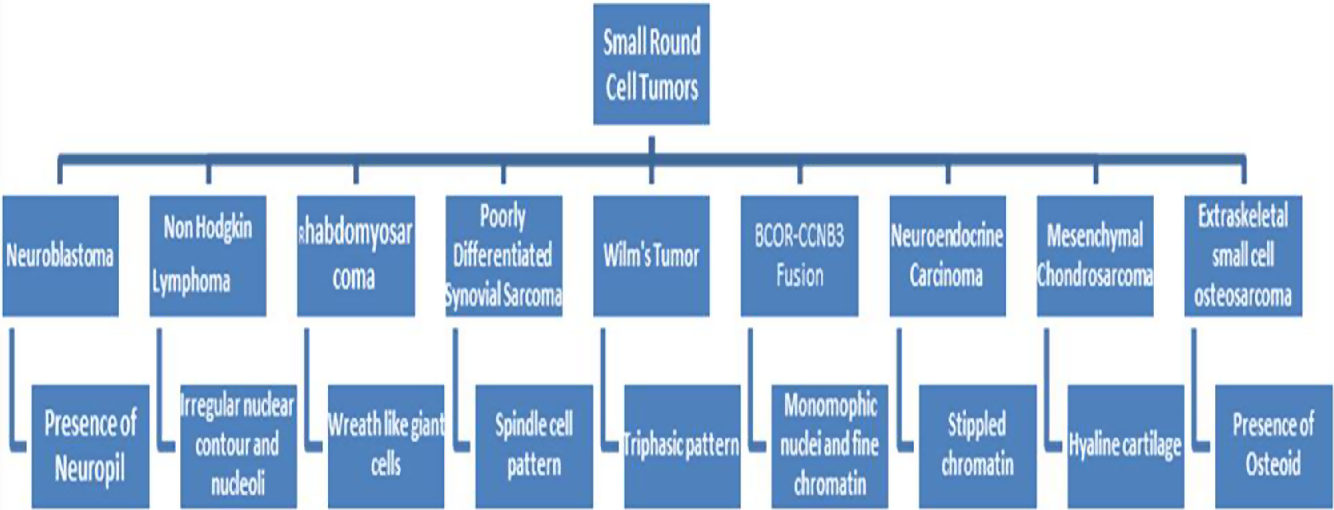
Differential diagnoses for extraskeletal malignant round cell tumours on small biopsies include a wide range of tumours as follows:
a) Neuroblastoma
b) Non-Hodgkin lymphoma including lymphoblastic lymphoma
c) Rhabdomyosarcoma
d) Poorly differentiated synovial sarcoma
e) Wilm’s tumour (WT)1
f) BCOR-CCNB3 fusion sarcomas
g) Desmoplastic small round cell tumour
h) Neuroendocrine tumour
i) Mesenchymal chondrosarcoma
j) Extraskeletal myxoid chondrosarcoma
k) Extraskeletal small-cell osteosarcoma
A few pathognomonic histomorphological characteristics were used to differentiate them from Ewing sarcoma as shown in Figure 1.
Flow chart representing the differential diagnosis of small round cell tumours.

Histopathology and Immunohistochemistry
Small biopsies of malignant round cell tumour pose a challenge due to lack of pathognomonic features in the sample provided and also scanty nature of the tissue.
IHC evaluation was done based on the morphological features. Various markers were tested, and final diagnosis was made as a process of exclusion. The most common IHC markers that were tested for diagnosis were cluster of differentiation (CD) 99, friend leukaemia integration (FLI)-1, NKX2.2 (Mouse homolog of NK homeobox protein), terminal deoxynucleotidyl transferase (TdT), CD20, paired box protein (PAX)5, desmin, myogenin and MyoD1, transducin-like enhancer of split 1 (TLE-1), epithelial membrane antigen, synaptophysin, chromogranin, WT1, BCL6 corepressor (BCOR), cytokeratin (CK), SRY-Box transcription factor (SOX)9 and special AT-rich sequence-binding protein (SATB)2.
Among the markers, crisp strong diffuse membrane positivity with CD99 is useful, though not always specific. The recently described NKX2.2 is also most often specific though not in 100% of the cases. FLI-1 and TLE-1 though commonly positive are not very specific.
Hence, molecular confirmation by fluorescence in situ hybridization (FISH) or reverse transcriptase-polymerase chain reaction (RT-PCR) for t (11; 22) (q24; q12) and rarer variants such as Ewing sarcoma breakpoint region-V-ETS avian erythroblastosis virus E26 oncogene homolog (EWSR1-ERG), EWSR1-ETS variant (ETV)1, EWSR1-ETV4 and EWSR1-fifth Ewing sarcoma variant was done.
RT-PCR has been routinely done as a part of confirmatory diagnostic workup of Ewing sarcoma family of tumours. Tumours with EWS-FLI1 Type1, EWS-FLI1Type 2 or EWS-ERG translocation were considered positive for Ewing sarcoma.
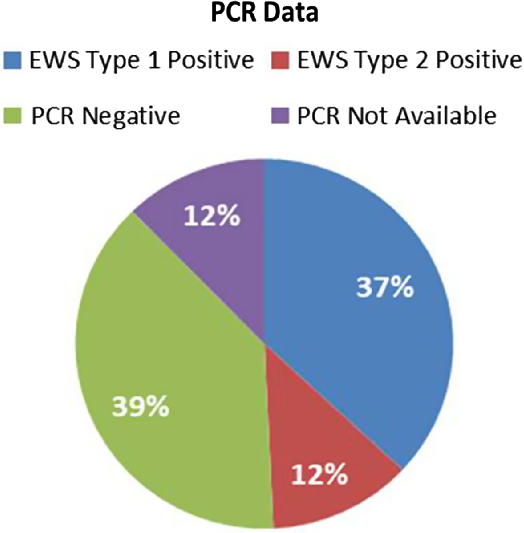
PCR data (Figure 2) was available for 57 (88%) patients and unavailable for 8 (12%) patients. Out of the 57 (88%) patients with PCR data, 24 (37%) were positive for EWS FLI1-Type 1 translocation, 8 (12%) were positive for EWS FLI1-Type 2 translocation and 25 (39%) patients were negative for the common Ewing sarcoma translocations.
Pie chart representing the distribution of polymerase chain reaction data.

IHC Data
Of the 65 patients, 63 (97%) were positive for CD 99, 20 (31%) patients were positive for FLI-1, 19 (29%) were positive for synaptophysin, 16 (25%) were positive for CD56, 14 (21·5%) were positive for vimentin, 9 (14%) for CK, 7 (11%) for neuron-specific enolase and 4 (6%) for desmin.
Sitewise Distribution
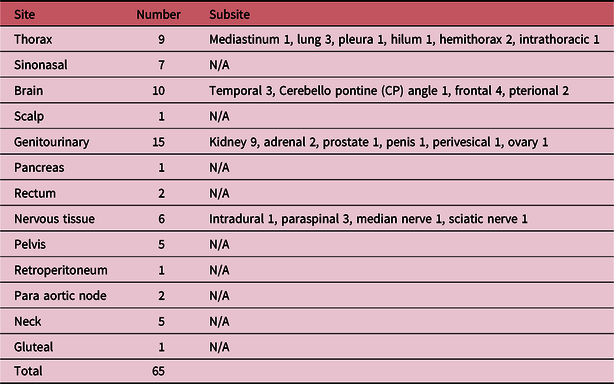
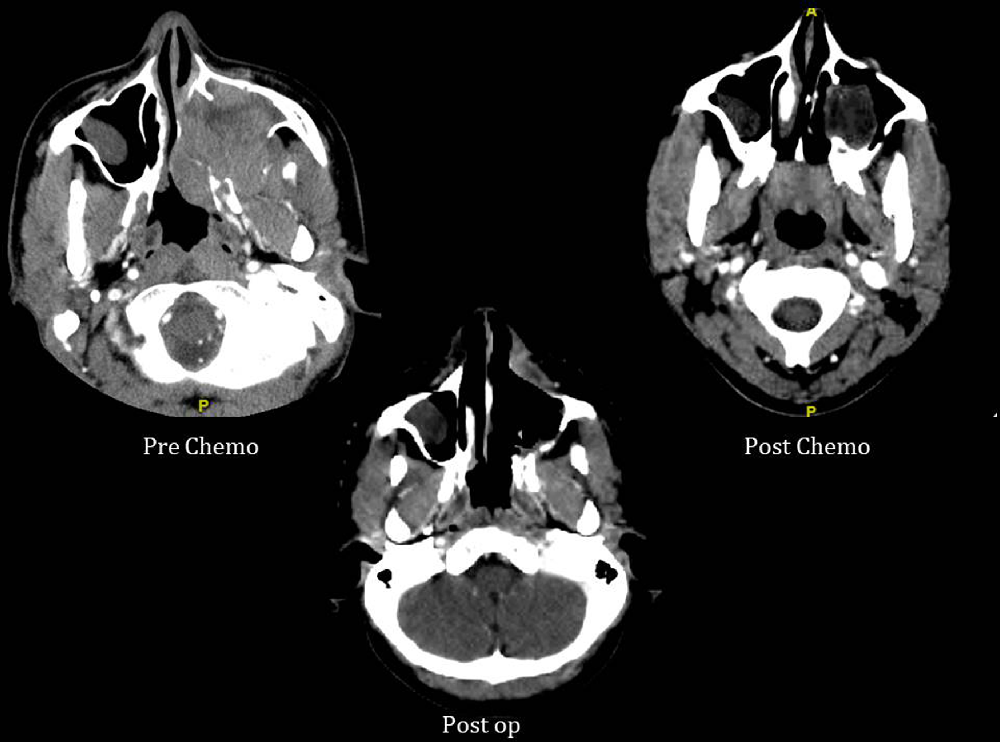
In our cohort of patients, the most frequent sites (Table 2) of extraosseous Ewing tumour were the kidney—9/65 (13·8%) and brain—10/65 (15·4%) followed closely by nasal and sinonasal regions—7/65 (10·8%) (Figure 3). Other common sites included lungs 3/65 and neck 5/65.
Sitewise distribution

N/A, not applicable.
Sinonasal tumour.

Presentation
Among the 65 patients, 16 (24·6%) presented with inoperable/metastatic disease at diagnosis. Of these 16 patients, 10 received chemotherapy alone, 1 had palliative radiation therapy (RT) alone, 2 received chemotherapy followed by palliative RT, 2 were deemed unfit for any form of oncological treatment and were offered best supportive care alone and 1 patient died during evaluation.
Among the patients with localised disease (n = 49) at presentation, 48 patients had multi-modality management. One patient died of acute on chronic renal failure while under evaluation.
Treatment Modality
Surgery
Of the 65 patients, 38 (58·5%) patients underwent surgery with radical intent, and 1 patient underwent ventriculo-peritoneal shunt placement only. Among the 38 patients, 18 (47·4%) had excision with negative margins (R0), 7 (18·4%) had excision with microscopic positive margins (R1) and 13 (34·2%) patients had excision with gross residual disease/biopsy only (R2).
Chemotherapy
Of the 65 patients, 45 (69·2%) received at least one cycle of chemotherapy and 20 (30·8%) did not receive any systemic therapy. Twenty-six (40%) patients received at least eight cycles of vincristine, adriamycin, cyclophosphamide alternating with ifosphamide and etoposide chemotherapy. Eighteen (27·7%) patients completed all the planned cycles of chemotherapy.
Radiation Therapy
Twenty-nine patients received external beam radiation therapy, delivered using 6/15 mega voltage dual-energy linear accelerator as part of their treatment. Twenty-two patients had adjuvant RT (45–55·8 Gy) after surgery, five patients had palliative RT (30–45 Gy) and two patients had definitive RT (66 Gy in 33 fractions).
Outcomes
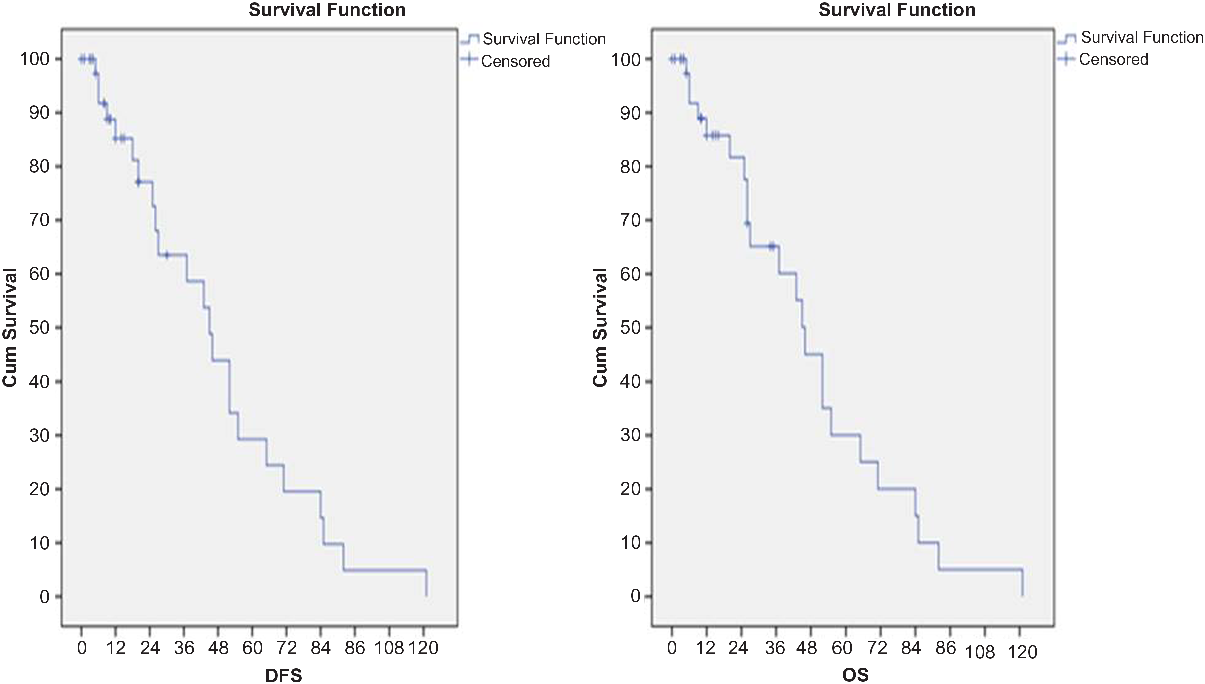
The median overall survival of the 49 non-metastatic patients was 46 months, and the median disease-free survival was 45 months (Figure 4).
Kaplan–Meier curves for the disease-free and overall survival. X-axis—time in months; Y-axis—percentage survival.

Factors Affecting Outcome
Surgery
The 36 months disease-free survival was 35% in those patients who had surgery versus 8% in those who did not undergo surgical resection, this difference was statistically significant (p = 0·002). Similarly, the overall survival at 36 months was statistically significantly higher (p = 0·003) among those who had surgery (40%) compared to those who did not have surgery (8%).
Extent of Surgical Resection
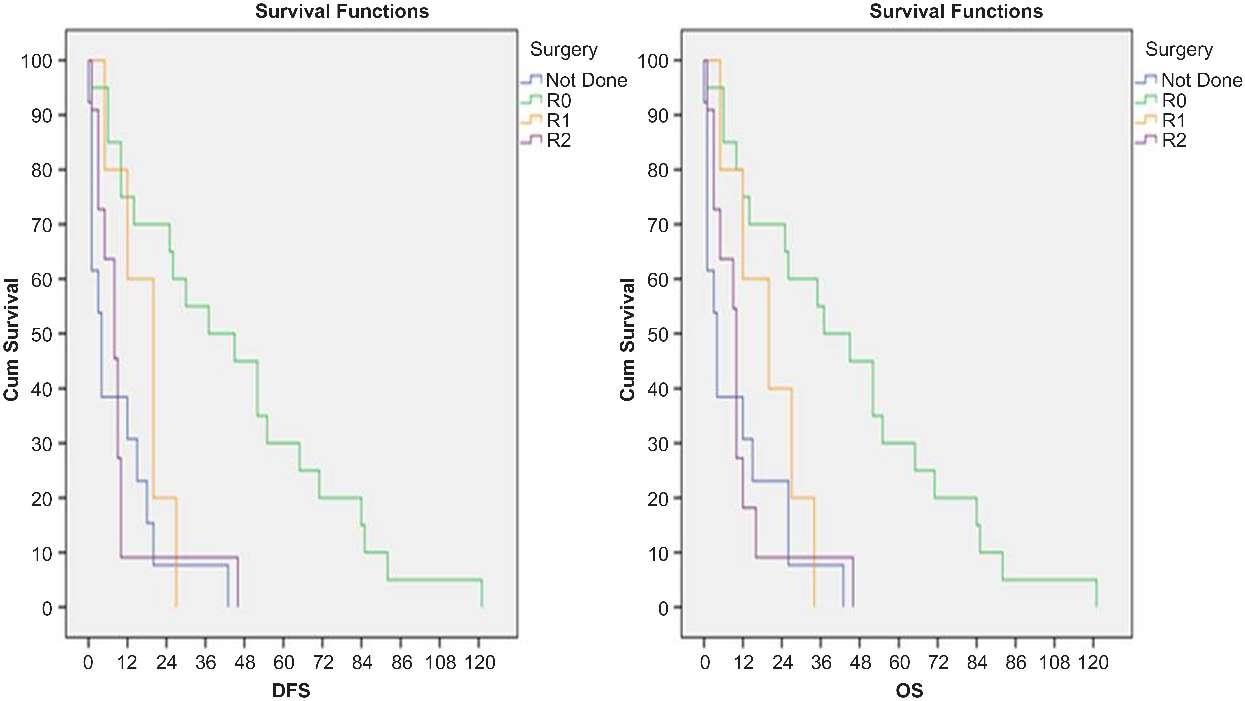
Completeness of surgical resection was a significant predictor of median overall and disease-free survival in our study. The median overall survival was 37 months in those who underwent R0 resection, 20 months in those who had microscopic residual disease (R1) and 10 months in those who had gross residual disease (R2) (p = 0·0001). Similarly, the disease-free survival was 37 months for R0, 20 months for R1 and 8 months for R2 resection (p = 0·0001) (Figure 5).
Representing the Kaplan–Meier curves for the disease-free and overall survival depending on the extent of surgical excision (X-axis—time in months; Y-axis—percentage survival).

Completeness of Chemotherapy
Both overall and disease-free survival were significantly better in those patients who completed the planned cycles of chemotherapy (p = 0·0001). The overall survival at 36 months was 53% in those who completed chemotherapy versus 8% for those who did not. Similarly, the disease-free survival was 51% for those who completed chemotherapy compared to 7% for those who did not. The median disease-free and overall survivals were 37 and 38 months, respectively, in those completed chemotherapy and those who did not.
Addition of Radiation Therapy
Both overall (p = 0·018) and disease-free survival (p = 0·025) were statistically significantly higher in those who received radiation therapy as part of their multi-modality treatment versus those who did not receive RT. The 36 months overall survival was 45% with RT versus 8% without. Similarly, the 36 months disease-free survival was 45% with RT versus 8% without. The median overall survival was 26 months with RT versus 5 months without. The median disease-free survival was 25 months with RT versus 5 months without.
Follow-up
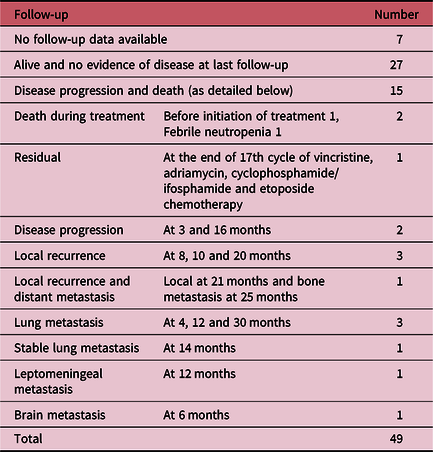
The follow-up ranged from 1 to 121 months. Follow-up data was available for 42 out of 49 patients with non-metastatic disease at presentation. Seven patients were lost to follow-up (Table 3).
Follow-up statistics

Discussion
Extraosseous Ewing sarcoma is a rare tumour, most common in the soft tissue of trunk and lower limb between 10 and 30 years of age.Reference Galyfos, Karantzikos, Kavouras, Sianou, Palogos and Filis5 Extraosseous Ewing tumours can occur anywhere from head to toe. Most common extraskeletal locations include the retroperitoneum, viscera like ovary, kidney, pancreas, omentum, orbit, skin and chest wall.Reference Javery, Krajewski and O’Regan7 Extraosseous Ewing family of tumours is generally considered more aggressive than their skeletal counterparts.Reference Galyfos, Karantzikos, Kavouras, Sianou, Palogos and Filis5
Diagnosis of these tumours on small biopsy pose a challenge due to a wide spectrum of morphologically and immunohistochemically similar tumours. This necessitates inclusion of molecular diagnostic techniques such as FISH and RT-PCR for confirmatory diagnosis. However, absence of molecular confirmation should prompt a review of the clinical, histological and immune histochemical features but should not rule out the diagnosis of Ewing sarcoma by itself.
Multi-modality treatment continues to be the backbone of management in these tumours which includes surgical resection with wide margins, chemotherapy with vincristine, doxorubicin, cyclophosphamide and actinomycin D alternating with ifosfamide and etoposide and also post-operative tumour bed irradiation.Reference Womer, West and Krailo8
In our study, non-metastatic disease at presentation, amenability for surgical resection, completeness of surgical resection, completeness of chemotherapy and addition of adjuvant radiation therapy, all had significant impact on improved survival (p < 0·05).
This was in concordance with a similar study of 57 patients published by El Weshi et al.,Reference El Weshi, Allam and Ajarim9 who found that adequate surgical resection, aggressive chemotherapy and adjuvant local radiation therapy would be the optimal treatment for superior outcomes in this uncommon disease.
The disease stage and the site of presentation play a major role in the treatment decisions. Rud et al.Reference Rud, Reiman, Pritchard, Frassica and Smithson10 in their report of 42 cases of extraosseous Ewing sarcoma reported a survival rate at 2 years of 54% and at 5 years of 38%. Similar to the present series, those who had surgical resection with wide margins followed up by post-op radiation and adjuvant chemotherapy were the long-term survivors.
Qureshi et al.Reference Qureshi, Laskar and Kembhavi11 investigated the impact of negative but close resection margins on local recurrence in a cohort of patients with extraosseous Ewing sarcoma and found that optimum local control was possible irrespective of quantitative extent of negative margin and they concluded that achieving a three-dimensional tumour-free margin should be the goal of surgery.
In the European Cooperative Ewing Sarcoma Studies and EICESS trials, patients who had intralesional excision/debulking surgery followed by radiation therapy had the same local control as the patients who had RT alone. In regions where complete excision is not feasible, offering definitive RT would be a better option than intralesional excision followed by RT.Reference Schuck, Ahrens and Paulussen12
In concordance with published literature, those who presented with localised disease could undergo surgical resection. Of the nine who underwent surgery with wide margins and had post-operative tumour bed irradiation and completed chemotherapy, four are long-term survivors and are disease-free at the time of this review.
The results of this retrospective cohort study will help in aiding the differential diagnosis of this rare entity and also reiterates the importance of multi-modality treatment approach and completeness of planned treatment for optimum outcomes.
Future prospective studies are needed to assess the role of neoadjuvant radiation along with chemotherapy to enhance the surgical outcomes since in our study, completeness of surgical excision was one of the most important factors predicting the long-term survival.
Limitations
Retrospective study with data from a single institute.
Conclusion
Extraosseous Ewing sarcoma is a rare and aggressive tumour diagnosed by molecular techniques. Multi-modality treatment including surgical resection with wide margins, adjuvant post-operative tumour bed irradiation when indicated and completion of systemic chemotherapy result in optimum outcomes.
Acknowledgements
None.
Financial Support
None.
Conflicts of interest
None.