1 Introduction
According to the famous dictum of William Labov (Reference Labov, Lehmann and Malkiel1982: 20), ‘historical linguistics may be characterized as the art of making the best use of bad data’; scholars working in the field of historical linguistics must rely on data whose survival rests on the insecure foundation of ‘historical accidents beyond the control of the investigator’. This may be true of historical linguistics in general, but the problems of bad data are, if possible, even worse in such fields of study as historical dialectology and historical contact linguistics. Historical documents portraying authentic spoken dialect data are extremely rare, and the reliability of contemporaneous comments on spoken nonstandard varieties is often difficult to assess. Despite these undeniable problems with the data available, nonstandard varieties of English are a surprisingly rich source of data − also for historical linguistic and historical contact linguistic argumentation − and they can potentially supply fresh evidence for past contact situations, evidence that may not have survived in written documents that tend to reflect the language practices of usually relatively small literate elites rather than the less educated majority of population. The important role of dialectal data, both contemporary and historical, for contact linguistic argumentation is evidenced, for example, by treatments of the Northern Subject Rule (Klemola Reference Klemola and Tristram2000; Filppula, Klemola & Paulasto Reference Filppula, Klemola and Paulasto2008: 42–9) and the so-called Cumbric score, or sheep-counting numerals, in the north of England (Jackson Reference Jackson1955: 88; Barry Reference Barry1969; Filppula, Klemola & Paulasto Reference Filppula, Klemola and Paulasto2008: 102–5).
The focus of this article is on an unusual adverb + infinitive construction sporadically referred to in a number of descriptions of nineteenth-century and early twentieth-century traditional southwestern and west Midlands dialects of English. The construction is most often reported in the form of a formulaic phrase away to go, meaning ‘away he went’, though it is also found with a range of other adverbs. Besides the somewhat formulaic away to go construction, the same dialects also make use of a possibly related imperative construction, consisting of a preposition or adverb and a to-infinitive, as in out to come! ‘Come out!’; a negative imperative construction consisting of the negator not and the base form of the verb, as in Not put no sugar in!, is also reported sporadically from the same dialect areas. These construction types appear to be marginal at best in earlier varieties of English, whereas comparable constructions with the verbal noun are a well-established feature of especially British Celtic languages (i.e. Welsh, Breton, and Cornish). This prompts the question of the possibility of transfer from the British Celtic languages as an explanation for the use of these constructions in the traditional southwestern and west Midlands dialects of English.
The organization of the article is as follows. Section 2 focuses on the existing evidence for the historical infinitive construction and related constructions in traditional southwestern and west Midlands dialects, and introduces the sources used in this study. In section 3, I move on to discuss the historical precedents of the away to go and related constructions in English, and attempt to show that the construction is marginal in documented earlier varieties of English. In section 4, the Celtic analogues of the construction are introduced and discussed, and in section 5, I move on to assess the plausibility of Celtic influence in the case of the dialectal historical infinitive and related constructions. The article is rounded off with a short conclusion in section 6.
2 To-infinitive constructions in English dialects
2.1 The away to go construction
As Smith (Reference Smith1987) and Shorrocks (Reference Shorrocks1991) have observed, there is some evidence for the use of an unusual adverb + infinitive construction (most frequently reported in the form of a phrase away to go) in the southwestern and west Midlands dialects of English. The English Dialect Dictionary (EDD) includes a number of examples of the construction consisting of an adverb followed by the infinitive to go. The example in (1) is listed under the EDD s.v. away (A.5. Phr. away to go), with the following meaning: ‘away he went’:
(1)
[A young kitchenmaid, describing the depredations of a manservant on the pastry-shelf, said,] ‘It wuz Lucas, ma'am, ’e comen in out o’ the ’all an’ took some of the fancy pies an’ away to-go.’
(Shropshire) (EDD, I: 100)
Additional examples of the construction from Devon in (2) are reported in Laycock (Reference Laycock1929: 142) and from Dorset in (3) in Lovelace (Reference Lovelace1989: 6) (both quoted here from Shorrocks Reference Shorrocks1991: 138):
(2)
Away-to-go = ‘away he went’. The cat zeed the dog an’ away-ta-go.
(Devon; Laycock Reference Laycock1929: 142)Footnote 2(3)
I picked up me tools an’ away da goo!
(Dorset; Lovelace Reference Lovelace1989: 6)
As far as Cornwall is concerned, the evidence for the existence of the construction comes from the dialect writings of Arthur Quiller-Couch, cited by Smith (Reference Smith1987: 44), and a reference to its existence in present-day Cornish English in Phillips (Reference Phillips1976: 80).Footnote 3
Although the rather formulaic phrase away to go seems to be the form in which the construction is most often documented, the infinitive form to go is also found with a number of other adverbs. Thus, under s.v. go (II.4. Phr.), the EDD lists examples of the construction with about, and back, down, in, out, etc., exemplified in (4) to (6):
(4)
They go to X—, and about to go
(Devon)‘The visitors no sooner arrive than they turn about and are off again.’
(EDD, II, 663)(5)
back, down, in, out, etc. to go, ‘to go back down, in, out, etc. with the idea of prompt energetic action’.
(EDD, II, 662)(6)
In giving a lad a mount, or ‘a leg up’: ‘Now then, up to go.’
(Devon) (EDD, II, 663)
Outside the British Isles, Shorrocks (Reference Shorrocks1991) reports that the away to go construction is also found in present-day Newfoundland English, where, according to Shorrocks (Reference Shorrocks1991: 140), the construction functions as a highly emphatic and climactic narrative device. Shorrocks (ibid.) notes that in Newfoundland English, the construction only occurs ‘in co-ordinate clauses (parallel clauses), i.e. where subject + finite verb might otherwise appear’. Furthermore, Shorrocks observes, the construction is preceded by the conjunction and, ‘and constitutes the final structure in a series of structures’. Shorrocks’ examples, from the Dictionary of Newfoundland English data files, include the following:
(7)
An’ he . . . she took the nine . . . pups an’ put [them] ’board the vessel, an’ away to go (i.e. ‘off they went’).
(MUNFLA: tape C251) (Shorrocks Reference Shorrocks1991: 140)(8)
Took his ship an’ away to go. Now he went back an’ he picked up the doctor. . . .
(MUNFLA: tape C283) (Shorrocks Reference Shorrocks1991: 140)
Shorrocks (ibid.) reports that the construction in Newfoundland seems to be lexically restricted to the adverbial away and the infinitive to go, though he does point out that there is some evidence for the use of the construction with other infinitives, such as to run.
2.2 Narrative infinitive in Hiberno-English
A similar, though not completely identical construction, is well documented in traditional varieties of Hiberno-English (cf. Joyce Reference Joyce1910/1979: 45–6; van Hamel Reference van Hamel1912: 279; Henry Reference Henry1957: 188–90; Bliss Reference Bliss and Trudgill1984: 147–8; Filppula Reference Filppula1999: 184). Joyce (Reference Joyce1910/1979: 45) calls the Hiberno-English construction ‘Narrative Infinitive’, and points out that a corresponding construction is widely employed in Irish. According to Joyce (ibid.), Hiberno-English speakers ‘constantly imitate’ the Irish Narrative Infinitive construction in their speech. The sentences in (9) and (10) from Joyce (Reference Joyce1910/1979) and (11) from Henry (Reference Henry1957) illustrate the Narrative Infinitive in Hiberno-English:
(9) How did you come by all that money?
To get into the heart of the fair (meaning ‘I got into the heart of the fair’), and to cry old china.
(Joyce Reference Joyce1910/1979: 45)(10) How did the mare get hurt?
Oh Tom Cody to leap her over the garden wall yesterday, and she to fall on her knees on the stones.
(Joyce Reference Joyce1910/1979: 45–6)(11)
She to go and her to follow her − it's the best anymore.
(Henry Reference Henry1957: 190)
Filppula (Reference Filppula1999: 184) also refers to this construction in passing, and points out that the Narrative Infinitive in Hiberno-English is generally considered to show the influence of Irish verbal noun construction found in similar contexts. Filppula (ibid.), however, does not include Narrative Infinitive among the features chosen for a detailed investigation in his study of Hiberno-English grammar, pointing out that, on the basis of his corpus evidence, the construction is rare in present-day dialects of Hiberno-English, and ‘is probably a recessive feature’.
The Hiberno-English Narrative Infinitive offers a relatively close parallel to the infinitival constructions found in southwestern and west Midlands dialects and in Newfoundland English discussed in section 2.1, though it has to be pointed out that, unlike the southwestern/west Midlands/Newfoundland historical infinitive construction, the Hiberno-English construction can occur with an overt subject, as in examples (10) and (11). Furthermore, the Hiberno-English Narrative Infinitive does not seem to collocate with adverbs such as away or about in the way that is typical of the southwestern/west Midlands/Newfoundland construction.
2.3 To-infinitive construction in commands
In addition to the use of an adverb + infinitive construction as an historical or narrative infinitive, southwestern dialects also employ a possibly related imperative construction involving the use of a to-infinitive or the base form of the verb. This construction is commented on as follows by one of the most reliable nineteenth-century dialect grammarians, Frederick Thomas Elworthy, in his Outline of the Grammar of the Dialect of West Somerset (1877):
Curious forms of the imperative Een tŭ goo·! ‘Go in!’ Aewt tŭ goo! ‘Go out!’ are difficult to explain. So Au·p tŭ kau·m! ‘Come up!’ Aewt tŭ kau·m! ‘Come out!’ Baa·k tŭ kau·m! ‘Come back!’ These expressions are all emphatic, and would be used especially while assistance was given – in lending a hand, for instance.
(Elworthy Reference Elworthy1877: 53–4)Footnote 4More examples of the imperative use of the construction are listed in the EDD s.v. away (A.5. Phr. away to go), with the following meaning: ‘be off, go away’:
(12)
Now then, away to go.
(Warwickshire) (EDD, I: 100)(13)
Tak’ this and away to-go.
(Shropshire) (EDD, I: 100)
The example in (14) below is the only instance of the construction found in the Survey of English Dialects (SED) Basic Material data; it is recorded from Withypool in Somerset (31So 8), as a response to the SED questionnaire item VIII.7.9 (Go away! Off you go!).Footnote 5
(14)
əweı tə goː ‘away to go’
(SED VIII.7.9, 31So 8, Withypool, Somerset)
Further examples of the use of the adverb + infinitive construction as a command (both positive and negative) are found in Devon (15) and Worcestershire (16).
(15)
Now then, away-ta-go, all the lot of ’e!
(Devon; Laycock Reference Laycock1929:142)(16)
‘But’, I says, ‘Not to stop.’
(SED Tape-recordings, 16Wo 5, Earl's Croome, Worcestershire)
Corresponding usage is not widely reported in Irish English, though Henry (Reference Henry1957) includes the following example in his discussion of the uses of the infinitive:
(17)
Open the gate then, an’ not to open it after(wards).
(Henry Reference Henry1957: 188)
There is also some evidence from the southwest for the use of negative imperatives with just the base form of the verb rather than a to-infinitive, noted by Wakelin (Reference Wakelin1977: 125), who considers this ‘an interesting construction’. Wakelin's examples in (18) to (20) come from the Survey of English Dialects incidental material included in the published SED Basic Material:
(18)
not put no sugar in!
(SED IX.7.11, 31So 8, Withypool, Somerset)(19)
not wait!
(SED IX.7.11, 31So 8, Withypool, Somerset)(20)
not go!
(SED IX.7.11, 37D 6, South Zeal, Devon)
2.4 Summary
As the discussion above has shown, the evidence for the types of adverb + infinitive construction in English dialects is very patchy. The historical infinitive-like construction is most widely reported as a formulaic phrase away to go, which seems to be used in emphatic and climactic functions (cf. Shorrocks Reference Shorrocks1991: 145). There is some evidence, however, that besides away, the construction can also be used with other adverbs, which suggests that the construction may well have been productive in the dialects. The construction is used typically, though not exclusively, as the final element in a series of two or more co-ordinate clauses that share the same subject.
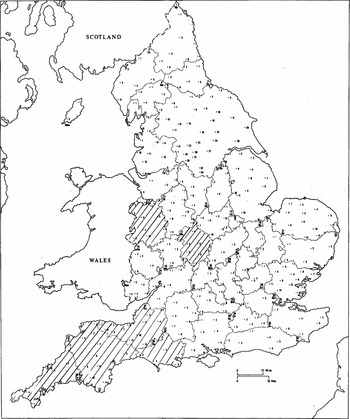
The geographical distribution of the construction is relatively clear-cut, being restricted to the traditional southwestern and west Midlands dialects (see map 1); outside England, the construction is also reported in Newfoundland. In addition, a closely related narrative infinitive construction is well documented in traditional Hiberno-English dialects. Besides the historical infinitive-type construction, there is also some evidence for the existence of a possibly related adverb + infinitive construction used in commands in roughly the same dialect areas.Footnote 6 Having established that the constructions in English dialects are used in a clearly defined geographical area, we turn next to a survey of the historical precedents of the constructions in English.
The geographical distribution of the adverb + infinitive construction in traditional dialects of England

3 Parallels in earlier varieties of English
There is relatively little evidence for the use of historical infinitive-type constructions in earlier varieties of English. Jespersen (Reference Jespersen1940: 327) notes that ‘(a) loose infinitive corresponding to the historical infinitive in French and other languages was formerly in use in English, but has never been frequent’. Jespersen's example in (21) comes from Chaucer's Troilus and Criseyde:
(21)
And she to laughe, it thoughte hir herte breste.
(Ch T 2.11108)(Jespersen Reference Jespersen1940: 327)
Shorrocks (Reference Shorrocks1991: 140–1) draws attention to Visser's (1966) construction types 998 and 999, and considers especially Visser's type 998: ‘He turnit his bridil and to ga’ an interesting parallel to the away to go construction. According to Visser (Reference Visser1966: 1059), the construction type, which can be found both with and without the infinitive marker to, ‘occurs sporadically in Middle and early Modern English’. Visser (Reference Visser1966: 1060) also discusses a closely related type 999: ‘Arður com sone, and Scottes to fleone’, where the infinitive has its own pronominal or full noun subject. Visser's earliest example in (22) is from Layamon (c.1205):
(22)
Ah Arður com sone mid selere strengðe, And Scottes to fleone.
(Layamon 21653)
Visser (Reference Visser1966: 1060) remarks that these two construction types are ‘often compared with the Latin “historic infinitive”’. He points out, however, that the possibility of Old French influence is made problematic by the existence of possible examples of the construction type in Old English.Footnote 7
Evidence for the use of the to-infinitive in negative commands is similarly very scarce. The existence of the colloquial Not to worry! in present-day varieties of English seems to be an almost isolated phenomenon. The earliest attestation of the phrase Not to worry in the OED is from 1958 (OED s.v. not A.I.5.a (c) colloq. not to—: do not—). The OED notes that the colloquial negative command not to— is ‘(i)n early use preceded by please’, and proceeds to give the earliest attestation of the construction from 1790, reproduced below in (23):
(23)
Please not to be in a hurry.
(1790, OED)
More examples of the negative command with please and a to-infinitive are listed in OED (s.v. please, v., II.6.d), where the ‘imperative or optative use’ of please is said to be originally Scottish.Footnote 8 The OED notes that this please-construction was formerly used ‘with bare infinitive, that-clause, or and followed by imperative’, but that it is nowadays only used with the to-infinitive which, furthermore, is considered to be ‘chiefly regional’.Footnote 9
To summarize, the evidence for the existence of narrative or historical infinitive-like constructions in earlier historical varieties of English is not strong. Jespersen (Reference Jespersen1940: 327) simply mentions that the construction ‘has never been frequent in English’. Visser's (1966) collection of material shows that the infinitive has been to some extent used in contexts where it occurs in place of a finite verb, but, as Shorrocks (Reference Shorrocks1991: 140) observes, ‘it is questionable how close a parallel such uses constitute to the dialectal away to go’. Given the geographical distribution of the away to go construction and the lack of close parallels to the construction in earlier varieties of English, it makes sense to look for parallels to the construction in the adjoining Brittonic Celtic languages; this is the question we turn to next.
4 Parallels in the (Brittonic) Celtic languages
Verbs in the Celtic languages do not have an infinitive form. However, one of the central uses of the verbal noun in the Celtic languages is functionally equivalent to the infinitive in English (cf. Lewis & Pedersen Reference Lewis and Pedersen1937/1961: 312).Footnote 10 Of central importance for the purposes of this article is the Middle Welsh, Middle Breton, and Cornish use of the verbal noun as a narrative device corresponding to the narrative or historic infinitive in Latin. Poppe (Reference Poppe, Gruffydd and Jacobs1995: 145) draws attention to this construction in Middle Welsh:
Nearly every page of continuous narrative Middle Welsh Prose displays a stylistic feature associated with the verb which is systematically exploited in main clauses and which, in analogy to tense-switching, could be called form-switching, i.e. a change between finite and non-finite forms of the verb. Verbal nouns can be used for finite verbs and are then equivalent to narrative past tenses.
Poppe (Reference Poppe, Gruffydd and Jacobs1995: 145) points out that the similarity between the Latin narrative or historic infinitive and the Middle Welsh narrative use of the verbal noun was already noted by Thurneysen (Reference Thurneysen, Stempel and Ködderitzsch1907/1991: 149). According to Evans (Reference Evans1964: 161), in Middle Welsh ‘(t)he verbal noun is often used instead of a finite verb in a series of co-ordinate statements, with a finite verb preceding’.Footnote 11 Among Evans’ examples of this construction is the following:
(24)

‘A large number of attendants arose and began to fill the bag.’

Evans states further that the verbal noun may also be used in contexts where there is no preceding finite verb, as in the example in (25)
(25)
‘The shoemakers came and took counsel.’
The use of historic or narrative infinitive survives in the present-day Brittonic languages. Gregor (Reference Gregor1980: 232) notes that ‘[a] verb joined to a preceding clause containing a verb with the same subject is put in the Infinitive instead of Finite Tense (the Past)’. Gregor's examples include the following:
(26)
‘I went into the house and made a cup of tea.’
(27)
‘The thief took the lamb and killed it and ate it.’
(28)
‘Arthur arose and went.’
In Modern Welsh the construction is in frequent use (King Reference King1993: 198; Thorne Reference Thorne1993: 327–8), but, as Russell (Reference Russell1995: 271) observes, ‘the pattern is rare in Modern Breton’.
Turning next to the imperative constructions, the first observation to make is that the Brittonic languages do not generally employ the verbal noun in commands. Middle Welsh, Cornish and Middle Breton all have a formally distinct imperative in the 2sg. and 3sg.; in the plural the imperative is formally identical with the present indicative (Lewis & Pedersen Reference Lewis and Pedersen1937/1961: 278, 284). However, Hemon (Reference Hemon1984: 267) notes that already in Middle Breton, ‘the verbal noun is often used as a substitute for the imperative’, as in (29):
(29)
‘Now then! Let us dispatch her’
(Le Mystere de Sainte Barbe, 1557; Hemon Reference Hemon1984: 267))
Negative imperative in the earlier varieties of Brittonic languages consists of a negative particle followed by the imperative form of the verb. Thus, in Middle Welsh, the negative imperative assumes the form na/nac + imperative, as in (30); the corresponding Middle Breton negative imperative is exemplified in (31):
(30)
‘Don't go!’
(Evans Reference Evans1964: 174)(31)
‘Do not eat, do not drink!’
(Hemon Reference Hemon1984: 284)
Evans (Reference Evans1964: 164) observes that ‘(t)he negative particle ny, na cannot be used with the verbal noun’ in Middle Welsh, and Hemon (Reference Hemon1984: 286) makes a similar comment on Middle Breton.Footnote 12 According to Hemon (Reference Hemon1984: 258), however, Middle Breton makes frequent use of a negative command construction consisting of the word arabat, functioning as the negator in the clause, and a verbal noun, as in (32).Footnote 13 According to Hemon (ibid.), arabat, which acts as the negator in the clause, ‘seems to have been originally a noun meaning “folly”’.
(32)
‘Do not despise the sayings of the old people.’
(Hemon Reference Hemon1984: 258)
According to Thorne (Reference Thorne1993: 311), a similar construction is also in common use in both spoken and literary varieties of Modern Welsh, where the construction consists of the imperative form of peidio ‘cease’ followed by the preposition â/ag ‘with’ and a verbal noun, as in (33):Footnote 14
(33)
‘Don't worry, darling.’
(Thorne Reference Thorne1993: 312)
Thorne (ibid.) notes further that in informal and spoken varieties of Welsh, the preposition â/ag is frequently omitted, as in (34):
(34)
‘Don't think that I am hard, Idris.’
(Thorne Reference Thorne1993: 312)
Though the peidio + â/ag + verbal noun construction was in use in Middle Welsh, it was, according to Evans (Reference Evans1964: 165), seldom used as a pure negator, but normally retained to some extent its original meaning of ‘cease’. Evans (ibid.) goes on to comment, however, that ‘already in MW there are examples where the verb seems to have been almost entirely stripped of these meanings and reduced to a simple negative’. The negative imperative in Welsh thus shows development from a construction with a negative particle + imperative to constructions where an originally imperative form of a verb meaning ‘cease’ now functions as a simple negator before the verbal noun.
5 Summary and discussion
The documentation for the adverb + infinitive constructions in southwestern and west Midlands dialects consists mainly of references to the construction in a number of nineteenth-century and early twentieth-century dialect descriptions and a handful of examples in the English Dialect Dictionary. In addition, the construction is relatively well documented in present-day Newfoundland English (Shorrocks Reference Shorrocks1991), where it is, however, only reported in the form of a relatively formulaic phrase away to go. Both in the southwestern and west Midlands dialects and in Newfoundland English, the construction is used in two different ways: (i) as an emphatic narrative device found as the final element in a series of two or more co-ordinate clauses sharing the same subject and (ii) as an imperative construction.
In effect, what we are dealing with here is a typical case of the ‘bad data’ problem: the adverb + infinitive constructions we have surveyed in this study seem to be mainly a feature of the nonstandard traditional dialects in the southwest and west Midlands, and the less than systematic body of evidence on the use of the construction makes it difficult to draw any firm conclusions on its structure or use in the dialects. It is likely, however, that the surviving uses of the away to go construction represent vestigial traces of a construction that has at some stage in the past been more productive in the dialects, though it only survives as a lexically restricted narrative device with an emphatic or climactic function.
The use of the verbal noun as a narrative device to replace finite verbs in co-ordinated strings, corresponding to the use of the historical infinitive in Latin, is a very commonly used pattern in the Brittonic languages: it is reported to be frequently used in Middle Welsh (Evans Reference Evans1964; Poppe Reference Poppe, Gruffydd and Jacobs1995; Russell Reference Russell1995) and in Middle Breton. The construction remains very frequent in Modern Welsh, whereas in Modern Breton it has become less frequently used (Russell Reference Russell1995: 271). The fact that a closely analogous construction is a well established and very commonly used pattern in the Brittonic languages makes it possible that the away to go construction may represent a Brittonic-influenced innovation in the southwestern and west Midlands dialects, as Phillips (Reference Phillips1976: 80) and Shorrocks (Reference Shorrocks1991) have suggested. It must be admitted, however, that the case for the Brittonic influence must remain somewhat speculative, as Shorrocks (Reference Shorrocks1991: 145) also concedes.
The question of parallels for the imperative constructions discussed above is more problematic. There is no obvious Brittonic parallel for the ‘curious’ emphatic imperative mentioned by Elworthy (Reference Elworthy1877: 53–4), which consists of an adverbial + to-infinitive, as in In to go!, Out to come! In the case of the negative imperative consisting of the negator not + the base form of the verb, as in Not put no sugar in!, the Middle Welsh, Middle Breton, and Cornish negative imperatives offer an obvious structural parallel: in the earlier varieties of Brittonic languages the negative imperative consisted of a negative particle followed by the imperative form of the verb, as in Middle Welsh Na dos! ‘Go (thou) not!’ Transfer from Welsh and Cornish is thus, in principle, possible. In the light of the scant evidence to be gleaned from the few observations on this construction in southwestern dialects of English that we have, the question of the possibility of Brittonic influence must remain highly speculative.
6 Conclusion
This article has focused on a vestigial adverb + infinitive construction in the south-western and west Midlands dialects of English. Though the construction is relatively poorly documented in a number of descriptions of nineteenth-century dialects, the EDD and the SED, the evidence is sufficient to show that the construction has in all likelihood been productive in the dialects, though it is most often reported as a formulaic phrase Away to go!, meaning ‘away he/she/they went’; this away to go construction is frequently, though not exclusively, used as the last element in a series of co-ordinate clauses sharing the same subject. The use of corresponding adverb + infinitive constructions is marginal in earlier documented varieties of English. This, combined with the geographical distribution of the construction in English dialects, and the fact that the geographically close British Celtic languages make extensive use of an analogous historical infinitive-like narrative device, makes transfer from Welsh and Cornish a distinct possibility. In addition to the away to go construction, the same dialects also employ an imperative construction consisting of a preposition or adverb and a to-infinitive, as in out to come! ‘Come out!’, and a negative imperative construction with the negator not followed by a to-infinitive or the base form of the verb, as in not to stop! or not put no sugar in! Although these imperative constructions are sometimes considered to be closely related to the away to go construction, their links with the Brittonic languages are more problematic, and it is possible that we will have to seek elsewhere for an explanation for Elworthy's (1877) ‘curious’ southwestern imperatives.
It is of course very difficult – perhaps impossible – to prove conclusively that language contact in the relatively distant past has led to a change in the structure of a given language, and I make no claims about having proved that contacts with the adjacent Brittonic languages have caused the changes in southwestern and west Midlands dialects discussed in this article. However, by accumulating evidence that points towards the possibility of contact-induced change in the past, I believe we can gradually build a case for the likelihood of Celtic influence having played a role in the development of English. In this way, I hope the data discussed in this article will prove relevant for the re-evaluation of the Celtic hypothesis.