





1. Introduction
A smooth cobordism
$W \colon M \leadsto N$
 between compact smooth d-manifolds (possibly with boundary) is an h-cobordism if
$\partial W = M \cup (\partial M \times I) \cup N$
 and the inclusions
$M \hookrightarrow W$
 and
$N \hookrightarrow W$
 are homotopy equivalences; in this case, we say that M and N are smoothly h-cobordant. If moreover both inclusions are simple homotopy equivalences, then
$W \colon M \leadsto N$
 is an s-cobordism, and we say that M and N are smoothly s-cobordant.
To each h-cobordism, throughout assumed to be connected and based, we can associate its torsion
$\tau (W,M) \in {\mathrm{Wh}}(\pi _1(M))$
 , taking values in the Whitehead group of the fundamental group [Reference Whitehead28, §2]. By Milnor’s duality formula [Reference Milnor19, p. 394] for torsion,
$\tau (W,N) =0$
 if and only if
$\tau (W,M)=0$
 , which by a result of Whitehead [Reference Whitehead28, §10] in turn holds if and only if W is an s-cobordism. In dimensions
$d \geq 5$
 , the Whitehead torsion induces a bijection [Reference Kervaire13]

In dimension
$d=4$
 , it is well-known that this map is not injective [Reference Donaldson6], and it is an open question whether it is surjective [Reference Baykur, Kirby and Ruberman3, Problem 4.18]. Let us make the latter explicit.
Question 1.1. Given a connected, compact, smooth 4-manifold M with fundamental group
$\pi = \pi _1(M)$
 , can each torsion
$\tau \in {\mathrm{Wh}}(\pi )$
 be realized by a smooth h-cobordism?
The following related question was raised explicitly in [Reference Kasprowski, Powell and Ray12, Question 1.16] and [Reference Baykur, Kirby and Ruberman3, Problem 4.18], and also remains open.
Question 1.2. Is every pair of compact, smooth 4-manifolds that are smoothly h-cobordant also smoothly s-cobordant?
If the Whitehead group
${\mathrm{Wh}}(\pi )$
 vanishes, for example, if
$\pi $
 is torsion-free and satisfies the K-theoretic Farrell–Jones conjecture [Reference Lueck16], then every h-cobordism is an s-cobordism; restricting to 4-manifolds with this fundamental group, both Questions 1.1 and 1.2 trivially have positive answers. Finite cyclic groups are the best-known examples of groups for which the Whitehead group can be nontrivial [Reference Milnor19], [Reference Oliver21]. Our first result is that both questions admit a positive answer when certain technical conditions are satisfied, for example, for
$\pi $
 finite cyclic.
Recall that a smooth h-cobordism
$W \colon M \leadsto M'$
 is inertial if M and
$M'$
 are diffeomorphic,
$\mathrm {SK}_1(\pi ) := \ker [K_1(\mathbb {Z}\pi ) \to K_1(\mathbb {Q}\pi )]$
 , and
$L_5^{s}(\mathbb {Z}\pi )$
 and
$L_5^h(\mathbb {Z}\pi )$
 are the Wall surgery obstruction groups, with s- and h-decoration, respectively.
Theorem A. Let M be a smooth, compact, connected, oriented 4-manifold with finite fundamental group
$\pi := \pi _1(M)$
 . Suppose that either
-
(i) $\mathrm {SK}_1(\pi ) = 0$
 and the forgetful map
$L_5^{s}(\mathbb {Z}\pi ) \to L_5^h(\mathbb {Z}\pi )$
is injective;
-
(ii) $\mathrm {SK}_1(\pi ) = 0$
and M is topologically pre-stabilized, that is, homeomorphic to
$X \# (S^2 \times S^2)$
for some closed topological 4-manifold X; or -
(iii) M is smoothly pre-stabilized, that is, diffeomorphic to $X \# (S^2 \times S^2)$
for some closed smooth 4-manifold X.


Then, for each
$x \in {\mathrm{Wh}}(\pi ),$
 there exists an inertial smooth h-cobordism
$W \colon M \leadsto M'$
 with torsion
$\tau (W,M) = x$
 .
A key ingredient in the proof is Galvin’s realization of the Casson–Sullivan invariant [Reference Galvin8]. Next, a positive answer to Question 1.1 that produces inertial h-cobordisms, as in Theorem A, leads to a positive answer to Question 1.2.
Corollary B. If M satisfies the hypotheses of Theorem A, then every 4-manifold that is smoothly h-cobordant to M is also smoothly s-cobordant to M.
Example 1.3.
-
• Case (i) applies if $\pi $
is a finite cyclic group
$C_n$
of order n, since
$\mathrm {SK}_1(\pi ) = 0$
by [Reference Bass, Milnor and Serre2, Proposition 4.14] and
$L_5^s(\mathbb {Z} C_n) =0$
by [Reference Bak1]. -
• Case (ii) applies to many more examples of fundamental groups $\pi $
, since
$\mathrm {SK}_1(\pi )=0$
in, for example, the following cases:-
– $\pi $
is abelian and either (a) each Sylow subgroup of
$\pi $
has the form
$C_{p^n}$
or
$C_p \times C_{p^n}$
for some n, or (b)
$\pi = (C_2)^k$
for some k [Reference Oliver21, Theorem 14.2(iii)]; -
– $\pi $
is a dihedral group
$D_{2n}$
of order
$2n$
[Reference Magurn17, Theorem 21.1]; -
– $\pi $
is on the list of [Reference Ushitaki26, Theorem A], for example, the binary icosahedral group.
-


Remark 1.4. By the Ranicki–Rothenberg exact sequence of [Reference Shaneson25, §4], the kernel of
$L_5^{s}(\mathbb {Z}\pi ) \to L_5^h(\mathbb {Z}\pi )$
 is a quotient of the Tate cohomology group
$\smash {\widehat {H}^6}(C_2;{\mathrm{Wh}}(\pi ))$
 . Since the latter are 2-torsion, this kernel is trivial, for example, when
$L_5^{s}(\mathbb {Z}\pi )$
 is free abelian.
We continue to consider Question 1.1, but now without any consideration of whether the realising h-cobordism is inertial. There is a “standard” method to try to construct a smooth h-cobordism
${W \colon M \leadsto N}$
 with a given torsion x. We explain it in detail later, but roughly one represents x by an
$(n \times n)$
 -matrix X with columns
$X_i$
 , adds n trivial five-dimensional
$2$
 -handles to
$M \times I$
 , and then represents each
$X_i$
 by an embedded
$2$
 -sphere by tubing together parallel copies of capped-off cores of the new
$2$
 -handles. Attaching a 3-handle to each such embedded 2-sphere results in a cobordism
$W \colon M \leadsto N$
 , where
$M \hookrightarrow W$
 is homotopy equivalence with
$\tau (W,M) = [X] \in {\mathrm{Wh}}(\pi )$
 . But
$N \hookrightarrow W$
 is in general only a
$\mathbb {Z}\pi $
 -homology isomorphism, as there is no reason a priori for the embedded 2-spheres representing the
$X_i$
 to admit immersed dual spheres and hence one loses control on the fundamental group
$\pi _1(N)$
 .
Our second result says that whether this construction can work or not is closely related to an invariant of Cohen [Reference Cohen5]. To each
$x \in {\mathrm{Wh}}(\pi )$
 , he associates a number
$\dim (x) \in \{0,2,3\}$
 , with
$\dim (0)=0$
 and
$\dim (x) \in \{2,3\}$
 for
$x \neq 0$
 , and he conjectured that
$x \neq 0 \Leftrightarrow \dim (x) = 3$
 .
Theorem C. Let M be a smooth, compact, connected, oriented 4-manifold with fundamental group
$\pi := \pi _1(M)$
 . Then, for
$x \in {\mathrm{Wh}}(\pi ),$
 we have:
-
(i) if $\dim (x) \in \{0,2\}$
, there exists an h-cobordism
$W \colon M \leadsto N$
with
$\tau (W,M) = x$
; -
(ii) if $\dim (x)\ {=}\ 3$
, the standard construction cannot yield any h-cobordism
$W \colon M\ {\leadsto}\ N$
with
$\tau (W,M) \,{=}\, x$
.


Example 1.5. Rothaus and Magurn found examples of
$x \in {\mathrm{Wh}}(D_{2n})$
 with
$\dim (x) =3$
 [Reference Magurn18], [Reference Rothaus22], [Reference Rothaus23] (see Example 3.4 for more details). By Theorem C, one cannot realize these torsions using the standard construction. Theorem A(ii), however, does realize these torsions for topologically pre-stabilized manifolds, as does (iii) for smoothly pre-stabilized 4-manifolds. Since our proof of Theorem A relies on surgery theory and smoothing theory, it is non-constructive. We hope that 4-manifold topologists are encouraged to find explicit constructions.
2. Proof of Theorem A and Corollary B
Recall that M is a smooth, compact, connected, oriented
$4$
 -manifold with finite fundamental group
$\pi := \pi _1(M)$
 . Since
$\pi $
 is finite, it is a good group in the sense of [Reference Freedman and Quinn7], and hence by the topological realization of Whitehead torsion by h-cobordisms (e.g., [Reference Kasprowski, Powell and Ray12, Theorem 3.5]), for every
$x \in {\mathrm{Wh}}(\pi ),$
 there exists a topological h-cobordism
$W \colon M \leadsto N$
 with
$\tau (W,M) =x$
 . We want to show that M and N are homeomorphic. To do this, we deal with case (i) of Theorem A first, in Lemma 2.1, and then we show it for cases (ii) and (iii) simultaneously, in Lemma 2.2. After that, we complete the proof of Theorem A in unison for all three cases.
Lemma 2.1. In case (i), M and N are homeomorphic.
Proof. Let
$g \colon W \to M$
 be a homotopy inverse to the inclusion
$\mathrm {inc}_M \colon M \to W$
 . By using the collar on
$M,$
 we may assume that g is a weak deformation retract, which in particular means that
$g \circ \mathrm {inc}_M = \mathrm{Id}_M$
 . Let
$f := g \circ \mathrm {inc}_N \colon N \to M$
 be the homotopy equivalence
$f \colon N \to M$
 induced by W. This has Whitehead torsion
$\tau (f) = x- \overline {x}$
 (e.g., [Reference Nagy, Nicholson and Powell20, Proposition 2.38]), where
$x \mapsto \overline {x}$
 is the involution on the Whitehead group. The involution acts trivially on the quotient of
${\mathrm{Wh}}(\pi )$
 by
$\mathrm {SK}_1(\pi )$
 [Reference Oliver21, Corollary 7.5], so using the hypothesis that
$\mathrm {SK}_1(\pi ) = 0$
 , the involution acts trivially on
${\mathrm{Wh}}(\pi )$
 , and thus
$\tau (f) = x-\overline {x} = x-x =0$
 , that is, f is a simple homotopy equivalence.
Take the product of g with a continuous map
$h \colon W \to I$
 satisfying
$h^{-1}(\{0\}) =M$
 and
$h^{-1}(\{1\}) = N$
 , to obtain a homotopy equivalence of pairs
$(F,\mathrm{Id}_M \sqcup f) \colon (W,M \cup N) \to (M \times I,M \cup M)$
 . This can be considered as a degree one normal map over
$M \times I$
 by adding normal data as follows: take
$G \colon M \times I \to W$
 to be a homotopy inverse to F, and consider the stable vector bundle data

where
$\nu _W$
 is the stable normal bundle of W. (It may be helpful to observe that this is similar to the construction of the map
$\eta \colon \mathcal {S}^s(M \times I,\partial ) \to \mathcal {N}(M \times I,\partial )$
 in the surgery exact sequence.)
Since the restrictions of this degree one map to the ends are given by
$f\colon N \to M$
 and
$\mathrm{Id}_M \colon M \to M$
 , both of which are simple homotopy equivalences, the simple surgery obstruction
$\sigma _s(W,F)$
 of
$(W,F)$
 represents an element in the surgery obstruction group
$L_5^s(\mathbb {Z}\pi )$
 . Since F is a homotopy equivalence,
$(W,F)$
 has trivial surgery obstruction in
$L_5^h(\mathbb {Z}\pi )$
 , and hence
$\sigma _s(W,F)$
 lies in the kernel of
$L_5^s(\mathbb {Z}\pi ) \to L_5^h(\mathbb {Z}\pi )$
 . As this kernel is trivial by hypothesis (i),
$\sigma _s(W,F)=0$
 , and so
$(W,F)$
 is normally bordant relative to the boundary to a simple homotopy equivalence [Reference Wall27, Chapter 6]; the resulting bordism is an s-cobordism. Since
$\pi $
 is finite, and finite groups are good, by the s-cobordism theorem [Reference Freedman and Quinn7, Chapter 7], it follows that M and N are homeomorphic.
Lemma 2.2. In cases (ii) and (iii), M and N are homeomorphic.
Proof. As M and N are h-cobordant, they are stably homeomorphic [Reference Lawson15]. Since (ii) and (iii) require that there is a homeomorphism
$M \cong X \# (S^2 \times S^2)$
 , the fundamental group is finite, and M as well as N are closed, [Reference Hambleton and Kreck9, Theorem B] implies that M and N are homeomorphic.
We have now shown that M and N are homeomorphic in all three cases. We record the following conclusion.
Corollary 2.3. Let M be a smooth, compact, connected, oriented
$4$
 -manifold with finite fundamental group
$\pi := \pi _1(M)$
 , and suppose at least one of the assumptions (i), (ii), or (iii) holds. For every
$x \in {\mathrm{Wh}}(\pi )$
 , there exists a topological inertial h-cobordism
$W \colon M \leadsto M$
 with
$\tau (W,M) =x$
 .
We will need the following in the proof of the next lemma. Given a self-homeomorphism
${\varphi \colon M \to M}$
 that is the identity on the boundary, let
$\mathrm {C}_{\varphi }$
 denote the mapping cylinder of
$\varphi $
 , with the evident smooth structure on the boundary. The Casson–Sullivan invariant
$\mathrm {cs}({\varphi })$
 of
$\varphi $
 is defined as the image of the Kirby–Siebenmann invariant
$\mathrm{ks}(\mathrm {C}_{\varphi },\partial \mathrm {C}_{\varphi })$
 under the isomorphisms

where
$\mathrm {inc} \colon M \to \mathrm {C}_{\varphi }$
 is the inclusion into the mapping cylinder as the domain. In our cases, Galvin showed that it is possible to realize each element of
$H_1(M;\mathbb {Z}/2)$
 as
$\mathrm {cs}({\varphi })$
 , for some
$\varphi $
 . For cases (i) and (ii), apply [Reference Galvin8, Theorem 1.7], using that the Casson–Sullivan realizability criterion of [Reference Galvin8, Definition 4.11] is satisfied whenever
$\mathrm {SK}_1(\pi )=0$
 , by [Reference Galvin8, Proposition 4.13. For case (iii), we instead use [Reference Galvin8, Theorem 1.1], which applies to smoothly pre-stabilized 4-manifolds.
Lemma 2.4. Let M and N be compact, smooth 4-manifolds with fundamental group
$\pi $
 , and let
$(W;M,N)$
 be a topological h-cobordism. Suppose that either
$\pi $
 is finite and
$\mathrm {SK}_1(\pi )=0$
 , or N is smoothly pre-stabilized. Then the given smooth structure on M, and some smooth structure on N diffeomorphic to the given one, extend to a smooth structure on W.
Proof. Start with the given smooth structure on
$\partial W = M \cup _{\partial M} N$
 . The Kirby–Siebenmann obstruction to smoothing W relative to its boundary is

We claim that we can reparameterize N by precomposing the embedding
$N \to W$
 with the inverse of a suitable homeomorphism
${\varphi } \colon N \to N$
 , to obtain an h-cobordism
$W \colon M \leadsto N$
 with a new smooth structure on its boundary, so that now the obstruction to smoothing W relative to its boundary vanishes. Assuming this, since the dimension of W is at least
$5$
 , high-dimensional smoothing theory [Reference Kirby and Siebenmann14, Essay IV] implies that this smooth structure on
$M \cup _{\partial M} N$
 extends to a smooth structure on W. In addition, the new smooth structure on N arises by pulling back the original smooth structure along a homeomorphism, and so this homeomorphism provide the claimed diffeomorphism between the new and old smooth structures on N.
We use the Casson–Sullivan realization described before the lemma, together with a suitable additivity formula for the Kirby–Siebenmann invariant, to prove the claim. Reparameterizing using the inverse of the homeomorphism
${\varphi } \colon N \to N$
 is equivalent to replacing W with the union
$W' := W \cup _N \mathrm {C}_{\varphi }$
 . Consider the following commutative diagram of maps of pairs:

The maps
$\kappa $
 and
$\lambda $
 induce isomorphisms on cohomology by excision, and the maps i and j induce isomorphisms on cohomology because W and
$\mathrm {C}_{\varphi }$
 are h-cobordisms. By naturality of the Kirby–Siebenman invariant, we have that

We therefore have the following in
$H^4(W',\partial W';\mathbb {Z}/2)$
 . Here, the first and last equations use (2.5), the second equation uses naturality of obstruction theory, and the third uses that
$i = q \circ p$
 and
$j= r \circ p$
 :

The fact that
$j^* (\lambda ^*)^{-1}$
 is surjective, together with the aforementioned realization result for Casson–Sullivan invariants, means that we can choose
$\varphi $
 so that
$j^*(\lambda ^*)^{-1}\mathrm{ks}(\mathrm {C}_\varphi ,\partial \mathrm {C}_\varphi ) = i^* (\kappa ^*)^{-1} \mathrm{ks}(W,\partial W)$
 , and hence
$\mathrm{ks}(W',\partial W') = 0$
 . To see that we can choose
$\varphi $
 appropriately, we compare the images of the invariants under Poincaré duality, in
$H_1(W';\mathbb {Z}/2)$
 (a group that does not depend on
$\varphi $
 ), and note that by Galvin’s Casson–Sullivan realization [Reference Galvin8, Theorems 1.1 and 1.7, we can obtain any element of
$H_1(N;\mathbb {Z}/2) \cong H_1(\mathrm {C}_\varphi ;\mathbb {Z}/2) \cong H_1(W';\mathbb {Z}/2)$
 . Here, Galvin’s Casson–Sullivan realization applies because
$\pi $
 is finite and
$\mathrm {SK}_1(\pi )=0$
 , or N is smoothly pre-stabilized, as discussed above the statement of the lemma.
Apply Lemma 2.4 to an inertial h-cobordism
$(W;M,M)$
 arising from Corollary 2.3. Let
$M'$
 denote M with the second smooth structure arising from the lemma. By the lemma, the smooth structure on
$M \cup M'$
 extends to one on W. Thus,
$W \colon M \leadsto M'$
 is the desired inertial smooth h-cobordism with Whitehead torsion
$x \in {\mathrm{Wh}}(\pi )$
 .
To deduce Corollary B, start with a smooth h-cobordism
$V \colon M \leadsto N$
 , and let
$y \in {\mathrm{Wh}}(\pi _1(M))$
 denote its Whitehead torsion. Let
$\theta \colon \pi _1(M) \to \pi _1(N)$
 denote the isomorphism induced by V. Set
$x=-\theta _*(y) \in {\mathrm{Wh}}(\pi _1(N))$
 , and apply Theorem A to obtain a smooth inertial h-cobordism
$W \colon N \leadsto N'$
 with torsion
$-\theta _*(y)$
 . Then the concatenation
$W \circ V \colon M \leadsto N'$
 has torsion
$y +\theta _*^{-1}(-\theta _*(y)) = 0 \in {\mathrm{Wh}}(\pi _1(M))$
 , and so is a smooth s-cobordism. Then, since
$N'$
 is diffeomorphic to N, by gluing on
$N \times I$
 using the diffeomorphism, we deduce that in fact M and N are smoothly s-cobordant, as required.
3. Proof of Theorem C
We explain how an attempt to replicate, in dimension
$d=4$
 , the “standard” high-dimensional construction of h-cobordisms with specified torsion, leads to a group-theoretic conjecture of Cohen. This discussion goes through in all categories of manifolds—smooth, PL, and topological—so does not shed light on questions specifically concerning smooth manifolds.
Remark 3.1. Freedman and Quinn [Reference Freedman and Quinn7, §7.1, p. 102] assert: “The standard construction of h-cobordisms (Rourke and Sanderson [Reference Rourke and Sanderson24, p. 90]) works in this dimension, and shows that there is an h-cobordism with any given torsion.” Combining Theorem C and Example 1.5, this statement is not correct. This minor error was observed before in [Reference Hausmann and Jahren10, Lemma 5.8], which also explained how to use [Reference Freedman and Quinn7] to fix it (though they, in turn, erroneously omit the hypothesis that the fundamental group must be good and assert the proof works for smooth manifolds). See the survey [Reference Kasprowski, Powell and Ray12, Theorem 3.5] for a complete proof of topological realization of Whitehead torsion by h-cobordisms.
3.1. A conjecture of Cohen
We start by recalling definitions from [Reference Cohen5, §1]. Let
$\mathcal {P}$
 denote the data of a group
$\pi $
 , a free group
${F = \langle x_1,\ldots ,x_n \rangle }$
 on n generators, and relators
$r_1,\ldots ,r_n$
 that lie in the smallest normal subgroup N of
$\pi \ast F$
 containing
$x_1,\ldots ,x_n$
 . Sending
$x_i$
 to e induces the right surjection, split by the inclusion of
$\pi $
 , in the short exact sequence

Such an extension is said to be trivial if the right map
$\pi (\mathcal {P}) \to \pi $
 is an isomorphism, and proper if it is not. The relations
$r_i$
 can, like every element in N, be written as a product

with
$n(i) \geq 0$
 ,
$g(i,k) \in \pi $
 ,
$x(i,k) \in \{x_1,\ldots ,x_n\}$
 , and
$\varepsilon (i,k) \in \pm 1$
 . Define then an
$(n \times n)$
 -matrix
$X(\mathcal {P})$
 with entries in
$\mathbb {Z}\pi $
 by

See [Reference Cohen5, §4] for more details as well as an alternative description of
$X(\mathcal {P})$
 in terms of Fox derivatives. The following lemma is a straightforward exercise.
Lemma 3.2. Given a finitely presented group
$\pi $
 and an
$(n \times n)$
 -matrix X with entries in
$\mathbb {Z}\pi $
 , there exists
$\mathcal {P}$
 such that
$X(\mathcal {P}) = X$
 .
Following Cohen, we say that
$\mathcal {P}$
 is admissible if
$X(\mathcal {P})$
 is invertible. We are interested specifically in admissible
$\mathcal {P}$
 , because in such cases
$X(\mathcal {P})$
 represents an element

By [Reference Cohen5, Proposition 4.1], if the extension is trivial, that is,
$\pi (\mathcal {P}) \xrightarrow {\cong } \pi $
 is an isomorphism,
$X(\mathcal {P})$
 is invertible and thus the extension is admissible. There also exist, however, admissible proper extensions, as we will see in Example 3.4.
Definition 3.3. For
$x \in {\mathrm{Wh}}(\pi )$
 , define

Example 3.4. For
$D_{2n}$
 the dihedral group with
$2n$
 elements, there exist elements
$x \in {\mathrm{Wh}}(D_{2n})$
 with
$\dim (x)=3$
 whenever n does not divide
$12$
 . This was proven by Rothaus for n prime [Reference Rothaus23, Theorem 11] and in general by Magurn [Reference Magurn18, Corollaries 13 and 15]. An explicit example appears in [Reference Rothaus22, p. 285]: writing
$D_{10} = \langle g,h \mid g^5,h^2,hgh = g^{-1} \rangle $
 , the unit
$(-1+g-g^2+g^3+g^4) + h(1-2g+g^2) \in \mathbb {Z} D_{10}$
 represents an element
$x \in {\mathrm{Wh}}(D_{10})$
 with
$\dim (x) = 3$
 .
Remark 3.5. The work of Rothaus and Magurn amounts to the statement that if
$x \in {\mathrm{Wh}}(G)$
 maps to a non-zero element in the quotient
$\mathrm {Ro}(G) := {\mathrm{Wh}}(G)/\smash {{\mathrm{Wh}}^+(G)}$
 , where
$\smash {{\mathrm{Wh}}^+(G)} $
 is a certain subgroup of “positive elements,” then
$\dim (x) = 3$
 . Magurn observed the quotient map
${\mathrm{Wh}}(G) \to \mathrm {Ro}(G)$
 factors through
${\mathrm{Wh}}'(G)/2{\mathrm{Wh}}'(G)$
 , where
${\mathrm{Wh}}'(G)$
 is the torsion-free quotient of
${\mathrm{Wh}}(G)$
 [Reference Magurn18, §3] and that if
$\mathrm {Ro}(H) = 0$
 for all hyperelementary subgroups
$H \subset G,$
 then
$\mathrm {Ro}(G) = 0$
 as well [Reference Magurn18, Theorem 2(b)]. It follows that this approach cannot prove that
$\dim (x) = 3$
 for a majority of non-zero elements of
${\mathrm{Wh}}(G)$
 .
Notwithstanding, there are no known examples of x with
$\dim (x) = 2$
 , and Cohen conjectured [Reference Cohen5, Conjecture A] the following.
Conjecture 1 (Cohen).
For every group
$\pi $
 ,
$\dim (x) = 3$
 if and only if
$x \neq 0 \in {\mathrm{Wh}}(\pi )$
 .
3.2. The standard construction
To begin the proof of Theorem C, let us recall what is arguably the “standard” method for constructing an h-cobordism with specified torsion; it is alluded to in Remark 3.1 and used in [Reference Hudson11, Part 2, §12] and [Reference Rourke and Sanderson24, p. 82]. Let M be a connected compact smooth 4-manifold with
$\pi = \pi _1(M)$
 and
$x \in {\mathrm{Wh}}(\pi )$
 be represented by
$X \in \mathrm {GL}_n(\mathbb {Z} \pi )$
 . Our candidate
$W \colon M \leadsto N$
 will be a concatenation
${W := W_1 \circ W_0 \colon M \leadsto N}$
 of two cobordisms. The first cobordism is

and the second cobordism
$W_1 \colon M \# (S^2 \times S^2)^{\# n}\ {\leadsto}\ N$
 we shall construct now. We have
$H_2(M \# n(S^2 \times S^2);\mathbb {Z}\pi ) \cong H_2(M;\mathbb {Z}\pi ) \oplus (\mathbb {Z}\pi \oplus \mathbb {Z}\pi )^n$
 , where the first copy of
$\mathbb {Z}\pi $
 in the ith
$\mathbb {Z}\pi \oplus \mathbb {Z}\pi $
 summand is represented by the embedded 2-sphere
$A_i = S^2 \times \{0\}$
 and the second by
$B_i = \{0\} \times S^2$
 , intersecting transversely in a single point. For each column
$X_j$
 of X, we want to construct a
$2$
 -sphere
$C_j$
 with trivialized normal bundle whose collection of
$\mathbb {Z}\pi $
 -equivariant intersection numbers with the
$2$
 -spheres
$A_i$
 is given by the column
$X_j$
 , by tubing together parallel copies of the
$B_i$
 . If we do so, attaching five-dimensional
$3$
 -handles along the
$C_j$
 yields a second cobordism

so that
$M \hookrightarrow W = W_1 \circ W_0$
 is a homotopy equivalence with torsion
$\tau (W,M)$
 given by x. The difficulty, which does not arise in higher dimensions, is to guarantee that the inclusion
$N \to W$
 is also a homotopy equivalence; note that by Poincaré–Lefschetz duality and the universal coefficients theorem, it is always a
$\mathbb {Z}\pi $
 -homology equivalence, so this is a question about the induced map on fundamental groups.
To investigate this difficulty, we need prescribe the tubing, and to do so we use an admissible presentation
$\mathcal {P}$
 with generators
$x_1,\ldots ,x_n$
 and relators
$r_1,\ldots ,r_n$
 , satisfying
$[X(\mathcal {P})] = [X] \in {\mathrm{Wh}}(\pi )$
 , which exists by Lemma 3.2. Recall that we can write

where
$n(i) \geq 1$
 since X is invertible. We may and will assume—by conjugating, taking the inverse, and reordering, if necessary—that
$x(i,1) = x_i$
 ,
$g(i,1) = e$
 , and
$\varepsilon (i,1) = 1$
 , for each i. Here, we use the following observations:
-
1. Replacing $r_i$
by
$\gamma r_i^{\delta } \gamma ^{-1}$
, for
$\delta \in \{\pm 1\}$
and
$\gamma \in \pi $
, corresponds to multiplying the ith row of
$X(\mathcal {P})$
by
$\delta \gamma $
. This does not affect
$[X(\mathcal {P})]$
. -
2. Changing the order of the factors $g(i,k) x(i,k)^{\varepsilon (i,k)} g(i,k)^{-1}$
in
$r_i$
does not affect
$X(\mathcal {P})$
, hence does not affect
$[X(\mathcal {P})]$
.


We start by taking the 2-sphere
$B(i,1)$
 to be
$B_i$
 , and for
$k \geq 2$
 , we take
$B(i,k)$
 to be a disjoint parallel copy of
$B_i$
 , each contained in the ith copy of
$(S^2 \times S^2)^\circ $
 in
$M \# n(S^2 \times S^2),$
 where
$(-)^\circ $
 denotes that we remove the interior of a
$4$
 -disc. Identifying
$(S^2 \times S^2) \setminus \smash {\cup _{k=1}^{n(i)} B(i,k)}$
 with
$S^2 \times (S^2 \setminus \{n(i) \text {points}\})$
 and observing that removing the interior of a
$4$
 -disc does not change the fundamental group, we get an isomorphism

This group is free, but it is helpful for the upcoming computation to present it in this manner, as having
$n(i)$
 generators and a single relation. Using Seifert–van Kampen, this implies

Here, the
$x(i,k)$
 are represented by meridians of the removed 2-spheres, connected to the basepoint in M by specified paths. Next, for
$k \geq 2,$
 we tube
$B(i,k)$
 to
$B(j_{i,k},1)$
 , where
$j_{i,k}$
 is defined by
$x(i,k) = x_{j_{i,k}}$
 . For the tubing, use mutually disjoint, embedded paths, given as follows: go from
$B(i,k)$
 to the basepoint along the specified path, follow the loop
$g(i,k)^{-1}$
 , and then go from the basepoint to
$B(j_{i,k},1)$
 , again using the specified path. The tubing preserves the orientation if
$\varepsilon (i,k)$
 is
$1$
 and reverses it if
$\varepsilon (i,k)$
 is
$-1$
 . The end result is n embedded
$2$
 -spheres
$C_i$
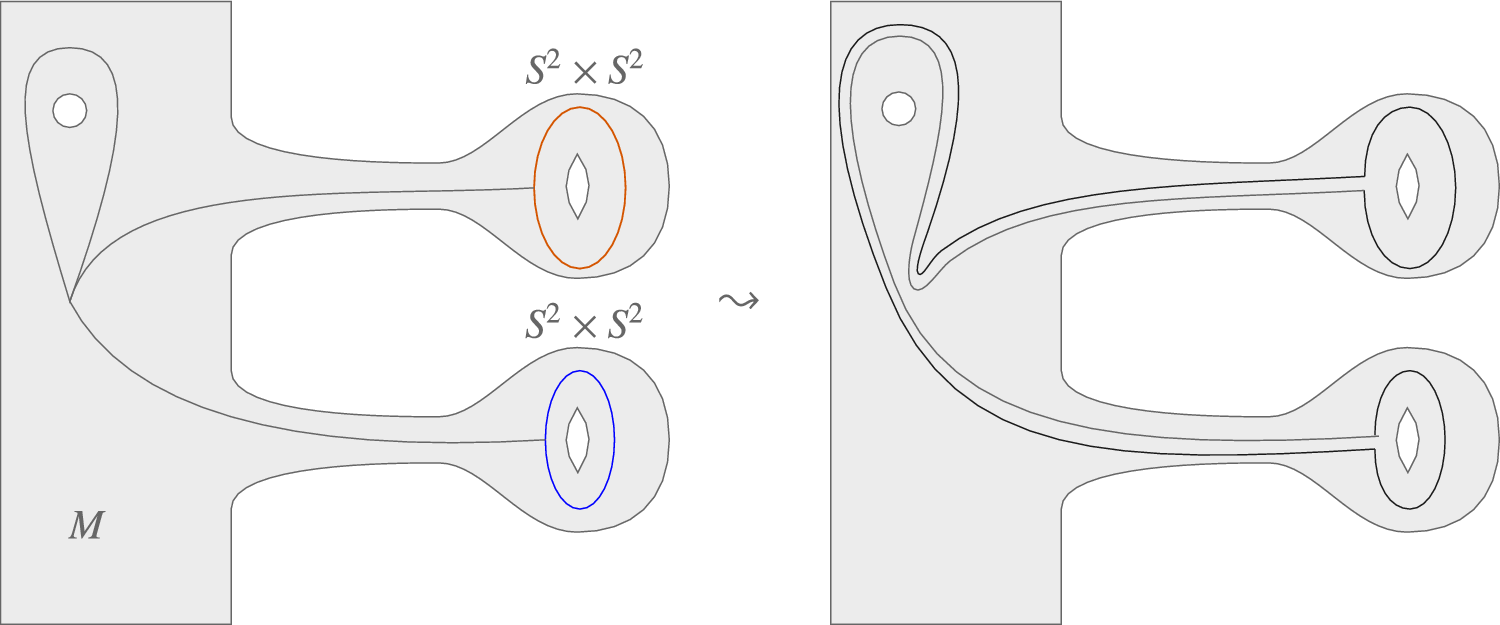
 . An instance of this tubing is illustrated in Figure 1.
A parallel copy of
$B_1$
 (in red) is tubed to a parallel copy of
$B_2$
 (in blue) along a path given concatenating a preferred path from the former to the basepoint, a loop in M, and a preferred path from the basepoint to the latter. In general, we perform many such tubings, possibly involving many parallel copies of the same cores, and also need to specify with which orientation the tubings should be performed.

Figure 1 Long description
The diagram consists of two panels separated by a tilde arrow indicating a transformation.
In the left panel, a large gray manifold M has two bulbous protrusions on the right. Each protrusion contains a torus-like core labeled S super 2 times S super 2. The top core is outlined in red and the bottom core is outlined in blue. A network of thin black lines connects a loop in the upper left of M to the centers of these two cores.
In the right panel, the manifold M is shown after the tubing operation. The red and blue cores have been replaced by black outlines that are now physically connected to the central loop by a continuous, hollow tube-like structure. This tube follows the path of the black lines from the first panel, effectively merging the boundaries of the cores with the path through the manifold.
Using Seifert–van Kampen (see, e.g., [Reference Boyle4, Lemma 9]), each tubing has the effect of adding a relation
$x(i,k) = g(i,k) x(j_{i,k},1)^{\varepsilon (i,k)} g(i,k)^{-1}$
 . Write

Note that
$t(i,1) = x(i,1) = x_1$
 and that

Let
$\langle y_1 \dots y_\ell \mid s_1,\dots ,s_m \rangle $
 be a presentation of
$\pi $
 . Introducing this and the relations coming from tubing, we obtain

where in each generator or relator in which i appears, i ranges from
$1$
 to n. The relations
$x(i,k) = t(i,k)$
 can be canceled against the generators
$x(i,k)$
 , for
$k=2,\dots ,n(i)$
 and
$i=1,\dots ,n$
 . When doing this, we must substitute using these relations into
${\textstyle \prod }_{k=1}^{n(i)} x(i,k)$
 . This yields

We obtain

The latter group is exactly
$\pi (\mathcal {P})$
 . Finally, using Seifert–van Kampen, attaching the copies of
$D^3 \times S^1$
 from the upper boundaries of the 3-handles does not change the fundamental group, and so the inclusion induces an isomorphism

Tracing through the construction, the map induced by the inclusion

is identified under the isomorphisms with the projection given by sending each
$x_i$
 to e.
Let
$x = [X] = [X(\mathcal {P})] \in {\mathrm{Wh}}(\pi )$
 . If
$\dim (x) =0,2$
 , then it follows that the map
$\pi _1(N) \to \pi _1(W)$
 induced by the inclusion is an isomorphism, and so W is an h-cobordism. By construction,
$\tau (W,M) = x$
 . On the other hand, if
$\dim (x) =3$
 , then
$\pi _1(N) \to \pi _1(W)$
 is not an isomorphism, and so W arising from the standard construction fails to be an h-cobordism. This completes the proof of Theorem C.
Example 3.6. For
$\pi = C_5 = \langle g \mid g^5 \rangle $
 and
$x \in {\mathrm{Wh}}(\pi )$
 represented by the unit
$1-g+g^2$
 , we can assume
$\mathcal {P}$
 to have a single generator x and a single relation
$x(gx^{-1}g^{-1})(g^2xg^{-2})$
 . Then the above construction has outgoing boundary where
$\pi _1(N)$
 surjects onto
$S_5$
 , so is not isomorphic to
$C_5$
 [Reference Cohen5, Example (4.5)]. That is,
$\pi (\mathcal {P})$
 is a proper admissible extension. A computer search with GAP among similar admissible extensions of
$C_5$
 yielded no trivial examples.
Remark 3.7. We finish by commenting on how far a general h-cobordism is from the standard construction. Standard handle trading techniques yield the following: every h-cobordism
$W \colon M \leadsto N$
 can be assumed to only have
$2$
 - and
$3$
 -handles, with
$2$
 -handles necessarily trivially attached, as many
$3$
 -handles as
$2$
 -handles, and the
$3$
 -handles attached simultaneously. Thus, it is determined by disjoint embeddings
$\varphi _i \colon S^2 \hookrightarrow M \# n(S^2 \times S^2)$
 with trivialized normal bundles. However, these need not be isotopic to the type of 2-spheres used in the standard construction. It is not apparent whether it is possible to extract from these 2-spheres an admissible presentation or relate its torsion to
$\tau (W,M)$
 .
Acknowledgements
The authors would like to thank Ian Hambleton and Daniel Kasprowski for several helpful remarks, including the suggestion to add case (iii) of Theorem A. The second author thanks Michelle Daher, Daniel Galvin, Csaba Nagy, John Nicholson, and Arunima Ray for stimulating conversations on these and related questions. The authors are grateful to the organizers of the Zeeman Centenary Conference at the University of Warwick in December 2025, at which some of this work was done.
Funding statement
A.K. acknowledges the support of the Natural Sciences and Engineering Research Council of Canada (NSERC; funding reference numbers 512156 and 512250).




 Open access

