In recent years donkey milk (DM) has captured scientific attention because of its compelling nutrients and functional elements. The chemical composition of DM is very similar to human milk so it has been used as an adequate replacement for infants with multiple food allergies and intolerances (Mansueto et al. Reference Mansueto, Iacono, Taormina, Seidita, D'Alcamo, Adragna, Randazzo, Carta, Rini and Carroccio2013). Recently, fermented beverages based on donkey milk were proposed as important sources of probiotics and antioxidants with several health benefits (Perna et al. Reference Perna, Intaglietta, Simonetti and Gambacorta2015).
Donkey milk presents high levels of lactose and low contents of casein and fat. One of the main particularities of DM is its high lysozyme's content (around 1000–4000 mg/l) compared to cow (0·09 mg/l) and human milk (40–200 mg/l) (Chiavari et al. Reference Chiavari, Coloretti, Nanni, Sorrentino and Grazia2005). Lysozyme displays an antibacterial activity against a vast number of Gram-positive bacteria; including lactic acid bacteria (LAB). However some authors suggested that the levels of lactose in DM might contribute to the survival of adapted LAB (Chiavari et al. Reference Chiavari, Coloretti, Nanni, Sorrentino and Grazia2005).
The microbiota of DM has been scarcely studied. Most of the available reports focus on its safety and hygienic quality (Chiavari et al. Reference Chiavari, Coloretti, Nanni, Sorrentino and Grazia2005; Cavallarin et al. Reference Cavallarin, Giribaldi, Soto-Del Rio, Valle, Barbarino, Gennero and Civera2015). Just lately Carminati et al. (Reference Carminati, Tidona, Fornasari, Rossetti, Meucci and Giraffa2014) investigated the LAB composition from bulk milk samples of a single donkey farm using biomolecular methods.
The aim of this study was to provide an ample characterisation of LAB biodiversity in raw donkey milk. We applied a culture-dependent approach, based on randomly amplified polymorphic DNA (RAPD)-PCR combined with 16S rDNA sequencing. A broader survey of the lactic acid bacteria present in DM might contribute to the detection of possible probiotic species with biotechnological potential.
Materials and methods
Milk sampling
Three donkey dairy farms from the Piedmont region, North West part of Italy were sampled during the spring of 2013. In the sampling plan of spring 2014 an additional farm was included. Details of the farms are given in Supplementary Table S1. Bulk milk (300 ml) was collected and stored in sterile conditions at 4 °C. Samples were analysed the day after milking.
Growth and isolation of LAB colonies
Serial dilutions of raw DM were prepared in physiological saline solution and peptone (85 : 15 v:v) (OXOID LTD, Basingstoke, Hampshire, England). LAB colonies were grown on MRS agar (OXOID LTD) at 30 °C for 48 h in anaerobiosis and on M17 agar (OXOID LTD) at 37 °C for 48 h. All the analyses were done in technical triplicate.
Well-defined colonies were inoculated in the corresponding liquid medium under the previously mentioned conditions. Isolates were kept at −80 °C, after the addition of 15% sterile glycerol, until their further analyses.
Identification of isolates by RAPD-PCR and sequencing
RAPD-PCR was performed as described by Andrighetto et al. (Reference Andrighetto, Borney, Barmaz, Stefanon and Lombardi2002). Profiles were grouped with the Gel Compar II software package (Applied Maths, Kortrjik, Belgium) using the Pearson product moment correlation coefficient and UPGMA cluster analysis. Representative isolates from the different RAPD-PCR clusters and subclusters were identified by sequencing the V1–V3 region of the 16S rDNA. Amplification was performed using primer pairs P1 and P2 (Ruaro et al. Reference Ruaro, Andrighetto, Torriani and Lombardi2013); after purification with ExoSAP-IT kit (GE Healthcare), the PCR products were sequenced with the 3130 Genetic Analyser (Applied Biosystems). Species attribution was obtained after alignment of DNA sequences with the public database ‘Ribosomal Database Project’ and with the database available from the National Centre for Biotechnology Information.
Results and discussion
In the last 20 years donkey milk has been studied mainly in Europe. Most of the available reports were conducted in southern Italy where donkeys’ raising is a tradition. The increasing demand from allergic consumers has derived in the opening and spread of donkey dairy farms in the Piedmont region. Cavallarin et al. (Reference Cavallarin, Giribaldi, Soto-Del Rio, Valle, Barbarino, Gennero and Civera2015) evaluated the chemical and microbiological quality of DM in this zone, but a deeper characterisation of its microorganisms, especially LAB, was still needed. This study describes the lactic acid bacteria present in raw donkey milk, reporting microorganisms with biotechnological potential that were not previously associated with DM.
The general characteristics of the surveyed farms are shown in Supplementary Table S1. They are all small family-run dairies, located in different geographic areas.
Jennies are milked once a day; obtaining around one litre per day per animal. Raw milk is sold directly for human consumption or for cosmetics production.
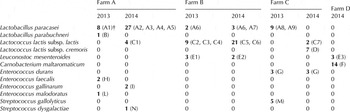
We selected a total of 144 colonies from MRS (N = 92) and M17 (N = 52). Combining the results obtained from RAPD-PCR analysis and 16S rDNA sequencing we found 11 bacterial species and 28 different biotypes (Table 1). LAB species more frequently detected were Lactobacillus paracasei (34%), Lactococcus lactis (29·9%) and Carnobacterium maltaromaticum (9·7%). Less abundant genera were Leuconostoc, Enterococcus and Streptococcus.
Lactic acid bacteria and biotypes determined by RAPD-PCR and 16S rDNA sequencing analyses

† Number of colonies (RAPD-PCR biotype).
L. paracasei – the most abundant species in this study – is commonly found in cheese, mainly participating in the ripening process due to its proteolytic and lipolytic activities. Ashokkumar et al. (Reference Ashokkumar, Sree Krishna, Pavithra, Hemalatha and Priya2011) isolated L. paracasei from DM and tested its bacteriocins for commercial applications in the food processing industry.
Different species of the genus Lactobacillus can be used as probiotics for the production of donkey milk fermented beverage. Particularly L. rhamnosus and L. casei were considered optimum candidates for the production of these beverages (Chiavari et al. Reference Chiavari, Coloretti, Nanni, Sorrentino and Grazia2005). The authors used strains that were isolated from cheese, so they needed an initial growing phase in DM. Recently Perna et al. (Reference Perna, Intaglietta, Simonetti and Gambacorta2015) investigated the fermentative and antioxidant activity of L. acidophilus and L. casei – not isolated from DM – supplemented to donkey milk yoghurt, proposing it as a novel food.
Regarding the coccus-shaped bacteria, the prevalent species in this study corresponded to Lactococcus lactis, constituting the second most abundant group (Table 1). As far as the authors know there are no previous reports of the isolation of this bacterium in DM; though L. lactis has been widely described in cow, goat, sheep, buffalo and human milk (Quigley et al. Reference Quigley, O'Sullivan, Stanton, Beresford, Ross, Fitzgerald and Cotter2013).
Carminati et al. (Reference Carminati, Tidona, Fornasari, Rossetti, Meucci and Giraffa2014) reported the abundance of cocci in DM. It is interesting to note that the authors found only coccus-shaped LAB; in particular Enterococcus faecalis, and Enterococcus faecium as the dominant species. In the present study Enterococcus spp. represented only the 7·5% of the total isolated colonies. These discrepancies might be the result of our broader sampling.
The third most abundant species was Carnobacterium maltaromaticum (Table 1), a psychotropic LAB generally recovered from soft cheeses. It was first isolated from milk with a distinct malty or chocolate like flavour. C. maltaromaticum is a slow acidifying LAB; some strains are considered protective cultures in fish and meat products because they produce bacteriocins against L. monocytogenes (Afzal et al. Reference Afzal, Jacquet, Delaunay, Borges, Millière, Revol-Junelles and Cailliez-Grimal2010).
During the isolation process we observed twelve colonies that grew in MRS, with particular morphologies (data not shown). After their characterisation it was determined that the isolates corresponded to the yeast Kluyveromyces marxianus. These unpredicted recoveries could be due to the scarce selectivity of culture media. K. marxianus is commonly found in dairy products, with a particular contribution in cheese ripening. Recently its potential probiotic features have been studied in isolates from cow milk and whey (Maccaferri et al. Reference Maccaferri, Klinder, Brigidi, Cavina and Costabile2012).
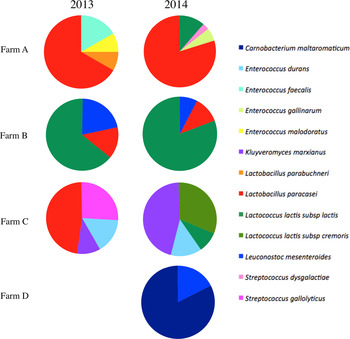
Figure 1 shows the bacterial distributions between the farms denoting a high variability of the ecosystem. Profiles of Farm A and B were very similar from one year to another; with a prevalence of L. paracasei in the former and L. lactis subsp. lactis in the latter. Farm C had a consistent flora of L. paracasei in 2013 that was completely lost in the second year. Farm D was characterised by a homogeneous profile; still it was the only one that presented a high percentage of C. maltaromaticum.
Distribution of the species identified by RAPD-PCR and 16S rDNA sequencing from raw donkey milk.

Going more into detail the two LAB species that presented a higher number of biotypes were L. paracasei and L. lactis subsp. lactis with 9 and 7 different profiles respectively (Table 1). Analysing the distribution of the 28 biotypes it could be observed both farm and year specificities (Table 1). Only Farm B and C maintained a single biotype in both years (A6 and G respectively). It is interesting to note how Farm A and B presented a high variability of profiles even if the species distribution was similar in both years (Fig. 1).
This ample biodiversity is probably due to: (i) the recent introduction in the Piedmont region of donkey milk farms, (ii) the different geographical environments of the farms (iii) the semi-extensive farm type, (iv) the barely standardisation of the farm practices and (v) the bulk milk was probably obtained from different jennies in both samplings – considering the approximately 1-year donkeys’ gestation period.
Moreover all the biotypes’ profiles of L. paracasei and L. lactis subsp. lactis isolated from donkey milk were compared with isolates from cow cheeses (Grana Padano and Asiago cheeses) previously characterised (data not shown). Donkey biotypes grouped with cow's with a range of 53–76% of similarity for L. paracasei and 51–64% for L. lactis subsp. lactis. This observation suggests a genetic relatedness among strains from the two different milk species despite the differences in the composition of both milks.
Regardless of the limitations of the culture-dependent methods, this study represents a significant insight to the ample diversity of the lactic acid bacteria present in the highly selective ecosystem of raw donkey milk. Many of the isolated microorganisms – not detected before in DM – belong to species known for their probiotic and biotechnological potential. Promising fermented products have already been obtained even if the bacteria were not isolated from DM. It is clear how a more comprehensive and detailed knowledge of the intrinsic microbiota of donkey milk might enhance the development of new functional foods with important health benefits for susceptible consumers.
Supplementary material
The supplementary material for this article can be found at http://dx.doi.org/10.1017/S0022029916000376.
All authors participated in both research and manuscript preparation. All authors have approved the final version of this article. The research has been supported by a grant of the Italian Ministry of University and Research (ex 60%).