Introduction
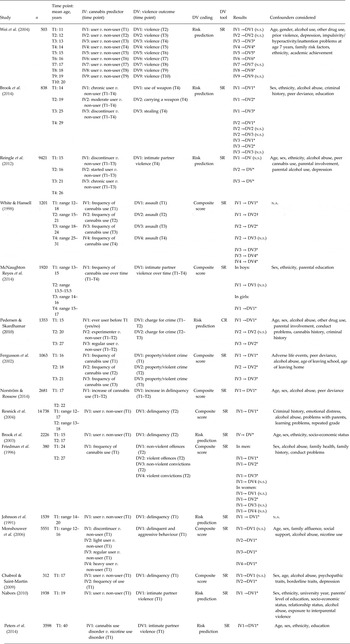
Cannabis is the most widely used illicit drug in most parts of the world (United Nations Office on Drugs and Crime, 2010), with onset of use often during the developmentally critical period of adolescence and persisting through early adulthood (Patton et al. Reference Patton, Coffey, Lynskey, Reid, Hemphill, Carlin and Hall2007). Among the many potential aversive consequences of cannabis use on cognitive, behavioural and mental health outcomes (Lindsay et al. Reference Lindsay, Foale, Warren and Henry2005; Bhattacharyya et al. Reference Bhattacharyya, Fusar-Poli, Borgwardt, Martin-Santos, Nosarti, O'Carroll, Allen, Seal, Fletcher, Crippa, Giampietro, Mechelli, Atakan and McGuire2009, Reference Bhattacharyya, Atakan, Martin-Santos, Crippa, Kambeitz, Prata, Williams, Brammer, Collier and McGuire2012a , Reference Bhattacharyya, Crippa, Allen, Martin-Santos, Borgwardt, Fusar-Poli, Rubia, Kambeitz, O'Carroll, Seal, Giampietro, Brammer, Zuardi, Atakan and McGuire b ; Schoeler & Bhattacharyya, Reference Schoeler and Bhattacharyya2013, Peters et al. Reference Bhattacharyya, Iyegbe, Atakan, Martin-Santos, Crippa, Xu, Williams, Brammer, Rubia, Prata, Collier and McGuire2014; Schoeler et al. Reference Schoeler, Kambeitz, Behlke, Murray and Bhattacharyya2016a , Reference Schoeler, Monk, Sami, Klamerus, Foglia, Brown, Camuri, Altamura, Murray and Bhattacharyya b ), previous research has shown that violent behaviour (Johnson et al. Reference Johnson, Wish, Schmeidler and Huizinga1991; Monshouwer et al. Reference Monshouwer, Van Dorsselaer, Verdurmen, Bogt, De Graaf and Vollebergh2006; Nabors, Reference Nabors2010; Peters et al. Reference Peters, Schwartz, Wang, O'Grady and Blanco2014) or delinquency and aggression in adolescence (Fergusson et al. Reference Fergusson, Horwood and Swain-Campbell2002; Monshouwer et al. Reference Monshouwer, Van Dorsselaer, Verdurmen, Bogt, De Graaf and Vollebergh2006; Chabrol & Saint-Martin, Reference Chabrol and Saint-Martin2009) may result from cannabis use. Pharmacologically, cannabis may cause impairments in response inhibition resulting in behavioural control in vulnerable individuals that may underlie impulsive, violent behaviour, by altering the normal functioning of its underlying neural substrate, the ventrolateral prefrontal cortex in man (Bhattacharyya et al. Reference Bhattacharyya, Iyegbe, Atakan, Martin-Santos, Crippa, Xu, Williams, Brammer, Rubia, Prata, Collier and McGuire2014, Reference Bhattacharyya, Atakan, Martin-Santos, Crippa, Kambeitz, Malhi, Giampietro, Williams, Brammer, Rubia, Collier and McGuire2015). Existing observational evidence in this area, mostly cross-sectional, constrains the possibility of drawing causal inferences. Longitudinal evidence in this regard has been limited as well (Friedman et al. Reference Friedman, Kramer, Kreisher and Granick1996; Brook et al. Reference Brook, Brook, Rosen and Rabbitt2003, Reference Brook, Lee, Finch and Brook2014; Pedersen & Skardhamar, Reference Pedersen and Skardhamar2010), mainly lacking in serial assessments over time and having relatively short follow-up periods (e.g. no study has followed up beyond 15 years; see Table 1). Effects of risk factors such as antisocial personality, alcohol or other illicit drug use or family history of criminality (Farrington, Reference Farrington2000; Jennings et al. Reference Jennings, Reingle, Staras and Maldonado-Molina2012; Theobald & Farrington, Reference Theobald and Farrington2012) have also not always been considered (White & Hansell, Reference White and Hansell1998; McNaughton Reyes et al. Reference McNaughton Reyes, Foshee, Bauer and Ennett2014; Norström & Rossow, Reference Norström and Rossow2014). Preliminary evidence suggests a dose–response relationship between cannabis use and violence/delinquency (Reingle et al. Reference Reingle, Staras, Jennings, Branchini and Maldonado-Molina2012; Brook et al. Reference Brook, Lee, Finch and Brook2014; Norström & Rossow, Reference Norström and Rossow2014), though the evidence is limited from similar shortcomings as highlighted above. All (Johnson et al. Reference Johnson, Wish, Schmeidler and Huizinga1991; Friedman et al. Reference Friedman, Kramer, Kreisher and Granick1996; White & Hansell, Reference White and Hansell1998; Fergusson et al. Reference Fergusson, Horwood and Swain-Campbell2002; Brook et al. Reference Brook, Brook, Rosen and Rabbitt2003, Reference Brook, Lee, Finch and Brook2014; Resnick et al. Reference Resnick, Ireland and Borowsky2004; Monshouwer et al. Reference Monshouwer, Van Dorsselaer, Verdurmen, Bogt, De Graaf and Vollebergh2006; Chabrol & Saint-Martin, Reference Chabrol and Saint-Martin2009; Nabors, Reference Nabors2010; Reingle et al. Reference Reingle, Staras, Jennings, Branchini and Maldonado-Molina2012; Norström & Rossow, Reference Norström and Rossow2014; Peters et al. Reference Peters, Schwartz, Wang, O'Grady and Blanco2014) but one (Pedersen & Skardhamar, Reference Pedersen and Skardhamar2010) of the studies based on longitudinal general population samples assessing criminal behaviour have relied on self-reports of violence. Self-reports may be susceptible to bias such as testing effects, developmental changes or under-reporting of violent behaviour (Lauritsen, Reference Lauritsen1998; Piquero et al. Reference Piquero, Schubert and Brame2014). The only study that collected data from crime registers did not find that cannabis was a significant predictor (Pedersen & Skardhamar, Reference Pedersen and Skardhamar2010), which may suggest either a true null finding or reflect the problem of under-reporting of less serious crimes in record data considering that not all acts of violence need to be criminal in nature (Blumstein et al. Reference Blumstein, Cohen, Roth and Visher1986; Pepper & Petrie, Reference Pepper and Petrie2003). Under-reporting of violence in official records may also arise as a result of failure of the criminal justice system to detect and record all offenders as well as bias in arrest processes. While neither self-report nor official records provide an accurate account of the true rate of crime, they are the methods of choice for obtaining longitudinal data on individual violent careers and it has been suggested that both methods may be employed in concert to overcome some of the limitations of each (Blumstein et al. Reference Blumstein, Cohen, Roth and Visher1986). Furthermore, less is known regarding the directionality of the association between cannabis use and violence, an issue that deserves careful consideration since reverse causation may explain the association. For instance, impulsiveness/disinhibition or conduct problems evident in childhood have also been linked to subsequent use/abuse of cannabis (von Sydow et al. Reference von Sydow, Lieb, Pfister, Höfler and Wittchen2002; Brook et al. Reference Brook, Lee, Finch, Brown and Brook2013; Pingault et al. Reference Pingault, Côté, Galéra, Genolini, Falissard, Vitaro and Tremblay2013) and other studies in adolescents and young adults have reported a reciprocal relationship between substance use and violence (Xue et al. Reference Xue, Zimmerman and Cunningham2009; Scholes-Balog et al. Reference Scholes-Balog, Hemphill, Kremer and Toumbourou2013).
Summary of observational studies looking at the effect of cannabis use on violence

IV, Independent variable, DV, dependent variable, T, time point of assessment; SR, self-reported violence; n.s., cannabis not associated with violence (p > 0.05); n.a., not applicable; CR, criminal records.
* Cannabis associated with increased violence (p < 0.05).
† Cannabis associated with reduced violence (p < 0.05).
In the present study, we have attempted to address the limitations outlined above by employing multi-wave, prospective assessment of a population-based cohort of all school-aged male children from a defined geographical area in London, and included violence data based on both self-report and criminal records to establish the precise nature of the relationship between cannabis use and violent behaviour. The participants have been followed up over nearly half a century to assess the effect of exposure to cannabis at different stages of life on violent behaviour, as indexed using two independent measures, recorded violent convictions (VCs) and self-reports. We examined whether ‘continued use’ is the critical determinant that underpins the association between cannabis use and violence after controlling for potential confounding factors such as family history of criminality, childhood antisocial behaviour, mental health history, alcohol and other illicit drug use (Farrington, Reference Farrington1995; Resnick et al. Reference Resnick, Ireland and Borowsky2004; Bennett et al. Reference Bennett, Holloway and Farrington2008).
Method
Study sample
The Cambridge Study in Delinquent Development (CSDD), originally designed by Donald J. West and directed since 1982 by David P. Farrington, is a prospective longitudinal study of the development of offending and antisocial behaviour in a cohort of 411 boys born mostly in 1953 and living in a homogeneous, working-class urban area of London (West & Farrington, Reference West and Farrington1973; Farrington, Reference Farrington1995). They represented the complete population of boys who were 8 years old at that time (1961/1962) and were attending one of six primary schools in a deprived area in London. Multiple waves (T1–T8) of data collection, which included participant interviews [at ages 8 (T1), 10 (T2), 14 (T3), 16 (T4), 18 (T5), 21 (T6), 32 (T7) and 48 (T8) years] complemented information obtained from parents (annually) and teachers (bi-annually) between the ages of 8 and 15 years. Of the sample, 97% were white and all were raised in two-parent working-class households (Farrington, Reference Farrington1995). For a detailed description of the methods, see online Supplementary Appendix S1.
Measures
VC: criminal records
Conviction information was obtained for every year from age 10–56 years through searches at the central Criminal Record Office in London or from countries where the participants had emigrated to. VC was defined as conviction for robbery, assault, threatening behaviour or possessing an offensive weapon. We estimated two separate dependent variables (DVs). For cannabis users, only convictions that were committed subsequent to cannabis use were considered:
-
(a) DV1 VC (cumulative number of subsequent VCs) was computed by calculating the cumulative mean number/year from age 10 to 56 years.
-
(b) DV2 VC (risk of subsequent VC) was coded as a dichotomized variable, ‘yes’ if at least one conviction was committed between the age of 10 and 56 years.
Self-reported violence (SR-V)
SR-V was measured based on report of the person's involvement in assaults, fights and use of a weapon in physical fights and estimated as two DVs as for VCs:
-
(a) DV1 SR-V (cumulative number of subsequent SR-V): SR-V (yes/no) was available at three different time points: T5, T7 and T8, based on information on violence between age ranges 15–18, 27–32 and 43–48 years, respectively.
-
(b) DV2 SR-V (risk of subsequent SR-V) was a dichotomized variable, coded as ‘yes’ if a subject admitted to violence at T5, T7 or T8.
Cannabis use (independent variable; IV)
Cannabis use during the preceding 5 years was assessed at ages 14 (T3), 16 (T4), 18 (T5), 32 (T7) and 48 (T8) years. For the purposes of this investigation, we focused on cannabis use at T5, T7 and T8, as very few individuals had reported cannabis use at T4 or earlier (see online Supplementary Appendix S2).
-
(a) IV1 (ever cannabis use) was coded as ‘yes’ if a subject was classified as a cannabis user in at least one of the assessments.
-
(b) IV2 (continuity of cannabis use) was computed as an ordinal variable based on cannabis use: (1) never cannabis user, (2) cannabis user at one time point only (e.g. at T5 only but not T7 or T8), (3) cannabis user at two time points (e.g. cannabis use at T5 and T7 but not T8), or (3) cannabis user at all three time points.
Covariates
The covariates included in the analysis were chosen based on previous research, reporting a link between violence and antisocial behaviour (Farrington, Reference Farrington2000), mental illness (Brennan et al. Reference Brennan, Mednick and Hodgins2000) and substance use, including alcohol, illicit drugs and nicotine (Bennett et al. Reference Bennett, Holloway and Farrington2008; Jennings et al. Reference Reingle, Staras, Jennings, Branchini and Maldonado-Molina2012):
-
(a) Antisocial traits were assessed at age 10 years based on teacher, peer or parent ratingsFootnote 1 Footnote † using the Antisocial Personality Scale (Farrington, Reference Farrington1991).
-
(b) Alcohol abuse defined as presence of binge drinking (>13 units per evening in the last month, yes/no) was assessed at T5, T7 and T8 and a continuous variable was computed based on whether binge-drinking was present or not at the 1–3 time points assessed (score ranging from 0 to 3).
-
(c) Other drug use (yes/no) assessed at T7 was coded as ‘yes’ if the person had tried drugs other than cannabis.
-
(d) Cigarette use defined as presence of smoking (>£2 spent on cigarettes per week/over 20 cigarettes/day) was assessed at T5 and T7 and T8 and a score (from 0 to 3) was computed based on whether smoking was present or not at the 1–3 time points assessed (scoring from 0 to 3).
-
(e) Diagnosis of mental illness (yes/no) was assessed using the Structured Clinical Interview for DSM-IV Axis I Disorders (SCID) (First et al. Reference First, Spitzer, Gibbon and Williams1998) as part of a psychiatric interview at T8. Subjects were classified as those with or without a lifetime diagnosis of a mental disorder by age 48 years.
Childhood risk factors
Based on previous literature (West & Farrington, Reference West and Farrington1973; Theobald & Farrington, Reference Theobald and Farrington2012), essential childhood risk factors that may independently contribute to both violence and drug use were included in these analyses:
-
(a) Social class was coded as ‘low’ if the family breadwinner had an unskilled manual job.
-
(b) Family history (presence of delinquent sibling and/or criminal parent) was measured up to the boy's tenth birthday.
Analysis
Data were analysed using R (R Core Team, 2015) comprising four main statistical approaches:
-
(1) The Kruskal–Wallis test was followed by Bonferroni correction for multiple testing to make comparisons among the four different cannabis trajectory groups (never use v. use at one, two or three time points) on the average number of total VCs committed by age 56 years/average number of SR-V by age 48 years.
-
(2) Univariate logistic regression analysis was employed to estimate the effect of cannabis use and other potential risk factors on violence. Subsequently, we carried out multivariate logistic regression analyses to examine the relationship between cannabis use and violence, while accounting for the covariates retained from the initial bivariate models (all factors with p ⩽ 0.10 were included).
-
(3) Fixed-effects logistic regression models were fitted in order to extend the ordinary logistic regression by adjusting for time-invariant non-observed fixed factors that vary across individuals, such as family background, genetic influences, personality or pre-existing violent traits. In order to minimize the influence of reverse causation we (i) implemented fixed-effects models that used lagged outcome, i.e. examined whether changes in cannabis use were associated with subsequent changes in violence and (ii) tested a competing reverse causation model in which we tested the effect of changes in violence on changes in cannabis use. Alcohol use and cigarette use were included as time-dynamic covariates in the models (for details, see Supplementary Appendix S3).
-
(4) Finally, structural equation modelling was employed, in which cross-lagged reciprocal causal pathway models were fitted to examine the longitudinal bi-directional paths between cannabis and violence, while controlling for time-dynamic factors including alcohol and cigarette use (assessed at age 18, 32 and 48 years) and time-invariant factors including antisocial personality measured at age 10 years. Model goodness of fit was assessed on the basis of a number of fit indices described in Supplementary Appendix S4.
Results
Follow-up characteristics
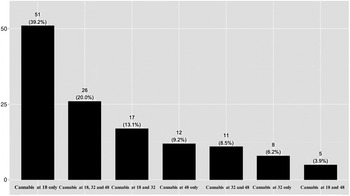
Out of the 411 boys assessed at baseline, complete multi-wave cannabis and violence data (T1–T8) at follow-up 48 years later were available for a total number of 340 for SR-V and 339 for VC (for follow-up flow chart, see online Supplementary Fig. S1). Missing data on alcohol use (n = 1), cigarette use (n = 6) and family history of crime (n = 2) slightly reduced the number of subjects in the multivariate regression models (see Table 2). Comparing subjects without complete data who were not included in the univariate analyses (n = 71) with those with complete data (n = 340) revealed that there were no significant differences between the two groups in predictor variables and violence, except for SR-V at age 18 years. This was less likely to have been reported (p = 0.04) in those who subsequently dropped out (see online Supplementary Table S1). Of the sample, 16% (n = 55/339) had at least one registered VC between the ages of 10 and 56 years, while 49% (n = 165/340) reported a violent act at least once over follow-up. Of this sample, 38% (n = 130/340) had used cannabis at least once in their life, of whom a large proportion (39%) had used cannabis in their teens only and then stopped (Fig. 1), while 20% of those who started it by age 18 years reported using it at the ages of 32 and 48 years.
Cannabis trajectories.

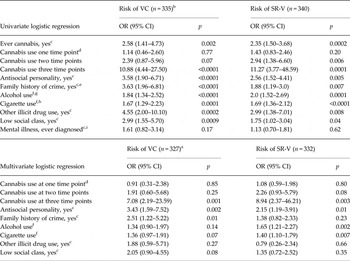
Logistic regression predicting risk of VC and risk of SR-V (following cannabis use) a

VC, Violent conviction; SR-V, risk of self-reported violence; OR, odds ratio; CI, confidence interval.
a For some subjects (n = 4 for conviction data, n = 1 for SR-V) outcome was coded as absence of violence since the violent act only preceded cannabis use (see online Supplementary Table S2).
b Some subjects (n = 4) were excluded since it was not possible to establish whether the conviction was a preceding event or subsequent to cannabis use.
c Dichotomized variable.
d Ordinal variable (reference group is never cannabis use).
e Missing data for n = 2.
f Continuous variable.
g Missing data for n = 1.
h Missing data for n = 6.
i Missing data for n = 50.
The highest proportion of the sample was found to have never been violent and never used cannabis (VC 56%, SR-V 37%; online Supplementary Table S2). Over a fifth reported violent behaviour following cannabis use (SR-V 22%), while a lower proportion was convicted following cannabis use (VC 7%). This was substantially higher than the proportion of subjects in whom violence preceded cannabis use but did not continue subsequently (VC 1.2%, SR-V 0.3%) or those subjects in whom violence preceded and also followed cannabis use (VC 2.1%, SR-V 1.2%).
Continued cannabis use and number of VCs
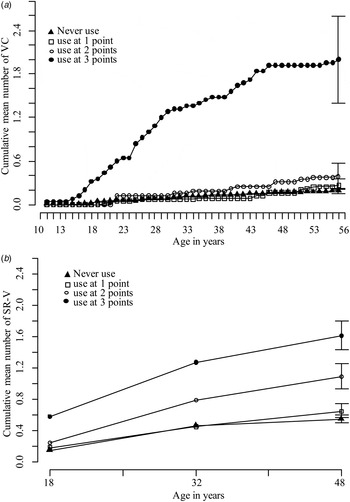
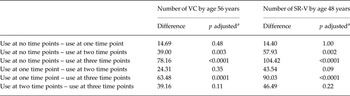
Results from the Kruskal–Wallis test indicated that there was a significant effect of cannabis use trajectory on total number of VCs by age 56 years (p < 0.001) and total number of SR-V by age 48 years (p < 0.001) (Fig. 2a, b ). Pairwise post-hoc testing showed that continued cannabis use was associated with significantly more VCs by age 56 years compared with never users or those who used it only at one or two time points throughout follow-up (Table 3). There was a similar effect on SR-V.
(a) Violent convictions (VC, cumulative means for n = 335) over time by cannabis group. (b) Self-reported violence (SR-V, cumulative means for n = 340) over time by cannabis group. For VC, from the total sample, some subjects (n = 4) were excluded from the analysis since it was not possible to establish whether the conviction was a preceding event or subsequent to cannabis use. Values are means, with error bars.

Kruskal–Wallis test pairwise comparisons

VC, Violent conviction; SR-V, self-reported violence.
a p Values adjusted with Bonferroni correction.
Continued cannabis use and risk of subsequent violence
Univariate logistic regression analysis revealed that those who used cannabis at least once in their life had an increased risk for a subsequent VC [odds ratio (OR) 2.58, 95% confidence interval (CI) 1.41–4.73] and SR-V (OR 2.35, 95% CI 1.50–3.68), but this effect disappeared when controlled for confounders in multivariate analysis (online Supplementary Table S3). When cannabis use was categorized, only continued cannabis use (as indexed by use at all three time points assessed over the follow-up period) remained a significant predictor, implicating a dose-dependent effect (see Table 2). Continued cannabis use remained the strongest predictor for subsequent VC (OR 7.08, 95% CI 2.19–23.59) and SR-V (OR 8.94, 95% CI 2.37–46.21). The only other factor that had a significant effect on both VC and SR-V in the multivariate model was antisocial personality (OR 3.43, 95% CI 1.59–7.52 for VC and OR 2.15, 95% CI 1.19–3.91 for SR-V). Family history of crime was only predictive of VC (OR 2.51, 95% CI 1.22–5.22), and alcohol use (OR 1.65, 95% CI 1.21–2.27) and nicotine use (OR 1.40, 95% CI 1.10–1.79) were associated with SR-V but not VC.
Directionality of the association between cannabis and violence
The results from the cross-lagged fixed-effects models suggest that change in cannabis use over time increases the odds by 1.18 (95% CI 1.09–1.28) for subsequent SR-V and by 1.08 (95% CI 1.02–1.14) for subsequent VC (see online Supplementary Table S5), while controlling for factors that may vary over time, including cigarette and alcohol use. The cross-lagged fixed-effects models testing for reverse directionality showed that SR-V was a significant predictor for subsequent changes in cannabis use (1.06, 95% CI 1.00–1.12); however, a similar effect was not observed for recorded VCs (1.01, 95% CI 0.92–1.12).
The results from structural equation modelling indicate evidence of statistically significant reciprocal relationships between cannabis use and violence, such that (1) cannabis use predicts subsequent VC (0.205, 95% CI 0.026–0.385) and SR-V (0.190, 95% CI 0.065–0.314) and (2) violence in turn also predicts subsequent cannabis use (0.191, 95% CI 0.026–0.356 for VC; 0.215, 95% CI 0.065–0.366 for SR-V). The fit indices for the reciprocal directionality models from the structural equation analysis are shown in online Supplementary Table S6. When exploring the unconstrained path estimates for the different time points, the results indicated that the nature of the association differed depending on the developmental stage: reciprocal associations were present in early adulthood: cannabis use at age 18 years as a predictor for subsequent VC (0.240, 95% CI 0.001–0.479) and SR-V (0.153, 95% CI −0.024 to 0.329); violence at age 18 years as a predictor for subsequent cannabis use: 0.265 (95% CI 0.055–0.476) for VC and 0.324 (95% CI 0.118–0.530) for SR-V. Significant effects of cannabis on violence were present in late adulthood for SR-V [cannabis at age 32 years as a predictor for subsequent SR-V (0.212, 95% CI 0.010–0.414)] but not vice versa [SR-V at 32 years not a predictor for cannabis use at 48 years (0.083, 95% CI −0.100 to 0.266)]. No significant associations (p > 0.25) were found in late adulthood using structural equation modelling (see online Supplementary Fig. S2 and Supplementary Table S5).
Discussion
In the present study, we set out to examine the nature of the association between cannabis use and violent behaviour and the determinants of that relationship. Using data from half a century follow-up of a prospectively recruited cohort from a defined geographical area, we found that exposure to cannabis is associated with an increased risk for subsequent criminal/violent activity across the lifespan from childhood through to middle age that is independent from and persists even after controlling for other measured putative risk factors and unobserved time-invariant factors of confounding. Furthermore, we showed that the adverse effect of cannabis use on subsequent violent behaviour is driven by continued use of the substance, as indexed by use endorsed at multiple time points. Stronger association between violence and use of cannabis endorsed at several time points spread over a substantial proportion of lifetime suggests a dose–response relationship between cannabis use and violence, consistent with previous literature (Monshouwer et al. Reference Monshouwer, Van Dorsselaer, Verdurmen, Bogt, De Graaf and Vollebergh2006; Reingle et al. Reference Reingle, Staras, Jennings, Branchini and Maldonado-Molina2012; Brook et al. Reference Brook, Lee, Finch and Brook2014). We also established that this relationship is not only true for self-reports of violent behaviour, as in the previous studies (Johnson et al. Reference Johnson, Wish, Schmeidler and Huizinga1991; Fergusson et al. Reference Fergusson, Horwood and Swain-Campbell2002; Brook et al. Reference Brook, Brook, Rosen and Rabbitt2003, Reference Brook, Lee, Finch and Brook2014; Resnick et al. Reference Resnick, Ireland and Borowsky2004; Monshouwer et al. Reference Monshouwer, Van Dorsselaer, Verdurmen, Bogt, De Graaf and Vollebergh2006; Nabors, Reference Nabors2010; Reingle et al. Reference Reingle, Staras, Jennings, Branchini and Maldonado-Molina2012; McNaughton Reyes et al. Reference McNaughton Reyes, Foshee, Bauer and Ennett2014; Norström & Rossow, Reference Norström and Rossow2014; Peters et al. Reference Peters, Schwartz, Wang, O'Grady and Blanco2014), but goes beyond existing evidence by demonstrating for the first time that continued cannabis use is associated with a 7-fold greater odds for subsequent VCs, a robust outcome measure that is not vulnerable to some of the methodological weaknesses of SR-V. To put this in perspective, the size of this effect is comparable with the effect of continued nicotine use over similar duration (40 years) on the risk of lung cancer in the UK (OR 8.3, 95% CI 2.3–29.7) (Crispo et al. Reference Crispo, Brennan, Jöckel, Schaffrath-Rosario, Wichmann, Nyberg, Simonato, Merletti, Forastiere and Boffetta2004).
Together, these results imply a reciprocal relationship between cannabis use and violence, which is consistent with a number of studies that reported such a relationship between substance use and violence in adolescence and emerging adulthood (Xue et al. Reference Xue, Zimmerman and Cunningham2009; Scholes-Balog et al. Reference Scholes-Balog, Hemphill, Kremer and Toumbourou2013) as well as studies that suggest a link between impulsiveness/disinhibition or conduct problems evident in childhood and subsequent use/abuse of cannabis (von Sydow et al. Reference von Sydow, Lieb, Pfister, Höfler and Wittchen2002; Brook et al. Reference Brook, Lee, Finch, Brown and Brook2013; Pingault et al. Reference Pingault, Côté, Galéra, Genolini, Falissard, Vitaro and Tremblay2013), alcohol (Caspi et al. Reference Caspi, Moffitt, Newman and Silva1996) or illicit drugs (Fergusson et al. Reference Fergusson, Boden and Horwood2008). Our results tend to suggest that these reciprocal effects are only dominant in early adulthood and violence in later life is not associated with subsequent cannabis use, although cannabis use at later age remained a significant predictor for SR-V. However, it is worth noting that this may also reflect lack of adequate power to detect such effects in the present sample, as both outcomes become less common in later life. No association was found for VC at later age, which may indicate that cannabis use is a stronger predictor for less serious violent acts rather than those that may lead to conviction. The results add to previous investigations on reciprocal relationships reporting that cannabis use but not violence remained a consistent predictor over time (Wei et al. Reference Wei, Loeber and White2004). It has also been reported that the strength of association between crime and cannabis varies across different developmental stages in adolescence, with younger users being more affected than older users (Fergusson et al. Reference Fergusson, Horwood and Swain-Campbell2002), again suggesting that a range of associated psychosocial risk factors evident in younger cannabis users may increase its effect on violence. Together, the results of the present study speak to several of the criteria (specificity, temporality, biological gradient and strength) commonly considered to ascertain whether an association is causal in nature (Hill, Reference Hill1965). Although the findings indicate pharmacological effects of cannabis on violence, the relatively long lag between the measurement time points (>12 years in structural equation models) do not allow one to draw conclusions regarding acute or non-acute pharmacological effects. Nevertheless, the findings are consistent with independent experimental evidence that a single dose of cannabis can cause impairments in behavioural control that may underlie impulsive, violent behaviour, by altering the normal functioning of its underlying neural substrate, the ventrolateral prefrontal cortex in man (Bhattacharyya et al. Reference Bhattacharyya, Iyegbe, Atakan, Martin-Santos, Crippa, Xu, Williams, Brammer, Rubia, Prata, Collier and McGuire2014). These results are not only consistent with previous evidence as highlighted earlier, but also internally consistent, as we show that the relationship exists for two separate but related and complementary outcome measures obtained from independent sources, one based on official records and another on self-report from participants.
By using fixed-effects models and taking into consideration potential confounders in risk prediction models, we have tried to account for both measured and unmeasured time-invariant factors (such as genetic or temperamental traits by considering antisocial personality traits assessed at age 10 years; parental modelling by considering family history of crime; social class, etc.) and factors that change over time (e.g. alcohol binge drinking, cigarette use other illicit drug use). Taking these factors into consideration is crucial as they may potentially confound the association between cannabis use and subsequent violence (Norström & Rossow, Reference Norström and Rossow2014). It is worth noting that despite the range of putative predictors tested here, continued cannabis use remained the most significant predictor in the ordinary multivariate regression analysis and together with antisocial personality traits was consistently associated with both measures of subsequent violent behaviour. The results further indicate that the effect of continued cannabis use is not confounded by antisocial personality traits present at the age of 10 years, another important predictor, albeit with an weaker association (with odds of 3.4 for risk of conviction and odds of 2.2 for risk of SR-V). This is in line with previous research showing that cannabis remains an independent predictor after controlling for early conduct problems (Pedersen & Skardhamar, Reference Pedersen and Skardhamar2010). Antisocial personality traits appear to be a stronger predictor for conviction than for SR-V, consistent with previous research using data from both self-reports and criminal convictions (Moffitt et al. Reference Moffitt, Caspi, Harrington and Milne2002), perhaps indicating that antisocial traits are more likely to be associated with more severe offences (Farrington, Reference Farrington1995).
From a public health point of view, these results are particularly relevant in that they show longitudinal effects of persistent cannabis use on violence. More specifically, they suggest that intervention programmes in early adulthood are likely to be most beneficial if they target both cannabis use and violent behaviour in light of their reciprocal relationship, and provide an empirical basis for consideration of the consequences of cannabis use in middle age. It is worth noting a few caveats in interpreting the results of this study. First, we did not investigate the effects of cannabis use parameters such as frequency of use or type of cannabis used, which have been shown to moderate the effects of cannabis on violence (Friedman et al. Reference Friedman, Kramer, Kreisher and Granick1996; White & Hansell, Reference White and Hansell1998; Fergusson et al. Reference Fergusson, Horwood and Swain-Campbell2002; Monshouwer et al. Reference Monshouwer, Van Dorsselaer, Verdurmen, Bogt, De Graaf and Vollebergh2006; Chabrol & Saint-Martin, Reference Chabrol and Saint-Martin2009; Pedersen & Skardhamar, Reference Pedersen and Skardhamar2010; Norström & Rossow, Reference Norström and Rossow2014). Hence, it may be argued that self-report data of cannabis use as available in this study are imprecise and do not easily demonstrate a dose–response association given the binary (yes/no) measure of cannabis exposure used in this analysis. Nevertheless, we were able to detect a strong association with violent outcomes that persisted after controlling for putative risk factors. An imprecise estimation of the predictor variable is only likely to have diluted its effect on the outcome variable. However, this is unlikely to have influenced the direction of the results reported herein as the effect of cannabis use on violent outcomes that we report here is unlikely to have been overestimated. On the contrary, the true effect of cannabis use on violent outcomes is perhaps greater than that we observe here. Furthermore, an intuitive approach to examining a dose–response relationship in the context of cannabis use has involved taking into account frequency/number of cannabis joints smoked (Fergusson et al. Reference Fergusson, Horwood and Swain-Campbell2002). Instead, the results presented here show that use of cannabis spread over a longer period of an individual's life has a greater effect on violent outcome than use spread over a shorter duration. Persistent cannabis use as in the present study is likely to indicate more frequent use (Windle & Wiesner, Reference Windle and Wiesner2004; Schulenberg et al. Reference Schulenberg, Merline, Johnston, O'Malley, Bachman and Laetz2005). Our results are therefore consistent with studies showing a dose–response relationship between cannabis use and violence. In this context, it is worth mentioning that self-reported cannabis use and violence from age 18 years onwards as reported in this cohort do not reflect lifetime use data but use over the 5 years preceding the follow-up time point under consideration.
Second, the study sample comprised only male subjects, thus not generalizable to females. This aspect of study design was beyond the control of the present investigators, as the cohort was initiated over half a century ago. Nevertheless, given that the association between cannabis use and violence seems to be more prominent in males than females (Friedman et al. Reference Friedman, Kramer, Kreisher and Granick1996; Nabors, Reference Nabors2010; Pedersen & Skardhamar, Reference Pedersen and Skardhamar2010), this study addresses the relationship in the segment of the population where perhaps this may be most relevant. Notwithstanding these limitations, the present study substantially extends the current literature in a number of ways. Most previous studies were cross-sectional or prospectively investigated outcome over relatively short follow-up periods (Farrington, Reference Farrington2010). In contrast, in the present study we were able to investigate prospectively collected data on cannabis use, violent outcome and confounding factors. We used information from multiple time points from statutory, and multiple non-statutory, sources over nearly 50 years of longitudinal follow-up in a sample of all young males of a certain age from a defined catchment area. Furthermore, this methodology enabled us to accurately estimate temporal sequencing of the IVs and DVs of interest that has not been possible in previous studies. Although we cannot conclude formally regarding the causal effects of cannabis on violence as the present study is observational, our methodology enabled us to accurately estimate temporal sequencing of the IVs and DVs of interest that has not been possible in previous studies. Methodology as adopted here is considered only second best to evidence from randomized controlled trials in the context of investigation of causal relationships (Murray et al. Reference Murray, Farrington and Eisner2009). Together, the results of the present study provide support for a causal relationship between exposure to cannabis and subsequent violent outcomes across a major part of the lifespan.
Supplementary material
For supplementary material accompanying this paper visit http://dx.doi.org/10.1017/S0033291715003001
Acknowledgements
The CSDD data collection was funded by the Home Office and the Department of Health. S.B. has received support from the National Institute for Health Research (NIHR) (NIHR Clinician Scientist Award; NIHR CS-11-001) and the UK Medical Research Council (MR/J012149/1) and from the NIHR Mental Health Biomedical Research Centre at South London and Maudsley NHS Foundation Trust and King's College London.
D.P.F. provided the data. S.B., D.T. and D.P.F. designed the study and supervised the analyses; T.S. and D.T. carried out the data analysis and wrote the first draft together with S.B. All other authors reviewed the results and contributed to the final draft of the manuscript.
Declaration of Interest
None.