1. Introduction
1.1. the property generation task and feature variables
Property generation is a task whose main purpose is to measure conceptual representations. In this task, a series of words are presented and subjects must list the features that best describe the concepts to which those words correspond.
As McRae, Cree, Seidenberg, and McNorgan (Reference McRae, Cree, Seidenberg and McNorgan2005) point out, it is important to note that the property generation task does not provide a literal record of conceptual representations, because they are not constituted by a fixed list of straightforwardly verbalizable features; therefore, the complexity and richness of such representations cannot be fully captured by feature listing. Nonetheless, the information provided by this task is valid because participants employ those representations systematically when they produce features.
Different feature variables can be calculated from the data gathered by means of the property generation task. In the present study, we will focus on two of them: feature type and order of production.
feature type refers to the kind of information that a feature conveys. Several taxonomies have been proposed over the years, such as the ones advanced by Warrington and Shallice (Reference Warrington and Shallice1984), Devlin, Gonnerman, Andersen, and Seidenberg (Reference Devlin, Gonnerman, Andersen and Seidenberg1998), Cree and McRae (Reference Cree and McRae2003), Wu and Barsalou (Reference Wu and Barsalou2009), and Peraita and Grasso (Reference Peraita and Grasso2010). These taxonomies share some common aspects, but diverge regarding the quantity and characteristics of the different coding categories that they comprise. For instance, Warrington and Shallice (Reference Warrington and Shallice1984) and Devlin et al. (Reference Devlin, Gonnerman, Andersen and Seidenberg1998) differentiate two main kinds of features: perceptual ones and functional ones. On their part, Wu and Barsalou’s (Reference Wu and Barsalou2009) taxonomy consists of five major categories: taxonomic categories, situation properties, entity properties, introspective properties, and miscellaneous. More recently, Santos, Chaigneau, Simmons, and Barsalou (Reference Santos, Chaigneau, Simmons and Barsalou2011) presented a taxonomy in which three main types of features are differentiated: linguistic, taxonomic, and object-situation. In our research, we employed this taxonomy, which is based on the Linguistic and Situated Simulation theory (hereafter, LASS) (Barsalou, Santos, Simmons, & Wilson, Reference Barsalou, Santos, Simmons, Wilson, De Vega, Glenberg and Graesser2008; Simmons, Hamann, Harenski, Hu, & Barsalou, Reference Simmons, Hamann, Harenski, Hu and Barsalou2008; Santos et al., Reference Santos, Chaigneau, Simmons and Barsalou2011). We will offer a detailed description of this taxonomy in Section 1.4.
order of production refers to the position in which a feature appears in the lists given by participants in the property generation task. This variable is thought to reflect how readily accessible a given feature is. Within LASS theory, order of production is a crucial variable.
1.2. LASS theory: linguistic and situated simulation systems
LASS theory grew out of Paivio’s (Reference Paivio1986) Dual Code Theory. Paivio was one of the first researchers who argued against traditional approaches to conceptual content, which claimed that knowledge is represented exclusively as amodal and arbitrary symbols (Pylyshyn, Reference Pylyshyn1973).
According to Paivio’s (Reference Paivio1986) Dual Code Theory, there does not exist a representational code based on propositions (which are constituted by amodal and arbitrary symbols). On the contrary, there are two representational systems: a verbal system and an imagery system. The representational units that these systems process are modality-specific perceptual-motor analogues. Even though the verbal and imagery systems differ both functionally and structurally, they are closely inter-related.
According to LASS theory, the representation and the processing of concepts also rely on two systems: a linguistic system and a situated simulation system. The first one works with linguistic forms, which may be auditory (i.e., spoken language), visual (i.e., written or sign language), or tactile (i.e., Braille). A crucial characteristic of the linguistic system is that it neither represents nor processes meaning. In this respect, LASS theory is very similar to Glaser’s (Reference Glaser1992) Lexical Hypothesis, according to which the linguistic system performs only a superficial processing, independent of conceptual information. This thesis differentiates LASS and the Lexical Hypothesis from the Dual Code Theory (because, according to the latter, deep conceptual processing occurs in both the verbal and the imagery systems).
LASS theory claims that the meaning of linguistic forms comes from the situated simulation system. Following Barsalou (Reference Barsalou2009, p. 1281), a simulation is “the re-enactment of perceptual, motor and introspective states acquired during experience with the world, body and mind”. Simulations are produced by simulators, which Barsalou defined as the knowledge and associated processes that enable someone to accurately represent something. Accordingly, when someone recognizes the word HORSE, neural states re-enact to represent the way horses look, the sounds they make, the ways in which that person interacts with them, and so on. Besides, the meaning of the word is not represented in a vacuum; on the contrary, it is represented in specific situations: simulations associated with HORSE represent particular horses in specific situations that contain concrete settings (the field), agents (a jockey), objects (a saddle), actions (the horse might be running), etc.
The linguistic and situated simulation systems work together to enable information processing, and both become active after perceiving a stimulus. These systems interact constantly; however, the activation of each system peaks at different moments, and therefore their respective contributions are not simultaneous. When the initial stimulus used in a certain task is a word, the activation of the linguistic system peaks first. On perceiving the word, the linguistic system immediately recognizes it as a linguistic form (which, as noted before, could be visual, auditory, or tactile), and not as a picture or a noise, or anything but language; after that, this system produces other linguistic forms that are associated with the cue word. This word association processFootnote 1 is of central importance in the early stages of conceptual processing. The associated linguistic forms support different superficial strategies and function as pointers to associated conceptual information. When these strategies are good enough for the appropriate execution of certain tasks, there is no need to retrieve conceptual information; this is the case of lexical decision tasks in which subjects must differentiate words from non-words whose phonology or orthography clearly do not correspond to an acceptable or existing word in a given language. Once the linguistic system stops being useful to successfully meet the requirements of a task, the situated simulation system begins to dominate conscious deliberated cognition.
1.3. LASS theory and the property generation task
Few studies have explored in depth the mechanisms that underlie the property generation task, in spite of its wide usage and importance. The main exception to this is Santos et al.’s (Reference Santos, Chaigneau, Simmons and Barsalou2011) research. These authors claim that two different mechanisms underlie the execution of this task: word association (executed by the linguistic system) and situated simulation (executed by the simulation system).
According to LASS theory, the activation of the linguistic system peaks first. Consequently, Santos et al. (Reference Santos, Chaigneau, Simmons and Barsalou2011) predict that the first responses that subjects would give in the property generation task would proceed from this system. These responses would consist in linguistic forms, superficially (not conceptually) associated with the word provided as a stimulus.
The activation of the simulation system peaks more slowly than the activation of the linguistic system. As a consequence, these authors predict that the features that proceed from the simulation system (named ‘object-situation responses’) would be produced later than word associations. Object-situation responses convey deep conceptual information about the properties of the entity to which the verbal stimulus refers (for example, for the stimulus FORK, an answer of this kind could be [is made of metal]Footnote 2) and about aspects of the situations in which that entity is typically encountered (for the stimulus FORK, an answer of this type could be [is found in kitchens]).
One last prediction that can be derived from LASS theory concerns taxonomic features. Three sub-types must be differentiated: superordinate, subordinate, and coordinate. For instance, for the stimulus SPIDER a superordinate response could be [is an animal], a subordinate response could be [tarantula], and a coordinate response could be [scorpion] (see Section 1.4. for a detailed description and examples of these kinds of responses). The production of subordinate or coordinate features can easily be interpreted as a product of a situated simulation, so they are expected to behave like object-situation responses. On the contrary, the case of superordinate concepts is more confusing within LASS theory, because it is not clear how they could be instantiated in a situated simulation. Besides, according to Santos et al. (Reference Santos, Chaigneau, Simmons and Barsalou2011), people memorize – particularly during childhood – phrases that allude to superordinate taxonomic relations; so they suggest that superordinate responses originate in the linguistic system. Therefore, they predict that these responses would tend to be produced after linguistic responses, and before subordinate, coordinate, and object-situation responses.
1.4. santos et al.’s (2011) coding scheme
The hierarchical coding scheme developed by Santos et al. (Reference Santos, Chaigneau, Simmons and Barsalou2011) contains the following response categories (ordered, according to the cited authors, from the most linguistic ones to the least linguistic ones, and therefore from the least conceptual ones to the most conceptual ones; all of the examples that we will mention were proposed by those authors):
-
1. Linguistic responses:
-
1a. Compound continuation forward: compound phrases where the associated word follows the stimulus; these phrases are common in English (the language in which Santos et al.’s (Reference Santos, Chaigneau, Simmons and Barsalou2011) study was carried out) and may be lexicalized. For example, BEE [bee sting].
-
1b. Compound continuation backward: compound phrases where the associated word precedes the stimulus; these phrases are common in English and may be lexicalized. For example, GOLF [miniature golf].
-
1c. Sound similarity: the response is associated with the stimulus because both words sound in a similar way. For example, ACCEPT [except].
-
1d. Root similarity: the associated word has the same root morpheme as the stimulus. For example, ACCEPT [acceptance].
-
1e. Synonym: the response has essentially the same meaning as the stimulus. For example, CAR [automobile].
-
1f. Antonym: the response has the opposite meaning to the stimulus. For example, ACCEPT [reject].
-
-
2. Taxonomic responses:
-
2a. Domain higher-level category (i.e., superordinate): the response refers to categories that encompass the entities which are designated by the stimulus. Those categories can present varied levels of abstraction. For example, BEE [insect], [living being].
-
2b. Domain lower-level category (i.e., subordinate): the response refers to subtypes of the entities which are designated by the stimulus. The level of specificity of such subtypes can vary too. For example, CAR [sedan].
-
2c. Domain same-level category (i.e., coordinate): the response alludes to entities which belong to the same taxonomic level as those that are designated by the stimulus. For example, BEE [wasp].
-
-
3. Object-situation responses: as mentioned above, this kind of response conveys deep conceptual information about the properties of the entity to which the verbal stimulus refers and about aspects of the situation in which that entity is typically encountered. Santos et al. (Reference Santos, Chaigneau, Simmons and Barsalou2011) do not introduce any subcategorization within this class of responses. For example, BEE [wings], [summer], [flowers].
1.5. predictions derived from LASS theory and aim of this paper
To sum up, Santos et al. (Reference Santos, Chaigneau, Simmons and Barsalou2011) propose the following predictions concerning the responses obtained through the property generation task:
-
a. Responses that bare a linguistic relation to the stimulus will tend to be produced earlier than object-situation responses (i.e., linguistic responses will appear earlier in participants’ protocols than object-situation responses).
-
b. Taxonomic superordinate responses will tend to be produced after linguistic responses and before object-situation responses.
-
c. Taxonomic coordinate and subordinate responses will behave like object-situation ones, and will therefore tend to appear after linguistic and superordinate responses.
-
d. Object-situation responses will significantly outnumber linguistic responses.
The aim of the current paper is to test these predictions. In order to do so, we did not collect new data. On the contrary, we employed two existent databases: Manoiloff, Artstein, Canavoso, Fernández, and Segui’s (Reference Manoiloff, Artstein, Canavoso, Fernández and Segui2010) word-association database; and Vivas, Vivas, Comesaña, García Coni, and Vorano’s (Reference Vivas, Vivas, Comesaña, García Coni and Vorano2017) property generation database.
2. Methods
2.1. materials
To contextualize our research, we will first describe the main aspects of Manoiloff et al.’s (Reference Manoiloff, Artstein, Canavoso, Fernández and Segui2010) and Vivas et al.’s (Reference Vivas, Vivas, Comesaña, García Coni and Vorano2017) databases.
2.1.1. Manoiloff et al.’s (Reference Manoiloff, Artstein, Canavoso, Fernández and Segui2010) data
Manoiloff et al. (Reference Manoiloff, Artstein, Canavoso, Fernández and Segui2010) carried out a word association task using 400 words as stimuli, the majority of which are concrete nouns in Argentinian Spanish. The corresponding concepts belong to diverse semantic categories.
35 psychology undergraduate students from the National University of Córdoba (Argentina) participated in this task; participants were either female or male, ranging in age from 18 to 26 years; all of them were native Argentinian Spanish speakers. The task was carried out in two separate sessions. At the beginning of each session, the researchers gave participants individual answer sheets, which included the instruction to write down the first word that came to their minds after hearing each stimulus. After gathering the data, Manoiloff et al. (Reference Manoiloff, Artstein, Canavoso, Fernández and Segui2010) built a base in which they arranged participants’ raw responses per concept according to their value in the variable production frequency (i.e., the quantity of participants who wrote a certain answer).
2.1.2. Vivas et al.’s (Reference Vivas, Vivas, Comesaña, García Coni and Vorano2017) data
Vivas et al. (Reference Vivas, Vivas, Comesaña, García Coni and Vorano2017) implemented a property generation task using the same verbal stimuli that Manoiloff et al. (Reference Manoiloff, Artstein, Canavoso, Fernández and Segui2010) had employed.
810 undergraduate students from the National University of Mar del Plata (Argentina) participated in Vivas et al.’s (Reference Vivas, Vivas, Comesaña, García Coni and Vorano2017) research; participants were either female or male (73% and 27%, respectively), and their ages ranged from 20 to 40 years; all of them were native Argentinian Spanish speakers. Each participant received one spreadsheet, which included 15 stimuli and 15 blank lines per stimuli; each spreadsheet was completed by 30 participants. The instructions were written in the spreadsheets, and asked participants to list all the features that came to their minds to describe the concepts at issue, and to write down those features in the order in which they came to mind. No time limit was given to participants; they completed the task in about 20–30 minutes.
After gathering the data, Vivas et al. (Reference Vivas, Vivas, Comesaña, García Coni and Vorano2017) created an individual file for each spreadsheet. Those files contained 15 pages (one per stimulus), each of which incuded 30 rows (one per participant). Each row contained the raw responses given by each participant, in the order in which they were produced.
2.1.3. Selected data
We selected a subset of Manoiloff et al.’s (Reference Manoiloff, Artstein, Canavoso, Fernández and Segui2010) and Vivas et al.’s (Reference Vivas, Vivas, Comesaña, García Coni and Vorano2017) 400 concepts. First, we restricted our selection to only those words that were monomorphemic non-polysemic nouns; we did this to avoid the effect of processing linguistically complex items. Only 248 words fulfilled this requirement. Then, we analyzed the corresponding concepts by considering the two variables that Santos et al. (Reference Santos, Chaigneau, Simmons and Barsalou2011) took into account: linguistic associativeness and conceptual type. We obtained the values of these two variables using Manoiloff et al.’s (Reference Manoiloff, Artstein, Canavoso, Fernández and Segui2010) word association data.
The variable linguistic associativeness is operationalized by Santos et al. (Reference Santos, Chaigneau, Simmons and Barsalou2011) as the percentage of linguistic responses that a stimulus produces in a word association task. There are three possible values for this variable: low (0% to 33.3% of linguistic responses), medium (33.4% to 66.6% of linguistic responses), and high (66.7% to 100% of linguistic responses).
Santos et al. (Reference Santos, Chaigneau, Simmons and Barsalou2011) propose to identify the conceptual type of a stimulus according to the most frequent association it produces in a word association task. Those researchers consider eight conceptual types: compound continuation forward, compound continuation backward, synonym, antonym, taxonomic category, semantic field, stereotypical object property, and brand. We added a ninth conceptual type: inverse stereotypical object property. Every conceptual type will be described in Section 2.2.2.
In order to calculate linguistic associativeness and conceptual type, first we had to code the responses given by participants in Manoiloff et al.’s (Reference Manoiloff, Artstein, Canavoso, Fernández and Segui2010) word association task. (We excluded from our consideration the responses that were produced only by one participant, because – as Nelson, McEvoy, and Schreiber (Reference Nelson, McEvoy and Schreiber1999) note – idiosyncratic responses are highly unreliable.) To code the responses, we employed a modified version of the coding scheme designed by Santos et al. (Reference Santos, Chaigneau, Simmons and Barsalou2011) (see Section 2.2.1.). We introduced some modifications into their scheme, because (a) some coding categories were underspecified in their paper, and (b) we needed to contemplate some of the peculiarities of the language we worked with (Spanish). The responses gathered by Manoiloff et al. (Reference Manoiloff, Artstein, Canavoso, Fernández and Segui2010) were coded by two raters who were trained in the coding scheme. In cases of doubt, a consensus was established between the two raters and a third independent rater.
After coding every response, we calculated the linguistic associativeness and conceptual type of the 248 concepts that we had preselected. Only 25 concepts showed high values of linguistic associativeness; 45 showed medium values; and 178 showed low values. We selected 25 concepts from each group.
All but one of the concepts which presented a high level of linguistic associativeness presented the values ‘compound continuation forward’ or ‘compound continuation backward’ as their conceptual type; the conceptual type of the remaining concept was ‘semantic field’. Conceptual types were more diversified in the case of the concepts which presented a medium level of linguistic associativeness, and were even more diversified in the case of the concepts which presented a low level of linguistic associativeness. Nonetheless, even among these concepts, the distribution of conceptual types was far from homogeneous; furthermore, two conceptual types were absent from our base: antonyms and brands. Taking this into account, we selected the 25 concepts of medium linguistic associativeness and the 25 concepts of low linguistic associativeness by stratified random sampling (the strata were defined by conceptual type), in order to represent the different conceptual types as homogeneously as possible.
The list of the stimuli we finally selected, with their corresponding values of linguistic associativeness and conceptual type, is shown in the ‘Appendix’.
2.2. procedure
Once we had selected the 75 concepts we would work with, we extracted their corresponding features from Vivas et al.’s (Reference Vivas, Vivas, Comesaña, García Coni and Vorano2017) property generation database. This base contains the raw (i.e., not unified: see Section 2.2.3.) responses given by participants (30 participants per concept), and those raw responses appear in the spontaneous order in which they were produced. For the 75 concepts we had selected, there was a total of 9831 unique responses.
We coded each of these responses following our adjusted version of Santos et al.’s (Reference Santos, Chaigneau, Simmons and Barsalou2011) coding scheme (see Section 2.2.1.). We followed the authors’ prescription of applying it sequentially: if the response bore a linguistic relationship to the stimulus, these authors classified it as a linguistically related response. If the response could not be classified as linguistic, they evaluated whether it could be coded as taxonomic: if that was the case, they coded it as a taxonomically related response. If the response had not been coded as linguistically or taxonomically related to the stimulus, they classified it as an object-situation response. The features were coded by two raters who were trained in the coding scheme. In cases of doubt, a consensus was established between the two raters and a third independent rater.
2.2.1. Adapted version of Santos et al.’s (Reference Santos, Chaigneau, Simmons and Barsalou2011) coding scheme
Linguistic response categories
-
a. Compound continuation forward: the response and the stimulus constitute a compound lexical unit or noun phrase. The continuation is forward because the response appears after the stimulus. We applied this category to cover those cases in which the response and the stimulus form a linguistic unit, be it a true compound word (a1), or a well-formed noun phrase of several subtypes (a2 and a3):
-
a1. True compound words: the stimulus and the response together form a single word, as in TELA [telaraña] ‘SPIDER [spider web]’.
-
a2. Compound phrases: two or more words used together which, though maintaining their phonological independence, behave as a single lexical unit and not as a head and a modifier. Consequently, the following linguistic proof can be applied: if all of the words behave as a single lexical entry, adding a modifier will affect the whole phrase and not any of the individual words. Compound phrases can be semantically transparent (i.e., the meaning of the compound can be easily inferred from the meaning of each word) or opaque (i.e., the meaning of the compound cannot be inferred from the meaning of the component words). We also include here obvious fixed collocations, such as [como perro y] GATO ‘[like dog and] CAT’.
-
a3. Well-formed noun phrases bearing a head–complement relationship. This subcategory covers specifically those cases in which the complement is an argument thematically selected by the head. The thematic roles can be: origin (BANANA [de Ecuador] ‘BANANA [from Ecuador]’), means ([viaje en] AVIÓN ‘PLANE [trip]’), content (BOTELLA [de vino] ‘BOTTLE [of wine]’), material (PANTALÓN [de jean] ‘[jean] TROUSERS’), or goal (TIJERA [de podar] ‘[pruning] SHEARS’). So this category covers several cases of prepositional phrases. However, in many cases the prepositions did not spontaneously appear in participants’ answers; we consider that it was legitimate to include them because, because of their syntactic properties, those prepositions are light syntactic connectors which carry no lexical value but make the syntactic relationship visible and render the phrase agrammatical if they do not appear. This subcategory also covers the cases in which head and complement as a unit refer to a clearly identifiable subtype of the class of the entities designated by the head; for instance, ÁGUILA [calva] ‘EAGLE [bald]’. For an adjective to be considered a complement, the proper gender and number agreement requirements should be met and the whole noun phrase should be replaceable by ‘a kind of + head’. Consequently, for instance, [calva] ‘[bald fem sg]’ can be coded as a compound continuation forward response for ÁGUILA, but [calvos] ‘[bald masc pl]’ cannot, because it does not agree in terms of gender and number with ÁGUILA.
-
-
b. Compound continuation backward: this category has the same definition and covers the same cases as compound continuation forward. The only difference lies in the fact that in this case the response appears before the stimulus, not after it.
We applied compound continuation forward or backward when the response consisted of either the missing part of the compound continuation or the whole compound continuation. For instance, if the stimulus is TREN ‘TRAIN’, both the response [bala] ‘[bullet]’ and the response [tren bala] ‘[bullet train]’ (i.e., high-speed rail) were coded as cases of compound continuation forward.Footnote 3
-
c. Sound similarity: the sound of the response is similar to the sound of the stimulus. For example: MARIPOSA [hermosa] ‘BUTTERFLY [beautiful]’. In most cases, the last syllable of the response is identical to the last syllable of the stimulus, and the response and the stimulus have the same number of syllables. Both Manoiloff et al.’s (Reference Manoiloff, Artstein, Canavoso, Fernández and Segui2010) word association task and Vivas et al.’s (Reference Vivas, Vivas, Comesaña, García Coni and Vorano2017) property generation task were carried out in written form, not orally; this is not problematic, because of the high grapheme–phoneme transparency of Spanish.
-
d. Root similarity: the response has the same root morpheme as the stimulus. For example: GALLINA [gallinero] ‘HEN [henhouse]’.
-
e. Synonyms: the response has essentially the same meaning as the stimulus. For example: AUTO [coche] ‘CAR [automobile]’.
-
f. Antonyms: the response has the opposite meaning of the stimulus. For example: RÁPIDO [lento] ‘FAST [slow]’.
Taxonomic response categories
-
a. Superordinate categories: the response refers to categories that encompass the entities which are designated by the stimulus. Those categories can present varied levels of abstraction. For example: GATO [felino] [animal] [ser viviente] ‘CAT [feline] [animal] [living being]’.
-
b. Subordinate categories: the response refers to subtypes of the entities which are designated by the stimulus. For example: PERRO [Golden Retriever] ‘DOG [Golden Retriever]’. The level of specificity of such subtypes can vary too. This coding category also includes responses that allude to the existence of different subtypes without specifying any of them in particular, as in MARIPOSA [hay diferentes especies] ‘BUTTERFLY [there are different species]’.
-
c. Coordinate categories: the response alludes to entities which belong to the same taxonomic level as those that are designated by the stimulus. For instance, TENEDOR [cuchara] ‘FORK [spoon]’.
Object-situation responses
These responses refer to the characteristics of the object which is designated by the stimulus, or to diverse aspects of the situations in which the object at issue usually appears (such as qualities of those situations, actions that are carried out with the object, mental states that the object provokes, etc.). For example, BANANA [amarilla] [se come] [mono] [es rica] ‘BANANA [yellow] [is eaten] [monkey] [is tasty]’.
2.2.2. Relationship between coding responses and conceptual types
As we have previously indicated, the conceptual type of a certain concept is defined by the most frequent associations elicited by the concept in a word-association task. Thus, in the case of the conceptual type compound continuation forward, the dominant word associate is a compound continuation forward response; in the conceptual type compound continuation backward, the dominant word associate is a compound continuation backward response; in the conceptual type synonym, the dominant word associate is a synonym response; in the conceptual type antonym, the dominant word associate is an antonym response; in the conceptual type taxonomic category, the dominant word associate is a taxonomic superordinate response; in the conceptual type semantic field, the dominant word associate is a taxonomic coordinate response; in the conceptual type stereotypical object property, the dominant word associate is an object-situation response; in the conceptual type that we added, i.e., inverse stereotypical object property, the dominant word associate is an object-situation response as well;Footnote 4 finally, in the conceptual type brand, the dominant word associate is a response that refers to a certain brand.
2.2.3. Unification and coding scheme
The spontaneous responses that subjects give in tasks such as word association and property generation are usually very variable. For some purposes, it seems reasonable to unify them (that is to say, to record identically those responses that purportedly convey the same meaning). However, in the context of this project we considered that it was better to work with the raw (i.e., not unified) responses, because unification might interfere with the appropriate application of the coding scheme.
Some morphological features of the responses, such as their gender and number, are important to identify which coding category should be used to classify them. If we had unified the responses, those cues would have disappeared. For example: some participants gave the answer [calva] ‘[bald fem sg]’ for the stimulus ÁGUILA ‘EAGLE’, but others produced [calvas] ‘[bald fem pl]’, [calvo] ‘[bald masc sg]’, and [calvos] ‘[bald masc pl]’. In the former case, the response is coded as a compound continuation forward (see a3. of the adapted coding scheme). But it is not possible to code the latter three cases in the same way, because in those cases there is no number and/or gender agreement between the noun and the adjectives.
2.3. statistical analyses
Once we had coded all the features, we performed a descriptive analysis in order to describe the proportion of the different types of feature, both discriminated per conceptual type and in general. Furthermore, in order to determine if there were significant differences among the proportions of the diverse feature types, we performed a one-way ANOVA considering the general response category (i.e., linguistic, taxonomic superordinate, taxonomic coordinate and subordinate, and object-situation) as a factor, and the proportions of each feature type per concept as response variable. As a second step, we calculated the proportion of each feature type for each level of linguistic associativeness. We performed separated one-way ANOVAs for each general response category in order to determine if there were significant differences according to the linguistic associativeness (which is a factor with three levels: high, medium, and low) of the 75 selected concepts. Finally, we described and analyzed the order of production of each feature type. We performed a χ2 analysis with general response category and output position (1st to 6th), considering the frequency of each type of response. Conceptual type was included as a layer. All the databases are provided online <https://osf.io/ywh4c/?view_only=6a1abfabba2d4e5fa160eb6ec3dda335>.
3. Results
In the tables that follow, we will present separately the data that corresponds to the specific and general response categories. The general response category labeled ‘linguistic’ includes the following specific response categories: compound continuation forward, compound continuation backward, root similarity, sound similarity, synonym, and antonym. The general response category labelled ‘taxonomic superordinate’ includes only taxonomic superordinate responses. The general response category labelled ‘taxonomic coordinate-subordinate’ includes taxonomic coordinate and taxonomic subordinate responses. Finally, the general response category labelled ‘object-situation’ includes only object-situation responses. We decided to report the results concerning taxonomic coordinate-subordinate responses separately from taxonomic superordinate ones because (as we mentioned in Section 1.3.) the behavior of the former type of responses should diverge from the behavior of the latter.
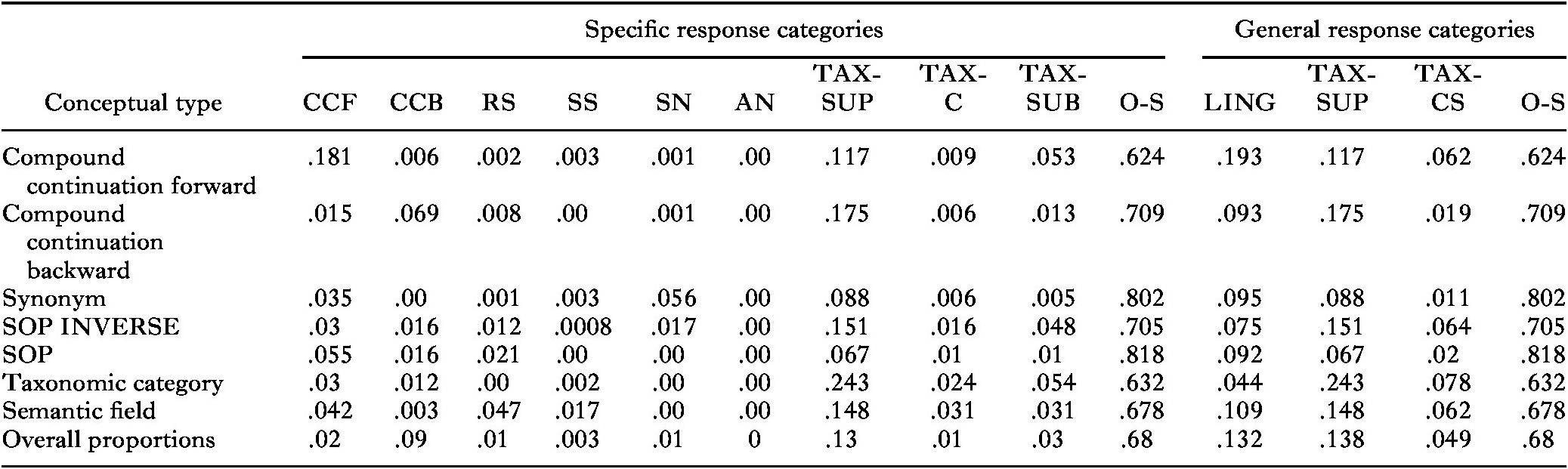
First of all, the proportion of each feature type for each conceptual type was calculated (see Table 1). As can be observed, the results for the specific response categories confirm the assignment of the concepts to the different conceptual types: thus, the largest proportion of compound continuation forward responses was registered in the cluster of compound continuation forward concepts; the largest proportion of compound continuation backward responses corresponded to the cluster of compound continuation backward concepts; the largest proportion of synonym responses occurred in the cluster of synonym concepts; the largest proportion of taxonomic superordinate responses was registered in the cluster of taxonomic category concepts; the largest proportion of taxonomic coordinate responses occurred in the cluster of semantic field concepts; finally, the largest proportion of object-situation responses was registered in the cluster of stereotypical object property concepts. However, the second largest proportion of object-situation responses was not registered in the cluster of inverse stereotypical object property concepts, as was expected; instead, it was registered in the cluster of synonym concepts.
Proportion of types of features according to conceptual type

Notes. CCF: compound continuation forward; CCB: compound continuation backward; RS: root similarity; SS: sound similarity; SN: synonym; AN: antonym; TAX-SUP: taxonomic superordinate; TAX-C: taxonomic coordinate; TAX-SUB: taxonomic subordinate; O-S: object-situation; LING: linguistic; TAX-CS: taxonomic coordinate-subordinate; SOP INVERSE: stereotypical object property inverse; SOP: stereotypical object property.
It is also relevant to observe that the proportion of root similarity, sound similarity, and synonym responses was particularly low, and that antonym responses were absent. Furthermore, in order to determine if there were significant differences among the proportions of each feature type, a one-way ANOVA was performed, considering the general response category as a factor and the proportion of each feature type per concept as response variable. The results indicated that there were significant differences among the proportions of each general feature type (F(3,296) = 723.052, p < .001, ƞ = .880). The proportion of object-situation responses significantly outnumbers the proportion of linguistic (p < .001), taxonomic superordinate (p < .001), and taxonomic coordinate-subordinate (p < .001) responses. There was no statistical difference between linguistic and taxonomic superordinate responses (p = 1). Additionally, significant differences were observed between linguistic and taxonomic coordinate-subordinate responses (p < .001), and between taxonomic superordinate and taxonomic coordinate-subordinate responses (p < .001).
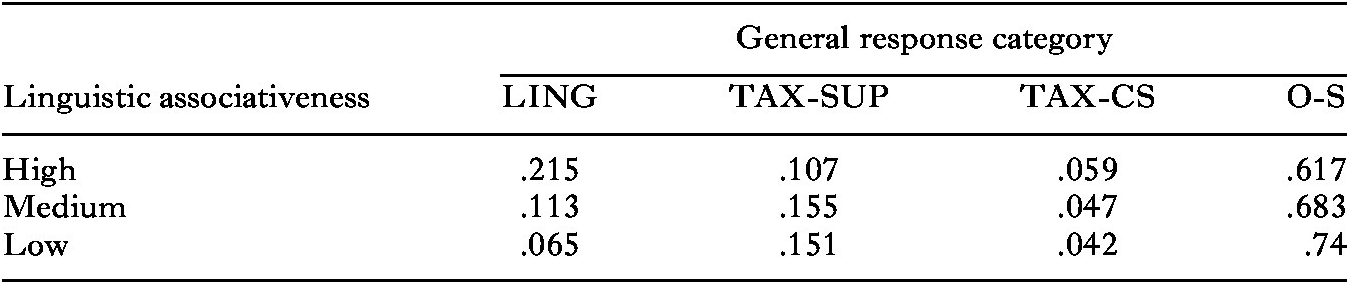
As can be seen in Table 2, we also calculated the proportion of responses of each of the general response categories according to the linguistic associativeness level of the concepts. Separated one-way ANOVAs were performed for each general response category in order to determine if there were differences according to the linguistic associativeness (a factor with three levels: high, medium, and low) of the 75 selected concepts. The ANOVA for the proportion of linguistic responses indicated significant differences across the three levels of linguistic associativeness (F(2,72) = 26.418, p < .001, ƞ = .423), showing that the proportion of linguistic responses is high for concepts with high linguistic associativeness, and low for concepts with low linguistic associativeness. Conversely, the analysis of object-situation responses indicated that the concepts with low levels of linguistic associativeness showed a high proportion of this kind of responses (F(2,72) = 9.018, p < .001, ƞ = .200); in particular, significant differences were observed between the proportion of object-situation responses in concepts with high levels of linguistic associativeness and the proportion of object-situation responses in concepts with medium levels of linguistic associativeness (p < .001). For its part, the ANOVA for the proportion of taxonomic superordinate responses did not indicate significant differences across the three levels of linguistic associativeness (F(2,72) = 2.741, p > .05). Finally, taxonomic coordinate-subordinate responses also remained relatively constant across the different levels of linguistic associativeness (F(2,72) = 0.819, p > .05).
Proportion of responses by linguistic associativeness level and general response category

Notes. LING: linguistic; TAX-SUP: taxonomic superordinate; TAX-CS: taxonomic coordinate-subordinate; O-S: object-situation.
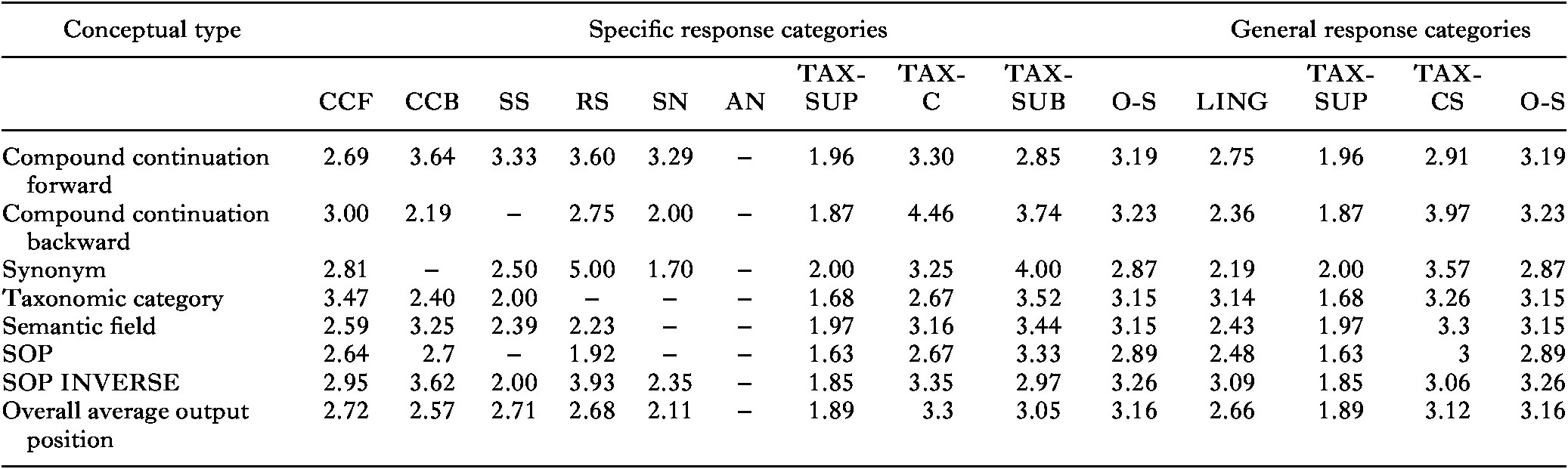
Finally, the average output position of each feature type was analyzed. Table 3 displays the results of the output position of each response type (1 corresponds to the first response that participants gave for a stimulus, 2 to the second, and so on). Linguistic responses were produced earlier (mean order of production = 2.66; SD = 1.517) than object-situation responses (mean order of production = 3.16; SD = 1.495); and taxonomic coordinate-subordinate responses (mean order of production = 3.12; SD = 1.423) showed a similar pattern of output position to object-situation responses. On their part, taxonomic superordinate responses were produced earlier (mean order of production = 1.89; SD = 1.363) than linguistic responses. Actually, taxonomic superordinate responses showed the earliest output positions averages in every conceptual type, whilst linguistic responses were the second fastest kind of responses in every conceptual type. On their part, taxonomic coordinate-subordinate and object-situation responses were the slowest types of responses in every conceptual type.
Average output position by specific response category, general response category, and conceptual type

Notes. CCF: compound continuation forward; CCB: compound continuation backward; SS: sound similarity; RS: root similarity; SN: synonym; AN: antonym; TAX-SUP: taxonomic superordinate; TAX-C: taxonomic coordinate; TAX-SUB: taxonomic subordinate; O-S: object-situation; LING: linguistic; TAX-CS: taxonomic coordinate-subordinate; SOP INVERSE: stereotypical object property inverse; SOP: stereotypical object property.
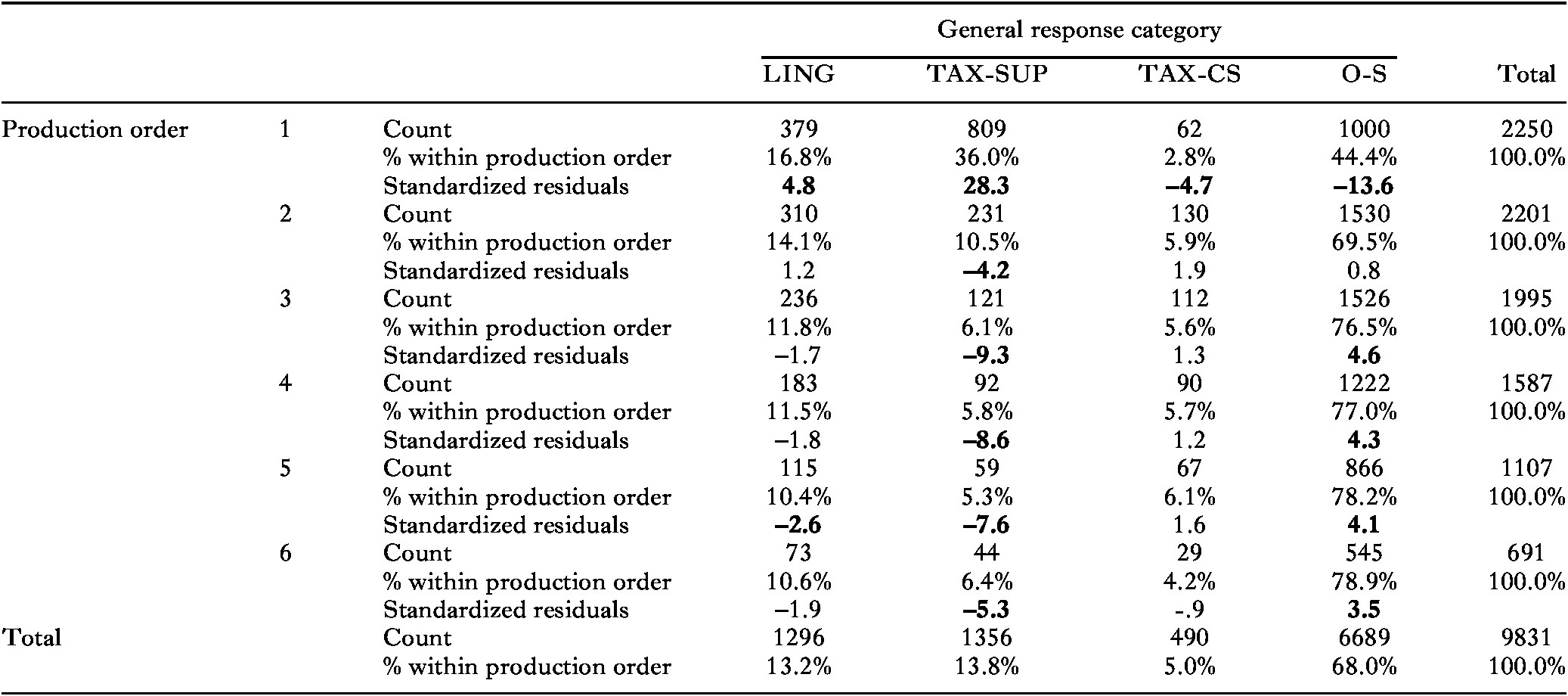
Furthermore, a χ2 analysis was performed with general response category and output position (1st to 6th), considering the frequency of each type of response. Conceptual type was included as a layer. The results indicate significant differences for the full model (χ2 (15, N = 9831) = 1390, p < .001) as well as for each conceptual type (p < .001). Table 4 shows the contingency table corresponding to the full set with independence of conceptual type. The numbers of the standardized residuals indicate which values make a higher contribution to the value of the statistic (standardized residuals higher than 2 or lower than –2 are considered significant). As can be seen, linguistic responses were higher than expected and taxonomic superordinate responses were much higher than expected.
Contingency table with production order and general response category

Notes. LING: linguistic; TAX-SUP: taxonomic superordinate; TAX-CS: taxonomic coordinate-subordinate; O-S: object-situation.
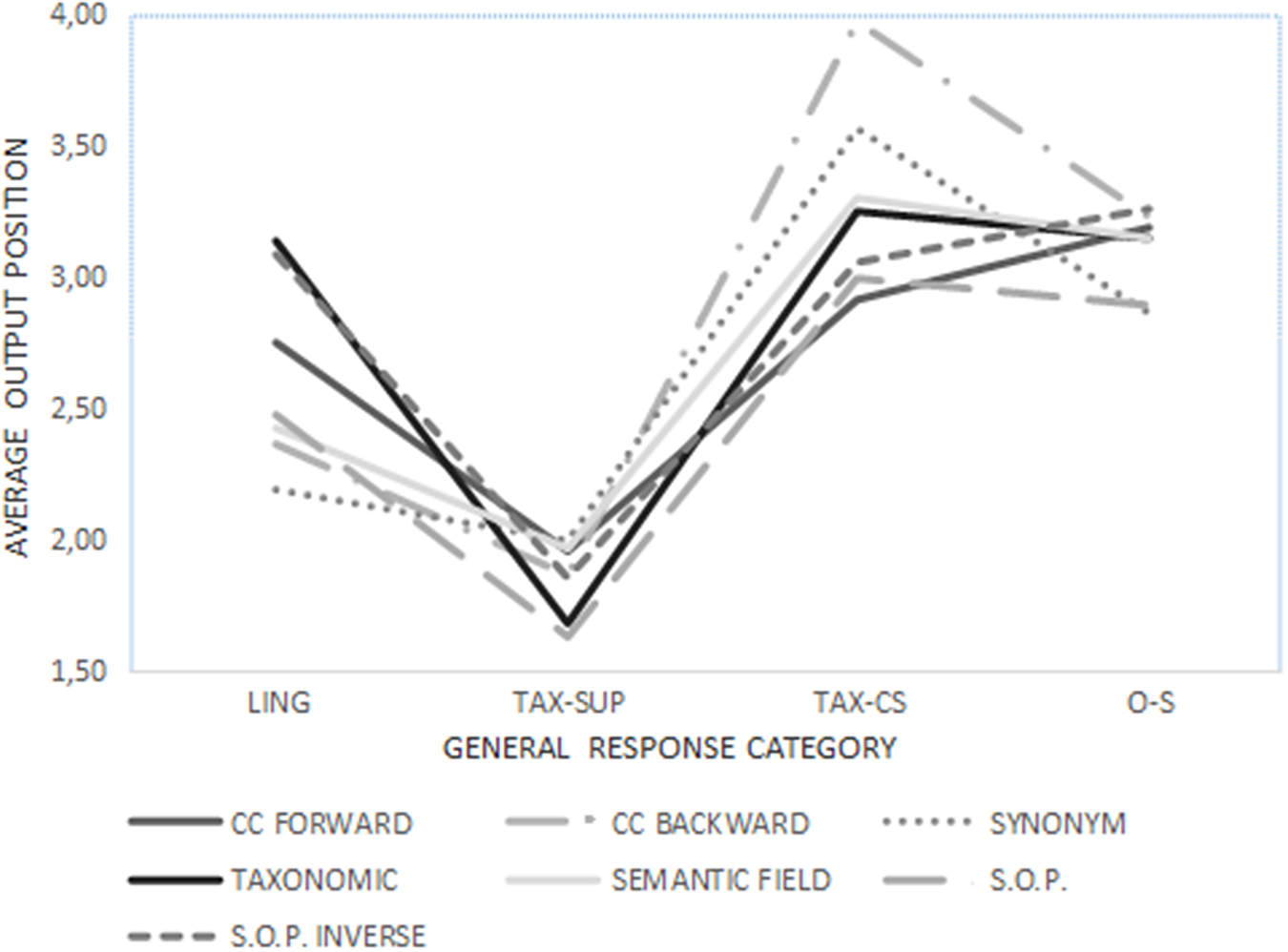
As illustrated in Figure 1, there are some differences in the patterns of the output position of the general response categories according to the conceptual type, which indicates that this variable modulates the average output position of the general response categories. For instance, in the case of synonym concepts, the average output position of linguistic responses was considerably lower than the average output position of object-situation and taxonomic coordinate-subordinate responses; in contrast, in the case of taxonomic category concepts, the average output position of linguistic responses did not differ substantially from the average output position of object-situation and taxonomic coordinate-subordinate responses. It can also be observed that the variability across conceptual types of the average output position of linguistic and taxonomic coordinate-subordinate responses is higher than the variability of taxonomic superordinate and object-situation responses. It is also important to note that, in every conceptual type, taxonomic superordinate responses were produced faster than any other type of response.
Average output position by general response category and conceptual type.
Notes. CC FORWARD: compound continuation forward; CC BACKWARD: compound continuation backward; SOP: stereotypical object property; SOP INVERSE: stereotypical object property inverse; LING: linguistic; TAX-SUP: taxonomic superordinate; TAX-CS: taxonomic coordinate and subordinate; O-S: object-situation.

4. Discussion
The aim of the current paper was to test predictions derived from LASS theory, using Vivas et al.’s (Reference Vivas, Vivas, Comesaña, García Coni and Vorano2017) property generation database. We will analyze each of the results and discuss the evidence obtained in favor and against each prediction in turn.
Initially, we performed some descriptive analyses in order to study the effect of the conceptual type and linguistic associativeness of the concepts. First of all, we observed (see Table 1) a correspondence between feature type and conceptual type, as also observed by Santos et al. (Reference Santos, Chaigneau, Simmons and Barsalou2011, pp. 103–104): the highest proportion of compound continuation forward responses occurred in the stimuli that correspond to the compound continuation forward conceptual type; the highest proportion of compound continuation backward responses occurred in the stimuli that correspond to the compound continuation backward conceptual type; and so on. Given that the conceptual types were defined according to the patterns of responses that the different concepts produced in Manoiloff et al.’s (Reference Manoiloff, Artstein, Canavoso, Fernández and Segui2010) word association task, these results show that the property generation task tapped into word association patterns (see also Vivas, Manoiloff, García, Lizarralde, & Vivas, Reference Vivas, Manoiloff, García, Lizarralde and Vivas2018). Nonetheless, it can be observed that the proportions at issue are not significantly high (for instance, the proportion of synonym responses in the stimuli that correspond to the synonym conceptual type is .056). This fact could be accounted for considering that the vast amount of time that participants had to produce their answers may have allowed the simulation system to generate more responses, thereby making the word association patterns less evident. The only exception is the case of object-situation responses in the stereotypical object property conceptual type, and this is precisely because that conceptual type is defined by responses typically produced by the simulation system.
It was observed (see Table 1) that object-situation responses were the most prevalent type of feature, while sound similarity, root similarity, and synonyms were the least frequent kinds of responses, and antonyms were absent.Footnote 5 Taken as a whole, linguistic responses were clearly outnumbered by object-situation responses. Our results are similar to those obtained by Santos et al. (Reference Santos, Chaigneau, Simmons and Barsalou2011, p. 104). Our results support the prediction derived from LASS theory concerning the differences between the proportions of those kinds of responses. According to this theory, this can be explained by considering the long production time of the property generation task, which allows the simulation system to reach its peak and sustain its activity, increasing the number of responses which originate in that system. However, there is an alternative and simpler explanation to account for this result: the instructions of the property generation task explicitly ask participants to produce characteristic features of the concepts at issue; therefore, it is not likely that participants would produce sound similarity responses, root similarity responses, synonyms, or antonyms, as these types of responses do not match the aim of the task.
We also studied the relationship between general feature type and linguistic associativeness. It was observed (see Table 2) that the proportion of linguistic responses decreases when linguistic associativeness declines. This result, which is in accordance with what Santos et al. (Reference Santos, Chaigneau, Simmons and Barsalou2011, p. 105) found, supports the hypothesis that the process of word association is implied in the property generation task. For their part, taxonomic superordinate, coordinate, and subordinate responses remain stable across the different levels of linguistic associativeness. In this respect, Santos et al.’s (Reference Santos, Chaigneau, Simmons and Barsalou2011, pp. 105–106) results differ from our results: they found that the proportion of taxonomic responses increased as the level of linguistic associativeness declined.Footnote 6 Finally, we found that the proportion of object-situation responses increases significantly as the level of linguistic associativeness of the concepts descends. In this respect, our results differ again from the ones found by Santos et al. (Reference Santos, Chaigneau, Simmons and Barsalou2011, pp. 105–106): in their case, object-situation responses remained almost exactly constant across the three levels of linguistic associativeness. These researchers interpret these two last results as indicating that the linguistic system is responsible not only for linguistic responses but also for taxonomic superordinate responses; we will object to this idea later on in this section.
Finally, we analyzed (see Tables 3 and 4) the order of production of each type of feature to test the remaining three predictions derived from LASS theory: (1) responses that bear a linguistic relation to the stimulus will tend to be produced earlier than object-situation responses; (2) taxonomic superordinate responses will tend to be produced after linguistic responses and before object-situation responses; and (3) taxonomic coordinate and subordinate responses will behave like object-situation responses, and so will tend to appear last.
The first and the third predictions were corroborated in our study; in this respect, our results are very similar to the ones obtained by Santos et al. (Reference Santos, Chaigneau, Simmons and Barsalou2011, pp. 106–108). In contrast, the second prediction was not corroborated in our study: taxonomic superordinate responses tended to appear faster than any other kind of responses. However, our results are similar to Santos et al.’s (Reference Santos, Chaigneau, Simmons and Barsalou2011, p. 108) results in this respect too: they reported that taxonomic superordinate responses were produced faster than any other type of response (with the exception of antonym responses; however, they too found a very low proportion of this type of response; 2011, p. 97). Again, these researchers interpret this result as supporting the idea that taxonomic superordinate responses originate in the linguistic systems; later on, we will present arguments against this.
As indicated, our results are quite similar to the ones obtained by Santos et al. (Reference Santos, Chaigneau, Simmons and Barsalou2011). Nonetheless, and as we anticipated, we consider that their proposal presents some limitations which should be analyzed, and which qualify the conclusions that can be extracted from those results. We will dedicate the rest of this section to the discussion of these issues.
First of all, we consider that it would be convenient to carry out a critical review of the types of responses that Santos et al. (Reference Santos, Chaigneau, Simmons and Barsalou2011) judge to be linguistic. The need of such a review comes from the lack of clarity concerning what these authors mean when they define the linguistic system as a system which only processes formal and shallow aspects of words. This may be interpreted in several different ways. If – as Santos et al. seem to assert in many occasions – formal and shallow aspects of words are completely divorced from semantic and conceptual properties, then only phonological or orthographic properties (i.e., perceptual properties) could genuinely be considered linguistic. If so, sound similarity responses would be the only clearly linguistic kind of response; it is important to highlight again that the proportion of this type of response was significantly low, both in our database and in Santos et al.’s database. Root similarity responses are not as shallow and formal as sound similarity responses: the fact that two words share a root morpheme implies that they are related by the semantic-conceptual information carried by that morpheme. Furthermore, synonyms and antonyms clearly involve semantic information (Katz, Reference Katz1972; Pustejovsky, Reference Pustejovsky1995); consequently, they should not be considered a product of the shallow processing of the linguistic system.
We consider that the linguistic system processes both phonological and semantic formal features; i.e., the linguistic system processes phonological forms and logical forms (in the sense of Chomsky, Reference Chomsky2000). It was in line with this that we modified Santos et al.’s (Reference Santos, Chaigneau, Simmons and Barsalou2011) coding scheme; the main modifications we introduced concerned forward and backward continuation compounds. Thus, as we indicated in Section 2.2.1., we classified a response which produced – together with the stimulus – a noun phrase bearing a head–complement relationship as a compound continuation response even if the preposition did not appear in the response given by the participant, because such prepositions, due to syntactic properties, are light syntactic connectors carrying no lexical value. We specified the complement as an argument thematically selected by the head, and we detailed the thematic roles we considered (origin, means, content, material, and goal), because they are formal properties that determine the linguistic structure.
Having said this about forward and backward compound continuation responses, it should be noted that, although they could be stored as lexical contiguities, as Santos et al. (Reference Santos, Chaigneau, Simmons and Barsalou2011) suggest, they could also be produced by a situated simulation. Consider the response [hive] for the concept BEE: the cognitive process that results in the production of [hive] can be thought to involve the lexical expression of a thematic relation (Estes, Golonka, & Jones, Reference Estes, Golonka and Jones2011; García Coni, Ison, & Vivas, Reference García Coni, Ison and Vivas2019) of a scene where a bee is next to a hive. If that was the case, that response would be a product of the simulation system, instead of being a product of the linguistic system. This fact is recognized by Santos and colleagues (Reference Santos, Chaigneau, Simmons and Barsalou2011), but they argue that it is less likely that the compound [beehive] results from the description of a simulation than that it emerges from the linguistic system; however, they do not give any argument in favor of this claim.
Another aspect of Santos et al.’s (Reference Santos, Chaigneau, Simmons and Barsalou2011) coding scheme which should be critically appraised is related to the order in which it should be applied. As we indicated at the end of Section 2.2., we followed Santos and colleagues’ prescription of applying it in a sequential way. It could be argued that this could lead to the spurious confirmation of Santos et al.’s predictions concerning the order of production of the different feature types. We acknowledge this risk; however, we consider that that risk decreases as the description of each coding category becomes increasingly precise. Santos et al.’s coding scheme is quite precise; thus, it is quite likely to classify the responses in a very similar way when applying the coding scheme sequentially and when applying it simultaneously. Furthermore, we consider that our modified version of Santos et al.’s coding scheme is even more precise than theirs; therefore, the coincidences between its sequential and its simultaneous application should be greater. Now, whether we agree about when to consider that a response is linguistic is a different issue, which we have already discussed in the previous paragraphs.
Another important issue that should be discussed concerns taxonomic superordinate responses; these do not fit clearly into LASS theory. Santos et al. (Reference Santos, Chaigneau, Simmons and Barsalou2011, p. 92) claim that these responses are usually conceived as involving conceptual relations, but they can also be extracted through language, as we learn phrases like “a cat is an animal”, and thus – they claim – this type of responses may originate in the linguistic system. These researchers do not provide adequate arguments for this claim; but even if we accepted it, we consider – based on the authors that we will discuss in the following paragraphs – that taxonomic superordinate relations are clearly deeper than mere linguistic associations. Thus, it is difficult to interpret, from LASS theory, the fact that taxonomic superordinate responses appear first in the lists produced by participants in the property generation task.
Alternative models conceive superordinate relations differently. For example, in Zannino, Perri, Monaco, Caltagirone, Luzzi, and Carlesimo’s (Reference Zannino, Perri, Monaco, Caltagirone, Luzzi and Carlesimo2014) proposal, simple categorizations (e.g., differentiating things that can be eaten from those that cannot) can be derived from modality-specific representations, while more complex classifications based on explicit criteria (e.g., identifying different household items) would be processed in the central component of the semantic network. Most of the taxonomic superordinate responses in our study are of this last type.
Another alternative view to consider here is the hub-and-spoke model (Lambon Ralph & Patterson, Reference Lambon Ralph, Patterson, Hickok and Small2008; Lambon Ralph, Reference Lambon Ralph2014). According to this model, superordinate classification is an essential function of the supra-modal semantic hub, which is not linguistic. This hub would always be essential for object classification due to its function as a supra-modal component, which integrates information from multiple sensorimotor subsystems, including language. As can be noted, these theoretical proposals suggest that the production of superordinate responses would be an index of deep conceptual activation.
At this point, it is important to distinguish the properties of the linguistic system as conceived within LASS theory (i.e., a system that does not process meaning, but merely word forms), from the way in which it is conceived within alternative proposals. Many authors propose that the linguistic system does process deep conceptual information. For example, Andrews, Vigliocco, and Vinson (Reference Andrews, Vigliocco and Vinson2009) propose two kinds of data from which information can be extracted to build a semantic representation: experiential and distributional. The former would be extracted from the interaction with the physical world, and the latter from the statistical distribution of words throughout spoken and written language. Word meaning would emerge from the combination of both types of data. In this case, these authors do not refer to two systems, but to different sources of information for meaning representation.
Another proposal in the same line is the extended version of the hub-and-spoke model, developed by Hoffman, McClelland, and Lambon Ralph (Reference Hoffman, McClelland and Lambon Ralph2018). In the original version, these authors include verbal and non-verbal information within the same semantic system; the multi-modal information would be integrated in a trans-modal hub (Lambon Ralph, Jefferies, Patterson, & Rogers, Reference Lambon Ralph, Jefferies, Patterson and Rogers2016). But in the extended version, they incorporated some principles of the distributional semantics approach, considering “the idea that semantic relationships can also be inferred from the co-occurrence of words or objects in the same contexts” (Hoffman et al., Reference Hoffman, McClelland and Lambon Ralph2018, p. 320). Therefore, the supra-modal semantic hub would be the core component of the semantic system, while it would receive input and send output to modality specific systems, including verbal descriptors.
Alternatively, the model proposed by Zannino and colleagues (Reference Zannino, Perri, Monaco, Caltagirone, Luzzi and Carlesimo2014) states that semantic memory comprises a central supra-modal hub and several superficial modality-specific (input and output) representations. However, in contrast to the hub-and-spoke model, they propose that the supra-modal hub is involved every time our behaviors are based on declarative, verbalizable thought, but other non-verbal categorization processes can take place outside this system on implicit tasks. Zannino and colleagues consider that superficial verbal representations (word forms) do not carry meaning, but are input and output stages needed to verbalize word meaning.
Thus, taking into account different explanations beyond the LASS model, it can be thought that, when people are instructed to produce defining features for certain concepts, the first operation they perform would consist of identifying the category to which the object at issue belongs. This can be interpreted as a process instantiated in the semantic hub, according to the hub-and-spoke proposal (Hoffman et al., Reference Hoffman, McClelland and Lambon Ralph2018), or in the linguistic hub proposed by Zannino et al. (Reference Zannino, Perri, Monaco, Caltagirone, Luzzi and Carlesimo2014). That process would allow to assign to the object the properties of the corresponding category (e.g., it is an animal; therefore: it eats, breaths, dies, etc.) (Lambon Ralph, Reference Lambon Ralph2014). Then, subjects would focus on the object-situation properties. On the one hand, that would include specific properties inherent to the object. That information would be initially extracted from the spokes, according to the hub-and-spoke model. On the other hand, it would include properties related to the context where the object is found or used, or the objects with which it is associated (i.e., situational properties). This last kind of information would be extracted from the patterns of co-occurrence of items, as explained by the extended hub-and-spoke model (Hoffman et al., Reference Hoffman, McClelland and Lambon Ralph2018).
Finally, it should be pointed out that, as Borghesani and Piazza (Reference Borghesani and Piazza2017) state, the timing of semantic processing depends on the task. Consequently, the hypothesized initial activation of the linguistic system would not be universal. Barsalou himself (Lebois, Wilson-Mendenhaal, & Barsalou, Reference Lebois, Wilson-Mendenhaal and Barsalou2015) has argued for this idea. As the property generation task is a controlled production task, participants have time to decide consciously which feature is more relevant for the task at hand. This process would direct semantic activation when automatic processing fails to generate a suitable response (Hoffman et al., Reference Hoffman, McClelland and Lambon Ralph2018).
5. Conclusion
Our results support three of the four hypotheses derived from LASS theory: (1) object-situation responses significantly outnumber linguistic responses; (2) linguistic responses appear earlier than object-situation responses; and (3) taxonomic coordinate and subordinate responses behave like object-situation responses, and therefore appear after linguistic and taxonomic superordinate responses. In spite of this, we consider that LASS theory presents different limitations related to these predictions; therefore, we have offered critical considerations of diverse aspects of this theory.
In addition, our results do not support the remaining prediction derived from LASS theory: that taxonomic superordinate responses tend to be produced after linguistic responses and before object-situation responses. On the contrary, we observed that this kind of responses was produced earlier than any other type of responses. We have analyzed alternative explanations to account for these results.
We think that the data obtained both by Santos et al. (Reference Santos, Chaigneau, Simmons and Barsalou2011) and by means of the current study is not enough to assert that the linguistic system activates first in property generation tasks. Furthermore, we consider that many of the responses classified as linguistic by Santos et al. can be attributed to a deeper processing, so alternative models (such as the hub-and-spoke model or the linguistic hub hypothesis) can provide better accounts for the property generation task data.
Finally, some caveats must be raised about our results. First of all, unlike Santos et al. (Reference Santos, Chaigneau, Simmons and Barsalou2011), our analyses cover only concrete concepts; thus, our results cannot be generalized to other types of words. Besides, as the property generation task gives enough time to perform a controlled processing, it is difficult to know just by analyzing behavioral responses the timing of semantic processing. Moreover, it may be convenient to analyze our data employing different coding schemes, in order to examine if – and, in any case, to what extent – the results differ. We consider that it would be profitable to address these and related issues in future investigations.
Appendix
1. Concepts whose linguistic associativeness is high

2. Concepts whose linguistic associativeness is medium

3. Concepts whose linguistic associativeness is low