Palmer amaranth is a summer annual weed that infests arid regions of northern Mexico and the southwestern United States (Culpepper et al. Reference Culpepper, Webster, Sosnoskie and York2010; Sauer Reference Sauer1957). Movement of Palmer amaranth seed from the U.S. Southwest to the U.S. East Coast occurred from the late 19th to early 20th century (Sauer Reference Sauer1957). A press release from the Weed Science Society of America in 2017 reported Palmer amaranth as the most problematic weed in broadleaf, fruit, and vegetable crops. In 2011 Palmer amaranth was identified in Indiana in previously flooded fields along the Ohio River in Posey and Vanderburgh counties (Legleiter and Johnson Reference Legleiter and Johnson2013). Transport of Palmer amaranth seed from infested fields to new areas has been reported to occur via contaminated gin trash and strong winds (Menges Reference Menges1987; Norsworthy et al. Reference Norsworthy, Smith, Steckel and Koger2009). To date, Palmer amaranth has been found in 44 counties in Indiana. It is not clear how Palmer amaranth was introduced to these counties, but many infestations have been located near livestock facilities. This association my help to explain Palmer amaranth’s introduction and spread throughout Indiana.
Biological characteristics that limit season-long Palmer amaranth control include an extended emergence pattern and rapid vegetative growth. In South Carolina, Palmer amaranth emergence begins in early May and ceases in late October (Jha and Norsworthy Reference Jha and Norsworthy2009). Similar Palmer amaranth emergence patterns have been observed in Indiana (unpublished data). Palmer amaranth plants that emerge early in the season produce the highest quantity of seed. Keeley et al. (Reference Keeley, Carter and Thullen1987) reported a single female plant that emerged in early May produced 600,000 seeds plant−1 by late November compared with August-emerging plants that produced 62,000 seeds plant−1. Early-emerging Palmer amaranth also produces large amounts of biomass and competes with cash crops. Klingaman and Oliver (Reference Klingaman and Oliver1994) reported that season-long Palmer amaranth competition with soybean reduced soybean grain yield 68% with Palmer amaranth densities of 10 plants m−1 row. Cotton (Gossypium hirsutum L.) lint yield is more sensitive to Palmer amaranth competition than soybean grain yield. Rowland et al. (Reference Rowland, Murray and Verhalen1999) reported season-long Palmer amaranth competition at densities of 1 plant m−1 row reduced cotton lint yield by 86%.
In recent years, control of Palmer amaranth has been unsuccessful in cropping systems where continuous glyphosate use has selected for resistant biotypes (Grey et al. Reference Grey, Turpin, Wells and Webster2014; Norsworthy Reference Norsworthy2003; Sosnoskie and Culpepper Reference Sosnoskie and Culpepper2014). Palmer amaranth resistant to glyphosate was first identified in Macon County Georgia in 2005 and is now present in 27 states, including Indiana (Culpepper et al. Reference Culpepper, Grey, Vencill, Kichler, Webster, Brown, York, Davis and Hanna2006; Heap Reference Heap2017). Glyphosate-resistant (GR) biotypes have been confirmed in 15 out of 18 counties in Indiana from which Palmer amaranth was screened (unpublished data). Further complicating control, some Palmer amaranth biotypes have evolved resistance to herbicides other than glyphosate; including imazethapyr and thifensulfuron, trifluralin, atrazine, fomesafen, and topramezone (WSSA site-of-action groups 2, 3, 5, 14, and 27, respectively) (Gossett et al. Reference Gossett, Murdock and Toler1992; Horak and Peterson Reference Horak and Peterson1995; Jhala et al. Reference Jhala, Sandell, Rana, Kruger and Knezevic2014; Peterson Reference Peterson1999; Salas et al. Reference Salas, Burgos, Tranel, Singh, Glasgow, Scott and Nichols2016).
Over the past decade, biotechnology companies have been working to develop corn (Zea mays L.), cotton, and soybean that express genes that endow resistance to glyphosate plus 2,4-D choline herbicides. A new formulation of 2,4-D, known as 2,4-D choline, was designed to mitigate off-target injury to 2,4-D–sensitive species and will be the only 2,4-D formulation labeled in ‘Enlist®’ soybean. Soybean cultivars that contain Enlist® traits, when planted into soils treated with 2,4-D choline, will not require a waiting period prior to planting and will also survive POST treatment to glyphosate plus 2,4-D choline when applied at recommended rates.
There are currently 17 weed species that have evolved resistance to 2,4-D after 60 yr of this herbicide’s commercial availability. In the United States, repeated applications of 2,4-D have selected for 2,4-D–resistant spreading dayflower (Commelina diffusa Burm. f.), wild carrot (Daucus carota L.), common waterhemp (Amaranthus rudis Sauer), and prickly lettuce (Lactuca serriola L.) (Heap Reference Heap2017). Tall waterhemp [Amaranthus tuberculatus (Moq.) Sauer], a notorious weed that has evolved resistance to six herbicide sites of action, was reported to survive 35.8 kg ae ha−1 of 2,4-D (Bernards et al. Reference Bernards, Crespo, Kruger, Gaussoin and Tranel2012). Moreover, horseweed [Conyza canadensis (L.) Cronq.] biotypes with varying degrees of sensitivity to 2,4-D amine exist in Indiana (Kruger et al. Reference Kruger, Davis, Weller and Johnson2008).
Deregulation of crops resistant to glyphosate plus 2,4-D choline are expected to increase 2,4-D applications year−1 from an average of 1.9 in 2015 to 2.3 by 2019 (Benbrook Reference Benbrook2012). Large-scale misuse of glyphosate plus 2,4-D choline–resistant cropping technologies will likely result in evolution of 2,4-D–resistant weed biotypes, mimicking what has been observed in the past decade following misuse of GR cropping technologies. The objectives of this research were to characterize glyphosate resistance and 2,4-D amine tolerance in four Palmer amaranth biotypes and determine whether a premix formulation of glyphosate plus 2,4-D choline (Enlist Duo®) applied at current recommended labeled field rates is effective in controlling GR and glyphosate-susceptible Palmer amaranth that also exhibits variable tolerance to 2,4-D amine.
Materials and Methods
Sampling Strategy
A total of 44 biotypes were collected during 2013 and 2014 from fields infested with Palmer amaranth. Most fields were in soybean production at the time of Palmer amaranth seed collection. Seed were collected from female plants, as described by Burgos (Reference Burgos2015). Information regarding collection location and cropping system are listed in Table 1. Seed from biotype 35, denoted as S1, was collected from a field in commercial watermelon [Citrullus lanatus (Thunb.) Matsum. & Nakai] production and was selected as the susceptible control. The S1 biotype has a known history to be controlled with glyphosate and 2,4-D amine.
Location and cropping system of fields where Palmer amaranth seeds were collected.

Preliminary Screening Procedure
All 44 biotypes were evaluated in a preliminary herbicide screening experiment that was conducted once. Palmer amaranth seeds were germinated on a 200-square plastic-plug tray that measured 28 by 55 by 2 cm and were covered with clear plastic lids for 40 h in the greenhouse. A single plant at the 2 true-leaf stage was transplanted into a 164-cm3 Cone-tainer™ (Ray Leach SC-10 Super Cell Cone-tainers, Stuewe & Sons, Corvallis, OR) filled with a mixture of silt loam field soil, sand, and potting medium at a 7:2:1 ratio and fertilized biweekly (Miracle-Gro® Water Soluble All Purpose Plant Food (24-8-16), Scotts Miracle-Gro Products, Marysville, OH). Greenhouse temperatures were maintained from 23 to 30 C, and plants were exposed to supplemental lighting with a 16-h photoperiod. A total of 10 plants from each biotype were treated with 2,500 g ae ha−1 of glyphosate (Touchdown HiTech®, Syngenta Crop Protection, P.O. Box 18300, Greensboro, NC) plus 0.25% v/v of nonionic surfactant (Activator 90, Loveland Products, P.O. Box 1286, Greeley, CO) (44 biotypes×10 replications=440 plants). Ten additional plants from each biotype were treated with 560 g ae ha−1 of 2,4-D amine (Weedar® 64, Dow AgroSciences, 9330 Zionsville Road, Indianapolis, IN) (44 biotypes×10 replications=440 plants). All treatments included ammonium sulfate (N-Pak AMS® 3.4L, Winfield Solutions, St Paul, MN) applied at 2.9 kg ai ha−1. Spray applications were made inside an enclosed track-spray chamber with a single 8002E nozzle (TeeJet®, Spraying Systems, Wheaton, IL) calibrated to deliver a carrier volume of 140 L ha−1 at a pressure of 207 kPa. Plants were returned to the greenhouse after treatment.
Biotype Selection
Results from the preliminary greenhouse experiments showed that all plants from biotypes 33, 36, and 44 (denoted as R1, R2, and R3, respectively) survived treatment to 2,500 gaeha−1 of glyphosate at 21 d after treatment (DAT) and all plants from biotype S1 were controlled. The R1, R2, and R3 biotypes were suspected to be GR, because glyphosate failed to control these biotypes in the field. Results from preliminary greenhouse experiments showed all plants from biotype S1 were completely killed after treatment to 560 gaeha−1 of 2,4-D amine at 21 DAT; therefore the 560 gaeha−1 rate of 2,4-D amine was chosen as the discriminating dose. Biotypes were considered to be resistant to glyphosate on the basis of mortality at 21 DAT. After conclusion of the preliminary experiment, four biotypes were chosen for future experimentation. Two biotypes, R1 and R2, exhibited resistance to glyphosate and increased tolerance to 2,4-D amine; R3 exhibited resistance to glyphosate and was susceptible to 2,4-D amine; and S1 was susceptible to both glyphosate and 2,4-D amine. A glyphosate-susceptible biotype that also exhibited increased tolerance to 2,4-D amine was not identified during the preliminary screening experiment.
Glyphosate, 2,4-D Amine, and Glyphosate plus 2,4-D Choline Dose–Response Experiment
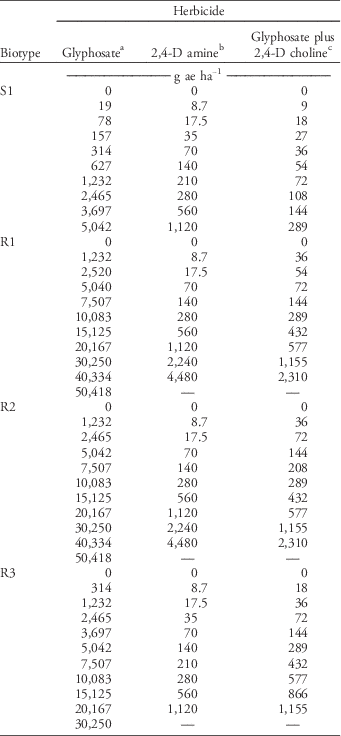
Greenhouse dose–response experiments were conducted at Purdue University to determine Palmer amaranth resistance to glyphosate, tolerance to 2,4-D amine, and whether a premix formulation of glyphosate plus 2,4-D choline (Enlist Duo®, Dow AgroSciences, 9330 Zionsville Road, Indianapolis, IN) will control GR Palmer amaranth with increased tolerance to 2,4-D amine. A commercial 2,4-D choline formulation was not available; therefore, the amine formulation was used for the 2,4-D–only dose–response experiment. Palmer amaranth seed germination, growth stage of transplanted material, soil, and greenhouse conditions were the same as described in the Preliminary Screening Procedure section. Differential rate structures were used to account for the variability in herbicide sensitivity among biotypes and to develop dose–response curves (Table 2).
Herbicide rates used in the glyphosate, 2,4-D amine, and glyphosate plus 2,4-D choline dose–response experiment.

a Touchdown HiTech®, Syngenta Crop Protection, P.O. Box 18300, Greensboro, NC.
b Weedar® 64, Dow AgroSciences, 9330 Zionsville Road, Indianapolis, IN.
c Enlist Duo®, Dow AgroSciences, 9330 Zionsville Road, Indianapolis, IN.
Experimental Design, Data Collection, and Statistical Analysis
The dose–response experiment was arranged in a randomized complete block design with a factorial arrangement of 4 biotypes, 10 to 11 herbicide rates, and 3 herbicides: glyphosate, 2,4-D amine, and glyphosate plus 2,4-D choline. Each treatment was replicated 10 times, and the experiment was repeated. At 21 DAT, Palmer amaranth control was visually assessed using a scale of 0% to 100%, where 0 was no control and 100 was complete plant death. To determine plant mortality, individual plants were rated as live (green tissue or red-colored stems) or dead (no green tissue or red-colored stems). Plants were harvested at 21 DAT by clipping the stem 1 cm above the soil surface. Aboveground biomass was dried for 7 d in a forced-air dryer set at 38 C.
Data were analyzed using a nonlinear regression model with the ‘drc’ package in R (Knezevic and Streibig Reference Knezevic and Streibig2007). All experimental runs were combined for statistical analysis, and herbicides were analyzed separately. Aboveground biomass was converted to a percentage of the nontreated check for each biotype. A dose–response model was created using Equation 1 to explain Palmer amaranth aboveground biomass and percent visually assessed control regressed over herbicide rates.
 $$Y=d/(1{\plus}{\rm exp}\{ b[{\rm log}(x){\minus}{\rm log}(e)\} )$$
In this three-parameter log-logistic model, b is the slope, d is maximum visually assessed control or aboveground biomass relative to the nontreated check, and e is the GR50 (Ritz et al. Reference Ritz, Kniss and Streibig2015). The GR50 represents the herbicide dose needed to provide 50% control or reduce aboveground biomass by 50%. The level of resistance (R:S) for each biotype was determined by dividing the biotype of interest by biotype S1. Graphical representation to test the goodness of fit was evaluated for all data, and a trend in error variance was not observed, suggesting that the three-parameter log-logistic model was an appropriate model for these data (Archontoulis and Miguez Reference Archontoulis and Miguez2015).
Logistic regression for binary data was used to analyze Palmer amaranth mortality (Moretti et al. Reference Moretti, Hanson, Hembree and Shrestha2013; Pratley et al. Reference Pratley, Urwin, Stanton, Baines, Broster, Cullis, Schafer, Bohn and Krueger1999):
 $${\rm P}\,=\,e^{{(a\,{\plus}\,bx)}} /1{\plus}e^{{(a\,{\plus}\,bx)}} $$
In this model, parameters a and b are coefficients for the fitted curve, and x is the herbicide rate. The herbicide dose to cause 50% and 90% mortality (LD50 and LD90) and the 95% confidence intervals were calculated. Goodness of fit was tested using the receiving operating characteristic (ROC) curve (Moretti et al. Reference Moretti, Hanson, Hembree and Shrestha2013). The ROC curve describes how well the model fit the data. An ROC value of 1 represents a perfect model fit. The ROC value for Palmer amaranth mortality ranged from 0.94 to 0.96 for 2,4-D amine, 0.84 to 0.99 for glyphosate, and 0.89 to 0.95 for glyphosate plus 2,4-D choline. In response to Palmer amaranth mortality, the main effects (biotype and herbicide rate) and their interaction were significant for each herbicide. A single regression was fit for all experimental runs.
Results and Discussion
Glyphosate
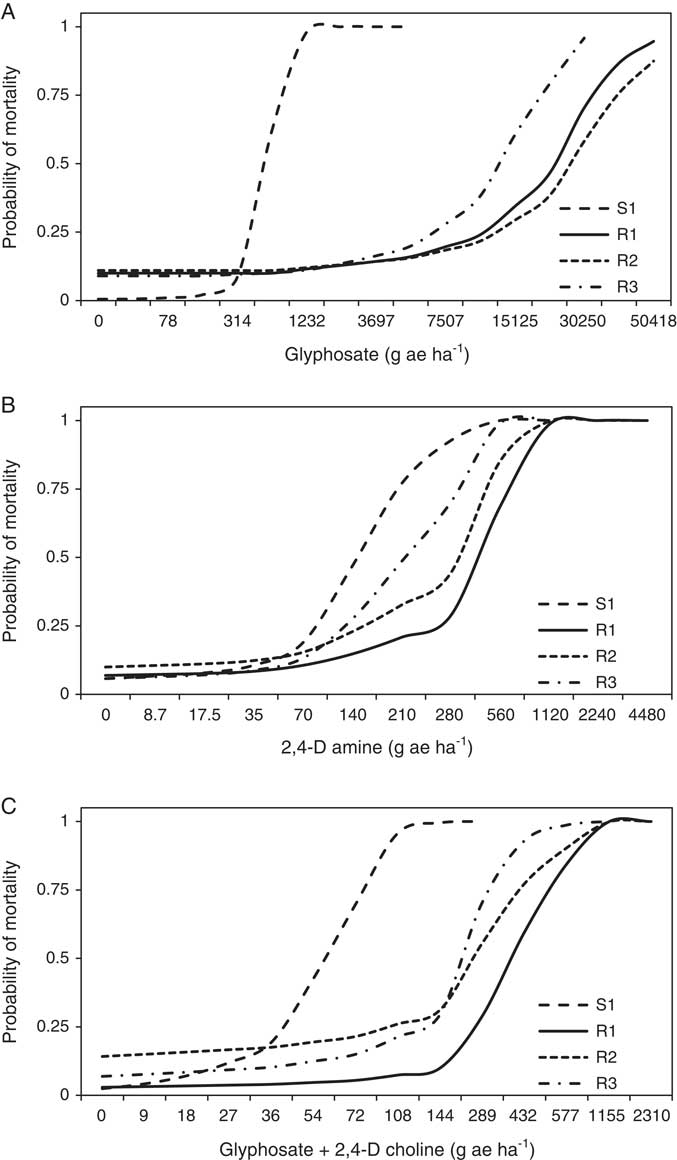
Palmer amaranth mortality was determined at 21 DAT. The predicted LD50 rate of glyphosate for GR biotypes ranged from 12,891 to 26,198 gaeha−1; however, the LD50 for the S1 biotype was 572 gaeha−1 (Table 3; Figure 1A). This indicates that the R1, R2, and R3 biotypes were 22- to 45-fold more resistant to glyphosate than the S1 biotype. The LD90 rate of glyphosate for R1, R2, and R3 biotypes was 14- to 31-fold more than the single maximum POST labeled rate of glyphosate (1,750 gaeha−1) (Anonymous 2017b). Thus, glyphosate is no longer an effective herbicide option for control of R1, R2, and R3 biotypes.
Probability of mortality of four Palmer amaranth biotypes 21 d after (A) glyphosate, (B) 2,4-D amine, and (C) glyphosate plus 2,4-D choline treatment. The lines represent the estimated regression line. Parameter estimates for the logistic regression line for each herbicide and biotype are located in Tables 3 (glyphosate), 5 (2,4-D amine), and 7 (glyphosate plus 2,4-D choline). The probability of Palmer amaranth mortality was calculated using the formula:
 $${\rm P}=e^{{(a{\plus}bx)}} /1{\plus}e^{{(a{\plus}bx)}} $$
. In this model, parameters a and b are coefficients for the fitted curve, and x is the herbicide rate.

Parameters of logistic regression for 50% and 90% Palmer amaranth mortality at 21 d after treatment of glyphosate in a greenhouse experiment.Footnote a , Footnote b

a Abbreviations: a and b are regression parameters related to the intercept and slope on a logit scale; LD50 and LD90, lethal dose of herbicide expressed in g ae ha−1 that is required to cause 50% or 90% mortality; lower and upper, the 95% confidence interval values; R, resistant; ROC, receiving operating characteristic; S, susceptible.
b
The three-parameter logistic model was fit for binary data
$${\rm P}=e^{{(a{\plus}bx)}} /1{\plus}e^{{(a{\plus}bx)}} $$
, where a and b are parameters of the fitted curve, and x is the herbicide dose. An ROC value closer to 1 suggests the model was a perfect fit to the data.
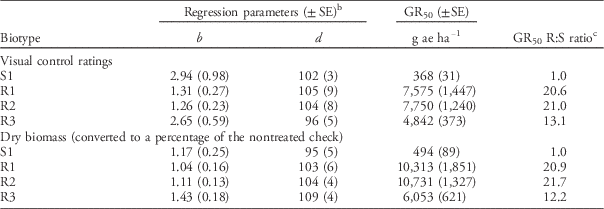
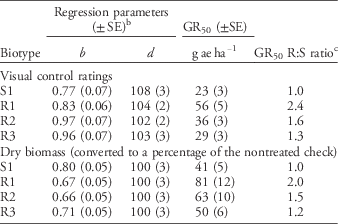
A common observation among GR biotypes after being treated with 15,125 gaeha−1 of glyphosate at 21 DAT were stunted plants. A similar observation by Nandula et al. (Reference Nandula, Reddy, Koger, Poston, Rimando, Duke, Bond and Ribeiro2012) reported Palmer amaranth plants were severely stunted after a 6,720 gaeha−1 treatment of glyphosate. Palmer amaranth GR50 values for control and biomass ranged from 4,842 to 7,750 and 6,053 to 10,731 gaeha−1 of glyphosate, respectively, for the R1, R2, and R3 biotypes, which indicated a 12- to 21-fold level of resistance compared with the glyphosate-susceptible biotype (Table 4). In a similar study, Nandula et al. (Reference Nandula, Reddy, Koger, Poston, Rimando, Duke, Bond and Ribeiro2012) reported Palmer amaranth from Mississippi was 14- to 17-fold more resistant to glyphosate than the susceptible biotype.
Dose–response curve regression parameter estimates for visual control ratings and dry biomass of four Palmer amaranth biotypes used in the glyphosate dose–response experiment.Footnote a

a Abbreviations: GR50, is the herbicide rate expressed in g ae ha−1 that is required to reduce 50% control or 50% dry biomass.
b The dose–response curve corresponding to parameters in this table can be found in Figure 4A for visual control ratings and Figure 5A for dry biomass. Regression parameters correspond to Equation 1 in the “Materials and Methods.” In this three-parameter logistic model, b is the slope of the curve, d is maximum visually assessed control or biomass, and GR50 is the herbicide rate for 50% control or biomass relative to the nontreated check.
c R:S (most resistant: most susceptible) ratios were calculated by dividing the GR50 of the biotype of interest by the GR50 of biotype S1, the glyphosate-susceptible biotype.
The R1, R2, and R3 biotypes were highly resistant to glyphosate; however, the R2 biotype required 1.6- and 1.8-fold more glyphosate than the R3 biotype to achieve 50% control and to reduce biomass by 50%. Amplification of 5-enolpyruvylshikimate-3-phosphate synthase (EPSPS), a mechanism that confers GR in Palmer amaranth, was not measured in these plants. It is possible that plants from the R2 biotype had more EPSPS copies than plants from the R3 biotype. Chatham et al. (Reference Chatham, Bradley, Kruger, Martin, Owen, Peterson, Mithila and Tranel2015) reported surviving GR tall waterhemp plants from Illinois that had, on average, one more EPSPS copy number (a mechanism that confers GR in common waterhemp) when treated with 3,360 g ae ha−1 of glyphosate compared with surviving GR common waterhemp plants treated with 840 g ae ha−1 of glyphosate, suggesting that GR common waterhemp with an increased EPSPS copy number will be selected for when higher rates of glyphosate are applied.
2,4-D Amine
The LD50 rate of 2,4-D amine ranged from 145 to 418 g ae ha−1 (Table 5; Figure 1B). The R:S ratio for LD50 indicated that the R1 biotype was 1.4- to 2.9-fold more tolerant to 2,4-D amine than all other biotypes. In field settings, Palmer amaranth mortality below 50% at 21 DAT is unacceptable. An acceptable mortality rate is likely to range from 90% to 100%. To achieve 90% Palmer amaranth mortality, the rate of 2,4-D amine needed ranged from 257 to 764 gaeha−1. When compared with the susceptible biotype, S1, the R1 biotype required 3-fold more 2,4-D amine to achieve 90% mortality.
Parameters of logistic regression for 50% and 90% Palmer amaranth mortality at 21 d after treatment of 2,4-D amine in a greenhouse experiment.Footnote a , Footnote b

a Abbreviations: a and b are regression parameters related to the intercept and slope on a logit scale; LD50 and LD90, lethal dose of herbicide expressed in g ae ha−1 that is required to cause 50% or 90% mortality; lower and upper, the 95% confidence interval values; R, resistant; ROC, receiving operating characteristic; S, susceptible.
b
The three-parameter logistic model was fit for binary data
$${\rm P}=e^{{(a{\plus}bx)}} /1{\plus}e^{{(a{\plus}bx)}} $$
, where a and b are parameters of the fitted curve, and x is the herbicide dose. An ROC value closer to 1 suggests the model was a perfect fit to the data.
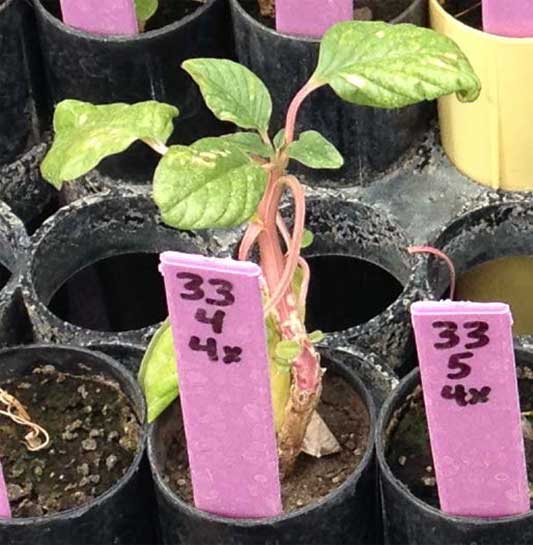
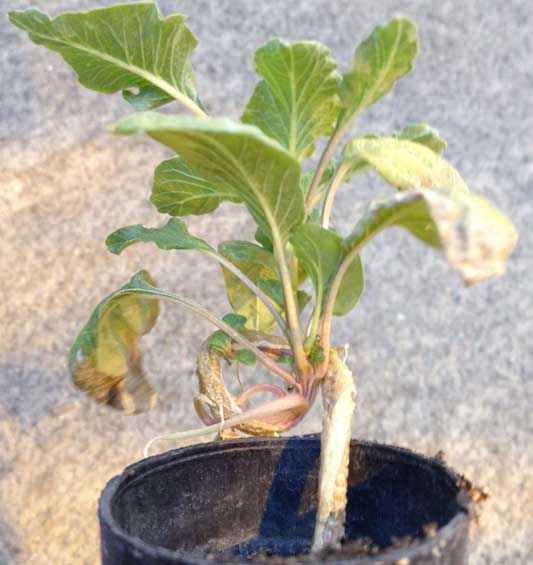
Herbicide formulations that include 2,4-D alone are not labeled for Enlist® soybean to date, although an herbicide formulation of glyphosate plus 2,4-D choline is available for commercial use. If a commercial formulation of 2,4-D alone is available, the POST labeled rate in Enlist® soybean will likely range from 560 to 1,064 gaeha−1, as these are rates of 2,4-D amine labeled for control of early-emerging Palmer amaranth prior to planting soybean (Anonymous 2017c). Results from this study show that 29% of Palmer amaranth from R1 were expected to be alive at 21 DAT with 560 g ae ha−1 of 2,4-D amine. However, it is important to consider that 1,064 gaeha−1 resulted in 98% Palmer amaranth mortality. Thus, up to 2% of plants that are expected to be alive have the potential to produce seed if not controlled prior to seed production. Kruger et al. (Reference Kruger, Davis, Weller and Johnson2008) reported rosette-stage horseweed that survived treatment with 280 gaeha−1 of 2,4-D amine were able to produce seed. Moreover, Bernards et al. (Reference Bernards, Crespo, Kruger, Gaussoin and Tranel2012) reported that tall waterhemp, a species similar to Palmer amaranth, produced seed after treatment with 35,840 gaeha−1 of 2,4-D. Palmer amaranth survival after a treatment of 1,064 gaeha−1 of 2,4-D amine in this experiment was low; however, a single female plant produces a plethora of seed if not controlled (Keeley et al. Reference Keeley, Carter and Thullen1987). Plants that produce vast amounts of seed present the possibility to select for unique mechanism(s) of resistance and for resistance to develop quickly (Gressel Reference Gressel2009). Plants that survived a 560 gaeha−1 treatment of 2,4-D amine in the preliminary experiment produced seed. However, stems were severely calloused and many were split open, which introduces the potential for insect and pathogen infection to occur (Figure 2). Another observation was severely stunted plants. Regeneration of plant tissue from plants that survived most often occurred near the apical meristem, followed by formation of new leaves at lower nodes (Figure 3). Water and nutrients were two factors not limited in this experiment. Surviving plants exposed to water stress and deprived of proper fertility for extended periods of time may not survive long enough to produce seed in field settings, thus reducing the chance of evolved resistance to 2,4-D from occurring.
A close-up view of a 2,4-D–tolerant Palmer amaranth plant that survived a treatment of 1,120 g ae ha−1 of 2,4-D amine at 21 d after treatment.
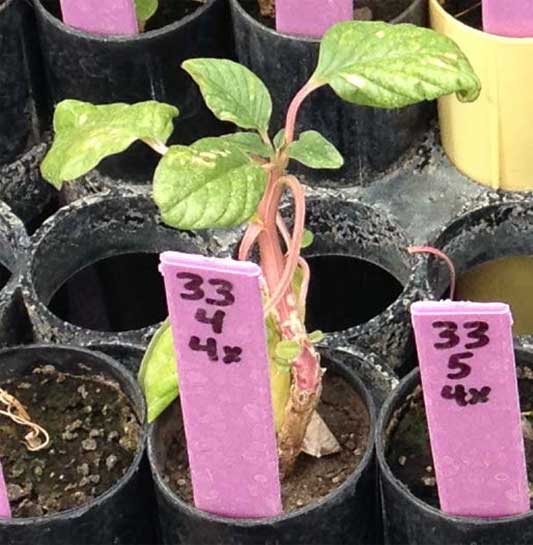
A 2,4-D–tolerant Palmer amaranth plant (R1 biotype) exhibiting severe stem twisting and splitting from a 560 g ae ha−1 treatment of 2,4-D amine. New leaf emergence occurred at the apical meristem and along the stem midsection.

All Palmer amaranth biotypes treated with 2,240 gaeha−1 of 2,4-D amine were controlled 100% and produced 90% less biomass than the nontreated check at 21 DAT (Table 6; Figures 4B and 5B). Biomass reduction greater than 90% rarely occurred, as dead Palmer amaranth carcasses contribute to biomass accumulation. After thorough analysis of these data, it appears that S1, R1, R2, and R3 biotypes exhibit variation in natural tolerance to 2,4-D amine. Natural tolerance to glyphosate has been reported in other weed species. Norsworthy et al. (Reference Norsworthy, Burgos and Oliver2001) reported glyphosate tolerance in pitted morningglory (Ipomoea lacunosa L.) was due to reduced absorption. Additional research is needed to determine whether leaf characteristics such as epicuticular wax and cuticle thickness influence the level of 2,4-D tolerance in Indiana Palmer amaranth. Common waterhemp and Palmer amaranth are two species in the genus Amaranthus that exhibit similar biological characteristics; both species also share a history in evolving resistance to similar herbicides. If we disregard recent historical events—that is, the evolution of 2,4-D resistance in common waterhemp from repeated 2,4-D applications—evolution of 2,4-D–resistant Palmer amaranth will result in the near future. Therefore, it is imperative that growers, scientists, and industry representatives exercise and encourage herbicide-resistant cropping technology stewardship so these technologies can be used by future generations.
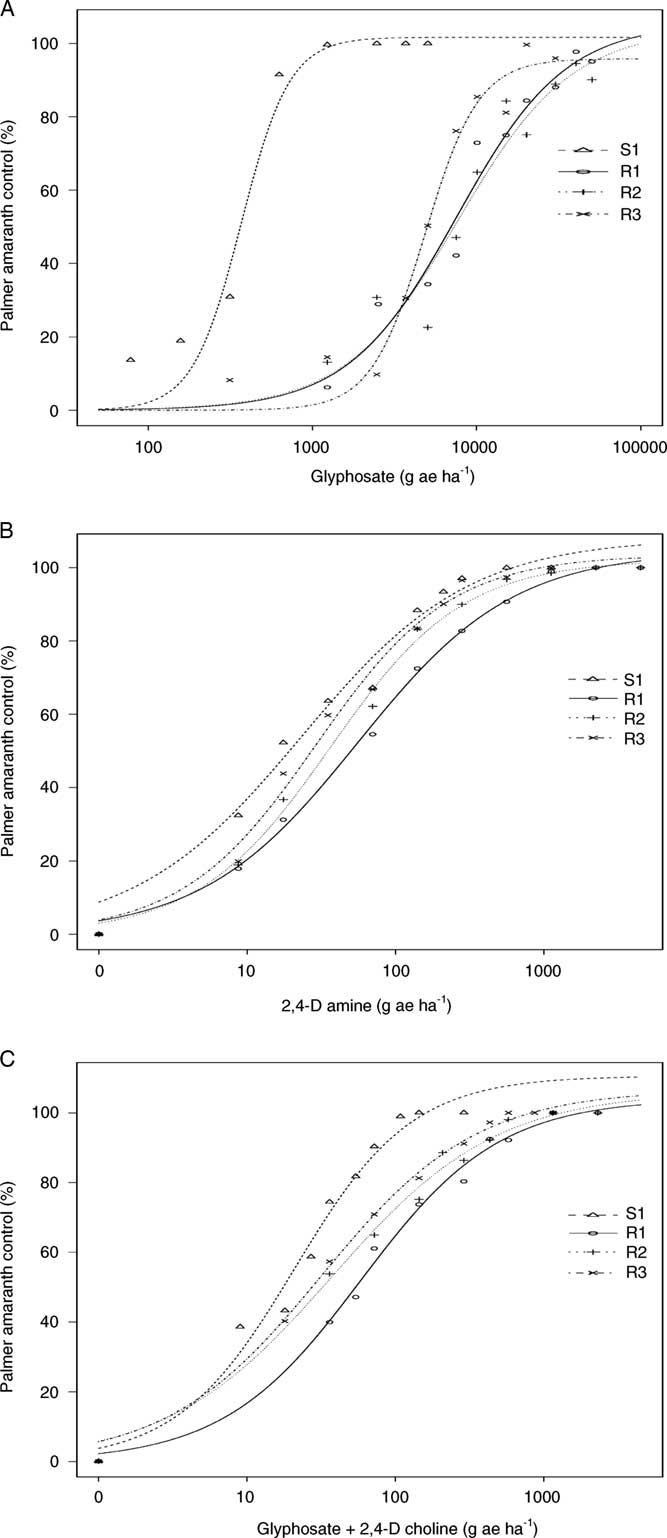
Dose–response curves of Palmer amaranth control at 21 d after treatment in response to increasing rates of (A) glyphosate, (B) 2,4-D amine, and (C) glyphosate plus 2,4-D choline. Symbols represent the treatment mean; lines represent the estimated regression line.

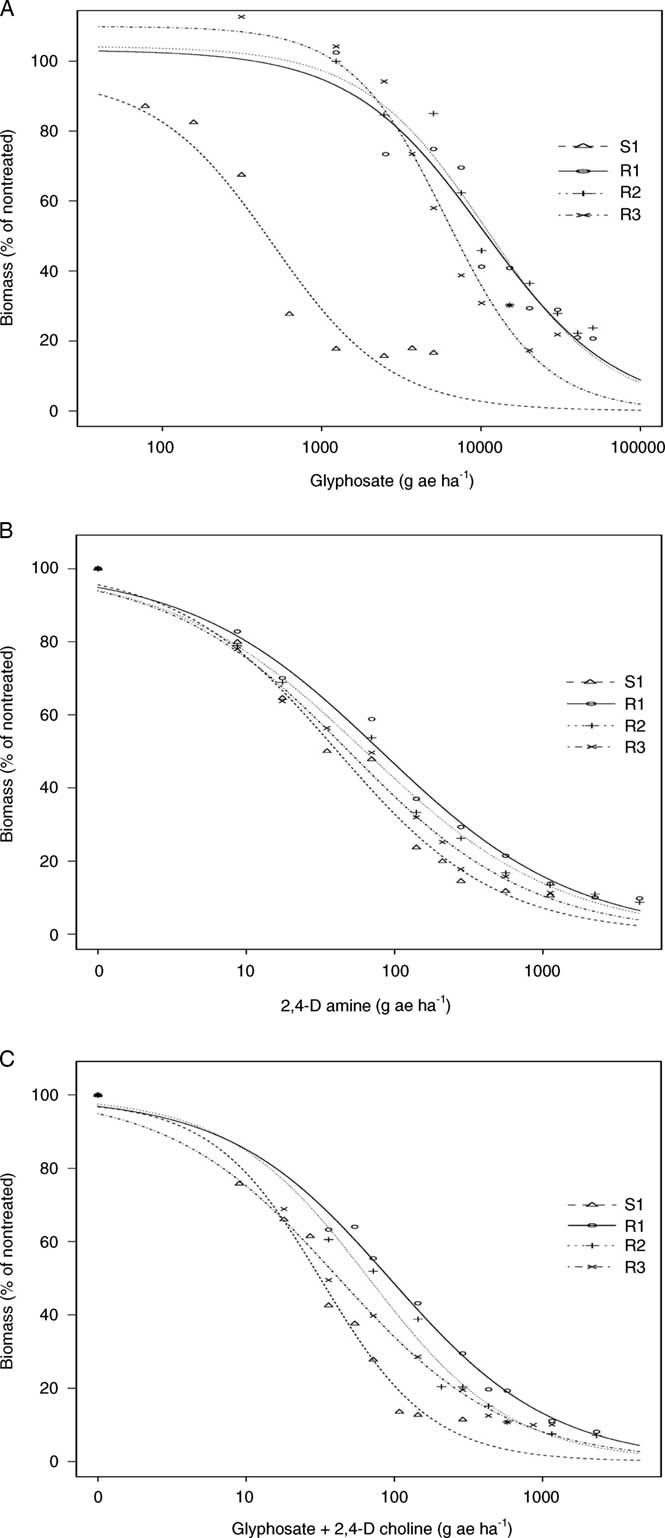
Dose–response curves of Palmer amaranth biomass compared to the nontreated check of four Palmer amaranth biotypes at 21 d after treatment in response to increasing rates of (A) glyphosate, (B) 2,4-D amine, and (C) glyphosate plus 2,4-D choline. Symbols represent the treatment mean; lines represent the estimated regression line.

Dose–response curve regression parameter estimates for visual control ratings and dry biomass of four Palmer amaranth biotypes used in the 2,4-D amine dose–response experiment.Footnote a

a Abbreviations: GR50, herbicide rate expressed in g ae ha−1 that is required to reduce 50% control or 50% dry biomass.
b The dose–response curve corresponding to parameters in this table can be found in Figure 4B for visual control ratings and Figure 5B for dry biomass. Regression parameters correspond to Equation 1 in the “Materials and Methods.” In this three-parameter logistic model, b is the slope of the curve, d is maximum visually assessed control or biomass, and GR50 is the herbicide rate for 50% control or biomass relative to the nontreated check.
c R:S (most resistant: most susceptible) ratios were calculated by dividing the GR50 of the biotype of interest by the GR50 of biotype S1, the glyphosate-susceptible biotype.
Glyphosate plus 2,4-D Choline (Enlist Duo®)
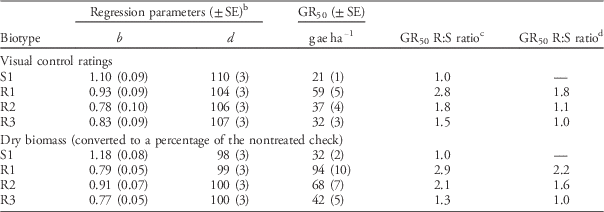
The logistic regression model predicted less than 100% mortality for R1 and R2 biotypes with a 577 gaeha−1 treatment of the glyphosate plus 2,4-D choline (300 gaeha−1 of glyphosate plus 277 gaeha−1 of 2,4-D choline) premix formulation (Figure 1C). The logistic regression model predicted 13% of plants from R1 that were treated with 577 gaeha−1 of glyphosate plus 2,4-D choline were alive at 21 DAT. The R:S ratio for LD50 and LD90 indicated that the R1 biotype was 6.6- and 6.8-fold more tolerant to glyphosate plus 2,4-D choline than the S1 biotype, respectively (Table 7). It is important to consider that the S1 biotype was susceptible to glyphosate and less tolerant to 2,4-D amine than the R1 biotype, which was GR and tolerant to 2,4-D amine. A comparison of only GR biotypes revealed that the R1 biotype required up to 1.8- and 1.6-fold more glyphosate plus 2,4-D choline than R2 and R3 biotypes based on LD50 and LD90 values, respectively. The rate of glyphosate plus 2,4-D choline to reduce control and biomass by 50% ranged from 21 to 59 and 32 to 94 gaeha−1, respectively (Table 8). A greater rate of glyphosate plus 2,4-D choline to achieve 50% control and biomass reduction has been reported in common waterhemp. Chahal et al. (Reference Chahal, Aulakh, Rosenbaum and Jhala2015) reported common waterhemp that measured 10-cm tall required 339 and 303 gaeha−1 of glyphosate plus 2,4-D choline for 50% control and 50% biomass reduction, respectively.
Parameters of logistic regression for 50% and 90% Palmer amaranth mortality at 21 d after treatment of glyphosate plus 2,4-D choline in a greenhouse experiment.Footnote a , Footnote b

a Abbreviations: a and b are regression parameters related to the intercept and slope on a logit scale; Bio, biotype; LD50 and LD90, lethal dose of herbicide expressed in g ae ha−1 that is required to cause 50 or 90% mortality; lower and upper, the 95% confidence interval values; R, resistant; ROC, receiving operating characteristic; S, susceptible.
b
The three-parameter logistic model was fit for binary data
$${\rm P}=e^{{(a{\plus}bx)}} /1{\plus}e^{{(a{\plus}bx)}} $$
, where a and b are parameters of the fitted curve, and x is the herbicide dose. An ROC value closer to 1 suggests the model was a perfect fit to the data.
c R:S (most resistant: most susceptible) ratios were calculated by dividing the LD50 of the biotype of interest by the LD50 of biotype S1, the glyphosate-susceptible biotype.
d R:S (most resistant: most susceptible) ratios of glyphosate-resistant biotypes were calculated by dividing the LD50 of the biotype of interest by the LD50 of biotype R3 (glyphosate-resistant and most sensitive to 2,4-D amine).
Dose–response curve regression parameter estimates for visual control ratings and dry biomass of four Palmer amaranth biotypes used in the glyphosate plus 2,4-D choline dose–response experiment.Footnote a

a Abbreviations: GR50, the herbicide rate expressed in g ae ha−1 that is required to reduce 50% control or 50% dry biomass.
b The dose–response curve corresponding to parameters in this table can be found in Figure 4C for visual control ratings and Figure 5C for dry biomass. Regression parameters correspond to Equation 1 in the “Materials and Methods.” In this three-parameter logistic model, b is the slope of the curve, d is maximum visually assessed control or biomass, and GR50 is the herbicide rate for 50% control or biomass relative to the nontreated check.
c R:S (most resistant: most susceptible) ratios were calculated by dividing the GR50 of the biotype of interest by the GR50 of biotype S1, the glyphosate-susceptible biotype.
d R:S (most resistant: most susceptible) ratios of glyphosate-resistant biotypes were calculated by dividing the GR50 of the biotype of interest by the GR50 of biotype R3 (glyphosate-resistant and most sensitive to 2,4-D amine).
All plants treated to 1,155 g ae ha−1 of glyphosate plus 2,4-D choline (600 gaeha−1 of glyphosate plus 555 gaeha−1 of 2,4-D choline) were controlled 100% and produced 89% to 93% less biomass than the nontreated check at 21 DAT (Figures 4C and 5C). The 1,155 gaeha−1 rate of glyphosate plus 2,4-D choline is below the labeled POST field rate (1,618 to 2,195 gaeha−1) of Enlist Duo® (Anonymous 2017a). Numerous researchers have reported increased control of GR weed species when glyphosate is tank mixed with 2,4-D, dicamba, or saflufenacil. Waggoner et al. (Reference Waggoner, Mueller, Bond and Steckel2011) reported 16% to 49% more control of GR horseweed at 30 DAT with 1,061 gaeha−1 of glyphosate mixed with saflufenacil at 6, 12, 25, and 50 g ai ha−1 compared with 1,061 gaeha−1 of glyphosate alone. Enhanced control of GR common waterhemp has also been reported with glyphosate plus dicamba and glyphosate plus 2,4-D tank mixtures compared with glyphosate alone (Robinson et al. Reference Robinson, Simpson and Johnson2012; Spaunhorst and Bradley Reference Spaunhorst and Bradley2013). Results from these data show that Palmer amaranth biotypes that are highly resistant to glyphosate and that also exhibit tolerance to 2,4-D amine can be controlled with a tank mixture of glyphosate plus 2,4-D choline. These data further suggest that if reduced rates of glyphosate plus 2,4-D choline (≤577 gaeha−1) are applied to GR Palmer amaranth with increased tolerance to 2,4-D amine, unsatisfactory control will result. However, it is likely that continuous use of glyphosate plus 2,4-D choline without alternative control methods and applied at sublethal doses will select for Palmer amaranth biotypes that are resistant to both herbicide sites of action.
Acknowledgments
The authors would like to thank the Indiana Soybean Alliance and the United Soybean Board for funding of this research. Additional thanks to Marcelo Moretti for assistance in data analysis. The U.S. Department of Agriculture is an equal opportunity provider and employer.