On November 7, 1922, vessels from the Caspian flotilla assembled in the harbor of Baku, a port city on the Caspian Sea in what is now the Republic of Azerbaijan, to partake in a mass spectacle commemorating the fifth anniversary of the October Revolution. Composed and conducted by the Futurist composer Arsenii Avraamov (1886–1944), the “Symphony of Sirens,” as the mass spectacle was called, constructed a montage-like interaction of military, industrial, and human sounds across Baku's ethnically-diverse districts, docks, factories, and squares. These sounds included those of ship cannons, machine guns, artillery batteries, hydroplanes, factory sirens, crowds of spectators, and a specially-designed steam-whistle machine, the magistral΄, capable of belting out “The Internationale” or “La Marseillaise” (Figure 1). The symphony leveled the distinction between its listeners and participants, radically altering Baku's industrial and oil-derricked landscape into both orchestra and auditorium. Its deafening and awe-inspiring noise rearranged the spatiality and temporality of the city, transforming the oftentimes fraught relationship between its religiously- and ethnically-divided working classes—consisting of Azerbaijanis, Armenians, and Russians—into a symbol of proletarian unity and Soviet power.
An idealized sketch of the steam-whistle machine (Magistral΄). Arseny Avraamov, “Simfoniya Gudkov,” Gorn, no. 9 (November 1923): 110

What is known about Avraamov's symphony comes primarily by way of a reproduction of the symphony's “score”—a set of military-like instructions originally published in three Baku newspapers, the Baku Worker, Labor, and Communist (the latter in Turkish).Footnote 1 These instructions were republished in a 1923 article Avraamov wrote for the Proletkul΄t journal Gorn (the title is a pun on the Russian word for “bugle” and “blast furnace”). According to this article, Avraamov conducted the symphony via semaphore and telephone from atop a Swedish Mast. Using these devices, Avraamov signaled cannon fire from the battleship Dostoinyi parked in Baku's harbor. The cannon fire functioned as a pacing mechanism; different rounds signaled specific sonic events. The fifth gun signaled the sirens of the first and second districts of Black Town, a neighborhood named for the oil that gushed from its derricks; the tenth gun signaled the sirens of the Azneft trade offices, the seat of the Azerbaijani Oil Administration; the fifteenth gun signaled the sirens of the “mountain district” (Armenian Village), the taking-off of hydroplanes, and the ringing of bells; the eighteenth gun signaled the sirens of the railroad depot and the playing of the “Warszawianka” by a joint brass orchestra.Footnote 2 The noise reached its climax with the sounding of the twenty-fifth cannon, followed by a brief pause that marked the transformation of the sounds of alarm and continuous battle into a worker's anthem. Crowds near the harbor began singing the “Internationale” and the “Marseillaise,” accompanied by the steam-whistle machine. The symphony concluded with a “general festive chord of all steam whistles and sirens lasting three minutes accompanied by a ringing bell,” followed by a ceremonial march and an uproar of celebratory artillery fire, wailing sirens, an automobile chorus, machine guns, steam engines, and two more repetitions of the “Internationale.”Footnote 3
With the mild sarcasm of scare quotes, the Bolshevik chronicler René Fueloep-Miller wrote that the “music” of the symphony “could be heard far beyond the walls of the town. . .;” it was intended to “remind the proletariat of its real home, the factory.”Footnote 4 This article, by contrast, aims to temper the myth of the Baku Symphony's awe-inspiring sound and scale—one that has been largely unquestioned in English-language sound and urban studies scholarship on Avraamov's mass spectacle.Footnote 5 Instead of focusing solely on the symphony's dreaded noise, I pay attention to the symphony's silence—to the limits of what can be known about its sounds. Drawing on Avraamov's untranslated writings and personal correspondences, as well as an ear-witness account, I wish to complicate the “fact” of the Baku Symphony's successful performance—its attempt to harness the noise of industry as a way of sounding the Revolution. In doing so, I investigate how the symphony's ideal of unity collides with the geographic, social, and sonic reality of the city it sought to compose. Part one of this article examines this ideal in terms of Avraamov's work as cultural organizer in the Caucasus. Part two outlines the reasons for questioning the success of the symphony's performance in Baku. Part three explores the personal philosophy behind Avraamov's ideal of unity through the failed Moscow Symphony. Finally, part four traces this ideal's connection to Avraamov's idiosyncratic views on mechanical reproduction. What emerges is an account of the symphony as an attempt to reproduce the spirit of the October Revolution in terms of an urban framework in which the networks for waging war, extracting resources, colonizing space, and transmitting sound make use of overlapping channels.
I
Like many in the Russian avant-garde, Arsenii Avraamov was fond of pseudonyms and wordplay. As a young revolutionary Cossack, he was Arsenii Krasnokutsky (Russian Krasnyi = red); as a commissar for the arts stationed in Dagestan he was Arslan Ibrahim ogli Adamov (Hebrew Adam = red); lastly, as a composer and music theorist he was simply Ars (latin Ars = art), aka Revarsavr (the Revolutionary Arsenii Avraamov).Footnote 6 These names expressed a fundamental unity. “Avraamov” invokes the idea of Abraham, the Father of monotheism. His monicker Ars harkens to the overarching unity of all arts. His play on translations of “red” points to the unity of all peoples in the communist idea. As such, with a twist of a word, a revolutionary Don Cossack became a Muslim. Likewise, with the felicitous first three letters of his first name, a composer inscribed himself in the middle of an artistic revolution (Revarsavr) and cemented an identity between himself and Art.
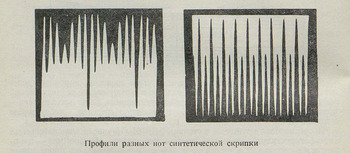
Avraamov's many names embody the “universalist-cosmogonic aspirations” of his musical practice in all its theoretical, aesthetic, and political manifestations from his early, Scriabin-inspired writings on microtonality to his invention of a 48-tone Universal Tone System (Weltonsystem) to his ethnomusicological studies and experiments in sound synthesis and sound film.Footnote 7 These universalist tendencies, as Nikolai Izvolov suggests, were characteristic of the avant-garde artistic movements of the 1910s.Footnote 8 What poets like Aleksei Khruchenykh and Velimir Khlebnikov sought to do for the word—that is, create a trans-rational language (zaum) that would facilitate universal expression—Avraamov sought to do for the tone by de-tempering the well-tempered scale. Microtonality was the frequent subject of Avraamov's articles for Muzikal΄nyi Sovremennik and Letopis΄, two journals he co-edited with the composer Nikolai Roslavets from 1914 to 1916, in which he explored the mathematical, religious, physiological, and social foundations of music. In a similar vein, in the 1930s, Avraamov's experiments in sound synthesis (alongside those of Evgeny Sholpo, Boris Yankovsky, and Nikolai Voinov) sought to create a universal language of geometric figures (circles, triangles, squares) that could, in principle, produce any sound whatsoever, be it the sounds of nature, human speech, traditional instruments, or never-before-heard whoops and bleeps (Figure 2). Meticulously drawn by hand and then photographed onto a film strip, the combination of these shapes promised not only to bring about the music of the future, but to one day annul time itself—that is, by resurrecting Lenin's voice.Footnote 9 More practically, they allowed for the direct expression of a composer's idea by giving him control, in Avraamov's words, of a “universal ‘super-orchestra, conducted by the composer himself. . .”Footnote 10 According to Sholpo, such an orchestra would make the neuromuscular “acrobatics of miserable conservatory students” obsolete.Footnote 11
An example of drawn sound in Avraamov's article “Synthetic Music:” Arseny Avraamov, “Sinteticheskaia muzyka,” Sovetskaia muzyka 8 (1939).

Performed in part by ostensibly-miserable conservatory students (amassed aboard the battleship Dostoinyi), the “Symphony of Sirens” embodied the same universal spirit as Avraamov's ideas on microtonality and sound synthesis. Echoing the words of the Futurist-Taylorist poet Alexei Gastev (1882–1939), Avraamov explained that the symphony sought to convert the “call of slavery”—the “chaotic industrial roar” of factory sirens under the alienated conditions of capitalism—into a collective “song of the future.”Footnote 12 Instruments like the steam-whistle machine symbolically embodied this idea by channeling the industrial noise of alienated workers into a common melody (the “Internationale”).Footnote 13 In an epigraph to a 1924 article for the journal Artist and Viewer, Avraamov quoted Vladimir Maiakovskii's 1918 “Orders for the Army of Art:” “Enough of penny truisms / Erase the old from your heart / The streets are our brushes / The squares are our palettes.”Footnote 14 The symphony attempted to literalize these lines using the streets and squares (as well as oil refineries and factory sirens) of Baku as instruments in a “universal super orchestra” capable of synthesizing, as it were, the sounds of the October Revolution.
Avraamov's symphony belongs to a tradition of Soviet festivals that sought to literally bring the masses into culture through the application of Futurist and Soviet-Taylorist ideas concerning the fusion of art, labor, industry, and urban planning with modes of audience participation.Footnote 15 The roots of this tradition go back to Jean Jacques Rousseau's ideas on theater, particularly his proclamation that the “entertainments appropriate to a republic are those in which the citizen, participating in his own person, is reinforced in the sentiment of his own being and in his relation to his fellow beings.”Footnote 16 As Katerina Clark points out, the mass spectacle also derived “from a German dream of Greek wholeness” found mutatis mutandis in the works of G.W.F. Hegel, Friedrich Nietzsche, and Richard Wagner, and carried over into Russia by philologists like Viacheslav Ivanov and Tadeusz Stefan Zieliński.Footnote 17 The universalist ambitions of this dream found fertile soil in civil-war Petrograd. In the eyes of Petersburg intellectuals like Avraamov, “Petrograd, as a ‘commune,’ was. . .a sort of modern socialistic version of the old city-state. The next step—the move to a world commune—would entail expanding that model to embrace the entire world.”Footnote 18
The “Symphony of Sirens” follows this trajectory. Avraamov first attempted to stage the symphony in 1918 in Petrograd, followed by а technically-flawed performance in Nizhnii Novgorod (1919) that employed а flotilla of small torpedo boats.Footnote 19 The next performance sought to export the Petrogradian ideal to the world using Baku as a “gateway” to the east—an idea that had been recently championed in speeches and celebrations at Baku's 1920 First Congress of the Peoples of the East.Footnote 20 The transition from Petrograd commune to global city-state was, of course, far from smooth. The political climate in which the symphony was performed was characterized by a colonial dynamic of mutual suspicion and distrust between the Bolsheviks and the “formerly-colonized” subjects of the Russian Empire. The rights of oppressed nations to self-determination was a major sticking point in Bolshevik policy throughout the early 1920s. While skeptical of nationalism and nationalist movements, and generally dismissive of the Caucasus as “backwards,” the Bolsheviks nonetheless sought to present themselves as guarantors of national liberation by promoting ethnic particularism and positive discrimination in the domains of language, culture, education, and local government.Footnote 21 As Terry Martin argues, in positioning themselves as guarantors of these rights, the Bolsheviks hoped to stave off a resurgence of pre-Soviet power dynamics under the cover of formal legal equality and state neutrality.Footnote 22
Considered in this light, Avraamov's cultural projects in the Caucasus appear as an instance of what Lenin at times decried—the persistence of Russian chauvinism in the guise of ostensibly egalitarian relations between workers.Footnote 23 The story of Avraamov's Islamic name provides insight into this dynamic. Following the October Revolution, Avraamov became the head of the Musical Department of Proletkul΄t, the Proletarian Culture Movement, as well as a Commissar of Arts for Narkompros, the People's Commissariat of Enlightenment. In 1921, his work as a cultural curator for the Red Army sent him to Dagestan where, following an expedition to collect folksongs, he was expelled from the party for impersonating and aggravating the Muslim population. What is known about Avraamov's expulsion comes by way of an unsent 1943 letter to the Central Committee of the Communist Party in which the composer petitions to be re-instated as a member.Footnote 24 According to this letter, Avraamov came into conflict with the chairman of the Dagestan Soviet, the Lak and Russian writer Saïd Ibragimovich Gabiev (1882–1963), concerning Avraamov's attempt to commandeer pianos from wealthy residents in order to build a music school. In St. Petersburg, Avraamov argued, one simply stuck a Nagant (a typical Red-Army revolver) to the side of a person's head and commandeered what was needed by the state. In response, Gabiev accused Avraamov of being a Tsentrovik, an interloper from the center, who knew nothing about “Eastern Politics.” He then threatened to send the composer back to Russia, to which Avraamov replied, “But I am in Russia, am I not?”Footnote 25
Following their dispute, Avraamov set off on an excursion to collect folksongs, during which, as one might imagine, his interaction with locals did not improve. Forced to bring him folksingers, local militiamen in the town of Gubden provided him with tuneless prisoners instead. What is worse, there was nothing to eat: “Not only did [the locals] not treat me [to a meal]; they wouldn't even sell me any [food].”Footnote 26 One vendor, Avraamov reports, went so far as to pour a pail of milk onto the street rather than sell him a cup. Frustrated and hungry, Avraamov arrived in the town of Gunib (about 80 kilometers away), where he and a communist school teacher hit upon a plan. They went to a sympathetic local mullah who, apparently moved by Avraamov's story, wrote a letter stating that “the bearer of this document, one Arslan Ibrahim-ogli Adamov, had been born a Muslim, but, having been raised in Russia, had forgotten the local language and customs.” For this reason, it is “necessary to teach and help him with everything he does not understand.”Footnote 27 The mullah and school teacher then shaved Avraamov's head, dressed him in a traditional chokha, and outfitted him with a khanjali knife and astrakhan hat.
Avraamov's new outfit and mandate, he reports, “worked miracles.” The locals “received me as a welcome guest; they sat me in a place of honor, fed me, gave me drink, sang songs and danced for me; they even forced their women to sing and dance and play the harmonica (for some reason with them this is a female instrument).”Footnote 28 Thrilled by his success, he wrote a full report for the first Party purge detailing the story of his Islamic identity and how he used it to further Bolshevik propaganda efforts, going so far as to sign the report with his pseudonym. Bolshevik officials, however, were not impressed. He was accused of “double-dealing” and summarily expelled from the Party. Shortly after the failure of his appeal, he arrived in Baku and—after working at an oil refinery and a high school—began organizing the “Symphony of Sirens.”
Avraamov's symphony echoes the contradictions of his attempt to collect folksongs in the Caucasus. It offers a vision for the socialist reconstruction of post-imperial space that inadvertently reproduces the colonial relationships characteristic of that space. The universal principles that the symphony embodies mask the colonial dynamics that make the expression of these principles possible. This is apparent in the role that Baku's history of resource extraction plays in the symphony's composition. No factor contributed more to the sonic profile of Avraamov's mass spectacle than the oil rush of the 1870s.Footnote 29 As Audrey L. Altstadt points out, during this period and in its wake, scores of Russian and Armenian workers arrived in Baku to work in Nobel and Rothschild refineries. In the 1890s, “Russian peasants came by the thousands for jobs in the oil fields. By the early twentieth century, they would be the largest ethnic group in Baku. Armenians flocked to the city for commerce and oil. Iranian Azerbaijanis similarly came as oil workers, taking the worst unskilled jobs.”Footnote 30 By the turn of the twentieth century, Baku was producing more oil than all US refineries combined, roughly 200,000 barrels per day.Footnote 31 This material wealth largely flowed away from the city. “Of the 54 oil firms engaged in the extraction of oil in Baku in 1888, only 2 major companies were Azerbaijani owned.”Footnote 32
As the oil flowed out, the landscape too began to change. While Azerbaijanis “continued to live in homogenous mahalle (quarters) or villages,” Russians and Armenians began filling the working-class and oil-producing districts of the cities.Footnote 33 From 1897 to 1913, the population of Baku doubled from 111,904 to 214,672, while the population of Azerbaijani Turks remained constant.Footnote 34 This displacement evoked resentment that often boiled over into ethnic violence, dashing socialist hopes of organizing the working-class. From February 6 to 9, 1905, “several areas [of Baku] were engulfed in bloody battles between Azerbaijani and Armenian populations.”Footnote 35 A general strike in August of the same year quickly degenerated “into another round of the Azerbaijani-Armenian feud that ended with the burning of vast sections of the oil districts.”Footnote 36 Such eruptions of violence continued in the Bolshevik era, undermining the attempt to build a unified labor movement. The most famous of these, the March and September Days, which surrounded the formation of the 1918 Baku Commune, saw the slaughter of 12,000 Azerbaijanis and 15,000 Armenians just four years before the staging of Avraamov's symphony.Footnote 37
Like many of Baku's residents at the turn of the twentieth century, the “Symphony of Sirens” was a transplant, grafted onto a city that had undergone seismic levels of industrial expansion. The mass spectacle tapped into Baku's already existing networks of colonialism and resource extraction—the Transcaucasian Railroad Depot, the offices of the Azerbaijani Oil Administration (Azneft), the shipping docks, and the industrial and oil districts of Zykh, Black Town, Armenian Village, White Town, and Bibi-Eibat—in an attempt to make them sing the melody of the October Revolution. In doing so, as D.D.B Wendel suggests, the symphony sought to unify these spaces, overcoming years of ethnic division through the interconnected sounds of labor and transforming Baku into a symbol of inter-ethnic proletarian solidarity.Footnote 38 At the same time, by not acknowledging the inequities among Baku's working-class population, the symphony reproduced them in its “song of the future.” Its logic of Petrogradian universal unity was expressed by a collective noise making that drowned out all distinctions. The multi-ethnic population that made it possible for the symphony to express this Petrogradian ideal was the result of colonization. The same goes for the industrialization of the spaces the symphony connected. The sounds theses spaces produced were primarily those of a colonizing workforce. As such, like Avraamov himself, the mass spectacle was a kind of Tsentrovik, a symphony from the center. Its universalist ambitions ended up treating all space as, in effect, Russian space.
II
Further complicating the colonial dynamics of Avraamov's mass spectacle is the potential failure of the symphony itself, a fact that has been typically overlooked given the rush of some scholars to treat Avraamov's account of events as historically accurate. Due to an increasing interest in the phenomenon of noise over the course of the last half of the twentieth century, sound and urban studies scholars have sought to tune their historical ears to noisy events like the “Symphony of Sirens.”Footnote 39 Similarly, reacting to the eurocentrism of avant-garde studies, they have sought to recover avant-garde events on the “non-European” periphery.
These scholars primarily rely on Avraamov's Gorn article and instructions as a faithful representation of events in Baku. In their 2012 preliminary remarks to a new translation of the Gorn instructions, Marina Frolova-Walker and Jonathan Walker write that “although published in 1923, [the instructions] are entirely an account of events that took place in 1922.. . .They document a successful performance of Avraamov's “Symphony of Sirens” in Baku. . ..”Footnote 40 Mel Gordon's 1994 translation of the Gorn instructions also creates the impression of a fully-realized performance. Based on Gordon's translation, Wendel has gone so far as to provide a meticulous “spatial reconstruction” of the symphony by charting its movements across a 1913 map of BakuFootnote 41, as well as offering some speculations on how the natural acoustics of the city's harbor facilitated the performance.Footnote 42 In her opinion, Baku's ethnic composition had “a profound impact, not only on the choice to site the symphony in the Azerbaijani city, but also on the logistical success of the complex performance and its intended outward symbolism.”Footnote 43
Such accounts and reconstructions manifest a misplaced desire to turn the symphony into a definitive sonic event—one in which every sound has its place. Yet there are reasons to doubt that the performance in Baku was an unequivocal success. First, the Gorn article is a limited document. It can tell us much about Avraamov's concept for the mass spectacle but comparatively little about how it sounded. As Sergei Rumiantsev points out, there are, in fact, discrepancies between the reproduction of instructions in Gorn and the extant originals published in the Baku Worker. Footnote 44 The instructions in the Baku Worker feature many of the same events as those in Gorn, albeit in a different order. In Gorn, the tenth gun signals the sirens of the Azneft trade offices and the docks; in the Baku Worker, it signals the II and III factory groups of Black Town. In Gorn, the fifteenth gun signals the sirens of the mountain district (Armenian Village), hydroplanes, and bells; in the Baku Worker, it signals Group I of Black Town, the sirens of the Caspian Flotilla, and a recital of the “Warszawianka” by a joint brass orchestra.
Such differences persist to the end of the symphony, altering not just the location and timing of certain sounds, but also their significance. This chiefly concerns the placement of a series of sounds, conducted directly via semaphore, around the pause following the twenty-fifth cannon—the moment when the chaotic sounds of slavery, alarm, and battle give way to the “Internationale,” played on the steam-whistle machine. The Baku Worker places a portion of the Gorn “finale”—a burst of rifle salvos, machine gun fire, sirens, and an automobile chorus—ahead of the pause, thus determining these sounds as noises of fear and anxiety, rather than those of victory.
Second, there is a general lack of ear-witness accounts of the symphony's success. Avraamov himself appears to have been aware of this problem. In an October 13, 1923 letter, Avraamov asked his lover, Revecca Zhiv, whom he met as a piano teacher in Rostov-on-Don and with whom he maintained a correspondence in the run-up to the Moscow performance, to send him materials related to the Baku Symphony:
By the way, please send one typed “instructions” [of the “Symphony of Sirens”], one blank [text-note] of the “Internationale,” my article from Don Labor, the notice in “Southern Soviet,” the mandate from the TsK AKP [Central Committee of the Azerbaijan Communist Party], and the article written by A. Borodin. These will give me a better chance of winning the battle with the Central Committee. Otherwise I do not have any “evidence” of the Baku experiment. Please also send my tuning key.Footnote 45
Avraamov wrote this letter prior to the failed 1923 Moscow performance of the symphony, suggesting that he needed to convince authorities in Moscow not just of the importance of the Baku experiment, but of its very existence. The evidence that he asks for, however, is rather scant: the symphony's instructions (perhaps those from the Baku Worker); the text-notes to the “Internationale” (Figure 3); an article that Avraamov himself wrote; a notice (most likely announcing the symphony's performance); and a mandate from the Azerbaijan Communist Party giving Avraamov permission to perform.Footnote 46 Little of this evidence concerns the Baku performance itself—how it sounded or how audiences reacted. As Rumiantsev points out, “except for Avraamov and the invisible A. Borodin, no one wrote anything about the Baku Symphony, while in Moscow they only knew about it from the words of its organizer-initiator.”Footnote 47 What is more, A. Borodin appears to reference the Georgian composer Aleksandr Porfirievich Borodin (1833–1887), leading Rumianstev to suspect that Avraamov may have used the name as another pseudonym.
Text-notes to the “Internationale.” Arseny Avraamov, “Simfoniya Gudkov,” Gorn, 114.

A final reason for skepticism is the possibility that Avraamov's lack of evidence is a result of the symphony's failure to sound. One reason to think this might be the case is an ear-witness account from Lydia Ivanova (1896–1985), the daughter of the symbolist poet, Viacheslav Ivanov. Ivanova had been living in Baku since 1920, where her father held the University Chair in Classical Philology. In her memoirs, she dedicates three paragraphs to Avraamov:
There arrived in Baku a musician—Avraamov. He was a lanky, red-haired enthusiast with a starved look. Everyone pitied him, fed him, listened to his theories. Then came one of the largest civil celebrations and Avraamov hit upon the idea of observing it with an immense, never-before-seen symphony of all peoples. The sirens of all oil refineries surrounding Baku would create a tremendous organ which would play the melody of the “Internationale.” Each siren would be responsible for playing one note of the melody. Small siren boats in the harbor would assemble into groups, composing chords for accompaniment. Avraamov was supposed to conduct this whole symphony himself, standing on a battery and signaling the artillery to shoot from a cannon in the port. At the same time, in each oil refinery [the workers] knew which siren to play after each cannon shot. Avraamov was able to get money and permission from the corresponding institutions. Preparations lasted a very long time and were very complicated.
At the fated hour a large group of people gathered to listen, but the symphony suffered an utter collapse [poterpela krakh]. A cannon sounded, a siren, another cannon, another siren—then the cannon went silent. The sirens, too, went silent; then each began wailing at random, at first one by one, then roaring all together. It seems that on the horizon a vessel appeared; the authorities aboard forbade the cannon from firing. Avraamov announced that, despite this setback, never in his life did he feel more powerful than when he was conducting a 60-verst orchestra.
Avraamov lived a little longer in Baku on money he received for his symphony. Then, after borrowing as much as he could from acquaintances, he disappeared from the city, leaving his wife, whom he was quick enough to marry in his short time there. Spiteful tongues said that he systematically roamed from city to city, leaving behind debts and a local wife.Footnote 48
Ivanova's account presents Avraamov as part ecstatic avant-garde artist, part Soviet trickster. The fact that the symphony was cut short—and that the sirens failed to sound the “Internationale”—explains the lack of ear-witness accounts. While some of Baku's residents may have heard a cannon firing into the harbor, they did not necessarily realize that they were listening to the sounds of a symphony. Of course, this does not prove that the symphony was a failure. Nevertheless, it suggests that scholars do not have a mandate for declaring the symphony a success, let alone treating the Gorn instructions as a precise record of sounds and movements.
This potential failure changes the colonial dynamics of the symphony. Rather than a propaganda effort to foster inter-ethnic harmony, Avraamov's “symphony of all peoples” appears largely as promotional material for a repeat performance. In fact, the Gorn article is explicit about this goal: “For the Sixth Anniversary [of the October Revolution], we want every town with at least ten boilers to organize a well-deserved ‘accompaniment’ for the revolutionary festivities, and here we present a manual for organizing the ‘Symphony of Sirens’ applicable to various local conditions.”Footnote 49 In this regard, the Gorn article finalized post hoc the significance and theoretical groundwork of the mass spectacle. It lent the ostensible events in Baku the legitimacy of objective fact, not just to ensure a repeat performance in Moscow, but to promote and serve as a model for similar performances in other major cities. Indeed, in a letter to Zhiv, Avraamov suggests that performances of the symphony in German cities would signal a Revolution in Germany.Footnote 50
The potential failure of the Baku Symphony also highlights the difficulties of composing city space. The symphony emerges at the same time as the city symphony film, a genre that includes such notable works as Paul Strand and Charles Sheeler's Manhatta (1921), Alberto Cavalcanti's Nothing but Time (1926), Walter Ruttmann's Berlin, Symphony of a Great City (1927), and Dziga Vertov's Man with a Movie Camera (1929).Footnote 51 These films seek to organize the fragmentary metropolis according to musical principles. Avraamov's literal approach to this idea reveals the limits of the genre. City symphony films have the advantage of taking place in contained architectural settings in which there are more-or-less defined norms of spectatorship. Expanding the theater to the size of a city, by contrast, encounters problems of scale. Where will audience members listen? How will the symphony deliver a relatively uniform acoustic experience? From what position will its juxtaposition of urban spaces make sense? Avraamov's symphony does not appear to provide satisfying answers to these questions.Footnote 52 In Gorn, he hardly raises them. Though he conceived a new kind of performance, Avraamov did not conceive a new kind of space. Instead, the symphony assumes the uniformity of acoustic space and experience, as if Baku were just another auditorium. No matter where one stands—and no matter whether one is a member of the colonizing or colonized proletariat—the sounds of the symphony are supposed to be the same. The resulting cacophony reveals the antagonism between the spatially- and temporally- heterogeneous spaces of the city and the unifying and harmonizing impulses of the symphony.
III
In a certain sense, the true audience of the “Symphony of Sirens” was not in Baku, but rather in Moscow. Similar to scholars today, this audience “heard” the symphony by reading about it in Gorn. By contrast, with respect to the 1923 Moscow performance, the verdicts of the critics were unambiguous. One journalist reported that the music critic and composer Mikhail Gnesin (1883–1957) “considered the Symphony unsuccessful on account of its overly-complicated melody.”Footnote 53 Another critic, A. Uglov, reported that
[t]he strength of several pipes sounding together was so staggering [potriasaiushchii], in the literal sense of the word, that not everyone was left standing. It helped little to stuff cotton in one's ears. Likewise, during the performance, a few of the steam whistles did not give off the same sound as they did during the trial run. Attempts to adjust the melody of the “symphony” were not successful.. . .The failure of this first experiment should not embarrass anyone; it follows that the second should be approached in a more experienced way.Footnote 54
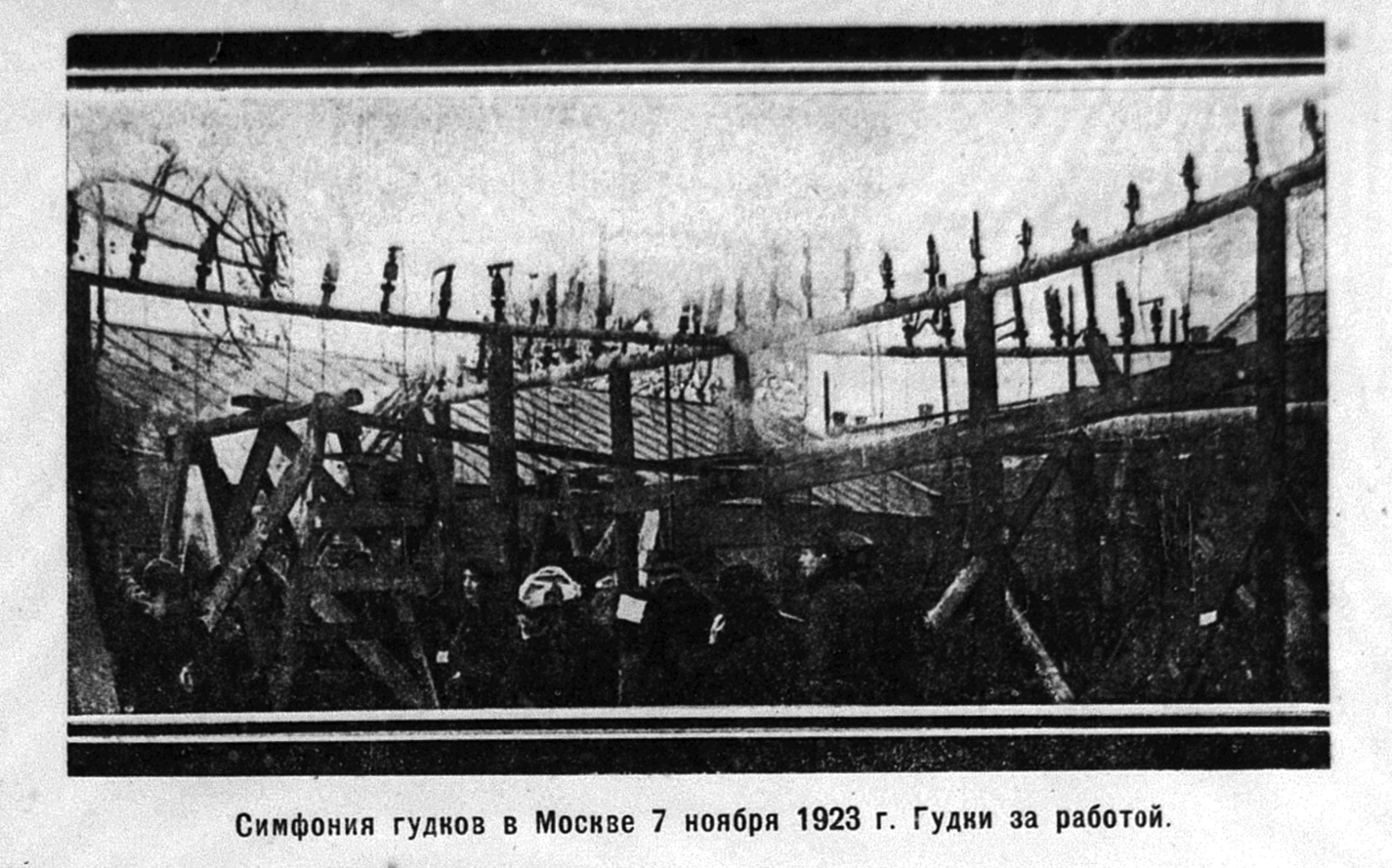
Responding to such criticisms, Avraamov eventually acknowledged some of the Moscow Symphony's problems. In his 1924 article for Artist and Viewer, he blamed the excessively difficult harmonization of the “Internationale” and the “Warszawianka” for the steam-whistle machine's technical difficulties. In contrast to Uglov, however, he argued that the symphony was not too loud, but rather not loud enough. The steam-whistle machine (Figure 4) had been misplaced “in the courtyard of the Moscow Hydroelectric Station (instead of on its roof as had been initially planned.)” There was thus “not enough sound for the Moscow auditorium.”Footnote 55 Similarly, in his correspondence with Zhiv, Avraamov complained about the lack of sound: “. . .in all, there were only twenty-seven cannon shots! That's supposed to be a big drum! And there weren't any machine guns. . .only rifle salutes! At the same time, twenty airplanes were buzzing over Red Square as we were sounding off. . .”Footnote 56
The Magistral΄ (steam-whistle machine) in the Moscow performance of the “Symphony of Sirens.” Arseny Avraamov, Simfoniya Gudkov,” Khudozhnik i zritel΄, no. 1 (January 1924), 50.

Few scholars discuss the Moscow Symphony except to say it was a failure. In doing so, they overlook key elements of Avraamov's correspondence and philosophy that provide insight into the symphony's ideal of unity. As it turns out, this ideal is more spiritual and personal than Avraamov's articles would lead one to suspect. A Futurist-Taylorist Gesamtkunstwerk, the Moscow Symphony was, in a certain sense, also a love song. In a 1923 appeal to Moscow factory committees just days before the performance, the symphony appeared under a curious title: “For the sixth anniversary of the October Revolution, the ‘Symphony La’ will be performed on the magistral΄ [steam-whistle machine] and the factory sirens of the Zam[oskvoretskii] district and railway stations.”Footnote 57 The “Symphony La” refers to the sixth of solfeggio (do re mi fa so la ti da); it also refers to Avraamov's complicated romantic history. In a letter to Zhiv, written just before the Moscow performance, Avraamov explains that the title “La” incorporates both her and his wife Olga into the structure of the composition. “The theme of the symphony is yours,” he writes, “the tonality is hers. The thing is, the children and I always called her La. . . .. Hence, let it be La, the theme's concluding chord—the tonic of the entire symphony.”Footnote 58
Though he soon denounced the Moscow mass spectacle as a failure, Avraamov initially considered this conceit a great success. Immediately following the symphony's recital, he wrote to Zhiv on a piece of tracing paper: “It happened.. . .Everything happened! ReveccA sounded over Moscow—and will sound once more on the night of the 12th at 11 pm.. . .You both stood with me there on the heights.. . .Not my hands but yours and ‘La's’ raised the banner of the ‘Symphony of Sirens’ over the Kremlin and were given an artillery salute.”Footnote 59 A symphony that converts the alienated sounds of work into a song of proletarian unity thus performed another kind of transformation—from a symphony of labor to a polyamorous love song. Indeed, a few weeks after the performance, Avraamov wrote a letter to Zhiv's mother, Sofia Veniaminovna, proposing a union between Revecca, his wife Olga, and two other lovers—Eva and Lilya Segal.Footnote 60
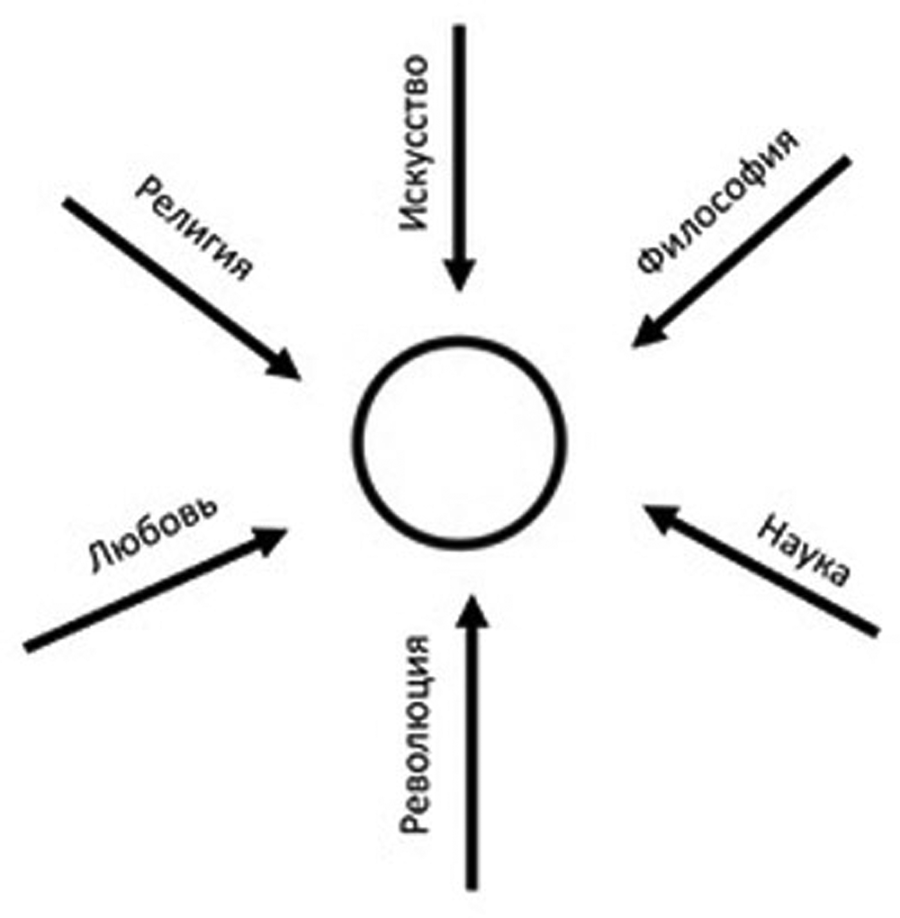
The concluding chord of the Moscow Symphony is not merely a romantic conceit; it is a fundamental element of the symphony's composition. Love is an active principle in Avraamov's philosophy of art. Not surprisingly, the most striking summation of this principle is found in his correspondence with Zhiv. In a letter dated “Year Six of the First Century,” Avraamov details a program for the unification of all creative drives—a program he calls LIR (Liubov΄, Isskustvo, Revoliutsiia—Love, Art, Revolution) as in the Russian words for lyre and lyric.Footnote 61 LIR in fact encompasses six creative drives—love, art, religion, science, philosophy, and revolution. Although equal to one another, these drives are in constant conflict, which Avraamov illustrates in terms of world-historical figures: “Science vs. Religion (Newton, Copernicus); Religion vs. Art (Savonarola, Luther, Nikon), Art vs. Science (‘Mozart and Salieri’);” and so on. Likewise, he arranges these drives with arrows pointing toward an empty inner circle (Figure 5) and poses the problem of their infighting in biblical terms: “six irreconcilably hostile figures I see now on this great historical crossroads, on the threshold of the New World.. . .The legend of the Tower of Babel and its builders resurrects itself—a terrible legend, all the more terrifying since it is being born out in life, in reality.”Footnote 62
Author's rendition of Avraamov's sketch from his letter to Revecca Zhiv. Reproduced in Rumiantsev, Ars Novyi, 58.

The Tower is a stock trope of the Russian avant-garde, one that manifests itself in projects like Vladimir Tatlin's “Monument to the Third International,” a three-tiered structure in which each rotating level corresponds to the cycles of year, month, and day. Clark has noted the similarity between Tatlin's tower and mass spectacles in general, arguing that “both these products of revolutionary utopianism entail the sacerdotalization of space and highly ritualized movement through it.”Footnote 63 As an attempt to reconcile all creative drives through the unification of art (music, performance), science (industrial technology), religion (communism), revolution (October), and eventually love (Revecca and Olga), Avraamov's symphony goes one step further by seeking to construct its tower in sound. The empty inner circle at the center of Avraamov's sketch outlines the tower as a non-place—a utopia. Its sonic corollary is the silence that follows the sounding of the 25th cannon, which marks the moment when the chaotic and conflicting noises of alienated labor are miraculously transformed into a song of unity. Like the empty inner circle, the moment of silence is a non-place; it is outside the spatial and sonic dynamics of both the city and the symphony. In Baku and Moscow, this non-place clashes with actual city space; the result is a chaotic and disorganized din.
The foregoing shows that the symphony's engagement with the city's “streets and squares” as materials for aesthetic and social construction concerns a metaphysical space that is far removed from the city. That said, by emphasizing love in his art, Avraamov hedges against the possibility that this non-place will not be realized through his projects on earth. In the same letter, he writes that he and Zhiv must choose between two paths: the first—the path of avowed love—demands that Zhiv break all ties with her past life and join Avraamov in the construction of a new world. This world would be the “real” materialization of utopia on earth. The second “no less sublime” path—that of secret love—requires that neither Avraamov nor Zhiv speak of their love but instead reap the rewards of its sublimation in art. “Let the fruits of our love speak for us,” Avraamov writes, “our immortal children. You will be their father—I, their mother. I will find the strength to forget the nightmare that surrounds us and create, create—give birth without end.”Footnote 64
In the path of secret love, the fact that Revecca will be forever unattainable allows Avraamov to usurp her reproductive role, using his longing as a means to create ad infinitum. The path of avowal holds that utopia can be achieved—Avraamov can build his Tower of Babel just as he can realize his love. The path of secret love, by contrast, holds that one must defer utopia in order to keep dreaming it. Avraamov, here, may give birth to works of art—his “immortal children”—so long as he ignores the limitations of the real world—the “nightmare that surrounds.”Footnote 65 As such, for Avraamov, love as a principle serves to reconcile the contradictions of utopian construction. Operating behind his symphony is a mechanism that wishes to simultaneously engage and flee the world; to bring about utopia in reality and yet defer its arrival by dreaming. This two-fold desire is hidden in the concluding chord of the Moscow Symphony.
IV
The era of ludic Petrograd-inspired mass spectacles came to an end shortly after the Moscow Symphony. Out of work, Avraamov lived a meager existence around the Pegasus Stall, a Futurist café in Moscow. His next major project was the soundtrack for the first Soviet sound film, Piatiletka: The Plan of Great Works, followed by his pioneering experiments in sound synthesis.Footnote 66 Yet even in the harsh cultural climate of the 1930s, Avraamov never gave up dreaming about the “Symphony of Sirens.” In 1933, he conceived of resurrecting the symphony as a piece of synthetic music composed of drawn sounds:
The “Symphony of Sirens” is being constructed out of right triangles, and it will be more harmonious and more powerful than my “documentary” siren symphonies, performed in Moscow and Baku.. . .For the ‘International’ we especially like the timbre of squares and rectangles—no natural recording could produce such singular and forceful sounds. Trapezoids and isosceles triangles produce softer, more “lyrical” colors: they will be used in the “Funeral March.”Footnote 67
Prior to this proposal, Avraamov also envisioned broadcasting the symphony from airplanes using electro-acoustic instruments: “And if the sound of sirens is not powerful and qualitative enough, what could we dream about? Clearly: about the devices of Theremin or Rzhevkin installed on aeroplanes, flying above Moscow! An Aerosymphony!”Footnote 68
Here, the non-place of Avraamov's symphony is resurrected in the airborne thundering of electronic instruments and the abstract geometry of sound synthesis. These dreams point to a crucial yet overlooked aspect of Avraamov's mass spectacle—its reliance on an idiosyncratic conception of mechanical reproduction. Avraamov did not share his contemporaries’ anxieties about new technologies like the gramophone and the movie camera. In a 1916 article titled “The Coming Musical Science and the New Era in Music History,” he recalls a debate with a friend about the possibility of creating an exact copy of the Venus de Milo.Footnote 69 The friend argues that it is “impossible to recreate the Venus de Milo, that even the most ideal copy would be dead, even if its material and form were flawlessly and mathematically reproduced.” Avraamov replies that he is not so sure:
I admit that the feeling one experiences contemplating the original might be a special one, related, for example, to that sacred trembling which accompanies the examination of an authentic Bach manuscript. However, in the case of this feeling, a trick is certainly possible—if I do not suspect anything, I will look upon a forgery with no less a feeling of “sacred trembling.”Footnote 70
“Sacred trembling” resembles Walter Benjamin's notion of aura, an artwork's unique time and place. For Benjamin, mechanical reproducibility spelled the decay of aura. The works of the Soviet avant-garde, he believed, were uniquely positioned to take advantage of this decay in the service of a politicized aesthetics. By contrast, Avraamov believed that aura—the feeling of awe in the presence of the original—must be mechanically reproducible to ensure the possibility of politicized mass art. If it were not, he writes, then every single person in search of “authentic aesthetic enjoyment” would have “to make a pilgrimage to the Louvre or the Vatican.”Footnote 71 Against such an absurdity he proposes making exact copies of the Venus de Milo and placing them in the squares of every major city.
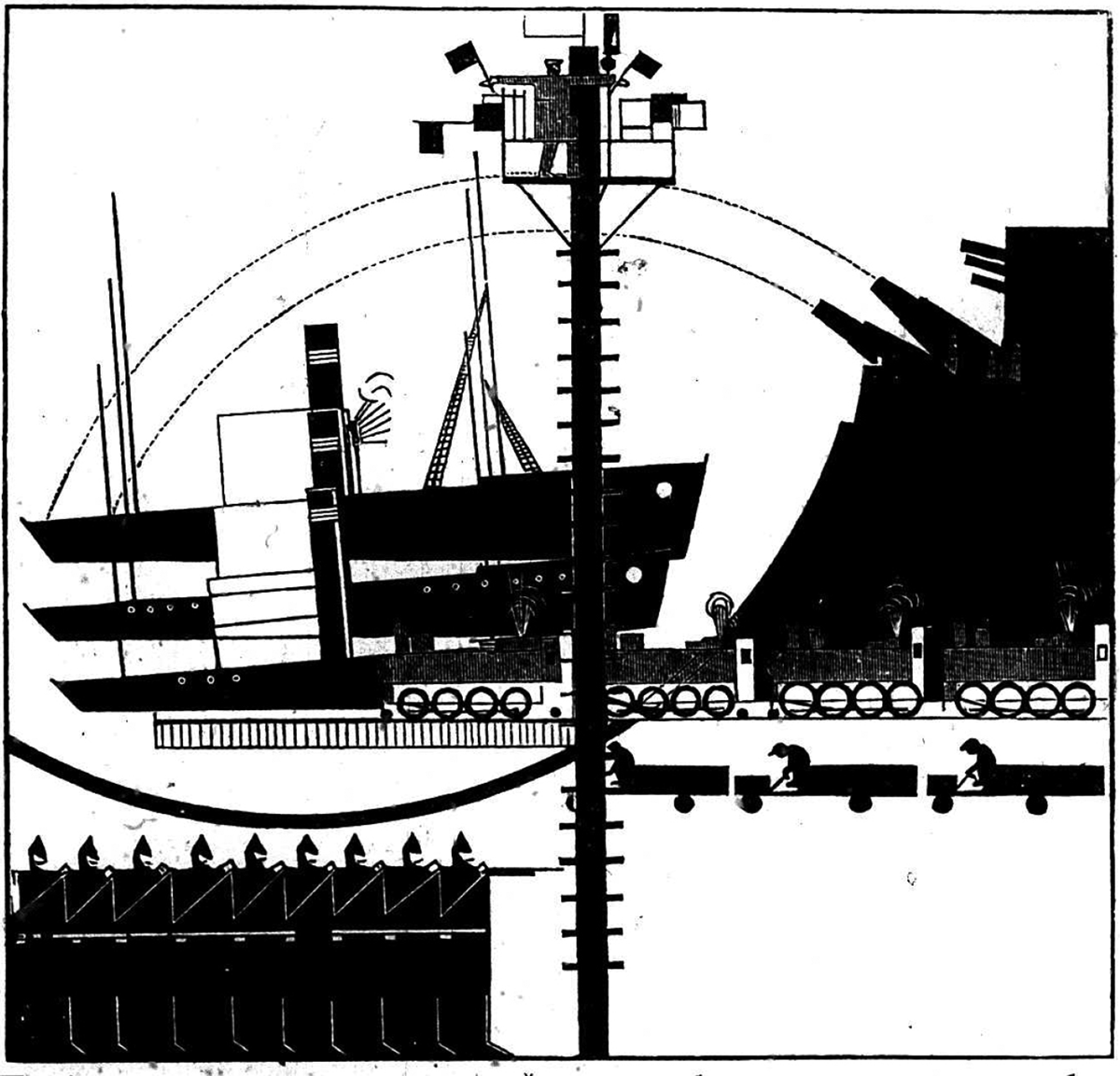
This conception of mechanical reproduction is another instance of Avraamov's ideal of unity—the unity of original and copy. The “Symphony of Sirens” is inspired by the desire to replicate the Venus de Milo and place it in every city square. Just before his discussion of the famous statue, Avraamov writes “let us suppose that once a year (to dream of any more is frightening), all the major works of our great masters were compulsorily performed in all our cities, or at least in all the regional capitals—wouldn't that be utopia?”Footnote 72 This proto-“Symphony of Sirens” would be played city-wide for the masses, as opposed to in a concert hall for a restricted audience. Technologies of mechanical reproduction would be instrumental to realizing it. As Wendel points out, the Swedish Mast from which Avraamov ostensibly conducted the symphony was a type of tower used to mount radio antennae (Figure 6). In Artist and Viewer, Avraamov suggests that such technologies would resolve “the social problem in music” through the “active engagement of the broad masses with musical creativity (the socialization of music) and the perfection of its hitherto archaic material technology (the electrification of music).” The first solution he characterized as a movement “from the village to the city; the second—from the city to the village.”Footnote 73 Electrified music would create a collective aesthetic experience in cities similar to the kind that already existed in villages.
Artist's rendering of the “Symphony of Sirens” in Baku. Swedish Mast is the central figure. Arseny Avraamov, “Simfoniya Gudkov,” Gorn, no. 9 (November 1923): 113.

In creating a mass electric village, the “Symphony of Sirens” essentially flips the conventional understanding of mechanical reproducibility on its head: not a multitude of recorded copies sent out to individual homes, but one central copy delivered en masse to an entire city; not the decay of aura, but its preservation and democratization.Footnote 74 Interestingly, this idea of flawless mechanical reproduction has its roots in a pre-Revolutionary search for authentic Russian music. In the same discussion of mass performances, Avraamov writes: “[n]ot long ago, we had [u nas] Taneev and Scriabin. . .Who had them [u kogo]? Where is this ‘ours’ [gde eto ‘u nas’]? In Moscow? In Petrograd? Even in the Grand Duchy of Kiev they only know Scriabin on the basis of a few tours, and the great works of Taneev—even in Kiev—have never been played at all.”Footnote 75 How is it possible to say these are Russian composers if so few Russians have actually heard them? As Avraamov poses it, the question “to whom does a particular form of music belong” becomes a question about where this music resides—“gde eto u nas?” The phonograph provides the answer: it resides in the community of listeners who hear it, who bear its imprint.
For Avraamov, music inheres in people in a material sense. When a great pianist plays, he argued, the pressure of his fingers on the keys causes unique vibrations in the strings. If we can perfectly capture these vibrations then “we have in our hands nothing less than a negative of creative ecstasy.” If we recreate these very same vibrations—using recording technology—then we will have a “positive image—authentic creative ecstasy.”Footnote 76 A phonograph record does not just register vibrating airwaves but the very pressure in the pianist's fingers that bear the creativity of his performance. By extension, the listener who hears this recorded performance experiences these same vibrations. Each stage of the process—from the ecstasy of the performer to the plane of the phonograph to the ears of the listener—is a lossless reflection of an integral whole.
This utopian faith in recording technology hearkens to the first uses of the phonograph to record Russian and Ukrainian folksongs. Here, for instance, is Evgeniia Lineva, the first person in Russia to record peasant music with a phonograph:
What had seemed impossible was now a fact. Songs, echoing somewhere in space—filling the fields, forests, and villages, unconquerable, uncatchable—could now be captured on the cylinder made of delicate resin, carried over onto paper in the same whimsical form which flowed from the poet's mouth—from the mouth of the people—and preserved for posterity for many years to come.Footnote 77
In this quote, Lineva whimsically elides a rather complicated process. Peasant songs were recorded on resin cylinders, but they did not magically appear on the page. Nor were these recordings meant for the general public. Instead, they were analyzed by an expert musicologist, then transferred to paper using graphic notation, then approximated using standard musical notation, and finally published in song books like Lineva's Folk Songs of the Ukraine. Footnote 78 This great chain that connects sounds echoing through the fields to posterity is in fact broken in many places, yet Lineva suggests that the final product maintains the integrity of the original melody. With the ear as opposed to the eye, she is happy to follow, to borrow Benjamin's famous phrase, “a mountain range on the horizon or a branch that casts its shadow on the beholder,” confident that her phonograph will capture the music that resonates through these spaces.Footnote 79
Similarly, Avraamov's notions of “sacred trembling” and “creative ecstasy” describe a seamless connection between artist, artwork, and audience facilitated by recording technology.Footnote 80 This logic of the exact copy pervades Avraamov's mass spectacle. The symphony is a way of transmitting and reproducing the sounds of the October Revolution. In this regard, it treats the city as a medium for bearing the imprint of this momentous event. In “The City is a Medium,” Friedrich Kittler argues that the city is constituted by dense material networks—bridges, highways, automobiles, oil refineries, gates, and ports—designed to record, transmit, and process information.Footnote 81 Avraamov's symphony rewires and reconnects these networks based on a utopian conception of mechanical reproduction. The symphony is structured according to a logic of signal and receiver. An unbroken chain connects Avraamov in his tower to crowds of listeners and performers via semaphore, cannon fire, and wailing sirens. The city's material infrastructure serves as a conduit for transmitting the “creative ecstasy” of the composer. Listeners experience the “sacred trembling” of the October Revolution through the thundering sounds that literally shake their streets. This is a way of giving the people “their” music, albeit in proletarian (as opposed to Russian) terms—their music as workers. Instead of bringing the artwork to the city, the symphony transforms the city into a work of art. Instead of bringing the Venus de Milo, it brings the Revolution. In this manner, all peoples, from Petersburg to Baku (and onto Berlin) could experience the aura of the same event.
V
The “Symphony of Sirens” hovers between sound and silence, tantalizingly close to our ears and yet echoing from an unbridgeable distance. Quite possibly, the symphony is a siren song of Avraamov's own making—one that seduces scholars today with its scale, noise, and colonial ambition. Like Avraamov, we too have a desire to hear and reproduce the original. Yet it is the failure of the symphony that tells the more interesting story. This failure reveals the underlying dreams of unity at the heart of the symphony's construction—the unity of all peoples (regardless of race, religion, or ethnicity); the unity of all creative drives; and the unity of original and copy (of flawless mechanical reproduction). It also underscores the resistance of urban spaces to such dreams. Playing the Revolution through a city's material infrastructure does not replicate its creative ecstasy any more than a copy of the Venus de Milo re-creates the presence of the original. In Baku, the political, ethnic, and material makeup of the city most likely rejected the Petrogradian ideal of the “Symphony of Sirens.” In Moscow, it was distorted through the mistuned sounds of a broken steam-whistle and over-powered by the rumblings of an airshow.