

A question has repeatedly been asked in studies of state security policies and interests: What determines the security outlook of a state? An underlying assumption is that the security concerns and priorities of states located within a region are interlinked and overlapping. States located next to each other – sharing a border or boundary (at sea) – are, naturally, statistically more inclined to end up in conflict with each other (Bremer Reference Bremer1992). In other words, the geographic location of a state matters to understand its security concerns and priorities. As with the larger body of international relations theory, regional approaches are grounded in different epistemological foundations and emphasise different variables.
This chapter outlines approaches to studying security that deal with the following topics: (1) security amongst states, (2) the role of geography in defining that security, or so-called geopolitics, and (3) the concept of regional security. This lays the foundation for an in-depth study of Arctic security dynamics. In essence, security relations amongst states inherently entail a regional dimension (states of geographic proximity being more concerned with similar or the same security issues), although various approaches have grappled with this dimension in different ways.
Security of States
The topic of security lies at the core of international studies. It encompasses issues such as war, survival, and power. The first writings on international relations – written before the advent of ‘modern’ statehood – were all concerned with these issues in an attempt to secure the survival of their community through power expansion and warfare.Footnote 1 Several scholars have utilised this drive for security to explain the formation of a state and attributes related to its structure (Tilly Reference Tilly1990; Fukuyama Reference Fukuyama2011; Vu Reference Vu2010). Similarly, realist scholars have argued that survival (and thus security) is the ultimate goal for any state in the current international system due to its anarchic structure (Waltz Reference Waltz1959; Mearsheimer Reference Mearsheimer2001).
However, security is not a uniform term. As David Baldwin (Reference Baldwin1997) argues, this term has experienced a proliferation of usage and meaning after the end of the Cold War. He asked some relevant questions related to security: Security for whom? For which values? How much? From which threats? By what means? At what cost? And in which time period? While recognising the whole range of security studies and the interlinkages between the different types of security and safety, this chapter, and the book at large, focuses on what is often referred to as state (or military) security (Hoogensen Gjørv and Goloviznina Reference Hoogensen Gjørv and Goloviznina2014: 2–4). This means a state-centric point of view, where the survival of the state as a community, structure, and institution has primacy (Waltz Reference Waltz1979: 126; Tripp Reference Tripp2013), a point returned to in the final section of this chapter.
Then another question arises: What determines the security outlook of a state? In other words, in terms of security, how can the interests and behaviours of states be conceptualised in the international system? Well-trodden realist approaches hold that anarchy defines the international structure and states are primarily concerned with survival. In a neorealist view of international relations, states ultimately take advantage of each other in a relative power balance, as states are rational actors seeking the optimal course of action within the constraints and determinants of the anarchical international system. Thus, states primarily differ in terms of relative capabilities (Waltz Reference Waltz1979: 97).
While Hans Morgenthau (Reference Morgenthau1954) and classical realists before him place emphasis on human behaviour and leaders’ interests, Waltz’s (Reference Waltz1979) neorealism argues for the structural constraints under which states operate and influence their security actions. Robert Jervis (Reference Jervis1976) in turn argues that security interests are defined by perception and misperception, which can be used to explain the outbreak of hostilities. Robert Gilpin (Reference Gilpin1981) sees the structure as an equilibrium, where changes in states’ power forces a ‘redistribution’ of power in the system. In addition, states are security-maximising actors seeking security and welfare on an indifference curve (Gilpin Reference Gilpin1981: 18). Mearsheimer (Reference Mearsheimer2001: 29) argues that great powers ‘are always searching for opportunities to gain power over their rivals, with hegemony as their final goal’. Power (as latent power and military power) equals material capabilities. In sum, a state’s security interests revolve around its survival through acquisition of power and maintaining a constant structural and relative balance with other states.
So-called constructivist approaches challenge some of the previously mentioned assumptions. As Alexander Wendt (Reference Wendt1999) argues, anarchy is what you make of it. Thus, the focus remains on how state interests are formed, instead of taking them as given. The type of anarchy present amongst states depends on the ideas that drive relations, the internalisation of the anarchic culture, and the concept of ‘othering’ (Wendt Reference Wendt1999: 299–312). In other words, ‘[i]deas thus define the meaning of material power’ (Tannenwald Reference Tannenwald2005: 19). The argument is that, in contrast to only material capabilities, ideas and states’ conceptions of each other matter. This goes beyond perceiving the international system as only a system of similar entities that vary on certain parameters, and instead allows a more nuanced conception of how different states interact with each other in different contexts and settings; that is, ‘[t]he answer to the question of who are enemies and friends begins at home’ (Hopf Reference Hopf2002: 294). Others have expanded on this to examine how states’ interests and behaviours are influenced by norms, identity, and conceptions of ‘morality’ (Finnemore and Sikkink Reference Finnemore and Sikkink1998; Price Reference Price2008).
Understanding a state’s security interests is not just a consequence of material constraints and attributes but also that of states’ perception of each other, their historical relationships, and their identities. Where does geography come into play? Often, mainstream international relations has not paid sufficient attention to geography and its role in shaping outcomes in international affairs (Agnew Reference Agnew1994; Sjoberg Reference Sjoberg2008).Footnote 2 One can speculate whether this is due to its historical focus on state-centric models and territorial boundaries, which homogenise global spaces and obscure the complexities of socio-spatial phenomena such as transnational migration (Karayiğit Reference Karayiğit2021). The focus has been on a narrower set of questions related to the role of territory in conflict/war between states and as a source of friction (e.g., Hensel Reference Hensel and Paul1999; Hensel et al. Reference Hensel, McLaughlin Mitchell and Thomas2008; Hensel Reference Hensel2017; Huth Reference Huth1998; J. K. Choi and Eun Reference Choi and Eun2017). The neglect of wider theorising of the relations between geography/territory and international relations could perhaps also be explained by the decline of academic (political) geography in the USA post World War II after the concept of geopolitics became tainted (Dodds Reference Dodds2019: 28–30).
Geography and Geopolitics
Examining the linkages between security and international relations, it is apparent that geographic proximity serves as a cornerstone in shaping the security relations amongst states. As a consequence of European state formation and finite territorial space, the concepts of territorial sovereignty and boundaries have come to define the modern state and its relations to others (Krasner Reference Krasner1999; Zacher Reference Zacher2001; A. Buchanan and Moore Reference Buchanan and Moore2003). As states formed, developed, and expanded, the need to define and uphold territorial boundaries became increasingly relevant (Tilly Reference Tilly1990: 131). Friedrich Kratochwil (Reference Kratochwil1986: 33) holds that the 1659 Treaty of the Pyrenees between France and Spain established the first modern state boundary. In turn, because of European state formation and the finite territorial space in this part of the world, the concept of territorial sovereignty and boundaries has come to define the modern state and its relations to other states across the globe (Elden Reference Elden2013; Agnew Reference Agnew1994; Sack Reference Sack1986).Footnote 3
When the emphasis was placed on delimitation of, or establishing jurisdiction in, all territory in the nineteenth and twentieth centuries, ‘frontier’ regions became a source of interstate friction as they lacked clear demarcation. Disputes have further emerged as states have sought, and continue to seek, to expand their territory and define their borders. The link between territory, sovereignty, and conflict has been extensively proven (Holsti Reference Holsti1991; Goertz and Diehl Reference Goertz and Diehl1992; Vasquez Reference Vasquez1993; Forsberg Reference Forsberg1996; Huth Reference Huth1998; Wiegand Reference Wiegand2011; J. K. Choi and Eun Reference Choi and Eun2017; Carter Reference Carter2010). John Vasquez (Reference Vasquez1995), for example, shows how at least 79 per cent of all wars between 1648 and 1990 were fought over territory-related issues.
Disputing economic and political interests amongst states fixated on, or shaped by, geographical traits – sometimes emerging into outright conflict – is an inherent feature of international politics. This brings attention to the notion of geopolitics. The term geopolitics was born out of the confluence of geography and politics, trying to encapsulate an approach to understanding the interplay between geographical space, political power, and international relations. The word derives from the German term Geopolitik and was first introduced by Rudolf Kjellén in 1899 and later popularised by Halford Mackinder and other scholars (Mackinder Reference Mackinder1904). The roots of the term can be traced to Kjellén’s vision of a framework that integrates geography, political science, and sociology to analyse the spatial dynamics of power (R. Kjellén Reference Kjellén1924).Footnote 4
The critique of traditional geopolitical analyses has often been that they are too narrowly focused on resource drives and tend to be deterministic in their analytical capacity. Moreover, the term has also been tainted by its usage especially by Nazi Germany but also other regimes and state leaders to legitimise expansionist state actions (Dodds Reference Dodds2019: 20–27).Footnote 5
During the Cold War, however, George Kennan (Reference Kennan1947: 575), the architect of US containment policy, emphasised a strategic approach to counter the USSR, advocating for ‘patient but firm and vigilant containment’. In the 1970s, US National Security Adviser Henry Kissinger used the term geopolitics to describe the power struggle between the superpowers (Ó Tuathail Reference Ó Tuathail2010: 256). The end of the Cold War in the early 1990s marked a shift in international politics. To fill the resulting geopolitical void, intellectuals proposed new visions, through, for example, Fukuyama’s (Reference Fukuyama1989, Reference Fukuyama2006) ‘The End of History’, Huntington’s (Reference Huntington1993, Reference Huntington2003) ‘The Clash of Civilizations’, and the shift from geopolitics to geoeconomics (Sparke Reference Sparke1998). New geopolitical perspectives emerged, focusing on environmental issues and transnational challenges such as sustainable development and inequality. Kaplan, advocating neoclassical geopolitics, predicted future conflicts driven by environmental scarcity, affecting subnational groups and threatening state survival. He later expanded on this in his ‘revenge of geography’ theory (Kaplan Reference Kaplan2009, Reference Kaplan2012).
One additional approach to geopolitics builds on the premise that ‘distance in international relations … is an “illusion”’ (Henrikson Reference Henrikson2002: 441). Thus, critical geopolitics emphasises that, in addition to existing physical geography, distinctive mental perceptions of space form and re-form images and ideas of a physical reality that influence actions (Kuus Reference Kuus2014). This calls for efforts to ‘reveal the hidden politics of geopolitical knowledge’ (Ó Tuathail, Dalby, and Routledge Reference Ó Tuathail, Dalby and Routledge2003: 3). In particular, the critical approach draws attention to how the narratives of conflict, geography, and politics impact governance (e.g., Peters, Steinberg, and Stratford Reference Peters and Stratford2018) and how different decision makers describe and conceive the same spatial domains (Dodds, Kuus, and Sharp Reference Dodds, Kuus, Sharp, Dodds, Kuus and Sharp2013).
Critical geopolitics aims to ‘move beyond the statist framing of power and spatiality’ by including human beings and their (political) institutions that are often not considered the main focus of analysis (Kuus Reference Kuus, Dodds, Kuus and Sharp2013: 381–82). Notwithstanding the broad scope of many of the critical approaches to geopolitics, the central point, in essence, is to try to break deterministic, rigid, or simple causal statements concerning politics and geography – while still maintaining a focus on geographic traits.
The Return of Geopolitics
Bearing in mind this history and these different approaches, in contemporary language today, ‘geopolitics’ has evolved to become a lens through which analysts, policymakers, and scholars examine the interplay between geography and politics, sometimes attempting to ‘claim’ an objective truth concerning the relationship between state relations and geography (Topalidis et al. Reference Topalidis, Kartalis, Velentzas and Gr Sidiropoulou2024). It is commonly used to describe the strategic considerations and power struggles between states on the world stage and seems to have become shorthand for ‘great power rivalry’ or ‘possible conflict’. A quick check of online search trends related to ‘what is geopolitics’ and ‘geopolitics’ (as a field of study) further highlights an increased interest since 2004, with a marked uptick from around the start of 2014 (Google Trends Reference Trends2024).
The increased use of, and interest in, the term can thus be explained by several interrelated trends over the last decade. The ‘world is flat’ argued Thomas Friedman in 2005, perpetuating the idea that new technology has made the world increasingly smaller, removing the barriers posed by traditional geographic concerns. Alas, a backlash was inevitable. Whereas – at least in Western circles – it was popular to argue for the decline in relevance of borders and geography’s waning importance as a determinant of state action in the 1990s and early 2000s (Bethlehem Reference Bethlehem2014; Ikenberry Reference Ikenberry2014), global affairs over the last two decades have led to a counterreaction.
The decline of US hegemony and the interlinked relative global power shift eastwards have spurred the notion of a ‘multipolar’ world where state–state interactions on a less-than-global level have increased in importance. Other developments have reasserted geography’s role for understanding international relations in the 2020s and beyond. For most of Europe, the re-emergence of Russia as a traditional security threat from around 2007 to 2008 is linked to territory and space. The Russian war in Georgia in 2008, the annexation of Crimea from Ukraine in 2014 with the following conflict in eastern Ukraine, and the full-scale invasion of Ukraine in 2022 highlight the importance of territory, disputed borders, and in consequence related security practices by states.
Also underscoring the role of geography and states’ desire to manage the constraints that derive from it is China’s increasing expansion of power through ‘traditional’ means such as infrastructure development, base construction, and military presence and power. The Belt and Road Initiative is perhaps the foremost example of a geopolitical, or geoeconomic if you will, development. Geoeconomics entails the attempt by states to make use of commercial and economic ventures to achieve (geo)political goals. Instead of outright application of military power, states make use of investments, ownership in companies, or direct territorial action aimed at gaining economic advantages (such as expanding territorial seas or blocking sea lanes) to ensure political goals (Luttwak Reference Luttwak1990; Sparke Reference Sparke1998; Wigell and Vihma Reference Wigell and Vihma2016). As tensions between the USA and China have increased, more traditional Cold War-style questions of territory and anti-access and area denial in the East and South China Seas have also received attention alongside concerns over Chinese intentions regarding Taiwan (C. Schofield, Sumaila, and Cheung Reference Schofield, Sumaila and Cheung2016; Aspinwall Reference Aspinwall2020; Yabuki and Selden Reference Yabuki and Selden2014).
Finally, a global backlash against ‘globalisation’ with the reintroduction of border and trade barriers has been apparent since the fallout of the global financial crisis in 2008 (Burgoon and Trubowitz Reference Burgoon and Trubowitz2023). Populist parties gaining power in Western countries leading to – amongst other things – the election of Victor Orban in Hungary (in 2010), the election of Donald Trump in the USA (in 2016 and in 2024), and the decision to leave the European Union by the United Kingdom (in 2016) are prime examples of this anti-globalisation trend. Other strongman features centred around ‘protecting’ national borders are increasingly prevalent, even sought after, amongst state leaders ranging from Narendra Modi in India to Recep Tayyip Erdoğan in Türkiye, who tend to portray themselves as fighting against global forces and for local and national interests (for this argument in full see Rachman Reference Rachman2023).
Although these trends, events, and developments are an eclectic (and cherry-picked) bundle of issues, they arguably underscore a point, namely the increased popular fascination with the role of geography in shaping global politics. One outcome of, as well as a contributing factor to, this turn away from the ‘global’ and towards the national and regional has been the growth of investigative non-fiction works promising the ultimate guide to understanding geography’s role in shaping international affairs. The best examples are perhaps Robert Kaplan’s (Reference Kaplan2012) The Revenge of Geography, Tim Marshall’s (Reference Marshall2015) Prisoners of Geography, and Ian Morris’s (Reference Morris2023) Geography Is Destiny, where variants of the same argument are presented: states are destined by their respective geography, and if we ignore the underlying limitations posed by geography, we will fail in our analyses of world politics. By studying, for example, ten maps, we can ‘reveal the future of the world’ (Marshall Reference Marshall2021). State leaders, ranging from Norway to Brazil, seem to have caught on (Rachman Reference Rachman2023; Gahr Støre Reference Støre2019).
However, as the critical approaches to geopolitics highlight, these works tend to – at times – exaggerate geography to the extent that it becomes the primary (or only) factor defining politics of states. The key problem is the determinism of the linkages between geography and the ability by states (and their peoples and leaders) to act (i.e., politics), which sometimes might result in political leaders being overly obsessed with geopolitics with detrimental consequences for other issues such as combatting climate change (see Toal Reference Toal2024). As succinctly put by Daniel Immerwahr (Reference Immerwahr2022) in a longer feature article titled ‘Are We Really Prisoners of Geography?’ where he critiques the determinism of the works of Marshall and Kaplan:Footnote 6
For Marshall, the ‘tribes’ of the Balkans are perpetually in the thrall of ‘ancient suspicions’, the Democratic Republic of the Congo ‘remains a place shrouded in the darkness of war’ and the Greeks and Turks have been locked in a ‘mutual antagonism’ since the Trojan war.
Kaplan sees things similarly. Russia has always been an ‘insecure and sprawling land power’, he writes, its people held ‘throughout history’ in ‘fear and awe’ of the Caucasus mountains. He approvingly quotes a retired historian’s theory that Russians, facing cold winters, possess an enhanced ‘capacity for suffering’.
At the same time, regardless of the trendiness of geopolitics or studies of geography, or the sometimes simplified deterministic manner in which linkages are presented, it is still clear that we cannot ignore geography and its impact on international relations.Footnote 7 The fundamental assumption of geopolitics is the relative importance of geographic space and distance, that is, geographic proximity amongst states and boundaries between territories. It explores how states strategically position themselves, form alliances, and engage in conflicts based on geographic considerations. Natural barriers such as mountain ranges, rivers, and deserts can fortify or compromise a state’s security. Coastal states, with their inherent vulnerability to maritime threats, do formulate defence strategies distinct from those of landlocked nations. The historical use of geographical features as defensive strongholds, exemplified by the Great Wall of China or the mountainous terrain in Afghanistan, does underscore the impact of topography on military tactics and security doctrines.
Moreover, looking to the sea, the maritime domain with its intricate network of trade routes and sea lanes, also constitutes a geopolitical space where geography plays a role in shaping security relations – perhaps more so in the twenty-first century than ever before (e.g., Østhagen Reference Østhagen2022b). Coastal states and those controlling strategic waterways hold considerable sway in global trade. The geopolitical significance of maritime chokepoints, such as the Strait of Hormuz or the Malacca Strait, underscores how geographical control over these passages can be a source of power and influence. At the same time, the geopolitics of the ocean is built on different sets of rights, notions of sovereignty, and states’ ability to control space and uphold rights (Østhagen Reference Østhagen2022).
In sum, the prevalence of geopolitical analyses linking geography, territory, and regions has varied over time, often in sync with fluctuations in the levels of conflict amongst states. Geopolitical diagnoses are still frequently employed to interpret international relations and the correlation between power and the organisation of space, although we should be mindful of exactly how we make use of theories linking space and political action, and to what extent outcomes in international relations are seen as predetermined due to geographic constraints.
This interplay, especially concerning state security interests, is what continues to inspire studies of geography, state actions, and – as a natural arena for these dynamics – regions. The question then becomes: How can we better unpack, and understand, these linkages? Can we utilise frameworks that employ approaches from international relations and lean on political geography (and geopolitical approaches) to take geography seriously as one determinant of state security and affairs, albeit without falling into the ‘territorial trap’?Footnote 8
The polar regions are ideal examples of these challenges, where a literally melting icescape contributes to a perception of states jockeying for position to exploit resources and/or engage in regional governance efforts (e.g., Stokke, Østhagen, and Raspotnik Reference Stokke, Østhagen and Raspotnik2022). Marshall (Reference Marshall2019: 286), for example, looking at the Arctic, contends that the melting ice is changing geography and thus a race amongst states for territory and resources is ‘inevitable’.
However, in the Arctic, as we will turn to shortly, conceptions of ‘geopolitical rivalry’ caused by ice melting remain too simplistic (Østhagen Reference Østhagen2021b). The ‘race’ has not materialised and does not look likely to become the case in the near-to-medium term either. Symptomatic of many claims about the future of the Arctic, much work looking at this ‘new’ region ignores distinguishing between different parts of the Arctic, different types of resources, and different types of dispute.Footnote 9 These types of analysis are often under-theorised and only sparingly engage with international relations thinking on regionalism – on which they inherently lean by referring to regional dynamics, constrained by a geographic ‘boundary’ or limit. Therefore, to complete the picture, we need to lean on a range of theories and conceptualisations that have taken a closer look at regions – as a political process, as well as a level of analysis of security dynamics.
Regions and Regionalism
One approach to dig deeper and beyond the immediate geopolitical headlines or contemporary fascination with deterministic statements about the role of geography is to study security relations and state interactions in the specific locales (spaces) where geopolitics is taking place. On the face of it, certain geographical regions undoubtedly emerge as geopolitical ‘hotspots’, characterised by contested borders, historical grievances, and competing territorial claims. The Middle East, the Korean Peninsula, and the South China Sea exemplify how geography intertwines with historical, cultural, and political factors to create volatile security landscapes – and in turn a fascination with the geography of these domains. Proximity to major powers, access to critical resources, and the historical legacy of regional conflicts contribute to the intricate tapestry of security relations. States manoeuvre within these regional dynamics, forming alliances, engaging in diplomatic dialogues, and at times, resorting to conflict resolution mechanisms to navigate the interplay of geographic constraints.
However, we can move beyond just describing these issues and concerns in such a simple manner and study the theorising of regions in and of themselves. Whereas critical geopolitics has attempted to break the deterministic cycle between geographical attributes and state behaviour, regionalism – as a multidimensional research field not necessarily attached to one theory – has broadly speaking been concerned with the political processes of how regions are formed, constructed, and maintained (e.g., Börzel and Risse Reference Börzel and Risse2016). Strands of scholarship based on rationalist, constructivist, or other social theories have sought to grapple with the central characteristics and developments of regions (Söderbaum Reference Söderbaum, Beeson and Stubbs2012).
Regional studies have oscillated in and out of fashion. Traditional regionalism in international relations refers to the formal process of intergovernmental collaboration between neighbouring countries to address shared challenges and goals. This process often leads to the establishment of regional organisations or institutions such as the European Union, ASEAN, or the African Union. Regionalism emerged prominently after World War II, largely driven by the need for economic recovery, political stability, and the prevention of future conflicts. It is characterised by treaties and agreements that aim to promote economic integration, enhance security cooperation, and even facilitate political dialogue and ‘normative’ integration amongst states (e.g., Bicchi Reference Bicchi2006 on the EU). Traditional regionalism emphasises economic integration through the creation of customs unions, free trade areas, and common markets (Hettne Reference Hettne2007). It is often driven by state actors seeking to enhance economic growth and achieve political gains through collective strength.
The first wave of regionalist scholarship, emerging in the late 1960s and early 1970s, was driven by two international processes: the proliferation of new states in the wake of decolonisation and the interest generated by European integration (Väyrynen Reference Väyrynen2003). These early efforts assigned little agency to regions instead placing them as subordinates at the systemic level. This subordination was ensured by the possibility of external intervention by the primary system, which at this point was a bipolar dynamic between the USA and the USSR. The European integration process is a prime example, where member states pooled sovereignty in certain areas to achieve greater economic and political clout. This approach was plagued by problems of definition, which made it difficult to operationalise (Moon Reference Moon1998). This definitional arguing and world events in the late 1970s and early 1980s led to a move away from regional scholarship (Kelly Reference Kelly2007).Footnote 10
Regional studies regained their appeal with the end of the Cold War and the collapse of bipolarity. Instead of picking up where things had been left a decade earlier, this new wave of scholarship eschewed strict definitions and instead embraced an emphasis on functionalism (Alagappa Reference Alagappa1995; Väyrynen Reference Väyrynen2003) – Oran Young (Reference Young1992: 244) defined it as: ‘Short of becoming a locus of regional conflict, a geographically defined area may achieve the status of a distinctive region for purposes of policy analysis and public decision making when it enters a period of political turmoil or flux as a result of the impact of realigning forces’.
‘New regionalism’ provides a broader understanding of regional cooperation beyond formal state-led initiatives. It reflects changes in the global political economy and is characterised by a more varied, decentralised, and multidimensional approach. New regionalism encompasses a range of actors, including non-state entities such as businesses, civil society organisations, and transnational networks, highlighting a shift from purely economic and state-centric frameworks to include cultural, environmental, and social dimensions.
From this, ‘constructivist’ scholars argued that regions are not naturally defined but are socially constructed and politically debated – they exist as concepts, with no universal agreement on their boundaries (Acharya Reference Acharya2001). As put by Iver B. Neumann (Reference Neumann, Zielonka and Pravda2001: 57): ‘regions are spoken into existence; thus, lie where politicians want them to lie’. In essence, regions became unbundled from territory. Scholars also focused on understanding regionalism by examining ideas, identity, and the socialisation of norms within geographic areas (Amable Reference Amable2022). Fredrik Söderbaum (Reference Söderbaum, Beeson and Stubbs2012: 14) argued, for example, that ‘there are no “natural” regions; all regions are heterogeneous with unclear territorial margins’.
This new regionalism was not one coherent bloc, however. Here the focus is on two strands: the region-building analysis that was often a counterreaction to security dynamics and concerns, and the specific ‘security region’ frameworks that tried to bridge this emerging chasm by arguing that there are, indeed, objective regions out there at least in terms of security interactions.
Starting from the assumption that mainstream international relations theories are normatively flawed, critical approaches believe that a theory should respond to the reality of the developing world as well as the developed. At the heart of such approaches is the idea that regions are a means of both conflict resolution and resistance to larger threats. The goal is not only, or always, to develop an analytical model but a theory of (or even to argue for) regionalisation.
From an economic point of view, Björn Hettne (Reference Hettne2009) saw the replacement of the Westphalian state system by regions as a ‘second great transformation’. Influenced heavily by developments in Europe, regions are a means of bringing order through cooperation. These regions act as shields against neoliberal globalisation and US hegemony (Hettne Reference Hettne, Hettne, Inotai and Sunkel1999). Thus, a normative element to this approach exists whereby regional order itself is seen as desirable. As Robert Kelly (Reference Kelly2007; 213–14) puts it: ‘Regionalism is viewed as serving progressive values like multilateralism and global governance.’ Despite their break with mainstream international relations theories, these critical approaches, for the most part, adopt the basic premise of a global power hierarchy with a hegemon on top.
This means that these critical approaches implicitly accept the notion of openness, albeit in the context of something to be avoided through the process of regionalisation. Regions are often conceived of as appearing on a continuum. Kaisa Lähteenmäki and Jyrki Käkönen (Reference Lähteenmäki, Käkönen, Hettne, Inotai and Sunkel1999: 214–15) posit that regionalisation begins with proximity, which in turn evolves into a shared regional identity. Hettne (Reference Hettne2007) and Fulvio Attinà (Reference Attinà2004) draw similar parallels, with regions culminating in a regional security community or a regional security partnership respectively. This ultimately evolves into a regional organisation and, later, a regional security community.
Proposed by Karl Deutsch in 1957, ‘security communities’ are neatly defined as communities where there is ‘real assurance that the members of that community will not fight each other physically but will settle their disputes in some other way’ (Deutsch et al. Reference Deutsch, Burrell and Kann1957: 5). Picked up by IR scholars, in the mid 1990s, Emanuel Adler wrote that ‘[i]n a liberal community-region, people learn the practices and behaviour that differentiate aggressive states from peaceful states. In other words, each side develops a common knowledge of “the other’s dovishness”. In this sense, the democratic nature of a state becomes an indicator of its “dovishness”’ (Adler Reference Adler1997: 258).
Since then, a number of scholars have taken up the study of these communities around the world. The typical examples of an uncontested security community tend to be the Nordic countries (‘Norden’) or North American cooperation (Friis Reference Friis2021; Charron and Fergusson Reference Charron and Fergusson2022; Saxi Reference Saxi2019). Amitav Acharya (Reference Acharya2001) went on to examine whether, and how, the countries in Southeast Asia (ASEAN) constitute a security community distinct from European norms and liberal values; Michael Williams and Iver Neumann (Reference Williams and Neumann2000) discovered how NATO transformed from an alliance to a security community; Harald Müller (Reference Müller2006) uncovered how security communities unravel, a topic later explored by Simon Koschut (Reference Koschut2016) more broadly; and Pernielle Rieker (Reference Rieker2016) explored the boundaries of the European security community and the processes taking place there.
Furthermore, although a security community is not the same as a security region, the literature on security communities has noted a shift away from the geographic focus. By definition, security communities are not geographically bound. Acharya (Reference Acharya2001: 27) argues that scholars today define regions as ‘imagined communities, created by processes of interaction and socialization’. In turn, what constitutes a region might change at different times, making the ‘old’ idea of geographic proximity less relevant. In the early 1980s, Deutsch (Reference Deutsch and Torsvik1981: 54) argued along the same lines in defining regions: ‘In many ways … regions are made by culture, history, politics and economics rather than by geography alone.’ Scholars of security communities not only challenge the geographically bounded focus but they also see it as less relevant to explaining states’ security cooperation and behaviour. As stated by Allen, Massey, and Cochrane (Reference Allen, Massey and Cochrane1998: 2), ‘“regions” only exist in relation to particular criteria. They are not “out there” waiting to be discovered; they are our (and others’) constructions.’
Security Regions
Alongside the increased attention given to region-building efforts and even how to transcend traditional security concerns (and geography), others argue that the regional level of analysis in terms of security dynamics and state interactions has been largely ignored in favour of the systemic, or the national/domestic, levels.
David Lake (Reference Lake, David and Morgan1997: 50–51) argues that regional security is not inherently defined by geographic proximity and adjacency, as instead shared security ‘externalities’ bind states together, even when the states themselves are located far apart. By making it issue-specific, Lake avoided the complications that came with geography and history. In such cases, the flow of threats (or amity, as the case may be) remains paramount. For example, the decision by Australia to engage in fighting terrorism in Afghanistan in 2001 illustrates how geography is rendered less relevant with the rise of transnational threats and increased power projection through technology. In Lake’s approach, Kelly (Reference Kelly2007: 209) argues, regions become purely functional; they become simply ‘anything less than global’. While this deterritorialised approach echoes some constructivist scholars who seek to break with the positivist leanings of regional studies, Lake applied rationalist neorealist principles. Security externalities translate to threat(s) projected by one state far enough to affect others. History is only important insofar as it is the history of threats; fearful behaviour overrides all else.
In another approach focusing on regional causes of war, Douglas Lemke (Reference Lemke2002: 49) takes A. F. K. Organski’s (Reference Organski1968) power transition theory and conceives of (security) regions as local power hierarchies, all subsumed underneath the dominant global one. In total, he found twenty-three of these local hierarchies under the larger power structure of American primacy. These regions (local hierarchies) shared the same characteristics as the international level, except openness. Lemke accepted the concept of proximity and further caveated it by saying that all states within a security region must be able to reach each other and interact. The limit of this ability to act is the boundary of a security region. If a loss of more than 50 per cent of power projection between the national capitals of two respective countries is found, a state is removed from a security region.
Finally, perhaps one of the most common approaches to regional security studies – the regional security complex theory (RSCT) developed by Buzan and Wæver (Reference Buzan and Wæver2003: 47–50) – shares some similarities with traditional security approaches, while also adding a constructivist element in terms of how security interactions emerge and are maintained. Keeping the focus on competition between states and the systemic overlay, RSCT enriched traditional international relations studies by adding another level of analysis – the regional – that was better suited to understanding the post-Cold War era. RSCT departs from international relations orthodoxy in its assertion that, when the systemic overlay recedes, regional dynamics become a key component of the international system. The emphasis is on the regional level, and an appreciation of the territorial, especially when looking at security: ‘Security is a distinctive realm in which the logic of territoriality continues to operate strongly’ (Buzan and Wæver Reference Buzan and Wæver2003: 12).
Regional security complexes (RSCs) in turn are ‘traditional, state-based military-political complexes’ that are informed by a mix of neorealist principles and region-specific variables (Buzan Reference Buzan, Hettne, Inotai and Sunkel2000: 19). RSCs are ‘mini-anarchies’ that face the same problems of anarchy, polarity, and state competition as the systemic level (Buzan Reference Buzan, Hettne, Inotai and Sunkel2000: 4). However, RSCs are differentiated from the systemic level in several following ways. The first is the possibility of ‘overlay’ and ‘penetration’ by external powers. For example, during the Cold War, regional dynamics were superseded by the global security dilemma, as the two superpowers vied for power. This is defined as the ‘openness’ of a region to interference from above (Kelly Reference Kelly2007: 207). Penetration takes place when external powers establish security alliances with states within an RSC. Overlay occurs when the influence of major powers extends beyond basic penetration, dominating a region to the extent that the Indigenous security dynamics effectively become nonfunctional (Buzan and Wæver Reference Buzan and Wæver2003: 46, 61).
The second is the importance of proximity. These regions, or RSCs, are formed by ‘patterns of amity and enmity’ between neighbouring states, that is, ‘who fears or likes whom’,Footnote 11 with the limits of the RSC defined by the power projection capabilities of the states in question (Buzan Reference Buzan1983: 190). Interactions between geographically proximate states, both positive and negative, become more intense and compound over time. This translates into regional security dilemmas informed by shared histories. Taken together, in the words of Buzan and Wæver (Reference Buzan and Wæver2003: 46), RSCT is the idea that ‘anarchy plus the distance effect plus geographical diversity yields a pattern of regionally based clusters, where security interdependence is markedly more intense between the states inside such complexes than between states inside the complex and those outside it’.
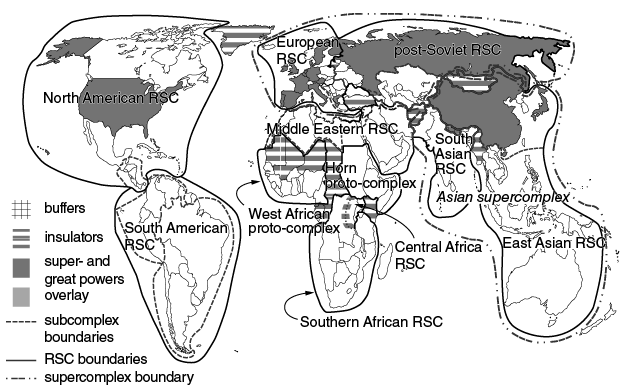
In other words, the region is characterised by units whose securitisation processes are so intertwined that their security issues cannot be addressed separately (See Figure 2.1). Or, as put by Buzan and Wæver, ‘a set of units whose major processes of securitisation, desecuritisation, or both are so interlinked that their security problems cannot reasonably be analysed or resolved apart from one another’ (Buzan and Wæver Reference Buzan and Wæver2003: 44). Echoing the scholars of geopolitics, the argument is that if we truly want to understand security interactions amongst states, focusing solely on global or national dynamics does not capture the majority of these. Simple geographic closeness leads to more security interactions among neighbouring states than those far apart. While there are occasional links across sparsely populated areas and non-territorial clusters, such as those formed around international terrorism, these are exceptions. As put by Dennis Amable (Reference Amable2022: 3): ‘These variables – geographic proximity and meaningful interaction – have proven crucial in making the regional system the most salient level for analyzing security issues.’
A world map of RSCs.
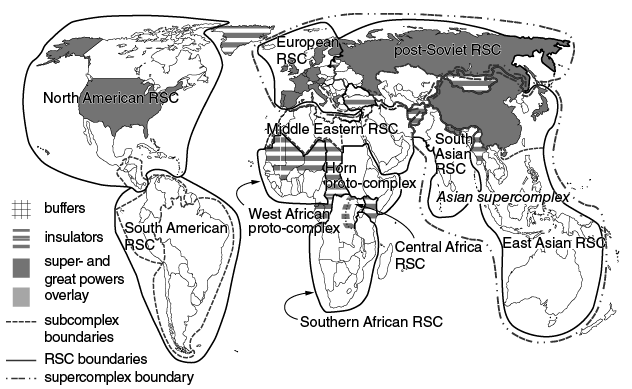
When it comes to how to study (or unpack) these RSCs, Buzan and Wæver (Reference Buzan and Wæver2003; 48) highlight that they ‘study the security discourses and security practices of actors, not primarily their regional(ist) discourses and practices’. The theory outlines four levels of analysis – domestic, state–state, interregional, and role of global powers – and we must consider how they interconnect (Buzan and Wæver Reference Buzan and Wæver2003: 51). Together, these four levels form the security constellation. The key is to focus on securitisation processes, namely processes in which issues are framed as security threats, leading to the justification of extraordinary measures to address them. This concept emerged from Buzan and Wæver’s work in the late twentieth century, emphasising the importance of discourse in shaping security perceptions and practices. Their approach moves away from traditional definitions of security, focusing instead on how security is constructed through political language and social contexts.
Some critics argue that the theory places too much emphasis on predefined regions, potentially oversimplifying the complex and dynamic nature of security relations (Sadurski Reference Sadurski2022). Regions are not static entities, and the boundaries of RSCs can change over time. Moreover, some argue that the theory’s primary focus on states and state-centric security dynamics may limit its applicability in regions where non-state actors significantly influence security matters (Ramutsindela Reference Ramutsindela2015). There is also criticism that the theory neglects global factors impacting regional security dynamics, such as globalisation, transnational threats, and the influence of major global powers (Lemke Reference Lemke2005). Finally, there has been some systemic pushback from scholars who hold that openness and weak states counter the claims made by regionalism; regions are porous and, despite being more difficult to penetrate after the Cold War, they are still open to great power hegemony (Katzenstein Reference Katzenstein2005: 22).
An Approach to Unpack Security Dynamics in a Specific Region
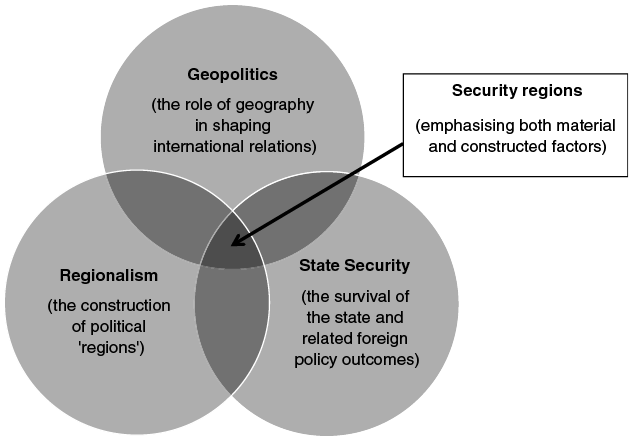
Broadly conceived from this review of current literature and approaches, three broad strands link the regional and the role of geography with an emphasis on traditional security considerations as well as state practices:
2 Geopolitics and the emphasis on geography for international relations.
3 Regionalism and the emphasis on region-building processes amongst states.
Despite the critiques mentioned, this book draws extensively on the ideas of Buzan, Wæver, and other scholars who have explored the delineation of regions as territorial entities; as political, economic, and cultural constructs; and as arenas for intense security interactions and threat perceptions. Geographic proximity undeniably influences the security perspectives of states and, consequently, geopolitical dynamics. However, different approaches emphasise various aspects of regional security and interactions, whether concentrating on the significance of regions or the role of geography (see Figure 2.2.). This book utilises these diverse concepts of the regional by focusing on the Arctic at the start of the twenty-first century, offering more general insights into how to study areas considered security regions, where security interactions are constantly evolving.
Diagram outlining the three broad strands of approaches that constitute this study of security regions.
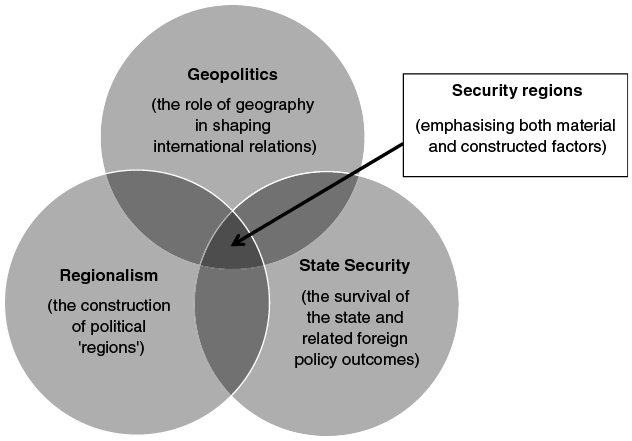
The approach in this book builds particularly on the RSCT and the updated discussions found in Greenland in Arctic Security from 2024 by Marc Jacobsen, Ole Wæver. and Ulrik Pram Gad (Reference Jacobsen, Wæver and Gad2024b: 343) but also more broadly on what has been outlined in this chapter, namely the fundamental notions of what security entails for states, the role of geography therein (as linked to geopolitics and the study of political geography), and – finally – regions as both a political construct and a complex of security dynamics and practices. The following assumptions guide the onwards study of a particular ‘region’:
The centrality of geography: regions exist, as a concept, as a territorial object, and as a venue or container for security interactions amongst states. Regions are bounded; they cannot contain everything and everyone and they are marked by boundaries. Inherently, these boundaries are the product of the limitations of existing states’ reach (power, capability, capacity). That reach is – still – severely influenced by geography. Seas, mountains, deserts, and territorial chokepoints do matter, as does human habitation, population centres, cities, and infrastructure connecting peoples. Still, leaning on Buzan and Wæver, a starting point for analysis remains ‘a set of units whose major processes of securitisation, desecuritisation, or both are so interlinked that their security problems cannot reasonably be analysed or resolved apart from one another’ (Buzan and Wæver Reference Buzan and Wæver2003: 44).
State-centric security focus: despite the critique of the RSCT for being too state-centric, that is the explicit approach taken here. There are undoubtedly other actors that impact security dynamics in a regional context but states are still the primary ones in global affairs today. Moreover, since the focus here is not on evaluating the relevance of the RSCT or similar theories, but instead examining the linkages between these types of theories and geography/geopolitics, as well as regionalism, choosing one specific actor focus (state-oriented) is a deliberate choice. Although this study of Arctic security dynamics is not wedded to examining only state or military dimensions of security, that tends to be where the focus lands given its centrality in trying to unpack state behaviour, geography, and related conflict potential.
However, when considering one threat in relation to other threats, it makes more sense with a unified concept of security rather than separating it into distinct issues or separate sectors such as ‘economic security’ and ‘societal security’ (Baldwin Reference Baldwin1997; Gunhild Hoogensen Gjørv and Goloviznina Reference Hoogensen Gjørv and Goloviznina2014). In terms of a regional scope of analysis, ‘different issues get tied together, and a world of regions is therefore less unlikely than one might at first think when listing the diversity of security issues each drawing on a particular sector’ (Buzan and Wæver Reference Buzan and Wæver2003: 49). Moreover, this approach allows the exploration of different levels of security in the Arctic, such as wider systemic rivalry and narratives of insider/outsider privileges (the global level), instilling regional cooperation to deal with issues of environmental and human security (regional level), or national concerns linked to economic or Indigenous security (domestic level).Footnote 12
Merging regionalisation and security regions across levels: region-building efforts create structures that can impact security relations amongst states in a given security region, but we need to try to separate between those efforts and related statements and where states’ focus on security actually goes in terms of practices. Consequently, there is also a need to examine region-building efforts and the political constructions that derive from those efforts. Albeit constructs, these forums, institutions, and even speech and performative acts by diplomats, officials, and others are part of constituting mechanisms that arguably have tangible impact on matters of Arctic governance, cooperation, and in essence security (of states). Emphasising all three levels of analysis as outlined in Chapter 1, is central, seeing them holistically in tandem.
Moreover, this emphasis needs to be combined with a consideration of the ‘naturally given’ territorial dimensions that define each regional space. As Buzan and Wæver (Reference Buzan and Wæver2003: 12) emphasised more than two decades ago: ‘The relevance of territorial versus non-territorial patterns of securitisation is an empirical question.’ The approach put forth here positions itself somewhere in between these different ways of conceiving of geography and the role of regions, however you define and structure them. The fundamental argument is that they all do something right but can also be further improved and tailored to better explain security in a regional domain as seen from a state perspective.
Objects of study: the objects of study are inherently states and their security practices. This entails studying: (1) security issues/issues that have become ‘securitised’; (2) geographical traits and related restrictions imposed by states within a spatial domain; and (3) region-building efforts and attempts at constructing less-than-global, but more-than-national, structures amongst states.
We must study a combination of foreign policy security statements and discourse and security and defence actions and investments. In states, the former tends to be dominated by, but not exclusive to, the respective foreign ministries, whereas the latter tends to be dominated by, but not exclusive to, the respective defence ministries and/or defence structures. However, these cannot be understood in isolation from each other or other non-state actors at both the national and international levels.
The concern with such an expansive scope is naturally that it becomes impossible to account for all of it, and the selection of what data and which developments to highlight will be subject to some degree of cherry-picking. Still, it is up to researchers and scholars to produce explanations and narratives that approximate a mapping of security practices within a regional context and open these up for scrutiny and evaluation. In this rather broad and eclectic approach to data, this framework deviates from the emphasis on securitisation by widening the scope of what is to be assessed, studied, and included.
What in turn this book focuses on, is trying to map and distinguish the various levels of analysis relevant to understanding the ‘geopolitics’ of a particular region (or subregional domain). It places an emphasis on the subregional level, or a scaled down version of the regional – so-called subregional security complexes (SRSCs). This emerges from the study of the Arctic in the following chapters, but it might also prove relevant when examining other parts of the world. This will be returned to in the final chapters. By exploring different security-and-state-oriented dynamics at different levels of analysis, it is easier to unpack state security, security regions, and the role of geography. From these assumptions and considerations, when taking a closer look at a specific geographical domain – in this instance the Arctic – the most fruitful approach is to start with defining the regional security dynamics and then showcasing how they are separate from the global level, the national level, and the subregional level. This is how the book now proceeds.

 Open access