In the midst of the Great Depression, Indiana’s commissioner of agriculture corrected those individuals whose distance from rural life led them to presume the economy initially faltered following the Great Crash of 1929: “That wasn’t when it began; that was when you found it out.” Footnote 1 A full decade prior to “Black Tuesday”—October 29, 1929—the end of World War I had ushered in ruinous deflation and a lengthy agricultural depression. Credit was so scarce following the war that farmers sought personal loans from unlikely sources. Henry Ford received direct appeals for individual aid. “Recently I have had severe losses and I am likely to lose my home,” wrote one beleaguered farmer. “If you can help me with a loan promptly, I will greatly appreciate your kindness.” Footnote 2 The severity and rapid onset of this crisis prompted shocked farmers to examine the causes of their ordeal. Finance attracted intense scrutiny, and numerous farmers and their advocates faulted the Federal Reserve System for raising discount rates and not acting to reduce pressures for debt liquidation. Others seconded this analysis, notably labor leaders who concluded credit contraction had worsened unemployment during the depression of 1920–1921. Leading progressive reformer Senator Robert M. La Follette Sr. (R–Wis.) endorsed their criticisms. These diverse voices raised serious questions about liquidationist Federal Reserve System policies that privileged financial interests over other sectors of the economy. The period’s popular protest yielded such financial reforms as Federal Intermediate Credit Banks and fostered the use of countercyclical Federal Reserve measures, although this innovation did not result in an aggressive monetary response during the subsequent economic crisis that developed into the Great Depression.
World War I had been a boom period for farmers. This state of affairs changed dramatically following the armistice. The average price of the nation’s ten leading agricultural crops plummeted 57 percent over the last six months of 1920. “The unprecedented drop in prices of farm products in 1920 came as a stunning surprise to the majority of farmers,” reported Secretary of Agriculture Henry C. Wallace. “They had expected some decline, but nothing so severe as what actually happened.” Footnote 3 The severity of agricultural price declines begged for explanation. Many farmers concluded that the Federal Reserve System shouldered much of the blame for their economic predicament. The “sentiment” of a National Farmers Union meeting “was that readjustment was naturally to be expected after the war … but that the deflation policy of those in financial authority … is responsible for the tremendous decrease in prices.” Footnote 4 The organization accordingly resolved: “We condemn the policy of the Federal Reserve Board in raising re-discount rates and curtailing credits.” Footnote 5 Farmers attended meetings addressing the agricultural crisis in hundreds of counties across the nation. “From one end of the country to the other,” the Saturday Evening Post reported, “there was testimony as to money shortages whenever the farmer went to the bank.” The magazine further related: “For this the Federal Reserve System and city banks were blamed consistently by farmers everywhere, and the deflation policy of the Federal Reserve was universally condemned as disastrous to the farmer.” Footnote 6
Many farmers believed Federal Reserve System policy resulted from the institution’s subservience to powerful private financial interests. Minnesota farm leader Magnus W. Brown claimed that the Federal Reserve Act had been “enacted for the purpose of placing the absolute control of our money system in the hands of a few large New York Banks, in conjunction with a few other large banks in scattered industrial centers working in collusion with them.” He concluded: “The present depression in the price of farm products is the direct result of the policy of the Federal Reserve Bank Board.” Footnote 7 This understanding of how the Federal Reserve System operated was a widely accepted explanation for the severity of the agricultural crisis. Accusations leveled by Comptroller of the Currency John Skelton Williams lent sanctioned financial authority to this position. Williams also fostered a belief that the Federal Reserve System had aided Wall Street at the same time that it denied relief to farmers. “The policy of the Federal Reserve Board and of certain reserve bank authorities seemed to be that if certain big banks wanted anything, why let them have it promptly and no questions asked,” he charged, “but if a little bank or farmer needed funds, comb him well; make him give up everything he has as security. Footnote 8
The comptroller’s indictment nurtured the concept of the “Crime of 1920”—a belief that the Federal Reserve Board had targeted farmers for deflation. In the words of Idaho Progressive Party leader Henry F. Samuels: “The owners and controllers of the Federal Reserve Bank System ordered on May 20, 1920, that all farmers’ banks collect the farmers’ notes and do not reloan.” Footnote 9 The gravity of this event remained seared in the minds of many farmers for years. More than a decade later, National Farmers Union President John A. Simpson vividly recounted a conversation in 1920 with Williams, in which the comptroller informed him that the Federal Reserve Board had voted to initiate deflation that May. Williams reportedly said officials had been undeterred by knowledge that this decision would ruin many “little country banks” and farmers, because they believed there were too many small-town banks and that farmers were “getting so prosperous they won’t work.” Footnote 10
Organized labor concurred with agricultural criticism of post-World War I financial policy. William H. Johnston, president of the International Association of Machinists, charged that the Federal Reserve System bore “responsibility for unemployment and industrial depression.” Footnote 11 He was one of a number of labor leaders to make such declarations. American Federation of Labor President Samuel Gompers expanded the “Crime of 1920” to encompass workers when he connected credit contraction to unemployment and wage cuts. Gompers contended that leading financiers bore blame for the suffering of “5,000,000 unemployed in the United States, men and women who are willing and anxious to work.” He attested that these unfortunate workers were the victims of “the contraction program, the object being to make people hungry.” Gompers believed this “artificial period” had been “inaugurated by the profiteers who found in the Federal Reserve Board a willing instrument to aid their plans.” Footnote 12
Prominent financial figures such as Secretary of the Treasury David F. Houston, and his predecessor Senator Carter Glass (D–Va.), stridently defended the Federal Reserve System against popular criticism. Houston contended:
The ignorant part of the community … unable or unwilling to see the facts resorted to the easy and usual practice of attributing the financial ills to the banking machinery of the country, even going so far as to charge that there was a deliberate conspiracy on the part of the Reserve Board and of many bankers to crush the farmers. Footnote 13
Houston repudiated such claims. “The truth is that, while some prices, particularly those of farm products, greatly declined, there was no real deflation. There was no decline in the volume of credit during 1920.” Footnote 14 Glass made the same argument, but more passionately. “[I]nstead of deflating credits and currency, the Federal reserve banks, during the period of falling prices, enormously expanded bank credits.” Footnote 15 He despaired:
[A] large body of citizens has been induced to believe that the Federal reserve banking system is … creating widespread depression. … Instead of clearly apprehending, that which the facts so amply attest, that this reserve banking system saved their country from inconceivable distress, from irremedial disaster. Footnote 16
Glass was livid over the adverse appraisal of the Federal Reserve System’s actions, and denounced those who promulgated this belief. “For my part, I fervently thank God that I have no responsibility for its inception or its propagation or the dissemination of its vile odors.” Footnote 17
The analyses of economic historians are at variance with Glass’s interpretation. These studies characterize the Federal Reserve System’s handling of postwar monetary policy as inelegant at best. Footnote 18 Financial policymakers came under close public scrutiny during the depression of 1920–1921, and contemporary critics reached a similar conclusion. Farmers and workers protested that Federal Reserve System policy was biased in favor of financial interests. The dismissal of this legitimate criticism in previous historical accounts as a groundless outbreak of mass financial ignorance is unfounded and obscures the significance of this episode. Congress rejected the claims of finance’s apologists when they set up a temporary federal mechanism for meeting emergency agricultural credit requirements. A permanent system of government banks was subsequently established to address farmers’ demand for operating credit. The membership of the Federal Reserve Board was broadened to include an agricultural representative. Federal Reserve officials also responded to the political reaction that the depression of 1920–1921 had precipitated. The accepted contemporary central banking practices that guided their actions during this period had been called into question. They recognized the advisability of avoiding similarly abrupt economic downturns—and the political pressure they provoked—in the future. Central bank officials began to acknowledge a responsibility to nonfinancial interests and subsequent Federal Reserve policy demonstrated greater concern for economic stability. The nation’s financial leadership had implicitly recognized the legitimacy of the criticisms leveled against them.
Conventional practices and ideas had not been dislodged from the Federal Reserve System, however. Successive studies have viewed its policy decisions following the Great Crash of 1929 with dismay. They are in agreement that the Federal Reserve did not respond satisfactorily to this crisis, and have offered various explanations that help clarify the causes of this blunder. Footnote 19 One factor underlying this failure was the reflexive faith of many Federal Reserve officials that economic depressions constituted natural processes of liquidation, which were imperative for purging maladjustments that had developed during prosperous periods. Footnote 20 This theory shaped Federal Reserve monetary policy during the Great Depression. For example, Lynn P. Talley, governor of the Federal Reserve Bank of Dallas, opposed “interference with economic trends through artificial methods to compose situations that in themselves grow out of events recognized at the time as being fallacious.” Footnote 21 Examining events during the depression of 1920-1921 underscores the depth of commitment to liquidationist ideas in financial circles. The withering public criticism of Federal Reserve policy following World War I pushed its officials to take halting steps away from this theory. The central bank began making use of countercyclical policy to promote economic recovery. However, this departure proved to be tentative. Liquidationist thought had been axiomatic in financial circles for so long that it remained firmly entrenched.
During the depression of 1920–1921, the political pressure on central bankers was intense because the Federal Reserve System was the outstanding target of public protest over economic conditions. Popular criticism managed to modify Federal Reserve policies, but failed to fundamentally disturb many financial leaders’ adherence to liquidationist ideas. Blame for the Great Depression was assigned more diffusely than had been the case in 1920–1921. One popular rhyme reduced the cause of the 1930s depression to a few accessible factors. “Mellon pulled the whistle, Hoover rang the bell, Wall Street gave the signal—And the country went to Hell!” Footnote 22 Even this simple analysis, however, identified multiple guilty parties. Moreover, the central bank was omitted while other financial culprits were named. Absent the focused public criticism of 1920–1921, the Federal Reserve System hewed to habitual practices during the Great Slide of 1929–1933. Popular protest during the depression of 1920–1921 left its imprint on the Federal Reserve, but these critics failed to overturn the established theoretical bias of most Federal Reserve officials, and monetary policy during the Great Depression was more passive as a result.
This article first reviews the historical literature on popular dissent from post-World War I financial policy. It then turns to the experience of farmers and workers during the depression of 1920–1921, before exploring their criticisms of the Federal Reserve System’s liquidationist policy approach. The mechanics of the Federal Reserve’s tight-money policy and its economic consequences are subsequently examined. The article goes on to consider the impact of public criticism on Federal Reserve policy and financial legislation.
Charges Were Thrown Wildly
Studies of the popular response to the depression of 1920–1921 generally disregard the cogent criticisms that contemporaries directed toward financial policymakers. M. Elizabeth Sanders’s intervention affirming agricultural opposition to Federal Reserve System policies provides an important exception, but passes over the “political outcry” itself. Footnote 23 Other studies addressing the protests of farmers bear the imprint of their mid-twentieth-century historiographical moment by portraying these voices as the product of an irrational, strictly rural impulse. Footnote 24 This was a time when one of American history’s most prominent popular protest movements—the late-nineteenth-century Populists—was castigated as an ominous manifestation of mass ignorance and prejudice. Richard Hofstadter influentially depicted the Populists as rural, backward looking, and susceptible to conspiracy thinking. One mid-twentieth-century critic even declared, “American fascism had its roots in American populism.” Footnote 25 Such histrionic claims about Populism manifested and encouraged an unfavorable attitude toward other past instances of popular political protest. The era’s perspective on the criticism of financial policies following World War I reflects this negative appraisal of Populism. The prevailing mid-century image of Populism also neglected its urban following. Footnote 26 This omission encouraged a notion that protest movements in which farmers played a leading role lacked wider appeal. Organized labor’s postwar financial criticisms have been overlooked.
Hofstadter popularized the view of insurgent farmers as prone to paranoia, arguing there was “something about the Populist imagination that loved the secret plot and the conspiratorial meeting.” Footnote 27 Starting from much the same standpoint, Arthur S. Link applies this understanding of political ideas that derive their strength from a mass following to the post-World War I farm crisis. Link articulates the still prevailing interpretation of the popular response to this event. He portrays the perspective of farmers on the Federal Reserve System’s culpability as an ignorant reaction that betrayed a proclivity for unfounded conspiracy theories. “Charges were thrown wildly about during 1920–1922,” Link stresses. He further emphasizes that the Federal Reserve was subjected to “violent attacks,” which resulted from the fact that “farmers … did not understand what had happened with regard to the credit situation.” Link argues that the “anti-Reserve agitation of the agrarian spokesmen” was unjustified because of the “great expansion of credit by the System to meet the needs of the farmers during the critical deflationary period.” Footnote 28 Subsequent studies have deferred to Link’s interpretation. Footnote 29 This period of popular protest, however, should not be dismissed as the infelicitous manifestation of a conspiracy-minded rural outlook.
Financial Straits
Workers and farmers suffered during the sharp post-World War I depression. The unemployment rate is conservatively estimated to have almost tripled from 1919 to 1921. Footnote 30 Farm income decreased by more than 40 percent over the same period. Footnote 31 Industry rebounded within two years, but agriculture had entered a period of protracted decline. The farm parity ratio stood at one hundred ten in 1919, before falling to ninety-nine the following year, and to eighty the year after that. In 1923, the ratio recovered slightly to eighty-seven, but it would not reach one hundred again until World War II. Footnote 32 The effects on post-World War I agriculture of shrinking foreign markets and elimination of government price supports instituted to bolster the war effort were compounded by deflation. The consequences for farmers were dire. Secretary Wallace reported: “Many thousands of farmers have not been able to weather the storm, notwithstanding their most strenuous efforts.” Footnote 33
For farmers, the depression of 1920–1921 stood in stark contrast with the preceding years. The Great War had brought prosperity. It sparked a surge of demand for food that prompted farmers to aggressively ramp up their production. Government officials exhorted farmers that the war effort demanded they produce more food. Footnote 34 Borrowing was encouraged to increase output. “Wheat will win the war,” was the slogan. Footnote 35 President Woodrow Wilson directly appealed to farmers through a flier the U.S. Department of Agriculture distributed across rural America. “Without abundant food, alike for the armies and the peoples now at war, the whole great enterprise upon which we have embarked will break down and fail.” Footnote 36 The government’s wartime easy credit policy encouraged farmers to invest in their operations. Footnote 37 They planted more marginal farmland: forty million new acres were placed under cultivation. Footnote 38 Expenditures on fertilizer more than doubled. Footnote 39 Newly purchased machinery propelled by the internal combustion engine replaced horse-drawn farm implements. Sales of tractors spiked from 19,000 in 1916, to 109,000 by 1919. Footnote 40 Farm debt ballooned from $4.7 billion in 1914 to $8.5 billion in 1920, even while farm income rose from $7.9 billion to $17.8 billion during this period. Footnote 41 Wartime agricultural prosperity fueled a 60 percent increase in the price of farmland between 1916 and 1920. Footnote 42
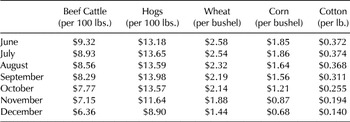
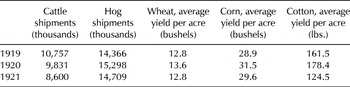
The factors that generated this boom disappeared following the war, and commodity prices came crashing down during the summer of 1920. The cessation of hostilities in Europe had not brought an immediate end to the high demand for American agricultural products, but this export market contracted as European agriculture recovered. The value of farm exports decreased from over $4 billion in 1919 to less than $2 billion by 1922. Footnote 43 Wartime government price supports ceased to provide any cushion for farmers after the last guarantee on wheat was lifted on June 1, 1920, immediately prior to the commodity price collapse. Footnote 44 Agricultural prices declined precipitously that summer. Wheat had averaged $2.16 per bushel in 1919, but was only $1.03 in 1921. Corn plummeted from $1.51 a bushel to 52 cents. Cattle that had averaged $54.65 per head were valued at only $39.07. The value of hogs dropped even more sharply, from $22.18 to $13.63 per head. Cotton prices halved, from 35 cents per pound to 17 cents. Footnote 45 The financial strain farmers felt because of these price decreases was not offset by higher crop yields or livestock shipments Footnote 46 (see Tables 1 and 2).
Agricultural commodity prices, June–December 1920

Source: Department of Agriculture, Yearbook 1920, pp. 542, 557, 640, 732, 754.
Agricultural commodity supply, 1919–1921

Source: Department of Agriculture, Yearbook 1922, pp. 571, 583, 711, 833, 898.
Farmers who had been caught up in the wartime boom overlooked the potential for a severe shock to the agricultural economy following the war. One Virginia farmer’s caustic reaction to the rapid price collapse reveals the bitter experience of this turn of events. “Of course we would like to continue to play the role of food philanthropists—produce food at a loss—but we cannot do it. Therefore many of us in the coming year, in spite of slogans such as ‘Food Wins the War’ or ‘Feed the Nation’ or ‘Feed Starving Europe’ will merely try to feed the farmer.” Footnote 47 Corn prices sank so low that midwestern farmers substituted their crop for coal or firewood as fuel during the winter. Footnote 48 An Iowa farmer who possessed a reputation for being hardworking and honest was forced to quit farming and place all of his personal property on the auction block. Farming was the only way of life he had ever known, and he could not imagine what the future held. This forlorn man wept the morning that his home, and the work of a lifetime, was to go up for sale. Footnote 49 One Idahoan farmed “a fine location,” but had been thrust into “financial straits” by collapsing prices and anticipated a similar fate. “What will I do when I cannot pay what I must pay or lose my house?” Footnote 50 A southern farmer reported that unless cotton prices rose, “I [will] lose my home and everything in it.” Another man had “witnessed the ups and downs of North Dakota [for] nearly forty years and … the situation is the worst we have seen.” A Colorado farmer had survived “drouth [drought] seasons and grasshopper seasons,” but concluded he had “never seen as discouraging times for the farmer as at present.” Footnote 51
Fully 28 percent of Montana’s farmers lost their land between 1920 and 1923. Footnote 52 In South Dakota, sixteen of the eighteen counties located west of the Missouri River experienced their highest years of farm foreclosure not during the Great Depression but between 1921 and 1925. Footnote 53 One of the state’s farm leaders later recalled, “farmers were going broke—foreclosures, evictions, dispossessions were the order of the day out here.” Footnote 54 County extension agents reported that in Oklahoma “there probably never was a time when there was a greater feeling of insecurity or a more general despondency among the farmers.” Footnote 55
Workers experienced a similarly abrupt deterioration of their economic circumstances following the end of World War I. By 1921 unemployment stood at over 21 percent in manufacturing and transportation. Footnote 56 Prolonged joblessness among Norwegian seamen residing in Brooklyn compelled them to turn their backs on the sea and head west, embarking on a futile pursuit of work inland. Footnote 57 More than 80 percent of Detroit’s autoworkers were without jobs by the end of 1920. Footnote 58 In the wartime boomtown of Akron, rubber industry employment fell by over fifty thousand jobs in six months. Jobless workers abandoned the city, heading south to stave off hunger back home on hardscrabble Appalachian farms. Footnote 59 Those industrial workers who still had jobs saw their wages cut by 10 to 25 percent. Footnote 60 Wage reductions at one North Carolina textile mill prompted workers to protest that they “did not receive sufficient pay on which to live properly and decently.” Footnote 61
Exceptional expressions of anguish were directed toward finance during the depression of 1920–1921. One man who lost his farm to a bank marched into its office. “[H]ere’s the deed to my farm,” he apprised the banker. “I worked all my life to own that farm … now you’ve got it.” The devastated farmer then pulled out a Colt .45. “Now I’ve lost everything in the world—so I’m going to kill you and myself.” Fortunately, this overwrought man’s emotions quieted and no physical violence ensued. Footnote 62 Dramatic occurrences like this one were isolated. Popular dissent was expressed through political pressure for reform. John R. Howard, president of the American Farm Bureau Federation, attested that the Federal Reserve System was “not a farmers’ bank” and foresaw impending political conflict. “[T]he big interests of the country do not want the farmers to have a bank which will function in their interests. It is one of our biggest fights ahead.” Footnote 63
An Instrument to Deflate
The lack of concern Federal Reserve System officials exhibited over the social costs of the depression of 1920–1921 elicited reactions from agricultural interests that ran the gamut from incensed hyperbole to measured criticism. Many critics emphasized that while this severe depression pressed hard upon ordinary citizens, those who occupied positions of authority remained secure. A meeting of farmers in Marshall County, Kansas, protested that deflationary policies sacrificed working people so others could profit: “We believe that this contraction of currency and bank credits is in the interest and at the instigation of the fund-holding investment classes and to the detriment and ruin of the producing class.” Footnote 64 Rural grievances were fueled by Comptroller Williams’s charge that the Federal Reserve System favored Wall Street over the small-town banks farmers relied upon for credit. In response to popular protest, Congress formed the Joint Commission of Agricultural Inquiry, which conducted a study with the Federal Reserve Board and Federal Reserve Bank of New York; it found no discrimination against small-town banks. Footnote 65 Nonetheless, Williams’s claim endured. It spoke to deep-rooted dissatisfaction over credit arrangements. Farmers had long taken exception to the discrepancy between their restricted access to the nation’s money in comparison to the special privilege of currency issue accorded federally chartered banking corporations. Footnote 66 Percy E. Quin (D–Miss.) proclaimed Williams’s viewpoint from the floor of the House of Representatives. “The sweet-singing mocking birds of Wall Street always got the money they wanted, but the farmer, who produced by toil the cotton, the meat, the corn, the wheat, the wool of the United States, could not get a dime of money through the Federal Reserve Board.” Footnote 67
A diabolical cast was even attributed to the central bank’s actions. “Federal Reserve oligarchs deliberately staged the greatest financial debacle in all human history,” declared one pamphlet circulated in North Dakota. “Never before in a given time in this land has there been such a holocaust of failures, of suicides and of unemployment. Never before in this land were such sacrifices laid on the twin altars of Moloch and of Mammon.” Footnote 68 Other less sensational critiques meditated upon the competence of Federal Reserve officials. D. Edward Lyday, president of the Texas Farmers Union, stated that if the Federal Reserve Board had not anticipated the effects of deflation, “then its members are utterly incapable and should be relieved of their positions at the earliest possible moment.” However, Lyday considered these officials’ actions to be so questionable that they cast doubt upon their intentions. He charged that if these men had known “of the wreck and ruin, the crime, suicide and despair that would follow such a policy … it would constitute one of the greatest crimes in history.” Footnote 69
Failure of financial leaders to treat the agricultural depression as a critical situation requiring urgent measures provoked indignation. The Federal Reserve Board rejected direct appeals from farm leaders to reduce discount rates. The Department of the Treasury spurned plans for providing emergency credit that would allow farmers to hold their crop during this period of low commodity prices. Footnote 70 Secretary Houston decreed that his department “cannot be a party to an undertaking to hold commodities off the market.” Footnote 71 Despite lack of any government aid, a number of Iowa farmers held their crop rather than selling it to pay off their debts. This action prompted the Federal Reserve Bank of Chicago to demand that member banks liquidate their loans so that “the basic law of supply and demand will again begin to operate normally and values reach their natural and proper level.” Footnote 72
The generally staid Iowa farm journal Wallaces’ Farmer became uncharacteristically combative over the Federal Reserve’s refusal to utilize free gold to aid hard-pressed farmers. On October 1, 1920, Federal Reserve Banks held slightly over $267 million in excess of the legal reserves required against deposit liabilities and Federal Reserve Notes. Footnote 73 Wallaces’ Farmer protested that free gold was not being used to counter deflation.
Under the Federal Reserve law this two hundred and sixty-seven million dollars of excess reserves is enough to provide for the issuance of at least four hundred million dollars more of federal reserve notes as well as increasing the loaning power of the banks of the United States by a total of around $2,600,000,000. Footnote 74
Agriculture’s plight was not the priority for Federal Reserve leaders anxious to bolster gold reserves. Their focus was ensuring gold convertibility and bank liquidity. Footnote 75 Wallaces’ Farmer indicted Federal Reserve inaction. “[T]he present financial situation is not critical except in so far as the Federal Reserve Board arbitrarily makes it critical.” The agricultural journal bitterly concluded that Federal Reserve officials were indifferent to hardship on the farm. “[M]any farmers will get no pay for their work in the year 1920, the Federal Reserve Board doubtless regards this situation as a healthful symptom.” Footnote 76 Free gold exceeded $500 million by the end of January 1921, and Wallaces’ Farmer fruitlessly raised the issue again shortly thereafter. Footnote 77
Organized labor contended that Federal Reserve System policy was responsible not only for the farm crisis but also for the distress of unemployed workers. Reformer-economist W. Jett Lauck was labor’s most conspicuous critic of post-World War I credit policy. Testifying before Congress on behalf of organized labor, Lauck stated that a liquidationist perspective had led the Federal Reserve Board to conclude, “the farmer must be deflated.” Lauck also called attention to the private financial interests that many farmers claimed exerted undue influence over the Federal Reserve System. He contended the power of this “capital and credit combination” proceeded from “intercapital relations and interlocking directorates that focus in the banking house of Morgan & Co.” Lauck testified that while it was “foolish” to suggest “bankers and financiers … would be so dastardly … as to provoke a panic,” they had seized upon this opportunity to “deflate labor.” He explained: “[B]eginning with the constriction of bank credit itself [financial interests] … clamped a brake upon all industry [and that] intensified unemployment.” Industrial corporations controlled by this “combination” further exacerbated unemployment by utilizing “exorbitant profits” accrued during the war to maintain prices temporarily. If they had responded to falling demand by cutting prices, this would have stimulated production and thereby created jobs. These corporations chose not to reduce prices as part of “a deliberate plan … to get labor costs as low as possible.” The economist emphasized that these policies were “directly planned … to weaken or disrupt the labor unions, which had been greatly expanded during the war period.” Footnote 78
The editor of the union journal Labor agreed that a “great drive to destroy all of organized labor … was launched by the House of Morgan before the ink on the Armistice was dry.” Footnote 79 This perspective was consonant with contemporary events. Employers waged an aggressive campaign for the open shop following the end of the war, establishing organizations to advance this objective in cities across the nation, both large and small. Footnote 80 The slack labor market during the depression of 1920–1921 aided this attack on unions. A Wall Street journalist reported “the financial district” believed the period of high unemployment “to be a good time to attempt to settle this question of open shop.” Footnote 81 Union membership had increased from 2.6 million to 5.1 million from 1915 to 1920, but subsequently fell 25 percent between 1920 and 1923. Footnote 82
In February 1922, Senator La Follette affirmed the financial analysis farmers and labor had constructed during the depression of 1920–1921. He stressed the role of corporate power in this process, contending that the nation’s farmers and workers were suffering due to the actions of “great business combinations.” He charged, “The masters of American finance and business devoted the year 1920 to ‘deflating’ the farmers, using as their agency the Federal reserve system.” La Follette stated that once this aim had been accomplished workers became the target of “enormous aggregations of capital.” He deplored:
The year 1921 has been devoted by these same masters of business and credit to the infernal … task of ‘deflating’ labor and destroying their unions, which alone stand between them and serfdom. … Labor has been crushed by … unemployment and wage cutting. Footnote 83
La Follette wanted to protect workers and farmers from suffering such a fate in the future.
“Fighting Bob” La Follette was the major political figure of the Left following World War I. He enjoyed an ability to construct coalitions that united disparate groups, as demonstrated by his 1924 presidential candidacy under the banner of the Progressive Party. Footnote 84 In 1922 the union members, farmers, Progressives, and Socialists who formed the forerunner of this party had denounced the Federal Reserve System for restricting credit, and thereby serving “as an instrument to deflate and crush farmers and independent business men and cause nation-wide unemployment.” Footnote 85 La Follette talked about deflation on the campaign trail and explicitly incorporated the “Crime of 1920” into the Progressive Party’s platform, which declared “ruin and bankruptcy for agriculture is the direct and logical result of the policies and legislation which deflated the farmer.” Footnote 86 This plank addressed farmers specifically, but the issue spoke to other constituencies. A member of the Order of Railroad Telegraphers indicated this broader political appeal in 1922, when he stated that the “Federal Reserve Board’s deflation of credits, at the command of the big bankers, withdrawing the money supply from the farmers and small business men … drove millions of American citizens to the wall.” Footnote 87 La Follette demonstrated how widespread public criticism of Federal Reserve System policy was by placing this issue at the center of his 1924 campaign.
Deflation Is Bound to Hurt
Critics of post-World War I financial policy presented a legitimate objection to the priorities of the nation’s recently established central bank. Federal Reserve System leaders acknowledged no obligation to take steps designed to relieve the crisis facing farmers and workers during the depression of 1920–1921. A Swedish-language Chicago newspaper faulted the limited perspective of these financial officials. It observed in 1922 that “policies of the [Federal Reserve] Bank are not formulated with a view to the interests of agriculture.” While lay voices appreciated the impact of the institution’s policies on the public, Federal Reserve officials discounted this consideration. Footnote 88
Farmers were trapped in a squeeze between falling commodity prices and rising credit prices. They carried mortgage debt to purchase and improve farmland, and short-term debt for seasonal production and marketing purposes. As agricultural prices dropped, farmers’ need for credit rose because these funds allowed them to continue making loan payments as they came due and also to await a price recovery by holding their product. Between 30 percent and 35 percent of the credit farmers used was short term, and local banks were the most important source of these funds. Footnote 89 Securing these essential loans became increasingly difficult after the Federal Reserve System initiated tight-money policies in late 1919. Footnote 90 By the spring of 1920, the Arizona Cattle Growers Association was already protesting that ranchers suffered from an “inability to secure funds.” Footnote 91
The policy the Federal Reserve System pursued following World War I was liquidationist. In an attempt to check inflation, Federal Reserve Banks urged member banks to restrict loans, and raised the price of money with high discount rates that reached an unprecedented 7 percent. Footnote 92 Lending by national banks decreased over 11 percent from 1920 to 1921. Footnote 93 The money supply shrank by 9 percent during the depression. Footnote 94 There was a 16 percent one-year deflation, a remarkably steep price decline for a period when gross national product fell 2 percent. Footnote 95 The Federal Reserve did not ease tight-money policies in response to this contraction. Discount rates of 7 percent were maintained until April and May 1921, despite the ongoing downturn. Footnote 96
Federal Reserve Banks attempted to accommodate member banks under pressure during this deflationary period. They increased their lending to banks in agricultural areas pressed by slow loan repayments and declining deposits. Footnote 97 However, one Nebraska banker later recalled that while many banks borrowed from the Federal Reserve Banks, “the Fed became a little panicky and began calling in these loans much too fast to keep an even economy in the farming areas.” Footnote 98 Banks struggling to meet their liabilities often called the short-term loans of farmers rather than extending them. Footnote 99 The 25.3 percent decline nationally in the average size of farm mortgage loans from 1920 to 1922 indicates distress borrowing by farmers against real estate security to fund other debts. Footnote 100
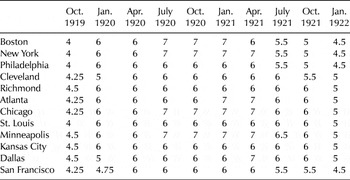
Post-World War I Federal Reserve Board policy was directed toward lowering price levels. In February 1919, Governor of the Federal Reserve Bank of New York Benjamin Strong Jr. insisted: “WE MUST DEFLATE: Notwithstanding the hardships and losses resulting.” Footnote 101 This objective was proclaimed in the Federal Reserve Board’s 1919 annual report. “The expansion of credit set in motion by the war must be checked.” Footnote 102 The Federal Reserve utilized a number of methods to realize this objective. Notably, its officials made the critical decision to raise discount rates. Beginning in November 1919, the discount rate at the Federal Reserve Bank of New York was increased from 4 percent to 7 percent over the course of seven months. Five additional Federal Reserve Banks followed this lead and matched the 7 percent rate, and the remainder raised their rates to 6 percent. In July 1920, the Federal Reserve Bank of Chicago indicated that recently implemented “credit restrictions and high interest rates” would be maintained “indefinitely” Footnote 103 (see Table 3).
Federal Reserve Bank discount rates, October 1919–January 1922

Source: Board of Governors, Banking and Monetary Statistics, pp. 439–440.
Federal Reserve Banks adopted additional methods to reduce member bank borrowing. Penalty discount rates were introduced. The determination to discourage the extension of credit led four Federal Reserve Banks serving agricultural districts to introduce progressive rates in April and May 1920. This practice added a progressively graduated penalty to the established discount rate when a member bank was borrowing heavily in relation to its resources. One small Alabama bank paid an extraordinary 87.5 percent on some of its borrowing. The 227 banks that paid progressive rates did not constitute a substantial share of the nation’s financial institutions, but banks located in areas with the greatest need for credit during the economic downturn were most burdened by this policy. Footnote 104 Marginal collateral requirements were another policy that Federal Reserve Banks used to restrict member bank borrowing. Eleven of twelve Federal Reserve Banks recurrently required member banks to provide a margin of additional collateral for the eligible paper they discounted. In some instances additional collateral of as much as 100 percent was demanded. Footnote 105
Federal Reserve officials aggressively employed moral suasion, directing bankers to contract credit. “The banks should lean less heavily upon the Federal Reserve Banks, and rely more upon their own resources,” intoned Governor of the Federal Reserve Board W. P. G. Harding in a May 1920 message to the nation’s banks. “Unnecessary and habitual borrowings should be discouraged, and the liquidation of long-standing non-essential loans should proceed.” Footnote 106 The mechanics of this policy were imparted by John U. Calkins, governor of the Federal Reserve Bank of San Francisco, when he informed the California Bankers Association that “overexpansion of bank credit … must be corrected,” and outlined two methods for accomplishing this objective: “coercion” and “cooperation.” Coercive methods available to the Federal Reserve System, he related, included higher discount rates, progressive discount rates, and “plain refusal” to further extend member banks’ credit. Calkins preferred that cooperation on the part of member banks would make recourse to coercion unnecessary. “The place to begin contraction of credit is in the offices of the managing officers of the commercial banks of this county,” he instructed. However, Calkins warned the assembled bankers, “Undesirable and friction-creating methods of coercion … must be applied in case of failure or even partial failure of cooperation.” Footnote 107 Federal Reserve Bank of Chicago official Charles H. McNider transmitted the same message to the South Dakota Bankers Association: “You have got to curtail your loans … you have got to deflate. … For just as sure as the sun shines,” he cautioned, “unless you co-operate with the Federal Reserve Bank … to this end … you are going to the rocks.” Footnote 108
While many small-town banks found deflationary Federal Reserve policies burdensome, bankers who outspokenly embraced credit contraction expressed the prevailing faith in liquidationist theory among the financial fraternity. In early 1920, the Wall Street Journal reported “an atmosphere of cheerfulness and an unmistakable sense of relief in banking circles at the action of the Federal Reserve Board in putting up discount rates.” The president of Chase National Bank, for example, believed that increasing rates was “unquestionably a good thing.” Footnote 109 “[A] necessary adjustment period is upon us,” agreed the president of the American Bankers Association. “Naturally, deflation is bound to hurt,” he acknowledged. Footnote 110 A noted banker speaking at a conference in St. Paul declared “further credit to farmers should not be considered as credit but as charity.” Footnote 111 The venerable northeastern agricultural magazine Farm Journal surmised that leading financial figures believed “farmers have been demanding more than their right.” Footnote 112 One politically moderate farm periodical reported that a New York banker revealed his institution planned to restrict credit so “wheat and other commodities came down to where they belong.” This banker recognized that liquidationist measures were upholding the established power relations between economic interests. “[T]he farmer needed to be shown his place once more almost as badly as did labor,” he avowed. Footnote 113 The superior position that business interests long enjoyed in relation to agriculture and labor was amplified during the 1920s, a decade whose ethos would be captured by President Calvin Coolidge’s terse pronouncement that “the business of America is business.” Footnote 114
Federal Reserve policymakers focused on counteracting inflationary pressure during the depression of 1920–1921. They accordingly were eager to reverse expansionary wartime monetary policy. Federal Reserve Bank of Cleveland official Robert Wardrop acknowledged: “I think a reasonable depression in business will be a good thing for the country.” Footnote 115 When Federal Reserve leaders formulated this policy approach, they prioritized the inflationary fears of financial interests. This consideration conflicted with restoring agricultural prices and reducing unemployment. Although failures among small-town banks increased during the depression of 1920–1921, finance fared well in comparison to other sectors of the economy. The real value of banks’ financial assets and outstanding loans rose during the economic downturn as prices fell. National banks increased their capital and surplus from 1920 to 1921 while maintaining their dividends. Footnote 116 Financial leaders prioritized supporting the gold standard and the banking system’s liquidity. They did not take countercyclical aims into consideration. The rate of failure among industrial and commercial firms in 1921 was more than double that of the previous year. Footnote 117 Almost 80 percent of manufacturing industries reported income declines of more than 50 percent. Footnote 118 Governor Harding insisted: “A periodic depression is, as a rule, a distinct benefit to the country” because these events caused “inefficient business men … to fail.” Footnote 119 This faith in liquidationist theory led Federal Reserve officials to pursue tight-money policies during a period of economic contraction. Footnote 120
The Federal Reserve System assumed no responsibility for cushioning agriculture and labor. As deflation proceeded, Federal Reserve Bank of New York official Robert H. Treman stressed that “no real or permanent deflation [can be] completed until wage deflation takes place.” Footnote 121 Federal Reserve policymakers continued to pursue deflation even after the downturn had become severe. In January 1921 the Federal Reserve Board maintained that “progress in business readjustment is accompanied by a further decline of prices.” Footnote 122 Critics of liquidationist ideas indicted financial leaders for demonstrating indifference to the plight of Americans confronting postwar commodity price declines and reduced employment. They believed more consideration should be given to the impact of this policy approach on farmers and workers, and demanded that policymakers take greater account of these people.
A Change in the Policy
Popular criticism of the Federal Reserve System during the depression of 1920–1921 tempered its policy approach. Discount rate reductions were initiated earlier in 1921 than they would have been in the absence of political protest. Governor Strong noted the proliferation of numerous “cheap money” programs. Footnote 123 He observed that farmers had “made an impressive showing and their complaints reached all classes of Congressmen and executive officers of the government right up to the President.” When Strong conceded that the Federal Reserve Bank of New York should reduce its discount rate in May 1921, he explained, “Resistance in this situation is always liable to invite political retaliation. … I finally concluded that the wisest course was to meet, in part at least, the demand for lower rates,” Strong confessed. Footnote 124
A number of Federal Reserve officials took new interest in modulating economic fluctuations. Popular protest over the collapse of commodity prices had produced the first congressional investigation of the central bank: the Joint Commission of Agricultural Inquiry that examined the Federal Reserve System’s responsibility for the farm crisis. This body’s report reprimanded the central bank, concluding:
[It was] probable … a change in the policy of the Federal reserve system with reference to discount rates would have accomplished a reversal in part of the psychological and economic factors which at this time were moving in the direction of lower prices. Footnote 125
Federal Reserve officials wanted to avoid similar scrutiny and criticism in the future. Footnote 126 Paul M. Warburg had played an important part in establishing the central bank, was a former vice governor of the Federal Reserve Board, and continued to serve on its advisory council. He was protective of the institution and anxious to enhance its public prestige. In 1923 Warburg urged that the Federal Reserve System “go to the utmost limit in aiding the agricultural classes.” Footnote 127
Federal Reserve policy placed more emphasis on avoiding sharp economic swings following the depression of 1920–1921. In 1922 Governor of the Federal Reserve Bank of Philadelphia George Washington Norris professed, “the prevention of disaster, and not succor following disaster, is the goal of a successful credit policy.” Footnote 128 Federal Reserve officials employed discount rates and the increasingly important tool of open market operations to effect countercyclical policy during the recession of 1923–1924. Footnote 129 From December 1923 to September 1924, the central bank increased its holdings of government securities by more than $500 million. Footnote 130 Strong was satisfied that this approach had precluded a potential resurgence of popular protest. He stated that easing actions had “done much to arrest the growth of unsound and radical and extreme ideas which might … have been a menace to both Government finance and a sound monetary and credit policy.” Footnote 131 In 1924 the Federal Reserve Board publicly declared that open market operations provided for “the flow of credit into and out of the reserve banks in such a way as to exercise a steadying influence … and to reduce the tendency toward periodical tightness of money.” Footnote 132 This more active approach to monetary policy elicited protest from uncompromising liquidationists. Benjamin M. Anderson Jr., economist of Chase National Bank, inveighed that Federal Reserve Banks “have systematically increased their holding of Government securities,” thereby creating “excessively cheap money.” Footnote 133
Such objections notwithstanding, the Federal Reserve System’s response to the Great Depression demonstrates that its leadership had not discarded liquidationist ideas. As late as January 1933, Governor of the Federal Reserve Bank of New York George L. Harrison observed, “a majority of the Governors in their hearts favored a complete reversal of open market policy by letting Government securities run off permanently without replacing [them].” Footnote 134 Distance from the political firestorm following World War I allowed Federal Reserve officials to slide back into accustomed practices. In 1930 Norris opposed countercyclical open market operations, which, he claimed, “interfered with the operation of the natural law of supply and demand in the money market, and has created artificially low interest rates, and artificially high prices for government securities.” Footnote 135
Some Federal Reserve officials wanted the central bank to act aggressively. The experience of 1920–1921 had not been lost on Eugene I. Meyer Jr., who repeatedly urged a more vigorous open market policy after being appointed governor of the Federal Reserve Board in September 1930. He met with opposition from inside the Federal Reserve System. Liquidationist ideas were deeply embedded within financial circles and most Federal Reserve officials adhered to this theory in the face of the Great Depression. The leadership of seven of the twelve Federal Reserve Banks consistently rejected aggressive expansionary policies, and only New York and Atlanta reliably supported easing actions. Opponents found Meyer’s proposals to make larger purchases of government securities unacceptable, and the decentralized structure of the Federal Reserve System allowed them to disregard his leadership. Footnote 136
The outstanding instance of expansionary Federal Reserve policy during the Great Slide of 1929–1933 occurred in the spring of 1932, when extensive open market operations resulted in the purchase of more than $1 billion of government securities. Footnote 137 This event further highlights the crucial role that political pressure played in countering liquidationist ideas. The recent introduction of a number of inflationary bills in Congress had alarmed Federal Reserve officials. Footnote 138 Harrison professed that “the only way to forestall some sort of radical financial legislation by Congress, is to go further and faster with our own program.” Footnote 139 However, expansionary open market operations concluded that summer amid the conflicting viewpoints of various Federal Reserve officials. Footnote 140 Because popular criticism of the Federal Reserve System was not as focused and intense as it had been during the depression of 1920–1921, no driving political force opposed officials who upheld liquidationist ideas, or compelled Federal Reserve Banks to coordinate their actions in the interest of defending the central bank from public protest. The Federal Reserve System proved to be remarkably passive during the worst economic crisis of the twentieth century.
Popular protest during the depression of 1920–1921 exerted significant influence over elected officials. For the first time, the national government sponsored a conference to study the problem of unemployment. Footnote 141 While industrial employment soon recovered, agriculture remained depressed. Congress implemented a series of financial measures to aid the nation’s farmers. The War Finance Corporation was revived to address emergency agricultural credit needs. It loaned $300 million from 1921 to 1924. Footnote 142 Reforms were instituted to the Federal Reserve System. The law was changed so that Federal Reserve Banks could no longer employ progressive discount rates. Footnote 143 Additionally, the Federal Reserve Board was enlarged to include one member representing agricultural interests. Footnote 144 The Joint Commission of Agricultural Inquiry had concluded that the “outstanding deficiency of the present banking system” was the difficulty of securing credit for periods from six months to three years. Footnote 145 Legislation establishing a system to meet farmers’ operating credit needs was enacted to address this situation. The Agricultural Credits Act of 1923 created twelve government-owned and operated Federal Intermediate Credit Banks. They helped provide farmers with credit for terms between six months and three years by discounting agricultural paper for financial institutions that issued farm loans. Footnote 146 Farmers and workers mounted a determined challenge to existing financial arrangements during the depression of 1920–1921. While their protest produced a number of reforms, it would take the lengthy and severe disruption of the Great Depression to topple liquidationist ideas from their perch. Footnote 147