Introduction
Agrobiodiversity occupies a unique place within biological diversity, as it relates directly to sustainable food security and agricultural development. It is actively managed by farmers and therefore inherited indigenous knowledge is an integral part of this agrobiodiversity. The importance of dryland agrobiodiversity in particular has been emphasized by the Convention on Biological Diversity 1 as it relates to the livelihoods of poor rural communities and to crops and livestock of global significance.
West Asia encompasses one of the three mega-centers of diversity of global importance, where wheat, barley, lentil and many forage legume and fruit tree species were domesticated over the past 10,000 yearsReference Vavilov 2 – Reference Harlan 4 . Traditional farming systems, rich in landraces and wild relatives of these crops and local breeds of livestock continue to provide the basis for sustaining the livelihoods of local communities living in dry areas and mountainous regions. The loss of biodiversity in general and agrobiodiversity in particular is occurring at an alarming pace due mainly to anthropogenic factors (including overuse, land use changes and introduction of new varieties and crop species) in addition to the major threats of climate change and land degradationReference Maxted, Ford-Lloyd, Hawkes, Maxted, Ford-Lloyd and Hawkes 5 , Reference Amri, Shideed, Mazid, Valkoun and Saxena 6 .
The conservation and sustainable use of agrobiodiversity are critical to realizing the Millennium Development Goals and Agenda 21 objectives 7 , 8 . The conservation and availability of agricultural biodiversity will become increasingly important to pursue breeding efforts and also in the context of rehabilitation of degraded ecosystems, adaptation to climate change and greater resilience.
The Convention on Biological Diversity 1 and the International Treaty on Plant Genetic Resources for Food and Agriculture 9 call for collective efforts among countries for effective conservation and sustainable use of agrobiodiversity. They both emphasized the use of in situ and on-farm conservation strategies to complement the ongoing efforts of conservation of genetic resources in gene banks. In situ conservation incorporates two distinct approaches: conservation of wild species in natural habitats and on-farm conservation of domesticated varieties or local breeds. On-farm conservation managed by farmers and its promotion should be directly linked to enhancing the livelihoods of its custodiansReference Jarvis, Hodgkin and Brush 10 . Local varieties (landraces) are still used in traditional farming systems and by subsistence farmers and are an important source of valuable genes for breeding programs.
Bioversity International (previously the International Plant Genetic Resource Institute) has conducted several projects in several countries on promoting on-farm conservation of crop landraces which allowed a better understanding of the status and threats to local agrobiodiversity and the development of approaches for its on-farm conservation and sustainable use Reference Jarvis 11 , Reference Eyzaguirre, Iwanaga, Eyzaguirre and Iwanaga 12 . On-farm conservation managed by farmers and its promotion should be directly linked to enhancing the livelihoods of these farmersReference Jarvis, Hodgkin and Brush 10 . Local varieties (landraces) are still used in the traditional farming systems and by subsistence farmers and are an important source of valuable genes for breeding programs.
The International Center for Agricultural Research in the Dry Areas (ICARDA) has coordinated a five-year project entitled ‘Conservation and Sustainable Use of Dryland Agrobiodiversity’ launched in 1999 to promote in situ conservation and sustainable use of dryland agrobiodiversity in Jordan, Lebanon, the Palestinian Authority and Syria with funding from the Global Environment Facility (GEF) through the United Nations Development Programme (UNDP)Reference Amri, Shideed, Mazid, Valkoun and Saxena 6 , Reference Mazid, Shideed and Amri 13 . The project developed a holistic approach for promoting in situ conservation of landraces and wild relatives including technological, institutional and policy options in addition to value-adding technologies, alternative sources of income and access to markets for custodians of agrobiodiversity, and awareness increase for the general publicReference Amri, Shideed, Mazid, Valkoun and Saxena 6 .
This paper aims to show the status of agrobiodiversity and the impacts of some of these project activities on the livelihoods of rural communities living in the drylands. The hypothesis of this study was that agrobiodiversity conservation would generate enough income for farmers thus improving their livelihood, particularly for small scale farmers, to sustain conservation. Added-value and income-generating activities are evidence for support of this hypothesis.
Materials and Methods
This activity was part of the project on ‘Conservation and Sustainable Use of Dryland Agrobiodiversity’ and was executed in Jordan, Lebanon, the Palestinian Authority and SyriaReference Mazid, Shideed and Amri 13 . The project strategy was to develop community-driven in situ and on-farm agrobiodiversity conservation initiatives in representative areas of global agrobiodiversity significance. The combining of specialized international and regional institutions with national institutions in the project greatly enhanced the synergy of the project, and awareness promotion was a priority at all project levels. Innovative approaches to in situ and on-farm conservation were developed alongside appropriate resource management to maintain the productivity of resources and economic viability of the community. The project strengthened institutional and community capacity, to promote a progressively greater national contribution to agrobiodiversity conservation and management.
The argument of this paper is that generation of cash income is the way in which development projects traditionally are expected to create incentives for conservation and sustainable use of natural resourcesReference Mainka and Trivedi 14 , Reference Carletto, Covarrubias, Davis, Krausova, Stamoulis, Winters and Zezza 15 . Alternatively, this study focuses on livelihoods as a more appropriate measure of what the project meant to local people, and therefore of its likely contribution to development and agrobiodiversity conservation. The rationale for this was grounded in greater understanding of poverty, such as the importance of assets, diversified portfolios of activities and the variety of outcomes pursued by the poor.
The project was managed as five components. Each of the four participating countries had its own nationally executed component, whereas regional coordination was done by ICARDA. The project activities were implemented at the national level by national research institutes: the National Center for Agricultural Research and Technology Transfer (NCARTT) in Jordan, the Lebanese Agricultural Research Institute (LARI) in Lebanon, the General Commission for Scientific Agricultural Research (GCSAR) in Syria and the Ministry of Agriculture and UNDP/PAPP in the Palestinian Authority.
Target areas were selected to capture maximum genetic diversity of the target crops in a minimum number of areas. Thus, they were selected for the presence of target species, to be representative of major and complementary ecosystems, and suitability of working conditions, which include willingness of local communities to participate, and the potential for impact. In each participating country, two target areas were selected, and 2–6 sites chosen in each target area to include the diversity of environments and farming systems (Table 1 and Fig. 1).
Locations of the target areas in the four countries.

Some characteristics of agrobiodiversity in the target areas in the four countries.

To review the project's achievements, a full socio-economic assessment of its preliminary impacts was conducted in 2005, following the baseline survey conducted in 1999–2000. ICARDA's social scientists implemented this study in collaboration with national teams. The study covered the eight target areas (two per country) in the four participating countries. The main objectives of this study were to assess the impact of the project on conserving agrobiodiversity in targeted areas and to assess the effect of value-adding, including income-generating activities introduced by the project on livelihoods of rural communities.
After a group discussion with farmers in the target area, a formal questionnaire was prepared and tested. Each national team carried out fieldwork activity for data collection in its respective target areas. Each enumerator utilized one questionnaire per respondent. The questionnaire focused on collecting data on the following main themes:participation in the project; household structure and income source; characterization of household livelihood strategies; cropping systems and cultural practices; changes in land use; seed and seedling use and exchange; household assets; gender activities and farmers’ perceptions of the project.
Household samples were selected and interviewed in the target areas in Jordan, Lebanon, the Palestinian Authority and Syria. The sample farms were grouped in terms of their participation in the project into: (1) Participants in agrobiodiversity technology enhancement activities, which include seed treatments, seed distribution, water harvesting for fruit trees, water harvesting for shrubs, fruit tree nurseries, nurseries for rangeland shrubs, reforestation, field genebanks and revegetation and rehabilitation rangeland. (2) Participants in value-added, income-generating activities, which include organic farming, bee keeping and honey production, food processing especially jam, dairy processing, mushroom production, medicinal plants cultivation, home gardens and feed blocks. (3) Participants in field days, training and educational programs that include fairs control, meetings and workshops, training courses on jams, dairy processing, honey and mushroom production. (4) Non participants that were randomly selected within the same communities.
Many criteria were used for selection of the participants, including being known custodians of agrobiodiversity by the community, willingness to participate and contribute financially to the project and to be part of any grouping to be formed by the interested farmers.
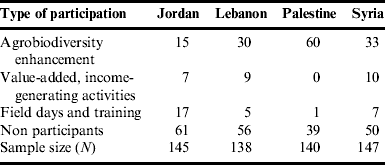
The survey sample included 570 households: 276 that had participated in the project and 294 that had not. Given the homogeneity among the target areas, a random sampling approach was used. According to CollinsonReference Collinson 16 , 50–60 farmers was a sufficient sample size, and hence, the sample size in this study included about 70 households randomly selected in each target area, about 40–60% of them had participated in the project activities, and the remainder had not. Table 2 shows the sample size in each country and sample farms’ classification by type of participation in the project.
Classification of sample farms by type of participation in the four countries (% of households).

A sustainable livelihood framework was used to characterize households in the study areas. Livelihood strategies, agrobiodiversity use and incomes were compared within and across all countries studied, among poor and better-off households, by using a principal components analysis to create a wealth index that accounted for five types of capital of a household: human, natural, financial, physical and social. The wealth index in this study utilized some household assets indexes such as cropland, rangeland, livestock, vehicles and houses, on- and off-farm incomes, access to credit, cooperatives and health care. Based on these variables, households were classified into four wealth groupings (quartiles), each corresponding to 25% of the range of values obtained for the wealth index. Impact assessment in terms of household income was calculated; and a factor related to equality had to be taken into account by calculating the Gini coefficient to assess equity in incomes within participating and non participating households in each country. The Gini coefficient is a number within 0–1, where 0 is perfect equality (i.e., everyone has the same income) and 1 is perfect inequality (i.e., one person has all the income, and everyone else has zero).
Results and Discussion
Assessment of status and threats for local agrobiodiversity
The predominant farming system depends mostly on environmental conditions, mainly topography and climate (Table 3). In the rangeland-dominated areas, i.e., Muwaqqar in Jordan, and Aarsal in Lebanon, livestock is the only activity for 77 and 53% of households, respectively. In these two sites, the remaining farmers mainly planted rainfed barley and had olive trees under irrigation in Muwaqqar; and correspondingly vetch and cherries in Aarsal. In the mountains of Ajloun in Jordan and Al-Haffeh in Syria, 66 and 80% of farmers, respectively, grew mainly fruit trees and 20% practiced both cropping and livestock raising. In Al-Haffeh, no farmers had small ruminants; and in Ajloun farmers mainly raised goats in semi-intensified systems. In the remaining target areas, the farmers were split between crop-producing and crop–livestock producers and only 1–8% were exclusively herders. These results show the great diversity of farming systems, and the importance of livestock in drier and flatter areas and of fruit trees in mountainous areas. In Palestine, the lower number of herders might be due to restricted access to rangelands due to the prevailing political situation. The importance of crop–livestock systems is an important attribute of farming systems in arid and semi-arid areas and contributes to buffering of the effects of droughts, with the livestock playing an important role in providing cash to farmersReference Amri, Shideed, Mazid, Valkoun and Saxena 6 .
Predominant types of farming systems in target areas in the four countries (% of households).

The second indicator of local agrobiodiversity is shown by the number of crops used at the farm level. The range in average numbers of crops grown per farm was 2.25–4.84 (Table 4), showing that farmers in all agroclimatic zones tended to grow >2 crops. However, the highest numbers were in mountainous and high rainfall areas. In these latter systems, several crop species can be grown in the same field, as indicated by the crop diversity index. In Ajloun and Al-Haffeh, some farmers' fields had up to 15 crops, with mainly fruit trees in the top layer and field crops in the lower layer. Some farmers even planted medicinal plants and vegetables under fruit trees. Among the predominant fruit trees were olive, apple, grapes, cherries and figs in Ajloun, Sweida and Al-Haffeh; and among field crops were barley, wheat, lentil, chickpea and vetch. This diversity of crops contributes to the diversification of the diet of local communities, the feed calendar of livestock and the diversification of sources of income, and also allows for the spread of labor needs over the whole year.
Average number of fields and crops per farm and crop diversity index in target areas.

The third indicator of agrobiodiversity investigated was the number of landraces known or still in use by farmers. For fruit trees, large numbers of landraces were cited by farmers, including more than ten landraces of olives, 20 of grapes, 15 of figs, five of cherries, two of almonds, three of apples, three of apricots and four of plums. Improved varieties are mainly used in the cases of apples, cherries and apricots. For barley, lentil and chickpea, the commonly designated local landraces could include several populations.
Farmers have acknowledged the disappearance of some landraces of all crops and have attributed this to limited efforts to multiply their seeds within the existing informal seed production system and fruit tree nurseries. Marketing problems and storability could also have contributed to the decrease in importance of landraces. Another major threat to local agrobiodiversity is related to loss of local knowledge due to limited interest of young generations to invest and work in agriculture. However, the farmers appreciated landraces of most crops for their adaptation to low-input conditions and to major biotic and abiotic stresses. In addition, these landraces had good quality attributes that give the products of these landraces a price premium in the market.
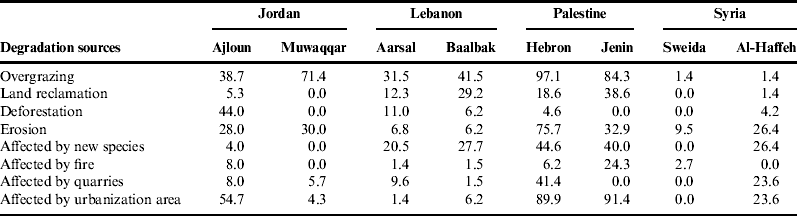
Farmers were asked if they had degradation on their farms, its sources and effects on agrobiodiversity (Table 5). The three major degradation factors mentioned were overgrazing, introduction of new species and land reclamation. The source of degradation varied between locations. In Jordan, overgrazing, deforestation and urbanization were the three main sources. Overgrazing and introduction of new species were the two main sources of degradation in Lebanon. In Palestine, the major threats to agrobiodiversity were overgrazing, soil erosion, introduction of new species and urbanization in both Hebron and Jenin; however, quarries and land reclamation were sources of degradation in Hebron and Jenin, respectively. In Syria, only in Al-Haffeh were erosion, introduction of new species and urbanization the main sources of degradation.
Sources of degradation of local agrobiodiversity (% of farmers).

Household assets and socio-economic characterization
Household characteristics are based on the main household assets, including natural, physical, financial, human and social capitals. Total holding area per household ranged from 0.9 ha at Al-Haffeh in Syria to 17.5 ha at Muwaqqar in Jordan. Most farmers in the target areas owned their agricultural land, except in Muwaqqar, where some farmers either rented land from landlords or had sharecropping arrangements. Common rangelands were available for the majority of households, except in Jordan, where this type of land was available for only 20% of households in the target areas. Drinking water is available for most households, except in Sweida where only 7% of households reported they had a drinking water source in the community, whereas the others have to bring drinking water from other villages or from the town of Sweida. Water resources for irrigation were very limited and the percentage of irrigated area in farms was low and insignificant for all target areas.
Average family size was 7–13 persons per household. Labor opportunities outside the target area ranged from 6% at Hebron in Palestine to 45% at Haffeh in Syria. Wage laborers were available when needed in all target areas, except in Muwaqqar, where shepherds were mainly needed. Although some household heads were illiterate, others held a university degree. Generally, the education level among households in the target areas was higher in Jordan and Palestine compared to Syria and Lebanon. Most farmers classified their livelihood levels as moderately well-off, except Ajloun in Jordan, where 44% of responders classified themselves as well-off.
Off-farm income was important in all target areas and represented 43–68% of total income. Average annual household income ranged from US$2200 to 9000 in the target areas, implying that daily per capita income was <US$1–5. Income per person per day was around US$2 in Jordan, Lebanon and Jenin (Palestine), but <US$2 in Syria and Hebron (Palestine). However, off-farm income is crucial for sustaining the livelihoods of local communities and allowing them to continue their contribution to the conservation and sustainable use of agrobiodiversity, mainly when the alternative sources of income are linked to valorization of local products. In areas where there is little opportunity for off-farm employment, incentive payment for environmental services is an optionReference Bond, Grieg-Gran, Wertz-Kanounnikoff, Hazlewood, Wunder and Angelsen 17 that needs to be pursued.
Agricultural cooperatives were available in the target areas but most farmers in the sample were not members, except in Sweida in Syria where about 85% of responders reported that they were members of a cooperative. Most farmers in the target areas owned their houses, but very few farmers owned a tractor, car or pick-up. Many farmers in the sample had livestock—sheep, goats or cows—but flock size varied among the target areas. Flocks were larger in dry compared to wetter areas. Schools, public clinics, electricity and telephones were available to most households in target areas. Most households had a separate kitchen in their house, and a satellite dish and TV. Houses had an average of five rooms.
Sources of household income
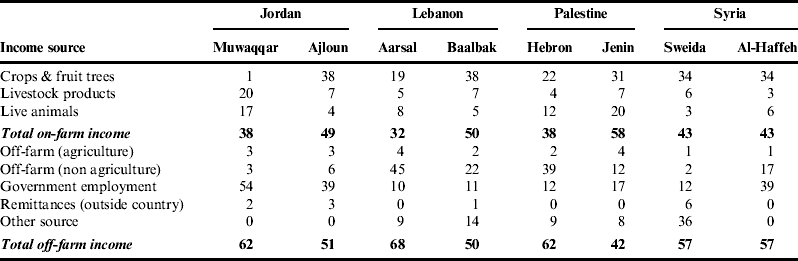
Household farmers in the target areas had many activities as part of their livelihoods. They had many income sources, and there was variation in the amount and contribution of income sources among the four countries. Income from on-farm activities including returns from crops and fruit trees, livestock products and live animals represented <50% total household income in the four countries. Income from government employment was important in Jordan (48%) and Syria (20%), whereas income from off-farm (non agriculture) was important in Lebanon (34%) and Palestine (26%). Livestock was the main source of on-farm income in Jordan, whereas plant production (crops and fruit trees) was the major source in Lebanon, Palestine and Syria.
Contribution of alternative income sources to total household income was diverse, according to target areas in each country (Table 6). In Jordan, income from government employment was significant in Muwaqqar followed by income from livestock; whereas at Ajloun, income from crops and fruit trees was important. In Lebanon, household income from off-farm activities outside agriculture was the main source in Aarsal; and income from crops and fruit trees was the major income source in Baalbak. However, there were many factors that influenced the contribution of alternative sources to total household income: e.g., farm resource availability, farmers’ education, skills and experience and opportunities for off-farm activities.
Contribution of alternative sources to total household income by target area (%).

The wealth index
The livelihood analyses in this study were focused on how income sources differed between households in the four countries and among the target areas; therefore, there was a need to use one indicator for comparisons. This indicator was the wealth index, which was based on the status of the households’ assets. The calculated wealth index was used to rank households of a community.
In the wealth ranking, variables were identified by the key factors of principal components analysis as important in distinguishing households from each other in each country. CavendishReference Cavendish 18 in household studies from Shindi Ward in Chivi area in Zimbabwe, and Campbel et al.Reference Campbel, Jeffrey, Kozanayi, Luckert, Mutambo and Zindi 19 in a study on household livelihoods in semi-arid regions, used wealth quartiles to explore patterns of income distribution. We undertook a similar analysis and calculated the wealth index as the most important factor to characterize household livelihoods and differentiate wealth levels.
Five main elements were hypothesized to represent household wealth situation. These elements included human, natural, financial, physical and social capitals as presented in the subsection ‘Household assets and socio-economic characterization’. Several variables were selected and used to represent each element.
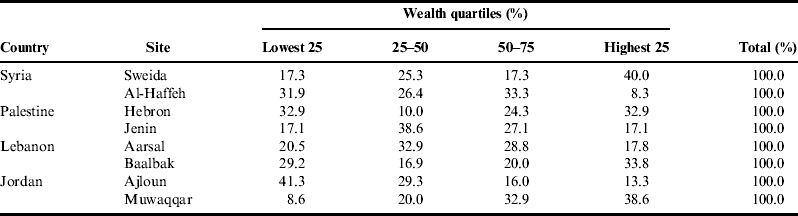
The wealth index was sorted into categories and classified households in the sample into four welfare quartiles. The distributions of households among the wealth quartiles were not the same in different target areas (Table 7). For example, most farmers in Sweida were in the highest wealth quartile; whereas, only 8% of farmers in Al-Haffeh were in the highest wealth quartile.
Wealth quartiles (% of households) in the target areas in the four countries.

Livelihood strategies
Sources of household income by wealth quartiles
Household income from all sources was calculated and summarized (Fig. 2). Income from all sources increased with increasing wealth quartile. Percentage of income from crop production and off-farm labor wages from agriculture were generally higher in the lowest 25% compared to other groups.
Income sources in the target areas by country and wealth quartiles.

Livelihood typologies
Livelihood strategies are diverseReference Ellis 20 and are influenced by linkages inside and outside agricultureReference Reardon, Delgado and Matlon 21 – Reference de Haan 23 , and life-cycle family characteristics such as age, education and number of family membersReference Kusterer 24 , Reference Valdivia 25 . The degree of diversification of the household portfolio is determined by these characteristics, and by the household's and individual's objectives, such as risk management practices, and/or strategies available to cope with shocks. In areas of greater risk, the household strategies are expected to be more diversified as a means to minimize possible shocks from negative climate events, especially when loss-management strategies are limitedReference Dunn, Kalaitzandonakes and Valdivia 26 .
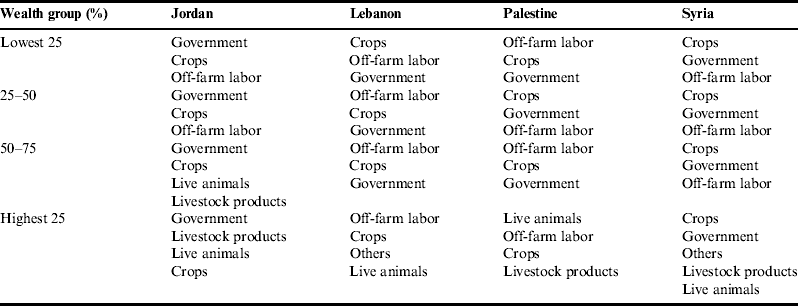
Overall, households in the study areas depended on many sources for their income (Table 8). The main sources for households in the lowest 25% quartiles in the four countries came from crop production, followed by off-farm labor and government employment. The highest welfare quartile was relatively more dependent on livestock products and selling of live animals, in addition to crop production, off-farm labor and government employment. However, the lowest quartiles were relatively more dependent on livestock compared to those in the highest quartiles.
Main sources of household income in the target areas in the four countries.

Impact on household income and livelihoods
Previous assessments of the project indicated very encouraging impacts, and helped in the setting-up of agrobiodiversity programs in research institutions in Jordan, Lebanon and Syria; and in the creation of agrobiodiversity units in the Ministry of Agriculture of the Palestinian Authority and in the Forestry Department in Jordan. There has been a shift toward the use of wild relatives of fruit trees in forestation efforts. In Syria, 500,000 seedlings of target landrace species were planted in 2003, compared to 30,000 in 1999. Awareness has increased at all levels regarding the need to conserve agrobiodiversity. This has facilitated collaboration with tourism and education ministries and with other projects and nongovernmental organizations. Sites rich in agrobiodiversity have been identified and designated so by governments, after approval by local communities. Many accessions of target species have been collected and placed in gene banks. Protocols for ecogeographic/botanic survey database management have been set up and a policy framework developed and shared.
However, the impact assessment also explored a wide variety of changes or trends caused by the project in terms of financial and livelihood impacts, and hence, the impact assessment differed from conventional project reviews in two ways. (1) It assessed impacts in terms of broad economic and livelihood change, not in terms of pre-defined project objectives and plans. This was because it sought to identify overall contribution to development, not to only assess accomplishment of planned activities for internal management purposes. Changes in livelihoods were adopted as a key measure of impact. (2) An assessment of commercial viability was an integral component, because the project interventions affected different household enterprises, and hence, viability determined sustainability. The commercial assessment was a complement to, rather than a component of, the analysis of local economic and livelihood impacts.
The impact assessments in this study explored changes and trends caused by the project for the households in the target areas, and analyzed these in terms of their financial and livelihood impact. Therefore, households who participated in the project were compared in terms of type of participation, wealth quartiles and income from agriculture, with those who did not participate in the project.
Increasing the average agricultural income is not necessary to have a positive effect on poor farmers, and other factors related to equity have to be taken into account. There are several ways to express the degree of income inequality in a society. As in many other studiesReference Charles-Coll 27 , the Gini coefficient is used in this study to measure income inequality. The main advantage of the Gini coefficient is that it is a measure of inequality of income—focusing more on the distribution and not on the central tendency as is the case with averages and medians, which can often be affected by the relative size of a few outliers.
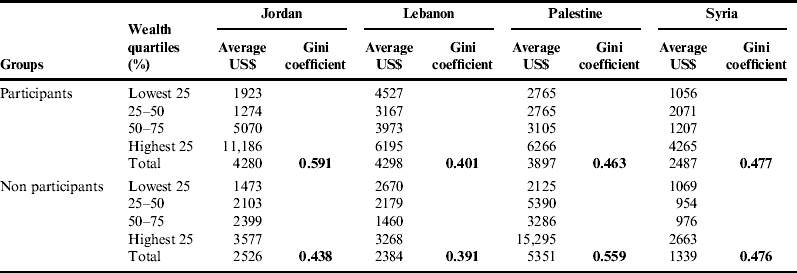
The analysis of income from agriculture indicated higher average household incomes for households that participated in the project compared to households that did not. The estimated Gini coefficients varied among participating and non participating households.
The comparison was done between participants and non participants within each group of the wealth quartiles, which were classified based on household assets by using sub-indexes including cropland area, rangeland area, owned livestock numbers, vehicle and house ownership, on- and off-farm activities, access to credit, cooperatives membership and health care. Statistical analysis indicated that there were no significant differences between the averages of these variables in each wealth quartile. Therefore, notable increase in annual household income (Table 9) can be attributed to a large extent to household participation in agrobiodiversity enhancement project, compared to non participating households, which reflects the impact of the project on rural livelihoods. The annual increase, on average, was estimated at US$1616 per household in the four countries; and the values of Gini coefficients, a measurement of income inequality emphasis on distribution rather than tendencies, were not significantly different, indicating that enhancing agrobiodiversity did not increase inequalities between poorer and better-off farmers.
Comparison between average household income from agriculture by participation in agrobiodiversity enhancement activities (US$/household).

Lessons Learned
Impact assessment is a critical element of the learning process in agricultural research and development. Impact studies may primarily be initiated to answer the question ‘what is the effect of research on the stated goals of the agricultural research program?’ Successful impact studies often involve collection of baseline information in order to capture the situation before program interventions are made. Collection of such baseline data makes it possible for a before–after type of analysis. In this project, the baseline survey was carried out in the year 2000, focusing more on the technical and biological aspects than the socio-economic information of the target population. Information related to agrobiodiversity conservation as well as farmer's perception toward the project using a solid and extensive monitoring plan throughout the project life cycle.
Activities that help raise farmers’ awareness on the importance of conserving dryland agrobiodiversity are essential. However, that alone cannot allow sustainability of the conservation actions. Hence, raising the awareness of all stakeholders is an important activity, to get, among other things, the support of government institutions in scaling up the project impacts, Any in situ conservation efforts will require tackling the livelihoods of the custodians of the remaining agrobiodiversity and development of enabling policies and legislations to empower local communities. The impact of this pilot project cannot be extended to more communities in the countries or outside without having a follow-up program to continue the momentum created by the project and the required support by governments within rural development programs or/and by various funds established worldwide for sharing the benefits generated from the use of genetic resources. Most farmers are keen to receive monetary incentives to contribute to conservation and sustainable use of agrobiodiversity of global importance; however, there are several other non monetary incentives that could allow intensive participation of men and women of the communities to the efforts of better management of agrobiodiversity.
The success of an agrobiodiversity conservation project not only depends on farmers’ skills and knowledge but to a large extent on the overall policy environment. Policy related to agrobiodiversity conservation is part of the larger agricultural and environmental policy framework. Therefore, the policy environment has to be taken into consideration when planning, implementing and evaluating agrobiodiversity projects. As a primary task in evaluation, it is necessary to judge whether the general policy environment is conducive or hampering the implementation of projects that aim at the conservation of genetic resources. Stakeholders’ involvements in planning and implementation of such projects, as well as support capacity building for national policy makers, are needed.
Since impacts are expected, it is important to follow up the project at farm level to speed up the spread of the outputs of the project and hence adoption. Many research for development projects produce research outputs, but additional actions are required to promote and disseminate the technologies or methods developed by the project.
This study also showed the importance of traditional farming systems in contributing to the on-farm conservation of dryland and mountainous agrobiodiversity. However, the sustainability of on-farm conservation of remaining agrobiodiversity will require research into low-cost technologies to improve crop and livestock productivities, the empowerment of local communities, in addition to diversification of incomes through value-adding technologies and alternative sources of incomes of the main custodians of local agrobiodiversity. This study has demonstrated that there are several technological, institutional, value-adding and alternative sources of income, which can contribute to on-farm conservation of agrobiodiversity of local and global importance.
Conclusion and Recommendations
The ways people make a living, and the constraints they face and opportunities they have, can strongly affect the status and management of their resources, including agrobiodiversity. Livelihood strategies in dry areas are dynamic, particularly due to uncertainty in agriculture driven by variation in rainfall intensity and distribution. Therefore, people engage in different livelihood activities and are always looking for additional income sources. Farmers in dry areas and the agrobiodiversity they hold face both environmental and socio-economic conditions that make the incidence of poverty relatively high.
The analysis indicated that farm resources, including water, land, livestock, agrobiodiversity, crops and knowledge, were essential resources and assets in generating livelihoods of families in the target areas. Although agriculture may not be the main source of household income, it is still a major component in dry areas. Access, control and management of these resources help shape which activities are pursued. When access is limited or opportunistic due to lack of institutions supporting this access by individuals, the ability to sustain the natural resource base and other human assets is endangered.
Data analysis also indicated that the average income from agriculture was higher for households that participated in the project than for those that did not. The estimated increase in annual household income attributed to household contribution in the project could also reflect impact of the project on rural livelihoods. The average estimated annual increase was US$1616 per household in the four countries, and ranged from US$1148 in Syria to US$1914 in Lebanon.
The results of this study highlighted the importance of agrobiodiversity conservation in improving the livelihoods of all segments of farming communities. However, to be effective, research should be based on the importance of targeted species for different farming groups. This study provides clear indications that the diversification of farming systems including livestock, field crops and fruit trees along with off-farm activities are essential for conservation and sustainable use of dryland agrobiodiversity.
Finally, to promote on-farm community-driven agrobiodiversity conservation and sustainable use for food and agriculture we recommend, at the community level, the following: (1) support on-farm conservation of agricultural biodiversity using incentives appropriate to the context; (2) support farmer-to-farmer seed exchange, including seed fairs and community seed banks, where it is effective; (3) enhance local-level seed production by providing technical backup and business advice; (4) promote integrated crop management; (5) commit to continuing natural resources research on agricultural biodiversity; (6) strengthen local community organizations to increase farmers’ voices on agricultural biodiversity issues; (7) promote income-generating activities that use agricultural biodiversity; (8) strengthen local-level capacity for agricultural biodiversity management and use, including tools such as ‘farmer field schools’; and (9) invest in developing local markets for biodiversity-friendly agricultural products.
The recommendations at the national level should cover: support to rural development in areas rich in agrobiodiversity, mainstreaming and better coordination of national genetic resources policies and programs, including wider stakeholder involvement in planning and implementation, and capacity building for national policy makers; and support the decentralization of agricultural research and extension services, including participatory plant breeding.
At the international level, equitable benefit sharing should target those farmers contributing to agrobiodiversity of global significance, including exchange of technologies, marketing of local products and joining efforts with national government to support rural development.
Acknowledgements
The authors thank national project managers Dr Mohamed Ajlouni (Jordan), Drs Raghed Assi and Wafa Khoury (Lebanon), Mr Younis Sbeih (Palestine) and Mr Ali Khnifes and Mr Adnan Saad (Syria) and national project socio-economic teams for facilitating the acquisition of data and the fieldwork related to promoting value-adding technologies and alternative sources of income.