Background
Since the early 1990s, the number of international nongovernmental organizations (INGOs) involved in the provision of Humanitarian Assistance (HA) has significantly grown. 1 Many of these INGOs in the last decade have strengthened and enlarged their capacity to deliver humanitarian aid, and the need to employ more professionals in the field of HA has increased tremendously.Reference Peter, Hein, Russ, Bertleff and Caspersz 2 Shortage of human resources in humanitarian health care is especially exacerbated in areas where humanitarian action is most needed - difficult contexts that often are remote and insecure - and the requirement of specific skill sets is not routinely gained during traditional medical training.Reference Mowafi, Nowak and Hein 3 In addition, unplanned staff turnover within INGOs is problematic and expensive, affecting not only learning and efficiency, but also the capacity of agencies to respond to new emergencies, or even sometimes just to continue existing programs.Reference Loquercio, Hammersley and Emmens 4
Standard training specific to humanitarian health work was developed to ensure that individuals hired for a given post would have the capacity to function at a commonly understood level of training, to increase the number and types of workers available for humanitarian work, and increasing the efficiency of human resources utilization in humanitarian projects and recognition that humanitarian work is a multi-disciplinary endeavor.Reference Asgary and Lawrence 5 Daily and colleagues, in a study on reviewing published disaster health competencies, emphasize the need for developing a framework and standardized terminology in the articulation of competency sets for disaster health professionals that can be accepted and adapted universally.Reference Daily, Padjen and Birnbaum 6
Several studies had been conducted to determine core competencies of health care professionals in the humanitarian field, specifically doctors and nurses,Reference Peter, Hein, Russ, Bertleff and Caspersz 2 , Reference Mowafi, Nowak and Hein 3 , Reference Daily, Padjen and Birnbaum 6 , Reference Ripoll Gallardo, Djalali and Foletti 7 but the role of pharmacists in the provision of health services during humanitarian interventions has not been explored in detail. Although, the World Health Organization (WHO; Geneva, Switzerland) demonstrates the integral place of pharmacist within all aspects of health care related interventions to assure the use of quality drugs, disease prevention, and health promotion and it recommends that pharmacists are adequately represented on the staff of international health agencies. 8
The participation of pharmacists in the provision of effective medication therapy management (MTM), by assuming functions related to health status assessment and needs, considering patient strengths and vulnerabilities are largely recognized. 9 - Reference Kokane and Avhad 11 In this sense, determining core comprehensive competencies of pharmacists as humanitarian workers could lead to course design on the capacity building of professional pharmacists acting in the humanitarian context, who would contribute to the quality of delivered health services during humanitarian interventions. Hence, the objective of this paper is to evidence the technical skills related to functions performed by pharmacists and the personal and managerial skills of pharmacists who worked in the humanitarian context.
Methods
Study Design
This study employed qualitative research methodology and is based on the experiences of humanitarian pharmacists who oversaw the pharmaceutical services, and of health professionals who coordinated humanitarian medical interventions in the field.
The study includes:
1. A literature review of the common, essential health services provided in humanitarian contexts was conducted. Competencies related to the technical and personal skills required for a pharmacist were described. This review laid the groundwork for the construction of the interview guides and further analysis of the data.
2. Semi-structured interviews were conducted. Combination of closed and open-ended questions were used to clarify the technical skills related to functions that pharmacists need while working in the humanitarian field versus skills required for the pharmacists working in non-humanitarian settings. The interviews were recorded using utility recording teleconferences (Call Recorder – SKYPE; Skype Technologies; Palo Alto, California USA), then were transcribed and analyzed using a content analysis methodology, and the main categories of professional technical skills related to the pharmacists’ functions in HA were defined.
The study was based upon the hypothesis that besides the skill sets specific to the organization of pharmaceutical services, pharmacists as any other professionals acting in HA would require exclusive skills and knowledge to work as a team member in complex humanitarian settings and to be able to adjust and adapt their professional skills to resource-poor settings.Reference Johnson, Idzerda and Baras 12
Interviews
Purposive sampling was used to recruit pharmacists and other health professionals who worked in the humanitarian field as expatriate pharmacists and medical coordinators, respectively. The initial recruitment was realized through the LinkedIn (LinkedIn Corp.; Sunnyvale, California USA) professional social network, and the snowball methodReference Bowling 13 was used for further sampling.
The inclusion criteria used for both professional categories were: (1) overall experience in the humanitarian field of more than two years; and (2) experience of at least two different humanitarian programs. There was no scientifically sound reason or requirement of the regulations to exclude any group or individual.
Medical coordinators are responsible for overall medical activities in different projects of the mission within the country, and pharmacists are functionally and technically accountable to medical coordinators. During the interview, it was expected that medical coordinators would provide responses based on their experiences of what the pharmacists’ role in humanitarian projects should be, what the most important functional technical skills for a pharmacist working in the humanitarian field are, and how to increase their competencies. It was expected that pharmacists may have somewhat different perspectives and may provide different prospectives related to the functional technical skills. Therefore, both pharmacists and medical coordinators were interviewed.
The interview guide (Appendix 1; available online only) contained closed questions related to the pharmacists’ functions in humanitarian aid, where responses were recorded by circling a pre-coded response category (Yes, No, NA [Not Applicable]), and if the reply was “No” or “NA,” the open verbatim response was expected. The second part of the interview contained open-ended questions related to the personal and management skills required for a pharmacist as a humanitarian aid professional.
Considering the interviewees’ responses and consulting the “Core Humanitarian Competencies Framework” (Consortium of British Humanitarian Agencies [CBHA; United Kingdom]) and “A Global Competency Framework for Services Provided by Pharmacy Workforce” (International Pharmaceutical Federation [FIP; The Hague, Netherlands]), the personal and management skills were analyzed and categorized under three domains related to humanitarian context, personal, and managerial behaviors.
The research proposal was reviewed and approved by the Ethics and Research Committee (CEP) of the Fluminense Federal University (Niterói, Brazil) by the number CAAE: 54366016.0.0000.5243. All participants signed the Terms of Consent and the presentation of results respects the protection of personal data of interviewed persons.
Results
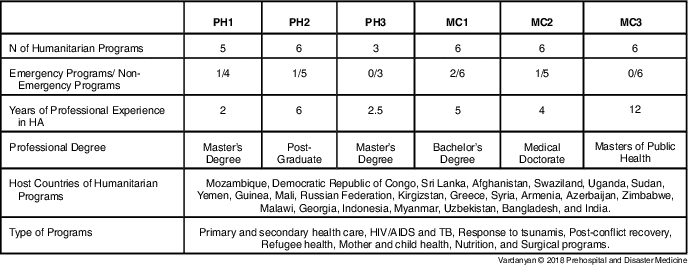
Interviewees’ professional data are presented in Table 1.
Professional Profiles of Interviewees

Abbreviations: HA, Humanitarian Assistance; MC, medical coordinator; PH, pharmacist.
The interviews were transcribed and the technical skills were grouped in to two categories: (1) Technical knowledge specific to administration and management of pharmaceutical services; and (2) Technical knowledge specific to essential health services.
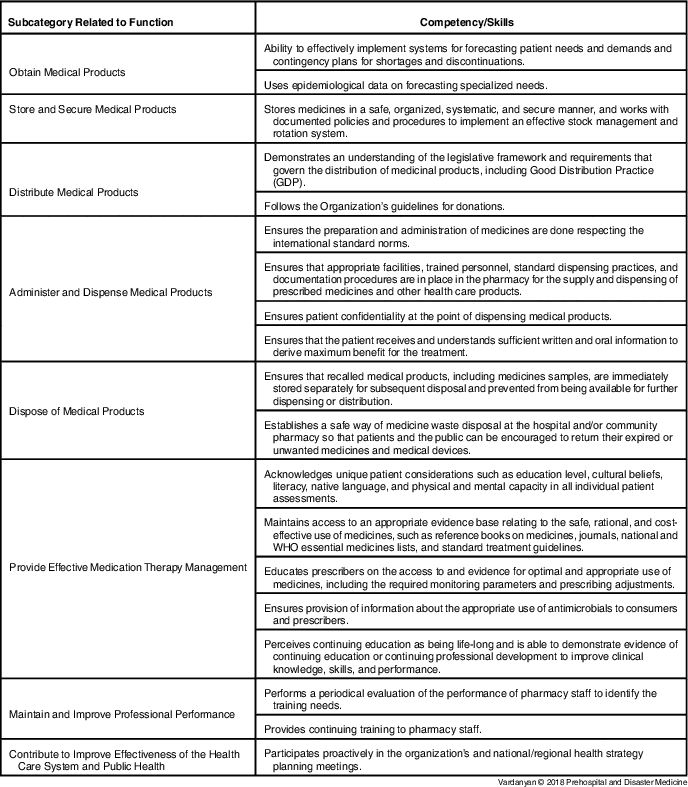
The major findings related to the category of competencies, related to the administration and management of pharmaceutical services in humanitarian interventions, are presented in the Table 2.
The Category of Technical Knowledge Specific to Administration and Management of Pharmaceutical Services

Abbreviation: WHO, World Health Organization.
The proper planning and forecasting technics were highlighted by interviewees as essential skills required for pharmacists to ensure uninterrupted supply of medicinal products to patients. On the other hand, the role of the pharmacist in ensuring safe preparation and administration of medicines was not an important part of the daily routine. This would be expected as the interviews also referred that this function was not very well-defined in the job description of pharmacists.
Although pharmacists ensure that appropriate trained personnel, standard dispensing practices, and documentation procedures are in place in the pharmacy for the supply and dispensing of prescribed medicines and other health care products, 14 the interviewees mentioned obstacles in assuring proper administration and dispensing of medicinal products: language barrier; and cultural specificities of the local populations, including of local staff.
Interviewees mentioned nutrition, vaccination, surgical programs, refugee health, and Human Immunodeficiency Virus (HIV)/acquired immunodeficiency syndrome (AIDS) and tuberculosis (TB) and cholera as the technical knowledge that they had to acquire for providing efficient pharmaceutical services in specific programs. Two interviewed pharmacists had a completely different level of knowledge on HIV/AIDS programs before deployment in humanitarian missions:
“I worked for 5 years in Brazil in HIV/AIDS and TB program. And when I went to the field it helped me a lot” (PH2; F).
“I had zero knowledge. Before going to the mission my organization send me to the HIV/AIDS program in Kenya for three weeks to get on the job training on HIV/AIDS and TB” (PH1; F).
The interviewees mentioned that the technical training, mentorship programs, and technical guidelines specific to each program were available within the organization and were of great support on gaining the knowledge required in performing the assignments efficiently.
The personal and management skills that interviewees considered most important, taking into consideration their experiences, were: working under pressure, cultural sensitivity, adaptability and flexibility, team work and leadership skills, analytical thinking, and initiative skills.
One pharmacist and one medical coordinator considered working under pressure an essential interpersonal skill for any humanitarian aid professional, as the working environment in the humanitarian field is stressful, complex, and often requires prompt actions:
“We have to be prepared to a sudden change in the program and able to quickly act on being prepared to assist sudden arrival of wounded patients” (PH1; F).
“Working under pressure is one of the essential skills for any humanitarian worker” (MC2; M).
“To be able to work with professionals coming from different countries can be quite challenging” (PH1; F).
“The way approaching local staff is very important” (PH2; F).
The population of humanitarian relief workers is multi-cultural and consists of professionals whose educational backgrounds vary from one country to another. The cultural sensitivity was an asset for building a strong professional relationship within the humanitarian organization and with other stakeholders.
Adaptability and flexibility were skills most referred by the interviewees:
“Living and working conditions in humanitarian settings can be very different from the conditions humanitarian worker is used to in his/her home country, therefore, the adaptability is important” (PH1; F).
“Sudden change of the program and activities due to emergency or security issues requires the professionals to be flexible” (MC2; M).
“One of the important personal skills is adaptability and flexibility, to be able to adapt to the local context” (MC3; M).
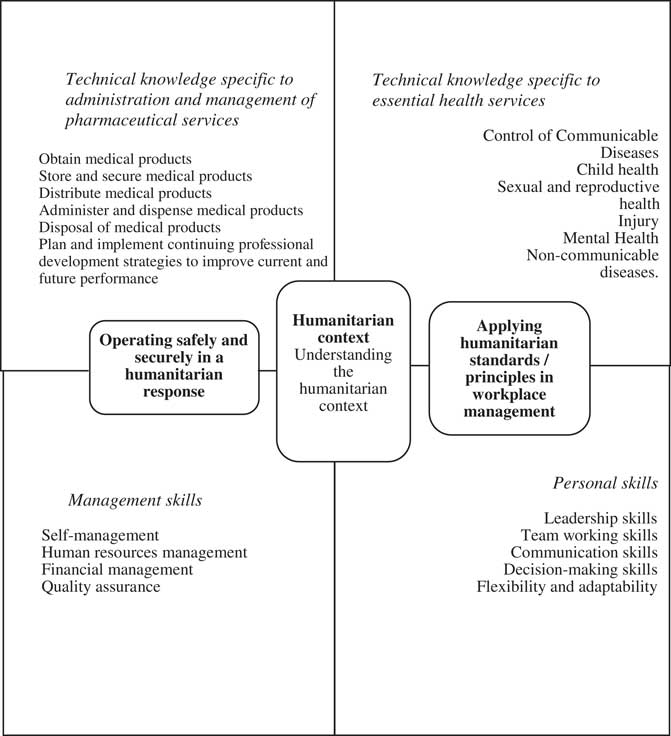
To summarize and provide an overview of the study, a framework of core competencies for pharmacists acting in HA was developed; this is presented in Figure 1. The framework presents core behaviors for pharmacists acting in humanitarian response and brings the personal and management skills highlighted by interviewees. In addition, specific knowledge on humanitarian context was considered a central component in the competencies of pharmacists working in HA.
Recommended Core Competency Framework for a Pharmacist Working in Humanitarian Assistance. Source: Interviews, Guidelines on Good Pharmacy Practice Joint International Pharmaceutical Federation/World Health Organization, 17 and Core Humanitarian Competencies Framework Consortium of British Humanitarian Agencies.Reference Terry 31

Discussion
This study is based on the experiences of interviewed professionals who oversaw medical programs in HA. Although only six professionals were interviewed, the study is based on interviewees’ experiences in 25 countries, with different geopolitical contexts, and in different emergency and non-emergency programs focused on: primary and secondary health care; HIV/AIDS and TB; response to tsunamis; post-conflict recovery; refugee health; mother and child health; nutrition; and surgical programs.
Expatriate pharmacists had minimum involvement in the procurement of medicinal products in the field. Most humanitarian interventions are performed in less-regulated countries, where the quality assurance of local regulatory authorities is weak and the quality of medicines available in the local market is unreliable. Approximately 50% of all reports of substandard and falsified medicines received by the WHO Global Alert System are from Sub-Saharan Africa, and 80% of these are for essential medicines like anti-malarial medicines and antibiotics. 14 In the countries where the importation of medicines is not restricted, many humanitarian organizations import medicinal products from Humanitarian Procurement Centers or the humanitarian organization’s supply centers located abroad, which are certified procurement centers. 15 , 16
The proper planning and forecasting techniques were highlighted by interviewees as essential skills required for pharmacist to ensure an uninterrupted supply of medicinal products to patients. Forecasting process for the emergency programs, especially during the acute phase, is simplified to the procurement of standard Emergency Health Kits, which contribute to the speed of response. 17 When the acute phase is over and basic health needs have been covered, specific needs for further supplies and equipment are assessed as soon as possible. One of the interviewed medical coordinators did not consider essential the pharmacist’s input during the acute phase of emergencies, as the Kits are ready to be used by medical professionals with sufficient amounts of medicinal products. Yet, employing a standardized drug management system and training the local clinical staff on the use of essential medicines are among the essential tasks during the emergency phase recommended by the Johns Hopkins University (Baltimore, Maryland USA) and International Federation of Red Cross and Red Crescent Societies (IFRC; Geneva, Switzerland), 18 and the input of the pharmacist should be considered in both the emergency phase and the post-emergency assessment and further planning activities. 18
According to interviewees, the role of the pharmacist in ensuring safe preparation and administration of medicines was not very well-defined in the job description of pharmacists. Many studies in the last 10 years concluded the important role of clinical pharmacists within the hospital multi-disciplinary committee to recognize, design, and implement tailored interventions for reduction of medication errors.Reference Elden and Ismail 19 - Reference Fortescue, Kaushal and Landrigan 22 Problems with medicine selection and dosages, improper administration of medicines, and lack of adherence by patients to prescribed treatment, medicine–medicine and medicine–food interactions, and adverse medicine events are the factors affecting risk-benefit ratios of medicines. Medicine-related problems have clinical as well as cost implications. It has been estimated that the cost of problems with the use of medicines is equal to or greater than the cost of the medicines themselves. 23
Recognizably, pharmacist must participate in the provision of effective MTM by assuming functions in all phases of the supply chain, but mainly assuring the rational use of medicines. 8 Nevertheless, the results of this study indicated an unbalanced relation between the managerial activities and the participation of pharmacists in the provision of effective medication therapy.
By taking direct responsibility for individual patient’s medicine-related needs, pharmacists can make a unique contribution to the outcome of drug therapy and to their patients’ quality of life. This approach has been given the name pharmaceutical care.Reference Wiedenmayer, Summers, Mackie, Gous, Everard and Tromp 24 The implementation and practice of pharmaceutical care must be supported and improved by measuring, assessing, and improving pharmacy practice activities, utilizing the conceptual framework of continuous quality improvement. Further specific investigations would require defining the benefits and limits in the participation of pharmacists in the effective MTM in resource-limited settings during HA. Among many other concerns, the investigation would need to consider diverse contexts of HA, availability of clinical pharmacists, and prioritize the most vulnerable groups, such as children.
The technical knowledge specific to each of the health services commonly provided and supported by the humanitarian organizations is essential for the efficient realization of all above mentioned tasks.Reference Brown, Guerin, Legros, Paquet, Pecoul and Moren 25 The population of humanitarian aid workers is multi-national and they come from all over the world; in the online survey conducted by Peter Walker and colleagues, more than 22% of respondents acting in humanitarian aid said that they were from Africa and Asia.Reference Walker and Russ 26 Thus, the technical knowledge specific to health services will vary. It will depend on the epidemiological profile and the disease burden of each country of residence of expatriate pharmacists. For example, the residents from high-income countries do not have much exposure to HIV/AIDS and TB-related health services or cholera, and they should gain that specific knowledge before deployment in humanitarian programs.
Pharmacist should perceive continuing education as being life-long and should be able to demonstrate evidence of continuing education or continuing professional development to improve clinical knowledge, skills, and performance. 15 As a contribution to the sustainability of the implemented health programs in humanitarian settings, pharmacist will provide training to the local pharmacy and health staff. An experienced expatriate pharmacist can contribute to the improvement of the pharmaceutical services by sharing the rich experience of humanitarian pharmacists with the local personnel.
The personal and managerial skills presented in the results could be the ones required for any humanitarian health worker to deal with a broad range of public health, medical, managerial, operational, social, cultural, political, and security issues. Some of these skills are described in the Core Humanitarian Competency Framework recommended by CBHA,Reference Rutter 27 some are included in the Global Competency Framework for Services Provided by Pharmacy Workforce recommended by FIP, 28 and some are common to both frameworks. Many skills recommended by FIP and CBHA, such as understanding of humanitarian context and application of humanitarian principles, were not mentioned by interviewees, but are not less important for pharmacists as humanitarian professionals.
The main principles – humanity, impartiality, neutrality, and independence – gained broad acceptance in the world of humanitarian actors and have become fundamental in any HA.Reference Leader 29 They are confronted with the reality of the political and operational contexts in which they are applied, and their relevance sometimes will be questionable due to outside events and developments.Reference Labbe´ and Daudin 30 Understanding the complexity of the HA, its phases, and the challenges of humanitarian organizations in applying these principles in a relevant manner in concrete operational settings is an essential requirement for any professional working in humanitarian settings. Thus, the professional will be able to apply organization principles in the workplace management, to make right decisions, and to understand the decisions made by their superior colleagues.
When the HA is performed in zones of armed conflicts, humanitarian aid workers are more exposed to insecurity, and they sometimes can be at an increased risk of becoming an object of attack themselves, if one or more parties to a conflict start perceiving humanitarian actors as instruments of political agenda.Reference Terry 31 Understanding the security context, risks, and threats and complying with safety and security protocols set by an organization will reduce vulnerability to self-security and security of colleagues.
Achieving results effectively, which reflects program quality, accountability, decision making, and impact described in the CBHA Core Humanitarian Competencies Framework,Reference Rutter 27 has commonality with the skills of “quality assurance,” which reflects quality of provided services, feed-back and audits, and professional development of human resources as management skills recommended by FIP. Interviewees did not point out those skills, but as the literature recommends,Reference Elden and Ismail 19 , Reference Rutter 27 , Reference Leader 29 they are important skills in the professional development of the pharmacist in the humanitarian context.
As highlighted in the results, adaptability and flexibility were skills that interviewees most mentioned; this could certainly contribute to developing and maintaining collaborative relationships, but will require good communication and team working skills, which are described and recommended by FIP as personal skills essential for pharmacists as professionals. 28 The leadership skills highlighted by interviewees are also described as important skills for any humanitarian worker in the Core Humanitarian Competencies FrameworkReference Rutter 27 and are recommended by FIP 28 as pharmacist personal skills.
Limitations
This technique was limited by the respondents’ willingness to provide profound information. The sample size of six was small but was considered sufficient for qualitative methodology.Reference Bowling 13 However, such sample size can potentially lead to a bias that is inherent for this methodology. Therefore, the results of this study were not limited to the responses of interviewees and the additional literature research was conducted to fulfill the objectives of this research.
Conclusions
The study method allowed to explore the experiences of humanitarian workers and identify the core competencies required for a pharmacist to work in the humanitarian field. The results disclose minimum participation of the humanitarian pharmacists in the management of effective medication therapy and highlights great efforts being dedicated to pharmaceutical product supply and management. Personal skills, working under pressure, adaptability, and flexibility were pointed out by interviewees as essential skills working in a humanitarian context. Self-management in a pressured and changing environment, the ability to adapt to changing situations, and planning, prioritizing, and performing tasks well under pressure are the behaviors required for pharmacists and for any other humanitarian health worker. A core competency framework for a pharmacist working in HA was provided. This framework can be used as a guide in designing a specialized competency-based training program to prepare pharmacists for the assignments in humanitarian programs. Also, it can guide an experienced HA pharmacist on their coaching activities for newly assigned pharmacists and human resources departments in constructing a comprehensive job description for pharmacists working in humanitarian organizations.
Supplementary Material
To view supplementary material for this article, please visit https://doi.org/10.1017/S1049023X18000304