


Introduction
According to Nolen-Hoeksema's (Reference Nolen-Hoeksema1987, Reference Nolen-Hoeksema1991) Response Styles Theory, rumination exacerbates low mood. Rumination refers to a perseverative cognitive process and it has been defined as ‘repetitively focusing on the fact that one is depressed; on one's symptoms of depression; and on the causes, meanings, and consequences of depressive symptoms’ (Nolen-Hoeksema, Reference Nolen-Hoeksema1991, p. 569).
Rumination predicts depression in cross-sectional and longitudinal studies (for a review, see Nolen-Hoeksema et al., Reference Nolen-Hoeksema, Wisco and Lyubomirsky2008). Women and girls are more likely to engage in rumination than males, and ruminative thinking appears to mediate the gender difference in depressive symptoms (e.g. Butler and Nolen-Hoeksema, Reference Butler and Nolen-Hoeksema1994; Rood et al., Reference Rood, Roelofs, Bogels, Nolen-Hoeksema and Schouten2009). Consequently, rumination may explain why females are twice as likely as men to experience depression (Nolen-Hoeksema, Reference Nolen-Hoeksema1987).
Rumination has also been identified in numerous other psychological disorders (Nolen-Hoeksema and Morrow, Reference Nolen-Hoeksema and Morrow1991; Kocovski et al., Reference Kocovski, Endler, Rector and Flett2005; Guastella and Moulds, Reference Guastella and Moulds2007). It has therefore been suggested that rumination is potentially an important transdiagnostic process (Harvey et al., Reference Harvey, Watkins, Mansell and Shafran2004).
Understanding the developmental origins of rumination has been highlighted as a critical area of research (Nolen-Hoeksema et al., Reference Nolen-Hoeksema, Wisco and Lyubomirsky2008). Nolen-Hoeksema (Reference Nolen-Hoeksema1991) hypothesized that parenting factors may play a role in the development of rumination. Firstly, she argued that children of depressed mothers tend to have difficulty regulating their own negative affect and she suggested that a tendency to ruminate may be transmitted via modelling (Nolen-Hoeksema, Reference Nolen-Hoeksema1991). She also suggested that critical and controlling parenting behaviours may mean children fail to develop active coping strategies which could lead them to use more passive styles of coping, such as rumination (Nolen-Hoeksema, Reference Nolen-Hoeksema1991). Additionally, Gaté et al. (Reference Gaté, Watkins, Simmons, Byrne, Schwartz and Whittle2013) have suggested an important role for parental positivity. They suggest that if active problem solving is not met with positive reinforcement from parents, such as praise, then these adaptive behaviours may be less likely to continue. Consequently, Gaté et al. (Reference Gaté, Watkins, Simmons, Byrne, Schwartz and Whittle2013) suggest that low levels of parental positivity may lead to passive modes of responding, including rumination. However, to date, these hypotheses have received little research attention.
If mothers are modelling ruminative coping styles to their children and their children are copying them, then we would expect there to be a significant positive correlation between mother and child rumination scores. Whilst there could be alternative explanations for a positive association between these variables, a lack of correlation would be hard to explain if there is a modelling process occurring, as hypothesized by Nolen-Hoeksema (Reference Nolen-Hoeksema1991). Two studies found no correlation in children aged 8–12 years (Gardner and Epkins, Reference Gardner and Epkins2012; Gibb et al., Reference Gibb, Grassia, Stone, Uhrlass and McGeary2012). However, Stroud and Fitts (Reference Stroud and Fitts2015) found a positive association with mothers and their older children (mean 12.4 years). If a positive association can be explained by parental modelling, then the possible development of rumination via parental modelling may be developmentally sensitive and emerge as young people enter adolescence, a key risk period for depression (Rood et al., Reference Rood, Roelofs, Bogels, Nolen-Hoeksema and Schouten2009).
Other parental behaviours have been shown to correlate with rumination. For example, parental control is correlated with adolescent rumination (e.g. Spasojevic and Alloy, Reference Spasojevic and Alloy2002; Manfredi et al., Reference Manfredi, Caselli, Rovetto, Rebecchi, Ruggiero, Sassaroli and Spada2011; Hilt et al., Reference Hilt, Armstrong and Essex2012; Vatanasin et al., Reference Vatanasin, Thapinta, Thompson and Thunjaroenkul2012). Additionally, one study found that low maternal–adolescent relationship quality and high maternal encouragement of avoidance and denial responses to stressors was associated with adolescent rumination (Stroud and Fitts, Reference Stroud and Fitts2015). However, all of these studies have used self-report measures of parenting which are subject to bias.
In a prospective longitudinal study of 163 adolescents and their mothers, Gaté et al. (Reference Gaté, Watkins, Simmons, Byrne, Schwartz and Whittle2013) found that low levels of observed positive maternal behaviour predicted an increase in rumination scores over time for girls but not boys, and that this increase in rumination mediated the relationship between maternal positivity and depressive symptoms in daughters. Gaté et al. (Reference Gaté, Watkins, Simmons, Byrne, Schwartz and Whittle2013) also explored the role of observed aggressive maternal behaviour, although there was no association with adolescent rumination. This was a broad measure and therefore this study was not able to isolate the specific impact of maternal critical comments on emerging adolescent rumination.
Given the results of Gaté et al. (Reference Gaté, Watkins, Simmons, Byrne, Schwartz and Whittle2013) and the observed differences in the prevalence of depression and rumination in males and females (e.g. Twenge and Nolen-Hoeksema, Reference Twenge and Nolen-Hoeksema2002; Jose and Brown, Reference Jose and Brown2008) it may be useful to explore the impact of parental behaviour towards male and female offspring separately. Additionally, research has revealed larger effect sizes for the relationship between same-sex parenting styles than opposite-sex parenting styles on depressive symptoms (Alloy et al., Reference Alloy, Abramson, Smith, Gibb and Neeren2006). Consequently, focusing on mother–daughter relationships might have the strongest clinical implications.
The aim of the current study was to explore the relationship between rumination in adolescent females and maternal rumination, criticism and positivity. If mothers are transmitting ruminative responses to daughters via modelling then we would expect rumination in mothers and their daughters to be positively correlated. Similarly, if maternal criticism is a risk factor for rumination in daughters and if maternal positivity is protective, these behaviours observed directly from mothers should be significantly associated with adolescent rumination. Additionally, as mother and daughter affect are likely to be related to both daughter rumination and parenting style (Lovejoy et al., Reference Lovejoy, Graczyk, O'Hare and Neuman2000; Nolen-Hoeksema et al., Reference Nolen-Hoeksema, Wisco and Lyubomirsky2008; Rood et al., Reference Rood, Roelofs, Bogels, Nolen-Hoeksema and Schouten2009), questionnaires ascertaining mother and daughter affect were used in order to see if any statistically significant findings remained after controlling for mother and daughter affect.
Method
Participants
Two hundred and two girls aged 16–18 years were recruited from high schools in the East and South East of England. Their mothers were also invited to take part. One hundred and fifty four dyads completed self-report questionnaire measures of rumination and affect. The majority of mothers (75.3%) and daughters (77.6%) were of white British ethnicity.
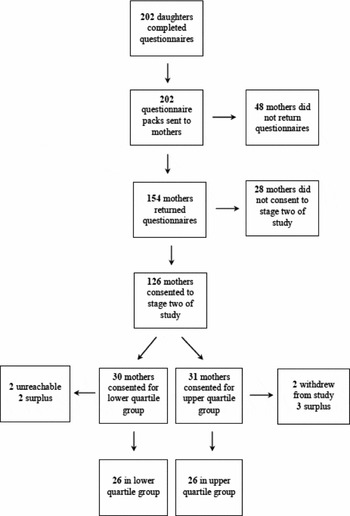
On the basis of the daughter's rumination score, an upper and lower quartile group were identified and their mothers were invited to complete the Five Minute Speech Sample (FMSS) by telephone. Thirty-one mothers of high ruminators and 30 mothers of low ruminators were eligible to participate, and 26 mothers in each group were recruited as indicated by power calculations (see Fig. 1 for recruitment flow chart).
Flow of participants through stages 1 and 2 of the study

Measures
Ruminative Responses Scale (Nolen-Hoeksema and Morrow, Reference Nolen-Hoeksema and Morrow1991)
The Ruminative Responses Scale (RRS) is a 22-item self-report measure of rumination. It has good internal reliability, with Cronbach's alpha (α) values ranging from .88 to .93 in adult (Luminet, Reference Luminet, Papageorgiou and Wells2004) and adolescent samples (Kercher and Rapee, Reference Kercher and Rapee2009). Scores on the RRS predict concurrent and prospective depressive symptoms in adults (e.g. Nolen-Hoeksema et al., Reference Nolen-Hoeksema, Wisco and Lyubomirsky2008) and adolescents (e.g. Kercher and Rapee, Reference Kercher and Rapee2009).
In response to criticisms about the content validity of the RSS (i.e. that some items may overlap with depression; e.g. Conway et al., Reference Conway, Csank, Holm and Blake2000), a two-factor scale from the RRS items has been developed: ‘brooding’ and ‘reflective pondering’ (Treynor et al., Reference Treynor, Gonzalez and Nolen-Hoeksema2003). Reflective pondering is a form of contemplation which shows only a weak relationship with depressive symptoms and does not mediate the gender difference in depression (Treynor et al., Reference Treynor, Gonzalez and Nolen-Hoeksema2003). The brooding subscale has good concurrent and predictive validity regarding its relationship with depressive symptoms and the subscale mediates the gender difference in depression (Treynor et al., Reference Treynor, Gonzalez and Nolen-Hoeksema2003). The five-item brooding subscale has acceptable internal validity in non-clinical adult (Cronbach's α = .77; Treynor et al., Reference Treynor, Gonzalez and Nolen-Hoeksema2003) and adolescent samples (Cronbach's α = .79; Cox et al., Reference Cox, Funasaki, Smith and Mezulis2012). The brooding subscale was used to assess rumination in this study.
Positive and Negative Affect Scale (Watson et al., Reference Watson, Clark and Tellegen1988)
The Positive and Negative Affect Schedule (PANAS) consists of two 10-item subscales, measuring positive affect (PA) and negative affect (NA). Participants are asked to rate how they have been feeling over ‘the last few weeks’. The PANAS has good internal reliability when used with adults (Crawford and Henry, Reference Crawford and Henry2004) and adolescents (Joiner et al., Reference Joiner, Catanzaro and Laurent1996; Melvin and Molloy, Reference Melvin and Molloy2000; Molloy et al., Reference Molloy, Pallant and Cantas2001). It also has good convergent and divergent validity with alternative measures of anxiety and depression in both adult (Crawford and Henry, Reference Crawford and Henry2004) and youth samples (Joiner et al., Reference Joiner, Catanzaro and Laurent1996).
The Five Minute Speech Sample (Magana et al., Reference Magana, Goldstien, Karno, Miklowitz, Jenkins and Falloon1986; Daley et al., Reference Daley, Sonuga-Barke and Thompson2003)
The Five Minute Speech Sample (FMSS; Magana et al., Reference Magana, Goldstien, Karno, Miklowitz, Jenkins and Falloon1986) originated within adult mental health to measure parental expressed emotion. Increasingly, the measure has been used in a wider range of contexts and research has demonstrated that a high frequency of critical comments and a low frequency of positive comments are related to child and adolescent psychopathology (McCarty and Weisz, Reference McCarty and Weisz2002; Vostanis et al., Reference Vostanis, Nicholls and Harrington1994; Wambolt et al., Reference Wambolt, O'Connor, Wambolt, Gavin and Klinnert2000). Daley et al. (Reference Daley, Sonuga-Barke and Thompson2003) adapted the coding system to be more developmentally appropriate for younger samples and some research has used individual subscales to assess specific components of parental behaviour. For example, one study utilizing the two frequency counts, critical and positive comments, found excellent inter-rater reliability when used with the mothers of non-clinical adolescents (r = .96, for positive comments, r = 1.0 for critical comments; Clark and Coker, Reference Clark and Coker2009). These two subscales were also employed in the current study.
During the FMSS, the parent is asked to comment on their thoughts and feelings about their child for five minutes without any interruptions or comments from the researcher. The FMSS was collected over the phone. Beck et al. (Reference Beck, Daley, Hastings and Stevenson2004) compared FMSS ratings administered by phone and face-to-face and found 100% agreement between ratings obtained via these two methods.
Procedure
The study was advertised to female students aged 16–18 years in four high schools via email, posters and through a short talk at lunchtime or during assembly. Participants completed questionnaires at school with the researcher present. They then took a questionnaire pack home to their mothers and completed packs were returned to the high school office. Mothers could indicate on their form whether or not they wished to participate in stage two of the study. This was a telephone call to administer the Five Minute Speech Sample. Seventy-six per cent of mothers (154/202) returned questionnaires and 126 consented to the telephone call (62% of n = 202; see Fig. 1). Analyses comparing mothers who did (n = 126) or did not (n = 28) consent to complete the telephone call revealed that non-consenters were more likely to be single (Fisher's exact test: p = .043) and to be from a non-white British background (χ2 1 = 8.71, p < .01), although there were no significant differences between these groups according to age (mean difference = 0.852, 95% CI –0.60 to 2.46) or educational level (mean difference = 0.326, 95% CI –1.23 to 1.96, all group comparisons two-tailed).
Consenting mothers of daughters scoring in the upper or lower quartile of the brooding subscale were selected. The total brooding scores of daughters in the lower quartile ranged from 6 to 9 and the total scores ranged from 14 to 20 in the upper quartile. Mothers of high and low ruminating daughters (top and bottom quartile) were invited to take part in the FMSS. Two participants from the low rumination group could not be contacted and two participants from the high rumination group no longer wanted to participate when contacted. This left 28 potential participants in the low rumination group and 29 in the high rumination group. Each participant was contacted in turn until a required sample size of 26 was reached for each group.
During the collection of the FMSS, mothers were asked to go into a room on their own where there would not be any distractions. The speech samples were recorded and transcribed and then rated for the frequency of critical and positive comments by the first author. Fifteen per cent of FMSSs were also blindly rated by an experienced FMSS coder. There was high agreement between the two sets of ratings (intraclass correlations ≥ .98).
Statistical approach
The distribution of the data was assessed visually using histograms, stem and leaf diagrams and Q–Q plots. Normality was explored by examining the significance of the skewness and kurtosis values and also the significance of the Shapiro–Wilk test. All tests employed considered significance at the p = .05 level. Data were transformed as appropriate. If the data did not display a normal distribution following transformation, then bootstrapping was used with the original untransformed data. Bootstrapping estimates the characteristics of the sampling distribution by using the sample data itself. It does not change the statistic in question (e.g. the mean difference) but it estimates how accurate it is (Wright et al., Reference Wright, London and Field2011). Statistical analyses were conducted using SPSS version 19, which supports bootstrapping procedures for a number of different tests. The default setting of 1000 bootstraps was used and bias corrected and accelerated confidence intervals were selected, as recommended by Field (Reference Field2013).
Results
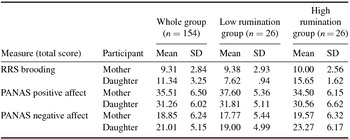
Descriptive data for brooding and affect scores for the 154 mother–daughter dyads and for the high and low rumination groups (n = 26 each) are shown in Table 1. For participants in this sample, the internal reliability of the brooding subscale (mothers’ Cronbach's α = .73, daughters’ Cronbach's α = .69) and the PANAS was acceptable (mothers’ Cronbach's α PA: .86, NA: .84; daughters’ Cronbach's α PA: .81, NA: .72).
Mother and daughter brooding and affect scores

RRS, ruminative responses scale; PANAS, positive and negative affect scale.
For daughters there was a significant, positive correlation between rumination and negative affect (r = .39, 95% CI .231 to .532, two-tailed) but no relationship between rumination and positive affect (r = –.08, 95% CI –.232 to .084). Daughter rumination was not correlated with mother negative affect (r = .07, 95% CI –.087 to .227) or mother positive affect (r = –.11, 95% CI –.271 to .038). There was also no correlation between mother and daughter rumination (r = .05, 95% CI –.115 to .200, two-tailed). This relationship remained non-significant when controlling for daughter negative affect (b = –.02, 95% CI –.19 to .15, p = .86, two-tailed).
Affect scores and maternal comments were examined within the sub-groups of low and high ruminator girls. For daughters there was a significant difference in negative affect between the high and low ruminator groups (t 50 = 2.78, p = 0.008, two-tailed) but no significant difference in their positive affect (t 50 = .76, p = 0.449, two-tailed; see Table 1). There was also no between-groups difference in negative affect for mothers (t 50 = 1.12, p = .270, two-tailed). There was a trend for mothers of low rumination daughters to report higher positive affect than the mothers of high rumination daughters (t 50 = 1.94, p = 0.059, two-tailed).
Maternal positivity and criticism were assessed by observation using the FMSS. Mean positive comments were 6.08 (SD = 3.15, 95% CI 4.76 to 7.32) for mothers of low rumination daughters and 3.38 (SD = 2.48, 95% CI 2.58 to 4.28) for mothers of high rumination daughters. A bootstrapped independent-samples t-test indicated that this was statistically significant (p = .002, 95% CI .78 to 4.16, two-tailed). Cohen's d revealed a large effect size (d = .95). To control for the potential impact of affect on maternal behaviour, maternal positive affect and daughter negative affect were controlled. This calculation was completed in R as bootstrapping is not well supported for ANOVA in SPSS version 19. There was still a significant group difference in positive comments when controlling for these two affect variables (β = 2.95, SE = .90, 95% CI –4.41 to –.84, two-tailed).
The frequency of critical comments in this sample was extremely low. One mother in the low rumination group made three critical comments about her daughter and the other 25 mothers in the group made no critical comments. In the high rumination group, five mothers made critical comments about their daughters, with three mothers making one critical comment and two mothers making two critical comments. Due to the low frequency of critical comments, each observation was dichotomized as either containing no critical comments or one or more critical comments. Fisher's exact test revealed a non-significant group difference (p = 0.19, two-tailed).
Discussion
This study investigated the relationship between adolescent rumination and maternal rumination, criticism and positivity using an observational measure of parental behaviour, the FMSS. Overall, the results showed that the mothers of low ruminating daughters were significantly more positive about their daughters and that this effect remained when controlling for mother and daughter affect variables. However, the relationship between maternal criticism and daughter rumination was difficult to explore due to a low frequency of critical comments in this sample. Rumination was not correlated in mothers and daughters, suggesting a lack of support for Nolen-Hoeksema's (Reference Nolen-Hoeksema1991) modelling hypothesis.
Adolescent girls are at particularly high risk of developing depression (Rood et al., Reference Rood, Roelofs, Bogels, Nolen-Hoeksema and Schouten2009). Depression during adolescence is difficult to treat and also increases the risk of lifelong mental distress and physical health problems (Bardone et al., Reference Bardone, Moffitt, Caspi, Dickson, Stanton and Silva1998; Birmaher et al., Reference Birmaher, Brent and Benson1998). It is therefore important to identify internal and environmental variables that may mediate this risk so that effective prevention and treatment programmes can be developed. These results suggest that rumination in adolescent girls, which itself is a predictor of depression onset (Nolen-Hoeksema et al., Reference Nolen-Hoeksema, Wisco and Lyubomirsky2008), is associated with the absence of positive maternal behaviours. These findings are consistent with Gaté et al. (Reference Gaté, Watkins, Simmons, Byrne, Schwartz and Whittle2013) who found that low maternal positivity predicted an increase in rumination in daughters between 12 and 15 years. Interestingly, they did not find a significant cross-sectional relationship between maternal positivity and rumination in females at any time point. They suggest that the impact of parenting on rumination may emerge over time and this may explain why a significant cross-sectional result was found in the present study with older girls (aged 16–18 years).
Gaté et al. (Reference Gaté, Watkins, Simmons, Byrne, Schwartz and Whittle2013) argue that low maternal positivity may mean that adaptive behaviours in their children, which could serve as alternatives to rumination, are not reinforced and therefore are less likely to continue. However, exactly why low maternal positivity is related to rumination in their children requires further investigation. It is also possible that low maternal positivity means that children develop low self-efficacy, which could leave them vulnerable to rumination. These mechanisms require further exploration.
Nolen-Hoeksema (Reference Nolen-Hoeksema1991) hypothesized that a tendency to ruminate may be transmitted via modelling. In the present study, there was no relationship between mother and daughter rumination, in line with the findings of Gibb et al. (Reference Gibb, Grassia, Stone, Uhrlass and McGeary2012) and Gardner and Epkins (Reference Gardner and Epkins2012) and in contrast to those of Stroud and Fitts (Reference Stroud and Fitts2015). Whilst a positive correlation between mother and daughter rumination could be explained by processes other than modelling, the finding of no correlation in this study is difficult to explain if rumination is at least partly transmitted via modelling. However, it could be that a different socialization process is occurring. Rose (Reference Rose2002) suggested that co-rumination may be an important factor in the development of emotional difficulties. Co-rumination is an interpersonal process which can be defined as ‘discussing the same problem repeatedly, mutual encouragement of discussing problems, speculating about problems, and focusing on negative feelings’ (Rose, Reference Rose2002, p. 1830). Exploring whether parental co-rumination is correlated with offspring rumination either cross-sectionally or prospectively could form a useful avenue for further investigation. Additionally, future research could investigate if parental modelling of positive coping skills is protective against the development of rumination during adolescence.
Nolen-Hoeksema (Reference Nolen-Hoeksema1991) also suggested that parental criticism may lead to rumination in offspring. The relationship between parental criticism and offspring rumination has not been explored previously. However, Gaté et al. (Reference Gaté, Watkins, Simmons, Byrne, Schwartz and Whittle2013) did investigate the role of aggressive parenting behaviours in the development of rumination and found no association. As with critical comments in the present study, Gaté et al. (Reference Gaté, Watkins, Simmons, Byrne, Schwartz and Whittle2013) also found a very low frequency of maternal aggressive behaviours in their sample. This may reflect the fact that both studies used non-clinical samples. This could be seen as a weakness of both studies. However, it may be more appropriate to use non-clinical samples when investigating the developmental origins of a psychological phenomenon. It is possible that a focus on the relationship between rumination and low positive interactions between mother and daughters, rather than a focus on negative parental behaviours, may be a more useful focus for future research and eventually in the development of prevention or treatment programmes.
The findings of this study add to the extant existing literature on the relationship between parental behaviours and rumination in their children. Other strengths of this study include the fact that it is one of the only studies to use an observational measure of parental behaviour, although this measure did not observe interactions between mothers and daughters directly. A significant limitation is that this study was correlational in nature and so it is not possible to infer causality. Therefore, it cannot be concluded that low maternal positivity causes the development of rumination in adolescent females. It could be that daughters who tend to ruminate elicit less praise from their parents. Additionally, analyses showed that of the mothers that completed the questionnaires, those that were single or from non-White British backgrounds were less likely to consent to the telephone call. Consequently, the results may not be as applicable to more socially and ethnically diverse samples.
Future research should use observational measures of parenting using prospective designs. Additionally, the role of fathers, siblings and peers could also be explored. Peer relationships may be especially influential as they become increasingly important at the stage in development when rumination is emerging (Furman and Buhrmester, Reference Furman and Buhrmester1992).
In summary, the results of this investigation indicate an association between low maternal positivity and higher rumination scores in adolescent daughters, even when controlling for mother and daughter affect. A lack of positive association between mother and daughter rumination undermines Nolen-Hoeksema's (Reference Nolen-Hoeksema1991) modelling hypothesis, although it may be worth investigating the role of co-rumination. Finally, the relationship between maternal criticism and daughter rumination could not be explored due to a low frequency of critical comments in this sample, similar to the findings of Gaté et al. (Reference Gaté, Watkins, Simmons, Byrne, Schwartz and Whittle2013). Future research should aim to use observational measures of parenting, prospective designs and explore the role of other significant relationships.
Acknowledgements
We would like to thanks the teachers, mothers and daughters that made this project possible.
Financial support: This work was supported by a small internal funding source at the academic institution. No external funding was applied for.
Conflicts of interest: The authors have no conflicts of interest with respect to this publication.
Ethical standards: The authors assert that all procedures contributing to this work comply with the ethical standards of the relevant national and institutional committees on human experimentation and with the Helsinki Declaration of 1975, and its most recent revision. Ethical approval was granted by the Research Ethics Committee at the University where the research was based.



Comments
No Comments have been published for this article.