On a May evening in 1884 an engineer for the Spanish Fort Railroad guided his train from the private pleasure resort of the same name on the shores of Lake Pontchartrain toward downtown New Orleans. As he approached Hagan Avenue, approximately halfway to his destination, he noticed an obstruction on the tracks. Engaging the brake, he managed to halt the train before a collision. As he exited the engine to clear the debris, he was confronted by fifteen dairy farmers, armed with shotguns and revolvers, who hurled “hot words” at him. He began clearing the tracks when one of the farmers, pistol raised, approached him. The two men grappled before the engineer managed to knock his assailant to the ground and retreat back to the train, taking off toward the city at speed.Footnote 1 The ambush was a response to an incident that occurred earlier that day in which a cow, being driven to pasture beyond Hagan Avenue, was struck and killed by one of the Spanish Fort trains. While it is unclear what, exactly, the dairymen hoped to achieve through the confrontation, it was not the first or last time that municipal leaders and private interests clashed with the unregulated agrarian practices that characterized life on the outskirts of the Crescent City.
This altercation is representative of a broader tension that existed between the modernizing New Orleans of the late nineteenth century and its undeveloped suburbs. While the New South movement in New Orleans did not prove to be the post-Civil War renaissance that it was in other southern cities, such as Atlanta, Georgia, particular segments of the city’s ruling class nonetheless embraced urbanization as a means of attracting much-needed northern capital and reversing the city’s financial decline.Footnote 2 The dairy farmers and their cattle, however, proved to be obstacles standing in the way of this initiative. With a near-monopoly on the low-lying swampland between the developed city and Lake Pontchartrain known as the “back of town,” they were a physical impediment to urban expansion.Footnote 3 Yet, the root of the conflict went much deeper than the mere presence of these agrarian residents. The dairy farmers were engaged in an economy premised not only upon personal autonomy within the marketplace, but control over resources and labor time made possible through cooperative production.Footnote 4 The civic elite, alternatively, sought to clear the area for residential development in order to fuel a speculative economy based on real estate values. In their commitment to this cooperative economy, residents of New Orleans’s outskirts developed a set of common-use agrarian practices that eschewed private property restrictions in favor of shared access to resources and, as a result, challenged the financial aspirations of the city’s modernizers.Footnote 5
This article examines the process of urbanization in late nineteenth-century New Orleans that was intended to reify private residential development as the proper use of open land and, in doing so, overcome one distinct obstacle, among many, that New South advocates faced as they attempted to modernize their cities in the decades after the Civil War. More specifically, it traces the efforts of one reform-minded mayor, Joseph A. Shakspeare, as he attempted to eliminate the commons over the course of his two nonconsecutive terms, first through updated municipal regulations and then, once these proved insufficient, by deploying a form of urban space capable of fundamentally transforming the character of the land: the large-scale public park. Historians have long noted that public parks were viewed as a panacea for the many ills arising from the nineteenth-century city (be they physical, social, or economic), yet little effort has been made to understand how such spaces functioned within the unique context of the postbellum South.Footnote 6 This article seeks to correct this gap in scholarship and, in doing so, shed new light on the ways in which urban space was manipulated in service of the New South project.
Shakspeare’s desire to enclose the commons stemmed from a larger movement that was taking place across the South in which various cities within the former Confederacy attempted to reinvigorate their economies and reintegrate themselves into the nation through a process of industrialization and urbanization fueled by northern capital. This “New South” movement, as its promoters dubbed it, required southern leaders to style their cities after northern models in order to signal progress along lines familiar to the investors they hoped to court.Footnote 7 Banishing livestock from the city streets was a major aspect of this process. As environmental historians such as Catherine McNeur, Michael Rawson, and Andrew Robichaud have demonstrated, urban reformers in Boston and New York worked to clear their respective cities of pigs and cows as much as half a century before Shakspeare embarked on his own cattle war. Driven by public health concerns, real estate interests, and fear of ethnic populations that commonly relied on personal livestock, wealthy urbanites in the Northeast successfully shaped city space according to a division between work and home generated by an increasingly industrial society.Footnote 8 Likewise, Frederick Brown shows that relatively young cities on the West Coast, such as Seattle, embraced the same process, though not until they experienced rapid growth in the early twentieth century.Footnote 9 Viewed in this context, Shakspeare can be understood as engaging in a national process of urban enclosure that took place over the long nineteenth century in order to signal New Orleans’s status as a metropolis of the New South.
Urban parks were supportive of the mayor’s efforts in several ways. Large swathes of naturalistic greenspace were considered staple features of the modern urban environment since New York City’s Central Park was opened 1859, making them clear indicators of metropolitan development.Footnote 10 They were also a proven means of boosting the value of surrounding real estate, stimulating the sort of speculative economy that Shakspeare and like-minded businessmen championed.Footnote 11 Most significantly, parks functioned as a tool of social control capable of conforming visitors to middle- and upper-class standards of behavior that projected metropolitan sophistication.Footnote 12 Recent scholarship has focused on advancing our understanding of parks with regard to this latter angle, revealing the central role that such spaces played in converting members of the public into urban subjects. Historians like McNeur, along with cultural geographers such as Alvaro Sevilla-Buitrago and Nate Gabriel, have shown that by enclosing public lands, eliminating the autonomous appropriation of natural resources, and associating “nature” with leisure rather than work in the public consciousness, parks shaped individuals into constituents governed by, and supportive of, capitalistic exchange.Footnote 13
Applying this critical understanding of urban parks to a southern context offers a new avenue for understanding the social machinations of the New South movement. As James Cobb rightly notes, southern proponents of northern-style modernity faced significant challenges when it came to winning the support of local populations. Not only were many white southerners skeptical of the idea of embracing the economic practices of their former foes, but some insisted that accepting urban living and industrial wage labor amounted to forsaking their antebellum culture.Footnote 14 An examination of southern parks during this transitional period reveals one way by which New South advocates attempted to navigate such challenges. By introducing members of the public to spaces that were structured and regulated according to the tenets of industrial capitalism, they conditioned their fellow southerners to be the urban subjects needed to carry the project of modernization forward.
This article argues that Mayor Shakspeare deployed parks in this way during his struggle to enclose the commons that bordered New Orleans. When municipal regulation proved insufficient to eliminate the practices of the dairy farmers, he pushed to improve two parks on the outskirts of the city in order to physically remove large swathes of the commons from use and reorient public perceptions of New Orleans’s suburban fringe, associating it with private residential development rather than collective agrarianism. As modernization efforts were carried out across the city in the 1890s the parks were continuously improved, thereby drawing the public’s attention to the condition of the commons that surrounded them while framing private development as its proper and inevitable fate. They also aided in eliminating the behavior associated with the commons by shaping members of the public into urban subjects. By forcing visitors to interact with a naturalistic environment according to middle-class conceptions of leisure, the parks made clear that the back of town’s proper function was to provide pleasure rather than subsistence. In these ways, the parks played a major role in removing the commons from New Orleans’s periphery and clearing the way for subsequent residential development.
Shakspeare’s First Term, 1880–1882
When Joseph A. Shakspeare, the forty-three-year-old owner of a local ironworks, won the mayoralty in 1880 he did so on a robust platform of municipal reform that promised to address the manifold problems facing New Orleans.Footnote 15 Prominent among these was the city’s persistent “cattle nuisance.” New Orleans’s dairy farmers had a long-standing practice of allowing their cows to pasture freely on the outskirts of the city, particularly in the Second and Sixth Districts. Gilbert Shaw, a Union soldier from Massachusetts stationed on the Bayou St. John during the Civil War, marveled at the peculiar habit in an 1863 letter home: “There are no fences here + every body [sic] lets his cattle go just where they want too [sic]. Each man puts his brand … on every cow. They let them run until they have a calf + then take them home + milk them about five months + let them run until they have another calf.”Footnote 16 City leaders stressed the need for legislation that prevented cattle from wandering into the city limits and damaging property soon after the war’s end. In 1866, several aldermen pointed to the destruction of drainage ditches in the Second District as evidence of their need to act. “In no other city,” they claimed, “were the cattle allowed to pasture inside of the city limits.”Footnote 17 Similarly, an 1870 editorial in the Times-Picayune urged the maximum fine be issued to a farmer caught driving his cattle through the streets of the Sixth District, explaining that “an example is needed … [because] complaint after complaint has been made [on the matter] without avail.”Footnote 18 Such complaints were commonplace in the postbellum period, but were voiced with increasing urgency as the city modernized in the final decades of the nineteenth century.
From the mid-1870s onward New Orleans expanded into the territory of the dairy farmers, particularly in the Sixth District where the American section of the city steadily pressed upriver along the levee.Footnote 19 As a result, there was increased tension between city leaders and the inhabitants of the semi-agrarian outskirts. Residents of both districts frequently petitioned the municipal authorities complaining about the damage done to their property by wandering cattle. Fences were uprooted, gardens were devoured, and sidewalks were destroyed.Footnote 20 The streetcars that ran along St. Charles Avenue, the main thoroughfare of the Sixth District, were often stalled by cows on the tracks. The “continual whistle of the engines” used to drive them away was, according to the Times-Picayune, “a screaming nuisance to all who hear [it].”Footnote 21 Significantly, the modest urban improvements that the city was able to fund were undone by the animals nearly as soon as they were completed. John Fitzpatrick, administrator of Public Works during Shakspeare’s first term, blamed the cows for the dire condition of the streets in the Second District beyond Claiborne Avenue in January of 1881. Upon inspecting his department’s work in the area, Fitzpatrick found the streets “in an impassable condition,” with some roads beyond Hagan Avenue containing holes “nearly three feet in depth and some eight feet in diameter.” The reason, he explained, was the constant passing of cows that pasture on the commons: “As they travel in one another’s footsteps their paths, after a rain, can be seen on the shell-roads, where the hoofs have cut through and these spots are the nuclei for deep holes, which are soon made by passing vehicles.”Footnote 22
In an effort to address the problem, Shakspeare pushed for stricter enforcement of existing laws that regulated the movement of livestock within the city limits. New Orleans already had a pound ordinance on the books that prohibited the movement of cattle across public roads, but its application in the past had been uneven and fraught with controversy. In 1874, for example, attempts by the city’s pound-catchers to confiscate cattle had resulted in violent clashes with their owners. Resistance on behalf of the dairy farmers grew to such an extent that those of the Sixth District organized the Dairymen’s Co-operative and Mutual Aid Society the same year in order to present a unified front against the city.Footnote 23 The organization had grown steadily by 1881 to include farmers in other districts. By 1889, there were said to be 1,000 registered members.Footnote 24 The group proved to be a major obstacle in the way of Shakspeare’s effort to address the cattle nuisance. In August of 1881, John F. Bremer, president of the society, sent a letter to the mayor contesting his administration’s interpretation of the existing pound ordinance. The pound-catchers had been impounding unattended cattle found anywhere within the city limits, but, as Bremer explained, “the sum and substance of the ordinance is to prevent cattle … from roving on the streets and banquettes, and certainly not from grazing on the open lots without impinging on the streets and banquettes.”Footnote 25 While the city had the authority to keep cows off of the streets and sidewalks, it had no power to prevent them from grazing on the commons. Existing legislation alone, Shakspeare now realized, would not be enough to rid New Orleans’s suburbs of free-range livestock.
At the same time that he was grappling with Bremer and his fellow dairy farmers, Shakspeare set about reorganizing the city’s defunct park administration. New Orleans had two large public parks prior to Shakspeare’s time in office—City Park to the north of the city and Audubon Park to the west—but their distance from the urban core coupled with a persistent lack of funding meant they remained entirely unimproved as of 1880.Footnote 26 Two ordinances were passed by the City Council in 1881, one in April and the other in July, which placed both properties under the control of private management boards.Footnote 27 As these acts removed the parks from the purview of the Police Administrator, they can be seen as fulfilling another one of Shakspeare’s reform promises of eliminating opportunities for political patronage. Given his determination to eliminate the cattle nuisance, however, they can be understood as a second prong of his campaign to fundamentally alter the character of the suburban territory. Located in the Second District and Sixth District, respectively, City Park and Audubon Park were not only far enough away from the city proper to be amidst the commons but were in the districts with the highest concentrations of dairy farmers. If they could be improved into parks properly so-called, New Orleans would have both two striking examples of modern urban infrastructure and incentive for private interests to develop what was, in Shakspeare’s opinion, idle real estate. In this way, the parks had the potential to profoundly influence public perception of the commons. Rather than remain characterized by agrarian uses, the parks would associate the outskirts of the city with suburban development and contemporary trends in middle-class leisure.
The local press did its part to reinforce this new conception of the suburbs during its coverage of park development during this period. Newspapers consistently framed the use of parkland as a commons as diametrically opposed to the ways in which parks functioned in other cities across the country, thereby delineating the “proper” use of urban space. “During the pleasant days of spring, summer and fall the great parks of New York, Philadelphia, Chicago and other cities are filled with people,” a writer for the Times-Democrat explained before juxtaposing such cases with the state of Audubon Park. “Now it is only a pasture ground for stray cattle. It ought to be enclosed at once, and laid out in accordance with some definite plan for its improvement.”Footnote 28 Another article raised a similar point in the spring of 1881:
Everybody knows how [the parks] have been converted into cattle pastures; how the lordly live-oaks … which in other cities would be regarded as of priceless value, have been chopped down … for fire-wood, and how the school children have actually been afraid to go a-Maying there lest the horned cattle should dispute their right to enjoy the grateful shade of the leafy monarchs of the field.Footnote 29
Such articles not only advocated for park improvement but were didactic insofar as they informed the public of the right and wrong uses of the city’s suburban fringe. One should look to the undeveloped outskirts for leisure rather than subsistence. The persistence of the commons, the local press insisted, both put New Orleans at odds with other American cities and deprived its residents of what was rightfully theirs.
Despite the aid of the local press, Shakspeare’s efforts to initiate park development were unsuccessful. The boards of both parks struggled to make significant progress due to a lack of available funding. Modest work such as the erection of fences and gates was carried out, but nothing close to the significant landscape design needed to transform the tracts into pleasure resorts was accomplished. Furthermore, what basic steps the park commissioners managed to take were met with active resistance from the dairy farmers. In July of 1881, for example, P. A. Peyroux, a member of the City Park board, reported to the mayor that overnight “1200 feet of the fence around the park had been pulled down by parties whose cattle had been put off the grounds.”Footnote 30 Their lack of progress caused both boards to cease their activities by the end of 1883. The City Park board was abolished in April 1882, only a year after its formation, following accusations that one of the commissioners had been leasing the grounds to individual dairy farmers.Footnote 31 The commissioners of Audubon Park disbanded in September of 1883 after the City Council agreed to lease the site to the private company overseeing the forthcoming World’s Industrial and Cotton Centennial Exposition.Footnote 32 As a result, Shakspeare failed to make any significant progress in his fight against the commons by the expiration of his term in November of 1882. Not only had his renewed enforcement of the pound ordinance crumbled in the face of opposition from the Dairymen’s Society, but his reorganization of park administration failed to produce the conceptual foils needed to bring public attention to the state of the suburbs. Despite his popularity Shakspeare declined to run for re-election in 1882, clearing the way for the Democratic Ring to regain control of the city.Footnote 33
Shakspeare’s Second Term, 1888–1892
The intervening six years of Ring control signaled a relapse of municipal politics into dysfunction and outright corruption, leading to a resurgent reform movement that returned Shakspeare to the mayor’s office in the election of 1888.Footnote 34 Bolstered by a new, extended four-year term, he resumed his push to raise New Orleans to contemporary urban standards. The commons once again came under scrutiny. In June of 1888, only a month after Shakspeare’s inauguration, the city police carried out a raid on Metairie Ridge, in the Second District near City Park, during which a large number of cattle were impounded. The dairy farmers successfully petitioned for the release of their cows, claiming that, as the animals had been under the watch of keepers, no law had been broken. Grudgingly conceding that “the pound ordinances were defective,” the mayor vowed to submit revised regulations to the City Council.Footnote 35 In the meantime, the local press once again rallied behind Shakspeare’s effort to eliminate the commons, sounding a now-familiar refrain about the impropriety of free-roaming cows:
The swamps back of New Orleans and the rear streets of the city are no fit place for grazing cattle. This is recognized the world over, and no city of 10,000 people or more, save this, offers its thoroughfares as free pasture. People living in the cow neighborhoods lead a miserable life on account of this almost criminal leniency to the dairymen, and nothing perhaps conduces more to prevent the building up of the rear precincts than these roaming cattle, which trample down gutters, ruin trees and banquettes, and convert the streets into a series of ruts and stagnant cow wallows [emphasis added].Footnote 36
While the press complaints about property damage were not new, its emphasis on residential development was. It was not only that wandering cattle damaged infrastructure; their presence was an active deterrent to the settlement and improvement of the back of town. The dairy farmers countered on the same terms. They escorted a contingent of city councilmen on a tour of the Second District and claimed that it was the frequent trading of property between wealthy landowners, not the practices of the dairy farmers, which had led to neglect. A journalist covering the event relayed their argument: “A good deal of property not owned by them has been sold and resold so often for taxes that it is hard to trace the real owner … The land would be overgrown with high weeds and a dwelling place for reptiles, a hiding place for unsavory characters and a general nuisance, were it not for the cattle grazing there.” Far from destroying the land, the dairy farmers contended, they had improved it: “Whatever other good roadways there are in the territory mentioned were made by the dairymen, who have also repaired bridges and made other improvements for their own benefit.”Footnote 37 In an effort to head off Shakspeare’s new pound ordinance, the farmers proposed a compromise. They would erect and maintain fences, at their own expense, on each side of Canal Street in order to keep cattle off of the road while allowing them to remain on the commons behind Hagan Avenue. They even offered to hire a gatekeeper to ensure that vehicles could move freely on the road. The idea was quickly shot down by the city attorney, who determined that “public roads and streets cannot be appropriated to private uses.”Footnote 38
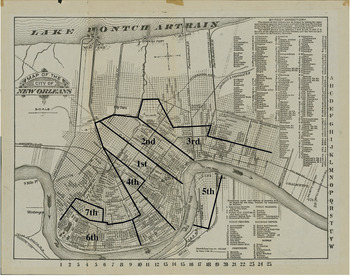
By August Shakspeare’s revised pound ordinance was drafted. It extended the pound limits deeper into the Second and Sixth Districts, so that the Hagan Avenue commons and the entire length of St. Charles Avenue leading to, and including, Audubon Park were now within its jurisdiction (see fig. 1). Furthermore, it broadened regulations by ensuring that any cattle “found running over banquettes, through ditches and on the streets, commons, or open lots, or trespassing on private property, whether … in charge of a driver or not [emphasis added]” were subject to seizure.Footnote 39
Map showing approximate boundaries of pound districts established in 1888. Adapted from F. F. Hansell & Bro., Map of the City of New Orleans, 1893, Louisiana Digital Library, https://louisianadigitallibrary.org/islandora/object/lsm-lhc%3A79.

Crucially, these revisions eliminated the loopholes that had allowed the dairy farmers’ practices to persist. The effect was to exclude livestock from all potentially habitable parts of the city, thereby freeing them up for residential development. The ordinance was soon followed by a revised dairy ordinance, which was intended to go beyond regulating the movement of cattle by directly addressing the industry that relied upon them. Under the new ordinance, it was deemed unlawful to establish or maintain a dairy within the Sixth District.Footnote 40 Significantly, this only applied to the Uptown area that included Audubon Park where there existed the greatest potential for land speculation. Indeed, supporters of the ordinance framed the law as a means of protecting real estate interests. Homeowners along the Sixth District’s major thoroughfares testified that cows damaged property and deterred renters and buyers. “The demand for property in that locality [is] good,” they insisted, “and the day the dairymen moved their dairies, that day their land [will] increase in values.” The dairy farmers condemned the move, claiming that the law was only for the benefit of the wealthy who had moved to the area long after the dairymen had improved it. “The milkmen had made the Sixth District,” one stated, “not the men residing in the great residences on the avenues.” The landowners scoffed at the idea. “The dairies [are] like the Indians of the Far West,” one responded, “they … have to give way to the march of progress.”Footnote 41
At the same time that Shakspeare was pressuring the dairy farmers through new legislation, he again attempted to revive the city’s park initiative. After a proposed tax to provide consistent funding to the park boards failed to pass a public vote, the mayor and his fellow park advocates turned to the private sector for assistance.Footnote 42 In January of 1890 J. Ward Gurley, prominent local lawyer and president of the Audubon Park Board of Commissioners, approached the New Orleans Board of Trade with a proposition. As a body which was deeply concerned with improving the appearance and economic standing of the city, Gurley explained, the Board of Trade should join the Audubon commissioners in establishing a formal organization for the purpose of raising funds for park improvements. This private association would charge $10 per member in annual dues while soliciting additional donations from public-spirited citizens. It would function as an auxiliary of the existing Board of Commissioners, giving that body complete control over how the money was allocated.Footnote 43 The Board of Trade enthusiastically agreed. By May the Audubon Park Improvement Association was formally organized with a membership of 350 of the city’s most prominent citizens, Mayor Shakspeare among them.Footnote 44
The group moved swiftly to grow its ranks and acquire contributions. In doing so, they made the improvement of Audubon Park undeniably the project of the city’s elite. One of its first actions was to distribute 250 subscription lists to “secretaries of the various commercial bodies and exchanges of the city” in order to add men of means to their ranks.Footnote 45 They also worked to raise awareness of their efforts amongst New Orleans’s influential citizens. The society columns of local newspapers began championing the association’s progress, encouraging readers to contribute; the Audubon Park Ladies’ Auxiliary Association staged an opera, the proceeds of which were transferred to the park fund; and experts were hired to give public lectures on the importance of public parks in cities across the United States and Europe.Footnote 46 Within a month the association’s membership had reached 500, guaranteeing the board at least $5,000 to begin improvements.Footnote 47
The success of the Audubon Park Improvement Association inspired prominent downtown residents to rally their own neighborhood constituency on behalf of City Park. Victor Anseman, a florist who had lived on Metairie Road since childhood, enlisted the help of Aristée L. Tissot, a former judge for the Second District Court and influential local Democrat who lived on the Bayou St. John, opposite the park, to replicate the Audubon model. With Tissot’s help, Anseman was able to assemble a group of commercial elite and politicians, most of whom resided in the mansions along Esplanade Avenue, to form the City Park Improvement Association in the summer of 1891.Footnote 48 The association quickly gained support of the city’s ruling class. Leading newspapers such as the Times-Democrat applauded the efforts of the “best known and most influential of the downtown residents” to reclaim the park from its neglected state, while the Louisiana Review framed their work as an absolute necessity: “New Orleans certainly needs parks … [but] it is almost impossible for people living on this side of Canal street to patronize Audubon Park, which is seven or eight miles distant.” Improving City Park, they insisted, would solve this problem.Footnote 49 J. Ward Gurley addressed a citizens’ meeting on the subject of City Park shortly after the group’s formation. He wanted to express the support of the Audubon managers in an effort to avoid the sectional tension that had sunk the Audubon Park Tax three years earlier: “Audubon Park [is] as much the property of the people below Canal street as it [is] those of the Sixth District,” he explained, “and vice versa, as regards City Park.”Footnote 50 The City Council, eager to rid itself of responsibility for the park, transferred control of the property to the association in August.Footnote 51
With stable sources of funding now secured for both parks, the respective managing bodies began converting the spaces into conceptual foils to the commons. The members of the City Park Improvement Association came face to face with the challenge when they inspected the park property shortly after the group’s formation. The Times-Picayune, covering the commissioners’ tour, described an array of subsistence activities taking place in the park that went far beyond the mere grazing of cattle:
During their rounds they noticed several milkmen cutting the grass and hauling the hay without authority, but claiming that the grounds where they were cutting were not fenced in. Others were hunting and many large boys were trapping birds, and on several trees were leaning common ladders evidently used for gathering moss. Several of the fine trees were found injured. In front were several parties picnicking under the splendid oaks, showing the usefulness of the park even in its present neglected condition. During the tour of inspection someone set fire to the grass in the northeast corner of the park … It was supposed that the fire originated from the burning waddings of a hunter’s gun.Footnote 52
The paper’s description illustrates the myriad ways in which low-income New Orleanians living on the city’s periphery relied on the resources of the commons, and how the commons encompassed what was, in name only, City Park. Tellingly, the author juxtaposed these activities with those of middle-class leisure, such as picnicking, which demonstrated the park’s potential “usefulness.” Such framing is significant, as it reinforced what Nate Gabriel describes as a “new knowledge of the city,” in which it is understood as a wholly capitalist space and the park (representative of nature more broadly) is reified as a non-economic one. Such designations aided in the production of urban subjects that would disseminate this conception throughout the rest of the city, thereby consolidating capitalism’s dominance over the urban environment.Footnote 53 The article in the Times-Picayune shows the beginnings of the same dynamic taking shape in New Orleans. By enclosing and improving the parks—by making them spaces of leisure rather than work—the civic elite could physically remove the commons and its associated activities from the city while convincing the public that the space’s inherent purpose was that of capitalistic consumption, specifically real estate development.
It was the task of both associations to reinforce this conception of the city by eliminating the agrarian behavior of the commons in each of their parks. This most obvious first step in this regard was to physically enclose the land. While Audubon Park inherited a fence built during the exposition, City Park was without any physical boundaries in 1891. One of the City Park Association’s first orders of business was to erect a 1,300-foot iron fence along the front of the park on Metairie Road and enclose the remaining sides with barbed wire.Footnote 54 By demarcating the limits of the park, the commissioners were able to restrict the movement of people and animals while exerting control over the natural resources that made the land such a fruitful commons. Each association also utilized explicit regulations to influence behavior within the parks. Shortly after their inspection of City Park, the commissioners proposed rules that prohibited the activities they had witnessed. The report of the executive committee presented at the association’s monthly meeting in September recommended that “the gathering of moss and shrubs, the shooting and trapping of birds and other practices of the sort be prohibited under the pain of a fine of $10.” They soon posted these rules on signs throughout the park.Footnote 55 Similar regulations were formally established for both parks in 1896 through an act of the state legislature and a corresponding municipal ordinance. These rules prohibited cutting or damaging any plants in either park, hunting or discharging firearms, disturbing or killing birds, fishing without a permit, and, of course, allowing animals to stray within the grounds. The penalty for violating any regulations was a fine of no more than $25 or thirty days in jail.Footnote 56
In addition to explicit regulation, the park managers fought the commons by ensuring that visitors associated the space with middle-class leisure rather than agrarian production. Initial steps were taken in this direction through grand festivals hosted on the grounds which were intended to both showcase the semi-improved parks and raise additional funding to continue the work. In April of 1891, the Audubon Park commissioners put on their first fête champêtre, or garden party. Thousands of citizens attended the event, during which they were treated to games, music, horse races, bicycle parades, and military drills. Rather than sparse fields occupied by grazing cattle, visitors entered the park through gates “decked out with flags and bunting” and looked over “shrubbery in … new and verdant covering,” refreshment stands and “booths … bedecked with flags,” and an elegantly decorated dancing pavilion.Footnote 57 The City Park commissioners followed suit, holding their own festival in the spring of 1892.Footnote 58 They became annual events, in addition to various May Day festivals and school picnics.Footnote 59 As structured events, these gatherings functioned as introductions to proper park usage. In addition to showcasing improvements and raising revenue, they attracted large segments of the public to the parks and forced them to interact with the spaces according to middle-class social norms, furthering the land’s association with leisure in the public consciousness.
The festivals also helped to foster a sense of communal investment in the parks. This was particularly true in the case of Audubon Park, the commissioners of which consistently emphasized the fact that the park belonged to every member of the public. J. Ward Gurley, for example, explained that it was the responsibility of every New Orleanian to maintain the park as residents of a modern city during his speech at the inaugural fête champêtre:
Every man, woman and child should learn to regard it as his and her right to use and enjoy, and his and her duty and obligation to protect and care for this property. You cannot afford to be indifferent about it. It has cost you too much. It is of too much importance to you in the future. As the city grows you will need it more and more—all of it. Its entire length and breadth, and even more.Footnote 60
While such rhetoric was necessary for an organization reliant on public contributions, it also provided every citizen with a personal stake in the park’s development. By referencing the financial investment already made and presenting the growth of New Orleans as inevitable, Gurley framed the space’s designation as a public park as a necessity. In doing so, he gave the public a reason to oppose the land’s return to a commons. The Ladies’ Auxiliary Association took this concept a step further during an 1891 Arbor Day event to which they invited “every benevolent, military, Masonic, Pythian and firemen association in New Orleans.” Each group was asked to plant a tree that would stand as “a lasting tribute to their patriotic pride and public spirit.”Footnote 61 The move gave physical form to the public’s vested interest in the park’s maintenance as such. By contributing trees to the beautification of the grounds, the various civic groups reaffirmed their claim to the property as members of an urban public. This claim was assured as long as the land remained enclosed.
From 1891 onward, both park commissions carried out piecemeal improvements to their respective grounds that assisted in the effort to alter public opinion of the suburbs. Walking paths and carriage roads were laid out, artificial water features were constructed, foliage was planted, and benches and refreshment stands were brought into the parks.Footnote 62 The ultimate purpose of such improvements was not simply to change the appearance of the grounds, but to alter the public’s perception of both parks and the neighborhoods that surrounded them. The manicured parks would aide in presenting the adjacent areas as prosperous suburban extensions of the city, rather than agrarian hinterlands standing in the way of urban expansion. As was the case with other large-scale urban parks of the nineteenth century, the designs catered specifically to middle- and upper-class leisure activities. The carriageways provided extensive drives for the wealthy to showcase their equipages, broad walking paths created space for promenading, and the lakes and lawns encouraged genteel sports.Footnote 63 The intent, however, went beyond simply serving the interests of the city’s wealthiest residents; upon exposure to such activities, it was thought, members of the working class would conform to “respectable” forms of public behavior. This is clear in the official rules adopted by both parks in 1896 which explicitly forbade “boisterous, indecent or vulgar language” as well as anything deemed to be a “nuisance to the public decency.”Footnote 64 The local press did its part to disseminate this new code of conduct as well. In 1891, the Times-Picayune detailed the journey of Mrs. Juley Robinson, a presumably fictionalized Black resident as she traveled to Audubon Park to “get something to eat for nothing”:
The Audubon park, as is too well known, is at present intersected by a choice variety of ditches … Along these ditches, almost any day, can be seen a motley collection of men, women and children, mostly black. The men generally are too old to do any more strenuous work, the women often are often too lazy, and here and there amongst them one can discern a manifestly thrifty individual … who comes crawfishing to save money … When the monotony of crawfish catching begins to pall on the not-easily-palled African temperament, Mrs. Robinson sets her bucket, in which she has thrown a handful of earth, so the fish can have something ‘to chaw on’ in the notch of a tree, while she sets to gathering pepper grass, or poke, or night shade, any and all of which are fine for greens.Footnote 65
By associating the use of the park as a commons with Mrs. Robinson, the article played upon racial animus to reinforce what was deemed the correct use of the land. Despite white dairy farmers being the most reliant upon the commons, such behavior was now portrayed as characteristic of Black New Orleanians who were “too lazy” to work for a living. By racializing the commons in such a way, the city’s elites could transcend class divisions to galvanize the white public in support of their vision of urban development.
The Results
In terms of transforming the commons into a residential neighborhood, Audubon Park proved to be more successful in the short term. This was due, in large part, to the fact that middle- and upper-class settlement had been trending in that direction since the Louisiana Purchase. As Anglo-American immigrants steadily arrived in and settled upstream from the city along the levee, the space between the urban core and what would become Audubon Park was increasingly characterized by ornate homes and modern infrastructure.Footnote 66 But the park itself aided this process in significant ways. In the mid-1890s a syndicate of northern capitalists selected a site on St. Charles Avenue, directly opposite the northern boundary of the park, for the gated community they intended to build. Modeled after the “beautiful [private] parks that do so much to make life pleasant in the North and West,” Audubon Place, as the development was named, catered to the city’s elite by offering exclusivity and modern amenities.Footnote 67 It proved so popular that the company expanded the development’s acreage in 1898. When asked how he and his partners settled on Audubon Place’s location, Samuel Bowman, one of the investors, pointed to the park. It made sense to him that “new and handsome homes [were] being built on the very threshold of the park,” for there was “not a finer place in the city, or for that matter in the south.”Footnote 68 Other elite institutions, such as Tulane University, gravitated toward the park as well. In 1893, the “Harvard of the South” was moved from its downtown location to land adjacent to Audubon Place.Footnote 69 The move was mutually beneficially to both establishments, as Audubon Place ensured “as desirable a class of neighbors as the college could itself regulate” while the university had “a tendency to bring in the cultured and conservative element” that the real estate developers hoped to entice.Footnote 70
Audubon Park’s ability to attract such development allowed the area to blossom into a sprawling suburb characterized by opulent homes, refined culture, and modern infrastructure as opposed to a commons populated by working-class farmers and free-roaming cattle. Guidebooks soon began directing tourists to the area. One, published in 1913, for example, described St. Charles Avenue as “the show street of New Orleans,” and encouraged visitors to take the street car journey down its length to see “the palaces of the sugar and lumber kings” which adorned either side.Footnote 71 Another described the park itself as a “spot of imposing beauty … in the upper part of the city … surrounded on three sides by the residential section of splendid mansions.”Footnote 72 As such publications show, Audubon Park became the cornerstone of residential development in the Sixth District. By providing access to leisure amenities and boosting real estate values, the park’s establishment accelerated Uptown-centric settlement trends. This increased pressure on the area’s agrarian residents and ensured the elimination of the commons by the turn of the century.
City Park was less successful in generating residential development in the Second District. Whereas the area surrounding Audubon Park was well on its way to becoming a residential enclave by the close of the century, City Park remained situated amidst the commons. Much of this had to do with the cultural and economic divide that existed between the older Creole Downtown and the newer American Uptown. The notoriously insular Creole community was reluctant to mix with the American newcomers and remained concentrated in the French Quarter, allowing the bulk of postwar investment to be focused upriver.Footnote 73 The Creole elite gradually erected mansions along Esplanade Avenue, the main downtown thoroughfare that led to City Park, but at nowhere near the rate with which homes were built along St. Charles. Most homes did not reach the vicinity of the park until the early 1900s through the 1920s.Footnote 74 The other major reason for the Second District’s lagging development was technological in nature. New Orleans simply lacked the ability to drain the backswamp to the extent necessary to make it suitable for large-scale habitation. Whereas Audubon Park’s position on the natural levee provided ample dry land on either side, City Park remained amidst low-lying lands until an improved drainage system was completed in the early twentieth century. The combined effects of both factors allowed the commons to remain in the area surrounding City Park. Pushed out of the Sixth District by the mid-1890s, the rural working class was relegated to the yet undrained backswamp that bordered City Park’s western edge. Evidence of their common-use practices in that locale can be found even after New Orleans transitioned into the twentieth century. In 1903, for example, the City Park Improvement Association wrote to Mayor Paul Capdevielle echoing complaints heard twenty years prior: “A large number of Cows are allowed to roam at large on City Park Avenue … [they] enter in the Park, causing great damage, and necessitating the employment of our employees almost daily to put them out.”Footnote 75 No such complaints were issued by the Audubon Park commissioners.
Despite the differing rates of progress, both Audubon Park and City Park played a central role in the efforts of Shakspeare and other city elites to eliminate the commons and initiate the process of private residential development beyond the urban core. The enclosure and improvement of each park allowed the New Orleans’s modernizers to juxtapose the common-use practices that characterized life in the back of town with their vision of suburbanization, condemning the former while promoting the latter. The real estate speculation that followed the increase in value of property adjacent to park land aided this initiative by framing suburban development as both proper and inevitable. Furthermore, the explicit regulation of park space had a social effect. By promoting behavior which corresponded with middle- and upper-class leisure, the parks helped to mold the public into urban subjects which viewed the natural qualities of the back of town as a source of pleasure rather than subsistence. In this way, they created a constituency within New Orleans’s population that was supportive of Shakspeare’s agenda of modernization. These effects combined to both physically remove the dairy farmers and landless poor from areas desired for real estate development and delegitimize the land-use practices that ran counter to the speculative economy on which such development was based. As a result, the path was clear for New Orleans to expand its territory as it entered the twentieth century.